Uplifting Farmers in Myanmar

By Chiu Chuan Peinn
Translated by Wu Hsiao-ting
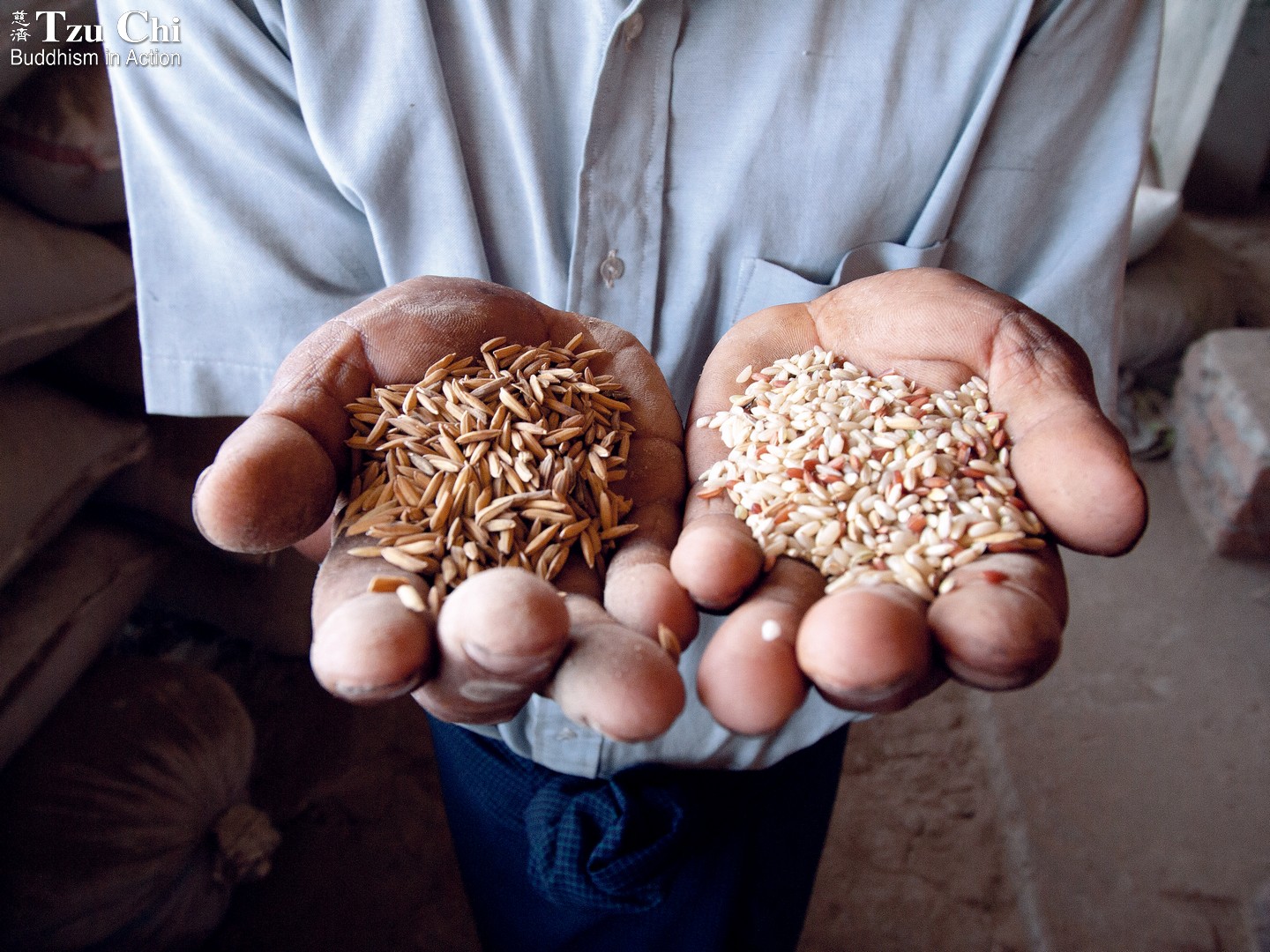
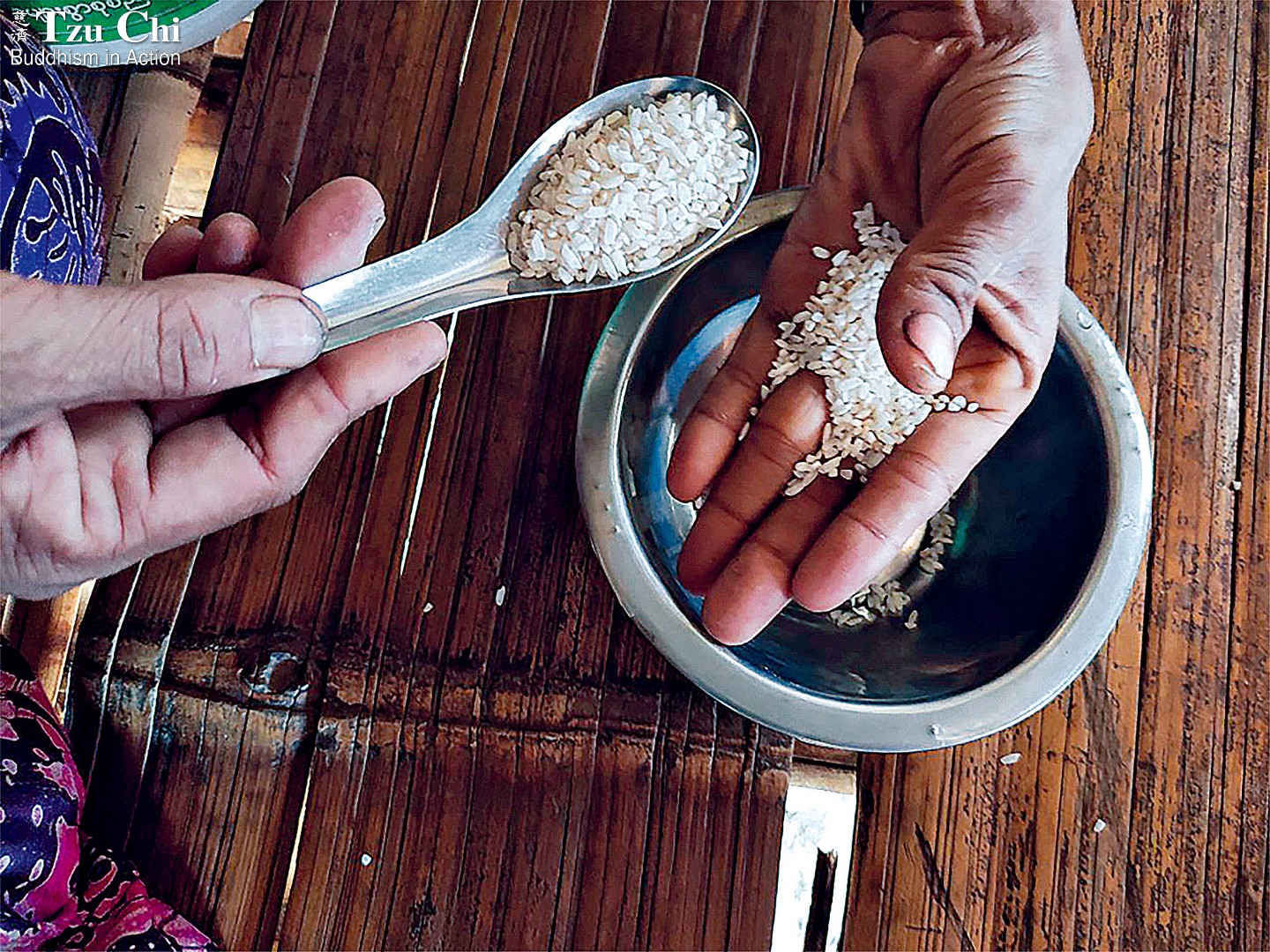
Harvested rice grains (left) become edible rice (right) after hulling and milling, each grain representing farmers’ hard work. Hsiao Yiu-hwa

When Daw Thida Khin visited Myanmar’s rural areas with Tzu Chi volunteers 16 years ago, she was struck by a troubling paradox: farmers could grow rice but couldn’t afford to eat it, instead having to borrow money to buy rice.

Once known as the world’s rice bowl, Myanmar suffered devastating losses in 2008 when Cyclone Nargis flooded the Irrawaddy Delta, the country’s main rice-growing region, with seawater. The entire harvest was wiped out. After the disaster, Daw Thida Khin, an ethnic Chinese woman born in northern Myanmar and the wife of a Taiwanese businessman, joined a team of Tzu Chi volunteers—mostly from Malaysia—to assess the damage in areas around Yangon City.

In northern Myanmar, she explained, farmers generally lived comfortably, whether living in wooden stilt houses or brick homes. Every household had a rice granary to store their harvest, using it gradually while waiting for better market prices. But when she arrived in Yangon, she was surprised to find that farmers’ houses were small and lacked granaries. She couldn’t help but ask, “Don’t you store any rice? What do you eat throughout the year?”

Flooding is common in some regions of Myanmar, leading to unstable harvests. When yields are poor, farmers must borrow money to buy seeds and fertilizers for the next season. While they usually borrow from government sources with lower interest rates, failure to repay forces some to turn to private lenders with higher rates.

As interest accumulates, many farmers become overwhelmed by debt, often having to surrender their harvest to creditors and take on extra work to survive. Some even use their land as collateral, eventually becoming tenant farmers.

“Local farmers told me that many were already in debt before Cyclone Nargis hit,” Daw Thida Khin recalled. “When they harvested, their crops went straight to paying off their debts. I saw many families whose rice containers were completely empty.”

When the land no longer belongs to the farmer, neither does the rice they grow. To eat rice, they must take on additional work to afford it.

Giving them what they need

After Cyclone Nargis, Myanmar experienced several other floods. In the immediate aftermath, Tzu Chi provided aid in the form of food, daily necessities, and school supplies. The foundation then shifted its focus to agricultural support, offering farmers rice seeds, fertilizers, and vegetable seeds for crop rotation to help restore soil nutrients. These efforts aimed not only to alleviate the post-disaster food crisis and increase farmers’ incomes but also to prevent them from leaving their farmland and hometowns in search of work.

U Thein Tun, a rice farmer living in Tha Nat Pin, Thanlyin Township, Yangon Region, had long been repaying debts with his harvest while working extra jobs to support his family. He rented an ox to plow four acres of land, allowing him to harvest ten barrels of rice per acre. Unfortunately, the cost of renting the ox was 20 barrels. During the rainy season, when farming was impossible, he had no choice but to borrow money to buy rice.

In 2010, he received rice and seeds from Tzu Chi and was inspired by the story shared by volunteers of Tzu Chi’s humble beginnings: how a small group of people saved a little money every day to help those in need. Moved by how small but regular contributions can accumulate to benefit many, he started setting aside a handful of rice each day for charity. Despite his poverty, he faithfully continued this practice, even when it meant he had little left for himself. Not only did he save rice in his own rice bank, but he also traveled to other villages to promote the practice, encouraging others to set aside a small portion of their rice each day to help those in need.

In August 2015, Myanmar experienced its worst flooding in 40 years due to continuous heavy rains and Cyclone Komen. More than 200,000 hectares of farmland were submerged. U San Thein, from the village of Shwe Na Gwin in Okkan Township, Yangon Region, was among the 21,000 households that received rice seeds from Tzu Chi in the aftermath. After learning how a handful of rice could help others, he began promoting the concept from household to household, even purchasing containers for others to store their rice. Thanks to his efforts, many villagers in Shwe Na Gwin joined the rice bank initiative. Even residents from neighboring villages began to participate.

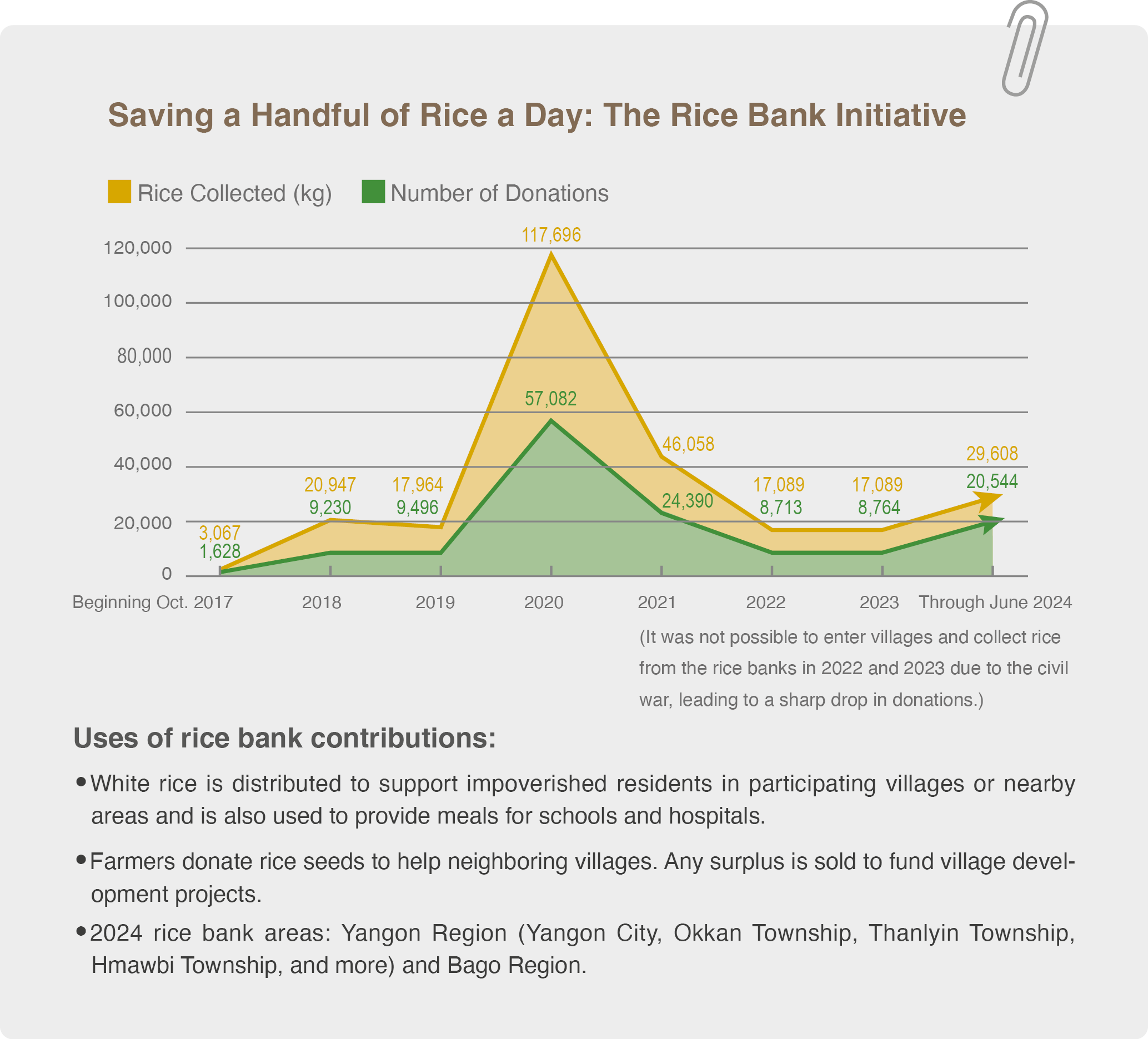
Today, over 200 villages in the Yangon and Bago Regions participate in the rice bank initiative. Families set aside a handful of rice before cooking, contributing without sacrificing their own food security. In 2020, the campaign collected over 117,000 kilograms (257,940 pounds) of rice. Although participation temporarily declined due to the COVID-19 pandemic and political instability, the initiative began to recover in 2024, with nearly 30,000 kilograms of rice donated in the first half of the year. Daw Thida Khin noted, “It’s heartening to see villages once inspired gradually rejoining the effort.”

Shwe Na Gwin, once the poorest village in Okkan Township, has undergone a remarkable transformation. Cement roads, a reinforced concrete bridge, and solar panels now mark the landscape. The new roads allow farmers to transport their crops directly to town, bypassing middlemen. Nearly 90 percent of families have paid off their debts, allowing farmers to regain control of their harvests. Another positive outcome is that 200 villagers now volunteer with Tzu Chi.

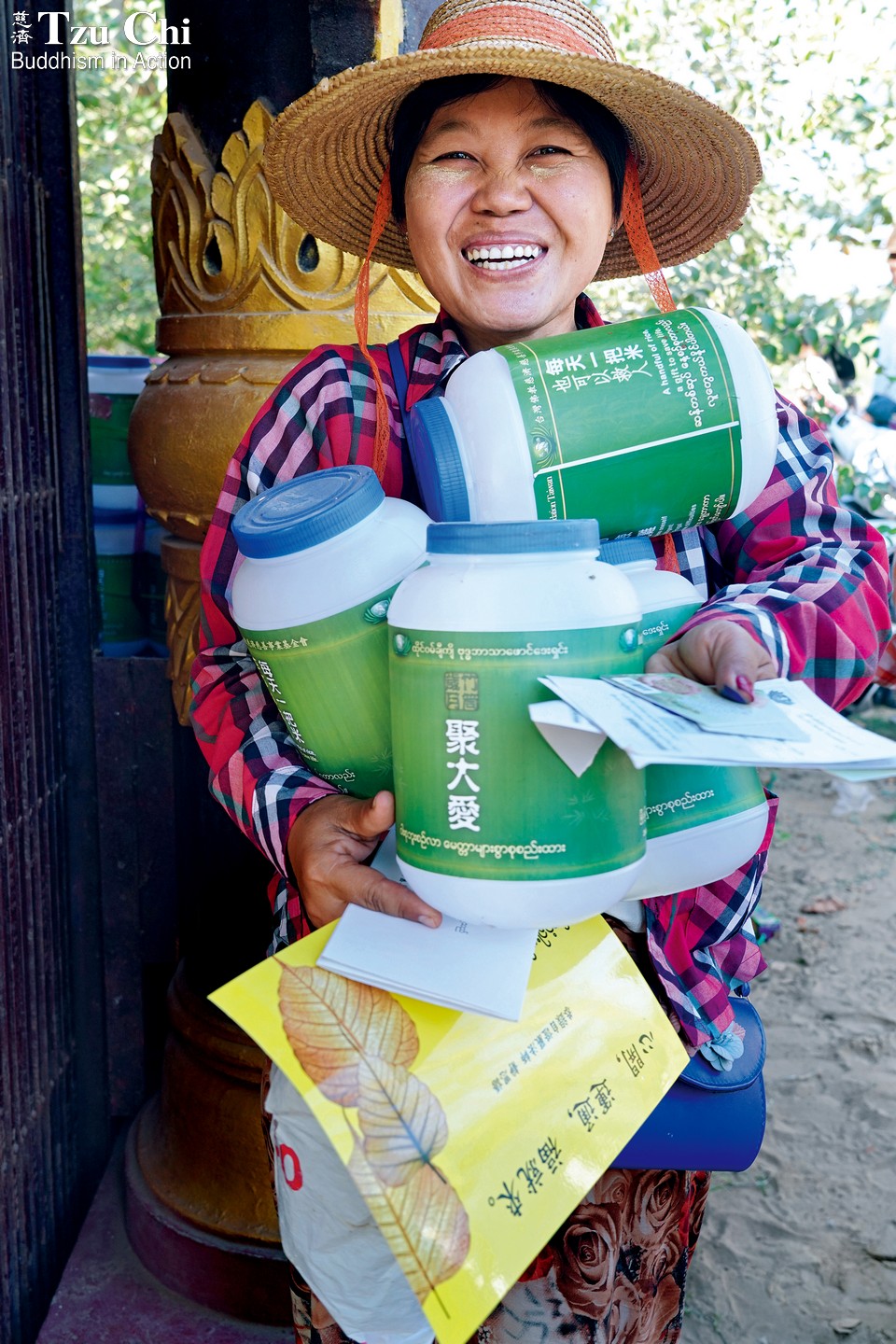
Villagers in Myanmar save a handful of rice from their home supplies each day, allowing them to fill a Tzu Chi rice bank with a capacity of 2.6 kilograms in about 20 days. In the photos, villagers happily receive empty rice banks from Tzu Chi, while volunteers regularly visit participating villages to collect donated rice to assist those in need. Photo 1 by Hsiao Yiu-hwa; photo 2 by Kyi Lee Lae Oo
Ongoing challenges

Myanmar has been embroiled in internal conflict for four years and has faced international economic sanctions. While the impact of the COVID-19 pandemic has largely subsided, inflation continues to affect livelihoods, with prices for daily essentials tripling. The supplies Tzu Chi distributes to disaster victims and other vulnerable groups—such as crop seeds and building materials—are all sourced locally, and their costs have inevitably risen due to inflation. For instance, last October, during the rainy season, the Bago Region experienced another severe flood, with floodwaters lingering for 14 days. The rising prices complicated Tzu Chi’s relief efforts, but volunteers pressed on, providing hot meals to survivors. They also launched an agricultural recovery plan, in which fertilizers were supplied to villages in Okkan participating in the rice bank initiative. Though the town of Okkan is outside the Bago Region, it was also affected.

Due to the internal conflict, many towns have been placed under lockdown. Villages under Tzu Chi’s long-term care have also been locked down, with some losing all contact. Have local farmers’ livelihoods thus been severely impacted? Volunteer Daw Thida Khin is pessimistic but still holds on to hope. “We’ve been waiting for our chance to go back in,” she said.

Shwe Na Gwin village was placed under lockdown, but fortunately, it was lifted after a few months. As the flow of resources into the village increased, its situation began to improve. Despite frequent natural disasters and the ongoing conflict, villagers continue to donate a handful of rice each day. Tzu Chi has partnered with the Ministry of Agriculture, Livestock, and Irrigation to improve agriculture in the area. The ministry teaches farming techniques, while Tzu Chi supplies plows and rice harvesters, which villagers can rent at half price. The funds raised from this system provide for road repairs or other development projects in the village. Farmers also donate rice seeds according to their ability to help neighboring villages. Any surplus seeds are sold, with the proceeds further contributing to development projects in the village.

In the past, rice collected from the villages participating in the rice bank initiative was transported to Yangon to support Tzu Chi care recipients. Today, however, the rice is used locally, first to support elderly individuals without family and then households facing financial hardship. By early July 2024, more than 2,200 instances of aid to households had been recorded.

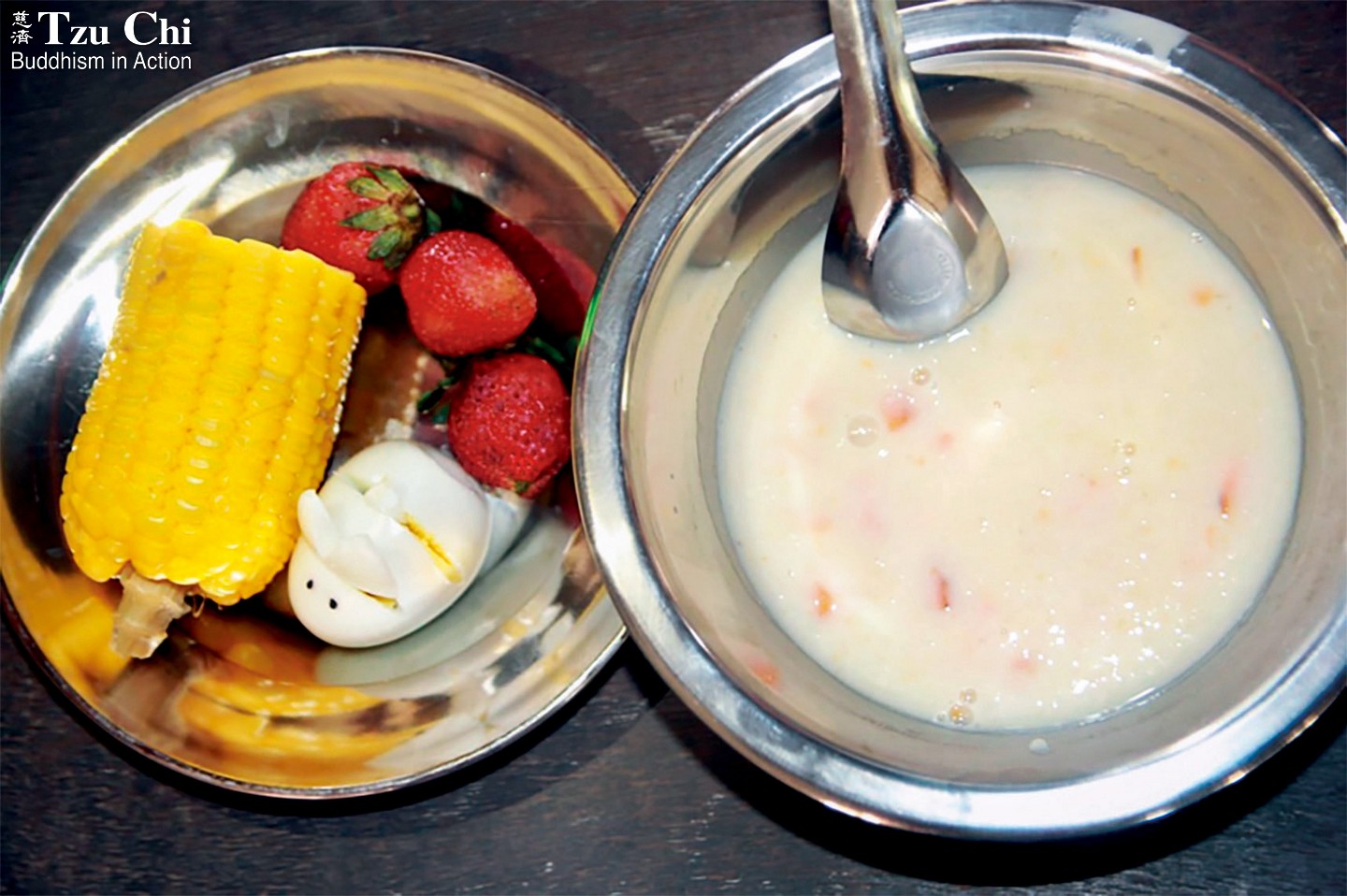
Volunteers also use rice from the rice banks to cook vegetable porridge for underprivileged patients at three hospitals. “The people of Myanmar have a tradition of donating money to hospitals out of goodwill,” said Daw Thida Khin. “We chose three institutions that receive fewer donations as our focus of aid. Generally, those who go to government hospitals are less well-off. The porridge Tzu Chi provides can help ease these patients’ burden.”

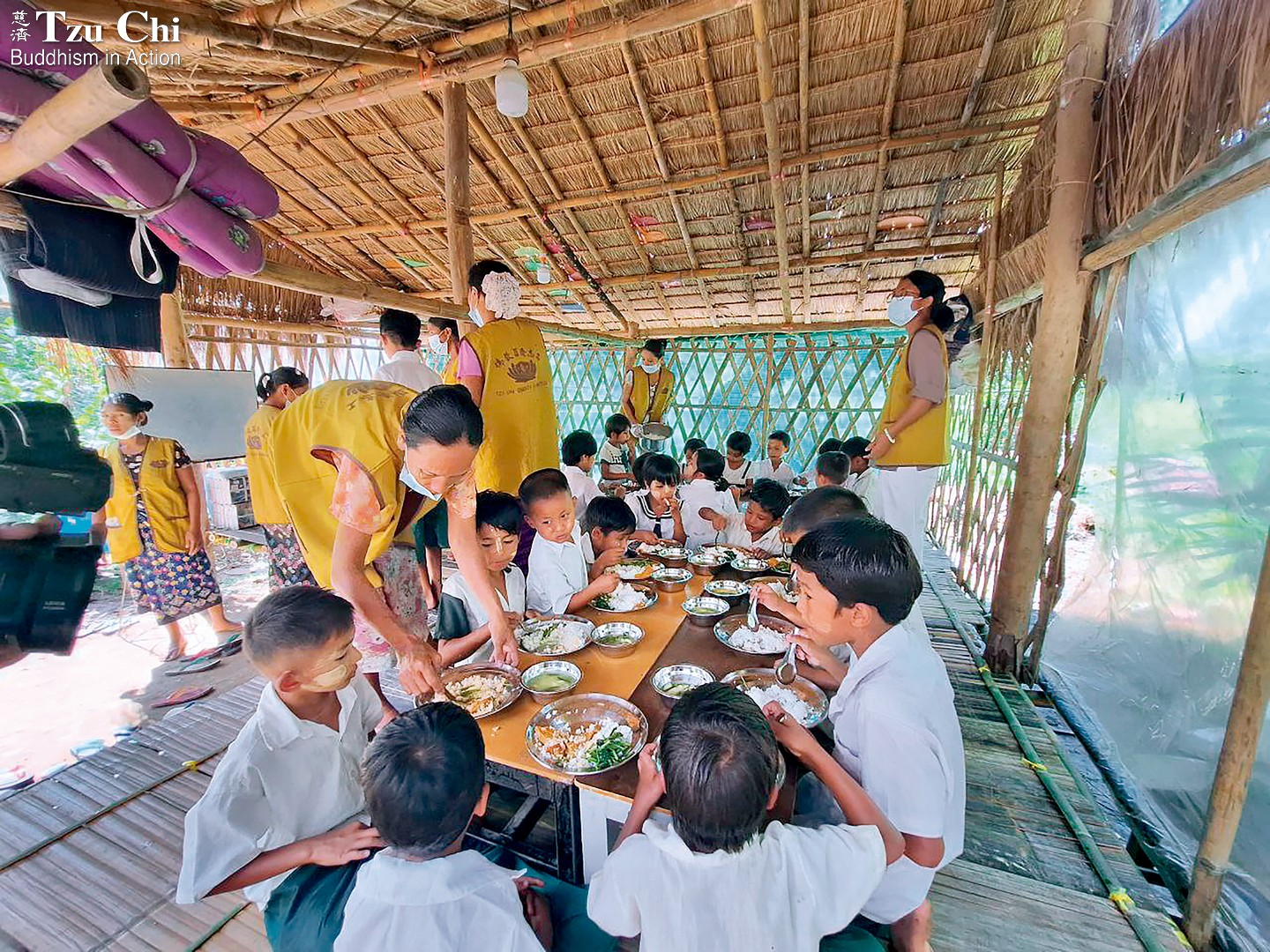
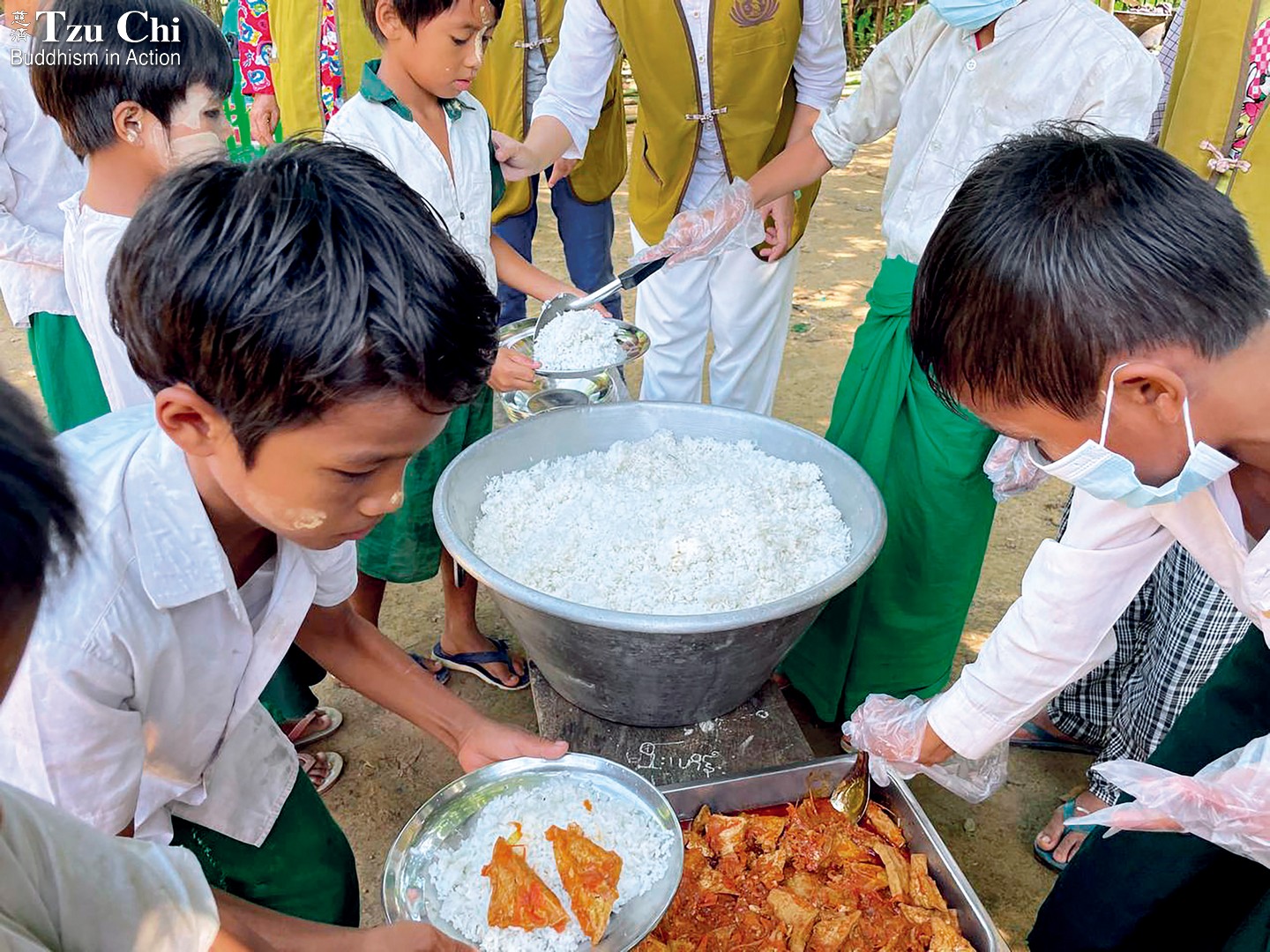
Volunteers also provide lunches to students at six schools in Shwe Na Gwin, Thae Pyar, Waw, and other locations. They design menus, share them with teachers, and employ village women in a work-relief program to cook. The meals use rice from rice banks and vegetables grown by local farmers, with any additional ingredients purchased as needed. Daw Thida Khin explained the reason behind the initiative: “The pandemic and political instability in recent years have led to rising unemployment, leaving many families with unstable incomes. As a result, many children could no longer bring lunch to school.” With school hours running from 9 a.m. to 3 or 4 p.m., these meals help children stave off hunger throughout the day.

“In some villages, safety concerns prevent volunteers from entering, so we ask teachers to help,” Daw Thida Khin added. “Our volunteers call to ask, ‘What dishes did you cook today?’ We must ensure the meals are nutritious.” From June 2023 to February 2024, more than 38,000 nutritious lunches were provided to students.

Agricultural yields have significantly increased in Myanmar’s villages thanks to improved rice seeds and farming techniques. However, abnormal weather and human factors continue to challenge food security. Tzu Chi has introduced the idea of helping others through small, continuous acts of kindness, planting seeds of goodwill in the hearts of local people and fostering a force capable of bringing positive change.

The civil war in Myanmar has affected families’ livelihoods, leaving many children unable to bring lunch to school. Tzu Chi provides meals for students at six schools, using rice from rice banks and vegetables donated by farmers, along with eggs, fruit, and other items, to ensure the children receive proper nutrition and have enough to eat. Photo 1 by Yi Mon Than; photos 2 and 3 by Saw Tho Han Saw

By Chiu Chuan Peinn
Translated by Wu Hsiao-ting

Harvested rice grains (left) become edible rice (right) after hulling and milling, each grain representing farmers’ hard work. Hsiao Yiu-hwa

When Daw Thida Khin visited Myanmar’s rural areas with Tzu Chi volunteers 16 years ago, she was struck by a troubling paradox: farmers could grow rice but couldn’t afford to eat it, instead having to borrow money to buy rice.

Once known as the world’s rice bowl, Myanmar suffered devastating losses in 2008 when Cyclone Nargis flooded the Irrawaddy Delta, the country’s main rice-growing region, with seawater. The entire harvest was wiped out. After the disaster, Daw Thida Khin, an ethnic Chinese woman born in northern Myanmar and the wife of a Taiwanese businessman, joined a team of Tzu Chi volunteers—mostly from Malaysia—to assess the damage in areas around Yangon City.

In northern Myanmar, she explained, farmers generally lived comfortably, whether living in wooden stilt houses or brick homes. Every household had a rice granary to store their harvest, using it gradually while waiting for better market prices. But when she arrived in Yangon, she was surprised to find that farmers’ houses were small and lacked granaries. She couldn’t help but ask, “Don’t you store any rice? What do you eat throughout the year?”

Flooding is common in some regions of Myanmar, leading to unstable harvests. When yields are poor, farmers must borrow money to buy seeds and fertilizers for the next season. While they usually borrow from government sources with lower interest rates, failure to repay forces some to turn to private lenders with higher rates.

As interest accumulates, many farmers become overwhelmed by debt, often having to surrender their harvest to creditors and take on extra work to survive. Some even use their land as collateral, eventually becoming tenant farmers.

“Local farmers told me that many were already in debt before Cyclone Nargis hit,” Daw Thida Khin recalled. “When they harvested, their crops went straight to paying off their debts. I saw many families whose rice containers were completely empty.”

When the land no longer belongs to the farmer, neither does the rice they grow. To eat rice, they must take on additional work to afford it.

Giving them what they need

After Cyclone Nargis, Myanmar experienced several other floods. In the immediate aftermath, Tzu Chi provided aid in the form of food, daily necessities, and school supplies. The foundation then shifted its focus to agricultural support, offering farmers rice seeds, fertilizers, and vegetable seeds for crop rotation to help restore soil nutrients. These efforts aimed not only to alleviate the post-disaster food crisis and increase farmers’ incomes but also to prevent them from leaving their farmland and hometowns in search of work.

U Thein Tun, a rice farmer living in Tha Nat Pin, Thanlyin Township, Yangon Region, had long been repaying debts with his harvest while working extra jobs to support his family. He rented an ox to plow four acres of land, allowing him to harvest ten barrels of rice per acre. Unfortunately, the cost of renting the ox was 20 barrels. During the rainy season, when farming was impossible, he had no choice but to borrow money to buy rice.

In 2010, he received rice and seeds from Tzu Chi and was inspired by the story shared by volunteers of Tzu Chi’s humble beginnings: how a small group of people saved a little money every day to help those in need. Moved by how small but regular contributions can accumulate to benefit many, he started setting aside a handful of rice each day for charity. Despite his poverty, he faithfully continued this practice, even when it meant he had little left for himself. Not only did he save rice in his own rice bank, but he also traveled to other villages to promote the practice, encouraging others to set aside a small portion of their rice each day to help those in need.

In August 2015, Myanmar experienced its worst flooding in 40 years due to continuous heavy rains and Cyclone Komen. More than 200,000 hectares of farmland were submerged. U San Thein, from the village of Shwe Na Gwin in Okkan Township, Yangon Region, was among the 21,000 households that received rice seeds from Tzu Chi in the aftermath. After learning how a handful of rice could help others, he began promoting the concept from household to household, even purchasing containers for others to store their rice. Thanks to his efforts, many villagers in Shwe Na Gwin joined the rice bank initiative. Even residents from neighboring villages began to participate.

Today, over 200 villages in the Yangon and Bago Regions participate in the rice bank initiative. Families set aside a handful of rice before cooking, contributing without sacrificing their own food security. In 2020, the campaign collected over 117,000 kilograms (257,940 pounds) of rice. Although participation temporarily declined due to the COVID-19 pandemic and political instability, the initiative began to recover in 2024, with nearly 30,000 kilograms of rice donated in the first half of the year. Daw Thida Khin noted, “It’s heartening to see villages once inspired gradually rejoining the effort.”

Shwe Na Gwin, once the poorest village in Okkan Township, has undergone a remarkable transformation. Cement roads, a reinforced concrete bridge, and solar panels now mark the landscape. The new roads allow farmers to transport their crops directly to town, bypassing middlemen. Nearly 90 percent of families have paid off their debts, allowing farmers to regain control of their harvests. Another positive outcome is that 200 villagers now volunteer with Tzu Chi.

Villagers in Myanmar save a handful of rice from their home supplies each day, allowing them to fill a Tzu Chi rice bank with a capacity of 2.6 kilograms in about 20 days. In the photos, villagers happily receive empty rice banks from Tzu Chi, while volunteers regularly visit participating villages to collect donated rice to assist those in need. Photo 1 by Hsiao Yiu-hwa; photo 2 by Kyi Lee Lae Oo

Ongoing challenges

Myanmar has been embroiled in internal conflict for four years and has faced international economic sanctions. While the impact of the COVID-19 pandemic has largely subsided, inflation continues to affect livelihoods, with prices for daily essentials tripling. The supplies Tzu Chi distributes to disaster victims and other vulnerable groups—such as crop seeds and building materials—are all sourced locally, and their costs have inevitably risen due to inflation. For instance, last October, during the rainy season, the Bago Region experienced another severe flood, with floodwaters lingering for 14 days. The rising prices complicated Tzu Chi’s relief efforts, but volunteers pressed on, providing hot meals to survivors. They also launched an agricultural recovery plan, in which fertilizers were supplied to villages in Okkan participating in the rice bank initiative. Though the town of Okkan is outside the Bago Region, it was also affected.

Due to the internal conflict, many towns have been placed under lockdown. Villages under Tzu Chi’s long-term care have also been locked down, with some losing all contact. Have local farmers’ livelihoods thus been severely impacted? Volunteer Daw Thida Khin is pessimistic but still holds on to hope. “We’ve been waiting for our chance to go back in,” she said.

Shwe Na Gwin village was placed under lockdown, but fortunately, it was lifted after a few months. As the flow of resources into the village increased, its situation began to improve. Despite frequent natural disasters and the ongoing conflict, villagers continue to donate a handful of rice each day. Tzu Chi has partnered with the Ministry of Agriculture, Livestock, and Irrigation to improve agriculture in the area. The ministry teaches farming techniques, while Tzu Chi supplies plows and rice harvesters, which villagers can rent at half price. The funds raised from this system provide for road repairs or other development projects in the village. Farmers also donate rice seeds according to their ability to help neighboring villages. Any surplus seeds are sold, with the proceeds further contributing to development projects in the village.

In the past, rice collected from the villages participating in the rice bank initiative was transported to Yangon to support Tzu Chi care recipients. Today, however, the rice is used locally, first to support elderly individuals without family and then households facing financial hardship. By early July 2024, more than 2,200 instances of aid to households had been recorded.

Volunteers also use rice from the rice banks to cook vegetable porridge for underprivileged patients at three hospitals. “The people of Myanmar have a tradition of donating money to hospitals out of goodwill,” said Daw Thida Khin. “We chose three institutions that receive fewer donations as our focus of aid. Generally, those who go to government hospitals are less well-off. The porridge Tzu Chi provides can help ease these patients’ burden.”

Volunteers also provide lunches to students at six schools in Shwe Na Gwin, Thae Pyar, Waw, and other locations. They design menus, share them with teachers, and employ village women in a work-relief program to cook. The meals use rice from rice banks and vegetables grown by local farmers, with any additional ingredients purchased as needed. Daw Thida Khin explained the reason behind the initiative: “The pandemic and political instability in recent years have led to rising unemployment, leaving many families with unstable incomes. As a result, many children could no longer bring lunch to school.” With school hours running from 9 a.m. to 3 or 4 p.m., these meals help children stave off hunger throughout the day.

“In some villages, safety concerns prevent volunteers from entering, so we ask teachers to help,” Daw Thida Khin added. “Our volunteers call to ask, ‘What dishes did you cook today?’ We must ensure the meals are nutritious.” From June 2023 to February 2024, more than 38,000 nutritious lunches were provided to students.

Agricultural yields have significantly increased in Myanmar’s villages thanks to improved rice seeds and farming techniques. However, abnormal weather and human factors continue to challenge food security. Tzu Chi has introduced the idea of helping others through small, continuous acts of kindness, planting seeds of goodwill in the hearts of local people and fostering a force capable of bringing positive change.

The civil war in Myanmar has affected families’ livelihoods, leaving many children unable to bring lunch to school. Tzu Chi provides meals for students at six schools, using rice from rice banks and vegetables donated by farmers, along with eggs, fruit, and other items, to ensure the children receive proper nutrition and have enough to eat. Photo 1 by Yi Mon Than; photos 2 and 3 by Saw Tho Han Saw
關鍵字

After an Emotional Roller Coaster Ride

Narrated by Dr. Yu Cheng-chan, vice superintendent of Taichung Tzu Chi Hospital
Compiled by Guo Su-xia and Wang Rui-lin
Abridged and translated by Wu Hsiao-ting
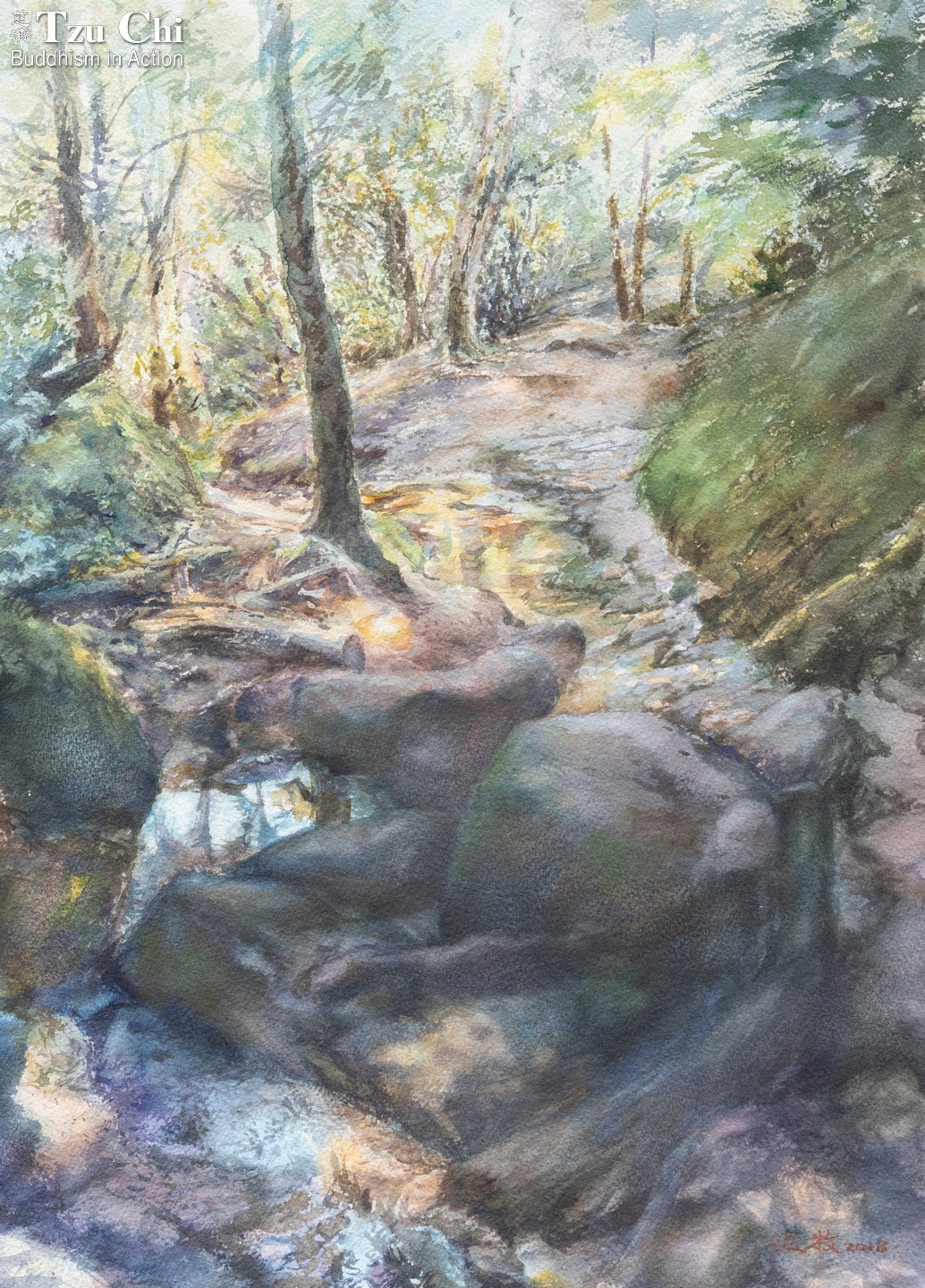
Painting by Wen Mu (Detail from Road)

A woman in her mid-70s, who had recovered from stage three stomach cancer after receiving treatment from me, returned to my clinic and unexpectedly broke down in tears.

A 75-year-old woman from Taiwan’s Atayal tribe came to my clinic at Taichung Tzu Chi Hospital with symptoms of abdominal pain, poor appetite, black stools, and significant weight loss—ten kilograms (22 pounds) over the past six months. A gastroscopy and biopsy confirmed stomach cancer, with the tumor in a difficult-to-reach area.

Given her age and the seriousness of her condition, both her family and our medical team hesitated to pursue aggressive treatment. However, we were committed to finding a solution. After discussing her options with her family, I decided to treat her with a combination of immunotherapy and chemotherapy to shrink the tumor, followed by minimally invasive surgery.

Her recovery was difficult. She experienced delirium after the surgery and temporarily lost recognition of those around her. She developed pleural effusion, or “water on the lungs,” and extended bed rest led to muscle atrophy in her legs, making them weak and unsteady. To make matters worse, her surgical wounds healed poorly.

Her physical challenges were worrisome enough, but her care was further complicated by the fact that her primary caregiver was a foreign worker who spoke a different language. Nurses had to rely on gestures or translation apps to communicate and help with her care. Thankfully, she was eventually discharged and allowed to return home to rest.

If we hadn’t intervened, she might have given up, believing nothing more could be done. But stepping in came with a lot of pressure. As her condition fluctuated, so did my emotions—like riding a roller coaster. Even during a medical training course in Singapore, I couldn’t stop worrying about her. Would she recover? Later, when I reviewed her pathology report, I was amazed—there were no cancer cells left, only ulcers and fibrotic granulation tissue. She had essentially been cured!

When she returned to my clinic, I expected gratitude and happiness. Instead, she broke down in tears. She explained that before her illness, she had enjoyed visiting friends and leading an active life in her village. But now, after surgery, her strength had greatly diminished. Her legs were so weak she couldn’t even leave her house. This made her deeply sad.

Her reaction caught me by surprise. Though she was cancer-free, her physical strength hadn’t returned. Living in a remote mountainous area in Miaoli County, northern Taiwan, she had no access to rehabilitation facilities. I decided to visit her in person to better understand her situation and offer a solution.

We quickly assembled a home visit team with experts in nursing, rehabilitation, nutrition, pharmacy, case management, and social work. Nine of us packed into a van and set off. The journey, which became more strenuous on the mountain roads, took over an hour and a half. Once there, we assessed her living conditions and watched her take a few steps. She was unsteady and at risk of falling. Our rehabilitation specialist advised her to use her sofa for support and taught her exercises to strengthen her legs at home, like standing, squatting, tiptoeing, and balancing on one leg.

A week into home rehabilitation exercises, she returned to the clinic and happily shared that her leg strength had significantly improved. The rehabilitation specialist provided her with a lightweight quad cane to replace her bamboo walking stick, which was expected to reduce her risk of falling. With her progress, I agreed that she only needed to return for monthly check-ups.

Though we stayed only half an hour in her home, the home visit required over three hours of travel round trip and the mobilization of a large team. Such trips aren’t always practical from a hospital cost perspective, but are invaluable for certain patients. They show the patient that their doctor genuinely cares, which boosts their confidence and encourages them to make more effort. Plus, by seeing their environment firsthand, we can better tailor treatment plans to prevent complications.

Advances in medical technology give hope, but attentive patient care makes treatment even more effective. It builds trust, provides emotional support, and reduces anxiety. The extra effort can truly make a difference.

Narrated by Dr. Yu Cheng-chan, vice superintendent of Taichung Tzu Chi Hospital
Compiled by Guo Su-xia and Wang Rui-lin
Abridged and translated by Wu Hsiao-ting
Painting by Wen Mu (Detail from Road)

A woman in her mid-70s, who had recovered from stage three stomach cancer after receiving treatment from me, returned to my clinic and unexpectedly broke down in tears.

A 75-year-old woman from Taiwan’s Atayal tribe came to my clinic at Taichung Tzu Chi Hospital with symptoms of abdominal pain, poor appetite, black stools, and significant weight loss—ten kilograms (22 pounds) over the past six months. A gastroscopy and biopsy confirmed stomach cancer, with the tumor in a difficult-to-reach area.

Given her age and the seriousness of her condition, both her family and our medical team hesitated to pursue aggressive treatment. However, we were committed to finding a solution. After discussing her options with her family, I decided to treat her with a combination of immunotherapy and chemotherapy to shrink the tumor, followed by minimally invasive surgery.

Her recovery was difficult. She experienced delirium after the surgery and temporarily lost recognition of those around her. She developed pleural effusion, or “water on the lungs,” and extended bed rest led to muscle atrophy in her legs, making them weak and unsteady. To make matters worse, her surgical wounds healed poorly.

Her physical challenges were worrisome enough, but her care was further complicated by the fact that her primary caregiver was a foreign worker who spoke a different language. Nurses had to rely on gestures or translation apps to communicate and help with her care. Thankfully, she was eventually discharged and allowed to return home to rest.

If we hadn’t intervened, she might have given up, believing nothing more could be done. But stepping in came with a lot of pressure. As her condition fluctuated, so did my emotions—like riding a roller coaster. Even during a medical training course in Singapore, I couldn’t stop worrying about her. Would she recover? Later, when I reviewed her pathology report, I was amazed—there were no cancer cells left, only ulcers and fibrotic granulation tissue. She had essentially been cured!

When she returned to my clinic, I expected gratitude and happiness. Instead, she broke down in tears. She explained that before her illness, she had enjoyed visiting friends and leading an active life in her village. But now, after surgery, her strength had greatly diminished. Her legs were so weak she couldn’t even leave her house. This made her deeply sad.

Her reaction caught me by surprise. Though she was cancer-free, her physical strength hadn’t returned. Living in a remote mountainous area in Miaoli County, northern Taiwan, she had no access to rehabilitation facilities. I decided to visit her in person to better understand her situation and offer a solution.

We quickly assembled a home visit team with experts in nursing, rehabilitation, nutrition, pharmacy, case management, and social work. Nine of us packed into a van and set off. The journey, which became more strenuous on the mountain roads, took over an hour and a half. Once there, we assessed her living conditions and watched her take a few steps. She was unsteady and at risk of falling. Our rehabilitation specialist advised her to use her sofa for support and taught her exercises to strengthen her legs at home, like standing, squatting, tiptoeing, and balancing on one leg.

A week into home rehabilitation exercises, she returned to the clinic and happily shared that her leg strength had significantly improved. The rehabilitation specialist provided her with a lightweight quad cane to replace her bamboo walking stick, which was expected to reduce her risk of falling. With her progress, I agreed that she only needed to return for monthly check-ups.

Though we stayed only half an hour in her home, the home visit required over three hours of travel round trip and the mobilization of a large team. Such trips aren’t always practical from a hospital cost perspective, but are invaluable for certain patients. They show the patient that their doctor genuinely cares, which boosts their confidence and encourages them to make more effort. Plus, by seeing their environment firsthand, we can better tailor treatment plans to prevent complications.

Advances in medical technology give hope, but attentive patient care makes treatment even more effective. It builds trust, provides emotional support, and reduces anxiety. The extra effort can truly make a difference.

關鍵字

Lost and Found

By Yi Yi
Abridged and translated by Wu Hsiao-ting
Photo by Huang Xiao-zhe

A family’s experience with dementia highlights the importance of love, care, and a proactive approach to maintaining cognitive health.

In an aging society, it’s crucial to strengthen our network of care to better support the elderly.

Recently, Tzu Chi’s Da Ai TV aired the second season of Still Me, a drama inspired by true stories about dementia. Its popularity highlights the growing concern over dementia in Taiwan, where the elderly population is rapidly increasing.

According to Taiwan’s Ministry of Health and Welfare, approximately 350,000 people aged 65 and older are living with dementia. My father is one of them. While he initially managed mild memory loss well, the turning point was the COVID-19 pandemic. His greatest joy was singing karaoke with friends; his eyes would light up at the mention of it, and he would proudly tell us how many songs he could sing.

Unfortunately, social distancing measures during the pandemic led to the closure of karaoke venues. With limited social interaction and being stuck at home watching TV all day, my father’s memory began to decline more rapidly.

One autumn afternoon, after days of rain, he took his bicycle out and got lost. Hours passed without any sign of him, and as it grew dark and more rain began to fall, our anxiety escalated. With his phone likely dead, we couldn’t track him. We reported him missing to the police and enlisted the Taiwan Alzheimer’s Disease Association to post a missing person flyer online. We drove around and around searching for him, but he was nowhere to be found.

We experienced the fear and anxiety that every family of a dementia patient dreads. The wait was agonizing—I don’t know how many tears I cried, and I struggled to eat or sleep.

During this distressing time, I was reminded of a childhood experience when I got lost. A kind woman found me and called my father to pick me up. I felt scared and alone, crying until I finally saw him in the golden light of the setting sun, riding toward me on his bicycle. In his comforting presence, my fears and tears melted away. The memory was still warm and reassuring, even after all the years. Now, in my distress, I prayed to Guan Yin, the Bodhisattva of Compassion, that someone would help guide him back to us.

Nearly 32 hours later, we finally received good news—the police had found him! A passerby, seeing him, sensed something was wrong and gently coaxed him to a nearby police station, where he waited for us to pick him up.

I can only imagine what my father experienced during those 32 hours. He hadn’t spent any of the money he had with him, suggesting he may have gone without food or water. He likely hadn’t slept either. Security footage showed that on the first evening, he had asked a shopkeeper for directions, indicating that at that point, he still knew he was lost. By the time we found him the next night, he had lost awareness of his situation and didn’t even realize we had been frantically searching for him. After hours in the rain, he was dehydrated, shaky, and clearly frightened.

A family effort

Once home, my father rested for two days, and his cognitive abilities and energy gradually improved. To prevent a reoccurrence of such a frightening situation, our family took proactive measures. We implemented multiple tracking methods and made other important adjustments, including changes to his diet.

My father has always loved eating bread, but research suggests that excessive consumption of refined carbohydrates, like bread and pasta, can adversely affect glucose and insulin metabolism. This can impact blood vessels in the brain and can contribute to the buildup of beta-amyloid plaques, which are believed to play a key role in the development of Alzheimer’s disease.

To promote brain health, we introduced brain-boosting foods into my father’s diet, including nuts, pumpkins, tomatoes, dark chocolate, and black coffee. We incorporated vitamins and aromatherapy with essential oils into his daily routine, while cutting back on processed foods.

Once the pandemic eased, my father started walking an hour or more every morning. In the evenings, we engaged him in various activities, including calligraphy, finger exercises, and singing along to songs on the computer. We provided plenty of encouragement and praise during these activities.

We also started taking advantage of government elderly care services and arranged for a caregiver to visit my father for one to two hours each weekday. This caregiver engages him in conversation and cognitive activities, like playing chess. Thanks to these efforts, my father has not only maintained but even improved his cognitive abilities.

In our aging society, creating a close-knit support network for the elderly is crucial. Taiwan’s government provides a broad range of elderly care services, while Tzu Chi has established long-term care service stations in various communities. These venues offer seniors vibrant learning environments where they can stimulate their minds, interact with others, and enjoy their later years. Many seniors have experienced improved memory and moods through these programs.

Ensuring that aging occurs with dignity and quality of life is a challenge every society must address. The COVID-19 pandemic highlighted the essential need for love, care, and meaningful interaction in our relationships. May we support our elders with warmth and may every person with dementia spend their remaining years in safety and love.

By Yi Yi
Abridged and translated by Wu Hsiao-ting
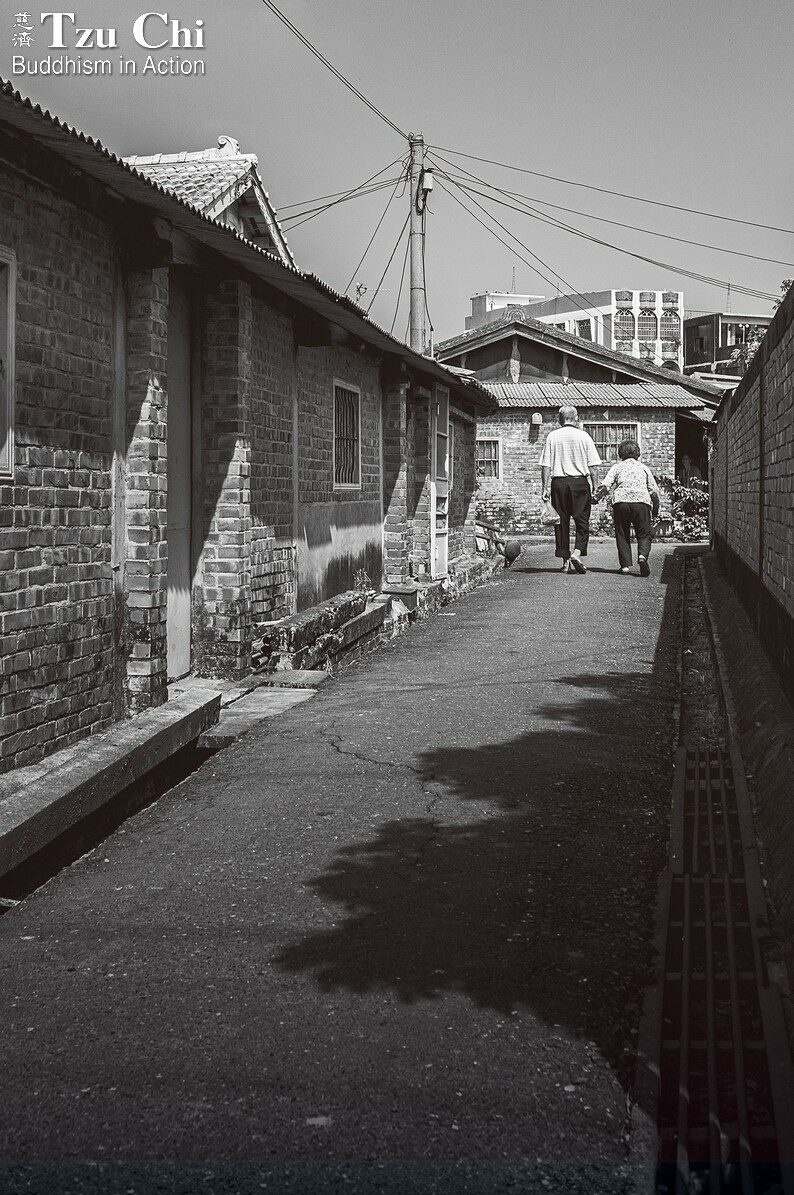
Photo by Huang Xiao-zhe

A family’s experience with dementia highlights the importance of love, care, and a proactive approach to maintaining cognitive health.

In an aging society, it’s crucial to strengthen our network of care to better support the elderly.

Recently, Tzu Chi’s Da Ai TV aired the second season of Still Me, a drama inspired by true stories about dementia. Its popularity highlights the growing concern over dementia in Taiwan, where the elderly population is rapidly increasing.

According to Taiwan’s Ministry of Health and Welfare, approximately 350,000 people aged 65 and older are living with dementia. My father is one of them. While he initially managed mild memory loss well, the turning point was the COVID-19 pandemic. His greatest joy was singing karaoke with friends; his eyes would light up at the mention of it, and he would proudly tell us how many songs he could sing.

Unfortunately, social distancing measures during the pandemic led to the closure of karaoke venues. With limited social interaction and being stuck at home watching TV all day, my father’s memory began to decline more rapidly.

One autumn afternoon, after days of rain, he took his bicycle out and got lost. Hours passed without any sign of him, and as it grew dark and more rain began to fall, our anxiety escalated. With his phone likely dead, we couldn’t track him. We reported him missing to the police and enlisted the Taiwan Alzheimer’s Disease Association to post a missing person flyer online. We drove around and around searching for him, but he was nowhere to be found.

We experienced the fear and anxiety that every family of a dementia patient dreads. The wait was agonizing—I don’t know how many tears I cried, and I struggled to eat or sleep.

During this distressing time, I was reminded of a childhood experience when I got lost. A kind woman found me and called my father to pick me up. I felt scared and alone, crying until I finally saw him in the golden light of the setting sun, riding toward me on his bicycle. In his comforting presence, my fears and tears melted away. The memory was still warm and reassuring, even after all the years. Now, in my distress, I prayed to Guan Yin, the Bodhisattva of Compassion, that someone would help guide him back to us.

Nearly 32 hours later, we finally received good news—the police had found him! A passerby, seeing him, sensed something was wrong and gently coaxed him to a nearby police station, where he waited for us to pick him up.

I can only imagine what my father experienced during those 32 hours. He hadn’t spent any of the money he had with him, suggesting he may have gone without food or water. He likely hadn’t slept either. Security footage showed that on the first evening, he had asked a shopkeeper for directions, indicating that at that point, he still knew he was lost. By the time we found him the next night, he had lost awareness of his situation and didn’t even realize we had been frantically searching for him. After hours in the rain, he was dehydrated, shaky, and clearly frightened.

A family effort

Once home, my father rested for two days, and his cognitive abilities and energy gradually improved. To prevent a reoccurrence of such a frightening situation, our family took proactive measures. We implemented multiple tracking methods and made other important adjustments, including changes to his diet.

My father has always loved eating bread, but research suggests that excessive consumption of refined carbohydrates, like bread and pasta, can adversely affect glucose and insulin metabolism. This can impact blood vessels in the brain and can contribute to the buildup of beta-amyloid plaques, which are believed to play a key role in the development of Alzheimer’s disease.

To promote brain health, we introduced brain-boosting foods into my father’s diet, including nuts, pumpkins, tomatoes, dark chocolate, and black coffee. We incorporated vitamins and aromatherapy with essential oils into his daily routine, while cutting back on processed foods.

Once the pandemic eased, my father started walking an hour or more every morning. In the evenings, we engaged him in various activities, including calligraphy, finger exercises, and singing along to songs on the computer. We provided plenty of encouragement and praise during these activities.

We also started taking advantage of government elderly care services and arranged for a caregiver to visit my father for one to two hours each weekday. This caregiver engages him in conversation and cognitive activities, like playing chess. Thanks to these efforts, my father has not only maintained but even improved his cognitive abilities.

In our aging society, creating a close-knit support network for the elderly is crucial. Taiwan’s government provides a broad range of elderly care services, while Tzu Chi has established long-term care service stations in various communities. These venues offer seniors vibrant learning environments where they can stimulate their minds, interact with others, and enjoy their later years. Many seniors have experienced improved memory and moods through these programs.

Ensuring that aging occurs with dignity and quality of life is a challenge every society must address. The COVID-19 pandemic highlighted the essential need for love, care, and meaningful interaction in our relationships. May we support our elders with warmth and may every person with dementia spend their remaining years in safety and love.

關鍵字

Rising From Rock Bottom

Narrated by Tu Bo-yu
Compiled by Zhang Li-yun
Translated by Wu Hsiao-ting
Photo by Li Yan-shu

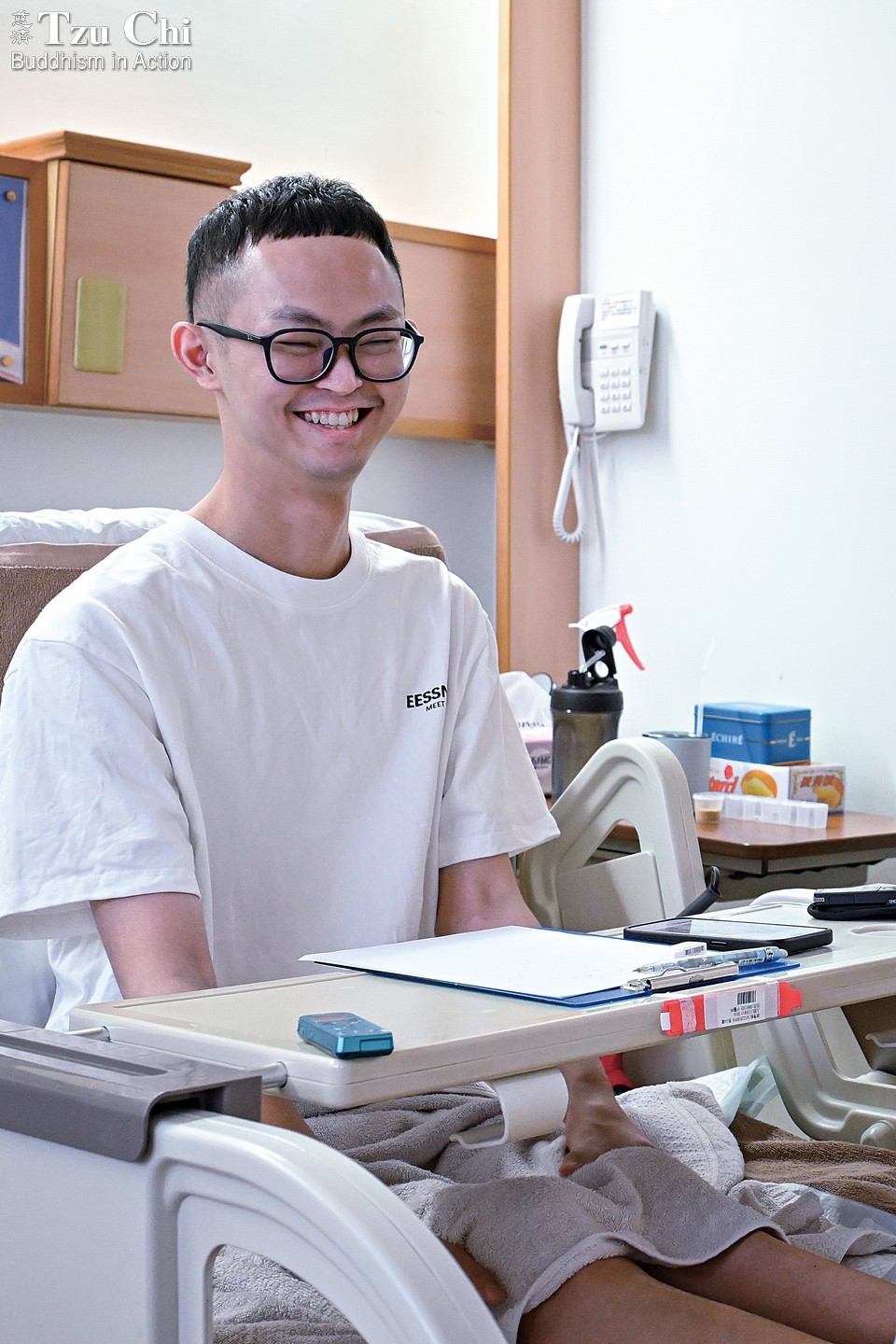
In less than a year, my life was turned upside down—I went from full of vitality to half-paralyzed. When all treatments failed, Hualien Tzu Chi Hospital offered me a glimmer of hope.

I was once a healthy, active young man who loved playing basketball. But in 2021, at just 21 years old, I began to experience frequent falls. Initially, I attributed it to fatigue, believing a good night’s sleep would restore my energy. However, I soon found myself growing tired more easily, stumbling as if I were drunk. I also began losing control of my bladder and bowels. Once, while out on a business errand, I had a sudden urge to use the restroom but lost control halfway there. At other times, I felt an urgent need to urinate but couldn’t. Eventually, I could barely stand for more than three minutes at a time. Even getting up required immense effort. The doctors kept saying, “You need further observation.”

Frustrated by the lack of answers, I underwent tests at a local hospital in central Taiwan, where doctors suspected I had a rare hereditary disease. I was referred to a medical center in northern Taiwan, and genetic testing confirmed that I had adrenoleukodystrophy—the same rare genetic disease depicted in the movie Lorenzo’s Oil. The doctor looked at my genetic report and frowned; at that time, no established treatment protocols existed in the medical literature for the disease.

My condition deteriorated rapidly. In less than a year, I went from being able to run and jump to walking slowly, then needing a walker, and ultimately becoming half-paralyzed. During a family trip, while soaking my feet in a hot spring, I realized I couldn’t feel the heat, leading to burns and blisters on my feet. From that point on, I was mostly bedridden, which resulted in severe blood clots in my right leg. This, along with cellulitis, caused my leg to swell so badly that I required hospitalization.

One day, while my mother was massaging me, I suddenly felt tightness in my chest, as if my heart were being squeezed. I lost consciousness. When I woke up, I was surrounded by doctors and nurses trying to save my life. I had suffered a severe pulmonary embolism. Fearing that the embolism might spread to my heart, the doctors transferred me to the intensive care unit for observation. They eventually decided to proceed with a hematopoietic stem cell transplant. Fortunately, a matching donor was found through Tzu Chi’s bone marrow registry, and I underwent the transplant in March 2023.

Truth be told, I was at my breaking point before the transplant and wanted to give up. The cost of long-term treatment was overwhelming, and I didn’t want to burden my family any further. But before the procedure, my donor wrote me a card wishing me a speedy recovery. I drew strength from the love I felt and decided to keep fighting.

Although my body did not reject the transplant and my red and white blood cell counts improved—much to the nurses’ surprise—my condition remained unchanged. The doctors had no answers. After all this effort, it felt like I was standing at the edge of an abyss I couldn’t cross. I felt hopeless and had an honest conversation with my mother about my situation. I told her we had tried our best, and if my condition didn’t improve, we should let nature take its course and stop treatment rather than prolong my suffering.

Just when I was about to give up, a friend came across a report on the integration of Western and traditional Chinese medical treatments at Hualien Tzu Chi Hospital. This rekindled a glimmer of hope, and we decided to give it another try. In March 2024, I was admitted to the hospital, where I received endogenous stem cell therapy along with acupuncture and herbal treatments from Superintendent Lin Shinn-rong and Vice Superintendent Ho Tsung-jung. After seven treatment sessions over about six months, I could clearly feel my body improving. Although I still can’t move my lower body, I can now move around in bed, sit up, and turn over like a normal person. My lower back is also stronger. I previously had no sensation below my chest, but now I’m regaining feeling in my thighs. My bladder and bowel functions have returned to normal and my appetite has improved.

Although progress has been slow and incremental, it feels wonderful to be constantly improving. I look forward to the day when I can return to a normal life!

Narrated by Tu Bo-yu
Compiled by Zhang Li-yun
Translated by Wu Hsiao-ting
Photo by Li Yan-shu

In less than a year, my life was turned upside down—I went from full of vitality to half-paralyzed. When all treatments failed, Hualien Tzu Chi Hospital offered me a glimmer of hope.

I was once a healthy, active young man who loved playing basketball. But in 2021, at just 21 years old, I began to experience frequent falls. Initially, I attributed it to fatigue, believing a good night’s sleep would restore my energy. However, I soon found myself growing tired more easily, stumbling as if I were drunk. I also began losing control of my bladder and bowels. Once, while out on a business errand, I had a sudden urge to use the restroom but lost control halfway there. At other times, I felt an urgent need to urinate but couldn’t. Eventually, I could barely stand for more than three minutes at a time. Even getting up required immense effort. The doctors kept saying, “You need further observation.”

Frustrated by the lack of answers, I underwent tests at a local hospital in central Taiwan, where doctors suspected I had a rare hereditary disease. I was referred to a medical center in northern Taiwan, and genetic testing confirmed that I had adrenoleukodystrophy—the same rare genetic disease depicted in the movie Lorenzo’s Oil. The doctor looked at my genetic report and frowned; at that time, no established treatment protocols existed in the medical literature for the disease.

My condition deteriorated rapidly. In less than a year, I went from being able to run and jump to walking slowly, then needing a walker, and ultimately becoming half-paralyzed. During a family trip, while soaking my feet in a hot spring, I realized I couldn’t feel the heat, leading to burns and blisters on my feet. From that point on, I was mostly bedridden, which resulted in severe blood clots in my right leg. This, along with cellulitis, caused my leg to swell so badly that I required hospitalization.

One day, while my mother was massaging me, I suddenly felt tightness in my chest, as if my heart were being squeezed. I lost consciousness. When I woke up, I was surrounded by doctors and nurses trying to save my life. I had suffered a severe pulmonary embolism. Fearing that the embolism might spread to my heart, the doctors transferred me to the intensive care unit for observation. They eventually decided to proceed with a hematopoietic stem cell transplant. Fortunately, a matching donor was found through Tzu Chi’s bone marrow registry, and I underwent the transplant in March 2023.

Truth be told, I was at my breaking point before the transplant and wanted to give up. The cost of long-term treatment was overwhelming, and I didn’t want to burden my family any further. But before the procedure, my donor wrote me a card wishing me a speedy recovery. I drew strength from the love I felt and decided to keep fighting.

Although my body did not reject the transplant and my red and white blood cell counts improved—much to the nurses’ surprise—my condition remained unchanged. The doctors had no answers. After all this effort, it felt like I was standing at the edge of an abyss I couldn’t cross. I felt hopeless and had an honest conversation with my mother about my situation. I told her we had tried our best, and if my condition didn’t improve, we should let nature take its course and stop treatment rather than prolong my suffering.

Just when I was about to give up, a friend came across a report on the integration of Western and traditional Chinese medical treatments at Hualien Tzu Chi Hospital. This rekindled a glimmer of hope, and we decided to give it another try. In March 2024, I was admitted to the hospital, where I received endogenous stem cell therapy along with acupuncture and herbal treatments from Superintendent Lin Shinn-rong and Vice Superintendent Ho Tsung-jung. After seven treatment sessions over about six months, I could clearly feel my body improving. Although I still can’t move my lower body, I can now move around in bed, sit up, and turn over like a normal person. My lower back is also stronger. I previously had no sensation below my chest, but now I’m regaining feeling in my thighs. My bladder and bowel functions have returned to normal and my appetite has improved.

Although progress has been slow and incremental, it feels wonderful to be constantly improving. I look forward to the day when I can return to a normal life!

關鍵字

Undaunted Commitment—The Ankang Recycling Station

By Chiu Chuan Peinn
Translated by Wu Hsiao-ting
Photos by Hsiao Yiu-hwa

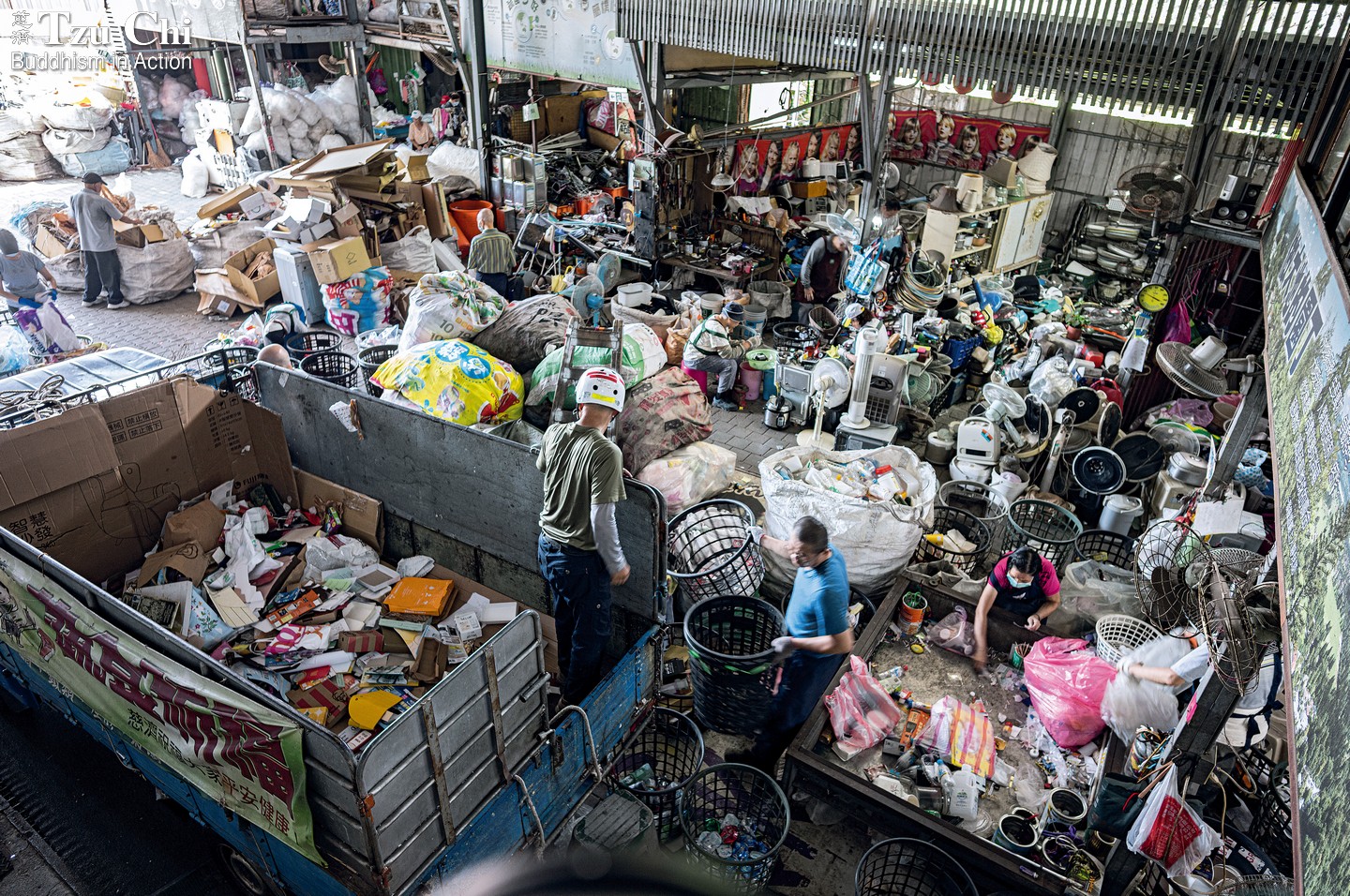
Despite its modest size, the Ankang Recycling Station processes an average of 9,000 PET bottles each week, alongside significant quantities of other recyclables. The work is endless, but volunteers give their best effort.

The Ankang Recycling Station may not be large, but its sorting areas are well-organized. Recyclables are collected from stores, factories, and residential buildings, then sorted on-site by dedicated volunteers.

It was mid-September in Taiwan, but the coolness of autumn felt far away as temperatures reached 36°C (96.8°F). The stifling heat was palpable inside the two-story Tzu Chi Ankang Recycling Station, but some volunteers had long since arrived. Gao Yi-feng (高懿楓), smiling cheerfully, mentioned that she had opened the doors at 6:30 a.m. Many volunteers head home after lunch to escape the heat, but those who arrive later in the morning often stay until 3 or 4 p.m.

Located on Ankang Road in Xindian, New Taipei City, the Ankang Recycling Station covers an area roughly the size of two to three basketball courts. At its center is the preliminary sorting area, where a volunteer was separating plastics, paper, PET bottles, and other recyclables from a mixed pile of waste. On the second floor, a thrift store displays donated secondhand items, mostly clothing. Electrical appliances and other items repaired by volunteer Guo Shang-yi (郭尚一), such as fans, clocks, and dehumidifiers, are also available.

The PET bottle sorting area is situated at the far end of the station, where an average of 9,000 PET bottles are processed each week. Liao Guo-rui (廖國瑞), who is around 50 years old, smiled and commented, “There are always more PET bottles in the summer. When it’s hot, young people love their cold drinks.”

The station also has a kitchen. Next to the kitchen is the area where appliances are repaired or dismantled for recycling. Further ahead is the plastic and metal sorting area, where 86-year-old Lin Chun-tu (林春土) was busy removing cords from blinds, separating the aluminum slats. The more thoroughly items are sorted, the better price they fetch from recyclers.

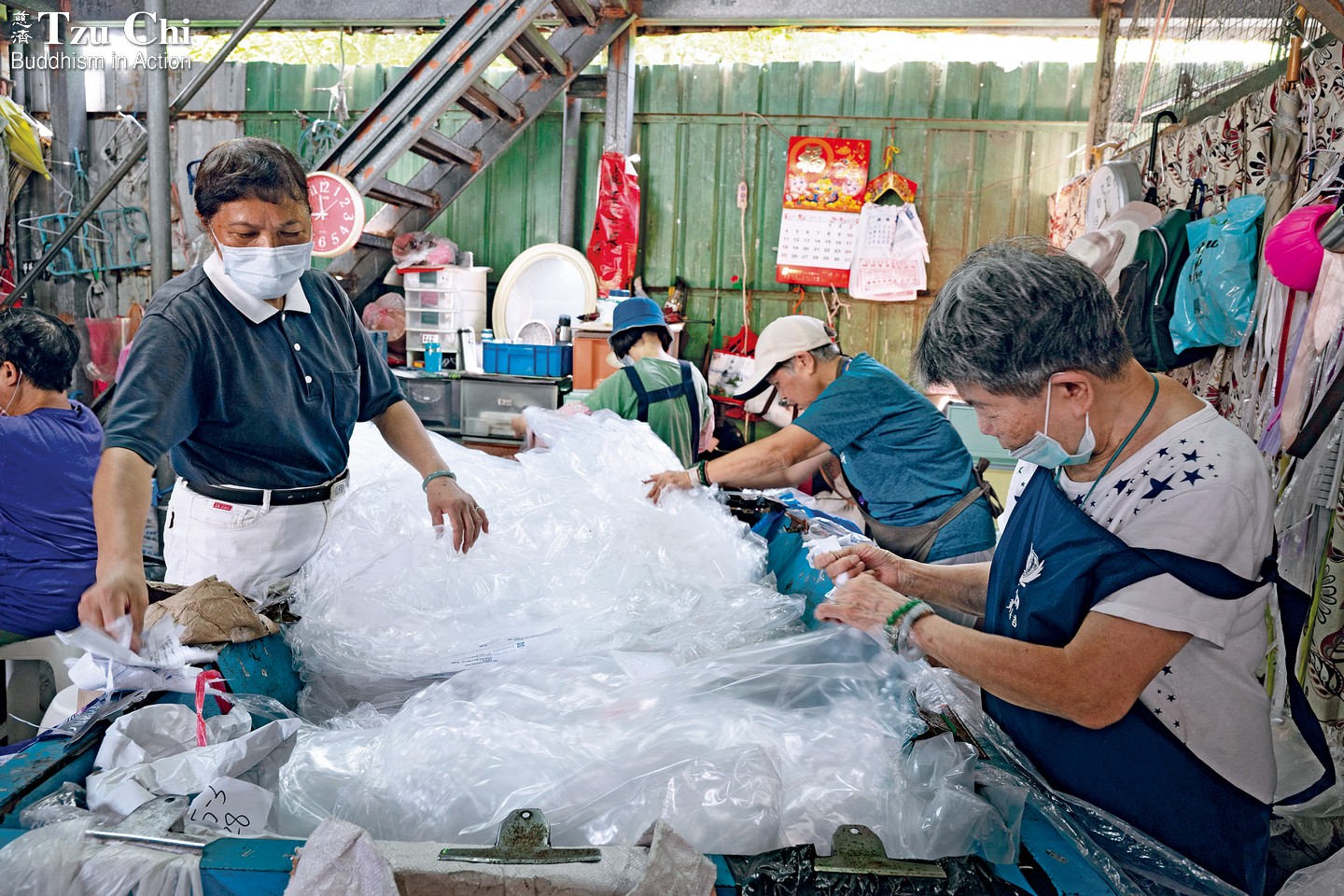
Closest to the front entrance is the plastic bag sorting area, where four female volunteers were sorting bags by color before further categorizing them into types such as PP (polypropylene) and PE (polyethylene). Every Monday, Wednesday, and Friday evening, a vertical compactor compresses the plastic bags into cubes for easier storage and transport.

One volunteer smiled at me and asked, “Here to help?” Before I could answer, another volunteer chimed in, “He’s a reporter for Tzu Chi Monthly!” The two exchanged glances, realizing I hadn’t expected the question, and burst out laughing.

Next to the plastic bag sorting area is a 25-square-meter (270-square-foot) storage space filled with large transparent bags packed with even more transparent bags. I was taken aback by the sheer volume and couldn’t help but wonder aloud how the volunteers managed to tackle it all. Lin Long-guang (林龍光), 72, responded light-heartedly, “Plastic bags come in every day. It’s a never-ending task, but we just do our best.” Lin has been volunteering at the station since it opened in 2007. In addition to his work at the station, he trains hospital volunteers at Taipei Tzu Chi Hospital and fulfills other volunteer duties as needed, yet he still faithfully reports to the recycling station every day. When the kitchen isn’t preparing meals, he brings boxed lunches from the Jing Si Hall next to the hospital for the volunteers.

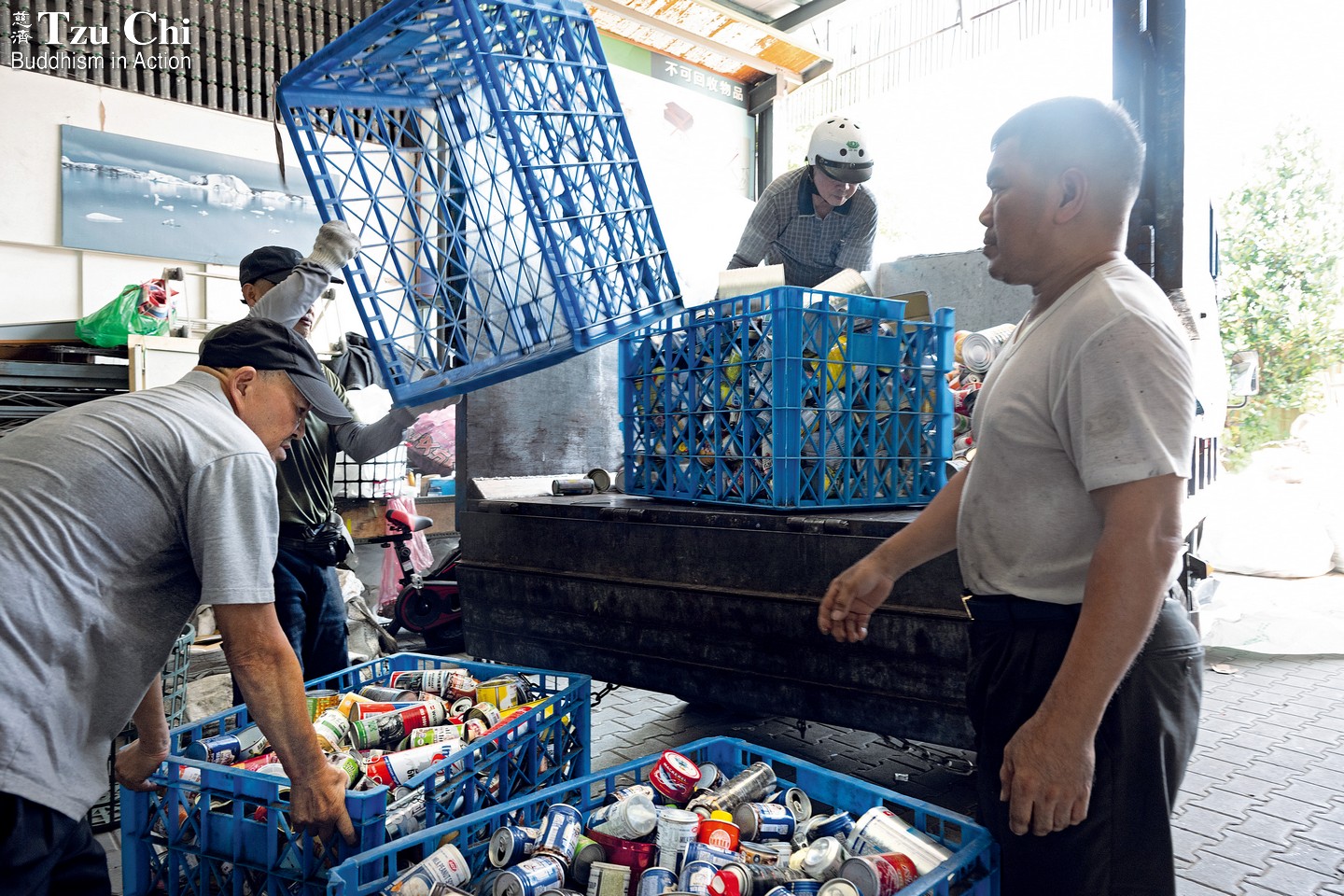
Volunteers load sorted recyclables onto a truck. Different categories of recycling go to different recycling companies.

Not for profit, but for resource conservation

Huang Jin-tian (黃金田) uses a truck to collect recyclables from stores. I accompanied him on his route that day. His first stop was at an auto maintenance shop, where he picked up cardboard boxes. He then made his way to other designated spots to collect plastic bags left by retailers, most of which had been used to package clothing.

Once the truck bed was full, Huang pulled a black net from the front of the truck to cover the recyclables and prevent them from flying out during transit. He remarked that the volume of clothing bags increases in winter, making this covering even more essential.

Huang pointed out the entrance to an alley we passed on the way back to the station and said, “There used to be a Tzu Chi collection point for recyclables there, but it isn’t there anymore.” Chen Wen-xian (陳文憲) explained that while recycling benefits the environment, it’s important to consider its impact on the community. For instance, if the storage or transport of recyclables hinders local residents’ access to their homes or ability to navigate the neighborhood, then the location of a collection point needs to be reevaluated. Volunteers must balance environmental efforts with respect for residents’ daily lives.

“Most of our collection points are now located at residential buildings, businesses, and factories,” Chen continued. He noted that recyclables from residential buildings are typically more mixed, including plastics, metals, mixed paper, and electrical appliances, which require more time to sort once they arrive at the recycling station. By comparison, recyclables from factories and businesses are more straightforward, consisting mainly of plastic bags and cardboard boxes.

Although factories and businesses could pay recycling companies to collect their recyclables, those companies often impose strict sorting requirements. For example, commercial recycling companies would likely reject loads of recycling containing mixed materials, like iron and aluminum. In contrast, Tzu Chi volunteers or recycling stations accept mixed recyclables from businesses and sort the materials themselves—for free. Volunteers engage in recycling not for profit but for the sake of the environment, which fosters cooperation from stores, companies, and factories. “Our volunteers recycle materials to prevent waste, incineration, and air pollution,” Chen said. “They hope the recyclables can be reused to conserve resources.”

Volunteers process plastic bags. Plastic bags arrive in large quantities at the recycling station nearly every day.

Education is the key

The ultimate fate of recyclables once they arrive at the Ankang Recycling Station depends upon their type. PET bottles are purchased by DA.AI Technology and transformed into clothing and blankets; paper, iron, aluminum, and stainless steel are sent to various recycling companies, while copper and electronic boards are collected directly by recycling companies.

However, some recyclables remain unwanted, such as composite snack packaging, laundry detergent refill packs, glass, and Styrofoam. These items are often rejected due to their low recycling value. Volunteers at the station typically seek help from the local government’s environmental protection department to collect these materials, hoping to prevent them from ending up in incinerators.

The Ankang Recycling Station also serves an educational role by hosting visits from local schools. During these visits, volunteers share their recycling efforts, teach students about environmental protection, and inspire them to lead eco-friendly lifestyles. As Chen Wen-xian pointed out, “Education is the foundation of environmental protection.” Without raising awareness, significant waste will continue to be generated, which is decidedly not good for the environment.

The station’s kitchen was serving meals on the day of my visit. Before eating, the volunteers sang the “Offering Song” together: “May I cultivate all that is good; may I abandon all that is harmful….” After the meal, as I prepared to leave, I saw volunteers unloading a large quantity of recyclables from a truck. Lin Long-guang’s words echoed in my mind: it’s an endless task, and they can only do their best.

By Chiu Chuan Peinn
Translated by Wu Hsiao-ting
Photos by Hsiao Yiu-hwa

Despite its modest size, the Ankang Recycling Station processes an average of 9,000 PET bottles each week, alongside significant quantities of other recyclables. The work is endless, but volunteers give their best effort.

The Ankang Recycling Station may not be large, but its sorting areas are well-organized. Recyclables are collected from stores, factories, and residential buildings, then sorted on-site by dedicated volunteers.

It was mid-September in Taiwan, but the coolness of autumn felt far away as temperatures reached 36°C (96.8°F). The stifling heat was palpable inside the two-story Tzu Chi Ankang Recycling Station, but some volunteers had long since arrived. Gao Yi-feng (高懿楓), smiling cheerfully, mentioned that she had opened the doors at 6:30 a.m. Many volunteers head home after lunch to escape the heat, but those who arrive later in the morning often stay until 3 or 4 p.m.

Located on Ankang Road in Xindian, New Taipei City, the Ankang Recycling Station covers an area roughly the size of two to three basketball courts. At its center is the preliminary sorting area, where a volunteer was separating plastics, paper, PET bottles, and other recyclables from a mixed pile of waste. On the second floor, a thrift store displays donated secondhand items, mostly clothing. Electrical appliances and other items repaired by volunteer Guo Shang-yi (郭尚一), such as fans, clocks, and dehumidifiers, are also available.

The PET bottle sorting area is situated at the far end of the station, where an average of 9,000 PET bottles are processed each week. Liao Guo-rui (廖國瑞), who is around 50 years old, smiled and commented, “There are always more PET bottles in the summer. When it’s hot, young people love their cold drinks.”

The station also has a kitchen. Next to the kitchen is the area where appliances are repaired or dismantled for recycling. Further ahead is the plastic and metal sorting area, where 86-year-old Lin Chun-tu (林春土) was busy removing cords from blinds, separating the aluminum slats. The more thoroughly items are sorted, the better price they fetch from recyclers.

Closest to the front entrance is the plastic bag sorting area, where four female volunteers were sorting bags by color before further categorizing them into types such as PP (polypropylene) and PE (polyethylene). Every Monday, Wednesday, and Friday evening, a vertical compactor compresses the plastic bags into cubes for easier storage and transport.

One volunteer smiled at me and asked, “Here to help?” Before I could answer, another volunteer chimed in, “He’s a reporter for Tzu Chi Monthly!” The two exchanged glances, realizing I hadn’t expected the question, and burst out laughing.

Next to the plastic bag sorting area is a 25-square-meter (270-square-foot) storage space filled with large transparent bags packed with even more transparent bags. I was taken aback by the sheer volume and couldn’t help but wonder aloud how the volunteers managed to tackle it all. Lin Long-guang (林龍光), 72, responded light-heartedly, “Plastic bags come in every day. It’s a never-ending task, but we just do our best.” Lin has been volunteering at the station since it opened in 2007. In addition to his work at the station, he trains hospital volunteers at Taipei Tzu Chi Hospital and fulfills other volunteer duties as needed, yet he still faithfully reports to the recycling station every day. When the kitchen isn’t preparing meals, he brings boxed lunches from the Jing Si Hall next to the hospital for the volunteers.

Volunteers load sorted recyclables onto a truck. Different categories of recycling go to different recycling companies.

Not for profit, but for resource conservation

Huang Jin-tian (黃金田) uses a truck to collect recyclables from stores. I accompanied him on his route that day. His first stop was at an auto maintenance shop, where he picked up cardboard boxes. He then made his way to other designated spots to collect plastic bags left by retailers, most of which had been used to package clothing.

Once the truck bed was full, Huang pulled a black net from the front of the truck to cover the recyclables and prevent them from flying out during transit. He remarked that the volume of clothing bags increases in winter, making this covering even more essential.

Huang pointed out the entrance to an alley we passed on the way back to the station and said, “There used to be a Tzu Chi collection point for recyclables there, but it isn’t there anymore.” Chen Wen-xian (陳文憲) explained that while recycling benefits the environment, it’s important to consider its impact on the community. For instance, if the storage or transport of recyclables hinders local residents’ access to their homes or ability to navigate the neighborhood, then the location of a collection point needs to be reevaluated. Volunteers must balance environmental efforts with respect for residents’ daily lives.

“Most of our collection points are now located at residential buildings, businesses, and factories,” Chen continued. He noted that recyclables from residential buildings are typically more mixed, including plastics, metals, mixed paper, and electrical appliances, which require more time to sort once they arrive at the recycling station. By comparison, recyclables from factories and businesses are more straightforward, consisting mainly of plastic bags and cardboard boxes.

Although factories and businesses could pay recycling companies to collect their recyclables, those companies often impose strict sorting requirements. For example, commercial recycling companies would likely reject loads of recycling containing mixed materials, like iron and aluminum. In contrast, Tzu Chi volunteers or recycling stations accept mixed recyclables from businesses and sort the materials themselves—for free. Volunteers engage in recycling not for profit but for the sake of the environment, which fosters cooperation from stores, companies, and factories. “Our volunteers recycle materials to prevent waste, incineration, and air pollution,” Chen said. “They hope the recyclables can be reused to conserve resources.”

Volunteers process plastic bags. Plastic bags arrive in large quantities at the recycling station nearly every day.

Education is the key

The ultimate fate of recyclables once they arrive at the Ankang Recycling Station depends upon their type. PET bottles are purchased by DA.AI Technology and transformed into clothing and blankets; paper, iron, aluminum, and stainless steel are sent to various recycling companies, while copper and electronic boards are collected directly by recycling companies.

However, some recyclables remain unwanted, such as composite snack packaging, laundry detergent refill packs, glass, and Styrofoam. These items are often rejected due to their low recycling value. Volunteers at the station typically seek help from the local government’s environmental protection department to collect these materials, hoping to prevent them from ending up in incinerators.

The Ankang Recycling Station also serves an educational role by hosting visits from local schools. During these visits, volunteers share their recycling efforts, teach students about environmental protection, and inspire them to lead eco-friendly lifestyles. As Chen Wen-xian pointed out, “Education is the foundation of environmental protection.” Without raising awareness, significant waste will continue to be generated, which is decidedly not good for the environment.

The station’s kitchen was serving meals on the day of my visit. Before eating, the volunteers sang the “Offering Song” together: “May I cultivate all that is good; may I abandon all that is harmful….” After the meal, as I prepared to leave, I saw volunteers unloading a large quantity of recyclables from a truck. Lin Long-guang’s words echoed in my mind: it’s an endless task, and they can only do their best.

關鍵字

Pioneering New Paths—Integrated Medicine at Hualien Tzu Chi Hospital

By Zhang Li-yun
Translated by Wu Hsiao-ting
Photos by Li Yan-shu

Hualien Tzu Chi Hospital provides precision medicine that integrates both traditional Chinese and Western medical practices for the effective treatment of severe and challenging conditions.

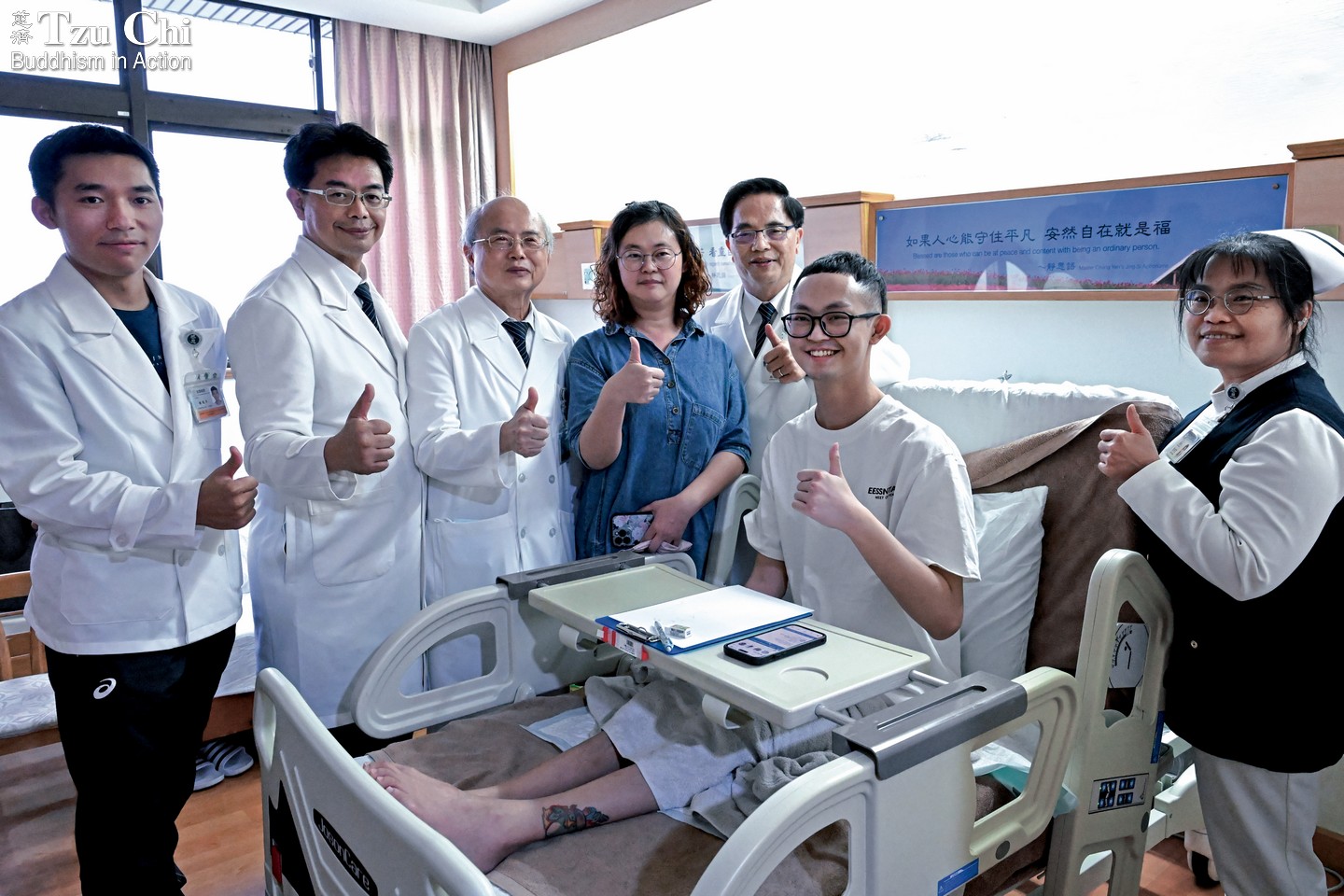
Tu Bo-yu (seated), a patient receiving precision medicine that integrates traditional Chinese and Western treatments, has made good progress under the care of Lin Shinn-zong (fifth from left), Chang Jan-gowth (third from left), and Ho Tsung-jung (second from left).

In March 2024, 23-year-old Tu Bo-yu (涂博俞) was admitted to Hualien Tzu Chi Hospital in eastern Taiwan with a diagnosis of adrenomyeloneuropathy—a form of adrenoleukodystrophy, a rare genetic disorder that poses significant treatment challenges. His symptoms included bladder and bowel dysfunction, as well as paralysis below the chest. Lorenzo’s oil has traditionally been used to manage symptoms, but recent advancements in gene therapy are now being explored. However, such treatment remains prohibitively expensive, and its efficacy is still under evaluation.

Adrenoleukodystrophy is caused by mutations in the ABCD1 gene, leading to the build-up of very long chain fatty acids. Dr. Lin Shinn-zong (林欣榮), superintendent of Hualien Tzu Chi Hospital and a specialist in neuroscience and neurosurgery, explained, “These fatty acids disrupt the myelin sheath’s role in conducting nerve signals, preventing messages from the brain from reaching the hands and feet. Patients can deteriorate rapidly and may not survive for long.”

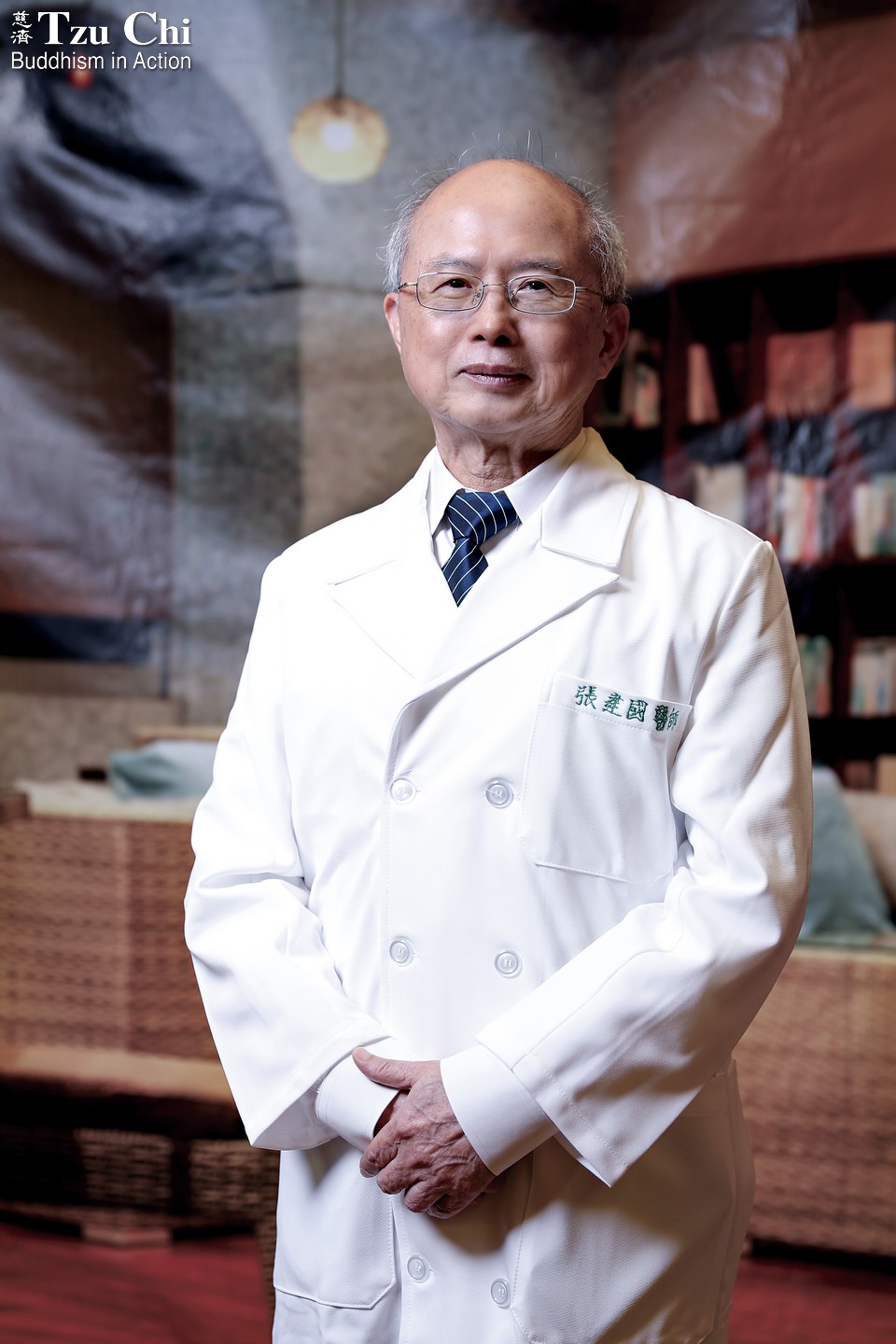
Faced with this complex neurodegenerative disease, Dr. Lin has been actively seeking solutions. “Master Cheng Yen often reminds us that all forms of life in the world are interconnected and imbued with a life force,” he said. “For every illness, nature offers a remedy. Since Western medicine has its limitations, we have enlisted the help of traditional Chinese herbal medicine while using molecular biology to explore methods that may help break down these fatty acids. Professor Chang Jan-gowth [張建國], an expert in next-generation whole-genome analysis, has been providing invaluable insights.”

In mid-February 2024, Taiwan’s Ministry of Health and Welfare announced plans to include next-generation genome sequencing testing in National Health Insurance coverage. Following this announcement, Hualien Tzu Chi Hospital established a molecular tumor committee on February 21. The committee combines multiple specialties from both Western and traditional Chinese medicine to provide more precise treatments for patients with cancer and rare diseases. The committee is chaired by Dr. Lin, with Professor Chang serving as vice chair. Professor Chang specializes in genetic diagnostics and in applying traditional Chinese medicine to cancer treatment.

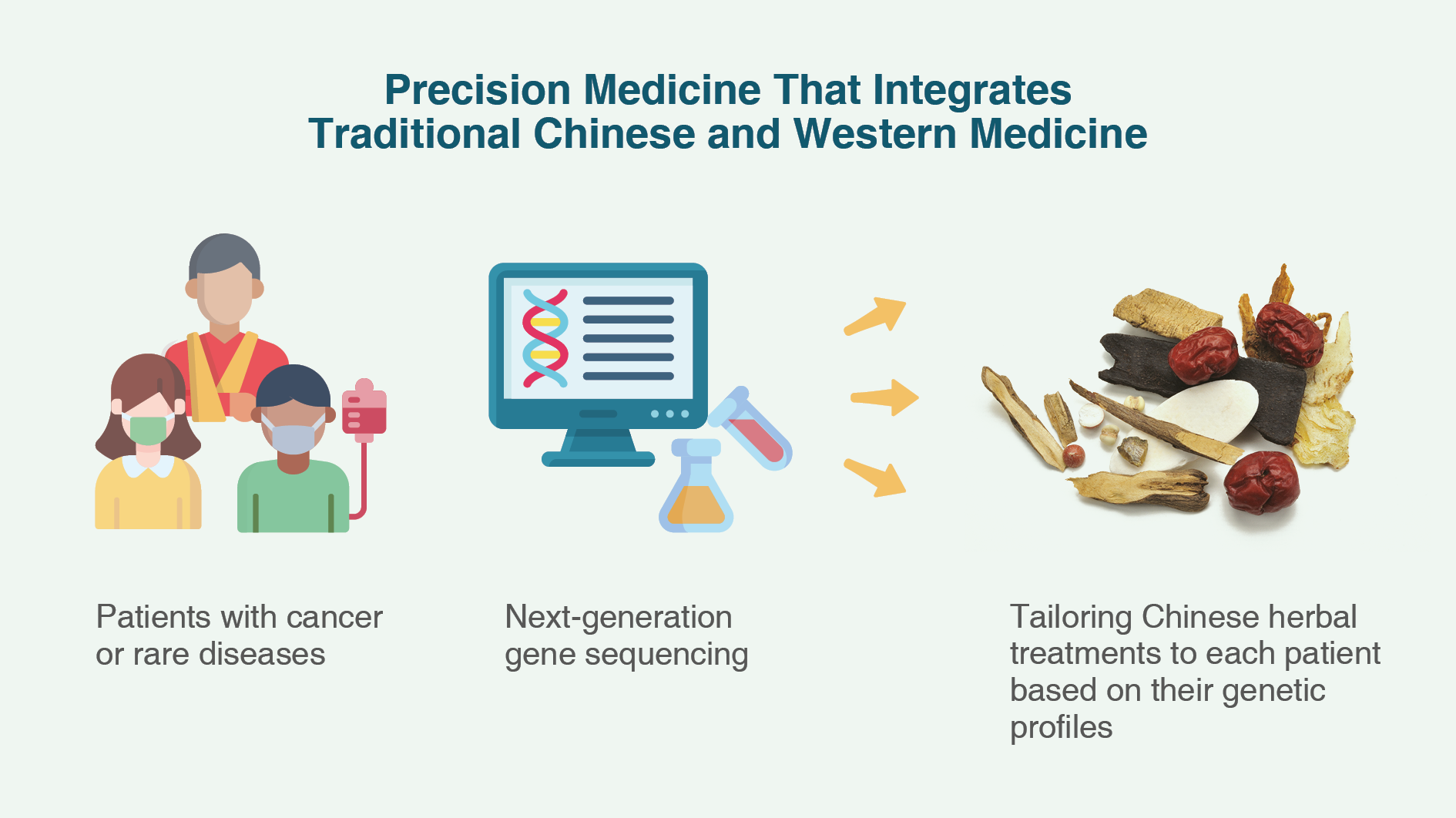
Dr. Lin noted that the precision medicine team at the hospital employs gene testing to clearly identify the causes of diseases and find effective herbal remedies. This approach has produced significant results over the past six months. For adrenoleukodystrophy, Professor Chang has developed a strategy to identify compensatory genes similar to ABCD1. Dr. Lin explained, “We are targeting the normal ABCD2 and ABCD3 genes for therapy, after discovering Chinese herbs that can act on these two genes. Vice Superintendent Ho Tsung-jung [何宗融] has prescribed these herbal remedies to patients, and the effects have been impressive.” Through their collective efforts, the team is overcoming traditional treatment bottlenecks through endogenous stem cell therapy, acupuncture, and herbal treatments.

Precision medicine

Precision medicine employs advanced technologies, such as genetic sequencing, to develop treatment plans tailored to each patient’s genetic profile, thereby improving cure rates and reducing side effects. Dr. Lin pointed out that this approach has evolved into personalized treatment. “By analyzing a patient’s DNA and RNA, we can identify genetic deficiencies and apply the appropriate Western medicines,” he said. “What sets our team at Hualien Tzu Chi Hospital apart is that we’re the only ones in the world using DNA and RNA analysis to pinpoint precise traditional herbal medicines for specific conditions.”

Hualien Tzu Chi Hospital’s commitment to researching traditional Chinese herbal medicine dates back to 2020, during the COVID-19 pandemic. As the outbreak unfolded, Master Cheng Yen pointed out that, in ancient times, when Western medicine was not widely available, people relied on traditional herbal remedies to combat epidemics. She expressed hope that Tzu Chi healthcare professionals would study herbal treatments for the prevention and treatment of COVID-19.

Under Dr. Lin’s leadership, the hospital developed Jing Si Herbal Tea, designed to deliver antiviral, anti-inflammatory, and anti-thrombotic benefits, thereby improving treatment outcomes for patients with mild to moderate COVID-19. The herbal tea can also serve as a daily health supplement. Building on this foundation of research into traditional herbal remedies, the team more recently extracted a small molecule called z-BP from the traditional Chinese herb Angelica sinensis to develop a new drug for malignant brain tumors. Clinical trials conducted on 20 brain cancer patients showed significant tumor reduction just one month after Angelica patches were implanted in their brain.

Reflecting on the public’s fear during the pandemic and the high costs of Western treatments for cancer, degenerative diseases, and rare conditions, Dr. Lin expressed great hope for the integrated precision medicine efforts at the hospital: “By drawing on Professor Chang’s expertise, we believe traditional Chinese medicine can also play a role in combating cancer and aging, offering patients renewed hope in their healing journey.”

In the realm of innovative treatments, Dr. Lin Shinn-rong stands out as the first in Taiwan to successfully transplant embryonic neural stem cells into Parkinson’s disease patients. He is also a global pioneer in using autologous peripheral blood stem cells for stroke treatment: “In the case of Parkinson’s disease, each person’s DNA and RNA variations are unique, necessitating tailored herbal treatments.”

While Western medicine and traditional Chinese medicine approach the diagnosis and treatment of diseases differently, integrating them can leverage advanced technologies—such as genetic sequencing—to analyze the characteristics of a particular disease and subsequently identify suitable herbal remedies. This integration is especially critical for rare genetic diseases, where small patient populations and limited treatment options pose significant challenges. Meanwhile, cancer presents a complex condition with its hundreds of genetic mutations, calling for a multifaceted approach.

Ho Tsung-jung, vice superintendent of Hualien Tzu Chi Hospital and director of the Traditional Chinese Medicine Department, pointed out that, unlike Western medicine, there is no comprehensive database with information for traditional Chinese herbal remedies. Instead, the team must rely on the expertise of genetic researchers to identify precise herbal remedies.

Although Chinese herbal medicine has a rich history and is generally considered safe, each herb contains a variety of compounds. To fully understand how these medicines work, researchers need to analyze them in a manner similar to Western medicines. Chang Jan-gowth emphasized that the herbal medicine database is still incomplete and expressed his hope to develop a comprehensive one for Taiwan.

Chang Jan-gowth is a leading authority on whole-genome analysis in Taiwan, using next-generation gene sequencing to develop more effective treatment options for patients.

From illness to rebirth

In the past six months, a remarkable example of the successful integration of traditional Chinese and Western medicine at Hualien Tzu Chi Hospital involved a 39-year-old patient from Hong Kong. Once an accomplished athlete in fencing and swimming, he was diagnosed in 2016 with amyotrophic lateral sclerosis—better known as ALS or Lou Gehrig’s disease. This progressive neurodegenerative disease left him unable to even lift his hands and reliant on a ventilator for survival.

In March of this year, he began treatment at Hualien Tzu Chi Hospital. A team of medical professionals began providing precision care that combines traditional Chinese and Western practices. The team includes Dr. Lin, Dr. Ho, Professor Chang, Neurosurgery Department Director Tsai Sheng-tzung (蔡昇宗), and Vice Director of the Traditional Chinese Medicine Preventive Medicine Center Chen Jhong-kuei (陳中奎). Their approach incorporates acupuncture, herbal medicine, endogenous stem cell therapy, adipose-derived stem cell treatment, and a personalized rehabilitation program. Within five months, the patient experienced obvious improvements in grip strength, enabling him to lift his phone and drink water independently.

Another inspiring story comes from Tu Bo-yu, the patient mentioned at the beginning of this article. In September, his mother, Liao Xing-jun (廖幸君), shared that after six months of treatment, her son had rediscovered his passion for painting and singing. His ability to create art, sing, and engage in limited movements greatly improved his quality of life, leaving everyone in awe.

Reflecting on this journey, Liao recounted the unpredictability of her son’s condition after he fell ill. “One minute he could walk, and the next, he was completely paralyzed,” she said. “I often wondered if I’d wake up to see him alive!” Remembering the difficult days when his lung condition worsened and he struggled with a lack of appetite and could only communicate in fragments, she said, “Now, seeing him speak fluently and draw makes me want to cry. Before, I cried because of his illness; now I cry out of joy.”

Since his diagnosis, Tu Bo-yu has used social media to share his experiences, raising awareness about his rare condition and encouraging others facing similar challenges to find their strength. Dr. Lin Shinn-rong has been a source of encouragement, reminding him that there are still many things he can accomplish in life and urging him to keep striving, helping to instill hope in those who feel hopeless.

Liao expressed her deep gratitude, saying, “My son shares that while falling ill was unfortunate, he has met many kind people along the way, making him feel like the luckiest person. I am truly grateful to the medical team; meeting you all has been such a blessing!”

By Zhang Li-yun
Translated by Wu Hsiao-ting
Photos by Li Yan-shu

Hualien Tzu Chi Hospital provides precision medicine that integrates both traditional Chinese and Western medical practices for the effective treatment of severe and challenging conditions.

Tu Bo-yu (seated), a patient receiving precision medicine that integrates traditional Chinese and Western treatments, has made good progress under the care of Lin Shinn-zong (fifth from left), Chang Jan-gowth (third from left), and Ho Tsung-jung (second from left).

In March 2024, 23-year-old Tu Bo-yu (涂博俞) was admitted to Hualien Tzu Chi Hospital in eastern Taiwan with a diagnosis of adrenomyeloneuropathy—a form of adrenoleukodystrophy, a rare genetic disorder that poses significant treatment challenges. His symptoms included bladder and bowel dysfunction, as well as paralysis below the chest. Lorenzo’s oil has traditionally been used to manage symptoms, but recent advancements in gene therapy are now being explored. However, such treatment remains prohibitively expensive, and its efficacy is still under evaluation.

Adrenoleukodystrophy is caused by mutations in the ABCD1 gene, leading to the build-up of very long chain fatty acids. Dr. Lin Shinn-zong (林欣榮), superintendent of Hualien Tzu Chi Hospital and a specialist in neuroscience and neurosurgery, explained, “These fatty acids disrupt the myelin sheath’s role in conducting nerve signals, preventing messages from the brain from reaching the hands and feet. Patients can deteriorate rapidly and may not survive for long.”

Faced with this complex neurodegenerative disease, Dr. Lin has been actively seeking solutions. “Master Cheng Yen often reminds us that all forms of life in the world are interconnected and imbued with a life force,” he said. “For every illness, nature offers a remedy. Since Western medicine has its limitations, we have enlisted the help of traditional Chinese herbal medicine while using molecular biology to explore methods that may help break down these fatty acids. Professor Chang Jan-gowth [張建國], an expert in next-generation whole-genome analysis, has been providing invaluable insights.”

In mid-February 2024, Taiwan’s Ministry of Health and Welfare announced plans to include next-generation genome sequencing testing in National Health Insurance coverage. Following this announcement, Hualien Tzu Chi Hospital established a molecular tumor committee on February 21. The committee combines multiple specialties from both Western and traditional Chinese medicine to provide more precise treatments for patients with cancer and rare diseases. The committee is chaired by Dr. Lin, with Professor Chang serving as vice chair. Professor Chang specializes in genetic diagnostics and in applying traditional Chinese medicine to cancer treatment.

Dr. Lin noted that the precision medicine team at the hospital employs gene testing to clearly identify the causes of diseases and find effective herbal remedies. This approach has produced significant results over the past six months. For adrenoleukodystrophy, Professor Chang has developed a strategy to identify compensatory genes similar to ABCD1. Dr. Lin explained, “We are targeting the normal ABCD2 and ABCD3 genes for therapy, after discovering Chinese herbs that can act on these two genes. Vice Superintendent Ho Tsung-jung [何宗融] has prescribed these herbal remedies to patients, and the effects have been impressive.” Through their collective efforts, the team is overcoming traditional treatment bottlenecks through endogenous stem cell therapy, acupuncture, and herbal treatments.

Precision medicine

Precision medicine employs advanced technologies, such as genetic sequencing, to develop treatment plans tailored to each patient’s genetic profile, thereby improving cure rates and reducing side effects. Dr. Lin pointed out that this approach has evolved into personalized treatment. “By analyzing a patient’s DNA and RNA, we can identify genetic deficiencies and apply the appropriate Western medicines,” he said. “What sets our team at Hualien Tzu Chi Hospital apart is that we’re the only ones in the world using DNA and RNA analysis to pinpoint precise traditional herbal medicines for specific conditions.”

Hualien Tzu Chi Hospital’s commitment to researching traditional Chinese herbal medicine dates back to 2020, during the COVID-19 pandemic. As the outbreak unfolded, Master Cheng Yen pointed out that, in ancient times, when Western medicine was not widely available, people relied on traditional herbal remedies to combat epidemics. She expressed hope that Tzu Chi healthcare professionals would study herbal treatments for the prevention and treatment of COVID-19.

Under Dr. Lin’s leadership, the hospital developed Jing Si Herbal Tea, designed to deliver antiviral, anti-inflammatory, and anti-thrombotic benefits, thereby improving treatment outcomes for patients with mild to moderate COVID-19. The herbal tea can also serve as a daily health supplement. Building on this foundation of research into traditional herbal remedies, the team more recently extracted a small molecule called z-BP from the traditional Chinese herb Angelica sinensis to develop a new drug for malignant brain tumors. Clinical trials conducted on 20 brain cancer patients showed significant tumor reduction just one month after Angelica patches were implanted in their brain.

Reflecting on the public’s fear during the pandemic and the high costs of Western treatments for cancer, degenerative diseases, and rare conditions, Dr. Lin expressed great hope for the integrated precision medicine efforts at the hospital: “By drawing on Professor Chang’s expertise, we believe traditional Chinese medicine can also play a role in combating cancer and aging, offering patients renewed hope in their healing journey.”

In the realm of innovative treatments, Dr. Lin Shinn-rong stands out as the first in Taiwan to successfully transplant embryonic neural stem cells into Parkinson’s disease patients. He is also a global pioneer in using autologous peripheral blood stem cells for stroke treatment: “In the case of Parkinson’s disease, each person’s DNA and RNA variations are unique, necessitating tailored herbal treatments.”

While Western medicine and traditional Chinese medicine approach the diagnosis and treatment of diseases differently, integrating them can leverage advanced technologies—such as genetic sequencing—to analyze the characteristics of a particular disease and subsequently identify suitable herbal remedies. This integration is especially critical for rare genetic diseases, where small patient populations and limited treatment options pose significant challenges. Meanwhile, cancer presents a complex condition with its hundreds of genetic mutations, calling for a multifaceted approach.

Ho Tsung-jung, vice superintendent of Hualien Tzu Chi Hospital and director of the Traditional Chinese Medicine Department, pointed out that, unlike Western medicine, there is no comprehensive database with information for traditional Chinese herbal remedies. Instead, the team must rely on the expertise of genetic researchers to identify precise herbal remedies.

Although Chinese herbal medicine has a rich history and is generally considered safe, each herb contains a variety of compounds. To fully understand how these medicines work, researchers need to analyze them in a manner similar to Western medicines. Chang Jan-gowth emphasized that the herbal medicine database is still incomplete and expressed his hope to develop a comprehensive one for Taiwan.

Chang Jan-gowth is a leading authority on whole-genome analysis in Taiwan, using next-generation gene sequencing to develop more effective treatment options for patients.

From illness to rebirth

In the past six months, a remarkable example of the successful integration of traditional Chinese and Western medicine at Hualien Tzu Chi Hospital involved a 39-year-old patient from Hong Kong. Once an accomplished athlete in fencing and swimming, he was diagnosed in 2016 with amyotrophic lateral sclerosis—better known as ALS or Lou Gehrig’s disease. This progressive neurodegenerative disease left him unable to even lift his hands and reliant on a ventilator for survival.

In March of this year, he began treatment at Hualien Tzu Chi Hospital. A team of medical professionals began providing precision care that combines traditional Chinese and Western practices. The team includes Dr. Lin, Dr. Ho, Professor Chang, Neurosurgery Department Director Tsai Sheng-tzung (蔡昇宗), and Vice Director of the Traditional Chinese Medicine Preventive Medicine Center Chen Jhong-kuei (陳中奎). Their approach incorporates acupuncture, herbal medicine, endogenous stem cell therapy, adipose-derived stem cell treatment, and a personalized rehabilitation program. Within five months, the patient experienced obvious improvements in grip strength, enabling him to lift his phone and drink water independently.

Another inspiring story comes from Tu Bo-yu, the patient mentioned at the beginning of this article. In September, his mother, Liao Xing-jun (廖幸君), shared that after six months of treatment, her son had rediscovered his passion for painting and singing. His ability to create art, sing, and engage in limited movements greatly improved his quality of life, leaving everyone in awe.

Reflecting on this journey, Liao recounted the unpredictability of her son’s condition after he fell ill. “One minute he could walk, and the next, he was completely paralyzed,” she said. “I often wondered if I’d wake up to see him alive!” Remembering the difficult days when his lung condition worsened and he struggled with a lack of appetite and could only communicate in fragments, she said, “Now, seeing him speak fluently and draw makes me want to cry. Before, I cried because of his illness; now I cry out of joy.”

Since his diagnosis, Tu Bo-yu has used social media to share his experiences, raising awareness about his rare condition and encouraging others facing similar challenges to find their strength. Dr. Lin Shinn-rong has been a source of encouragement, reminding him that there are still many things he can accomplish in life and urging him to keep striving, helping to instill hope in those who feel hopeless.

Liao expressed her deep gratitude, saying, “My son shares that while falling ill was unfortunate, he has met many kind people along the way, making him feel like the luckiest person. I am truly grateful to the medical team; meeting you all has been such a blessing!”

關鍵字

Words From Dharma Master Cheng Yen—Transforming Hearts for a Better World

Translated by Teresa Chang

With autumn ending and winter approaching, each shorter day reminds us of time’s fleeting nature. Life is brief, but the best way to counter this brevity is by making the most of every moment. Whether it’s through completing a meaningful task or acting on a generous thought, every positive action brings its own reward—in giving, we ultimately receive.

Our hearts are fields of spiritual cultivation. Everyone we encounter is a fellow cultivator, playing a role in our collective journey. Therefore, we should care for one another with gratitude. Even when someone irritates us or we struggle to get along, we must strive to transform those feelings into positivity, as this is essential for our spiritual growth. By doing so, we can better focus our minds and cultivate wisdom. Each person we meet can aid in our cultivation and has the potential to attain buddhahood; let us never underestimate anyone and always cherish those around us.

Taming our wants and desires also aids in our spiritual cultivation, as it helps free our minds from attachments. Society is evolving, and one generation inevitably gives way to the next. Lifestyles and values have shifted from the past. I remember when people led simpler and often more impoverished lives, content with basic meals of rice and vegetables. Today, there is access to a far wider variety of foods, yet many still feel unsatisfied. This extends beyond food to clothing, housing, and transportation, but the desire for “more” and “better” has placed increasing demands on the Earth’s resources.

Many people center their lives around their desires—small wishes for ordinary people and grand ambitions for those in power. Some seem to stop at nothing to get what they want. Moreover, what they have is never enough; they always seek something better, leaving little room for satisfaction. Their hearts cannot find peace in this way. It’s akin to a desert under a scorching sun: no matter how much water is poured onto the sand, the parched earth remains unquenched.

Desires and wants often lead to competition. People vie with one another to get more, while nations engage in rivalries that can destabilize societies. Though natural disasters may cause temporary upheaval, the impact of conflicts and wars can persist indefinitely. Even the wealthy are not immune. Even those with abundant possessions may be forced to abandon everything and flee in times of conflict. Each time I see refugees struggling in forgotten corners of the world, my heart aches—where is their home? Their plight weighs heavily on me.

We humans are arguably the most intelligent of all beings. While we can create unrest, we also possess the power to bring peace to the world. If our hearts and minds stray from the right path, we cannot be a blessing for society or humanity. We must take good care of our hearts and minds, for even a few misguided words can lead to tragedy.

Everyone has their own perspectives. Even within the same family, siblings born to the same parents can hold different views. When a family cannot live in harmony, parents are burdened with worry. The same dynamics present in small dysfunctional families can likewise be found in larger communities: if individuals refuse to consider others’ perspectives and take on confrontational attitudes, conflicts will multiply, resulting in more strife.

Looking back at history, whether one brings happiness or misfortune to others, whether one benefits or harms society, can often be determined by a single thought. Religion serves as a guide, elevating our thoughts and harmonizing our hearts, providing a unified direction. Goodness and love are the common threads woven through all religions. Whatever faith one follows, it is essential to respect and appreciate one another. Unity among different faiths is crucial for realizing a harmonious world.

The sufferings in this world are endless and cannot be fully expressed. In addition to man-made disasters, drastic changes in climate have intensified natural disasters. Yet, whether these disasters are caused by human actions or natural forces, they ultimately track back to the human heart. When people’s minds are unbalanced and driven by selfishness and greed, the world becomes filled with negativity, leading to disasters. Conversely, people sow blessings when they act out of kindness and altruism. These accumulated blessings create a protective layer over the planet.

Our world needs us to inspire more people to activate their innate love, guide them onto the right path, and unite the positive energies of all religions. Let us focus on all that can dispel harmful influences, promote goodness, and bring peace to the world. Please be ever more mindful.

Dharma Master Cheng Yen encourages us to care for and appreciate even those who irritate us or with whom we struggle to get along, as everyone contributes to our cultivation. Huang Xiao-zhe

Translated by Teresa Chang

With autumn ending and winter approaching, each shorter day reminds us of time’s fleeting nature. Life is brief, but the best way to counter this brevity is by making the most of every moment. Whether it’s through completing a meaningful task or acting on a generous thought, every positive action brings its own reward—in giving, we ultimately receive.

Our hearts are fields of spiritual cultivation. Everyone we encounter is a fellow cultivator, playing a role in our collective journey. Therefore, we should care for one another with gratitude. Even when someone irritates us or we struggle to get along, we must strive to transform those feelings into positivity, as this is essential for our spiritual growth. By doing so, we can better focus our minds and cultivate wisdom. Each person we meet can aid in our cultivation and has the potential to attain buddhahood; let us never underestimate anyone and always cherish those around us.

Taming our wants and desires also aids in our spiritual cultivation, as it helps free our minds from attachments. Society is evolving, and one generation inevitably gives way to the next. Lifestyles and values have shifted from the past. I remember when people led simpler and often more impoverished lives, content with basic meals of rice and vegetables. Today, there is access to a far wider variety of foods, yet many still feel unsatisfied. This extends beyond food to clothing, housing, and transportation, but the desire for “more” and “better” has placed increasing demands on the Earth’s resources.

Many people center their lives around their desires—small wishes for ordinary people and grand ambitions for those in power. Some seem to stop at nothing to get what they want. Moreover, what they have is never enough; they always seek something better, leaving little room for satisfaction. Their hearts cannot find peace in this way. It’s akin to a desert under a scorching sun: no matter how much water is poured onto the sand, the parched earth remains unquenched.

Desires and wants often lead to competition. People vie with one another to get more, while nations engage in rivalries that can destabilize societies. Though natural disasters may cause temporary upheaval, the impact of conflicts and wars can persist indefinitely. Even the wealthy are not immune. Even those with abundant possessions may be forced to abandon everything and flee in times of conflict. Each time I see refugees struggling in forgotten corners of the world, my heart aches—where is their home? Their plight weighs heavily on me.

We humans are arguably the most intelligent of all beings. While we can create unrest, we also possess the power to bring peace to the world. If our hearts and minds stray from the right path, we cannot be a blessing for society or humanity. We must take good care of our hearts and minds, for even a few misguided words can lead to tragedy.

Everyone has their own perspectives. Even within the same family, siblings born to the same parents can hold different views. When a family cannot live in harmony, parents are burdened with worry. The same dynamics present in small dysfunctional families can likewise be found in larger communities: if individuals refuse to consider others’ perspectives and take on confrontational attitudes, conflicts will multiply, resulting in more strife.

Looking back at history, whether one brings happiness or misfortune to others, whether one benefits or harms society, can often be determined by a single thought. Religion serves as a guide, elevating our thoughts and harmonizing our hearts, providing a unified direction. Goodness and love are the common threads woven through all religions. Whatever faith one follows, it is essential to respect and appreciate one another. Unity among different faiths is crucial for realizing a harmonious world.

The sufferings in this world are endless and cannot be fully expressed. In addition to man-made disasters, drastic changes in climate have intensified natural disasters. Yet, whether these disasters are caused by human actions or natural forces, they ultimately track back to the human heart. When people’s minds are unbalanced and driven by selfishness and greed, the world becomes filled with negativity, leading to disasters. Conversely, people sow blessings when they act out of kindness and altruism. These accumulated blessings create a protective layer over the planet.

Our world needs us to inspire more people to activate their innate love, guide them onto the right path, and unite the positive energies of all religions. Let us focus on all that can dispel harmful influences, promote goodness, and bring peace to the world. Please be ever more mindful.

Dharma Master Cheng Yen encourages us to care for and appreciate even those who irritate us or with whom we struggle to get along, as everyone contributes to our cultivation. Huang Xiao-zhe

關鍵字

千年の病苦を見つめる

目の病気を抱えて、インド・ブッダガヤから戻った。眼科医から、長時間強い紫外線が当たる場所にいたことで起きた疾患だと言われた。たったの一カ月で、このような病気になったのだ。そこで生まれ育った現地の人は、どうしているのだろう?現地に一年半も滞在している年配の師兄師姐(慈済ボランティアの呼称)たちは、どうなのだろうか?

月刊誌『慈済』のカメラマンという仕事は、「郷に入っては郷に従え」で現地の人々と打ち解け、言葉の壁や文化の隔たりを取り除き、人と人の距離を縮める不二法門にあたる。(撮影・楊文輝)

一九八〇年代に大学を卒業し、同級生から記念に一冊の翻訳小説をもらった。ドイツの作家ヘルマン・ヘッセが著作したこの『シッダールタ』を数ページ読んでみたが、何も感じるものはなかった。時が流れ、何度も引っ越しをしたことで、本はどこへいったのか分からなくなった。

二〇二四年三月初め、私は仕事でインド・ブッダガヤを訪れた。一般人からすれば、余り聞き慣れない名前だが、仏教徒にとって、ブッダガヤは聖地である。二千五百年余り前、ブッダはここで成道したのだ。各国の仏教団体は今でもそこに道場や連絡所を設けており、慈済も二〇二三年にその地に連絡拠点を設立した。私は慈済人の活動内容を記録し、映像によって慈済の足跡を歴史に刻む任務を担った。

撮影任務は三月いっぱいまで続き、その後は帰国した。仕事が終わる頃、目に違和感を覚え始めた。黒目と白目の間に小さく膨らんだ白い点があるだけだったが、まばたきする度に、まぶたがその膨らんだ白い点と擦れて、とても不快だった。帰国して直ぐ病院で診察してもらった結果、眼科医から「翼状片」と診断された。長時間紫外線の強い場所での活動によって引き起こされ、熱帯地方の人が最も罹りやすい眼疾患だと言う。

医師は、翼状片は元に戻すことはできず、薬で取り除くこともできず、炎症を止めるだけで、悪化を防止するしかない、と言った。仮に悪化した場合は、手術で取り除くしかないが、再発しないとは保証できない。先ず一週間点眼し、もし白い点がまぶたの開閉に影響しなければ、再診する必要はなく、症状と平和裏に共存することになる。

五ミリリットルの目薬をもらった帰り道、自分はインドには一カ月しか滞在してなかったのにこのような病気に罹ったが、そこで生まれ育った現地の人々はどうしているのだろうと思った。そういう疑問を携えていたので、帰宅するや否やパソコンを起動し、インドで撮影した数万枚の画像ファイルを一心不乱にチェックすることにした。

賑やかに栄えたガヤ市街地の交差点は交通量が多く、電動三輪タクシーやバイク、貨物を満載した三輪車の他、歩行者がひっきりなしに行き交い、我先にと道を通り、容易でない日常の浮世絵を描き出していた。

仏教遺跡の入り口にいる人々

想像通り、画像の中には数多くの現地の人の状況が映っており、その症状が現れていた。一目で分かる眼疾患は白内障、翼状片、失明などで、程度が異なる身体障害や栄養失調等も見られた。最もこれらの疾患がある人々に遭遇し易い場所は、各仏教遺跡の入り口で、彼らは寄り集まって聖地巡礼者や観光客に物乞いをしていた。この点は理解に難くなく、本人の身体障害のみならず、カースト階級において最も底辺に属する彼らは、仏教徒は世の人を憐れみ、慈悲深いと思っているからだ。

インドに滞在した一カ月間、頻繁に仏教遺跡を出入りし、入り口の物乞いとすれ違っていた。友人は、慈悲には智慧が必要であり、焼け石に水では問題を解決できないので、施しをしないように、と再三注意してくれた。友人の言うことはもっともなので、私はその原則を守っていた。しかし、ある日の早朝、ラージギルの霊鷲山で任務を終えて下山し、車に戻った時、一人の痩せこけた女性が両眼を失明した若い人を連れて、車の窓の前まで来て卑しい表情を浮かべ、渇望する眼差しであの乾いた両手を差し出した。その刹那視線が合い、なぜか心が揺さぶられ、一瞬脳裏にアメリカの一世代前の写真家、スティーヴ・マッカリーの或る作品を思い出した。雨の日のインドで車内から外を撮影している時に、一人の女性が子どもを抱いて濡れたまま車のドアの側まで来て何かを求めて手を差し出した様子を写した作品だ……。

私は急いで手をポケットに入れ、このような現地の社会の底辺にいる人々の生活を描写するリアリティーのある場面を、ささやかな心付けで交換しようと思った。しかし、時はすでに遅く、インド人のドライバーはすでに車を発進させてしまった。急いで止めてもらったが、車はすでに移動していた。私は窓を開け、気持ちだけのものを与えると、婦人はそれを受け取り、感謝の気持ちを表したが、失明した男性を連れて、ふらふらした足取りで背を向けて離れて行った。私の企みは失敗した。私は自分のことを硬骨漢だと思っていたが、実のところ、自分の骨には、気づかないくらい小さな優しさが隠れていたのだと、ふと気づいた。

朝日が差す時刻、粗末な手作りの木造の手押し車に横たわった1人の重度障害の子どもが、マハーボディ寺院の前で、善意の人による布施を待っていた。ここで生計を立てるのは容易ではないが、障害者は尚更だ。

慈済が定義する福田

仏典の記載によれば、シッダールタ王子は城を出た時、老人や病人、死者、修行者に出会い、人間(じんかん)の生老病死の苦しみを深く感じ、人生の離苦(りく)の道を考え始めたとある。苦心して長く瞑想しても悟ることができず、やがて月が出た或る晩に、馬に乗って家を離れ、修行の道に入った。最後は転々とした挙句、ブッダガヤで悟りを開いて仏陀となった。

時が過ぎれば、当時の人間(じんかん)の苦しみを知ることはできないが、二千年余り後の今日、仏陀が生活していた空間で、一カ月間見聞きし、触れた生活体験を仏教の歴史記述に照らし合わせると、私の独断的な推測だが、社会の底辺に生きている現地の人々の条件は、さほど大きく変化していないのではないかと考えられる。例えば生活面では、まだ改善する余地が大いにある。慈済の語彙が定義するこの空間は、即ち福田である。空間が大きければ大きいほど、福田も大きいのだ。

慈済のブッダガヤでの活動は、主にシンガポールとマレーシアの師兄師姐が責任を持って行っている。この平均年齢が五十歳前後の慈済人グループには、七十才を超えた人もおり、彼らは食事と宿泊代を自費で負担して、一、二カ月滞在する人もいれば、四、五カ月滞在する人もいる。中にはインドのビザが切れたらシンガポールやマレーシアに帰国するか、隣国のネパールに数日間行って戻って来る人もおり、この広大な福田で、精一杯黙々と奉仕を続けている。

彼らは、地方に行って公衆衛生を推し進め、健康診断サービスを提供し、禁酒を勧めている。また、貧困世帯を訪問し、彼らの生活に関心を寄せ、大愛村を建て、学校を訪問して教育において何が不足しているかという聞き取りを行っている。裁縫クラス、パソコンクラス、英語クラスを開設し、微力ながら尽力することで、現地の社会的弱者層の長い間手のひらを上にしていたライフスタイルが変わって欲しいと切に願っている。

慈済は失明したソニさんに1万ルピー(約17000円)の手術費を支援して、眼部の苦痛を解決した。シンガポールから来た慈済人医師会ボランティアの陳秀珠さんらは再診に付き添い、彼女が手術後に最良のケアを得られるよう、眼科医と相談した。

自ら参加することで感じられる

まるで影のように、私は毎日師兄師姐たちの外出に同行し、奔走した。眼疾患があるケア対象者の診察に付き添ったり、体に合う杖を探す障害者を関連の店へ連れて行ったり、大愛村の工事の進捗状況を見に行ったり、学校に赴いて学生の学習状況を理解したり、仏教遺跡の巡礼に同行したりした。

転々と一カ月間過ごして帰国したが、上述した翼状片が見つかった時は、一年ほど滞在している年配の師兄や師姐はどうしているだろうかと案じた。

また、ある友人には、あなたたち慈済人はなぜあのような所に行って、割の合わないことをしているのかと尋ねられた。私は彼ら本人ではないので、代弁することはできないが、現実にこの職場で半世紀を過ごして彼らと共に仕事をこなしながら私が得た体験は、楽しいものだった。というのも、彼らは名利でも生活のためでもなく、そのような現実に左右されず、皆で心を一つにして互いに協力し、純粋に奉仕したいだけなのだ。さらに宗教の心情がもたらす信念によって、彼らはすればするほど法悦に満ちているのである。

それから、師兄師姐たちが遠路はるばるここに来て行っているのは、錦上に花を添えようとしているのではなく、雪中に炭を送っているのであり、対象は助けを必要としている人々なのである。無私の奉仕をすれば、相手も誠意で以て応え、あなたを家族とみなしてくれる。このような関係や感覚は、そこに参加するチャンスがなければ、肌で感じられないものである。

正直に言うと、ブッダの故郷で慈済志業を行っている師兄師姐たちは、実のところ、幸福だ。ここはブッダが成道した場所であり、仏教の発祥地なのだから。人々はここで、二千年余りも仏教の済世を旨とする精神を受け継いできたのだ。他の場所と比べて意義深いと言えるのではないだろうか。

(慈済月刊六九二期より)

目の病気を抱えて、インド・ブッダガヤから戻った。眼科医から、長時間強い紫外線が当たる場所にいたことで起きた疾患だと言われた。たったの一カ月で、このような病気になったのだ。そこで生まれ育った現地の人は、どうしているのだろう?現地に一年半も滞在している年配の師兄師姐(慈済ボランティアの呼称)たちは、どうなのだろうか?

月刊誌『慈済』のカメラマンという仕事は、「郷に入っては郷に従え」で現地の人々と打ち解け、言葉の壁や文化の隔たりを取り除き、人と人の距離を縮める不二法門にあたる。(撮影・楊文輝)

一九八〇年代に大学を卒業し、同級生から記念に一冊の翻訳小説をもらった。ドイツの作家ヘルマン・ヘッセが著作したこの『シッダールタ』を数ページ読んでみたが、何も感じるものはなかった。時が流れ、何度も引っ越しをしたことで、本はどこへいったのか分からなくなった。

二〇二四年三月初め、私は仕事でインド・ブッダガヤを訪れた。一般人からすれば、余り聞き慣れない名前だが、仏教徒にとって、ブッダガヤは聖地である。二千五百年余り前、ブッダはここで成道したのだ。各国の仏教団体は今でもそこに道場や連絡所を設けており、慈済も二〇二三年にその地に連絡拠点を設立した。私は慈済人の活動内容を記録し、映像によって慈済の足跡を歴史に刻む任務を担った。

撮影任務は三月いっぱいまで続き、その後は帰国した。仕事が終わる頃、目に違和感を覚え始めた。黒目と白目の間に小さく膨らんだ白い点があるだけだったが、まばたきする度に、まぶたがその膨らんだ白い点と擦れて、とても不快だった。帰国して直ぐ病院で診察してもらった結果、眼科医から「翼状片」と診断された。長時間紫外線の強い場所での活動によって引き起こされ、熱帯地方の人が最も罹りやすい眼疾患だと言う。

医師は、翼状片は元に戻すことはできず、薬で取り除くこともできず、炎症を止めるだけで、悪化を防止するしかない、と言った。仮に悪化した場合は、手術で取り除くしかないが、再発しないとは保証できない。先ず一週間点眼し、もし白い点がまぶたの開閉に影響しなければ、再診する必要はなく、症状と平和裏に共存することになる。

五ミリリットルの目薬をもらった帰り道、自分はインドには一カ月しか滞在してなかったのにこのような病気に罹ったが、そこで生まれ育った現地の人々はどうしているのだろうと思った。そういう疑問を携えていたので、帰宅するや否やパソコンを起動し、インドで撮影した数万枚の画像ファイルを一心不乱にチェックすることにした。

賑やかに栄えたガヤ市街地の交差点は交通量が多く、電動三輪タクシーやバイク、貨物を満載した三輪車の他、歩行者がひっきりなしに行き交い、我先にと道を通り、容易でない日常の浮世絵を描き出していた。

仏教遺跡の入り口にいる人々

想像通り、画像の中には数多くの現地の人の状況が映っており、その症状が現れていた。一目で分かる眼疾患は白内障、翼状片、失明などで、程度が異なる身体障害や栄養失調等も見られた。最もこれらの疾患がある人々に遭遇し易い場所は、各仏教遺跡の入り口で、彼らは寄り集まって聖地巡礼者や観光客に物乞いをしていた。この点は理解に難くなく、本人の身体障害のみならず、カースト階級において最も底辺に属する彼らは、仏教徒は世の人を憐れみ、慈悲深いと思っているからだ。

インドに滞在した一カ月間、頻繁に仏教遺跡を出入りし、入り口の物乞いとすれ違っていた。友人は、慈悲には智慧が必要であり、焼け石に水では問題を解決できないので、施しをしないように、と再三注意してくれた。友人の言うことはもっともなので、私はその原則を守っていた。しかし、ある日の早朝、ラージギルの霊鷲山で任務を終えて下山し、車に戻った時、一人の痩せこけた女性が両眼を失明した若い人を連れて、車の窓の前まで来て卑しい表情を浮かべ、渇望する眼差しであの乾いた両手を差し出した。その刹那視線が合い、なぜか心が揺さぶられ、一瞬脳裏にアメリカの一世代前の写真家、スティーヴ・マッカリーの或る作品を思い出した。雨の日のインドで車内から外を撮影している時に、一人の女性が子どもを抱いて濡れたまま車のドアの側まで来て何かを求めて手を差し出した様子を写した作品だ……。

私は急いで手をポケットに入れ、このような現地の社会の底辺にいる人々の生活を描写するリアリティーのある場面を、ささやかな心付けで交換しようと思った。しかし、時はすでに遅く、インド人のドライバーはすでに車を発進させてしまった。急いで止めてもらったが、車はすでに移動していた。私は窓を開け、気持ちだけのものを与えると、婦人はそれを受け取り、感謝の気持ちを表したが、失明した男性を連れて、ふらふらした足取りで背を向けて離れて行った。私の企みは失敗した。私は自分のことを硬骨漢だと思っていたが、実のところ、自分の骨には、気づかないくらい小さな優しさが隠れていたのだと、ふと気づいた。

朝日が差す時刻、粗末な手作りの木造の手押し車に横たわった1人の重度障害の子どもが、マハーボディ寺院の前で、善意の人による布施を待っていた。ここで生計を立てるのは容易ではないが、障害者は尚更だ。

慈済が定義する福田

仏典の記載によれば、シッダールタ王子は城を出た時、老人や病人、死者、修行者に出会い、人間(じんかん)の生老病死の苦しみを深く感じ、人生の離苦(りく)の道を考え始めたとある。苦心して長く瞑想しても悟ることができず、やがて月が出た或る晩に、馬に乗って家を離れ、修行の道に入った。最後は転々とした挙句、ブッダガヤで悟りを開いて仏陀となった。

時が過ぎれば、当時の人間(じんかん)の苦しみを知ることはできないが、二千年余り後の今日、仏陀が生活していた空間で、一カ月間見聞きし、触れた生活体験を仏教の歴史記述に照らし合わせると、私の独断的な推測だが、社会の底辺に生きている現地の人々の条件は、さほど大きく変化していないのではないかと考えられる。例えば生活面では、まだ改善する余地が大いにある。慈済の語彙が定義するこの空間は、即ち福田である。空間が大きければ大きいほど、福田も大きいのだ。

慈済のブッダガヤでの活動は、主にシンガポールとマレーシアの師兄師姐が責任を持って行っている。この平均年齢が五十歳前後の慈済人グループには、七十才を超えた人もおり、彼らは食事と宿泊代を自費で負担して、一、二カ月滞在する人もいれば、四、五カ月滞在する人もいる。中にはインドのビザが切れたらシンガポールやマレーシアに帰国するか、隣国のネパールに数日間行って戻って来る人もおり、この広大な福田で、精一杯黙々と奉仕を続けている。

彼らは、地方に行って公衆衛生を推し進め、健康診断サービスを提供し、禁酒を勧めている。また、貧困世帯を訪問し、彼らの生活に関心を寄せ、大愛村を建て、学校を訪問して教育において何が不足しているかという聞き取りを行っている。裁縫クラス、パソコンクラス、英語クラスを開設し、微力ながら尽力することで、現地の社会的弱者層の長い間手のひらを上にしていたライフスタイルが変わって欲しいと切に願っている。

慈済は失明したソニさんに1万ルピー(約17000円)の手術費を支援して、眼部の苦痛を解決した。シンガポールから来た慈済人医師会ボランティアの陳秀珠さんらは再診に付き添い、彼女が手術後に最良のケアを得られるよう、眼科医と相談した。

自ら参加することで感じられる

まるで影のように、私は毎日師兄師姐たちの外出に同行し、奔走した。眼疾患があるケア対象者の診察に付き添ったり、体に合う杖を探す障害者を関連の店へ連れて行ったり、大愛村の工事の進捗状況を見に行ったり、学校に赴いて学生の学習状況を理解したり、仏教遺跡の巡礼に同行したりした。

転々と一カ月間過ごして帰国したが、上述した翼状片が見つかった時は、一年ほど滞在している年配の師兄や師姐はどうしているだろうかと案じた。

また、ある友人には、あなたたち慈済人はなぜあのような所に行って、割の合わないことをしているのかと尋ねられた。私は彼ら本人ではないので、代弁することはできないが、現実にこの職場で半世紀を過ごして彼らと共に仕事をこなしながら私が得た体験は、楽しいものだった。というのも、彼らは名利でも生活のためでもなく、そのような現実に左右されず、皆で心を一つにして互いに協力し、純粋に奉仕したいだけなのだ。さらに宗教の心情がもたらす信念によって、彼らはすればするほど法悦に満ちているのである。

それから、師兄師姐たちが遠路はるばるここに来て行っているのは、錦上に花を添えようとしているのではなく、雪中に炭を送っているのであり、対象は助けを必要としている人々なのである。無私の奉仕をすれば、相手も誠意で以て応え、あなたを家族とみなしてくれる。このような関係や感覚は、そこに参加するチャンスがなければ、肌で感じられないものである。

正直に言うと、ブッダの故郷で慈済志業を行っている師兄師姐たちは、実のところ、幸福だ。ここはブッダが成道した場所であり、仏教の発祥地なのだから。人々はここで、二千年余りも仏教の済世を旨とする精神を受け継いできたのだ。他の場所と比べて意義深いと言えるのではないだろうか。

(慈済月刊六九二期より)

關鍵字

Tzu Chi Event Highlights—Aug. 13 to Oct. 24, 2024

Taiwan

Tzu Chi is constructing residences for victims of the April 3 Hualien earthquake. Construction began on September 14, with land provided by the Hualien County Government. The project, expected to be completed by the end of next year, will feature a U-shaped, five-story building with over a hundred units. Earthquake survivors will be able to live there until they get back on their feet, after which the building will be converted into social housing for underprivileged people.

The 2024 Tzu Chi International Medical Association (TIMA) Convention took place from September 15 to 17 at the Jing Si Hall in Hualien, with 327 volunteers from 15 countries and regions participating. Since its establishment 28 years ago, TIMA has organized 18,420 free clinics across 58 countries and regions, totaling over four million patient visits.

Sri Lanka

The Singapore chapter of the Tzu Chi International Medical Association conducted a large-scale free clinic in Sri Lanka from August 23 to 25, providing dental, internal medicine, and traditional Chinese medicine services, as well as optometry and cataract screenings. The clinic saw a total of 4,638 patient visits.

Indonesia

Three hundred households suffered from severe water shortages during the dry season in Nanggulan, Sendangagung, Sleman Regency, in the Special Region of Yogyakarta. Without access to clean water, residents had to buy water to meet their basic needs. To address this issue, Tzu Chi Indonesia, in partnership with the Indonesian Army, the Yogyakarta government, and the Erajaya Group, drilled a well 45 meters (130 feet) deep to access a clean water source. A 6,000-liter water tank was installed above the well for storage. The well was officially inaugurated on September 18.

Japan

Tzu Chi completed five rounds of cash aid distributions in the quake-stricken zone on the Noto Peninsula by early September, benefiting 15,314 households across seven cities and towns. Volunteers contributed 1,437 shifts to support the effort.

Floods hit quake-affected areas on the Noto Peninsula, triggered by heavy rainfall as Tropical Storm Pulasan weakened into a tropical depression. Tzu Chi launched relief efforts in response, including cash-for-work cleanup and assistance with agricultural harvesting from September 21 to October.

Myanmar

Typhoon Yagi weakened into a tropical depression, causing heavy rainfall and flooding in eastern and central Myanmar in September. Over 400 people lost their lives. After assessing damage in Tatkon Township, Naypyidaw Union Territory, Tzu Chi volunteers initiated cash-for-work cleanup efforts and distributed cash aid and relief supply packages in October.

Vietnam

Tzu Chi volunteers conducted disaster assessments in northern Vietnam after torrential rain brought by Typhoon Yagi in September. They are planning to distribute cash aid to more than 2,000 households in Lào Cai and Yên Bái provinces.

Thailand

Typhoon Yagi triggered downpours that severely impacted Chiang Mai and Chiang Rai provinces. In October, Tzu Chi distributed cash aid to 918 households in Chiang Rai, including 139 households in Mueang Chiang Rai and 779 households in Mae Sai. A second round of distributions is scheduled for mid-November. Assessments are also underway to rebuild homes for vulnerable households affected by the disaster in Mae Salong.

Lesotho

Lesotho has faced a severe drought for the past two years, leading to a food security crisis. Since January alone, Tzu Chi’s rice distributions have benefited 7,200 people. In August, distributions reached 1,485 households in Machage and Raliopelo. A total of 300 metric tons (330 short tons) of Taiwanese rice is expected to be distributed this year.

The United States

Hurricane Helene made landfall in Florida on September 27, sweeping across the southeastern United States. Hurricane Milton followed less than two weeks later, causing further devastation. Volunteers evaluated the extent of damage in Tampa, Florida, as well as in Asheville, North Carolina, and plan to distribute aid in November.

Chile

In February, wildfires in central and southern Chile damaged over 10,000 homes. The government deemed the fires the country’s worst disaster since a magnitude 8.8 earthquake in February 2010. Tzu Chi volunteers conducted disaster assessments and partnered with a supermarket to provide shopping vouchers for those affected. Three distribution events were held on September 28 and 29, assisting 2,695 people.

Mozambique

A vocational training center was inaugurated on August 14 in the Metuchira Tzu Chi Great Love Village in Nhamatanda District, Sofala Province, a housing community built by Tzu Chi for survivors of Cyclone Idai. The center offers classes in sewing and knitting, with plans for additional classes in computer skills and agricultural techniques.

Tzu Chi’s first slow sand filter facility outside of Taiwan was inaugurated on August 13 in the Kura Tzu Chi Great Love Village in Nhamatanda District, providing clean water to the village’s residents. The facility was created in partnership with the Taiwan Water Corporation.

Saint Vincent and the Grenadines

Hurricane Beryl ravaged the Caribbean island nation of Saint Vincent and the Grenadines in early July. Ninety percent of homes on Union Island—one of the hardest-hit areas—sustained severe damage. In September, Tzu Chi volunteers from Saint Martin provided cross-border assistance, supporting 1,040 households with food and essential supplies totaling 32 kilograms (70 pounds) per family.

Guatemala

Tzu Chi has been providing long-term support to residents of Chuarrancho, where 90 percent of the population are impoverished farmers. On August 18, volunteers conducted a winter aid distribution in collaboration with the municipal government, supplying items including rice and noodles to 459 families.

Taiwan

Tzu Chi is constructing residences for victims of the April 3 Hualien earthquake. Construction began on September 14, with land provided by the Hualien County Government. The project, expected to be completed by the end of next year, will feature a U-shaped, five-story building with over a hundred units. Earthquake survivors will be able to live there until they get back on their feet, after which the building will be converted into social housing for underprivileged people.

The 2024 Tzu Chi International Medical Association (TIMA) Convention took place from September 15 to 17 at the Jing Si Hall in Hualien, with 327 volunteers from 15 countries and regions participating. Since its establishment 28 years ago, TIMA has organized 18,420 free clinics across 58 countries and regions, totaling over four million patient visits.

Sri Lanka

The Singapore chapter of the Tzu Chi International Medical Association conducted a large-scale free clinic in Sri Lanka from August 23 to 25, providing dental, internal medicine, and traditional Chinese medicine services, as well as optometry and cataract screenings. The clinic saw a total of 4,638 patient visits.

Indonesia

Three hundred households suffered from severe water shortages during the dry season in Nanggulan, Sendangagung, Sleman Regency, in the Special Region of Yogyakarta. Without access to clean water, residents had to buy water to meet their basic needs. To address this issue, Tzu Chi Indonesia, in partnership with the Indonesian Army, the Yogyakarta government, and the Erajaya Group, drilled a well 45 meters (130 feet) deep to access a clean water source. A 6,000-liter water tank was installed above the well for storage. The well was officially inaugurated on September 18.

Japan

Tzu Chi completed five rounds of cash aid distributions in the quake-stricken zone on the Noto Peninsula by early September, benefiting 15,314 households across seven cities and towns. Volunteers contributed 1,437 shifts to support the effort.

Floods hit quake-affected areas on the Noto Peninsula, triggered by heavy rainfall as Tropical Storm Pulasan weakened into a tropical depression. Tzu Chi launched relief efforts in response, including cash-for-work cleanup and assistance with agricultural harvesting from September 21 to October.

Myanmar

Typhoon Yagi weakened into a tropical depression, causing heavy rainfall and flooding in eastern and central Myanmar in September. Over 400 people lost their lives. After assessing damage in Tatkon Township, Naypyidaw Union Territory, Tzu Chi volunteers initiated cash-for-work cleanup efforts and distributed cash aid and relief supply packages in October.

Vietnam

Tzu Chi volunteers conducted disaster assessments in northern Vietnam after torrential rain brought by Typhoon Yagi in September. They are planning to distribute cash aid to more than 2,000 households in Lào Cai and Yên Bái provinces.

Thailand

Typhoon Yagi triggered downpours that severely impacted Chiang Mai and Chiang Rai provinces. In October, Tzu Chi distributed cash aid to 918 households in Chiang Rai, including 139 households in Mueang Chiang Rai and 779 households in Mae Sai. A second round of distributions is scheduled for mid-November. Assessments are also underway to rebuild homes for vulnerable households affected by the disaster in Mae Salong.

Lesotho

Lesotho has faced a severe drought for the past two years, leading to a food security crisis. Since January alone, Tzu Chi’s rice distributions have benefited 7,200 people. In August, distributions reached 1,485 households in Machage and Raliopelo. A total of 300 metric tons (330 short tons) of Taiwanese rice is expected to be distributed this year.

The United States

Hurricane Helene made landfall in Florida on September 27, sweeping across the southeastern United States. Hurricane Milton followed less than two weeks later, causing further devastation. Volunteers evaluated the extent of damage in Tampa, Florida, as well as in Asheville, North Carolina, and plan to distribute aid in November.

Chile

In February, wildfires in central and southern Chile damaged over 10,000 homes. The government deemed the fires the country’s worst disaster since a magnitude 8.8 earthquake in February 2010. Tzu Chi volunteers conducted disaster assessments and partnered with a supermarket to provide shopping vouchers for those affected. Three distribution events were held on September 28 and 29, assisting 2,695 people.

Mozambique

A vocational training center was inaugurated on August 14 in the Metuchira Tzu Chi Great Love Village in Nhamatanda District, Sofala Province, a housing community built by Tzu Chi for survivors of Cyclone Idai. The center offers classes in sewing and knitting, with plans for additional classes in computer skills and agricultural techniques.

Tzu Chi’s first slow sand filter facility outside of Taiwan was inaugurated on August 13 in the Kura Tzu Chi Great Love Village in Nhamatanda District, providing clean water to the village’s residents. The facility was created in partnership with the Taiwan Water Corporation.

Saint Vincent and the Grenadines

Hurricane Beryl ravaged the Caribbean island nation of Saint Vincent and the Grenadines in early July. Ninety percent of homes on Union Island—one of the hardest-hit areas—sustained severe damage. In September, Tzu Chi volunteers from Saint Martin provided cross-border assistance, supporting 1,040 households with food and essential supplies totaling 32 kilograms (70 pounds) per family.

Guatemala

Tzu Chi has been providing long-term support to residents of Chuarrancho, where 90 percent of the population are impoverished farmers. On August 18, volunteers conducted a winter aid distribution in collaboration with the municipal government, supplying items including rice and noodles to 459 families.

關鍵字

語り尽くせない良い話

生命の価値は語り尽くせない記憶にあり、
全てが人間(じんかん)を利する良い話です。

幸いにも慈済人がいる

新店静思堂を出発する前、上人は慈済委員たちの話を聞いて開示しました。

「ここ数日、ベテラン慈済人が過去の慈済での出来事を語るのを聞きました。当時は黒髪だった師兄や師姐たちが今、白髪になっているのを見ると、感謝と愛着の気持ちが湧き上がります。実は私も振り返ってみると、同じように年を取っており、行動が緩慢になっていることに気づきました。逆にこの「老いた弟子」たちはまだまだ活発で、頭脳明晰な上に動きがテキパキしており、社会で人のために奉仕することで、とても価値のある人生を送っています」。

「私たちは、これまでどれだけの事を成して来たでしょうか。慈済に参加してから、どれだけ慈済の志業に投入して来たかを振り返ってみましょう。志を持って全ての衆生を利し、苦難にある人がいることを聞けば、どんな山奥であっても、苦労を厭わず訪ねたり、遠く被災地に赴いて支援したり、往復の交通費まで自分で負担して、見返りを求めずに奉仕をしてきたはずです」。

「私は常日頃、幸いにも慈済人がいることに感謝しています。思い返してみると、幸いにも慈済が存在し、各地にリサイクルステーションがあるから、地域のお年寄りたちは人生の方向を見つけているのです。多くのお年寄りは、毎日夜が明ける前に家を出てリサイクルステーションへ奉仕に行き、志を同じくした人たちと一緒に、手を動かしながら楽しく雑談しています。その内容はいつも私の言葉のことであり、不本意なことに遭遇した時も、お互いに解決方法を見つけ合っています」。

「慈済人は慈済の法を説き、自分を教育して平和な家庭を築いています。慈済人の家庭は仲睦まじく、地域全体にも影響を与えており、家庭が睦まじくなれば、社会も平穏になるのです。ですからここ数十年、台湾は大方平穏です。台湾には福がある故に、私たちは市場から『五十銭の貯金』を人々に呼びかけ、今では世界の数多くの国で慈善支援を同時進行させるまでになっているのです」。また上人は、「慈済が無から有に、小から大になった最も大きな要因は、慈済人の心掛けが同じであることにあります。誰もが心を合わせることで大きな力になっているのです。ですから、微々たる一点に始まって、世界を照らす光までになったのです」と指摘しました。

上人は、「慈済人は『誠・正・信・実』の心と行動で以て、大衆の愛の心を動かしています。慈済が行っていることは、人間(じんかん)に有益な良い事であると信じているから彼らは愛を発揮し、集まった力で護持しているのです」と言いました。「私たちがこれだけ多くを建設して来たのは利益のためではありません。医療を例に取れば、生命を守り、健康を守り、愛を守るためです。建物が強固で安全なものであれば、そこで医療チームの一人ひとりが同じ方向に行動できるのです。それが愛であり、病院の建物の良能を最大限に発揮させていることになります」。

慈済人が発揮している愛は、社会大衆を啓発する愛であり、清浄無垢の慈悲の愛で、決して偏った愛ではありません。「慈悲とは、無縁の人を慈しみ、相手の身になって憐れむことです。愛がある故にそれを追い求めますが、特定の人だけを愛するのではなく、愛を広く大きくして、天地万物を愛さなければなりません。衆生を愛するからこそ、日常の行動で地球の生態系に配慮してください。大地と大気の汚染を招いてはなりません。大地と気候が順調で平穏になれば、衆生の平安を守ることができるのです」。

「今回、台北に長く留まっていますが、語り尽くせない話や尽きない慈済のストーリーを聞くことができました。慈済は愛のエネルギーを伝え続け、人心を善の方向に導き、絶え間なく善行して福をもたらし、その福の気を結集して、人間(じんかん)を和やかな目出度い雰囲気で満たせば、衆生の平安は守られるのです」。

上人は、以前から行って来た慈済の事を振り返り、機会を逃さず皆さんと分かち合うよう、年配の慈済人を励ましました。

「こうやって頭脳を働かせ続け、いつも慈済大家族の中で大勢の人と一緒にボランテイアしたり、活動したりすれば、絶えず脳の「利他」行為に反応する部分を刺激し、覚醒した仏心を啓発することができるのです。何十年も慈済に投入してきた人たちには、尽きない思い出があり、それらは全て人間(じんかん)を利する良い話ばかりです。それをいつも人々と分かち合えば、自分の記憶に深く刻むことができ、いつか人生の終末に来た時に、はっきりした覚知と意識を持って逝くことができます。皆さんも日々を無駄にせず、善という大きな環境の中で、菩薩たちに向き合って、身で以て模範を示し、自分も人も立派な人になって、絶えず善法を教え、伝承してください」。

(慈済月刊六九四期より)

生命の価値は語り尽くせない記憶にあり、
全てが人間(じんかん)を利する良い話です。

幸いにも慈済人がいる

新店静思堂を出発する前、上人は慈済委員たちの話を聞いて開示しました。

「ここ数日、ベテラン慈済人が過去の慈済での出来事を語るのを聞きました。当時は黒髪だった師兄や師姐たちが今、白髪になっているのを見ると、感謝と愛着の気持ちが湧き上がります。実は私も振り返ってみると、同じように年を取っており、行動が緩慢になっていることに気づきました。逆にこの「老いた弟子」たちはまだまだ活発で、頭脳明晰な上に動きがテキパキしており、社会で人のために奉仕することで、とても価値のある人生を送っています」。

「私たちは、これまでどれだけの事を成して来たでしょうか。慈済に参加してから、どれだけ慈済の志業に投入して来たかを振り返ってみましょう。志を持って全ての衆生を利し、苦難にある人がいることを聞けば、どんな山奥であっても、苦労を厭わず訪ねたり、遠く被災地に赴いて支援したり、往復の交通費まで自分で負担して、見返りを求めずに奉仕をしてきたはずです」。

「私は常日頃、幸いにも慈済人がいることに感謝しています。思い返してみると、幸いにも慈済が存在し、各地にリサイクルステーションがあるから、地域のお年寄りたちは人生の方向を見つけているのです。多くのお年寄りは、毎日夜が明ける前に家を出てリサイクルステーションへ奉仕に行き、志を同じくした人たちと一緒に、手を動かしながら楽しく雑談しています。その内容はいつも私の言葉のことであり、不本意なことに遭遇した時も、お互いに解決方法を見つけ合っています」。

「慈済人は慈済の法を説き、自分を教育して平和な家庭を築いています。慈済人の家庭は仲睦まじく、地域全体にも影響を与えており、家庭が睦まじくなれば、社会も平穏になるのです。ですからここ数十年、台湾は大方平穏です。台湾には福がある故に、私たちは市場から『五十銭の貯金』を人々に呼びかけ、今では世界の数多くの国で慈善支援を同時進行させるまでになっているのです」。また上人は、「慈済が無から有に、小から大になった最も大きな要因は、慈済人の心掛けが同じであることにあります。誰もが心を合わせることで大きな力になっているのです。ですから、微々たる一点に始まって、世界を照らす光までになったのです」と指摘しました。

上人は、「慈済人は『誠・正・信・実』の心と行動で以て、大衆の愛の心を動かしています。慈済が行っていることは、人間(じんかん)に有益な良い事であると信じているから彼らは愛を発揮し、集まった力で護持しているのです」と言いました。「私たちがこれだけ多くを建設して来たのは利益のためではありません。医療を例に取れば、生命を守り、健康を守り、愛を守るためです。建物が強固で安全なものであれば、そこで医療チームの一人ひとりが同じ方向に行動できるのです。それが愛であり、病院の建物の良能を最大限に発揮させていることになります」。

慈済人が発揮している愛は、社会大衆を啓発する愛であり、清浄無垢の慈悲の愛で、決して偏った愛ではありません。「慈悲とは、無縁の人を慈しみ、相手の身になって憐れむことです。愛がある故にそれを追い求めますが、特定の人だけを愛するのではなく、愛を広く大きくして、天地万物を愛さなければなりません。衆生を愛するからこそ、日常の行動で地球の生態系に配慮してください。大地と大気の汚染を招いてはなりません。大地と気候が順調で平穏になれば、衆生の平安を守ることができるのです」。

「今回、台北に長く留まっていますが、語り尽くせない話や尽きない慈済のストーリーを聞くことができました。慈済は愛のエネルギーを伝え続け、人心を善の方向に導き、絶え間なく善行して福をもたらし、その福の気を結集して、人間(じんかん)を和やかな目出度い雰囲気で満たせば、衆生の平安は守られるのです」。

上人は、以前から行って来た慈済の事を振り返り、機会を逃さず皆さんと分かち合うよう、年配の慈済人を励ましました。

「こうやって頭脳を働かせ続け、いつも慈済大家族の中で大勢の人と一緒にボランテイアしたり、活動したりすれば、絶えず脳の「利他」行為に反応する部分を刺激し、覚醒した仏心を啓発することができるのです。何十年も慈済に投入してきた人たちには、尽きない思い出があり、それらは全て人間(じんかん)を利する良い話ばかりです。それをいつも人々と分かち合えば、自分の記憶に深く刻むことができ、いつか人生の終末に来た時に、はっきりした覚知と意識を持って逝くことができます。皆さんも日々を無駄にせず、善という大きな環境の中で、菩薩たちに向き合って、身で以て模範を示し、自分も人も立派な人になって、絶えず善法を教え、伝承してください」。

(慈済月刊六九四期より)

關鍵字