Balancing Compassion and Caution

By Wu Hsiao-ting
Photo by Hsiao Yiu-hwa

A personal encounter highlights the delicate balance between compassion and vigilance in our everyday lives.
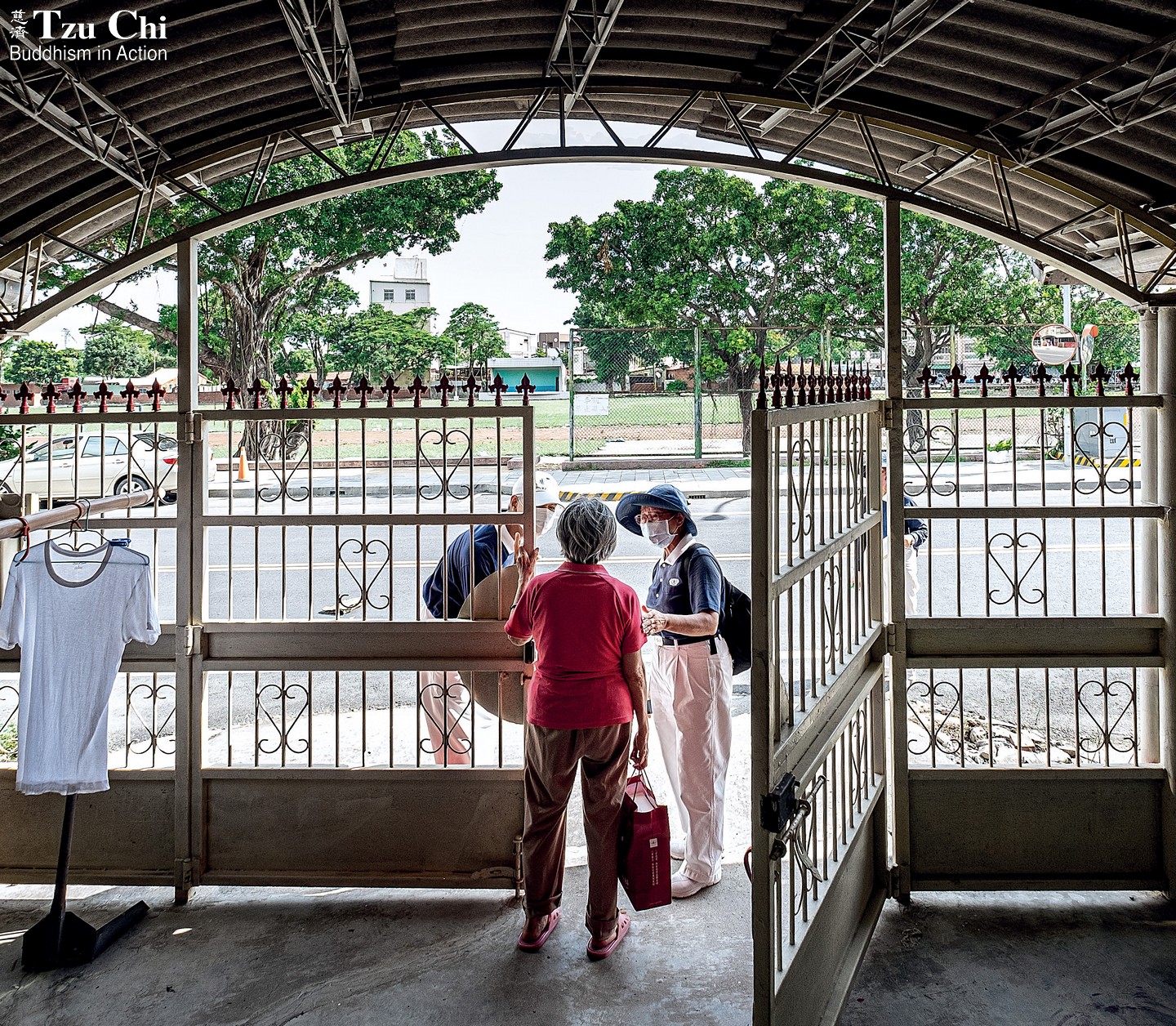
Something happened recently while I was enjoying breakfast at a café that made me reflect on finding the right balance between kindness and caution. A high school-aged girl came up to me and asked to use my phone to call her mom. I was immediately suspicious, due to all the warnings about scams I had heard. I declined her request, worried that I might be enabling a scammer. Later, though, I began to feel guilty about my response, especially when I remembered how crowded the café was, with a long line of people waiting for their takeout. Perhaps the girl just needed to inform her mom that her breakfast was taking longer than expected. I started wondering if I had become too cautious, even to the point of being unkind. This made me think about how to balance compassion with protecting myself from deceit.

This situation reminded me of something Eric Moo (巫啟賢), a well-known singer in the Chinese-speaking world, once said in a TV interview. He said he always gives money to beggars, even though his friends warn him that many are fakes. Moo’s view is: what if there’s a time he doesn’t give, and it’s someone who really needs help? He’d rather give money to ten people, even if eight are faking, because he can afford it and he knows he’s helped the two who genuinely need it. He says having faith in others brings him happiness. I remember being moved by his words.

Thinking about this, I realized that being too cautious might make us miss real chances to help others. If we’re too guarded, we might ignore or dismiss people who genuinely need help, losing opportunities to make a positive difference. At the same time, feeling guilty about possibly having turned away someone who truly needed help can weigh heavily on us.

Finding the right balance between being kind and being cautious isn’t easy. However, looking back, I see that I might have been too quick to say no. A thoughtful check of the situation might have helped me make a better decision. Even if I was unsure about letting her use my phone, I could have offered to make the call for her. That way, I’d still be helpful without exposing myself to deceit.

It’s important to trust your instincts but also use a bit of common sense. Learning about common scams can help you tell genuine requests from potential tricks. It’s about staying informed while keeping an open heart. The world could use more kindness and less suspicion. Finding this balance can be tricky, but it’s worth it to keep the world a warmer and wiser place.

By Wu Hsiao-ting
Photo by Hsiao Yiu-hwa

A personal encounter highlights the delicate balance between compassion and vigilance in our everyday lives.

Something happened recently while I was enjoying breakfast at a café that made me reflect on finding the right balance between kindness and caution. A high school-aged girl came up to me and asked to use my phone to call her mom. I was immediately suspicious, due to all the warnings about scams I had heard. I declined her request, worried that I might be enabling a scammer. Later, though, I began to feel guilty about my response, especially when I remembered how crowded the café was, with a long line of people waiting for their takeout. Perhaps the girl just needed to inform her mom that her breakfast was taking longer than expected. I started wondering if I had become too cautious, even to the point of being unkind. This made me think about how to balance compassion with protecting myself from deceit.

This situation reminded me of something Eric Moo (巫啟賢), a well-known singer in the Chinese-speaking world, once said in a TV interview. He said he always gives money to beggars, even though his friends warn him that many are fakes. Moo’s view is: what if there’s a time he doesn’t give, and it’s someone who really needs help? He’d rather give money to ten people, even if eight are faking, because he can afford it and he knows he’s helped the two who genuinely need it. He says having faith in others brings him happiness. I remember being moved by his words.

Thinking about this, I realized that being too cautious might make us miss real chances to help others. If we’re too guarded, we might ignore or dismiss people who genuinely need help, losing opportunities to make a positive difference. At the same time, feeling guilty about possibly having turned away someone who truly needed help can weigh heavily on us.

Finding the right balance between being kind and being cautious isn’t easy. However, looking back, I see that I might have been too quick to say no. A thoughtful check of the situation might have helped me make a better decision. Even if I was unsure about letting her use my phone, I could have offered to make the call for her. That way, I’d still be helpful without exposing myself to deceit.

It’s important to trust your instincts but also use a bit of common sense. Learning about common scams can help you tell genuine requests from potential tricks. It’s about staying informed while keeping an open heart. The world could use more kindness and less suspicion. Finding this balance can be tricky, but it’s worth it to keep the world a warmer and wiser place.
關鍵字

Noto’s Path to Revival

By Jessica Yang
Edited and translated by Wu Hsiao-ting

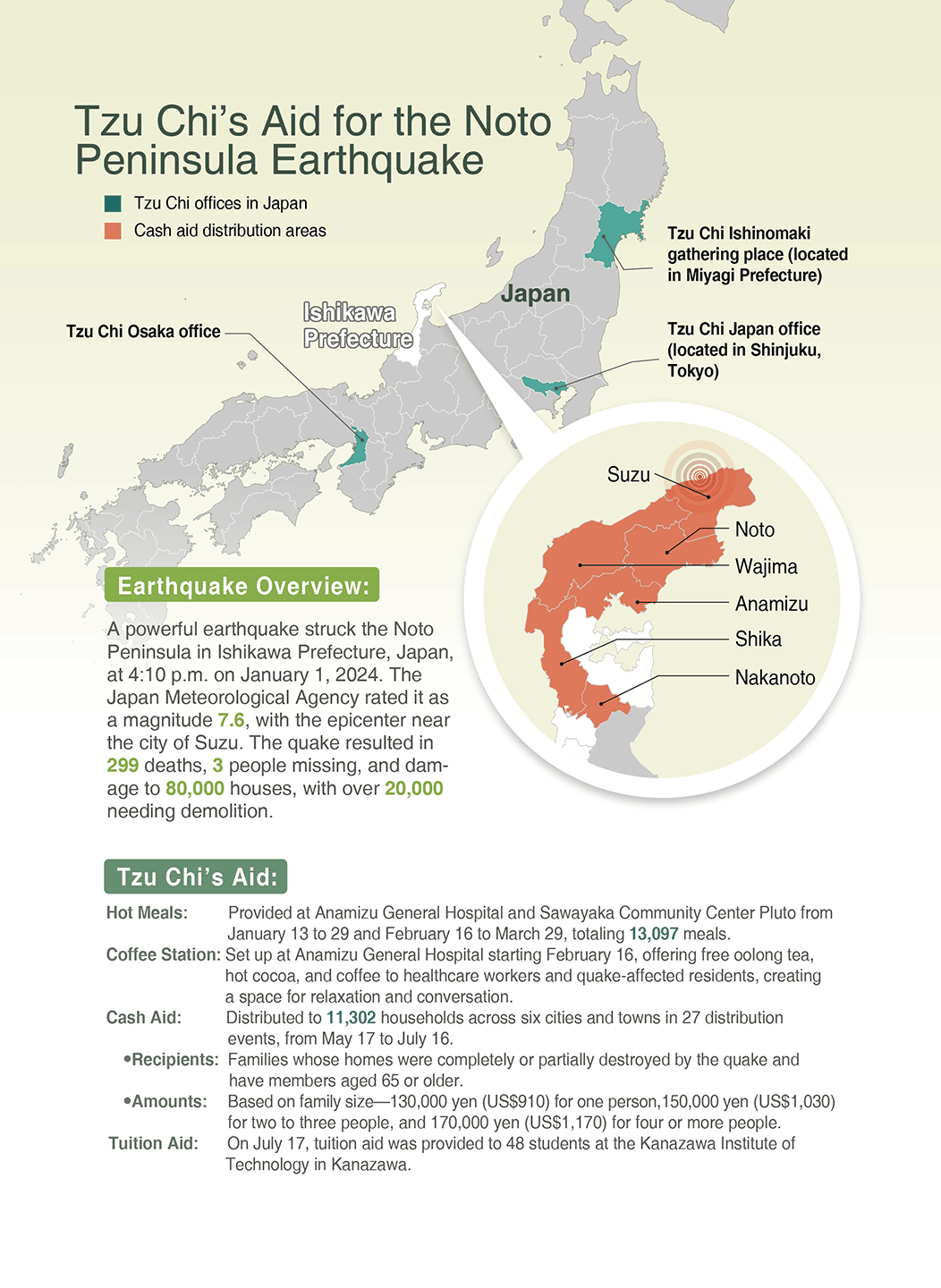
Noto has a way of winning hearts, making it easy to become emotionally attached to the area. As the region works toward recovering from the January earthquake, we continually ask ourselves: what more can we do to help?

After a strong tremor struck the Noto Peninsula in Japan on January 1, volunteers repeatedly traveled to affected areas like Wajima and met with government agencies to discuss aid models. Chen Jing-hui

There is an old Japanese proverb that says, “The people of Noto are gentle and kind, and even the land reflects this.” The Noto Peninsula, located in Japan’s central Ishikawa Prefecture, extends over a hundred kilometers (62 miles) into the Sea of Japan. After an earthquake struck the peninsula on January 1, Tzu Chi launched disaster relief efforts. This led to my visits as a reporter for Tzu Chi’s Da Ai TV. I am grateful for the opportunity to deeply connect with this land through my assignment.

When people hear about the Noto Peninsula, they often think of satoyama and satoumi. But what are these concepts?

Satoyama refers to rural areas, including villages, farmland, forests, grasslands, bamboo groves, and more, managed by people to create and maintain rich natural environments. These areas support diverse plant and animal life while preserving and nurturing unique traditional cultures. Satoumi pertains to coastal areas where people benefit from the sea’s bounty while also protecting marine life.

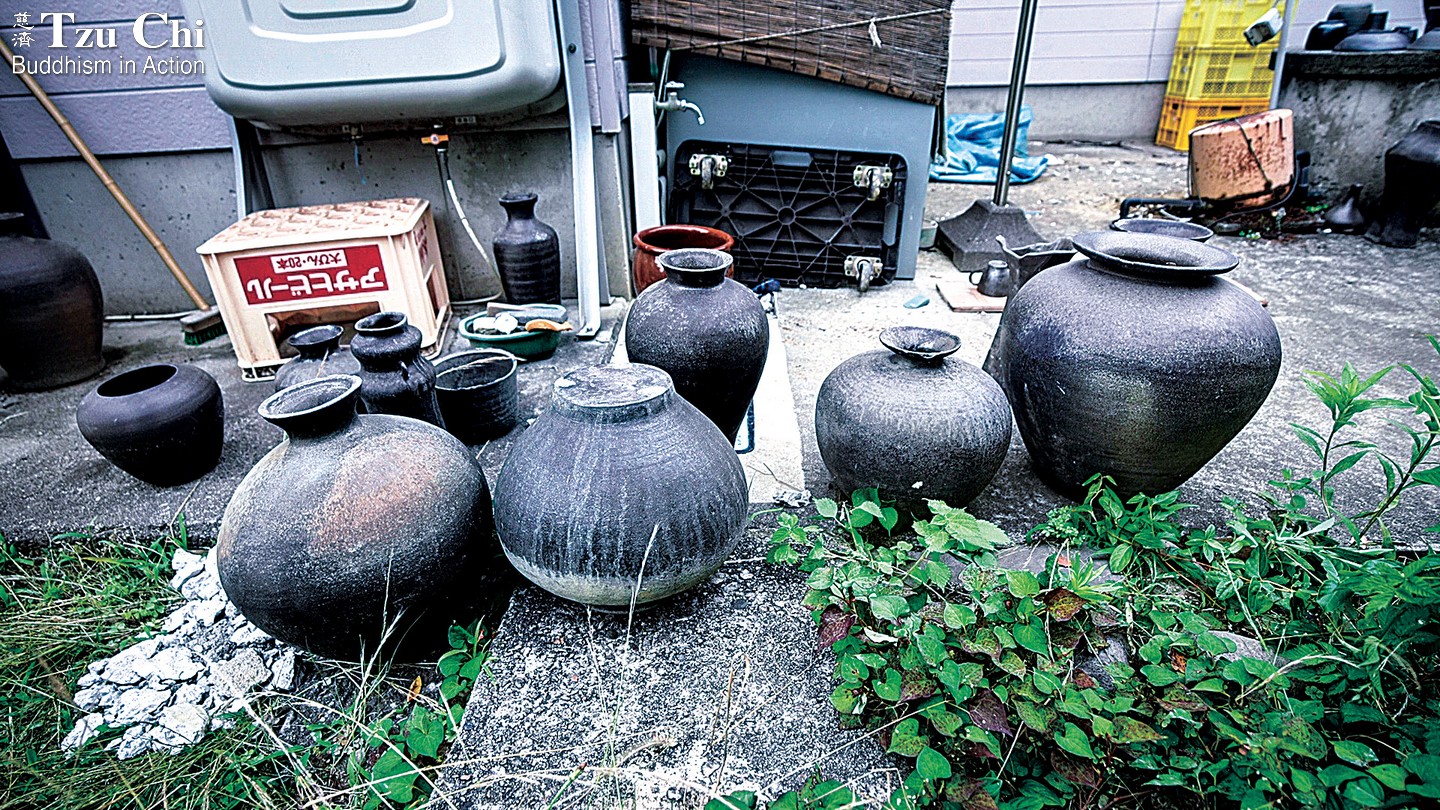
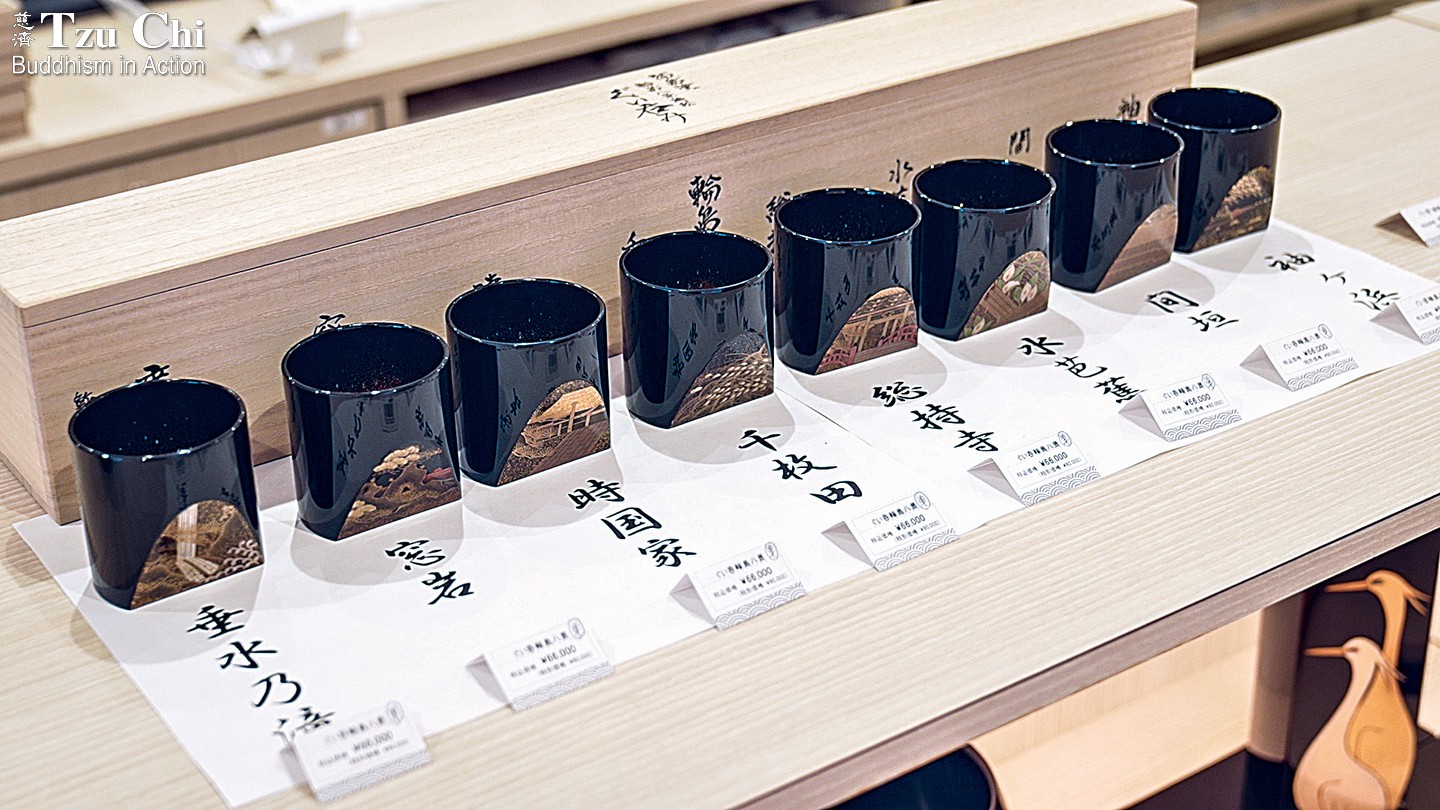
The Noto Peninsula is characterized by low mountains and hills. With the peninsula surrounded on three sides by the Sea of Japan, its coastline is rich in biodiversity. The residents’ lives have always been intertwined with the sea, farmland, and forests. They have preserved historic festivals and continue to practice traditional crafts passed down through the centuries, such as Wajima lacquerware and Suzu pottery.

Residents of the Noto Peninsula live in harmony with nature, respecting the heavens and cherishing the earth. This way of life has been inherited for generations. In June 2011, the area’s satoyama and satoumi were designated a Globally Important Agricultural Heritage System by the United Nations’ Food and Agriculture Organization, bringing global attention to the region.

I visited the Noto Peninsula for the first time in April 2024 with Hsieh Ching-kuei (謝景貴), advisor for the CEO’s Office of the Tzu Chi charity mission, and Teng Chih-ming (鄧志銘), a colleague from Da Ai TV. Brother Hsieh remarked at the time, “Tzu Chi’s basic principles for disaster relief have always been to attend to both the physical and emotional needs of survivors to help them return to a normal life. However, with global warming accelerating, we need to incorporate innovative methods of aid. Beyond attending to survivors’ physical and emotional needs, we should integrate the concept of ‘sustainability’ into the recovery process.”

This made me wonder: aside from distributing cash aid to affected households, what more can we do for Noto’s agriculture, cultural assets, and elderly care? Recognizing the potential for a new model of international disaster relief for Tzu Chi, we decided to focus our report on these areas while documenting the region’s recovery efforts. During months of filming across multiple trips, we witnessed the community’s resilience and unity and were deeply touched by the unique warmth and hospitality of the Noto Peninsula.

Devastated

The breathtaking scenery of Noto immediately captivated us as we drove onto the main access road to the peninsula in April. The azure Sea of Japan was on one side, and lush green hills on the other. For a moment, I felt as though I was driving along Taiwan’s Hualien-Taitung Coastal Highway. The stunning views almost made us forget that the Noto Peninsula was a region recovering from an earthquake.

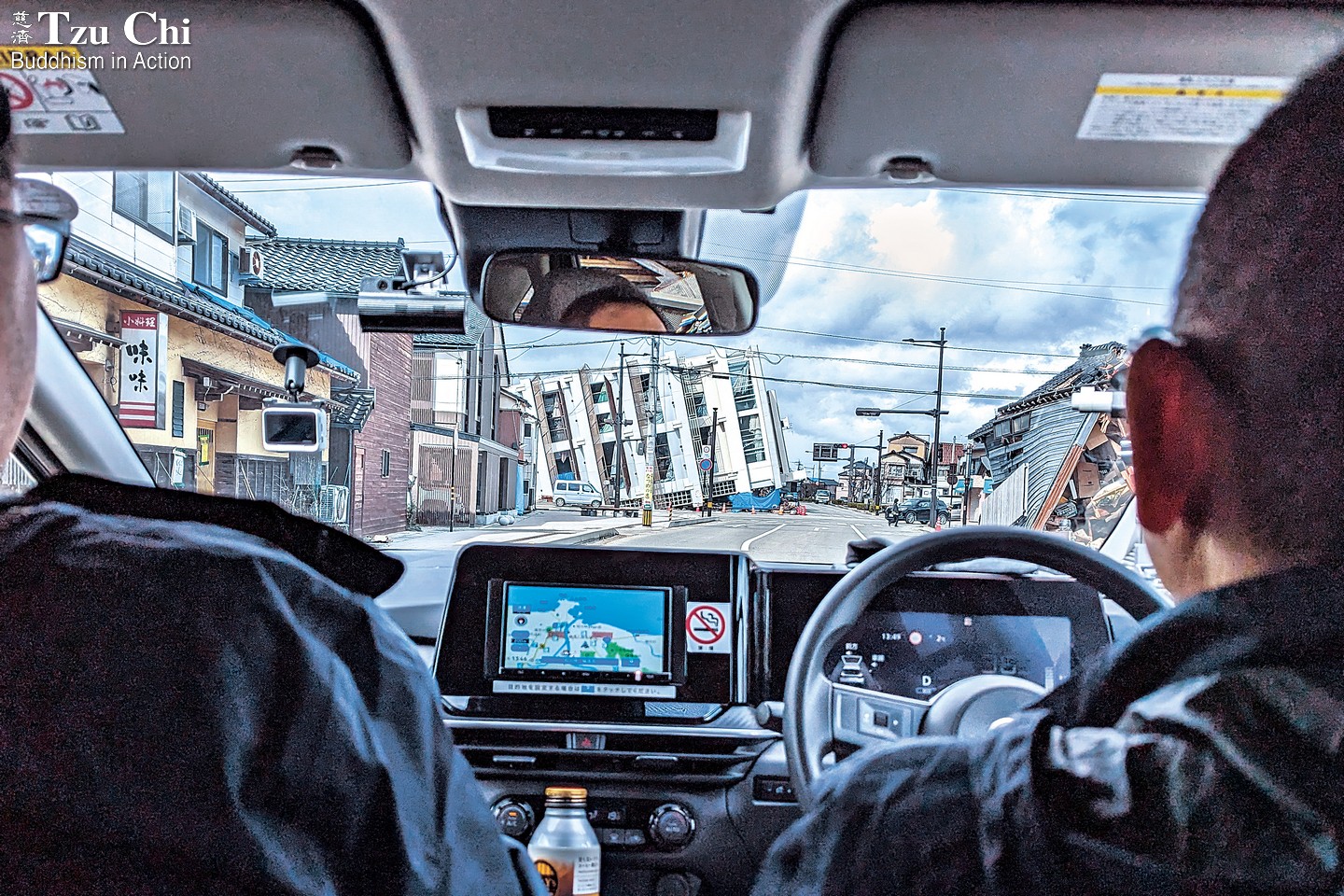
As we continued our journey, the landscape began to change. Construction vehicles and repair crews became more frequent, and the sight of buckled and cracked roads grew common. It was easy to imagine how isolated the Noto Peninsula must have felt in the early days after the quake.

Wajima lacquerware artist Hiroyuki Ejiri, whose house is by the sea between Wajima and Suzu, shared his experience of the earthquake. He recounted how the tremor was so intense that he and his family struggled to stand and had to run outside for safety. Observing the sea water receding, they feared a tsunami and quickly moved to higher ground. Fortunately, the tsunami did not materialize. After the tsunami warning was lifted, he attempted to drive his family to Kanazawa for refuge. “However, both the road to Wajima and the road to Suzu were cut off, and the phones were down. We were completely isolated,” he said. “The roads were reopened three days later, but getting to Kanazawa, which usually took two hours, took us nine hours that day.” Hiroyuki Ejiri’s helplessness at the time mirrored that of many local residents.

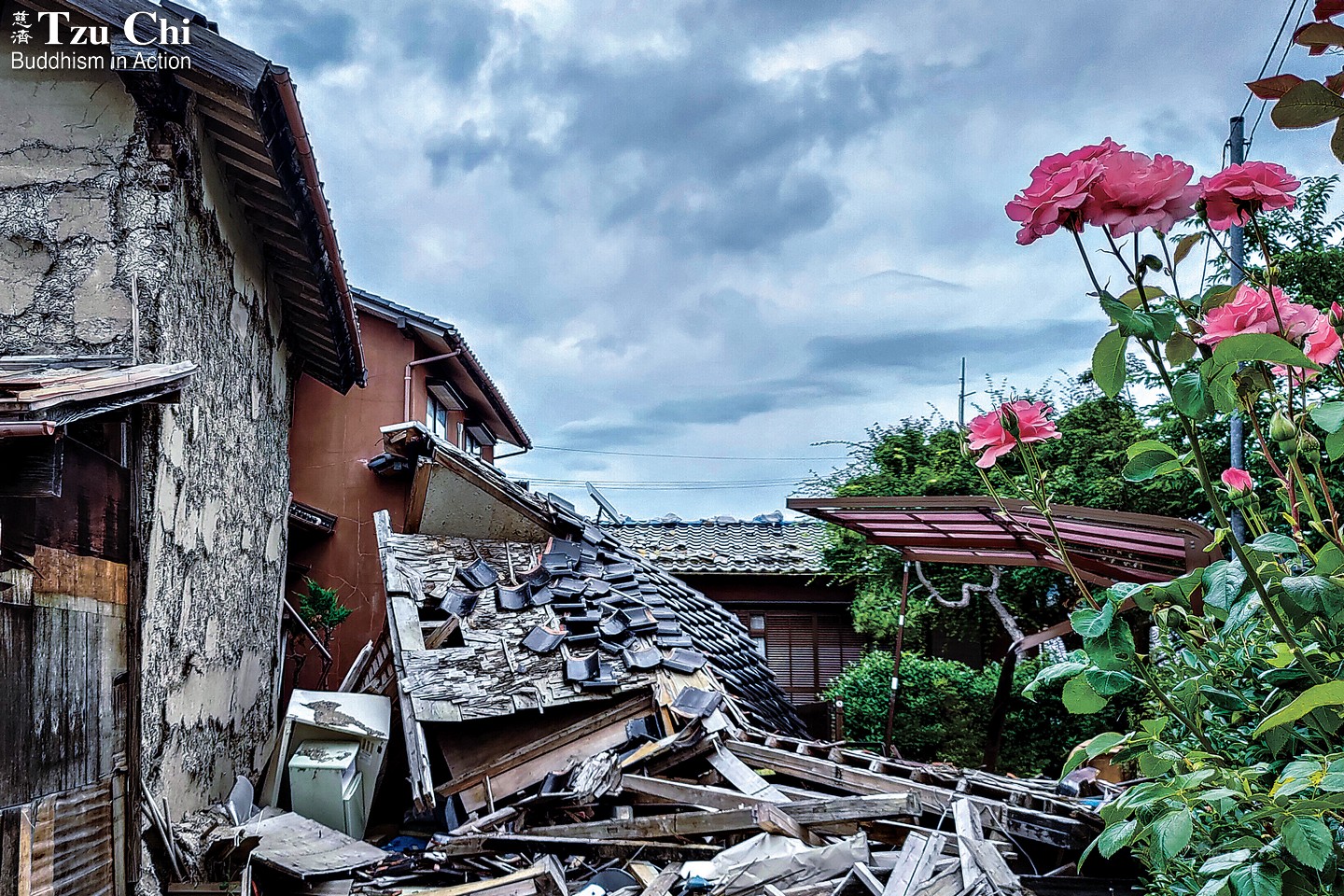
When we returned to the Noto Peninsula five months after the earthquake, we saw ongoing infrastructure restoration projects along the way. However, upon entering the heavily damaged city of Wajima, we found many buildings still lying in ruins where they had collapsed. Wajima, situated next to the Sea of Japan, had once been a beautiful coastal city renowned for the Wajima Morning Market—one of Japan’s three major morning markets and the city’s most bustling and prosperous area. Tragically, the powerful earthquake triggered a fire that raged for 14 hours, destroying over 200 buildings in the market area. Additionally, more than 15,000 houses throughout the city were either completely or partially destroyed or damaged by the earthquake.

Wajima resident Kensei Sumi said that about 80 percent of the collapsed and damaged houses in the city had remained untouched. He also mentioned that clearing the ruins was expected to take two years, with rebuilding projected to take three to four years. “My house was marked as uninhabitable,” he said, “but staying in the evacuation center is very inconvenient. I still prefer my own home.”

Roses bloom beautifully in June at a residence in Machino, Wajima. The garden remains lovely, but the owner who planted the flowers can no longer live in the damaged home. Lin Ling-li

Pressing on

Wajima lacquerware, designated an important intangible cultural property by the Japanese government in 1977, is a traditional craft in which Wajima residents take great pride. Many shops and workshops specializing in this craft at the Wajima Morning Market were destroyed by the earthquake and its aftermath.

Lacquerware artist Sushii Tatsuya showed us his devastated workshop. This building was severely tilted, with damaged beams and pillars and a buckled floor. Materials for making lacquerware were scattered everywhere. The government’s red notice on the building indicated it was uninhabitable and had to be demolished.

“This workshop is where I built everything from the ground up,” he said. “It was created with all my heart and soul. It’s as important to me as my life. The Japanese phrase ‘isshokenmei’ [putting one’s whole heart into something] perfectly captures my state of mind. If this place is demolished…” He choked up, unable to continue, his tears reflecting his profound attachment to his workshop and his sense of helplessness.

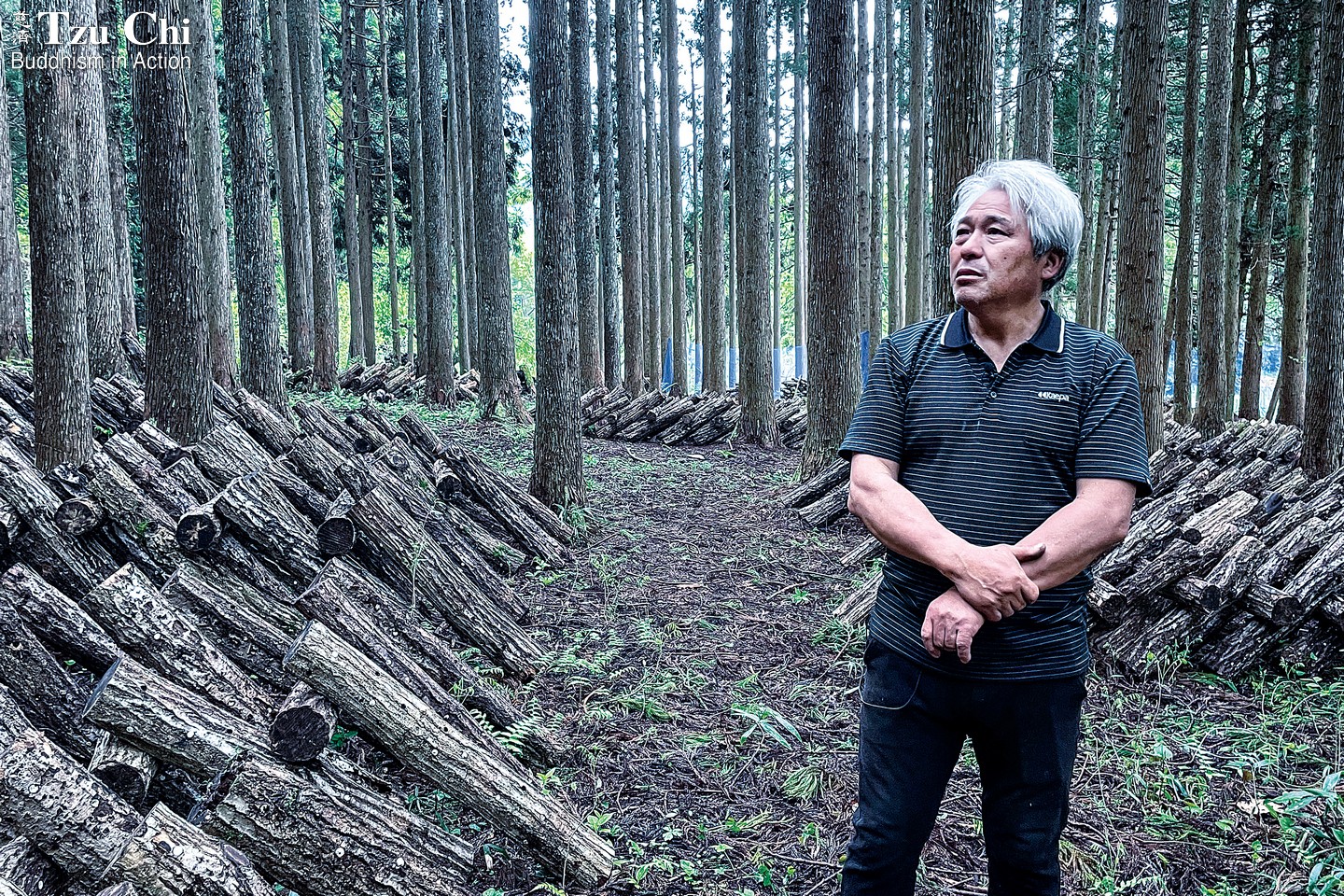
During our visit, we witnessed the plight of quake-stricken residents and their inexpressible suffering, yet also their resilience and warmth. Mushroom farmer Masaharu Takamori shared, “My house was deemed half-destroyed. The damage is significant, but I am more concerned about the elderly residents in the mountains. About 70 percent of the area is in a terrible state. The severity of the impact is such that you can’t find it in your heart to say ‘keep going’ to the people there… But still, everyone must keep going and move forward.” Despite his own challenges, his primary concern was for his fellow villagers.

Similarly, Katsuyoshi Shuden, a farmer from the town of Noto, prioritized his community. His farmland suffered extensive damage, with losses difficult to estimate. When we met to film how he was restoring his irrigation system, Mr. Shuden received a warm hug from Brother Hsieh. Shuden said, “Taiwan has recently experienced an earthquake too. Thank you for still coming to offer care to us.” He then took out a bag from the trunk of his car, containing three metal boxes with the coins he had saved to help others. He donated the money to Tzu Chi.

We asked him about the most difficult challenge since the earthquake. With eyes moist and rimmed with red, he said, “I’m more concerned about the disappearance of our settlement than the damage I suffered. Our elderly population is large, as the younger generation has been moving away. The earthquake has worsened this situation, and many people feel emotionally empty.”

Every interviewee we met was focused on their fellow villagers, not themselves. They are striving to rebuild with their own strength, not just for themselves but for the entire community, supporting each other. This resilience and unique warmth define the spirit of the Noto Peninsula.

Noto has a way of winning people’s hearts, and it’s easy to become emotionally attached. The pure, kind, and sincere people of Noto continually inspire me to think about how we could further support their recovery.

Mushroom farmer Masaharu Takamori is concerned about how the older people in the mountains will rebuild their lives after the earthquake. Jessica Yang

The Noto Peninsula is known for its traditional crafts: Suzu pottery (photo 1 by Lin Jian-li) and Wajima lacquerware (photo 2 by Teng Chih-ming).

Grateful for this land and its people

Brother Hsieh often reminded us during our visits to Noto, partly to motivate himself, “Tzu Chi’s new international disaster relief model may not succeed; you might end up recording a failed process.” On one occasion, resting his right hand on his chin and frowning, he said, “The wisdom of Noto’s satoyama and satoumi has been passed down through generations, with sustainability woven into their way of life. If we can help farmers here achieve international sustainability certification and increase the value of their rice during their recovery, that would be wonderful.”

When Wajima lacquerware artists expressed concerns that their centuries-old craft might disappear, Brother Hsieh wondered, “Is there a public welfare model that could help these artists restart their workshops?” After learning that the earthquake had damaged all the kilns used by Suzu pottery artists, affecting the livelihoods of 54 people, he asked, “Let’s think together. Is there any way to let more Taiwanese people know about Suzu pottery?”

Frankly, I’m not entirely sure what Tzu Chi’s new international disaster relief model entails. What I do know is that before the interviews, we thoroughly researched the life and culture of the Noto Peninsula. During the interviews, we visited town after town and village after village, explored the lives of the locals, and learned their true needs. Only then could we discuss effective ways to support their recovery and prosperity.

As Tzu Chi approaches its 60th anniversary, we remain committed to our mission of relieving suffering and giving joy, whether through charity or international disaster relief. As I understand it, the “new model” involves aligning with international trends and global sustainability while standing together with the locals and developing solutions collaboratively.

Our documenting team first visited the Noto Peninsula in late April this year. Since then, we have made three trips totaling over 60 days. Besides developing an attachment to this land, I feel as though we are deeply loved by it as well. Whenever I needed materials and stories, the locals would arrange them for me, making me profoundly grateful for this land and its people.

As I reviewed footage and wrote scripts in the early mornings, I reflected on how well the beautiful and peaceful Noto treats its people, and how the people, in turn, love and respect the land. Even when natural disasters cause severe damage and hardships, the resilience of both the land and its people shines through. The community’s mutual support and trust, combined with their kindness, create a powerful force for good.

Natural disasters will only increase in the future, but I believe that maintaining this spirit of kindness and resilience will help everyone, no matter where they are, face and overcome their challenges.

By Jessica Yang
Edited and translated by Wu Hsiao-ting

Noto has a way of winning hearts, making it easy to become emotionally attached to the area. As the region works toward recovering from the January earthquake, we continually ask ourselves: what more can we do to help?

After a strong tremor struck the Noto Peninsula in Japan on January 1, volunteers repeatedly traveled to affected areas like Wajima and met with government agencies to discuss aid models. Chen Jing-hui

There is an old Japanese proverb that says, “The people of Noto are gentle and kind, and even the land reflects this.” The Noto Peninsula, located in Japan’s central Ishikawa Prefecture, extends over a hundred kilometers (62 miles) into the Sea of Japan. After an earthquake struck the peninsula on January 1, Tzu Chi launched disaster relief efforts. This led to my visits as a reporter for Tzu Chi’s Da Ai TV. I am grateful for the opportunity to deeply connect with this land through my assignment.

When people hear about the Noto Peninsula, they often think of satoyama and satoumi. But what are these concepts?

Satoyama refers to rural areas, including villages, farmland, forests, grasslands, bamboo groves, and more, managed by people to create and maintain rich natural environments. These areas support diverse plant and animal life while preserving and nurturing unique traditional cultures. Satoumi pertains to coastal areas where people benefit from the sea’s bounty while also protecting marine life.

The Noto Peninsula is characterized by low mountains and hills. With the peninsula surrounded on three sides by the Sea of Japan, its coastline is rich in biodiversity. The residents’ lives have always been intertwined with the sea, farmland, and forests. They have preserved historic festivals and continue to practice traditional crafts passed down through the centuries, such as Wajima lacquerware and Suzu pottery.

Residents of the Noto Peninsula live in harmony with nature, respecting the heavens and cherishing the earth. This way of life has been inherited for generations. In June 2011, the area’s satoyama and satoumi were designated a Globally Important Agricultural Heritage System by the United Nations’ Food and Agriculture Organization, bringing global attention to the region.

I visited the Noto Peninsula for the first time in April 2024 with Hsieh Ching-kuei (謝景貴), advisor for the CEO’s Office of the Tzu Chi charity mission, and Teng Chih-ming (鄧志銘), a colleague from Da Ai TV. Brother Hsieh remarked at the time, “Tzu Chi’s basic principles for disaster relief have always been to attend to both the physical and emotional needs of survivors to help them return to a normal life. However, with global warming accelerating, we need to incorporate innovative methods of aid. Beyond attending to survivors’ physical and emotional needs, we should integrate the concept of ‘sustainability’ into the recovery process.”

This made me wonder: aside from distributing cash aid to affected households, what more can we do for Noto’s agriculture, cultural assets, and elderly care? Recognizing the potential for a new model of international disaster relief for Tzu Chi, we decided to focus our report on these areas while documenting the region’s recovery efforts. During months of filming across multiple trips, we witnessed the community’s resilience and unity and were deeply touched by the unique warmth and hospitality of the Noto Peninsula.

Devastated

The breathtaking scenery of Noto immediately captivated us as we drove onto the main access road to the peninsula in April. The azure Sea of Japan was on one side, and lush green hills on the other. For a moment, I felt as though I was driving along Taiwan’s Hualien-Taitung Coastal Highway. The stunning views almost made us forget that the Noto Peninsula was a region recovering from an earthquake.

As we continued our journey, the landscape began to change. Construction vehicles and repair crews became more frequent, and the sight of buckled and cracked roads grew common. It was easy to imagine how isolated the Noto Peninsula must have felt in the early days after the quake.

Wajima lacquerware artist Hiroyuki Ejiri, whose house is by the sea between Wajima and Suzu, shared his experience of the earthquake. He recounted how the tremor was so intense that he and his family struggled to stand and had to run outside for safety. Observing the sea water receding, they feared a tsunami and quickly moved to higher ground. Fortunately, the tsunami did not materialize. After the tsunami warning was lifted, he attempted to drive his family to Kanazawa for refuge. “However, both the road to Wajima and the road to Suzu were cut off, and the phones were down. We were completely isolated,” he said. “The roads were reopened three days later, but getting to Kanazawa, which usually took two hours, took us nine hours that day.” Hiroyuki Ejiri’s helplessness at the time mirrored that of many local residents.

When we returned to the Noto Peninsula five months after the earthquake, we saw ongoing infrastructure restoration projects along the way. However, upon entering the heavily damaged city of Wajima, we found many buildings still lying in ruins where they had collapsed. Wajima, situated next to the Sea of Japan, had once been a beautiful coastal city renowned for the Wajima Morning Market—one of Japan’s three major morning markets and the city’s most bustling and prosperous area. Tragically, the powerful earthquake triggered a fire that raged for 14 hours, destroying over 200 buildings in the market area. Additionally, more than 15,000 houses throughout the city were either completely or partially destroyed or damaged by the earthquake.

Wajima resident Kensei Sumi said that about 80 percent of the collapsed and damaged houses in the city had remained untouched. He also mentioned that clearing the ruins was expected to take two years, with rebuilding projected to take three to four years. “My house was marked as uninhabitable,” he said, “but staying in the evacuation center is very inconvenient. I still prefer my own home.”

Roses bloom beautifully in June at a residence in Machino, Wajima. The garden remains lovely, but the owner who planted the flowers can no longer live in the damaged home. Lin Ling-li

Pressing on

Wajima lacquerware, designated an important intangible cultural property by the Japanese government in 1977, is a traditional craft in which Wajima residents take great pride. Many shops and workshops specializing in this craft at the Wajima Morning Market were destroyed by the earthquake and its aftermath.

Lacquerware artist Sushii Tatsuya showed us his devastated workshop. This building was severely tilted, with damaged beams and pillars and a buckled floor. Materials for making lacquerware were scattered everywhere. The government’s red notice on the building indicated it was uninhabitable and had to be demolished.

“This workshop is where I built everything from the ground up,” he said. “It was created with all my heart and soul. It’s as important to me as my life. The Japanese phrase ‘isshokenmei’ [putting one’s whole heart into something] perfectly captures my state of mind. If this place is demolished…” He choked up, unable to continue, his tears reflecting his profound attachment to his workshop and his sense of helplessness.

During our visit, we witnessed the plight of quake-stricken residents and their inexpressible suffering, yet also their resilience and warmth. Mushroom farmer Masaharu Takamori shared, “My house was deemed half-destroyed. The damage is significant, but I am more concerned about the elderly residents in the mountains. About 70 percent of the area is in a terrible state. The severity of the impact is such that you can’t find it in your heart to say ‘keep going’ to the people there… But still, everyone must keep going and move forward.” Despite his own challenges, his primary concern was for his fellow villagers.

Similarly, Katsuyoshi Shuden, a farmer from the town of Noto, prioritized his community. His farmland suffered extensive damage, with losses difficult to estimate. When we met to film how he was restoring his irrigation system, Mr. Shuden received a warm hug from Brother Hsieh. Shuden said, “Taiwan has recently experienced an earthquake too. Thank you for still coming to offer care to us.” He then took out a bag from the trunk of his car, containing three metal boxes with the coins he had saved to help others. He donated the money to Tzu Chi.

We asked him about the most difficult challenge since the earthquake. With eyes moist and rimmed with red, he said, “I’m more concerned about the disappearance of our settlement than the damage I suffered. Our elderly population is large, as the younger generation has been moving away. The earthquake has worsened this situation, and many people feel emotionally empty.”

Every interviewee we met was focused on their fellow villagers, not themselves. They are striving to rebuild with their own strength, not just for themselves but for the entire community, supporting each other. This resilience and unique warmth define the spirit of the Noto Peninsula.

Noto has a way of winning people’s hearts, and it’s easy to become emotionally attached. The pure, kind, and sincere people of Noto continually inspire me to think about how we could further support their recovery.

Mushroom farmer Masaharu Takamori is concerned about how the older people in the mountains will rebuild their lives after the earthquake. Jessica Yang

The Noto Peninsula is known for its traditional crafts: Suzu pottery (photo 1 by Lin Jian-li) and Wajima lacquerware (photo 2 by Teng Chih-ming).

Grateful for this land and its people

Brother Hsieh often reminded us during our visits to Noto, partly to motivate himself, “Tzu Chi’s new international disaster relief model may not succeed; you might end up recording a failed process.” On one occasion, resting his right hand on his chin and frowning, he said, “The wisdom of Noto’s satoyama and satoumi has been passed down through generations, with sustainability woven into their way of life. If we can help farmers here achieve international sustainability certification and increase the value of their rice during their recovery, that would be wonderful.”

When Wajima lacquerware artists expressed concerns that their centuries-old craft might disappear, Brother Hsieh wondered, “Is there a public welfare model that could help these artists restart their workshops?” After learning that the earthquake had damaged all the kilns used by Suzu pottery artists, affecting the livelihoods of 54 people, he asked, “Let’s think together. Is there any way to let more Taiwanese people know about Suzu pottery?”

Frankly, I’m not entirely sure what Tzu Chi’s new international disaster relief model entails. What I do know is that before the interviews, we thoroughly researched the life and culture of the Noto Peninsula. During the interviews, we visited town after town and village after village, explored the lives of the locals, and learned their true needs. Only then could we discuss effective ways to support their recovery and prosperity.

As Tzu Chi approaches its 60th anniversary, we remain committed to our mission of relieving suffering and giving joy, whether through charity or international disaster relief. As I understand it, the “new model” involves aligning with international trends and global sustainability while standing together with the locals and developing solutions collaboratively.

Our documenting team first visited the Noto Peninsula in late April this year. Since then, we have made three trips totaling over 60 days. Besides developing an attachment to this land, I feel as though we are deeply loved by it as well. Whenever I needed materials and stories, the locals would arrange them for me, making me profoundly grateful for this land and its people.

As I reviewed footage and wrote scripts in the early mornings, I reflected on how well the beautiful and peaceful Noto treats its people, and how the people, in turn, love and respect the land. Even when natural disasters cause severe damage and hardships, the resilience of both the land and its people shines through. The community’s mutual support and trust, combined with their kindness, create a powerful force for good.

Natural disasters will only increase in the future, but I believe that maintaining this spirit of kindness and resilience will help everyone, no matter where they are, face and overcome their challenges.

關鍵字

New Perspectives, New Understandings

By Guo Cai-xi
Translated by Wu Hsiao-ting
Photo by Yang Xiu-li

Does “new” have to mean something never used before? A four-year-old’s surprising wisdom sheds light on how our perspectives shape our reality.

As my two children continue to grow, I’ve noticed that many of their childhood clothes no longer fit them. Sorting through their wardrobe one day, I picked out items that were still in great condition, about 80 to 90 percent new. After washing and drying them, I took photos and organized them by season and size. Then, I reached out to various messaging groups to see if anyone wanted these clothes, hoping to extend their lifespan.

As I looked at the clothes, a charming anecdote involving my youngest daughter when she was four years old came to mind. One day, when we were sorting through clothes for the season, I said to her, “Xiao-xi, you end up wearing your sister’s hand-me-downs most of the time. I sometimes feel a little guilty because I don’t often buy you new clothes.” In response, she said, “But the clothes I’ve never worn are new to me!” Her spontaneous response caught me by surprise, brought me joy, and taught me a valuable lesson.

My daughter’s response prompted me to reconsider the definitions of “new” and “old.” It reminded me that things can be viewed from different perspectives. As Dharma Master Cheng Yen says, “If we look at a chipped cup from another angle, it is still round.” Let’s always remember that by shifting our perspective we possess the ability to shape a fresh reality for both ourselves and those around us.

By Guo Cai-xi
Translated by Wu Hsiao-ting
Photo by Yang Xiu-li

Does “new” have to mean something never used before? A four-year-old’s surprising wisdom sheds light on how our perspectives shape our reality.

As my two children continue to grow, I’ve noticed that many of their childhood clothes no longer fit them. Sorting through their wardrobe one day, I picked out items that were still in great condition, about 80 to 90 percent new. After washing and drying them, I took photos and organized them by season and size. Then, I reached out to various messaging groups to see if anyone wanted these clothes, hoping to extend their lifespan.

As I looked at the clothes, a charming anecdote involving my youngest daughter when she was four years old came to mind. One day, when we were sorting through clothes for the season, I said to her, “Xiao-xi, you end up wearing your sister’s hand-me-downs most of the time. I sometimes feel a little guilty because I don’t often buy you new clothes.” In response, she said, “But the clothes I’ve never worn are new to me!” Her spontaneous response caught me by surprise, brought me joy, and taught me a valuable lesson.

My daughter’s response prompted me to reconsider the definitions of “new” and “old.” It reminded me that things can be viewed from different perspectives. As Dharma Master Cheng Yen says, “If we look at a chipped cup from another angle, it is still round.” Let’s always remember that by shifting our perspective we possess the ability to shape a fresh reality for both ourselves and those around us.

關鍵字

After the Deluge in Southern Taiwan

By Tzu Chi documenting volunteers
Edited and translated by Wu Hsiao-ting

Typhoon Gaemi’s relentless downpour wreaked havoc on southern Taiwan, but Tzu Chi’s swift and compassionate response provided essential aid and hope amidst the devastation.

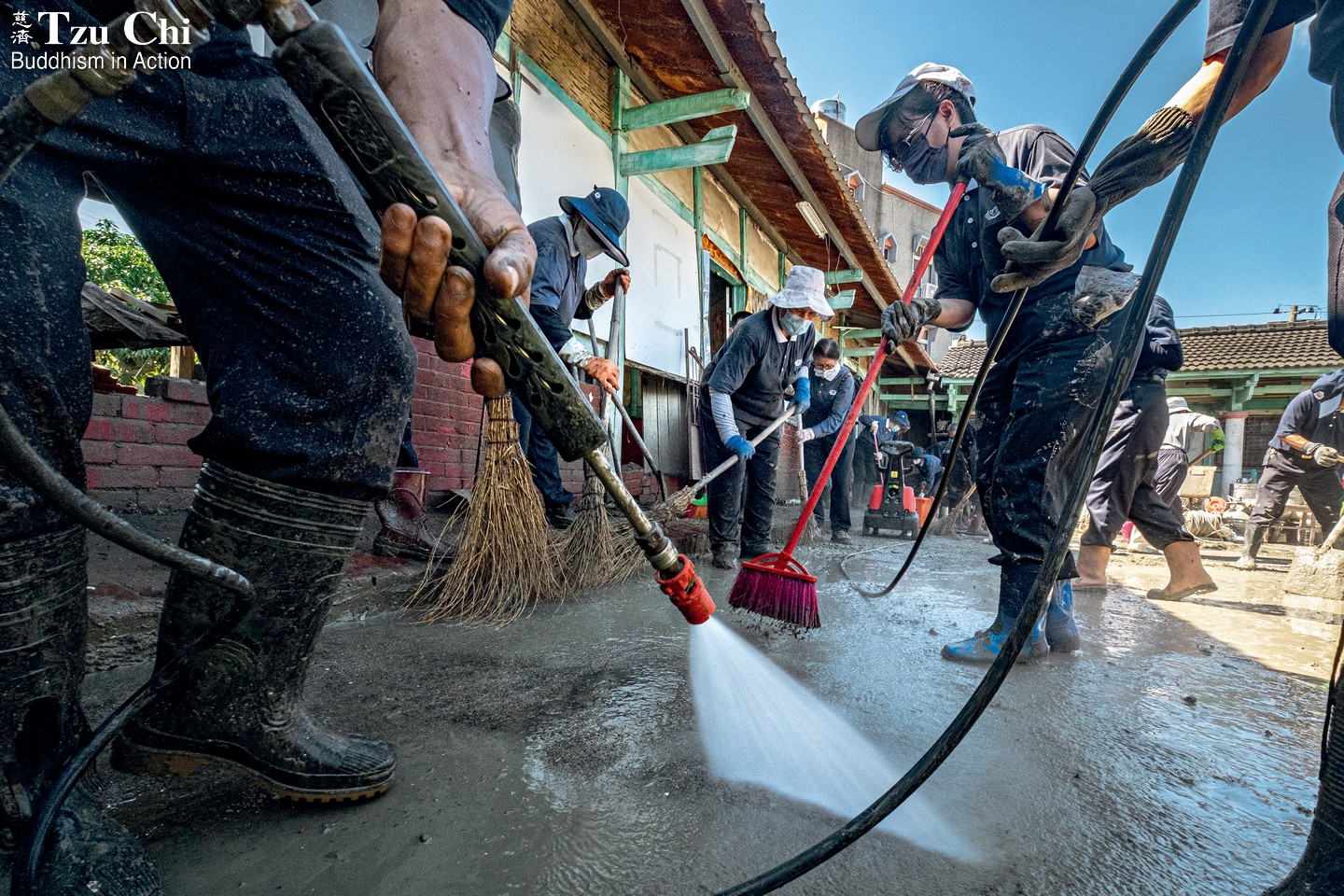
Volunteers clean a flood victim’s home after Typhoon Gaemi in Fenjihu, a low-lying area in Baihe District, Tainan. Huang Xiao-zhe

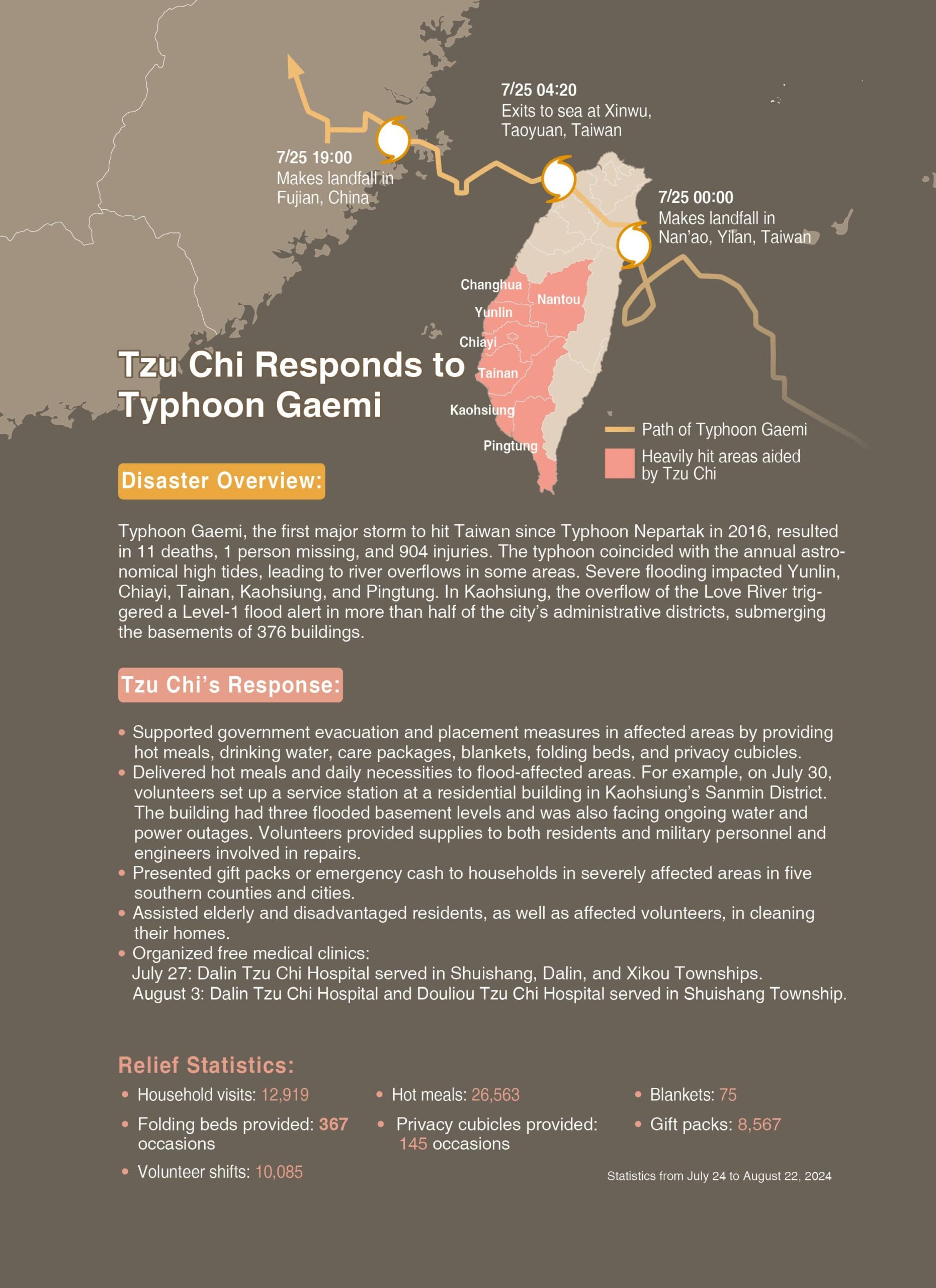
Typhoon Gaemi, the first to hit Taiwan this year, made landfall in Yilan County at midnight on July 25 and exited the island through Taoyuan City just 4 hours and 20 minutes later. Despite weakening after landfall, the typhoon’s outer edges, combined with southwesterly winds, brought torrential rain to southern Taiwan. Chiayi, Tainan, Kaohsiung, and Pingtung saw rainfall nearly matching the peak daily totals recorded during Typhoon Morakot in 2009. Severe flooding was reported across the southern regions.

The Bazhang River in Chiayi overflowed early on July 25, flooding homes up to the first floor. Liuxin Village in Shuishang Township, located near the riverbank, was particularly affected. Village Chief Chen Huang-ru (陳皇如) said that when the typhoon warning was issued, he, as usual, went into alert mode, monitoring the water levels at the floodgates day and night. However, despite such vigilance, flooding still occurred.

Mr. Li, a resident of Liuxin Village, recounted that village officers broadcasted warnings just before the river overflowed, urging residents to evacuate to the township shelter. However, living alone and severely disabled, his only option was to take refuge at his sister’s home in the city. “Two days later, when the water receded, I returned home to a scene of devastation,” he said. “I was overwhelmed and didn’t know what to do, so I sought help from the village chief. I’m deeply grateful to the Tzu Chi volunteers who came to assist!”

On July 28, over a hundred Tzu Chi volunteers gathered at the Shuishang Township Office, equipped with brooms, basins, buckets, hoses, shovels, and other tools. They divided into groups and headed into the community to help residents clean up. Along the way, they saw piles of water-damaged furniture and debris, while grapple trucks and bulldozers operated alongside garbage trucks collecting the debris. Residents expressed their gratitude upon seeing the volunteers, putting their palms together and saying, “Oh! Such a large group! Thank you, Tzu Chi brothers and sisters. We’re so fortunate to have you!”

A Tzu Chi team had earlier conducted home visits in Shuishang Township and discovered that some families lacked the resources to clean up on their own. In response, they asked village chiefs to compile a list of homes needing cleaning assistance. Initially, only a few households were reported, but as volunteers arrived on-site on July 28, more residents requested help. The volunteers worked together to clean up the mud and remove debris. They also assisted villagers in disposing of or returning large items of furniture to their original positions, accelerating the recovery process.

Village Chief Chen Huang-ru remarked that the flood had left his village in disarray, with an unbearable stench. “Tzu Chi not only provided us with material assistance but also made us feel genuinely cared for and supported. This has been a tremendous encouragement as we work to restore our lives.”

Volunteers returned to Chen’s village on August 3. That morning, the community broadcast echoed with Chen’s reminders to the villagers: “Today, Tzu Chi volunteers will visit affected households to offer support. Please stay home and wait for them. Doctors from Dalin Tzu Chi Hospital will also be providing free medical services at Liu’an Temple. If you need medical attention, don’t hesitate to drop by.”

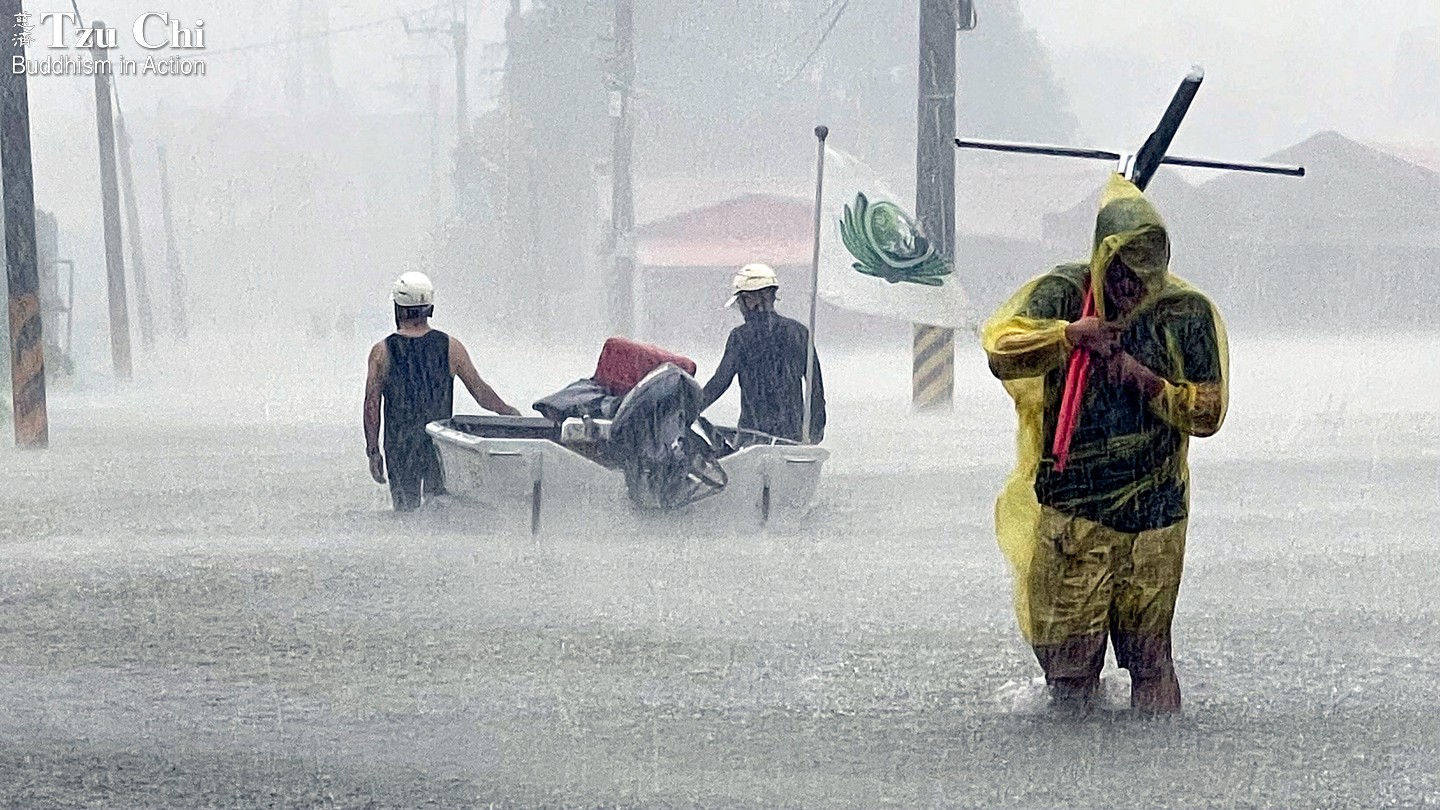
Volunteers use rescue boats to deliver hot meals to flooded areas in Madou, Tainan, on July 26. Typhoon Gaemi had already passed by that time, but heavy rain continued in the region. Chen He-sheng

Meal service

Tzu Chi offices in over a dozen counties and cities across Taiwan swiftly established disaster response centers after the land warning for Typhoon Gaemi was issued at 11:30 a.m. on July 23. Volunteers took inventory and organized emergency supplies, ready to support the government’s shelter and relief efforts. Later, due to the typhoon, people living in southern counties and cities had three consecutive days off. For those trapped by floodwaters or busy restoring their homes, a hot meal became a precious comfort. Volunteers ultimately distributed over 26,000 boxed meals in the aftermath of the storm.

Though the Liucuo and Baimi neighborhoods in Gangshan District, Kaohsiung, hadn’t experienced flooding in years, they were not spared this time. Floodwaters rose to waist height on the morning of July 25. The heads of both neighborhoods sought assistance from Tzu Chi. Volunteers immediately delivered supplies and boxed meals.

The following morning, volunteers braved intermittent strong winds and heavy rain to deliver additional aid to Liucuo, including over 800 loaves of bread, 600 packs of cookies, and 25 boxes of bottled water. Volunteer Ou Jin-ye (歐金葉), who leads a culinary team, received a notification about flood victims’ need for boxed lunches and quickly sprang into action. She organized a team to purchase ingredients, cook, and pack the meals. Within just a few hours, 370 packed lunches were delivered to the activity center in Baimi.

Around the same time, Tzu Chi volunteers in other areas of Kaohsiung fully mobilized, splitting into groups to support flood-affected communities. While distributing bread, they also checked if residents needed boxed meals for lunch that day. Yao Hao-zhe (姚皓哲), a resident of Xiaoshun Street in Sanmin District, gratefully accepted the bread and said, “This will be my first meal of the day.” He recalled going downstairs at around 5 a.m. on July 25 to check the water level of Baozhu Ditch, a tributary of the Love River, in front of his home. The water level was still low at the time, but just two hours later, it surged over the concrete embankment, flooding the area nearly half a story high.

Amid torrential rain, volunteers returned to Xiaoshun Street with 120 boxed lunches at 11 a.m. Residents said they had been busy cleaning up after the half-story-high floodwaters receded and had no time to cook, relying only on dry food to stave off their hunger. These hot meals were truly a blessing.

Earlier that day, before 7 a.m., Tzu Chi’s Kaohsiung Jing Si Hall was bustling with activity. A team in the basement received bread from a chain bakery, while volunteers in another area prepared gift packs for flood survivors. Culinary volunteers washed, chopped, and cooked ingredients in large woks and pots in the kitchen. Everyone was busy, yet focused and organized.

“We had purchased and prepared ingredients over the past two days in anticipation of this need,” said volunteer Wu Xiu-xia (吳秀霞). She led a team of 50 volunteers in cooking and packing the food. Yan Yue-tao (顏月桃), another volunteer, added, “We received the task last night around 6 p.m., so I reached out to my contacts to gather more ingredients. We can easily make 1,600 boxed lunches!” By 11 a.m., the boxed lunches were ready and delivered along four routes to Qiaotou, Ziguan, and other locations in Kaohsiung.

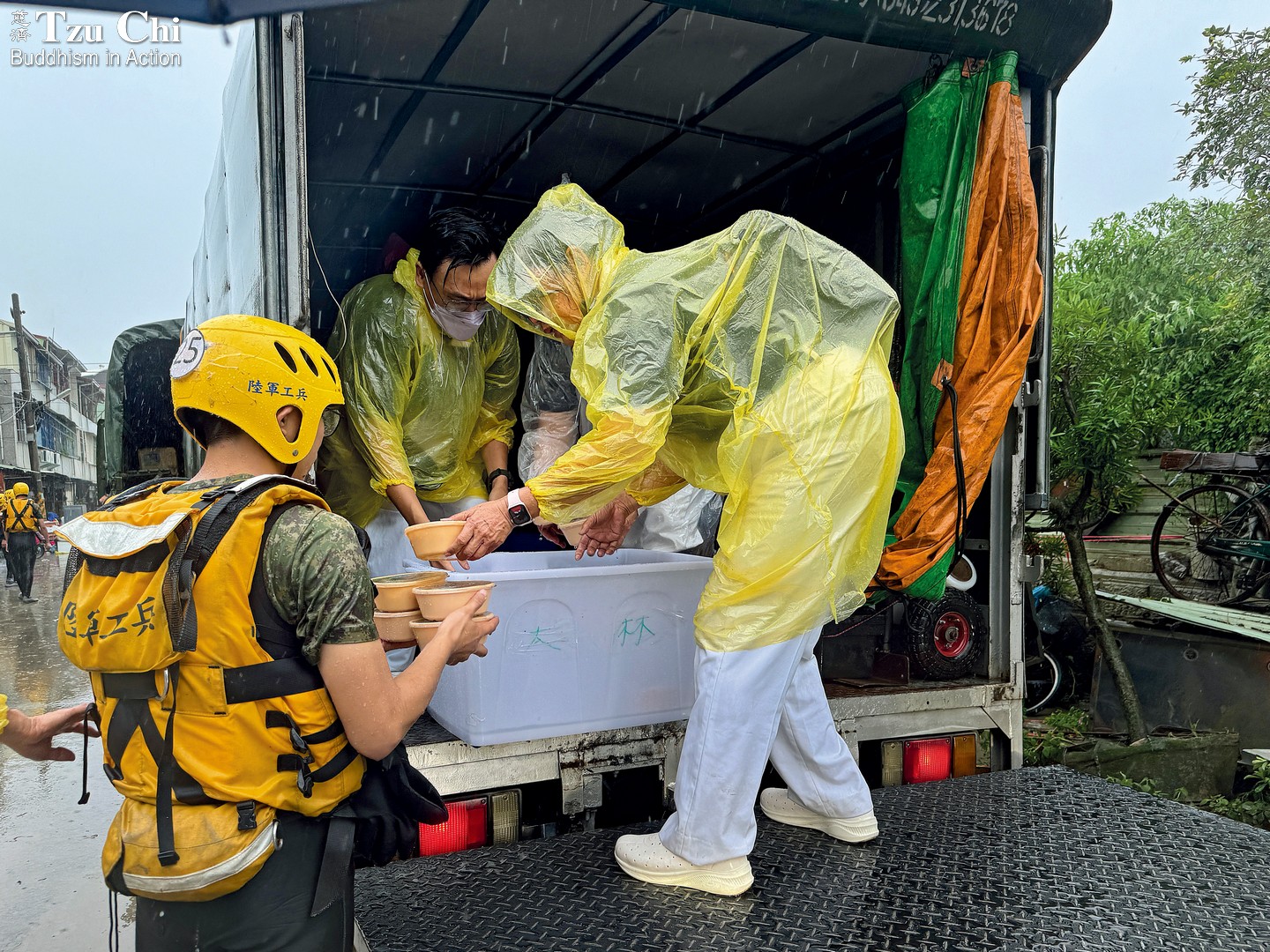
With military assistance, volunteers deliver hot meals to Shuishang Township, Chiayi (photo 1 by Zhang Ju-fen).

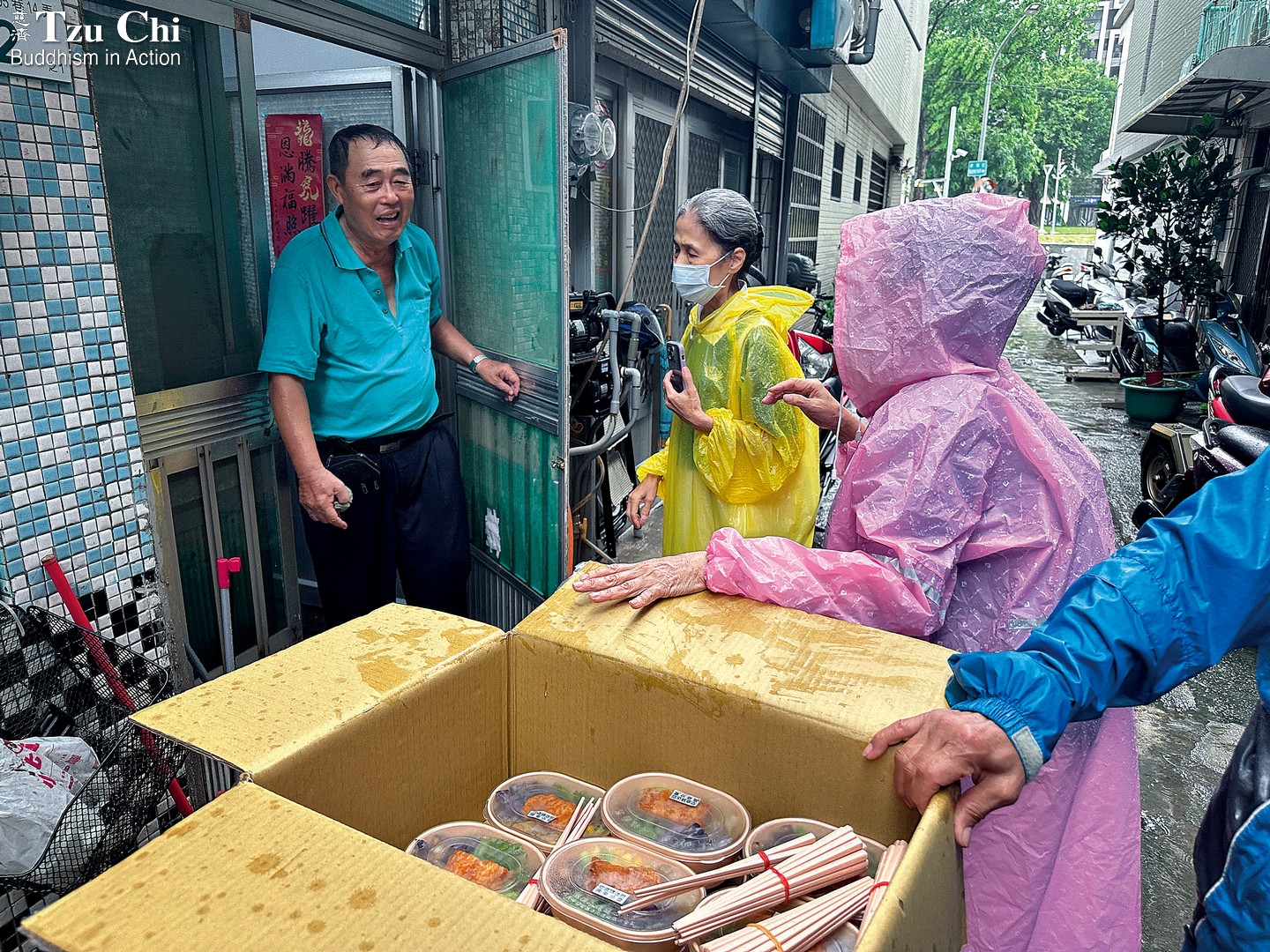
In Kaohsiung, volunteers bring hot meals to a flooded community near a tributary of the Love River (photo 2 by Cai Xiang-ling).

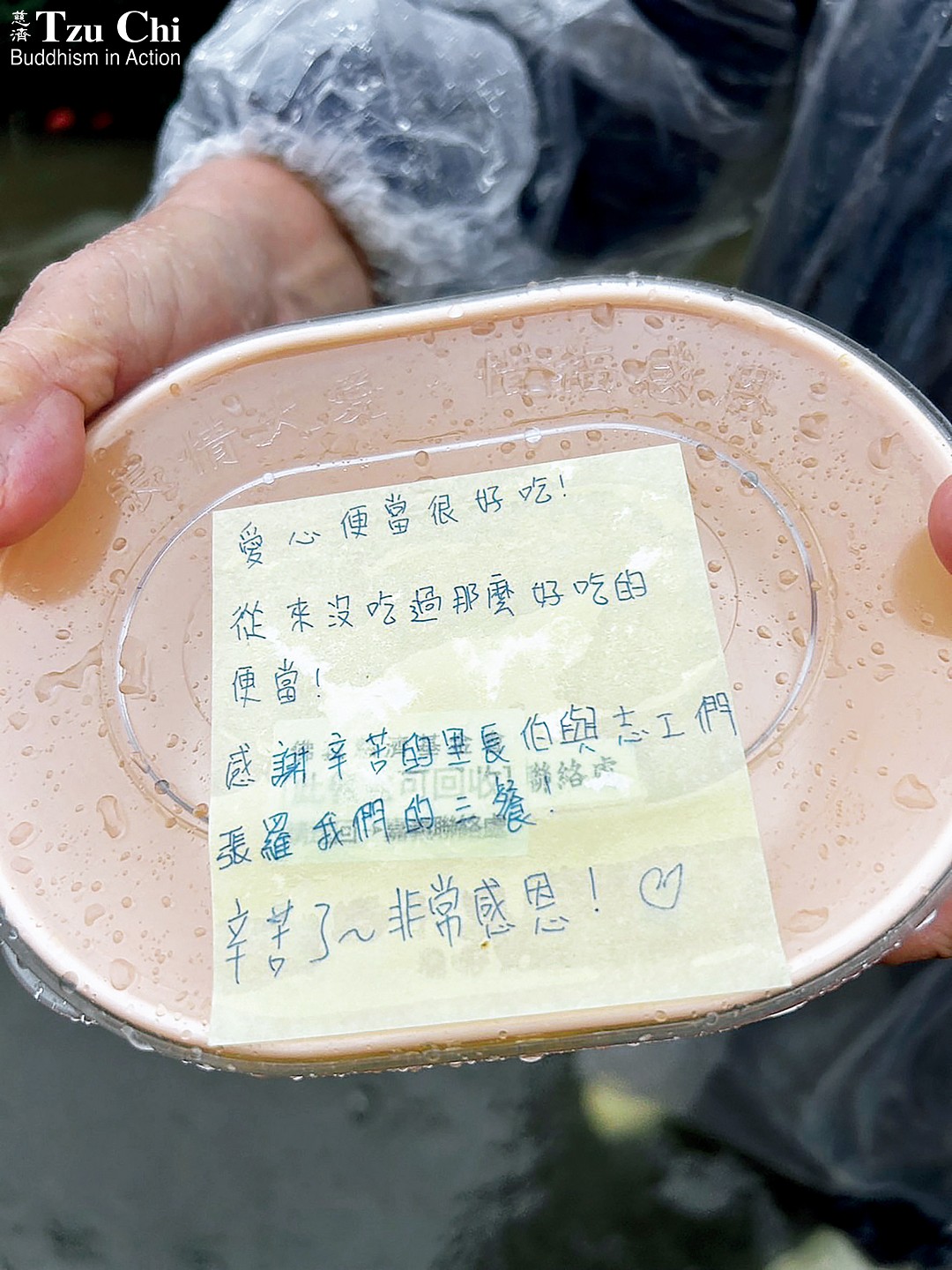
A resident expresses gratitude with a note when returning his meal box; part of the note reads: “This is the best boxed meal I’ve ever had!” (photo 3 courtesy of the Chiayi County Government).

More demand for food

Although the typhoon had passed Taiwan by the morning of July 26, areas in Yunlin and Chiayi had accumulated over a thousand millimeters of rain. Low-lying regions in Dalin, Xikou, and Xingang Townships were flooded, leaving many homes isolated like islands. With food hard to obtain and many restaurants closed, local governments urgently requested boxed meals from Tzu Chi. The demand was high, but severe weather and the fact that many volunteers’ homes were affected by the disaster made manpower scarce. Zeng Ya-wen (曾雅雯), a Tzu Chi volunteer who works at Dalin Tzu Chi Hospital, reached out to the hospital’s Department of Nutritional Therapy for assistance. They readily agreed and asked Zeng to gather help for packing the meals.

Zeng quickly rallied her colleagues. The first batch of stir-fried noodles was ready within 15 minutes, but the number of requested meals quickly increased from 1,000 to 1,500. The nutritionists emptied the refrigerators and contacted suppliers for more ingredients.

While the kitchen buzzed with activity, volunteers prepared vehicles for meal delivery. More volunteers gathered in various townships, ready to collaborate with local government personnel to distribute the meals in the disaster areas. Later, as they ventured into heavily flooded zones, they were joined by military, police, and firefighters who came to assist.

Volunteers received another request for food assistance in Pingtung County, Taiwan’s southernmost area. On the afternoon of July 24, 86 residents of Taiwu Township were urgently evacuated to a shelter. With no time to prepare food, the township head, Pan Ming-fu (潘明福), contacted Tzu Chi volunteer Dai Ming-an (戴明安) for help.

The fierce winds and rain had caused many stores to close. Volunteer Wu Pei-ru (吳佩儒) visited two supermarkets that were still open but found the bread shelves empty. Several other volunteers searched for open bakeries and managed to purchase over a hundred loaves of bread.

The volunteers gathered at Tzu Chi’s Chaozhou office, loaded the bread and other supplies into vehicles, and set off in the dark for the shelter. The wind and rain blurred their vision, and falling branches along the way were alarming, but they finally arrived at 8 p.m. The evacuees were overjoyed. The children were especially thrilled to see the cookies, temporarily forgetting the challenges caused by the typhoon.

 At the shelter, the volunteers noticed elderly residents sleeping on the floor. They reported this to Zhang Zhi-xiang (張智翔), a social worker at Tzu Chi’s Pingtung office. He responded by delivering folding beds, arriving just before 10 p.m. Volunteer Wu Pei-ru also noticed the lack of water dispensers in the shelter, which meant that the instant noodles they had brought couldn’t be served. She and the other volunteers decided on the spot to provide hot meals for lunch the next day.

The next morning, with food ingredients still hard to obtain, Wu contacted Ms. Su, a Tzu Chi donating member who ran a grocery business, for help. Ms. Su immediately went to her warehouse, gathered supplies, and personally delivered them to the Tzu Chi Chaozhou office.

However, after checking the supplies, Wu found there still wasn’t enough food. She made a trip to the local wholesale market, only to find it flooded and closed. Standing in the water, she called Ms. Su again, who generously said, “Come and take whatever you need! I won’t charge you a penny.”

Later that day, 18 volunteers braved the rain to gather at the Tzu Chi office. Within two hours, they had prepared 130 boxed meals. The journey to deliver them was again fraught with wind and rain, but the volunteers took comfort in knowing that the evacuees would receive freshly cooked meals to warm their stomachs and hearts.

Helping the elderly and disabled clean up

Typhoon Gaemi’s devastating floods left countless homes in need of cleaning. Tzu Chi volunteers across various regions assessed their manpower and decided to focus on helping the elderly, disabled, and fellow volunteers.

On August 1, Chiayi volunteers arrived in Yixing Village, Shuishang Township, to carry out a cleanup mission for Ms. Zhang, a Tzu Chi care recipient. Although a week had passed since the typhoon, some roads remained flooded.

The volunteers quickly set to work upon arriving at Ms. Zhang’s home. The ground and floors were slippery, causing frequent slips and falls. They shoveled mud out of the house and carried damaged items outside for disposal, finding that nearly everything inside was ruined. When asked how high the water had risen, Zhang pointed to the roof, saying, “It filled the entire house.”

Zhang, who lived alone and was in poor health, had been under Tzu Chi’s care since last year. Because her house is located in a low-lying area, she was the first to evacuate to the shelter set up at the township office when the typhoon hit. Volunteer Ye Xiu-rong (葉秀榮) shared that Zhang was so apprehensive about returning home afterwards that she stayed on at the shelter even after all the other evacuees had left.

While Zhang was still at the shelter, Lin Ming-nan (林名男), deputy superintendent of Dalin Tzu Chi Hospital, arrived to provide free medical care to flood survivors. Zhang, feeling both stressed and grateful, said, “Thank Tzu Chi for providing us at the shelter with beds, care packages, and hot food, and thank the medical professionals from Dalin Tzu Chi Hospital for their healthcare. However, despite this good care, I still worry about whether my house was swept away.”

This prompted a visit to her home by volunteers on July 31. The house was still standing but in a state of disarray. Volunteers organized a cleanup effort for the following day, planning for 15 people. It was a pleasant surprise when 25 showed up. The house smelled foul, and some volunteers even vomited while they worked, but they pressed on. After a few hours, the rooms and kitchen were spotless. Zhang hugged Ye Xiu-rong, tearfully saying, “Now I have a place to sleep. I’m so happy!”

Land subsidence in Yunlin’s coastal areas had left many homes in Dagou, Shuilin Township, situated lower than the roads. The combination of high tides and heavy rain from Typhoon Gaemi caused flooding that took a long time to recede. Mr. Chen, a 68-year-old with mobility issues who lives alone, was evacuated to a shelter during the typhoon. With no time to move his belongings to higher ground, all his furniture and appliances were submerged. On August 4, over 20 volunteers arrived at his home to help him clean up.

Volunteers moved everything outside to clean or discard. Cai Qing-sen (蔡清森) used a high-pressure washer to clean the walls and floors. Since the house lacked drains, Cai Jin-ding (蔡進丁) and Tang Shi-xian (湯士賢) scooped up the dirty water, while Xia Ying-qi (夏縈) carried the buckets outside to empty into the gutter. The volunteers returned what furniture they could salvage after cleaning, restoring Mr. Chen’s home as best they could.

Mr. Su and his wife, in their 70s and childless, live in a brick house with a metal roof in Xinjia, Houbi District, Tainan. The typhoon left their home in a mess. Due to their age, they requested Tzu Chi’s assistance. Around 30 volunteers helped move out soaked furniture and clean out the mud inside. Mr. Su was deeply grateful.

Volunteers returned to visit the couple a week later. Mr. Su, touched by their support, said. “It’s wonderful to have Tzu Chi. I can’t express my gratitude to you enough. Seeing you all again makes me want to cry.” Everything usable inside the house had been elevated, but it was otherwise empty—no bed or furniture, just the lingering smell of disinfectant. The couple was staying in a friend’s vacant house, but they returned each morning to continue putting their home back together.

Mr. Su shared, “The flooding wasn’t this bad 15 years ago with Typhoon Morakot, nor 6 years ago during that August rainstorm! This time, the water came so fast. I had to drive my wife to safety. It was like a vast ocean, just like the end of the world.” Overcome with emotion, he began to cry, so a volunteer stepped forward to comfort him.

Once he had calmed down, he added, “After Typhoon Morakot, we managed on our own without asking for help. My wife and I quietly cleaned up. But now that we’re older, I told her we shouldn’t push ourselves too hard. We felt so helpless. Fortunately, you came. I’m truly grateful.”

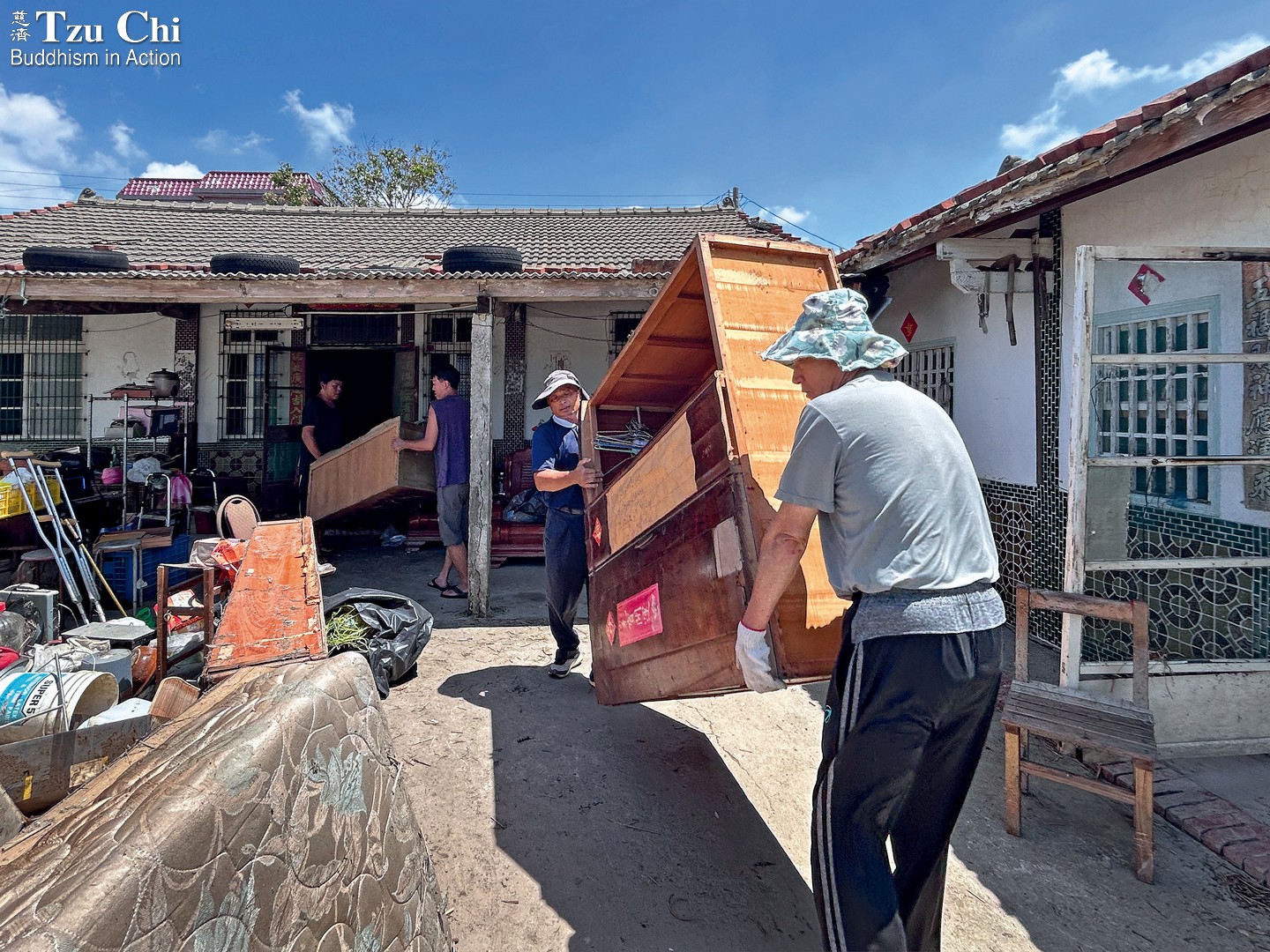
After the floodwaters receded, volunteers helped vulnerable and elderly residents, as well as affected volunteers, clean their homes. In photo 1, volunteers clear debris from a traditional courtyard house in Beigang, Yunlin (photo by Cai Yi-da).

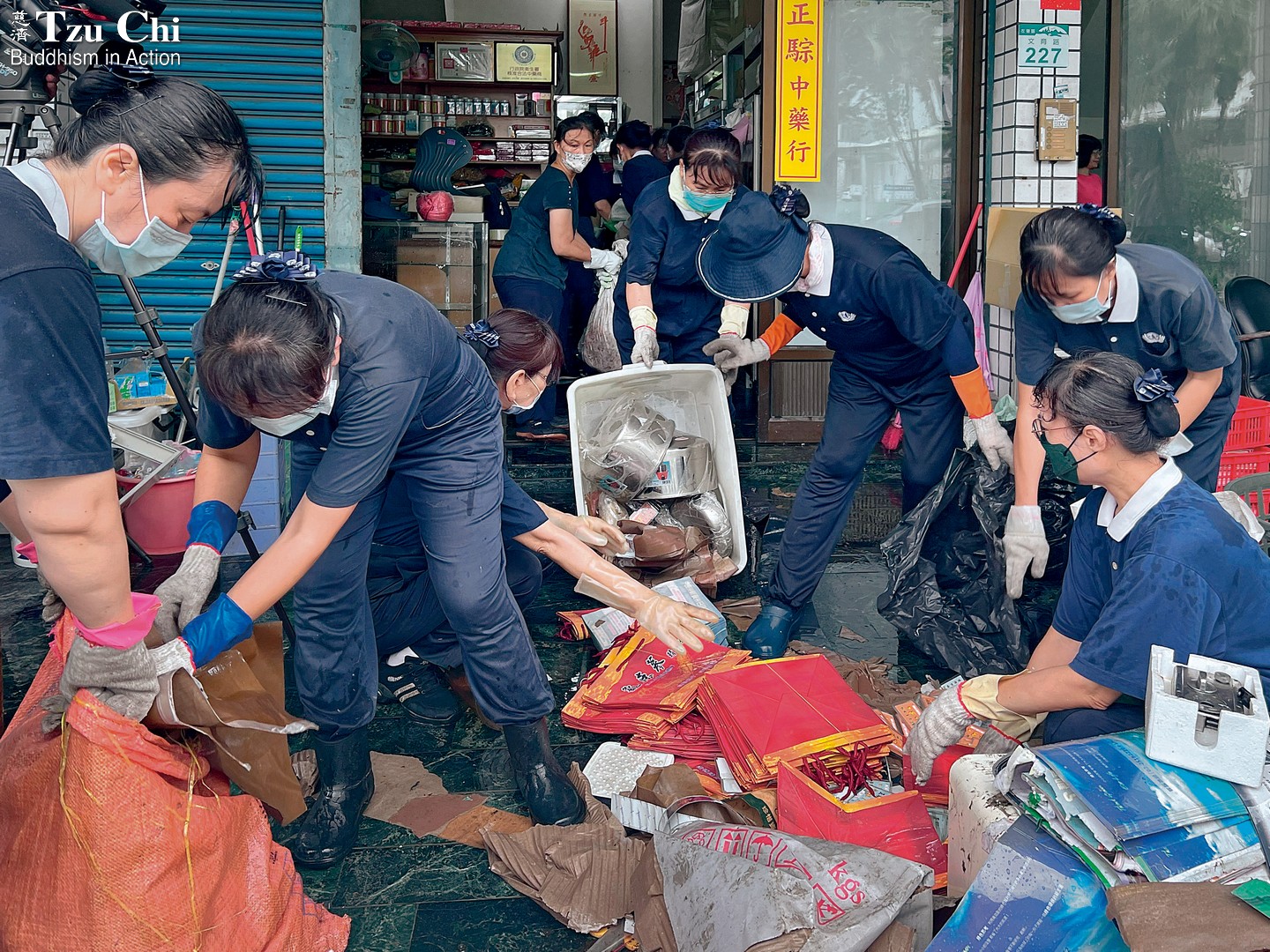
Photo 2 shows volunteers removing waterlogged items from the flooded basement of a store in Zuoying, Kaohsiung (photo by Wang Zhong-yi).

Home visits

In addition to providing meals and cleanup services, volunteers mobilized in late July and early August to visit residents in the hardest-hit areas, delivering gift packs and offering solace. Each gift pack contained a letter of comfort from Dharma Master Cheng Yen, multigrain powder, rice crackers, soy milk powder, and more. Ye Ya-ling (葉雅玲), a social worker at Tzu Chi’s Tainan office, explained the purpose of these visits: “First, to deliver Master Cheng Yen’s words of comfort and Tzu Chi’s blessings; second, to identify families that may need further assistance.”

Ms. Xu, a resident of Xinjia, Houbi District, raises ducks for a living. She lost all the ducks in one of her two duck houses to the flood, with only a few surviving in the other. Overcome with sadness and frustration, she was moved to tears by Master Cheng Yen’s concern and the blessings from Tzu Chi volunteers worldwide. Seeing her tears, volunteer Zhuang Jin-zhi (莊錦治) quickly embraced her in a comforting hug.

Xie He Mei-mei (謝何美梅) from Madou District, Tainan, smiled brightly when she saw the Tzu Chi volunteers at her door. “It’s a real comfort to know that people continue to care about us,” she said. She was waiting for someone to repair her household appliances and still needed to put her large furniture back in place. She recounted the helplessness she and her 86-year-old husband felt when the floodwaters came. When the volunteers asked if she had been eating well, she smiled and replied, “When there weren’t Tzu Chi meals, I just ate instant noodles.”

Though Typhoon Gaemi brought destruction and misery, the presence of Tzu Chi volunteers, who offered a listening ear and support, provided much-needed consolation. The volunteers hoped that Master Cheng Yen’s blessings and the care and love from all Tzu Chi volunteers would bring peace to the hearts of those affected.

Volunteers visit a household in Annei, Yanshui, Tainan, where they deliver a gift pack and offer support. Huang Xiao-zhe

By Tzu Chi documenting volunteers
Edited and translated by Wu Hsiao-ting

Typhoon Gaemi’s relentless downpour wreaked havoc on southern Taiwan, but Tzu Chi’s swift and compassionate response provided essential aid and hope amidst the devastation.

Volunteers clean a flood victim’s home after Typhoon Gaemi in Fenjihu, a low-lying area in Baihe District, Tainan. Huang Xiao-zhe

Typhoon Gaemi, the first to hit Taiwan this year, made landfall in Yilan County at midnight on July 25 and exited the island through Taoyuan City just 4 hours and 20 minutes later. Despite weakening after landfall, the typhoon’s outer edges, combined with southwesterly winds, brought torrential rain to southern Taiwan. Chiayi, Tainan, Kaohsiung, and Pingtung saw rainfall nearly matching the peak daily totals recorded during Typhoon Morakot in 2009. Severe flooding was reported across the southern regions.

The Bazhang River in Chiayi overflowed early on July 25, flooding homes up to the first floor. Liuxin Village in Shuishang Township, located near the riverbank, was particularly affected. Village Chief Chen Huang-ru (陳皇如) said that when the typhoon warning was issued, he, as usual, went into alert mode, monitoring the water levels at the floodgates day and night. However, despite such vigilance, flooding still occurred.

Mr. Li, a resident of Liuxin Village, recounted that village officers broadcasted warnings just before the river overflowed, urging residents to evacuate to the township shelter. However, living alone and severely disabled, his only option was to take refuge at his sister’s home in the city. “Two days later, when the water receded, I returned home to a scene of devastation,” he said. “I was overwhelmed and didn’t know what to do, so I sought help from the village chief. I’m deeply grateful to the Tzu Chi volunteers who came to assist!”

On July 28, over a hundred Tzu Chi volunteers gathered at the Shuishang Township Office, equipped with brooms, basins, buckets, hoses, shovels, and other tools. They divided into groups and headed into the community to help residents clean up. Along the way, they saw piles of water-damaged furniture and debris, while grapple trucks and bulldozers operated alongside garbage trucks collecting the debris. Residents expressed their gratitude upon seeing the volunteers, putting their palms together and saying, “Oh! Such a large group! Thank you, Tzu Chi brothers and sisters. We’re so fortunate to have you!”

A Tzu Chi team had earlier conducted home visits in Shuishang Township and discovered that some families lacked the resources to clean up on their own. In response, they asked village chiefs to compile a list of homes needing cleaning assistance. Initially, only a few households were reported, but as volunteers arrived on-site on July 28, more residents requested help. The volunteers worked together to clean up the mud and remove debris. They also assisted villagers in disposing of or returning large items of furniture to their original positions, accelerating the recovery process.

Village Chief Chen Huang-ru remarked that the flood had left his village in disarray, with an unbearable stench. “Tzu Chi not only provided us with material assistance but also made us feel genuinely cared for and supported. This has been a tremendous encouragement as we work to restore our lives.”

Volunteers returned to Chen’s village on August 3. That morning, the community broadcast echoed with Chen’s reminders to the villagers: “Today, Tzu Chi volunteers will visit affected households to offer support. Please stay home and wait for them. Doctors from Dalin Tzu Chi Hospital will also be providing free medical services at Liu’an Temple. If you need medical attention, don’t hesitate to drop by.”

Volunteers use rescue boats to deliver hot meals to flooded areas in Madou, Tainan, on July 26. Typhoon Gaemi had already passed by that time, but heavy rain continued in the region. Chen He-sheng

Meal service

Tzu Chi offices in over a dozen counties and cities across Taiwan swiftly established disaster response centers after the land warning for Typhoon Gaemi was issued at 11:30 a.m. on July 23. Volunteers took inventory and organized emergency supplies, ready to support the government’s shelter and relief efforts. Later, due to the typhoon, people living in southern counties and cities had three consecutive days off. For those trapped by floodwaters or busy restoring their homes, a hot meal became a precious comfort. Volunteers ultimately distributed over 26,000 boxed meals in the aftermath of the storm.

Though the Liucuo and Baimi neighborhoods in Gangshan District, Kaohsiung, hadn’t experienced flooding in years, they were not spared this time. Floodwaters rose to waist height on the morning of July 25. The heads of both neighborhoods sought assistance from Tzu Chi. Volunteers immediately delivered supplies and boxed meals.

The following morning, volunteers braved intermittent strong winds and heavy rain to deliver additional aid to Liucuo, including over 800 loaves of bread, 600 packs of cookies, and 25 boxes of bottled water. Volunteer Ou Jin-ye (歐金葉), who leads a culinary team, received a notification about flood victims’ need for boxed lunches and quickly sprang into action. She organized a team to purchase ingredients, cook, and pack the meals. Within just a few hours, 370 packed lunches were delivered to the activity center in Baimi.

Around the same time, Tzu Chi volunteers in other areas of Kaohsiung fully mobilized, splitting into groups to support flood-affected communities. While distributing bread, they also checked if residents needed boxed meals for lunch that day. Yao Hao-zhe (姚皓哲), a resident of Xiaoshun Street in Sanmin District, gratefully accepted the bread and said, “This will be my first meal of the day.” He recalled going downstairs at around 5 a.m. on July 25 to check the water level of Baozhu Ditch, a tributary of the Love River, in front of his home. The water level was still low at the time, but just two hours later, it surged over the concrete embankment, flooding the area nearly half a story high.

Amid torrential rain, volunteers returned to Xiaoshun Street with 120 boxed lunches at 11 a.m. Residents said they had been busy cleaning up after the half-story-high floodwaters receded and had no time to cook, relying only on dry food to stave off their hunger. These hot meals were truly a blessing.

Earlier that day, before 7 a.m., Tzu Chi’s Kaohsiung Jing Si Hall was bustling with activity. A team in the basement received bread from a chain bakery, while volunteers in another area prepared gift packs for flood survivors. Culinary volunteers washed, chopped, and cooked ingredients in large woks and pots in the kitchen. Everyone was busy, yet focused and organized.

“We had purchased and prepared ingredients over the past two days in anticipation of this need,” said volunteer Wu Xiu-xia (吳秀霞). She led a team of 50 volunteers in cooking and packing the food. Yan Yue-tao (顏月桃), another volunteer, added, “We received the task last night around 6 p.m., so I reached out to my contacts to gather more ingredients. We can easily make 1,600 boxed lunches!” By 11 a.m., the boxed lunches were ready and delivered along four routes to Qiaotou, Ziguan, and other locations in Kaohsiung.

With military assistance, volunteers deliver hot meals to Shuishang Township, Chiayi (photo 1 by Zhang Ju-fen).

In Kaohsiung, volunteers bring hot meals to a flooded community near a tributary of the Love River (photo 2 by Cai Xiang-ling).

A resident expresses gratitude with a note when returning his meal box; part of the note reads: “This is the best boxed meal I’ve ever had!” (photo 3 courtesy of the Chiayi County Government).

More demand for food

Although the typhoon had passed Taiwan by the morning of July 26, areas in Yunlin and Chiayi had accumulated over a thousand millimeters of rain. Low-lying regions in Dalin, Xikou, and Xingang Townships were flooded, leaving many homes isolated like islands. With food hard to obtain and many restaurants closed, local governments urgently requested boxed meals from Tzu Chi. The demand was high, but severe weather and the fact that many volunteers’ homes were affected by the disaster made manpower scarce. Zeng Ya-wen (曾雅雯), a Tzu Chi volunteer who works at Dalin Tzu Chi Hospital, reached out to the hospital’s Department of Nutritional Therapy for assistance. They readily agreed and asked Zeng to gather help for packing the meals.

Zeng quickly rallied her colleagues. The first batch of stir-fried noodles was ready within 15 minutes, but the number of requested meals quickly increased from 1,000 to 1,500. The nutritionists emptied the refrigerators and contacted suppliers for more ingredients.

While the kitchen buzzed with activity, volunteers prepared vehicles for meal delivery. More volunteers gathered in various townships, ready to collaborate with local government personnel to distribute the meals in the disaster areas. Later, as they ventured into heavily flooded zones, they were joined by military, police, and firefighters who came to assist.

Volunteers received another request for food assistance in Pingtung County, Taiwan’s southernmost area. On the afternoon of July 24, 86 residents of Taiwu Township were urgently evacuated to a shelter. With no time to prepare food, the township head, Pan Ming-fu (潘明福), contacted Tzu Chi volunteer Dai Ming-an (戴明安) for help.

The fierce winds and rain had caused many stores to close. Volunteer Wu Pei-ru (吳佩儒) visited two supermarkets that were still open but found the bread shelves empty. Several other volunteers searched for open bakeries and managed to purchase over a hundred loaves of bread.

The volunteers gathered at Tzu Chi’s Chaozhou office, loaded the bread and other supplies into vehicles, and set off in the dark for the shelter. The wind and rain blurred their vision, and falling branches along the way were alarming, but they finally arrived at 8 p.m. The evacuees were overjoyed. The children were especially thrilled to see the cookies, temporarily forgetting the challenges caused by the typhoon.

 At the shelter, the volunteers noticed elderly residents sleeping on the floor. They reported this to Zhang Zhi-xiang (張智翔), a social worker at Tzu Chi’s Pingtung office. He responded by delivering folding beds, arriving just before 10 p.m. Volunteer Wu Pei-ru also noticed the lack of water dispensers in the shelter, which meant that the instant noodles they had brought couldn’t be served. She and the other volunteers decided on the spot to provide hot meals for lunch the next day.

The next morning, with food ingredients still hard to obtain, Wu contacted Ms. Su, a Tzu Chi donating member who ran a grocery business, for help. Ms. Su immediately went to her warehouse, gathered supplies, and personally delivered them to the Tzu Chi Chaozhou office.

However, after checking the supplies, Wu found there still wasn’t enough food. She made a trip to the local wholesale market, only to find it flooded and closed. Standing in the water, she called Ms. Su again, who generously said, “Come and take whatever you need! I won’t charge you a penny.”

Later that day, 18 volunteers braved the rain to gather at the Tzu Chi office. Within two hours, they had prepared 130 boxed meals. The journey to deliver them was again fraught with wind and rain, but the volunteers took comfort in knowing that the evacuees would receive freshly cooked meals to warm their stomachs and hearts.

Helping the elderly and disabled clean up

Typhoon Gaemi’s devastating floods left countless homes in need of cleaning. Tzu Chi volunteers across various regions assessed their manpower and decided to focus on helping the elderly, disabled, and fellow volunteers.

On August 1, Chiayi volunteers arrived in Yixing Village, Shuishang Township, to carry out a cleanup mission for Ms. Zhang, a Tzu Chi care recipient. Although a week had passed since the typhoon, some roads remained flooded.

The volunteers quickly set to work upon arriving at Ms. Zhang’s home. The ground and floors were slippery, causing frequent slips and falls. They shoveled mud out of the house and carried damaged items outside for disposal, finding that nearly everything inside was ruined. When asked how high the water had risen, Zhang pointed to the roof, saying, “It filled the entire house.”

Zhang, who lived alone and was in poor health, had been under Tzu Chi’s care since last year. Because her house is located in a low-lying area, she was the first to evacuate to the shelter set up at the township office when the typhoon hit. Volunteer Ye Xiu-rong (葉秀榮) shared that Zhang was so apprehensive about returning home afterwards that she stayed on at the shelter even after all the other evacuees had left.

While Zhang was still at the shelter, Lin Ming-nan (林名男), deputy superintendent of Dalin Tzu Chi Hospital, arrived to provide free medical care to flood survivors. Zhang, feeling both stressed and grateful, said, “Thank Tzu Chi for providing us at the shelter with beds, care packages, and hot food, and thank the medical professionals from Dalin Tzu Chi Hospital for their healthcare. However, despite this good care, I still worry about whether my house was swept away.”

This prompted a visit to her home by volunteers on July 31. The house was still standing but in a state of disarray. Volunteers organized a cleanup effort for the following day, planning for 15 people. It was a pleasant surprise when 25 showed up. The house smelled foul, and some volunteers even vomited while they worked, but they pressed on. After a few hours, the rooms and kitchen were spotless. Zhang hugged Ye Xiu-rong, tearfully saying, “Now I have a place to sleep. I’m so happy!”

Land subsidence in Yunlin’s coastal areas had left many homes in Dagou, Shuilin Township, situated lower than the roads. The combination of high tides and heavy rain from Typhoon Gaemi caused flooding that took a long time to recede. Mr. Chen, a 68-year-old with mobility issues who lives alone, was evacuated to a shelter during the typhoon. With no time to move his belongings to higher ground, all his furniture and appliances were submerged. On August 4, over 20 volunteers arrived at his home to help him clean up.

Volunteers moved everything outside to clean or discard. Cai Qing-sen (蔡清森) used a high-pressure washer to clean the walls and floors. Since the house lacked drains, Cai Jin-ding (蔡進丁) and Tang Shi-xian (湯士賢) scooped up the dirty water, while Xia Ying-qi (夏縈) carried the buckets outside to empty into the gutter. The volunteers returned what furniture they could salvage after cleaning, restoring Mr. Chen’s home as best they could.

Mr. Su and his wife, in their 70s and childless, live in a brick house with a metal roof in Xinjia, Houbi District, Tainan. The typhoon left their home in a mess. Due to their age, they requested Tzu Chi’s assistance. Around 30 volunteers helped move out soaked furniture and clean out the mud inside. Mr. Su was deeply grateful.

Volunteers returned to visit the couple a week later. Mr. Su, touched by their support, said. “It’s wonderful to have Tzu Chi. I can’t express my gratitude to you enough. Seeing you all again makes me want to cry.” Everything usable inside the house had been elevated, but it was otherwise empty—no bed or furniture, just the lingering smell of disinfectant. The couple was staying in a friend’s vacant house, but they returned each morning to continue putting their home back together.

Mr. Su shared, “The flooding wasn’t this bad 15 years ago with Typhoon Morakot, nor 6 years ago during that August rainstorm! This time, the water came so fast. I had to drive my wife to safety. It was like a vast ocean, just like the end of the world.” Overcome with emotion, he began to cry, so a volunteer stepped forward to comfort him.

Once he had calmed down, he added, “After Typhoon Morakot, we managed on our own without asking for help. My wife and I quietly cleaned up. But now that we’re older, I told her we shouldn’t push ourselves too hard. We felt so helpless. Fortunately, you came. I’m truly grateful.”

After the floodwaters receded, volunteers helped vulnerable and elderly residents, as well as affected volunteers, clean their homes. In photo 1, volunteers clear debris from a traditional courtyard house in Beigang, Yunlin (photo by Cai Yi-da).

Photo 2 shows volunteers removing waterlogged items from the flooded basement of a store in Zuoying, Kaohsiung (photo by Wang Zhong-yi).

Home visits

In addition to providing meals and cleanup services, volunteers mobilized in late July and early August to visit residents in the hardest-hit areas, delivering gift packs and offering solace. Each gift pack contained a letter of comfort from Dharma Master Cheng Yen, multigrain powder, rice crackers, soy milk powder, and more. Ye Ya-ling (葉雅玲), a social worker at Tzu Chi’s Tainan office, explained the purpose of these visits: “First, to deliver Master Cheng Yen’s words of comfort and Tzu Chi’s blessings; second, to identify families that may need further assistance.”

Ms. Xu, a resident of Xinjia, Houbi District, raises ducks for a living. She lost all the ducks in one of her two duck houses to the flood, with only a few surviving in the other. Overcome with sadness and frustration, she was moved to tears by Master Cheng Yen’s concern and the blessings from Tzu Chi volunteers worldwide. Seeing her tears, volunteer Zhuang Jin-zhi (莊錦治) quickly embraced her in a comforting hug.

Xie He Mei-mei (謝何美梅) from Madou District, Tainan, smiled brightly when she saw the Tzu Chi volunteers at her door. “It’s a real comfort to know that people continue to care about us,” she said. She was waiting for someone to repair her household appliances and still needed to put her large furniture back in place. She recounted the helplessness she and her 86-year-old husband felt when the floodwaters came. When the volunteers asked if she had been eating well, she smiled and replied, “When there weren’t Tzu Chi meals, I just ate instant noodles.”

Though Typhoon Gaemi brought destruction and misery, the presence of Tzu Chi volunteers, who offered a listening ear and support, provided much-needed consolation. The volunteers hoped that Master Cheng Yen’s blessings and the care and love from all Tzu Chi volunteers would bring peace to the hearts of those affected.

Volunteers visit a household in Annei, Yanshui, Tainan, where they deliver a gift pack and offer support. Huang Xiao-zhe

關鍵字

善の念を結集し、広く法縁を結ぶ

自分を軽く見てはならず、
人は誰でも仏性を有しており、
人間(じんかん)菩薩を募れば、
至る所が道場になります。
善の念を育んで、広く善の法縁を結び、
善の念を結集して福を作り、菩薩道に精進すれば、
至誠があらゆる生を慈しみで潤し、
世を平和と清浄に導くでしょう。

自分を軽く見てはならず、人は誰でも仏性を有しており、人間(じんかん)菩薩を募れば、至る所が道場になります。

善の念を育んで、広く善の法縁を結び、善の念を結集して福を作り、菩薩道に精進すれば、至誠があらゆる生を慈しみで潤し、世を平和と清浄に導くでしょう。

自分を軽く見てはならず、
人は誰でも仏性を有しており、
人間(じんかん)菩薩を募れば、
至る所が道場になります。
善の念を育んで、広く善の法縁を結び、
善の念を結集して福を作り、菩薩道に精進すれば、
至誠があらゆる生を慈しみで潤し、
世を平和と清浄に導くでしょう。

自分を軽く見てはならず、人は誰でも仏性を有しており、人間(じんかん)菩薩を募れば、至る所が道場になります。

善の念を育んで、広く善の法縁を結び、善の念を結集して福を作り、菩薩道に精進すれば、至誠があらゆる生を慈しみで潤し、世を平和と清浄に導くでしょう。

關鍵字

心を等しく豊かに導き、貧困を無くそう

編集者の言葉

持続可能という言葉が、世界中で流行っている。今世界の国や企業、民間団体は、取り組みや物作りにおいて、皆、国連の唱える十七の持続可能な開発目標(以下SDGs)に合わせるようにしており、それにより運用過程や結果における影響は全て生態系に優しくなり、衆生を利する方向に進もうとしている。

慈済が志業を推進し始めてから、今年で五十九年目になる。慈善、医療、教育、環境保全、地域ボランティア及び国際災害支援等の項目を含め、その多くの活動が、二〇一六年から国連が唱えているSDGsに、偶然にも一致している。慈済の各志業体が網羅する活動範囲は、人類の地球上における生活と生産及び生態などに関係しており、この三つとも互いに密接に繋がって、助け合って、成り立っているので、正にSDGsの構成内容その物になっている。

月刊誌『慈済』は七月号から、慈済志業の発展がSDGsに対応している記事を連載する。先ず五十八年間にわたる慈善支援から始まり、慈済慈善志業で尽くしてきた地域社会の貧困改善の実践とその理念、特色を考え、そして、それらとSDGs「目標1、貧困をなくそう」との関連と影響について紹介している。

慈済が台湾で行っている慈善志業の内容は、日に日に多様化して完成したと言える。例えば、病による貧困に対して、慈済は実際に経済面と医療面の支援が必要だと捉えている。教育問題では、評価してから学費や雑費の支援、或いは課外補習を提供している。そして、家に短期や長期にわたって自立した生活ができない人や寝たきりの人がいる場合は、エコ福祉用具プラットフォームを通じて直ちに必要な設備を届けることができる。一人暮らしの高齢者や障害者の住環境に問題があれば、修繕を行う。

上述の慈善志業モデルは、対象者に合わせた「オーダーメイド」のようなものであり、具体的に各世帯が直面している問題に対応して、解決策を講じている。そして、慈済のこの「地域慈善ネットワーク」は、政府の社会福祉で及ばない所を補い、民間の慈善パワーによって、弱者が目前の困難な状況を脱し、いつか貧困から抜け出して、安定した生活を軌道に乗せ、余力があれば、人助けができるよう期待するものである。

慈済の地域慈善が行っている諸々は、その本質がSDGs1に沿っていると共に、貧困の撲滅と困窮した生活の改善の外、慈済の慈善は彼らが考え方や価値観、人生観を変えることに期待したものである。

短期的な困窮に対する支援にしろ、長期的な貧困や病に苦しむ人への支援にしろ、慈済の貧富に関する考え方は、基本的生活に必要な物資の確保をするだけでなく、それ以上に心に愛と善があることを大切にしている。なぜならこれこそが、「等しい豊かさ」というプラスエネルギーだからだ。そして、このような世の中になってこそ、真に貧困の終わりという目標に到達できると言える。このような慈善モデルは、早くから世界各国の慈済ボランティアによって「コピー」されて広がり、同じ原則に基づいて世界各地で慈善活動が行われ、貧困を覆してきたのだ。

(慈済月刊六九二期より)

編集者の言葉

持続可能という言葉が、世界中で流行っている。今世界の国や企業、民間団体は、取り組みや物作りにおいて、皆、国連の唱える十七の持続可能な開発目標(以下SDGs)に合わせるようにしており、それにより運用過程や結果における影響は全て生態系に優しくなり、衆生を利する方向に進もうとしている。

慈済が志業を推進し始めてから、今年で五十九年目になる。慈善、医療、教育、環境保全、地域ボランティア及び国際災害支援等の項目を含め、その多くの活動が、二〇一六年から国連が唱えているSDGsに、偶然にも一致している。慈済の各志業体が網羅する活動範囲は、人類の地球上における生活と生産及び生態などに関係しており、この三つとも互いに密接に繋がって、助け合って、成り立っているので、正にSDGsの構成内容その物になっている。

月刊誌『慈済』は七月号から、慈済志業の発展がSDGsに対応している記事を連載する。先ず五十八年間にわたる慈善支援から始まり、慈済慈善志業で尽くしてきた地域社会の貧困改善の実践とその理念、特色を考え、そして、それらとSDGs「目標1、貧困をなくそう」との関連と影響について紹介している。

慈済が台湾で行っている慈善志業の内容は、日に日に多様化して完成したと言える。例えば、病による貧困に対して、慈済は実際に経済面と医療面の支援が必要だと捉えている。教育問題では、評価してから学費や雑費の支援、或いは課外補習を提供している。そして、家に短期や長期にわたって自立した生活ができない人や寝たきりの人がいる場合は、エコ福祉用具プラットフォームを通じて直ちに必要な設備を届けることができる。一人暮らしの高齢者や障害者の住環境に問題があれば、修繕を行う。

上述の慈善志業モデルは、対象者に合わせた「オーダーメイド」のようなものであり、具体的に各世帯が直面している問題に対応して、解決策を講じている。そして、慈済のこの「地域慈善ネットワーク」は、政府の社会福祉で及ばない所を補い、民間の慈善パワーによって、弱者が目前の困難な状況を脱し、いつか貧困から抜け出して、安定した生活を軌道に乗せ、余力があれば、人助けができるよう期待するものである。

慈済の地域慈善が行っている諸々は、その本質がSDGs1に沿っていると共に、貧困の撲滅と困窮した生活の改善の外、慈済の慈善は彼らが考え方や価値観、人生観を変えることに期待したものである。

短期的な困窮に対する支援にしろ、長期的な貧困や病に苦しむ人への支援にしろ、慈済の貧富に関する考え方は、基本的生活に必要な物資の確保をするだけでなく、それ以上に心に愛と善があることを大切にしている。なぜならこれこそが、「等しい豊かさ」というプラスエネルギーだからだ。そして、このような世の中になってこそ、真に貧困の終わりという目標に到達できると言える。このような慈善モデルは、早くから世界各国の慈済ボランティアによって「コピー」されて広がり、同じ原則に基づいて世界各地で慈善活動が行われ、貧困を覆してきたのだ。

(慈済月刊六九二期より)

關鍵字

フィリピン・ダバオ市 バナナが豊作の時

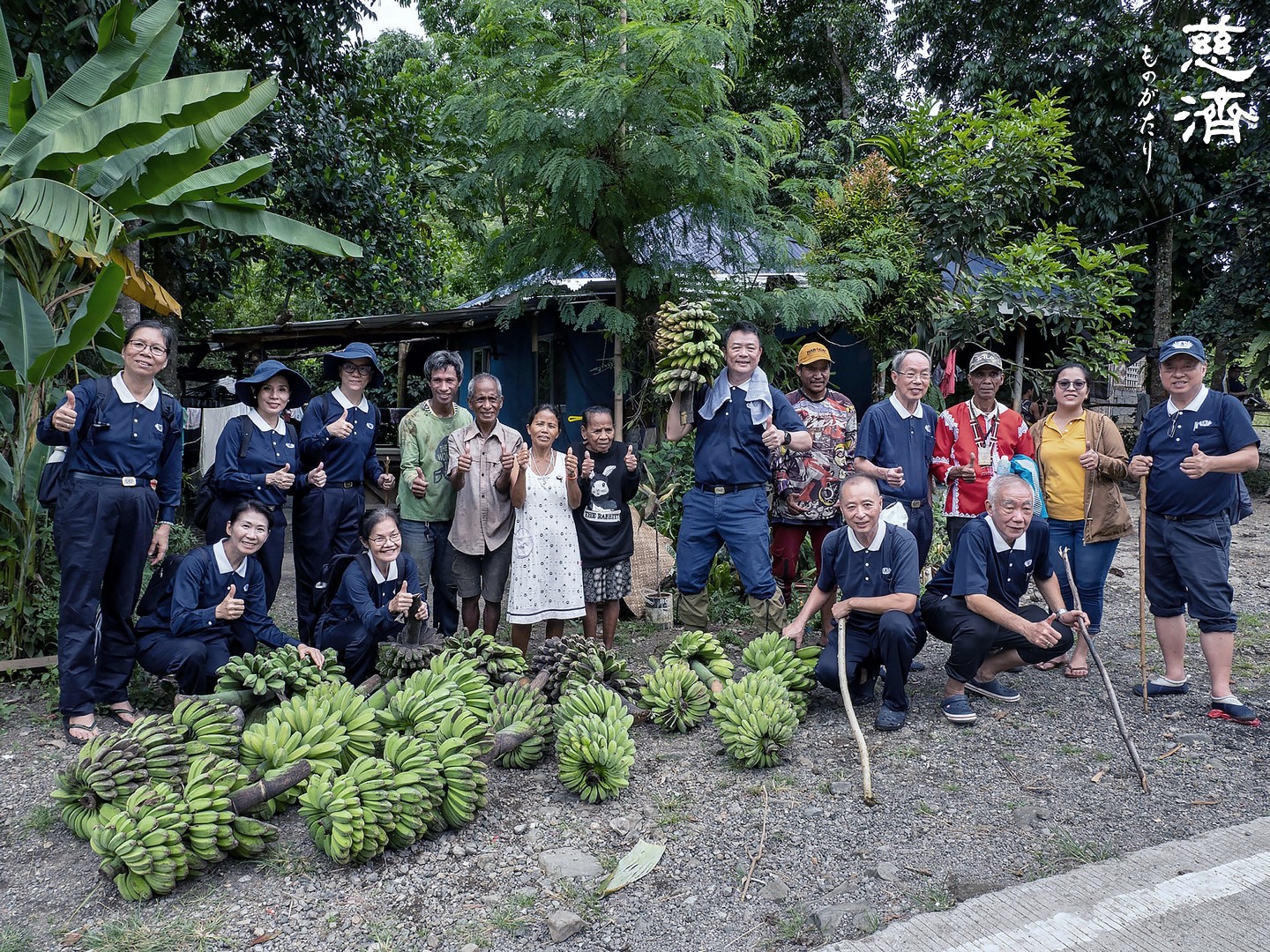
北ダバオ州の山間部にある部落の住民は、有機バナナの栽培による貧困支援プロジェクトに参加している。慈済が品種の選択から技術指導、流通販売まで協力して来たことで、収入が徐々に安定して来ている。

住民らは一日に一食も保証されなかった生活から、今では三食で米が食べられるようになった。

北ダバオ州サント・ニーニョ部落の住民は、慈済の農業による脱貧困プロジェクトに参加し、ボランティアの協力の下、生活を改善するモデルを切り拓いた。(撮影・Harold Alzaga)

私だけではなく、ここのバナナ農家は皆とても幸せです」。エリックさんは部落の農家と一緒に生い茂ったバナナ園で収穫をしていた。大きなバナナの房を担いで山を下り、川を渡った。ダバオとマニラのボランティアも豊作の喜びを分かち合いながら、バナナを運ぶ手伝いをした。

二〇二二年以前、このような光景は、三人の子供を持つ若い父親であるエリックさんにとって、遠い夢話だった。北ダバオ州タラインゴッド・サントニーニョの原住民居住地はダバオ市から車で約三時間半の距離にあり、広い山間地区では雇用機会が乏しく、住民は付加価値の低いトウモロコシやマニラ麻を栽培し、収穫した物を他の所に輸送するが低い値段でしか売れず、運賃を差し引いた後のお金は殆ど手元に残らなかった。トウモロコシは四カ月毎に収穫するので、一世帯の平均所得は月五百ベソ(約1300円)だった。それだけでは四カ月も生活できないので、山菜や芋でお腹を満たしていた。山奥の山村は電気、交通などインフラも整備されてなく、村民は病気になっても下山して治療を受けるお金さえなかった。

二〇二〇年十月、慈済ボランティアは、コロナ禍による経済的な困窮を緩和するための物資を持って来た時、部落は貧しくて活気がなく、住民の目が虚ろだったことに気づいた。「『家徒四壁』と言う言葉がありますが、ここは竹で編んだ家の壁が三方しかなかったのです」とボランティアの呉麗君(ウー・リージュン)さんが言った。

慈済は、長期的な生計問題を解決する時、物資の支援だけに頼るのではなく、「喉の渇きを解決してあげるよりも、井戸を掘ることを教える」という例えを基本としている。そこで、二〇二二年一月に、慈済の農業による脱貧困プロジェクトを始めた。農業専門のボランティアである蔡天保(ツァイ・ティエンバオ)さんは、農産物加工分野で、食品原料の中で最も不足していたバナナの品種を選び、慈済が苗木を提供すると同時に、農民に有機栽培の技術を伝授した。

この地域の百十一世帯のうち、一部は既に若い男性が出稼ぎに行っているので、四十一世帯がプロジェクトに参加した。有機肥料を使った環境に優しい農耕法で栽培しており、バナナの木の成長が遅くても、質、量共に申し分ない。二〇二三年八月にはすでに実がなり、収穫した後にまた新しい芽が出た。栽培面積が拡大するにつれ、四カ月で二千五百株のバナナの木から一万五千キロの収穫があった。ボランティアは輸送を手伝うだけでなく、市場より高い値段で買い取って、食糧市場に投入した。

「この一年間、村民の生活が向上したので、私も本当に感動しました」。プロジェクトを担当するのは、ダバオボランティアのアリエルさんだ。

「このプロジェクトの良い点は、持続可能であることです。真面目に続ければ、土地も住民をも利します」。

アルマンドさんによると、家族は以前一日一食の生活で、長い間、米が食べられない時期もあったという。「しかし今は違います。三食とも米のご飯が食べられ、時には子供に小遣いもあげられるようになりました」。

村人の収入が安定して増えると共に、部落には電気が通るようになった。エリックさんはテレビを買ったことで、部落外の世界の出来事が分かるようになった。「疲れて帰って来て、家族と一緒にテレビを見るのは素晴らしいことです」。子供に飴を買ってあげることもできるようになった。「父親として、子供に生活必需品を買ってあげられないのは、とても辛いことでした。今、子供の嬉しそうな顔を見ることができて、私も嬉しいです!」。

エリックさんとアルマンドさんは、分割払いで中古バイクを買い、農作物を麓まで運んだり、市場へ買い出しに行ったりするようになった。「以前は市場へ行くのに徒歩で六時間掛かっていました。今は三十分で行けます」とアルマンドさんがホッとした様子で言った。「子供に良い教育を受けさせ、良い暮らしをさせたい」、これはアルマンドさんにとって夢のような生活だったが、今、この土地は一家を養い、未来が見える場所となっている。

(慈済月刊六九二期より)

北ダバオ州の山間部にある部落の住民は、有機バナナの栽培による貧困支援プロジェクトに参加している。慈済が品種の選択から技術指導、流通販売まで協力して来たことで、収入が徐々に安定して来ている。

住民らは一日に一食も保証されなかった生活から、今では三食で米が食べられるようになった。

北ダバオ州サント・ニーニョ部落の住民は、慈済の農業による脱貧困プロジェクトに参加し、ボランティアの協力の下、生活を改善するモデルを切り拓いた。(撮影・Harold Alzaga)

私だけではなく、ここのバナナ農家は皆とても幸せです」。エリックさんは部落の農家と一緒に生い茂ったバナナ園で収穫をしていた。大きなバナナの房を担いで山を下り、川を渡った。ダバオとマニラのボランティアも豊作の喜びを分かち合いながら、バナナを運ぶ手伝いをした。

二〇二二年以前、このような光景は、三人の子供を持つ若い父親であるエリックさんにとって、遠い夢話だった。北ダバオ州タラインゴッド・サントニーニョの原住民居住地はダバオ市から車で約三時間半の距離にあり、広い山間地区では雇用機会が乏しく、住民は付加価値の低いトウモロコシやマニラ麻を栽培し、収穫した物を他の所に輸送するが低い値段でしか売れず、運賃を差し引いた後のお金は殆ど手元に残らなかった。トウモロコシは四カ月毎に収穫するので、一世帯の平均所得は月五百ベソ(約1300円)だった。それだけでは四カ月も生活できないので、山菜や芋でお腹を満たしていた。山奥の山村は電気、交通などインフラも整備されてなく、村民は病気になっても下山して治療を受けるお金さえなかった。

二〇二〇年十月、慈済ボランティアは、コロナ禍による経済的な困窮を緩和するための物資を持って来た時、部落は貧しくて活気がなく、住民の目が虚ろだったことに気づいた。「『家徒四壁』と言う言葉がありますが、ここは竹で編んだ家の壁が三方しかなかったのです」とボランティアの呉麗君(ウー・リージュン)さんが言った。

慈済は、長期的な生計問題を解決する時、物資の支援だけに頼るのではなく、「喉の渇きを解決してあげるよりも、井戸を掘ることを教える」という例えを基本としている。そこで、二〇二二年一月に、慈済の農業による脱貧困プロジェクトを始めた。農業専門のボランティアである蔡天保(ツァイ・ティエンバオ)さんは、農産物加工分野で、食品原料の中で最も不足していたバナナの品種を選び、慈済が苗木を提供すると同時に、農民に有機栽培の技術を伝授した。

この地域の百十一世帯のうち、一部は既に若い男性が出稼ぎに行っているので、四十一世帯がプロジェクトに参加した。有機肥料を使った環境に優しい農耕法で栽培しており、バナナの木の成長が遅くても、質、量共に申し分ない。二〇二三年八月にはすでに実がなり、収穫した後にまた新しい芽が出た。栽培面積が拡大するにつれ、四カ月で二千五百株のバナナの木から一万五千キロの収穫があった。ボランティアは輸送を手伝うだけでなく、市場より高い値段で買い取って、食糧市場に投入した。

「この一年間、村民の生活が向上したので、私も本当に感動しました」。プロジェクトを担当するのは、ダバオボランティアのアリエルさんだ。

「このプロジェクトの良い点は、持続可能であることです。真面目に続ければ、土地も住民をも利します」。

アルマンドさんによると、家族は以前一日一食の生活で、長い間、米が食べられない時期もあったという。「しかし今は違います。三食とも米のご飯が食べられ、時には子供に小遣いもあげられるようになりました」。

村人の収入が安定して増えると共に、部落には電気が通るようになった。エリックさんはテレビを買ったことで、部落外の世界の出来事が分かるようになった。「疲れて帰って来て、家族と一緒にテレビを見るのは素晴らしいことです」。子供に飴を買ってあげることもできるようになった。「父親として、子供に生活必需品を買ってあげられないのは、とても辛いことでした。今、子供の嬉しそうな顔を見ることができて、私も嬉しいです!」。

エリックさんとアルマンドさんは、分割払いで中古バイクを買い、農作物を麓まで運んだり、市場へ買い出しに行ったりするようになった。「以前は市場へ行くのに徒歩で六時間掛かっていました。今は三十分で行けます」とアルマンドさんがホッとした様子で言った。「子供に良い教育を受けさせ、良い暮らしをさせたい」、これはアルマンドさんにとって夢のような生活だったが、今、この土地は一家を養い、未来が見える場所となっている。

(慈済月刊六九二期より)

關鍵字

The Illustrated Jing Si Aphorisms

The Buddha says:

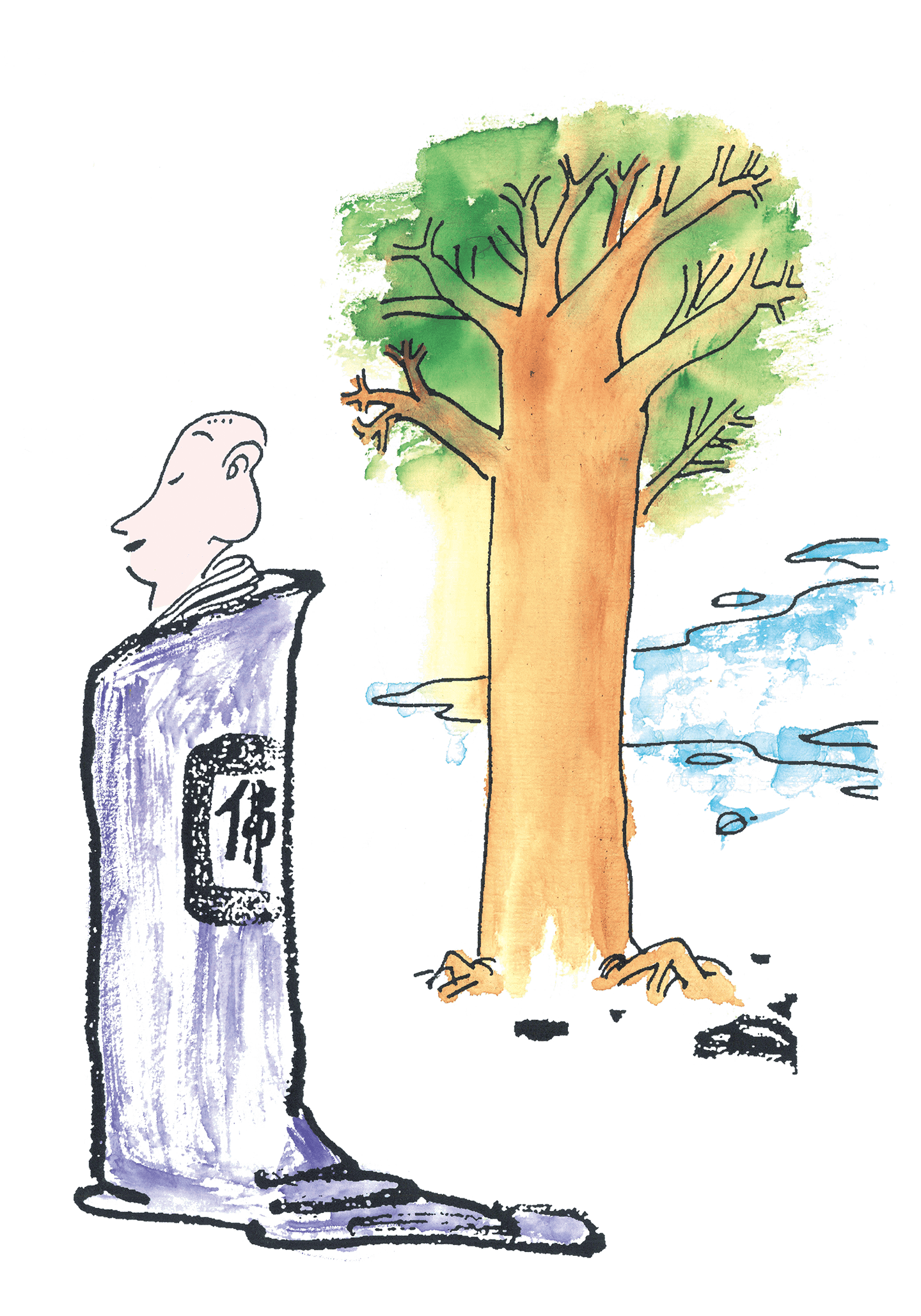
Whoever sees the Dharma, sees me.
Whoever has not seen the Dharma, cannot see me.
Even if he were gripping my robe,
he still would not be able to see me.

Some people think that so long as they read the sutras‭, ‬the Buddha will protect them from all trouble‭. ‬They‮'‬re wrong‭. ‬Living beings are often confused and go the wrong way‭.‬

The Buddha showed us the right direction in life‭. ‬We should diligently practice what he taught us‭. ‬That is real Buddhism‭.‬

I can hardly believe that my younger brother passed away so quickly. I just can’t accept that it has really happened.

Dharma Master Cheng Yen: “When each of us has played our role on the stage of life, we must step off. Those still onstage must continue to play their roles as best they can. If we do the best we can while we are alive, then our love will remain even after we have left this world.”

Translated by E. E. Ho and W. L. Rathje; drawings by Tsai Chih-chung; coloring by May E. Gu

The Buddha says:

Whoever sees the Dharma, sees me.
Whoever has not seen the Dharma, cannot see me.
Even if he were gripping my robe,
he still would not be able to see me.

Some people think that so long as they read the sutras‭, ‬the Buddha will protect them from all trouble‭. ‬They‮'‬re wrong‭. ‬Living beings are often confused and go the wrong way‭.‬

The Buddha showed us the right direction in life‭. ‬We should diligently practice what he taught us‭. ‬That is real Buddhism‭.‬

I can hardly believe that my younger brother passed away so quickly. I just can’t accept that it has really happened.

Dharma Master Cheng Yen: “When each of us has played our role on the stage of life, we must step off. Those still onstage must continue to play their roles as best they can. If we do the best we can while we are alive, then our love will remain even after we have left this world.”

Translated by E. E. Ho and W. L. Rathje; drawings by Tsai Chih-chung; coloring by May E. Gu

關鍵字

苦楽を共にする人生で 自分の幸福を祈ってください

(絵・陳九熹)

人生は苦ばかりと言いますが、お互いに関心を寄せ合いながら暮らしていれば幸福と言えます。

自分自身を祝福しましょう。日々良い人と一緒に、よい言葉を聞き、善いことをしてください。更に自分が行って来た善行を共有すれば、それを振り返るほど、嬉しくなるでしょう。

六月、行脚のために花蓮を離れて、南回りで北まで充実した三十一日間を過ごしました。皆さんの人生を見つめ直す話は、聞けば聞くほど喜びを感じるのです。皆さんが幸いにも慈済に参加し、慈済が世界中に残した足跡にはその諸々を見ることができ、慈済が支援した衆生には、皆さんの貢献が見て取れます。私も過去を振り返り、「幸いなことに、とても価値のある人生でした」と自分に言い聞かせています。

慈済人が地域道場と慈済病院を守っているのを見ると、愛の力はとても強固であることが分かり、何十年も変わっていません。また、環境保全ボランティアは早朝から出かけて、時間を気にかけることもなく、見返りを求めず奉仕するだけでなく、心から「感謝します」と言います。その功徳は、実に計り知れないものです。また、途中で菩薩の皆さんの精進した話を聞き、高齢や貧困、病に苦しんでいる人を目にします。ベテランボランティアとして、三、四十年にわたって慈済に参加していますが、心して一途に慈済の志業に投入し、たとえ体は衰えても、慧命は中断することなく、慈済精神を維持し続けており、誠に心強いばかりです。もちろん残念なこともあります。病気で会いに来られない人もいますし、もう会えない人もいます。弟子が先に逝ったことを聞くと、本当に名残惜しいものです。しかし、智慧を働かせ、全ては自然の法則であると自分に言い聞かせています。そして、弟子が自在に行き来し、安らかで自在になり、気にかけることも悩みもなくなるよう、敬虔に祝福してあげるのです。

人生に悔いは残っても、今まで長い年月をかけて、私たちが共通の愛の心を結集して来たからこそ、世界中に慈済が広まったのです。私たちは皆、この人生を価値のあるものにして来ました。仏法に出会い、慈済に加わり、人間(じんかん)の菩薩道で励んでいます。命は、一日過ぎると一日減りますが、慧命は成長しており、世代から世代へと受け継いで、愛の歴史を作り続けるのです。

人生には節目があり、若い時は立ち止まることなく勉強し、正しい考えを認識できるようになるのが、最も幸せなことです。現代社会の趨勢は、若者は進学や就職に家を離れ、そして新しい家庭を築き、年長者は、一人暮らしや老夫婦で生活しています。少年から中年、そして老齢期になる過程では、楽しいながらも多くの人は煩悩を抱えています。貧しい人も裕福な人も、思い通りにならないことはたくさんあります。人生は苦ばかりと言いますが、人々がお互いに関心を寄せ合い、仲良く暮らしていけば、それで幸福だと言えます。

年齢を重ねるほど、一層時間を無駄にしてはいけません。リサイクルステーションや支部に行って、毎日良い言葉を口にし、成して来た善行の話をしながら、手を動かし、頭を働かせ、楽しくしていれば、自ずと健康になります。寿命は無量であるため、自信を持ち、その長さを気に掛けず、自分を祝福するのです。

「私は幸せです。毎日善人と会い、よい言葉を聞き、自分がして来た善行は覚えていてくれ、心には憂い事も不満もなく、満ち足りた心でいつも楽しい」と。

毎日皆さんの分かち合いを聞くのは、それぞれの家庭の「経」を聞くようなものです。或る家庭は事情がやや難解で、私の前に来ると、皆に向かって訴えます。そうすると、以前は自分が一番苦しいと思っていた人が、思いもよらず、もっと苦しい人がいることを知れば、甘んじて今の状況を受け入れよう、と思うようになるでしょう。煩悩を感謝に変え、自分を困らせた人が、自分を忍耐強い人間に変えてくれたことに感謝しましょう。

生の喜びと老の無力感は、人生の本質のようなものです。子供や孫ができると、とても喜び、孫が幼い時は、私たちの意見をまだ聞いてくれます。孫が成長するにつれ、私たちも世話がやける老人になります。しかし、人生は過ぎれば終わりなのではなく、福は増やしても、煩悩を増やしてはいけません。

もし、損得勘定が高く、先が見通せず、執着してばかりいるならば、常々障害が絶えず、苦しみ続けるでしょう。無明が増え続ければ、今生で苦しむだけでなく、悪縁が来世にもたらされ、更に苦しむことになるでしょう。人生は「風や雨」が付きものです。私たちは自分で風を遮り、雨を避けるところを見つけ、そして、無明を取り除く方法を学ばなければなりません。

行脚に同行した職員たちは毎晩、世界の様々な情報を整理して提供してくれました。自然界では四大元素のバランスが崩れ、人の心も調和せず、複雑に交差しています。即ち、「衆生の共業(ぐうごう、多くの生物に共通する果報を引き起こす業)」です。このようなことに対して、いつも感慨深いものがあり、私は、止まることなく、残された命を善用し、時間のある限り、より多くのことをしよう、と自分に警鐘を鳴らしています。

世の中には苦難が多く、いつも善と悪が綱引きをしていますが、善の力が大きければ、人は平穏に健康でいられます。しかし、もし悪の力が強ければ、善も引っぱられてしまいます。どうすればバランスが取れるのでしょうか?お互いに引っ張り合わず、愛で以て譲り合い、礼儀正しく、誠心誠意で接すれば、美しい世界を作り上げることができるのです。

地球の温暖化は深刻で、気温は上昇し続けています。私たちが使っている物は、殆どが大地を破壊して、それを切断したり、製造されたりして出来たものです。生活の利便性を享受しながらも、地球の生態系のことを忘れてはいけません。消費を減らし、質素な生活をし、殺生を無くして菜食をし、善行を多く行い、悪行を減らさなければいけません。愛のエネルギーは尽きることがなく、体力が続く限り、善行を続ければいいのです。皆さんの精進を願っています。

(慈済月刊六九三期より)

(絵・陳九熹)

人生は苦ばかりと言いますが、お互いに関心を寄せ合いながら暮らしていれば幸福と言えます。

自分自身を祝福しましょう。日々良い人と一緒に、よい言葉を聞き、善いことをしてください。更に自分が行って来た善行を共有すれば、それを振り返るほど、嬉しくなるでしょう。

六月、行脚のために花蓮を離れて、南回りで北まで充実した三十一日間を過ごしました。皆さんの人生を見つめ直す話は、聞けば聞くほど喜びを感じるのです。皆さんが幸いにも慈済に参加し、慈済が世界中に残した足跡にはその諸々を見ることができ、慈済が支援した衆生には、皆さんの貢献が見て取れます。私も過去を振り返り、「幸いなことに、とても価値のある人生でした」と自分に言い聞かせています。

慈済人が地域道場と慈済病院を守っているのを見ると、愛の力はとても強固であることが分かり、何十年も変わっていません。また、環境保全ボランティアは早朝から出かけて、時間を気にかけることもなく、見返りを求めず奉仕するだけでなく、心から「感謝します」と言います。その功徳は、実に計り知れないものです。また、途中で菩薩の皆さんの精進した話を聞き、高齢や貧困、病に苦しんでいる人を目にします。ベテランボランティアとして、三、四十年にわたって慈済に参加していますが、心して一途に慈済の志業に投入し、たとえ体は衰えても、慧命は中断することなく、慈済精神を維持し続けており、誠に心強いばかりです。もちろん残念なこともあります。病気で会いに来られない人もいますし、もう会えない人もいます。弟子が先に逝ったことを聞くと、本当に名残惜しいものです。しかし、智慧を働かせ、全ては自然の法則であると自分に言い聞かせています。そして、弟子が自在に行き来し、安らかで自在になり、気にかけることも悩みもなくなるよう、敬虔に祝福してあげるのです。

人生に悔いは残っても、今まで長い年月をかけて、私たちが共通の愛の心を結集して来たからこそ、世界中に慈済が広まったのです。私たちは皆、この人生を価値のあるものにして来ました。仏法に出会い、慈済に加わり、人間(じんかん)の菩薩道で励んでいます。命は、一日過ぎると一日減りますが、慧命は成長しており、世代から世代へと受け継いで、愛の歴史を作り続けるのです。

人生には節目があり、若い時は立ち止まることなく勉強し、正しい考えを認識できるようになるのが、最も幸せなことです。現代社会の趨勢は、若者は進学や就職に家を離れ、そして新しい家庭を築き、年長者は、一人暮らしや老夫婦で生活しています。少年から中年、そして老齢期になる過程では、楽しいながらも多くの人は煩悩を抱えています。貧しい人も裕福な人も、思い通りにならないことはたくさんあります。人生は苦ばかりと言いますが、人々がお互いに関心を寄せ合い、仲良く暮らしていけば、それで幸福だと言えます。

年齢を重ねるほど、一層時間を無駄にしてはいけません。リサイクルステーションや支部に行って、毎日良い言葉を口にし、成して来た善行の話をしながら、手を動かし、頭を働かせ、楽しくしていれば、自ずと健康になります。寿命は無量であるため、自信を持ち、その長さを気に掛けず、自分を祝福するのです。

「私は幸せです。毎日善人と会い、よい言葉を聞き、自分がして来た善行は覚えていてくれ、心には憂い事も不満もなく、満ち足りた心でいつも楽しい」と。

毎日皆さんの分かち合いを聞くのは、それぞれの家庭の「経」を聞くようなものです。或る家庭は事情がやや難解で、私の前に来ると、皆に向かって訴えます。そうすると、以前は自分が一番苦しいと思っていた人が、思いもよらず、もっと苦しい人がいることを知れば、甘んじて今の状況を受け入れよう、と思うようになるでしょう。煩悩を感謝に変え、自分を困らせた人が、自分を忍耐強い人間に変えてくれたことに感謝しましょう。

生の喜びと老の無力感は、人生の本質のようなものです。子供や孫ができると、とても喜び、孫が幼い時は、私たちの意見をまだ聞いてくれます。孫が成長するにつれ、私たちも世話がやける老人になります。しかし、人生は過ぎれば終わりなのではなく、福は増やしても、煩悩を増やしてはいけません。

もし、損得勘定が高く、先が見通せず、執着してばかりいるならば、常々障害が絶えず、苦しみ続けるでしょう。無明が増え続ければ、今生で苦しむだけでなく、悪縁が来世にもたらされ、更に苦しむことになるでしょう。人生は「風や雨」が付きものです。私たちは自分で風を遮り、雨を避けるところを見つけ、そして、無明を取り除く方法を学ばなければなりません。

行脚に同行した職員たちは毎晩、世界の様々な情報を整理して提供してくれました。自然界では四大元素のバランスが崩れ、人の心も調和せず、複雑に交差しています。即ち、「衆生の共業(ぐうごう、多くの生物に共通する果報を引き起こす業)」です。このようなことに対して、いつも感慨深いものがあり、私は、止まることなく、残された命を善用し、時間のある限り、より多くのことをしよう、と自分に警鐘を鳴らしています。

世の中には苦難が多く、いつも善と悪が綱引きをしていますが、善の力が大きければ、人は平穏に健康でいられます。しかし、もし悪の力が強ければ、善も引っぱられてしまいます。どうすればバランスが取れるのでしょうか?お互いに引っ張り合わず、愛で以て譲り合い、礼儀正しく、誠心誠意で接すれば、美しい世界を作り上げることができるのです。

地球の温暖化は深刻で、気温は上昇し続けています。私たちが使っている物は、殆どが大地を破壊して、それを切断したり、製造されたりして出来たものです。生活の利便性を享受しながらも、地球の生態系のことを忘れてはいけません。消費を減らし、質素な生活をし、殺生を無くして菜食をし、善行を多く行い、悪行を減らさなければいけません。愛のエネルギーは尽きることがなく、体力が続く限り、善行を続ければいいのです。皆さんの精進を願っています。

(慈済月刊六九三期より)

關鍵字

世界に目を向ける

ジンバブエ
とても貴重な一口の浄水

文・呉秀玲(台南慈済ボランティア)、ビーゴ(ジンバブエ支部現地ボランティア)
写真提供・朱金財(ジンバブエ慈済ボランティア)
訳・何慧純

子供たちは水たまりや池の水を直接、手ですくって飲んでいたが、雨が少なくて干ばつのジンバブエでは驚くには当たらない。しかし、去年コレラの感染が拡大し、一万人を超える患者が出た。不衛生な飲み水が主な感染経路だった。「コレラが広まった地域では、手を洗うよう呼び掛けるポスタ―があちこちで見られましたが、水不足が深刻なコミュニティで、どうやって手を洗えばいいのでしょう」。慈済ボランティアの朱金財(ヅゥ・ジンツァイ)さんは、どうしようもないという様子で、「これは現実離れした宣伝です」と語った。

ボランティアは、二つの方向から同時に支援した。つまり浄水剤を応急的に配付すると同時に、三つのチ―ムに分かれて、コレラの流行地域で井戸の修理を行った。專門のボランティアは井戸の底の鉄パイプを取り出して、損傷程度を確認したり、部品を取り替えたりすると共に、井戸の中に浄水剤を入れて飲み水の安全を確保した。一本の井戸で約六百世帯の水が賄えるが、去年から今年二月末までのコレラ禍が激しかった時期に、慈済のチームは六百二十本を超える井戸を修理した。この十年間で、二百三十六本の新しい井戸を掘った。

アメリカ
低所得世帯は学校で診療を受けた

文・陳曉瑩 
撮影・蔣國安(アメリカ・ノースカリフォニア慈済ボランティア) 
訳・何慧純

ノースカリフォニアの慈済ボランティアはこの十年余り、「幸福キャンパスプロジェクト」を推進して教育資源の支援やボランティア家庭教師、皆勤賞授与などを行ってきた。シリコンバレ―の南側にあるキャンベル市ローズマリー小学校は、長期的な協力パートナーであるが、ボランティアは、コミュニティの中に多くのスペイン系不法移民がいることを発見した。彼らは収入が不安定だったり、低所得者だったりで、健康保険も負担できず、高額な医療費も払えないため、医者にかかる時も、言語と経済上の困難が伴う。

二〇二三年十月、慈済は初めて学校でコミュニティ向けの施療を行い、二〇二四年三月に再びやって来て、漢方と歯科、脊椎関係の診療及び歯の衛生教育を行った。会場は「福慧エコ間仕切りテント」で診察室を作り、スペイン語の通訳ボランティアが会場で通訳した。施療活動は今後も半年に一回行う予定である。

(慈済月刊六九〇期より)

ジンバブエ
とても貴重な一口の浄水

文・呉秀玲(台南慈済ボランティア)、ビーゴ(ジンバブエ支部現地ボランティア)
写真提供・朱金財(ジンバブエ慈済ボランティア)
訳・何慧純

子供たちは水たまりや池の水を直接、手ですくって飲んでいたが、雨が少なくて干ばつのジンバブエでは驚くには当たらない。しかし、去年コレラの感染が拡大し、一万人を超える患者が出た。不衛生な飲み水が主な感染経路だった。「コレラが広まった地域では、手を洗うよう呼び掛けるポスタ―があちこちで見られましたが、水不足が深刻なコミュニティで、どうやって手を洗えばいいのでしょう」。慈済ボランティアの朱金財(ヅゥ・ジンツァイ)さんは、どうしようもないという様子で、「これは現実離れした宣伝です」と語った。

ボランティアは、二つの方向から同時に支援した。つまり浄水剤を応急的に配付すると同時に、三つのチ―ムに分かれて、コレラの流行地域で井戸の修理を行った。專門のボランティアは井戸の底の鉄パイプを取り出して、損傷程度を確認したり、部品を取り替えたりすると共に、井戸の中に浄水剤を入れて飲み水の安全を確保した。一本の井戸で約六百世帯の水が賄えるが、去年から今年二月末までのコレラ禍が激しかった時期に、慈済のチームは六百二十本を超える井戸を修理した。この十年間で、二百三十六本の新しい井戸を掘った。

アメリカ
低所得世帯は学校で診療を受けた

文・陳曉瑩 
撮影・蔣國安(アメリカ・ノースカリフォニア慈済ボランティア) 
訳・何慧純

ノースカリフォニアの慈済ボランティアはこの十年余り、「幸福キャンパスプロジェクト」を推進して教育資源の支援やボランティア家庭教師、皆勤賞授与などを行ってきた。シリコンバレ―の南側にあるキャンベル市ローズマリー小学校は、長期的な協力パートナーであるが、ボランティアは、コミュニティの中に多くのスペイン系不法移民がいることを発見した。彼らは収入が不安定だったり、低所得者だったりで、健康保険も負担できず、高額な医療費も払えないため、医者にかかる時も、言語と経済上の困難が伴う。

二〇二三年十月、慈済は初めて学校でコミュニティ向けの施療を行い、二〇二四年三月に再びやって来て、漢方と歯科、脊椎関係の診療及び歯の衛生教育を行った。会場は「福慧エコ間仕切りテント」で診察室を作り、スペイン語の通訳ボランティアが会場で通訳した。施療活動は今後も半年に一回行う予定である。

(慈済月刊六九〇期より)

關鍵字