Reshaping Her Future

By Wei Yu-xian
Translated by Wu Hsiao-ting
Photos by Chen Li-xue

Tzu Chi helped a little girl whose face was disfigured by a fire undergo reconstructive surgery. Her hardship helped a Tzu Chi volunteer, coping with sudden vision loss in his left eye, see his own challenge in a new light.
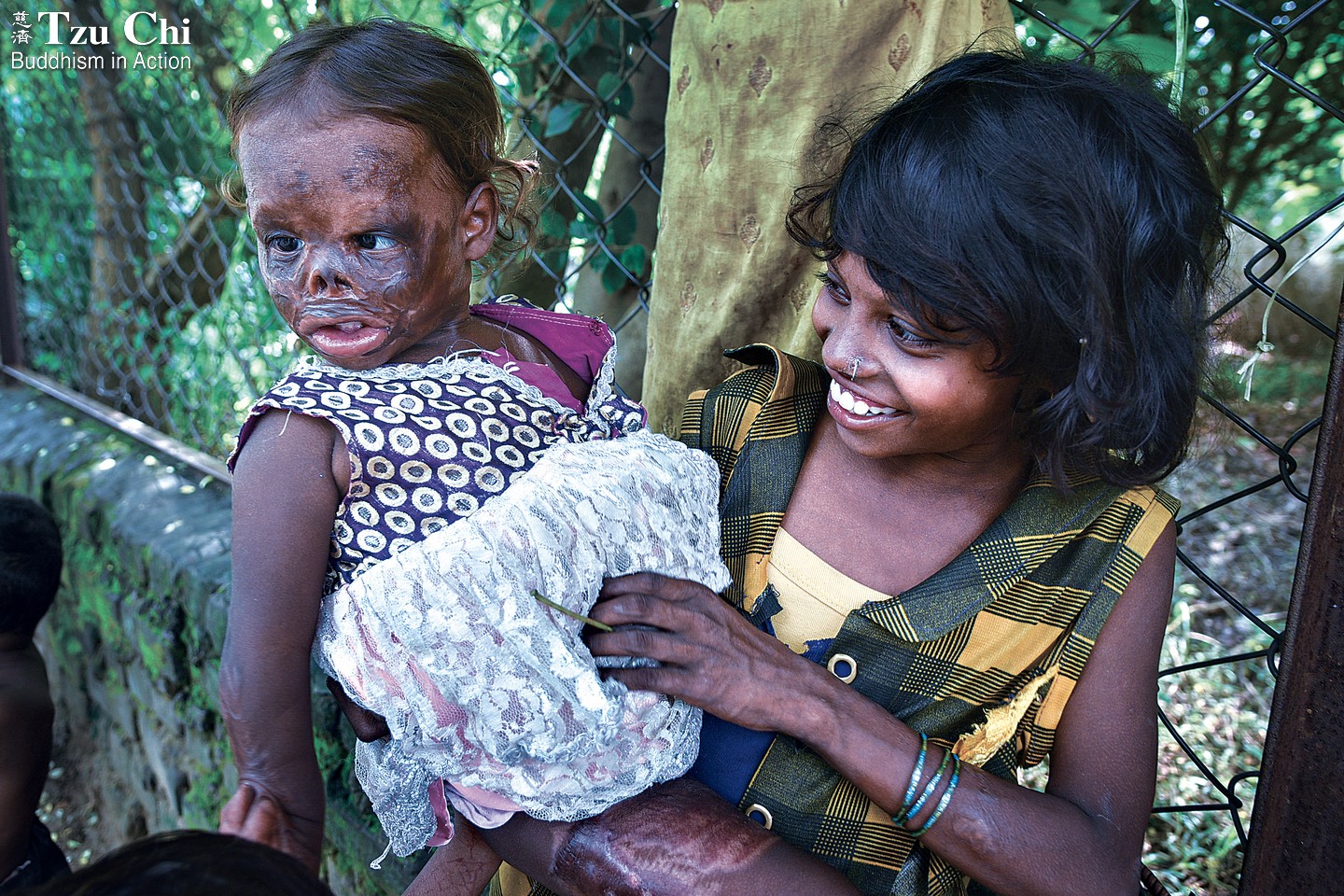
Raushni Kumari, held by her sister, finished the first phase of reconstructive surgery with Tzu Chi’s help.

On the morning of September 26, 2023, nine Tzu Chi volunteers visited Raushni Kumari, a two-and-a-half-year-old, and her family in Bakraur, Bodh Gaya. Their home, even shabbier than the other simple dwellings around it, had walls coated with mud, bamboo poles supporting the eaves, and a makeshift protective barrier of straw, presumably serving as a windbreak. Lok Bee Hua was among the visiting volunteers. Standing less than 160 centimeters (5’2’’) tall, even she had to stoop to enter the house.

Raushni was engrossed in play with neighbors when the volunteers arrived. She displayed minimal expression upon seeing them. But then, it was difficult to discern her emotions from her face. A year and a half earlier, she accidentally tumbled from a bed and landed directly on a fire used for warmth beside it. Her face and right hand suffered severe burns. Her face was severely disfigured.

Stark examples of life’s impermanence

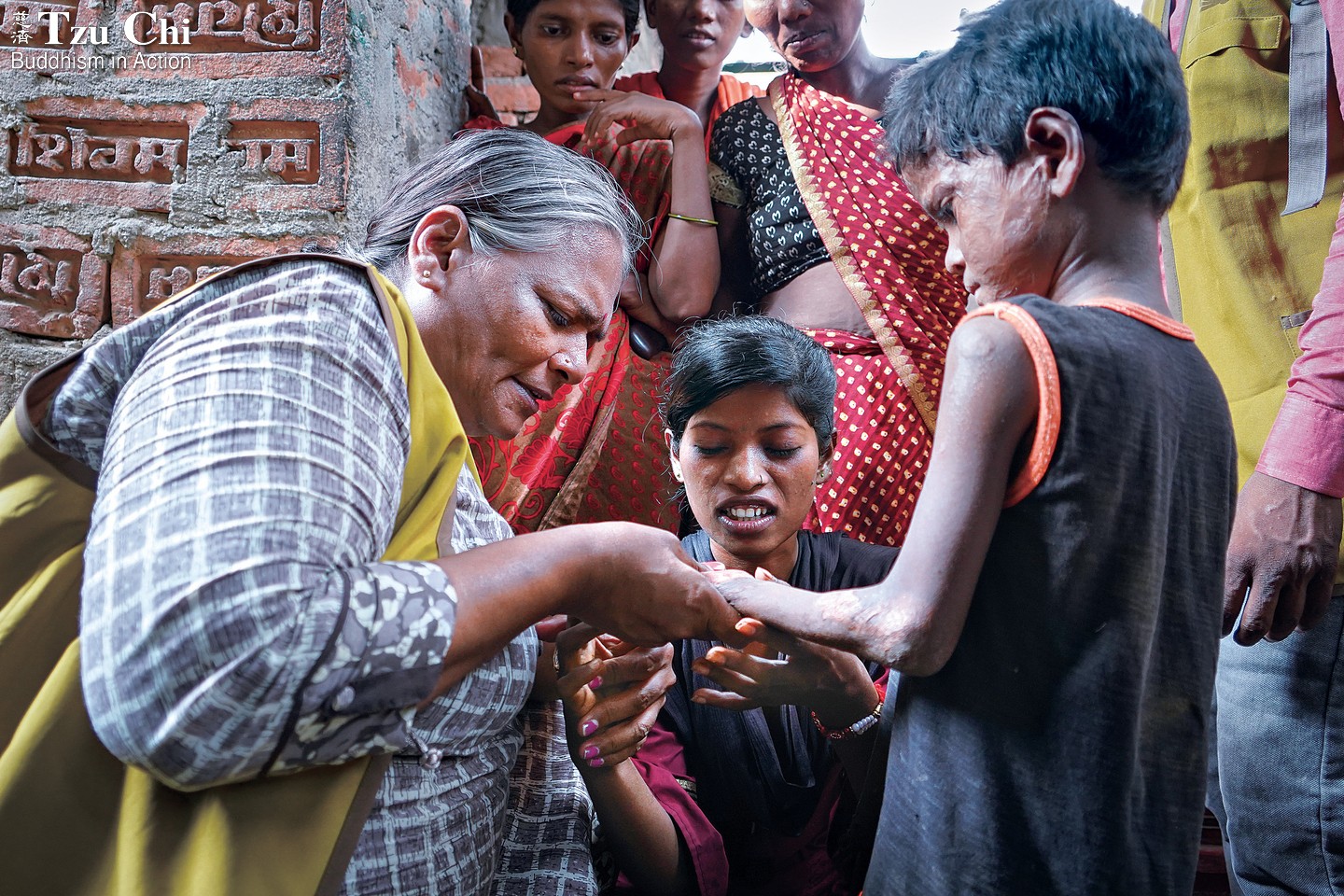
The burns had left Raushni’s skin around both eyes sagging, hindering her vision. The skin around her mouth was scorched too, preventing proper closure and affecting her ability to eat and drink. Her right palm suffered a contracture due to the burns, restricting her movement to her thumb. Her parents sought medical help for her without success for a year after the incident, until Tzu Chi intervened.

Volunteers accompanied the toddler to plastic surgeon Dr. Sanjay Kumar’s clinic for evaluation. He confirmed that Raushni’s facial issues could be improved through reconstructive and skin graft surgeries, enhancing her field of vision and ability to eat and drink. The girl’s mother revealed a long-lost smile when she heard this good news.

Raushni is the fourth of five children. Her father, supporting the family of seven, earns a living working odd jobs. The estimated cost of 146,500 rupees (US$1,760) for the surgery and hospitalization over 21 days was next to impossible for him. Tzu Chi decided to help.

Volunteer Lok Bee Hua took charge of the family after arriving in Bodh Gaya from Malaysia on May 12, 2023. On May 21, while returning from Dr. Sanjay’s clinic to Bodh Gaya, she received a call from her husband’s elder sister in Malaysia, informing her that her husband, Khoo Chin Theong (邱振忠), had suddenly lost vision in his left eye. Doctors were still investigating the cause.

Remaining calm, Lok first accompanied Raushni home after the clinic visit before contacting her hospitalized husband. During their conversation, Lok inquired about his condition and how he was feeling. She then shared with him about the recent visit to the plastic surgeon with Raushni and the upcoming treatments for the little girl. She talked to her husband again the next day. He told her that Raushni’s unfortunate story had helped him put things in perspective. He realized that the little girl had had it worse than he did—at least he still had one eye that could see, while this young girl, at such a tender age, had suffered grave burns, severely disfiguring her face. He told Lok, “The girl taught me that in this world, there are people who are suffering more than me.”

He suggested that Lok do what needed to be done in India instead of rushing back to Malaysia, assuring her not to worry, as he had his sister and medical workers to take care of him. He added that from the smile and radiance on her face, he knew that she was doing the right thing by helping the needy in India. “I was quite moved when I heard that,” Lok remarked.

She eventually returned to Malaysia in early June, after settling affairs in India. Her husband’s first words upon seeing her were, “Seeing that little girl helped me gradually let go of the sudden blindness in my left eye.” Lok shared with him that everything happens for a reason. She also said that thankfully their life is reasonably comfortable, and while the loss of vision may be challenging, if it had happened to someone with a heavier financial burden, it would have been even worse. Her husband found added comfort as he absorbed her words.
Raushni Kumari, held by her sister, finished the first phase of reconstructive surgery with Tzu Chi’s help.

Sempu Paswan’s tuk-tuk

Raushni was admitted to the hospital on May 26 for surgery. The hospital, a four-hour drive from Bodh Gaya, worried Raushni’s mother, who hadn’t traveled far before. Making the situation more difficult was that she had a child she was breastfeeding. Considering this, volunteers arranged for Raushni’s grandmother to go as well, providing 9,000 rupees (US$110) for two weeks of living expenses.

Tests before the surgery revealed that Raushni had insufficient hemoglobin. So, she had two bags of blood transfused into her, rested for two days, and then proceeded with the facial reconstructive surgery. Skin from her right thigh was used for her grafts. The goal of this first surgery was to allow her lips to close, making eating more convenient. Once she recovered sufficiently, surgery would be performed on her right hand to restore its functionality.

“This little girl ‘saved’ my husband,” said Lok.

Lok, now 46, became a certified Tzu Chi volunteer in 2018. Her husband, Khoo Chin Theong, received his certification in June 2023. During his visit to Taiwan for his volunteer certification, Dharma Master Cheng Yen encouraged him to visit India and witness the local living conditions, saying that it might further help him mentally cope with his loss of vision. Following the Master’s advice, Khoo traveled to Bodh Gaya on September 1, staying for three weeks and joining his wife in charitable visits to the needy.

On the afternoon of September 16, Khoo, along with his wife and other volunteers, visited Ganga Bigha village to promote an upcoming community cleanup event. During the visit, a villager named Sempu Paswan approached him, expressing hope that Khoo might visit his home. Realizing the villager needed assistance, Khoo followed him home.

With the help of a local volunteer to translate, Khoo learned that Sempu earned a living by driving a tuk-tuk. Two days earlier, while he was driving his wife in his tuk-tuk, the vehicle collided with a truck and overturned. The roof of his tuk-tuk caved in and the seats dislodged. Sempu’s wife was hospitalized, and was in great pain, even after returning home. She could barely move. In addition to his wife, Sempu had four young children and his elderly mother to support. He was in a difficult situation. Having previously seen Tzu Chi volunteers conducting health check-ups in the village, he sought their help when he saw them again, clinging to them as if he had found a lifeline.

After learning about his situation, volunteers first delivered a month’s worth of food supplies to his home. They saw his wife, a bandage covering part of her face, lying on a hardboard bed in a small room. There were no windows and only one light bulb for illumination. A female volunteer gently touched her head, and she opened her eyes. Using her left hand, she pointed to her lower back, indicating pain. Her four children sat beside her or stood by the bed, gazing innocently at the volunteers.

Sempu told the volunteers that his most pressing need was to repair his tuk-tuk so that he could get back to work and earn money. With minimal savings and high medical expenses for his wife’s injury, he had borrowed money from his sister. He hoped that Tzu Chi volunteers could help him through this tough time.

Lok and other volunteers accompanied Sempu to fix the tuk-tuk, with Tzu Chi sharing the costs. The repairs were finished on September 21. Witnessing Sempu able to drive his tuk-tuk and earn a living once more, volunteers felt relieved and happy for him.

By Wei Yu-xian
Translated by Wu Hsiao-ting
Photos by Chen Li-xue

Tzu Chi helped a little girl whose face was disfigured by a fire undergo reconstructive surgery. Her hardship helped a Tzu Chi volunteer, coping with sudden vision loss in his left eye, see his own challenge in a new light.

Raushni Kumari, held by her sister, finished the first phase of reconstructive surgery with Tzu Chi’s help.

On the morning of September 26, 2023, nine Tzu Chi volunteers visited Raushni Kumari, a two-and-a-half-year-old, and her family in Bakraur, Bodh Gaya. Their home, even shabbier than the other simple dwellings around it, had walls coated with mud, bamboo poles supporting the eaves, and a makeshift protective barrier of straw, presumably serving as a windbreak. Lok Bee Hua was among the visiting volunteers. Standing less than 160 centimeters (5’2’’) tall, even she had to stoop to enter the house.

Raushni was engrossed in play with neighbors when the volunteers arrived. She displayed minimal expression upon seeing them. But then, it was difficult to discern her emotions from her face. A year and a half earlier, she accidentally tumbled from a bed and landed directly on a fire used for warmth beside it. Her face and right hand suffered severe burns. Her face was severely disfigured.

Stark examples of life’s impermanence

The burns had left Raushni’s skin around both eyes sagging, hindering her vision. The skin around her mouth was scorched too, preventing proper closure and affecting her ability to eat and drink. Her right palm suffered a contracture due to the burns, restricting her movement to her thumb. Her parents sought medical help for her without success for a year after the incident, until Tzu Chi intervened.

Volunteers accompanied the toddler to plastic surgeon Dr. Sanjay Kumar’s clinic for evaluation. He confirmed that Raushni’s facial issues could be improved through reconstructive and skin graft surgeries, enhancing her field of vision and ability to eat and drink. The girl’s mother revealed a long-lost smile when she heard this good news.

Raushni is the fourth of five children. Her father, supporting the family of seven, earns a living working odd jobs. The estimated cost of 146,500 rupees (US$1,760) for the surgery and hospitalization over 21 days was next to impossible for him. Tzu Chi decided to help.

Volunteer Lok Bee Hua took charge of the family after arriving in Bodh Gaya from Malaysia on May 12, 2023. On May 21, while returning from Dr. Sanjay’s clinic to Bodh Gaya, she received a call from her husband’s elder sister in Malaysia, informing her that her husband, Khoo Chin Theong (邱振忠), had suddenly lost vision in his left eye. Doctors were still investigating the cause.

Remaining calm, Lok first accompanied Raushni home after the clinic visit before contacting her hospitalized husband. During their conversation, Lok inquired about his condition and how he was feeling. She then shared with him about the recent visit to the plastic surgeon with Raushni and the upcoming treatments for the little girl. She talked to her husband again the next day. He told her that Raushni’s unfortunate story had helped him put things in perspective. He realized that the little girl had had it worse than he did—at least he still had one eye that could see, while this young girl, at such a tender age, had suffered grave burns, severely disfiguring her face. He told Lok, “The girl taught me that in this world, there are people who are suffering more than me.”

He suggested that Lok do what needed to be done in India instead of rushing back to Malaysia, assuring her not to worry, as he had his sister and medical workers to take care of him. He added that from the smile and radiance on her face, he knew that she was doing the right thing by helping the needy in India. “I was quite moved when I heard that,” Lok remarked.

She eventually returned to Malaysia in early June, after settling affairs in India. Her husband’s first words upon seeing her were, “Seeing that little girl helped me gradually let go of the sudden blindness in my left eye.” Lok shared with him that everything happens for a reason. She also said that thankfully their life is reasonably comfortable, and while the loss of vision may be challenging, if it had happened to someone with a heavier financial burden, it would have been even worse. Her husband found added comfort as he absorbed her words.

Raushni Kumari, held by her sister, finished the first phase of reconstructive surgery with Tzu Chi’s help.

Sempu Paswan’s tuk-tuk

Raushni was admitted to the hospital on May 26 for surgery. The hospital, a four-hour drive from Bodh Gaya, worried Raushni’s mother, who hadn’t traveled far before. Making the situation more difficult was that she had a child she was breastfeeding. Considering this, volunteers arranged for Raushni’s grandmother to go as well, providing 9,000 rupees (US$110) for two weeks of living expenses.

Tests before the surgery revealed that Raushni had insufficient hemoglobin. So, she had two bags of blood transfused into her, rested for two days, and then proceeded with the facial reconstructive surgery. Skin from her right thigh was used for her grafts. The goal of this first surgery was to allow her lips to close, making eating more convenient. Once she recovered sufficiently, surgery would be performed on her right hand to restore its functionality.

“This little girl ‘saved’ my husband,” said Lok.

Lok, now 46, became a certified Tzu Chi volunteer in 2018. Her husband, Khoo Chin Theong, received his certification in June 2023. During his visit to Taiwan for his volunteer certification, Dharma Master Cheng Yen encouraged him to visit India and witness the local living conditions, saying that it might further help him mentally cope with his loss of vision. Following the Master’s advice, Khoo traveled to Bodh Gaya on September 1, staying for three weeks and joining his wife in charitable visits to the needy.

On the afternoon of September 16, Khoo, along with his wife and other volunteers, visited Ganga Bigha village to promote an upcoming community cleanup event. During the visit, a villager named Sempu Paswan approached him, expressing hope that Khoo might visit his home. Realizing the villager needed assistance, Khoo followed him home.

With the help of a local volunteer to translate, Khoo learned that Sempu earned a living by driving a tuk-tuk. Two days earlier, while he was driving his wife in his tuk-tuk, the vehicle collided with a truck and overturned. The roof of his tuk-tuk caved in and the seats dislodged. Sempu’s wife was hospitalized, and was in great pain, even after returning home. She could barely move. In addition to his wife, Sempu had four young children and his elderly mother to support. He was in a difficult situation. Having previously seen Tzu Chi volunteers conducting health check-ups in the village, he sought their help when he saw them again, clinging to them as if he had found a lifeline.

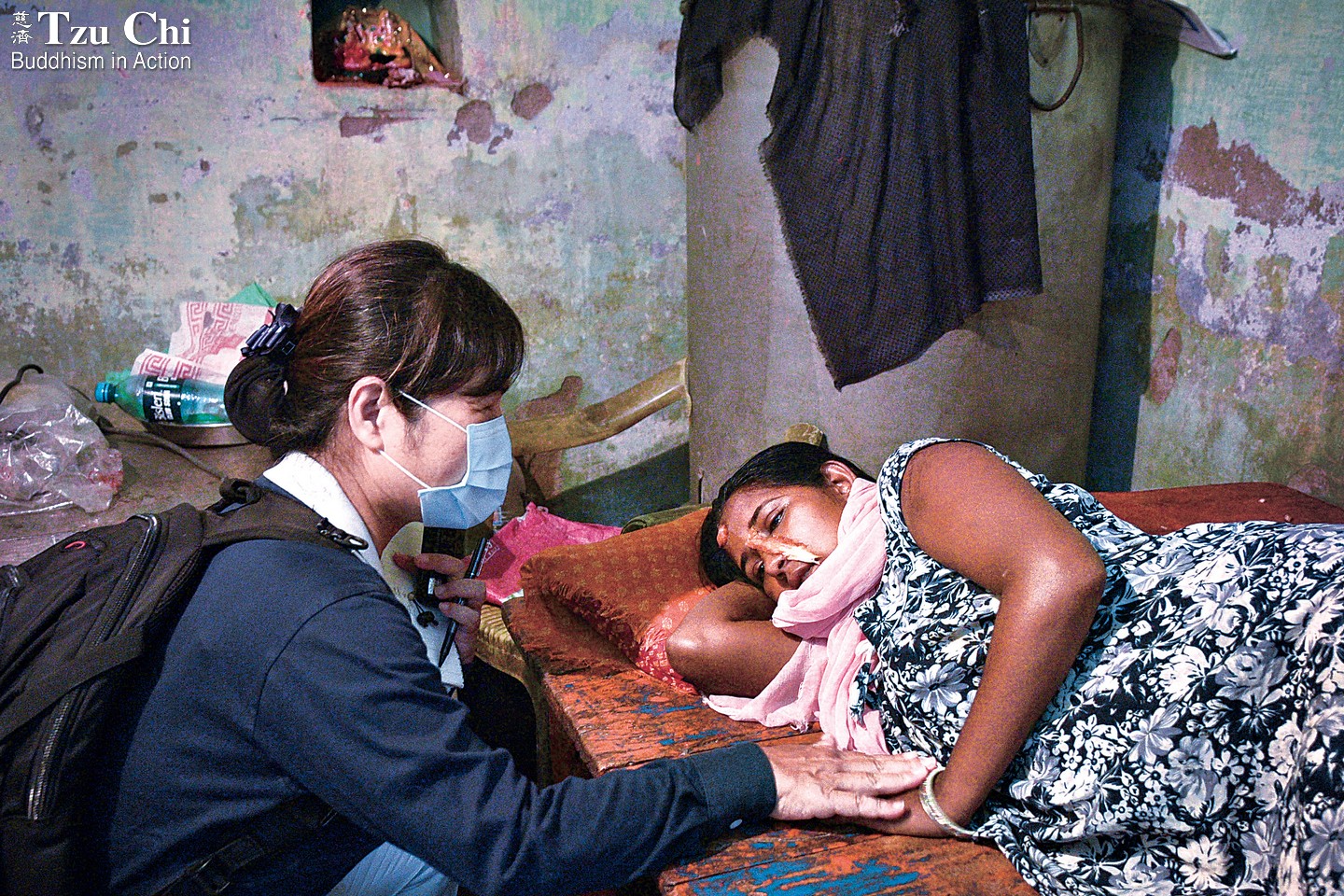
After learning about his situation, volunteers first delivered a month’s worth of food supplies to his home. They saw his wife, a bandage covering part of her face, lying on a hardboard bed in a small room. There were no windows and only one light bulb for illumination. A female volunteer gently touched her head, and she opened her eyes. Using her left hand, she pointed to her lower back, indicating pain. Her four children sat beside her or stood by the bed, gazing innocently at the volunteers.

Sempu told the volunteers that his most pressing need was to repair his tuk-tuk so that he could get back to work and earn money. With minimal savings and high medical expenses for his wife’s injury, he had borrowed money from his sister. He hoped that Tzu Chi volunteers could help him through this tough time.

Lok and other volunteers accompanied Sempu to fix the tuk-tuk, with Tzu Chi sharing the costs. The repairs were finished on September 21. Witnessing Sempu able to drive his tuk-tuk and earn a living once more, volunteers felt relieved and happy for him.
關鍵字

Journey in the Land of the Buddha’s Enlightenment

By Wei Yu-xian
Translated by Wu Hsiao-ting
Photos by Chen Li-xue

A Taiwanese volunteer reflects on her visit to Bodh Gaya, where she participated in Tzu Chi’s charitable missions.

Dr. Chitra visited Bakraur village on September 12, 2023, to check on three medical cases, one of which involved a six-year-old boy with burn injuries. Ye Jin-hong

On September 9, 2023, I arrived at the Tzu Chi office in Bodh Gaya, along with 11 fellow volunteers from Malaysia. We were welcomed by Brother Sio Kee Hong (蘇祈逢), the deputy CEO of Tzu Chi Kuala Lumpur and Selangor, who had been stationed in Bodh Gaya since February 2023. He exclaimed, “Coming to Bodh Gaya, you’ll attain buddhahood more quickly!”

His words hinted at the challenges that lay ahead, but having mentally prepared for the Indian heat and food, I didn’t take his words to heart.

Sister Chen Li-xue (陳麗雪) and I both hail from Taichung, Taiwan. My primary responsibility during this trip was text documentation, while she focused mostly on photography. She had arrived in India eight days before me, and had arranged for my accommodations. Thanks to her, I could quickly start my volunteer duties.

Dr. Chitra

Tzu Chi’s volunteer attendance system in Bodh Gaya was well-established and running smoothly by the time I arrived. The charity, medical, and education teams communicated daily through a group chat, sharing information about their upcoming work. Volunteers interested in joining any of the teams responded in the chat to arrange transportation. On the day after my arrival, Sister Chen and I decided to accompany Dr. Chitra’s medical team, documenting their health checkups for villagers and profiling the doctor herself.

Dr. Chitra, born in 1963, is a native of Chennai, India. In 1988, she married a man from Kota Kinabalu, Malaysia, and relocated with him to that city the following year, where she pursued a career in medicine. Introduced to Tzu Chi by a neighbor, she became involved in the foundation’s activities and officially joined the Tzu Chi International Medical Association 15 years ago. She retired as a physician in 2021. When she heard about Tzu Chi’s philanthropic endeavors in Bodh Gaya, she willingly volunteered her expertise. She arrived in early September 2023 and joined Tzu Chi’s medical team to provide healthcare services to impoverished villages.

We were immediately greeted with the strong odor of cow dung hanging in the air when we reached Ganga Bigha village, along with the medical team. We brushed against cows and sheep as we walked down the road and saw hens and their chicks foraging for food. The scenes were reminiscent of rural Taiwan in the 1950s and 1960s.

Dr. Chitra fluently greeted the villagers in a local dialect and inquired about their well-being. Some villagers had high blood pressure; her earnest advice to them was to stop drinking. Women suffering from illness shared their discomfort with her. Dr. Chitra sat beside them, holding their hands, speaking to them like family. The kind doctor always wore a warm smile, regardless to whom she was speaking. Due to my limited proficiency in English, I had to rely on a Malaysian volunteer for translation support during my interview with her. Fortunately, she didn’t mind, and it resulted in a wonderful connection between us.

The houses in the village were not numbered, so Sister Lim Kim Yan (林金燕), a retired nurse from Singapore and the medical team’s coordinator, implemented a practical solution. To facilitate the medical team’s work, she asked her team members to affix number tags on doors belonging to households interested in Tzu Chi’s health checkups. Villagers needing additional medical attention after the initial examinations were reported to the community clinic.

Tzu Chi also provided free monthly support for individuals facing economic difficulties and with a body mass index below 16, indicating they were severely underweight. The support entailed the provision of chickpeas, soybeans, and other legumes, aiming to enhance their nutritional intake.

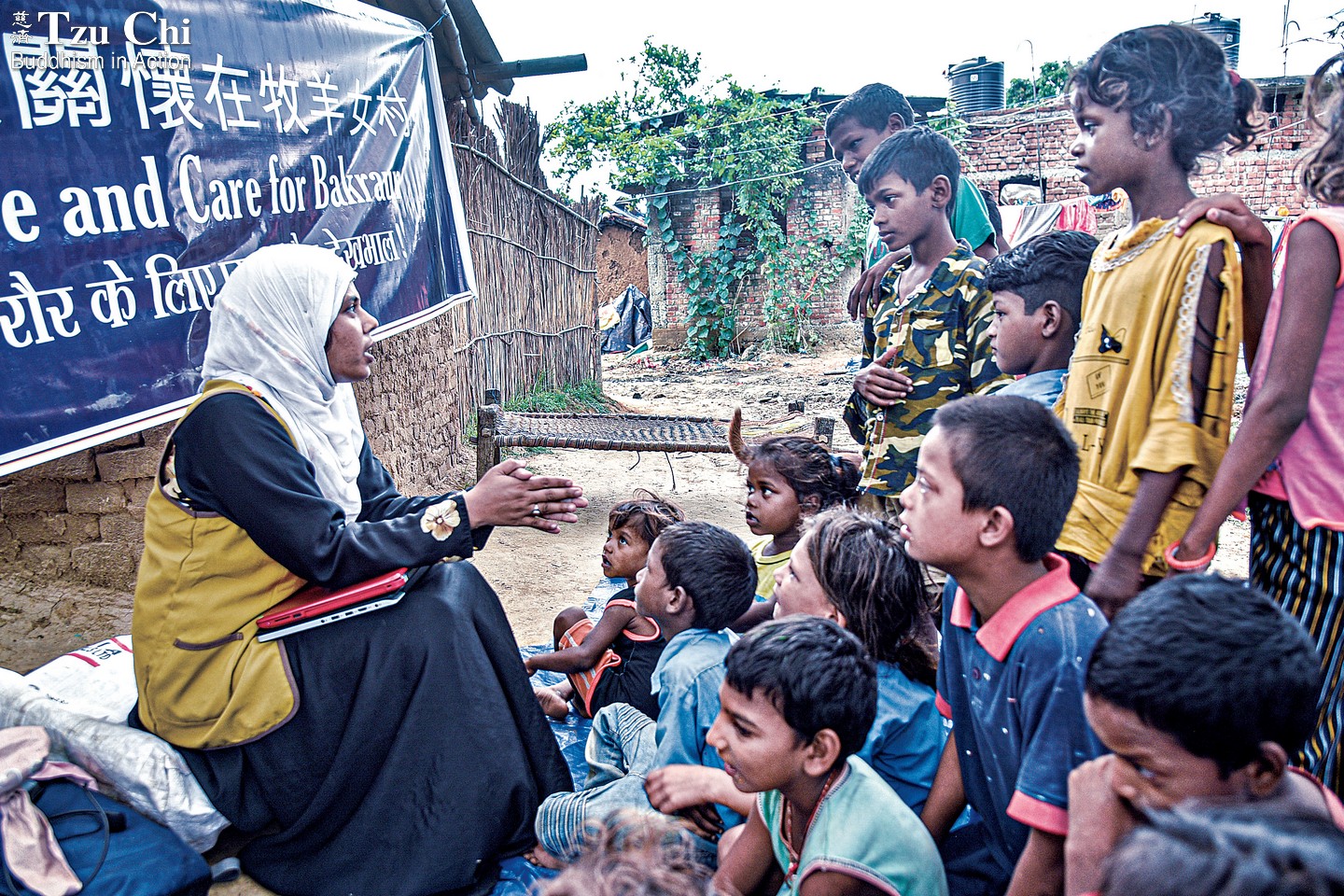
Children listen intently while volunteer Rozi Parween tells a story.

Classes under trees

At 3:30 in the afternoon on September 11, I joined the education team on a trip to Bakraur village. My mission was to document their weekly Tzu Chi class, conducted outdoors under the shade of a tree. During our journey in three tuk-tuks I observed lively scenes of children playing and frolicking outdoors and groups of women either seated in front of houses or holding small children.

When we arrived, I asked Sister Yaw Ah Moi, the education team’s coordinator, “Where are the participants of our class?” Without hesitation, she replied, “We’ll go find them!” The team swiftly sprang into action, going from house to house, inviting women and children to join our class. Some volunteers planned to teach the women how to sew scrunchies, while others would engage children in group activities. In just a short time, they had successfully gathered about 50 adults and children.

Seeing their proactive efforts to locate students left me utterly speechless. As a retired teacher, I was accustomed to children coming to class, not teachers actively seeking students. The education team’s enthusiastic spirit and proactive approach immediately won me over.

A different scene unfolded when I followed the education team to Silaunja village on the afternoon of September 15 for similar activities. Just before reaching our destination, Sister Yaw shared with me that when the team first started classes in the village, the tree they had chosen for their sessions didn’t provide enough shade. Consequently, the team made the decision to take the students and move deeper into the village in search of a larger, cooler tree under which to hold their classes.

However, when the team invited the children to move further into the village with them, their mothers hesitated. The mothers voiced concerns about the residents in the rear part of the village belonging to a lower social class than those in the front. As a result, the mothers were unwilling to let their children play with those in the back. Subsequently, each time the team passed through the village to reach the rear area for a class, the children who couldn’t participate could only watch eagerly as the team passed through.

When we arrived on the 15th, the children in the back of the village immediately held their chins with both hands, making the “Happy Face” gesture taught to them by Tzu Chi volunteers. The youngsters gathered under a tree and cheerfully participated in the group activities led by the education team. They obediently followed directions, jumping to the right, left, up, and down.

Our team shared an animated video recounting the tale, “The Elephant That Saved a Girl’s Life,” told by Master Cheng Yen. Volunteers Tan Lee Ting (陳麗婷) and Rozi Parween each held a laptop, playing the video, while Rozi explained the story in the children’s dialect.

These children hailed from families with modest means, and their homes typically had only essential items, such as beds and cooking ware. Since their families likely didn’t own televisions or cell phones, watching the video must have been fun for them. Every child stared intently at the small laptop screens. We weren’t certain if they fully grasped the story or not, but their focused expressions touched our hearts.

Regrettably, rain started to fall midway through the activity. Both adults and children scattered, some running back home, others seeking shelter in an empty house near the tree. After the rain subsided, everyone emerged from their shelters. Suddenly, Sister See Paik Lan (施依伶) slipped and fell on the slippery ground. Three more volunteers slipped in succession, getting their clothes and shoes covered in mud. The children, amused by the scene, erupted into laughter, which sparked laughter among the nearby adults as well. The four volunteers, caught up in the mirth and light-hearted atmosphere, momentarily forgot the awkwardness of their now mud-stained shoes and clothes.

As we were leaving the village, Sister See stopped me and said, “Yu-xian, this child has been holding my hand since I fell. It seems he’s afraid that I might fall again.” I turned around and captured this moment with my phone. I then asked Rozi to inquire on my behalf why the child was holding Sister See’s hand. The boy explained that in the video he watched earlier, when the big waves came, the little elephant saved the little girl, so he wanted to “save” Sister See too. This response deeply touched everyone. Isn’t this the best proof of the adage, “The mind, the Buddha, and living beings—there is no difference among these three”?

During her visit to Bodh Gaya in September 2023, Wei Yu-xian (魏玉縣), the author of this article, contemplates Prince Siddhartha’s journey in pursuit of the path of liberation.

My heart remained in Bodh Gaya

The tuk-tuk is the most convenient means of transportation in Bodh Gaya. This three-wheeled electric vehicle has two rows of seats facing each other, allowing four people to ride. There is also space next to the driver for an additional passenger. Though the local roads are predominantly paved, they are riddled with potholes, turning the tuk-tuk ride into a bumpy journey that sways to the left and right. Passengers must hold tightly to a hanging ring in the tuk-tuk to keep themselves steady.

Experienced volunteers wisely cautioned us against extending our bodies beyond the metal bars next to the seats to avoid having them hit by passing vehicles. After a few days in Bodh Gaya, I noticed soreness in my shoulders, realizing it was from gripping a hanging ring too tightly. The dull pain in both upper arms, on the other hand, stemmed from bumping into the metal bars beside the seats.

Volunteers went out almost every day for Tzu Chi activities, and immersed themselves in their work at the Tzu Chi office when they returned. Oftentimes, their only interruptions were messages announcing that “Lunch is ready” or “Dinner is ready,” drawing them up to the top floor to enjoy the meals prepared by Malaysian volunteers. Given their routine, the days of the week and specific dates faded in importance. Even if there was a power outage during computer work or a shower, there was no need for concern. The generator quickly came to life, ensuring a continuous power supply.

Before I left to return to Taiwan on September 28, I wanted to see Raushni again. I first encountered the little girl, about the same age as my granddaughter, on my third day in Bodh Gaya. She was walking with her mother, hand in hand, in a crowd of people. The visible scars on her face and her right palm turned outward were remnants of a tragic fire accident. Curious about her story, I asked volunteer Seema and learned that Tzu Chi was already helping her, which relieved my concerns.

On September 26, Sister Lok Bee Hua took us to visit Raushni. As our tuk-tuk came to a stop near her house, the girl’s 30-year-old mother emerged from the house. She greeted us with a welcoming smile. Several children surrounded her, but Raushni was nowhere to be seen.

“Where is Raushni?” volunteer Vivek Kumar asked. “She’s playing outside,” the mother replied.

We found Raushni, wearing a bright dress, playing with her brother, sister, and neighboring children under a tree. She looked at us with big eyes while other children gathered around Sister Aw Kwai Wan and began singing. Raushni’s little brother, naked and covered in mud, asked us to hold him. Seeing his adorable appearance, everyone happily took turns holding him.

Sister Lok suggested that the mother dress her little son. She explained that the little one was reluctant to wear clothes and always took them off. Even so, she went inside her home, fetched clothes, returned, and patiently dressed him.

During our visit, we carefully examined the area on Raushni’s right thigh where skin had been taken for her facial reconstructive surgery. Noticing some scraped skin there, we advised her mother to apply medication regularly to prevent infection.

After playing some more with the children, we left with a sense of contentment. I held onto the hope that, with Tzu Chi’s assistance, Raushni could look forward to a brighter and better future.

On my second day back in Taiwan, I strolled along a mountain path behind my home. I hadn’t traversed this trail in a month. As I gazed at Taichung City below, my thoughts wandered to Bodh Gaya. “Today, the charity team is visiting Bakraur to teach women handicrafts; the education team is organizing an athletic event at a school; the medical team is….”

Although I was physically in Taiwan, my heart remained in Bodh Gaya.

By Wei Yu-xian
Translated by Wu Hsiao-ting
Photos by Chen Li-xue

A Taiwanese volunteer reflects on her visit to Bodh Gaya, where she participated in Tzu Chi’s charitable missions.

Dr. Chitra visited Bakraur village on September 12, 2023, to check on three medical cases, one of which involved a six-year-old boy with burn injuries. Ye Jin-hong

On September 9, 2023, I arrived at the Tzu Chi office in Bodh Gaya, along with 11 fellow volunteers from Malaysia. We were welcomed by Brother Sio Kee Hong (蘇祈逢), the deputy CEO of Tzu Chi Kuala Lumpur and Selangor, who had been stationed in Bodh Gaya since February 2023. He exclaimed, “Coming to Bodh Gaya, you’ll attain buddhahood more quickly!”

His words hinted at the challenges that lay ahead, but having mentally prepared for the Indian heat and food, I didn’t take his words to heart.

Sister Chen Li-xue (陳麗雪) and I both hail from Taichung, Taiwan. My primary responsibility during this trip was text documentation, while she focused mostly on photography. She had arrived in India eight days before me, and had arranged for my accommodations. Thanks to her, I could quickly start my volunteer duties.

Dr. Chitra

Tzu Chi’s volunteer attendance system in Bodh Gaya was well-established and running smoothly by the time I arrived. The charity, medical, and education teams communicated daily through a group chat, sharing information about their upcoming work. Volunteers interested in joining any of the teams responded in the chat to arrange transportation. On the day after my arrival, Sister Chen and I decided to accompany Dr. Chitra’s medical team, documenting their health checkups for villagers and profiling the doctor herself.

Dr. Chitra, born in 1963, is a native of Chennai, India. In 1988, she married a man from Kota Kinabalu, Malaysia, and relocated with him to that city the following year, where she pursued a career in medicine. Introduced to Tzu Chi by a neighbor, she became involved in the foundation’s activities and officially joined the Tzu Chi International Medical Association 15 years ago. She retired as a physician in 2021. When she heard about Tzu Chi’s philanthropic endeavors in Bodh Gaya, she willingly volunteered her expertise. She arrived in early September 2023 and joined Tzu Chi’s medical team to provide healthcare services to impoverished villages.

We were immediately greeted with the strong odor of cow dung hanging in the air when we reached Ganga Bigha village, along with the medical team. We brushed against cows and sheep as we walked down the road and saw hens and their chicks foraging for food. The scenes were reminiscent of rural Taiwan in the 1950s and 1960s.

Dr. Chitra fluently greeted the villagers in a local dialect and inquired about their well-being. Some villagers had high blood pressure; her earnest advice to them was to stop drinking. Women suffering from illness shared their discomfort with her. Dr. Chitra sat beside them, holding their hands, speaking to them like family. The kind doctor always wore a warm smile, regardless to whom she was speaking. Due to my limited proficiency in English, I had to rely on a Malaysian volunteer for translation support during my interview with her. Fortunately, she didn’t mind, and it resulted in a wonderful connection between us.

The houses in the village were not numbered, so Sister Lim Kim Yan (林金燕), a retired nurse from Singapore and the medical team’s coordinator, implemented a practical solution. To facilitate the medical team’s work, she asked her team members to affix number tags on doors belonging to households interested in Tzu Chi’s health checkups. Villagers needing additional medical attention after the initial examinations were reported to the community clinic.

Tzu Chi also provided free monthly support for individuals facing economic difficulties and with a body mass index below 16, indicating they were severely underweight. The support entailed the provision of chickpeas, soybeans, and other legumes, aiming to enhance their nutritional intake.

Children listen intently while volunteer Rozi Parween tells a story.

Classes under trees

At 3:30 in the afternoon on September 11, I joined the education team on a trip to Bakraur village. My mission was to document their weekly Tzu Chi class, conducted outdoors under the shade of a tree. During our journey in three tuk-tuks I observed lively scenes of children playing and frolicking outdoors and groups of women either seated in front of houses or holding small children.

When we arrived, I asked Sister Yaw Ah Moi, the education team’s coordinator, “Where are the participants of our class?” Without hesitation, she replied, “We’ll go find them!” The team swiftly sprang into action, going from house to house, inviting women and children to join our class. Some volunteers planned to teach the women how to sew scrunchies, while others would engage children in group activities. In just a short time, they had successfully gathered about 50 adults and children.

Seeing their proactive efforts to locate students left me utterly speechless. As a retired teacher, I was accustomed to children coming to class, not teachers actively seeking students. The education team’s enthusiastic spirit and proactive approach immediately won me over.

A different scene unfolded when I followed the education team to Silaunja village on the afternoon of September 15 for similar activities. Just before reaching our destination, Sister Yaw shared with me that when the team first started classes in the village, the tree they had chosen for their sessions didn’t provide enough shade. Consequently, the team made the decision to take the students and move deeper into the village in search of a larger, cooler tree under which to hold their classes.

However, when the team invited the children to move further into the village with them, their mothers hesitated. The mothers voiced concerns about the residents in the rear part of the village belonging to a lower social class than those in the front. As a result, the mothers were unwilling to let their children play with those in the back. Subsequently, each time the team passed through the village to reach the rear area for a class, the children who couldn’t participate could only watch eagerly as the team passed through.

When we arrived on the 15th, the children in the back of the village immediately held their chins with both hands, making the “Happy Face” gesture taught to them by Tzu Chi volunteers. The youngsters gathered under a tree and cheerfully participated in the group activities led by the education team. They obediently followed directions, jumping to the right, left, up, and down.

Our team shared an animated video recounting the tale, “The Elephant That Saved a Girl’s Life,” told by Master Cheng Yen. Volunteers Tan Lee Ting (陳麗婷) and Rozi Parween each held a laptop, playing the video, while Rozi explained the story in the children’s dialect.

These children hailed from families with modest means, and their homes typically had only essential items, such as beds and cooking ware. Since their families likely didn’t own televisions or cell phones, watching the video must have been fun for them. Every child stared intently at the small laptop screens. We weren’t certain if they fully grasped the story or not, but their focused expressions touched our hearts.

Regrettably, rain started to fall midway through the activity. Both adults and children scattered, some running back home, others seeking shelter in an empty house near the tree. After the rain subsided, everyone emerged from their shelters. Suddenly, Sister See Paik Lan (施依伶) slipped and fell on the slippery ground. Three more volunteers slipped in succession, getting their clothes and shoes covered in mud. The children, amused by the scene, erupted into laughter, which sparked laughter among the nearby adults as well. The four volunteers, caught up in the mirth and light-hearted atmosphere, momentarily forgot the awkwardness of their now mud-stained shoes and clothes.

As we were leaving the village, Sister See stopped me and said, “Yu-xian, this child has been holding my hand since I fell. It seems he’s afraid that I might fall again.” I turned around and captured this moment with my phone. I then asked Rozi to inquire on my behalf why the child was holding Sister See’s hand. The boy explained that in the video he watched earlier, when the big waves came, the little elephant saved the little girl, so he wanted to “save” Sister See too. This response deeply touched everyone. Isn’t this the best proof of the adage, “The mind, the Buddha, and living beings—there is no difference among these three”?

During her visit to Bodh Gaya in September 2023, Wei Yu-xian (魏玉縣), the author of this article, contemplates Prince Siddhartha’s journey in pursuit of the path of liberation.

My heart remained in Bodh Gaya

The tuk-tuk is the most convenient means of transportation in Bodh Gaya. This three-wheeled electric vehicle has two rows of seats facing each other, allowing four people to ride. There is also space next to the driver for an additional passenger. Though the local roads are predominantly paved, they are riddled with potholes, turning the tuk-tuk ride into a bumpy journey that sways to the left and right. Passengers must hold tightly to a hanging ring in the tuk-tuk to keep themselves steady.

Experienced volunteers wisely cautioned us against extending our bodies beyond the metal bars next to the seats to avoid having them hit by passing vehicles. After a few days in Bodh Gaya, I noticed soreness in my shoulders, realizing it was from gripping a hanging ring too tightly. The dull pain in both upper arms, on the other hand, stemmed from bumping into the metal bars beside the seats.

Volunteers went out almost every day for Tzu Chi activities, and immersed themselves in their work at the Tzu Chi office when they returned. Oftentimes, their only interruptions were messages announcing that “Lunch is ready” or “Dinner is ready,” drawing them up to the top floor to enjoy the meals prepared by Malaysian volunteers. Given their routine, the days of the week and specific dates faded in importance. Even if there was a power outage during computer work or a shower, there was no need for concern. The generator quickly came to life, ensuring a continuous power supply.

Before I left to return to Taiwan on September 28, I wanted to see Raushni again. I first encountered the little girl, about the same age as my granddaughter, on my third day in Bodh Gaya. She was walking with her mother, hand in hand, in a crowd of people. The visible scars on her face and her right palm turned outward were remnants of a tragic fire accident. Curious about her story, I asked volunteer Seema and learned that Tzu Chi was already helping her, which relieved my concerns.

On September 26, Sister Lok Bee Hua took us to visit Raushni. As our tuk-tuk came to a stop near her house, the girl’s 30-year-old mother emerged from the house. She greeted us with a welcoming smile. Several children surrounded her, but Raushni was nowhere to be seen.

“Where is Raushni?” volunteer Vivek Kumar asked. “She’s playing outside,” the mother replied.

We found Raushni, wearing a bright dress, playing with her brother, sister, and neighboring children under a tree. She looked at us with big eyes while other children gathered around Sister Aw Kwai Wan and began singing. Raushni’s little brother, naked and covered in mud, asked us to hold him. Seeing his adorable appearance, everyone happily took turns holding him.

Sister Lok suggested that the mother dress her little son. She explained that the little one was reluctant to wear clothes and always took them off. Even so, she went inside her home, fetched clothes, returned, and patiently dressed him.

During our visit, we carefully examined the area on Raushni’s right thigh where skin had been taken for her facial reconstructive surgery. Noticing some scraped skin there, we advised her mother to apply medication regularly to prevent infection.

After playing some more with the children, we left with a sense of contentment. I held onto the hope that, with Tzu Chi’s assistance, Raushni could look forward to a brighter and better future.

On my second day back in Taiwan, I strolled along a mountain path behind my home. I hadn’t traversed this trail in a month. As I gazed at Taichung City below, my thoughts wandered to Bodh Gaya. “Today, the charity team is visiting Bakraur to teach women handicrafts; the education team is organizing an athletic event at a school; the medical team is….”

Although I was physically in Taiwan, my heart remained in Bodh Gaya.

關鍵字

More Than a School

Compiled by Tzu Chi Monthly editorial staff
Translated by Wu Hsiao-ting
Photos by Mohammed Nimir Aljamal

El Menahil International School in Türkiye helps Syrian refugee children continue their education during displacement. The school also restores the dignity of Syrian education workers by providing them with employment opportunities.

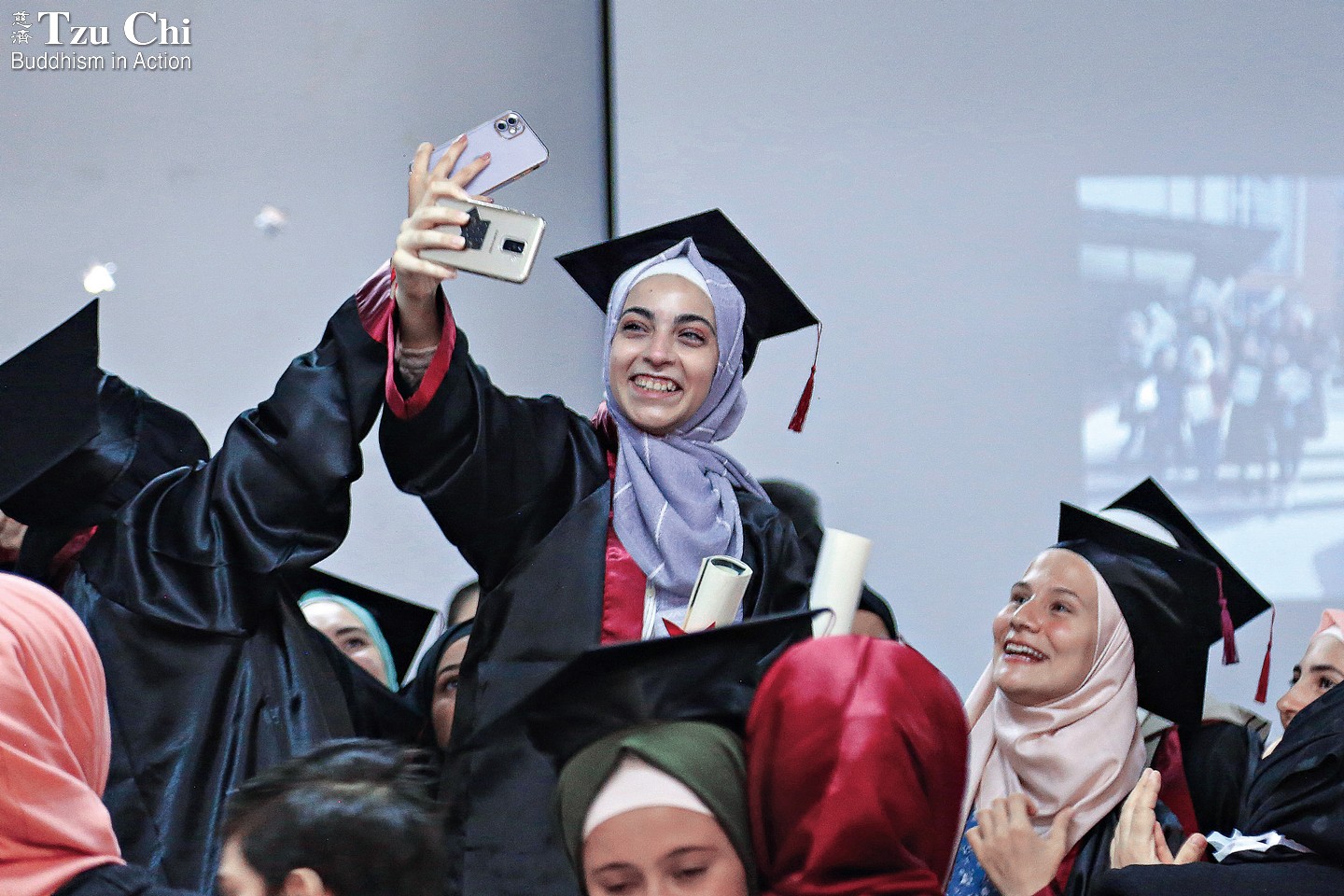
Graduates capture their happiness at the graduation ceremony of El Menahil International School’s high school female class in 2021.

Muhammed Munir Amino’s life was going well in his early 30s. He was raising four beautiful children with his wife in a lovely house, and serving successfully as the principal of a secondary school. Unfortunately, his peaceful life took a tragic turn with the onset of the Syrian civil war in 2011. His hometown, the border city of Idlib, was transformed overnight into a battleground. The conflict compelled him to leave the life he had loved. Bidding farewell to his wife, children, and mother was the most heart-wrenching part.

He eventually ended up in Istanbul, Türkiye, in 2015, but all of his educational expertise was irrelevant in his host city, leaving him no choice but to work in a bakery.

In the same year, Tzu Chi, in collaboration with the government of the Sultangazi district in Istanbul, established El Menahil, a school for Syrian refugee children. Amino was able to join the school, thus re-entering the education system. He became a Tzu Chi volunteer at the same time, assisting the foundation in monthly aid distributions to thousands of Syrian refugee families. He even traveled to quake-stricken areas for disaster relief after earthquakes struck southern Türkiye in February 2023.

The term “Menahil” in the Tzu Chi school’s name, translated from Arabic, means “spring of water,” symbolizing a source of knowledge for children trapped in an educational desert. In 2018, the school received accreditation from an American accrediting agency and was renamed El Menahil International School. Graduates can now obtain diplomas acknowledged by the Turkish Ministry of Education and pursue further education worldwide.

By the end of 2022, El Menahil International School had nurtured 343 graduates, with 265 of them entering universities. Among the latter, 70 pursued medical-related disciplines, 114 entered STEM fields, and 81 pursued literature and social sciences. Because the number of students enrolled in the school has been increasing, Tzu Chi has acquired land to build a new campus.

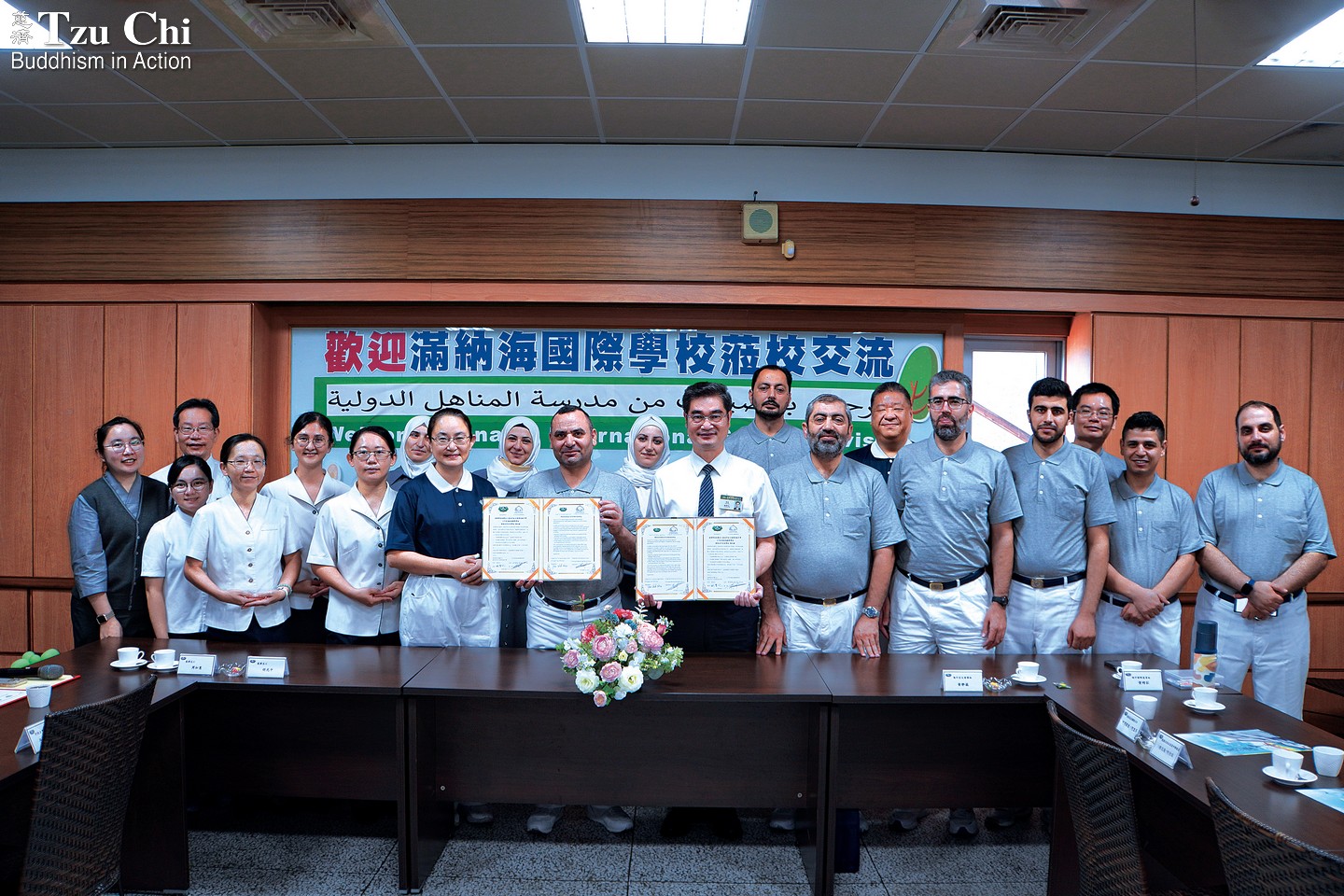
In October 2023, a team of 13, including personnel from the school and Tzu Chi volunteers from Türkiye, visited various Tzu Chi facilities in Taiwan. During the trip, Muhammed Munir Amino, in his capacity as the principal of El Menahil’s high school division and the school’s academic director, signed a memorandum of understanding with Tainan Tzu Chi Senior High School in southern Taiwan, aiming to expand the international perspectives of students at both schools. Before returning to Türkiye, he choked back tears, saying that history would remember the people who guided thousands of Syrian students from darkness to light with love and kindness. He promised Dharma Master Cheng Yen and Tzu Chi volunteers that he and the other visiting educators would take the love they had experienced in Taiwan back to Türkiye and someday return with outstanding graduates, sharing how Tzu Chi’s assistance had led them to achieve excellence in life.

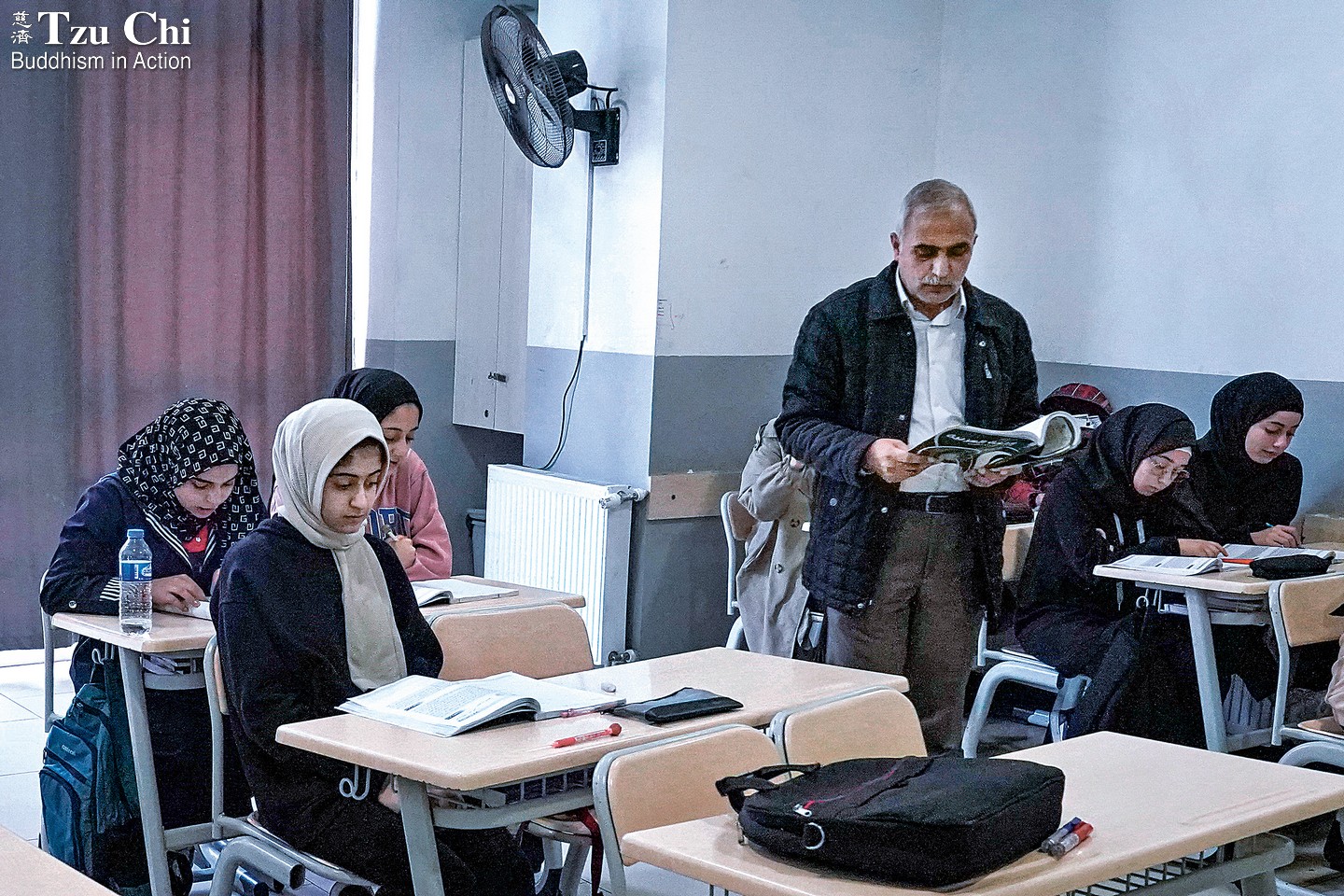
El Menahil International School hires Syrian intellectuals to provide quality education. Yu Zi-cheng

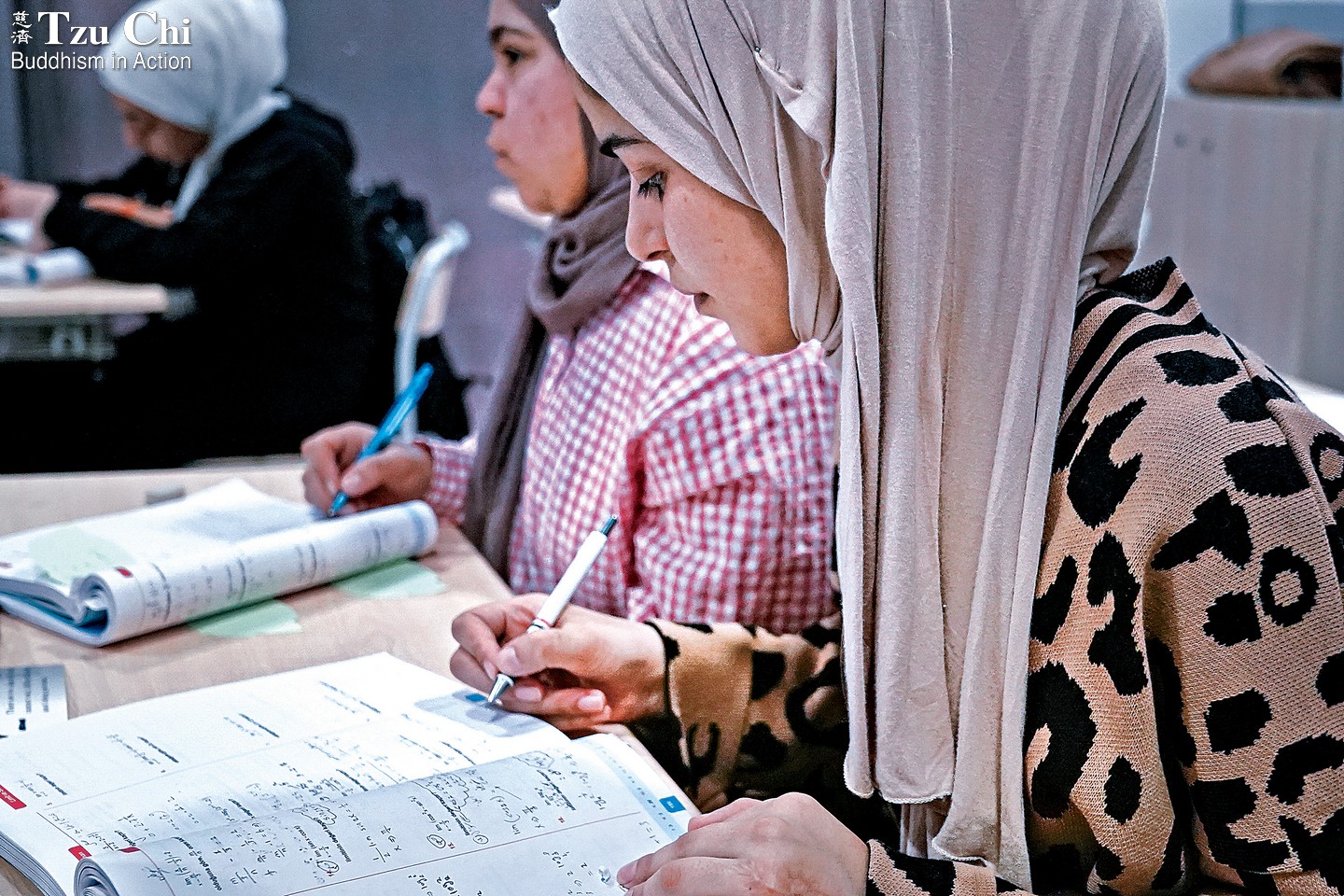
Students take notes during a class at El Menahil in November 2023.

Educational empowerment

The Syrian civil war has dragged on for nearly 13 years, resulting in 300,000 fatalities and displacing more than 13 million people. Türkiye hosts the largest number of Syrian refugees, providing shelter for as many as 3.7 million people.

In 2014, Tzu Chi volunteers in Türkiye, including Faisal Hu (胡光中), Nadya Chou (周如意), and Yu Zi-cheng (余自成), initiated assistance to Syrian refugee families. Alongside other efforts, they visited households, identified children not enrolled in school, and played a pivotal role in establishing El Menahil school for them. These young individuals faced the harsh realities of war and displacement during their formative years, often compelled to work to help support their families. Tzu Chi stepped in with financial aid and offered them an opportunity to pursue an education. This support not only alleviated the economic burden on their families but also became a source of empowerment, allowing these young people to envision a brighter future despite the adversities they had experienced.

“El Menahil is more than just a school,” said Dana Salem, the director of the student affairs office in the school’s elementary division. “Here, I learned about love and had the chance to become a volunteer. We share love with both teachers and students, navigating the days of overseas displacement together.”

Salem enjoyed a comfortable life before the civil war, believing it would remain that way. Who could have predicted the eruption of conflict and the subsequent upheaval of their lives? She encountered difficult challenges after arriving in Türkiye, which continued until she secured a teaching position at El Menahil.

Salem emphasized that El Menahil provided Syrian children the opportunity to study Arabic, something that regular schools in Türkiye didn’t offer, helping the youngsters reconnect with their mother tongue. In fact, the school offers education in three languages: Arabic to preserve the cultural roots of Syrian students; Turkish to assist their integration into Turkish society; and English to facilitate international connections. Additionally, the school provides elective Chinese courses, as many students aspire to communicate directly with Dharma Master Cheng Yen, the founder of Tzu Chi.

Tzu Chi’s assistance to the students extends beyond their time at the school. If graduates are accepted into university but face financial challenges, the foundation offers monthly living stipends ranging from 1,000 to 3,000 Turkish lira (US$34 to $103), as well as a 30 to 50 percent subsidy on tuition fees. All this is to assist students in successfully completing their education and improving their prospects for securing stable employment after graduation.

El Menahil currently boasts over 5,000 students spanning grades one through 12, both on-site and online, with approximately 300 faculty and staff members. Elham Haddad, the school’s director of distance education, explained that online learning includes some 3,000 students, including those unable to leave Syria and women who must stay home. When the new campus is completed in the future, there will be an additional private high school for underprivileged Turkish students.

An essential aspect of El Menahil is that the Syrian educators serving at the school not only teach students but have become important participants in Tzu Chi’s charitable endeavors. Besides helping the foundation provide aid for their fellow compatriots and underserved Turkish people, they also take on international missions, such as traveling to Lebanon to help people affected by the Beirut explosion and to Poland to assist Ukrainian refugees. This work allows them to transition from recipients of aid to contributors, further enriching their lives.

Personnel from El Menahil International School visited Tainan Tzu Chi Senior High School in October 2023, signing a memorandum of understanding between the two schools. Chen Da-sheng

Tokens of appreciation

The personnel from the school who visited Tzu Chi’s facilities in Taiwan in October 2023 had already obtained Turkish citizenship, allowing them to travel abroad. While the primary focus of their visit centered on the exchange of educational experiences, the most eagerly anticipated part was meeting with Master Cheng Yen. During their time with the Master, they recounted the pain of being unable to return to their homeland, the emotional toll of being separated from loved ones, and the uncertainties surrounding their future. Almost every one of them became emotional, choking up or breaking into tears as they shared the pain of loss and the joy of reunions.

“I’ll never forget that day,” said Elham Haddad, the director of distance education. “When the school where I worked in Syria was bombed, many people died in front of me. Everything was covered in blood. Stepping over bodies, I was so afraid I would see my own child. It wasn’t until I found my daughter crying in a corner that my heart eased. Holding her tightly to me, I knew that we had to leave our homeland.” Haddad added that, with Tzu Chi’s help, his children had gained admission to the best university in Türkiye. On one occasion, he overheard them talking to each other: “Tzu Chi helped us, how can we repay them?” “Don’t worry, after graduating from dentistry, we’ll join Tzu Chi’s International Medical Association and help people around the world. That’s how we’ll repay them.”

Ziad Zamzam, the director of student affairs, shared his profound bewilderment about the war. “We are a peace-loving people; we never imagined that one day, war would find us.” He revealed that he had crossed into Türkiye in 2017, but it was only when he connected with El Menahil that he could finally resume his beloved teaching profession. “With a job and income, I was able to bring my wife and children to Türkiye. I am grateful to Tzu Chi and everyone for standing by us through these challenging years.”

After the war erupted, Vice Principal Ahmed Aliyan’s brother and uncle died after enduring cruel torture. Two years later, Aliyan received a photo of his deceased brother, with a number written on his forehead. Fearing for their lives, Aliyan and his family decided to flee their home country. “Ten of us were smuggled into Istanbul, including six children from my brother and me, along with our parents. We didn’t know what to do next. I was almost 50 years old at that time, and no factory was willing to hire me. Eventually, Tzu Chi gave me an opportunity, and I became a teacher at El Menahil.”

He started volunteering for Tzu Chi on his very first day at work. He visited Syrian refugee families after school every day until ten at night. After the Beirut explosion in 2020, he represented Tzu Chi in relief efforts, distributing items to those affected, including blankets. “At the distribution venue,” he said, “memories flooded back from several years before when I received five blankets from Tzu Chi. Our whole family felt warm, inside and out, that night.”

Currently, the most significant challenge facing the school’s faculty and staff is the surge in rent. The influx of quake survivors into Istanbul after the devastating tremors in southern Türkiye in February 2023, coupled with inflation, has led to a sharp increase in rental costs. If they can’t pay the rent for their homes, they face immediate eviction. With rent nearly matching their monthly salary, they have to tighten their belts to send money to their families in Syria, making every day a financial struggle.

Muhammed Munir Amino expressed his sorrow, saying, “Going back to our home country isn’t an option. Life there is very difficult.” He explained that even going out to buy food was dangerous—they ran the risk of not returning.

Despite the challenges they face, they are very grateful to Tzu Chi for offering them unwavering support along the way, even increasing their pay to try to make their lives easier. As a token of their appreciation for the foundation, the school personnel brought gifts to Taiwan. These gifts included treasured wooden crafts and hand-knitted creations by mothers, along with drawings by students. Volunteer Faisal Hu, who accompanied the Syrian educators to Taiwan, highlighted Tzu Chi’s significance to them: Tzu Chi helped them transition from losing everything due to the war to regaining their human dignity. In the words of Dana Salem: “We left our homeland, arrived in Türkiye, and found a new home in Tzu Chi.”

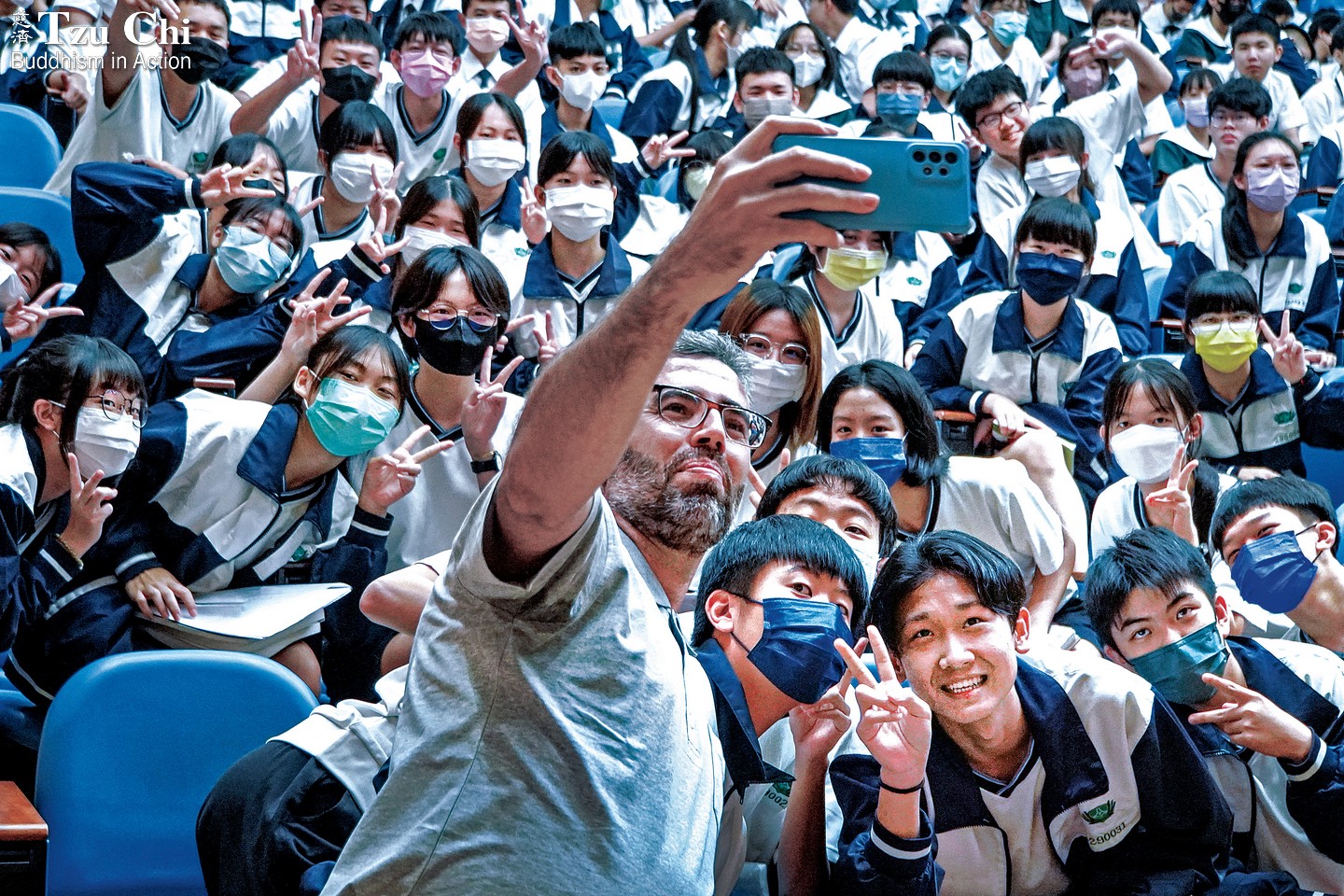
A representative from El Menahil International School takes a selfie with students at Tainan Tzu Chi Senior High School in October 2023. Chen Da-sheng

Compiled by Tzu Chi Monthly editorial staff
Translated by Wu Hsiao-ting
Photos by Mohammed Nimir Aljamal

El Menahil International School in Türkiye helps Syrian refugee children continue their education during displacement. The school also restores the dignity of Syrian education workers by providing them with employment opportunities.

Graduates capture their happiness at the graduation ceremony of El Menahil International School’s high school female class in 2021.

Muhammed Munir Amino’s life was going well in his early 30s. He was raising four beautiful children with his wife in a lovely house, and serving successfully as the principal of a secondary school. Unfortunately, his peaceful life took a tragic turn with the onset of the Syrian civil war in 2011. His hometown, the border city of Idlib, was transformed overnight into a battleground. The conflict compelled him to leave the life he had loved. Bidding farewell to his wife, children, and mother was the most heart-wrenching part.

He eventually ended up in Istanbul, Türkiye, in 2015, but all of his educational expertise was irrelevant in his host city, leaving him no choice but to work in a bakery.

In the same year, Tzu Chi, in collaboration with the government of the Sultangazi district in Istanbul, established El Menahil, a school for Syrian refugee children. Amino was able to join the school, thus re-entering the education system. He became a Tzu Chi volunteer at the same time, assisting the foundation in monthly aid distributions to thousands of Syrian refugee families. He even traveled to quake-stricken areas for disaster relief after earthquakes struck southern Türkiye in February 2023.

The term “Menahil” in the Tzu Chi school’s name, translated from Arabic, means “spring of water,” symbolizing a source of knowledge for children trapped in an educational desert. In 2018, the school received accreditation from an American accrediting agency and was renamed El Menahil International School. Graduates can now obtain diplomas acknowledged by the Turkish Ministry of Education and pursue further education worldwide.

By the end of 2022, El Menahil International School had nurtured 343 graduates, with 265 of them entering universities. Among the latter, 70 pursued medical-related disciplines, 114 entered STEM fields, and 81 pursued literature and social sciences. Because the number of students enrolled in the school has been increasing, Tzu Chi has acquired land to build a new campus.

In October 2023, a team of 13, including personnel from the school and Tzu Chi volunteers from Türkiye, visited various Tzu Chi facilities in Taiwan. During the trip, Muhammed Munir Amino, in his capacity as the principal of El Menahil’s high school division and the school’s academic director, signed a memorandum of understanding with Tainan Tzu Chi Senior High School in southern Taiwan, aiming to expand the international perspectives of students at both schools. Before returning to Türkiye, he choked back tears, saying that history would remember the people who guided thousands of Syrian students from darkness to light with love and kindness. He promised Dharma Master Cheng Yen and Tzu Chi volunteers that he and the other visiting educators would take the love they had experienced in Taiwan back to Türkiye and someday return with outstanding graduates, sharing how Tzu Chi’s assistance had led them to achieve excellence in life.

El Menahil International School hires Syrian intellectuals to provide quality education. Yu Zi-cheng

Students take notes during a class at El Menahil in November 2023.

Educational empowerment

The Syrian civil war has dragged on for nearly 13 years, resulting in 300,000 fatalities and displacing more than 13 million people. Türkiye hosts the largest number of Syrian refugees, providing shelter for as many as 3.7 million people.

In 2014, Tzu Chi volunteers in Türkiye, including Faisal Hu (胡光中), Nadya Chou (周如意), and Yu Zi-cheng (余自成), initiated assistance to Syrian refugee families. Alongside other efforts, they visited households, identified children not enrolled in school, and played a pivotal role in establishing El Menahil school for them. These young individuals faced the harsh realities of war and displacement during their formative years, often compelled to work to help support their families. Tzu Chi stepped in with financial aid and offered them an opportunity to pursue an education. This support not only alleviated the economic burden on their families but also became a source of empowerment, allowing these young people to envision a brighter future despite the adversities they had experienced.

“El Menahil is more than just a school,” said Dana Salem, the director of the student affairs office in the school’s elementary division. “Here, I learned about love and had the chance to become a volunteer. We share love with both teachers and students, navigating the days of overseas displacement together.”

Salem enjoyed a comfortable life before the civil war, believing it would remain that way. Who could have predicted the eruption of conflict and the subsequent upheaval of their lives? She encountered difficult challenges after arriving in Türkiye, which continued until she secured a teaching position at El Menahil.

Salem emphasized that El Menahil provided Syrian children the opportunity to study Arabic, something that regular schools in Türkiye didn’t offer, helping the youngsters reconnect with their mother tongue. In fact, the school offers education in three languages: Arabic to preserve the cultural roots of Syrian students; Turkish to assist their integration into Turkish society; and English to facilitate international connections. Additionally, the school provides elective Chinese courses, as many students aspire to communicate directly with Dharma Master Cheng Yen, the founder of Tzu Chi.

Tzu Chi’s assistance to the students extends beyond their time at the school. If graduates are accepted into university but face financial challenges, the foundation offers monthly living stipends ranging from 1,000 to 3,000 Turkish lira (US$34 to $103), as well as a 30 to 50 percent subsidy on tuition fees. All this is to assist students in successfully completing their education and improving their prospects for securing stable employment after graduation.

El Menahil currently boasts over 5,000 students spanning grades one through 12, both on-site and online, with approximately 300 faculty and staff members. Elham Haddad, the school’s director of distance education, explained that online learning includes some 3,000 students, including those unable to leave Syria and women who must stay home. When the new campus is completed in the future, there will be an additional private high school for underprivileged Turkish students.

An essential aspect of El Menahil is that the Syrian educators serving at the school not only teach students but have become important participants in Tzu Chi’s charitable endeavors. Besides helping the foundation provide aid for their fellow compatriots and underserved Turkish people, they also take on international missions, such as traveling to Lebanon to help people affected by the Beirut explosion and to Poland to assist Ukrainian refugees. This work allows them to transition from recipients of aid to contributors, further enriching their lives.

Personnel from El Menahil International School visited Tainan Tzu Chi Senior High School in October 2023, signing a memorandum of understanding between the two schools. Chen Da-sheng

Tokens of appreciation

The personnel from the school who visited Tzu Chi’s facilities in Taiwan in October 2023 had already obtained Turkish citizenship, allowing them to travel abroad. While the primary focus of their visit centered on the exchange of educational experiences, the most eagerly anticipated part was meeting with Master Cheng Yen. During their time with the Master, they recounted the pain of being unable to return to their homeland, the emotional toll of being separated from loved ones, and the uncertainties surrounding their future. Almost every one of them became emotional, choking up or breaking into tears as they shared the pain of loss and the joy of reunions.

“I’ll never forget that day,” said Elham Haddad, the director of distance education. “When the school where I worked in Syria was bombed, many people died in front of me. Everything was covered in blood. Stepping over bodies, I was so afraid I would see my own child. It wasn’t until I found my daughter crying in a corner that my heart eased. Holding her tightly to me, I knew that we had to leave our homeland.” Haddad added that, with Tzu Chi’s help, his children had gained admission to the best university in Türkiye. On one occasion, he overheard them talking to each other: “Tzu Chi helped us, how can we repay them?” “Don’t worry, after graduating from dentistry, we’ll join Tzu Chi’s International Medical Association and help people around the world. That’s how we’ll repay them.”

Ziad Zamzam, the director of student affairs, shared his profound bewilderment about the war. “We are a peace-loving people; we never imagined that one day, war would find us.” He revealed that he had crossed into Türkiye in 2017, but it was only when he connected with El Menahil that he could finally resume his beloved teaching profession. “With a job and income, I was able to bring my wife and children to Türkiye. I am grateful to Tzu Chi and everyone for standing by us through these challenging years.”

After the war erupted, Vice Principal Ahmed Aliyan’s brother and uncle died after enduring cruel torture. Two years later, Aliyan received a photo of his deceased brother, with a number written on his forehead. Fearing for their lives, Aliyan and his family decided to flee their home country. “Ten of us were smuggled into Istanbul, including six children from my brother and me, along with our parents. We didn’t know what to do next. I was almost 50 years old at that time, and no factory was willing to hire me. Eventually, Tzu Chi gave me an opportunity, and I became a teacher at El Menahil.”

He started volunteering for Tzu Chi on his very first day at work. He visited Syrian refugee families after school every day until ten at night. After the Beirut explosion in 2020, he represented Tzu Chi in relief efforts, distributing items to those affected, including blankets. “At the distribution venue,” he said, “memories flooded back from several years before when I received five blankets from Tzu Chi. Our whole family felt warm, inside and out, that night.”

Currently, the most significant challenge facing the school’s faculty and staff is the surge in rent. The influx of quake survivors into Istanbul after the devastating tremors in southern Türkiye in February 2023, coupled with inflation, has led to a sharp increase in rental costs. If they can’t pay the rent for their homes, they face immediate eviction. With rent nearly matching their monthly salary, they have to tighten their belts to send money to their families in Syria, making every day a financial struggle.

Muhammed Munir Amino expressed his sorrow, saying, “Going back to our home country isn’t an option. Life there is very difficult.” He explained that even going out to buy food was dangerous—they ran the risk of not returning.

Despite the challenges they face, they are very grateful to Tzu Chi for offering them unwavering support along the way, even increasing their pay to try to make their lives easier. As a token of their appreciation for the foundation, the school personnel brought gifts to Taiwan. These gifts included treasured wooden crafts and hand-knitted creations by mothers, along with drawings by students. Volunteer Faisal Hu, who accompanied the Syrian educators to Taiwan, highlighted Tzu Chi’s significance to them: Tzu Chi helped them transition from losing everything due to the war to regaining their human dignity. In the words of Dana Salem: “We left our homeland, arrived in Türkiye, and found a new home in Tzu Chi.”

A representative from El Menahil International School takes a selfie with students at Tainan Tzu Chi Senior High School in October 2023. Chen Da-sheng

關鍵字

Always a Child in My Mom’s Eyes

Narrated by Bashar Kerdi
Compiled by Wei Yu-xian
Translated by Wu Hsiao-ting
Photo by Jessica Yang

I kissed my parents’ foreheads the day I left Syria, and gave another kiss to my beloved homeland. Tearfully, my mom said, “I hope you stay, but I also hope you go, because only then can you stay safe.”

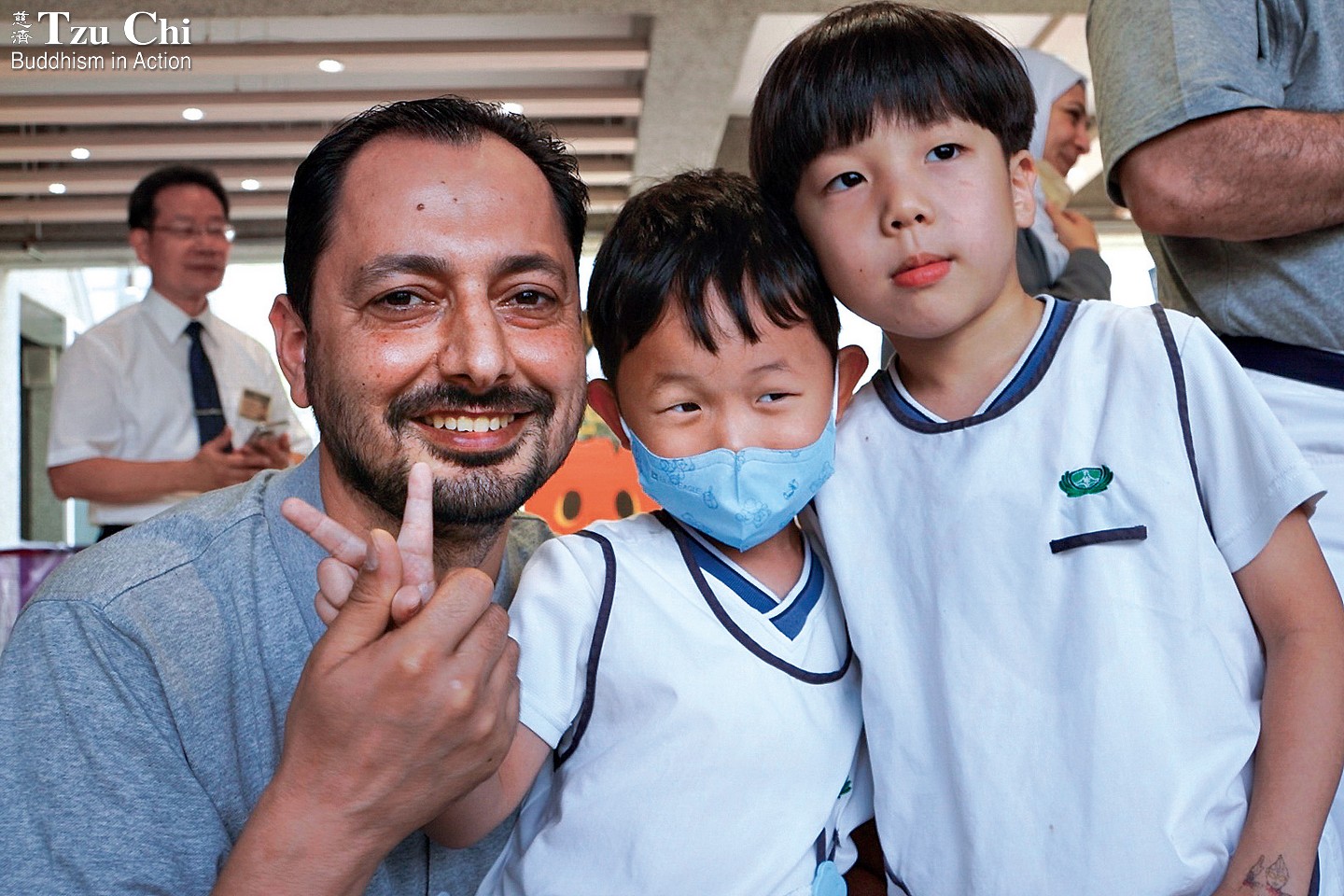
Bashar Kerdi, the head of the registration department at El Menahil, is pictured with two children during a visit to Tainan Tzu Chi Senior High School in southern Taiwan. The school includes a high school, junior high, elementary division, and a kindergarten.

Back in Syria, I served as a school principal while also running a computer repair shop. My wife was also an educator, a teacher. We had two children, owned our house and car, and led a comfortable life.

In 2011, the war transformed Syria into a nightmarish place. Despite my efforts to continue living there, I had to leave in 2016. On the day of my departure, I kissed my parents’ foreheads and bid farewell to my beloved homeland. Tearfully, my mother told me, “Your three sisters have already left; you are all I have left. I hope you stay, but I also hope you go because only then can you stay safe.”

I left my children and pregnant wife behind because I didn’t know what the future held. I went to Idlib first, near Türkiye, but couldn’t find work. A month later, I fled to Antakya, Türkiye, but the cost of living was too high. Eventually, I moved to Istanbul, where I opened a computer repair store.

In 2018, I decided to give up my computer repair business and joined the staff at El Menahil school. The school provided a sense of belonging, wrapping me in a warmth reminiscent of my mother’s embrace. I missed my family dearly, being away from them for so long. Fortunately, in the same year, I successfully arranged for my wife and three children to join me in Türkiye. The greatest joy was when we all acquired Turkish citizenship.

On February 6, 2023, massive earthquakes shook Türkiye. Many of my relatives lived in the heavily affected area of Antakya; over ten of them lost their lives. Tzu Chi didn’t leave us to our own devices; the next day, they took me to the disaster area on a school bus, allowing me to bring back three families.

I currently serve as the head of the enrollment department at El Menahil. Many parents wish to enroll their children in our school, yet available spots are limited. For children, the most challenging part is feeling inferior to their peers. They perceive the world through the pure lens of their souls, wondering, “Why do some children go to school every morning but I can’t?”

One day, a little girl and her mother came to El Menahil. The girl gazed at me with hopeful eyes, yearning for admission into our school. Both of them cried in front of me. The mother pleaded, “Sir, I bought her a school uniform, a backpack, and shoes. One day, she hugged them and cried herself to sleep. Please make her dream come true.”

I stood before them helplessly, facing one of the most challenging situations of my life. Many children were like this girl—El Menahil was akin to their paradise. How I wished to fulfill all these children’s dream.

After becoming refugees, we were reduced to mere numbers. This stripped us of our dignity, but Tzu Chi has played a pivotal role in helping us regain it. The foundation also gave us an opportunity to serve the needy. On this trip to Taiwan, I brought a gift from Türkiye—a decoration hand-knitted by my mother. In crafting this work, she poured seven years of longing for me, imbuing it with her motherly concerns and love—the kind that never forsakes you under any circumstances.

In my mother’s eyes, I am still a child. How I yearn to be embraced by her once again! I want to give this cherished knitting to Master Cheng Yen, who is like a mother to us, as a heartfelt token of gratitude for all that Tzu Chi has done for us.

Narrated by Bashar Kerdi
Compiled by Wei Yu-xian
Translated by Wu Hsiao-ting
Photo by Jessica Yang

I kissed my parents’ foreheads the day I left Syria, and gave another kiss to my beloved homeland. Tearfully, my mom said, “I hope you stay, but I also hope you go, because only then can you stay safe.”

Bashar Kerdi, the head of the registration department at El Menahil, is pictured with two children during a visit to Tainan Tzu Chi Senior High School in southern Taiwan. The school includes a high school, junior high, elementary division, and a kindergarten.

Back in Syria, I served as a school principal while also running a computer repair shop. My wife was also an educator, a teacher. We had two children, owned our house and car, and led a comfortable life.

In 2011, the war transformed Syria into a nightmarish place. Despite my efforts to continue living there, I had to leave in 2016. On the day of my departure, I kissed my parents’ foreheads and bid farewell to my beloved homeland. Tearfully, my mother told me, “Your three sisters have already left; you are all I have left. I hope you stay, but I also hope you go because only then can you stay safe.”

I left my children and pregnant wife behind because I didn’t know what the future held. I went to Idlib first, near Türkiye, but couldn’t find work. A month later, I fled to Antakya, Türkiye, but the cost of living was too high. Eventually, I moved to Istanbul, where I opened a computer repair store.

In 2018, I decided to give up my computer repair business and joined the staff at El Menahil school. The school provided a sense of belonging, wrapping me in a warmth reminiscent of my mother’s embrace. I missed my family dearly, being away from them for so long. Fortunately, in the same year, I successfully arranged for my wife and three children to join me in Türkiye. The greatest joy was when we all acquired Turkish citizenship.

On February 6, 2023, massive earthquakes shook Türkiye. Many of my relatives lived in the heavily affected area of Antakya; over ten of them lost their lives. Tzu Chi didn’t leave us to our own devices; the next day, they took me to the disaster area on a school bus, allowing me to bring back three families.

I currently serve as the head of the enrollment department at El Menahil. Many parents wish to enroll their children in our school, yet available spots are limited. For children, the most challenging part is feeling inferior to their peers. They perceive the world through the pure lens of their souls, wondering, “Why do some children go to school every morning but I can’t?”

One day, a little girl and her mother came to El Menahil. The girl gazed at me with hopeful eyes, yearning for admission into our school. Both of them cried in front of me. The mother pleaded, “Sir, I bought her a school uniform, a backpack, and shoes. One day, she hugged them and cried herself to sleep. Please make her dream come true.”

I stood before them helplessly, facing one of the most challenging situations of my life. Many children were like this girl—El Menahil was akin to their paradise. How I wished to fulfill all these children’s dream.

After becoming refugees, we were reduced to mere numbers. This stripped us of our dignity, but Tzu Chi has played a pivotal role in helping us regain it. The foundation also gave us an opportunity to serve the needy. On this trip to Taiwan, I brought a gift from Türkiye—a decoration hand-knitted by my mother. In crafting this work, she poured seven years of longing for me, imbuing it with her motherly concerns and love—the kind that never forsakes you under any circumstances.

In my mother’s eyes, I am still a child. How I yearn to be embraced by her once again! I want to give this cherished knitting to Master Cheng Yen, who is like a mother to us, as a heartfelt token of gratitude for all that Tzu Chi has done for us.

關鍵字

A No-Wait System

Narrated by Basel Khalil
Compiled by Wei Yu-xian
Translated by Wu Hsiao-ting
Photo by Abdulrahman Hritani

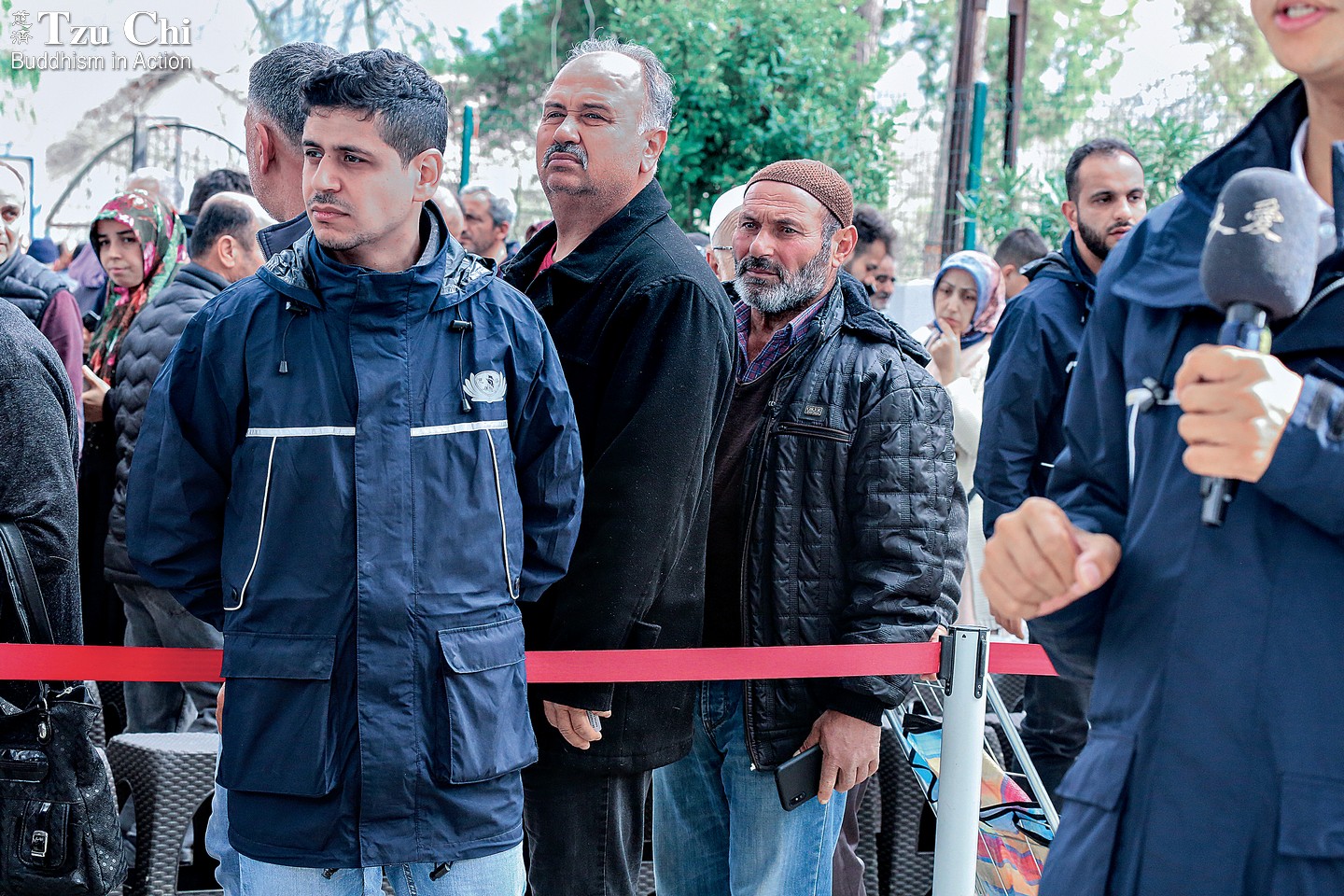
I endured a four-hour wait under the scorching sun, standing in a queue until I finally received my supplies. Wanting to spare others from similar painful experiences, I created the No-Wait System.

Basel Khalil (left) serves at a Tzu Chi distribution for victims of the February 2023 earthquakes in Türkiye, ready to step in whenever needed.

Two moments in my life stand out prominently to me. The first was when I donned the Tzu Chi volunteer vest; the second was in 2019 when I visited Taiwan and met Master Cheng Yen. I presented the Master with a Family Card during that visit, the same card used during Tzu Chi’s distributions in Türkiye, affectionately named “Master.” This occurred shortly after my marriage, and in return, Master Cheng Yen gave a gift to my wife. Fast forward to October 2023, when I visited Taiwan again, this time as a proud father of a daughter.

I was in my third year of studying software engineering at a university in Damascus, Syria, when the war broke out, forcing my family and me to leave our home and move to another province. I left home at six in the morning each day, got to school by noon, and hurried back home after two classes. Delaying meant having no place to stay for the night. I spent a significant amount of time commuting every day just to attend classes.

We relied on aid from charitable organizations for survival, queuing up for supplies, which was a painful experience. I tried to convince my brother to join me during a distribution during Ramadan, while we were fasting, but he refused. I had to go alone. I stood in a queue under the hot sun for four hours, but finally got my supplies. I informed the distribution staff I was a software engineering student and could help improve the queuing system.

Every day, I thought about designing a system that could spare people from long waiting times, as I had experienced. The organization could only serve a hundred families a day before I offered to create a No-Wait System for them, and even that took a considerable amount of time. After implementing my system, they were able to assist up to 800 families a day.

I joined the charitable organization after offering to create the system for them, and I remained with them even after obtaining my university degree. Working for them was an experience unlike anything in the regular job market. However, war eventually forced me to leave my home country. I’ll never forget the pain my departure caused my father. He didn’t want to say goodbye; his eyes were filled with sadness, but he tried his best not to show it.

The desire to see my father again never left me in Türkiye, not for a single day. After five years of separation, he told me he could finally visit me with my mother. Tragically, the day he got his passport, he passed away. My heart was broken.

I became an employee at El Menahil school after arriving in Türkiye. A month after I joined the school, I was asked to help with a distribution event on that weekend. I was surprised and asked, “We are a school; what are we distributing?” They replied, “El Menahil was founded by a charitable organization, so we are part of the organization.”

The next day at the distribution site, I saw people checking a wall for their names, just like students checking exam results. At that moment, I finally understood that the two years I spent working for the charity organization in Syria were to train myself to help these people!

As I had done in Syria, I successfully developed a software system to expedite Tzu Chi’s distributions. By sending distribution information to the care recipients, allowing them to register for the preferred date and time to collect our aid, and integrating this information to notify them when they could come to the distribution venue, the process became more efficient. On distribution day, after verifying their identity using the check-in system, claim slips would be printed, enabling them to receive their aid. This streamlined process provided more time for volunteers to interact with the care recipients. Additionally, the system could be monitored remotely online. It became a helpful tool during Tzu Chi’s distributions for Ukrainian refugees in Poland, and we were allowed to understand the entire progress of the events from Türkiye.

A team is like a computer; it must have power, and the power source for our team is Master Cheng Yen and everyone else in Tzu Chi. With the support from Tzu Chi, our “computer” can handle everything. I sincerely thank Master Cheng Yen. Her compassion has warmed everyone’s heart.

Narrated by Basel Khalil
Compiled by Wei Yu-xian
Translated by Wu Hsiao-ting
Photo by Abdulrahman Hritani

I endured a four-hour wait under the scorching sun, standing in a queue until I finally received my supplies. Wanting to spare others from similar painful experiences, I created the No-Wait System.

Basel Khalil (left) serves at a Tzu Chi distribution for victims of the February 2023 earthquakes in Türkiye, ready to step in whenever needed.

Two moments in my life stand out prominently to me. The first was when I donned the Tzu Chi volunteer vest; the second was in 2019 when I visited Taiwan and met Master Cheng Yen. I presented the Master with a Family Card during that visit, the same card used during Tzu Chi’s distributions in Türkiye, affectionately named “Master.” This occurred shortly after my marriage, and in return, Master Cheng Yen gave a gift to my wife. Fast forward to October 2023, when I visited Taiwan again, this time as a proud father of a daughter.

I was in my third year of studying software engineering at a university in Damascus, Syria, when the war broke out, forcing my family and me to leave our home and move to another province. I left home at six in the morning each day, got to school by noon, and hurried back home after two classes. Delaying meant having no place to stay for the night. I spent a significant amount of time commuting every day just to attend classes.

We relied on aid from charitable organizations for survival, queuing up for supplies, which was a painful experience. I tried to convince my brother to join me during a distribution during Ramadan, while we were fasting, but he refused. I had to go alone. I stood in a queue under the hot sun for four hours, but finally got my supplies. I informed the distribution staff I was a software engineering student and could help improve the queuing system.

Every day, I thought about designing a system that could spare people from long waiting times, as I had experienced. The organization could only serve a hundred families a day before I offered to create a No-Wait System for them, and even that took a considerable amount of time. After implementing my system, they were able to assist up to 800 families a day.

I joined the charitable organization after offering to create the system for them, and I remained with them even after obtaining my university degree. Working for them was an experience unlike anything in the regular job market. However, war eventually forced me to leave my home country. I’ll never forget the pain my departure caused my father. He didn’t want to say goodbye; his eyes were filled with sadness, but he tried his best not to show it.

The desire to see my father again never left me in Türkiye, not for a single day. After five years of separation, he told me he could finally visit me with my mother. Tragically, the day he got his passport, he passed away. My heart was broken.

I became an employee at El Menahil school after arriving in Türkiye. A month after I joined the school, I was asked to help with a distribution event on that weekend. I was surprised and asked, “We are a school; what are we distributing?” They replied, “El Menahil was founded by a charitable organization, so we are part of the organization.”

The next day at the distribution site, I saw people checking a wall for their names, just like students checking exam results. At that moment, I finally understood that the two years I spent working for the charity organization in Syria were to train myself to help these people!

As I had done in Syria, I successfully developed a software system to expedite Tzu Chi’s distributions. By sending distribution information to the care recipients, allowing them to register for the preferred date and time to collect our aid, and integrating this information to notify them when they could come to the distribution venue, the process became more efficient. On distribution day, after verifying their identity using the check-in system, claim slips would be printed, enabling them to receive their aid. This streamlined process provided more time for volunteers to interact with the care recipients. Additionally, the system could be monitored remotely online. It became a helpful tool during Tzu Chi’s distributions for Ukrainian refugees in Poland, and we were allowed to understand the entire progress of the events from Türkiye.

A team is like a computer; it must have power, and the power source for our team is Master Cheng Yen and everyone else in Tzu Chi. With the support from Tzu Chi, our “computer” can handle everything. I sincerely thank Master Cheng Yen. Her compassion has warmed everyone’s heart.

關鍵字

A Symphony of Sustainability—Elderly Eco-Heroes

By Cai Li-li
Translated by Wu Hsiao-ting
Photos by Huang Xiao-zhe

Despite their age, elderly volunteers at Tzu Chi’s Gangshan Campus create an inspiring eco-symphony as they work together to process discarded cables and electronics for recycling, minimizing waste and easing the Earth’s burden.

An open metal structure stands under a mango tree near the recycling station at the Tzu Chi Gangshan Campus in Kaohsiung, southern Taiwan. Even from a distance, you can hear knocking and banging emanating from it. Stepping closer reveals a group of recycling volunteers, with an average age of 80, working at a relaxed pace. While age has slowed them down a bit, they skillfully disassemble electrical appliances and extract copper wires from cables, using both their hands and their feet.

Within the metal structure, seven volunteers work together in a loose production line, creating a slow-motion symphony with their hands and feet as they cut, slice, and hammer on the electrical cables. Focused on their tasks, they share a clear goal: to sell recycled resources at a good price, supporting the production of high-quality programs for Tzu Chi’s Da Ai TV.

These volunteers, old enough to be grandparents, are like superheroes in the world of dismantling electrical appliances and cables for recycling. The youngest is 71, the oldest 85. Though age may not be on their side, their dedication to service remains unwavering as they enthusiastically embrace their role as the Earth’s guardians.

Striving for zero waste

Du Yu-zhu (杜玉珠), 81, serves as a dedicated volunteer at the recycling station, managing tasks that include receiving and organizing second-hand clothes and cleaning up after the daily recycling activities. With seemingly effortless grace, she juggles her various responsibilities while sharing stories about the station and fellow volunteers, radiating a gentle warmth that touches the hearts of those around her.

Over four years ago, the Tzu Chi Liuqiao and Houhong Recycling Stations in Kaohsiung’s Gangshan District merged with the station at the Gangshan Campus. After the merger, Du Yu-zhu repurposed a shipping container from the Liuqiao Recycling Station to store second-hand clothes. Later, when nearby factories donated discarded electrical cables, on-site volunteers began stripping them for recycling. They also recycled discarded household appliances.

Electrical devices and cables consist of various materials, such as stainless steel, copper, bronze, and plastic. Not all materials are accepted by recycling companies. The station’s volunteers diligently process and separate these materials, making every effort to reduce waste and environmental pollution.

Another remarkable volunteer at the station is Yu Cai Xiu (余蔡秀), 83, who works alongside her husband, Yu Yi-xiong (余益雄), affectionately known as Big Brother among their fellow volunteers. The dedicated couple has been actively involved in recycling work for many years, consistently working from morning till afternoon every day. Interestingly, nearly everyone in Yu Yi-xiong’s family volunteers for Tzu Chi, a fact that brings immense joy to Yu Cai Xiu.

Clad in recycled second-hand clothes and sporting makeshift boots crafted from plastic bags, she layers three pairs of gloves—two plastic and one cotton. Her protective ensemble is designed to guard against oil stains. Lowering herself onto a small stool, she places a basin filled with crushed gravel and sand in front of her. Into this, she adds long, hard cables coated with thick black oil. Methodically, she begins rolling the cables within the gravel and sand to remove the oil. In no time, her cotton gloves are covered with a thick layer of grease.

After Yu Cai Xiu finishes cleaning the cables, 81-year-old Yu Bang-shao (余邦紹) cuts them into small sections and works with her to peel off the insulation. Chen Mei-yu (陳美玉), 71, manages to remove further insulation before passing the cables to 76-year-old Zhu Chen Xiu-luan (朱陳秀鸞) and 84-year-old Huang Xie Min (黃謝敏) for the final steps. The entire team treats the extracted copper wires from the recycled cables with the utmost care, as if they were treasures.

Chen Mei-yu is the youngest among the volunteers and prefers to work quietly. She has battled and overcome COVID-19, but is still dealing with a lingering cough. Every cough causes discomfort in her back, but she doesn’t let that stop her from volunteering at the recycling station. She dislikes being idle or at loose ends.

Once Yu Bang-shao completes his work with the cables, he returns to his small stool to continue disassembling electrical appliances. He and his wife, 75-year-old Luo Jia-zhen (羅家蓁), are regulars at the recycling station, showing up every day. Once he starts working, he easily loses track of everything else. After a quick chat with others, he swiftly immerses himself in his work once more.

Luo Jia-zhen joined Tzu Chi’s recycling efforts in 2003. At the station, she often uses a hammer to take apart recycling items on the trunk of a lychee tree over ten years old. The tree trunk is now concave from years of use, speaking volumes about the effort she’s put in on it. Despite dealing with back pain and soreness, applying pain relief ointment as needed, Luo persists in her work. She remains motivated by the continuous influx of items awaiting dismantling, emphasizing, “Our hands never stop; if we don’t work hard, we won’t keep up with our workload. We practically start early and finish late every day.”

In January 2023, Luo began cancer treatment, facing all the challenges that accompanied it. Throughout it all, she maintained an optimistic and resilient outlook, viewing life and death as predetermined and facing it with courage. While undergoing chemotherapy, with reduced energy and weakened resistance, she temporarily paused her dismantling tasks at the recycling station. However, she continued sorting recyclables at home because neighbors continued bringing them over. Her son took over that part of her work during her hospital stay.

Now, she has returned to the recycling station and resumed disassembling appliances there. She says, “I want to be a good disciple of Master Cheng Yen, so I give my best effort. Even when unwell, I do what I can. I’m glad my actions enable me to not only support Da Ai TV but also care for the Earth.”

Volunteers with an average age of 80 carefully disassemble discarded electrical cables and appliances before organizing the components by type or material for recycling. This labor-intensive task demands patience and hard work, showcasing the dedication of these volunteers.

Staying focused to avoid sorrow

Even at the age of 85, Chen Cai Yue-ying (陳蔡月英) adeptly handles a power drill, effortlessly dismantling devices. Two years ago, she experienced the heartbreaking loss of her youngest son to cancer, a pain that lingers. Her daily volunteering now serves as a haven, providing solace from sorrow and the ache of longing.

Life recently threw her another curveball—her husband was diagnosed with Parkinson’s disease. Nevertheless, she remains steadfast, once again finding strength in her commitment to recycling amidst life’s uncertainties.

Mao Chen Xiu (毛陳秀), 83, boasts a round figure. She speaks sparingly, wholly focused on the task at hand. Perched in a small plastic chair, she skillfully pounds on a steel frame with a hammer to extract a bundle of copper wires embedded within. When the wires are exposed, her face lights up with satisfaction and joy, much like a child discovering their favorite candy, smiling with pure delight.

In 2003, Mao Chen Xiu began volunteering at Tzu Chi hospitals in Hualien and Dalin, located respectively in eastern and southern Taiwan. After her husband, also a Tzu Chi volunteer, passed away, she donned a volunteer vest he once wore, determined to fulfill both his and her share of volunteer duties. However, as the COVID-19 pandemic unfolded, coupled with her advancing age, she chose to forgo traveling to Hualien and Dalin for hospital volunteering. Instead, she now takes the 8:05 a.m. bus daily to the Gangshan Campus for volunteering and returns on the 4:00 p.m. bus. During volunteer Luo Jia-zhen’s cancer treatment, she took on the responsibility of opening and closing the area designated for dismantling.

Mao Chen Xiu lives by herself but doesn’t feel lonely. Her two sons have brought her to stay with them on multiple occasions and even expressed their desire for her to move in, but she prefers her home in Gangshan District, which makes volunteering at the Gangshan Campus convenient. “Idleness doesn’t suit me,” she says. “Life is short, especially at our age. We don’t know when we’ll depart this world, so it’s important to contribute while we can. Time and tide wait for no one.”

She shared that when she married into her husband’s family decades ago, she took on many responsibilities in line with the traditions of older Chinese society, given her husband’s status as the eldest son. With two brothers and six sisters in the family, it wasn’t until they also had married and started their own families that she finally had some free time, allowing her to pursue volunteering. As she reflects on these past experiences, her smile maintains a constant presence on her face.

From left: Luo Jia-zhen, Chen Mei-yu, Yu Cai Xiu, Mao Chen Xiu, Chen Cai Yue-ying, Huang Xie Min, and Du Yu-zhu, smiling with joy as they strive to safeguard a beautiful environment for future generations.

Extending the lifespan of items

Whenever volunteer Sun Xiang-han (孫湘涵) joins recycling activities at the Gangshan Campus, she makes a point of visiting the dismantling area and spending time with the group of elderly volunteers. Their pure intentions and actions for the environment move her deeply. Despite their age, they dedicate their entire days to recycling work, sometimes even foregoing breaks at noon, and only heading home after four in the afternoon.

Their meticulous efforts extend beyond reclaiming and recycling copper wires; they also ensure that no second-hand clothes brought to the station go to waste. They carefully select wearable garments, then pack and store them for later use. Even clothes considered unwearable are treasures to Du Yu-zhu. She hands them over to Huang Xie Min, skilled in tailoring, who cuts them into pieces for reuse by factories. The volunteers consistently prioritize extending the lifespan of items, reducing waste, and lightening the burden on the Earth.

Eighty-four-year-old Huang Xie Min excels not only in cutting fabrics but also in stripping cables to retrieve wires. Taking a break from her task of cutting cables with a utility knife, she expresses her appreciation for being able to serve at the recycling station. Sitting idly at home triggers unwanted thoughts and worries, she says. Volunteering at the recycling station keeps her engaged, diverting her from those unwelcome thoughts. She also enjoys chatting with fellow volunteers at the station and values the mutual care they provide for each other.

Du Yu-zhu oversees the operations of the recycling station, staying busy every day and finding joy in her work. She chuckles, mentioning that if she ever has a free moment and her hands aren’t occupied, she might doze off. Besides her recycling station duties, she sorts recyclables at the entrance of her home. She also attends funerals on Tzu Chi’s behalf, chants the Buddha’s name for the deceased, and cares for families of the departed. When asked about her boundless energy, she attributes it to the teachings of Dharma Master Cheng Yen, which give her the vitality and strength to handle various tasks and responsibilities.

In the small space beneath the mango tree, the senior volunteers move at a measured pace, diligently performing various tasks. They take the labor-intensive nature of their work in stride, remaining steadfast and unwavering. Even with their face masks on, one can perceive happiness and contentment in their eyes.

By Cai Li-li
Translated by Wu Hsiao-ting
Photos by Huang Xiao-zhe

Despite their age, elderly volunteers at Tzu Chi’s Gangshan Campus create an inspiring eco-symphony as they work together to process discarded cables and electronics for recycling, minimizing waste and easing the Earth’s burden.

An open metal structure stands under a mango tree near the recycling station at the Tzu Chi Gangshan Campus in Kaohsiung, southern Taiwan. Even from a distance, you can hear knocking and banging emanating from it. Stepping closer reveals a group of recycling volunteers, with an average age of 80, working at a relaxed pace. While age has slowed them down a bit, they skillfully disassemble electrical appliances and extract copper wires from cables, using both their hands and their feet.

Within the metal structure, seven volunteers work together in a loose production line, creating a slow-motion symphony with their hands and feet as they cut, slice, and hammer on the electrical cables. Focused on their tasks, they share a clear goal: to sell recycled resources at a good price, supporting the production of high-quality programs for Tzu Chi’s Da Ai TV.

These volunteers, old enough to be grandparents, are like superheroes in the world of dismantling electrical appliances and cables for recycling. The youngest is 71, the oldest 85. Though age may not be on their side, their dedication to service remains unwavering as they enthusiastically embrace their role as the Earth’s guardians.

Striving for zero waste

Du Yu-zhu (杜玉珠), 81, serves as a dedicated volunteer at the recycling station, managing tasks that include receiving and organizing second-hand clothes and cleaning up after the daily recycling activities. With seemingly effortless grace, she juggles her various responsibilities while sharing stories about the station and fellow volunteers, radiating a gentle warmth that touches the hearts of those around her.

Over four years ago, the Tzu Chi Liuqiao and Houhong Recycling Stations in Kaohsiung’s Gangshan District merged with the station at the Gangshan Campus. After the merger, Du Yu-zhu repurposed a shipping container from the Liuqiao Recycling Station to store second-hand clothes. Later, when nearby factories donated discarded electrical cables, on-site volunteers began stripping them for recycling. They also recycled discarded household appliances.

Electrical devices and cables consist of various materials, such as stainless steel, copper, bronze, and plastic. Not all materials are accepted by recycling companies. The station’s volunteers diligently process and separate these materials, making every effort to reduce waste and environmental pollution.

Another remarkable volunteer at the station is Yu Cai Xiu (余蔡秀), 83, who works alongside her husband, Yu Yi-xiong (余益雄), affectionately known as Big Brother among their fellow volunteers. The dedicated couple has been actively involved in recycling work for many years, consistently working from morning till afternoon every day. Interestingly, nearly everyone in Yu Yi-xiong’s family volunteers for Tzu Chi, a fact that brings immense joy to Yu Cai Xiu.

Clad in recycled second-hand clothes and sporting makeshift boots crafted from plastic bags, she layers three pairs of gloves—two plastic and one cotton. Her protective ensemble is designed to guard against oil stains. Lowering herself onto a small stool, she places a basin filled with crushed gravel and sand in front of her. Into this, she adds long, hard cables coated with thick black oil. Methodically, she begins rolling the cables within the gravel and sand to remove the oil. In no time, her cotton gloves are covered with a thick layer of grease.

After Yu Cai Xiu finishes cleaning the cables, 81-year-old Yu Bang-shao (余邦紹) cuts them into small sections and works with her to peel off the insulation. Chen Mei-yu (陳美玉), 71, manages to remove further insulation before passing the cables to 76-year-old Zhu Chen Xiu-luan (朱陳秀鸞) and 84-year-old Huang Xie Min (黃謝敏) for the final steps. The entire team treats the extracted copper wires from the recycled cables with the utmost care, as if they were treasures.

Chen Mei-yu is the youngest among the volunteers and prefers to work quietly. She has battled and overcome COVID-19, but is still dealing with a lingering cough. Every cough causes discomfort in her back, but she doesn’t let that stop her from volunteering at the recycling station. She dislikes being idle or at loose ends.

Once Yu Bang-shao completes his work with the cables, he returns to his small stool to continue disassembling electrical appliances. He and his wife, 75-year-old Luo Jia-zhen (羅家蓁), are regulars at the recycling station, showing up every day. Once he starts working, he easily loses track of everything else. After a quick chat with others, he swiftly immerses himself in his work once more.

Luo Jia-zhen joined Tzu Chi’s recycling efforts in 2003. At the station, she often uses a hammer to take apart recycling items on the trunk of a lychee tree over ten years old. The tree trunk is now concave from years of use, speaking volumes about the effort she’s put in on it. Despite dealing with back pain and soreness, applying pain relief ointment as needed, Luo persists in her work. She remains motivated by the continuous influx of items awaiting dismantling, emphasizing, “Our hands never stop; if we don’t work hard, we won’t keep up with our workload. We practically start early and finish late every day.”

In January 2023, Luo began cancer treatment, facing all the challenges that accompanied it. Throughout it all, she maintained an optimistic and resilient outlook, viewing life and death as predetermined and facing it with courage. While undergoing chemotherapy, with reduced energy and weakened resistance, she temporarily paused her dismantling tasks at the recycling station. However, she continued sorting recyclables at home because neighbors continued bringing them over. Her son took over that part of her work during her hospital stay.

Now, she has returned to the recycling station and resumed disassembling appliances there. She says, “I want to be a good disciple of Master Cheng Yen, so I give my best effort. Even when unwell, I do what I can. I’m glad my actions enable me to not only support Da Ai TV but also care for the Earth.”

Volunteers with an average age of 80 carefully disassemble discarded electrical cables and appliances before organizing the components by type or material for recycling. This labor-intensive task demands patience and hard work, showcasing the dedication of these volunteers.

Staying focused to avoid sorrow

Even at the age of 85, Chen Cai Yue-ying (陳蔡月英) adeptly handles a power drill, effortlessly dismantling devices. Two years ago, she experienced the heartbreaking loss of her youngest son to cancer, a pain that lingers. Her daily volunteering now serves as a haven, providing solace from sorrow and the ache of longing.

Life recently threw her another curveball—her husband was diagnosed with Parkinson’s disease. Nevertheless, she remains steadfast, once again finding strength in her commitment to recycling amidst life’s uncertainties.

Mao Chen Xiu (毛陳秀), 83, boasts a round figure. She speaks sparingly, wholly focused on the task at hand. Perched in a small plastic chair, she skillfully pounds on a steel frame with a hammer to extract a bundle of copper wires embedded within. When the wires are exposed, her face lights up with satisfaction and joy, much like a child discovering their favorite candy, smiling with pure delight.

In 2003, Mao Chen Xiu began volunteering at Tzu Chi hospitals in Hualien and Dalin, located respectively in eastern and southern Taiwan. After her husband, also a Tzu Chi volunteer, passed away, she donned a volunteer vest he once wore, determined to fulfill both his and her share of volunteer duties. However, as the COVID-19 pandemic unfolded, coupled with her advancing age, she chose to forgo traveling to Hualien and Dalin for hospital volunteering. Instead, she now takes the 8:05 a.m. bus daily to the Gangshan Campus for volunteering and returns on the 4:00 p.m. bus. During volunteer Luo Jia-zhen’s cancer treatment, she took on the responsibility of opening and closing the area designated for dismantling.

Mao Chen Xiu lives by herself but doesn’t feel lonely. Her two sons have brought her to stay with them on multiple occasions and even expressed their desire for her to move in, but she prefers her home in Gangshan District, which makes volunteering at the Gangshan Campus convenient. “Idleness doesn’t suit me,” she says. “Life is short, especially at our age. We don’t know when we’ll depart this world, so it’s important to contribute while we can. Time and tide wait for no one.”

She shared that when she married into her husband’s family decades ago, she took on many responsibilities in line with the traditions of older Chinese society, given her husband’s status as the eldest son. With two brothers and six sisters in the family, it wasn’t until they also had married and started their own families that she finally had some free time, allowing her to pursue volunteering. As she reflects on these past experiences, her smile maintains a constant presence on her face.

From left: Luo Jia-zhen, Chen Mei-yu, Yu Cai Xiu, Mao Chen Xiu, Chen Cai Yue-ying, Huang Xie Min, and Du Yu-zhu, smiling with joy as they strive to safeguard a beautiful environment for future generations.

Extending the lifespan of items

Whenever volunteer Sun Xiang-han (孫湘涵) joins recycling activities at the Gangshan Campus, she makes a point of visiting the dismantling area and spending time with the group of elderly volunteers. Their pure intentions and actions for the environment move her deeply. Despite their age, they dedicate their entire days to recycling work, sometimes even foregoing breaks at noon, and only heading home after four in the afternoon.

Their meticulous efforts extend beyond reclaiming and recycling copper wires; they also ensure that no second-hand clothes brought to the station go to waste. They carefully select wearable garments, then pack and store them for later use. Even clothes considered unwearable are treasures to Du Yu-zhu. She hands them over to Huang Xie Min, skilled in tailoring, who cuts them into pieces for reuse by factories. The volunteers consistently prioritize extending the lifespan of items, reducing waste, and lightening the burden on the Earth.

Eighty-four-year-old Huang Xie Min excels not only in cutting fabrics but also in stripping cables to retrieve wires. Taking a break from her task of cutting cables with a utility knife, she expresses her appreciation for being able to serve at the recycling station. Sitting idly at home triggers unwanted thoughts and worries, she says. Volunteering at the recycling station keeps her engaged, diverting her from those unwelcome thoughts. She also enjoys chatting with fellow volunteers at the station and values the mutual care they provide for each other.

Du Yu-zhu oversees the operations of the recycling station, staying busy every day and finding joy in her work. She chuckles, mentioning that if she ever has a free moment and her hands aren’t occupied, she might doze off. Besides her recycling station duties, she sorts recyclables at the entrance of her home. She also attends funerals on Tzu Chi’s behalf, chants the Buddha’s name for the deceased, and cares for families of the departed. When asked about her boundless energy, she attributes it to the teachings of Dharma Master Cheng Yen, which give her the vitality and strength to handle various tasks and responsibilities.

In the small space beneath the mango tree, the senior volunteers move at a measured pace, diligently performing various tasks. They take the labor-intensive nature of their work in stride, remaining steadfast and unwavering. Even with their face masks on, one can perceive happiness and contentment in their eyes.

關鍵字

Breaking Free—Jing-wei’s Triumph Over Limitations

By Leong Imm Chon
Abridged and translated by Wu Hsiao-ting
Photos courtesy of Chen Jing-wei

Despite living with a rare disease and being bound to a wheelchair, Chen Jing-wei fearlessly pursues his dreams. He earned recognition as one of Taiwan’s Ten Outstanding Young Persons in 2023.

Chen Jing-wei (陳景維), a 23-year-old resident of Yilan in northern Taiwan, daily confronts the challenges of spinal muscular atrophy, a genetic disorder affecting nerves and muscles, weakening the muscles over time. The Tzu Chi Foundation initiated support for him in 2019, enhancing the accessibility of his home, covering wheelchair maintenance expenses, and arranging monthly volunteer visits. These visits provide care and companionship for both him and his grandmother, Li Mei-hua (李美華), now 70. (For further details on Jing-wei’s story, please refer to the January 2021 issue of Tzu Chi Bimonthly.)

My connection with Jing-wei began in 2020, when I joined the Tzu Chi Foundation. He was a college sophomore at the time. His limbs and torso had already significantly weakened, and his spine had contorted. With his health in continual decline, life’s impermanence wasn’t an abstract concept, but an everyday truth.

By the end of 2020, only his right index finger retained mobility. By the end of 2021, even this sole movable finger began to stiffen and curve, compelling him to switch to an eye-controlled mouse in 2022.

Despite his physical condition, Jing-wei shared the vision of his life with me, fixing me with a crystal-clear gaze and full of anticipation for the future: “My life goals include successfully completing my university studies, publishing a book about my life’s journey, and stepping onto the TED stage.”

In my previous role as a school counselor in Malaysia, I provided guidance to many students, most of whom grappled with despondency in the face of illness or other challenges. Jing-wei, however, stood apart. He had learned to embrace his reality and coexist with a debilitating illness. Acutely aware of life’s delicate nature, he treasured every passing moment, striving to make the most of it.

Mei-hua, Jing-wei’s grandmother, assumed multiple roles when he was diagnosed with spinal muscular atrophy at only eight months old. In addition to her role as a loving grandmother, she also became like a father and a mother. She sold breakfast and took on cleaning jobs to make a living while tending to Jing-wei’s needs the best she could. She never allowed the hardships she confronted to define her, empowering her grandson to bravely pursue his dreams.

“I hope I outlive him!” These words from Mei-hua reverberated in my mind for a long time. She was afraid that if she passed away first, there would be no one to take good care of Jing-wei. I wonder if I’d have her courage if I were in her shoes. She has dedicated her life to safeguarding Jing-wei, and her positive attitude allows her to face difficulties with a smile. Her influence inspired Jing-wei to approach each day with a smile as well. Like the best of partners, the grandmother and grandson have grown together through thick and thin, their mutual support bringing light to each other’s lives.

Achieving recognition

In April 2023, when Jing-wei expressed his desire to apply for the prestigious Ten Outstanding Young Persons Award, I couldn’t help but cry. Witnessing his determination to embrace life’s opportunities moved me to tears.

Addressing me as “Sister,” he asked, “Do you think I’m eligible to apply for the award?”

I encouraged him to give it a try and assisted in refining his autobiography, which was necessary for the application. It felt like I was helping him realize yet another dream. For three years, volunteers in Tzu Chi and I had been helping him to turn his dreams into reality:

We supported him in publishing his first book, The Little Me, Who Wants to Shake This World, written in about ten months, spanning approximately 108,000 words. By writing the book, he hoped to inspire people with his life story. We also helped create an audio version of the book, allowing the visually impaired and others like Jing-wei to access the content by listening. Additionally, we organized a trip to an ocean park where Jing-wei rode a Ferris wheel for the first time. His grandmother also enjoyed the carousel, accompanied by our volunteers.

Jing-wei’s original aspirations included delivering a talk on the TED stage. While this particular goal remains unfulfilled, Master De Xin (德昕) from the Jing Si Abode encouraged him with these words, “As big as your heart is, so too is your world.” This statement broadened our perspectives. We came to understand that it’s crucial not to fixate solely on the channels that might have the most significant impact. With that in mind, Jing-wei has since embraced every opportunity to speak, accumulating over 70 presentations to date, reaching an audience of tens of thousands.

In 2020, Jing-wei won the prestigious Presidential Education Award, which honors students who manage to thrive and shine despite tough circumstances. The recognition was followed two years later by the Golden Eagle Award, a prize that commends outstanding citizens with disabilities. His journey of triumph continued as he was named one of Taiwan’s Ten Outstanding Young Persons in September 2023. His path to these accolades wasn’t without obstacles and rejections along the way. Nonetheless, he was always quick to bounce back, and he continued to advocate passionately for people with disabilities.

Jing-wei wasn’t the only one in his family recognized with awards. In 2023, his grandmother was selected as one of the ten exemplary loving mothers in Taiwan. Mei-hua’s phone call to me sharing the happy news filled my heart with immense warmth. I feel privileged to have played a part in helping them receive well-deserved recognition. Their inspiring stories serve as a beacon, offering hope to others.

Chen Jing-wei has shared his life story with many people. During his visit to Jiaoxi Junior High School in northern Taiwan, he encouraged students to understand the challenges posed by his illness by replicating and experiencing the stiff body posture he endures.

Jing-wei’s professional journey

After Tzu Chi began caring for the family in 2019, we improved the accessibility of their home and provided subsidies for Jing-wei’s rehabilitation. The foundation offered additional assistance, such as for tuition and transportation fees, but Jing-wei graciously declined the support. To cover these expenses, he sought corporate sponsorships, actively delivered speeches, and applied for scholarships to alleviate his grandmother’s financial burden. Before completing his university studies, he established a home-based studio, taking on projects in graphic design, social media editing, event planning, and more. While the initial outlook appeared promising, a series of challenges surfaced, one after another.

In addition to caring for Jing-wei, Mei-hua also cared for her husband and her mother-in-law. As Mei-hua aged, lifting Jing-wei became increasingly difficult. Consequently, Jing-wei had to hire and cover the monthly salary for a full-time home caregiver. At the same time, his studio faced irregular project flow and an unstable income. Despite his efforts to secure a full-time remote job, his job applications seemed to vanish without a trace.

For more than a year since his graduation, securing a full-time job was the foremost thought on his mind every morning when he woke up. To assist him, I recommended his resume to Jing Si Publishing Company, highlighting his design and planning strengths alongside his current situation. Taking Jing-wei’s physical condition into account, the company’s human resources department carefully evaluated his suitability for the position, his support system, and the logistics of recording remote work attendance.

After several months of waiting, Jing-wei joyfully shared the good news over the phone one day: “I’m officially starting my role as a design specialist at Jing Si Publishing on October 18.” He expressed gratitude towards me and others who aided him in securing the position. Not only was he relieved that his grandmother no longer had to worry about the monthly caregiver fees, but he was also elated to have secured his first job, signifying the recognition of his professional capabilities.

Chen Jing-wei received the Ten Outstanding Young Persons Award in September 2023. His grandmother, Li Mei-hua, joined him in accepting the honor, sharing in the joy.

Limitless potential

While I couldn’t directly experience the pain of Jing-wei’s illness or his grandmother’s struggles, our shared exploration of life’s possibilities over the past few years has been a profound learning experience. Together, we have navigated the unknown, gaining insights and growing through the process, discovering hidden treasures within life’s challenges.

I came to realize through this journey that the key to overcoming life’s challenges lies not in the problems themselves but in our attitude towards them. Mei-hua chose to shoulder the responsibility of caring for Jing-wei, and Jing-wei chose to courageously embrace coexistence with a rare illness. Each choice revealed different landscapes. I chose to accompany and assist Jing-wei in realizing his dreams, supporting him in exploring his resources and abilities, and leveraging his strengths for positive change.

Letting go emerged as a precious gift I learned from Mei-hua and Jing-wei. It instilled strength in facing the challenges posed by a rare illness for both the grandmother and grandson. Jing-wei, by letting go of and not obsessing over his physical challenges, transformed his rare illness from an obstacle into a source of motivation, encouraging him to surpass limitations and live with vitality. Mei-hua, by letting go of questioning why her grandson faced such challenges, embraced the reality of the rare illness, willingly assuming the responsibility of caring for her grandson.

Life doesn’t adhere to a fixed formula, and that’s what makes it brim with possibilities. Despite having to deal with the torment of illness, physical limitations, and economic pressures, Jing-wei strives to explore endless opportunities, enriching his life’s journey to the full. As he exclaimed to me, “Sister, let’s continue to do more things and make a positive impact in the world!”

Only love and acceptance can lead us to a place where we can truly be ourselves, embracing life’s sorrows and navigating through pain with resilience. Let’s embrace our unique journey and make the most of it!

By Leong Imm Chon
Abridged and translated by Wu Hsiao-ting
Photos courtesy of Chen Jing-wei

Despite living with a rare disease and being bound to a wheelchair, Chen Jing-wei fearlessly pursues his dreams. He earned recognition as one of Taiwan’s Ten Outstanding Young Persons in 2023.

Chen Jing-wei (陳景維), a 23-year-old resident of Yilan in northern Taiwan, daily confronts the challenges of spinal muscular atrophy, a genetic disorder affecting nerves and muscles, weakening the muscles over time. The Tzu Chi Foundation initiated support for him in 2019, enhancing the accessibility of his home, covering wheelchair maintenance expenses, and arranging monthly volunteer visits. These visits provide care and companionship for both him and his grandmother, Li Mei-hua (李美華), now 70. (For further details on Jing-wei’s story, please refer to the January 2021 issue of Tzu Chi Bimonthly.)

My connection with Jing-wei began in 2020, when I joined the Tzu Chi Foundation. He was a college sophomore at the time. His limbs and torso had already significantly weakened, and his spine had contorted. With his health in continual decline, life’s impermanence wasn’t an abstract concept, but an everyday truth.

By the end of 2020, only his right index finger retained mobility. By the end of 2021, even this sole movable finger began to stiffen and curve, compelling him to switch to an eye-controlled mouse in 2022.

Despite his physical condition, Jing-wei shared the vision of his life with me, fixing me with a crystal-clear gaze and full of anticipation for the future: “My life goals include successfully completing my university studies, publishing a book about my life’s journey, and stepping onto the TED stage.”

In my previous role as a school counselor in Malaysia, I provided guidance to many students, most of whom grappled with despondency in the face of illness or other challenges. Jing-wei, however, stood apart. He had learned to embrace his reality and coexist with a debilitating illness. Acutely aware of life’s delicate nature, he treasured every passing moment, striving to make the most of it.

Mei-hua, Jing-wei’s grandmother, assumed multiple roles when he was diagnosed with spinal muscular atrophy at only eight months old. In addition to her role as a loving grandmother, she also became like a father and a mother. She sold breakfast and took on cleaning jobs to make a living while tending to Jing-wei’s needs the best she could. She never allowed the hardships she confronted to define her, empowering her grandson to bravely pursue his dreams.

“I hope I outlive him!” These words from Mei-hua reverberated in my mind for a long time. She was afraid that if she passed away first, there would be no one to take good care of Jing-wei. I wonder if I’d have her courage if I were in her shoes. She has dedicated her life to safeguarding Jing-wei, and her positive attitude allows her to face difficulties with a smile. Her influence inspired Jing-wei to approach each day with a smile as well. Like the best of partners, the grandmother and grandson have grown together through thick and thin, their mutual support bringing light to each other’s lives.

Achieving recognition

In April 2023, when Jing-wei expressed his desire to apply for the prestigious Ten Outstanding Young Persons Award, I couldn’t help but cry. Witnessing his determination to embrace life’s opportunities moved me to tears.

Addressing me as “Sister,” he asked, “Do you think I’m eligible to apply for the award?”

I encouraged him to give it a try and assisted in refining his autobiography, which was necessary for the application. It felt like I was helping him realize yet another dream. For three years, volunteers in Tzu Chi and I had been helping him to turn his dreams into reality:

We supported him in publishing his first book, The Little Me, Who Wants to Shake This World, written in about ten months, spanning approximately 108,000 words. By writing the book, he hoped to inspire people with his life story. We also helped create an audio version of the book, allowing the visually impaired and others like Jing-wei to access the content by listening. Additionally, we organized a trip to an ocean park where Jing-wei rode a Ferris wheel for the first time. His grandmother also enjoyed the carousel, accompanied by our volunteers.

Jing-wei’s original aspirations included delivering a talk on the TED stage. While this particular goal remains unfulfilled, Master De Xin (德昕) from the Jing Si Abode encouraged him with these words, “As big as your heart is, so too is your world.” This statement broadened our perspectives. We came to understand that it’s crucial not to fixate solely on the channels that might have the most significant impact. With that in mind, Jing-wei has since embraced every opportunity to speak, accumulating over 70 presentations to date, reaching an audience of tens of thousands.

In 2020, Jing-wei won the prestigious Presidential Education Award, which honors students who manage to thrive and shine despite tough circumstances. The recognition was followed two years later by the Golden Eagle Award, a prize that commends outstanding citizens with disabilities. His journey of triumph continued as he was named one of Taiwan’s Ten Outstanding Young Persons in September 2023. His path to these accolades wasn’t without obstacles and rejections along the way. Nonetheless, he was always quick to bounce back, and he continued to advocate passionately for people with disabilities.

Jing-wei wasn’t the only one in his family recognized with awards. In 2023, his grandmother was selected as one of the ten exemplary loving mothers in Taiwan. Mei-hua’s phone call to me sharing the happy news filled my heart with immense warmth. I feel privileged to have played a part in helping them receive well-deserved recognition. Their inspiring stories serve as a beacon, offering hope to others.

Chen Jing-wei has shared his life story with many people. During his visit to Jiaoxi Junior High School in northern Taiwan, he encouraged students to understand the challenges posed by his illness by replicating and experiencing the stiff body posture he endures.

Jing-wei’s professional journey

After Tzu Chi began caring for the family in 2019, we improved the accessibility of their home and provided subsidies for Jing-wei’s rehabilitation. The foundation offered additional assistance, such as for tuition and transportation fees, but Jing-wei graciously declined the support. To cover these expenses, he sought corporate sponsorships, actively delivered speeches, and applied for scholarships to alleviate his grandmother’s financial burden. Before completing his university studies, he established a home-based studio, taking on projects in graphic design, social media editing, event planning, and more. While the initial outlook appeared promising, a series of challenges surfaced, one after another.

In addition to caring for Jing-wei, Mei-hua also cared for her husband and her mother-in-law. As Mei-hua aged, lifting Jing-wei became increasingly difficult. Consequently, Jing-wei had to hire and cover the monthly salary for a full-time home caregiver. At the same time, his studio faced irregular project flow and an unstable income. Despite his efforts to secure a full-time remote job, his job applications seemed to vanish without a trace.

For more than a year since his graduation, securing a full-time job was the foremost thought on his mind every morning when he woke up. To assist him, I recommended his resume to Jing Si Publishing Company, highlighting his design and planning strengths alongside his current situation. Taking Jing-wei’s physical condition into account, the company’s human resources department carefully evaluated his suitability for the position, his support system, and the logistics of recording remote work attendance.

After several months of waiting, Jing-wei joyfully shared the good news over the phone one day: “I’m officially starting my role as a design specialist at Jing Si Publishing on October 18.” He expressed gratitude towards me and others who aided him in securing the position. Not only was he relieved that his grandmother no longer had to worry about the monthly caregiver fees, but he was also elated to have secured his first job, signifying the recognition of his professional capabilities.

Chen Jing-wei received the Ten Outstanding Young Persons Award in September 2023. His grandmother, Li Mei-hua, joined him in accepting the honor, sharing in the joy.

Limitless potential

While I couldn’t directly experience the pain of Jing-wei’s illness or his grandmother’s struggles, our shared exploration of life’s possibilities over the past few years has been a profound learning experience. Together, we have navigated the unknown, gaining insights and growing through the process, discovering hidden treasures within life’s challenges.

I came to realize through this journey that the key to overcoming life’s challenges lies not in the problems themselves but in our attitude towards them. Mei-hua chose to shoulder the responsibility of caring for Jing-wei, and Jing-wei chose to courageously embrace coexistence with a rare illness. Each choice revealed different landscapes. I chose to accompany and assist Jing-wei in realizing his dreams, supporting him in exploring his resources and abilities, and leveraging his strengths for positive change.

Letting go emerged as a precious gift I learned from Mei-hua and Jing-wei. It instilled strength in facing the challenges posed by a rare illness for both the grandmother and grandson. Jing-wei, by letting go of and not obsessing over his physical challenges, transformed his rare illness from an obstacle into a source of motivation, encouraging him to surpass limitations and live with vitality. Mei-hua, by letting go of questioning why her grandson faced such challenges, embraced the reality of the rare illness, willingly assuming the responsibility of caring for her grandson.

Life doesn’t adhere to a fixed formula, and that’s what makes it brim with possibilities. Despite having to deal with the torment of illness, physical limitations, and economic pressures, Jing-wei strives to explore endless opportunities, enriching his life’s journey to the full. As he exclaimed to me, “Sister, let’s continue to do more things and make a positive impact in the world!”

Only love and acceptance can lead us to a place where we can truly be ourselves, embracing life’s sorrows and navigating through pain with resilience. Let’s embrace our unique journey and make the most of it!

關鍵字

Tzu Chi’s Aid Efforts After Morocco’s Powerful Quake

Text and photos provided by the Tzu Chi Foundation
Translated by Wu Hsiao-ting

On September 8, 2023, a magnitude 6.8 earthquake rocked Morocco in North Africa, marking the most powerful seismic occurrence in the region’s recorded history. The temblor wreaked havoc on villages in the Atlas Mountains and claimed nearly 3,000 lives. The aftermath of the disaster included landslides, collapsed homes, and severed roads. Many people were still living in tents two months after the quake, enduring tough conditions.

Even though the Tzu Chi Foundation didn’t have an office in Morocco, its personnel actively sought ways to provide relief. They decided to partner with the Jood Association, a local charity, for aid distribution.

A series of relief distributions unfolded in various villages beginning on November 8. Tzu Chi provided aid packages containing food such as rice, noodles, chickpeas, and cooking oil, totaling 87 kilograms (190 pounds)—a weight requiring two men to manage. This supply is sufficient for families of five for three months. Hygiene products and blankets were also part of the aid packages. As of early December, over 3,000 households, comprising more than 20,000 individuals, had received assistance. Tzu Chi has also donated two mobile shower units and aims to help 12,000 households by early 2024.

Text and photos provided by the Tzu Chi Foundation
Translated by Wu Hsiao-ting

On September 8, 2023, a magnitude 6.8 earthquake rocked Morocco in North Africa, marking the most powerful seismic occurrence in the region’s recorded history. The temblor wreaked havoc on villages in the Atlas Mountains and claimed nearly 3,000 lives. The aftermath of the disaster included landslides, collapsed homes, and severed roads. Many people were still living in tents two months after the quake, enduring tough conditions.

Even though the Tzu Chi Foundation didn’t have an office in Morocco, its personnel actively sought ways to provide relief. They decided to partner with the Jood Association, a local charity, for aid distribution.

A series of relief distributions unfolded in various villages beginning on November 8. Tzu Chi provided aid packages containing food such as rice, noodles, chickpeas, and cooking oil, totaling 87 kilograms (190 pounds)—a weight requiring two men to manage. This supply is sufficient for families of five for three months. Hygiene products and blankets were also part of the aid packages. As of early December, over 3,000 households, comprising more than 20,000 individuals, had received assistance. Tzu Chi has also donated two mobile shower units and aims to help 12,000 households by early 2024.

關鍵字

Quake-Affected Schools Resume Classes Amid Challenges

By Goh Lam Kia
Translated by Wu Hsiao-ting
Photos by Unish Khyaju

A shallow earthquake with a magnitude of 5.6 struck Jajarkot District, Karnali Province, Nepal, on November 3, 2023. This disaster resulted in over 150 fatalities, more than 300 injuries, and severe damage to 6,000 houses and other structures. Bheri Tribeni Secondary School (BTSS) in Rimna village, only 25 kilometers (16 miles) from the epicenter, lost 11 classrooms. Despite the challenges, classes resumed on November 20. Local residents set up makeshift tents using plastic sheets and bamboo, with students attending lessons on the ground.

Tzu Chi volunteers arrived following the quake from Lumbini, over 310 kilometers (193 miles) away, to assess the damage. They decided to build 40 temporary classrooms for five schools and evaluate the possibility of assisting in the reconstruction of BTSS.

Construction materials for the temporary classrooms were transported from Lumbini. Using the BTSS grounds as a demonstration site, volunteers employed local villagers for labor. They taught them to use power tools and understand construction drawings for assembling the framework and wall panels. Within two days, the first classroom was completed. Once finished, children eagerly moved in with desks and chairs. Volunteers provided additional help by offering new textbooks and school supplies. Construction followed in the other four schools to ensure that students could receive lessons in more comfortable settings as soon as possible.

Photo by Zhang Bo-lin

By Goh Lam Kia
Translated by Wu Hsiao-ting
Photos by Unish Khyaju

A shallow earthquake with a magnitude of 5.6 struck Jajarkot District, Karnali Province, Nepal, on November 3, 2023. This disaster resulted in over 150 fatalities, more than 300 injuries, and severe damage to 6,000 houses and other structures. Bheri Tribeni Secondary School (BTSS) in Rimna village, only 25 kilometers (16 miles) from the epicenter, lost 11 classrooms. Despite the challenges, classes resumed on November 20. Local residents set up makeshift tents using plastic sheets and bamboo, with students attending lessons on the ground.

Tzu Chi volunteers arrived following the quake from Lumbini, over 310 kilometers (193 miles) away, to assess the damage. They decided to build 40 temporary classrooms for five schools and evaluate the possibility of assisting in the reconstruction of BTSS.

Construction materials for the temporary classrooms were transported from Lumbini. Using the BTSS grounds as a demonstration site, volunteers employed local villagers for labor. They taught them to use power tools and understand construction drawings for assembling the framework and wall panels. Within two days, the first classroom was completed. Once finished, children eagerly moved in with desks and chairs. Volunteers provided additional help by offering new textbooks and school supplies. Construction followed in the other four schools to ensure that students could receive lessons in more comfortable settings as soon as possible.

Photo by Zhang Bo-lin

關鍵字

Tzu Chi Chronicles—Notable Highlights From Nov. 10 to Dec. 22, 2023

Nov. 11 – 12

The Eighth Tzu Chi Forum, “Fostering a New Era of Equal­ity,” was held in New Taipei City

The Eighth Tzu Chi Forum, “Fostering a New Era of Equality,” convened at the Xindian Jing Si Hall in northern Taiwan. Issues of inequality were addressed in regards to employment, housing, homeless care, energy, and food resources. Possible solutions were also proposed. Fifty scholars and experts from Taiwan and abroad delivered speeches and engaged in panel discussions, presenting a total of 35 papers. Additionally, the Tzu Chi Foundation signed a Memorandum of Understanding with the Garwood Center for Corporate Innovation at the University of California, Berkeley, with plans to host an innovation forum involving businesses from Malaysia, Indonesia, and Taiwan.

Nov. 15

Lin Chin-Lon, CEO of the Tzu Chi medical mission, was awarded Taiwan’s Outstanding Sus­tainability Achieve­ment Award

Lin Chin-Lon (林俊龍), CEO of the Tzu Chi medical mission, received the Outstanding Sustainability Achievement Award at the 16th Taiwan Corporate Sustainability Awards (TCSA) on November 15. In October, CEO Lin learned of his inclusion in the 2022 Annual Scientific Influence Ranking released by Stanford University. This additional recognition at the TCSA marked a double celebration of his achievements

Nov. 20

Tzu Chi Hospital Indonesia successfully performed Indonesia’s first pediatric stem cell transplant

The bone marrow (stem cell) transplant team at Hualien Tzu Chi Hospital in eastern Taiwan assisted Tzu Chi Hospital Indonesia in Jakarta in successfully performing Indonesia’s first pediatric hematopoietic stem cell transplant for patient Assyifa, diagnosed with severe thalassemia. Assyifa’s brother, Alfatih, served as the compatible donor. Since September 2020, Hualien Tzu Chi Hospital has provided training in stem cell transplantation for four Indonesian doctors, 14 nurses, and two medical technologists.

Nov. 24

Vice Superintendent Lin Ming-nan honored for advancing Dalin Tzu Chi Hospital as an international environmental benchmark

For more than a decade, Vice Superintendent Lin Ming-nan (林名男) of Dalin Tzu Chi Hospital in southern Taiwan has championed environmental awareness within Taiwan’s medical community, establishing the hospital as an exemplar for environmental practices. He has also played a pivotal role in helping the hospital win the Outstanding Fulfillment of WHO Health Promoting Hospital Standards Award. In recognition of his contributions to environmental sustainability and health promotion, he was honored with the 2023 Taiwan Medical Contribution Award from the Taiwan Medical Association. Dr. Lin sees this award a testament to the collaborative efforts of the entire hospital team.

Nov. 30 – Dec. 13

Tzu Chi shared practical experiences in addressing climate change at COP28

The 28th United Nations Climate Change Conference, known as COP28, took place in Dubai, United Arab Emirates. The Tzu Chi delegation attended as an official observer to the United Nations Framework Convention on Climate Change and in the capacity of co-chair of the Multi-Faith Advisory Council. Through participating in forums and organizing an exhibition, the Tzu Chi delegation shared the foundation’s specific accomplishments in promoting environmental protection, reducing plastic usage, lowering medical carbon footprint, and enhancing public environmental awareness. The goal is to harness the efforts of various religious groups to together address climate issues. Vice Superintendent Lin Ming-nan of Dalin Tzu Chi Hospital was also invited to elaborate on the relationship between vegetarianism, health, and the environment during side meetings.

Dec. 6

Aid provided to 130,000 people affected by floods in Pakistan

In 2022, floods in Pakistan impacted over 33 million people, prompting collaboration between Tzu Chi and six NGOs to provide assistance. In 2023, recurring floods damaged around 45 percent of the country’s agricultural land. Coupled with inflation reaching nearly a 49-year high, the population has faced daunting financial challenges. Tzu Chi, once again partnering with the Al-Madinah Islamic Research Center and three other NGOs, renewed efforts to offer aid in the form of food, blankets, and free medical clinics. As of December 6, 2023, a total of 131,301 people had benefited from the assistance. (Repeated services are counted as separate recipients.)

Dec. 9

Vision Future Incubator Results Presentation offered effective solutions to social issues

The Tzu Chi Foundation held the Sixth Vision Future Incubator (VFI) Results Presentation at the Huashan 1914 Creative Park in Taipei. They also announced the participants selected for the 7th VFI. VFI is a sponsorship program for people under 40 with innovative ideas to improve the world. Participants receive grants and guidance from mentors to implement their projects. The 11 teams in the 6th VFI presented solutions addressing subjects like stray animals, small farmers, the elderly, and children. The VFI program exemplifies Tzu Chi’s commitment to fostering positive change and making a meaningful impact on diverse societal challenges.

Dec. 10

The Tzu Chi International Youth Sustainability Conference showcased youth achievements in sustainability

The Second Annual Tzu Chi International Youth Association Sustainability Conference, centered around the theme “Sustainable Vitality, I DO!”, took place at Taipei’s Plantarium. The event highlighted Tzu Chi youth’s year-long accomplishments in sustainability, encompassing contributions to the foundation’s assistive device program, outreach to inmates at Hualien Prison in eastern Taiwan, and other efforts. There were related exhibitions on-site. The conference brought together young people, demonstrating their commitment and proactive efforts in promoting sustainability.

Dec. 18

Tzu Chi initiated distributions to quake victims in Gansu Province, China

At 11:59 p.m. on December 18, a powerful magnitude 6.2 earthquake struck Jishishan County, Gansu Province, resulting in the tragic loss of over 150 lives in Gansu and Haidong City, Qinghai Province. With temperatures below freezing in the disaster area, Tzu Chi volunteers quickly mobilized to provide essential supplies such as folding beds, blankets, cotton tents, electric blankets, coal stoves, and medical kits. Arriving in the disaster area on the evening of the 21st, volunteers initiated aid distributions to four villages in three townships the following day.

Nov. 11 – 12

The Eighth Tzu Chi Forum, “Fostering a New Era of Equal­ity,” was held in New Taipei City

The Eighth Tzu Chi Forum, “Fostering a New Era of Equality,” convened at the Xindian Jing Si Hall in northern Taiwan. Issues of inequality were addressed in regards to employment, housing, homeless care, energy, and food resources. Possible solutions were also proposed. Fifty scholars and experts from Taiwan and abroad delivered speeches and engaged in panel discussions, presenting a total of 35 papers. Additionally, the Tzu Chi Foundation signed a Memorandum of Understanding with the Garwood Center for Corporate Innovation at the University of California, Berkeley, with plans to host an innovation forum involving businesses from Malaysia, Indonesia, and Taiwan.

Nov. 15

Lin Chin-Lon, CEO of the Tzu Chi medical mission, was awarded Taiwan’s Outstanding Sus­tainability Achieve­ment Award

Lin Chin-Lon (林俊龍), CEO of the Tzu Chi medical mission, received the Outstanding Sustainability Achievement Award at the 16th Taiwan Corporate Sustainability Awards (TCSA) on November 15. In October, CEO Lin learned of his inclusion in the 2022 Annual Scientific Influence Ranking released by Stanford University. This additional recognition at the TCSA marked a double celebration of his achievements

Nov. 20

Tzu Chi Hospital Indonesia successfully performed Indonesia’s first pediatric stem cell transplant

The bone marrow (stem cell) transplant team at Hualien Tzu Chi Hospital in eastern Taiwan assisted Tzu Chi Hospital Indonesia in Jakarta in successfully performing Indonesia’s first pediatric hematopoietic stem cell transplant for patient Assyifa, diagnosed with severe thalassemia. Assyifa’s brother, Alfatih, served as the compatible donor. Since September 2020, Hualien Tzu Chi Hospital has provided training in stem cell transplantation for four Indonesian doctors, 14 nurses, and two medical technologists.

Nov. 24

Vice Superintendent Lin Ming-nan honored for advancing Dalin Tzu Chi Hospital as an international environmental benchmark

For more than a decade, Vice Superintendent Lin Ming-nan (林名男) of Dalin Tzu Chi Hospital in southern Taiwan has championed environmental awareness within Taiwan’s medical community, establishing the hospital as an exemplar for environmental practices. He has also played a pivotal role in helping the hospital win the Outstanding Fulfillment of WHO Health Promoting Hospital Standards Award. In recognition of his contributions to environmental sustainability and health promotion, he was honored with the 2023 Taiwan Medical Contribution Award from the Taiwan Medical Association. Dr. Lin sees this award a testament to the collaborative efforts of the entire hospital team.

Nov. 30 – Dec. 13

Tzu Chi shared practical experiences in addressing climate change at COP28

The 28th United Nations Climate Change Conference, known as COP28, took place in Dubai, United Arab Emirates. The Tzu Chi delegation attended as an official observer to the United Nations Framework Convention on Climate Change and in the capacity of co-chair of the Multi-Faith Advisory Council. Through participating in forums and organizing an exhibition, the Tzu Chi delegation shared the foundation’s specific accomplishments in promoting environmental protection, reducing plastic usage, lowering medical carbon footprint, and enhancing public environmental awareness. The goal is to harness the efforts of various religious groups to together address climate issues. Vice Superintendent Lin Ming-nan of Dalin Tzu Chi Hospital was also invited to elaborate on the relationship between vegetarianism, health, and the environment during side meetings.

Dec. 6

Aid provided to 130,000 people affected by floods in Pakistan

In 2022, floods in Pakistan impacted over 33 million people, prompting collaboration between Tzu Chi and six NGOs to provide assistance. In 2023, recurring floods damaged around 45 percent of the country’s agricultural land. Coupled with inflation reaching nearly a 49-year high, the population has faced daunting financial challenges. Tzu Chi, once again partnering with the Al-Madinah Islamic Research Center and three other NGOs, renewed efforts to offer aid in the form of food, blankets, and free medical clinics. As of December 6, 2023, a total of 131,301 people had benefited from the assistance. (Repeated services are counted as separate recipients.)

Dec. 9

Vision Future Incubator Results Presentation offered effective solutions to social issues

The Tzu Chi Foundation held the Sixth Vision Future Incubator (VFI) Results Presentation at the Huashan 1914 Creative Park in Taipei. They also announced the participants selected for the 7th VFI. VFI is a sponsorship program for people under 40 with innovative ideas to improve the world. Participants receive grants and guidance from mentors to implement their projects. The 11 teams in the 6th VFI presented solutions addressing subjects like stray animals, small farmers, the elderly, and children. The VFI program exemplifies Tzu Chi’s commitment to fostering positive change and making a meaningful impact on diverse societal challenges.

Dec. 10

The Tzu Chi International Youth Sustainability Conference showcased youth achievements in sustainability

The Second Annual Tzu Chi International Youth Association Sustainability Conference, centered around the theme “Sustainable Vitality, I DO!”, took place at Taipei’s Plantarium. The event highlighted Tzu Chi youth’s year-long accomplishments in sustainability, encompassing contributions to the foundation’s assistive device program, outreach to inmates at Hualien Prison in eastern Taiwan, and other efforts. There were related exhibitions on-site. The conference brought together young people, demonstrating their commitment and proactive efforts in promoting sustainability.

Dec. 18

Tzu Chi initiated distributions to quake victims in Gansu Province, China

At 11:59 p.m. on December 18, a powerful magnitude 6.2 earthquake struck Jishishan County, Gansu Province, resulting in the tragic loss of over 150 lives in Gansu and Haidong City, Qinghai Province. With temperatures below freezing in the disaster area, Tzu Chi volunteers quickly mobilized to provide essential supplies such as folding beds, blankets, cotton tents, electric blankets, coal stoves, and medical kits. Arriving in the disaster area on the evening of the 21st, volunteers initiated aid distributions to four villages in three townships the following day.

關鍵字