Helping Them Find a Way Out—Refugees in Malaysia

By Yap Chai Hoon
Translated by Rose Ting
Photos by Sam Pin Fook

Where does the solution to the refugee problem lie? Perhaps it is as close as the human heart.
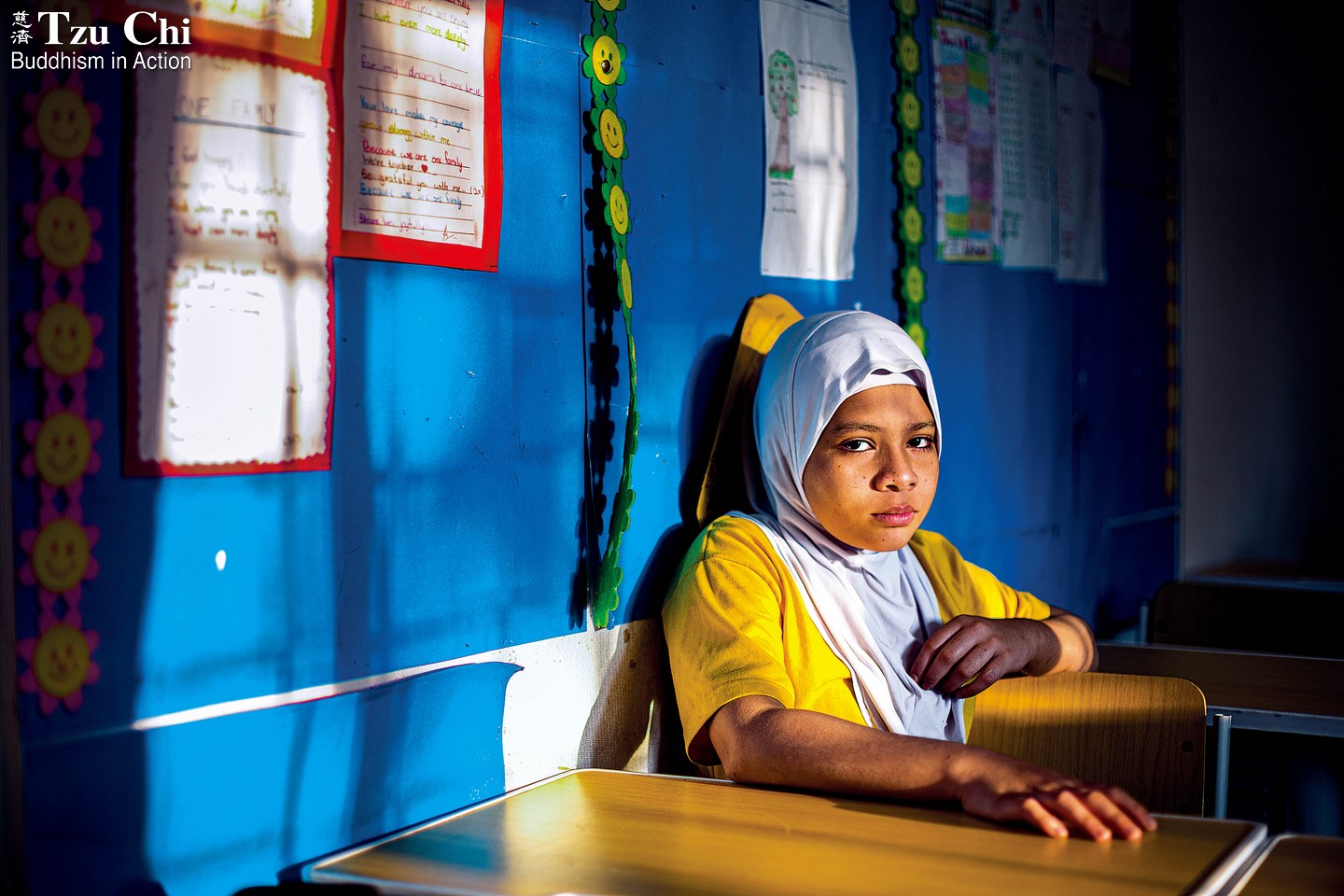
According to statistics from the UNHCR, Malaysia currently hosts more than 45,000 refugees under 18. Though most of them are unable to attend school, Tzu Chi and the UNHCR jointly run two schools to help serve the educational needs of some of these young persons. Sam Pin Fook

It is a scene replicated countless times every day the world over: while a teacher works hard to deliver a lesson in the front of a classroom, a student sits in the back and listens carefully to keep up with the notes. But this wasn’t an ordinary school, nor was the student an ordinary pupil.

The school was the Tzu-Chi Unity Alternative Learning Centre in Kuala Lumpur, Malaysia. It was established by Tzu Chi and the United Nations High Commissioner for Refugees (UNHCR) and offers refugees lessons in English, Malay, math, science, and other subjects. The student was Onaisah Mohamad Harun, a refugee who had been attending the school for four years. It was her dream to one day become a medical doctor, but it was a distant dream at best. Both her father and younger sister were sick, and they couldn’t afford the medical bills. Instead of being able to go to medical school, it was more likely she might have to stop attending school altogether.

Her father’s instructions

The Rakhine and Rohingya peoples in Myanmar have been at odds for nearly a hundred years due to a number of historical, political, racial, and geographical reasons. This has led to a massive exodus of Rohingyas from the country. More than a million Rohingyas have escaped from Myanmar since August 2017, fleeing brutal persecution. Most of them—90 percent—have ended up in refugee camps in Bangladesh. The others have sought refuge in Southeast Asian countries. Malaysia has been one of the preferred destinations for Rohingyas because of a shared belief in Islamic teachings.

Over 180,000 people are currently registered as refugees or asylum seekers in Malaysia. Among those, 150,000 are from Myanmar, including Rohingyas and Chins. “Dad said our hometown [in Myanmar] wasn’t safe to live in,” Onaisah recalled, “so we fled to Malaysia. It was like in a movie. The police wouldn’t let us go ashore. Mom said my younger sister was suffering from a high fever at the time, but we couldn’t even take her to the doctor.”

Onaisah’s father, Mohamad Harun Mohamad Hussein, explained: “Our house in our hometown [in Myanmar] was set on fire, and we couldn’t find a place to pray. Life was tough. I took my family and escaped to Malaysia, but I had only enough money to pay the deposit to travel to the country. I began paying off the rest after I found a job in Malaysia.”
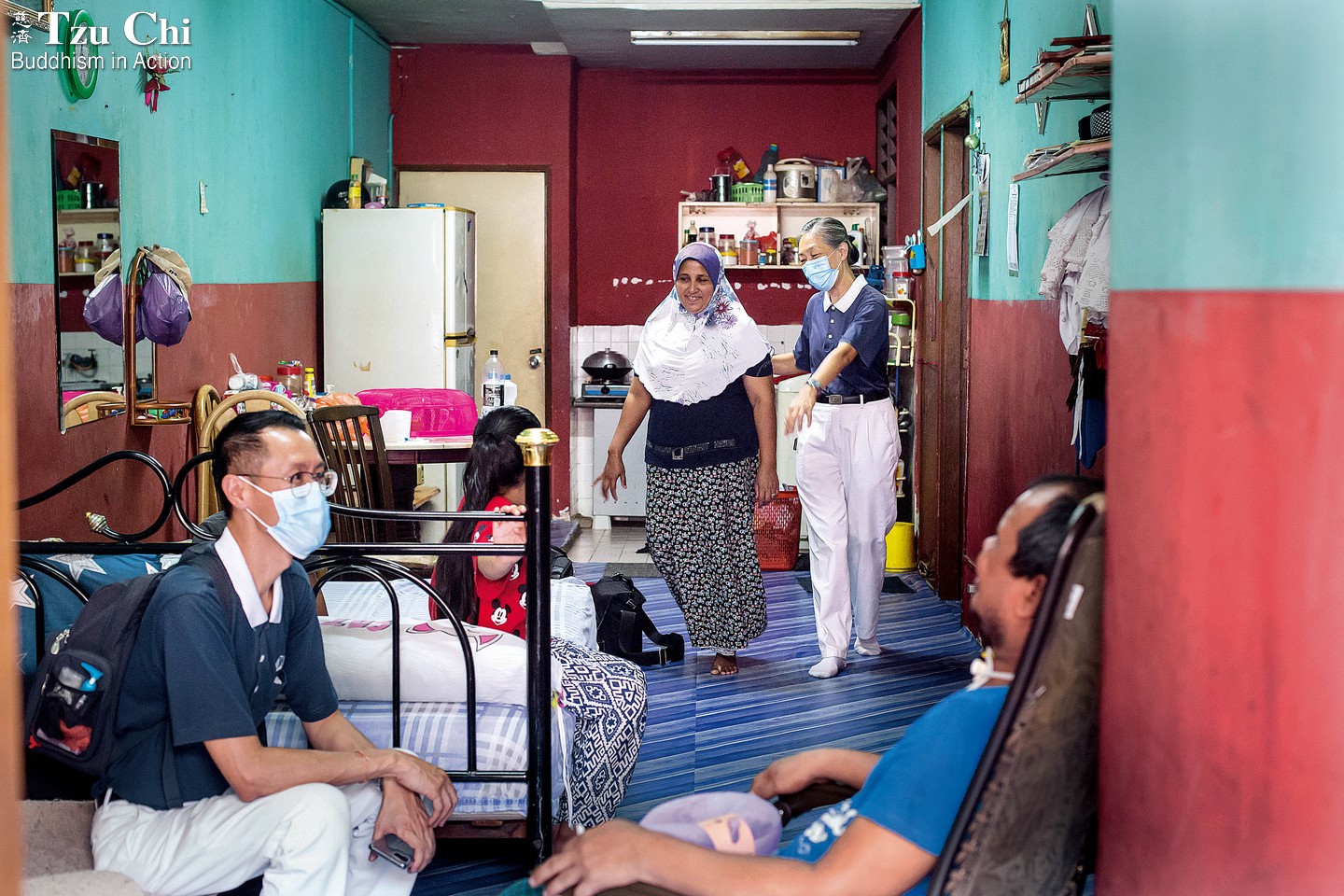
Harun and his family look forward to Tzu Chi volunteers’ visit every month. Harun seems to forget his tribulations in life while chatting with the volunteers.

Life eventually settled down for the family, and they even welcomed a new member into their fold—a baby boy. Sadly, the good times didn’t last. COVID-19 hit in March 2020. To arrest the spread of the virus, the Malaysian government enacted measures to restrict movement. And then Harun lost his job, the only source of income for his family.

After being unable to make the rent for several months, Harun asked the UNHCR for help. Tzu Chi, a partner of the UN agency, arranged for volunteers to assess the family’s situation in August. As a result, the family was granted a monthly subsidy of 700 ringgit (US$162) for half a year. Tzu Chi volunteers also continued to visit the family and arranged for the foundation to pay for the children’s transportation fees to school. When they discovered that Harun was having a health issue, they suggested that he seek medical attention at a Tzu Chi free clinic center in Kuala Lumpur. Harun saw the doctors there, then was referred by the center to Kuala Lumpur Hospital, where he was diagnosed with stage 3 oral cancer.

Harun was able to receive surgery for his cancer with the help of a 10,000 ringgit (US$2,310) subsidy from the UNHCR, but it wasn’t long until he suffered a relapse. The tumor on his face made breathing difficult, nor could he lie flat to sleep. Adding to his tribulations was his worry and concern about his wife and children’s future. With everything he was dealing with, it’s no surprise he often had no appetite and slept poorly.

When the pandemic became so bad that Tzu Chi volunteers couldn’t carry out their regular home visits to the family, volunteers, concerned about Harun’s state of mind, asked a clinical psychologist from the Tzu Chi International Medical Association to extend care to him via videoconferencing. This service greatly helped bring peace to Harun’s mind.

To help Harun sleep better, volunteer Heng Wa Seng (王華成) found a second-hand recliner at a Tzu Chi recycling station and delivered it to him. Tzu Chi also continued to help the family pay the medical bills incurred by Harun and his younger daughter, Sowaibah Mohamad Harun.

Fate has been ruthless to Harun, but fortunately his children have been good and thoughtful. Onaisah and her older brother, Abdul Hamid Mohamad Harun, take turns tending to their father’s needs. Onaisah is a great help to her mother, Halimah Mohamad Yacoob, when it comes to housework. Onaisah has been learning Malay and English at the Tzu Chi learning center, and serves as an interpreter during her father’s hospital visits. Volunteer Michele Ng (黃明珍) is happy to see how fluently Onaisah speaks both languages, and how her confidence has grown.

One day, Onaisah accompanied her father to a follow-up appointment at the hospital. Before they left their home, Harun said something to her that brought her to tears. “Dad told me he probably won’t be able to live long because of his illness, but he also said that we are fortunate to have encountered Tzu Chi and the UNHCR. He said we must never forget their kindness.”

She continued recounting while wiping away her tears: “Though it isn’t his fault that he is sick and unable to work, he feels bad for not being able to give us things we wanted. He is plagued by a sense of guilt.”

Even though Harun is having a hard time in life, he never forgets to remind his children to do good. He told Onaisah that if she ever becomes a doctor, she must tend to the medical needs of underserved people and reach out to those in need.
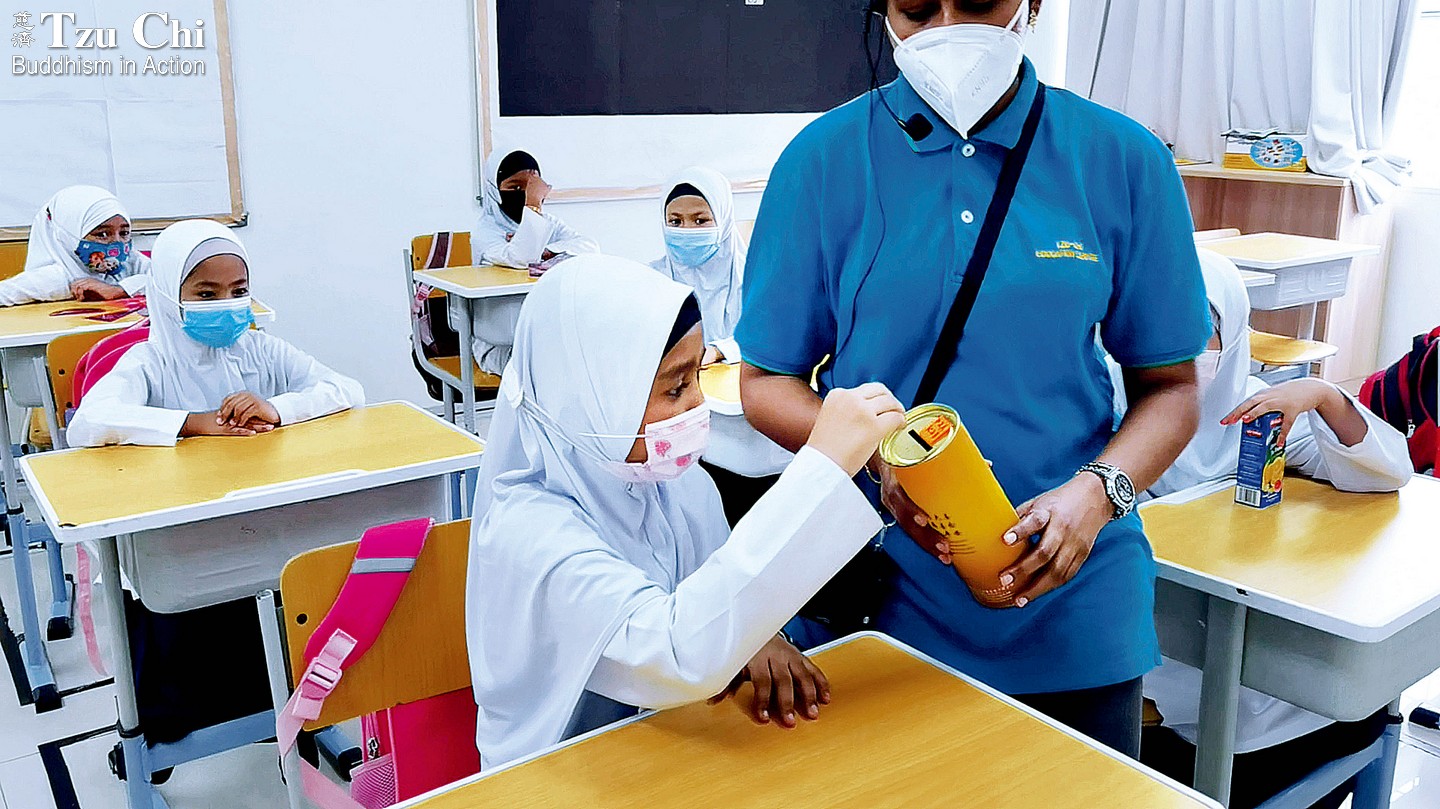
Teachers and students at the two refugee schools run by the UNHCR and Tzu Chi started a donation drive for Ukrainian refugees in March 2022. Liu Jing Xin

Who should refugees turn to for help?

The UNHCR protects the human rights of refugees in Malaysia by providing for their basic needs, such as shelter and food. The UN agency works with non-governmental organizations (NGOs) to meet other needs, such as medical care, education, and protection for women and children. Tzu Chi, for example, has been a longstanding partner of the UNHCR. Their cooperation can be traced back to October 2004, when the two organizations banded together for the first time to hold a free clinic. Since then, Tzu Chi has continuously expanded its scope of aid for refugees.

Echo Chien (簡慈露), CEO of Tzu Chi Kuala Lumpur and Selangor, said that Tzu Chi’s help for refugees is not confined to those areas designated by the UNHCR. The foundation does its best to serve the needs of refugees. “We take on work that is not required by the UNHCR,” said the CEO. Every time a refugee is referred to Tzu Chi for aid, the foundation evaluates their situation to determine whether they are eligible for Tzu Chi’s help. If they are, a case is opened for them, and Tzu Chi provides further assistance to them.

There is no easy fix for the refugee problem. NGOs that serve refugees are constantly faced with all kinds of challenges. MyCARE (Humanitarian Care Malaysia), an organization known for its work for refugees, is no exception. Haji Kamarul Zaman, CEO of MyCARE, believes that they must have the courage of their convictions when it comes to helping refugees. This is especially true, given the different views that exist in Malaysian society regarding the refugees there.

Not everyone welcomes the arrival of refugees, which is not surprising. Still, Kamarul Zaman holds that everyone living on this Earth should extend a helping hand to others in need. Malaysia is not the homeland of Rohingyas. If they could choose, wouldn’t they want to return to the bosom of their homeland? MyCARE empathizes with the plight of such displaced people, regards them as “guests,” and endeavors to be good hosts to them. If the refugees that have come to Malaysia can’t return to their home country in the foreseeable future, efforts must be made to reduce their negative impact on society.

“There is a large number of Rohingyas in Malaysia,” said the MyCARE CEO. “They will do whatever they need to survive. If we can’t help them have better lives here, all kinds of issues will arise. That’s why we extend all humanitarian aid within the limits of our abilities to them.”

MyCARE runs a boarding school in Serdang, Selangor. It has also taken over a religious day school in Kulai, Johor, following a request from the UNHCR. Kamarul Zaman said that his organization devotes a lot of energy to educating refugees. This helps them better integrate into Malaysian society. “If one day these refugees return to their home countries, the training and basic education they receive here will make them better able to help in the development of their homelands. If they never return and keep on living with us in this land, they’ll at least be better equipped to survive.”

MyCARE’s work is not limited to Malaysia. It partners with NGOs in 22 other countries, including Palestine, Iraq, Afghanistan, Pakistan, Nepal, Sri Lanka, Bangladesh, Myanmar, and Vietnam, to provide food, education, healthcare, shelter, and other forms of aid to refugees in those countries.

A concern that some people have about refugees is that they will dilute available social resources. People ask organizations like MyCARE, “Why not save our own people?” To that question, Kamarul Zaman answers that MyCARE, an affiliation of Pertubuhan IKRAM Malaysia (IKRAM), was formed to provide international humanitarian aid. As for needy Malaysian citizens, there is Yayasan Ikram Malaysia: i-Bantu, also an affiliation of IKRAM, to help.

“The Malaysian government has an established system to provide aid to its people,” Kamarul Zaman said. “Take Muslims for example. Each state in the country has a Majlis Agama and a Lembaga Zakat to serve their needs. Non-Muslims can apply for help from the Social Welfare Department. They can even seek assistance from friends, relatives, or charitable organizations. But who can refugees turn to for help? This is what we hope people in our society can understand.”
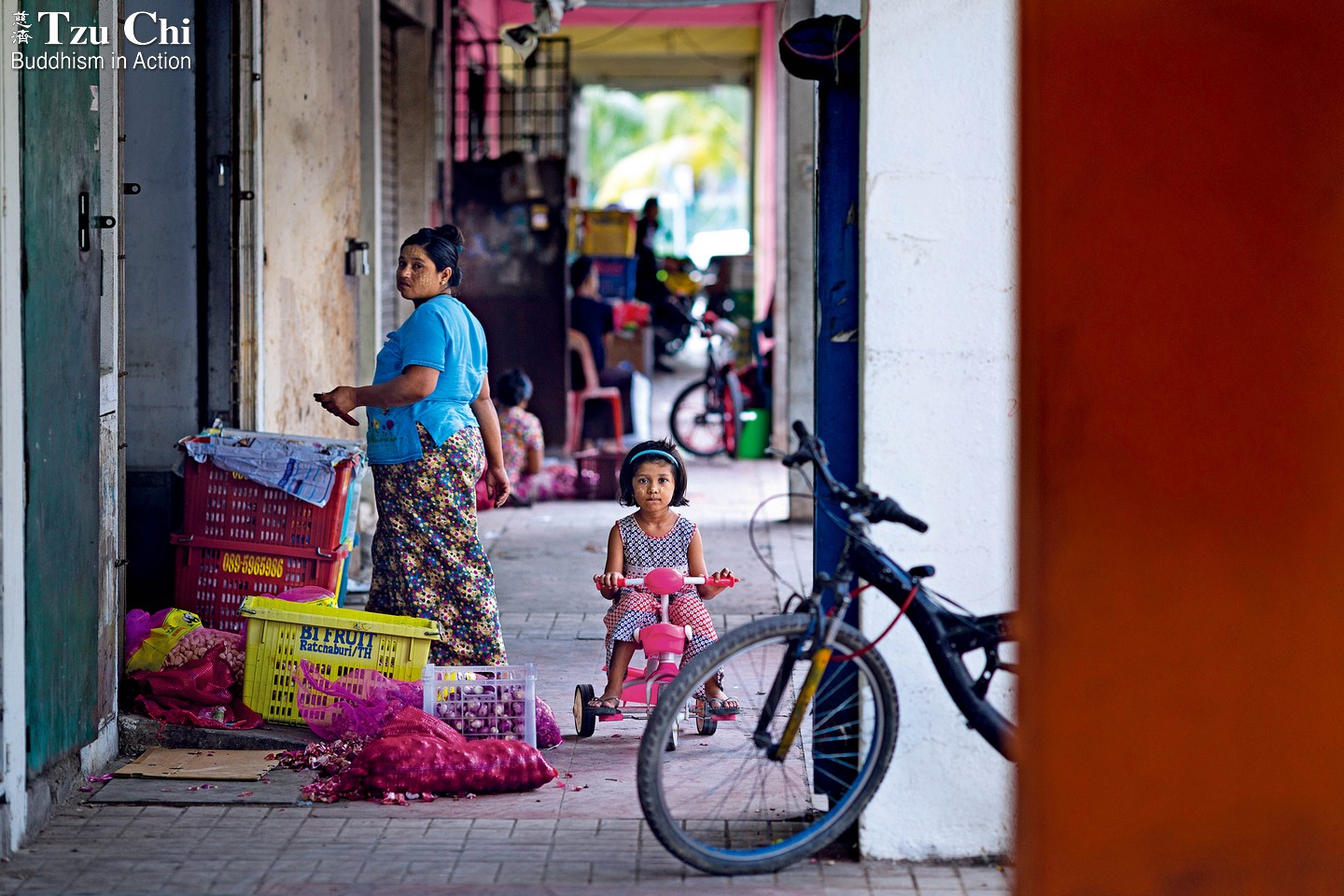
There are over 150,000 refugees from Myanmar in Malaysia. Some families have three generations living together in the country.

The hand that gives the rose

Kamarul Zaman, a devout Muslim, considers helping people in need to be a religious requirement, an obligation. At the same time, he believes that all religions guide people to do good and to live in peace and harmony with others. “As members of humanity,” he said, “what we are doing can perhaps be best summed up in this sentence: ‘The fragrance always stays in the hand that gives the rose.’”

Kamarul Zaman also pointed out an indisputable fact: while people accuse refugees of taking away from available social resources, they are turning a blind eye to the contributions refugees are making to society. “Go take a look at the Selayang wholesale market,” the CEO said, “and see who is doing the work locals don’t want to do.” Refugees have fled their countries to survive, he stressed. “They did not come here to beg, but to seek a chance of survival, through their own efforts if they can. We can at least give them a chance to do so.”

Cox’s Bazar, in Bangladesh, is home to the world’s largest refugee settlement, with nearly a million refugees from Myanmar sheltering there. The living conditions there are overcrowded and far from ideal. Malaysia, by comparison, is like heaven. Many Burmese refugees long to go there. Sadly, many lost their lives on the sea before they could reach their dream destination.

How do we solve the world’s refugee problem? Kamarul Zaman said there is no answer. “Our world continues to produce many refugees. This is a global issue.” He continued, clasping his hands: “At the root of all this is humanity’s greed. People’s hunger for power and profit has given rise to all kinds of problems. If everyone follows the guidance of the religion they believe in and lives in peace with others, peace will reign in our world, and there will be no more refugees.”

With no easy solution to the refugee problem in sight, the existence and work of NGOs provide at least a ray of hope for refugees.
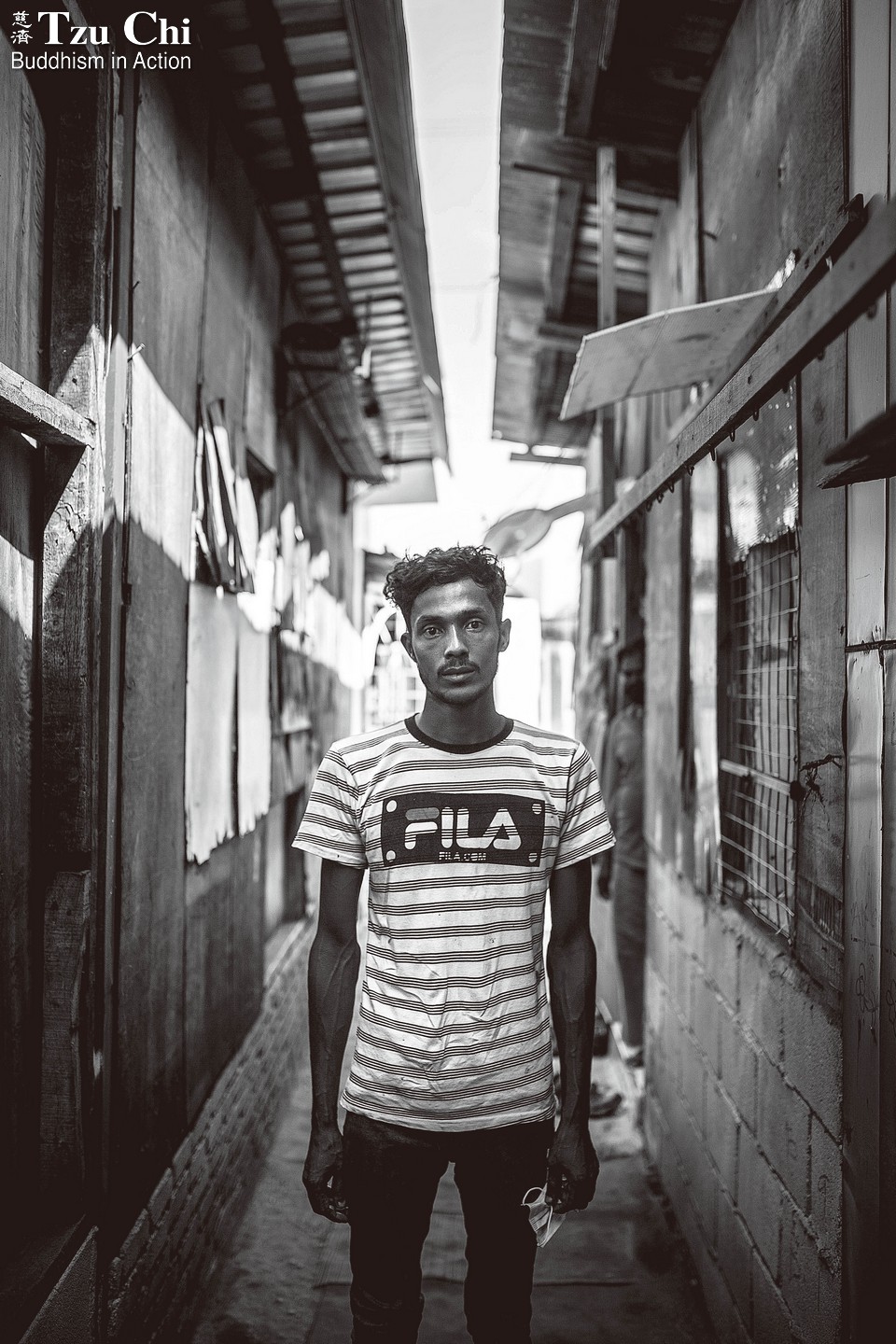
No one wants to leave their own country against their own will. Every refugee deserves help to guard their dignity as a human being.

🔎 Zoom in picture)

By Yap Chai Hoon
Translated by Rose Ting
Photos by Sam Pin Fook

Where does the solution to the refugee problem lie? Perhaps it is as close as the human heart.

According to statistics from the UNHCR, Malaysia currently hosts more than 45,000 refugees under 18. Though most of them are unable to attend school, Tzu Chi and the UNHCR jointly run two schools to help serve the educational needs of some of these young persons. Sam Pin Fook

It is a scene replicated countless times every day the world over: while a teacher works hard to deliver a lesson in the front of a classroom, a student sits in the back and listens carefully to keep up with the notes. But this wasn’t an ordinary school, nor was the student an ordinary pupil.

The school was the Tzu-Chi Unity Alternative Learning Centre in Kuala Lumpur, Malaysia. It was established by Tzu Chi and the United Nations High Commissioner for Refugees (UNHCR) and offers refugees lessons in English, Malay, math, science, and other subjects. The student was Onaisah Mohamad Harun, a refugee who had been attending the school for four years. It was her dream to one day become a medical doctor, but it was a distant dream at best. Both her father and younger sister were sick, and they couldn’t afford the medical bills. Instead of being able to go to medical school, it was more likely she might have to stop attending school altogether.

Her father’s instructions

The Rakhine and Rohingya peoples in Myanmar have been at odds for nearly a hundred years due to a number of historical, political, racial, and geographical reasons. This has led to a massive exodus of Rohingyas from the country. More than a million Rohingyas have escaped from Myanmar since August 2017, fleeing brutal persecution. Most of them—90 percent—have ended up in refugee camps in Bangladesh. The others have sought refuge in Southeast Asian countries. Malaysia has been one of the preferred destinations for Rohingyas because of a shared belief in Islamic teachings.

Over 180,000 people are currently registered as refugees or asylum seekers in Malaysia. Among those, 150,000 are from Myanmar, including Rohingyas and Chins. “Dad said our hometown [in Myanmar] wasn’t safe to live in,” Onaisah recalled, “so we fled to Malaysia. It was like in a movie. The police wouldn’t let us go ashore. Mom said my younger sister was suffering from a high fever at the time, but we couldn’t even take her to the doctor.”

Onaisah’s father, Mohamad Harun Mohamad Hussein, explained: “Our house in our hometown [in Myanmar] was set on fire, and we couldn’t find a place to pray. Life was tough. I took my family and escaped to Malaysia, but I had only enough money to pay the deposit to travel to the country. I began paying off the rest after I found a job in Malaysia.”

Harun and his family look forward to Tzu Chi volunteers’ visit every month. Harun seems to forget his tribulations in life while chatting with the volunteers.

Life eventually settled down for the family, and they even welcomed a new member into their fold—a baby boy. Sadly, the good times didn’t last. COVID-19 hit in March 2020. To arrest the spread of the virus, the Malaysian government enacted measures to restrict movement. And then Harun lost his job, the only source of income for his family.

After being unable to make the rent for several months, Harun asked the UNHCR for help. Tzu Chi, a partner of the UN agency, arranged for volunteers to assess the family’s situation in August. As a result, the family was granted a monthly subsidy of 700 ringgit (US$162) for half a year. Tzu Chi volunteers also continued to visit the family and arranged for the foundation to pay for the children’s transportation fees to school. When they discovered that Harun was having a health issue, they suggested that he seek medical attention at a Tzu Chi free clinic center in Kuala Lumpur. Harun saw the doctors there, then was referred by the center to Kuala Lumpur Hospital, where he was diagnosed with stage 3 oral cancer.

Harun was able to receive surgery for his cancer with the help of a 10,000 ringgit (US$2,310) subsidy from the UNHCR, but it wasn’t long until he suffered a relapse. The tumor on his face made breathing difficult, nor could he lie flat to sleep. Adding to his tribulations was his worry and concern about his wife and children’s future. With everything he was dealing with, it’s no surprise he often had no appetite and slept poorly.

When the pandemic became so bad that Tzu Chi volunteers couldn’t carry out their regular home visits to the family, volunteers, concerned about Harun’s state of mind, asked a clinical psychologist from the Tzu Chi International Medical Association to extend care to him via videoconferencing. This service greatly helped bring peace to Harun’s mind.

To help Harun sleep better, volunteer Heng Wa Seng (王華成) found a second-hand recliner at a Tzu Chi recycling station and delivered it to him. Tzu Chi also continued to help the family pay the medical bills incurred by Harun and his younger daughter, Sowaibah Mohamad Harun.

Fate has been ruthless to Harun, but fortunately his children have been good and thoughtful. Onaisah and her older brother, Abdul Hamid Mohamad Harun, take turns tending to their father’s needs. Onaisah is a great help to her mother, Halimah Mohamad Yacoob, when it comes to housework. Onaisah has been learning Malay and English at the Tzu Chi learning center, and serves as an interpreter during her father’s hospital visits. Volunteer Michele Ng (黃明珍) is happy to see how fluently Onaisah speaks both languages, and how her confidence has grown.

One day, Onaisah accompanied her father to a follow-up appointment at the hospital. Before they left their home, Harun said something to her that brought her to tears. “Dad told me he probably won’t be able to live long because of his illness, but he also said that we are fortunate to have encountered Tzu Chi and the UNHCR. He said we must never forget their kindness.”

She continued recounting while wiping away her tears: “Though it isn’t his fault that he is sick and unable to work, he feels bad for not being able to give us things we wanted. He is plagued by a sense of guilt.”

Even though Harun is having a hard time in life, he never forgets to remind his children to do good. He told Onaisah that if she ever becomes a doctor, she must tend to the medical needs of underserved people and reach out to those in need.

Teachers and students at the two refugee schools run by the UNHCR and Tzu Chi started a donation drive for Ukrainian refugees in March 2022. Liu Jing Xin

Who should refugees turn to for help?

The UNHCR protects the human rights of refugees in Malaysia by providing for their basic needs, such as shelter and food. The UN agency works with non-governmental organizations (NGOs) to meet other needs, such as medical care, education, and protection for women and children. Tzu Chi, for example, has been a longstanding partner of the UNHCR. Their cooperation can be traced back to October 2004, when the two organizations banded together for the first time to hold a free clinic. Since then, Tzu Chi has continuously expanded its scope of aid for refugees.

Echo Chien (簡慈露), CEO of Tzu Chi Kuala Lumpur and Selangor, said that Tzu Chi’s help for refugees is not confined to those areas designated by the UNHCR. The foundation does its best to serve the needs of refugees. “We take on work that is not required by the UNHCR,” said the CEO. Every time a refugee is referred to Tzu Chi for aid, the foundation evaluates their situation to determine whether they are eligible for Tzu Chi’s help. If they are, a case is opened for them, and Tzu Chi provides further assistance to them.

There is no easy fix for the refugee problem. NGOs that serve refugees are constantly faced with all kinds of challenges. MyCARE (Humanitarian Care Malaysia), an organization known for its work for refugees, is no exception. Haji Kamarul Zaman, CEO of MyCARE, believes that they must have the courage of their convictions when it comes to helping refugees. This is especially true, given the different views that exist in Malaysian society regarding the refugees there.

Not everyone welcomes the arrival of refugees, which is not surprising. Still, Kamarul Zaman holds that everyone living on this Earth should extend a helping hand to others in need. Malaysia is not the homeland of Rohingyas. If they could choose, wouldn’t they want to return to the bosom of their homeland? MyCARE empathizes with the plight of such displaced people, regards them as “guests,” and endeavors to be good hosts to them. If the refugees that have come to Malaysia can’t return to their home country in the foreseeable future, efforts must be made to reduce their negative impact on society.

“There is a large number of Rohingyas in Malaysia,” said the MyCARE CEO. “They will do whatever they need to survive. If we can’t help them have better lives here, all kinds of issues will arise. That’s why we extend all humanitarian aid within the limits of our abilities to them.”

MyCARE runs a boarding school in Serdang, Selangor. It has also taken over a religious day school in Kulai, Johor, following a request from the UNHCR. Kamarul Zaman said that his organization devotes a lot of energy to educating refugees. This helps them better integrate into Malaysian society. “If one day these refugees return to their home countries, the training and basic education they receive here will make them better able to help in the development of their homelands. If they never return and keep on living with us in this land, they’ll at least be better equipped to survive.”

MyCARE’s work is not limited to Malaysia. It partners with NGOs in 22 other countries, including Palestine, Iraq, Afghanistan, Pakistan, Nepal, Sri Lanka, Bangladesh, Myanmar, and Vietnam, to provide food, education, healthcare, shelter, and other forms of aid to refugees in those countries.

A concern that some people have about refugees is that they will dilute available social resources. People ask organizations like MyCARE, “Why not save our own people?” To that question, Kamarul Zaman answers that MyCARE, an affiliation of Pertubuhan IKRAM Malaysia (IKRAM), was formed to provide international humanitarian aid. As for needy Malaysian citizens, there is Yayasan Ikram Malaysia: i-Bantu, also an affiliation of IKRAM, to help.

“The Malaysian government has an established system to provide aid to its people,” Kamarul Zaman said. “Take Muslims for example. Each state in the country has a Majlis Agama and a Lembaga Zakat to serve their needs. Non-Muslims can apply for help from the Social Welfare Department. They can even seek assistance from friends, relatives, or charitable organizations. But who can refugees turn to for help? This is what we hope people in our society can understand.”

There are over 150,000 refugees from Myanmar in Malaysia. Some families have three generations living together in the country.

The hand that gives the rose

Kamarul Zaman, a devout Muslim, considers helping people in need to be a religious requirement, an obligation. At the same time, he believes that all religions guide people to do good and to live in peace and harmony with others. “As members of humanity,” he said, “what we are doing can perhaps be best summed up in this sentence: ‘The fragrance always stays in the hand that gives the rose.’”

Kamarul Zaman also pointed out an indisputable fact: while people accuse refugees of taking away from available social resources, they are turning a blind eye to the contributions refugees are making to society. “Go take a look at the Selayang wholesale market,” the CEO said, “and see who is doing the work locals don’t want to do.” Refugees have fled their countries to survive, he stressed. “They did not come here to beg, but to seek a chance of survival, through their own efforts if they can. We can at least give them a chance to do so.”

Cox’s Bazar, in Bangladesh, is home to the world’s largest refugee settlement, with nearly a million refugees from Myanmar sheltering there. The living conditions there are overcrowded and far from ideal. Malaysia, by comparison, is like heaven. Many Burmese refugees long to go there. Sadly, many lost their lives on the sea before they could reach their dream destination.

How do we solve the world’s refugee problem? Kamarul Zaman said there is no answer. “Our world continues to produce many refugees. This is a global issue.” He continued, clasping his hands: “At the root of all this is humanity’s greed. People’s hunger for power and profit has given rise to all kinds of problems. If everyone follows the guidance of the religion they believe in and lives in peace with others, peace will reign in our world, and there will be no more refugees.”

With no easy solution to the refugee problem in sight, the existence and work of NGOs provide at least a ray of hope for refugees.

No one wants to leave their own country against their own will. Every refugee deserves help to guard their dignity as a human being.
🔎 Zoom in picture)

關鍵字

Tzu Chi Care for Refugees in Thailand

By Budsara Sombut and Datchanee Suratep
Translated by Wu Hsiao-ting
Photos by Budsara Sombut

Life isn’t easy for these refugees. Because they are illegal, they aren’t allowed to work and can be arrested at any time. Their only hope is to be placed in a third country where they can start a new, better life.

The COVID-19 pandemic has made it harder for refugees to make ends meet. Tzu Chi Thailand reached out again in April this year to help. More than 1,500 families from over ten countries each received daily necessities, face masks, disinfectant alcohol, and 3,000 baht (US$88.4). Among the aid items were rice and flour, which refugees could choose from based on their eating preferences. Pinticha Jansuksri

One day, bullets and bombs fell like rain,” said Omar Ahmed Abdillahi. “My two older brothers were injured, and one of them died. Dad decided to take my injured brother to another country to be treated. They never came back. We don’t know if they are even still alive.”

Omar, 31, is from Somalia, an African country plagued by war. Every conflict results in incalculable losses, especially to those living amidst the conflict. Sadly, even innocent people meet cruel ends. Omar lost his brother to war, and as a member of an ethnic minority, he became a target of an armed group too. Just surviving became difficult. Not knowing what else to do, he decided in 2015 to leave his home country with his wife, Hamda, their three daughters, and his wife’s brother.

Most Somalis fleeing their country are first smuggled into Malaysia, and from there into Thailand. However, Omar didn’t know he and his family were going to Thailand; he had misread “Thailand” as “Finland” and thought they were going to Europe. It wasn’t until they arrived in Thailand that he realized their destination was the Southeast Asian country. Thailand didn’t sign the 1951 United Nations Refugee Convention, and as a result, many refugees cannot obtain legal identifications there. Their only choice is to live in the country illegally.

Omar and his family were arrested by the police just 11 days after they arrived in Thailand on the grounds that they had been smuggled into the country and had no passports. (Their passports had been confiscated by their smugglers.) Fortunately, a Muslim helped bail them out. But without legal identities, they continued living in fear of being apprehended again. They avoided going out as much as possible and had to maintain constant vigilance when they had no choice but to go out. Their lives were made even harder because they weren’t allowed to work. Life as an illegal refugee was surely no picnic.

Work relief

Omar and his family received a monthly subsidy from the Bangkok Refugee Center (BRC), but that money was only enough to pay their rent. As the breadwinner of his family, Omar had to try every way he could to make a living. He first worked as an interpreter at the BRC. Then, in 2017, he started serving as an interpreter at Tzu Chi’s community medical service events. That’s how Tzu Chi volunteers came to know him.

In 2014, Tzu Chi Thailand signed a memorandum of understanding with Tzu Chi USA and the U.S. State Department to provide free medical treatment to refugees in Thailand. Tzu Chi Thailand followed that agreement by offering community healthcare services to refugees in Bangkok, Thailand’s capital, on the fourth Sunday of every month. Those ran from 2015 to 2020. Starting in 2018, a small free clinic event was added on the second Sunday of every month. This latter service lasted for eight months. Negotiations were made with the concerned authorities for a short period of amnesty for refugees coming to these events so that they would not run afoul with law enforcement.

Because refugees in Thailand come from over 40 countries, Tzu Chi organized a work relief program and employed refugees from different countries to serve as interpreters at the free clinic events. Volunteer Kuo Mei-Chun (郭玫君), who helped organize the interpreting service, recalled that Omar, with a family of six to support—including a newborn son—carried a particularly heavy burden. “That’s why we often enlisted his service,” said Kuo.

Omar’s job as an interpreter brought in money for him and his family, thus easing his financial stress. However, another challenge arose not long after. He was arrested again in 2018 and detained at the Immigration Detention Centre. The burden of supporting his family thus fell to his wife.

Omar phoned Kuo the day before his detention telling her about what had happened to him and asking Tzu Chi volunteers to care for his family. Kuo was shocked by the news. She obtained Omar’s address and asked volunteers who lived in Omar’s district to go visit his family.

Volunteers Phongpot Patcharapakdeekumtorn (王敬閎), Suchon Saeheng (王忠炎), and Sunanta Sae-se (謝超) called on Omar’s family the very next day. From that day onwards, no one could reach Omar on his phone anymore. To help his family get by, Tzu Chi started providing two bags of rice, powdered milk, and financial aid to the family every month. This assistance moved Hamda, Omar’s wife, to no end. “The day Tzu Chi volunteers came to our home to offer help to us was the most beautiful day of my life,” she said. “I can’t overstate my happiness at the time. I felt as if I had been reborn.”

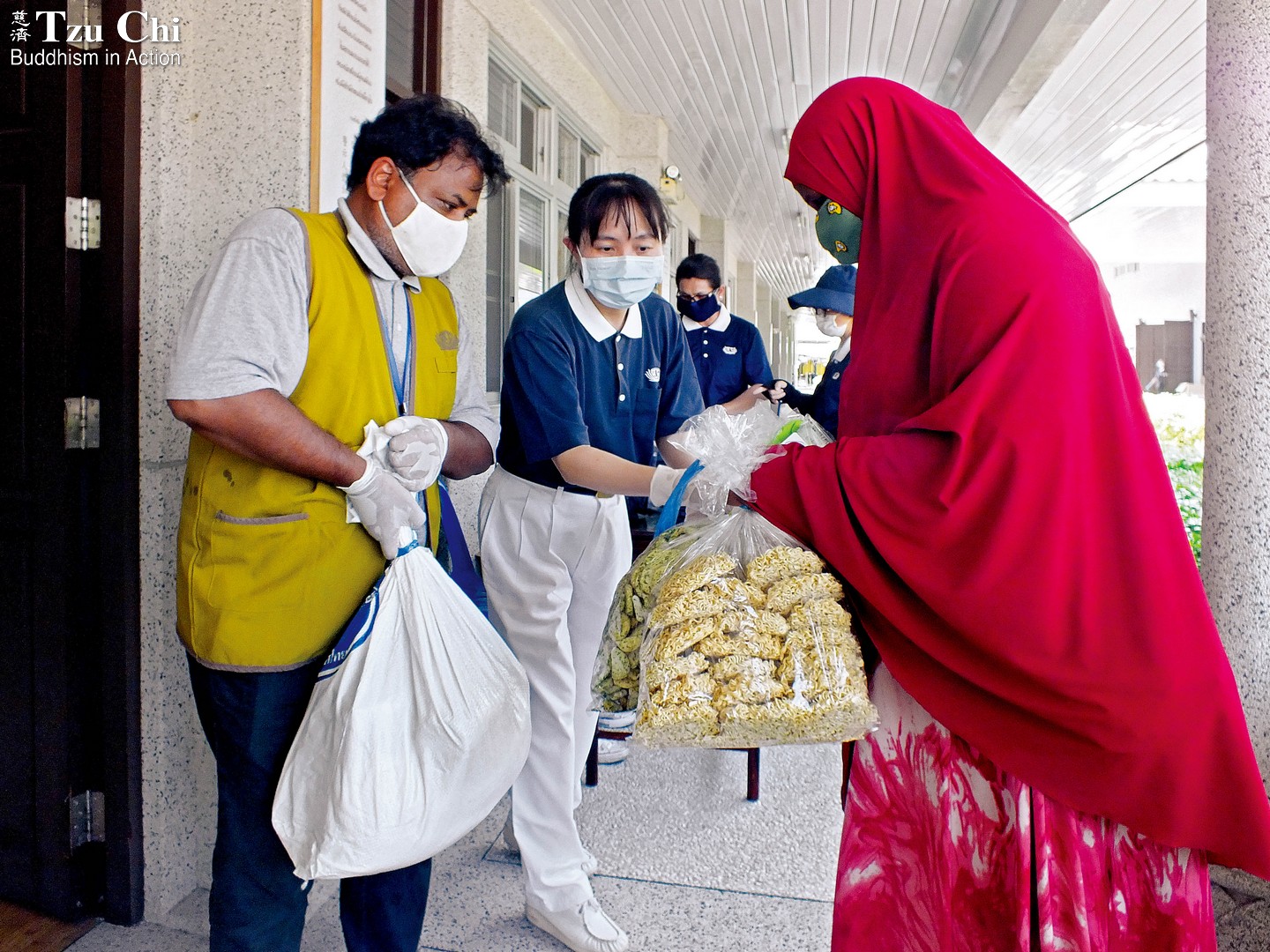
Volunteers distribute aid to refugees and other underserved people in May 2020 at the Tzu Chi Jing Si Hall in Bangkok to help them weather the financial challenge posed by the coronavirus crisis. The man on the left was a refugee serving as an interpreter. Refugees were hired for the occasion to provide interpreting services.

Prospect of a new, better life

Omar was finally released from the detention center in October 2020, thanks to the help of a public service organization. He was never allowed to contact his family during those two years when he was locked up. When he returned home and learned how the aid from Tzu Chi had kept his family clothed and fed during his absence, he was as grateful as could be. “Tzu Chi will always be in our hearts,” Omar said. “We’ll never forget their kindness!”

After living in Thailand for seven years, Omar and his family passed the screening of the United Nations High Commissioner for Refugees (UNHCR) to be placed in a third country. They are moving to Canada. Volunteers visited the family to give them their best wishes when they learned of the good news. They also brought them some donated winter clothes. They hoped that no matter how far away they move or how cold the weather is in their adopted country, Tzu Chi’s love will always be able to keep them warm at heart.

Volunteer Patcharapakdeekumtorn has been there for the family for nearly four years. He said that because of their status, refugees can’t work in the country, even though they are fully capable of working. Such policies make it a struggle for them to get by. “I’m so happy for Omar and his family that they are moving to another country to start a new life,” he said.

The family was originally scheduled to leave for Canada on March 24, but some of them were diagnosed with COVID-19 a few days before their departure, so their departure date was postponed to May 25.

Because of the pandemic and skyrocketing prices, Tzu Chi Thailand started their first wave of relief distributions for this year in January, planning to provide 6,600 needy families with daily necessities. While carrying out the work, volunteers didn’t forget to deliver medicine, Jing Si herbal tea (a health drink developed in response to the coronavirus), multigrain powder, and other supplies to Omar and his family, who were being quarantined at home. They also arranged for a doctor to see the family online. Their symptoms improved afterwards, and their test results came back negative.

Omar and his family were on Tzu Chi Thailand’s aid recipient list from 2018 to January this year. Though their case is now closed and the family is going away, volunteers believe that the good affinities they have formed with the family will be cherished and remembered by everyone involved.

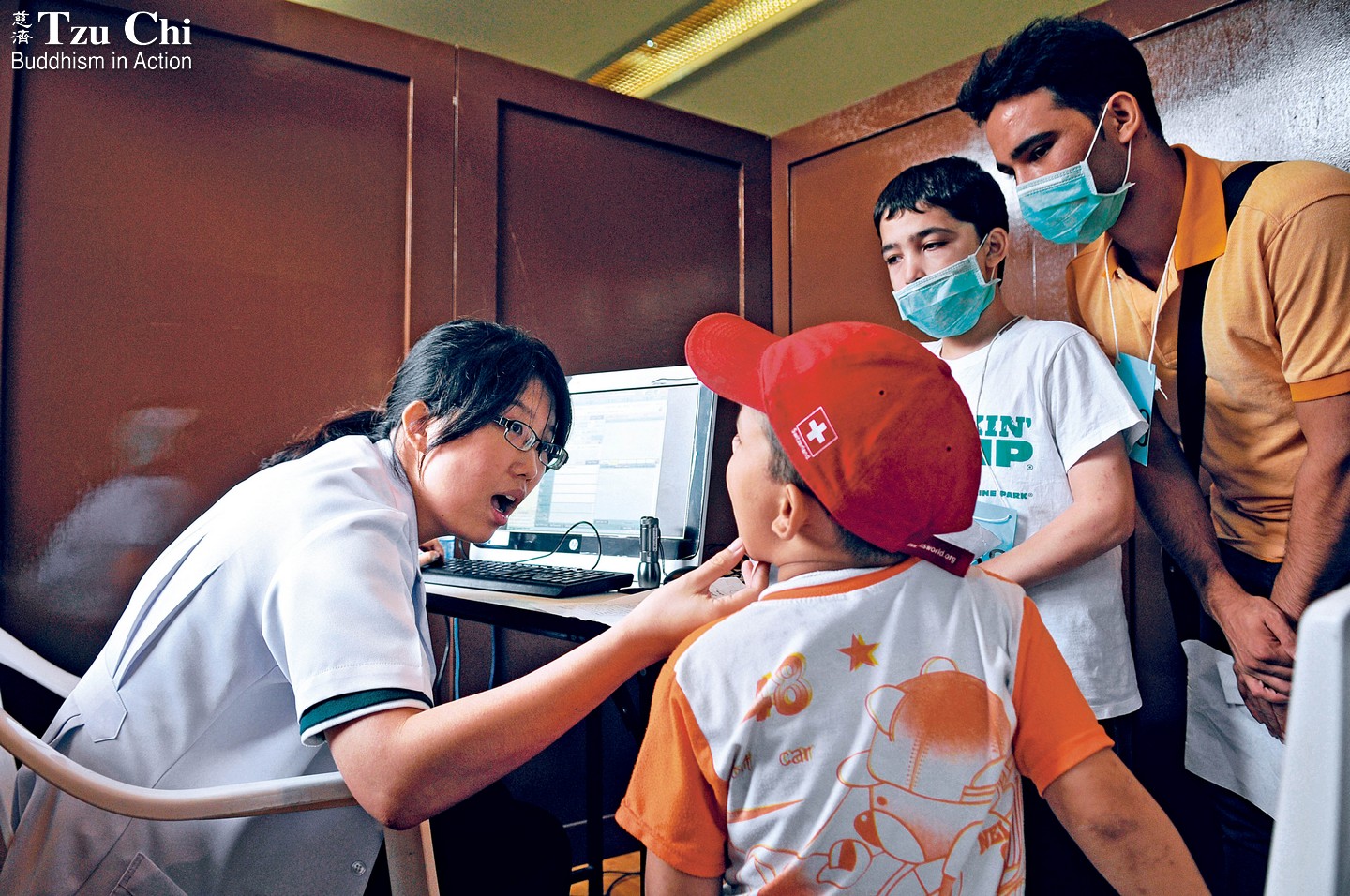
A volunteer medical professional sees an Afghan refugee child at a Tzu Chi free clinic in Bangkok. Bangkok hosts many international refugees. Tzu Chi Thailand offered regular medical services from 2015 to 2020 to serve this group of people.

🔎 Zoom in picture)

By Budsara Sombut and Datchanee Suratep
Translated by Wu Hsiao-ting
Photos by Budsara Sombut

Life isn’t easy for these refugees. Because they are illegal, they aren’t allowed to work and can be arrested at any time. Their only hope is to be placed in a third country where they can start a new, better life.

The COVID-19 pandemic has made it harder for refugees to make ends meet. Tzu Chi Thailand reached out again in April this year to help. More than 1,500 families from over ten countries each received daily necessities, face masks, disinfectant alcohol, and 3,000 baht (US$88.4). Among the aid items were rice and flour, which refugees could choose from based on their eating preferences. Pinticha Jansuksri

One day, bullets and bombs fell like rain,” said Omar Ahmed Abdillahi. “My two older brothers were injured, and one of them died. Dad decided to take my injured brother to another country to be treated. They never came back. We don’t know if they are even still alive.”

Omar, 31, is from Somalia, an African country plagued by war. Every conflict results in incalculable losses, especially to those living amidst the conflict. Sadly, even innocent people meet cruel ends. Omar lost his brother to war, and as a member of an ethnic minority, he became a target of an armed group too. Just surviving became difficult. Not knowing what else to do, he decided in 2015 to leave his home country with his wife, Hamda, their three daughters, and his wife’s brother.

Most Somalis fleeing their country are first smuggled into Malaysia, and from there into Thailand. However, Omar didn’t know he and his family were going to Thailand; he had misread “Thailand” as “Finland” and thought they were going to Europe. It wasn’t until they arrived in Thailand that he realized their destination was the Southeast Asian country. Thailand didn’t sign the 1951 United Nations Refugee Convention, and as a result, many refugees cannot obtain legal identifications there. Their only choice is to live in the country illegally.

Omar and his family were arrested by the police just 11 days after they arrived in Thailand on the grounds that they had been smuggled into the country and had no passports. (Their passports had been confiscated by their smugglers.) Fortunately, a Muslim helped bail them out. But without legal identities, they continued living in fear of being apprehended again. They avoided going out as much as possible and had to maintain constant vigilance when they had no choice but to go out. Their lives were made even harder because they weren’t allowed to work. Life as an illegal refugee was surely no picnic.

Work relief

Omar and his family received a monthly subsidy from the Bangkok Refugee Center (BRC), but that money was only enough to pay their rent. As the breadwinner of his family, Omar had to try every way he could to make a living. He first worked as an interpreter at the BRC. Then, in 2017, he started serving as an interpreter at Tzu Chi’s community medical service events. That’s how Tzu Chi volunteers came to know him.

In 2014, Tzu Chi Thailand signed a memorandum of understanding with Tzu Chi USA and the U.S. State Department to provide free medical treatment to refugees in Thailand. Tzu Chi Thailand followed that agreement by offering community healthcare services to refugees in Bangkok, Thailand’s capital, on the fourth Sunday of every month. Those ran from 2015 to 2020. Starting in 2018, a small free clinic event was added on the second Sunday of every month. This latter service lasted for eight months. Negotiations were made with the concerned authorities for a short period of amnesty for refugees coming to these events so that they would not run afoul with law enforcement.

Because refugees in Thailand come from over 40 countries, Tzu Chi organized a work relief program and employed refugees from different countries to serve as interpreters at the free clinic events. Volunteer Kuo Mei-Chun (郭玫君), who helped organize the interpreting service, recalled that Omar, with a family of six to support—including a newborn son—carried a particularly heavy burden. “That’s why we often enlisted his service,” said Kuo.

Omar’s job as an interpreter brought in money for him and his family, thus easing his financial stress. However, another challenge arose not long after. He was arrested again in 2018 and detained at the Immigration Detention Centre. The burden of supporting his family thus fell to his wife.

Omar phoned Kuo the day before his detention telling her about what had happened to him and asking Tzu Chi volunteers to care for his family. Kuo was shocked by the news. She obtained Omar’s address and asked volunteers who lived in Omar’s district to go visit his family.

Volunteers Phongpot Patcharapakdeekumtorn (王敬閎), Suchon Saeheng (王忠炎), and Sunanta Sae-se (謝超) called on Omar’s family the very next day. From that day onwards, no one could reach Omar on his phone anymore. To help his family get by, Tzu Chi started providing two bags of rice, powdered milk, and financial aid to the family every month. This assistance moved Hamda, Omar’s wife, to no end. “The day Tzu Chi volunteers came to our home to offer help to us was the most beautiful day of my life,” she said. “I can’t overstate my happiness at the time. I felt as if I had been reborn.”

Volunteers distribute aid to refugees and other underserved people in May 2020 at the Tzu Chi Jing Si Hall in Bangkok to help them weather the financial challenge posed by the coronavirus crisis. The man on the left was a refugee serving as an interpreter. Refugees were hired for the occasion to provide interpreting services.

Prospect of a new, better life

Omar was finally released from the detention center in October 2020, thanks to the help of a public service organization. He was never allowed to contact his family during those two years when he was locked up. When he returned home and learned how the aid from Tzu Chi had kept his family clothed and fed during his absence, he was as grateful as could be. “Tzu Chi will always be in our hearts,” Omar said. “We’ll never forget their kindness!”

After living in Thailand for seven years, Omar and his family passed the screening of the United Nations High Commissioner for Refugees (UNHCR) to be placed in a third country. They are moving to Canada. Volunteers visited the family to give them their best wishes when they learned of the good news. They also brought them some donated winter clothes. They hoped that no matter how far away they move or how cold the weather is in their adopted country, Tzu Chi’s love will always be able to keep them warm at heart.

Volunteer Patcharapakdeekumtorn has been there for the family for nearly four years. He said that because of their status, refugees can’t work in the country, even though they are fully capable of working. Such policies make it a struggle for them to get by. “I’m so happy for Omar and his family that they are moving to another country to start a new life,” he said.

The family was originally scheduled to leave for Canada on March 24, but some of them were diagnosed with COVID-19 a few days before their departure, so their departure date was postponed to May 25.

Because of the pandemic and skyrocketing prices, Tzu Chi Thailand started their first wave of relief distributions for this year in January, planning to provide 6,600 needy families with daily necessities. While carrying out the work, volunteers didn’t forget to deliver medicine, Jing Si herbal tea (a health drink developed in response to the coronavirus), multigrain powder, and other supplies to Omar and his family, who were being quarantined at home. They also arranged for a doctor to see the family online. Their symptoms improved afterwards, and their test results came back negative.

Omar and his family were on Tzu Chi Thailand’s aid recipient list from 2018 to January this year. Though their case is now closed and the family is going away, volunteers believe that the good affinities they have formed with the family will be cherished and remembered by everyone involved.

A volunteer medical professional sees an Afghan refugee child at a Tzu Chi free clinic in Bangkok. Bangkok hosts many international refugees. Tzu Chi Thailand offered regular medical services from 2015 to 2020 to serve this group of people.

🔎 Zoom in picture)

關鍵字

Light in Darkness—Combating Hong Kong’s Fifth COVID Wave

By Tse Kan
Compiled and translated by Wu Hsiao-ting

As COVID cases in Hong Kong hit record numbers, volunteers in the city visited one institution after another to deliver anti-coronavirus supplies. The atmosphere was tense, but everyone working together to help the city brought light to a dark time.

After enduring four waves of COVID-19, Hong Kong enjoyed a happy respite from the infection in 2021—several months passed in the second half of the year during which no domestic cases were reported in the city. In response, the government eased its precautionary measures to curb the virus. We Tzu Chi volunteers in Hong Kong looked forward to finally being able to hold our annual blessing ceremonies after a two-year suspension. Eight such ceremonies, albeit on a smaller scale, were scheduled to take place in January this year.

However, sometimes the best laid plans change, which is all the more true during the pandemic. The fifth COVID wave hit so suddenly and took off so rapidly that the government tightened its pandemic restrictions again. After stricter COVID countermeasures were announced on January 5, our Hong Kong chapter cancelled its scheduled blessing ceremonies.

Nearly two years had passed since I had visited my aging parents in my childhood home in Fujian Province, southeastern China. As the coronavirus situation in Hong Kong continued to escalate, my parents were very worried about me. Even when they took sick, they forbade my sisters to tell me about it. They always told me they were doing very well and not to worry about them. Instead, they encouraged me to focus on myself and my children and take good care of ourselves. They said there was no urgency to visit them, that a reunion with them could wait until the pandemic was over and quarantine was no longer mandatory.

It was a long and gloomy winter. Daily case counts shot up from the hundreds to thousands to tens of thousands in two short months. As the numbers climbed, more and more people around me became infected. In the beginning, we could receive our screening results on the very day we were tested, but then the wait extended to two to three days or even a week. The load on the healthcare system was very heavy. With high numbers of people needing to be tested, every test center and mobile sample collection station was swamped. Face masks became a daily necessity and the demand for COVID test kits soared.

Though the Tzu Chi Jing Si Hall in the city was forced to temporarily close, Tzu Chi Hong Kong’s charitable work never stopped. In fact, our volunteers stepped up their efforts to solicit donations and tried all sorts of channels to purchase PPE and other necessities to help in the fight against the spread of the infection.

On February 24, 50,000 COVID-19 antigen test kits arrived in Hong Kong. They had been purchased for us by Tzu Chi volunteers in Guangdong Province, southern China. Another 4,000 donated test kits of a brand appointed by the government arrived at the Jing Si Hall at the same time. Tzu Chi headquarters in Taiwan sent us a shipping container packed with 90,000 rapid test kits and 746 boxes of Jing Si herbal tea in concentrated liquid, tea bag, and drop forms. (Jing Si herbal tea was a health drink developed in response to the coronavirus pandemic and contains an effective mixture of herbal medicines). Fifty thousand face masks purchased by Tzu Chi Hong Kong from South Korea reached us on March 2. Forty thousand COVID-19 antigen test kits, another donated batch, arrived soon after.

When I learned about all this from volunteer Lin Hui Hung (林惠鴻), I was deeply moved. So many kind-hearted people and volunteers had been quietly working to help our city battle the latest wave of infections, and yet I had done nothing to help. That’s when I expressed my willingness to Sister Lin to serve as a documenting volunteer during this period to help record Tzu Chi Hong Kong’s anti-coronavirus efforts.

I live with my oldest daughter. She is a piano teacher and has contact with many students. I work too. Neither of us can achieve zero contact with other people anyway, so I had no qualms about going out to record Tzu Chi’s work.

During this time, our volunteers had been contacting our long-term care recipients, other underserved people, and institutions to inquire about their situation and about whether they had enough anti-coronavirus supplies to meet their needs. Based on the information they collected, supplies were quickly packed and delivered to individuals and organizations, with the number of helpers kept to a minimum.

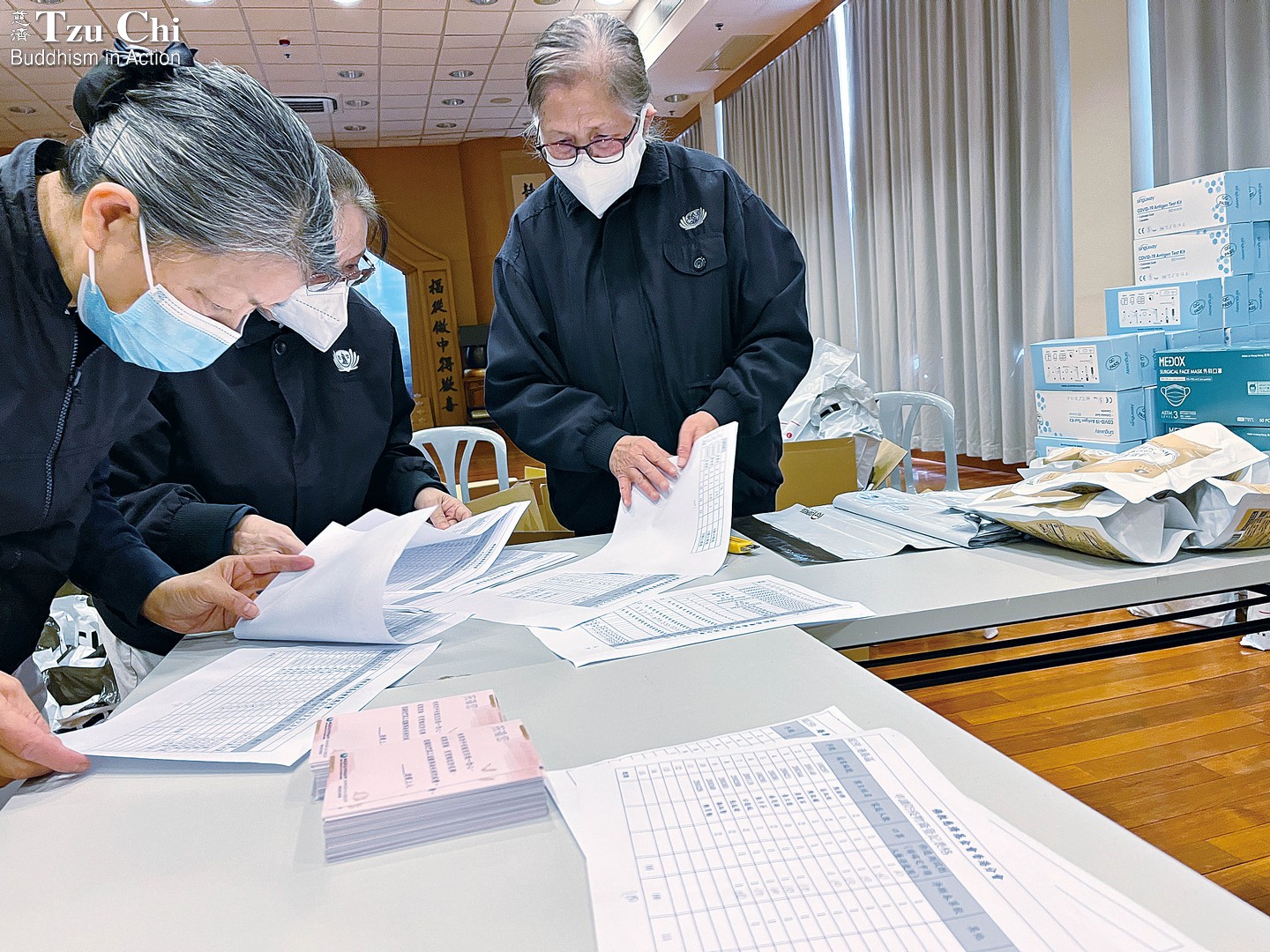
Volunteers check lists of underserved families needing anti-coronavirus supplies before packing goods for delivery. Volunteers had compiled the lists after personally contacting one disadvantaged household after another to ascertain their needs. Hsu Su Chin

Love as the antidote

Hong Kong reported over 50,000 cases daily at the peak of its fifth wave. Everyone was very worried. However, even when things were at their worst, there was no lack of volunteers to help carry out Tzu Chi work. Sze Chung Ling (施頌鈴), CEO of Tzu Chi Hong Kong, pointed out that despite the severity of the COVID situation, the response was always enthusiastic any time the chapter asked for volunteers. For example, volunteers Leung Yun Hung (梁潤雄) and Ho Chun Yau (何俊佑) each has two little grandchildren at home, and their families didn’t want them to go out to volunteer—they were afraid that they might bring the virus home. Even so, the two volunteers bravely stepped up to the plate.

Making deliveries during such a time was risky, especially for these older volunteers, but they accepted the challenge without complaint or regret.

Accompanying our volunteers to document their efforts, I saw firsthand what a challenge the pandemic had posed to our society and how everyone was doing their part to help pull our city through this difficult time.

Many institutions, such as nursing homes for the elderly or facilities for people with disabilities, had reported confirmed cases. Most of those infected had to quarantine on-site, in their own rooms. However, because so many employees at such institutions had also been infected, there was a severe shortage of manpower, making the workload of those who could still remain on duty very heavy.

The volunteers and I could feel the worry and concern about the pandemic and the people under their care from the frontline workers, whether they were institutional administrators, nurses, social workers, or regular employees. But behind that worry and concern was something else: an unselfish Great Love. It was deeply moving to witness. These frontline workers, even after seeing their colleagues fall victim to the virus one after another, still stuck to their post. They were all greatly worthy of our respect.

During this difficult time, to be able to provide some help to these people, to be able to spread the love of Dharma Master Cheng Yen and Tzu Chi volunteers through them, made us feel that every little effort we made, every small bit of love we gave, was worth it.

Every institution we reached out to had needs for different supplies. But whether it was rapid test kits, face masks, protective clothing, gloves, or hand sanitizer that they needed, we did our best to supply. Shipping services were also impacted by the fifth COVID wave, since many cross-border truck drivers were also infected. As a result, a lot of goods couldn’t get into Hong Kong, and the prices of vegetables and other kinds of food spiked. Getting by became even more difficult for vulnerable people. Therefore, our volunteers followed the distribution of anti-coronavirus supplies with that of food and shopping vouchers to help needy families cope.

The world is rife with suffering, and we pray for the pandemic to be over soon. However, we have an antidote to any kind of suffering, as long as there is love and kindness. Love never ceases to be the miracle cure of life.

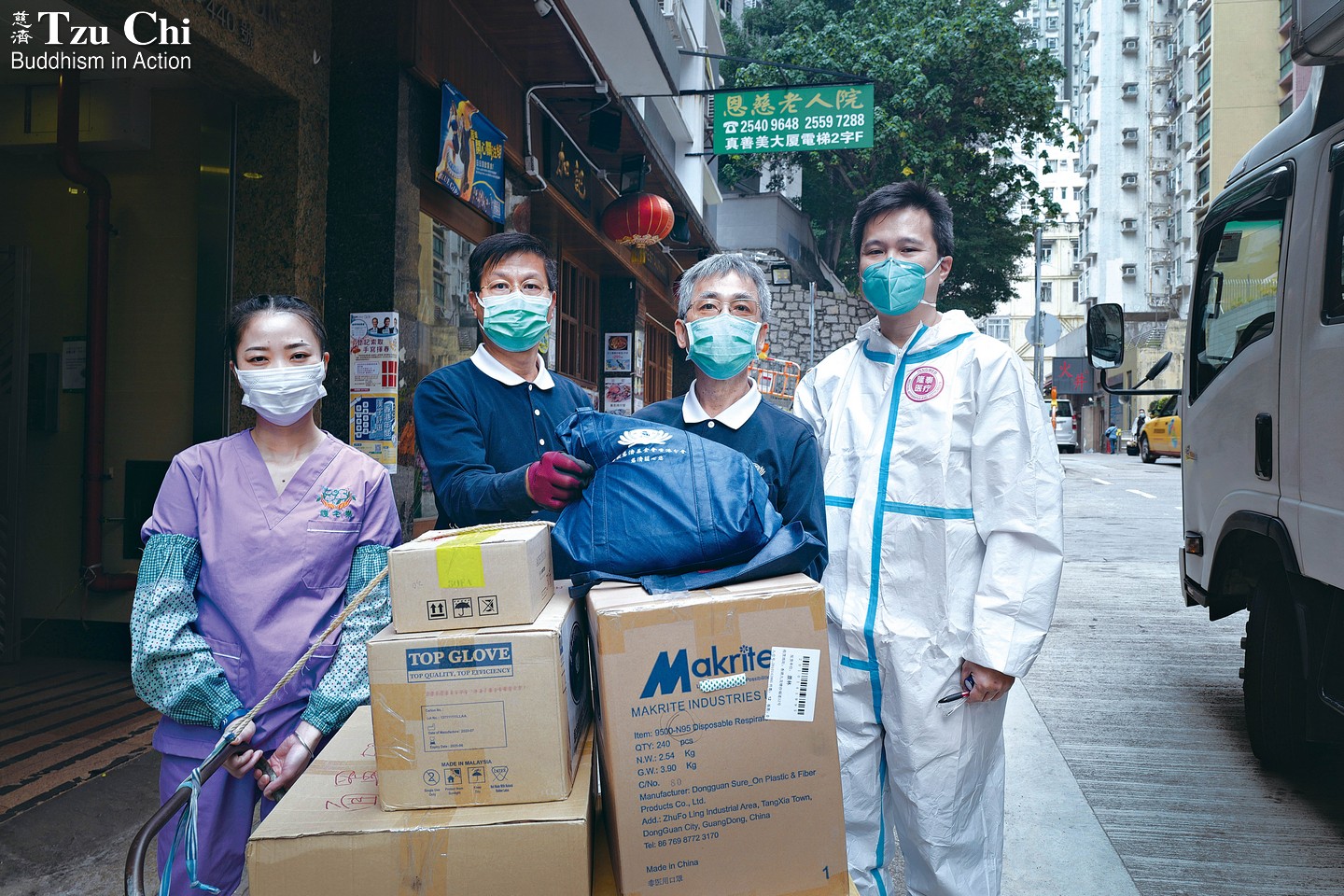
Volunteers pose with staffers of a nursing home in front of the facility after delivering anti-coronavirus supplies to the institution. Tse Kan

By Tse Kan
Compiled and translated by Wu Hsiao-ting

As COVID cases in Hong Kong hit record numbers, volunteers in the city visited one institution after another to deliver anti-coronavirus supplies. The atmosphere was tense, but everyone working together to help the city brought light to a dark time.

After enduring four waves of COVID-19, Hong Kong enjoyed a happy respite from the infection in 2021—several months passed in the second half of the year during which no domestic cases were reported in the city. In response, the government eased its precautionary measures to curb the virus. We Tzu Chi volunteers in Hong Kong looked forward to finally being able to hold our annual blessing ceremonies after a two-year suspension. Eight such ceremonies, albeit on a smaller scale, were scheduled to take place in January this year.

However, sometimes the best laid plans change, which is all the more true during the pandemic. The fifth COVID wave hit so suddenly and took off so rapidly that the government tightened its pandemic restrictions again. After stricter COVID countermeasures were announced on January 5, our Hong Kong chapter cancelled its scheduled blessing ceremonies.

Nearly two years had passed since I had visited my aging parents in my childhood home in Fujian Province, southeastern China. As the coronavirus situation in Hong Kong continued to escalate, my parents were very worried about me. Even when they took sick, they forbade my sisters to tell me about it. They always told me they were doing very well and not to worry about them. Instead, they encouraged me to focus on myself and my children and take good care of ourselves. They said there was no urgency to visit them, that a reunion with them could wait until the pandemic was over and quarantine was no longer mandatory.

It was a long and gloomy winter. Daily case counts shot up from the hundreds to thousands to tens of thousands in two short months. As the numbers climbed, more and more people around me became infected. In the beginning, we could receive our screening results on the very day we were tested, but then the wait extended to two to three days or even a week. The load on the healthcare system was very heavy. With high numbers of people needing to be tested, every test center and mobile sample collection station was swamped. Face masks became a daily necessity and the demand for COVID test kits soared.

Though the Tzu Chi Jing Si Hall in the city was forced to temporarily close, Tzu Chi Hong Kong’s charitable work never stopped. In fact, our volunteers stepped up their efforts to solicit donations and tried all sorts of channels to purchase PPE and other necessities to help in the fight against the spread of the infection.

On February 24, 50,000 COVID-19 antigen test kits arrived in Hong Kong. They had been purchased for us by Tzu Chi volunteers in Guangdong Province, southern China. Another 4,000 donated test kits of a brand appointed by the government arrived at the Jing Si Hall at the same time. Tzu Chi headquarters in Taiwan sent us a shipping container packed with 90,000 rapid test kits and 746 boxes of Jing Si herbal tea in concentrated liquid, tea bag, and drop forms. (Jing Si herbal tea was a health drink developed in response to the coronavirus pandemic and contains an effective mixture of herbal medicines). Fifty thousand face masks purchased by Tzu Chi Hong Kong from South Korea reached us on March 2. Forty thousand COVID-19 antigen test kits, another donated batch, arrived soon after.

When I learned about all this from volunteer Lin Hui Hung (林惠鴻), I was deeply moved. So many kind-hearted people and volunteers had been quietly working to help our city battle the latest wave of infections, and yet I had done nothing to help. That’s when I expressed my willingness to Sister Lin to serve as a documenting volunteer during this period to help record Tzu Chi Hong Kong’s anti-coronavirus efforts.

I live with my oldest daughter. She is a piano teacher and has contact with many students. I work too. Neither of us can achieve zero contact with other people anyway, so I had no qualms about going out to record Tzu Chi’s work.

During this time, our volunteers had been contacting our long-term care recipients, other underserved people, and institutions to inquire about their situation and about whether they had enough anti-coronavirus supplies to meet their needs. Based on the information they collected, supplies were quickly packed and delivered to individuals and organizations, with the number of helpers kept to a minimum.

Volunteers check lists of underserved families needing anti-coronavirus supplies before packing goods for delivery. Volunteers had compiled the lists after personally contacting one disadvantaged household after another to ascertain their needs. Hsu Su Chin

Love as the antidote

Hong Kong reported over 50,000 cases daily at the peak of its fifth wave. Everyone was very worried. However, even when things were at their worst, there was no lack of volunteers to help carry out Tzu Chi work. Sze Chung Ling (施頌鈴), CEO of Tzu Chi Hong Kong, pointed out that despite the severity of the COVID situation, the response was always enthusiastic any time the chapter asked for volunteers. For example, volunteers Leung Yun Hung (梁潤雄) and Ho Chun Yau (何俊佑) each has two little grandchildren at home, and their families didn’t want them to go out to volunteer—they were afraid that they might bring the virus home. Even so, the two volunteers bravely stepped up to the plate.

Making deliveries during such a time was risky, especially for these older volunteers, but they accepted the challenge without complaint or regret.

Accompanying our volunteers to document their efforts, I saw firsthand what a challenge the pandemic had posed to our society and how everyone was doing their part to help pull our city through this difficult time.

Many institutions, such as nursing homes for the elderly or facilities for people with disabilities, had reported confirmed cases. Most of those infected had to quarantine on-site, in their own rooms. However, because so many employees at such institutions had also been infected, there was a severe shortage of manpower, making the workload of those who could still remain on duty very heavy.

The volunteers and I could feel the worry and concern about the pandemic and the people under their care from the frontline workers, whether they were institutional administrators, nurses, social workers, or regular employees. But behind that worry and concern was something else: an unselfish Great Love. It was deeply moving to witness. These frontline workers, even after seeing their colleagues fall victim to the virus one after another, still stuck to their post. They were all greatly worthy of our respect.

During this difficult time, to be able to provide some help to these people, to be able to spread the love of Dharma Master Cheng Yen and Tzu Chi volunteers through them, made us feel that every little effort we made, every small bit of love we gave, was worth it.

Every institution we reached out to had needs for different supplies. But whether it was rapid test kits, face masks, protective clothing, gloves, or hand sanitizer that they needed, we did our best to supply. Shipping services were also impacted by the fifth COVID wave, since many cross-border truck drivers were also infected. As a result, a lot of goods couldn’t get into Hong Kong, and the prices of vegetables and other kinds of food spiked. Getting by became even more difficult for vulnerable people. Therefore, our volunteers followed the distribution of anti-coronavirus supplies with that of food and shopping vouchers to help needy families cope.

The world is rife with suffering, and we pray for the pandemic to be over soon. However, we have an antidote to any kind of suffering, as long as there is love and kindness. Love never ceases to be the miracle cure of life.

Volunteers pose with staffers of a nursing home in front of the facility after delivering anti-coronavirus supplies to the institution. Tse Kan

關鍵字

Help Through a Difficult Time

Text and photo by Xu Jing-yi
Translated by Wu Hsiao-ting

Mr. Zhu and his father were the only family each other had for 44 years. Their lives were hard, but their love and support for each other sustained them. When his father passed on, Mr. Zhu was very sad. Fortunately, Tzu Chi volunteers made sure he wouldn’t struggle alone.

January 21, 2022, was a wet, cold day. At just a little past six in the morning, four Tzu Chi volunteers braved the heavy rain and met at an intersection in Taishan, New Taipei City, before walking to Mr. Zhu’s home. The volunteers were picking Zhu up to go to his father’s funeral.

Zhu, a 44-year-old cerebral palsy victim, is not very mobile and often relies on a wheelchair to get around. The volunteers pushed his wheelchair and held up an umbrella for him, then helped him get into the car they were taking to the funeral home. Zhu couldn’t stop thanking the volunteers, saying, “Thank you so much. It’s raining so hard today but you still came to keep me company. I don’t know how I can ever pay you back.”

When they had arrived at the funeral home, Zhu, assisted by the undertaker, Mr. Cai, went to see his father for the last time and bid him farewell before getting in the hearse headed for the crematorium. The volunteers followed the hearse in their car. Once at the crematorium, a series of rituals were performed before the body was pushed into the incinerator. Zhu reminisced about his father with the volunteers while waiting for the body to be cremated.

He told the volunteers he had been brought up by his father. He had no memory of his mother. Because he had cerebral palsy, it was no easy task to take care of him, but his father lovingly tended to his needs. Later, as his father gradually grew older, it became Zhu’s turn to take care of him. He would accompany his dad to the hospital when he was ill. It was for that reason that Zhu blamed himself for his father’s sudden passing. He felt that his dad had died so suddenly because he hadn’t taken him to the doctor soon enough when he was feeling unwell. Zhu felt that if he had just gotten his father treatment sooner, he’d still be alive. Every time he thought of this, his tears would gush forth.

The volunteers consoled him, saying, “You did your best. Your father was old, and his organs no longer functioned so well. You must take good care of yourself.” Seeing him wipe away his tears again and again, the volunteers began to feel sad too.

Families waited in clusters in the waiting area at the crematorium. Zhu was the only one there who didn’t have any family around, but he wasn’t alone thanks to the volunteers around him. Later, when his father’s ashes had been put into an urn, the undertaker said courteously to him, “I won’t charge you anything for my services today. I know the situation you are in. My best wishes to you. Please be strong.”

Zhu’s eyes glistened with tears when he heard Mr. Cai’s words. He put his palms together in front of his chest and repeatedly thanked the undertaker. The volunteers were touched by the undertaker’s kind gesture as well, which goes to show how full of love and warmth this world is. They gave Mr. Cai a deep bow to convey their appreciation.

The undertaker went on to say, “Sisters, I know you’re all very busy. You may go home now. I’ll carry the urn for Mr. Zhu and drive him to the columbarium to have the urn placed there. I’ll drive him home afterwards. Don’t you worry.” The volunteers bowed to Mr. Cai again. His selfless giving elicited their deepest respect.

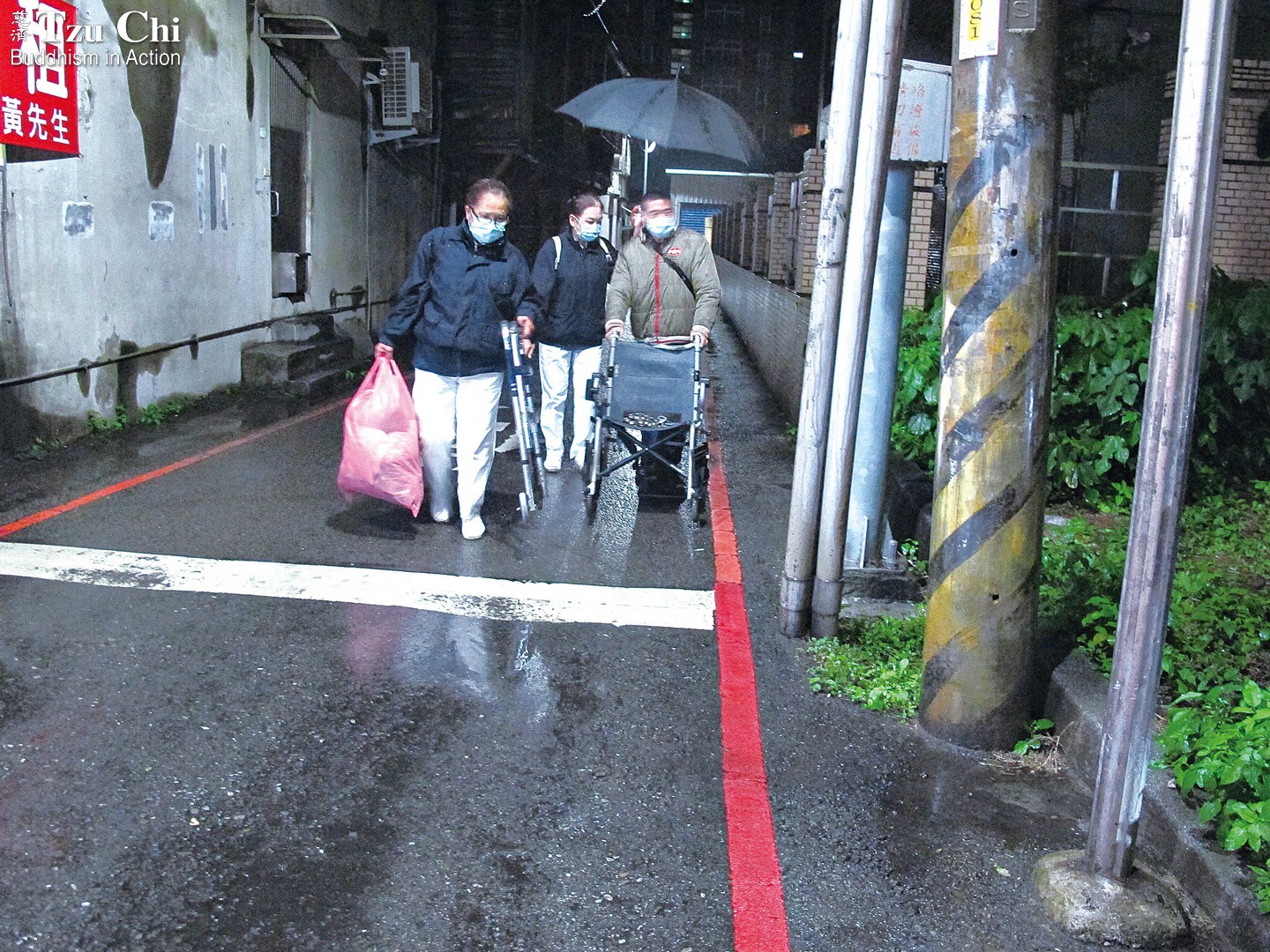
Tzu Chi volunteers accompany Mr. Zhu to his father’s funeral on a winter morning in January 2022.

Support through a hard time

Tzu Chi started providing help to Zhu and his father in July 2017. In September that year, a group of volunteers joined medical workers from Taipei Tzu Chi Hospital to give their home a thorough cleaning. Volunteers continued extending care to the father and son after that, including helping them move into a new home in August 2020. Throughout it all, they helped the two men weather one difficulty after another. Eventually the father and son became donating members, making regular donations to the foundation, despite their modest means.

Zhu’s father, 94, was hospitalized this January. Just a few days after he checked into the hospital, the hospital informed Zhu that his father’s condition had become critical. They told him to prepare clothes for his father to wear in anticipation of his imminent passing. Zhu was shocked and sad. He never anticipated his father’s condition would deteriorate so fast. His hands were not strong enough to open their wardrobe at home, so he quickly asked for help from Tzu Chi volunteer Lin Shu-mei (林淑梅).

Lin went to their home and opened their wardrobe to pick out the clothes. She was greeted by a musty smell. She went through the clothes inside and discovered they were either too tattered or old to be worn. She eventually found a suit that could serve the purpose, but she needed other clothes as well. Hopping on her motor scooter, she visited a few stores and bought with her own money some new underwear, socks, shirts, and a pair of shoes for Zhu’s father.

Zhu was a good son and hard-working too. He had had surgery for cancer two years before, but just one week after he was discharged from the hospital, he returned to work. He did his best to make a living. After his father passed on, he said to Tzu Chi volunteers, “Now that my dad is no longer around for me to take care of, I can work eight hours a day instead of four.”

Volunteers asked him if he needed help tidying up his home and sorting his father’s stuff. He tearfully declined their offer of help. “Thank you, sisters. I’m not in the mood to do that just yet. My home might be a bit messy, but I want to keep it that way for a while. I can’t help feeling my dad is still around. I miss him so much.” Patting him on his shoulders, the volunteers said, “Okay, we understand. Be sure to let us know if you need any help. We’ll continue to visit you at home.”

It had been just the two of them, father and son, relying on each other for the past 44 years. Though their lives were difficult, their hearts were warmed by each other’s company. It was thus no surprise Zhu was devastated by his father’s passing. Tzu Chi volunteers will continue to give him family-like support to help him feel less alone and face the future with optimism.

Text and photo by Xu Jing-yi
Translated by Wu Hsiao-ting

Mr. Zhu and his father were the only family each other had for 44 years. Their lives were hard, but their love and support for each other sustained them. When his father passed on, Mr. Zhu was very sad. Fortunately, Tzu Chi volunteers made sure he wouldn’t struggle alone.

January 21, 2022, was a wet, cold day. At just a little past six in the morning, four Tzu Chi volunteers braved the heavy rain and met at an intersection in Taishan, New Taipei City, before walking to Mr. Zhu’s home. The volunteers were picking Zhu up to go to his father’s funeral.

Zhu, a 44-year-old cerebral palsy victim, is not very mobile and often relies on a wheelchair to get around. The volunteers pushed his wheelchair and held up an umbrella for him, then helped him get into the car they were taking to the funeral home. Zhu couldn’t stop thanking the volunteers, saying, “Thank you so much. It’s raining so hard today but you still came to keep me company. I don’t know how I can ever pay you back.”

When they had arrived at the funeral home, Zhu, assisted by the undertaker, Mr. Cai, went to see his father for the last time and bid him farewell before getting in the hearse headed for the crematorium. The volunteers followed the hearse in their car. Once at the crematorium, a series of rituals were performed before the body was pushed into the incinerator. Zhu reminisced about his father with the volunteers while waiting for the body to be cremated.

He told the volunteers he had been brought up by his father. He had no memory of his mother. Because he had cerebral palsy, it was no easy task to take care of him, but his father lovingly tended to his needs. Later, as his father gradually grew older, it became Zhu’s turn to take care of him. He would accompany his dad to the hospital when he was ill. It was for that reason that Zhu blamed himself for his father’s sudden passing. He felt that his dad had died so suddenly because he hadn’t taken him to the doctor soon enough when he was feeling unwell. Zhu felt that if he had just gotten his father treatment sooner, he’d still be alive. Every time he thought of this, his tears would gush forth.

The volunteers consoled him, saying, “You did your best. Your father was old, and his organs no longer functioned so well. You must take good care of yourself.” Seeing him wipe away his tears again and again, the volunteers began to feel sad too.

Families waited in clusters in the waiting area at the crematorium. Zhu was the only one there who didn’t have any family around, but he wasn’t alone thanks to the volunteers around him. Later, when his father’s ashes had been put into an urn, the undertaker said courteously to him, “I won’t charge you anything for my services today. I know the situation you are in. My best wishes to you. Please be strong.”

Zhu’s eyes glistened with tears when he heard Mr. Cai’s words. He put his palms together in front of his chest and repeatedly thanked the undertaker. The volunteers were touched by the undertaker’s kind gesture as well, which goes to show how full of love and warmth this world is. They gave Mr. Cai a deep bow to convey their appreciation.

The undertaker went on to say, “Sisters, I know you’re all very busy. You may go home now. I’ll carry the urn for Mr. Zhu and drive him to the columbarium to have the urn placed there. I’ll drive him home afterwards. Don’t you worry.” The volunteers bowed to Mr. Cai again. His selfless giving elicited their deepest respect.

Tzu Chi volunteers accompany Mr. Zhu to his father’s funeral on a winter morning in January 2022.

Support through a hard time

Tzu Chi started providing help to Zhu and his father in July 2017. In September that year, a group of volunteers joined medical workers from Taipei Tzu Chi Hospital to give their home a thorough cleaning. Volunteers continued extending care to the father and son after that, including helping them move into a new home in August 2020. Throughout it all, they helped the two men weather one difficulty after another. Eventually the father and son became donating members, making regular donations to the foundation, despite their modest means.

Zhu’s father, 94, was hospitalized this January. Just a few days after he checked into the hospital, the hospital informed Zhu that his father’s condition had become critical. They told him to prepare clothes for his father to wear in anticipation of his imminent passing. Zhu was shocked and sad. He never anticipated his father’s condition would deteriorate so fast. His hands were not strong enough to open their wardrobe at home, so he quickly asked for help from Tzu Chi volunteer Lin Shu-mei (林淑梅).

Lin went to their home and opened their wardrobe to pick out the clothes. She was greeted by a musty smell. She went through the clothes inside and discovered they were either too tattered or old to be worn. She eventually found a suit that could serve the purpose, but she needed other clothes as well. Hopping on her motor scooter, she visited a few stores and bought with her own money some new underwear, socks, shirts, and a pair of shoes for Zhu’s father.

Zhu was a good son and hard-working too. He had had surgery for cancer two years before, but just one week after he was discharged from the hospital, he returned to work. He did his best to make a living. After his father passed on, he said to Tzu Chi volunteers, “Now that my dad is no longer around for me to take care of, I can work eight hours a day instead of four.”

Volunteers asked him if he needed help tidying up his home and sorting his father’s stuff. He tearfully declined their offer of help. “Thank you, sisters. I’m not in the mood to do that just yet. My home might be a bit messy, but I want to keep it that way for a while. I can’t help feeling my dad is still around. I miss him so much.” Patting him on his shoulders, the volunteers said, “Okay, we understand. Be sure to let us know if you need any help. We’ll continue to visit you at home.”

It had been just the two of them, father and son, relying on each other for the past 44 years. Though their lives were difficult, their hearts were warmed by each other’s company. It was thus no surprise Zhu was devastated by his father’s passing. Tzu Chi volunteers will continue to give him family-like support to help him feel less alone and face the future with optimism.

關鍵字

Joys and Woes During the Pandemic

By Yeh Tzu-hao
Abridged and translated by Wu Hsiao-ting
Photos by Hsiao Yiu-hwa

Tzu Chi volunteers in Taiwan were happy when the pandemic eased after a surge in COVID cases last summer and allowed their recycling work to return to normal. But increased amounts of garbage—spurred on by e-commerce and takeout food services—became a source of worry.

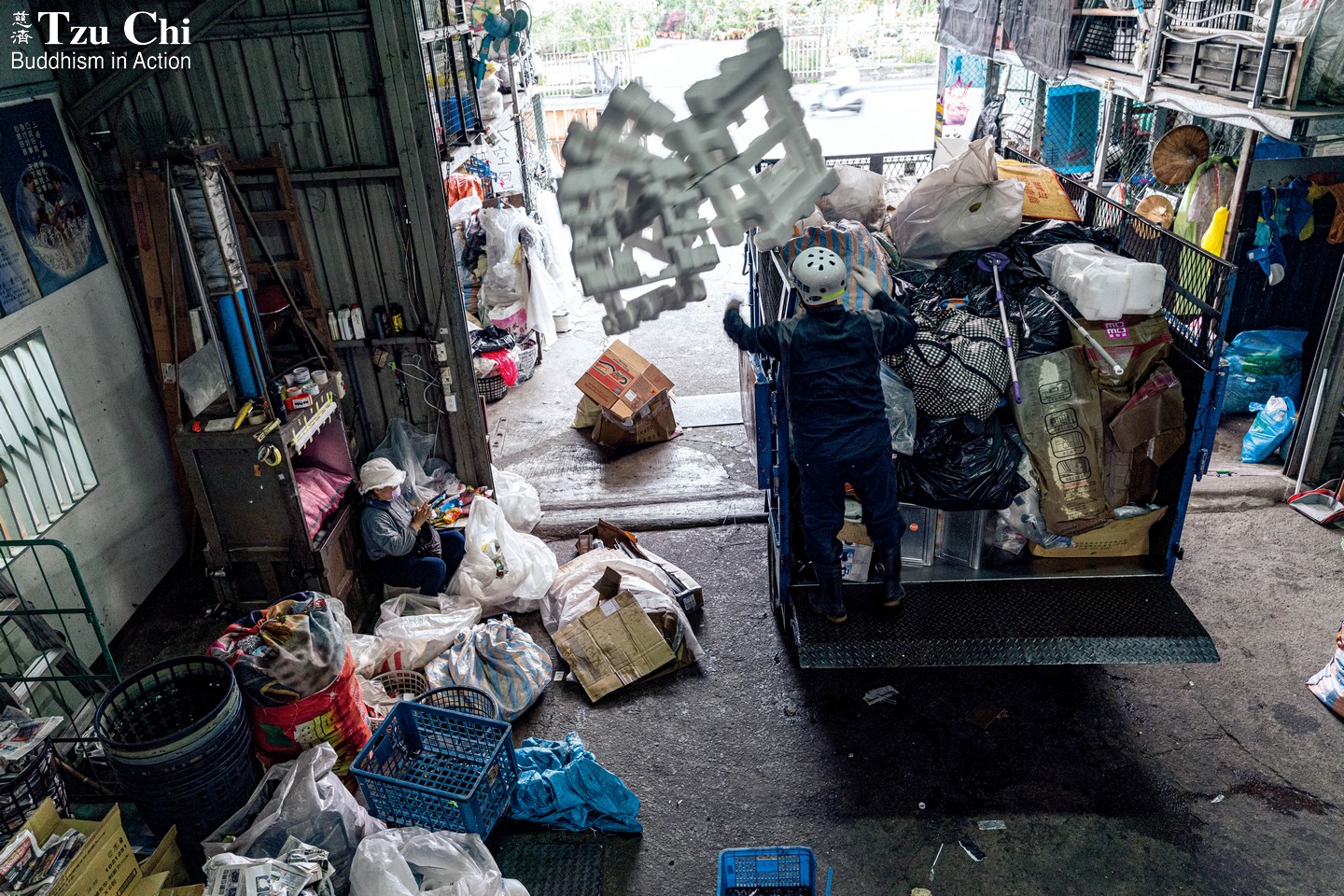
A volunteer unloads a truck at a recycling station in Muzha, Taipei, in December 2021.

Early one rainy winter morning, Yang Pan Chun-hui (楊潘春慧), 83, boarded a bus headed down the mountain to a Tzu Chi recycling station in Muzha, Taipei, northern Taiwan. When she arrived, she was cheerfully greeted by the people already there. “Hui, here you are!” they exclaimed as she walked into the station.

She had always enjoyed serving at the station, but cherished her time there even more now, after a sudden spike of COVID-19 cases in Taiwan last year caused Tzu Chi recycling stations across the island to close for more than two months. She knew what it was like to be at loose ends, and it was most certainly no fun.

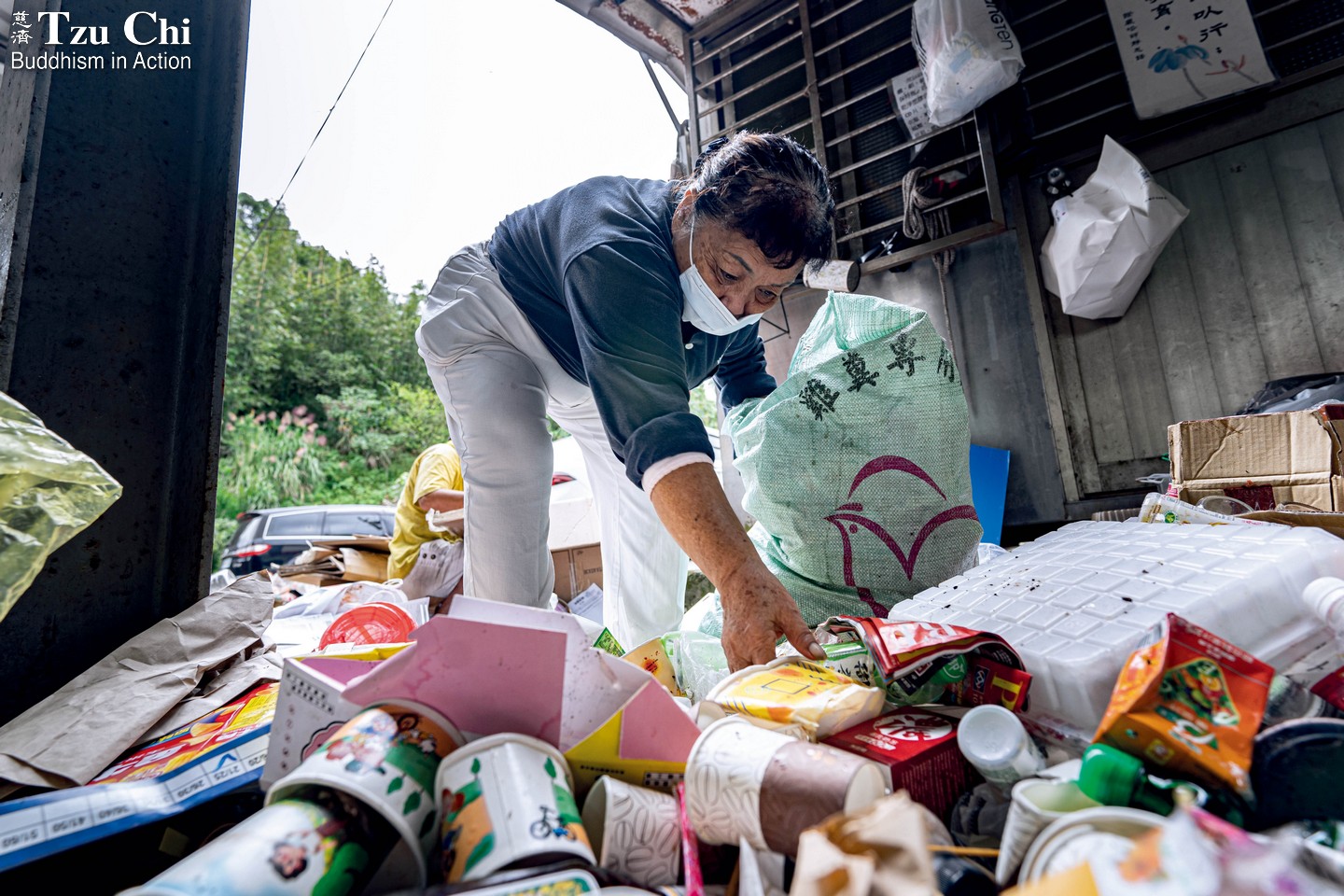
Her work at the station that day was to remove the caps from plastic bottles. Before long, the small bucket at her feet was full of caps of all sorts of colors. Though she wasn’t making any money for her services at the station, she was as happy as could be. “For me, sitting idly at home is hard work,” said the octogenarian. “Having work to do is a blessing.”

Unprecedented measures

The temporary closure of Tzu Chi recycling stations from mid-May to late July in 2021 was an unprecedented event. Since the foundation started recycling work in 1990, its stations had never stopping taking in recyclables, not even during the SARS epidemic of 2003.

“We made the decision to close not just to protect our volunteers, but for the safety of society as a whole,” said Zhang Han-jun (張涵鈞), head of Tzu Chi’s Section for the Promotion and Development of Environmental Protection Work. He explained that the virus that caused COVID-19 could remain active for as long as three days on the surface of recycled items. One couldn’t be too careful.

The doors to the stations were locked and notices put up turning away all recyclables during the closure, but people continued to take bag after bag of recycling to Tzu Chi recycling stations. This occurred even in Hualien, eastern Taiwan, where the amounts of garbage produced were comparatively small.

“At first, we posted a smaller sign asking people not to bring recyclables to us,” said volunteer Lin Cui-yun (林翠雲), of the Meilun Recycling Station in Hualien. “When that didn’t work, we put up a large banner with the same announcement, but to no avail. People said they were so used to bringing recyclables to us that they couldn’t bring themselves to take them elsewhere.” Lin recalled that even though the streets were quiet during that time, people never stopped dropping recycling at the station.

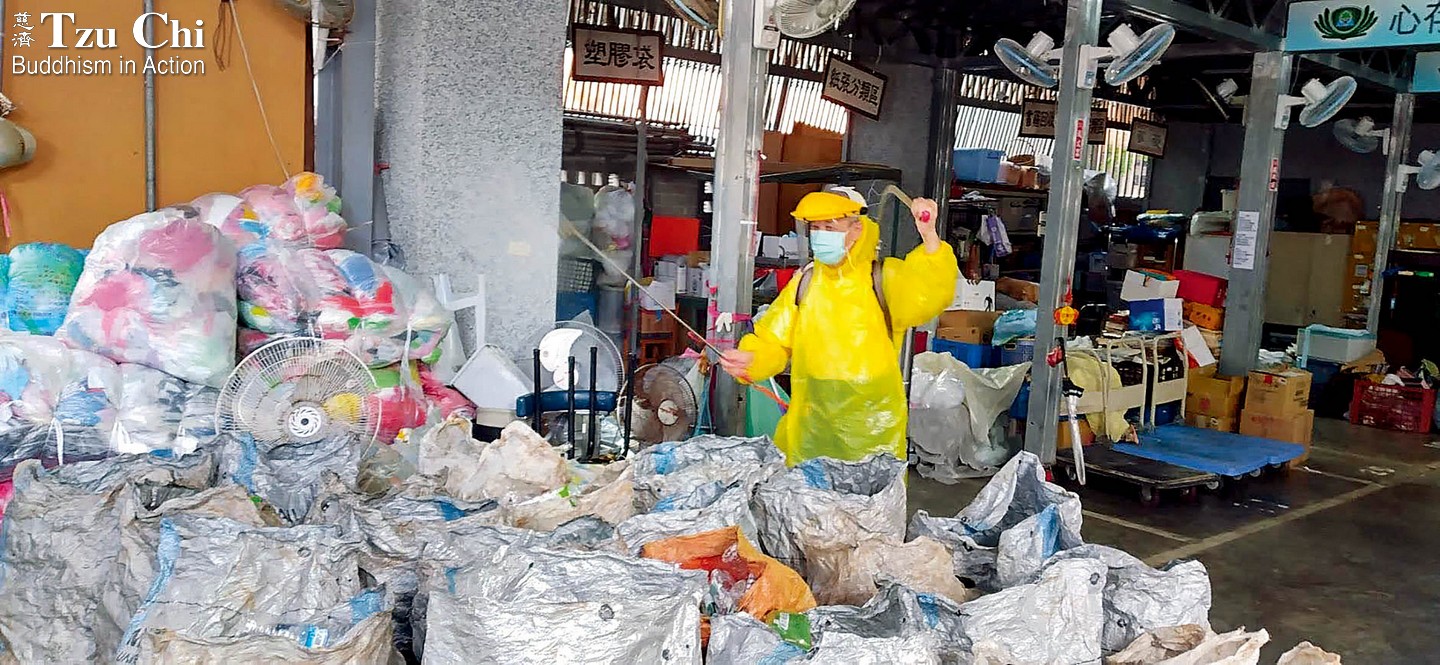
With the surge in confirmed COVID infections, Taiwan’s government had raised its COVID alert to the second highest level, level three, and capped indoor gatherings to no more than five people. Even so, Lin knew that they had to find a way to process the recyclables brought to the station so they wouldn’t end up as regular garbage. Keeping the number of helpers as low as possible, she invited another volunteer to work with her at the station. They followed instructions from Tzu Chi headquarters in Hualien and sterilized all recycling with disinfectant spray before they set to work. They ramped up personal protection against the virus too. “I always double masked,” said Lin.

Fewer people working meant more work for each person. One time, Lin took her nephew to the station to help her out. When the youngster saw the huge piles of recycling they had to sort, he instantly wailed: “Why so much? We can’t possibly finish all of it!”

“But we can’t just throw in the towel,” Lin said. “Some of the items in the piles, such as paper meal boxes, will rot and stink if we don’t process them as soon as possible and send them to the recycling merchant.”

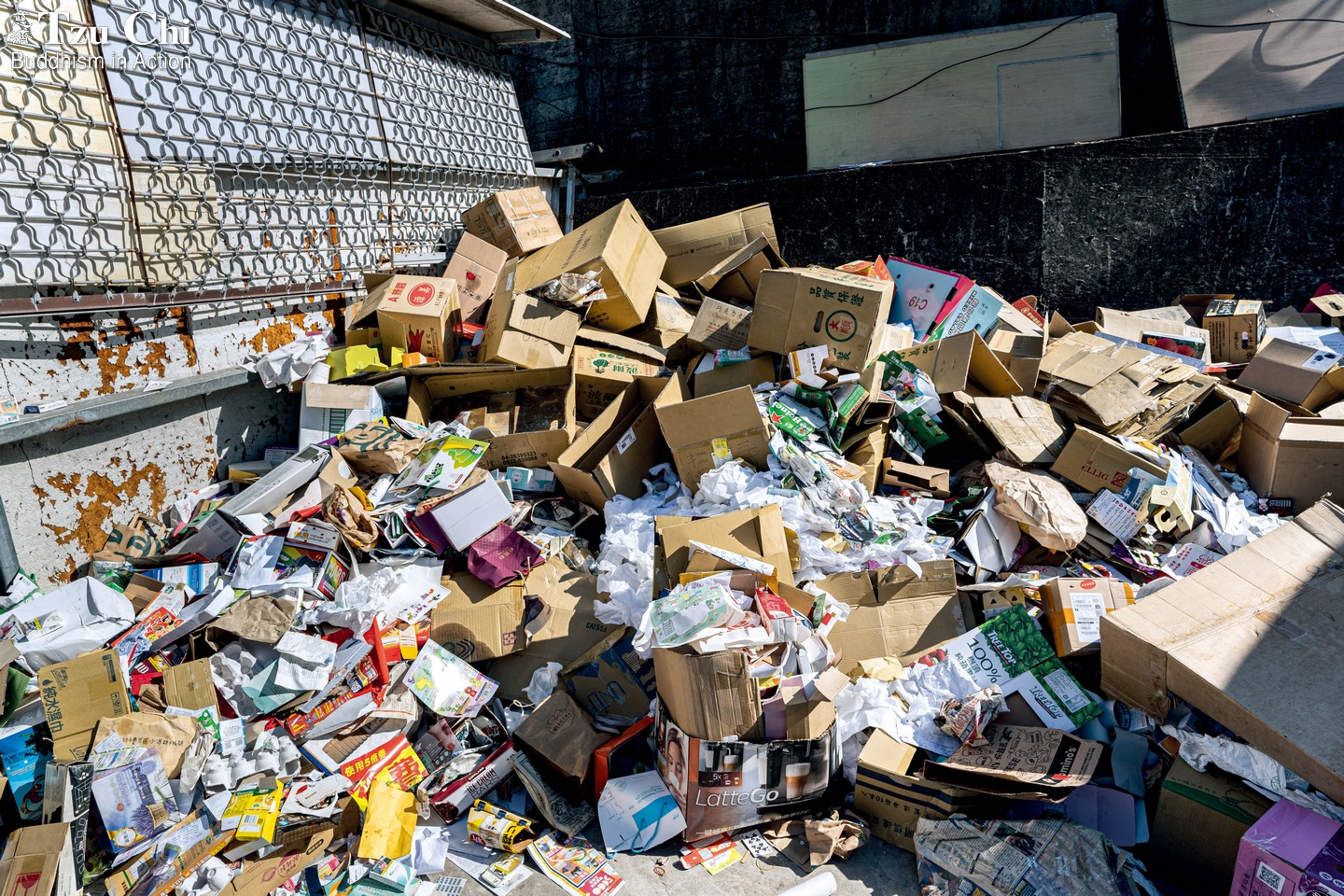
Lin explained that due to the pandemic, the demand for food delivery had grown substantially, leading to a spike in disposable containers and utensils. One time she and a few other volunteers worked for an entire week, from six in the morning into the afternoon, just to finish processing some recyclables. It was quite a job, especially for someone like her, who was over 70.

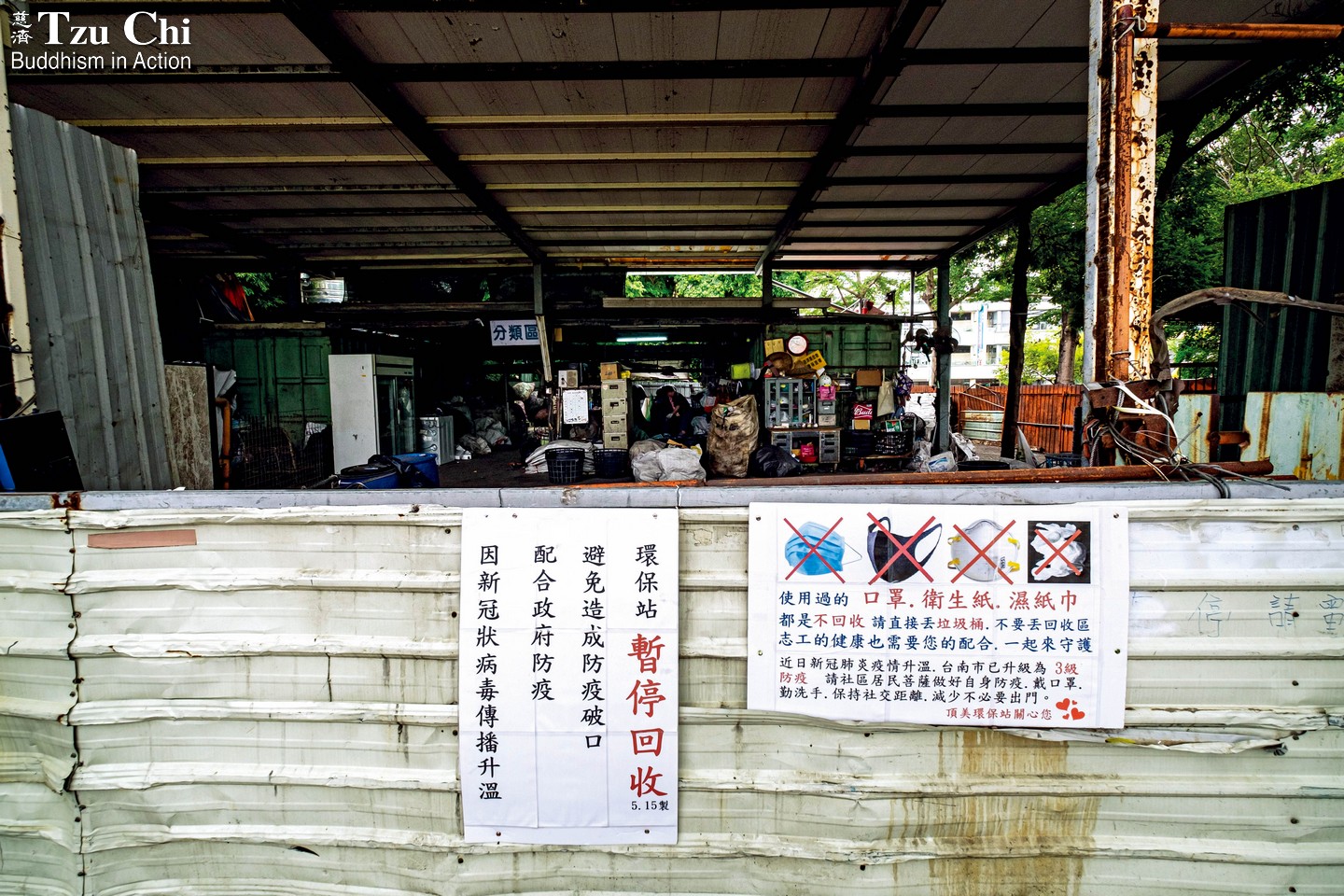
A sign (left) put up at the Dingmei Recycling Station in Tainan following a surge in COVID cases in Taiwan in mid-May 2021. It informs people that the station is temporarily turning away all recyclables.

Happy to be back in the saddle

“We worked half in fear and half in joy during that period,” said volunteer Lin Xiu-xia (林秀霞), of the Fuyang Recycling Station in Fengyuan, Taichung, central Taiwan. “We all loved to be recycling, but were afraid of the virus!” Lin added that after the COVID alert was raised to level three, she and other team leaders often called other volunteers and urged them to avoid unnecessary outings. They especially made a point to stay in touch with all the older volunteers. With the pandemic setting everyone’s nerves on edge, Lin and her fellow volunteers did everything with caution and a heightened sense of vigilance.

“The operation of our recycling station didn’t come to a complete halt,” said another volunteer, Li Mei-ying (李美櫻), “but we staggered the times for volunteers to work at the station. For example, we’d let in two or three people one day to sort plastic bags, and three or four the next to separate things by type.”

In normal times, the Fuyang station typically sees an average of 20 volunteers working there at the same time, but during the restricted time last summer, it was down to four people at the most. The capacity to handle work was lowered to one fifth of the usual level. Fortunately, the amount of recycling that ended up at the station was also greatly reduced, so the volunteers weren’t spread too thin. They even had some spare time to process a backlog of unfinished work that had been lying around for some time. “Take Brother Zhan Yi-qin [詹益欽],” Li said. “He did a good cleanout of the station, removing stuff that had been there for as long as anyone could remember.”

“My home is close to the station,” Zhan explained after putting down a bench grinder and an aluminum broom handle he had cut halfway through. “It takes me just five minutes to drive my motor scooter here. It was pretty safe for me to come and work here.” As if trying to justify his rationale for working at the station during that dangerous time, he continued: “I’d close the door as soon as I came in and work alone here. We have a lot of space here; even if there were more than one person working here at the same time, we made sure to keep it under the required limit.”

The volunteers’ strict observance of the government’s regulations was commendable, but it also meant that many older volunteers who had long served at Tzu Chi recycling stations were suddenly forced out of work. Many of them didn’t welcome the unexpected holiday.

Even if they were allowed to work at a recycling station, their family might not have agreed to let them do so. “My sons support my volunteering,” said volunteer Lai Qiu-ju (賴秋菊). “But during the level three alert period, they wouldn’t let me go to the recycling station. They said if I got infected [with COVID-19], our entire family would be forced into isolation.”

Lai said that because everyone in her family worked, she was often the only person at home during the day. Time hung heavy on her hands with nothing to do. That’s why she had jumped at the opportunity to volunteer at the Fuyang station when it opened more than four years before. She happily took two buses every day to get to the station and do her bit to help the environment. Who was to know the recycling station would close its door in mid-May? Even the buses she took to get to the station stopped running.

“Lai felt down, cooped up at home with nothing to do,” said volunteer Lin Xiu-xia, who often phoned her to check on her during that time. “She said her body had begun to ache again, and she was near the point of clinical depression.” After learning about her situation, Lin conferred with their leader and decided to let Lai come back to the station to volunteer. Lai’s sons eventually agreed to let her do so too. Thus, Lin began bringing Lai to the station on a motor scooter.

“My ‘holiday’ was thus shorter than others’,” said Lai. “I was back at work as soon as the pandemic had eased a little. My hand ached, but I forgot about my aches and pains as soon as I had work to engage me.” Lai was back to her old spirited self as soon as she was back at the station.

“Our volunteers always tell me they are wimps at home but whirlwinds at the station,” said volunteer Lin, her eyes crinkling with a smile.

A recycling station being sterilized after the COVID alert was raised to level three in Taiwan last year Courtesy of the Section for the Promotion and Development of Environmental Protection Work, Tzu Chi Foundation

Temporary collection points

With all sorts of pandemic restrictions in place, volunteers tried all sorts of ways to keep their work going while following the regulations. The Renhe Recycling Station in Tainan, southern Taiwan, for example, set up eight temporary collection points at people’s homes to cope.

Volunteer Liu Yu-wen (劉玉文), who is in charge of the Renhe station, said that he closed the station as soon as the level three alert was announced. He even changed the lock on the front door to prevent the volunteers who had keys to the station from entering. But after that, his cell phone just wouldn’t stop ringing.

“People kept calling me to complain that their homes were cluttered with recyclables,” Liu said. “They insisted on giving their recycling to Tzu Chi. Some even dropped their recycling off at the door of our station. That’s why we eventually reached an agreement with some volunteers and people of the general public to set up eight collection points.”

Liu explained how the temporary collection points worked, which was different from a typical collection point. Usually, volunteers collect mixed recyclable garbage at a collection point and transport it to a recycling station to be sorted. But people who took their recyclables to the temporary points needed to first clean and thoroughly separate the recyclables by type. That pre-processing allowed volunteers to pick up the recyclables and deliver them directly to recycling merchants, thus preventing the gathering of crowds.

Ms. Lin, over 80, was one of those who took part in this temporary arrangement. She had been collecting recyclables for Tzu Chi for over 20 years. She had begun to suffer from severe insomnia when she had grown older, and would often wake up in the middle of the night and not be able to fall back asleep. With her family sound asleep and no one to spend time with her, she took to visiting food stalls that catered to late-night customers to collect recyclables. She’d rinse and sort her recycling at home before volunteers dropped by to take it away. Accommodating her schedule, volunteer Liu Yu-wen always sent out a truck to her home early every morning to pick up her recyclables.

This arrangement worked perfectly until the level three COVID alert was issued. Considering that older people were more susceptible to the coronavirus, Liu advised Ms. Lin to take a timeout from her recycling work. Her children also pleaded with her not to go out to collect recyclables. But without her recycling work, her life seemed to lose its focus. “She didn’t like to watch TV,” Liu explained, “and there was nothing else to occupy her time at home. After staring at the ceiling for three days, she started going out to collect recyclables again and even took them to our station herself.”

That’s why Liu started sending a truck to her home three times a week during the level three alert period to pick up her recyclables. The truck came back every time with a full load. The volunteers who did the pickups always reminded her to take precautions against COVID when she went out for her recycling work. Fortunately, the pandemic alert was lowered to level two in late July 2021, allowing all Tzu Chi recycling stations, including the Renhe station, to resume their normal operations. Volunteers were thus able to return to their old routines.

Even so, the pandemic hadn’t ended yet, and every station still needed to take necessary preventive measures. “Before we closed our station last year,” Liu said, “we asked a cleaning company to sterilize our entire station with disinfecting sprayers. Now we urge our volunteers to don protective gear, use sanitizers, and maintain social distance when they work at the station. We also sterilize our station on our own every week with disinfectant spray.” He stressed that they still went about everything with caution.

After the wave of cases last year, volunteers cherished every opportunity to serve even more. Even though they do not make a single penny for their work, the joy they derive from it makes them feel more than adequately rewarded. Taking due care to protect themselves, they cheerfully continue to reclaim reusable resources and minimize damage to our beautiful Earth.

A volunteer sorts through a pile of recyclables. Paper food containers make up a large part of the recycling.

By Yeh Tzu-hao
Abridged and translated by Wu Hsiao-ting
Photos by Hsiao Yiu-hwa

Tzu Chi volunteers in Taiwan were happy when the pandemic eased after a surge in COVID cases last summer and allowed their recycling work to return to normal. But increased amounts of garbage—spurred on by e-commerce and takeout food services—became a source of worry.

A volunteer unloads a truck at a recycling station in Muzha, Taipei, in December 2021.

Early one rainy winter morning, Yang Pan Chun-hui (楊潘春慧), 83, boarded a bus headed down the mountain to a Tzu Chi recycling station in Muzha, Taipei, northern Taiwan. When she arrived, she was cheerfully greeted by the people already there. “Hui, here you are!” they exclaimed as she walked into the station.

She had always enjoyed serving at the station, but cherished her time there even more now, after a sudden spike of COVID-19 cases in Taiwan last year caused Tzu Chi recycling stations across the island to close for more than two months. She knew what it was like to be at loose ends, and it was most certainly no fun.

Her work at the station that day was to remove the caps from plastic bottles. Before long, the small bucket at her feet was full of caps of all sorts of colors. Though she wasn’t making any money for her services at the station, she was as happy as could be. “For me, sitting idly at home is hard work,” said the octogenarian. “Having work to do is a blessing.”

Unprecedented measures

The temporary closure of Tzu Chi recycling stations from mid-May to late July in 2021 was an unprecedented event. Since the foundation started recycling work in 1990, its stations had never stopping taking in recyclables, not even during the SARS epidemic of 2003.

“We made the decision to close not just to protect our volunteers, but for the safety of society as a whole,” said Zhang Han-jun (張涵鈞), head of Tzu Chi’s Section for the Promotion and Development of Environmental Protection Work. He explained that the virus that caused COVID-19 could remain active for as long as three days on the surface of recycled items. One couldn’t be too careful.

The doors to the stations were locked and notices put up turning away all recyclables during the closure, but people continued to take bag after bag of recycling to Tzu Chi recycling stations. This occurred even in Hualien, eastern Taiwan, where the amounts of garbage produced were comparatively small.

“At first, we posted a smaller sign asking people not to bring recyclables to us,” said volunteer Lin Cui-yun (林翠雲), of the Meilun Recycling Station in Hualien. “When that didn’t work, we put up a large banner with the same announcement, but to no avail. People said they were so used to bringing recyclables to us that they couldn’t bring themselves to take them elsewhere.” Lin recalled that even though the streets were quiet during that time, people never stopped dropping recycling at the station.

With the surge in confirmed COVID infections, Taiwan’s government had raised its COVID alert to the second highest level, level three, and capped indoor gatherings to no more than five people. Even so, Lin knew that they had to find a way to process the recyclables brought to the station so they wouldn’t end up as regular garbage. Keeping the number of helpers as low as possible, she invited another volunteer to work with her at the station. They followed instructions from Tzu Chi headquarters in Hualien and sterilized all recycling with disinfectant spray before they set to work. They ramped up personal protection against the virus too. “I always double masked,” said Lin.

Fewer people working meant more work for each person. One time, Lin took her nephew to the station to help her out. When the youngster saw the huge piles of recycling they had to sort, he instantly wailed: “Why so much? We can’t possibly finish all of it!”

“But we can’t just throw in the towel,” Lin said. “Some of the items in the piles, such as paper meal boxes, will rot and stink if we don’t process them as soon as possible and send them to the recycling merchant.”

Lin explained that due to the pandemic, the demand for food delivery had grown substantially, leading to a spike in disposable containers and utensils. One time she and a few other volunteers worked for an entire week, from six in the morning into the afternoon, just to finish processing some recyclables. It was quite a job, especially for someone like her, who was over 70.

A sign (left) put up at the Dingmei Recycling Station in Tainan following a surge in COVID cases in Taiwan in mid-May 2021. It informs people that the station is temporarily turning away all recyclables.

Happy to be back in the saddle

“We worked half in fear and half in joy during that period,” said volunteer Lin Xiu-xia (林秀霞), of the Fuyang Recycling Station in Fengyuan, Taichung, central Taiwan. “We all loved to be recycling, but were afraid of the virus!” Lin added that after the COVID alert was raised to level three, she and other team leaders often called other volunteers and urged them to avoid unnecessary outings. They especially made a point to stay in touch with all the older volunteers. With the pandemic setting everyone’s nerves on edge, Lin and her fellow volunteers did everything with caution and a heightened sense of vigilance.

“The operation of our recycling station didn’t come to a complete halt,” said another volunteer, Li Mei-ying (李美櫻), “but we staggered the times for volunteers to work at the station. For example, we’d let in two or three people one day to sort plastic bags, and three or four the next to separate things by type.”

In normal times, the Fuyang station typically sees an average of 20 volunteers working there at the same time, but during the restricted time last summer, it was down to four people at the most. The capacity to handle work was lowered to one fifth of the usual level. Fortunately, the amount of recycling that ended up at the station was also greatly reduced, so the volunteers weren’t spread too thin. They even had some spare time to process a backlog of unfinished work that had been lying around for some time. “Take Brother Zhan Yi-qin [詹益欽],” Li said. “He did a good cleanout of the station, removing stuff that had been there for as long as anyone could remember.”

“My home is close to the station,” Zhan explained after putting down a bench grinder and an aluminum broom handle he had cut halfway through. “It takes me just five minutes to drive my motor scooter here. It was pretty safe for me to come and work here.” As if trying to justify his rationale for working at the station during that dangerous time, he continued: “I’d close the door as soon as I came in and work alone here. We have a lot of space here; even if there were more than one person working here at the same time, we made sure to keep it under the required limit.”

The volunteers’ strict observance of the government’s regulations was commendable, but it also meant that many older volunteers who had long served at Tzu Chi recycling stations were suddenly forced out of work. Many of them didn’t welcome the unexpected holiday.

Even if they were allowed to work at a recycling station, their family might not have agreed to let them do so. “My sons support my volunteering,” said volunteer Lai Qiu-ju (賴秋菊). “But during the level three alert period, they wouldn’t let me go to the recycling station. They said if I got infected [with COVID-19], our entire family would be forced into isolation.”

Lai said that because everyone in her family worked, she was often the only person at home during the day. Time hung heavy on her hands with nothing to do. That’s why she had jumped at the opportunity to volunteer at the Fuyang station when it opened more than four years before. She happily took two buses every day to get to the station and do her bit to help the environment. Who was to know the recycling station would close its door in mid-May? Even the buses she took to get to the station stopped running.

“Lai felt down, cooped up at home with nothing to do,” said volunteer Lin Xiu-xia, who often phoned her to check on her during that time. “She said her body had begun to ache again, and she was near the point of clinical depression.” After learning about her situation, Lin conferred with their leader and decided to let Lai come back to the station to volunteer. Lai’s sons eventually agreed to let her do so too. Thus, Lin began bringing Lai to the station on a motor scooter.

“My ‘holiday’ was thus shorter than others’,” said Lai. “I was back at work as soon as the pandemic had eased a little. My hand ached, but I forgot about my aches and pains as soon as I had work to engage me.” Lai was back to her old spirited self as soon as she was back at the station.

“Our volunteers always tell me they are wimps at home but whirlwinds at the station,” said volunteer Lin, her eyes crinkling with a smile.

A recycling station being sterilized after the COVID alert was raised to level three in Taiwan last year Courtesy of the Section for the Promotion and Development of Environmental Protection Work, Tzu Chi Foundation

Temporary collection points

With all sorts of pandemic restrictions in place, volunteers tried all sorts of ways to keep their work going while following the regulations. The Renhe Recycling Station in Tainan, southern Taiwan, for example, set up eight temporary collection points at people’s homes to cope.

Volunteer Liu Yu-wen (劉玉文), who is in charge of the Renhe station, said that he closed the station as soon as the level three alert was announced. He even changed the lock on the front door to prevent the volunteers who had keys to the station from entering. But after that, his cell phone just wouldn’t stop ringing.

“People kept calling me to complain that their homes were cluttered with recyclables,” Liu said. “They insisted on giving their recycling to Tzu Chi. Some even dropped their recycling off at the door of our station. That’s why we eventually reached an agreement with some volunteers and people of the general public to set up eight collection points.”

Liu explained how the temporary collection points worked, which was different from a typical collection point. Usually, volunteers collect mixed recyclable garbage at a collection point and transport it to a recycling station to be sorted. But people who took their recyclables to the temporary points needed to first clean and thoroughly separate the recyclables by type. That pre-processing allowed volunteers to pick up the recyclables and deliver them directly to recycling merchants, thus preventing the gathering of crowds.

Ms. Lin, over 80, was one of those who took part in this temporary arrangement. She had been collecting recyclables for Tzu Chi for over 20 years. She had begun to suffer from severe insomnia when she had grown older, and would often wake up in the middle of the night and not be able to fall back asleep. With her family sound asleep and no one to spend time with her, she took to visiting food stalls that catered to late-night customers to collect recyclables. She’d rinse and sort her recycling at home before volunteers dropped by to take it away. Accommodating her schedule, volunteer Liu Yu-wen always sent out a truck to her home early every morning to pick up her recyclables.

This arrangement worked perfectly until the level three COVID alert was issued. Considering that older people were more susceptible to the coronavirus, Liu advised Ms. Lin to take a timeout from her recycling work. Her children also pleaded with her not to go out to collect recyclables. But without her recycling work, her life seemed to lose its focus. “She didn’t like to watch TV,” Liu explained, “and there was nothing else to occupy her time at home. After staring at the ceiling for three days, she started going out to collect recyclables again and even took them to our station herself.”

That’s why Liu started sending a truck to her home three times a week during the level three alert period to pick up her recyclables. The truck came back every time with a full load. The volunteers who did the pickups always reminded her to take precautions against COVID when she went out for her recycling work. Fortunately, the pandemic alert was lowered to level two in late July 2021, allowing all Tzu Chi recycling stations, including the Renhe station, to resume their normal operations. Volunteers were thus able to return to their old routines.

Even so, the pandemic hadn’t ended yet, and every station still needed to take necessary preventive measures. “Before we closed our station last year,” Liu said, “we asked a cleaning company to sterilize our entire station with disinfecting sprayers. Now we urge our volunteers to don protective gear, use sanitizers, and maintain social distance when they work at the station. We also sterilize our station on our own every week with disinfectant spray.” He stressed that they still went about everything with caution.

After the wave of cases last year, volunteers cherished every opportunity to serve even more. Even though they do not make a single penny for their work, the joy they derive from it makes them feel more than adequately rewarded. Taking due care to protect themselves, they cheerfully continue to reclaim reusable resources and minimize damage to our beautiful Earth.

A volunteer sorts through a pile of recyclables. Paper food containers make up a large part of the recycling.

關鍵字

Young People Work to Reduce Waste

By Yeh Tzu-hao
Translated by Wu Hsiao-ting
Photos by Hsiao Yiu-hwa

The pandemic made takeaways, deliveries, and online shopping more popular in Taiwan. But the resulting rise in single-use containers and packaging is exacting an environmental toll. While Tzu Chi volunteers work hard to recycle, some young people are leading the way in waste reduction.

A Good to Go member returns a cup by scanning the QR code on the cup at a self-service cup rental and return machine in Gongguan, Taipei. One can ask to use Good to Go’s container rental services at partner stores, or rent containers at Good to Go’s self-service machines through the LINE app.

“I’ve noticed over the past year a conspicuous increase in paper cups and paper meal boxes,” said Tzu Chi volunteer Luo Heng-yuan (羅恒源), of New Taipei City, northern Taiwan. “The number of plastic bags and cardboard boxes has grown too. We have recycled so much. You wouldn’t know how bad the problem has become unless you’ve worked at a recycling station.”

The government in Taiwan banned indoor dining and relaxed its restrictions on the use of disposable tableware during the surge of COVID-19 cases in 2021. The measures set back the progress the island had made over the years in cutting back on waste. According to statistics from the Environmental Protection Administration, more than 88,000 tons of paper tableware were used and recycled from January to July 2021. That’s an increase of 6.5 percent compared to the same period the previous year. If the paper tableware that was not recycled is also factored in, the amount would be even more staggering.

Pandemic-fueled online shopping and deliveries also contributed to a growth in garbage generation on the island. Taiwan’s e-commerce achieved a turnover of 241.2 billion Taiwanese dollars (US$8,353,390,000) in 2020. While online retail represents a huge business opportunity, it also results in a lot of packaging waste. Thirty-five thousand tons of such waste was produced in 2020 alone.

With online shopping and food deliveries booming, many are thinking of how to reduce waste and lower its impact on the environment. Some have gone one step further to tackle the issue—and not just on a personal level.

Good to Go

In a corner of the commercial district in Gongguan, Taipei, people approach something that looks like a vending machine—but they are not there to buy drinks or snacks. They instead are using the machine to borrow or return reusable cups. The self-service cup rental and return machine is a brainchild of the social enterprise “Good to Go.” In addition to borrowing or returning cups at such a machine, people can also use the Good to Go rental service at its partner shops. No rental fees or deposits are required.

Good to Go, a drink and food container rental service, was created six years ago by Song Yi-zhen (宋宜臻) and Li Yi-he (李翊禾). More than 150 drink shops and restaurants across seven cities and counties in Taiwan currently use their rental system, as well as an online food ordering and delivery platform.

Shops serving to-go tea drinks are everywhere in Taiwan. While they bring in money for many people, it comes at a cost—two billion discarded drink cups are generated each year on the island. Everyone agrees the number of these single-use items should be reduced, but they might hesitate to use services like Good to Go. After all, can they trust the cleanliness of the containers?

“We employ businesses specializing in washing dishes for schools and corporations to clean our containers,” Song Yi-zhen explained, stressing the safety of their product. “All containers are heat-sterilized after being thoroughly washed.” In other words, the containers are as good as new after being processed.

Good to Go’s cups come in two sizes and are made of food-grade polypropylene. They are more environmentally friendly than one-use paper cups. They are also safer to use: paper cups are lined with a thin layer of plastic to make them water-resistant, and hot beverages can dissolve the plastic lining, which then ends up being consumed.

Song observed that most people who use their cup rental service are those who have time to linger in a commercial or shopping district. They take time to enjoy their drinks as they leisurely stroll and shop, then return their cups before they leave to the Good to Go partner shops where they purchased their beverages. On the other hand, people who are in a hurry to leave generally opt to use paper cups. To make Good to Go’s service more popular, it must be easier for people on the go to return their used cups.

Song said that when they first came up with the idea to launch their rental service, they couldn’t understand why someone else hadn’t thought of it and done it already. They thought the idea would be easy to implement, that all they needed to do was to put clean containers in drink shops for people to use, then collect the used cups to be washed and sterilized before returning them to participating businesses for reuse. Only after they visited stores to propose their service did they realize that the enterprise might be more complicated than they had thought.

There were, for example, problems with efficiency and staff training. “An employee at a drink shop can very quickly use a cup sealing machine to seal a paper cup with a plastic film, turning out many cups in a short time,” Song said. “But it takes a longer time to cap a reusable cup.” She further explained that if a shop is experiencing a higher turnover rate, training new staff to use reusable cups could be an added cost. First-time customers asking questions about how to use the rental system could also lower a shop’s operation efficiency.

Despite all that, many shop owners knew that they too had a responsibility to protect the environment. Therefore, quite a few agreed to give it a try when Song and Li pitched their idea to shop owners in the Zhengxing Street commercial district in Tainan, southern Taiwan.

Good to Go co-founder Song Yi-zhen (right, above photo) introduces their reusable cups to children. Good to Go started off by providing transparent glass tumblers before switching to their current polypropylene cups. When holding a large event, renting reusable containers to use (right) can greatly reduce waste. Courtesy of Song Yi-zhen

A public welfare program for the youth

After some trial and error, their cup rental system eventually took off, so Song and Li added meal containers to their service. When a customer orders takeout food from a participating restaurant or via an online food and delivery platform that partners with Good to Go, they can choose to use food containers provided by Good to Go. Afterwards, they simply need to return the containers to the restaurant or a self-service return station.

Most of Good to Go’s partner stores and rental and return stations at present are concentrated in Tainan, where the company started. They launched their service in Taipei just last year, in the Gongguan commercial district and the area near Taipei Main Station. They still have a way to go to make their service more prevalent throughout Taiwan. Still, they have already attracted 15,000 people to join their system as members. Since it was founded, Good to Go has enabled shops to use 145,000 fewer one-use containers.

“We’re now working to set up a system like YouBike,” Song declared. YouBike is a bike-sharing system in Taiwan that allows people to rent a bike at one of the system’s rental stations, use it for their journey, and return it to the same or another station after use. “We aim to make it such that wherever and whenever a customer wants to rent or return our containers, they can easily do so.”

Looking back at the challenges they have overcome along the way, Song was quick to thank Chen Pei-zhen (陳珮甄), a professional arranged by the Tzu Chi Foundation to mentor the Good to Go team on how to improve their business model. Song said that because they believed they were doing a good thing for society, it was easy for them to charge ahead without thinking too much about the commercial aspect of their service. “We didn’t know very well how to do a good thing while managing to survive financially. Our mentor Ms. Chen gave us good advice in that respect.”

Yen Po-wen (顏博文), CEO of the Tzu Chi charity mission, cheered on the Good to Go team. “Food delivery services and online shopping have resulted in a remarkable amount of garbage,” he said. “It would be great for our environment if packaging is reused or recycled materials are used to make drink or food containers. I hope Good to Go’s service will soon be found throughout Taiwan.”

Good to Go was one of the teams chosen by Tzu Chi in December 2020 to participate in a sponsorship program for young people with good ideas to make the world a better place. Program participants are provided grants and mentorship to help implement their ideas. Another applicant selected for the program in 2020 was PackAge+.

The rise of online shopping has led to an increase in the use of single-use packaging.

Reusable packaging

PackAge+ was founded by Ye De-wei (葉德偉) to provide reusable shipping bags and boxes for e-commerce companies and customers to use. “I used to be an online retailer,” said Ye, “and I used a lot of cardboard boxes and poly mailers to package my goods for mailing. I often say that founding PackAge+ was like an act of atonement for me.”

According to estimates from the Environmental Protection Administration, online shopping in Taiwan accounted for more than 120 million pieces of packaging in 2020. Many e-commerce companies use cardboard boxes for packaging. On the surface, using cardboard boxes seem to be more eco-friendly than plastic packaging such as poly mailers. However, a cardboard box actually generates more carbon dioxide if incinerated after a single use. “The production and incineration of a poly mailer creates 1.2 kilograms [2.6 pounds] of carbon dioxide,” Ye explained, “but a cardboard box creates 1.92 kilograms [4.2 pounds].”

Reusable packaging offers a sound solution for the garbage problem created by online shopping, but if a consumer doesn’t return the reusable packaging, the supplier is forced to use a new one, defeating the purpose. How could the return rate be increased so that the system can work?

“Many people in Taiwan collect their deliveries at convenience stores,” said Ye, “so we set up return stations there to make it easier for people to return their packaging. For example, if you collect a book at such a store, you can unwrap and return the shipping bag on the spot.” Taiwan has the world’s second highest concentration of chain convenience stores, so setting up return stations there is a good way to raise return rates. In addition to convenience stores, PackAge+ has set up return stations at other venues, such as drink shops, too.

Besides setting up as many return stations as they can to boost return rates, PackAge+ is using other ways to incentivize participation. For example, if customers collect their deliveries at convenience stores and return their shipping bags on the spot, they can get special offers. The same happens when they return their bags to certain participating drink shops.

Ye sold accessories for electronic devices online for five years before founding PackAge+ in 2018. It was that experience that led him to his current career.

When he worked in e-commerce, Ye, like others in the same trade, would generously wrap people’s orders in protective materials to prevent them from being damaged during transportation. One time, much to his surprise, he received a complaint from a customer. “That customer said that he had intentionally bought a pair of headphones made from eco-friendly materials,” Ye recalled, “but it arrived padded with so much ‘garbage’ he felt it all but nullified his small effort to do good for the environment.”

Ye remembered that to ensure that the headphones arrived in good condition, he had used an extra-large packing box and stuffed the space around the headphones with a lavish amount of bubble wrap. He never expected that the care he took would be taken negatively. However, the episode did get him thinking about the harm he was doing the environment in running his business.

A documentary about climate change further pushed him to ponder this issue. The Earth had been getting warmer and warmer, making it an urgent necessity to cut carbon emissions. “If we do nothing about it now,” he thought, “we might be left high and dry ten years from now.”

He subsequently came up with the idea of using reusable packaging to reduce waste. He eventually succeeded in persuading some e-commerce businesses to use his reusable shipping bags and boxes. Such bags and boxes cost more than 20 times as much as cardboard boxes. However, they become less expensive than cardboard boxes if used at least 30 times.

When customers place orders on the websites of participating e-commerce companies, they can opt to use reusable packaging offered by PackAge+ for their purchases. If they do, they can get promotional offers, such as shopping coupons. Why let customers choose instead of just forcing them to use reusable packaging? Ye explained that test trials indicated that if customers were allowed no choice, their rates of returning the packaging were as low as ten percent. On the other hand, if people were allowed to choose, the return rates topped 80 percent. “People who consciously choose to use reusable packaging are more likely to make an effort to return it,” Ye explained.

During the pandemic, the cleanliness of the reusable shipping bags and boxes was a particular issue of concern. About this, Ye said, “The bags and boxes collected from our return stations are cleaned and sanitized before they are sent out to our partner companies to use again.” He added that the cleaning is outsourced to sheltered employment facilities to help disadvantaged people make a living. At this stage, packing materials that have reached their maximum number of times for use or are too damaged to be reused are picked out and recycled to be remade into new packing materials.

By late 2021, PackAge+ had established 479 return stations and rented out 140,000 pieces of reusable packaging to online retailers and customers. That equates to a reduction of 420,000 kilograms (925,940 pounds) of carbon emissions. It’s quite a feat.

“Our return rates so far have been 85 percent,” Ye observed. “We also have an app that allows people to check where our return stations are. At present, our stations are mostly concentrated in northern Taiwan. We need to work harder to increase the number of our return stations in central and southern Taiwan.”

Ye de-we (right, right photo), founder of PackAge+, came up with the idea of using reusable packaging to cut down on the waste generated by online shopping. The packing bags and boxes provided by PackAge+ are made from recycled materials and can be used many times. Left photo courtesy of Ye De-wei

Everyone can do their bit

The best thing anyone can do to lessen the impact that garbage has on the planet is create less trash. Reduce, reuse, and recycle: the three R’s are listed in order of priority. Recycling might be good, but the process itself consumes energy and resources.

We may not be able to make such a big difference as the young people profiled in this article, but we can help in smaller ways. We can, for example, support ideas that lead to less pollution in the world, and in turn, to a cleaner and better world. Big or small, we all have the power to help our environment.

By Yeh Tzu-hao
Translated by Wu Hsiao-ting
Photos by Hsiao Yiu-hwa

The pandemic made takeaways, deliveries, and online shopping more popular in Taiwan. But the resulting rise in single-use containers and packaging is exacting an environmental toll. While Tzu Chi volunteers work hard to recycle, some young people are leading the way in waste reduction.

A Good to Go member returns a cup by scanning the QR code on the cup at a self-service cup rental and return machine in Gongguan, Taipei. One can ask to use Good to Go’s container rental services at partner stores, or rent containers at Good to Go’s self-service machines through the LINE app.

“I’ve noticed over the past year a conspicuous increase in paper cups and paper meal boxes,” said Tzu Chi volunteer Luo Heng-yuan (羅恒源), of New Taipei City, northern Taiwan. “The number of plastic bags and cardboard boxes has grown too. We have recycled so much. You wouldn’t know how bad the problem has become unless you’ve worked at a recycling station.”

The government in Taiwan banned indoor dining and relaxed its restrictions on the use of disposable tableware during the surge of COVID-19 cases in 2021. The measures set back the progress the island had made over the years in cutting back on waste. According to statistics from the Environmental Protection Administration, more than 88,000 tons of paper tableware were used and recycled from January to July 2021. That’s an increase of 6.5 percent compared to the same period the previous year. If the paper tableware that was not recycled is also factored in, the amount would be even more staggering.

Pandemic-fueled online shopping and deliveries also contributed to a growth in garbage generation on the island. Taiwan’s e-commerce achieved a turnover of 241.2 billion Taiwanese dollars (US$8,353,390,000) in 2020. While online retail represents a huge business opportunity, it also results in a lot of packaging waste. Thirty-five thousand tons of such waste was produced in 2020 alone.

With online shopping and food deliveries booming, many are thinking of how to reduce waste and lower its impact on the environment. Some have gone one step further to tackle the issue—and not just on a personal level.

Good to Go

In a corner of the commercial district in Gongguan, Taipei, people approach something that looks like a vending machine—but they are not there to buy drinks or snacks. They instead are using the machine to borrow or return reusable cups. The self-service cup rental and return machine is a brainchild of the social enterprise “Good to Go.” In addition to borrowing or returning cups at such a machine, people can also use the Good to Go rental service at its partner shops. No rental fees or deposits are required.

Good to Go, a drink and food container rental service, was created six years ago by Song Yi-zhen (宋宜臻) and Li Yi-he (李翊禾). More than 150 drink shops and restaurants across seven cities and counties in Taiwan currently use their rental system, as well as an online food ordering and delivery platform.

Shops serving to-go tea drinks are everywhere in Taiwan. While they bring in money for many people, it comes at a cost—two billion discarded drink cups are generated each year on the island. Everyone agrees the number of these single-use items should be reduced, but they might hesitate to use services like Good to Go. After all, can they trust the cleanliness of the containers?

“We employ businesses specializing in washing dishes for schools and corporations to clean our containers,” Song Yi-zhen explained, stressing the safety of their product. “All containers are heat-sterilized after being thoroughly washed.” In other words, the containers are as good as new after being processed.

Good to Go’s cups come in two sizes and are made of food-grade polypropylene. They are more environmentally friendly than one-use paper cups. They are also safer to use: paper cups are lined with a thin layer of plastic to make them water-resistant, and hot beverages can dissolve the plastic lining, which then ends up being consumed.

Song observed that most people who use their cup rental service are those who have time to linger in a commercial or shopping district. They take time to enjoy their drinks as they leisurely stroll and shop, then return their cups before they leave to the Good to Go partner shops where they purchased their beverages. On the other hand, people who are in a hurry to leave generally opt to use paper cups. To make Good to Go’s service more popular, it must be easier for people on the go to return their used cups.

Song said that when they first came up with the idea to launch their rental service, they couldn’t understand why someone else hadn’t thought of it and done it already. They thought the idea would be easy to implement, that all they needed to do was to put clean containers in drink shops for people to use, then collect the used cups to be washed and sterilized before returning them to participating businesses for reuse. Only after they visited stores to propose their service did they realize that the enterprise might be more complicated than they had thought.

There were, for example, problems with efficiency and staff training. “An employee at a drink shop can very quickly use a cup sealing machine to seal a paper cup with a plastic film, turning out many cups in a short time,” Song said. “But it takes a longer time to cap a reusable cup.” She further explained that if a shop is experiencing a higher turnover rate, training new staff to use reusable cups could be an added cost. First-time customers asking questions about how to use the rental system could also lower a shop’s operation efficiency.

Despite all that, many shop owners knew that they too had a responsibility to protect the environment. Therefore, quite a few agreed to give it a try when Song and Li pitched their idea to shop owners in the Zhengxing Street commercial district in Tainan, southern Taiwan.

Good to Go co-founder Song Yi-zhen (right, above photo) introduces their reusable cups to children. Good to Go started off by providing transparent glass tumblers before switching to their current polypropylene cups. When holding a large event, renting reusable containers to use (right) can greatly reduce waste. Courtesy of Song Yi-zhen

A public welfare program for the youth

After some trial and error, their cup rental system eventually took off, so Song and Li added meal containers to their service. When a customer orders takeout food from a participating restaurant or via an online food and delivery platform that partners with Good to Go, they can choose to use food containers provided by Good to Go. Afterwards, they simply need to return the containers to the restaurant or a self-service return station.

Most of Good to Go’s partner stores and rental and return stations at present are concentrated in Tainan, where the company started. They launched their service in Taipei just last year, in the Gongguan commercial district and the area near Taipei Main Station. They still have a way to go to make their service more prevalent throughout Taiwan. Still, they have already attracted 15,000 people to join their system as members. Since it was founded, Good to Go has enabled shops to use 145,000 fewer one-use containers.

“We’re now working to set up a system like YouBike,” Song declared. YouBike is a bike-sharing system in Taiwan that allows people to rent a bike at one of the system’s rental stations, use it for their journey, and return it to the same or another station after use. “We aim to make it such that wherever and whenever a customer wants to rent or return our containers, they can easily do so.”

Looking back at the challenges they have overcome along the way, Song was quick to thank Chen Pei-zhen (陳珮甄), a professional arranged by the Tzu Chi Foundation to mentor the Good to Go team on how to improve their business model. Song said that because they believed they were doing a good thing for society, it was easy for them to charge ahead without thinking too much about the commercial aspect of their service. “We didn’t know very well how to do a good thing while managing to survive financially. Our mentor Ms. Chen gave us good advice in that respect.”

Yen Po-wen (顏博文), CEO of the Tzu Chi charity mission, cheered on the Good to Go team. “Food delivery services and online shopping have resulted in a remarkable amount of garbage,” he said. “It would be great for our environment if packaging is reused or recycled materials are used to make drink or food containers. I hope Good to Go’s service will soon be found throughout Taiwan.”

Good to Go was one of the teams chosen by Tzu Chi in December 2020 to participate in a sponsorship program for young people with good ideas to make the world a better place. Program participants are provided grants and mentorship to help implement their ideas. Another applicant selected for the program in 2020 was PackAge+.

The rise of online shopping has led to an increase in the use of single-use packaging.

Reusable packaging

PackAge+ was founded by Ye De-wei (葉德偉) to provide reusable shipping bags and boxes for e-commerce companies and customers to use. “I used to be an online retailer,” said Ye, “and I used a lot of cardboard boxes and poly mailers to package my goods for mailing. I often say that founding PackAge+ was like an act of atonement for me.”

According to estimates from the Environmental Protection Administration, online shopping in Taiwan accounted for more than 120 million pieces of packaging in 2020. Many e-commerce companies use cardboard boxes for packaging. On the surface, using cardboard boxes seem to be more eco-friendly than plastic packaging such as poly mailers. However, a cardboard box actually generates more carbon dioxide if incinerated after a single use. “The production and incineration of a poly mailer creates 1.2 kilograms [2.6 pounds] of carbon dioxide,” Ye explained, “but a cardboard box creates 1.92 kilograms [4.2 pounds].”

Reusable packaging offers a sound solution for the garbage problem created by online shopping, but if a consumer doesn’t return the reusable packaging, the supplier is forced to use a new one, defeating the purpose. How could the return rate be increased so that the system can work?

“Many people in Taiwan collect their deliveries at convenience stores,” said Ye, “so we set up return stations there to make it easier for people to return their packaging. For example, if you collect a book at such a store, you can unwrap and return the shipping bag on the spot.” Taiwan has the world’s second highest concentration of chain convenience stores, so setting up return stations there is a good way to raise return rates. In addition to convenience stores, PackAge+ has set up return stations at other venues, such as drink shops, too.

Besides setting up as many return stations as they can to boost return rates, PackAge+ is using other ways to incentivize participation. For example, if customers collect their deliveries at convenience stores and return their shipping bags on the spot, they can get special offers. The same happens when they return their bags to certain participating drink shops.

Ye sold accessories for electronic devices online for five years before founding PackAge+ in 2018. It was that experience that led him to his current career.

When he worked in e-commerce, Ye, like others in the same trade, would generously wrap people’s orders in protective materials to prevent them from being damaged during transportation. One time, much to his surprise, he received a complaint from a customer. “That customer said that he had intentionally bought a pair of headphones made from eco-friendly materials,” Ye recalled, “but it arrived padded with so much ‘garbage’ he felt it all but nullified his small effort to do good for the environment.”

Ye remembered that to ensure that the headphones arrived in good condition, he had used an extra-large packing box and stuffed the space around the headphones with a lavish amount of bubble wrap. He never expected that the care he took would be taken negatively. However, the episode did get him thinking about the harm he was doing the environment in running his business.

A documentary about climate change further pushed him to ponder this issue. The Earth had been getting warmer and warmer, making it an urgent necessity to cut carbon emissions. “If we do nothing about it now,” he thought, “we might be left high and dry ten years from now.”

He subsequently came up with the idea of using reusable packaging to reduce waste. He eventually succeeded in persuading some e-commerce businesses to use his reusable shipping bags and boxes. Such bags and boxes cost more than 20 times as much as cardboard boxes. However, they become less expensive than cardboard boxes if used at least 30 times.

When customers place orders on the websites of participating e-commerce companies, they can opt to use reusable packaging offered by PackAge+ for their purchases. If they do, they can get promotional offers, such as shopping coupons. Why let customers choose instead of just forcing them to use reusable packaging? Ye explained that test trials indicated that if customers were allowed no choice, their rates of returning the packaging were as low as ten percent. On the other hand, if people were allowed to choose, the return rates topped 80 percent. “People who consciously choose to use reusable packaging are more likely to make an effort to return it,” Ye explained.

During the pandemic, the cleanliness of the reusable shipping bags and boxes was a particular issue of concern. About this, Ye said, “The bags and boxes collected from our return stations are cleaned and sanitized before they are sent out to our partner companies to use again.” He added that the cleaning is outsourced to sheltered employment facilities to help disadvantaged people make a living. At this stage, packing materials that have reached their maximum number of times for use or are too damaged to be reused are picked out and recycled to be remade into new packing materials.

By late 2021, PackAge+ had established 479 return stations and rented out 140,000 pieces of reusable packaging to online retailers and customers. That equates to a reduction of 420,000 kilograms (925,940 pounds) of carbon emissions. It’s quite a feat.

“Our return rates so far have been 85 percent,” Ye observed. “We also have an app that allows people to check where our return stations are. At present, our stations are mostly concentrated in northern Taiwan. We need to work harder to increase the number of our return stations in central and southern Taiwan.”

Ye de-we (right, right photo), founder of PackAge+, came up with the idea of using reusable packaging to cut down on the waste generated by online shopping. The packing bags and boxes provided by PackAge+ are made from recycled materials and can be used many times. Left photo courtesy of Ye De-wei

Everyone can do their bit

The best thing anyone can do to lessen the impact that garbage has on the planet is create less trash. Reduce, reuse, and recycle: the three R’s are listed in order of priority. Recycling might be good, but the process itself consumes energy and resources.

We may not be able to make such a big difference as the young people profiled in this article, but we can help in smaller ways. We can, for example, support ideas that lead to less pollution in the world, and in turn, to a cleaner and better world. Big or small, we all have the power to help our environment.

關鍵字

A Life Transformed

By Ning Rong
Translated by Rose Ting
Photos courtesy of Tzu Chi Mozambique

Once she couldn’t understand why her life was so full of hardship. Though she resorted to violence in the past, she now reaches out not to hurt, but to hug.

If it took you 50 minutes round trip to fetch a bucket of water for daily use, would you be willing to share it with others? If you had to walk more than two hours and take four buses to get to the nearest Tzu Chi office, would you make it a regular trip? If one of your hands were broken, would you use the other to volunteer?

Denise Tsai (蔡岱霖), a Tzu Chi volunteer in Mozambique, once shared an inspiring story at the Jing Si Abode, the Buddhist convent founded by Dharma Master Cheng Yen in Hualien, eastern Taiwan. The protagonist in the story was once a thug in the countryside of Maputo Province, Mozambique. Her name is Amelia Fabiao Chirindza.

Raging at the world

Mozambique, located in southeastern Africa, is one of the poorest countries in the world. Amelia Fabiao Chirindza, born into a destitute family in this poor country, never went to school. She suffered domestic violence while young and married early to leave home. She joined the army afterwards, but eventually decided to leave because of the difficult time she had there. Her husband deserted her after her discharge. She was even ostracized by his clan. Hatred took hold of her heart. Every time she was ridiculed or insulted, she resorted to violence. She even attacked one of her opponents with a knife during one such clash. In her mind, violence was the best option. “People are afraid of you if you are fierce,” she said. Her ferocious image struck fear in many.

She turned to alcohol and cigarettes to numb herself from the many tribulations she had to endure. One time a man from her village with whom she was drinking got so drunk he tried to rape her. Though she escaped in time, the episode outraged her. She kept thinking, “How could he try to take advantage of me like that!?”

The rage within her, instead of subsiding, grew and grew. It was like a fire aided by an accelerant. Late one night, she went to the house of the man who tried to sexually assault her and set fire to it. The man awoke during the fire and managed to escape with just minor injuries. The police were not able to connect her to the arson, so the crime remained unsolved. Despite having committed a serious offence, Amelia didn’t feel she had done anything wrong.

Her only son was later jailed for a crime he had committed. His absence left Amelia alone to raise his two daughters. Her traumatic background, the injustices she had experienced, her violent behavior, and the pressure of being responsible for her grandchildren often left her emotionally unstable.

In 2013, Amelia’s situation was brought to the attention of Tzu Chi volunteers. They reached out to her and invited her to a gathering at the Tzu Chi Home in Mahotas, Maputo, the capital of Mozambique. Denise Tsai still remembers what Amelia was like back then: “She was wary of others. There was a fierce look in her eyes.”

Tsai shared Master Cheng Yen’s teachings and the ten Tzu Chi precepts with everyone present at the gathering. Much to everyone’s surprise, Amelia took the teachings to heart, and began attending Tzu Chi events. One time, after listening to a volunteer’s translation of a Dharma talk given by the Master, Amelia shared her thoughts and then added, “I don’t understand why my life is so full of hardship.”

During that time, the Master often talked about the five mental poisons: greed, anger, ignorance, arrogance, and doubt. Like a door suddenly thrown open, those teachings dispelled the darkness in Amelia’s mind and filled it with light. It was as if she had finally come to her senses, realizing the many wrongs she had done. Amelia eventually confessed in a gathering: “Actually, I suffer from all those five poisons.” Feeling ashamed, she broke down and cried in front of everyone.

Amelia began to understand the reason why she had had so many tribulations in her life—that it must have been because she had been creating bad karma nonstop. She began reflecting: “What should I do? Is it possible to change my life for the better?”

Reporting herself to the police

She often heard the Master teaching everyone to do their best to do good deeds and sow blessings. Gradually she came to a better understanding of the law of karma taught in Buddhism. She had to let go of all evil thoughts and become a better person if she wanted to bring about positive changes in her life. She bravely took her first step by giving up drinking and cigarettes. Then she started showing care for people in her village.

With each gathering at the Tzu Chi Home, Amelia absorbed more and more of the Master’s teachings and learned how to better conduct herself in life. She also grew more confident about sharing the Master’s teachings with others. She was illiterate, having never had any formal education herself, so she asked other volunteers to teach her how to read. She wanted to learn to read so that she could read aloud the words in an illustrated version of Jing Si Aphorisms, a collection of sayings by the Master. She wanted to share the words with others.

One day, Amelia was deeply impacted by a story told by Master Cheng Yen. The story was about a rich man who lost his fortune because of his arrogance and other vices. The story led Amelia to review her past life and all her vices. Because of the story and her deepening involvement with Tzu Chi—she had been visiting the needy with other volunteers and continued to attend Tzu Chi gatherings—her remorse for having hurt people increased. She began thinking she ought to ask for their forgiveness, and eventually made up her mind to do so when she was about to visit Taiwan in 2019 to receive her volunteer certification from the Master.

She said to her fellow volunteers at the time, “I must make amends for the wrongs I did before I become the Master’s disciple. I must apologize to the people I hurt before and ask for their forgiveness.”

True to her words, Amelia visited the woman she had injured with a knife and the man whose house she had set ablaze. She sincerely apologized to them and begged their forgiveness.

The woman and man, however, refused to accept her apologies. They were infuriated.

“What do I need to do to obtain your forgiveness?” she asked in all earnestness.

They told her she’d have to report herself to the police, then apologize to them in front of the entire village.

Amelia did as told. She went to the tribal chief and the village leader and asked for their help in assembling the villagers for her. Then, under a large tree, she told the police and everyone else there about the things she had done, including the fire she had set. She asked for everyone’s forgiveness.

Her courage and the remorse she showed moved everyone present. They believed that she was genuinely contrite. She gained the forgiveness she had wished for. The police were so impressed they decided to go easy on her—in fact, they didn’t even arrest her in the end.

After this event, whenever a conflict or fight erupted between villagers, the police would call Amelia and ask her to help settle the dispute. After all, she had set the best example for how to resolve a conflict.

“The police officers have become my good friends,” said Amelia. “I share the Master’s teachings with them too.”

Amelia Fabiao Chirindza and her two granddaughters pose at their simple, crude house in Mahubo, Maputo Province.

Endless love

Amelia makes a living by farming. That’s how she supports herself and her two granddaughters. When she visits her son in prison, she brings an illustrated copy of Jing Si Aphorisms with her and shares the inspirational words with him and the personnel at the prison. Under her influence and guidance, something slowly changed inside her son. He has even expressed his hope to volunteer with Tzu Chi after he is released from prison.

Amelia is thankful that the changes in her have brought about changes in her son too. She said that none of this would have been possible if Tzu Chi, like a big family, had not accepted or accommodated her.

“Everyone in the village knew I was a bully,” she said. “They disdained me and avoided me. Only Tzu Chi volunteers treated me with sincerity and gave me support as I worked to change my ways.”

A few years ago, Tzu Chi volunteers from Taiwan visited Maputo to see how volunteers there were carrying out Tzu Chi work. During their trip they visited Amelia at her home as well—she was the first native volunteer in Mahubo, about 90 minutes’ drive from the city center of Maputo. That visit allowed them to witness the difficult life Amelia led.

The volunteers arrived at Amelia’s home, built of wood and earth, after traveling across some wilderness. The interior of her home was nearly bare, with only a partition dividing the inside. The only furniture was a bed. Next to the main building was a latrine built of straw. Mozambique has a tropical savanna climate and often suffers from droughts. To fetch water for their daily use, Amelia or her family had to walk more than 20 minutes to a pond or river, and the water they brought home was turbid and had to sit for some time before it could be used. Even though getting water was difficult and time-consuming, Amelia shared her water with a nearby family consisting of an older person and a youngster. She looked out for them the best she could.

Seeing what a difficult life Amelia lived, volunteers asked her why she refused to become a Tzu Chi long-term aid recipient. She answered in all seriousness: “If I became an aid recipient, the supplies I received would only last for so long. But as a volunteer giving away my love, I receive endless love back. Master Cheng Yen has completely changed my life. She has taught me how to give and helped me realize I too have the ability to give. I learned from her not to put myself first, but to think of others first, and to forgive, love, and care for others.” She added that she had become a lot happier and more at peace after her life underwent such fundamental changes. She hoped that more people would become like her.

More than 50 people in Mahubo, influenced and inspired by Amelia, have now become Tzu Chi volunteers. They provide care for over 300 needy local residents.

Heavy rains resulted in flooding in the Nhamatanda District in Sofala Province, central Mozambique, in February 2020. Afterwards, Amelia and other volunteers assessed damage and carried out relief work. In this photo, Amelia (second from right) talks to flood victims at a rice distribution. Su Po-chia

Spreading good messages

As dedicated as Amelia is to Tzu Chi and her volunteering, it has never been easy for her to participate in the foundation’s work or attend its gatherings. In fact, it’s a lot of effort for her just to get to the Tzu Chi Home.

Volunteers followed her home one day to better understand the trouble she has to take to get to the Tzu Chi facility.

It takes about two hours to travel by car from Amelia’s home in Mahubo to the Tzu Chi Home. Amelia, being poor, doesn’t have a car, so she can only travel to the Tzu Chi office on foot or by bus. She typically leaves home at 3:25 in the morning to attend a gathering there. She has to walk two hours and 20 minutes to the bus stop, and she even has to cross a river on foot. When she finally reaches the bus stop, she still has to take four buses before she arrives at the Tzu Chi Home.

Amelia never feels traveling to the Tzu Chi Home is hard work, nor does she ever complain about it. She is eager to volunteer at the Tzu Chi Home, and regards any opportunity to learn the Master’s teachings as too precious to miss. Amelia is so determined that no distance would be too far.

Master Cheng Yen encourages all volunteers to introduce Tzu Chi to everyone they meet. Amelia follows those instructions to the letter. On her way to the bus stop to go to the Tzu Chi Home, or when she is waiting for the bus, she approaches everyone she sees and talks about Tzu Chi to them. She invites them to learn at the Tzu Chi Home with her.

“A life of abundance lies not in material possessions but in the heart.” These words of the Master’s have been deeply implanted in Amelia’s heart. They motivate her to give ever more mindfully of herself with love.

In 2019, Cyclone Idai devastated Mozambique, Zimbabwe, and Malawi. After carrying out emergency aid efforts in hard-hit areas in central Mozambique, Tzu Chi needed volunteers to stay there on a long-term basis to help implement the foundation’s longer term reconstruction work. Amelia lived in southern Mozambique but she volunteered to go to the country’s central region to help. “I’ll take the Tzu Chi spirit there,” she said.

Unexpectedly, the first week after her arrival, she was injured in a traffic accident. She had gone to visit villagers in the Nhamatanda District, and on her way back was knocked over by a speeding motor scooter. Her right arm suffered a fracture. She was rushed to the hospital, where her arm was put in a cast.

Despite her injury, Amelia didn’t want to return to her hometown to recuperate. “I just came up from the south,” she said, “and there are so many things to do.” Denise Tsai thought of how the Master always teaches everyone to focus on what they have, not what they don’t have, so she encouraged Amelia by saying, “You still have the other hand to work with.”

Amelia quickly responded: “Yes, and I still have a mouth with which I can invite others to volunteer for Tzu Chi.”

One day, Amelia said she felt very sorry for the man who had knocked her over. She said that if she were still her old self, she’d have been incensed at him, but now all she could think of was that he must have had a bad scare too. Besides, his leg had also been injured.

She tried to track him down, not to “settle the score with him,” she said, but to apologize to him. “I wasn’t careful when I walked on the road. That’s why he hit me.”

Everyone was amazed by Amelia’s magnanimity—both the volunteers who had come from Maputo to serve in central Mozambique and the newer volunteers locally.

Everyone was also impressed by her dedication to Tzu Chi’s charity work, especially given that she was so poor herself. But Amelia said that even though she struggled financially herself, she had met many people through her work with Tzu Chi who were worse off than her. As a result, she believed she was in a position to give, to help others.

“We often see Amelia’s happy and adorable smiles,” said Tsai. “We all find her smiles very ‘therapeutic.’” Tsai gave thanks for the Master’s teachings and for the warm, selfless support of her fellow volunteers for helping bring about Amelia’s transformation.

Now 66, Amelia says she will make the best of her life and volunteer until her last breath. Her story shows how love and giving are life’s true treasures and can lead one to find true, lasting joy within.

Amelia (middle) pictured in Taiwan during a 2019 trip to receive her volunteer certification from Dharma Master Cheng Yen. Volunteer Denise Tsai (right) has witnessed her transformation since she joined Tzu Chi. Liang Rong-wei

By Ning Rong
Translated by Rose Ting
Photos courtesy of Tzu Chi Mozambique

Once she couldn’t understand why her life was so full of hardship. Though she resorted to violence in the past, she now reaches out not to hurt, but to hug.

If it took you 50 minutes round trip to fetch a bucket of water for daily use, would you be willing to share it with others? If you had to walk more than two hours and take four buses to get to the nearest Tzu Chi office, would you make it a regular trip? If one of your hands were broken, would you use the other to volunteer?

Denise Tsai (蔡岱霖), a Tzu Chi volunteer in Mozambique, once shared an inspiring story at the Jing Si Abode, the Buddhist convent founded by Dharma Master Cheng Yen in Hualien, eastern Taiwan. The protagonist in the story was once a thug in the countryside of Maputo Province, Mozambique. Her name is Amelia Fabiao Chirindza.

Raging at the world

Mozambique, located in southeastern Africa, is one of the poorest countries in the world. Amelia Fabiao Chirindza, born into a destitute family in this poor country, never went to school. She suffered domestic violence while young and married early to leave home. She joined the army afterwards, but eventually decided to leave because of the difficult time she had there. Her husband deserted her after her discharge. She was even ostracized by his clan. Hatred took hold of her heart. Every time she was ridiculed or insulted, she resorted to violence. She even attacked one of her opponents with a knife during one such clash. In her mind, violence was the best option. “People are afraid of you if you are fierce,” she said. Her ferocious image struck fear in many.

She turned to alcohol and cigarettes to numb herself from the many tribulations she had to endure. One time a man from her village with whom she was drinking got so drunk he tried to rape her. Though she escaped in time, the episode outraged her. She kept thinking, “How could he try to take advantage of me like that!?”

The rage within her, instead of subsiding, grew and grew. It was like a fire aided by an accelerant. Late one night, she went to the house of the man who tried to sexually assault her and set fire to it. The man awoke during the fire and managed to escape with just minor injuries. The police were not able to connect her to the arson, so the crime remained unsolved. Despite having committed a serious offence, Amelia didn’t feel she had done anything wrong.

Her only son was later jailed for a crime he had committed. His absence left Amelia alone to raise his two daughters. Her traumatic background, the injustices she had experienced, her violent behavior, and the pressure of being responsible for her grandchildren often left her emotionally unstable.

In 2013, Amelia’s situation was brought to the attention of Tzu Chi volunteers. They reached out to her and invited her to a gathering at the Tzu Chi Home in Mahotas, Maputo, the capital of Mozambique. Denise Tsai still remembers what Amelia was like back then: “She was wary of others. There was a fierce look in her eyes.”

Tsai shared Master Cheng Yen’s teachings and the ten Tzu Chi precepts with everyone present at the gathering. Much to everyone’s surprise, Amelia took the teachings to heart, and began attending Tzu Chi events. One time, after listening to a volunteer’s translation of a Dharma talk given by the Master, Amelia shared her thoughts and then added, “I don’t understand why my life is so full of hardship.”

During that time, the Master often talked about the five mental poisons: greed, anger, ignorance, arrogance, and doubt. Like a door suddenly thrown open, those teachings dispelled the darkness in Amelia’s mind and filled it with light. It was as if she had finally come to her senses, realizing the many wrongs she had done. Amelia eventually confessed in a gathering: “Actually, I suffer from all those five poisons.” Feeling ashamed, she broke down and cried in front of everyone.

Amelia began to understand the reason why she had had so many tribulations in her life—that it must have been because she had been creating bad karma nonstop. She began reflecting: “What should I do? Is it possible to change my life for the better?”

Reporting herself to the police

She often heard the Master teaching everyone to do their best to do good deeds and sow blessings. Gradually she came to a better understanding of the law of karma taught in Buddhism. She had to let go of all evil thoughts and become a better person if she wanted to bring about positive changes in her life. She bravely took her first step by giving up drinking and cigarettes. Then she started showing care for people in her village.

With each gathering at the Tzu Chi Home, Amelia absorbed more and more of the Master’s teachings and learned how to better conduct herself in life. She also grew more confident about sharing the Master’s teachings with others. She was illiterate, having never had any formal education herself, so she asked other volunteers to teach her how to read. She wanted to learn to read so that she could read aloud the words in an illustrated version of Jing Si Aphorisms, a collection of sayings by the Master. She wanted to share the words with others.

One day, Amelia was deeply impacted by a story told by Master Cheng Yen. The story was about a rich man who lost his fortune because of his arrogance and other vices. The story led Amelia to review her past life and all her vices. Because of the story and her deepening involvement with Tzu Chi—she had been visiting the needy with other volunteers and continued to attend Tzu Chi gatherings—her remorse for having hurt people increased. She began thinking she ought to ask for their forgiveness, and eventually made up her mind to do so when she was about to visit Taiwan in 2019 to receive her volunteer certification from the Master.

She said to her fellow volunteers at the time, “I must make amends for the wrongs I did before I become the Master’s disciple. I must apologize to the people I hurt before and ask for their forgiveness.”

True to her words, Amelia visited the woman she had injured with a knife and the man whose house she had set ablaze. She sincerely apologized to them and begged their forgiveness.

The woman and man, however, refused to accept her apologies. They were infuriated.

“What do I need to do to obtain your forgiveness?” she asked in all earnestness.

They told her she’d have to report herself to the police, then apologize to them in front of the entire village.

Amelia did as told. She went to the tribal chief and the village leader and asked for their help in assembling the villagers for her. Then, under a large tree, she told the police and everyone else there about the things she had done, including the fire she had set. She asked for everyone’s forgiveness.

Her courage and the remorse she showed moved everyone present. They believed that she was genuinely contrite. She gained the forgiveness she had wished for. The police were so impressed they decided to go easy on her—in fact, they didn’t even arrest her in the end.

After this event, whenever a conflict or fight erupted between villagers, the police would call Amelia and ask her to help settle the dispute. After all, she had set the best example for how to resolve a conflict.

“The police officers have become my good friends,” said Amelia. “I share the Master’s teachings with them too.”

Amelia Fabiao Chirindza and her two granddaughters pose at their simple, crude house in Mahubo, Maputo Province.

Endless love

Amelia makes a living by farming. That’s how she supports herself and her two granddaughters. When she visits her son in prison, she brings an illustrated copy of Jing Si Aphorisms with her and shares the inspirational words with him and the personnel at the prison. Under her influence and guidance, something slowly changed inside her son. He has even expressed his hope to volunteer with Tzu Chi after he is released from prison.

Amelia is thankful that the changes in her have brought about changes in her son too. She said that none of this would have been possible if Tzu Chi, like a big family, had not accepted or accommodated her.

“Everyone in the village knew I was a bully,” she said. “They disdained me and avoided me. Only Tzu Chi volunteers treated me with sincerity and gave me support as I worked to change my ways.”

A few years ago, Tzu Chi volunteers from Taiwan visited Maputo to see how volunteers there were carrying out Tzu Chi work. During their trip they visited Amelia at her home as well—she was the first native volunteer in Mahubo, about 90 minutes’ drive from the city center of Maputo. That visit allowed them to witness the difficult life Amelia led.

The volunteers arrived at Amelia’s home, built of wood and earth, after traveling across some wilderness. The interior of her home was nearly bare, with only a partition dividing the inside. The only furniture was a bed. Next to the main building was a latrine built of straw. Mozambique has a tropical savanna climate and often suffers from droughts. To fetch water for their daily use, Amelia or her family had to walk more than 20 minutes to a pond or river, and the water they brought home was turbid and had to sit for some time before it could be used. Even though getting water was difficult and time-consuming, Amelia shared her water with a nearby family consisting of an older person and a youngster. She looked out for them the best she could.

Seeing what a difficult life Amelia lived, volunteers asked her why she refused to become a Tzu Chi long-term aid recipient. She answered in all seriousness: “If I became an aid recipient, the supplies I received would only last for so long. But as a volunteer giving away my love, I receive endless love back. Master Cheng Yen has completely changed my life. She has taught me how to give and helped me realize I too have the ability to give. I learned from her not to put myself first, but to think of others first, and to forgive, love, and care for others.” She added that she had become a lot happier and more at peace after her life underwent such fundamental changes. She hoped that more people would become like her.

More than 50 people in Mahubo, influenced and inspired by Amelia, have now become Tzu Chi volunteers. They provide care for over 300 needy local residents.

Heavy rains resulted in flooding in the Nhamatanda District in Sofala Province, central Mozambique, in February 2020. Afterwards, Amelia and other volunteers assessed damage and carried out relief work. In this photo, Amelia (second from right) talks to flood victims at a rice distribution. Su Po-chia

Spreading good messages

As dedicated as Amelia is to Tzu Chi and her volunteering, it has never been easy for her to participate in the foundation’s work or attend its gatherings. In fact, it’s a lot of effort for her just to get to the Tzu Chi Home.

Volunteers followed her home one day to better understand the trouble she has to take to get to the Tzu Chi facility.

It takes about two hours to travel by car from Amelia’s home in Mahubo to the Tzu Chi Home. Amelia, being poor, doesn’t have a car, so she can only travel to the Tzu Chi office on foot or by bus. She typically leaves home at 3:25 in the morning to attend a gathering there. She has to walk two hours and 20 minutes to the bus stop, and she even has to cross a river on foot. When she finally reaches the bus stop, she still has to take four buses before she arrives at the Tzu Chi Home.

Amelia never feels traveling to the Tzu Chi Home is hard work, nor does she ever complain about it. She is eager to volunteer at the Tzu Chi Home, and regards any opportunity to learn the Master’s teachings as too precious to miss. Amelia is so determined that no distance would be too far.

Master Cheng Yen encourages all volunteers to introduce Tzu Chi to everyone they meet. Amelia follows those instructions to the letter. On her way to the bus stop to go to the Tzu Chi Home, or when she is waiting for the bus, she approaches everyone she sees and talks about Tzu Chi to them. She invites them to learn at the Tzu Chi Home with her.

“A life of abundance lies not in material possessions but in the heart.” These words of the Master’s have been deeply implanted in Amelia’s heart. They motivate her to give ever more mindfully of herself with love.

In 2019, Cyclone Idai devastated Mozambique, Zimbabwe, and Malawi. After carrying out emergency aid efforts in hard-hit areas in central Mozambique, Tzu Chi needed volunteers to stay there on a long-term basis to help implement the foundation’s longer term reconstruction work. Amelia lived in southern Mozambique but she volunteered to go to the country’s central region to help. “I’ll take the Tzu Chi spirit there,” she said.

Unexpectedly, the first week after her arrival, she was injured in a traffic accident. She had gone to visit villagers in the Nhamatanda District, and on her way back was knocked over by a speeding motor scooter. Her right arm suffered a fracture. She was rushed to the hospital, where her arm was put in a cast.

Despite her injury, Amelia didn’t want to return to her hometown to recuperate. “I just came up from the south,” she said, “and there are so many things to do.” Denise Tsai thought of how the Master always teaches everyone to focus on what they have, not what they don’t have, so she encouraged Amelia by saying, “You still have the other hand to work with.”

Amelia quickly responded: “Yes, and I still have a mouth with which I can invite others to volunteer for Tzu Chi.”

One day, Amelia said she felt very sorry for the man who had knocked her over. She said that if she were still her old self, she’d have been incensed at him, but now all she could think of was that he must have had a bad scare too. Besides, his leg had also been injured.

She tried to track him down, not to “settle the score with him,” she said, but to apologize to him. “I wasn’t careful when I walked on the road. That’s why he hit me.”

Everyone was amazed by Amelia’s magnanimity—both the volunteers who had come from Maputo to serve in central Mozambique and the newer volunteers locally.

Everyone was also impressed by her dedication to Tzu Chi’s charity work, especially given that she was so poor herself. But Amelia said that even though she struggled financially herself, she had met many people through her work with Tzu Chi who were worse off than her. As a result, she believed she was in a position to give, to help others.

“We often see Amelia’s happy and adorable smiles,” said Tsai. “We all find her smiles very ‘therapeutic.’” Tsai gave thanks for the Master’s teachings and for the warm, selfless support of her fellow volunteers for helping bring about Amelia’s transformation.

Now 66, Amelia says she will make the best of her life and volunteer until her last breath. Her story shows how love and giving are life’s true treasures and can lead one to find true, lasting joy within.

Amelia (middle) pictured in Taiwan during a 2019 trip to receive her volunteer certification from Dharma Master Cheng Yen. Volunteer Denise Tsai (right) has witnessed her transformation since she joined Tzu Chi. Liang Rong-wei

關鍵字

I See Far Because I Can’t See

By Huang Yu-ying
Translated by Wu Hsiao-ting
Photo by Yan Lin-zhao

His eye condition isn’t an impediment, but an impetus that propels him to reach out to people in need.

Liu Yu-chen (劉育琛) walks slower than others, but his steps are steady and sure, guided forward by a clear purpose. Setting out on foot from his dormitory at National Taiwan University (NTU), Taipei, he arrives at an MRT station, and from there travels to a seniors’ daycare center for his internship. He started interning at the daycare center in his fourth year at the university and has been doing it for a semester. He has poor vision, but that doesn’t get in the way of the work he does at the center, where he chats with older people and leads activities to improve their physical and cognitive functions. He accompanies social workers to visit seniors at home too.

Yu-chen hails from a rural region in Miaoli, northern Taiwan, but he has lived in Taipei for nearly four years. He is used to getting around on his own, and is carving out a path for himself in a big city. Even as a youngster, he valued his freedom. His visual impairment didn’t hold him back then, and he refuses to let it deter him now from pursuing the life he wants.

A lonely childhood

Yu-chen suffers from congenital retinal detachment. It’s a hereditary condition that runs in his family: his grandmother, father, and sister all suffer from the same condition too.

Despite his eye defect, he doesn’t remember feeling different from normal-sighted people when he was little. However, that changed when he started going to school and attending physical education classes. “I wore very thick eyeglasses when I was little, and when I ran on the athletic field with my classmates, they always noticed things faster than I did,” Yu-chen recalled. “It took me a lot more effort to see stuff, and so my responses were slower than others’.” As a result, he began to feel alienated by his peers. He often felt dejected and grew more and more quiet. His father, Liu Xiu-huang (劉秀煌), saw what was happening and felt deeply for him. He knew what his son was going through, because he suffered from the same eye condition. When Yu-chen got down due to pressure from schoolwork or because his grades weren’t as good as he had hoped, his dad comforted him, saying, “I’ve been there.” He never scolded him for not doing better in school.

To help Yu-chen keep up in school, his teachers, with the help of the parents’ association, purchased a video magnifier for him. With the help of that equipment, Yu-chen, nearsighted with 30 diopters, was finally able to see the writing on the blackboard. That solved a big problem he was facing at school and greatly soothed his anxiety.

But life threw him another curveball when he was in junior high. One fateful day on the school’s basketball court, a flying ball hit his eyeglasses, damaging his eyeballs. He was rushed to the hospital. Surgery saved the sight in his left eye, but his right eye gradually lost what vision it had and became nearly completely blind.

This setback meant that he’d have to expend even more time and energy on his schoolwork if he was to do a good job. Despite the extra challenge, he was undaunted and continued to work hard at school. He sat close to the blackboard in class and listened attentively to his teachers. When he was in elementary school, he had ranked first among the students in his grade. He continued to excel afterwards, winning scholarships every semester during his junior and senior high school years. Seeing his academic achievement, his classmates realized the effort he must have put in, and that led them to notice his other virtues as well. His relationship with his classmates thus became better and better.

Most precious asset

Yu-chen’s family was of limited means. Every time he received his tuition payment notification, he’d first observe whether it was a good time to ask his father for money. If his father wasn’t bringing home much money at the time, he’d put the notification away. Only when his dad had money would he take it out. Poverty was one of the reasons that pushed Yu-chen to study hard. He wanted to earn scholarships to supplement his family’s income so that his father could breathe easier.

Yu-chen’s father never put pressure on him to get good grades in school. “He’s always let me decide for myself if I wanted to do well in school, without pushing me,” Yu-chen said. He appreciated his father’s attitude, which ended up teaching him discipline and increased his confidence. Instead of becoming discouraged by his eye impairment and his family’s poverty, Yu-chen strove to do his best. His efforts paid off. He did very well on his college entrance exam, and was accepted into the Department of Social Work at NTU, one of the most prestigious universities in Taiwan, as well as the Department of Mass Communication at a private university. Though he was very interested in broadcasting, he eventually chose NTU. First, it was more affordable. Second, focusing on social work had a special appeal: “I had been helped by many people along the way, including my teachers and Tzu Chi volunteers. Studying social work might lead to more opportunities for me to give back to them or to society.”

In 2018, Yu-chen left his family in Miaoli and arrived in Taipei to begin his studies at NTU. He was originally shy, but his time at the university gradually transformed him into a confident young man. It didn’t take him long to decide on his future career path. He had seen how rapidly Taiwanese society was aging, and so he decided to pursue a career in long-term care for the elderly. “I’ve seen the hair of the Tzu Chi volunteers who have been caring for my family change from black to white over the years,” he said. “Now it is my turn to take care of them.”

Volunteer Wu Yu-cai (吳玉彩) explained that she and her fellow volunteers started visiting Yu-chen and his family in 2013. In addition to caring for the family, they applied for Tzu Chi New Shoots Scholarships for Yu-chen every year. Tzu Chi started the scholarship program in 2007 to encourage students from underprivileged families to apply themselves in school, nurture good character, and bravely pursue their dreams. Recipients range from elementary to graduate school levels. “Yu-chen was an excellent student and won in the category of scholarly accomplishments for eight years straight,” Wu said.

In 2020, Yu-chen was even asked to give a short speech at a New Shoots Scholarship award ceremony. Volunteers felt he could serve as a model for everyone. “None of us got to choose what kind of family we were born into,” he said to his fellow recipients in the audience. “Our lives might be more difficult than others’, but that also brings out more courage in us. I hope that when you grow up, you can step up here on this stage and share with everyone how you’ve overcome the hardship that life threw at you and how you’ve done your best despite everything. Working hard to overcome all the obstacles before you will one day become your most unique and precious asset.”

Liu Yu-chen (middle) and his father, Xiu-huang (second from left), pose with Wu Yu-cai (second from right) and other Tzu Chi volunteers in a New Shoots Scholarship award ceremony in 2020. Ou Ming-da

Reaching out to the vulnerable

Yu-chen is more than just an excellent student—he devotes a lot of his energy to social services too. He volunteers through a school club at NTU as a tutor for students at Dongyin Elementary and Junior High School, located on an offshore island of Taiwan. He teaches youngsters there with the help of videoconferencing. When he was a sophomore, he founded a club at NTU dedicated to the care of the homeless. Members of the club began serving street people in December 2019. “For us college students,” Yu-chen said, “the homeless are a very special group, and one of the most vulnerable, destitute, and disadvantaged groups in society.”

As part of the club’s work, Yu-chen and other members visit the homeless at Taipei Main Station and distribute clothes and other basic necessities they have collected. They don’t just leave the stuff and walk away, but take the time to sit and chat with the homeless. They get to know the street people better through such chats.

Yu-chen and his fellow club members have distributed necessities to the homeless many times over the last two years. They also give out boxed meals and work towards having the public accept the homeless.

Yu-chen is in charge of public relations for the club. He handles speaking invitations and raises money for their work. The club is doing pretty well; its fan page on Facebook has more than 9,000 followers.

Yu-chen has discovered through his work for the homeless that some of them have had life experiences similar to his. For a long time when he was a child, he’d return home from school when his father was still away at work. When he felt hungry, he had no money on him to buy food to eat and could only starve. He remembers to this day his hunger pangs at the time. Experiences like this make it easier for him to empathize with the needy.

Every obstacle is a chance for growth

Yu-chen has lived a life that’s been harder than most, but he views the challenges he has encountered as opportunities that help him grow. He says it’s like playing a video game with different difficulty levels. If you choose the easy level, you might breeze through the game without any hassle. But you feel a greater sense of achievement when you take the challenge of the difficult level and successfully work through it. “My life was set at a difficult level from the start,” Yu-chen said, “but I accepted the challenges and kept working through them. I believed that if I persevered, I’d be richly rewarded at the end. There’s nothing wrong with an easy life, but every bend in the road gives you an opportunity to grow.”

When he was little, he couldn’t understand why he was different from others. He was caught in a tangled web of doubt. It wasn’t until he became a fifth grader that things began to change. That year, he was recommended by people with the Taiwan Fund for Children and Families, a nonprofit organization that provides services to vulnerable children and families, for some competitions and outdoor activities. He won some awards, but more importantly, he met other children facing serious obstacles, just like him. It was only then that he realized he wasn’t fighting alone. In addition, he had the extra support of a family and a home.

“I’ve learned via my work for the homeless that their definition of home is not just a place where they can sleep and shelter from the elements,” Yu-chen said. He’s observed that some street people actually have homes to which they could return, but they choose not to. These people choose to stay on the streets because they feel the streets are their real home—they have friends there and feel an emotional connection there. “It’s the same with me. My dormitory, for example, is a place where I can sleep and be protected from the elements, but it is not home. Home is where there are people waiting for me to return.”

Yu-chen feels blessed because his parents love him very much. Getting by might not be easy for them, but their family is happy together.

Liu Yu-chen stands in front of a poster for a bazaar he organized. He encouraged his schoolmates to donate things they did not need to share with others at the bazaar. Courtesy of Liu Yu-chen

Love from all around

In August 2021, Yu-chen won the Presidential Education Award for his courage and perseverance in the face of adversity and for making himself shine against all odds. He received help from many people in the process of applying for the award. His teachers, classmates, and people from the Taiwan Fund for Children and Families helped him prepare the required data; social workers at the Tzu Chi Taichung office in central Taiwan wrote a letter of recommendation for him; and Tzu Chi volunteers even accompanied him to be interviewed by the selection committee for the award. Yu-chen knows how integral all this support was in garnering the award. He keeps in mind every bit of help he received and plans to give back one day. “Receiving the Presidential Education Award doesn’t mean I’ve reached the end of my journey,” Yu-chen emphasized. “Instead, it means that I should strive to do more for society and help more underprivileged groups to be seen and heard.”

Tzu Chi social workers and volunteers have been there for Yu-chen and his family for eight years. They have witnessed how Yu-chen surmounted his learning challenges, transcended his limitations, and overcame doubts about himself to ultimately get into a prestigious university. What impressed them even more was how he uses his positive energy to influence people around him. Ji Wan-ting (紀婉婷), a social worker at the Tzu Chi Taichung office, often discusses events or articles related to social services with Yu-chen in her free time. She cares for him like an older sister.

She remembers the panic buying of disinfectant alcohol and personal protective equipment that occurred in Taiwan when COVID-19 cases started emerging in northern Taiwan in 2020 and a spike in confirmed infections and deaths was reported abroad. The result was a shortage of such goods. Yu-chen was among those who couldn’t obtain such items. Ji considered that since Yu-chen was living in Taipei, where the coronavirus situation was more severe, he would need such supplies more than she did. So she packed some disinfectant alcohol, alcohol hand wipes, and vitamins she had at home into a large box and mailed it to Yu-chen to help protect him and ease his mind.

Ji has nothing but good things to say about Yu-chen. She’s never heard him complain about anything, nor does he let his achievements go to his head. He is studious and eager to improve himself. Besides his major in university, he does his best to broaden his knowledge in other fields of study. “He takes full responsibility for his life, and reaches out to help others,” Ji commented. “I believe that the love and nurture he has received from Tzu Chi volunteers will become important nutrients for him on his future life path. We, on the other hand, are inspired to see him paying forward the love and kindness he has received from others.”

Set on helping others

Yu-chen is graduating from university this summer, but he has already tested into NTU’s Graduate Institute of Social Work, so he will stay on in school. He has drawn up a blueprint for his future. Now interning at a seniors’ daycare center, he is looking forward to carrying out research work on long-term care for the elderly, hoping to improve Taiwan’s care for older people by improving the government’s policies in this area.

The course load in graduate school will be more challenging, but Yu-chen is ready to take it on. “I’ve learned how to better manage my time since high school,” he said. “I set aside time for things I need to do, dividing my tasks and dedicating specific time blocks for each of them.” He can’t spend long periods of time reading or using a computer because of his poor eyesight, but organizing his time and spreading out his workload this way prevents him from putting too much of a strain on his eyes at any one time. It even increases his efficiency.

When asked to rate his performance so far, he said, “I give myself 80 points [out of 100].” In his mind, he still has many unfinished tasks and dreams to fulfill. He wants to do more for the homeless and to provide them with more in-depth services. He wants to do more for other sectors of society too.

Thank you for telling me you believe in me So that my dream stops being just a dream.
Let’s face the future together
And work for every tomorrow.

During an interview on Tzu Chi’s Da Ai e-Radio, Yu-chen sang the song “Thank you” to express his gratitude to everyone who has helped him along the way. Such people included his teachers through his school years, people from charity organizations, and social welfare workers. He also pledged to continue working for Taiwan’s society. “Others ‘see’ me because I can’t see,” he said. “I’ll try to ‘see’ and reach out to more people as best I can as I continue down life’s path.”

By Huang Yu-ying
Translated by Wu Hsiao-ting
Photo by Yan Lin-zhao

His eye condition isn’t an impediment, but an impetus that propels him to reach out to people in need.

Liu Yu-chen (劉育琛) walks slower than others, but his steps are steady and sure, guided forward by a clear purpose. Setting out on foot from his dormitory at National Taiwan University (NTU), Taipei, he arrives at an MRT station, and from there travels to a seniors’ daycare center for his internship. He started interning at the daycare center in his fourth year at the university and has been doing it for a semester. He has poor vision, but that doesn’t get in the way of the work he does at the center, where he chats with older people and leads activities to improve their physical and cognitive functions. He accompanies social workers to visit seniors at home too.

Yu-chen hails from a rural region in Miaoli, northern Taiwan, but he has lived in Taipei for nearly four years. He is used to getting around on his own, and is carving out a path for himself in a big city. Even as a youngster, he valued his freedom. His visual impairment didn’t hold him back then, and he refuses to let it deter him now from pursuing the life he wants.

A lonely childhood

Yu-chen suffers from congenital retinal detachment. It’s a hereditary condition that runs in his family: his grandmother, father, and sister all suffer from the same condition too.

Despite his eye defect, he doesn’t remember feeling different from normal-sighted people when he was little. However, that changed when he started going to school and attending physical education classes. “I wore very thick eyeglasses when I was little, and when I ran on the athletic field with my classmates, they always noticed things faster than I did,” Yu-chen recalled. “It took me a lot more effort to see stuff, and so my responses were slower than others’.” As a result, he began to feel alienated by his peers. He often felt dejected and grew more and more quiet. His father, Liu Xiu-huang (劉秀煌), saw what was happening and felt deeply for him. He knew what his son was going through, because he suffered from the same eye condition. When Yu-chen got down due to pressure from schoolwork or because his grades weren’t as good as he had hoped, his dad comforted him, saying, “I’ve been there.” He never scolded him for not doing better in school.

To help Yu-chen keep up in school, his teachers, with the help of the parents’ association, purchased a video magnifier for him. With the help of that equipment, Yu-chen, nearsighted with 30 diopters, was finally able to see the writing on the blackboard. That solved a big problem he was facing at school and greatly soothed his anxiety.

But life threw him another curveball when he was in junior high. One fateful day on the school’s basketball court, a flying ball hit his eyeglasses, damaging his eyeballs. He was rushed to the hospital. Surgery saved the sight in his left eye, but his right eye gradually lost what vision it had and became nearly completely blind.

This setback meant that he’d have to expend even more time and energy on his schoolwork if he was to do a good job. Despite the extra challenge, he was undaunted and continued to work hard at school. He sat close to the blackboard in class and listened attentively to his teachers. When he was in elementary school, he had ranked first among the students in his grade. He continued to excel afterwards, winning scholarships every semester during his junior and senior high school years. Seeing his academic achievement, his classmates realized the effort he must have put in, and that led them to notice his other virtues as well. His relationship with his classmates thus became better and better.

Most precious asset

Yu-chen’s family was of limited means. Every time he received his tuition payment notification, he’d first observe whether it was a good time to ask his father for money. If his father wasn’t bringing home much money at the time, he’d put the notification away. Only when his dad had money would he take it out. Poverty was one of the reasons that pushed Yu-chen to study hard. He wanted to earn scholarships to supplement his family’s income so that his father could breathe easier.

Yu-chen’s father never put pressure on him to get good grades in school. “He’s always let me decide for myself if I wanted to do well in school, without pushing me,” Yu-chen said. He appreciated his father’s attitude, which ended up teaching him discipline and increased his confidence. Instead of becoming discouraged by his eye impairment and his family’s poverty, Yu-chen strove to do his best. His efforts paid off. He did very well on his college entrance exam, and was accepted into the Department of Social Work at NTU, one of the most prestigious universities in Taiwan, as well as the Department of Mass Communication at a private university. Though he was very interested in broadcasting, he eventually chose NTU. First, it was more affordable. Second, focusing on social work had a special appeal: “I had been helped by many people along the way, including my teachers and Tzu Chi volunteers. Studying social work might lead to more opportunities for me to give back to them or to society.”

In 2018, Yu-chen left his family in Miaoli and arrived in Taipei to begin his studies at NTU. He was originally shy, but his time at the university gradually transformed him into a confident young man. It didn’t take him long to decide on his future career path. He had seen how rapidly Taiwanese society was aging, and so he decided to pursue a career in long-term care for the elderly. “I’ve seen the hair of the Tzu Chi volunteers who have been caring for my family change from black to white over the years,” he said. “Now it is my turn to take care of them.”

Volunteer Wu Yu-cai (吳玉彩) explained that she and her fellow volunteers started visiting Yu-chen and his family in 2013. In addition to caring for the family, they applied for Tzu Chi New Shoots Scholarships for Yu-chen every year. Tzu Chi started the scholarship program in 2007 to encourage students from underprivileged families to apply themselves in school, nurture good character, and bravely pursue their dreams. Recipients range from elementary to graduate school levels. “Yu-chen was an excellent student and won in the category of scholarly accomplishments for eight years straight,” Wu said.

In 2020, Yu-chen was even asked to give a short speech at a New Shoots Scholarship award ceremony. Volunteers felt he could serve as a model for everyone. “None of us got to choose what kind of family we were born into,” he said to his fellow recipients in the audience. “Our lives might be more difficult than others’, but that also brings out more courage in us. I hope that when you grow up, you can step up here on this stage and share with everyone how you’ve overcome the hardship that life threw at you and how you’ve done your best despite everything. Working hard to overcome all the obstacles before you will one day become your most unique and precious asset.”

Liu Yu-chen (middle) and his father, Xiu-huang (second from left), pose with Wu Yu-cai (second from right) and other Tzu Chi volunteers in a New Shoots Scholarship award ceremony in 2020. Ou Ming-da

Reaching out to the vulnerable

Yu-chen is more than just an excellent student—he devotes a lot of his energy to social services too. He volunteers through a school club at NTU as a tutor for students at Dongyin Elementary and Junior High School, located on an offshore island of Taiwan. He teaches youngsters there with the help of videoconferencing. When he was a sophomore, he founded a club at NTU dedicated to the care of the homeless. Members of the club began serving street people in December 2019. “For us college students,” Yu-chen said, “the homeless are a very special group, and one of the most vulnerable, destitute, and disadvantaged groups in society.”

As part of the club’s work, Yu-chen and other members visit the homeless at Taipei Main Station and distribute clothes and other basic necessities they have collected. They don’t just leave the stuff and walk away, but take the time to sit and chat with the homeless. They get to know the street people better through such chats.

Yu-chen and his fellow club members have distributed necessities to the homeless many times over the last two years. They also give out boxed meals and work towards having the public accept the homeless.

Yu-chen is in charge of public relations for the club. He handles speaking invitations and raises money for their work. The club is doing pretty well; its fan page on Facebook has more than 9,000 followers.

Yu-chen has discovered through his work for the homeless that some of them have had life experiences similar to his. For a long time when he was a child, he’d return home from school when his father was still away at work. When he felt hungry, he had no money on him to buy food to eat and could only starve. He remembers to this day his hunger pangs at the time. Experiences like this make it easier for him to empathize with the needy.

Every obstacle is a chance for growth

Yu-chen has lived a life that’s been harder than most, but he views the challenges he has encountered as opportunities that help him grow. He says it’s like playing a video game with different difficulty levels. If you choose the easy level, you might breeze through the game without any hassle. But you feel a greater sense of achievement when you take the challenge of the difficult level and successfully work through it. “My life was set at a difficult level from the start,” Yu-chen said, “but I accepted the challenges and kept working through them. I believed that if I persevered, I’d be richly rewarded at the end. There’s nothing wrong with an easy life, but every bend in the road gives you an opportunity to grow.”

When he was little, he couldn’t understand why he was different from others. He was caught in a tangled web of doubt. It wasn’t until he became a fifth grader that things began to change. That year, he was recommended by people with the Taiwan Fund for Children and Families, a nonprofit organization that provides services to vulnerable children and families, for some competitions and outdoor activities. He won some awards, but more importantly, he met other children facing serious obstacles, just like him. It was only then that he realized he wasn’t fighting alone. In addition, he had the extra support of a family and a home.

“I’ve learned via my work for the homeless that their definition of home is not just a place where they can sleep and shelter from the elements,” Yu-chen said. He’s observed that some street people actually have homes to which they could return, but they choose not to. These people choose to stay on the streets because they feel the streets are their real home—they have friends there and feel an emotional connection there. “It’s the same with me. My dormitory, for example, is a place where I can sleep and be protected from the elements, but it is not home. Home is where there are people waiting for me to return.”

Yu-chen feels blessed because his parents love him very much. Getting by might not be easy for them, but their family is happy together.

Liu Yu-chen stands in front of a poster for a bazaar he organized. He encouraged his schoolmates to donate things they did not need to share with others at the bazaar. Courtesy of Liu Yu-chen

Love from all around

In August 2021, Yu-chen won the Presidential Education Award for his courage and perseverance in the face of adversity and for making himself shine against all odds. He received help from many people in the process of applying for the award. His teachers, classmates, and people from the Taiwan Fund for Children and Families helped him prepare the required data; social workers at the Tzu Chi Taichung office in central Taiwan wrote a letter of recommendation for him; and Tzu Chi volunteers even accompanied him to be interviewed by the selection committee for the award. Yu-chen knows how integral all this support was in garnering the award. He keeps in mind every bit of help he received and plans to give back one day. “Receiving the Presidential Education Award doesn’t mean I’ve reached the end of my journey,” Yu-chen emphasized. “Instead, it means that I should strive to do more for society and help more underprivileged groups to be seen and heard.”

Tzu Chi social workers and volunteers have been there for Yu-chen and his family for eight years. They have witnessed how Yu-chen surmounted his learning challenges, transcended his limitations, and overcame doubts about himself to ultimately get into a prestigious university. What impressed them even more was how he uses his positive energy to influence people around him. Ji Wan-ting (紀婉婷), a social worker at the Tzu Chi Taichung office, often discusses events or articles related to social services with Yu-chen in her free time. She cares for him like an older sister.

She remembers the panic buying of disinfectant alcohol and personal protective equipment that occurred in Taiwan when COVID-19 cases started emerging in northern Taiwan in 2020 and a spike in confirmed infections and deaths was reported abroad. The result was a shortage of such goods. Yu-chen was among those who couldn’t obtain such items. Ji considered that since Yu-chen was living in Taipei, where the coronavirus situation was more severe, he would need such supplies more than she did. So she packed some disinfectant alcohol, alcohol hand wipes, and vitamins she had at home into a large box and mailed it to Yu-chen to help protect him and ease his mind.

Ji has nothing but good things to say about Yu-chen. She’s never heard him complain about anything, nor does he let his achievements go to his head. He is studious and eager to improve himself. Besides his major in university, he does his best to broaden his knowledge in other fields of study. “He takes full responsibility for his life, and reaches out to help others,” Ji commented. “I believe that the love and nurture he has received from Tzu Chi volunteers will become important nutrients for him on his future life path. We, on the other hand, are inspired to see him paying forward the love and kindness he has received from others.”

Set on helping others

Yu-chen is graduating from university this summer, but he has already tested into NTU’s Graduate Institute of Social Work, so he will stay on in school. He has drawn up a blueprint for his future. Now interning at a seniors’ daycare center, he is looking forward to carrying out research work on long-term care for the elderly, hoping to improve Taiwan’s care for older people by improving the government’s policies in this area.

The course load in graduate school will be more challenging, but Yu-chen is ready to take it on. “I’ve learned how to better manage my time since high school,” he said. “I set aside time for things I need to do, dividing my tasks and dedicating specific time blocks for each of them.” He can’t spend long periods of time reading or using a computer because of his poor eyesight, but organizing his time and spreading out his workload this way prevents him from putting too much of a strain on his eyes at any one time. It even increases his efficiency.

When asked to rate his performance so far, he said, “I give myself 80 points [out of 100].” In his mind, he still has many unfinished tasks and dreams to fulfill. He wants to do more for the homeless and to provide them with more in-depth services. He wants to do more for other sectors of society too.

Thank you for telling me you believe in me So that my dream stops being just a dream.
Let’s face the future together
And work for every tomorrow.

During an interview on Tzu Chi’s Da Ai e-Radio, Yu-chen sang the song “Thank you” to express his gratitude to everyone who has helped him along the way. Such people included his teachers through his school years, people from charity organizations, and social welfare workers. He also pledged to continue working for Taiwan’s society. “Others ‘see’ me because I can’t see,” he said. “I’ll try to ‘see’ and reach out to more people as best I can as I continue down life’s path.”

關鍵字

Tzu Chi Events Around the World

Volunteer Mohammed Kheir Alrozz shares aphorisms by Master Cheng Yen with children on-site at an aid distribution held in Dirar Bin Al Azwar, the Jordan Valley. Courtesy of Tzu Chi Jordan

Jordan

On February 18, 2022, Tzu Chi Jordan conducted three distributions in the Jordan Valley to help needy families cope during the coronavirus pandemic. The events were held in Fannoush, Dirar Bin Al Azwar, and Karaimah.

After driving one and a half hours from Amman, a team of 13 volunteers arrived in the valley with rice, sugar, cooking oil, lentils, dates, cheese, black tea bags, and other food to be given out to the underserved. They also had prepared jackets for children. During the distributions, volunteers helped the recipient children into their new jackets.

Volunteers brought spiritual nourishment to the youngsters in addition to the jackets. Mohammed Kheir Alrozz shared aphorisms by Dharma Master Cheng Yen with them, hoping to convey positive messages such as altruism, kindness, and compassion. The young ones responded warmly as they learned one wise saying after another, such as: “Kind words are like lotus flowers blooming out from your mouth; bad words are like poisonous snakes hissing out from your lips” and “Wear a smile. If you want others to smile, you must smile first.”

All told, 600 families benefited from the food distributions, and 300 children received jackets. Seeing aid recipients leave for home laden with supplies filled volunteers with gratitude for having had the opportunity to help lighten their financial burdens.

A Tzu Chi distribution conducted on February 26, 2022, for tornado victims in Dawson Springs, Kentucky, USA Lin Jun-zhi

The United States

Tzu Chi USA completed six distributions right before Christmas for 455 families after a string of tornadoes ripped through parts of America’s Midwest and South in December 2021. Volunteers were mobilized again in February 2022 to bring aid to more families impacted by the disaster.

Aid was delivered this time to Dawson Springs, a city in Kentucky up to 75 percent of which was destroyed. Two distributions were held there on February 25 and 26. Volunteers distributed cash cards worth a thousand U.S. dollars each, blankets, scarves, and other items. A number of tornado victims from Mayfield and Bowling Green, Kentucky, who had received aid from Tzu Chi in December 2021 came to Dawson Springs to help. Even though they were still rebuilding their homes, they had been inspired by Tzu Chi volunteers’ spirit of service in earlier distributions and came in that same spirit to serve their fellow tornado victims.

More than delivering the physical aid, volunteers hoped to bring love and care to the less fortunate. Their kind intentions were not lost on the people who came to the distributions. Vicky Hamby, one of the aid recipients, said that she received a $1,000 cash card, a blanket, a scarf, and “a lot of friendly faces” at the venue. “It gives me a lot of hope and encouragement to know that there are still good people that care about people that are hurting,” said Hamby.

More than two months had passed since the tornado disaster, but survivors were still emotional when they recounted that frightening experience. Deloris Williams was buried under rubble in the aftermath of the calamity, and she couldn’t move or yell for help because her mouth was full of debris. Fortunately, people found her and got her out. “And… I’m just thankful to be alive,“ she said. She added that at the distribution venue, she received “kind words, sympathy, and empathy” from people who really cared for others that had lost everything. “This, right here, from you all,” she said, holding up an envelope containing a cash card from Tzu Chi, “is a big help, and I mean it when I say, ‘Thank you.’”

The distributions on the two days helped 435 families (1,016 people). Forty-two volunteers from Chicago, Detroit, St. Louis, and other places together pulled off the events. Many beneficiary families took home coin banks to save money for charitable donations, setting into motion a cycle of goodness.

Indonesia

The economic fallout of the COVID-19 pandemic has affected many needy families. Tzu Chi Indonesia distributed food in April to many households in the nation to help vulnerable people have a better Eid al-Fitr, the Muslim festival which marks the end of the holy month of Ramadan.

Two distributions took place on April 2 and 3 in Sunter Agung, Tanjung Priok, North Jakarta, and Semanan, Kalideres, West Jakarta. One thousand seven hundred and seventy-six families each received ten kilograms (22 pounds) of rice and ten packets of noodles.

Ngatimin is a resident of Sunter Agung. He lives with his wife and two children. After receiving his share of the food from Tzu Chi, he immediately headed back home to take care of his wife, who had had a stroke three weeks earlier. He had been running the household in addition to working to make a living since his wife’s stroke. Tzu Chi’s aid brought comfort to him. “I’m thankful to receive this blessing from Tzu Chi,” he observed. “We can save the money we originally intended to use to buy rice and spend it elsewhere. The rice from you will be enough to last my family for about 20 days.” Ngatimin likes to watch Master Cheng Yen’s televised Dharma talks. He said that the Master’s teachings speak to him and give a lot of encouragement to people like him who find it difficult to get by. “Though I believe in a different religion than Buddhism, I find the Master’s teachings inspiring.”

Siti Fatimah, another aid recipient, lives in Semanan. Her husband passed away three years before. Since then, she’s supported her family by working as a washerwoman and a domestic helper. She has six children, some of whom are grown and have moved out and started their own families. She makes 800,000 rupiah (US$55) a month. That money has to pay their rent, her children’s school fees, and their other expenses, so she has to pinch every penny to make ends meet. That’s why she was very happy to receive the food from Tzu Chi.

Faced with rising prices and a pandemic that hasn’t ended yet, needy people can use all the help they can get. Tzu Chi Indonesia had distributed food aid to more than 25,000 families by April 14.


Volunteer Mohammed Kheir Alrozz shares aphorisms by Master Cheng Yen with children on-site at an aid distribution held in Dirar Bin Al Azwar, the Jordan Valley. Courtesy of Tzu Chi Jordan

Jordan

On February 18, 2022, Tzu Chi Jordan conducted three distributions in the Jordan Valley to help needy families cope during the coronavirus pandemic. The events were held in Fannoush, Dirar Bin Al Azwar, and Karaimah.

After driving one and a half hours from Amman, a team of 13 volunteers arrived in the valley with rice, sugar, cooking oil, lentils, dates, cheese, black tea bags, and other food to be given out to the underserved. They also had prepared jackets for children. During the distributions, volunteers helped the recipient children into their new jackets.

Volunteers brought spiritual nourishment to the youngsters in addition to the jackets. Mohammed Kheir Alrozz shared aphorisms by Dharma Master Cheng Yen with them, hoping to convey positive messages such as altruism, kindness, and compassion. The young ones responded warmly as they learned one wise saying after another, such as: “Kind words are like lotus flowers blooming out from your mouth; bad words are like poisonous snakes hissing out from your lips” and “Wear a smile. If you want others to smile, you must smile first.”

All told, 600 families benefited from the food distributions, and 300 children received jackets. Seeing aid recipients leave for home laden with supplies filled volunteers with gratitude for having had the opportunity to help lighten their financial burdens.

A Tzu Chi distribution conducted on February 26, 2022, for tornado victims in Dawson Springs, Kentucky, USA Lin Jun-zhi

The United States

Tzu Chi USA completed six distributions right before Christmas for 455 families after a string of tornadoes ripped through parts of America’s Midwest and South in December 2021. Volunteers were mobilized again in February 2022 to bring aid to more families impacted by the disaster.

Aid was delivered this time to Dawson Springs, a city in Kentucky up to 75 percent of which was destroyed. Two distributions were held there on February 25 and 26. Volunteers distributed cash cards worth a thousand U.S. dollars each, blankets, scarves, and other items. A number of tornado victims from Mayfield and Bowling Green, Kentucky, who had received aid from Tzu Chi in December 2021 came to Dawson Springs to help. Even though they were still rebuilding their homes, they had been inspired by Tzu Chi volunteers’ spirit of service in earlier distributions and came in that same spirit to serve their fellow tornado victims.

More than delivering the physical aid, volunteers hoped to bring love and care to the less fortunate. Their kind intentions were not lost on the people who came to the distributions. Vicky Hamby, one of the aid recipients, said that she received a $1,000 cash card, a blanket, a scarf, and “a lot of friendly faces” at the venue. “It gives me a lot of hope and encouragement to know that there are still good people that care about people that are hurting,” said Hamby.

More than two months had passed since the tornado disaster, but survivors were still emotional when they recounted that frightening experience. Deloris Williams was buried under rubble in the aftermath of the calamity, and she couldn’t move or yell for help because her mouth was full of debris. Fortunately, people found her and got her out. “And… I’m just thankful to be alive,“ she said. She added that at the distribution venue, she received “kind words, sympathy, and empathy” from people who really cared for others that had lost everything. “This, right here, from you all,” she said, holding up an envelope containing a cash card from Tzu Chi, “is a big help, and I mean it when I say, ‘Thank you.’”

The distributions on the two days helped 435 families (1,016 people). Forty-two volunteers from Chicago, Detroit, St. Louis, and other places together pulled off the events. Many beneficiary families took home coin banks to save money for charitable donations, setting into motion a cycle of goodness.

Indonesia

The economic fallout of the COVID-19 pandemic has affected many needy families. Tzu Chi Indonesia distributed food in April to many households in the nation to help vulnerable people have a better Eid al-Fitr, the Muslim festival which marks the end of the holy month of Ramadan.

Two distributions took place on April 2 and 3 in Sunter Agung, Tanjung Priok, North Jakarta, and Semanan, Kalideres, West Jakarta. One thousand seven hundred and seventy-six families each received ten kilograms (22 pounds) of rice and ten packets of noodles.

Ngatimin is a resident of Sunter Agung. He lives with his wife and two children. After receiving his share of the food from Tzu Chi, he immediately headed back home to take care of his wife, who had had a stroke three weeks earlier. He had been running the household in addition to working to make a living since his wife’s stroke. Tzu Chi’s aid brought comfort to him. “I’m thankful to receive this blessing from Tzu Chi,” he observed. “We can save the money we originally intended to use to buy rice and spend it elsewhere. The rice from you will be enough to last my family for about 20 days.” Ngatimin likes to watch Master Cheng Yen’s televised Dharma talks. He said that the Master’s teachings speak to him and give a lot of encouragement to people like him who find it difficult to get by. “Though I believe in a different religion than Buddhism, I find the Master’s teachings inspiring.”

Siti Fatimah, another aid recipient, lives in Semanan. Her husband passed away three years before. Since then, she’s supported her family by working as a washerwoman and a domestic helper. She has six children, some of whom are grown and have moved out and started their own families. She makes 800,000 rupiah (US$55) a month. That money has to pay their rent, her children’s school fees, and their other expenses, so she has to pinch every penny to make ends meet. That’s why she was very happy to receive the food from Tzu Chi.

Faced with rising prices and a pandemic that hasn’t ended yet, needy people can use all the help they can get. Tzu Chi Indonesia had distributed food aid to more than 25,000 families by April 14.


關鍵字

New Volunteers Carry on the Torch

By Liao Zhe-min
Translated by Wu Hsiao-ting
Photos by Hsiao Yiu-hwa

Every year during Tzu Chi’s year-end blessing ceremonies, newly minted volunteers, having completed at least two years’ training, receive their certifications from Dharma Master Cheng Yen. These volunteers, both young and old, come from all walks of life. Their journeys have been varied until their paths converge in Tzu Chi and they make the same vow to give to the needy and relieve suffering in the world. Bonded by the spirit of service and giving, they are committed to helping love ripple out.

Trainee volunteers (in gray shirts and white pants) soon to receive their certifications pose with a nun and certified volunteers at the Jing Si Abode, the Buddhist convent founded by Dharma Master Cheng Yen in Hualien, eastern Taiwan.

Returning to Their Spiritual Home

Trainee volunteers from all over Taiwan visited the Jing Si Abode in three groups in mid- and late October 2021, as their training was coming to a close. The Jing Si Abode is the spiritual home of all Tzu Chi volunteers. The photos here show nuns at the Abode providing guided tours for some of the trainee volunteers. Candle-making (top) is a source of income for the nuns at the Abode, who rely on their own strength to support themselves.

Embarking on the Bodhisattva Path

Dharma Master Cheng Yen (top) conferred certifications to new volunteers during a year-end blessing ceremony in November 2021. To become a certified Tzu Chi volunteer means to undertake the pledge to emulate the Buddha’s heart and take on the Master’s missions as one’s own. Newly certified volunteers (bottom) enact a story from the Lotus Sutra during a year-end blessing ceremony.

By Liao Zhe-min
Translated by Wu Hsiao-ting
Photos by Hsiao Yiu-hwa

Every year during Tzu Chi’s year-end blessing ceremonies, newly minted volunteers, having completed at least two years’ training, receive their certifications from Dharma Master Cheng Yen. These volunteers, both young and old, come from all walks of life. Their journeys have been varied until their paths converge in Tzu Chi and they make the same vow to give to the needy and relieve suffering in the world. Bonded by the spirit of service and giving, they are committed to helping love ripple out.

Trainee volunteers (in gray shirts and white pants) soon to receive their certifications pose with a nun and certified volunteers at the Jing Si Abode, the Buddhist convent founded by Dharma Master Cheng Yen in Hualien, eastern Taiwan.

Returning to Their Spiritual Home

Trainee volunteers from all over Taiwan visited the Jing Si Abode in three groups in mid- and late October 2021, as their training was coming to a close. The Jing Si Abode is the spiritual home of all Tzu Chi volunteers. The photos here show nuns at the Abode providing guided tours for some of the trainee volunteers. Candle-making (top) is a source of income for the nuns at the Abode, who rely on their own strength to support themselves.

Embarking on the Bodhisattva Path

Dharma Master Cheng Yen (top) conferred certifications to new volunteers during a year-end blessing ceremony in November 2021. To become a certified Tzu Chi volunteer means to undertake the pledge to emulate the Buddha’s heart and take on the Master’s missions as one’s own. Newly certified volunteers (bottom) enact a story from the Lotus Sutra during a year-end blessing ceremony.

關鍵字