Strength in Numbers—Gao Xin-yu

Interviewed and compiled by Liao Zhe-min
Translated by Wu Hsiao-ting

Must you join an organization to do good? Not necessarily. But there is only so much a person working alone can do, whether it be providing disaster relief or caring for the needy. There is truth in the old saying that there is strength in numbers.

I was a member of the Tzu Chi Collegiate Association when I was in college. I participated in a lot of volunteer work, including tutoring underprivileged students, cleaning beaches and mountains, and helping typhoon victims. The work that left the deepest impression on me was a cultural exchange activity with students who lived in remote villages in Guizhou Province, China, and who were receiving tuition aid from Tzu Chi. That was my first trip out of Taiwan; I was curious about any place outside of Taiwan, and Guizhou was no exception.

The places I visited in Guizhou lived up to my only impression of life in remote areas: travel there was inconvenient. Living conditions there were also subpar. Mere thunderbolts could cripple a town’s electrical grid and leave the entire area without power. When it rained outside, it rained inside in some homes too. The mountain villages in Guizhou might be like veritable Shangri-las to tourists, but the locals had to contend with a lack of resources, day in and day out.

Despite such deprivations, I discovered that the local folk were content and happy. They didn’t feel their lives were more backward than others’. They were, in a nutshell, at peace and ease with their lives. Given their situation, their outlook came as a surprise to me, and planted in me the seeds of a new perspective. It changed how I looked at poverty.
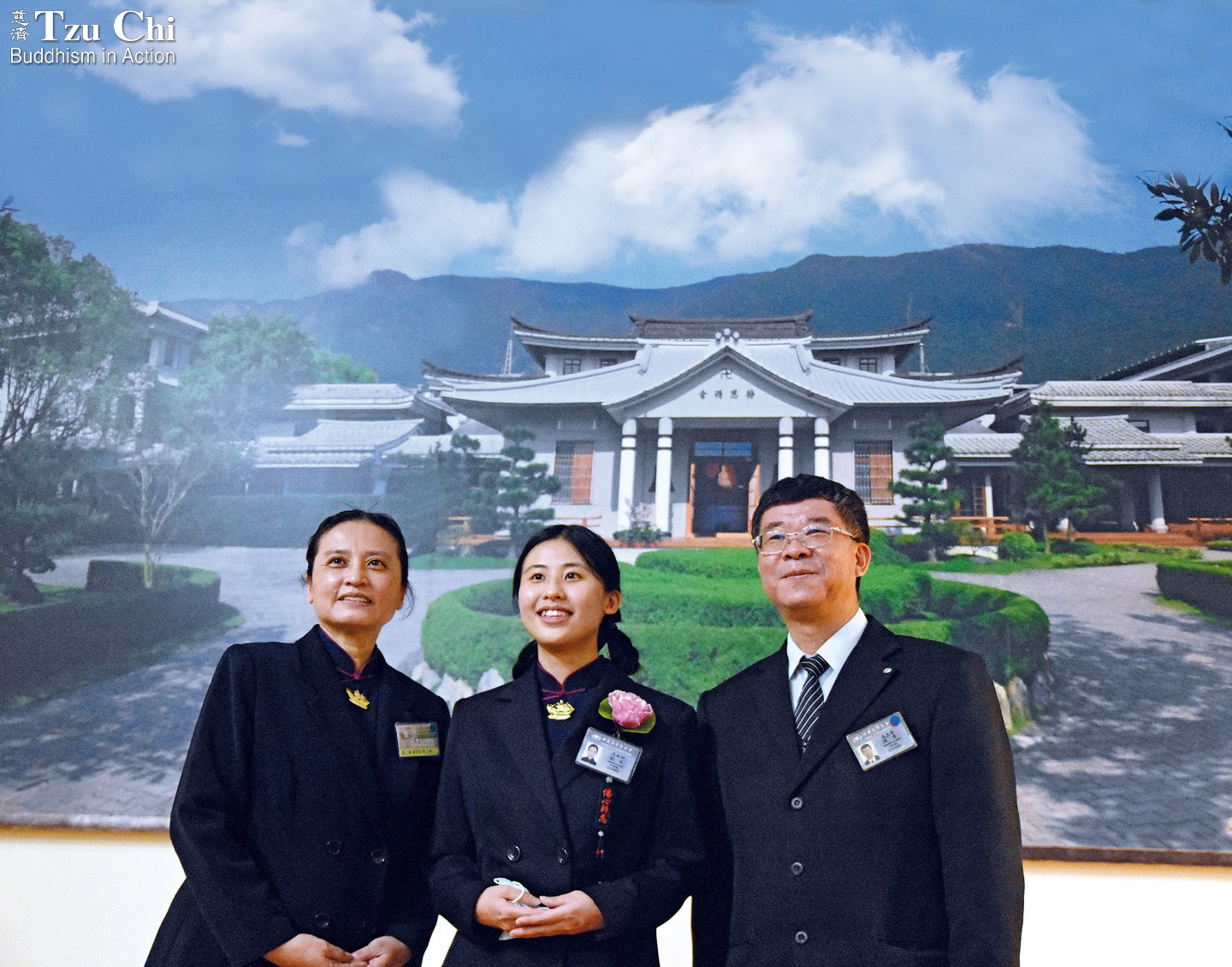
Accompanied by Tzu Chi volunteers in her community, Gao Xin-yu (高昕妤, middle) completed her volunteer training in 2021. She received her certification from Dharma Master Cheng Yen at the end of the same year. In the background is a picture of the Jing Si Abode. Xu Jin-fu

Alone or with a group?

What led me to join a service organization like the Tzu Chi Collegiate Association?

In college, I saw a world dominated by capitalism, making some rich while forcing others to live in deprivation. How could the impoverished change their fortunes for the better? Even getting a good education was no guarantee that underprivileged children could escape the hardship in which their families were trapped. They needed help, a boost from society to rise above the disadvantages that kept them poor. It was my belief that organizations devoted to charity work were essential in helping people break the cycle of poverty.

Dharma Master Cheng Yen was wise in establishing a system through which the rich are encouraged to give to the poor—she helps people who are relatively well-off realize that everyone has a responsibility to help bring about a better society. I joined the Tzu Chi Collegiate Association because it was through such a group I could best help people in need.

After I graduated from college and began working as an elementary school teacher, my mother—who is a certified Tzu Chi volunteer—would often ask me if I’d like to train to become a certified volunteer too. But I wasn’t in a hurry to do so. I was still young and felt there was plenty of time in my future to train and receive my certification. Even though I was untrained and uncertified, I had never stopped volunteering for Tzu Chi. I felt that was enough.

During this time, I began wondering whether it was necessary to join an organization to do good. I pondered the difference between doing good on one’s own and with a group. After some thought, I decided that the strength of one person is necessarily limited, whether it be providing disaster relief or caring for the needy. An individual working alone can get tired, or may be uncertain how to best help those in need. But if you are in a group like Tzu Chi, you have fellow volunteers to help you when you are tired, to guide you back on track when you are straying off course, and to talk to when you are unsure about yourself. There is truth in the old saying that there is strength in numbers.

Even though I was already volunteering for Tzu Chi and no stranger to the work they did, my participation would always be limited if I didn’t train and become a full-fledged volunteer. I would even be unqualified to do certain work. Once I realized this, training to be a certified volunteer became important. It would allow me to contribute more. Besides, Master Cheng Yen was getting old. I didn’t want to miss the opportunity of receiving my certification from her. That was why I decided to begin training.

Being a teacher kept me very busy, but attending training made my life even busier. Taiwan experienced a sudden outbreak of the coronavirus during the course of my training, and our in-person training classes were moved online. Other activities, such as volunteering at a Tzu Chi hospital or visiting the needy, were also cancelled. I was worried that my training wasn’t as solid as it should have been, but I was happy at the same time that I had started volunteering for Tzu Chi when I was in college and already had some understanding of the foundation.

Even though some of our training events—as well as many Tzu Chi activities— were cancelled due to the pandemic, our hands weren’t completely tied. On the contrary, it created some opportunities and possibilities. For instance, our volunteers became much more versed at using digital tools to promote and carry out Tzu Chi work. This also made it a lot easier to communicate with some older volunteers. My mother is a good example. She didn’t know much about using technology before the pandemic, but now can expertly lead an online study group.

After Typhoon Nepartak hit Taitung, eastern Taiwan, in 2016, Gao Xin-yu and her fellow members of the Tzu Chi Collegiate Association held a summer camp and provided care to students at Malan Elementary School in Taitung. Zhan Jin-de

Original aspirations

During that outbreak of domestic COVID cases in Taiwan, all schools were temporarily closed and instruction continued online. The shift to remote learning in mid-May 2021 negatively impacted some students’ learning. To help remedy the situation, Tzu Chi partnered with PaGamO, an educational platform that uses online gaming to foster learning, to launch an online learning program during the summer vacation. In the program, college students were enlisted to tutor elementary and secondary school students from disadvantaged families. As a Tzu Chi volunteer and teacher, I naturally had to give my full support to the program. I volunteered as a tutor and was glad to have the opportunity to serve. I knew I’d learn from the experience too. The tutoring program continued even when summer vacation ended and in-person classes resumed. I continued serving as a tutor for the program too, using my free time from work. I also helped improve the curriculum with other program tutors and interacted with parents.

One time I shared with my online students the importance of environmental protection. To make the topic more interesting and accessible, I started by asking them why people needed to clean drainage ditches when a typhoon was coming and what they usually found in the ditches. Such questions led the youngsters to wonder why there was so much garbage in ditches, how the garbage could cause blockage and flooding, and how, when washed out into the ocean, the trash could harm marine creatures such as sea turtles. My students were highly responsive and I found it easy to engage them because we were discussing topics related to their lives or to current issues. Some children became so invested they were unwilling to sign off even when I had dismissed a class. They wanted to stay on and chat with me.

Because of my background in special education, I was asked to accompany students with special needs when the summer vacation ended and a new semester began. One of the children assigned to me had difficulty focusing in class and struggled to learn new concepts. Online classes were difficult for him. One day during a class, when the student was again obviously distracted, I happened to see what was going on in the background. His siblings were running around naked, while his father was lying on his back, his eyes glued to a smartphone. I also caught the haggard, anxious look of the mother, who had enrolled her son in the program.

I suddenly realized that as far as this family was concerned, the boy’s school work could no longer take priority over what was going on in the home. I reported the family’s situation to our team and suggested that volunteers visit the family to find out if they were getting by okay and if they needed any assistance. To help the child, perhaps we needed to help the family first.

Once, because I was busy at work, I couldn’t immediately call back the mother of a child I was tutoring. The mother was unhappy when I called her. I was angry too, thinking to myself, “Why couldn’t she be more considerate? Didn’t she know I was busy?” I was really upset in that moment, but I did my best to stay calm by reminding myself of my original aspirations that had set me on the path of volunteering. I tried to put myself in the mother’s shoes too, and gradually I was better able to see things from her perspective. I realized I was facing a mother who was worried about her kid’s education and who probably didn’t know how to tactfully express her thoughts and feelings. After that, I felt a lot better. I calmly said to her, “Don’t worry. We’ll be sure to take care of that for you.”

Oftentimes we feel hurt in interpersonal relationships because we are expecting something different from the person with whom we are dealing. In most instances, no one really hurts you; they just fail to meet your expectations. I’ve since learned not to let my emotions get the better of me. Instead, I try to focus on what is really the problem at hand and address that issue.
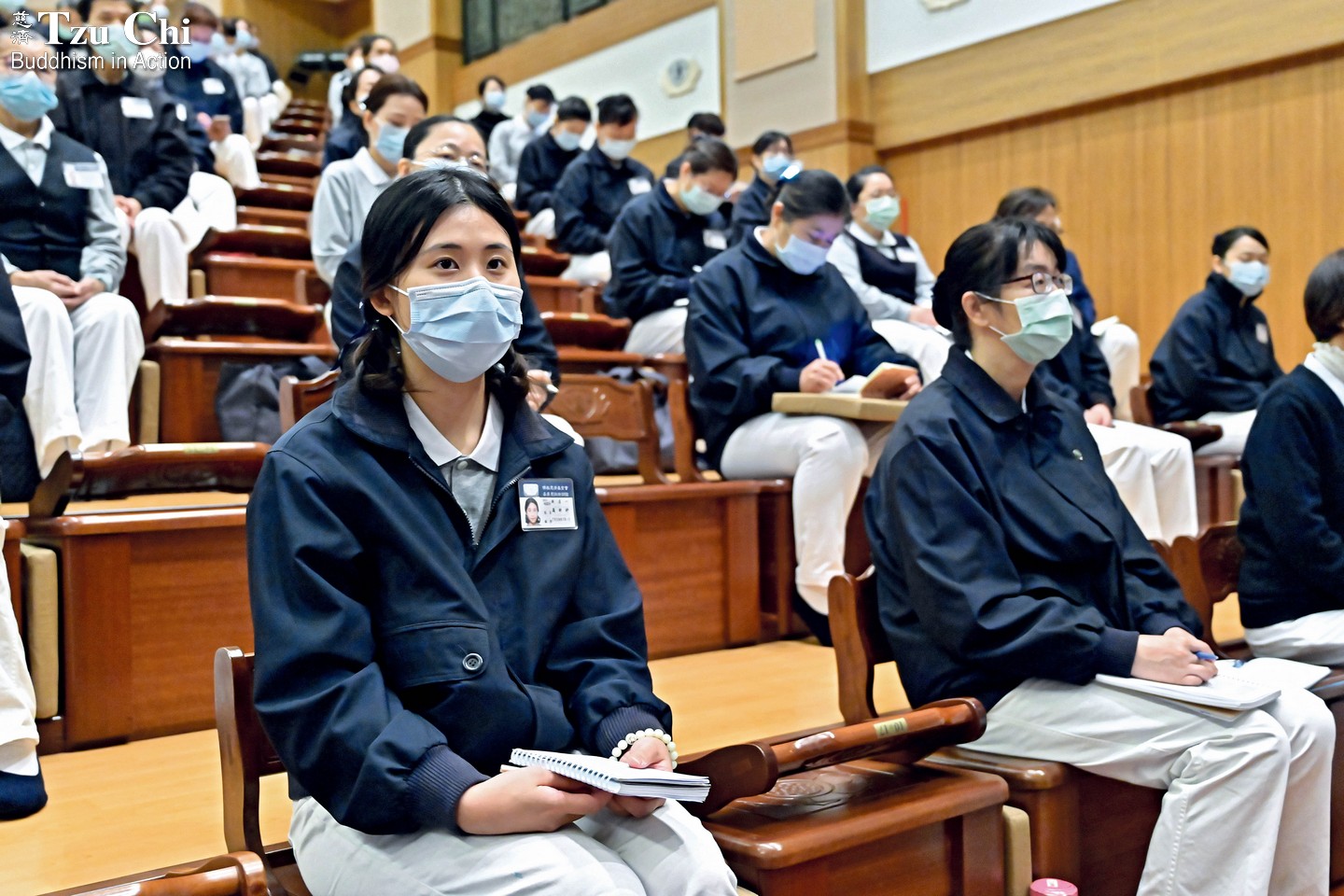
Gao attended a volunteer training class before an outbreak of COVID-19 in Taiwan in 2021 forced such physical events to grind to a halt. Lin Hong-mou

Living each day like it was my last

My schedule is now packed each day. I arrive at work every morning at eight and usually it isn’t until ten at night that I can unwind from the day. I have a lot on my plate, but I have also learned how to more efficiently use my time. Even though I had more free time on my hands in the past, I tended to procrastinate. Now that I know what I am doing has great significance, I’m better able to manage my time and map out my schedule more precisely. I do my best to increase my efficiency, living each day like it was my last.

When things happen that make me feel tired and down, I turn to Master Cheng Yen’s teachings for guidance and inspiration. Her teachings are like a guidebook for life, but you must personally live them out to really benefit from them. At 27, I’m younger than many other volunteers, so their life stories, experiences, and perceptions about life also provide precious lessons from which I can learn. I don’t have to experience the pain or tribulations they went through to learn those lessons. I’m thankful to them for the wisdom they impart with their words or personal examples.

With the help of the Buddha’s teachings, we in Tzu Chi are expected to constantly refine ourselves until we are each like a grain of rice with the chaff removed. Master Cheng Yen also expects the younger generations in Tzu Chi to bravely shoulder the responsibility of the world. For a time, the weight of that responsibility bore down on me—I felt I had taken on a hefty mission. But then I thought through it and realized I was putting undue pressure on myself. I am an elementary school teacher. I can live up to the Master’s expectations by mindfully guiding my students. Through education, I can play a role in helping them transform themselves into grains of rice free of chaff, and become adults that know how to give back to the society that has nurtured them. This is one way of shouldering the responsibility of the world.

The Tzu Chi volunteer uniform that I wear symbolizes the path of goodness the volunteers before me have paved. It’s an honor to wear it. I thank every volunteer for paving the road ahead of me and for sharing their life experiences and stories with me. The more I learn in Tzu Chi, the more I can share with others. Becoming a certified volunteer is like obtaining a key to the door that leads to goodness. It’s now my mission to help carry out Master Cheng Yen’s ideals and the charity work of Tzu Chi.

—Gao Xin-yu

Interviewed and compiled by Liao Zhe-min
Translated by Wu Hsiao-ting

Must you join an organization to do good? Not necessarily. But there is only so much a person working alone can do, whether it be providing disaster relief or caring for the needy. There is truth in the old saying that there is strength in numbers.

I was a member of the Tzu Chi Collegiate Association when I was in college. I participated in a lot of volunteer work, including tutoring underprivileged students, cleaning beaches and mountains, and helping typhoon victims. The work that left the deepest impression on me was a cultural exchange activity with students who lived in remote villages in Guizhou Province, China, and who were receiving tuition aid from Tzu Chi. That was my first trip out of Taiwan; I was curious about any place outside of Taiwan, and Guizhou was no exception.

The places I visited in Guizhou lived up to my only impression of life in remote areas: travel there was inconvenient. Living conditions there were also subpar. Mere thunderbolts could cripple a town’s electrical grid and leave the entire area without power. When it rained outside, it rained inside in some homes too. The mountain villages in Guizhou might be like veritable Shangri-las to tourists, but the locals had to contend with a lack of resources, day in and day out.

Despite such deprivations, I discovered that the local folk were content and happy. They didn’t feel their lives were more backward than others’. They were, in a nutshell, at peace and ease with their lives. Given their situation, their outlook came as a surprise to me, and planted in me the seeds of a new perspective. It changed how I looked at poverty.

Accompanied by Tzu Chi volunteers in her community, Gao Xin-yu (高昕妤, middle) completed her volunteer training in 2021. She received her certification from Dharma Master Cheng Yen at the end of the same year. In the background is a picture of the Jing Si Abode. Xu Jin-fu

Alone or with a group?

What led me to join a service organization like the Tzu Chi Collegiate Association?

In college, I saw a world dominated by capitalism, making some rich while forcing others to live in deprivation. How could the impoverished change their fortunes for the better? Even getting a good education was no guarantee that underprivileged children could escape the hardship in which their families were trapped. They needed help, a boost from society to rise above the disadvantages that kept them poor. It was my belief that organizations devoted to charity work were essential in helping people break the cycle of poverty.

Dharma Master Cheng Yen was wise in establishing a system through which the rich are encouraged to give to the poor—she helps people who are relatively well-off realize that everyone has a responsibility to help bring about a better society. I joined the Tzu Chi Collegiate Association because it was through such a group I could best help people in need.

After I graduated from college and began working as an elementary school teacher, my mother—who is a certified Tzu Chi volunteer—would often ask me if I’d like to train to become a certified volunteer too. But I wasn’t in a hurry to do so. I was still young and felt there was plenty of time in my future to train and receive my certification. Even though I was untrained and uncertified, I had never stopped volunteering for Tzu Chi. I felt that was enough.

During this time, I began wondering whether it was necessary to join an organization to do good. I pondered the difference between doing good on one’s own and with a group. After some thought, I decided that the strength of one person is necessarily limited, whether it be providing disaster relief or caring for the needy. An individual working alone can get tired, or may be uncertain how to best help those in need. But if you are in a group like Tzu Chi, you have fellow volunteers to help you when you are tired, to guide you back on track when you are straying off course, and to talk to when you are unsure about yourself. There is truth in the old saying that there is strength in numbers.

Even though I was already volunteering for Tzu Chi and no stranger to the work they did, my participation would always be limited if I didn’t train and become a full-fledged volunteer. I would even be unqualified to do certain work. Once I realized this, training to be a certified volunteer became important. It would allow me to contribute more. Besides, Master Cheng Yen was getting old. I didn’t want to miss the opportunity of receiving my certification from her. That was why I decided to begin training.

Being a teacher kept me very busy, but attending training made my life even busier. Taiwan experienced a sudden outbreak of the coronavirus during the course of my training, and our in-person training classes were moved online. Other activities, such as volunteering at a Tzu Chi hospital or visiting the needy, were also cancelled. I was worried that my training wasn’t as solid as it should have been, but I was happy at the same time that I had started volunteering for Tzu Chi when I was in college and already had some understanding of the foundation.

Even though some of our training events—as well as many Tzu Chi activities— were cancelled due to the pandemic, our hands weren’t completely tied. On the contrary, it created some opportunities and possibilities. For instance, our volunteers became much more versed at using digital tools to promote and carry out Tzu Chi work. This also made it a lot easier to communicate with some older volunteers. My mother is a good example. She didn’t know much about using technology before the pandemic, but now can expertly lead an online study group.

After Typhoon Nepartak hit Taitung, eastern Taiwan, in 2016, Gao Xin-yu and her fellow members of the Tzu Chi Collegiate Association held a summer camp and provided care to students at Malan Elementary School in Taitung. Zhan Jin-de

Original aspirations

During that outbreak of domestic COVID cases in Taiwan, all schools were temporarily closed and instruction continued online. The shift to remote learning in mid-May 2021 negatively impacted some students’ learning. To help remedy the situation, Tzu Chi partnered with PaGamO, an educational platform that uses online gaming to foster learning, to launch an online learning program during the summer vacation. In the program, college students were enlisted to tutor elementary and secondary school students from disadvantaged families. As a Tzu Chi volunteer and teacher, I naturally had to give my full support to the program. I volunteered as a tutor and was glad to have the opportunity to serve. I knew I’d learn from the experience too. The tutoring program continued even when summer vacation ended and in-person classes resumed. I continued serving as a tutor for the program too, using my free time from work. I also helped improve the curriculum with other program tutors and interacted with parents.

One time I shared with my online students the importance of environmental protection. To make the topic more interesting and accessible, I started by asking them why people needed to clean drainage ditches when a typhoon was coming and what they usually found in the ditches. Such questions led the youngsters to wonder why there was so much garbage in ditches, how the garbage could cause blockage and flooding, and how, when washed out into the ocean, the trash could harm marine creatures such as sea turtles. My students were highly responsive and I found it easy to engage them because we were discussing topics related to their lives or to current issues. Some children became so invested they were unwilling to sign off even when I had dismissed a class. They wanted to stay on and chat with me.

Because of my background in special education, I was asked to accompany students with special needs when the summer vacation ended and a new semester began. One of the children assigned to me had difficulty focusing in class and struggled to learn new concepts. Online classes were difficult for him. One day during a class, when the student was again obviously distracted, I happened to see what was going on in the background. His siblings were running around naked, while his father was lying on his back, his eyes glued to a smartphone. I also caught the haggard, anxious look of the mother, who had enrolled her son in the program.

I suddenly realized that as far as this family was concerned, the boy’s school work could no longer take priority over what was going on in the home. I reported the family’s situation to our team and suggested that volunteers visit the family to find out if they were getting by okay and if they needed any assistance. To help the child, perhaps we needed to help the family first.

Once, because I was busy at work, I couldn’t immediately call back the mother of a child I was tutoring. The mother was unhappy when I called her. I was angry too, thinking to myself, “Why couldn’t she be more considerate? Didn’t she know I was busy?” I was really upset in that moment, but I did my best to stay calm by reminding myself of my original aspirations that had set me on the path of volunteering. I tried to put myself in the mother’s shoes too, and gradually I was better able to see things from her perspective. I realized I was facing a mother who was worried about her kid’s education and who probably didn’t know how to tactfully express her thoughts and feelings. After that, I felt a lot better. I calmly said to her, “Don’t worry. We’ll be sure to take care of that for you.”

Oftentimes we feel hurt in interpersonal relationships because we are expecting something different from the person with whom we are dealing. In most instances, no one really hurts you; they just fail to meet your expectations. I’ve since learned not to let my emotions get the better of me. Instead, I try to focus on what is really the problem at hand and address that issue.

Gao attended a volunteer training class before an outbreak of COVID-19 in Taiwan in 2021 forced such physical events to grind to a halt. Lin Hong-mou

Living each day like it was my last

My schedule is now packed each day. I arrive at work every morning at eight and usually it isn’t until ten at night that I can unwind from the day. I have a lot on my plate, but I have also learned how to more efficiently use my time. Even though I had more free time on my hands in the past, I tended to procrastinate. Now that I know what I am doing has great significance, I’m better able to manage my time and map out my schedule more precisely. I do my best to increase my efficiency, living each day like it was my last.

When things happen that make me feel tired and down, I turn to Master Cheng Yen’s teachings for guidance and inspiration. Her teachings are like a guidebook for life, but you must personally live them out to really benefit from them. At 27, I’m younger than many other volunteers, so their life stories, experiences, and perceptions about life also provide precious lessons from which I can learn. I don’t have to experience the pain or tribulations they went through to learn those lessons. I’m thankful to them for the wisdom they impart with their words or personal examples.

With the help of the Buddha’s teachings, we in Tzu Chi are expected to constantly refine ourselves until we are each like a grain of rice with the chaff removed. Master Cheng Yen also expects the younger generations in Tzu Chi to bravely shoulder the responsibility of the world. For a time, the weight of that responsibility bore down on me—I felt I had taken on a hefty mission. But then I thought through it and realized I was putting undue pressure on myself. I am an elementary school teacher. I can live up to the Master’s expectations by mindfully guiding my students. Through education, I can play a role in helping them transform themselves into grains of rice free of chaff, and become adults that know how to give back to the society that has nurtured them. This is one way of shouldering the responsibility of the world.

The Tzu Chi volunteer uniform that I wear symbolizes the path of goodness the volunteers before me have paved. It’s an honor to wear it. I thank every volunteer for paving the road ahead of me and for sharing their life experiences and stories with me. The more I learn in Tzu Chi, the more I can share with others. Becoming a certified volunteer is like obtaining a key to the door that leads to goodness. It’s now my mission to help carry out Master Cheng Yen’s ideals and the charity work of Tzu Chi.

—Gao Xin-yu
關鍵字

No One Is More Convincing Than Me—Zeng Qi-xiong and Jiang Yong-xu
By Shi Yu-fang
Edited and translated by Wu Hsiao-ting

Paralyzed by accidents, they used to spend their days in bed, staring at the ceiling and seeing no hope for tomorrow. Now they volunteer outside of their homes, bringing their courage and resilience to those they meet. Their powerful examples encourage others to overcome adversity.

November 21, 2021, was a special, joyful day for Zeng Qi-xiong (曾啟雄) and Jiang Yong-xu (江永旭). That was the day they both received their volunteer certifications from Dharma Master Cheng Yen. The two men are about the same age, just three years apart, but what gives them a special connection is that both are wheelchair bound and were once bedridden with spinal injuries. They were like snails, withdrawn into their shells. Those days were dark indeed. They saw no hope for themselves and no way out, struggling with depression and even contemplating suicide—that is, until Tzu Chi volunteers entered their lives. It was those volunteers that encouraged them and helped them turn their lives around.

“If you want to see yourself change,” said Zeng Qi-xiong, “maybe Tzu Chi is just the place for you!”

Jiang Yong-xu chimed in, “I told myself, ‘If others can do it, so can I!’”

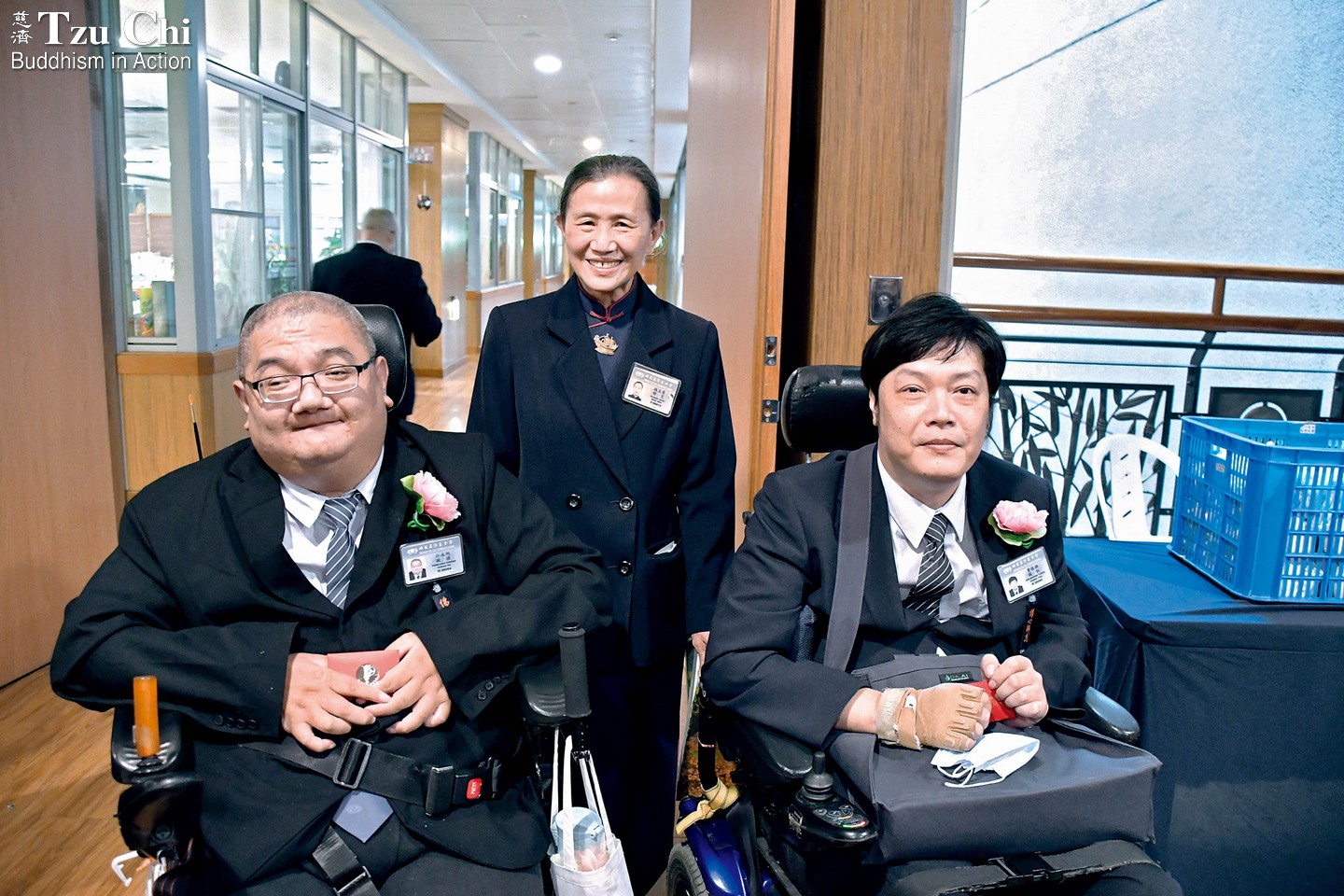
Zeng Qi-xiong (right) and Jiang Yong-xu (left), both spinal injury patients, received their Tzu Chi volunteer certifications in November 2021. Volunteer Sun Yu-gui (middle), who has provided care for them for years, wished them the best. Shi Long-wen

Tears and blood

Zeng Qi-xiong was raised by his grandma. When he was 22, he was on his way to work at a construction site when he was involved in a traffic accident, suffering a cervical spine injury. Paralyzed from the neck down, his life was derailed in an instant. In order to raise money to treat him, his father, Zeng Ze-qing (曾澤清), sold the house they were living in and their ancestral home. Despite valiant attempts at rehabilitation, Qi-xiong made little progress. He and his father were so distressed at the lack of progress they wanted to take their own lives.

When their money was all gone, Ze-qing moved with his mother and son from Taipei, northern Taiwan, to a rental in Taichung, central Taiwan. That was in 2003, two years after the traffic accident. To help his son acquire a skill, Ze-qing arranged for Qi-xiong to begin learning computer-aided design (CAD). During that time, Ze-qing had to take care of not only his son but also his mother, who was succumbing to dementia. All of this was on top of having to be the breadwinner to support his family. He was burning the candle at both ends.

The family’s situation was eventually brought to Tzu Chi’s attention. Volunteers visited the family to determine how the foundation could help. Sun Yu-gui (孫玉貴), one of the volunteers, had never been assigned to care for a paralyzed person before. She vividly remembered the first time she saw Qi-xiong. He was almost completely immobilized from the neck down. Though he could still move his hands a little, they weren’t strong enough to grip anything. He had to rely on his father for his daily needs, including getting dressed and changing his diapers.

“He is still so young,” Sun thought. “Will he have to spend the rest of his life confined to a bed?” She knew of some spinal injury patients who, after physical therapy, were able to take care of themselves. She hoped she could help the young man rebuild his life. Ze-qing, however, didn’t take well to the volunteers’ intentions to help. He felt his family could get by on their own strength and so he turned down the foundation’s offer of financial aid. He told the volunteers his son had been learning CAD for some time, and that as long as he could find work, he’d have no problem supporting himself. Later, when the volunteers came to their house for a visit, he’d leave to avoid having to see or talk to them.

Sun and her fellow volunteers persisted though. They kept up their visits and continued to show their care for Qi-xiong. Their persistence eventually won the father over. A visit on a Chinese New Year’s Eve, an important time for family gatherings, moved Ze-qing so much that he stopped leaving his home to avoid them. He still refused to accept Tzu Chi’s financial assistance, but he had at least opened his heart to the volunteers’ care and support.

Sun’s son happened to work in the field of computer-aided design, so she asked him if he could give Qi-xiong any help. He gifted Qi-xiong some CAD tools and even promised to sub-contract work out to him. Qi-xiong worked hard and successfully obtained four professional licenses. Sadly, his hands were still too weak to manipulate the computer input devices required for CAD, so he eventually was forced to give up trying to make a living in this field.

Sun felt really bad for Qi-xiong, that a possible way out had turned out to be a dead end for him. She racked her brains trying to think of how else she could help him.

One time, she and her fellow volunteers went to visit the family again. They repeatedly knocked on the door but received no response, even though they seemed to hear some indistinct sounds made by Qi-xiong’s grandmother through the door. Anxious that something untoward might have happened, they felt they had no choice but to ask a locksmith to come and open the door for them. After they entered, they learned that Ze-qing had passed out after throwing up blood, but had eventually regained consciousness and left for the hospital on his own, leaving Qi-xiong and his grandma shut up inside. Now Sun became deeply worried about the family. She urged Qi-xiong to face up to the fact that his father wouldn’t be able to take care of him forever.

Ze-qing was diagnosed with a duodenal ulcer. He was also at the time suffering from a medical condition called facial nerve paralysis. Qi-xiong had a rude awakening. He decided that he really needed to pull himself together and work harder to become independent instead of continuing to be a burden on his father. He picked up the pace of his physical therapy, and eventually he was able to turn himself and get out of bed unassisted.

Taking a suggestion made by friends, he decided to give painting a try. Since his hands were powerless to wield a paintbrush, he practiced by holding a brush or palette knife in his mouth. Ruan Li-ying (阮麗英), a painting teacher, started by teaching him the basics. A lot of sweat and blood was involved in Qi-xiong’s artistic journey. Without the use of his arms, he had to use brushes with extra-long handles so that he would not have to lean his neck and upper body too far forward to reach the canvas. His father used a bamboo chopstick to make a brush longer, but when Qi-xiong bit on it and turned it to paint, it sometimes pricked his mouth, causing lesions.

Qi-xiong kept at it and didn’t give up, but despite his best efforts, he began to wonder whether all his work was worth it. He wondered if he even had a talent for painting. His works always looked dark and cheerless.

Sun thought of enlisting the help of a famous mouth painter named Xie Kun-shan (謝坤山). She hoped he could give Qi-xiong some encouragement and share a few pointers with him. At her invitation, Xie called on Qi-xiong, and followed up with two more visits. He shared his life story with Qi-xiong, taught him to distinguish between warm and cool colors, and suggested he hone his skills by drawing still lifes. Qi-xiong forged ahead, and his hard work paid off. Eight years after he began painting, he was admitted into the Association of Mouth and Foot Painting Artists of the World, and began receiving a regular subsidy for buying pigments.

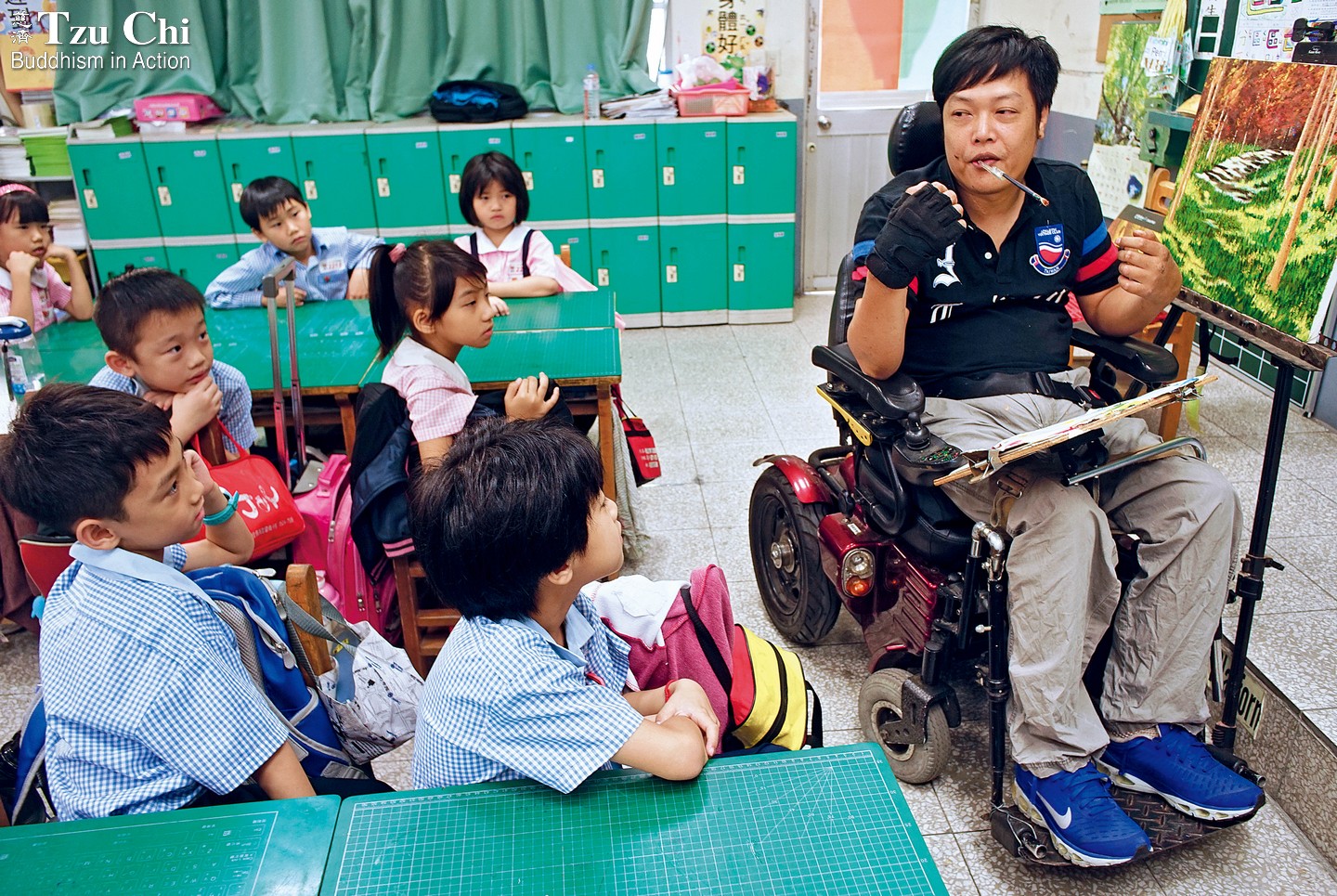
Zeng Qi-xiong shares his life story with schoolchildren to help them realize that everyone has unlimited potential. Lin Yan-huang

Confined to bed for 15 years

In 2015, Sun was asked to provide care for another spinal injury patient. When she saw the photos of Jiang Yong-xu, his legs covered in sores, her heart ached so much she couldn’t sleep that night. She tried very hard to think of what she could do to help him.

On her first visit to Yong-xu’s home, she saw him lying in a bed in the living room. His legs, which had lost all feeling, were completely stiff, and they would start to bleed with the slightest movement. They were in such bad shape due to lack of activity and poor circulation. His toenails dropped off at a touch. The application of topical medicine hadn’t helped.

Yong-xu had been cared for by his parents, who also needed to baby-sit their three young grandchildren. Yong-xu’s mother even needed to do odd jobs to help support the family. With their hands full, it was beyond them to take Yong-xu out regularly for medical attention. Sun said to the family after learning of their plight, “It’s okay. Since you can’t take Yong-xu out, let’s ask a doctor to come visit.”

Sun requested help from Taichung Tzu Chi Hospital. Superintendent Chien Sou-hsin (簡守信) personally visited Yong-xu and cleaned and dressed his sores. Medical professionals from the hospital continued to visit after that and taught Yong-xu’s parents how to care for his sores. Sometimes they even visited after work to chat with Yong-xu. Yong-xu and his family were surprised, saying, “You guys work really hard, don’t you?”

Yong-xu recalled how he had become paralyzed at age 19 after falling from a high place at work and sustaining an injury to his cervical spine. He hit rock bottom after the accident, feeling that he was done for. His legs gradually became so stiff he couldn’t even sit in a wheelchair. When Sun first visited him in 2015, he had been confined to his bed for 15 years.

In addition to treating his legs, people from Taichung Tzu Chi Hospital arranged for Yong-xu to receive physical therapy at the hospital. Dr. Cai Sen-wei (蔡森蔚), a physiatrist, visited Yong-xu’s home to determine if they needed to help create a barrier-free environment so that it’d be easier for Yong-xu to leave his home and go to the hospital for regular physiotherapy sessions. Afterwards, Yong-xu was hospitalized for a week for treatment on his leg sores and for rehabilitation. He was also given a power wheelchair to help him move around.

Sun encouraged him to work hard at his physical therapy so that he could regain some of his physical functions. Given the stiffness of his body, he made slow progress, and it was easy to get disheartened. To cheer him on, Sun asked Qi-xiong for help. “He had lain in bed for more than ten years,” she said to Qi-xiong. “I hope you can visit him. Maybe you can help light a spark within him.”

Qi-xiong visited him as requested. Yong-xu was surprised when he learned that Qi-xiong, a spinal injury patient like him, had driven a car to see him. “How can this man get around so easily on his own?” Yong-xu thought to himself. His mother was surprised too, asking, “Can he really drive?”

“He sure can,” Sun said. “And Yong-xu is younger than he. I believe he might be able to drive in the future too.”

The two men had a great time with each other. Yong-xu was so encouraged to see a quadriplegic like him move around so independently and even able to help support his family he decided to do his best at rehabilitation and be a good patient. In addition to treatment with Western medicine, he received acupuncture to complement his physiotherapy.

Since Yong-xu’s parents were getting on in years, Sun began thinking it was important for him to learn to make a living. She encouraged him to take up painting like Qi-xiong. As it turned out, Yong-xu was quite talented. Three years after he began drawing with his mouth, Chang Gung Memorial Hospital started collecting his works and providing him a regular income. Superintendent Chien Sou-hsin was so happy for him. Yong-xu is now able to support himself with his paintings and by selling dried fruits. His life is once again imbued with possibilities.

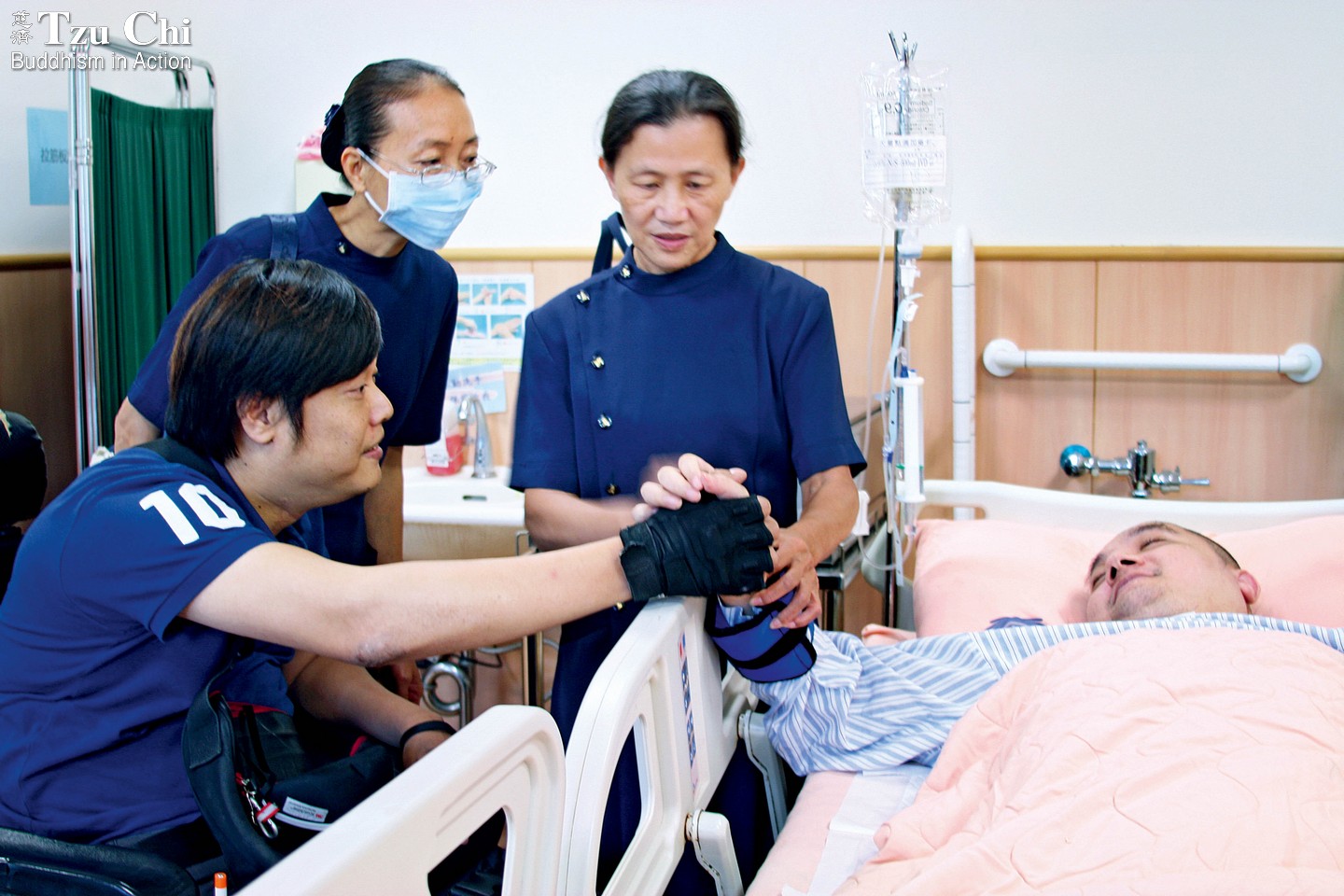
Zeng Qi-xiong visits Jiang Yong-xu at his bedside to cheer him on. Zeng Xiu-ying

Embarking together on the Bodhisattva Path

Qi-xiong and Yong-xu got to know each other because of their spinal injuries. They became good friends and even embarked together on the Bodhisattva Path.

“During those years when I was bedridden,” Yong-xu remembered, “I was like a prisoner powerless to break free from the walls that confined me. All I did every day was eat and wait to die. I lashed out at my family when my spirits were low, and all words of encouragement fell dead on my ears.” He was therefore deeply grateful to Tzu Chi for helping light shine into his life again.

At the encouragement of Superintendent Chien, Yong-xu started training in 2020 to become a certified volunteer. Qi-xiong signed up for volunteer training at the encouragement of Sun too. The two of them attended training classes, including online ones when physical classes were cancelled due to the coronavirus pandemic. They also took part in home visits to the needy. They even went to schools to share their life stories—they wanted to encourage others to not be defeated by life’s tribulations.

“I’ve received so much encouragement and such good care from Sun and other volunteers along the way,” said Qi-xiong. “I know full well the efforts put in by Tzu Chi to help the needy, and was inspired to join their ranks.” He explained that he had wanted to train to be certified over ten years ago. “I hoped to one day be able to help others, to visit and care for disadvantaged or sick people, and to contribute what little strength I have.”

His eyes welled up with tears when he received his certification from Dharma Master Cheng Yen. “Previously, my circumstances were such that I couldn’t fulfill my wish to train and be certified. Now my wish has finally come true! People like me have our limitations—we cannot get around as freely as others, but maybe we will be more convincing when it comes to offering encouragement to people who are ill, injured, or have limited mobility because we have similar experiences. That gives us an advantage over able-bodied people.”

“My hope for life was reignited,” Yong-xu said. “Now I want to bring my light to more people. I will pay forward the love Tzu Chi volunteers have given me.”

Stepping into a new phase in their lives, they are out to spread love and continue the cycle of goodness.

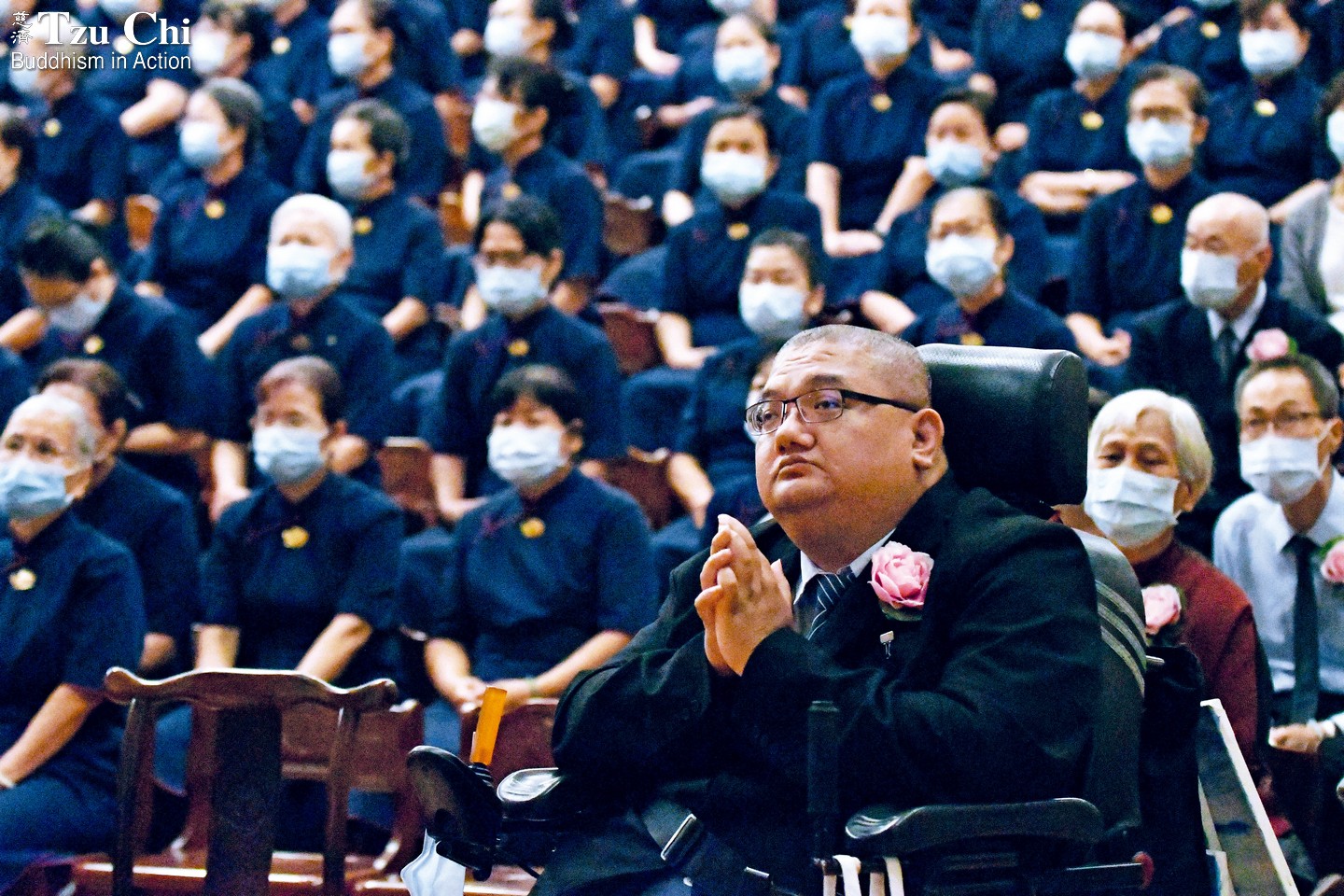
Looking back on his journey from a bedridden quadriplegic to a Tzu Chi volunteer, Jiang Yong-xu is full of gratitude to everyone who has helped him along the way. You Guo-lin

It was a joyful, emotional moment for me when I became Master Cheng Yen’s disciple. I’ve received the help of so many kind people. I’ll do like other Tzu Chi volunteers and contribute what I can.

—Zeng Qi-xiong

I’m full of thanks to Superintendent Chien and Tzu Chi volunteers for encouraging me to train to become a certified Tzu Chi volunteer. I hope I can inspire people with disabilities like me to never bow to fate and to bravely rise to challenges.

—Jiang Yong-xu

By Shi Yu-fang
Edited and translated by Wu Hsiao-ting

Paralyzed by accidents, they used to spend their days in bed, staring at the ceiling and seeing no hope for tomorrow. Now they volunteer outside of their homes, bringing their courage and resilience to those they meet. Their powerful examples encourage others to overcome adversity.

November 21, 2021, was a special, joyful day for Zeng Qi-xiong (曾啟雄) and Jiang Yong-xu (江永旭). That was the day they both received their volunteer certifications from Dharma Master Cheng Yen. The two men are about the same age, just three years apart, but what gives them a special connection is that both are wheelchair bound and were once bedridden with spinal injuries. They were like snails, withdrawn into their shells. Those days were dark indeed. They saw no hope for themselves and no way out, struggling with depression and even contemplating suicide—that is, until Tzu Chi volunteers entered their lives. It was those volunteers that encouraged them and helped them turn their lives around.

“If you want to see yourself change,” said Zeng Qi-xiong, “maybe Tzu Chi is just the place for you!”

Jiang Yong-xu chimed in, “I told myself, ‘If others can do it, so can I!’”

Zeng Qi-xiong (right) and Jiang Yong-xu (left), both spinal injury patients, received their Tzu Chi volunteer certifications in November 2021. Volunteer Sun Yu-gui (middle), who has provided care for them for years, wished them the best. Shi Long-wen

Tears and blood

Zeng Qi-xiong was raised by his grandma. When he was 22, he was on his way to work at a construction site when he was involved in a traffic accident, suffering a cervical spine injury. Paralyzed from the neck down, his life was derailed in an instant. In order to raise money to treat him, his father, Zeng Ze-qing (曾澤清), sold the house they were living in and their ancestral home. Despite valiant attempts at rehabilitation, Qi-xiong made little progress. He and his father were so distressed at the lack of progress they wanted to take their own lives.

When their money was all gone, Ze-qing moved with his mother and son from Taipei, northern Taiwan, to a rental in Taichung, central Taiwan. That was in 2003, two years after the traffic accident. To help his son acquire a skill, Ze-qing arranged for Qi-xiong to begin learning computer-aided design (CAD). During that time, Ze-qing had to take care of not only his son but also his mother, who was succumbing to dementia. All of this was on top of having to be the breadwinner to support his family. He was burning the candle at both ends.

The family’s situation was eventually brought to Tzu Chi’s attention. Volunteers visited the family to determine how the foundation could help. Sun Yu-gui (孫玉貴), one of the volunteers, had never been assigned to care for a paralyzed person before. She vividly remembered the first time she saw Qi-xiong. He was almost completely immobilized from the neck down. Though he could still move his hands a little, they weren’t strong enough to grip anything. He had to rely on his father for his daily needs, including getting dressed and changing his diapers.

“He is still so young,” Sun thought. “Will he have to spend the rest of his life confined to a bed?” She knew of some spinal injury patients who, after physical therapy, were able to take care of themselves. She hoped she could help the young man rebuild his life. Ze-qing, however, didn’t take well to the volunteers’ intentions to help. He felt his family could get by on their own strength and so he turned down the foundation’s offer of financial aid. He told the volunteers his son had been learning CAD for some time, and that as long as he could find work, he’d have no problem supporting himself. Later, when the volunteers came to their house for a visit, he’d leave to avoid having to see or talk to them.

Sun and her fellow volunteers persisted though. They kept up their visits and continued to show their care for Qi-xiong. Their persistence eventually won the father over. A visit on a Chinese New Year’s Eve, an important time for family gatherings, moved Ze-qing so much that he stopped leaving his home to avoid them. He still refused to accept Tzu Chi’s financial assistance, but he had at least opened his heart to the volunteers’ care and support.

Sun’s son happened to work in the field of computer-aided design, so she asked him if he could give Qi-xiong any help. He gifted Qi-xiong some CAD tools and even promised to sub-contract work out to him. Qi-xiong worked hard and successfully obtained four professional licenses. Sadly, his hands were still too weak to manipulate the computer input devices required for CAD, so he eventually was forced to give up trying to make a living in this field.

Sun felt really bad for Qi-xiong, that a possible way out had turned out to be a dead end for him. She racked her brains trying to think of how else she could help him.

One time, she and her fellow volunteers went to visit the family again. They repeatedly knocked on the door but received no response, even though they seemed to hear some indistinct sounds made by Qi-xiong’s grandmother through the door. Anxious that something untoward might have happened, they felt they had no choice but to ask a locksmith to come and open the door for them. After they entered, they learned that Ze-qing had passed out after throwing up blood, but had eventually regained consciousness and left for the hospital on his own, leaving Qi-xiong and his grandma shut up inside. Now Sun became deeply worried about the family. She urged Qi-xiong to face up to the fact that his father wouldn’t be able to take care of him forever.

Ze-qing was diagnosed with a duodenal ulcer. He was also at the time suffering from a medical condition called facial nerve paralysis. Qi-xiong had a rude awakening. He decided that he really needed to pull himself together and work harder to become independent instead of continuing to be a burden on his father. He picked up the pace of his physical therapy, and eventually he was able to turn himself and get out of bed unassisted.

Taking a suggestion made by friends, he decided to give painting a try. Since his hands were powerless to wield a paintbrush, he practiced by holding a brush or palette knife in his mouth. Ruan Li-ying (阮麗英), a painting teacher, started by teaching him the basics. A lot of sweat and blood was involved in Qi-xiong’s artistic journey. Without the use of his arms, he had to use brushes with extra-long handles so that he would not have to lean his neck and upper body too far forward to reach the canvas. His father used a bamboo chopstick to make a brush longer, but when Qi-xiong bit on it and turned it to paint, it sometimes pricked his mouth, causing lesions.

Qi-xiong kept at it and didn’t give up, but despite his best efforts, he began to wonder whether all his work was worth it. He wondered if he even had a talent for painting. His works always looked dark and cheerless.

Sun thought of enlisting the help of a famous mouth painter named Xie Kun-shan (謝坤山). She hoped he could give Qi-xiong some encouragement and share a few pointers with him. At her invitation, Xie called on Qi-xiong, and followed up with two more visits. He shared his life story with Qi-xiong, taught him to distinguish between warm and cool colors, and suggested he hone his skills by drawing still lifes. Qi-xiong forged ahead, and his hard work paid off. Eight years after he began painting, he was admitted into the Association of Mouth and Foot Painting Artists of the World, and began receiving a regular subsidy for buying pigments.

Zeng Qi-xiong shares his life story with schoolchildren to help them realize that everyone has unlimited potential. Lin Yan-huang

Confined to bed for 15 years

In 2015, Sun was asked to provide care for another spinal injury patient. When she saw the photos of Jiang Yong-xu, his legs covered in sores, her heart ached so much she couldn’t sleep that night. She tried very hard to think of what she could do to help him.

On her first visit to Yong-xu’s home, she saw him lying in a bed in the living room. His legs, which had lost all feeling, were completely stiff, and they would start to bleed with the slightest movement. They were in such bad shape due to lack of activity and poor circulation. His toenails dropped off at a touch. The application of topical medicine hadn’t helped.

Yong-xu had been cared for by his parents, who also needed to baby-sit their three young grandchildren. Yong-xu’s mother even needed to do odd jobs to help support the family. With their hands full, it was beyond them to take Yong-xu out regularly for medical attention. Sun said to the family after learning of their plight, “It’s okay. Since you can’t take Yong-xu out, let’s ask a doctor to come visit.”

Sun requested help from Taichung Tzu Chi Hospital. Superintendent Chien Sou-hsin (簡守信) personally visited Yong-xu and cleaned and dressed his sores. Medical professionals from the hospital continued to visit after that and taught Yong-xu’s parents how to care for his sores. Sometimes they even visited after work to chat with Yong-xu. Yong-xu and his family were surprised, saying, “You guys work really hard, don’t you?”

Yong-xu recalled how he had become paralyzed at age 19 after falling from a high place at work and sustaining an injury to his cervical spine. He hit rock bottom after the accident, feeling that he was done for. His legs gradually became so stiff he couldn’t even sit in a wheelchair. When Sun first visited him in 2015, he had been confined to his bed for 15 years.

In addition to treating his legs, people from Taichung Tzu Chi Hospital arranged for Yong-xu to receive physical therapy at the hospital. Dr. Cai Sen-wei (蔡森蔚), a physiatrist, visited Yong-xu’s home to determine if they needed to help create a barrier-free environment so that it’d be easier for Yong-xu to leave his home and go to the hospital for regular physiotherapy sessions. Afterwards, Yong-xu was hospitalized for a week for treatment on his leg sores and for rehabilitation. He was also given a power wheelchair to help him move around.

Sun encouraged him to work hard at his physical therapy so that he could regain some of his physical functions. Given the stiffness of his body, he made slow progress, and it was easy to get disheartened. To cheer him on, Sun asked Qi-xiong for help. “He had lain in bed for more than ten years,” she said to Qi-xiong. “I hope you can visit him. Maybe you can help light a spark within him.”

Qi-xiong visited him as requested. Yong-xu was surprised when he learned that Qi-xiong, a spinal injury patient like him, had driven a car to see him. “How can this man get around so easily on his own?” Yong-xu thought to himself. His mother was surprised too, asking, “Can he really drive?”

“He sure can,” Sun said. “And Yong-xu is younger than he. I believe he might be able to drive in the future too.”

The two men had a great time with each other. Yong-xu was so encouraged to see a quadriplegic like him move around so independently and even able to help support his family he decided to do his best at rehabilitation and be a good patient. In addition to treatment with Western medicine, he received acupuncture to complement his physiotherapy.

Since Yong-xu’s parents were getting on in years, Sun began thinking it was important for him to learn to make a living. She encouraged him to take up painting like Qi-xiong. As it turned out, Yong-xu was quite talented. Three years after he began drawing with his mouth, Chang Gung Memorial Hospital started collecting his works and providing him a regular income. Superintendent Chien Sou-hsin was so happy for him. Yong-xu is now able to support himself with his paintings and by selling dried fruits. His life is once again imbued with possibilities.

Zeng Qi-xiong visits Jiang Yong-xu at his bedside to cheer him on. Zeng Xiu-ying

Embarking together on the Bodhisattva Path

Qi-xiong and Yong-xu got to know each other because of their spinal injuries. They became good friends and even embarked together on the Bodhisattva Path.

“During those years when I was bedridden,” Yong-xu remembered, “I was like a prisoner powerless to break free from the walls that confined me. All I did every day was eat and wait to die. I lashed out at my family when my spirits were low, and all words of encouragement fell dead on my ears.” He was therefore deeply grateful to Tzu Chi for helping light shine into his life again.

At the encouragement of Superintendent Chien, Yong-xu started training in 2020 to become a certified volunteer. Qi-xiong signed up for volunteer training at the encouragement of Sun too. The two of them attended training classes, including online ones when physical classes were cancelled due to the coronavirus pandemic. They also took part in home visits to the needy. They even went to schools to share their life stories—they wanted to encourage others to not be defeated by life’s tribulations.

“I’ve received so much encouragement and such good care from Sun and other volunteers along the way,” said Qi-xiong. “I know full well the efforts put in by Tzu Chi to help the needy, and was inspired to join their ranks.” He explained that he had wanted to train to be certified over ten years ago. “I hoped to one day be able to help others, to visit and care for disadvantaged or sick people, and to contribute what little strength I have.”

His eyes welled up with tears when he received his certification from Dharma Master Cheng Yen. “Previously, my circumstances were such that I couldn’t fulfill my wish to train and be certified. Now my wish has finally come true! People like me have our limitations—we cannot get around as freely as others, but maybe we will be more convincing when it comes to offering encouragement to people who are ill, injured, or have limited mobility because we have similar experiences. That gives us an advantage over able-bodied people.”

“My hope for life was reignited,” Yong-xu said. “Now I want to bring my light to more people. I will pay forward the love Tzu Chi volunteers have given me.”

Stepping into a new phase in their lives, they are out to spread love and continue the cycle of goodness.

Looking back on his journey from a bedridden quadriplegic to a Tzu Chi volunteer, Jiang Yong-xu is full of gratitude to everyone who has helped him along the way. You Guo-lin

It was a joyful, emotional moment for me when I became Master Cheng Yen’s disciple. I’ve received the help of so many kind people. I’ll do like other Tzu Chi volunteers and contribute what I can.

—Zeng Qi-xiong

I’m full of thanks to Superintendent Chien and Tzu Chi volunteers for encouraging me to train to become a certified Tzu Chi volunteer. I hope I can inspire people with disabilities like me to never bow to fate and to bravely rise to challenges.

—Jiang Yong-xu

關鍵字

Helping Families Impacted by Typhoon Rai

Text provided by Tzu Chi Philippines
Translated by Wu Hsiao-ting
Photos by Johnny Kwok

Super Typhoon Rai ravaged central and southern Philippines in mid-December 2021. Tzu Chi volunteers swung into action immediately afterward to deliver aid and hope.

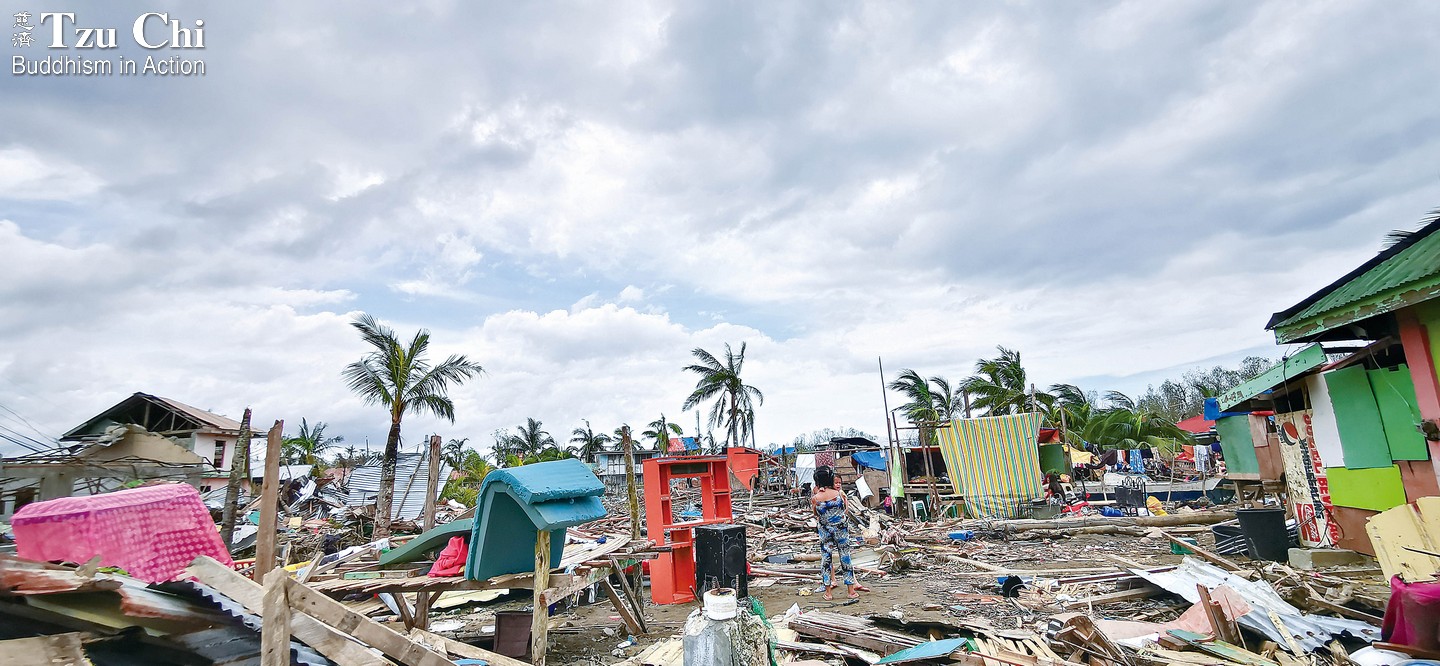
Typhoon Rai badly pummeled Bohol in the central Philippines. Its northern coastal areas, where the typhoon landed, were strewn with debris after the storm passed.

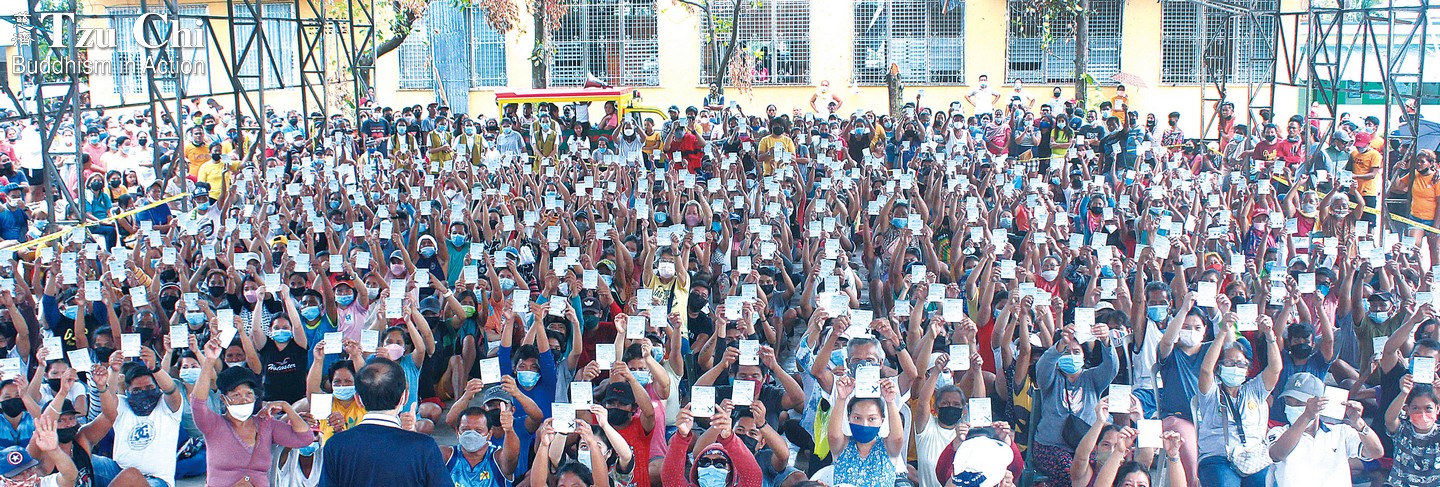
At a badly damaged school in Punta Engaño, Lapu-Lapu City, Cebu, the Philippines, more than a thousand people waiting quietly in line suddenly erupted into applause. Some even began crying tears of joy.

The outpouring of happiness and gratitude followed an announcement from a Tzu Chi volunteer regarding the amounts of financial aid the attendees would be receiving from the foundation. Each family would receive 10,000 to 20,000 pesos (US$195-390), depending on the size of the household. Normelita Nodalo said with tears coursing down her face: “I can’t believe that we’ll be receiving so much money from you! We don’t even know you and you don’t know us. For you to give us this much help is really touching!”

Reyno Igot, a polio victim, teared up too. “It’s expected to be three months before electricity is restored to the furniture store where I work,” he said. “If I didn’t bring home money, my three kids would starve.” The money from Tzu Chi would help see him through the difficulty he was facing after the severe disaster.

Typhoon Rai, known in the Philippines as Odette, hit the country on December 16, 2021, devastating seven provinces and resulting in more than 400 deaths. Over six million people were affected. It was the strongest storm to hit the country in 2021.

The Philippines is prone to typhoons. Even though alerts were issued and people evacuated before the storm struck, Rai still dealt a heavy blow to the country. It developed from a tropical depression to a super typhoon in just three days before barreling across the central and southern regions of the vast archipelago. Power outages ensued, cutting off communications in many areas.

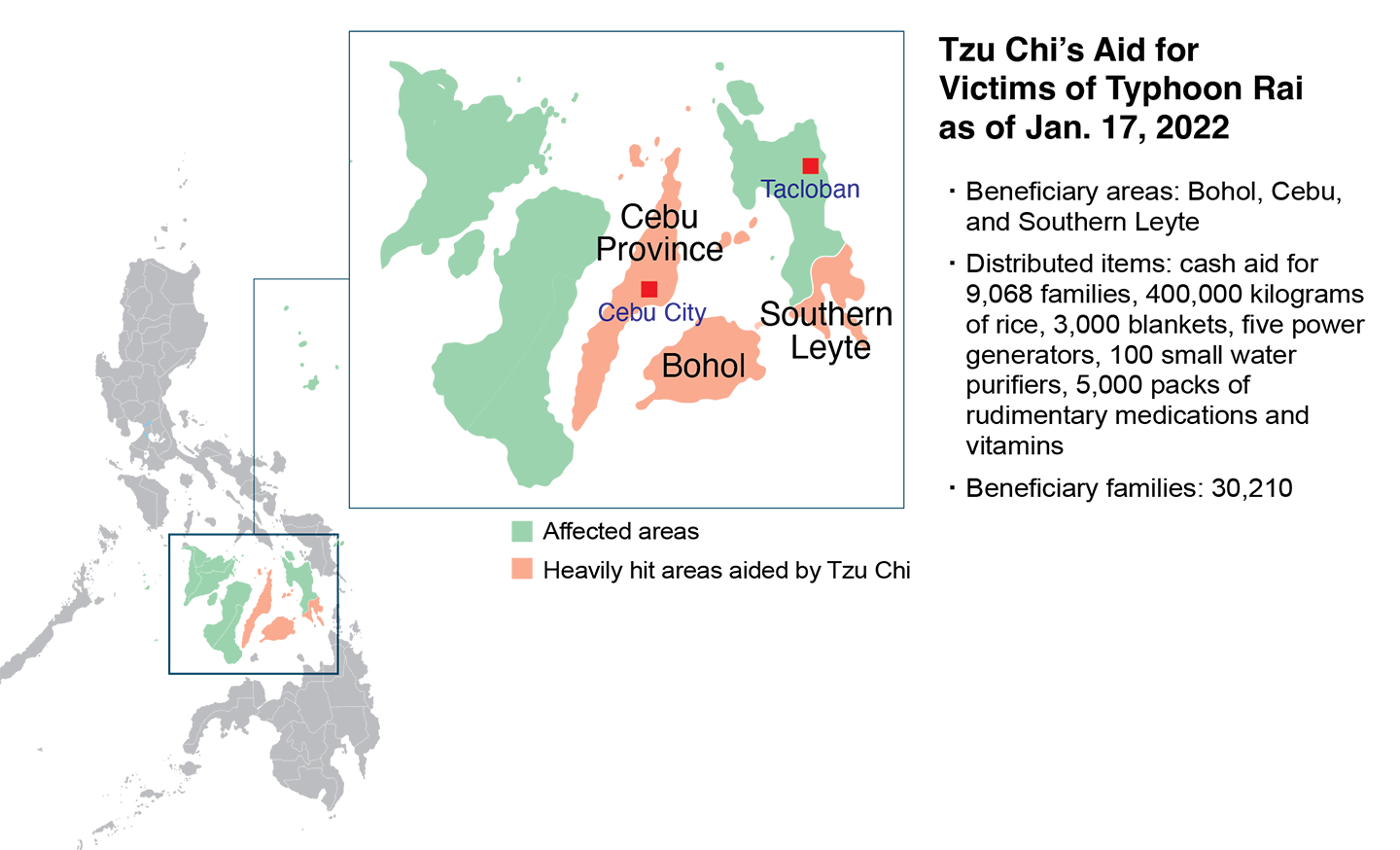
Tzu Chi decided to focus its damage assessment trips on the severely hit provinces of Bohol, Cebu, and Southern Leyte. Volunteers witnessed heartrending scenes of devastation that the typhoon had left behind in coastal cities and towns. Strong winds and massive flooding had left villages in ruins. Disregarding COVID safety protocols, people formed long lines at water supply stations. In one disaster area in northern Bohol, a large vessel had been swept into a village. Hungry people stood by the roadside holding placards written with “I’m starving.”

Drinking water and food were in short supply in the disaster zones and the price of fuel had soared, so Tzu Chi quickly purchased 400,000 kilograms (881,848 pounds) of rice and transported it, along with other relief supplies donated by businesses and individuals, to hard-hit areas. Large-scale distributions started in early January. More than 30,000 families had benefited by mid-January 2022. The foundation also provided power generators and water purification equipment to help ensure victims had access to clean water.

With rice and cash aid distributed by Tzu Chi in hand, survivors moved forward into the new year with their hearts lighter.

Rushing in Rice and Other Supplies

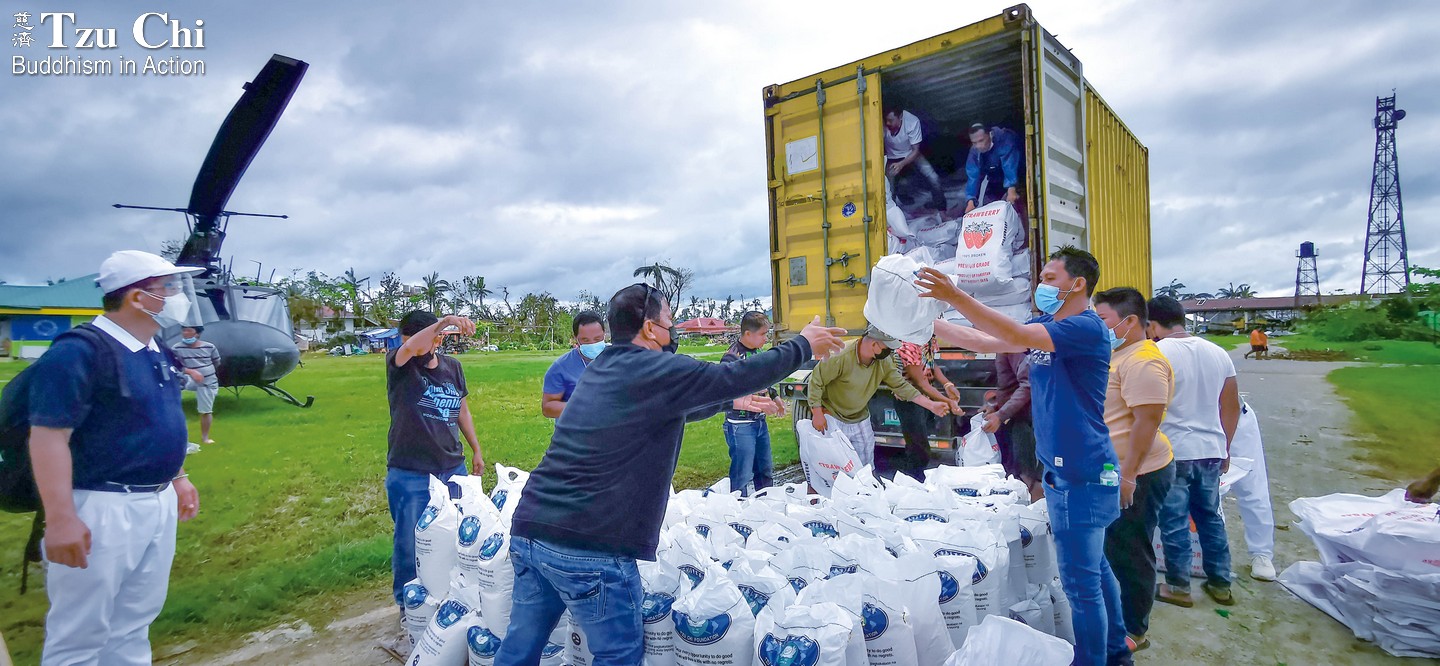
People faced shortages of food and drinking water in areas devastated by Typhoon Rai after water and electricity lines were disrupted. In response, Tzu Chi purchased rice and water purifiers in Manila and, with the help of a shipping company that had waived their fees, sent the goods along with other supplies donated by kind-hearted people to Bohol, Cebu, and Southern Leyte. People in Ubay, Cebu (photo 1), unload rice for more than a thousand families.

In photo 2, survivors hold their claim checks high at a distribution venue in Cebu, overjoyed over the financial aid they will be receiving from Tzu Chi. Regular business activities had ceased during and after Typhoon Rai, disrupting people’s income streams. Survivors could go to designated banks to cash their claim checks and then could use the money for building materials or necessities to get them through the difficult time. Courtesy of Tzu Chi Philippines

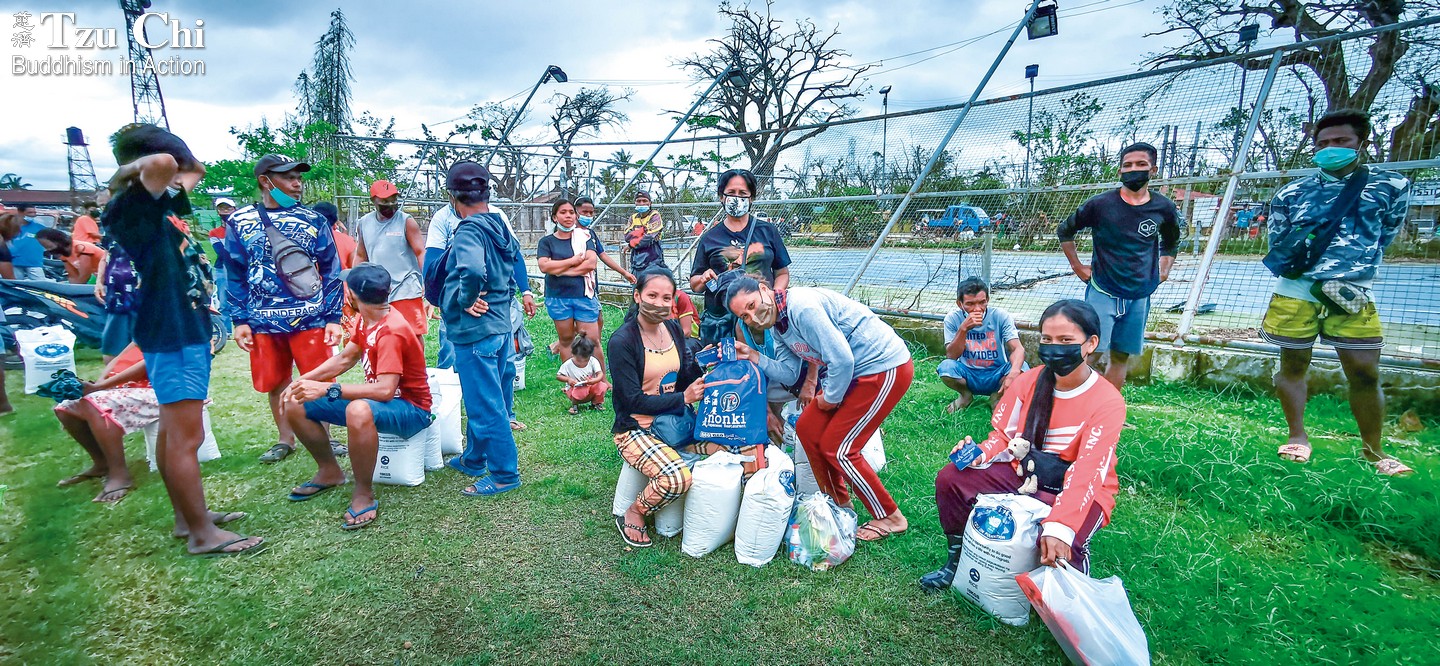
By mid-January 2022, 15,000 households in Bohol had each received 20 kilograms of rice from Tzu Chi (photo 3). Distributions of financial aid followed.

Sunshine Returns to Bohol

Narrated by Joven Uy
Interviewed and compiled by Liao Zhe-min and Li Xiu-ling
Translated by Wu Hsiao-ting

Typhoon Rai wreaked havoc in Bohol, the Philippines. Facing a disaster of this magnitude, it was impossible to rely on only a few people to pull off the relief work. I want to say “thank you” again and again to my fellow volunteers in the Philippines for their help.

I am a 70-year-old third-generation Chinese, born and raised in Bohol, an island province of the Philippines. The province is composed of the island itself and over 70 minor surrounding islands. It’s a well-known tourist attraction, offering beautiful beaches, attractive diving and snorkeling activities, and the Chocolate Hills, a world-famous geological formation. More than a million tourists flock here every year, so hotels and guesthouses abound. Most of the over 1.4 million residents work in tourism related jobs.

Because Bohol relies so much on tourism, the COVID-19 pandemic severely impacted the local economy. Repeated lockdowns and forced 14-day quarantines for foreign nationals over the last two years have led to the disappearance of tourists, leaving residents nearly bereft of their livelihoods and reliant on government aid to get by. Tzu Chi has also been providing food to families who are especially poor to help them weather the pandemic.

Sadly, as if the economic toll of COVID-19 wasn’t bad enough, Typhoon Rai hit in late 2021, delivering another hard blow to Bohol.

The typhoon brought winds and rains worse than any typhoon before. Power was out within three hours, plunging Tagbilaran, my area of residence and the capital of Bohol, into darkness. Tagbilaran is located in southwestern Bohol, more than 100 kilometers (62 miles) from where Typhoon Rai was projected to land, in northern Bohol. If the wind and rain were so bad where I live, I wondered how much worse it would be in the northeast.

As soon as daylight came, I went with other volunteers to Loboc, 25 kilometers (16 miles) east of Tagbilaran. We wanted to check out the situation where overflowing rivers had caused damage. We headed north after that, discovering areas of massive devastation. When flights resumed, Yee Lock Co (許怡樂), Johnny Kwok (郭嘉獎), and other volunteers from Manila arrived in Bohol to help us carry out damage assessment and relief work. We broke into two groups for our fact-finding trips in heavily hit cities and towns on the main island of Bohol and the small islands surrounding it.

Strong winds had destroyed houses in northern coastal areas, uprooted trees, and knocked out water, electricity, and communications services. Wherever we visited, we found people in urgent need of food and potable water. The mayor of Ubay told us he was worried that if outside aid didn’t arrive promptly, people might begin to fight for food. The governor of Bohol also appealed to Tzu Chi for help, saying that Rai had wreaked unprecedented havoc in his province.

Delivering aid

Storms and typhoons are common in the Philippines, and people here have long grown used to them. Ranked warnings from 1 to 5 are issued to caution the public of incoming weather disturbances. A level 5 indicates the strongest, most dangerous storm. Typhoon Rai, packing winds up to 260 kilometers (160 miles) per hour, was the first Level 5 storm ever to have hit Bohol. Infrastructure in the disaster areas was almost completely ruined, more than a hundred people were reported dead or missing, and over 100,000 families were affected.

Many people were evacuated in advance of the storm, but when they returned, they found their homes gone. Some affected households received small amounts of food, but wondered where their next meal would come from.

The massive earthquake that hit Bohol in October 2013 was described as a “once in a hundred years” event. It was a major calamity, but economic activities continued afterwards and people still had work to do. But the one-two punch of the pandemic and typhoon were different. The pandemic had caused people to lose their incomes, and the typhoon took their homes and belongings. The faces of survivors were marked with despair. The main island of Bohol suffered a severe blow, which directly impacted the surrounding small islands, as they depended on the main island for food and other supplies.

The Tzu Chi Manila office quickly responded by purchasing rice to distribute. Many kind people donated drinking water, water purifiers, and medicine on their own initiative for Tzu Chi to transport to Cebu and Bohol. Distributions were launched after the supplies arrived at the end of 2021.

Previously, because of lockdown restrictions, volunteers from Manila were prevented from coming to Bohol. For the past two years, distributing aid to local residents to help them through the pandemic had been left to the 30 volunteers and employees on the island. They were helped as well by more than a hundred students receiving Tzu Chi’s financial assistance in the province.

Tzu Chi’s footprint and work locally can be traced to the 2013 earthquake. Volunteers from Manila arrived on the island in the immediate aftermath of that earthquake to assess damage and provide relief. I hadn’t yet joined Tzu Chi, but after observing the volunteers and witnessing how they gave without expecting anything in return, I was deeply touched and decided to join their ranks. The Tzu Chi missions began taking root in Bohol in 2014. We built prefabricated classrooms for schools devastated by the earthquake, and have been providing charitable and medical aid to local needy people ever since.

More than a hundred students from Bohol graduate from college every year with Tzu Chi’s help. Besides helping young people with school fees, we guide them in doing charity work, hoping to bring out their compassion through such work. After Typhoon Rai hit, the students receiving aid from Tzu Chi and our volunteers in Bohol pitched in to help with the relief operations. Some entered data on aid recipients or moved relief goods into warehouses. Others volunteered at the distributions held in their hometowns. Regardless of their task, their help was invaluable in delivering aid quickly to people in need.

Although we had had experience distributing aid before in Bohol, this was the first time we were giving it out on such a large scale. Help was going to more than 10,000 families. We planned out every distribution with great care and worked with the military and police to quickly deliver 20 kilograms of rice into the hands of each family. January 2022 began with rain, but sunshine returned during our distributions—sunshine in the sky and on the smiling faces of the recipients.

I want to say over and over, “Thank you all so much!” Master Cheng Yen never forgot about Bohol. Without the help and support of volunteers from outside of Bohol, we couldn’t have carried off our distributions. We have also launched distributions of cash aid for residents of heavily hit areas.

There is still a lot of work to do to help the typhoon survivors rebuild their lives, a lot of work that requires us to work together. Natural disasters have been increasing in severity. It might be difficult to resist the devastation inflicted by a major disaster, but we can at least try to soften the impact by doing what we can to help the afflicted.

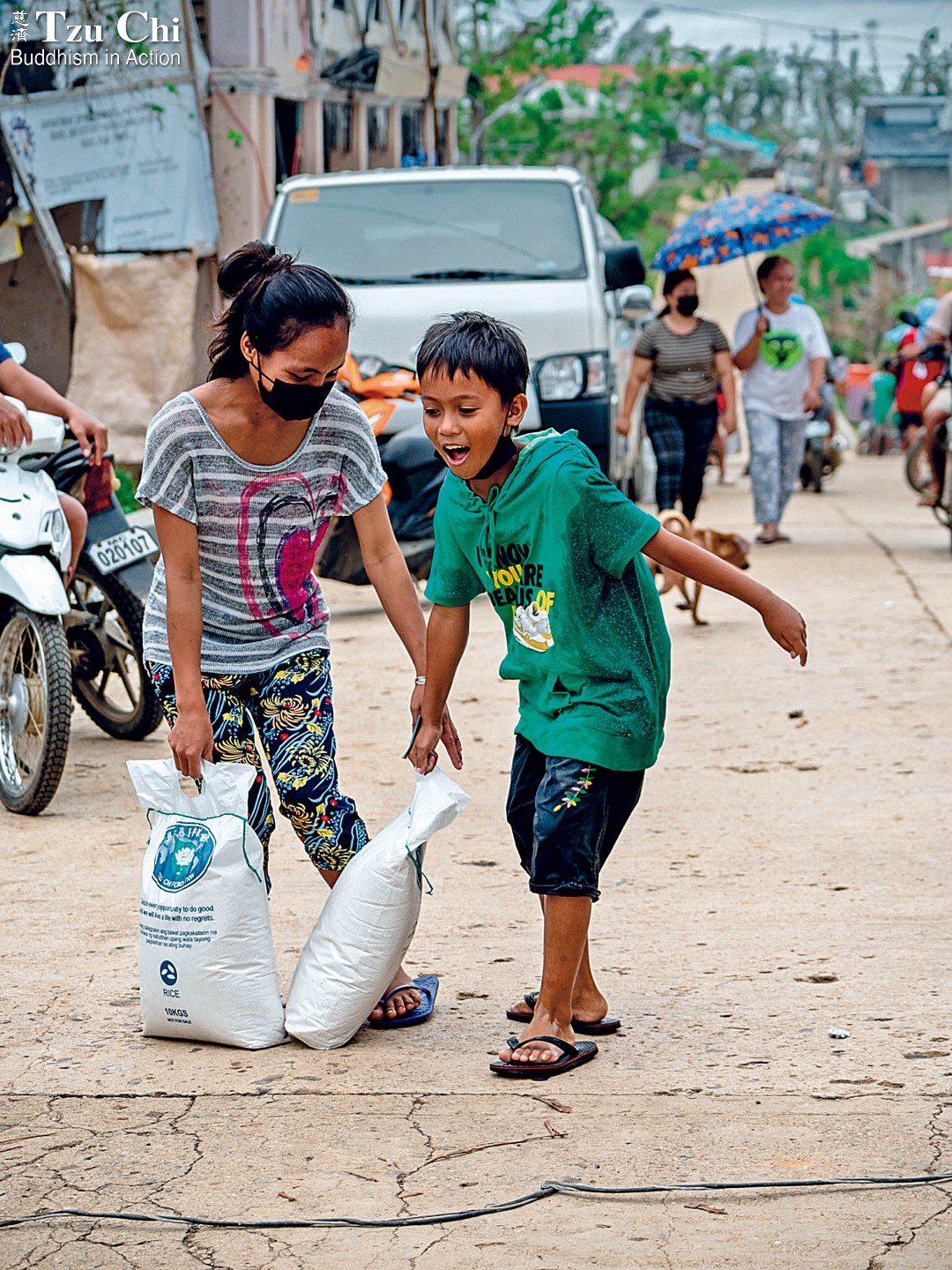
A boy in President Carlos P. Garcia, a municipality in the province of Bohol, helps his mother carry home the rice distributed by Tzu Chi in the aftermath of Typhoon Rai. Courtesy of Tzu Chi Philippines

Text provided by Tzu Chi Philippines
Translated by Wu Hsiao-ting
Photos by Johnny Kwok

Super Typhoon Rai ravaged central and southern Philippines in mid-December 2021. Tzu Chi volunteers swung into action immediately afterward to deliver aid and hope.

Typhoon Rai badly pummeled Bohol in the central Philippines. Its northern coastal areas, where the typhoon landed, were strewn with debris after the storm passed.

At a badly damaged school in Punta Engaño, Lapu-Lapu City, Cebu, the Philippines, more than a thousand people waiting quietly in line suddenly erupted into applause. Some even began crying tears of joy.

The outpouring of happiness and gratitude followed an announcement from a Tzu Chi volunteer regarding the amounts of financial aid the attendees would be receiving from the foundation. Each family would receive 10,000 to 20,000 pesos (US$195-390), depending on the size of the household. Normelita Nodalo said with tears coursing down her face: “I can’t believe that we’ll be receiving so much money from you! We don’t even know you and you don’t know us. For you to give us this much help is really touching!”

Reyno Igot, a polio victim, teared up too. “It’s expected to be three months before electricity is restored to the furniture store where I work,” he said. “If I didn’t bring home money, my three kids would starve.” The money from Tzu Chi would help see him through the difficulty he was facing after the severe disaster.

Typhoon Rai, known in the Philippines as Odette, hit the country on December 16, 2021, devastating seven provinces and resulting in more than 400 deaths. Over six million people were affected. It was the strongest storm to hit the country in 2021.

The Philippines is prone to typhoons. Even though alerts were issued and people evacuated before the storm struck, Rai still dealt a heavy blow to the country. It developed from a tropical depression to a super typhoon in just three days before barreling across the central and southern regions of the vast archipelago. Power outages ensued, cutting off communications in many areas.

Tzu Chi decided to focus its damage assessment trips on the severely hit provinces of Bohol, Cebu, and Southern Leyte. Volunteers witnessed heartrending scenes of devastation that the typhoon had left behind in coastal cities and towns. Strong winds and massive flooding had left villages in ruins. Disregarding COVID safety protocols, people formed long lines at water supply stations. In one disaster area in northern Bohol, a large vessel had been swept into a village. Hungry people stood by the roadside holding placards written with “I’m starving.”

Drinking water and food were in short supply in the disaster zones and the price of fuel had soared, so Tzu Chi quickly purchased 400,000 kilograms (881,848 pounds) of rice and transported it, along with other relief supplies donated by businesses and individuals, to hard-hit areas. Large-scale distributions started in early January. More than 30,000 families had benefited by mid-January 2022. The foundation also provided power generators and water purification equipment to help ensure victims had access to clean water.

With rice and cash aid distributed by Tzu Chi in hand, survivors moved forward into the new year with their hearts lighter.

Rushing in Rice and Other Supplies

People faced shortages of food and drinking water in areas devastated by Typhoon Rai after water and electricity lines were disrupted. In response, Tzu Chi purchased rice and water purifiers in Manila and, with the help of a shipping company that had waived their fees, sent the goods along with other supplies donated by kind-hearted people to Bohol, Cebu, and Southern Leyte. People in Ubay, Cebu (photo 1), unload rice for more than a thousand families.

In photo 2, survivors hold their claim checks high at a distribution venue in Cebu, overjoyed over the financial aid they will be receiving from Tzu Chi. Regular business activities had ceased during and after Typhoon Rai, disrupting people’s income streams. Survivors could go to designated banks to cash their claim checks and then could use the money for building materials or necessities to get them through the difficult time. Courtesy of Tzu Chi Philippines

By mid-January 2022, 15,000 households in Bohol had each received 20 kilograms of rice from Tzu Chi (photo 3). Distributions of financial aid followed.

Sunshine Returns to Bohol

Narrated by Joven Uy
Interviewed and compiled by Liao Zhe-min and Li Xiu-ling
Translated by Wu Hsiao-ting

Typhoon Rai wreaked havoc in Bohol, the Philippines. Facing a disaster of this magnitude, it was impossible to rely on only a few people to pull off the relief work. I want to say “thank you” again and again to my fellow volunteers in the Philippines for their help.

I am a 70-year-old third-generation Chinese, born and raised in Bohol, an island province of the Philippines. The province is composed of the island itself and over 70 minor surrounding islands. It’s a well-known tourist attraction, offering beautiful beaches, attractive diving and snorkeling activities, and the Chocolate Hills, a world-famous geological formation. More than a million tourists flock here every year, so hotels and guesthouses abound. Most of the over 1.4 million residents work in tourism related jobs.

Because Bohol relies so much on tourism, the COVID-19 pandemic severely impacted the local economy. Repeated lockdowns and forced 14-day quarantines for foreign nationals over the last two years have led to the disappearance of tourists, leaving residents nearly bereft of their livelihoods and reliant on government aid to get by. Tzu Chi has also been providing food to families who are especially poor to help them weather the pandemic.

Sadly, as if the economic toll of COVID-19 wasn’t bad enough, Typhoon Rai hit in late 2021, delivering another hard blow to Bohol.

The typhoon brought winds and rains worse than any typhoon before. Power was out within three hours, plunging Tagbilaran, my area of residence and the capital of Bohol, into darkness. Tagbilaran is located in southwestern Bohol, more than 100 kilometers (62 miles) from where Typhoon Rai was projected to land, in northern Bohol. If the wind and rain were so bad where I live, I wondered how much worse it would be in the northeast.

As soon as daylight came, I went with other volunteers to Loboc, 25 kilometers (16 miles) east of Tagbilaran. We wanted to check out the situation where overflowing rivers had caused damage. We headed north after that, discovering areas of massive devastation. When flights resumed, Yee Lock Co (許怡樂), Johnny Kwok (郭嘉獎), and other volunteers from Manila arrived in Bohol to help us carry out damage assessment and relief work. We broke into two groups for our fact-finding trips in heavily hit cities and towns on the main island of Bohol and the small islands surrounding it.

Strong winds had destroyed houses in northern coastal areas, uprooted trees, and knocked out water, electricity, and communications services. Wherever we visited, we found people in urgent need of food and potable water. The mayor of Ubay told us he was worried that if outside aid didn’t arrive promptly, people might begin to fight for food. The governor of Bohol also appealed to Tzu Chi for help, saying that Rai had wreaked unprecedented havoc in his province.

Delivering aid

Storms and typhoons are common in the Philippines, and people here have long grown used to them. Ranked warnings from 1 to 5 are issued to caution the public of incoming weather disturbances. A level 5 indicates the strongest, most dangerous storm. Typhoon Rai, packing winds up to 260 kilometers (160 miles) per hour, was the first Level 5 storm ever to have hit Bohol. Infrastructure in the disaster areas was almost completely ruined, more than a hundred people were reported dead or missing, and over 100,000 families were affected.

Many people were evacuated in advance of the storm, but when they returned, they found their homes gone. Some affected households received small amounts of food, but wondered where their next meal would come from.

The massive earthquake that hit Bohol in October 2013 was described as a “once in a hundred years” event. It was a major calamity, but economic activities continued afterwards and people still had work to do. But the one-two punch of the pandemic and typhoon were different. The pandemic had caused people to lose their incomes, and the typhoon took their homes and belongings. The faces of survivors were marked with despair. The main island of Bohol suffered a severe blow, which directly impacted the surrounding small islands, as they depended on the main island for food and other supplies.

The Tzu Chi Manila office quickly responded by purchasing rice to distribute. Many kind people donated drinking water, water purifiers, and medicine on their own initiative for Tzu Chi to transport to Cebu and Bohol. Distributions were launched after the supplies arrived at the end of 2021.

Previously, because of lockdown restrictions, volunteers from Manila were prevented from coming to Bohol. For the past two years, distributing aid to local residents to help them through the pandemic had been left to the 30 volunteers and employees on the island. They were helped as well by more than a hundred students receiving Tzu Chi’s financial assistance in the province.

Tzu Chi’s footprint and work locally can be traced to the 2013 earthquake. Volunteers from Manila arrived on the island in the immediate aftermath of that earthquake to assess damage and provide relief. I hadn’t yet joined Tzu Chi, but after observing the volunteers and witnessing how they gave without expecting anything in return, I was deeply touched and decided to join their ranks. The Tzu Chi missions began taking root in Bohol in 2014. We built prefabricated classrooms for schools devastated by the earthquake, and have been providing charitable and medical aid to local needy people ever since.

More than a hundred students from Bohol graduate from college every year with Tzu Chi’s help. Besides helping young people with school fees, we guide them in doing charity work, hoping to bring out their compassion through such work. After Typhoon Rai hit, the students receiving aid from Tzu Chi and our volunteers in Bohol pitched in to help with the relief operations. Some entered data on aid recipients or moved relief goods into warehouses. Others volunteered at the distributions held in their hometowns. Regardless of their task, their help was invaluable in delivering aid quickly to people in need.

Although we had had experience distributing aid before in Bohol, this was the first time we were giving it out on such a large scale. Help was going to more than 10,000 families. We planned out every distribution with great care and worked with the military and police to quickly deliver 20 kilograms of rice into the hands of each family. January 2022 began with rain, but sunshine returned during our distributions—sunshine in the sky and on the smiling faces of the recipients.

I want to say over and over, “Thank you all so much!” Master Cheng Yen never forgot about Bohol. Without the help and support of volunteers from outside of Bohol, we couldn’t have carried off our distributions. We have also launched distributions of cash aid for residents of heavily hit areas.

There is still a lot of work to do to help the typhoon survivors rebuild their lives, a lot of work that requires us to work together. Natural disasters have been increasing in severity. It might be difficult to resist the devastation inflicted by a major disaster, but we can at least try to soften the impact by doing what we can to help the afflicted.

A boy in President Carlos P. Garcia, a municipality in the province of Bohol, helps his mother carry home the rice distributed by Tzu Chi in the aftermath of Typhoon Rai. Courtesy of Tzu Chi Philippines

關鍵字

Rushing to the Aid of Flood Victims

Information provided by Tzu Chi Kuala Lumpur and Selangor
Translated by Wu Hsiao-ting
Photos by Lai Jih Chuan

After devastating floods in Malaysia, help poured in for victims in heavily hit areas.

Damaged furniture and other household items clutter the fronts of people’s homes in Taman Sri Nanding, Hulu Langat, southeastern Selangor. Tzu Chi volunteers organized cleanup events in the aftermath of serious flooding in Malaysia in December 2021. Their work helped to return people’s lives to normal.

Heavy downpours pounded Peninsular Malaysia in December 2021, right in the midst of its rainy season. On one of the days—December 18—the area received more rain than in an average month. Floods occurred in eight Malaysian states. Selangor, Kuala Lumpur, and Pahang were among the badly affected areas.

In some areas, floodwaters rose from waist high to one story, then even higher, forcing residents to seek safety in higher places. Cries for help could be heard here and there. Tzu Chi offices and volunteers’ cell phones were flooded with calls for aid. Volunteers in Selangor, Kuala Lumpur, and Pahang managed to enter disaster areas and shelters to assess the situation. They waded through water or rode in small boats to deliver packed meals. They also provided victims with dry food, blankets, clothing, mats, drinking water, and other necessities.

The floods had caused blackouts, so shelters were immersed in darkness at night. But many people never made it to a shelter anyway, remaining trapped in stricken areas as the rain continued to fall. Good news finally came on the morning of December 22: “The water has receded!”

The receding waters resulted in a mess on a staggering scale. Thick layers of mud were left behind. Damaged furniture, broken appliances, and other items soon accumulated into small mountains in alleys and streets. Standing water and garbage strewn around created worrisome sanitary conditions.

Tzu Chi responded by launching cleanups in heavily hit areas. During three consecutive days, starting on December 24, members of the general public, Tzu Chi volunteers, and military personnel together put in more than 6,000 shifts and cleaned up an area of 330,000 square meters (35,843,800 square feet). Volunteers came not just from neighboring states but also from farther areas. Some arrived after traveling several hundred kilometers and even bringing their own cleaning implements. Nima Shokouhfar, an engineer from a company in Penang, on the northwest coast of Peninsular Malaysia, was among those who joined the cleaning project. “We never know when a disaster might strike,” he said. “It might have happened to others this time, but next time it might be you who fall victim—that’s all the more reason why we human beings should help each other. The amount of physical activity I put in today is about the total amount I usually accumulate over a month. I’m bushed. But I had a good day.”

In early January 2022, Tzu Chi volunteers visited heavily hit areas again and called on more than 10,000 families to compile recipient rosters for distributions of cash aid coming later that month.

Into the Water and Through the Mud

Parts of Malaysia were hit by varying degrees of flooding from mid-December 2021 to early January 2022. Here, a volunteer (photo 1) hands a packed meal to a flood victim in Selangor. The state of Selangor was one of the regions deluged with floodwaters, reaching as high as two stories in some areas; most residents were trapped for days in the floods. Tzu Chi volunteers quickly mobilized to provide relief. Koh Poo Leng

Low-lying areas in the state of Pahang flood almost every time it rains. The entire Kampung Baru Sungai Perdak area was swamped during the December flooding. Two weeks after the disaster, residents were still struggling to clean their homes. Ten families, with thick mud all over their houses, appealed to Tzu Chi for help. More than a hundred volunteers from Selangor, Kuala Lumpur, Raub, and Penang pitched in to help on January 5, 2022 (photo 2).

After floodwaters receded in Selangor, volunteers launched three days of cleanup in Taman Sri Muda, Shah Alam, and Taman Sri Nanding, Hulu Langat. The military, members of the public, and Tzu Chi volunteers worked together during the effort. Flood victims (photo 3) thank volunteers for helping speed their recovery from the deluge.

I Cried Several Times in December

By Sia Ah Tong
Edited and translated by Wu Hsiao-ting
Photo by Lee Kok Keong

Many people lost almost all they had to the floods. Extending a helping hand was the least we could do.

We had several days of heavy rain in December 2021. I cried a lot of tears during that time too.

I’m a Tzu Chi volunteer in Selangor, Malaysia. On December 18, rushing flash floods triggered by torrential rains swept away many local resident’s belongings and wrecked their homes. Things that they had spent a lifetime to build were washed away or ruined in a few hours. Arriving in a flooded area on a military vehicle, I jumped into knee-deep water. I was standing on a road that used to be full of traffic, but now all I could see was floodwater. As I went about distributing necessities to flood victims, I listened to many pour out their sadness and heartache.

Dusk gradually descended. As the light slipped away, I wondered how residents were going to spend the night. They had no water or electricity, which had been cut off in the floods. My wife, Chen Wen Yen (曾文燕), and I had learned that a Tzu Chi long-term care recipient had been evacuated to a temporary shelter. We went there and looked through dozens of tents but were still unable to find her. We were getting very worried. It was just then that we heard someone calling out behind us: “Kak [Malay for sister]!” What a familiar voice! It was the care recipient we had been looking for. She hugged my wife and through her sobs told us that she had lost everything.

She then related to us what had happened to her and her children. Though the floodwaters rose and had submerged the roads, she braved the wind and rain to go to work in a factory because she couldn’t afford not to make money. Not long after she arrived at work, however, her child phoned her and said their home had flooded. She quickly set out for home, pushing her bicycle through the floodwaters. Though she had just four kilometers (2.5 miles) to cover, it felt like a lifetime to her before she reached home. When she finally arrived, she saw all their furniture, electrical appliances, and kitchen utensils soaked in or floating in the floodwaters. Her heart broke.

Many years of effort to build up her home were destroyed in a single morning. She had raised her two children alone after her husband had passed away. She had had to be strong and work harder than many others, but she had made it through. However, after suffering such heavy losses in the floods, she felt she just couldn’t hold on any longer.

My heart clenched as I listened to her; tears flowed uncontrollably down my cheeks. We had provided care and support for her for years, and had seen her grow stronger and undergo impressive transformation along the way. Before we even had a chance to celebrate for her, however, everything had gone down the drain. Wen Yen patted her on the back, telling her with her action that we would always be there for her. Tzu Chi would never leave her alone.

We couldn’t dwell in sadness too long. Not long after, I followed other volunteers to an affected area to help clean up. A family had just moved into their new home three months earlier, but looking at their house, you could never tell that it was new. The walls, just recently painted, now bore water stains left behind by the floods. A red cloth hung on the entrance door fluttered forlornly in the wind.

The owner of the house looked completely lost. His eyes vacant, he stared into the air in front of him, as if he was trying to fathom the unfairness of it all. He seemed powerless to move, powerless to pick up the pieces around him. Tzu Chi volunteers bustled around him, tidying things up. His mind went back to those two nights when he and his family were trapped in the floods. Their house had been immersed in water one story high, their electricity was out, and all they had left to eat was some biscuits. Time seemed to have come to a standstill. As the master of the house, he blamed himself for what had happened. He was frightened, but knew he had no choice but to be brave.

Their brand-new furniture, kitchen equipment, and electrical appliances—items that he had pinched and scraped to save up the money to buy—were ruined. “My house is gone, so is my car,” he said. “Everything is gone.” Even though he was as depressed as could be, he told me he was full of gratitude for Tzu Chi volunteers for extending a helping hand to them during this time. Tears streamed down his cheeks as he put his palms together in front of his chest to thank us. Men don’t cry easily, especially in the presence of strangers. I understood he must have been feeling a lot of helplessness and frustration.

My heart ached for him as I listened to his story. I couldn’t hold back my tears either. Many people grit their teeth and work hard just to build a warm home and provide their family with a good life. Sadly, for this man, all that he had worked hard to build lasted just a short time. Reality could be so cruel!

I still vividly remember his tears. I hope he is doing well. As long as one is safe and well, one can always start over.

I witnessed many hearts broken by misfortune this December, but I also witnessed how everyone came together to help. Responding to Tzu Chi’s call for help, people from everywhere rushed to the aid of those afflicted. Putting aside skin color and religious beliefs, leaving behind their work, they picked up cleaning utensils and set to work under the hot sun, cleaning up devastated communities. They worked without any ulterior motives—all they wanted was to restore homes to livable conditions so that victims could return to their homes sooner.

I prayed as I wrote this article, deep in the night on Christmas Eve. I prayed sincerely for the world to be free from disasters and for peace to fill every society.

Everyone’s home looked just as devastated as the next, and it would be difficult for them to clean up everything on their own.

Information provided by Tzu Chi Kuala Lumpur and Selangor
Translated by Wu Hsiao-ting
Photos by Lai Jih Chuan

After devastating floods in Malaysia, help poured in for victims in heavily hit areas.

Damaged furniture and other household items clutter the fronts of people’s homes in Taman Sri Nanding, Hulu Langat, southeastern Selangor. Tzu Chi volunteers organized cleanup events in the aftermath of serious flooding in Malaysia in December 2021. Their work helped to return people’s lives to normal.

Heavy downpours pounded Peninsular Malaysia in December 2021, right in the midst of its rainy season. On one of the days—December 18—the area received more rain than in an average month. Floods occurred in eight Malaysian states. Selangor, Kuala Lumpur, and Pahang were among the badly affected areas.

In some areas, floodwaters rose from waist high to one story, then even higher, forcing residents to seek safety in higher places. Cries for help could be heard here and there. Tzu Chi offices and volunteers’ cell phones were flooded with calls for aid. Volunteers in Selangor, Kuala Lumpur, and Pahang managed to enter disaster areas and shelters to assess the situation. They waded through water or rode in small boats to deliver packed meals. They also provided victims with dry food, blankets, clothing, mats, drinking water, and other necessities.

The floods had caused blackouts, so shelters were immersed in darkness at night. But many people never made it to a shelter anyway, remaining trapped in stricken areas as the rain continued to fall. Good news finally came on the morning of December 22: “The water has receded!”

The receding waters resulted in a mess on a staggering scale. Thick layers of mud were left behind. Damaged furniture, broken appliances, and other items soon accumulated into small mountains in alleys and streets. Standing water and garbage strewn around created worrisome sanitary conditions.

Tzu Chi responded by launching cleanups in heavily hit areas. During three consecutive days, starting on December 24, members of the general public, Tzu Chi volunteers, and military personnel together put in more than 6,000 shifts and cleaned up an area of 330,000 square meters (35,843,800 square feet). Volunteers came not just from neighboring states but also from farther areas. Some arrived after traveling several hundred kilometers and even bringing their own cleaning implements. Nima Shokouhfar, an engineer from a company in Penang, on the northwest coast of Peninsular Malaysia, was among those who joined the cleaning project. “We never know when a disaster might strike,” he said. “It might have happened to others this time, but next time it might be you who fall victim—that’s all the more reason why we human beings should help each other. The amount of physical activity I put in today is about the total amount I usually accumulate over a month. I’m bushed. But I had a good day.”

In early January 2022, Tzu Chi volunteers visited heavily hit areas again and called on more than 10,000 families to compile recipient rosters for distributions of cash aid coming later that month.

Into the Water and Through the Mud

Parts of Malaysia were hit by varying degrees of flooding from mid-December 2021 to early January 2022. Here, a volunteer (photo 1) hands a packed meal to a flood victim in Selangor. The state of Selangor was one of the regions deluged with floodwaters, reaching as high as two stories in some areas; most residents were trapped for days in the floods. Tzu Chi volunteers quickly mobilized to provide relief. Koh Poo Leng

Low-lying areas in the state of Pahang flood almost every time it rains. The entire Kampung Baru Sungai Perdak area was swamped during the December flooding. Two weeks after the disaster, residents were still struggling to clean their homes. Ten families, with thick mud all over their houses, appealed to Tzu Chi for help. More than a hundred volunteers from Selangor, Kuala Lumpur, Raub, and Penang pitched in to help on January 5, 2022 (photo 2).

After floodwaters receded in Selangor, volunteers launched three days of cleanup in Taman Sri Muda, Shah Alam, and Taman Sri Nanding, Hulu Langat. The military, members of the public, and Tzu Chi volunteers worked together during the effort. Flood victims (photo 3) thank volunteers for helping speed their recovery from the deluge.

I Cried Several Times in December

By Sia Ah Tong
Edited and translated by Wu Hsiao-ting
Photo by Lee Kok Keong

Many people lost almost all they had to the floods. Extending a helping hand was the least we could do.

We had several days of heavy rain in December 2021. I cried a lot of tears during that time too.

I’m a Tzu Chi volunteer in Selangor, Malaysia. On December 18, rushing flash floods triggered by torrential rains swept away many local resident’s belongings and wrecked their homes. Things that they had spent a lifetime to build were washed away or ruined in a few hours. Arriving in a flooded area on a military vehicle, I jumped into knee-deep water. I was standing on a road that used to be full of traffic, but now all I could see was floodwater. As I went about distributing necessities to flood victims, I listened to many pour out their sadness and heartache.

Dusk gradually descended. As the light slipped away, I wondered how residents were going to spend the night. They had no water or electricity, which had been cut off in the floods. My wife, Chen Wen Yen (曾文燕), and I had learned that a Tzu Chi long-term care recipient had been evacuated to a temporary shelter. We went there and looked through dozens of tents but were still unable to find her. We were getting very worried. It was just then that we heard someone calling out behind us: “Kak [Malay for sister]!” What a familiar voice! It was the care recipient we had been looking for. She hugged my wife and through her sobs told us that she had lost everything.

She then related to us what had happened to her and her children. Though the floodwaters rose and had submerged the roads, she braved the wind and rain to go to work in a factory because she couldn’t afford not to make money. Not long after she arrived at work, however, her child phoned her and said their home had flooded. She quickly set out for home, pushing her bicycle through the floodwaters. Though she had just four kilometers (2.5 miles) to cover, it felt like a lifetime to her before she reached home. When she finally arrived, she saw all their furniture, electrical appliances, and kitchen utensils soaked in or floating in the floodwaters. Her heart broke.

Many years of effort to build up her home were destroyed in a single morning. She had raised her two children alone after her husband had passed away. She had had to be strong and work harder than many others, but she had made it through. However, after suffering such heavy losses in the floods, she felt she just couldn’t hold on any longer.

My heart clenched as I listened to her; tears flowed uncontrollably down my cheeks. We had provided care and support for her for years, and had seen her grow stronger and undergo impressive transformation along the way. Before we even had a chance to celebrate for her, however, everything had gone down the drain. Wen Yen patted her on the back, telling her with her action that we would always be there for her. Tzu Chi would never leave her alone.

We couldn’t dwell in sadness too long. Not long after, I followed other volunteers to an affected area to help clean up. A family had just moved into their new home three months earlier, but looking at their house, you could never tell that it was new. The walls, just recently painted, now bore water stains left behind by the floods. A red cloth hung on the entrance door fluttered forlornly in the wind.

The owner of the house looked completely lost. His eyes vacant, he stared into the air in front of him, as if he was trying to fathom the unfairness of it all. He seemed powerless to move, powerless to pick up the pieces around him. Tzu Chi volunteers bustled around him, tidying things up. His mind went back to those two nights when he and his family were trapped in the floods. Their house had been immersed in water one story high, their electricity was out, and all they had left to eat was some biscuits. Time seemed to have come to a standstill. As the master of the house, he blamed himself for what had happened. He was frightened, but knew he had no choice but to be brave.

Their brand-new furniture, kitchen equipment, and electrical appliances—items that he had pinched and scraped to save up the money to buy—were ruined. “My house is gone, so is my car,” he said. “Everything is gone.” Even though he was as depressed as could be, he told me he was full of gratitude for Tzu Chi volunteers for extending a helping hand to them during this time. Tears streamed down his cheeks as he put his palms together in front of his chest to thank us. Men don’t cry easily, especially in the presence of strangers. I understood he must have been feeling a lot of helplessness and frustration.

My heart ached for him as I listened to his story. I couldn’t hold back my tears either. Many people grit their teeth and work hard just to build a warm home and provide their family with a good life. Sadly, for this man, all that he had worked hard to build lasted just a short time. Reality could be so cruel!

I still vividly remember his tears. I hope he is doing well. As long as one is safe and well, one can always start over.

I witnessed many hearts broken by misfortune this December, but I also witnessed how everyone came together to help. Responding to Tzu Chi’s call for help, people from everywhere rushed to the aid of those afflicted. Putting aside skin color and religious beliefs, leaving behind their work, they picked up cleaning utensils and set to work under the hot sun, cleaning up devastated communities. They worked without any ulterior motives—all they wanted was to restore homes to livable conditions so that victims could return to their homes sooner.

I prayed as I wrote this article, deep in the night on Christmas Eve. I prayed sincerely for the world to be free from disasters and for peace to fill every society.

Everyone’s home looked just as devastated as the next, and it would be difficult for them to clean up everything on their own.

關鍵字

Delivering Warmth to Counter Tornado Destruction

Information provided by Tzu Chi USA
Compiled and translated by Wu Hsiao-ting
Photos by Yue Ma

A string of tornadoes tore across parts of America’s Midwest and South at the end of 2021, leaving behind war zone-like scenes. But some who had lost their homes to the disaster received unexpected gifts just in time for Christmas, reminding them of the power of love during the blessed season.

A community in Bowling Green, Kentucky, was cut in half by a tornado in December 2021. Debris lay everywhere afterwards.

More than 30 tornadoes hit America’s Midwest and South on December 10 and 11, 2021, resulting in catastrophic damage. One of the tornadoes traveled over more than 300 kilometers (186 miles), sweeping across many areas in the state of Kentucky. Many people recalled hearing tornado warning sirens, but it was impossible to take shelter in time. Dystain Homess, a resident of Mayfield, Kentucky, spoke of the havoc wrought by the disaster: “People lost their homes, people lost their jobs, people lost their lives. I just never thought this would happen to my little town—all that history gone.”

Tornadoes typically occur in the U.S. Midwest in April and May. It was unusual for such violent twisters to hit in December. Buildings collapsed and fires broke out, killing dozens of people. Tzu Chi sprang into action to counter the destruction. They worked with the Federal Emergency Management Agency and the American Red Cross to deliver aid to three states. All told, 455 families benefited. In addition to a cash card loaded with a thousand U.S. dollars for each household, care packages containing blankets, scarves, winter hats, and other items were given out.

Todd Alcott is the mayor of Bowling Green, Kentucky, the worst-hit state. He said after learning of the monetary aid Tzu Chi was bringing to his city: “You know, a thousand dollars can mean buying a meal, buying a hotel room, giving them some respite…. I’m grateful for the families because I know that this will mean something to them, and we’re so appreciative for your gift.”

Volunteers from the states of Michigan, Indiana, Ohio, Missouri, Wisconsin, and Illinois raced against time to distribute the foundation’s aid to affected families before Christmas. They successfully pulled off the mission—the last distribution was completed on December 24. Volunteers spent Christmas Eve afterward in a hotel. Though they couldn’t spend the special time with their family, their hearts were warmed to have brought their best wishes to those in need.

Praying for the Deceased

After a series of unseasonably powerful tornadoes hit parts of the U.S. Midwest and South in late 2021, Tzu Chi volunteers rushed to affected areas to assess conditions. Distributions were launched soon afterwards. In photo 1, volunteers pray for the deceased in the town of Mayfield, Kentucky, one of the hardest-hit communities. Li You-da

Temperatures were low in the aftermath of the tornadoes, with power outages adding to the plight of survivors. Tzu Chi combined forces with the American Red Cross and organized six distributions to help victims through the challenging time. In photo 2, a survivor at a Tzu Chi distribution held in Bowling Green, Kentucky, tearfully recalls that scary time when the disaster hit. In photo 3, an aid recipient deposits money into a Tzu Chi coin bank at a distribution venue in Mayfield, Kentucky, to help other needy people and continue the cycle of love. Cash cards and other relief items from the foundation (photo 4) helped lighten the burdens of affected families on their way to recovery.

Impermanence Strikes Again

Narrated by Wei Jin-quan
Interviewed and compiled by Liao Zhe-min
Translated by Wu Hsiao-ting

I listened intently to tornado victims as they related their frightening experiences. I wanted them to know that there were people in the world who cared about them.

I was one of the Tzu Chi volunteers who helped carry out our foundation’s relief work after a devastating tornado clobbered Joplin, Missouri, the United States, in May 2011. That was how I came to witness the mayhem inflicted by an EF5-rated tornado. (Tornadoes range from 0 to 5, with 5s being the most powerful, on the Enhanced Fujita scale, more commonly referred to as the EF-Scale.) Though parts of Joplin survived untouched, other parts were completely destroyed. In one area of town, almost no building on a six-mile stretch of road was spared from the twister. Every structure was either completely or partially demolished.

After what I saw in Joplin, I began to take immediate action whenever I heard tornado sirens. I feared I’d turn out to be one of those struck down if I ignored the warning. Life is unpredictable. Though the houses on one side of town might be okay, those on the other side might be wrecked. We can’t be too careful.

On the night of December 10, 2021, tornado warnings sounded again and again where I live in southern Illinois. I took nothing for granted, and immediately took precautions. Fortunately, my area escaped unscathed. However, just eight kilometers (five miles) from my home, an Amazon warehouse was hit hard and badly damaged.

People described the devastation caused by the tornado outbreak this time like something you would see in a war zone. No matter if they were wooden or brick, all structures gave way as easily as if they had been houses of cards. What distinguished the disaster this time from those that had struck before was not the intensity but the large number of tornadoes that had formed. It resulted in many areas being hit. The damage caused was concentrated in densely populated areas, exacerbating the devastation.

My fellow volunteers and I arrived in various disaster areas within five days of the tornado disaster to assess damage, planning to get our aid to victims by Christmas. Many survivors had registered their damage and needs with the Red Cross, so we worked with the organization again to deliver aid.

Love had poured into affected cities and towns. Wherever we visited we saw charity organizations offering water, dry food, or even hot meals to those in need. We decided to focus our aid on those whose houses had been completely destroyed or were no longer habitable. We would provide each beneficiary family with a US$1,000 cash card, items to keep them warm, and other necessities. The most important item we provided was the cash card, which allowed the survivors to buy things they needed. Some, for example, had lost their eyeglasses or dentures in the disaster. Our financial assistance could help cover some of their urgent needs.

In Kentucky, I ran into a Red Cross volunteer with whom I had worked several times before in relief operations. He was also a local resident. I told him Tzu Chi was distributing US$1,000 cash cards to affected families and that Master Cheng Yen had instructed us to get the aid to the families by December 24 to help them have a better Christmas. Hearing this, he just stared in amazement at me. Then, with tears in his eyes, he said he was really impressed by Tzu Chi’s thoughtfulness, by how we paid attention to such details.

We put ourselves in the shoes of the needy when we deliver aid. We want the needy to feel our care and our sincere desire to help them in a timely and effective manner.

A touching experience every time

One of the places we visited during our relief mission this time was an Amish community in Mayfield, Kentucky. People there seemed cut off from the outside world and lived very simply. Due to their distrust of the outside world, they didn’t accept any offers for help after the disaster, even though their community had been hit hard.

Our team was lucky to know people who could connect us with the community. When we arrived and explained our intentions to help them with necessities and cash cards, they immediately asked, “Are those credit cards? We don’t want them!” Our volunteers quickly clarified by saying that we were not offering credit cards, but gift cards, and explained that they could use the money stored on the cards to buy things they needed. They eventually accepted our help, but still weren’t sure where to use the cards. Our volunteers suggested: “You can go buy building materials for the reconstruction of your houses.”

Because the coronavirus pandemic was still going strong in the United States, we knew the importance of taking precautions against the virus during our relief mission. Our Chicago team had prepared face masks designed to filter out particulate matter in the air for all the participating volunteers. They also distributed hand sanitizer to every one of us. In addition, we performed rapid COVID-19 testing on ourselves every morning; plastic dividers were installed on every table in a distribution venue, and volunteers put on gloves before handling paperwork. Such precautions ensured our safety as we served on the front lines.

As we gave out cash cards and necessities, we also listened to people share their stories with us. A mother came with a little girl. She choked up when she told us about that fateful day. She had held her little son in her arms to protect him that day, but when the tornado hit, their roof caved in, killing him on the spot.

A candle factory in Mayfield had suffered heavy casualties. Some employees from the factory showed up in a distribution to receive our aid. Among them was a tall, handsome young man. He arrived looking spiritless, as if all life had been drained out of him. I went up to him and asked if he was doing okay. He told me his fiancée had worked in the factory on that fateful day too but was sadly killed. He finished his statement in a few short words. I could see how forlorn and sad he was.

Other volunteers came to us and began comforting him. Then we listened quietly as he opened up more to us. Later, when he had received his aid and was leaving, I saw that he no longer looked as depressed as when he had first arrived. He must have felt better after letting out some of his pent-up grief. Sometimes the best we can do is offer a patient ear and be there for them. Sometimes all they need is a shoulder to lean on.

It is a touching experience whenever we volunteer in a relief operation on the front lines. We’ve learned that people need more than just help with money and supplies after they are hit by misfortune—they need a patient listening ear too. It may be because they find hope in that patient ear, because it makes them feel cared for. After releasing their emotions to us, they experience a shift away from their negative thoughts and find strength to keep going. Love, care, and a patient listening ear are the best gifts we can offer.

A volunteer serves tornado victims at a distribution in Bowling Green, Kentucky. Yue Ma

Information provided by Tzu Chi USA
Compiled and translated by Wu Hsiao-ting
Photos by Yue Ma

A string of tornadoes tore across parts of America’s Midwest and South at the end of 2021, leaving behind war zone-like scenes. But some who had lost their homes to the disaster received unexpected gifts just in time for Christmas, reminding them of the power of love during the blessed season.

A community in Bowling Green, Kentucky, was cut in half by a tornado in December 2021. Debris lay everywhere afterwards.

More than 30 tornadoes hit America’s Midwest and South on December 10 and 11, 2021, resulting in catastrophic damage. One of the tornadoes traveled over more than 300 kilometers (186 miles), sweeping across many areas in the state of Kentucky. Many people recalled hearing tornado warning sirens, but it was impossible to take shelter in time. Dystain Homess, a resident of Mayfield, Kentucky, spoke of the havoc wrought by the disaster: “People lost their homes, people lost their jobs, people lost their lives. I just never thought this would happen to my little town—all that history gone.”

Tornadoes typically occur in the U.S. Midwest in April and May. It was unusual for such violent twisters to hit in December. Buildings collapsed and fires broke out, killing dozens of people. Tzu Chi sprang into action to counter the destruction. They worked with the Federal Emergency Management Agency and the American Red Cross to deliver aid to three states. All told, 455 families benefited. In addition to a cash card loaded with a thousand U.S. dollars for each household, care packages containing blankets, scarves, winter hats, and other items were given out.

Todd Alcott is the mayor of Bowling Green, Kentucky, the worst-hit state. He said after learning of the monetary aid Tzu Chi was bringing to his city: “You know, a thousand dollars can mean buying a meal, buying a hotel room, giving them some respite…. I’m grateful for the families because I know that this will mean something to them, and we’re so appreciative for your gift.”

Volunteers from the states of Michigan, Indiana, Ohio, Missouri, Wisconsin, and Illinois raced against time to distribute the foundation’s aid to affected families before Christmas. They successfully pulled off the mission—the last distribution was completed on December 24. Volunteers spent Christmas Eve afterward in a hotel. Though they couldn’t spend the special time with their family, their hearts were warmed to have brought their best wishes to those in need.

Praying for the Deceased

After a series of unseasonably powerful tornadoes hit parts of the U.S. Midwest and South in late 2021, Tzu Chi volunteers rushed to affected areas to assess conditions. Distributions were launched soon afterwards. In photo 1, volunteers pray for the deceased in the town of Mayfield, Kentucky, one of the hardest-hit communities. Li You-da

Temperatures were low in the aftermath of the tornadoes, with power outages adding to the plight of survivors. Tzu Chi combined forces with the American Red Cross and organized six distributions to help victims through the challenging time. In photo 2, a survivor at a Tzu Chi distribution held in Bowling Green, Kentucky, tearfully recalls that scary time when the disaster hit. In photo 3, an aid recipient deposits money into a Tzu Chi coin bank at a distribution venue in Mayfield, Kentucky, to help other needy people and continue the cycle of love. Cash cards and other relief items from the foundation (photo 4) helped lighten the burdens of affected families on their way to recovery.

Impermanence Strikes Again

Narrated by Wei Jin-quan
Interviewed and compiled by Liao Zhe-min
Translated by Wu Hsiao-ting

I listened intently to tornado victims as they related their frightening experiences. I wanted them to know that there were people in the world who cared about them.

I was one of the Tzu Chi volunteers who helped carry out our foundation’s relief work after a devastating tornado clobbered Joplin, Missouri, the United States, in May 2011. That was how I came to witness the mayhem inflicted by an EF5-rated tornado. (Tornadoes range from 0 to 5, with 5s being the most powerful, on the Enhanced Fujita scale, more commonly referred to as the EF-Scale.) Though parts of Joplin survived untouched, other parts were completely destroyed. In one area of town, almost no building on a six-mile stretch of road was spared from the twister. Every structure was either completely or partially demolished.

After what I saw in Joplin, I began to take immediate action whenever I heard tornado sirens. I feared I’d turn out to be one of those struck down if I ignored the warning. Life is unpredictable. Though the houses on one side of town might be okay, those on the other side might be wrecked. We can’t be too careful.

On the night of December 10, 2021, tornado warnings sounded again and again where I live in southern Illinois. I took nothing for granted, and immediately took precautions. Fortunately, my area escaped unscathed. However, just eight kilometers (five miles) from my home, an Amazon warehouse was hit hard and badly damaged.

People described the devastation caused by the tornado outbreak this time like something you would see in a war zone. No matter if they were wooden or brick, all structures gave way as easily as if they had been houses of cards. What distinguished the disaster this time from those that had struck before was not the intensity but the large number of tornadoes that had formed. It resulted in many areas being hit. The damage caused was concentrated in densely populated areas, exacerbating the devastation.

My fellow volunteers and I arrived in various disaster areas within five days of the tornado disaster to assess damage, planning to get our aid to victims by Christmas. Many survivors had registered their damage and needs with the Red Cross, so we worked with the organization again to deliver aid.

Love had poured into affected cities and towns. Wherever we visited we saw charity organizations offering water, dry food, or even hot meals to those in need. We decided to focus our aid on those whose houses had been completely destroyed or were no longer habitable. We would provide each beneficiary family with a US$1,000 cash card, items to keep them warm, and other necessities. The most important item we provided was the cash card, which allowed the survivors to buy things they needed. Some, for example, had lost their eyeglasses or dentures in the disaster. Our financial assistance could help cover some of their urgent needs.

In Kentucky, I ran into a Red Cross volunteer with whom I had worked several times before in relief operations. He was also a local resident. I told him Tzu Chi was distributing US$1,000 cash cards to affected families and that Master Cheng Yen had instructed us to get the aid to the families by December 24 to help them have a better Christmas. Hearing this, he just stared in amazement at me. Then, with tears in his eyes, he said he was really impressed by Tzu Chi’s thoughtfulness, by how we paid attention to such details.

We put ourselves in the shoes of the needy when we deliver aid. We want the needy to feel our care and our sincere desire to help them in a timely and effective manner.

A touching experience every time

One of the places we visited during our relief mission this time was an Amish community in Mayfield, Kentucky. People there seemed cut off from the outside world and lived very simply. Due to their distrust of the outside world, they didn’t accept any offers for help after the disaster, even though their community had been hit hard.

Our team was lucky to know people who could connect us with the community. When we arrived and explained our intentions to help them with necessities and cash cards, they immediately asked, “Are those credit cards? We don’t want them!” Our volunteers quickly clarified by saying that we were not offering credit cards, but gift cards, and explained that they could use the money stored on the cards to buy things they needed. They eventually accepted our help, but still weren’t sure where to use the cards. Our volunteers suggested: “You can go buy building materials for the reconstruction of your houses.”

Because the coronavirus pandemic was still going strong in the United States, we knew the importance of taking precautions against the virus during our relief mission. Our Chicago team had prepared face masks designed to filter out particulate matter in the air for all the participating volunteers. They also distributed hand sanitizer to every one of us. In addition, we performed rapid COVID-19 testing on ourselves every morning; plastic dividers were installed on every table in a distribution venue, and volunteers put on gloves before handling paperwork. Such precautions ensured our safety as we served on the front lines.

As we gave out cash cards and necessities, we also listened to people share their stories with us. A mother came with a little girl. She choked up when she told us about that fateful day. She had held her little son in her arms to protect him that day, but when the tornado hit, their roof caved in, killing him on the spot.

A candle factory in Mayfield had suffered heavy casualties. Some employees from the factory showed up in a distribution to receive our aid. Among them was a tall, handsome young man. He arrived looking spiritless, as if all life had been drained out of him. I went up to him and asked if he was doing okay. He told me his fiancée had worked in the factory on that fateful day too but was sadly killed. He finished his statement in a few short words. I could see how forlorn and sad he was.

Other volunteers came to us and began comforting him. Then we listened quietly as he opened up more to us. Later, when he had received his aid and was leaving, I saw that he no longer looked as depressed as when he had first arrived. He must have felt better after letting out some of his pent-up grief. Sometimes the best we can do is offer a patient ear and be there for them. Sometimes all they need is a shoulder to lean on.

It is a touching experience whenever we volunteer in a relief operation on the front lines. We’ve learned that people need more than just help with money and supplies after they are hit by misfortune—they need a patient listening ear too. It may be because they find hope in that patient ear, because it makes them feel cared for. After releasing their emotions to us, they experience a shift away from their negative thoughts and find strength to keep going. Love, care, and a patient listening ear are the best gifts we can offer.

A volunteer serves tornado victims at a distribution in Bowling Green, Kentucky. Yue Ma

關鍵字

Tomorrow’s Fallen Leaves

By Ning Rong
Translated by Rose Ting
Photo by Huang Xiao-zhe

Let’s sweep up today’s fallen leaves and not worry about those that fall tomorrow. Live in the present. Make today count. That’s a practical attitude for life.

Sister Ning Rong [寧蓉], come help us sweep the fallen leaves,” Huang Ying-ju (黃映掬) called out to me. “They’re all over the place, and they’re difficult to sweep up.” Huang is an employee at the Jing Si Books and Café main branch at the Jing Si Abode, the Tzu Chi headquarters in Hualien, eastern Taiwan. I had just arrived at the store to volunteer after attending our daily volunteer morning meeting.

“Okay. I’ll be right with you,” I answered. I put down my purse and went to get a broom before joining Huang and the others. Some fierce northeast winds yesterday afternoon had blown down many leaves, followed by a dip in the temperature and rain. The wet ground had made it all that much more difficult to sweep up the leaves.

The Jing Si Books and Café main branch is being rebuilt on its original site. During its reconstruction, the store has been temporarily relocated to another spot at the Abode. There is a wooded area near the temporary store. Volunteers had laid interlocking paving bricks and pebbles in the shade of some trees in the woods and set up stone tables and chairs there. They created a nice corner to sit and rest.

But as nice as the place is, it is quite an undertaking to sweep up the leaves there, especially during the autumn and winter rains. That time of the year is the time more leaves fall, so there is a lot to clear away, and the rain just made our task more difficult, with some leaves stuck to the wet, uneven ground. We often had to squat down and pick up the leaves we couldn’t sweep up.

We were all sweaty by the time we had finally cleaned up the area. We sat and enjoyed a drink of water, feeling a great sense of achievement from having given the place a good cleaning. Suddenly, a gust of wind arose, and just as quickly the ground was littered with leaves again.

The scene in front of me made me think of the obstacles we often encounter on our path of spiritual cultivation. Just when we feel we have done a good job of cleaning away our inner impurities, someone’s negative comments or bad attitudes cause anger or unwholesome thoughts to rise in our minds again. It’s like the wind blowing a fresh batch of leaves off the trees onto a recently cleaned patch of ground.

Looking at the fallen leaves around us and thinking of this, I thought of an interesting anecdote that occurred during my childhood.

I was 11 that year. At the time, my family and I lived in a house with a stretch of woods behind it. When the wind picked up, it’d blow leaves off the trees, which would ride the breezes into our home. To keep our house cleaner, our father ordered us to sweep up leaves in the woods before going to school every day. That meant we’d have to get up earlier than before.

There was nothing pleasant about having to get up early to sweep up leaves, especially in autumn and winter, when it was tough to leave our warm beds. As expected, we were not happy about our Dad’s order, and it showed on our faces. One day, our dad saw our glum expressions and said to us, “Look at you, suffering from having to sweep up the leaves! Let me teach you how you can make your job easier. Before you sweep, shake the trees. That way, you will loosen the leaves that are going to fall off the day after, and you will only have to sweep every other day.”

We were overjoyed when we heard his suggestion. “Such an awesome idea! You should have shared it with us sooner!” we exclaimed.

A smile crept onto Dad’s face. Taking his white robe, he left for the hospital to see his patients.

The next day, we rose earlier than usual. After having breakfast prepared by our mom in record time, we went out into the woods and set to work shaking the trees, hoping to loosen the leaves that might fall off the following day. But we soon found ourselves covered in sweat, just halfway through our task. We realized only then that shaking the trees was even more work than sweeping up the leaves—especially because we were aiming to loosen the leaves that weren’t quite ready to fall off yet.

When we finally had swept up the leaves and felt our job was done, we rested cheerfully in our backyard. Mission accomplished! Just then, a gust of wind rose, blowing more leaves off the trees, covering the ground again. We were astounded. How could this have happened?

Our cousin said, “We mustn’t have shaken the trees with enough force. We must shake them more violently tomorrow.”

“Right!” my younger brother chimed in. “We had better give the trees such a good shake that we loosen the leaves that won’t fall off until the day after tomorrow too.”

“I say we shake off all the leaves that will fall off in the coming week,” I said. “That way we’ll only have to sweep once the entire week.”

The next day, we rushed to the woods immediately after we had gotten out of our beds and worked even harder to shake the trees. But it soon dawned on us that our endeavor was futile. The realization was like a rude awakening.

Seeing how crestfallen and baffled we were, Dad said to us, “My silly children, you can’t eat your dinner together with your lunch, can you? If you try, you’ll be too stuffed to eat it all, but you will still be hungry at night. Isn’t that right?” We nodded our agreement. He continued: “Focusing on what you need to do today is the way to go. It’s a pipe dream to want to finish two days’ work in a single day.”

Our young minds eventually came to grasp the fact that sweeping up tomorrow’s leaves along with today’s is an illusion. No matter what we do today, there will always be new fallen leaves tomorrow. The best we can do is do a good job with today’s work, and let tomorrow worry about itself.

This childhood experience provided a good lesson for me: Live in the present. Make today count. Speak kind words, think good thoughts, and do good deeds. That is the kind of attitude we should embrace for life. Sweep up today’s leaves and don’t worry about those that might fall tomorrow.

The other way around is also true. Don’t carry over your worries—the fallen leaves in your mind—from day to day. Leave your shoulders and hands free to take on what tomorrow will bring.

By Ning Rong
Translated by Rose Ting
Photo by Huang Xiao-zhe

Let’s sweep up today’s fallen leaves and not worry about those that fall tomorrow. Live in the present. Make today count. That’s a practical attitude for life.

Sister Ning Rong [寧蓉], come help us sweep the fallen leaves,” Huang Ying-ju (黃映掬) called out to me. “They’re all over the place, and they’re difficult to sweep up.” Huang is an employee at the Jing Si Books and Café main branch at the Jing Si Abode, the Tzu Chi headquarters in Hualien, eastern Taiwan. I had just arrived at the store to volunteer after attending our daily volunteer morning meeting.

“Okay. I’ll be right with you,” I answered. I put down my purse and went to get a broom before joining Huang and the others. Some fierce northeast winds yesterday afternoon had blown down many leaves, followed by a dip in the temperature and rain. The wet ground had made it all that much more difficult to sweep up the leaves.

The Jing Si Books and Café main branch is being rebuilt on its original site. During its reconstruction, the store has been temporarily relocated to another spot at the Abode. There is a wooded area near the temporary store. Volunteers had laid interlocking paving bricks and pebbles in the shade of some trees in the woods and set up stone tables and chairs there. They created a nice corner to sit and rest.

But as nice as the place is, it is quite an undertaking to sweep up the leaves there, especially during the autumn and winter rains. That time of the year is the time more leaves fall, so there is a lot to clear away, and the rain just made our task more difficult, with some leaves stuck to the wet, uneven ground. We often had to squat down and pick up the leaves we couldn’t sweep up.

We were all sweaty by the time we had finally cleaned up the area. We sat and enjoyed a drink of water, feeling a great sense of achievement from having given the place a good cleaning. Suddenly, a gust of wind arose, and just as quickly the ground was littered with leaves again.

The scene in front of me made me think of the obstacles we often encounter on our path of spiritual cultivation. Just when we feel we have done a good job of cleaning away our inner impurities, someone’s negative comments or bad attitudes cause anger or unwholesome thoughts to rise in our minds again. It’s like the wind blowing a fresh batch of leaves off the trees onto a recently cleaned patch of ground.

Looking at the fallen leaves around us and thinking of this, I thought of an interesting anecdote that occurred during my childhood.

I was 11 that year. At the time, my family and I lived in a house with a stretch of woods behind it. When the wind picked up, it’d blow leaves off the trees, which would ride the breezes into our home. To keep our house cleaner, our father ordered us to sweep up leaves in the woods before going to school every day. That meant we’d have to get up earlier than before.

There was nothing pleasant about having to get up early to sweep up leaves, especially in autumn and winter, when it was tough to leave our warm beds. As expected, we were not happy about our Dad’s order, and it showed on our faces. One day, our dad saw our glum expressions and said to us, “Look at you, suffering from having to sweep up the leaves! Let me teach you how you can make your job easier. Before you sweep, shake the trees. That way, you will loosen the leaves that are going to fall off the day after, and you will only have to sweep every other day.”

We were overjoyed when we heard his suggestion. “Such an awesome idea! You should have shared it with us sooner!” we exclaimed.

A smile crept onto Dad’s face. Taking his white robe, he left for the hospital to see his patients.

The next day, we rose earlier than usual. After having breakfast prepared by our mom in record time, we went out into the woods and set to work shaking the trees, hoping to loosen the leaves that might fall off the following day. But we soon found ourselves covered in sweat, just halfway through our task. We realized only then that shaking the trees was even more work than sweeping up the leaves—especially because we were aiming to loosen the leaves that weren’t quite ready to fall off yet.

When we finally had swept up the leaves and felt our job was done, we rested cheerfully in our backyard. Mission accomplished! Just then, a gust of wind rose, blowing more leaves off the trees, covering the ground again. We were astounded. How could this have happened?

Our cousin said, “We mustn’t have shaken the trees with enough force. We must shake them more violently tomorrow.”

“Right!” my younger brother chimed in. “We had better give the trees such a good shake that we loosen the leaves that won’t fall off until the day after tomorrow too.”

“I say we shake off all the leaves that will fall off in the coming week,” I said. “That way we’ll only have to sweep once the entire week.”

The next day, we rushed to the woods immediately after we had gotten out of our beds and worked even harder to shake the trees. But it soon dawned on us that our endeavor was futile. The realization was like a rude awakening.

Seeing how crestfallen and baffled we were, Dad said to us, “My silly children, you can’t eat your dinner together with your lunch, can you? If you try, you’ll be too stuffed to eat it all, but you will still be hungry at night. Isn’t that right?” We nodded our agreement. He continued: “Focusing on what you need to do today is the way to go. It’s a pipe dream to want to finish two days’ work in a single day.”

Our young minds eventually came to grasp the fact that sweeping up tomorrow’s leaves along with today’s is an illusion. No matter what we do today, there will always be new fallen leaves tomorrow. The best we can do is do a good job with today’s work, and let tomorrow worry about itself.

This childhood experience provided a good lesson for me: Live in the present. Make today count. Speak kind words, think good thoughts, and do good deeds. That is the kind of attitude we should embrace for life. Sweep up today’s leaves and don’t worry about those that might fall tomorrow.

The other way around is also true. Don’t carry over your worries—the fallen leaves in your mind—from day to day. Leave your shoulders and hands free to take on what tomorrow will bring.

關鍵字

Delivered From a Sea of Suffering

By Yeh Tzu-hao, Lin Shu-zhen, and Chen Mei-yi
Abridged and translated by Wu Hsiao-ting
Photos by Hsiao Yiu-hwa

Tzu Chi volunteers provided material and emotional support for crew members stuck on a ship.

Tzu Chi volunteers went to Taipei Harbor in late September 2021 at the request of Taiwan’s Maritime and Port Bureau to offer help and support to eight crew members on board the ship De Yun. By that time, the eight Burmese and Chinese crew members had been stranded on the cargo vessel for nearly two years. The shipowner had stopped paying the crew their wages in early 2020. Then the pandemic hit, making it difficult for the sailors to return to their home countries.

“We all chose to work at sea because we come from poor families,” said one of the crew, Liu Shu (not his real name), who is from China. “Now we can’t get our pay and we can’t go home. My girlfriend back in my hometown keeps telling me she wants to break up with me….” Pushed over the edge by the strain of being trapped on the ship, he had tried to commit suicide twice.

The others stuck onboard had had a tough time too. Shipmaster Nai Nai Aung (not his real name) is from Myanmar. The pandemic had hit his country hard during the time he was trapped onboard, taking his father’s life. His wife also had to sell their house because with his wages withheld, he hadn’t been able to send any money home in a long time. He was weighed down by worry. His fellow Burmese on the ship had not fared better—their family members had died of COVID or been forced to sell their property to make ends meet too. The crew had repeatedly demanded their back pay from the ship’s owner, but to no avail.

Liu Shu is a marine engineer. “Thinking back on it now,” he said, “we’ve completely wasted the last two years.” He continued and provided the visiting volunteers the backstory, explaining how he had gotten here.

Tzu Chi volunteers started visiting the crew of the ship De Yun in late September 2021 to provide care for them.

In late July 2019, he boarded the ship De Yun, docked in the seas off Zhejiang Province, China, after reaching the vessel via a shuttle boat. The 28-year-old ship was 80 meters (262 feet) long and had a full load displacement of 2,800 tons. Since the ship was old, the working conditions onboard were not so good. The shipowner promised Liu Shu he’d be able to receive his first pay two weeks after he boarded the ship, so he accepted the job without thinking too much about it.

“I should have signed the contract as soon as I got onboard,” Liu recollected, “but the shipowner told me we’d do that after we reached Taiwan.” He had worked as a seafarer for nearly eight years and had never had his wages owed him on a long-term basis. Trusting the shipowner, he didn’t voice any objections.

“When we first arrived,” he continued, “we docked in the waters off northern Taiwan. But two typhoons hit during that time, so we ended up moving to other waters to avoid the storms.” He remembered that they spent the Mid-Autumn Festival that year on the sea (Mid-Autumn Festival is a major Chinese holiday). Only afterwards did they enter Taipei Harbor and moor there. The original shipmaster was transferred off the ship at this point and replaced by Nai Nai Aung. Some Burmese men joined the ship as crew at that time too.

The time the ship lay at anchor in Taipei Harbor stretched from days to weeks to months. People who have some basic maritime knowledge know that it is unusual for a cargo ship that is in operation to stay docked for a long time. But because the crew of the De Yun were still receiving their wages at the time, they didn’t give much thought to the shipowner’s abnormal behavior. It wasn’t until January 2020, when their wages stopped, that they became worried.

The crew’s situation seemed to be a case of seafarer abandonment. Taiwan’s Maritime and Port Bureau began closely monitoring the ship’s situation.

Even though concerned authorities in Taiwan had been alerted to the problem, there wasn’t much they could do about it. The De Yun was a “flag of convenience” ship, one that flies the flag of a country other than the country of ownership. The vessel was flying the flag of Belize but the company was registered in the British Virgin Islands. The nationality of her owner was Chinese and the eight crew members on board the ship were either Chinese or Burmese. Since no Taiwanese were involved, it was difficult for Taiwan’s government to intervene in the labor dispute on the De Yun.

Chen Li-wen (right) was the main contact person for the mission of providing support for the ship’s crew. She and the other female volunteers responsible for the job were nicknamed “Mama Tzu Chi” by the crew.

Under normal circumstances, the crew on board could have applied to enter Taiwan, but these were not normal circumstances. After the coronavirus pandemic started, Taiwan banned the entry of all foreign nationals. The crew had no choice but to stay onboard.

The ship’s docking fees were in excess of 20,000 New Taiwan dollars (US$660) a day. The shipowner had been paying those—in fact, he had paid more than 10 million New Taiwan dollars (US$333,000) over two years—but yet continued to withhold the salaries he owed the crew. The crew were incensed. That was why they continued to stay onboard to negotiate with the owner. But even if they wanted to return home, pandemic restrictions had made everything so difficult. In a word, they were stuck.

To prevent the De Yun from continuing to occupy a berth at Taipei Harbor and affect the port’s operation, port authorities were eventually forced to move the ship to the most remote corner of the harbor. They only moved it back to a safer area when a typhoon was bearing down.

Though they had literally entered Taiwan, the crew members had never cleared customs. They were thus forced to confine their daily activities to the ship itself or on the embankment next to the vessel. A shipping agency supplied the vessel every two weeks with fuels, drinking water, and food, but such supplies were limited. Besides, the crew needed more than food and the minimum daily necessities to live. Their clothes were worn out. Their nerves were frayed. They weren’t being paid and they missed home. What they needed more than anything was help.

Their predicament made the news in Taiwan in July 2021. Liu Shu and Nai Nai Aung both spoke up in front of cameras for their own rights and those of their crewmates. After that, the shipowner indicated that he was willing to pay the crew 60 to 80 percent of their outstanding wages. In the end, the Burmese crew received only minimal pay, while Liu Shu and another Chinese national, the ship’s chief engineer, didn’t receive a penny because they hadn’t signed contracts with the shipowner.

To improve sanitation on board the De Yun, Tzu Chi volunteers bring cleaning products and bleach to the crew and teach them how to use the bleach to disinfect their environment. Courtesy of Chen Li-wen

Meeting every Wednesday

Since officials at the Maritime and Port Bureau were powerless to do much about the labor dispute, they turned to the private sector to ask for help for the crew. One official said after boarding the De Yun to check the conditions on board: “The clothes the crew wore were tattered beyond imagination. When we returned to our office, we immediately rustled up clothes from our colleagues and delivered them to the crew to wear.” They also began calling upon private charity organizations for assistance.

On September 11, 2021, they submitted an appeal to Tzu Chi, asking if the foundation could pay for the crew’s plane tickets home as well as help with their COVID screening and quarantine expenses. Because the crew hadn’t yet been allowed to leave Taiwan, the foundation decided to provide them with daily necessities and humanitarian care first. On September 26, Tzu Chi social workers in northern Taiwan contacted volunteers in Tamsui and Bali, near Taipei Harbor, and asked them to provide care for the crew.

“I was volunteering at the Bali Recycling Station when I received the request for help from Brother Kang Chun-de (康春德),” recalled volunteer Chen Li-wen (陳麗雯), who had lived for many years in Shanghai, China. She took on the role of contact person for the mission they were given. “Immediately afterwards, the two of us went to Taipei Harbor with five other volunteers: Jiang Qing-wen (蔣慶文), Ye Mei-hui (葉美慧), Qiu Chun-ying (邱春瑩), Wang Guo-min (王國民), and Zhou Ming-hong (周明鴻).”

The team from Tzu Chi, bringing rice, instant rice, noodles, soybean milk powder, and other food, arrived at the ship in the company of port officials and met with the crew on the embankment. The crew were either in their 20s or 30s. The volunteers felt for them when they saw how dispirited they were and yet how full of anger they were about what had happened to them. Volunteer Wang Guo-min, a Burmese of Chinese descent, served as interpreter as the team inquired about the crew’s needs.

After they returned, they picked out suitable autumn and winter clothes at home and at recycling stations and delivered them to the crew. They brought a box of pomelos too—the Mid-Autumn Festival had just passed and the citrus fruit was a popular food during the festival. The crew were overjoyed to see the fruit. Carefully peeling away the skin, they bit into the pulp. They ate sparingly to make the pomelos last longer. “Thank you,” they said to the volunteers. “We haven’t had fruit in a long time.”

Volunteers began visiting the crew every Wednesday. Chen Li-wen formed a core team with two other volunteers, Lai Yun-xin (賴雲新) and Su Jin-guo (蘇金國), another Burmese of Chinese descent. They’d visit the crew every week along with other volunteers. Volunteers Huang Qiu-liang (黃秋良) and Chen Jian-ji (陳建基) prepared a second-hand refrigerator for the crew when they learned that the one on the ship had broken down. This helped solve the food storage problem on the vessel.

The volunteers had noticed before that some of the crew had rashes or other skin problems, but it wasn’t until the team saw pictures of the crew’s untidy and messy living conditions on board that it occurred to them that it might have to do with the unhygienic environment on board. They responded by bringing the crew cleaning detergents and bleach and urging them to tidy up their living quarters. They also asked the crew to photograph their living space when they were done. “When everything became clean and tidy after their cleanup,” said Chen Li-wen, “they were very happy and cheerfully shared the results of their efforts with us.”

The captain of the De Yun created drawings depicting their lives on board and the crew’s longings for their families in an album given him by Tzu Chi volunteers. On the drawing pictured here, the captain’s Burmese writings were accompanied by a Chinese translation done by a Tzu Chi volunteer.

Lifted by Jing Si aphorisms

Besides material aid, volunteers provided something even more important—emotional care and support.

Henan Province in China was pummeled by severe flooding in July 2021. Liu Shu’s hometown was hit hard. With the help of Tzu Chi, Liu learned that his father and grandmother, after being evacuated by the local government, had safely returned home. Even so, he was still worried about them. To ease his mind, the team responsible for caring for the crew asked for help from their counterparts in China. They first contacted Qiu Yu-fen (邱玉芬), a volunteer in Shanghai, who in turn contacted volunteers in Henan and asked them to visit Liu’s family to check on them. Volunteers in Henan, after completing their relief work for the flood, traveled across half of the province to Liu’s home in Tanghe, in the city of Nanyang, to extend care to his family. They arrived loaded with gifts for the family.

When Liu’s father learned about his son’s situation in Taiwan from the visiting volunteers, he asked them to tell his son that all they cared about was that he was safe and well, and that he would return home in one piece. It didn’t matter that he couldn’t send money home. “Though our family is poor,” the father said, “I believe we’ll pull through any difficulties.”

The volunteers relayed the father’s messages and photos they had taken to volunteer Chen Li-wen, who then forwarded them to Liu Shu. Liu’s eyes brimmed with tears when he saw the messages and pictures. “You Tzu Chi volunteers are really something,” he said. “It’s amazing how you could find my family in such a short time and even personally visit them.”

Chen and other volunteers often shared Dharma Master Cheng Yen’s teachings and video clips of Tzu Chi activities with Liu Shu. They gifted him copies of Tzu Chi Monthly and other publications too. Something Liu heard in one of the videos happened to reflect his experience: “If not driven to the edge by despair, why would one choose to take one’s life?”

It was then Liu tearfully told Chen that he had tried to commit suicide when his girlfriend left him.

“You aren’t afraid even of dying,” Chen said after hearing Liu confess. “What else is there to be afraid of? A lot of opportunities will be waiting for you once you get back to your hometown. Don’t ever do anything foolish again.”

Because the crew were often gloomy and depressed, the volunteer team asked them if they’d like to copy Buddhist sutras to cultivate spiritual merits for themselves and their family and to pray for safety on their way home. Taking their suggestion, Liu copied the Heart Sutra 108 times in three days. Even before he was done, he had memorized the sutra and felt a lot more peaceful.

Chen and the other volunteers also encouraged the crew to copy Jing Si aphorisms, wise sayings by Master Cheng Yen. Volunteer Su Jin-guo translated some of the sayings from Chinese into Burmese so that the Burmese crew could copy them too. He also asked them to share their thoughts about the aphorisms.

“One time they asked me to explain this aphorism: ‘Spiritual cultivation must be carried out in society,’” Su said. “I experienced a mental shock when they asked.” He explained that the Burmese people put a premium on carrying out one’s spiritual practice away from the crowds, up in remote mountains. Master Cheng Yen, on the other hand, stresses the importance of doing one’s spiritual practice among people. Su believed that the aphorism would benefit the Burmese crew and inspire them to think differently. It was like planting a seed in them that might inspire them to walk the Bodhisattva Path and contribute to the greater good of the world.

The team suggested to Liu and the Burmese crew that they also attend online study group sessions organized by volunteers in China and Myanmar. This way they’d be exposed to Buddhist teachings more often even though they were trapped on the ship.

Due to the influence of Tzu Chi, the crew began to interact more frequently with their fellow crewmates from the other country. It was through such interactions that Liu Shu learned that the several young Burmese often slept poorly, and that they’d break down and cry in each other’s arms when they missed their family at night.

The crew had lived through two difficult years. They were angry about being abandoned by the shipowner, frustrated they couldn’t send money home, and anxious their family might worry about them when they learned about their situation. All sorts of emotions seethed within them as they were trapped on the ship. The knots in their hearts, however, gradually unraveled due to the care they were receiving from the Tzu Chi volunteers and the inspiration they were deriving from Buddhist teachings and Jing Si aphorisms. Meeting the volunteers every Wednesday became one of the things they looked forward to the most.

Nay Myat Htun (an alias), one of the Burmese crew, said, “When we were at the lowest point in our lives, when the going got really tough, we received Tzu Chi’s help. We’re really grateful to the volunteers for helping us find peace through the Buddha’s teachings and Jing Si aphorisms and break free from our agitated and troubled minds.”

A cab driver sprays Liu Shu with a disinfectant before taking him to customs, a hospital, and Taoyuan International Airport to run through the necessary procedures before he can leave Taiwan.

Giving back

On December 1, when a cold northeast wind was blasting, the crew gave their warmest best wishes to the Taiwanese society that had extended care to them by donating soap they had made to Tzu Chi for charity sale. They wanted to help the foundation raise money to pay for the COVID vaccines they had donated to Taiwan. The crew had made the soap using materials and tools provided by the volunteer team.

“I made a good wish with every bar of soap I made,” said Shipmaster Nai Nai Aung. “I also made some paper cuttings. I spent nearly two hours creating these cuttings—my eyes were all blurry by the time I was done.” The captain gingerly picked up some of the soap and paper cuttings he had made. The paper cuttings were in the shape of the Chinese character for “blessing.”

As 2021 drew to a close, Liu Shu decided he would not be fettered any more by the shipowner’s dishonest behavior. He decided to go home, reunite with his family, and marry his girlfriend, who had changed her mind about leaving him.

After he submitted his application to leave Taiwan, the Maritime and Port Bureau, the National Immigration Agency, and other government agencies worked together to simplify the procedures so that Liu could return home sooner. The volunteer team was very happy for him. Volunteer Ye Deng-xian (葉燈憲), a commercial airline pilot, gifted Liu a custom-tailored suit and accessories so that Liu could look his best on his wedding day.

“I’m really happy to be getting married,” said Liu. Trying on the suit, he had a picture taken at the helm of the De Yun amidst the cheers of the volunteer team and his fellow crew members. His spiffy look brightened even the old ship, marked by spots of rust and other signs of wear and tear.

Liu was scheduled to leave Taiwan on December 15. He completed his entry and exit procedures that day and took a COVID-19 nucleic acid test. With proof of a negative test result in hand, he arrived at Taoyuan International Airport that afternoon, ready to fly back to China. Volunteers Chen Li-wen, Lai Yun-xin, and Ye Deng-xian had accompanied him through the procedures of the day and then saw him off at the airport.

As soon as Liu checked into a quarantine hotel in Shanghai, he took a video of himself and sent it to the volunteer team. He said in the video: “What had happened to me in the past two years had brought home to me life’s impermanence and unpredictability. None of us knows what will happen to us in the next moment. That’s all the more reason why we must make the most of every day and never squander time away.” He continued: “I’ve arrived back in China loaded with blessings from all of you. I’ll work hard and follow in your footsteps to do good and sow more blessings.”

One day he sent Chen a message telling her his girlfriend had agreed to a vegetarian wedding and even said she’d volunteer in Tzu Chi distributions with him in the future. Chen responded by sending him a thumbs-up sticker.

After Liu returned to China, the other crew members followed the same path and returned to their home country one after the other too. They continued to fight for their rights with the help of Taiwan’s pro bono lawyers, hoping to one day get what was owed them.

Chen and her fellow volunteers were very happy they could give the crew a hand when they were feeling helpless and lost, trapped in a foreign land. They hoped that the care the crew received from them would make an imprint in their hearts and inspire them to generously give to others their love and kindness in the future.

Tzu Chi volunteers Chen Li-wen (second from right), Lai Yun-xin (far right), Ye Deng-xian (third from left), and others pose with Liu Shu (second from left) at Taoyuan Airport before Liu’s departure from Taiwan.

By Yeh Tzu-hao, Lin Shu-zhen, and Chen Mei-yi
Abridged and translated by Wu Hsiao-ting
Photos by Hsiao Yiu-hwa

Tzu Chi volunteers provided material and emotional support for crew members stuck on a ship.

Tzu Chi volunteers went to Taipei Harbor in late September 2021 at the request of Taiwan’s Maritime and Port Bureau to offer help and support to eight crew members on board the ship De Yun. By that time, the eight Burmese and Chinese crew members had been stranded on the cargo vessel for nearly two years. The shipowner had stopped paying the crew their wages in early 2020. Then the pandemic hit, making it difficult for the sailors to return to their home countries.

“We all chose to work at sea because we come from poor families,” said one of the crew, Liu Shu (not his real name), who is from China. “Now we can’t get our pay and we can’t go home. My girlfriend back in my hometown keeps telling me she wants to break up with me….” Pushed over the edge by the strain of being trapped on the ship, he had tried to commit suicide twice.

The others stuck onboard had had a tough time too. Shipmaster Nai Nai Aung (not his real name) is from Myanmar. The pandemic had hit his country hard during the time he was trapped onboard, taking his father’s life. His wife also had to sell their house because with his wages withheld, he hadn’t been able to send any money home in a long time. He was weighed down by worry. His fellow Burmese on the ship had not fared better—their family members had died of COVID or been forced to sell their property to make ends meet too. The crew had repeatedly demanded their back pay from the ship’s owner, but to no avail.

Liu Shu is a marine engineer. “Thinking back on it now,” he said, “we’ve completely wasted the last two years.” He continued and provided the visiting volunteers the backstory, explaining how he had gotten here.

Tzu Chi volunteers started visiting the crew of the ship De Yun in late September 2021 to provide care for them.

In late July 2019, he boarded the ship De Yun, docked in the seas off Zhejiang Province, China, after reaching the vessel via a shuttle boat. The 28-year-old ship was 80 meters (262 feet) long and had a full load displacement of 2,800 tons. Since the ship was old, the working conditions onboard were not so good. The shipowner promised Liu Shu he’d be able to receive his first pay two weeks after he boarded the ship, so he accepted the job without thinking too much about it.

“I should have signed the contract as soon as I got onboard,” Liu recollected, “but the shipowner told me we’d do that after we reached Taiwan.” He had worked as a seafarer for nearly eight years and had never had his wages owed him on a long-term basis. Trusting the shipowner, he didn’t voice any objections.

“When we first arrived,” he continued, “we docked in the waters off northern Taiwan. But two typhoons hit during that time, so we ended up moving to other waters to avoid the storms.” He remembered that they spent the Mid-Autumn Festival that year on the sea (Mid-Autumn Festival is a major Chinese holiday). Only afterwards did they enter Taipei Harbor and moor there. The original shipmaster was transferred off the ship at this point and replaced by Nai Nai Aung. Some Burmese men joined the ship as crew at that time too.

The time the ship lay at anchor in Taipei Harbor stretched from days to weeks to months. People who have some basic maritime knowledge know that it is unusual for a cargo ship that is in operation to stay docked for a long time. But because the crew of the De Yun were still receiving their wages at the time, they didn’t give much thought to the shipowner’s abnormal behavior. It wasn’t until January 2020, when their wages stopped, that they became worried.

The crew’s situation seemed to be a case of seafarer abandonment. Taiwan’s Maritime and Port Bureau began closely monitoring the ship’s situation.

Even though concerned authorities in Taiwan had been alerted to the problem, there wasn’t much they could do about it. The De Yun was a “flag of convenience” ship, one that flies the flag of a country other than the country of ownership. The vessel was flying the flag of Belize but the company was registered in the British Virgin Islands. The nationality of her owner was Chinese and the eight crew members on board the ship were either Chinese or Burmese. Since no Taiwanese were involved, it was difficult for Taiwan’s government to intervene in the labor dispute on the De Yun.

Chen Li-wen (right) was the main contact person for the mission of providing support for the ship’s crew. She and the other female volunteers responsible for the job were nicknamed “Mama Tzu Chi” by the crew.

Under normal circumstances, the crew on board could have applied to enter Taiwan, but these were not normal circumstances. After the coronavirus pandemic started, Taiwan banned the entry of all foreign nationals. The crew had no choice but to stay onboard.

The ship’s docking fees were in excess of 20,000 New Taiwan dollars (US$660) a day. The shipowner had been paying those—in fact, he had paid more than 10 million New Taiwan dollars (US$333,000) over two years—but yet continued to withhold the salaries he owed the crew. The crew were incensed. That was why they continued to stay onboard to negotiate with the owner. But even if they wanted to return home, pandemic restrictions had made everything so difficult. In a word, they were stuck.

To prevent the De Yun from continuing to occupy a berth at Taipei Harbor and affect the port’s operation, port authorities were eventually forced to move the ship to the most remote corner of the harbor. They only moved it back to a safer area when a typhoon was bearing down.

Though they had literally entered Taiwan, the crew members had never cleared customs. They were thus forced to confine their daily activities to the ship itself or on the embankment next to the vessel. A shipping agency supplied the vessel every two weeks with fuels, drinking water, and food, but such supplies were limited. Besides, the crew needed more than food and the minimum daily necessities to live. Their clothes were worn out. Their nerves were frayed. They weren’t being paid and they missed home. What they needed more than anything was help.

Their predicament made the news in Taiwan in July 2021. Liu Shu and Nai Nai Aung both spoke up in front of cameras for their own rights and those of their crewmates. After that, the shipowner indicated that he was willing to pay the crew 60 to 80 percent of their outstanding wages. In the end, the Burmese crew received only minimal pay, while Liu Shu and another Chinese national, the ship’s chief engineer, didn’t receive a penny because they hadn’t signed contracts with the shipowner.

To improve sanitation on board the De Yun, Tzu Chi volunteers bring cleaning products and bleach to the crew and teach them how to use the bleach to disinfect their environment. Courtesy of Chen Li-wen

Meeting every Wednesday

Since officials at the Maritime and Port Bureau were powerless to do much about the labor dispute, they turned to the private sector to ask for help for the crew. One official said after boarding the De Yun to check the conditions on board: “The clothes the crew wore were tattered beyond imagination. When we returned to our office, we immediately rustled up clothes from our colleagues and delivered them to the crew to wear.” They also began calling upon private charity organizations for assistance.

On September 11, 2021, they submitted an appeal to Tzu Chi, asking if the foundation could pay for the crew’s plane tickets home as well as help with their COVID screening and quarantine expenses. Because the crew hadn’t yet been allowed to leave Taiwan, the foundation decided to provide them with daily necessities and humanitarian care first. On September 26, Tzu Chi social workers in northern Taiwan contacted volunteers in Tamsui and Bali, near Taipei Harbor, and asked them to provide care for the crew.

“I was volunteering at the Bali Recycling Station when I received the request for help from Brother Kang Chun-de (康春德),” recalled volunteer Chen Li-wen (陳麗雯), who had lived for many years in Shanghai, China. She took on the role of contact person for the mission they were given. “Immediately afterwards, the two of us went to Taipei Harbor with five other volunteers: Jiang Qing-wen (蔣慶文), Ye Mei-hui (葉美慧), Qiu Chun-ying (邱春瑩), Wang Guo-min (王國民), and Zhou Ming-hong (周明鴻).”

The team from Tzu Chi, bringing rice, instant rice, noodles, soybean milk powder, and other food, arrived at the ship in the company of port officials and met with the crew on the embankment. The crew were either in their 20s or 30s. The volunteers felt for them when they saw how dispirited they were and yet how full of anger they were about what had happened to them. Volunteer Wang Guo-min, a Burmese of Chinese descent, served as interpreter as the team inquired about the crew’s needs.

After they returned, they picked out suitable autumn and winter clothes at home and at recycling stations and delivered them to the crew. They brought a box of pomelos too—the Mid-Autumn Festival had just passed and the citrus fruit was a popular food during the festival. The crew were overjoyed to see the fruit. Carefully peeling away the skin, they bit into the pulp. They ate sparingly to make the pomelos last longer. “Thank you,” they said to the volunteers. “We haven’t had fruit in a long time.”

Volunteers began visiting the crew every Wednesday. Chen Li-wen formed a core team with two other volunteers, Lai Yun-xin (賴雲新) and Su Jin-guo (蘇金國), another Burmese of Chinese descent. They’d visit the crew every week along with other volunteers. Volunteers Huang Qiu-liang (黃秋良) and Chen Jian-ji (陳建基) prepared a second-hand refrigerator for the crew when they learned that the one on the ship had broken down. This helped solve the food storage problem on the vessel.

The volunteers had noticed before that some of the crew had rashes or other skin problems, but it wasn’t until the team saw pictures of the crew’s untidy and messy living conditions on board that it occurred to them that it might have to do with the unhygienic environment on board. They responded by bringing the crew cleaning detergents and bleach and urging them to tidy up their living quarters. They also asked the crew to photograph their living space when they were done. “When everything became clean and tidy after their cleanup,” said Chen Li-wen, “they were very happy and cheerfully shared the results of their efforts with us.”

The captain of the De Yun created drawings depicting their lives on board and the crew’s longings for their families in an album given him by Tzu Chi volunteers. On the drawing pictured here, the captain’s Burmese writings were accompanied by a Chinese translation done by a Tzu Chi volunteer.

Lifted by Jing Si aphorisms

Besides material aid, volunteers provided something even more important—emotional care and support.

Henan Province in China was pummeled by severe flooding in July 2021. Liu Shu’s hometown was hit hard. With the help of Tzu Chi, Liu learned that his father and grandmother, after being evacuated by the local government, had safely returned home. Even so, he was still worried about them. To ease his mind, the team responsible for caring for the crew asked for help from their counterparts in China. They first contacted Qiu Yu-fen (邱玉芬), a volunteer in Shanghai, who in turn contacted volunteers in Henan and asked them to visit Liu’s family to check on them. Volunteers in Henan, after completing their relief work for the flood, traveled across half of the province to Liu’s home in Tanghe, in the city of Nanyang, to extend care to his family. They arrived loaded with gifts for the family.

When Liu’s father learned about his son’s situation in Taiwan from the visiting volunteers, he asked them to tell his son that all they cared about was that he was safe and well, and that he would return home in one piece. It didn’t matter that he couldn’t send money home. “Though our family is poor,” the father said, “I believe we’ll pull through any difficulties.”

The volunteers relayed the father’s messages and photos they had taken to volunteer Chen Li-wen, who then forwarded them to Liu Shu. Liu’s eyes brimmed with tears when he saw the messages and pictures. “You Tzu Chi volunteers are really something,” he said. “It’s amazing how you could find my family in such a short time and even personally visit them.”

Chen and other volunteers often shared Dharma Master Cheng Yen’s teachings and video clips of Tzu Chi activities with Liu Shu. They gifted him copies of Tzu Chi Monthly and other publications too. Something Liu heard in one of the videos happened to reflect his experience: “If not driven to the edge by despair, why would one choose to take one’s life?”

It was then Liu tearfully told Chen that he had tried to commit suicide when his girlfriend left him.

“You aren’t afraid even of dying,” Chen said after hearing Liu confess. “What else is there to be afraid of? A lot of opportunities will be waiting for you once you get back to your hometown. Don’t ever do anything foolish again.”

Because the crew were often gloomy and depressed, the volunteer team asked them if they’d like to copy Buddhist sutras to cultivate spiritual merits for themselves and their family and to pray for safety on their way home. Taking their suggestion, Liu copied the Heart Sutra 108 times in three days. Even before he was done, he had memorized the sutra and felt a lot more peaceful.

Chen and the other volunteers also encouraged the crew to copy Jing Si aphorisms, wise sayings by Master Cheng Yen. Volunteer Su Jin-guo translated some of the sayings from Chinese into Burmese so that the Burmese crew could copy them too. He also asked them to share their thoughts about the aphorisms.

“One time they asked me to explain this aphorism: ‘Spiritual cultivation must be carried out in society,’” Su said. “I experienced a mental shock when they asked.” He explained that the Burmese people put a premium on carrying out one’s spiritual practice away from the crowds, up in remote mountains. Master Cheng Yen, on the other hand, stresses the importance of doing one’s spiritual practice among people. Su believed that the aphorism would benefit the Burmese crew and inspire them to think differently. It was like planting a seed in them that might inspire them to walk the Bodhisattva Path and contribute to the greater good of the world.

The team suggested to Liu and the Burmese crew that they also attend online study group sessions organized by volunteers in China and Myanmar. This way they’d be exposed to Buddhist teachings more often even though they were trapped on the ship.

Due to the influence of Tzu Chi, the crew began to interact more frequently with their fellow crewmates from the other country. It was through such interactions that Liu Shu learned that the several young Burmese often slept poorly, and that they’d break down and cry in each other’s arms when they missed their family at night.

The crew had lived through two difficult years. They were angry about being abandoned by the shipowner, frustrated they couldn’t send money home, and anxious their family might worry about them when they learned about their situation. All sorts of emotions seethed within them as they were trapped on the ship. The knots in their hearts, however, gradually unraveled due to the care they were receiving from the Tzu Chi volunteers and the inspiration they were deriving from Buddhist teachings and Jing Si aphorisms. Meeting the volunteers every Wednesday became one of the things they looked forward to the most.

Nay Myat Htun (an alias), one of the Burmese crew, said, “When we were at the lowest point in our lives, when the going got really tough, we received Tzu Chi’s help. We’re really grateful to the volunteers for helping us find peace through the Buddha’s teachings and Jing Si aphorisms and break free from our agitated and troubled minds.”

A cab driver sprays Liu Shu with a disinfectant before taking him to customs, a hospital, and Taoyuan International Airport to run through the necessary procedures before he can leave Taiwan.

Giving back

On December 1, when a cold northeast wind was blasting, the crew gave their warmest best wishes to the Taiwanese society that had extended care to them by donating soap they had made to Tzu Chi for charity sale. They wanted to help the foundation raise money to pay for the COVID vaccines they had donated to Taiwan. The crew had made the soap using materials and tools provided by the volunteer team.

“I made a good wish with every bar of soap I made,” said Shipmaster Nai Nai Aung. “I also made some paper cuttings. I spent nearly two hours creating these cuttings—my eyes were all blurry by the time I was done.” The captain gingerly picked up some of the soap and paper cuttings he had made. The paper cuttings were in the shape of the Chinese character for “blessing.”

As 2021 drew to a close, Liu Shu decided he would not be fettered any more by the shipowner’s dishonest behavior. He decided to go home, reunite with his family, and marry his girlfriend, who had changed her mind about leaving him.

After he submitted his application to leave Taiwan, the Maritime and Port Bureau, the National Immigration Agency, and other government agencies worked together to simplify the procedures so that Liu could return home sooner. The volunteer team was very happy for him. Volunteer Ye Deng-xian (葉燈憲), a commercial airline pilot, gifted Liu a custom-tailored suit and accessories so that Liu could look his best on his wedding day.

“I’m really happy to be getting married,” said Liu. Trying on the suit, he had a picture taken at the helm of the De Yun amidst the cheers of the volunteer team and his fellow crew members. His spiffy look brightened even the old ship, marked by spots of rust and other signs of wear and tear.

Liu was scheduled to leave Taiwan on December 15. He completed his entry and exit procedures that day and took a COVID-19 nucleic acid test. With proof of a negative test result in hand, he arrived at Taoyuan International Airport that afternoon, ready to fly back to China. Volunteers Chen Li-wen, Lai Yun-xin, and Ye Deng-xian had accompanied him through the procedures of the day and then saw him off at the airport.

As soon as Liu checked into a quarantine hotel in Shanghai, he took a video of himself and sent it to the volunteer team. He said in the video: “What had happened to me in the past two years had brought home to me life’s impermanence and unpredictability. None of us knows what will happen to us in the next moment. That’s all the more reason why we must make the most of every day and never squander time away.” He continued: “I’ve arrived back in China loaded with blessings from all of you. I’ll work hard and follow in your footsteps to do good and sow more blessings.”

One day he sent Chen a message telling her his girlfriend had agreed to a vegetarian wedding and even said she’d volunteer in Tzu Chi distributions with him in the future. Chen responded by sending him a thumbs-up sticker.

After Liu returned to China, the other crew members followed the same path and returned to their home country one after the other too. They continued to fight for their rights with the help of Taiwan’s pro bono lawyers, hoping to one day get what was owed them.

Chen and her fellow volunteers were very happy they could give the crew a hand when they were feeling helpless and lost, trapped in a foreign land. They hoped that the care the crew received from them would make an imprint in their hearts and inspire them to generously give to others their love and kindness in the future.

Tzu Chi volunteers Chen Li-wen (second from right), Lai Yun-xin (far right), Ye Deng-xian (third from left), and others pose with Liu Shu (second from left) at Taoyuan Airport before Liu’s departure from Taiwan.

關鍵字

Indonesian Volunteers on a Mission—Helping Food Vendors Weather the Pandemic

Narrated by Ye Ling-wei
Compiled by Desvi Nataleni
Edited and translated by Wu Hsiao-ting
Photos courtesy of Tzu Chi Indonesia

Tzu Chi Indonesia purchased boxed meals from vendors impacted by the pandemic to distribute to the needy. Their program not only benefited the people receiving the food assistance but helped the vendors too—sometimes in surprising ways.

Tzu Chi Indonesia carried out a meal program that lasted from August 23 to the end of October 2021. The program was a win-win: it fed those in need and helped food vendors tackle the financial challenge posed by the pandemic. Volunteers in Surabaya, for example, ordered 200 vegetarian boxed meals every day from three eateries and distributed them to the underserved.

Tzu Chi Indonesia has carried out a lot of work to help people impacted by the COVID-19 pandemic. One example was a meal program offered from August 23 to the end of October 2021. Tzu Chi bought boxed meals from food vendors in Jakarta, Surabaya, and other areas affected by the pandemic and provided the food to the needy. Altogether, more than 30,000 meals were given out.

This activity put food into the hands of the underprivileged and eased financial pressure on struggling food vendors. But it helped more than these two groups of people. For example, participating vendors needed to buy ingredients to make the meals. The businesses that sold the ingredients thus benefited too. The transportation sector gained as well because their services were used to move the goods.

I live in Jakarta and was one of the volunteers who helped implement the program. Before we launched it, we visited neighborhood chiefs and asked them to provide us with lists of people who would need the food. We also asked around to find out the food preferences of residents. Our team worked with participating vendors to help them improve their services, including how to make their food taste and look better and how to practice better food hygiene. Culinary volunteer Jessica Nalasetya Winata (藍雪珠) even shared recipes with vendors to help them prepare delicious vegetarian food.

We were surprised to learn after we started working with the vendors that some of them had never received orders as large as ours were. As a result, they didn’t have a very good idea about the amount of ingredients they needed to prepare. There were times as they packed food into containers to be delivered that they discovered they had not prepared enough food to go into each box. If they had time, they solved the problem by cooking more. If not, they just packed each container with less food.

Referring to this issue, volunteer Winata said, “If they don’t know how to calculate the required amounts of ingredients, they probably don’t know how to manage their costs either. It’s no wonder that their finances have not improved, even though some of them have been in a popular business for years.” That’s why our volunteers also shared with vendors their experiences of managing costs. Volunteers hoped to help their businesses get on a better track and make more money for themselves. Even though the vendors hadn’t known us for long, they trusted us enough to accept our suggestions and put them into practice. Their readiness to listen to our advice really moved us.

In the beginning, the dishes offered by some of them were not very attractive, but they started making improvements once involved in the program. They even began to offer a greater variety of dishes. With that, they were able to attract more customers.

A volunteer distributes a boxed meal to a tricycle driver in Glodok, West Jakarta. Arimami Suryo Asmoro

Ipat’s road to improvement

Among the participating vendors, Ipat left the deepest impression on me. The chief of her neighborhood phoned me the day she started providing meals for our program, asking if we could change to another vendor. He said Ipat’s food wasn’t being well received. I paused a moment, feeling bad for Ipat, before responding, “Could you let me know what the problem is? Please give Ipat one more chance and let’s decide the day after tomorrow. Would that be okay?”

The next day, I followed another official from the community to a restaurant recommended by her to replace Ipat’s. The restaurant looked very cozy, clean, and neat. From the perspective of sanitation alone, Ipat’s stall couldn’t compare with it. But I told the official Tzu Chi’s objective in launching the meal program was to help small vendors struggling to stay afloat during the pandemic. Since the restaurant we were visiting seemed to be doing quite well, I suggested that we continue placing orders with Ipat, and use the opportunity to help her identify her problems and improve her business. The official eventually agreed with me. She said that Ipat’s business was the one faring the worst in the community, and that she wanted to help her business to improve too.

The next day, I arrived at an intersection near Ipat’s home and waited there. When I saw a woman carrying a meal box pasted with Tzu Chi’s logo, I stopped her and said, “Excuse me. You’ve had Ipat’s food, right? Did you like it? How did it taste?” The woman answered, “It didn’t taste good. Could we change to another vendor?” I followed up: “Could you tell me more about why you didn’t like her food?” “There wasn’t enough rice,” she replied, “and the taste was bland.” I then said to her, “I’ll forward your feedback to Ipat. But please give her one more chance.”

I stopped others and asked for their feedback too, and their replies were pretty much the same: the taste wasn’t good and the food hygiene could have been better. As I did with the first woman, I asked them to continue to support their neighbor Ipat. Later, I visited Ipat at her home and offered her some suggestions for improvement. Other volunteers visited her every day after that, cooked with her, sampled the food, and shared tips with her about how to better present her dishes. A week later, we let her do the food presentations herself. Her food tasted better and better. The people in her community stopped objecting to her food.

One day, Ipat told us she had used her earnings during this period to buy a second-hand refrigerator. “Now I can buy more ingredients because I have the freezer,” she said. “I can even start selling cold drinks.”

I was so happy for her when I heard this. I responded by making a poster for her to put up in her store. The poster sported pictures of the food items she offered in her stall along with this line: “Cold drinks available here!”

Tzu Chi volunteers coached Ipat in how to improve the presentation of her dishes.

Fatigue forgotten

Volunteer You You-zhi (游幼枝) shared the story of Asih, another participating vendor in our program. Almost no customers visited Asih’s stall due to pandemic restrictions imposed by the government. She lost all her money as a result and was forced to temporarily shutter her business. When our volunteers first placed an order for 50 boxed meals with her, she was overwhelmed and didn’t know what to do. But gradually she got back on her feet. She not only saved enough money to reopen her stall—she was even able to pay off her children’s school tuition. Meeting her daily expenses stopped being a challenge, too.

We couldn’t have pulled off such a successful program alone—it was due to the combined efforts of many people. We have people from different communities and even the military to thank. And people gave us such wonderful compliments. Neighborhood chief Abdul said that despite the pandemic, our volunteers visited different communities to work for the project. Our efforts benefited the underprivileged of course, but gave food vendors a big push forward as well. Tuminah, one of the food vendors, said: “Tzu Chi volunteers are no flesh and blood of mine, but they’ve given me so much help. I’m so thankful to the foundation. I’ll always remember how good Tzu Chi has been to me.” Even though it was just a few short sentences, such words of gratitude went a long way toward driving our fatigue away.

I’m thankful for the support and company of our senior volunteers too. They couldn’t visit the communities like us because of their age, but I always felt their care for me. Whenever I ran into difficulties, volunteer Lie Fie Lan (李蕙蘭) was always there for me. She said to me, “When I first joined Tzu Chi, several senior volunteers gave me a lot of support and guidance. They cared for me as if they were my mother. In return for their help, I want to support younger volunteers who are doing their best to give. I feel I must give them a hand whenever they need it.”

Despite all the hard work, positive feedback from participating vendors and the looks of satisfaction on the faces of street people as they devoured the food we provided made it all worthwhile. Participating in the program also made me realize the value and beauty of working together with others. Through it all, I came to a deeper appreciation of these words of Master Cheng Yen’s: “Those who are blessed derive joy from giving.”

Ipat had the ability to buy a second-hand refrigerator after her business began doing better. Inspired by Tzu Chi to help others, she obtained a coin bank from the foundation and placed it in her stall. Now her customers can drop their change in it to donate to the foundation.

Narrated by Ye Ling-wei
Compiled by Desvi Nataleni
Edited and translated by Wu Hsiao-ting
Photos courtesy of Tzu Chi Indonesia

Tzu Chi Indonesia purchased boxed meals from vendors impacted by the pandemic to distribute to the needy. Their program not only benefited the people receiving the food assistance but helped the vendors too—sometimes in surprising ways.

Tzu Chi Indonesia carried out a meal program that lasted from August 23 to the end of October 2021. The program was a win-win: it fed those in need and helped food vendors tackle the financial challenge posed by the pandemic. Volunteers in Surabaya, for example, ordered 200 vegetarian boxed meals every day from three eateries and distributed them to the underserved.

Tzu Chi Indonesia has carried out a lot of work to help people impacted by the COVID-19 pandemic. One example was a meal program offered from August 23 to the end of October 2021. Tzu Chi bought boxed meals from food vendors in Jakarta, Surabaya, and other areas affected by the pandemic and provided the food to the needy. Altogether, more than 30,000 meals were given out.

This activity put food into the hands of the underprivileged and eased financial pressure on struggling food vendors. But it helped more than these two groups of people. For example, participating vendors needed to buy ingredients to make the meals. The businesses that sold the ingredients thus benefited too. The transportation sector gained as well because their services were used to move the goods.

I live in Jakarta and was one of the volunteers who helped implement the program. Before we launched it, we visited neighborhood chiefs and asked them to provide us with lists of people who would need the food. We also asked around to find out the food preferences of residents. Our team worked with participating vendors to help them improve their services, including how to make their food taste and look better and how to practice better food hygiene. Culinary volunteer Jessica Nalasetya Winata (藍雪珠) even shared recipes with vendors to help them prepare delicious vegetarian food.

We were surprised to learn after we started working with the vendors that some of them had never received orders as large as ours were. As a result, they didn’t have a very good idea about the amount of ingredients they needed to prepare. There were times as they packed food into containers to be delivered that they discovered they had not prepared enough food to go into each box. If they had time, they solved the problem by cooking more. If not, they just packed each container with less food.

Referring to this issue, volunteer Winata said, “If they don’t know how to calculate the required amounts of ingredients, they probably don’t know how to manage their costs either. It’s no wonder that their finances have not improved, even though some of them have been in a popular business for years.” That’s why our volunteers also shared with vendors their experiences of managing costs. Volunteers hoped to help their businesses get on a better track and make more money for themselves. Even though the vendors hadn’t known us for long, they trusted us enough to accept our suggestions and put them into practice. Their readiness to listen to our advice really moved us.

In the beginning, the dishes offered by some of them were not very attractive, but they started making improvements once involved in the program. They even began to offer a greater variety of dishes. With that, they were able to attract more customers.

A volunteer distributes a boxed meal to a tricycle driver in Glodok, West Jakarta. Arimami Suryo Asmoro

Ipat’s road to improvement

Among the participating vendors, Ipat left the deepest impression on me. The chief of her neighborhood phoned me the day she started providing meals for our program, asking if we could change to another vendor. He said Ipat’s food wasn’t being well received. I paused a moment, feeling bad for Ipat, before responding, “Could you let me know what the problem is? Please give Ipat one more chance and let’s decide the day after tomorrow. Would that be okay?”

The next day, I followed another official from the community to a restaurant recommended by her to replace Ipat’s. The restaurant looked very cozy, clean, and neat. From the perspective of sanitation alone, Ipat’s stall couldn’t compare with it. But I told the official Tzu Chi’s objective in launching the meal program was to help small vendors struggling to stay afloat during the pandemic. Since the restaurant we were visiting seemed to be doing quite well, I suggested that we continue placing orders with Ipat, and use the opportunity to help her identify her problems and improve her business. The official eventually agreed with me. She said that Ipat’s business was the one faring the worst in the community, and that she wanted to help her business to improve too.

The next day, I arrived at an intersection near Ipat’s home and waited there. When I saw a woman carrying a meal box pasted with Tzu Chi’s logo, I stopped her and said, “Excuse me. You’ve had Ipat’s food, right? Did you like it? How did it taste?” The woman answered, “It didn’t taste good. Could we change to another vendor?” I followed up: “Could you tell me more about why you didn’t like her food?” “There wasn’t enough rice,” she replied, “and the taste was bland.” I then said to her, “I’ll forward your feedback to Ipat. But please give her one more chance.”

I stopped others and asked for their feedback too, and their replies were pretty much the same: the taste wasn’t good and the food hygiene could have been better. As I did with the first woman, I asked them to continue to support their neighbor Ipat. Later, I visited Ipat at her home and offered her some suggestions for improvement. Other volunteers visited her every day after that, cooked with her, sampled the food, and shared tips with her about how to better present her dishes. A week later, we let her do the food presentations herself. Her food tasted better and better. The people in her community stopped objecting to her food.

One day, Ipat told us she had used her earnings during this period to buy a second-hand refrigerator. “Now I can buy more ingredients because I have the freezer,” she said. “I can even start selling cold drinks.”

I was so happy for her when I heard this. I responded by making a poster for her to put up in her store. The poster sported pictures of the food items she offered in her stall along with this line: “Cold drinks available here!”

Tzu Chi volunteers coached Ipat in how to improve the presentation of her dishes.

Fatigue forgotten

Volunteer You You-zhi (游幼枝) shared the story of Asih, another participating vendor in our program. Almost no customers visited Asih’s stall due to pandemic restrictions imposed by the government. She lost all her money as a result and was forced to temporarily shutter her business. When our volunteers first placed an order for 50 boxed meals with her, she was overwhelmed and didn’t know what to do. But gradually she got back on her feet. She not only saved enough money to reopen her stall—she was even able to pay off her children’s school tuition. Meeting her daily expenses stopped being a challenge, too.

We couldn’t have pulled off such a successful program alone—it was due to the combined efforts of many people. We have people from different communities and even the military to thank. And people gave us such wonderful compliments. Neighborhood chief Abdul said that despite the pandemic, our volunteers visited different communities to work for the project. Our efforts benefited the underprivileged of course, but gave food vendors a big push forward as well. Tuminah, one of the food vendors, said: “Tzu Chi volunteers are no flesh and blood of mine, but they’ve given me so much help. I’m so thankful to the foundation. I’ll always remember how good Tzu Chi has been to me.” Even though it was just a few short sentences, such words of gratitude went a long way toward driving our fatigue away.

I’m thankful for the support and company of our senior volunteers too. They couldn’t visit the communities like us because of their age, but I always felt their care for me. Whenever I ran into difficulties, volunteer Lie Fie Lan (李蕙蘭) was always there for me. She said to me, “When I first joined Tzu Chi, several senior volunteers gave me a lot of support and guidance. They cared for me as if they were my mother. In return for their help, I want to support younger volunteers who are doing their best to give. I feel I must give them a hand whenever they need it.”

Despite all the hard work, positive feedback from participating vendors and the looks of satisfaction on the faces of street people as they devoured the food we provided made it all worthwhile. Participating in the program also made me realize the value and beauty of working together with others. Through it all, I came to a deeper appreciation of these words of Master Cheng Yen’s: “Those who are blessed derive joy from giving.”

Ipat had the ability to buy a second-hand refrigerator after her business began doing better. Inspired by Tzu Chi to help others, she obtained a coin bank from the foundation and placed it in her stall. Now her customers can drop their change in it to donate to the foundation.

關鍵字

A Safety Net for the Homeless

By Wei Yu-xian
Translated by Wu Hsiao-ting
Photo by Liu Ben-jie

Street people, living a vagrant, uncertain life, may not even know they are ill. Members of the Tzu Chi International Medical Association reach out to offer medical consultation for such people.

One person after another, curled up under comforters, could just be made out in a darkened corner of Taichung Station in central Taiwan. They ranged in age from 30 to 80. Regular meals were a luxury. The challenges of cold weather when winter set in made life even more difficult for them.

At 8:00 p.m. on December 26, 2021, a group of nearly 50 people set out to visit popular gathering places for the homeless at Taichung Station and in nearby areas. Their mission was to extend care to people living on the fringe of society. The party consisted of members of the Tzu Chi International Medical Association (TIMA), other Tzu Chi volunteers, and people from the Taichung City Association for the Homeless. They were bringing hot food, hand warmers, and other items that could help keep the street people warm.

When they entered an underpass near Taiwan Boulevard and Minquan Road, they saw one berth after another, some already occupied, others waiting for their owners to return. People already in their “homes” looked at the group of people as they approached.

Dr. Ji Bang-jie (紀邦杰), 75, bent down and crouched next to Mr. Wang, 46. “Have you had dinner?” the doctor asked. “Not yet,” Mr. Wang answered. A volunteer immediately brought him a bowl of hot rice noodle soup.

Wang hails from southern Taiwan, but now holds a job in Taichung City’s Social Affairs Bureau. He works there during the day, and only returns to the underpass at night.

Dr. Ji asked him, “How long have you been in Taichung?” “More than a year,” came the reply.

The doctor asked nurse Ye Hui-fen (葉慧芬) to take Wang’s blood pressure. The reading was 182 over 102. Everyone was shocked by the numbers, even Wang himself. He opened his eyes wide in surprise.

“You do not feel unwell at all?” asked the doctor.

“No,” Wang said. “The only problem I’m experiencing is difficulty falling asleep at night.”

The nurse went on to check Wang’s blood sugar. His number was again staggeringly high: 404 mg/dl.

A volunteer quickly told Wang that the Zenan Homeless Social Welfare Foundation, working with TIMA doctors, offers free medical services on the third Saturday of every month, from two to four p.m. After seeking medical attention there, a patient could take his referral slip and have his prescription filled for free at any clinic or hospital. The volunteer told Wang he could also go to the clinic run by Dr. Ji, who would not charge them anything.

Dr. Ji, who has long done what he can to care for the underprivileged in society, stood back up with a volunteer’s help. He then said with a sigh: “They don’t even know they are ill.” This short comment summed up how much his heart went out to the homeless.

Following close behind Dr. Ji was He Zhi-cheng (何志成), chairman of the Taichung City Association for the Homeless. If needed, he used the flashlight of his smartphone to provide light so that it would be easier for Dr. Ji to see a patient. The chairman explained that his association provides breakfast and lunch for the homeless. They also distribute sleeping bags and winter clothing to the homeless. He thanked Tzu Chi, their long-standing partner, for providing medical services to street people.

Dr. Ji Bang-jie, a TIMA volunteer, serves a street person in an underpass.

Volunteers moved on to a building near Zhongshan Park. A street person was ensconced next to each large pillar in the arcade of the building. The volunteers offered items to keep them warm. A few street people declined the supplies. They said they already had enough stuff to help them stay warm, and that if they accepted more, they wouldn’t be able to take everything with them. It turns out that every morning when day breaks, they have to take all their personal belongings and leave the arcade. Anything they leave behind will be confiscated and disposed of by the city’s sanitation workers.

Dr. Lin Chung-yi (林忠義), from Taichung Tzu Chi Hospital, knelt next to Mr. Huang, warmly asking if he had any health issues. The doctor often visits the homeless with his colleagues at the end of the year. “No,” Huang said in response to the physician’s question. “I’m over 80. Even if anything is wrong with me, I wouldn’t mind.”

Dr. Lin reached out to the older man’s arm, to feel if the clothes he was wearing were thick enough. “Are you wearing enough to keep you warm?” he asked. “Yes,” the man replied. “It’s cold,” the doctor continued. “Take good care. My best wishes to you.” Holding his stethoscope, he moved on to the next street person, his white coat standing out in the dim light.

Two Vietnamese women were also in the group visiting the homeless: Chen Shi Hong and Tao Yu Qiu (transliterated from their Chinese names). The two had settled in Taiwan after marrying men on the island. For two years now, they have been distributing vegetarian boxed meals every Tuesday and Saturday evenings to the homeless. They give out about 70 meals each time. They had joined Tzu Chi volunteers for the event on this night at the invitation of a friend. Seeing so many people working together for the homeless, Chen Shi Hong said, “I’m moved by the love of everyone. I hope I can join Tzu Chi too.”

The event that day lasted 3 hours and came to a close at 11 p.m., but Tzu Chi will continue to provide medical help for the homeless and distribute goods to them on major holidays. The compassionate work of Tzu Chi volunteers and others will help those on the margins of society navigate the uncertain times in their lives.

By Wei Yu-xian
Translated by Wu Hsiao-ting
Photo by Liu Ben-jie

Street people, living a vagrant, uncertain life, may not even know they are ill. Members of the Tzu Chi International Medical Association reach out to offer medical consultation for such people.

One person after another, curled up under comforters, could just be made out in a darkened corner of Taichung Station in central Taiwan. They ranged in age from 30 to 80. Regular meals were a luxury. The challenges of cold weather when winter set in made life even more difficult for them.

At 8:00 p.m. on December 26, 2021, a group of nearly 50 people set out to visit popular gathering places for the homeless at Taichung Station and in nearby areas. Their mission was to extend care to people living on the fringe of society. The party consisted of members of the Tzu Chi International Medical Association (TIMA), other Tzu Chi volunteers, and people from the Taichung City Association for the Homeless. They were bringing hot food, hand warmers, and other items that could help keep the street people warm.

When they entered an underpass near Taiwan Boulevard and Minquan Road, they saw one berth after another, some already occupied, others waiting for their owners to return. People already in their “homes” looked at the group of people as they approached.

Dr. Ji Bang-jie (紀邦杰), 75, bent down and crouched next to Mr. Wang, 46. “Have you had dinner?” the doctor asked. “Not yet,” Mr. Wang answered. A volunteer immediately brought him a bowl of hot rice noodle soup.

Wang hails from southern Taiwan, but now holds a job in Taichung City’s Social Affairs Bureau. He works there during the day, and only returns to the underpass at night.

Dr. Ji asked him, “How long have you been in Taichung?” “More than a year,” came the reply.

The doctor asked nurse Ye Hui-fen (葉慧芬) to take Wang’s blood pressure. The reading was 182 over 102. Everyone was shocked by the numbers, even Wang himself. He opened his eyes wide in surprise.

“You do not feel unwell at all?” asked the doctor.

“No,” Wang said. “The only problem I’m experiencing is difficulty falling asleep at night.”

The nurse went on to check Wang’s blood sugar. His number was again staggeringly high: 404 mg/dl.

A volunteer quickly told Wang that the Zenan Homeless Social Welfare Foundation, working with TIMA doctors, offers free medical services on the third Saturday of every month, from two to four p.m. After seeking medical attention there, a patient could take his referral slip and have his prescription filled for free at any clinic or hospital. The volunteer told Wang he could also go to the clinic run by Dr. Ji, who would not charge them anything.

Dr. Ji, who has long done what he can to care for the underprivileged in society, stood back up with a volunteer’s help. He then said with a sigh: “They don’t even know they are ill.” This short comment summed up how much his heart went out to the homeless.

Following close behind Dr. Ji was He Zhi-cheng (何志成), chairman of the Taichung City Association for the Homeless. If needed, he used the flashlight of his smartphone to provide light so that it would be easier for Dr. Ji to see a patient. The chairman explained that his association provides breakfast and lunch for the homeless. They also distribute sleeping bags and winter clothing to the homeless. He thanked Tzu Chi, their long-standing partner, for providing medical services to street people.

Dr. Ji Bang-jie, a TIMA volunteer, serves a street person in an underpass.

Volunteers moved on to a building near Zhongshan Park. A street person was ensconced next to each large pillar in the arcade of the building. The volunteers offered items to keep them warm. A few street people declined the supplies. They said they already had enough stuff to help them stay warm, and that if they accepted more, they wouldn’t be able to take everything with them. It turns out that every morning when day breaks, they have to take all their personal belongings and leave the arcade. Anything they leave behind will be confiscated and disposed of by the city’s sanitation workers.

Dr. Lin Chung-yi (林忠義), from Taichung Tzu Chi Hospital, knelt next to Mr. Huang, warmly asking if he had any health issues. The doctor often visits the homeless with his colleagues at the end of the year. “No,” Huang said in response to the physician’s question. “I’m over 80. Even if anything is wrong with me, I wouldn’t mind.”

Dr. Lin reached out to the older man’s arm, to feel if the clothes he was wearing were thick enough. “Are you wearing enough to keep you warm?” he asked. “Yes,” the man replied. “It’s cold,” the doctor continued. “Take good care. My best wishes to you.” Holding his stethoscope, he moved on to the next street person, his white coat standing out in the dim light.

Two Vietnamese women were also in the group visiting the homeless: Chen Shi Hong and Tao Yu Qiu (transliterated from their Chinese names). The two had settled in Taiwan after marrying men on the island. For two years now, they have been distributing vegetarian boxed meals every Tuesday and Saturday evenings to the homeless. They give out about 70 meals each time. They had joined Tzu Chi volunteers for the event on this night at the invitation of a friend. Seeing so many people working together for the homeless, Chen Shi Hong said, “I’m moved by the love of everyone. I hope I can join Tzu Chi too.”

The event that day lasted 3 hours and came to a close at 11 p.m., but Tzu Chi will continue to provide medical help for the homeless and distribute goods to them on major holidays. The compassionate work of Tzu Chi volunteers and others will help those on the margins of society navigate the uncertain times in their lives.

關鍵字

The Illustrated Jing Si Aphorisms

The Buddha says:

People who only say beautiful things
but do not put them into action
are like flowers that only look pretty
but have no fragrance.

“Mercy” means that we must show care and concern even for total strangers. “Compassion” means that we must share in the suffering of others.

These two words may sound very sublime, but if we don’t put them into practice, then they are nothing more than jargon. Therefore, we should practice mercy and compassion in our daily lives.

How was Tzu Chi able to concentrate the efforts and mobilize the love of so many people?

Dharma Master Cheng Yen replied: “We follow the four principles of sincerity, integrity, good faith, and honesty. We try to do every task well by being realistic and going in the proper direction. This is how we gain everyone’s support and trust.”

Translated by E. E. Ho and W. L. Rathje; drawings by Tsai Chih-chung; coloring by May E. Gu

The Buddha says:

People who only say beautiful things
but do not put them into action
are like flowers that only look pretty
but have no fragrance.

“Mercy” means that we must show care and concern even for total strangers. “Compassion” means that we must share in the suffering of others.

These two words may sound very sublime, but if we don’t put them into practice, then they are nothing more than jargon. Therefore, we should practice mercy and compassion in our daily lives.

How was Tzu Chi able to concentrate the efforts and mobilize the love of so many people?

Dharma Master Cheng Yen replied: “We follow the four principles of sincerity, integrity, good faith, and honesty. We try to do every task well by being realistic and going in the proper direction. This is how we gain everyone’s support and trust.”

Translated by E. E. Ho and W. L. Rathje; drawings by Tsai Chih-chung; coloring by May E. Gu

關鍵字