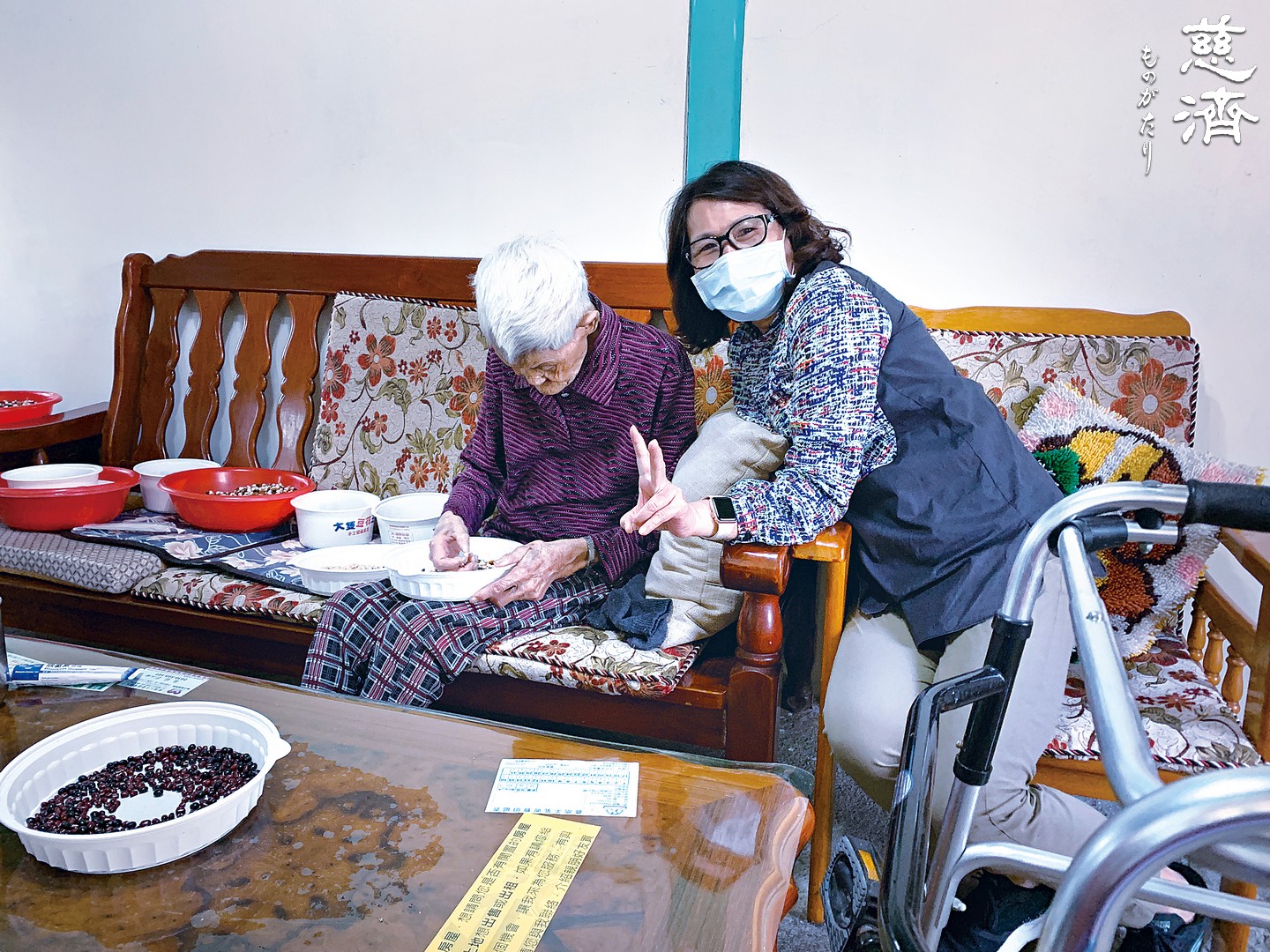

母の老化現象に、黄裕櫻さんは心を痛めると共に無力感を感じていた。
ずっと農業をして生きてきた母親の勤勉で倹約家という性格に合わせ、豆の選り分けトレーニングを勧めることにした。
黃裕櫻(フォン・ユーイン)さんと林耀錡(リン・ヤオチー)さんの後ろについて嘉義県水上郷にある三合院(中国の伝統家屋)のリビングに入った。そこは整頓されたスペースで、ローテーブルがあり、椅子の上には、大小多数のバケツが置かれ、中には何種類もの豆が入っていた。九十三歳のお婆ちゃんが、目の前に置かれた、皿いっぱいの十数種類の豆を選り分けていた。
「父が他界した後、母は三年前からだんだん記憶がなくなって来ました」と黃さんが回想した。「母は子供たちからもらったお小遣いを、自分しか知らない所に隠すのですが、どこに隠したか忘れてしまうのです」。見つからないと、家に泥棒が入ったと思い込み、慌てて泥棒を捜しに出掛けるため、家族はとても心配で、彼女を探し回るのだ。
「母は貴重品だと思って大切にしまうのですが、見つからないと、外国籍介護者のせいにしてしまいます。介護の人はいつも誤解されるため、我慢できなくなって、雇い主を変えたいと言い出すのです」と黃さんはいつも困ってしまう。彼女は、「母は七歳の時から農耕に従事し、九十歳になってもまだ野菜を植えることができたのですが、突然、このように老いてしまい、やるせない思いをしています」と言った。友人とどうすればいいかを話していた時、豆の選り分けトレーニングをしてはどうかとアドバイスしてくれた。
黃さんは、花豆、大豆、あずき、ササゲ、黑豆、そら豆、豌豆、レンズ豆、ひよこ豆等十数種類の豆を買ってきて、「これは、豆農家が要らなくなったものだから、一緒に選り分けて、孫が帰ってきた時に、煮込んで皆で食べましょう」と母親に言った。「一生、物を惜しんで来た母なので、豆を見て手を動かし始めました。花豆は花豆の箱に入れ、大豆は大豆の箱に、というように、そうやって心も安定してきたようです」。
母親はずっと座っていられるが、一定の時間が経つと、黃さんは彼女に付き添って三合院(中国の伝統家屋)から連れ出して、ご近所に挨拶するので、人との交流もだんだんできるようになったことがわかった。耳は遠いが、誰かが尋ねて来ると、「どうぞ座ってください!お喋りしましょう」と言う。また、顔を下に向けて真剣に豆を選り分けていると、とても静かな表情になる。「お婆ちゃん、豆を選り分けてどうするのですか?」と聞くと、それが聞こえたようで、「 炒めるか、スープにしてもいいですね」と答えた。
母の認知症は悪化していない。豆の選り分けもレベルアップした。大きい豆から先に選り分け、最後は一番小さい緑豆を残している。「慣れれば、上手になります。一番嫌いな種類も方法を変えて選り分けています」。黃さんは、集中して雑念がなくなれば、智慧がつく、ということを母親から見てとった。
黃裕櫻さん(右)は、異なる種類の豆を選り分ける母親に付き添っている。(撮影・汪秋戀)
黃さんは、母に孝行するのは本分だと思っている。懸命に義母の世話してくれるご主人の林さんにはことさら感謝している。林さんは、長男で一人息子なので、重病を患っていた両親の世話を長くしてきた経験がある。彼がリサイクルトラックを運転して、近くのリサイクル拠点で回收物を積みに行く時いつも、沿道の年長者の様子を観察する。目つきが虚ろで、挨拶しても返事がなかったり、唇が乾燥して口角から出血していたりすると、徘徊しているのではないかと考え、これ以上徘徊させないよう、まず同乗者のリサイクルボランティアに、なだめながら付き添ってもらい、自分は車を運転して近くの警察署に通報し、年長者を発見した場所までパトカーを誘導する。何度も、ショック状態になりかけたり、道に迷っている年長者を助けたそうだ。
黃さんも林さんも慈済ボランティアである。法師の言葉「善行と親孝行は待ったなし」を生活に応用している。「付き添いは認知症の年長者にとって、一番の良薬です。いつも母に付き添って話をしたり、話をして聞かせたりすることで、母は子供が側にいると感じ、もっと安心して豆の選り分けができるようになっています」。器用に指を動かし、集中して豆を選り分ける母を見ていると、「母親のいる子供は宝」という幸せに浸っている感じがする。
黃さんは、母の情緒が安定すると外国籍介護者も落ち着きました、と語った。黄さんたちが忙しい時に母をきちんと世話してくれる介護者には感謝している。
全ての年長者や年老いた親が、穏やかな温もりを感じて暮らしていけるよう、子供である私たちは努力しなければならない。
(慈済月刊六七七期より)
母の老化現象に、黄裕櫻さんは心を痛めると共に無力感を感じていた。
ずっと農業をして生きてきた母親の勤勉で倹約家という性格に合わせ、豆の選り分けトレーニングを勧めることにした。
黃裕櫻(フォン・ユーイン)さんと林耀錡(リン・ヤオチー)さんの後ろについて嘉義県水上郷にある三合院(中国の伝統家屋)のリビングに入った。そこは整頓されたスペースで、ローテーブルがあり、椅子の上には、大小多数のバケツが置かれ、中には何種類もの豆が入っていた。九十三歳のお婆ちゃんが、目の前に置かれた、皿いっぱいの十数種類の豆を選り分けていた。
「父が他界した後、母は三年前からだんだん記憶がなくなって来ました」と黃さんが回想した。「母は子供たちからもらったお小遣いを、自分しか知らない所に隠すのですが、どこに隠したか忘れてしまうのです」。見つからないと、家に泥棒が入ったと思い込み、慌てて泥棒を捜しに出掛けるため、家族はとても心配で、彼女を探し回るのだ。
「母は貴重品だと思って大切にしまうのですが、見つからないと、外国籍介護者のせいにしてしまいます。介護の人はいつも誤解されるため、我慢できなくなって、雇い主を変えたいと言い出すのです」と黃さんはいつも困ってしまう。彼女は、「母は七歳の時から農耕に従事し、九十歳になってもまだ野菜を植えることができたのですが、突然、このように老いてしまい、やるせない思いをしています」と言った。友人とどうすればいいかを話していた時、豆の選り分けトレーニングをしてはどうかとアドバイスしてくれた。
黃さんは、花豆、大豆、あずき、ササゲ、黑豆、そら豆、豌豆、レンズ豆、ひよこ豆等十数種類の豆を買ってきて、「これは、豆農家が要らなくなったものだから、一緒に選り分けて、孫が帰ってきた時に、煮込んで皆で食べましょう」と母親に言った。「一生、物を惜しんで来た母なので、豆を見て手を動かし始めました。花豆は花豆の箱に入れ、大豆は大豆の箱に、というように、そうやって心も安定してきたようです」。
母親はずっと座っていられるが、一定の時間が経つと、黃さんは彼女に付き添って三合院(中国の伝統家屋)から連れ出して、ご近所に挨拶するので、人との交流もだんだんできるようになったことがわかった。耳は遠いが、誰かが尋ねて来ると、「どうぞ座ってください!お喋りしましょう」と言う。また、顔を下に向けて真剣に豆を選り分けていると、とても静かな表情になる。「お婆ちゃん、豆を選り分けてどうするのですか?」と聞くと、それが聞こえたようで、「 炒めるか、スープにしてもいいですね」と答えた。
母の認知症は悪化していない。豆の選り分けもレベルアップした。大きい豆から先に選り分け、最後は一番小さい緑豆を残している。「慣れれば、上手になります。一番嫌いな種類も方法を変えて選り分けています」。黃さんは、集中して雑念がなくなれば、智慧がつく、ということを母親から見てとった。
黃裕櫻さん(右)は、異なる種類の豆を選り分ける母親に付き添っている。(撮影・汪秋戀)
黃さんは、母に孝行するのは本分だと思っている。懸命に義母の世話してくれるご主人の林さんにはことさら感謝している。林さんは、長男で一人息子なので、重病を患っていた両親の世話を長くしてきた経験がある。彼がリサイクルトラックを運転して、近くのリサイクル拠点で回收物を積みに行く時いつも、沿道の年長者の様子を観察する。目つきが虚ろで、挨拶しても返事がなかったり、唇が乾燥して口角から出血していたりすると、徘徊しているのではないかと考え、これ以上徘徊させないよう、まず同乗者のリサイクルボランティアに、なだめながら付き添ってもらい、自分は車を運転して近くの警察署に通報し、年長者を発見した場所までパトカーを誘導する。何度も、ショック状態になりかけたり、道に迷っている年長者を助けたそうだ。
黃さんも林さんも慈済ボランティアである。法師の言葉「善行と親孝行は待ったなし」を生活に応用している。「付き添いは認知症の年長者にとって、一番の良薬です。いつも母に付き添って話をしたり、話をして聞かせたりすることで、母は子供が側にいると感じ、もっと安心して豆の選り分けができるようになっています」。器用に指を動かし、集中して豆を選り分ける母を見ていると、「母親のいる子供は宝」という幸せに浸っている感じがする。
黃さんは、母の情緒が安定すると外国籍介護者も落ち着きました、と語った。黄さんたちが忙しい時に母をきちんと世話してくれる介護者には感謝している。
全ての年長者や年老いた親が、穏やかな温もりを感じて暮らしていけるよう、子供である私たちは努力しなければならない。
(慈済月刊六七七期より)
08・02
慈済アメリカ総支部は、6月から南カリフォルニアの善意の人たちと協力して、中南米からの華人系不法移民の世話を開始した。本日、モントレーパーク市で三回目の配付活動を行い、300セット余りの野菜や果物及びおむつ、ベビー用衣類などを用意し、必要なものを持ち帰ってもらった。
08・03
慈済基金会「第八回グローバル共善学習思考会議」が、「正義の経済と持続可能な環境」のテーマの下に、新店静思堂で開かれた。タン・プライズの持続可能な発展賞を獲得した、コロンビア大学SDGsセンターの主任で、国連SDGNの主席でもあるジェフリー・サクス氏を招いて講演が行われた。
08・04
慈済アメリカ・ダラス支部は、弱者家庭の学生を支援する「ダラス市長登校日活動に参加した。今回の参加は二十回目で、本日、30人のボランティアを動員して、2000着余りの制服を配付した。
08・05
◎慈済インドネシア支部はジャカルタ州政府と共に、ノースジャカルタなど5つの行政都市で貧困者向けの支援建設プロジェクトに参加する。本日、ジャカルタ州のヘル代理知事と慈済インドネシア支部の郭再源副執行長及びジャカルタのボランティアが、ウェスト・ジャカルタのパルメラ地区を訪れ、弱者家庭にニーズの聞き取りを行なった。
◎慈済基金会宗教所職員の王姵文(明智)さんたちは、ドミニカ共和国での支部の活動を支援した。本日、現地ボランティアと共に、デセオス・ソンリサス基金会と協力して、モンテ・プラタ州のインディオ居住区を訪れ、子供たちへの歯科施療を行うと共に、学用品を160人の学童に配付した。
08・08
證厳法師はドミニカ共和国ラロマナ市政府から「シティーキー」を授与された。同市は、法師が貧しい人たちに関心を寄せ、貧困生活から抜け出させるために、ゴミ山に住んでいた子供たちに教育を受けさせ、慈善ケアを行なったり、学校の建設を支援したことに対して感謝の意を表した。アメリカ慈済ボランティアの林玉娥(慮瑢)さんが代表で賞を受け取った。
08・11
慈済アメリカ・オースティン連絡所は「幸福な学校」プロジェクトで、長年にわたり新年度に、オーバートン小学校の低所得者家庭の児童に、カバンなどの学用品を提供してきた。本日もその寄贈が行われ、学校のスタッフが代表で受け取った。
08・12
ミャンマーの慈済ボランティアは、雨季の影響を受けたヤンゴン州オーガン町の15の米貯金をしている村を見舞った。本日から9月3日まで7回に分けて、969世帯に米と食用油などの物資を届けると共に、家庭訪問を行なった。
08・13
◎アメリカ・フロリダ州パインアイランドのパームストレーラー居住地区が、2022年9月にハリケーンイアンによって大きな被害を被った。マイアミの慈済ボランティアが慰問活動を続けており、本日、再び現地を訪れて、緊急支援を必要としている6世帯に被災補助金の申請と日用品の買付を手伝った。
◎慈済アメリカ総支部は、「歯科助手とボランティアの養成講座」を開催し、感染コントロール、法律、歯科施療の流れなどについて説明すると共に、機器の消毒などの実地作業も行なった。講座に参加した人は、その後に予定されている施療活動に参加応募して実習することができる。
08・14
第9回世界宗教会議が14日から18日まで、アメリカ・シカゴ市で開かれた。慈済基金会は役員の資格で企画に参加した。16の重要議題と座談会を主催したり、参加して、10余りのテーマで講演した。静思精舎から3人の師父と数多くの基金会の主任や職員たちで構成されたチームが参加し、アメリカ総支部とシカゴ支部の職員やボランティアたちも出席した。
08・15
慈済モザンビーク連絡所は、エイズに感染している子供たちの家庭に対して、五穀粉で栄養をつけるプロジェクトを展開している。本日、第二ステージの三回目の配付が行われ、一世帯当たり2パックの五穀粉と2袋の米及び豆が72人の子供を対象に提供された。
08・16
8月8日、アメリカ・ハワイのマウイ島で重大な山火事が発生し、数千人の住民が避難すると同時に、死者が100人を超えた。慈済ハワイ支部のボランティア一行3人は16日、被災状況の調査のため、オアフ島を出発し、赤十字社など救済団体のスタッフと災害支援に関して話し合った。
08・18
フィリピンの慈済ボランティア一行31人は、18日から21日まで、カガヤン州に赴いて、今年第5号の台風トクスリで大きな被害を被ったサンチェス・ミラ市の9つの村とアブルグ市の1つの村で、家庭訪問と配付を行なった。
08・19
エクアドル・マナビ州ポートヴィエホ・ピスロイ地区の慈済コミュニティーボランティアと修道女、現地志願者たちは一緒に、168人の学童に勉強の指導を行っている。
08・21
日々、アメリカ・ハワイ州のマウイ島被災者を気にかけている證厳法師は、本日9時45分に、ハワイの慈済ボランティアである范峰(濟榮)さんと蕭鳳英(慈光)さんたちにオンラインで、「被災地では視察に安全を確保し、支援とケアが被災者の心まで届くようにしなさい。被災者は全てを無くしているのですから、過渡期を過ごせるよう、精一杯支援してやってください。本部は徹底してサポートしますから」と言って聞かせた。
08・02
慈済アメリカ総支部は、6月から南カリフォルニアの善意の人たちと協力して、中南米からの華人系不法移民の世話を開始した。本日、モントレーパーク市で三回目の配付活動を行い、300セット余りの野菜や果物及びおむつ、ベビー用衣類などを用意し、必要なものを持ち帰ってもらった。
08・03
慈済基金会「第八回グローバル共善学習思考会議」が、「正義の経済と持続可能な環境」のテーマの下に、新店静思堂で開かれた。タン・プライズの持続可能な発展賞を獲得した、コロンビア大学SDGsセンターの主任で、国連SDGNの主席でもあるジェフリー・サクス氏を招いて講演が行われた。
08・04
慈済アメリカ・ダラス支部は、弱者家庭の学生を支援する「ダラス市長登校日活動に参加した。今回の参加は二十回目で、本日、30人のボランティアを動員して、2000着余りの制服を配付した。
08・05
◎慈済インドネシア支部はジャカルタ州政府と共に、ノースジャカルタなど5つの行政都市で貧困者向けの支援建設プロジェクトに参加する。本日、ジャカルタ州のヘル代理知事と慈済インドネシア支部の郭再源副執行長及びジャカルタのボランティアが、ウェスト・ジャカルタのパルメラ地区を訪れ、弱者家庭にニーズの聞き取りを行なった。
◎慈済基金会宗教所職員の王姵文(明智)さんたちは、ドミニカ共和国での支部の活動を支援した。本日、現地ボランティアと共に、デセオス・ソンリサス基金会と協力して、モンテ・プラタ州のインディオ居住区を訪れ、子供たちへの歯科施療を行うと共に、学用品を160人の学童に配付した。
08・08
證厳法師はドミニカ共和国ラロマナ市政府から「シティーキー」を授与された。同市は、法師が貧しい人たちに関心を寄せ、貧困生活から抜け出させるために、ゴミ山に住んでいた子供たちに教育を受けさせ、慈善ケアを行なったり、学校の建設を支援したことに対して感謝の意を表した。アメリカ慈済ボランティアの林玉娥(慮瑢)さんが代表で賞を受け取った。
08・11
慈済アメリカ・オースティン連絡所は「幸福な学校」プロジェクトで、長年にわたり新年度に、オーバートン小学校の低所得者家庭の児童に、カバンなどの学用品を提供してきた。本日もその寄贈が行われ、学校のスタッフが代表で受け取った。
08・12
ミャンマーの慈済ボランティアは、雨季の影響を受けたヤンゴン州オーガン町の15の米貯金をしている村を見舞った。本日から9月3日まで7回に分けて、969世帯に米と食用油などの物資を届けると共に、家庭訪問を行なった。
08・13
◎アメリカ・フロリダ州パインアイランドのパームストレーラー居住地区が、2022年9月にハリケーンイアンによって大きな被害を被った。マイアミの慈済ボランティアが慰問活動を続けており、本日、再び現地を訪れて、緊急支援を必要としている6世帯に被災補助金の申請と日用品の買付を手伝った。
◎慈済アメリカ総支部は、「歯科助手とボランティアの養成講座」を開催し、感染コントロール、法律、歯科施療の流れなどについて説明すると共に、機器の消毒などの実地作業も行なった。講座に参加した人は、その後に予定されている施療活動に参加応募して実習することができる。
08・14
第9回世界宗教会議が14日から18日まで、アメリカ・シカゴ市で開かれた。慈済基金会は役員の資格で企画に参加した。16の重要議題と座談会を主催したり、参加して、10余りのテーマで講演した。静思精舎から3人の師父と数多くの基金会の主任や職員たちで構成されたチームが参加し、アメリカ総支部とシカゴ支部の職員やボランティアたちも出席した。
08・15
慈済モザンビーク連絡所は、エイズに感染している子供たちの家庭に対して、五穀粉で栄養をつけるプロジェクトを展開している。本日、第二ステージの三回目の配付が行われ、一世帯当たり2パックの五穀粉と2袋の米及び豆が72人の子供を対象に提供された。
08・16
8月8日、アメリカ・ハワイのマウイ島で重大な山火事が発生し、数千人の住民が避難すると同時に、死者が100人を超えた。慈済ハワイ支部のボランティア一行3人は16日、被災状況の調査のため、オアフ島を出発し、赤十字社など救済団体のスタッフと災害支援に関して話し合った。
08・18
フィリピンの慈済ボランティア一行31人は、18日から21日まで、カガヤン州に赴いて、今年第5号の台風トクスリで大きな被害を被ったサンチェス・ミラ市の9つの村とアブルグ市の1つの村で、家庭訪問と配付を行なった。
08・19
エクアドル・マナビ州ポートヴィエホ・ピスロイ地区の慈済コミュニティーボランティアと修道女、現地志願者たちは一緒に、168人の学童に勉強の指導を行っている。
08・21
日々、アメリカ・ハワイ州のマウイ島被災者を気にかけている證厳法師は、本日9時45分に、ハワイの慈済ボランティアである范峰(濟榮)さんと蕭鳳英(慈光)さんたちにオンラインで、「被災地では視察に安全を確保し、支援とケアが被災者の心まで届くようにしなさい。被災者は全てを無くしているのですから、過渡期を過ごせるよう、精一杯支援してやってください。本部は徹底してサポートしますから」と言って聞かせた。
Translated by Teresa Chang
It has been my long-held aspiration to give back to the birthplace of the Buddha. The pervasive poverty in the region calls for compassionate people to plant seeds of goodness and bring about change. I’m grateful to the Tzu Chi volunteers from Singapore and Malaysia who share this aspiration with me. They initially paid short visits to Nepal and, since April of last year, have established a long-term presence there. Their efforts encompass missions of charity, healthcare, and education. For instance, they have introduced vocational sewing classes to equip local women with skills that can improve their families’ economic well-being. Our volunteers work with sincerity, taking each step steadily, in their mission to create a positive impact in local communities.
Earlier this year, they extended their philanthropic endeavors to Bodh Gaya, India, the place where the Buddha attained enlightenment. One heartwarming example of Tzu Chi’s impact there is Gain Manjhi, an elderly resident of Bakraur in Bodh Gaya. He previously lived by begging at tourist spots, often struggling to secure his daily meals. Worried neighbors informed our volunteers of his plight. Once he had enough to eat, he shifted from a recipient to a giver, joining our volunteers in aiding others.
Our volunteers didn’t just assist Gain Manjhi in rising above his beggar status; they aspired to bring about more positive transformations. Their goal is to foster self-sufficiency and ensure everyone has enough to eat.
Tzu Chi originated in Taiwan, a tiny dot on the world map. Our foundation has more than 55 years of history, yet it is also a mere droplet in the grand expanse of the world. Despite being a mere droplet, we have been doing our best to bring light to the world. Our journey began with 30 housewives, each saving a small amount of their grocery money every day for charity work. We’ve evolved from that humble beginning by combining bits and pieces of help. For decades now, we’ve been able to extend our care to suffering people around the world.
Life is impermanent and full of suffering. When faced with misfortune, some people lament, “I’ve been doing good deeds, so why do I still encounter such hardships?” But harboring resentment towards adversity will not offer a solution and might even hinder one’s spiritual growth. Wise individuals understand the unpredictable nature of life. When adversity strikes, they recognize it as a shared human experience. They perceive life as an ongoing journey of learning, intricately woven with karmic connections. With this understanding, they embrace life as it unfolds, facilitating the resolution of karmic debts. They uplift themselves and find the strength to help many others.
The world is indeed full of suffering, but it is only in this world that we can follow the Bodhisattva Path. Life’s suffering leads to the emergence of bodhisattvas. Because this world is full of trials, we must, even more so, make profound vows of dedication to help those in need. We must commit ourselves to remaining determined and steadfast in our mission, undeterred by obstacles.
As we walk the Bodhisattva Path, we should inspire others to join us on this path. This was one of the reasons why Tzu Chi volunteers took to the streets to raise funds for survivors of the February quakes in Türkiye. The essence of fundraising lies in raising people’s awareness of others’ suffering, reminding them of their own blessings, and inspiring them to tap into their inner wellspring of love. Though each individual’s strength or contribution might be limited, they can make a significant impact when pooled together.
In Türkiye, more than 8,000 kilometers from Taiwan, there are residents enduring the consequences of natural disasters and Syrian refugees displaced by man-made calamities. These refugees lost their good lives in their homeland due to the ignorance and delusion of a few. Such ignorance and delusion give rise to disputes, conflicts, and ultimately, devastating wars that bring untold suffering to countless people. It is only through pious sincerity, the cultivation of kind thoughts, and the practice of positive deeds that we can hope to dispel such disasters.
Disasters stem from the human mind. A virtuous thought can create heaven, while a malevolent one can lead to hell. The slightest shift in thought can make all the difference. Though observing the turmoil of the world may raise worries, it’s important not to succumb to anxiety. Instead, we should redouble our efforts to transform human hearts and minds. By nurturing the love within people’s hearts, and by encouraging everyone to give to the less fortunate, we offer a potent remedy for the world’s ills; we not only bring relief and joy to the needy, but also find fulfillment and happiness ourselves. Let us be ever more mindful.
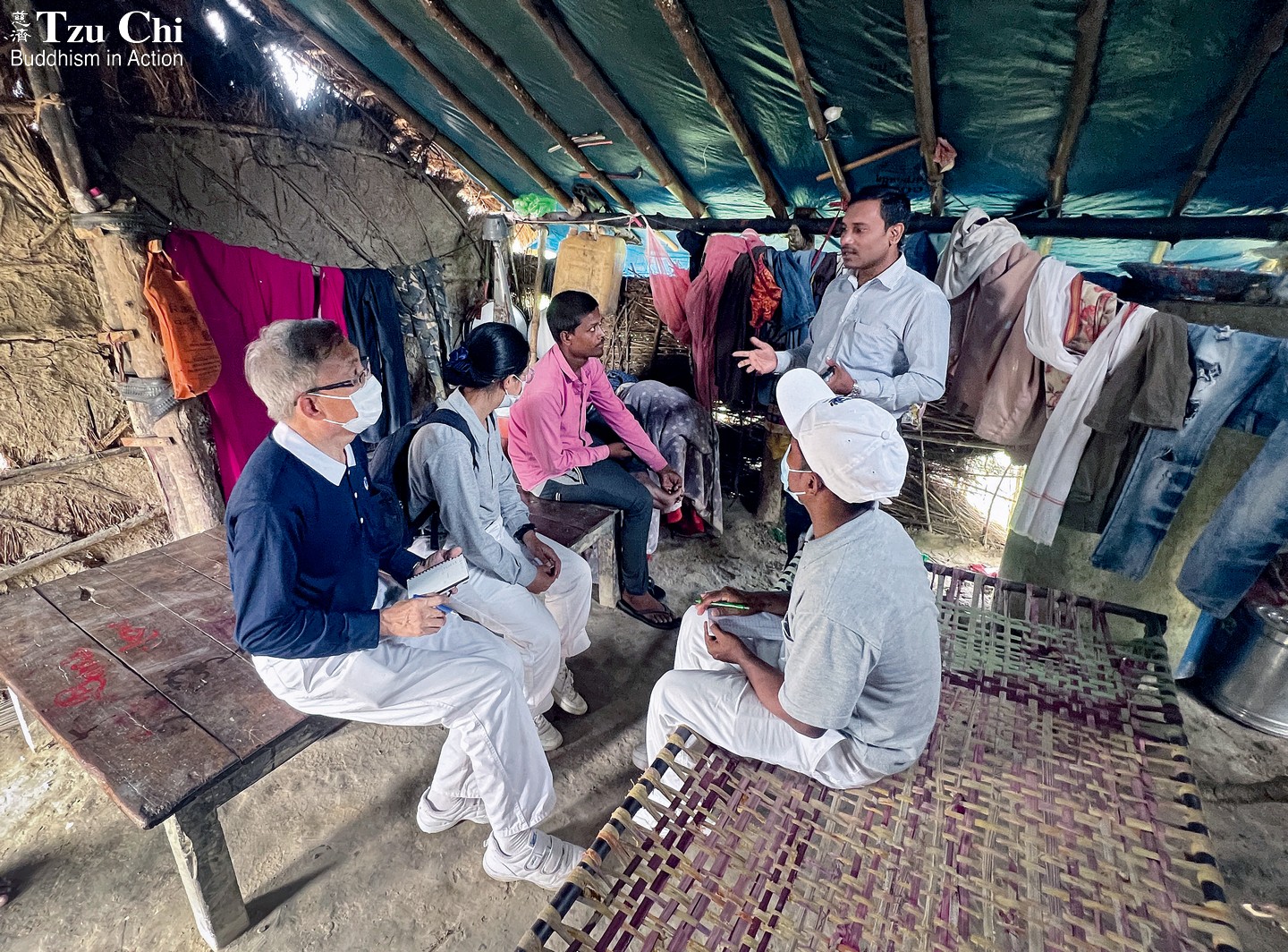
Tzu Chi volunteers visit a destitute family in Lumbini, Nepal, who have relied on begging for their livelihood for generations. Khoo Kean Yee

Translated by Teresa Chang
It has been my long-held aspiration to give back to the birthplace of the Buddha. The pervasive poverty in the region calls for compassionate people to plant seeds of goodness and bring about change. I’m grateful to the Tzu Chi volunteers from Singapore and Malaysia who share this aspiration with me. They initially paid short visits to Nepal and, since April of last year, have established a long-term presence there. Their efforts encompass missions of charity, healthcare, and education. For instance, they have introduced vocational sewing classes to equip local women with skills that can improve their families’ economic well-being. Our volunteers work with sincerity, taking each step steadily, in their mission to create a positive impact in local communities.
Earlier this year, they extended their philanthropic endeavors to Bodh Gaya, India, the place where the Buddha attained enlightenment. One heartwarming example of Tzu Chi’s impact there is Gain Manjhi, an elderly resident of Bakraur in Bodh Gaya. He previously lived by begging at tourist spots, often struggling to secure his daily meals. Worried neighbors informed our volunteers of his plight. Once he had enough to eat, he shifted from a recipient to a giver, joining our volunteers in aiding others.
Our volunteers didn’t just assist Gain Manjhi in rising above his beggar status; they aspired to bring about more positive transformations. Their goal is to foster self-sufficiency and ensure everyone has enough to eat.
Tzu Chi originated in Taiwan, a tiny dot on the world map. Our foundation has more than 55 years of history, yet it is also a mere droplet in the grand expanse of the world. Despite being a mere droplet, we have been doing our best to bring light to the world. Our journey began with 30 housewives, each saving a small amount of their grocery money every day for charity work. We’ve evolved from that humble beginning by combining bits and pieces of help. For decades now, we’ve been able to extend our care to suffering people around the world.
Life is impermanent and full of suffering. When faced with misfortune, some people lament, “I’ve been doing good deeds, so why do I still encounter such hardships?” But harboring resentment towards adversity will not offer a solution and might even hinder one’s spiritual growth. Wise individuals understand the unpredictable nature of life. When adversity strikes, they recognize it as a shared human experience. They perceive life as an ongoing journey of learning, intricately woven with karmic connections. With this understanding, they embrace life as it unfolds, facilitating the resolution of karmic debts. They uplift themselves and find the strength to help many others.
The world is indeed full of suffering, but it is only in this world that we can follow the Bodhisattva Path. Life’s suffering leads to the emergence of bodhisattvas. Because this world is full of trials, we must, even more so, make profound vows of dedication to help those in need. We must commit ourselves to remaining determined and steadfast in our mission, undeterred by obstacles.
As we walk the Bodhisattva Path, we should inspire others to join us on this path. This was one of the reasons why Tzu Chi volunteers took to the streets to raise funds for survivors of the February quakes in Türkiye. The essence of fundraising lies in raising people’s awareness of others’ suffering, reminding them of their own blessings, and inspiring them to tap into their inner wellspring of love. Though each individual’s strength or contribution might be limited, they can make a significant impact when pooled together.
In Türkiye, more than 8,000 kilometers from Taiwan, there are residents enduring the consequences of natural disasters and Syrian refugees displaced by man-made calamities. These refugees lost their good lives in their homeland due to the ignorance and delusion of a few. Such ignorance and delusion give rise to disputes, conflicts, and ultimately, devastating wars that bring untold suffering to countless people. It is only through pious sincerity, the cultivation of kind thoughts, and the practice of positive deeds that we can hope to dispel such disasters.
Disasters stem from the human mind. A virtuous thought can create heaven, while a malevolent one can lead to hell. The slightest shift in thought can make all the difference. Though observing the turmoil of the world may raise worries, it’s important not to succumb to anxiety. Instead, we should redouble our efforts to transform human hearts and minds. By nurturing the love within people’s hearts, and by encouraging everyone to give to the less fortunate, we offer a potent remedy for the world’s ills; we not only bring relief and joy to the needy, but also find fulfillment and happiness ourselves. Let us be ever more mindful.
Tzu Chi volunteers visit a destitute family in Lumbini, Nepal, who have relied on begging for their livelihood for generations. Khoo Kean Yee
By Hong Jing-jing
Translated by Wu Hsiao-ting
Photos by Hsiao Yiu-hwa
Empathizing with the inner agony and suffering of individuals with mental illness, Huang Xiu-yan extends a helping hand, striving to foster positive change.
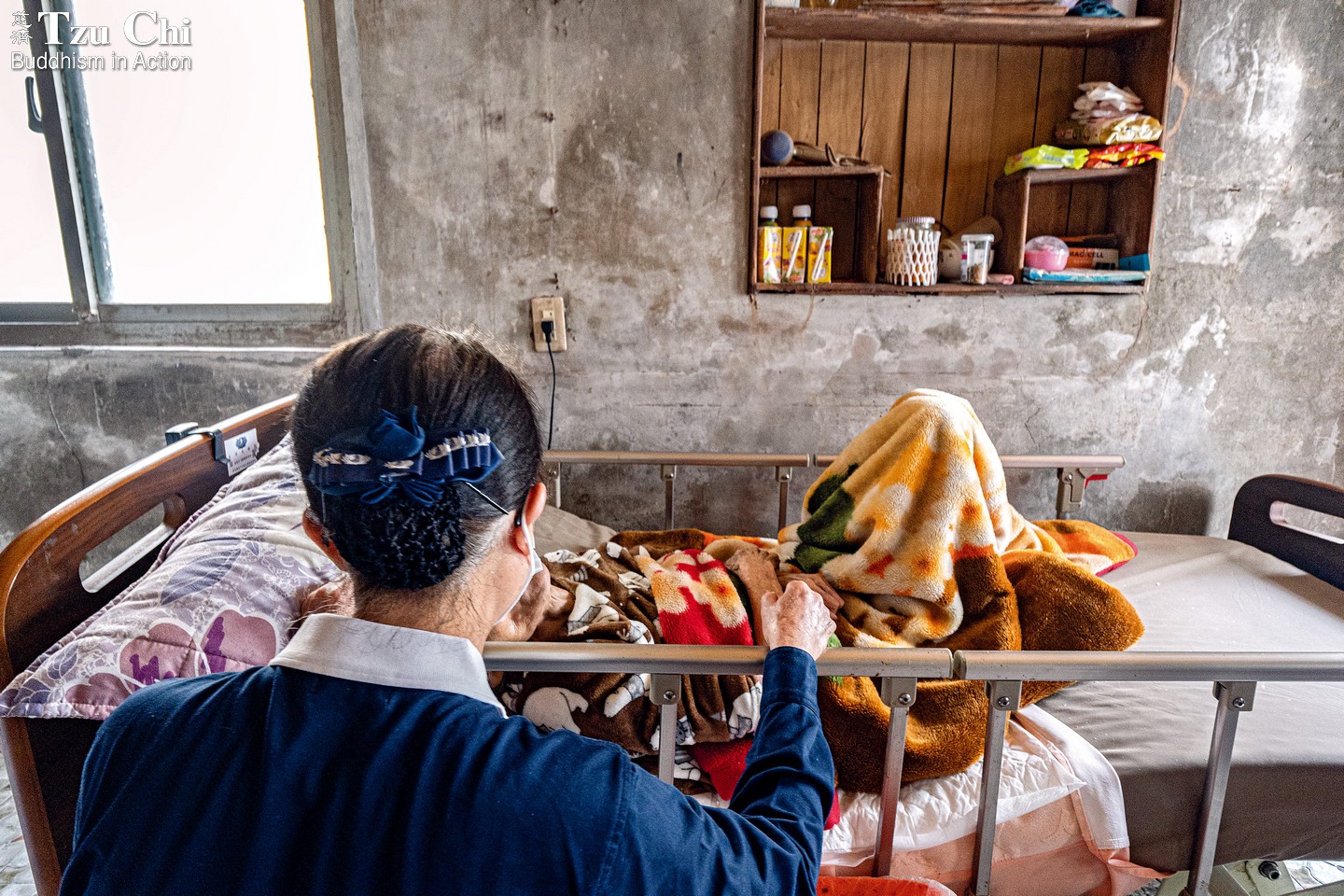
Tzu Chi volunteer Huang Xiu-yan talks to an older woman who struggles with a mental illness, along with hearing and visual impairments.
“I knew the nursing home was trying to find me via the public speaker system, but I was busy talking to the ants,” said Weng.
“You spent so much time talking to the ants, I waited for you for so long!” responded Huang Xiu-yan (黃秀燕).
Weng, battling schizophrenia, experiences absurd and bizarre delusions from time to time. Huang, a Tzu Chi volunteer living in Keelung, northern Taiwan, has been caring for him for 30 years. Recognizing that he was having an episode again, she responded with a calm and understanding demeanor.
Huang vividly remembers the first time she met Weng, in 1993. His head was wrapped in a plaster used for burn patients, leaving only his eyes visible. Not long after completing his compulsory military service, distressing changes in his mental state emerged. He was plagued by hallucinations and delusions, in a state of deep despondency. He even contemplated ending his life. Tragically, during an attempted gas suicide, an unexpected explosion inflicted extensive burns all over his body, distorting his face. He had to undergo more than 20 surgeries to regain the use of his hands.
Huang had been a certified Tzu Chi volunteer for just over a year when she began visiting Weng with other volunteers. It was her first experience with individuals grappling with mental illness. She watched how the more experienced volunteers gently and kindly encouraged the young man. “At that time, he was truly feeling hopeless and despaired,” she recalled, “but thanks to the genuine support from the volunteers, he eventually found the courage to face the world.”
When Weng was a little child, his parents divorced, and he was raised by his father. After the gas explosion destroyed their home, the father and son were forced to rent a place to live. His father resigned from his job at a factory warehouse to care for Weng. Tzu Chi volunteers promptly intervened, providing care and financial support for their living expenses and medical fees.
“Weng doesn’t exhibit any violent tendencies,” explained Huang. “When he takes his medication, he can engage in meaningful conversations with us.” After his father passed away, he lived alone, and Huang took over from the more experienced volunteers to help ensure his continuous care and support.
“Interacting with individuals with mental illness, just like any other care recipient, requires genuine sincerity in our approach,” said Huang. She has offered compassion and understanding to Weng for 30 years now. When he broke his leg in a car accident, she diligently delivered three meals to him almost every day during his recovery. When he moved into a nursing home in Taoyuan, she and other volunteers made regular monthly trips from Keelung to that city, taking him out to bookstores or for meals, and attending Tzu Chi’s year-end banquets for the foundation’s care recipients together. When he suffered from a severe case of scabies all over his body during a stay in a nursing home in Yilan, Huang accompanied him to seek medical treatment and meticulously disinfected all his clothes by boiling them.
Weng has no living family members, and Huang is the only person he trusts. On one occasion, during a severe bout of schizophrenia, Weng wandered aimlessly in his community and spoke incoherently, causing distress among other residents. His landlord urgently contacted Huang, seeking her assistance in handling the situation.
Weng’s gaze was unfocused when Huang found him, but he still recognized her. She asked him, “Are you feeling very uncomfortable? Are you being greatly disturbed?” Weng nodded, but immediately his speech became incoherent again. “Shall I take you to see the doctor?” Huang continued. “You might feel better.” Weng nodded his consent.
Huang stressed the importance that individuals with mental illness adhere to their medication schedule, as discontinuing medication can lead to relapses. Fortunately, Weng does not pose harm to others when he has a bout; his main symptoms are mumbling to himself and having a distant gaze.
Even so, Huang’s journey of providing support for him has been filled with incidents that required her vigilance. One time, during a cold snap and heavy rain in Keelung, Weng went missing from the nursing home he was residing at in that city. Huang was concerned that he might venture into the mountains, making it difficult to find him. Thankfully, that didn’t happen. The next day, the police found him naked, holding an umbrella, directing traffic on a street. “He explained his behavior by saying that a deity was descending from heaven, and he needed to remove his clothes to receive the deity,” Huang said. She understood that she could avoid triggering his emotions as long as she empathized with him without dismissing his beliefs. “I won’t ever say to him that he is abnormal. I just smiled and replied, ‘You are truly devout!’” she recalled.
Weng currently lives in a nursing home in Yuli, Hualien, which is quite a distance from Huang’s home in Keelung. Despite their geographical separation, Huang sends him food, copies of Tzu Chi Monthly, Buddhist scriptures, and other supplies every month. Weng can truly feel the sincere care from her, as demonstrated during the COVID-19 pandemic: he was the first person to call and express concern for Huang. He was genuinely worried about her well-being, advising her to wear masks properly, wash her hands with soap, and avoid crowded places. “He writes me letters too, expressing his gratitude for the care I’ve provided him,” Huang said, looking gratified.

Huang Xiu-yan attentively listens while a family member of a person with a mental illness shares her challenges of being a caregiver. Huang also helps such family members seek resources to alleviate their excessive physical and emotional burdens.
“Not every person with a mental illness is the same,” emphasized Huang. She stressed that when caring for people with mental conditions, one must always be attentive to their words and facial expressions. If they appear kind and amiable, it indicates that their inner states are relatively stable. However, if they are experiencing an episode, they may have negative and chaotic delusions that are difficult for others to grasp, requiring careful handling.
Huang recalled a situation when she and other volunteers arrived at a new care recipient’s home to visit. When they rang the doorbell, it inadvertently startled the care recipient, causing him to break into a furious outburst at the volunteers outside the door that lasted for half an hour. Undeterred, Huang astutely peered through the partially open door and noticed a tea set cabinet inside the house. “You seem to be skilled in brewing tea,” she said to the man, trying to engage him in conversation. Eventually, the person calmed down and welcomed Huang and the other volunteers into his home.
Over her many years of extending care, Huang has also encountered individuals who exhibit violent behavior. “One time, a man went berserk and was ready to attack us,” she said. “We had to make a hasty retreat.” She emphasized that in such situations, instead of continuing to provide care, it is essential to involve government agencies for assistance, enforce compulsory treatment for the individuals, and find suitable institutions in which they can be placed.
Huang pointed out that just as the physical body can fall ill, the mind can also experience illness. When one is sick, seeking professional treatment is essential. “In assisting individuals with mental disorders,” she said, “the primary focus should be on helping them seek medical care, followed by connecting them with relevant social welfare resources.”
In her efforts to aid individuals with mental conditions, Huang also offers her care to their family members. She has observed family members who grapple with the overwhelming challenge of “coexisting with the illness,” experiencing emotional and mental anguish as they try to support their loved ones amidst the complexities of the condition.
She once helped an 84-year-old woman with a mental illness. She also suffered from severe hearing impairment and blindness in both eyes. Regardless of how loudly Huang shouted, the woman couldn’t hear her. “Who are you? What are you saying?” the woman asked. “I am from Tzu Chi,” Huang replied. “What did you say? Who are you?” the woman asked again.
Huang and other volunteers became aware of the woman through a neighborhood chief. The woman’s home was overflowing with garbage, inside and out, prompting the chief to seek help from Tzu Chi. Approximately 60 volunteers came to assist with the cleanup. The elderly woman was extremely emaciated, confined to her bed, suffering with bedsores. She originally slept on a wooden bench in the living room. Volunteers later provided her with an electric hospital bed to help her rest more comfortably.
The woman’s daughter shared her struggles with Huang. “Every day, my mother tries to remove her own excrement manually,” she said. “No matter how much I try to talk to her, she won’t listen. I can’t take it anymore. Yesterday, I hit her out of helplessness. I really want to kick her out. I feel like I haven’t taken good care of her.” The elderly woman often shouted loudly. Her daughter had been taking care of her for a long time, enduring immense psychological stress and emotional burden, leading to a deep depression. The exhausted daughter complained and vented her grievances to Huang, who patiently listened, offering comfort and encouragement.
Huang has devoted over three decades to caring for the needy, accompanying numerous families afflicted by poverty and illness. When asked if she had ever been impacted by negative emotions, since she had to face families with problems often, she confidently replied in the negative. She said it was because her complete focus is on how to assist others and solve their problems, leaving no room for her to get entangled in pessimism.
She acknowledged that in the care of and interaction with individuals with mental disorders, one inevitably experiences fear, frustration, and helplessness. However, she expressed gratitude that Tzu Chi’s care for the needy for over half a century has been a collaborative team effort, supported by professional social workers’ guidance and assistance. With such teamwork and support, their journey can be described as “challenging but manageable.”
People with mental illness experience turmoil and disruption in their lives; their road to recovery is both long and challenging. Huang said that some people might fear or reject them, but she always treats them like family or friends, accompanying them to medical appointments, reminding them to take their medication on time, and making them feel understood and accepted, not alone and unsupported. This approach prevents them from becoming worse and enables them to keep progressing on the path to recovery.
Volunteers like Huang compassionately enter the lives of many poor individuals and families struggling with mental issues, effectively bridging the gaps and limitations of government social welfare resources. Their tireless endeavors radiate a beacon of hope and may even serve as a lifeline for those in dire need.
By Hong Jing-jing
Translated by Wu Hsiao-ting
Photos by Hsiao Yiu-hwa
Empathizing with the inner agony and suffering of individuals with mental illness, Huang Xiu-yan extends a helping hand, striving to foster positive change.
Tzu Chi volunteer Huang Xiu-yan talks to an older woman who struggles with a mental illness, along with hearing and visual impairments.
“I knew the nursing home was trying to find me via the public speaker system, but I was busy talking to the ants,” said Weng.
“You spent so much time talking to the ants, I waited for you for so long!” responded Huang Xiu-yan (黃秀燕).
Weng, battling schizophrenia, experiences absurd and bizarre delusions from time to time. Huang, a Tzu Chi volunteer living in Keelung, northern Taiwan, has been caring for him for 30 years. Recognizing that he was having an episode again, she responded with a calm and understanding demeanor.
Huang vividly remembers the first time she met Weng, in 1993. His head was wrapped in a plaster used for burn patients, leaving only his eyes visible. Not long after completing his compulsory military service, distressing changes in his mental state emerged. He was plagued by hallucinations and delusions, in a state of deep despondency. He even contemplated ending his life. Tragically, during an attempted gas suicide, an unexpected explosion inflicted extensive burns all over his body, distorting his face. He had to undergo more than 20 surgeries to regain the use of his hands.
Huang had been a certified Tzu Chi volunteer for just over a year when she began visiting Weng with other volunteers. It was her first experience with individuals grappling with mental illness. She watched how the more experienced volunteers gently and kindly encouraged the young man. “At that time, he was truly feeling hopeless and despaired,” she recalled, “but thanks to the genuine support from the volunteers, he eventually found the courage to face the world.”
When Weng was a little child, his parents divorced, and he was raised by his father. After the gas explosion destroyed their home, the father and son were forced to rent a place to live. His father resigned from his job at a factory warehouse to care for Weng. Tzu Chi volunteers promptly intervened, providing care and financial support for their living expenses and medical fees.
“Weng doesn’t exhibit any violent tendencies,” explained Huang. “When he takes his medication, he can engage in meaningful conversations with us.” After his father passed away, he lived alone, and Huang took over from the more experienced volunteers to help ensure his continuous care and support.
“Interacting with individuals with mental illness, just like any other care recipient, requires genuine sincerity in our approach,” said Huang. She has offered compassion and understanding to Weng for 30 years now. When he broke his leg in a car accident, she diligently delivered three meals to him almost every day during his recovery. When he moved into a nursing home in Taoyuan, she and other volunteers made regular monthly trips from Keelung to that city, taking him out to bookstores or for meals, and attending Tzu Chi’s year-end banquets for the foundation’s care recipients together. When he suffered from a severe case of scabies all over his body during a stay in a nursing home in Yilan, Huang accompanied him to seek medical treatment and meticulously disinfected all his clothes by boiling them.
Weng has no living family members, and Huang is the only person he trusts. On one occasion, during a severe bout of schizophrenia, Weng wandered aimlessly in his community and spoke incoherently, causing distress among other residents. His landlord urgently contacted Huang, seeking her assistance in handling the situation.
Weng’s gaze was unfocused when Huang found him, but he still recognized her. She asked him, “Are you feeling very uncomfortable? Are you being greatly disturbed?” Weng nodded, but immediately his speech became incoherent again. “Shall I take you to see the doctor?” Huang continued. “You might feel better.” Weng nodded his consent.
Huang stressed the importance that individuals with mental illness adhere to their medication schedule, as discontinuing medication can lead to relapses. Fortunately, Weng does not pose harm to others when he has a bout; his main symptoms are mumbling to himself and having a distant gaze.
Even so, Huang’s journey of providing support for him has been filled with incidents that required her vigilance. One time, during a cold snap and heavy rain in Keelung, Weng went missing from the nursing home he was residing at in that city. Huang was concerned that he might venture into the mountains, making it difficult to find him. Thankfully, that didn’t happen. The next day, the police found him naked, holding an umbrella, directing traffic on a street. “He explained his behavior by saying that a deity was descending from heaven, and he needed to remove his clothes to receive the deity,” Huang said. She understood that she could avoid triggering his emotions as long as she empathized with him without dismissing his beliefs. “I won’t ever say to him that he is abnormal. I just smiled and replied, ‘You are truly devout!’” she recalled.
Weng currently lives in a nursing home in Yuli, Hualien, which is quite a distance from Huang’s home in Keelung. Despite their geographical separation, Huang sends him food, copies of Tzu Chi Monthly, Buddhist scriptures, and other supplies every month. Weng can truly feel the sincere care from her, as demonstrated during the COVID-19 pandemic: he was the first person to call and express concern for Huang. He was genuinely worried about her well-being, advising her to wear masks properly, wash her hands with soap, and avoid crowded places. “He writes me letters too, expressing his gratitude for the care I’ve provided him,” Huang said, looking gratified.
Huang Xiu-yan attentively listens while a family member of a person with a mental illness shares her challenges of being a caregiver. Huang also helps such family members seek resources to alleviate their excessive physical and emotional burdens.
“Not every person with a mental illness is the same,” emphasized Huang. She stressed that when caring for people with mental conditions, one must always be attentive to their words and facial expressions. If they appear kind and amiable, it indicates that their inner states are relatively stable. However, if they are experiencing an episode, they may have negative and chaotic delusions that are difficult for others to grasp, requiring careful handling.
Huang recalled a situation when she and other volunteers arrived at a new care recipient’s home to visit. When they rang the doorbell, it inadvertently startled the care recipient, causing him to break into a furious outburst at the volunteers outside the door that lasted for half an hour. Undeterred, Huang astutely peered through the partially open door and noticed a tea set cabinet inside the house. “You seem to be skilled in brewing tea,” she said to the man, trying to engage him in conversation. Eventually, the person calmed down and welcomed Huang and the other volunteers into his home.
Over her many years of extending care, Huang has also encountered individuals who exhibit violent behavior. “One time, a man went berserk and was ready to attack us,” she said. “We had to make a hasty retreat.” She emphasized that in such situations, instead of continuing to provide care, it is essential to involve government agencies for assistance, enforce compulsory treatment for the individuals, and find suitable institutions in which they can be placed.
Huang pointed out that just as the physical body can fall ill, the mind can also experience illness. When one is sick, seeking professional treatment is essential. “In assisting individuals with mental disorders,” she said, “the primary focus should be on helping them seek medical care, followed by connecting them with relevant social welfare resources.”
In her efforts to aid individuals with mental conditions, Huang also offers her care to their family members. She has observed family members who grapple with the overwhelming challenge of “coexisting with the illness,” experiencing emotional and mental anguish as they try to support their loved ones amidst the complexities of the condition.
She once helped an 84-year-old woman with a mental illness. She also suffered from severe hearing impairment and blindness in both eyes. Regardless of how loudly Huang shouted, the woman couldn’t hear her. “Who are you? What are you saying?” the woman asked. “I am from Tzu Chi,” Huang replied. “What did you say? Who are you?” the woman asked again.
Huang and other volunteers became aware of the woman through a neighborhood chief. The woman’s home was overflowing with garbage, inside and out, prompting the chief to seek help from Tzu Chi. Approximately 60 volunteers came to assist with the cleanup. The elderly woman was extremely emaciated, confined to her bed, suffering with bedsores. She originally slept on a wooden bench in the living room. Volunteers later provided her with an electric hospital bed to help her rest more comfortably.
The woman’s daughter shared her struggles with Huang. “Every day, my mother tries to remove her own excrement manually,” she said. “No matter how much I try to talk to her, she won’t listen. I can’t take it anymore. Yesterday, I hit her out of helplessness. I really want to kick her out. I feel like I haven’t taken good care of her.” The elderly woman often shouted loudly. Her daughter had been taking care of her for a long time, enduring immense psychological stress and emotional burden, leading to a deep depression. The exhausted daughter complained and vented her grievances to Huang, who patiently listened, offering comfort and encouragement.
Huang has devoted over three decades to caring for the needy, accompanying numerous families afflicted by poverty and illness. When asked if she had ever been impacted by negative emotions, since she had to face families with problems often, she confidently replied in the negative. She said it was because her complete focus is on how to assist others and solve their problems, leaving no room for her to get entangled in pessimism.
She acknowledged that in the care of and interaction with individuals with mental disorders, one inevitably experiences fear, frustration, and helplessness. However, she expressed gratitude that Tzu Chi’s care for the needy for over half a century has been a collaborative team effort, supported by professional social workers’ guidance and assistance. With such teamwork and support, their journey can be described as “challenging but manageable.”
People with mental illness experience turmoil and disruption in their lives; their road to recovery is both long and challenging. Huang said that some people might fear or reject them, but she always treats them like family or friends, accompanying them to medical appointments, reminding them to take their medication on time, and making them feel understood and accepted, not alone and unsupported. This approach prevents them from becoming worse and enables them to keep progressing on the path to recovery.
Volunteers like Huang compassionately enter the lives of many poor individuals and families struggling with mental issues, effectively bridging the gaps and limitations of government social welfare resources. Their tireless endeavors radiate a beacon of hope and may even serve as a lifeline for those in dire need.
Narrated by Lee Jia-fu, psychiatrist, Taipei Tzu Chi Hospital
Interviewed and compiled by Hong Jing-jing
Translated by Wu Hsiao-ting
Photo by Huang Yong-fu
People with schizophrenia do not show a higher inclination for violence than the general population. Their hallucinations and delusions are caused by excessive dopamine secretions. They require medical treatment and rehabilitation.
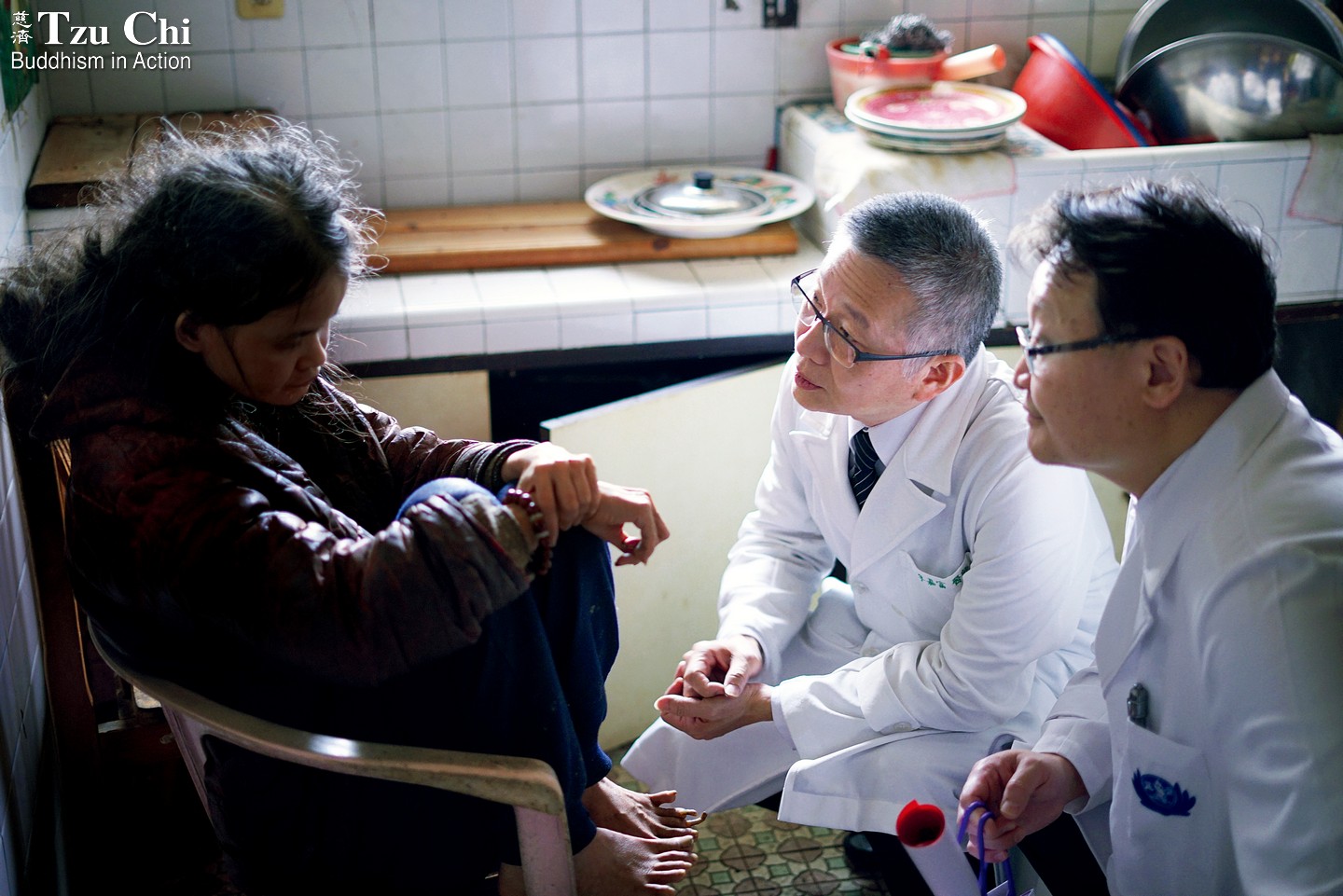
Dr. Lee Jia-fu (李嘉富, center) conducted a home visit to an individual affected by a mental illness when the Tzu Chi International Medical Association held a free clinic in New Taipei City in 2017.
Cai Shu-qing
Q:How can you identify if someone is suffering from schizophrenia? When is it essential to seek medical attention?
In clinical practice, the term delusion refers to the state of inventing things that do not exist, believing them to be true, and steadfastly clinging to these beliefs, despite others’ attempts to persuade or provide evidence to the contrary. Hallucinations, on the other hand, occur when one’s sensory perceptions receive stimuli that do not actually exist. That’s why others cannot perceive another’s hallucinations. For instance, a patient may hear voices that others cannot hear. When these symptoms of disordered thinking and perception persist and significantly impact a person’s sense of reality and judgment, the condition is identified as schizophrenia.
There is a simple method for assessing a person’s mental state known as ABCD. “A” stands for Affect, Attention, Appearance, and Attitude. This involves observing whether a person appears emotionless, excessively excited, depressed, or experiences rapid mood swings.
“B” represents Behavior. Patients with schizophrenia may display acute and contradictory states of confusion, such as smiling while talking about their recently deceased father or speaking incoherently and providing unrelated answers to questions.
“C” stands for Cognition. In a delusional state, individuals may experience heightened suspicion, leading them to doubt the intentions of strangers and fear that they might be plotting against them. The most prevalent symptoms include visual hallucinations, in which the patient sees things that do not exist, and auditory hallucinations, where they hear voices when no one is speaking. These experiences cause them to become detached from reality.
“D” represents Drive. For instance, a person may feel disinclined to interact with others and appear emotionally indifferent when expected to express emotions. You might notice someone you know becoming more withdrawn and isolated. He or she might have once been a top-performing student in class but now shows a lack of interest in attending school or participating in any activities, becoming more lethargic and unmotivated.
Usually, when people recognize the need for assistance, they recommend professional counseling. In Taiwan, involuntary hospitalization is regulated by the Mental Health Act, which provides a specific definition for severely ill patients. This includes individuals who exhibit significantly detached thoughts from reality or bizarre behaviors to the point where they cannot handle their own affairs. Moreover, it necessitates an evaluation and decision by a compulsory examination committee, authorizing hospitalization only if there is genuine evidence of dangerous behavior towards others or self-harm.
Q:Why do schizophrenics experience hallucinations or delusions?
Individuals with schizophrenia experience hallucinations or delusions due to excessive levels of dopamine, a neurotransmitter, in the brain.
When dopamine activity is too strong, it causes excessive sensitivity. The brain cannot selectively focus attention, and unwanted information floods in, making concentration difficult. It’s like hearing someone hissing insults and accusations in your ear, even if you don’t want to listen.
The sensory experience of a person with schizophrenia is as if you were to record the bustling environment of a metro station, capturing numerous voices and ambient noises, then play back the recording at a high volume while wearing headphones. The overwhelming cacophony, especially if experienced at night, can induce feelings of fear and anxiety.
Schizophrenia is diagnosed when hallucinations or delusions persist, and behaviors become chaotic, for a period of more than six months. The condition is more likely to develop between the ages of 15 and 25, with a higher incidence around 19 or 20. For example, some young men who usually lead a secluded life may experience increased stress when they fulfill their mandatory military service and undergo group living, leading to a worsening of symptoms.
Q:Is recovery possible for patients with schizophrenia?
Based on past clinical statistics, around one-fourth of individuals with schizophrenia have a good chance of recovery. Half of them may experience recurrent episodes, requiring long-term medication management. Another quarter of patients may have limited recovery even with drug treatment. The primary challenge arises from patients’ lack of insight into their condition during the initial stages, resulting in resistance towards seeking treatment, which becomes a significant hurdle in the therapeutic journey.
There exists an optimal golden period for treatment in the first two to five years after onset. Early detection and intervention are strongly advised to prevent severe brain damage. The latest generation of antipsychotic medications has reduced side effects, fosters improved functional recovery, and provides the option of long-acting injections. Recent research indicates that due to substantial advancements in treatment effectiveness, the number of patients requiring hospitalization, including long-term stays, has decreased.
Q:Is schizophrenia hereditary?
In the realm of mental disorders, conditions like anxiety and depression are more closely related to psychological and social stress. Their occurrence is more likely influenced by external stressors. For example, the COVID-19 pandemic resulted in a 25 percent surge in global cases of anxiety and depression. On the other hand, while schizophrenia may have some connection to stress triggers, it is primarily associated with one’s inherent constitution. Thus, the likelihood of schizophrenia occurring in the general population remains relatively constant, at approximately one percent.
If one parent is affected by the illness, the likelihood of their child being affected is about 12 percent. If both parents are affected, the probability increases significantly to 40 percent, but it is still not a certainty that the condition will be inherited. Focusing too much on the hereditary aspect may cause individuals with a genetic predisposition to feel helpless against their fate. Instead, the emphasis should be on whether individuals with genetic susceptibility can develop strong resilience to stress, potentially preventing the onset of the condition during their lifetime.
It’s important to stress that not everyone with a family history will develop the condition. Additionally, diseases associated with genetic factors related to dopamine have been found to be connected to increased creativity. Thus, some individuals with the genetic trait become university professors or innovative inventors as a result. Others with the trait are more susceptible to issues like alcohol addiction or antisocial tendencies. The outcome depends on how this genetic trait is channeled.
Q:When someone exhibits symptoms of schizophrenia, how can those around them help?
Patients do not exhibit a higher tendency for violent behavior. When they experience hallucinations or delusions, it is crucial for those around them not to immediately dismiss or actively reinforce these experiences. These hallucinations and delusions feel genuinely real to the patient, so denying them can foster feelings of mistrust. On the other hand, some people, in an effort not to invalidate the patient’s perceptions, may even claim to have had similar experiences, unintentionally reinforcing the delusions and exacerbating the symptoms. All of these responses should be avoided.
Suppose the person experiencing hallucinations or delusions says, “I personally saw an alien. Do you believe in aliens?” In such a situation, it is advisable to first understand the reasons behind their statement. You can ask, “Have you had a direct encounter? What happened during that experience?” or “So you’ve been feeling like aliens have placed a listening device on you, and that must have made you uncomfortable, right?” Instead of reinforcing the belief, show empathy by understanding their emotional experience.
Reminders From a Specialist:
When supporting individuals with schizophrenia, remember to offer care and companionship while also encouraging them to seek medical treatment for their condition.
Q:What is the best way to assist individuals with schizophrenia in their rehabilitation?
The core principles for individuals with schizophrenia to achieve recovery or improve well-being include “accurate understanding of the illness, early medical intervention, consistent treatment, adopting a healthy lifestyle, and returning to work.” Taiwan now has a well-established community mental health and rehabilitation system, encompassing daytime hospitalization, community rehabilitation centers, and recovery homes. Through the implementation of daytime ward rehabilitation, we are now able to annually provide life training to ten percent of chronic psychiatric patients, helping them reintegrate into the community or the workforce.
Medical predictions suggest that there is a possibility of a gradual decline in hospitalizations for new acute psychiatric patients in Taiwan within the next ten years, due to an aging population and declining birth rate. Furthermore, the continuous advancements in medication and injectable treatments are expected to reduce the number of patients in chronic psychiatric wards. Community healthcare policies will promote the establishment of more recovery homes or rehabilitation centers in local communities. Skilled professionals, including psychologists, social workers, and occupational therapists, will play a crucial role in helping patients prepare for their return home and assisting those with stabilized symptoms on their journey towards employment.
Narrated by Lee Jia-fu, psychiatrist, Taipei Tzu Chi Hospital
Interviewed and compiled by Hong Jing-jing
Translated by Wu Hsiao-ting
Photo by Huang Yong-fu
People with schizophrenia do not show a higher inclination for violence than the general population. Their hallucinations and delusions are caused by excessive dopamine secretions. They require medical treatment and rehabilitation.
Dr. Lee Jia-fu (李嘉富, center) conducted a home visit to an individual affected by a mental illness when the Tzu Chi International Medical Association held a free clinic in New Taipei City in 2017.
Cai Shu-qing
Q:How can you identify if someone is suffering from schizophrenia? When is it essential to seek medical attention?
In clinical practice, the term delusion refers to the state of inventing things that do not exist, believing them to be true, and steadfastly clinging to these beliefs, despite others’ attempts to persuade or provide evidence to the contrary. Hallucinations, on the other hand, occur when one’s sensory perceptions receive stimuli that do not actually exist. That’s why others cannot perceive another’s hallucinations. For instance, a patient may hear voices that others cannot hear. When these symptoms of disordered thinking and perception persist and significantly impact a person’s sense of reality and judgment, the condition is identified as schizophrenia.
There is a simple method for assessing a person’s mental state known as ABCD. “A” stands for Affect, Attention, Appearance, and Attitude. This involves observing whether a person appears emotionless, excessively excited, depressed, or experiences rapid mood swings.
“B” represents Behavior. Patients with schizophrenia may display acute and contradictory states of confusion, such as smiling while talking about their recently deceased father or speaking incoherently and providing unrelated answers to questions.
“C” stands for Cognition. In a delusional state, individuals may experience heightened suspicion, leading them to doubt the intentions of strangers and fear that they might be plotting against them. The most prevalent symptoms include visual hallucinations, in which the patient sees things that do not exist, and auditory hallucinations, where they hear voices when no one is speaking. These experiences cause them to become detached from reality.
“D” represents Drive. For instance, a person may feel disinclined to interact with others and appear emotionally indifferent when expected to express emotions. You might notice someone you know becoming more withdrawn and isolated. He or she might have once been a top-performing student in class but now shows a lack of interest in attending school or participating in any activities, becoming more lethargic and unmotivated.
Usually, when people recognize the need for assistance, they recommend professional counseling. In Taiwan, involuntary hospitalization is regulated by the Mental Health Act, which provides a specific definition for severely ill patients. This includes individuals who exhibit significantly detached thoughts from reality or bizarre behaviors to the point where they cannot handle their own affairs. Moreover, it necessitates an evaluation and decision by a compulsory examination committee, authorizing hospitalization only if there is genuine evidence of dangerous behavior towards others or self-harm.
Q:Why do schizophrenics experience hallucinations or delusions?
Individuals with schizophrenia experience hallucinations or delusions due to excessive levels of dopamine, a neurotransmitter, in the brain.
When dopamine activity is too strong, it causes excessive sensitivity. The brain cannot selectively focus attention, and unwanted information floods in, making concentration difficult. It’s like hearing someone hissing insults and accusations in your ear, even if you don’t want to listen.
The sensory experience of a person with schizophrenia is as if you were to record the bustling environment of a metro station, capturing numerous voices and ambient noises, then play back the recording at a high volume while wearing headphones. The overwhelming cacophony, especially if experienced at night, can induce feelings of fear and anxiety.
Schizophrenia is diagnosed when hallucinations or delusions persist, and behaviors become chaotic, for a period of more than six months. The condition is more likely to develop between the ages of 15 and 25, with a higher incidence around 19 or 20. For example, some young men who usually lead a secluded life may experience increased stress when they fulfill their mandatory military service and undergo group living, leading to a worsening of symptoms.
Q:Is recovery possible for patients with schizophrenia?
Based on past clinical statistics, around one-fourth of individuals with schizophrenia have a good chance of recovery. Half of them may experience recurrent episodes, requiring long-term medication management. Another quarter of patients may have limited recovery even with drug treatment. The primary challenge arises from patients’ lack of insight into their condition during the initial stages, resulting in resistance towards seeking treatment, which becomes a significant hurdle in the therapeutic journey.
There exists an optimal golden period for treatment in the first two to five years after onset. Early detection and intervention are strongly advised to prevent severe brain damage. The latest generation of antipsychotic medications has reduced side effects, fosters improved functional recovery, and provides the option of long-acting injections. Recent research indicates that due to substantial advancements in treatment effectiveness, the number of patients requiring hospitalization, including long-term stays, has decreased.
Q:Is schizophrenia hereditary?
In the realm of mental disorders, conditions like anxiety and depression are more closely related to psychological and social stress. Their occurrence is more likely influenced by external stressors. For example, the COVID-19 pandemic resulted in a 25 percent surge in global cases of anxiety and depression. On the other hand, while schizophrenia may have some connection to stress triggers, it is primarily associated with one’s inherent constitution. Thus, the likelihood of schizophrenia occurring in the general population remains relatively constant, at approximately one percent.
If one parent is affected by the illness, the likelihood of their child being affected is about 12 percent. If both parents are affected, the probability increases significantly to 40 percent, but it is still not a certainty that the condition will be inherited. Focusing too much on the hereditary aspect may cause individuals with a genetic predisposition to feel helpless against their fate. Instead, the emphasis should be on whether individuals with genetic susceptibility can develop strong resilience to stress, potentially preventing the onset of the condition during their lifetime.
It’s important to stress that not everyone with a family history will develop the condition. Additionally, diseases associated with genetic factors related to dopamine have been found to be connected to increased creativity. Thus, some individuals with the genetic trait become university professors or innovative inventors as a result. Others with the trait are more susceptible to issues like alcohol addiction or antisocial tendencies. The outcome depends on how this genetic trait is channeled.
Q:When someone exhibits symptoms of schizophrenia, how can those around them help?
Patients do not exhibit a higher tendency for violent behavior. When they experience hallucinations or delusions, it is crucial for those around them not to immediately dismiss or actively reinforce these experiences. These hallucinations and delusions feel genuinely real to the patient, so denying them can foster feelings of mistrust. On the other hand, some people, in an effort not to invalidate the patient’s perceptions, may even claim to have had similar experiences, unintentionally reinforcing the delusions and exacerbating the symptoms. All of these responses should be avoided.
Suppose the person experiencing hallucinations or delusions says, “I personally saw an alien. Do you believe in aliens?” In such a situation, it is advisable to first understand the reasons behind their statement. You can ask, “Have you had a direct encounter? What happened during that experience?” or “So you’ve been feeling like aliens have placed a listening device on you, and that must have made you uncomfortable, right?” Instead of reinforcing the belief, show empathy by understanding their emotional experience.
Reminders From a Specialist:
When supporting individuals with schizophrenia, remember to offer care and companionship while also encouraging them to seek medical treatment for their condition.
Q:What is the best way to assist individuals with schizophrenia in their rehabilitation?
The core principles for individuals with schizophrenia to achieve recovery or improve well-being include “accurate understanding of the illness, early medical intervention, consistent treatment, adopting a healthy lifestyle, and returning to work.” Taiwan now has a well-established community mental health and rehabilitation system, encompassing daytime hospitalization, community rehabilitation centers, and recovery homes. Through the implementation of daytime ward rehabilitation, we are now able to annually provide life training to ten percent of chronic psychiatric patients, helping them reintegrate into the community or the workforce.
Medical predictions suggest that there is a possibility of a gradual decline in hospitalizations for new acute psychiatric patients in Taiwan within the next ten years, due to an aging population and declining birth rate. Furthermore, the continuous advancements in medication and injectable treatments are expected to reduce the number of patients in chronic psychiatric wards. Community healthcare policies will promote the establishment of more recovery homes or rehabilitation centers in local communities. Skilled professionals, including psychologists, social workers, and occupational therapists, will play a crucial role in helping patients prepare for their return home and assisting those with stabilized symptoms on their journey towards employment.
By Du Hui Xi, Lee Lay Sim, Cecelia GC Ong, and Shen Ya-hui
Edited and translated by Wu Hsiao-ting
Tzu Chi launched sewing classes in Lumbini, empowering local women with practical skills. Volunteers have also helped graduates without sewing machines or who were struggling to find work. Establishing stable incomes transforms families, fostering stability and enabling children’s education.
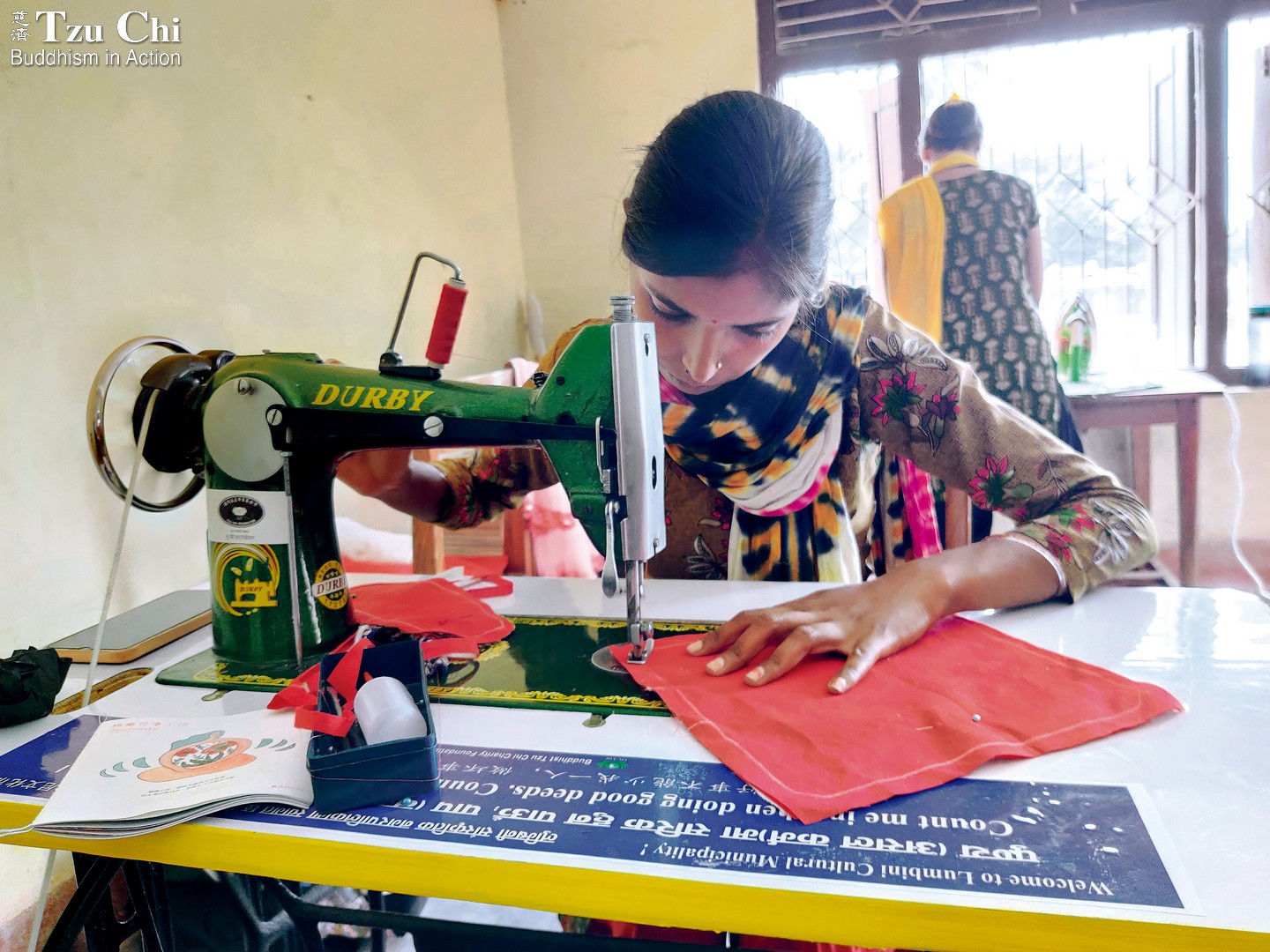
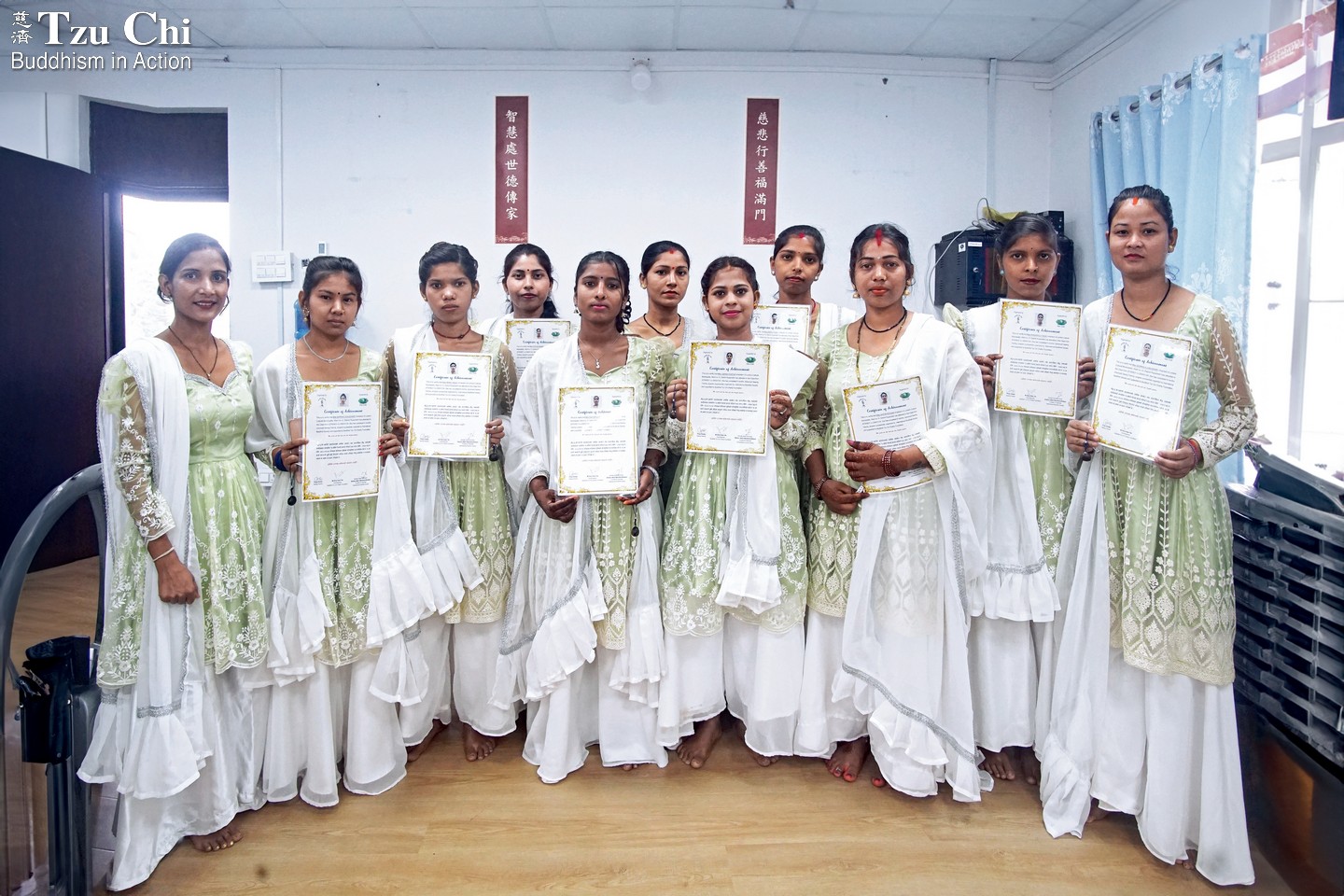
Graduates from Tzu Chi’s first sewing class at its Lumbini office showcase their handcrafted attire during their graduation ceremony (Photo 2 by Unish Khyaju). In June, a group of graduates joined a project to create cloth sanitary pads, providing them an opportunity to supplement their household finances (Photo 1 by Rajkumar).
“I really enjoy coming here for class. When I first began, I didn’t even know how to use sewing scissors, but now I’m proficient!” said Anita Bhooj, who had never thought of going to a class to learn sewing before Tzu Chi offered sewing courses in Lumbini. She had married at 16 according to her parents’ wishes. After the birth of her children, her days were filled with childcare and household chores. How could she find time to learn a skill?
On October 17, 2022, Tzu Chi launched its first vocational sewing course for women at its Lumbini office. The course lasted six months. The majority of participants hailed from a village about a kilometer (0.62 miles) away. There were no buses available to transport them, nor did they have bicycles, so the women had to walk to class. Though they were sometimes late, they never missed a session. The first sewing class graduated on May 25 this year.
A month before the graduation ceremony, Tzu Chi volunteers invited students to sew clothes as their graduation projects. The students were amazed when they learned that Tzu Chi would provide funds for fabric for the projects. Initially quiet and reserved, they eagerly discussed it among themselves and then searched online for preferred styles. In the end, they decided to make light green outfits in the trendy “Umbrella Style.” They said wearing the outfits in local villages could even attract orders for sewing work.
On their graduation day, the students, wearing the clothes they had made, cheerfully conveyed their appreciation for their teacher’s selfless instruction in cutting and sewing skills. They also thanked Tzu Chi for providing them with the precious opportunity to learn free of charge. Some were moved to share that they had been confined at home without any skills before this experience. Now, they could sew clothes, and perhaps even earn an income and become self-reliant.
“Learning sewing has truly transformed my life,” remarked Puja Khadka, the instructor for the sewing class. “I’ve become independent and no longer rely on my family for financial support.” She further emphasized that the acquired skill is a lifelong asset and expressed her wish to inspire more women by sharing her experience.
For the participants of the sewing course, acquiring a skill was just the first step; they also needed the means to earn a living. Their underprivileged backgrounds hindered their ability to afford a sewing machine. The suitability of their living spaces for housing sewing machines was also a concern. To ensure that they didn’t face unemployment after graduating, volunteers found an appropriate community space to establish a sewing workshop. Sewing machines were set up there, equipping the participants with tools to generate income. On their graduation day, Tzu Chi’s first local sewing workshop was inaugurated.
Tzu Chi helps graduates secure orders too. In June, with the foundation’s help, several graduates joined a cloth sanitary pad project organized by the Health Environment and Climate Action Foundation (HECAF360). They earn income through the project by making cloth sanitary pads, which are then handed over to HECAF360 for packaging design, market promotion, and school-based health education programs.
By Du Hui Xi, Lee Lay Sim, Cecelia GC Ong, and Shen Ya-hui
Edited and translated by Wu Hsiao-ting
Tzu Chi launched sewing classes in Lumbini, empowering local women with practical skills. Volunteers have also helped graduates without sewing machines or who were struggling to find work. Establishing stable incomes transforms families, fostering stability and enabling children’s education.
Graduates from Tzu Chi’s first sewing class at its Lumbini office showcase their handcrafted attire during their graduation ceremony (Photo 2 by Unish Khyaju). In June, a group of graduates joined a project to create cloth sanitary pads, providing them an opportunity to supplement their household finances (Photo 1 by Rajkumar).
“I really enjoy coming here for class. When I first began, I didn’t even know how to use sewing scissors, but now I’m proficient!” said Anita Bhooj, who had never thought of going to a class to learn sewing before Tzu Chi offered sewing courses in Lumbini. She had married at 16 according to her parents’ wishes. After the birth of her children, her days were filled with childcare and household chores. How could she find time to learn a skill?
On October 17, 2022, Tzu Chi launched its first vocational sewing course for women at its Lumbini office. The course lasted six months. The majority of participants hailed from a village about a kilometer (0.62 miles) away. There were no buses available to transport them, nor did they have bicycles, so the women had to walk to class. Though they were sometimes late, they never missed a session. The first sewing class graduated on May 25 this year.
A month before the graduation ceremony, Tzu Chi volunteers invited students to sew clothes as their graduation projects. The students were amazed when they learned that Tzu Chi would provide funds for fabric for the projects. Initially quiet and reserved, they eagerly discussed it among themselves and then searched online for preferred styles. In the end, they decided to make light green outfits in the trendy “Umbrella Style.” They said wearing the outfits in local villages could even attract orders for sewing work.
On their graduation day, the students, wearing the clothes they had made, cheerfully conveyed their appreciation for their teacher’s selfless instruction in cutting and sewing skills. They also thanked Tzu Chi for providing them with the precious opportunity to learn free of charge. Some were moved to share that they had been confined at home without any skills before this experience. Now, they could sew clothes, and perhaps even earn an income and become self-reliant.
“Learning sewing has truly transformed my life,” remarked Puja Khadka, the instructor for the sewing class. “I’ve become independent and no longer rely on my family for financial support.” She further emphasized that the acquired skill is a lifelong asset and expressed her wish to inspire more women by sharing her experience.
For the participants of the sewing course, acquiring a skill was just the first step; they also needed the means to earn a living. Their underprivileged backgrounds hindered their ability to afford a sewing machine. The suitability of their living spaces for housing sewing machines was also a concern. To ensure that they didn’t face unemployment after graduating, volunteers found an appropriate community space to establish a sewing workshop. Sewing machines were set up there, equipping the participants with tools to generate income. On their graduation day, Tzu Chi’s first local sewing workshop was inaugurated.
Tzu Chi helps graduates secure orders too. In June, with the foundation’s help, several graduates joined a cloth sanitary pad project organized by the Health Environment and Climate Action Foundation (HECAF360). They earn income through the project by making cloth sanitary pads, which are then handed over to HECAF360 for packaging design, market promotion, and school-based health education programs.
By Goh Lam Kia
Translated by Wu Hsiao-ting
Photos by Li Guo Xiang
Knowing that Dharma Master Cheng Yen has unfulfilled wishes, I understand that it’s my responsibility as a disciple to help fulfill them. I haven’t accomplished anything significant in my life, so I’m determined to seize this opportunity and make a meaningful impact.
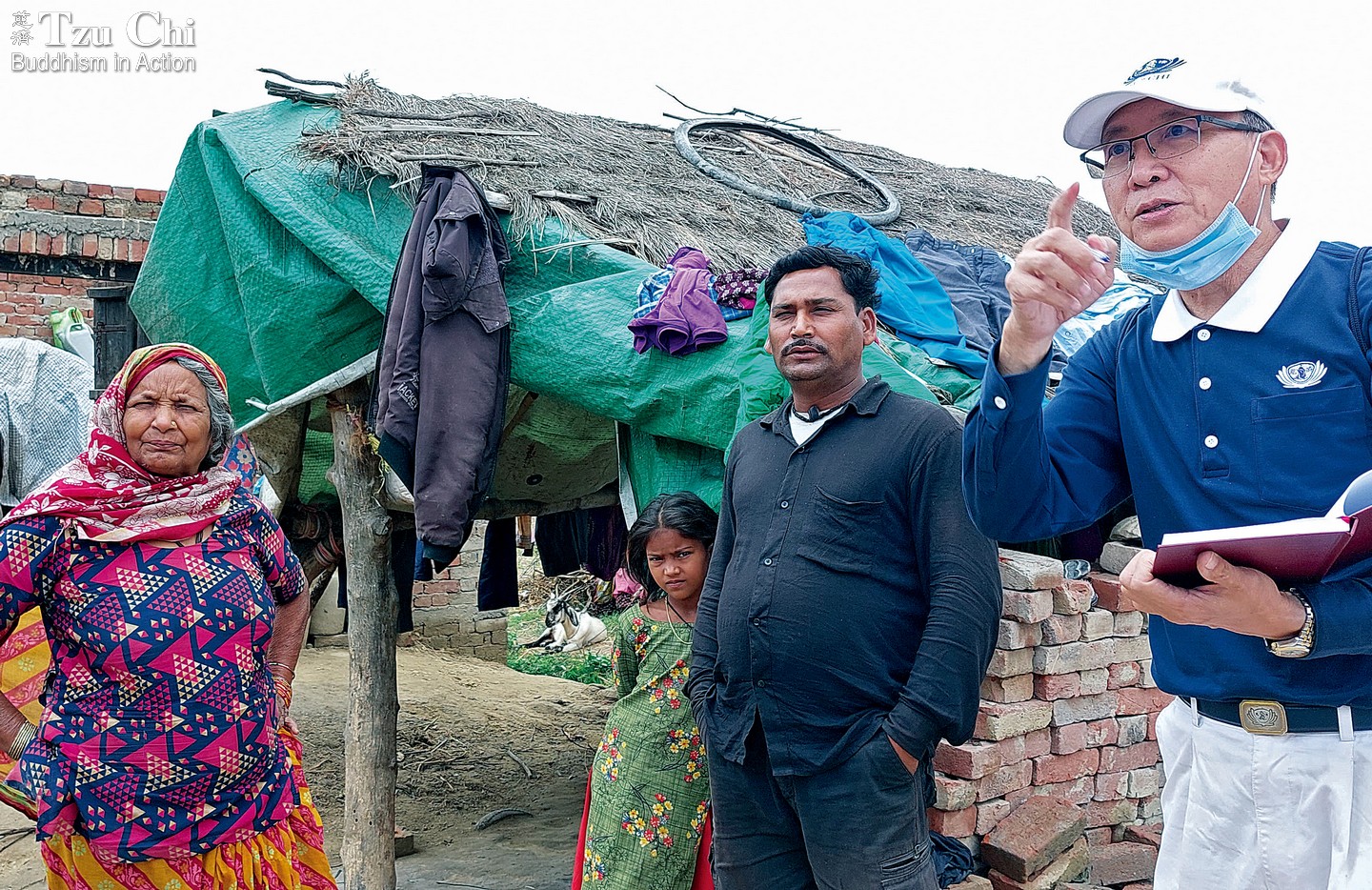
Singaporean Tzu Chi volunteer Goh Lam Kia (吳南凱, far right), stationed in Nepal on a long-term basis, appreciates the opportunity to serve in the country and make meaningful contributions.
I’m a member of a Tzu Chi volunteer team from Singapore and Malaysia, stationed on a long-term basis in Lumbini, Nepal. To be honest, I never anticipated finding myself in Lumbini for such an extended stay. The shift from the fast-paced, efficiency-driven lifestyle of highly-developed Singapore to the unhurried and tranquil pace of Nepal has been a wholly novel experience. From daily surroundings to dietary customs, everything requires a thorough adjustment.
There is a Chinese saying that says, “If the mountain doesn’t yield, attempt a detour; if the path remains unpassable, adapt your course.” Often, changing our surroundings and the people we come into contact with proves challenging. However, when we initiate change in ourselves, everything else begins to fall into place.
Coming from Singapore and Malaysia, we sometimes approach situations and handle matters here in Nepal based on our experiences from our home countries. This can lead to feelings of frustration and complaints when things don’t align with our expectations. To avoid such feelings of frustration, we must make a sincere effort to see things from the perspective of the local people.
Nepal is a landlocked nation without ports, which presents transportation challenges. Capitalists don’t usually come here to invest. The general population is not highly educated, which hampers technological progress, but they are kind-hearted and unassuming. Most people are involved in farming.
Driving on the roads, you don’t have to deal with “road bullies” but “cow bullies”—cows occupy the roads. In such situations, all you can do is slow down, honk the horn, and patiently wait for the cows to leisurely make way for you to pass.
During home visits, we have to bend down to enter the people’s low thatched houses. These modest dwellings have openings on all sides, and leak when it rains. People and animals share the same rooms, and the floors are coated with cow dung. Observing this, I couldn’t help but reflect that the impoverished way of life appears to have remained largely unchanged since the time of the Buddha, approximately 2,500 years ago.
How did I end up in Lumbini? It all started during a weekend in May 2022, when Tzu Chi Singapore’s CEO, Low Swee Seh (劉瑞士), arranged a meeting with Deputy CEO Khoo Kean Yee (邱建義) and me. During that meeting, he shared with us Dharma Master Cheng Yen’s deep desire to give back to the birthplace of the Buddha, uplift those in need there, and shine a light on the teachings of Buddhism at its very source. (Though the Buddha was born in Lumbini, less than ten percent of Nepalese are Buddhist. Hinduism is the predominant religion, followed by more than 80 percent of Nepalese.) Our CEO inquired if we were willing to contribute time and effort in Lumbini.
My immediate reaction to our CEO’s inquiry was that this was a once-in-a-lifetime chance. Recognizing that the Master had unfulfilled aspirations, I saw it as my responsibility as her disciple to fulfill her wishes and carry out her vision. I hadn’t accomplished anything significant in my life. With this remarkable opportunity to serve now before me, I decided I had to seize it to make a meaningful impact.
Since I arrived in Lumbini last July, I’ve come to realize that not everyone could have joined this mission as enthusiastically as I did. There are five conditions that must be met to enable you to serve here:
The arrival of the Buddha in this world over 2,500 years ago marked a significant moment. His mission was to illuminate the truths of life. I sometimes wonder, did he have any regrets before attaining nirvana? When he left behind his royal life to embark on his spiritual journey, it was to discover the path of liberation, alleviate the suffering of all sentient beings, and guide them toward enlightenment. Yet, today, more than 2,500 years later, an abundance of suffering still persists, encompassing not only physical afflictions but also inner spiritual unrest.
Similarly, the arrival of Dharma Master Cheng Yen in this world 86 years ago marked a momentous occasion. She teaches and guides everyone to walk the Bodhisattva Path and perform acts of benevolence for the benefit of humanity. She was an unknown Buddhist nun in 1966 when she founded Tzu Chi in Hualien, Taiwan. Now, the footprints of our humanitarian missions have reached 128 countries and areas. It’s evident that the Master is fulfilling the unfulfilled aspirations of the Buddha.
Our own arrivals in this world also hold great significance. It was a remarkable confluence of circumstances that allowed us to attain a human existence, join Tzu Chi, walk the Bodhisattva Path, disseminate the Buddha’s teachings, and even bring the teachings back to the very birthplace of the Buddha. As disciples of the Enlightened One, our mission is to spread his teachings and foster the well-being of all sentient beings.
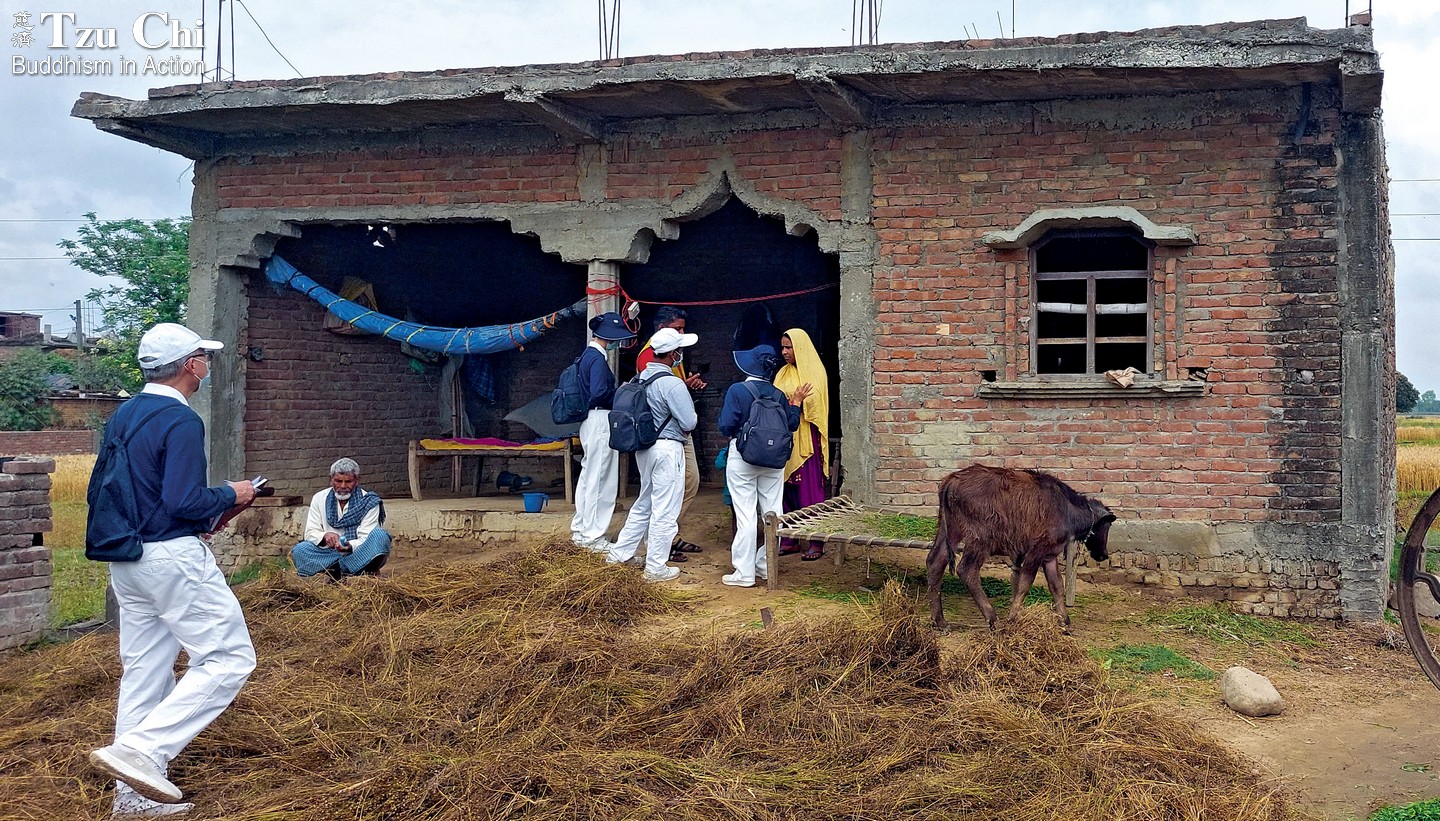
Volunteers use Lumbini as their operational base and conduct visits to the nearby rural areas in Kapilvastu. The households there exhibit a range of living conditions—some richer, others poorer. Many families have brick houses, albeit sparsely furnished.
Lumbini, located 250 kilometers (155 miles) from the capital city of Kathmandu, lies at the border of Nepal and India. The Maya Devi Temple in the local Lumbini Garden marks the place where the Buddha was born. It attracts many devotees and tourists.
I often stroll near the temple in the serene hours of dawn and dusk to nurture inner peace. My life in Singapore was usually fast-paced, leaving little time for my mind to settle. But here in Lumbini, my days are dedicated solely to Tzu Chi work, allowing me more time for introspection.
My duties in Lumbini include recording our work here. As a documenting volunteer, I often need to participate in and witness events firsthand, recording touching stories, capturing video footage, and creating news content to share with a wider audience. I keep a daily work journal too, chronicling the footsteps of our volunteers in Lumbini. Each day here unfolds with its own heartwarming stories worth documenting.
For example, there was a woman who begged near the Maya Devi Temple every day. I often crossed paths with her on my walks and would offer greetings. Later, one of the woman’s neighbors informed us that she really needed help. A team of us paid her a visit and discovered that she had a congenital disability in her left forearm. Her husband and older son had passed away a few years earlier, leaving her and her younger son to fend for themselves. Unfortunately, the younger son was burdened with a congenital heart condition, and they lacked the means to afford his medical treatment. Despite the best efforts of neighbors to help, they couldn’t come up with enough money to have him treated at a major hospital.
As she shared her heart-wrenching story with us, the beggar woman became emotional and burst out crying. We noticed that her rice container was empty, so we quickly bought rice and other food for her. Our assistance moved her to tears, prompting our volunteers to offer comforting hugs. She seemed to sense our genuine care, and a glimmer of hope appeared in her eyes. Afterwards, we coordinated with our medical team to provide further assistance and support.
Serving in Nepal, my fellow volunteers and I are often deeply touched by our experiences here. Those of us from Singapore have also come to appreciate the privilege of being born in our home country, where the government takes care of every citizen. This stands in contrast to many impoverished regions around the world, where resources are scarce, and assistance is often out of reach.
Another touching event took place at a government primary school. Last December, during the harsh winter, Tzu Chi initiated distributions to help students in over 20 schools. Our volunteers, bundled up in thick jackets against the cold, noticed a young girl at one school shivering uncontrollably. Approaching her, they touched her hands and were surprised to find that her clothes were wet. They immediately provided her with warm winter clothes, one of the items to be distributed, and held her close to share their warmth.
Our volunteers discovered the girl’s challenging circumstances the next day, during a home visit. Her parents had passed away, so she was being raised by her grandparents. But because her grandparents were quite elderly, she had taken on all household responsibilities at the tender age of 12. Our volunteers felt great sympathy for the girl.
The young girl explained that the school principal had announced that an organization would be visiting the school to distribute gifts, and he instructed all students to wear their school uniforms. She had only one uniform, which had been washed but hadn’t dried in time. Consequently, she had no choice but to don the damp uniform and go to school, enduring the chilly, gusty winds. Initially puzzled about why her mother had dressed her in wet clothes, our volunteers now felt deep remorse for their earlier assumptions. A few days later, on an early morning, they delivered food to her home before school and brought gloves for her and her grandmother.
The volunteers couldn’t help but express their heartache at her situation. Children in Nepal experience vastly different circumstances compared to those in more affluent nations. For example, in Singapore and Malaysia, children as young as this girl are cherished and showered with love by their parents. But here, they begin assisting their mothers from a very young age. We’ve learned of a family where, only three days after giving birth, a mother returned to the fields to harvest wheat, leaving her three-day-old infant in the care of older siblings at home. Shouldn’t those of us born into more fortunate circumstances learn to count our blessings and sow more?

The Lumbini Garden complex, spanning nearly eight square kilometers (three square miles), is intersected by a canal. Within this expansive area stand temples built by various countries. Prince Siddhartha, who would later become the Buddha, was born here over 2,500 years ago. Beyond the garden area, traditional village life unfolds in a different scene.
Tang Kiat Beng
Every day, our team of volunteers from Malaysia and Singapore, along with local volunteers, split up to conduct home visits, distribute aid, and discuss collaborations with government and local authorities. Obviously, a single documenting volunteer cannot cover all our activities, necessitating mutual support among team members. Those of us responsible for documenting our philanthropic efforts take photos, write reports, and share them on an online platform, from which we compile news. We also send daily journals back to Tzu Chi headquarters in Taiwan, complete with both text and photos.
Being a documenting volunteer comes with its own pressure. We accompany our team on visits during the day, often extending into late afternoon. As a result, we often can’t begin writing our journals until after dinner. At times, physical and mental exhaustion make it a challenge to articulate our experiences. On other occasions, we need time for introspection and reflection before we can begin writing.
Despite these challenges, we find fulfillment in serving as the hands, feet, eyes, and ears of Master Cheng Yen on the front lines. We report what we see, hear, and do, seeking her guidance for our work. Currently, in Lumbini, Tzu Chi has constructed a new building for a local free clinic center and initiated vocational training classes. Our School for All initiative has expanded to encompass 23 schools, and the number of locally trained volunteers has surpassed a hundred.
As we pass by the Lumbini Garden every day, we see a flourishing mango tree. It sprouted from a single seed, and over the years has grown into a substantial tree. The profusion of flowers on the tree will gradually transform into small mangoes, and with more time, the fruits will develop seeds, which can be used to grow more trees. Such a cycle of growth can continue endlessly.
Our efforts in Lumbini are akin to planting seeds of goodness and love. From one seed springs an infinite potential for growth. Conversely, countless seeds can emerge from just one act of kindness. As long as we persevere with unwavering determination and resolute hearts, the love we are spreading has the potential to one day make a big difference in Nepal. This reminds me of something shared by Master Cheng Yen: life is much like the journey of learning Buddhism. Whether one progresses swiftly or slowly, the key is to stay on the right path and keep moving forward.
By Goh Lam Kia
Translated by Wu Hsiao-ting
Photos by Li Guo Xiang
Knowing that Dharma Master Cheng Yen has unfulfilled wishes, I understand that it’s my responsibility as a disciple to help fulfill them. I haven’t accomplished anything significant in my life, so I’m determined to seize this opportunity and make a meaningful impact.
Singaporean Tzu Chi volunteer Goh Lam Kia (吳南凱, far right), stationed in Nepal on a long-term basis, appreciates the opportunity to serve in the country and make meaningful contributions.
I’m a member of a Tzu Chi volunteer team from Singapore and Malaysia, stationed on a long-term basis in Lumbini, Nepal. To be honest, I never anticipated finding myself in Lumbini for such an extended stay. The shift from the fast-paced, efficiency-driven lifestyle of highly-developed Singapore to the unhurried and tranquil pace of Nepal has been a wholly novel experience. From daily surroundings to dietary customs, everything requires a thorough adjustment.
There is a Chinese saying that says, “If the mountain doesn’t yield, attempt a detour; if the path remains unpassable, adapt your course.” Often, changing our surroundings and the people we come into contact with proves challenging. However, when we initiate change in ourselves, everything else begins to fall into place.
Coming from Singapore and Malaysia, we sometimes approach situations and handle matters here in Nepal based on our experiences from our home countries. This can lead to feelings of frustration and complaints when things don’t align with our expectations. To avoid such feelings of frustration, we must make a sincere effort to see things from the perspective of the local people.
Nepal is a landlocked nation without ports, which presents transportation challenges. Capitalists don’t usually come here to invest. The general population is not highly educated, which hampers technological progress, but they are kind-hearted and unassuming. Most people are involved in farming.
Driving on the roads, you don’t have to deal with “road bullies” but “cow bullies”—cows occupy the roads. In such situations, all you can do is slow down, honk the horn, and patiently wait for the cows to leisurely make way for you to pass.
During home visits, we have to bend down to enter the people’s low thatched houses. These modest dwellings have openings on all sides, and leak when it rains. People and animals share the same rooms, and the floors are coated with cow dung. Observing this, I couldn’t help but reflect that the impoverished way of life appears to have remained largely unchanged since the time of the Buddha, approximately 2,500 years ago.
How did I end up in Lumbini? It all started during a weekend in May 2022, when Tzu Chi Singapore’s CEO, Low Swee Seh (劉瑞士), arranged a meeting with Deputy CEO Khoo Kean Yee (邱建義) and me. During that meeting, he shared with us Dharma Master Cheng Yen’s deep desire to give back to the birthplace of the Buddha, uplift those in need there, and shine a light on the teachings of Buddhism at its very source. (Though the Buddha was born in Lumbini, less than ten percent of Nepalese are Buddhist. Hinduism is the predominant religion, followed by more than 80 percent of Nepalese.) Our CEO inquired if we were willing to contribute time and effort in Lumbini.
My immediate reaction to our CEO’s inquiry was that this was a once-in-a-lifetime chance. Recognizing that the Master had unfulfilled aspirations, I saw it as my responsibility as her disciple to fulfill her wishes and carry out her vision. I hadn’t accomplished anything significant in my life. With this remarkable opportunity to serve now before me, I decided I had to seize it to make a meaningful impact.
Since I arrived in Lumbini last July, I’ve come to realize that not everyone could have joined this mission as enthusiastically as I did. There are five conditions that must be met to enable you to serve here:
The arrival of the Buddha in this world over 2,500 years ago marked a significant moment. His mission was to illuminate the truths of life. I sometimes wonder, did he have any regrets before attaining nirvana? When he left behind his royal life to embark on his spiritual journey, it was to discover the path of liberation, alleviate the suffering of all sentient beings, and guide them toward enlightenment. Yet, today, more than 2,500 years later, an abundance of suffering still persists, encompassing not only physical afflictions but also inner spiritual unrest.
Similarly, the arrival of Dharma Master Cheng Yen in this world 86 years ago marked a momentous occasion. She teaches and guides everyone to walk the Bodhisattva Path and perform acts of benevolence for the benefit of humanity. She was an unknown Buddhist nun in 1966 when she founded Tzu Chi in Hualien, Taiwan. Now, the footprints of our humanitarian missions have reached 128 countries and areas. It’s evident that the Master is fulfilling the unfulfilled aspirations of the Buddha.
Our own arrivals in this world also hold great significance. It was a remarkable confluence of circumstances that allowed us to attain a human existence, join Tzu Chi, walk the Bodhisattva Path, disseminate the Buddha’s teachings, and even bring the teachings back to the very birthplace of the Buddha. As disciples of the Enlightened One, our mission is to spread his teachings and foster the well-being of all sentient beings.
Volunteers use Lumbini as their operational base and conduct visits to the nearby rural areas in Kapilvastu. The households there exhibit a range of living conditions—some richer, others poorer. Many families have brick houses, albeit sparsely furnished.
Lumbini, located 250 kilometers (155 miles) from the capital city of Kathmandu, lies at the border of Nepal and India. The Maya Devi Temple in the local Lumbini Garden marks the place where the Buddha was born. It attracts many devotees and tourists.
I often stroll near the temple in the serene hours of dawn and dusk to nurture inner peace. My life in Singapore was usually fast-paced, leaving little time for my mind to settle. But here in Lumbini, my days are dedicated solely to Tzu Chi work, allowing me more time for introspection.
My duties in Lumbini include recording our work here. As a documenting volunteer, I often need to participate in and witness events firsthand, recording touching stories, capturing video footage, and creating news content to share with a wider audience. I keep a daily work journal too, chronicling the footsteps of our volunteers in Lumbini. Each day here unfolds with its own heartwarming stories worth documenting.
For example, there was a woman who begged near the Maya Devi Temple every day. I often crossed paths with her on my walks and would offer greetings. Later, one of the woman’s neighbors informed us that she really needed help. A team of us paid her a visit and discovered that she had a congenital disability in her left forearm. Her husband and older son had passed away a few years earlier, leaving her and her younger son to fend for themselves. Unfortunately, the younger son was burdened with a congenital heart condition, and they lacked the means to afford his medical treatment. Despite the best efforts of neighbors to help, they couldn’t come up with enough money to have him treated at a major hospital.
As she shared her heart-wrenching story with us, the beggar woman became emotional and burst out crying. We noticed that her rice container was empty, so we quickly bought rice and other food for her. Our assistance moved her to tears, prompting our volunteers to offer comforting hugs. She seemed to sense our genuine care, and a glimmer of hope appeared in her eyes. Afterwards, we coordinated with our medical team to provide further assistance and support.
Serving in Nepal, my fellow volunteers and I are often deeply touched by our experiences here. Those of us from Singapore have also come to appreciate the privilege of being born in our home country, where the government takes care of every citizen. This stands in contrast to many impoverished regions around the world, where resources are scarce, and assistance is often out of reach.
Another touching event took place at a government primary school. Last December, during the harsh winter, Tzu Chi initiated distributions to help students in over 20 schools. Our volunteers, bundled up in thick jackets against the cold, noticed a young girl at one school shivering uncontrollably. Approaching her, they touched her hands and were surprised to find that her clothes were wet. They immediately provided her with warm winter clothes, one of the items to be distributed, and held her close to share their warmth.
Our volunteers discovered the girl’s challenging circumstances the next day, during a home visit. Her parents had passed away, so she was being raised by her grandparents. But because her grandparents were quite elderly, she had taken on all household responsibilities at the tender age of 12. Our volunteers felt great sympathy for the girl.
The young girl explained that the school principal had announced that an organization would be visiting the school to distribute gifts, and he instructed all students to wear their school uniforms. She had only one uniform, which had been washed but hadn’t dried in time. Consequently, she had no choice but to don the damp uniform and go to school, enduring the chilly, gusty winds. Initially puzzled about why her mother had dressed her in wet clothes, our volunteers now felt deep remorse for their earlier assumptions. A few days later, on an early morning, they delivered food to her home before school and brought gloves for her and her grandmother.
The volunteers couldn’t help but express their heartache at her situation. Children in Nepal experience vastly different circumstances compared to those in more affluent nations. For example, in Singapore and Malaysia, children as young as this girl are cherished and showered with love by their parents. But here, they begin assisting their mothers from a very young age. We’ve learned of a family where, only three days after giving birth, a mother returned to the fields to harvest wheat, leaving her three-day-old infant in the care of older siblings at home. Shouldn’t those of us born into more fortunate circumstances learn to count our blessings and sow more?
The Lumbini Garden complex, spanning nearly eight square kilometers (three square miles), is intersected by a canal. Within this expansive area stand temples built by various countries. Prince Siddhartha, who would later become the Buddha, was born here over 2,500 years ago. Beyond the garden area, traditional village life unfolds in a different scene.
Tang Kiat Beng
Every day, our team of volunteers from Malaysia and Singapore, along with local volunteers, split up to conduct home visits, distribute aid, and discuss collaborations with government and local authorities. Obviously, a single documenting volunteer cannot cover all our activities, necessitating mutual support among team members. Those of us responsible for documenting our philanthropic efforts take photos, write reports, and share them on an online platform, from which we compile news. We also send daily journals back to Tzu Chi headquarters in Taiwan, complete with both text and photos.
Being a documenting volunteer comes with its own pressure. We accompany our team on visits during the day, often extending into late afternoon. As a result, we often can’t begin writing our journals until after dinner. At times, physical and mental exhaustion make it a challenge to articulate our experiences. On other occasions, we need time for introspection and reflection before we can begin writing.
Despite these challenges, we find fulfillment in serving as the hands, feet, eyes, and ears of Master Cheng Yen on the front lines. We report what we see, hear, and do, seeking her guidance for our work. Currently, in Lumbini, Tzu Chi has constructed a new building for a local free clinic center and initiated vocational training classes. Our School for All initiative has expanded to encompass 23 schools, and the number of locally trained volunteers has surpassed a hundred.
As we pass by the Lumbini Garden every day, we see a flourishing mango tree. It sprouted from a single seed, and over the years has grown into a substantial tree. The profusion of flowers on the tree will gradually transform into small mangoes, and with more time, the fruits will develop seeds, which can be used to grow more trees. Such a cycle of growth can continue endlessly.
Our efforts in Lumbini are akin to planting seeds of goodness and love. From one seed springs an infinite potential for growth. Conversely, countless seeds can emerge from just one act of kindness. As long as we persevere with unwavering determination and resolute hearts, the love we are spreading has the potential to one day make a big difference in Nepal. This reminds me of something shared by Master Cheng Yen: life is much like the journey of learning Buddhism. Whether one progresses swiftly or slowly, the key is to stay on the right path and keep moving forward.
By Wang Wei-ling
Translated by Wu Hsiao-ting
Photos courtesy of Tzu Chi volunteers in Poland
The Dumpling Club at Tzu Chi’s Warsaw office provides a warm and enjoyable experience for older Ukrainian refugees.
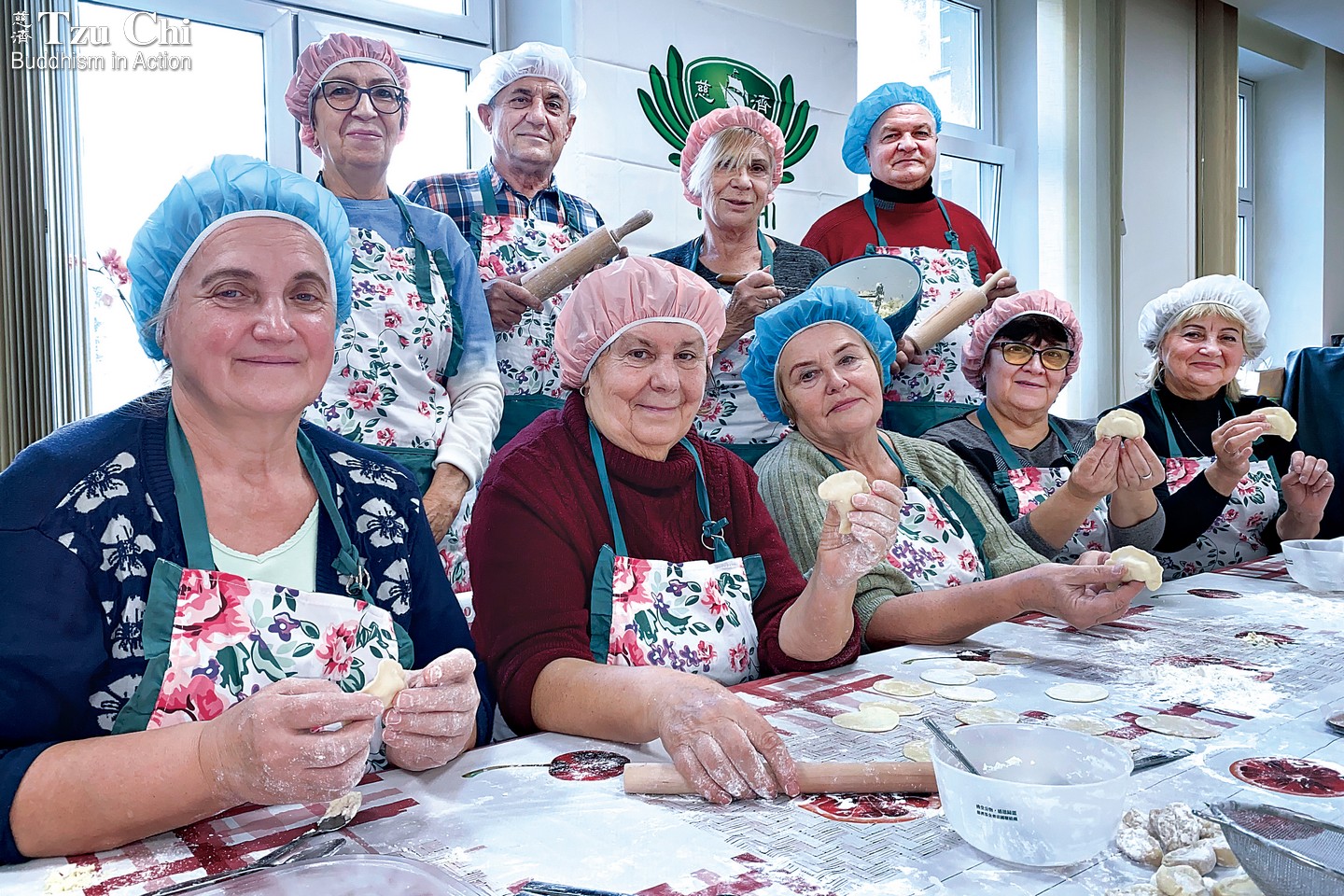
Senior Ukrainians gather at Tzu Chi’s Warsaw office every week for the Dumpling Club, where they prepare traditional Ukrainian dumplings. The proceeds from 80 percent of the dumplings made at the club go to the participants, while the remaining 20 percent is donated to their fellow refugees struggling to cope in Warsaw.
In a kitchen in Warsaw, Poland, a pot of sour cherries and sugar simmered gently on the stove, gradually transforming into a beautiful crimson-purple jam. The sunlight streaming in through the window was just perfect, the bright beams of light illuminating airborne flour particles and making them glimmer like grains of golden sand. Laughter echoed through the air, which also carried a tangy, sweet, and comforting aroma.
The kitchen was located in the Tzu Chi Warsaw office, where more than a dozen elderly Ukrainians, refugees from their war-torn homeland, had gathered around a long wooden table. Their hands, bearing the marks of time, expertly divided fermented dough into small balls and rolled them into thin, round wrappers. As they waited for the cherry jam to be ready for use as a dumpling filling, they shared their cherished family recipes for varenyky, traditional Ukrainian dumplings.
Hanna Mankus, a Ukrainian working for Tzu Chi in Warsaw, observed, “When these seniors come to the Dumpling Club, they become like kindergarteners, competing to see whose dumpling recipe is the best! Witnessing them cast aside their worries and radiate such cheerfulness has been a delightful surprise that I didn’t foresee when I first proposed the Dumpling Club project.”
Mankus understood the seniors’ pride as they shared their family recipes. She also understood the solace they found in participating in the club. As they filled the dumpling wrappers with ingredients, skillfully folding and pinching them into plump half-moons, they were momentarily transported back to the kitchens of their beloved homes in Ukraine. There, they had lovingly prepared the most delicious dumplings, both savory and sweet, in response to the charming requests of their grandchildren.
“After the war broke out, life became exceptionally tough for the elderly. They grappled with language barriers in a foreign land and were often burdened by health issues,” Mankus explained, her empathy deep for the seniors who were uprooted in their old age and forced to seek refuge in a foreign land. She highlighted one of their challenges: “Back in Ukraine, getting medical care was much easier; a simple phone call could secure you an appointment for the next day. But here, it could take six months to a year to see a specialist. They also struggle to communicate with healthcare providers.” Getting around was also problematic; even understanding bus stop signs posed a challenge. “Sometimes, even I myself feel like I’m from Mars,” she added.
Staying in Poland for an extended period became their new reality, but everything felt so unfamiliar. They had to start anew. Even stepping beyond the doors of their rooms in their host families’ homes became intimidating for these older individuals.
Nina Kravchenko, an elderly Ukrainian refugee, expressed her concerns: “I’m not sure if my Polish host family enjoys having me in their home or if I’m inconveniencing them. I worry that they might ask me to leave one day.”
Fear, anxiety, and loneliness weighed heavily on the seniors, leaving them increasingly despondent. To offer support, Mankus proposed the idea of establishing a dumpling club in late September 2022. Older Ukrainians were invited to gather at the Tzu Chi Warsaw office every Friday to make dumplings together.
“Ukrainians have a natural talent for making dumplings,” Mankus declared, “but the question was whether the elderly would be willing to leave their homes to participate in our club. Some initially had doubts, but I didn’t let them stop me.” She rallied help, organized purchases, prepared ingredients, and sent out invitations. “In the beginning, we had just seven elderly participants, but as of June this year, we’ve conducted over 30 sessions, and now 16 seniors regularly attend. They are fondly called the ‘Dumplingists.’” These Dumplingists eagerly anticipate their Friday gatherings and have even started meeting in a park for walks and chats.
Eighty percent of the dumplings made at the club are available for purchase. “We offer dumplings with a cabbage filling, paired with fried cheese, fried onions and mushrooms, or mashed potatoes,” Mankus explained. “We also have fruit jam options, with sour cherries being our unique specialty! Most Poles haven’t tasted these delights before, and those who purchased them were pleasantly surprised, with many showing their support by regularly buying the dumplings.” The proceeds from these sales are distributed among the elderly participants. Although the amounts may not be substantial, the seniors receive a sense of accomplishment as they earn money through their own culinary skills.
The remaining 20 percent of dumplings are donated to Tzu Chi’s long-term care recipients in Warsaw, who are financially strapped refugees unable to work due to various circumstances. “When we deliver the dumplings to these families,” said Mankus, “we always take pictures and show them to the Dumplingists upon our return. The seniors are deeply gratified, knowing that their presence still carries great meaning and that they can bring joy to others.”
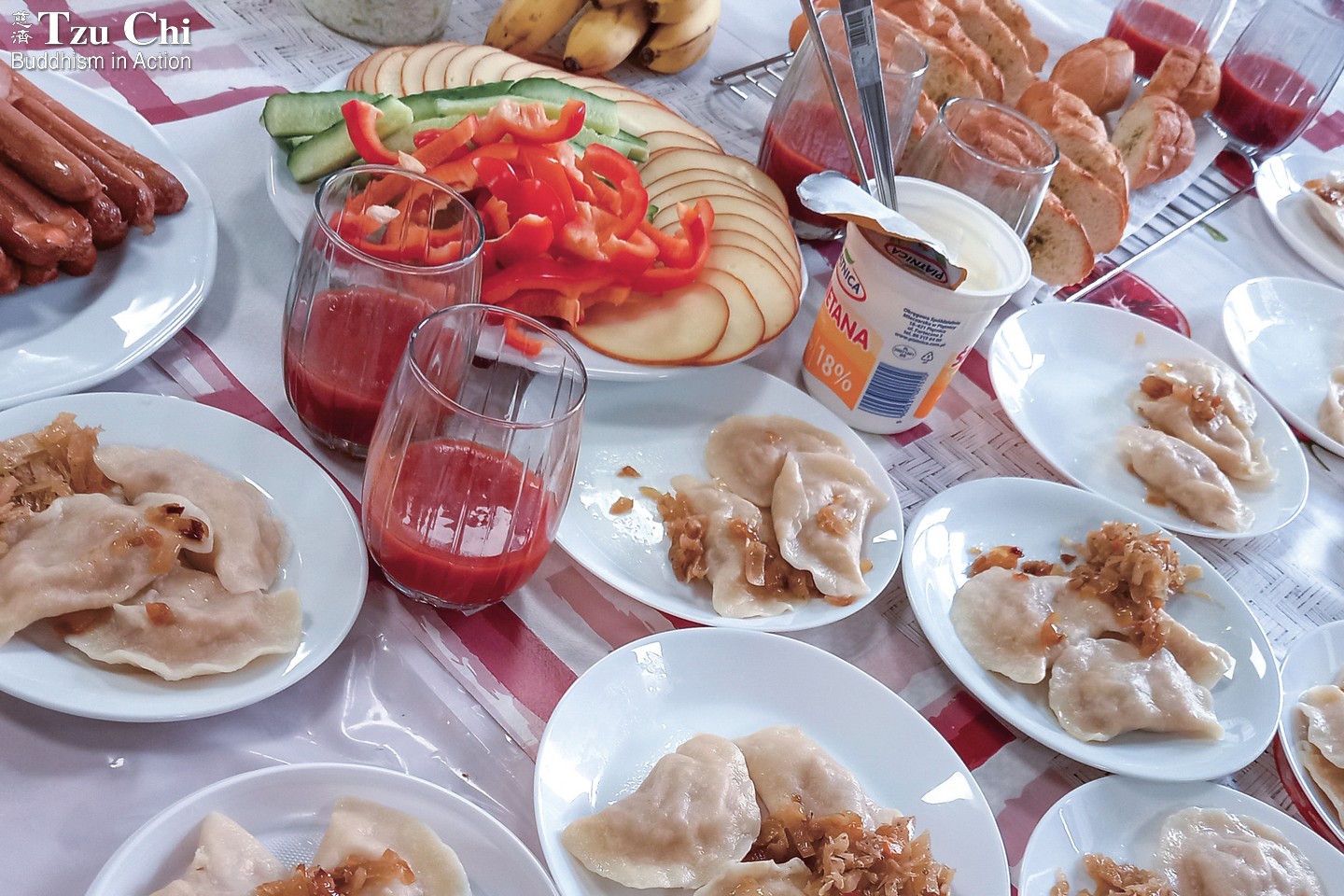
Ukrainian dumplings are traditionally served with fried onions and sour cream. At the Dumpling Club, all the food is vegetarian.
Mankus vividly recalled the harrowing experience of fleeing her homeland after the Russian invasion: “I boarded a train with my children. Our compartment was packed with 18 people, standing or sitting. We passed through areas where Russian forces were bombing, and the sky turned red. We were terrified, thinking about running out, but where could we escape to? We could only huddle together, hands shielding our heads, and hope for the best.”
Mankus had been an English teacher in Ukraine. After evacuating from Zaporizhzhia in southeastern Ukraine and arriving in Warsaw, she discovered that Tzu Chi was recruiting Ukrainian refugees who could speak English to assist with translating for the foundation’s relief efforts for displaced Ukrainians. That’s how she joined Tzu Chi, becoming a participant of their work relief program.
Over the past year, she has been assisting Tzu Chi in organizing English language courses and training more Ukrainians to speak English for the foundation’s medium- and long-term refugee services. “Initially, we thought this war would only last a few weeks,” she said, “and then we would be able to return home, but that did not happen. I’m very grateful to Tzu Chi for providing employment opportunities through their work relief program, which has empowered me to establish a life here in Poland.”
Nevertheless, not every refugee has been able to secure employment. According to Polish government statistics from March of this year, approximately 1.4 million Ukrainian refugees have opted to stay in Poland. A survey conducted by the Norwegian Refugee Council revealed that up to 70 percent of Ukrainian refugees in foreign lands, primarily women with children, are on the brink of poverty, struggling to meet even their most basic living expenses.
Susan Chen (陳樹微), a Tzu Chi volunteer from Germany, has visited Poland several times since the outbreak of the war to support Tzu Chi in its relief efforts for Ukrainian refugees. She pointed out that many non-profit organizations have pulled out of Poland, exacerbating the challenges faced by refugees. Moreover, the cost of essential goods and utilities has risen significantly this year. The Polish government alone cannot adequately care for all the refugees. “War is incredibly cruel, especially for innocent people,” Chen remarked. “Our presence here is not only to provide aid but also to ensure that victims of the war do not harbor hatred. We want them to realize that amidst the brutality of conflict, there are people who genuinely care about their well-being.”
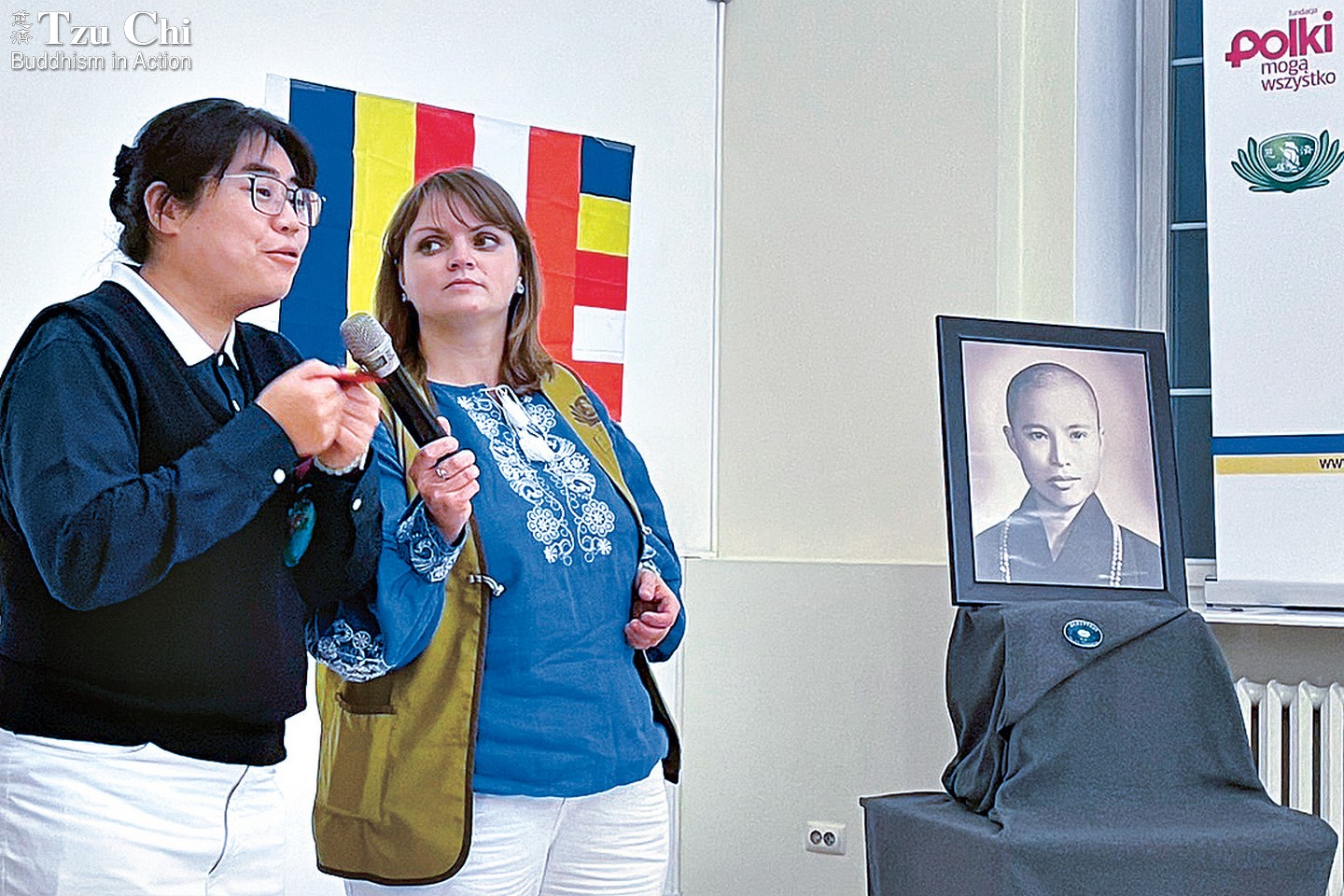
Hanna Mankus (second from left) serves as an interpreter in a Tzu Chi event, working alongside Tzu Chi volunteers to help her fellow Ukrainians.
Courtesy of Nadya Chou
On the first anniversary of the war, Mankus returned to her hometown of Zaporizhzhia for a visit. Located not far from the heavily bombed cities of Mariupol and Donetsk, Zaporizhzhia had become a refuge for many who fled those areas. As Mankus set foot on the streets of her hometown, she didn’t experience the excitement she had anticipated; instead, she felt disoriented. Everything had become so unfamiliar. All the windows in the buildings were vacant, and the air was filled with the scent of war. Even though it was daytime, the streets were deserted, and children were nowhere to be seen. “My home had temporarily become a shelter for displaced people from other cities, and the furniture had been rearranged. Naturally, I was okay with it,” she said.
After a short stay of just a few days, Mankus returned to Poland, deciding to stay in Warsaw for the safety and education of her children. When asked what she missed most about Ukraine, she took a moment to reflect before responding in earnest, “What I miss the most is actually the simple routine of waking up every morning, walking over to the refrigerator, seeing what’s inside, and thinking about what kind of breakfast to prepare. I really miss making my own sunny-side-up eggs.”
Mankus and her children currently live in a Catholic monastery in partnership with Tzu Chi, where their three daily meals are provided by the monastery. She expresses her gratitude to all the organizations that have generously provided assistance but can’t help but yearn for the days of her former independence. Still, she says, “If I have a message for my fellow countrymen, it is this: I hope that this war will make us all better, not worse.”
Families and elderly individuals receiving Tzu Chi’s care in Warsaw all participate in charitable activities alongside volunteers. This includes the production of dried fruit to be sent to underserved Ukrainian war zones for the elderly, vulnerable individuals, women, and children who are unable to leave. “In a well-known Ukrainian cartoon, there’s a saying, ‘The way your ship sails depends on how you name it,’” said Mankus. “So, I don’t consider myself a refugee; I see myself as a volunteer.”
In the kitchen of the Tzu Chi Warsaw office, participants of the Dumpling Club scooped dumplings ready to eat out of pots of boiling water. They brushed them with butter or topped them with fried onions before preparing to enjoy them with sour cream—this is the authentic way to savor Ukrainian dumplings. Everyone cheerfully dove in, finding comfort and strength in this traditional dish from their homeland.
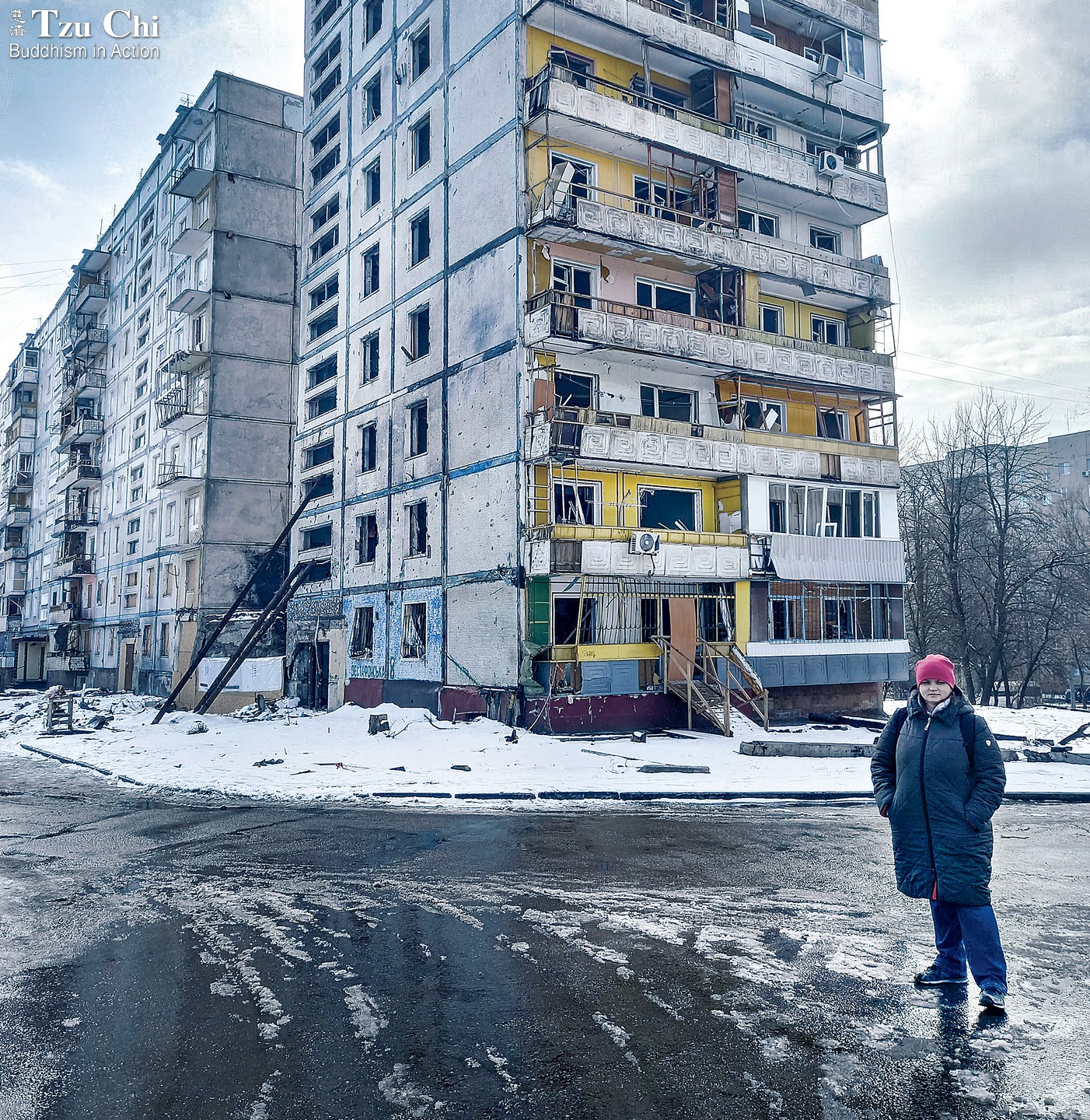
Hanna Mankus returned to her hometown of Zaporizhzhia, Ukraine, in early February this year. The streets were empty and the windows of buildings were either empty or boarded up.
Courtesy of Hanna Mankus
By Wang Wei-ling
Translated by Wu Hsiao-ting
Photos courtesy of Tzu Chi volunteers in Poland
The Dumpling Club at Tzu Chi’s Warsaw office provides a warm and enjoyable experience for older Ukrainian refugees.
Senior Ukrainians gather at Tzu Chi’s Warsaw office every week for the Dumpling Club, where they prepare traditional Ukrainian dumplings. The proceeds from 80 percent of the dumplings made at the club go to the participants, while the remaining 20 percent is donated to their fellow refugees struggling to cope in Warsaw.
In a kitchen in Warsaw, Poland, a pot of sour cherries and sugar simmered gently on the stove, gradually transforming into a beautiful crimson-purple jam. The sunlight streaming in through the window was just perfect, the bright beams of light illuminating airborne flour particles and making them glimmer like grains of golden sand. Laughter echoed through the air, which also carried a tangy, sweet, and comforting aroma.
The kitchen was located in the Tzu Chi Warsaw office, where more than a dozen elderly Ukrainians, refugees from their war-torn homeland, had gathered around a long wooden table. Their hands, bearing the marks of time, expertly divided fermented dough into small balls and rolled them into thin, round wrappers. As they waited for the cherry jam to be ready for use as a dumpling filling, they shared their cherished family recipes for varenyky, traditional Ukrainian dumplings.
Hanna Mankus, a Ukrainian working for Tzu Chi in Warsaw, observed, “When these seniors come to the Dumpling Club, they become like kindergarteners, competing to see whose dumpling recipe is the best! Witnessing them cast aside their worries and radiate such cheerfulness has been a delightful surprise that I didn’t foresee when I first proposed the Dumpling Club project.”
Mankus understood the seniors’ pride as they shared their family recipes. She also understood the solace they found in participating in the club. As they filled the dumpling wrappers with ingredients, skillfully folding and pinching them into plump half-moons, they were momentarily transported back to the kitchens of their beloved homes in Ukraine. There, they had lovingly prepared the most delicious dumplings, both savory and sweet, in response to the charming requests of their grandchildren.
“After the war broke out, life became exceptionally tough for the elderly. They grappled with language barriers in a foreign land and were often burdened by health issues,” Mankus explained, her empathy deep for the seniors who were uprooted in their old age and forced to seek refuge in a foreign land. She highlighted one of their challenges: “Back in Ukraine, getting medical care was much easier; a simple phone call could secure you an appointment for the next day. But here, it could take six months to a year to see a specialist. They also struggle to communicate with healthcare providers.” Getting around was also problematic; even understanding bus stop signs posed a challenge. “Sometimes, even I myself feel like I’m from Mars,” she added.
Staying in Poland for an extended period became their new reality, but everything felt so unfamiliar. They had to start anew. Even stepping beyond the doors of their rooms in their host families’ homes became intimidating for these older individuals.
Nina Kravchenko, an elderly Ukrainian refugee, expressed her concerns: “I’m not sure if my Polish host family enjoys having me in their home or if I’m inconveniencing them. I worry that they might ask me to leave one day.”
Fear, anxiety, and loneliness weighed heavily on the seniors, leaving them increasingly despondent. To offer support, Mankus proposed the idea of establishing a dumpling club in late September 2022. Older Ukrainians were invited to gather at the Tzu Chi Warsaw office every Friday to make dumplings together.
“Ukrainians have a natural talent for making dumplings,” Mankus declared, “but the question was whether the elderly would be willing to leave their homes to participate in our club. Some initially had doubts, but I didn’t let them stop me.” She rallied help, organized purchases, prepared ingredients, and sent out invitations. “In the beginning, we had just seven elderly participants, but as of June this year, we’ve conducted over 30 sessions, and now 16 seniors regularly attend. They are fondly called the ‘Dumplingists.’” These Dumplingists eagerly anticipate their Friday gatherings and have even started meeting in a park for walks and chats.
Eighty percent of the dumplings made at the club are available for purchase. “We offer dumplings with a cabbage filling, paired with fried cheese, fried onions and mushrooms, or mashed potatoes,” Mankus explained. “We also have fruit jam options, with sour cherries being our unique specialty! Most Poles haven’t tasted these delights before, and those who purchased them were pleasantly surprised, with many showing their support by regularly buying the dumplings.” The proceeds from these sales are distributed among the elderly participants. Although the amounts may not be substantial, the seniors receive a sense of accomplishment as they earn money through their own culinary skills.
The remaining 20 percent of dumplings are donated to Tzu Chi’s long-term care recipients in Warsaw, who are financially strapped refugees unable to work due to various circumstances. “When we deliver the dumplings to these families,” said Mankus, “we always take pictures and show them to the Dumplingists upon our return. The seniors are deeply gratified, knowing that their presence still carries great meaning and that they can bring joy to others.”
Ukrainian dumplings are traditionally served with fried onions and sour cream. At the Dumpling Club, all the food is vegetarian.
Mankus vividly recalled the harrowing experience of fleeing her homeland after the Russian invasion: “I boarded a train with my children. Our compartment was packed with 18 people, standing or sitting. We passed through areas where Russian forces were bombing, and the sky turned red. We were terrified, thinking about running out, but where could we escape to? We could only huddle together, hands shielding our heads, and hope for the best.”
Mankus had been an English teacher in Ukraine. After evacuating from Zaporizhzhia in southeastern Ukraine and arriving in Warsaw, she discovered that Tzu Chi was recruiting Ukrainian refugees who could speak English to assist with translating for the foundation’s relief efforts for displaced Ukrainians. That’s how she joined Tzu Chi, becoming a participant of their work relief program.
Over the past year, she has been assisting Tzu Chi in organizing English language courses and training more Ukrainians to speak English for the foundation’s medium- and long-term refugee services. “Initially, we thought this war would only last a few weeks,” she said, “and then we would be able to return home, but that did not happen. I’m very grateful to Tzu Chi for providing employment opportunities through their work relief program, which has empowered me to establish a life here in Poland.”
Nevertheless, not every refugee has been able to secure employment. According to Polish government statistics from March of this year, approximately 1.4 million Ukrainian refugees have opted to stay in Poland. A survey conducted by the Norwegian Refugee Council revealed that up to 70 percent of Ukrainian refugees in foreign lands, primarily women with children, are on the brink of poverty, struggling to meet even their most basic living expenses.
Susan Chen (陳樹微), a Tzu Chi volunteer from Germany, has visited Poland several times since the outbreak of the war to support Tzu Chi in its relief efforts for Ukrainian refugees. She pointed out that many non-profit organizations have pulled out of Poland, exacerbating the challenges faced by refugees. Moreover, the cost of essential goods and utilities has risen significantly this year. The Polish government alone cannot adequately care for all the refugees. “War is incredibly cruel, especially for innocent people,” Chen remarked. “Our presence here is not only to provide aid but also to ensure that victims of the war do not harbor hatred. We want them to realize that amidst the brutality of conflict, there are people who genuinely care about their well-being.”
Hanna Mankus (second from left) serves as an interpreter in a Tzu Chi event, working alongside Tzu Chi volunteers to help her fellow Ukrainians.
Courtesy of Nadya Chou
On the first anniversary of the war, Mankus returned to her hometown of Zaporizhzhia for a visit. Located not far from the heavily bombed cities of Mariupol and Donetsk, Zaporizhzhia had become a refuge for many who fled those areas. As Mankus set foot on the streets of her hometown, she didn’t experience the excitement she had anticipated; instead, she felt disoriented. Everything had become so unfamiliar. All the windows in the buildings were vacant, and the air was filled with the scent of war. Even though it was daytime, the streets were deserted, and children were nowhere to be seen. “My home had temporarily become a shelter for displaced people from other cities, and the furniture had been rearranged. Naturally, I was okay with it,” she said.
After a short stay of just a few days, Mankus returned to Poland, deciding to stay in Warsaw for the safety and education of her children. When asked what she missed most about Ukraine, she took a moment to reflect before responding in earnest, “What I miss the most is actually the simple routine of waking up every morning, walking over to the refrigerator, seeing what’s inside, and thinking about what kind of breakfast to prepare. I really miss making my own sunny-side-up eggs.”
Mankus and her children currently live in a Catholic monastery in partnership with Tzu Chi, where their three daily meals are provided by the monastery. She expresses her gratitude to all the organizations that have generously provided assistance but can’t help but yearn for the days of her former independence. Still, she says, “If I have a message for my fellow countrymen, it is this: I hope that this war will make us all better, not worse.”
Families and elderly individuals receiving Tzu Chi’s care in Warsaw all participate in charitable activities alongside volunteers. This includes the production of dried fruit to be sent to underserved Ukrainian war zones for the elderly, vulnerable individuals, women, and children who are unable to leave. “In a well-known Ukrainian cartoon, there’s a saying, ‘The way your ship sails depends on how you name it,’” said Mankus. “So, I don’t consider myself a refugee; I see myself as a volunteer.”
In the kitchen of the Tzu Chi Warsaw office, participants of the Dumpling Club scooped dumplings ready to eat out of pots of boiling water. They brushed them with butter or topped them with fried onions before preparing to enjoy them with sour cream—this is the authentic way to savor Ukrainian dumplings. Everyone cheerfully dove in, finding comfort and strength in this traditional dish from their homeland.
Hanna Mankus returned to her hometown of Zaporizhzhia, Ukraine, in early February this year. The streets were empty and the windows of buildings were either empty or boarded up.
Courtesy of Hanna Mankus
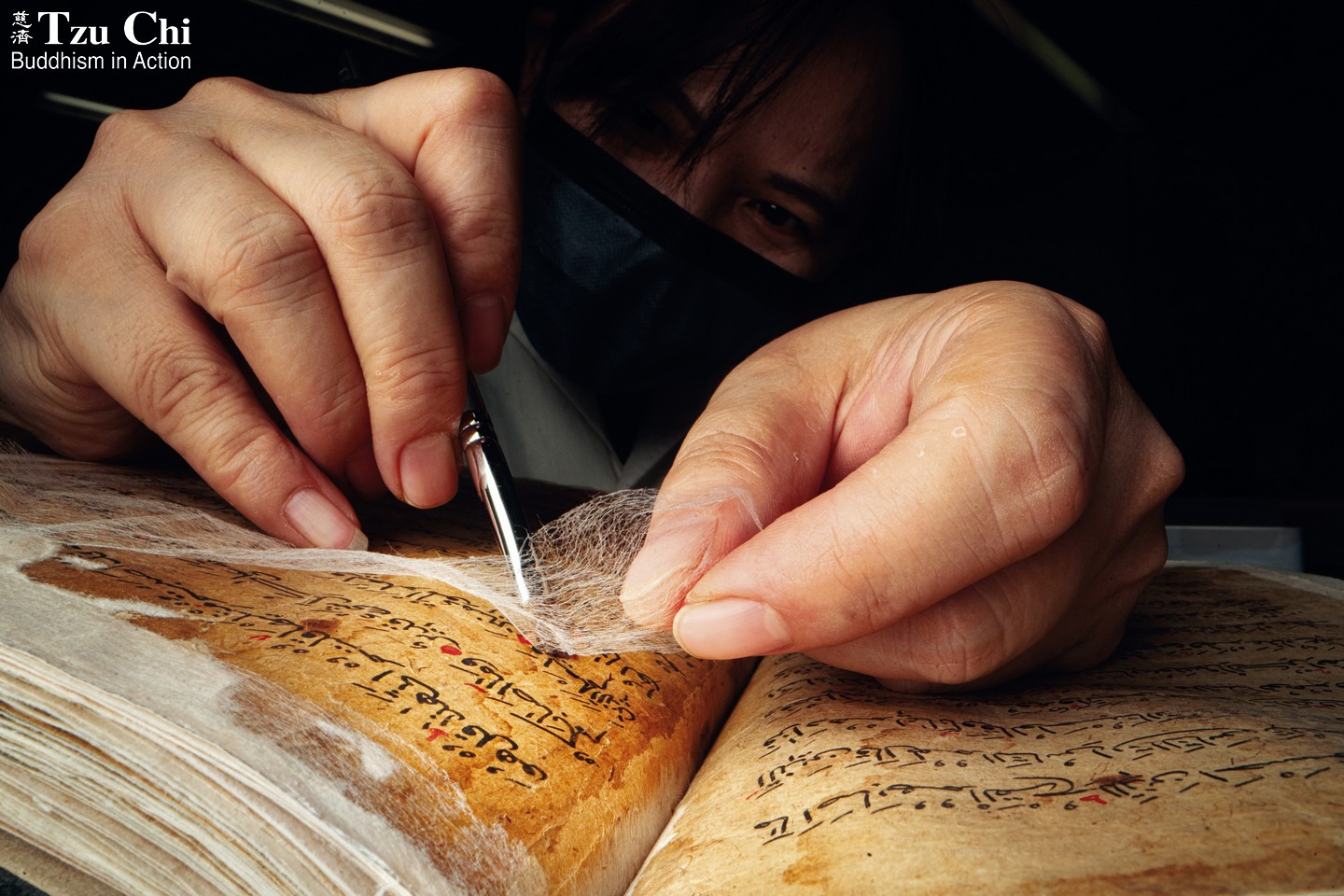
Photo by Liu Zi-zheng
By Jessica Yang and Ning Rong
Compiled and translated by Wu Hsiao-ting
Photos courtesy of the Program Department of Da Ai TV
A book restorer works on a 500-year-old handwritten Koran that has suffered damage from bookworms, water submersion, and even fire, aiming to reveal the original appearance of this sacred Islamic scripture.
An ancient hand-copied manuscript of the Koran, passed down for hundreds of years, displays different handwriting styles and varying shades of ink on its aged hemp paper.
Liu Zi-zheng
“This is undoubtedly the oldest book I’ve ever encountered, exhibiting multiple types of damage typical of old texts, including from insects,” remarked Xu Mei-wen (徐美文). Xu holds a Ph.D. in Library, Information, and Archival Studies from National Chengchi University in Taipei, and serves as a book restorer at Taiwan Book Hospital, an affiliate of the National Taiwan Library, New Taipei City. She carefully examined what was most likely a 500-year-old handwritten Koran. The cover of the leather-bound tome had become hardened and detached from the main body of the book, displaying the scars of fire, water submersion, burial in soil, and insect infestations. The pages bore traces of blood, mold, mud, flower petals, hair, plant seeds, and insect feces.
“Through deciphering the handwriting and studying other elements of the book,” Xu added, “we are inclined to believe that it was transcribed by ten individuals at different times around the 15th or 16th century. The restoration process poses a significant challenge due to the inconsistencies in the ages and colors of the paper used in the book.”
The Koran was found to harbor at least three types of bookworms upon initial examination, necessitating its placement in an anoxic disinfestation chamber for a week-long treatment to eradicate the insects. Afterwards, Xu carefully brushed each page clean with a soft brush. She then renumbered the 500-plus pages of the handwritten Koran before separating the cover from the body of pages. Next, she performed dry cleaning using an eraser and eraser powder. A lot of care was required, and each step of the delicate restoration was very time-consuming. Xu explained that missing even a single step in the meticulous process could jeopardize the outcome.
This Koran’s front and back covers each have a large hole (Photos 3 and 4). Experts speculate that they may have once been adorned with precious stones. The pages themselves showed extensive wear and tear (Photo 1). The manuscript was infested with three different types of bookworms. There were even what appeared to be insect wings inside the book, later confirmed to be flower petals (Photo 2). In the eyes of restoration experts, it embodied all the pathological conditions that could afflict a book, resembling a critically ill patient. The Koran is a fundamental Islamic scripture, considered to be the divine revelation of Allah. It serves as the cornerstone of the Muslim faith, providing guidance for Muslims’ way of life.
Photos 1 and 4 courtesy of the National Taiwan Library
After the book was taken apart and cleaned, one of the biggest challenges followed—finding an appropriate paper for the restoration effort.
Scientific examination plays a crucial role in restoration. Using a microscope, Xu and her team identified three types of paper used in the Koran. They also observed that the fibers in the paper were remarkably long.
Xu has 15 years of experience in cultural relic restoration and has dedicated years to the study of paper. She possesses extensive knowledge of its history. “The paper-making technology in the Middle East was introduced from China during the Tang Dynasty [618 to 907 CE],” she said. The transmission occurred after a group of skilled Chinese papermakers was captured and brought to the Arab world. “During the Tang Dynasty, paper was made from hemp fibers or bark from the paper-mulberry tree. But paper made from tree bark fibers was uncommon in the Arab world, due to the poor growth of trees in the region. Therefore, we have deduced that this Koran was made from hemp paper.”
Paper is a fundamental element in book restoration, but finding a matching modern paper to use proved to be a formidable task. Xu and her team reached out to various paper mills in an attempt to replicate the desired paper but were left empty-handed—none could produce a similar paper. Just when she was feeling stumped, a fortunate recollection came to her aid: she remembered having once purchased some hemp paper, conveniently stored in the National Taiwan Library’s warehouse.
Just like that, in their own warehouse, they found some Japanese hemp paper that closely resembled the thickness and texture of the paper used in the 500-year-old Koran. Moreover, the Japanese hemp paper was produced around the same time period as the Koran’s paper. However, the paper needed to be further processed before it could be used. “The color of the hemp paper was very white,” Xu remarked, “while the color of the Koran’s pages varied in depth. Thus, we needed to find a way to dye our paper to achieve an aged look.” Staying true to Taiwan Book Hospital’s commitment to restoring old books to their aged appearance, Xu took on the task of personally preparing the dye and coloring the hemp paper.
Restoring the Koran involved a methodical step-by-step process. First, the ancient scripture was placed inside an anoxic disinfestation chamber (Photo 1) and infused with 99.9 percent nitrogen for a week to thoroughly eliminate pests. Then, soft-bristle brushes were used to meticulously remove foreign substances (Photo 2). After that, the pages were renumbered, and the book cover was separated from the body. It was followed by a thorough dry-cleaning process using an eraser, moving in a clockwise circular motion (Photo 3).
The National Taiwan Library is nestled beside Number Four Park, in Zhonghe, New Taipei City. The Taiwan Book Hospital is located on the fifth floor of the library. The day we visited, three restoration technicians were meticulously preparing dyes in the Book Hospital. One was fetching water, while another heated dyes in a water bath. Xu, with a dropper and a measuring cup in hand, calculated the precise amount of dye needed. She explained that when they first started to restore the Koran, they estimated the handwritten book to be from the 15th or 16th century. Since the pigments of that time were definitely not modern artificial ones, she made a deliberate choice to experiment with plant dyes and mineral pigments. She recalled, “Initially, I tried using plant dyes and experimented with various plants, such as mixing peppercorns with ink. However, achieving the desired colors remained elusive.” After repeated attempts with plant-based dyes, all unsuccessful, Xu thought of the unique characteristics of the Middle Eastern region, with its plentiful deserts and scarce oases. Consequently, she transitioned to experimenting with mineral pigments. Through various adjustments, she finally confirmed the correct proportions for the formula.
“In the past, masters in the field relied on their experience to dye paper,” she said. “But when it came to restoring the Koran, we didn’t have the guidance of such masters. As a result, we had to start everything from scratch.”
Searching for the right paper, matching its color, and dying it consumed eight months for Xu. Then began the meticulous work of preserving the text on the Koran. For this, she used a Japanese-made, ultra-thin paper called Tengucho and adhered it to the pages of the Koran. Concerned that the moisture from the adhesive might cause the ink to bleed, she slowly pushed, rolled, and pressed the paper onto the pages using wrung-out cotton cloths. This method was a first for Taiwan Book Hospital and the first of its kind in Taiwan.
Xu believes that there is no fixed approach to restoring ancient books. Constant experimentation with new possibilities is necessary to restore old as old. Restoring ancient books is a significant endeavor in preserving cultural heritage. Currently, Taiwan lacks a comprehensive curriculum for training both Chinese and Western book restoration specialists. Restoration workers have to proactively seek guidance from professionals in various fields, much like Xu, who has sought advice from experts in library knowledge, archival aging, archival restoration, and mounting of paintings and calligraphy.
During the restoration of the centuries-old Koran, Xu added an artistic touch to the endeavor using techniques for mounting paintings. Having learned the art of mounting Chinese paintings or calligraphy on paper, Xu applied this approach to repair the Koran’s damaged pages. “I might be the first to treat a book like a painting during the restoration, making each page of the Koran resemble a piece of artwork,” she said. Her gentle and meticulous dedication enhanced the artistic value of this ancient Koran.
Xu encountered numerous challenges in the process of restoring the Koran, from cleaning the book, to mending the pages, to creating a cover. She persevered through all the obstacles. But the hard work was not limited to restoring the book. In reality, her inner struggle was quite profound.

One of the uses of the translucent and delicate Tengucho paper (Photo 1) is for archival conservation. Xu went to great lengths to import it from Japan and adhered it to the pages of the Koran to protect the text. To achieve the aged appearance of the book, she personally crafted dyes and colored the hemp paper chosen for the restoration (Photos 2 and 3). She used mineral dyes after repeated experiments and considering the characteristics of the medieval era and the Middle East. The dyed paper was then air-dried naturally (Photo 4). Various tools like brushes, tweezers, and cotton cloths were carefully used (Photos 5, 6, and 7) during the meticulous restoration process.
Photos 2 and 6 courtesy of the National Taiwan Library
The restoration of the over 500-page Koran proved to be more challenging than Xu had anticipated. “The process was truly agonizing!” she exclaimed. “It took more than two years.” She almost burst into tears when she was nearing completion of the project. “It was a really tough project. I often wondered why I took it on.” At one point, while attempting to restore the cover, she even considered giving up. Nevertheless, she pressed on. “Every time we met with Master Cheng Yen,” she said, “she always showed such respect for us.”
On July 5, 2020, Muslim Tzu Chi volunteer Faisal Hu (胡光中) presented the hand-copied Koran, a cherished piece with over 500 years of history, to Dharma Master Cheng Yen, the founder of the Buddhist Tzu Chi Foundation. The book had been discovered by Hu in an antique books and cultural relics market in Istanbul, Türkiye. While perusing the Koran, the Master noticed that the paper had turned yellow and brittle, and insects were emerging from it. Thus, she conceived the idea of restoration. The Master said after receiving the book, “Although I cannot understand the words in this Koran, its antiquity brings me great joy. Even though our religions are different, our core principles likely share similarities, offering educational and humanitarian value. Therefore, I am enthusiastic about its preservation.” With the assistance of Faisal Hu and another Tzu Chi volunteer, Wu Ying-mei (吳英美), the Koran was delivered to Taiwan Book Hospital for restoration.
Master Cheng Yen’s respect for other religions and selfless Great Love deeply touched Xu. Although not a Buddhist or Muslim, Xu approached the restoration with great reverence for the scripture. She refrained from eating pork and often engaged in inner dialogues with the Koran, feeling as if an unseen force was guiding her forward.
The most challenging task in the restoration of the Koran was restoring the cover. “At first, I wondered whether we should restore the cover at all,” Xu shared. “It was in such bad shape—the leather had hardened and badly cracked. I knew that Master Cheng Yen is a vegetarian and avoids using animal leather. However, if we were to have opted for PU [polyurethane] leather for the cover restoration, we wouldn’t have achieved the same authenticity.” Speaking of this, she expressed gratitude to Master Cheng Yen for her trust in their team and her respect for their expertise. “It really gave us strength to press ahead with the restoration.”
Shortly after the restoration team reported to Master Cheng Yen about the restoration progress of the Koran on November 18, 2022, Xu tried a different method of producing a non-leather cover, leading to a breakthrough. Employing the latest technology from the United States, Xu made a new cover using paper instead of leather. The color matching for the new cover was swift, taking “only” two weeks. Then Xu glued the cardboard cover to the original old cowhide cover, bringing the Koran back to its original appearance.
The restoration of the Koran allowed a precious piece of cultural heritage from the 15th or 16th century to be preserved. It will now be appreciated anew by present and future generations.
Zheng Ying-hang
“Why did we dedicate so much time to restoring this ancient book?” Xu asked. “It’s because of its historical significance and the value of the paper. What we undertook was the preservation of cultural heritage. If we failed to properly restore this classic, future generations would have been deprived of the opportunity to appreciate the beauty of these pages, paper, and text.”
Through the restoration of the handwritten Koran, a precious piece of cultural heritage from the 15th or 16th century was brought back to life. The restored Koran is expected to endure for hundreds of more years, possibly a thousand. There’s a heartwarming touch of beauty behind Xu and her team’s dedicated efforts. It now bears witness to the spirit of mutual respect and love among different religions. The act of Master Cheng Yen, a Buddhist, restoring the Islamic scripture reflects a broad and inclusive spirit, leaving a legacy to be remembered and cherished.
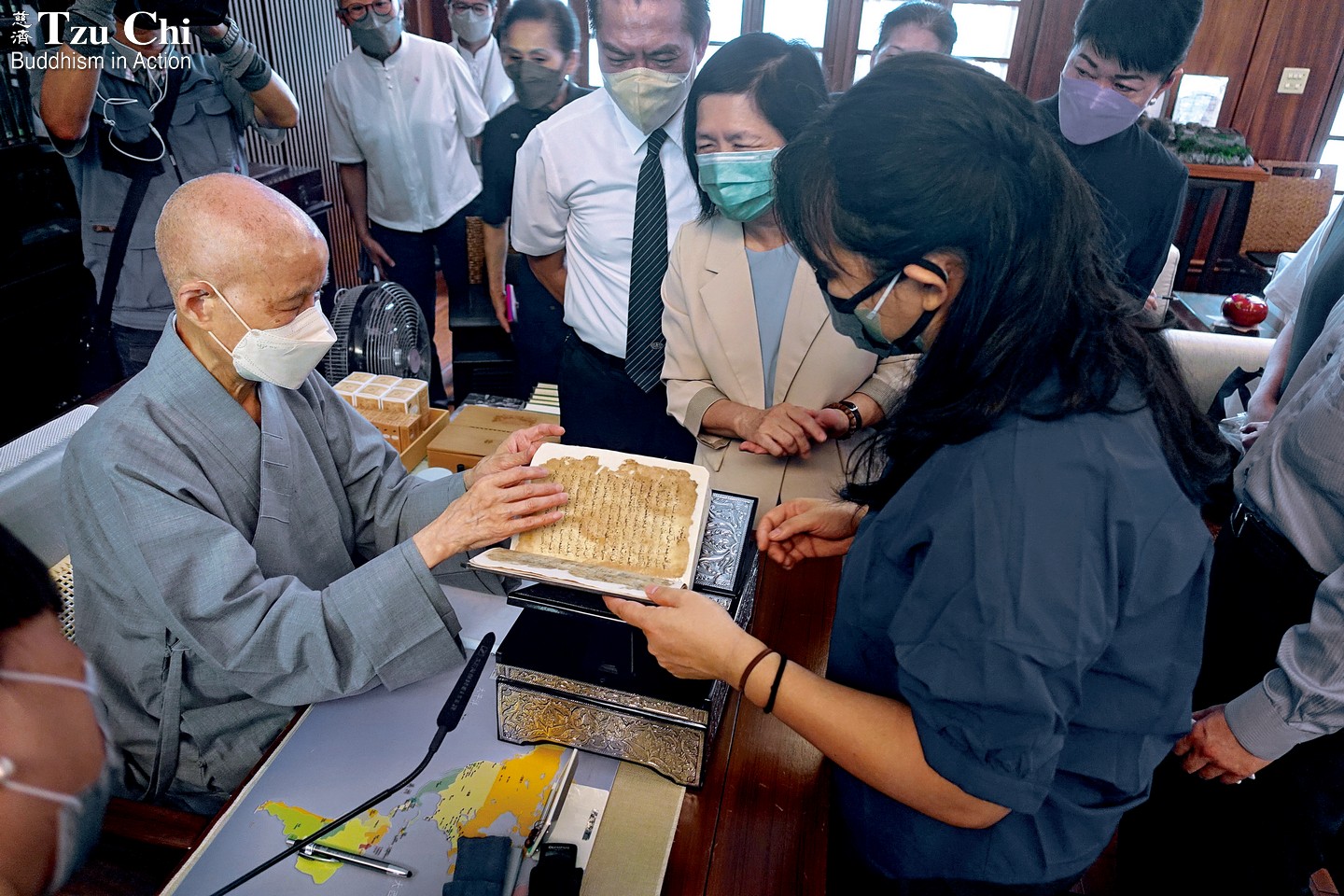
Master Cheng Yen examines the restored Koran, a labor of dedication by Xu Mei-wen (in profile) and her team.
Courtesy of the Tzu Chi Foundation
Photo by Liu Zi-zheng
By Jessica Yang and Ning Rong
Compiled and translated by Wu Hsiao-ting
Photos courtesy of the Program Department of Da Ai TV
A book restorer works on a 500-year-old handwritten Koran that has suffered damage from bookworms, water submersion, and even fire, aiming to reveal the original appearance of this sacred Islamic scripture.
An ancient hand-copied manuscript of the Koran, passed down for hundreds of years, displays different handwriting styles and varying shades of ink on its aged hemp paper.
Liu Zi-zheng
“This is undoubtedly the oldest book I’ve ever encountered, exhibiting multiple types of damage typical of old texts, including from insects,” remarked Xu Mei-wen (徐美文). Xu holds a Ph.D. in Library, Information, and Archival Studies from National Chengchi University in Taipei, and serves as a book restorer at Taiwan Book Hospital, an affiliate of the National Taiwan Library, New Taipei City. She carefully examined what was most likely a 500-year-old handwritten Koran. The cover of the leather-bound tome had become hardened and detached from the main body of the book, displaying the scars of fire, water submersion, burial in soil, and insect infestations. The pages bore traces of blood, mold, mud, flower petals, hair, plant seeds, and insect feces.
“Through deciphering the handwriting and studying other elements of the book,” Xu added, “we are inclined to believe that it was transcribed by ten individuals at different times around the 15th or 16th century. The restoration process poses a significant challenge due to the inconsistencies in the ages and colors of the paper used in the book.”
The Koran was found to harbor at least three types of bookworms upon initial examination, necessitating its placement in an anoxic disinfestation chamber for a week-long treatment to eradicate the insects. Afterwards, Xu carefully brushed each page clean with a soft brush. She then renumbered the 500-plus pages of the handwritten Koran before separating the cover from the body of pages. Next, she performed dry cleaning using an eraser and eraser powder. A lot of care was required, and each step of the delicate restoration was very time-consuming. Xu explained that missing even a single step in the meticulous process could jeopardize the outcome.
This Koran’s front and back covers each have a large hole (Photos 3 and 4). Experts speculate that they may have once been adorned with precious stones. The pages themselves showed extensive wear and tear (Photo 1). The manuscript was infested with three different types of bookworms. There were even what appeared to be insect wings inside the book, later confirmed to be flower petals (Photo 2). In the eyes of restoration experts, it embodied all the pathological conditions that could afflict a book, resembling a critically ill patient. The Koran is a fundamental Islamic scripture, considered to be the divine revelation of Allah. It serves as the cornerstone of the Muslim faith, providing guidance for Muslims’ way of life.
Photos 1 and 4 courtesy of the National Taiwan Library
After the book was taken apart and cleaned, one of the biggest challenges followed—finding an appropriate paper for the restoration effort.
Scientific examination plays a crucial role in restoration. Using a microscope, Xu and her team identified three types of paper used in the Koran. They also observed that the fibers in the paper were remarkably long.
Xu has 15 years of experience in cultural relic restoration and has dedicated years to the study of paper. She possesses extensive knowledge of its history. “The paper-making technology in the Middle East was introduced from China during the Tang Dynasty [618 to 907 CE],” she said. The transmission occurred after a group of skilled Chinese papermakers was captured and brought to the Arab world. “During the Tang Dynasty, paper was made from hemp fibers or bark from the paper-mulberry tree. But paper made from tree bark fibers was uncommon in the Arab world, due to the poor growth of trees in the region. Therefore, we have deduced that this Koran was made from hemp paper.”
Paper is a fundamental element in book restoration, but finding a matching modern paper to use proved to be a formidable task. Xu and her team reached out to various paper mills in an attempt to replicate the desired paper but were left empty-handed—none could produce a similar paper. Just when she was feeling stumped, a fortunate recollection came to her aid: she remembered having once purchased some hemp paper, conveniently stored in the National Taiwan Library’s warehouse.
Just like that, in their own warehouse, they found some Japanese hemp paper that closely resembled the thickness and texture of the paper used in the 500-year-old Koran. Moreover, the Japanese hemp paper was produced around the same time period as the Koran’s paper. However, the paper needed to be further processed before it could be used. “The color of the hemp paper was very white,” Xu remarked, “while the color of the Koran’s pages varied in depth. Thus, we needed to find a way to dye our paper to achieve an aged look.” Staying true to Taiwan Book Hospital’s commitment to restoring old books to their aged appearance, Xu took on the task of personally preparing the dye and coloring the hemp paper.
Restoring the Koran involved a methodical step-by-step process. First, the ancient scripture was placed inside an anoxic disinfestation chamber (Photo 1) and infused with 99.9 percent nitrogen for a week to thoroughly eliminate pests. Then, soft-bristle brushes were used to meticulously remove foreign substances (Photo 2). After that, the pages were renumbered, and the book cover was separated from the body. It was followed by a thorough dry-cleaning process using an eraser, moving in a clockwise circular motion (Photo 3).
The National Taiwan Library is nestled beside Number Four Park, in Zhonghe, New Taipei City. The Taiwan Book Hospital is located on the fifth floor of the library. The day we visited, three restoration technicians were meticulously preparing dyes in the Book Hospital. One was fetching water, while another heated dyes in a water bath. Xu, with a dropper and a measuring cup in hand, calculated the precise amount of dye needed. She explained that when they first started to restore the Koran, they estimated the handwritten book to be from the 15th or 16th century. Since the pigments of that time were definitely not modern artificial ones, she made a deliberate choice to experiment with plant dyes and mineral pigments. She recalled, “Initially, I tried using plant dyes and experimented with various plants, such as mixing peppercorns with ink. However, achieving the desired colors remained elusive.” After repeated attempts with plant-based dyes, all unsuccessful, Xu thought of the unique characteristics of the Middle Eastern region, with its plentiful deserts and scarce oases. Consequently, she transitioned to experimenting with mineral pigments. Through various adjustments, she finally confirmed the correct proportions for the formula.
“In the past, masters in the field relied on their experience to dye paper,” she said. “But when it came to restoring the Koran, we didn’t have the guidance of such masters. As a result, we had to start everything from scratch.”
Searching for the right paper, matching its color, and dying it consumed eight months for Xu. Then began the meticulous work of preserving the text on the Koran. For this, she used a Japanese-made, ultra-thin paper called Tengucho and adhered it to the pages of the Koran. Concerned that the moisture from the adhesive might cause the ink to bleed, she slowly pushed, rolled, and pressed the paper onto the pages using wrung-out cotton cloths. This method was a first for Taiwan Book Hospital and the first of its kind in Taiwan.
Xu believes that there is no fixed approach to restoring ancient books. Constant experimentation with new possibilities is necessary to restore old as old. Restoring ancient books is a significant endeavor in preserving cultural heritage. Currently, Taiwan lacks a comprehensive curriculum for training both Chinese and Western book restoration specialists. Restoration workers have to proactively seek guidance from professionals in various fields, much like Xu, who has sought advice from experts in library knowledge, archival aging, archival restoration, and mounting of paintings and calligraphy.
During the restoration of the centuries-old Koran, Xu added an artistic touch to the endeavor using techniques for mounting paintings. Having learned the art of mounting Chinese paintings or calligraphy on paper, Xu applied this approach to repair the Koran’s damaged pages. “I might be the first to treat a book like a painting during the restoration, making each page of the Koran resemble a piece of artwork,” she said. Her gentle and meticulous dedication enhanced the artistic value of this ancient Koran.
Xu encountered numerous challenges in the process of restoring the Koran, from cleaning the book, to mending the pages, to creating a cover. She persevered through all the obstacles. But the hard work was not limited to restoring the book. In reality, her inner struggle was quite profound.
One of the uses of the translucent and delicate Tengucho paper (Photo 1) is for archival conservation. Xu went to great lengths to import it from Japan and adhered it to the pages of the Koran to protect the text. To achieve the aged appearance of the book, she personally crafted dyes and colored the hemp paper chosen for the restoration (Photos 2 and 3). She used mineral dyes after repeated experiments and considering the characteristics of the medieval era and the Middle East. The dyed paper was then air-dried naturally (Photo 4). Various tools like brushes, tweezers, and cotton cloths were carefully used (Photos 5, 6, and 7) during the meticulous restoration process.
Photos 2 and 6 courtesy of the National Taiwan Library
The restoration of the over 500-page Koran proved to be more challenging than Xu had anticipated. “The process was truly agonizing!” she exclaimed. “It took more than two years.” She almost burst into tears when she was nearing completion of the project. “It was a really tough project. I often wondered why I took it on.” At one point, while attempting to restore the cover, she even considered giving up. Nevertheless, she pressed on. “Every time we met with Master Cheng Yen,” she said, “she always showed such respect for us.”
On July 5, 2020, Muslim Tzu Chi volunteer Faisal Hu (胡光中) presented the hand-copied Koran, a cherished piece with over 500 years of history, to Dharma Master Cheng Yen, the founder of the Buddhist Tzu Chi Foundation. The book had been discovered by Hu in an antique books and cultural relics market in Istanbul, Türkiye. While perusing the Koran, the Master noticed that the paper had turned yellow and brittle, and insects were emerging from it. Thus, she conceived the idea of restoration. The Master said after receiving the book, “Although I cannot understand the words in this Koran, its antiquity brings me great joy. Even though our religions are different, our core principles likely share similarities, offering educational and humanitarian value. Therefore, I am enthusiastic about its preservation.” With the assistance of Faisal Hu and another Tzu Chi volunteer, Wu Ying-mei (吳英美), the Koran was delivered to Taiwan Book Hospital for restoration.
Master Cheng Yen’s respect for other religions and selfless Great Love deeply touched Xu. Although not a Buddhist or Muslim, Xu approached the restoration with great reverence for the scripture. She refrained from eating pork and often engaged in inner dialogues with the Koran, feeling as if an unseen force was guiding her forward.
The most challenging task in the restoration of the Koran was restoring the cover. “At first, I wondered whether we should restore the cover at all,” Xu shared. “It was in such bad shape—the leather had hardened and badly cracked. I knew that Master Cheng Yen is a vegetarian and avoids using animal leather. However, if we were to have opted for PU [polyurethane] leather for the cover restoration, we wouldn’t have achieved the same authenticity.” Speaking of this, she expressed gratitude to Master Cheng Yen for her trust in their team and her respect for their expertise. “It really gave us strength to press ahead with the restoration.”
Shortly after the restoration team reported to Master Cheng Yen about the restoration progress of the Koran on November 18, 2022, Xu tried a different method of producing a non-leather cover, leading to a breakthrough. Employing the latest technology from the United States, Xu made a new cover using paper instead of leather. The color matching for the new cover was swift, taking “only” two weeks. Then Xu glued the cardboard cover to the original old cowhide cover, bringing the Koran back to its original appearance.
The restoration of the Koran allowed a precious piece of cultural heritage from the 15th or 16th century to be preserved. It will now be appreciated anew by present and future generations.
Zheng Ying-hang
“Why did we dedicate so much time to restoring this ancient book?” Xu asked. “It’s because of its historical significance and the value of the paper. What we undertook was the preservation of cultural heritage. If we failed to properly restore this classic, future generations would have been deprived of the opportunity to appreciate the beauty of these pages, paper, and text.”
Through the restoration of the handwritten Koran, a precious piece of cultural heritage from the 15th or 16th century was brought back to life. The restored Koran is expected to endure for hundreds of more years, possibly a thousand. There’s a heartwarming touch of beauty behind Xu and her team’s dedicated efforts. It now bears witness to the spirit of mutual respect and love among different religions. The act of Master Cheng Yen, a Buddhist, restoring the Islamic scripture reflects a broad and inclusive spirit, leaving a legacy to be remembered and cherished.
Master Cheng Yen examines the restored Koran, a labor of dedication by Xu Mei-wen (in profile) and her team.
Courtesy of the Tzu Chi Foundation
By Zhang Li-zhu
Translated by Wu Hsiao-ting
Photos by Huang Xiao-zhe
Yang Su is immensely grateful when she wakes up every day. She cherishes each new day as another chance to give of herself and sow seeds of blessings.
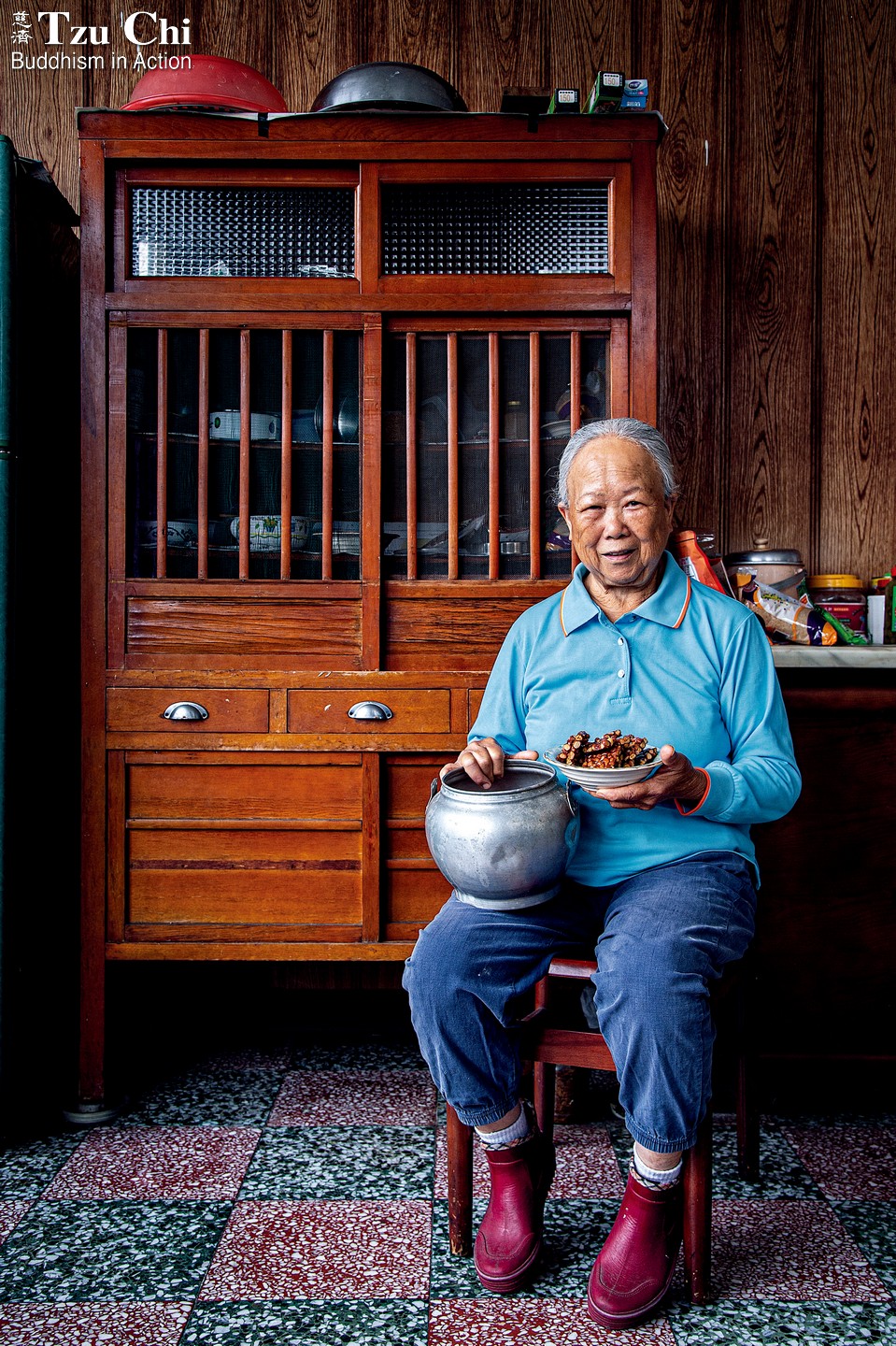
Yang Su (楊素), 82, always wears her gray hair in a ponytail. Despite a petite stature that conveys an impression of delicacy and frailty, her kindness knows no bounds. The acts of goodwill she performs rival those of individuals much younger than she is. Sometimes, she ventures out with friends as early as just after three in the morning to pick sweet potato leaves, which she then delivers to an orphanage to supplement the meals for the children there. She has a warm-hearted nature, so whenever she learns of a family facing hardship, she promptly reports their situation to Tzu Chi for assessment and assistance. She is frequently seen cycling around her community, visiting her neighbors. In fact, she is such a well-known presence in her neighborhood that she has earned the honorary title of an unofficial community leader.
Everyone in Tzu Chi who knows her affectionately refers to her as “Ah Po” (Grandma). Despite her advanced age and illiteracy, whenever her team leader informs her about any tasks to do, she readily agrees to lend a hand. This may include activities such as cleaning Tzu Chi facilities, participating in recycling work, cooking for Tzu Chi events, or chanting the Buddha’s name for the deceased.
Every Saturday morning, at around five o’clock, she arrives at the Tzu Chi Daya Recycling Station in Taichung, central Taiwan, to sort recycling. On the day I interviewed her for this article, she proudly showcased the clothes she was wearing, explaining that they were all obtained from the recycling station. Pointing to her sneakers, she exclaimed, “I found these shoes at the recycling station too, and they fit perfectly! I really like them.” Taking out another pair of shoes, she added, “These ones are almost brand-new, and I treasure them too much to wear them. They are another precious find from the recycling station!”
The clothes worn by her twin grandchildren and the winter comforters they use are all recycled as well. “I mend discarded and worn-out comforters with needle and thread, then slip them into clean covers,” she explained. “This way, my grandchildren have warm comforters to keep them cozy in the cold winter. They really appreciate the comforters I prepare for them.”
Due to her age and the responsibility of raising her twin grandchildren, Yang Su often struggles to make ends meet. However, she politely declined when her fellow volunteers suggested applying for financial assistance from Tzu Chi on her behalf—she felt that there were other families in greater need. She wakes up early every day, with a heart filled with gratitude. “When I open my eyes and realize I am still breathing, I express my thanks to the bodhisattvas for granting me another day. I’m grateful for another day to give of myself and sow blessings.”
Yang serves as a cleaning volunteer two days a week at the Tzu Chi Daya office. On the days she does, she often treats everyone to sweet potato buns, a traditional delicacy she makes herself. She wisely avoids food waste by collecting unwanted sweet potatoes from the fields to make her buns. Her fellow volunteers contribute ingredients such as mushrooms, bamboo shoots, and tofu skin for the fillings. The delightful taste of her sweet potato buns captured the attention of her team members, who recommended her for an appearance on a cooking show that aired on Tzu Chi’s Da Ai TV. Despite the recognition, Yang remained humble. “I’m more than happy to create delicious food. It brings joy to everyone and allows me to form good affinities with them,” she said.
The octogenarian cherishes and values food, always doing her best to prevent any from going to waste. Once, a farmer planted daikon radishes during a fallow period of his paddy fields and generously donated the vegetables to Tzu Chi. Yang and a group of volunteers diligently harvested the radishes under the scorching sun, then meticulously prepared and sun-dried them, transforming them into dried radishes. She emphasized, “We must race against the sun to ensure that the 3,000 kilograms [6,615 pounds] of radishes do not spoil. It would be a shame to let them go to waste.”
She has such a deep appreciation for food, she couldn’t bear the thought when she learned that the remaining food from lunches at an elementary school was being discarded as kitchen waste. Approaching a director at the school, she made a plea, “Please save the leftovers for me!” With the school’s approval, she began collecting leftovers at the school. She packages the leftovers into bags, and promptly delivers them to Tzu Chi care recipients in the community. “I’m not afraid of facing ridicule for asking for leftovers,” she said. “My only wish is to prevent food from being wasted and to help more families avoid hunger.”
Her fellow volunteers, aware of the difficult life she leads, always send leftover snacks from the Daya Recycling Station to her home. But instead of keeping the food solely for herself and her family, she divides it and delivers the majority of it to Tzu Chi care recipients in the neighborhood. When asked why she didn’t keep more for her grandchildren, she replied, “Because I have endured hardship and poverty. Whenever I have the chance, I must practice giving and generosity.”
“Walking to where the waters end, I sit and watch the rising clouds.” This verse by Chinese poet Wang Wei (王維, 692-761) aptly describes how Yang approaches her life, with its ups and downs. In the face of challenging circumstances, when it appears that there is no way forward, she never loses hope but instead embraces whatever comes her way with a philosophical attitude.
Yang was born in 1941 into a farming family in Ruisui Township, Hualien, eastern Taiwan. She was one of ten children. From an early age, she worked alongside her family, tending to crops such as sweet potatoes, sugarcane, pineapples, and peanuts. Their livelihood as farmers was at the mercy of the unpredictable weather, making it challenging for them to have three meals a day. Basic necessities were always scarce. The family’s strained finances meant that Yang never had the chance to pursue an education, nor did she ever dare to ask for such an opportunity. At the age of 20, she followed in her aunt’s footsteps and became a mortuary beautician, facing the deceased every day. This particular experience granted her an understanding early on of the impermanent nature of life.
When she was 24, she made a career change and began learning dressmaking in a sewing shop. After she had worked there for some time, the shop owner, having taken a liking to her, arranged for her to marry her younger brother. (Such arranged marriages were common in Taiwan at that time.) Yang recalled, “Fifty years ago, brides were usually carried in palanquins to the families they were married into, but I rode an ox-drawn cart to my future husband’s home!” She had never even met the man whom she married. He lived in a neighboring village and was six years her senior. Entering her new home, she discovered how simple and spare it was. Only then did she realize that she had married into a very poor family.
She grew vegetables, raised chickens, worked as a domestic helper, and chopped firewood in the mountains, all while caring for their three daughters and one son. Making a living in the remote region of Hualien was difficult, so five years after their marriage the couple took on jobs as longshoremen at Keelung Port in northern Taiwan. They took their son with them and entrusted their three daughters to the care of their grandmother. Working at the port, they managed to save some money over the course of several years. With their savings, they purchased land but eventually sold it to enter into a partnership with a relative to manufacture and export chopsticks. Later, they struck out on their own, but their business encountered limited success.
The couple’s eldest daughter, Chen You-fang (陳優芳), born in 1965, reminisced about that time: “Our family was involved in manufacturing chopsticks for export when I was in elementary school, but we didn’t make much profit from it. My father later switched to subcontracting the production of badminton racket components. The economy was good at the time, and Dad’s business flourished, generating a significant income.” She explained that her father even established a factory in Malaysia and had plans to relocate the entire family to that country. Unfortunately, he fell seriously ill before the plan could materialize.
When Yang’s husband became sick, her illiteracy left her incapable of managing his business, which was eventually passed on to their 32-year-old son. Her son worked hard to keep the business afloat, but the unscrupulous closure of one of his suppliers’ factories left him saddled with a massive debt. Following a divorce from his Malaysian wife, the weight of the debt became unbearable, prompting him to flee to escape the burden. His twin sons were just three years old at the time. The responsibility for raising them thus fell to Yang. Fortunately, her daughters considerately eased her burden by sharing the living expenses.
Lin Shu-zhen (林淑真) has known Yang for 33 years. She once worked at the couple’s factory in Taiwan. She spoke warmly about Yang and her husband, saying, “The tremendous generosity and kindness they showed me are difficult to put into words. My family was facing financial struggles during my time at their factory, and I would often bring my three-year-old daughter to work with me. Aware of my situation, they not only paid me more than what was owed for my work, but also provided advance payments on my salary to help cover our daily expenses.”
In 1991, Yang’s husband suffered a stroke in Malaysia. The family arranged for a private plane to bring him back to Taiwan. He remained bedridden for ten years before eventually passing away. The day after his funeral, Lin Shu-zhen, who had begun volunteering for Tzu Chi by that time, approached Yang and extended an invitation, “Come! I’ll take you to chant the Buddha’s name at a funeral.” (Tzu Chi volunteers offer this chanting service to bring peace to the souls of the departed and provide solace to the grieving families.) While Lin’s intention was to help Yang through the grieving process, Yang felt taken aback and angry, seeing her invitation as insensitive to her emotional state.
When Yang attended the funeral, she experienced a surprising and profound realization during the chanting session, that everything in the world is impermanent and subject to change. She recognized that her husband’s passing was a part of the natural order. Instead of immersing herself in sorrow, she resolved to transform her grief into blessings for her late husband and let go of her attachment to him. She reminded herself not to dwell on the past or shed excessive tears but to embrace life fully and make meaningful contributions.
After the funeral, she began wholeheartedly participating in Tzu Chi activities. She joined other volunteers in making and selling rice dumplings and cakes to support the foundation’s disaster relief efforts. Additionally, she enthusiastically helped sell steamed buns to raise money for the construction of Taichung Tzu Chi Hospital in central Taiwan. Her dedication touched many people, inspiring them to make purchases. Almost every day, she had to deliver ordered buns to homes on her scooter.
Upon hearing Master Cheng Yen’s call to donate blood and save lives, she was inspired to do so regularly. She continued this practice until the age of 65 when a nurse from the blood donation bus informed her, “You’re too old to donate blood anymore.” This news left her deeply disappointed.
In addition to being an active volunteer, Yang shared about Tzu Chi whenever she met someone. In 2007, volunteer Yan Su-pen (顏素盆) encouraged her to undergo training to become a certified volunteer. Yang took her suggestion and obtained her certification the following year.
Yang is known for being proactive in seeking out volunteer opportunities, finding joy in her service. If a few days pass without her receiving any volunteer service notifications, she phones her team leader, Liao Hui-qi (廖惠圻), and says, “Please don’t disregard this old lady simply because of her age. Being a Tzu Chi volunteer brings me immense joy. Please don’t leave me without work to do.”
In fact, Yang is far from idle. Besides her volunteering, she supports her grandchildren by working as a cleaning lady in the morning and a dishwasher at a restaurant in the evening. She often finishes her shifts late at night and returns home exhausted, sometimes even dozing off with her head on the table. Her grandchildren deeply appreciate her dedication and express their gratitude, saying, “Grandma, we will definitely take good care of you in the future.”
Yang said, “I’m not afraid of hard work. I’m willing to take on any job as long as it is legal and brings in income.” She has found a spiritual home in Tzu Chi, and her grandsons are a source of strength for her. For her, every opportunity that arises, whether it be work or volunteer service, is a blessing that allows her to contribute and enrich her life journey. As she embraces the spirit of gratitude and giving, her remarkable journey of service and selflessness continues to inspire those around her.
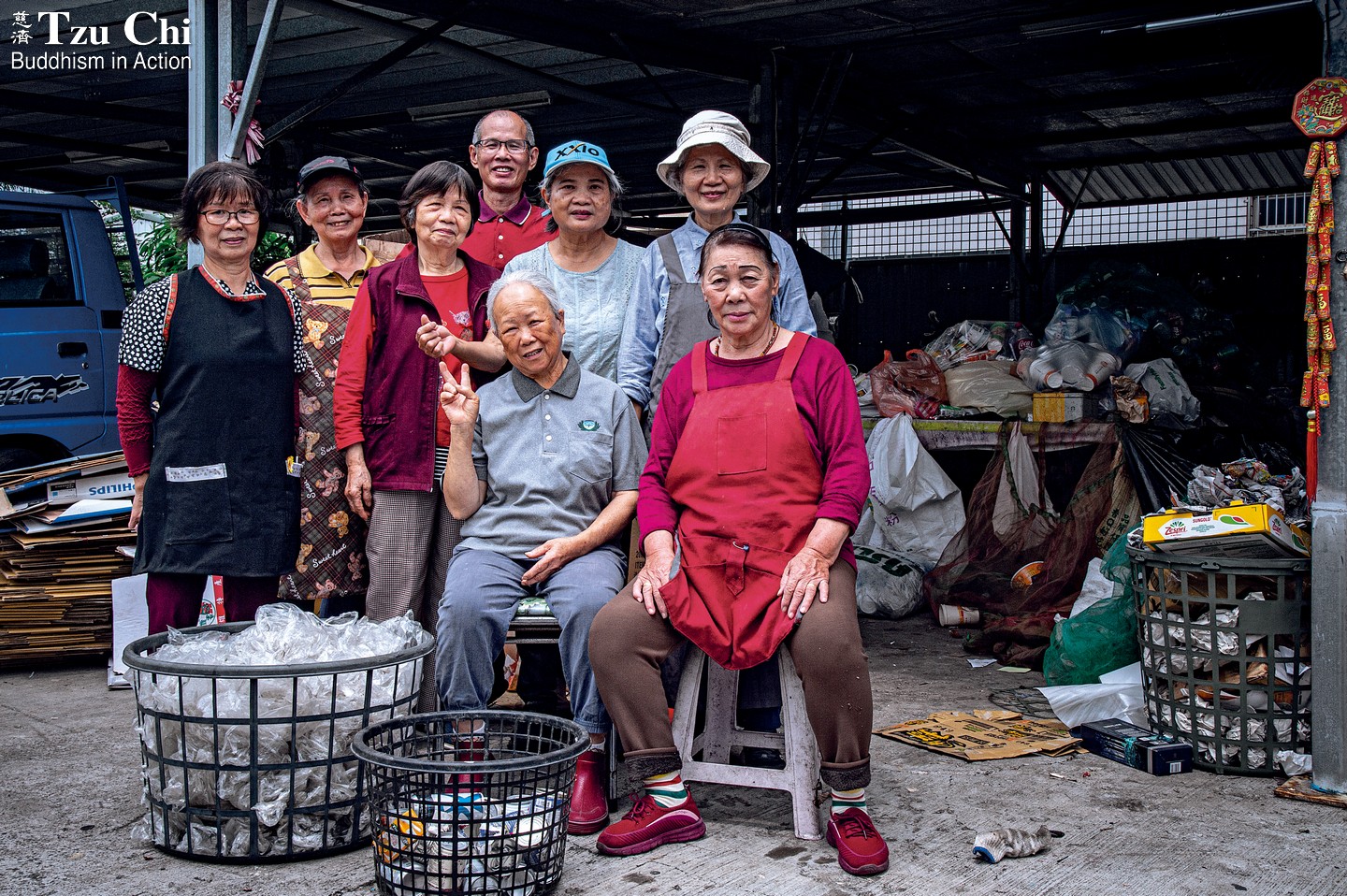
Everything Yang Su (seated on the left) wears in this photo is recycled, including her rain boots. When it comes to cherishing things, she is a role model for the volunteers at the Tzu Chi Daya Recycling Station in Taichung, central Taiwan.
By Zhang Li-zhu
Translated by Wu Hsiao-ting
Photos by Huang Xiao-zhe
Yang Su is immensely grateful when she wakes up every day. She cherishes each new day as another chance to give of herself and sow seeds of blessings.
Yang Su (楊素), 82, always wears her gray hair in a ponytail. Despite a petite stature that conveys an impression of delicacy and frailty, her kindness knows no bounds. The acts of goodwill she performs rival those of individuals much younger than she is. Sometimes, she ventures out with friends as early as just after three in the morning to pick sweet potato leaves, which she then delivers to an orphanage to supplement the meals for the children there. She has a warm-hearted nature, so whenever she learns of a family facing hardship, she promptly reports their situation to Tzu Chi for assessment and assistance. She is frequently seen cycling around her community, visiting her neighbors. In fact, she is such a well-known presence in her neighborhood that she has earned the honorary title of an unofficial community leader.
Everyone in Tzu Chi who knows her affectionately refers to her as “Ah Po” (Grandma). Despite her advanced age and illiteracy, whenever her team leader informs her about any tasks to do, she readily agrees to lend a hand. This may include activities such as cleaning Tzu Chi facilities, participating in recycling work, cooking for Tzu Chi events, or chanting the Buddha’s name for the deceased.
Every Saturday morning, at around five o’clock, she arrives at the Tzu Chi Daya Recycling Station in Taichung, central Taiwan, to sort recycling. On the day I interviewed her for this article, she proudly showcased the clothes she was wearing, explaining that they were all obtained from the recycling station. Pointing to her sneakers, she exclaimed, “I found these shoes at the recycling station too, and they fit perfectly! I really like them.” Taking out another pair of shoes, she added, “These ones are almost brand-new, and I treasure them too much to wear them. They are another precious find from the recycling station!”
The clothes worn by her twin grandchildren and the winter comforters they use are all recycled as well. “I mend discarded and worn-out comforters with needle and thread, then slip them into clean covers,” she explained. “This way, my grandchildren have warm comforters to keep them cozy in the cold winter. They really appreciate the comforters I prepare for them.”
Due to her age and the responsibility of raising her twin grandchildren, Yang Su often struggles to make ends meet. However, she politely declined when her fellow volunteers suggested applying for financial assistance from Tzu Chi on her behalf—she felt that there were other families in greater need. She wakes up early every day, with a heart filled with gratitude. “When I open my eyes and realize I am still breathing, I express my thanks to the bodhisattvas for granting me another day. I’m grateful for another day to give of myself and sow blessings.”
Yang serves as a cleaning volunteer two days a week at the Tzu Chi Daya office. On the days she does, she often treats everyone to sweet potato buns, a traditional delicacy she makes herself. She wisely avoids food waste by collecting unwanted sweet potatoes from the fields to make her buns. Her fellow volunteers contribute ingredients such as mushrooms, bamboo shoots, and tofu skin for the fillings. The delightful taste of her sweet potato buns captured the attention of her team members, who recommended her for an appearance on a cooking show that aired on Tzu Chi’s Da Ai TV. Despite the recognition, Yang remained humble. “I’m more than happy to create delicious food. It brings joy to everyone and allows me to form good affinities with them,” she said.
The octogenarian cherishes and values food, always doing her best to prevent any from going to waste. Once, a farmer planted daikon radishes during a fallow period of his paddy fields and generously donated the vegetables to Tzu Chi. Yang and a group of volunteers diligently harvested the radishes under the scorching sun, then meticulously prepared and sun-dried them, transforming them into dried radishes. She emphasized, “We must race against the sun to ensure that the 3,000 kilograms [6,615 pounds] of radishes do not spoil. It would be a shame to let them go to waste.”
She has such a deep appreciation for food, she couldn’t bear the thought when she learned that the remaining food from lunches at an elementary school was being discarded as kitchen waste. Approaching a director at the school, she made a plea, “Please save the leftovers for me!” With the school’s approval, she began collecting leftovers at the school. She packages the leftovers into bags, and promptly delivers them to Tzu Chi care recipients in the community. “I’m not afraid of facing ridicule for asking for leftovers,” she said. “My only wish is to prevent food from being wasted and to help more families avoid hunger.”
Her fellow volunteers, aware of the difficult life she leads, always send leftover snacks from the Daya Recycling Station to her home. But instead of keeping the food solely for herself and her family, she divides it and delivers the majority of it to Tzu Chi care recipients in the neighborhood. When asked why she didn’t keep more for her grandchildren, she replied, “Because I have endured hardship and poverty. Whenever I have the chance, I must practice giving and generosity.”
“Walking to where the waters end, I sit and watch the rising clouds.” This verse by Chinese poet Wang Wei (王維, 692-761) aptly describes how Yang approaches her life, with its ups and downs. In the face of challenging circumstances, when it appears that there is no way forward, she never loses hope but instead embraces whatever comes her way with a philosophical attitude.
Yang was born in 1941 into a farming family in Ruisui Township, Hualien, eastern Taiwan. She was one of ten children. From an early age, she worked alongside her family, tending to crops such as sweet potatoes, sugarcane, pineapples, and peanuts. Their livelihood as farmers was at the mercy of the unpredictable weather, making it challenging for them to have three meals a day. Basic necessities were always scarce. The family’s strained finances meant that Yang never had the chance to pursue an education, nor did she ever dare to ask for such an opportunity. At the age of 20, she followed in her aunt’s footsteps and became a mortuary beautician, facing the deceased every day. This particular experience granted her an understanding early on of the impermanent nature of life.
When she was 24, she made a career change and began learning dressmaking in a sewing shop. After she had worked there for some time, the shop owner, having taken a liking to her, arranged for her to marry her younger brother. (Such arranged marriages were common in Taiwan at that time.) Yang recalled, “Fifty years ago, brides were usually carried in palanquins to the families they were married into, but I rode an ox-drawn cart to my future husband’s home!” She had never even met the man whom she married. He lived in a neighboring village and was six years her senior. Entering her new home, she discovered how simple and spare it was. Only then did she realize that she had married into a very poor family.
She grew vegetables, raised chickens, worked as a domestic helper, and chopped firewood in the mountains, all while caring for their three daughters and one son. Making a living in the remote region of Hualien was difficult, so five years after their marriage the couple took on jobs as longshoremen at Keelung Port in northern Taiwan. They took their son with them and entrusted their three daughters to the care of their grandmother. Working at the port, they managed to save some money over the course of several years. With their savings, they purchased land but eventually sold it to enter into a partnership with a relative to manufacture and export chopsticks. Later, they struck out on their own, but their business encountered limited success.
The couple’s eldest daughter, Chen You-fang (陳優芳), born in 1965, reminisced about that time: “Our family was involved in manufacturing chopsticks for export when I was in elementary school, but we didn’t make much profit from it. My father later switched to subcontracting the production of badminton racket components. The economy was good at the time, and Dad’s business flourished, generating a significant income.” She explained that her father even established a factory in Malaysia and had plans to relocate the entire family to that country. Unfortunately, he fell seriously ill before the plan could materialize.
When Yang’s husband became sick, her illiteracy left her incapable of managing his business, which was eventually passed on to their 32-year-old son. Her son worked hard to keep the business afloat, but the unscrupulous closure of one of his suppliers’ factories left him saddled with a massive debt. Following a divorce from his Malaysian wife, the weight of the debt became unbearable, prompting him to flee to escape the burden. His twin sons were just three years old at the time. The responsibility for raising them thus fell to Yang. Fortunately, her daughters considerately eased her burden by sharing the living expenses.
Lin Shu-zhen (林淑真) has known Yang for 33 years. She once worked at the couple’s factory in Taiwan. She spoke warmly about Yang and her husband, saying, “The tremendous generosity and kindness they showed me are difficult to put into words. My family was facing financial struggles during my time at their factory, and I would often bring my three-year-old daughter to work with me. Aware of my situation, they not only paid me more than what was owed for my work, but also provided advance payments on my salary to help cover our daily expenses.”
In 1991, Yang’s husband suffered a stroke in Malaysia. The family arranged for a private plane to bring him back to Taiwan. He remained bedridden for ten years before eventually passing away. The day after his funeral, Lin Shu-zhen, who had begun volunteering for Tzu Chi by that time, approached Yang and extended an invitation, “Come! I’ll take you to chant the Buddha’s name at a funeral.” (Tzu Chi volunteers offer this chanting service to bring peace to the souls of the departed and provide solace to the grieving families.) While Lin’s intention was to help Yang through the grieving process, Yang felt taken aback and angry, seeing her invitation as insensitive to her emotional state.
When Yang attended the funeral, she experienced a surprising and profound realization during the chanting session, that everything in the world is impermanent and subject to change. She recognized that her husband’s passing was a part of the natural order. Instead of immersing herself in sorrow, she resolved to transform her grief into blessings for her late husband and let go of her attachment to him. She reminded herself not to dwell on the past or shed excessive tears but to embrace life fully and make meaningful contributions.
After the funeral, she began wholeheartedly participating in Tzu Chi activities. She joined other volunteers in making and selling rice dumplings and cakes to support the foundation’s disaster relief efforts. Additionally, she enthusiastically helped sell steamed buns to raise money for the construction of Taichung Tzu Chi Hospital in central Taiwan. Her dedication touched many people, inspiring them to make purchases. Almost every day, she had to deliver ordered buns to homes on her scooter.
Upon hearing Master Cheng Yen’s call to donate blood and save lives, she was inspired to do so regularly. She continued this practice until the age of 65 when a nurse from the blood donation bus informed her, “You’re too old to donate blood anymore.” This news left her deeply disappointed.
In addition to being an active volunteer, Yang shared about Tzu Chi whenever she met someone. In 2007, volunteer Yan Su-pen (顏素盆) encouraged her to undergo training to become a certified volunteer. Yang took her suggestion and obtained her certification the following year.
Yang is known for being proactive in seeking out volunteer opportunities, finding joy in her service. If a few days pass without her receiving any volunteer service notifications, she phones her team leader, Liao Hui-qi (廖惠圻), and says, “Please don’t disregard this old lady simply because of her age. Being a Tzu Chi volunteer brings me immense joy. Please don’t leave me without work to do.”
In fact, Yang is far from idle. Besides her volunteering, she supports her grandchildren by working as a cleaning lady in the morning and a dishwasher at a restaurant in the evening. She often finishes her shifts late at night and returns home exhausted, sometimes even dozing off with her head on the table. Her grandchildren deeply appreciate her dedication and express their gratitude, saying, “Grandma, we will definitely take good care of you in the future.”
Yang said, “I’m not afraid of hard work. I’m willing to take on any job as long as it is legal and brings in income.” She has found a spiritual home in Tzu Chi, and her grandsons are a source of strength for her. For her, every opportunity that arises, whether it be work or volunteer service, is a blessing that allows her to contribute and enrich her life journey. As she embraces the spirit of gratitude and giving, her remarkable journey of service and selflessness continues to inspire those around her.
Everything Yang Su (seated on the left) wears in this photo is recycled, including her rain boots. When it comes to cherishing things, she is a role model for the volunteers at the Tzu Chi Daya Recycling Station in Taichung, central Taiwan.