二十七至二十八日 行道有分寸

12.27~28《農十一月‧二十七至二十八》
【靜思小語】道與寸合起來就是「導」,守住道德、守好分寸,在茫茫大海中為自己導航。

不分貧富,關照長輩起居

十二月二十七日晨間談話時,上人交代顏博文執行長及張濟舵副執行長等人,不分貧富或獨居、雙老,須關懷年邁長者居住環境之扶手需求,比如浴室、廁所、臥室等。

臺灣社會人口愈趨高齡化,為了讓年長者生活更安全,慈濟早有「安美專案」,經社區提報,至案家實地丈量,裝置安全扶手、無障礙坡道、止滑措施、照明改善、蹲式馬桶改成坐式馬桶、浴缸拆除等。

上人提到,有必要進行普查及協助安裝扶手,讓長者們的生活起居更安全。「老人起居,扶手很重要,尤其是浴室很需要安裝扶手預防跌倒。不分貧富,不只是為獨居長者而做,應該普遍去做,只要到達這樣的年齡,不論家中有沒有子孫同住,都應該為他們做,尤其老人在浴室跌倒的頻率應該很高,一不注意,手沒有扶到牆面,就會跌倒或是撞到。」

求真求實,做多少寫多少

上人與王端正副總、林靜憪師姊談話時,提及佛法原本是口耳相傳,直到幾百年後才有文字紀錄,再經過不同年代的法師大德傳法、翻譯,佛經內容已有後世傳法者的分析整理,所以要求得貼近佛陀原話,實在很困難。就像《靜思語》也是經過編輯,教聯會老師們取其中的幾句話,就可以發展出很豐富的教案。所以自己比較期待大家掌握佛陀的精神,力行佛陀所指引的道路。

「在我自己看來,大家聽了師父講經以後最為受用的是《藥師經》、《地藏經》,早期我講經也比較完整。《地藏經》講到天堂、地獄,我把天堂、地獄『人間化』,教大家用心觀察,其實天堂、地獄的境界都可以在人間看得到、體會得到。慈濟已經做到對人間有影響力,所說的這些內容,真的很適應人間的方向,期待將這些內容整理成書籍出版,這是『文字般若』,很重要,所以是必然要做、一定要做的。」

上人說,慈濟歷史從「竹筒歲月」起步,從每人每天存五毛錢開始做慈善救濟,到現在能在國際間救苦救難,所凝聚與發揮的力量甚為龐大,可以看見慈濟在這幾十年來的成長與影響力,慈濟人要自我重視。過去教大家要謙虛,縮小自己,這是在與人互動時的修養;現在為了留歷史,要將這幾十年所做的呈現出來,當然內容要真實、實在─真的做多少就寫多少。從整理好的慈濟史料中,可以分析慈濟如何從克難的環境中起步,從花蓮開展出通達國際的菩薩大道。

整個下午,靜養中的上人觀看印公導師的大愛臺紀錄影片。

經藏演繹,引導人間之道

十二月二十八日上午十點後,上人在會客室全程觀看在高雄靜思堂舉行的歲末祝福屏東場次至點燈祈禱結束,欣慰大家精進如常。

原應靜養的上人,不欲多所休息,依然於午後時分來到會客室,與呂慈悅師姊等人談及經藏演繹。上人表示,這不只是練習排隊形的人文表達而已,是要真正傳達佛法道理。

「一隻螢火蟲的光芒很微弱,一整群就能讓人看見一整片閃亮的光。我秉持『為佛教,為眾生』這一念走過來,穩穩地把四大志業做得很扎實,最重要的就是慈濟人都很真、很誠,讓志業的根很牢固,菩提樹很茂盛。」

「我一直希望大家真正認識佛法,『有相無相無不相』,將這個觀念打開,一切歸空,然而真空妙有,本質是空,但是道理恆在,看不到但是很微妙地存在,也可以說『無有不成空,無空不成有』,想要用方法把這分精神表達出來。」

上人舉例從建築的相傳達佛法,讓人從形象中探討真空妙有的佛法道理。「相」要美、要生動,所以靜思堂的屋簷有飛天的造像,而且靜思堂的銅瓦會因為日漸氧化而變成綠色,展現歷史感。

上人肯定《無量義法髓頌》做得很好,還可以做得更精緻,而且從慈濟人、慈濟家庭再向社會推廣。也能改變喪事禮儀吵鬧的習俗,讓它更莊嚴平和,而且有內容,等於是弘法。「其實誦經應該就要弘法,『經者,道也;道者,路也』,讓人知道應該如何走人生的路,從小路歸向大道,從大道回歸原點,也就是『經』。現在的世間很複雜,我們要將雜亂的人心引導回歸真正的人間之道,從人間道回歸菩薩道,從菩薩道歸向佛道。」

「人生來時是如何而來,我們不清楚,但是生在人間,路要怎麼走;將來要去,要如何去,我們必須清楚。所以我常說,生不必學,死才要學。但是,要學死,就要看人如何生活,要怎樣走這條人間的道路。」上人說,出生無法自我掌控,知曉事理之後要讓自己的人生走正道,往生時則要有莊嚴道,所以曲調要莊嚴有道氣,讓人生有美的結束,也讓還在世的人有所感悟,知道要走正確的人生道路。上人並表示,要達到真善美的人生,就要德學兼備,德要樹立起來;若論德與學孰輕孰重,還是德比較重要。

慈航普渡,確定航向航線

上人對海外慈濟人說,歲月不留人,但是人間的志業是千秋萬世;自己這輩子可說真正是「為佛教,為眾生」,實行佛法的正道法。慈濟現在也在聯合國有了一席之地,無論在哪個國家地區,既用佛教慈濟的名稱,一定要行正道法,不能偏向,否則偏差、錯誤的業是無法承擔的。所以大家真的要很虔誠,與慈濟的精神會合,才能用「慈濟」之名,經過千秋百世,都在佛法的大道中,分寸都不能偏,否則稍有偏差就會入魔道,所以要很用心。

美國楊凱丞師兄報告慈濟墨西哥提娃那園區,為當地沒有機會讀書或輟學的孩子開辦「希望教室」,讓他們得以接受教育,以及慈善援助貧戶等。

提及醫療方面的需求,上人表示,美國慈濟人與墨西哥提娃那距離遙遠,如果當地都沒有慈濟志工,實在難以照顧好,所以要培養出當地的種子志工,要很有誠意投入與承擔。「我總是強調要有誠意,若沒有那一分真誠的心意,無法無私為人間付出,會容易變成營利;所以我們要培養的人才,必須真誠立志,志為苦難人而付出,才能建立志業。」

上人說,提娃那各項資源缺乏,居民普遍貧困,非常需要慈濟,但是要先有人能承擔志業,而且要有很多人都有這分誠意,了解慈濟要為當地做的事,也能以慈濟精神投入。尤其醫療不是只靠醫師看診開藥,還需要很精密的儀器與設備,即使只是一所小醫院,也要各科完備,包括檢驗、行政等方面,人力、物力都要齊備,有很微細的項目要考量與安排。且有心投入的醫療人員若可以來臺灣,深入了解慈濟,並具有慈濟精神。

上人形容一個醫療院所就像一艘大船,從船長到水手,各有職責,只專精某一部分,或是紙上談兵,都無法讓大船順利航行。不是學識高才能把事情做得好,要學德兼備,有學識還要有德行,有「德」才有「得」;一定要有道德,才能有所得,「德行」很重要,走過這條道,才有德、才有得,而且走這一條道,不能有絲毫的偏差。

「大海茫茫,一望無際,到底這艘船要往哪裏去?慈航普渡,就是要渡眾生到彼岸。在提娃那,有一群人看到當地居民的苦相,感慨『這些人怎麼這麼苦』,就是心得─見苦了,心得是苦;發心想要為他們做事,而且很願意去做,這是一個開始。有願,力從何處來?無法只靠一個人,要靠相同心願的一群人,才能擁抱蒼生;尤其在海中,只靠一個人要救溺水的人,很容易被拉下去。」

上人鼓勵凱丞師兄,年輕有志,還要培德,不只是孤單一個人忙忙碌碌,得不到群體的擁護。還未成佛,無法「唯我獨尊」;凡夫獨尊,無德就敗,失德就會失敗。智商很高、知識很充足,還要有慧根,提升智慧,所以要培養德、增長慧。「在你圓滿學業、獲得博士學位以後,再規畫下一步;你有度化眾生的志向,就要以此為中心,將航向、航線確定下來。」上人且言,做人最重要;並以雙手食指比「入」與「人」表示,看自己要入什麼門、做什麼人,要「看門道」,以智慧做好選擇。

上人指出「守志奉道,其道甚大」,而「博聞愛道,道必難會」。自己做慈濟,即是守志奉道而行,走到現在,已經從最初的羊腸小徑,開展為寬廣的四線道,四大志業並行。假如是博聞愛道,想要學習的範圍很廣,什麼都想學,但是沒有辦法專心地一門深入,每一門學科都學不好,都體會不到精髓。

又如航海,掌舵的人要專注,把握方向分寸不偏,否則在茫茫大海中,偏出航道就迷航了,所以凡事要守分寸;導航的「導」字,是道與寸合起來,意謂行道要有分寸,不能有一點點偏向,否則久之就迷失了。不論從事哪一種行業,都要守好做人的本分,要做好人,才有辦法做好事,把事情做好。

志為明醫,真誠利益眾生

大林慈濟醫院賴寧生院長等醫療團隊前來關心上人,上人再對大家談到當初在嘉義大林建院,有很不可思議的好因緣,想來自己也很大膽,當時這片土地周圍很荒涼,竟然就決定在此蓋醫院;雖說現在大林慈院周邊已經有許多商店與住家,但周圍人口仍是相對較少,若說這所醫院只靠周圍居民能有多少患者,實在很難,所以大林慈院在雲嘉結了很廣的醫病緣。

「人間的緣不是天生的,而是我們做到讓人歡喜,讓病人歡喜這位醫師,這位醫師有人緣、讓人喜愛,好緣就會不斷擴展開來,距離再遠也能牽得起來。師父常說,我這輩子得到很多人的好緣來支持,大家用愛護持志業,是因為我很真誠,才能廣結善緣。」

上人言,悉達多太子與提婆達多是堂兄弟,悉達多太子與眾生結善緣,而提婆達多所結的是不好的緣;悉達多太子成佛以後,提婆達多也來皈依並隨佛修行,但是一段時間以後,提婆達多覺得自己也能帶領僧團修行,所以分化佛陀僧團而另起爐灶。尚未成佛,他就顯露野心,心不在軌道上,偏之毫釐,失於千里,佛與魔就在毫釐之間。心即是佛,心也是魔,要成佛或成魔,都取決於一念心;學佛就是要學會分辨正與邪,其實判別正邪的方法很簡單,只要自問所努力的方向以及所做的一切,是為了利益眾生,或是利益自己?

若所求、所做是為了利益自己,或許這輩子能得到很多利益,但是人生有多長?佛陀對眾生的教育就是無常。利益眾生是千秋萬世,因為能在人間帶動善之道,讓人人依循善道走過來;利益自己只在一時,何況萬般帶不去,唯有此生為了牟利而造的業因、業緣,會跟隨到下一生。

「師父稱呼你們『大醫王』,是佛的別稱,眾生皆有心病,心靈有各種欲念,想法偏差,導致行為偏差;為了滿足個人的欲念,不斷地爭取,想要有所得。其實想要修行,修道得德,也是一種欲,這分『我想要』的欲念,若是為了利益群生,就還維持在正確的方向;如果偏向利己偏私,就是錯誤、就會有害。譬如醫師救人性命,只要方法正確,治療不必耗費高成本,就可以讓患者重拾健康;若醫師追求的是做『名醫』,要靠著名聲招攬病患,喜歡用特殊的藥治療,讓病人覺得很有效,卻忽略後遺症,可能會造成很大的危害。」

「是要做一個救命的醫師,還是要得名的醫師?我希望大家都是『明醫』,很明白、很清楚,是『明明德』的醫師。我希望世世代代的慈濟醫師都做到守護生命、守護健康、守護愛,都是有醫德的良醫、明醫。」上人叮嚀醫師們,「守志奉道,其道甚大」,要守好醫療志業的精神理念,道德分寸一定要拿捏好,才能自我導航,永遠走在正確的方向,這條醫療大道才會開得寬廣。

「慈濟要做出醫療的好典範,不是為了名,也不與人爭利,但是品質必須不斷提升。現在有斗六慈濟醫院和嘉義診所,都做得不錯,不過大林慈院是雲嘉慈濟醫療的大本營,要更有包容性,用德包容各院,各院都有向心力,凝聚慈濟精神,彼此攜手,共同在雲嘉守護生命、守護健康、守護愛。」

「你們專程來看師父,師父很感動,也很感恩,我銘記在心,期待各位也同樣相互感恩;師父盡力打造安定的好環境,讓你們實現從醫的志願,做一位好醫師,你們就要守志奉道,不為名、不為利,只要誠意、認真投入,成就師父『為佛教,為眾生』的志願,這就是最好的回報。」

《證嚴上人衲履足跡》,是「上人之日記」。

靜思精舍常住每日敬侍師側、記錄言行,經融會貫通於心,轉化為字字珠璣,彙整結集,每年四冊,依春、夏、秋、冬四季出版。

本專欄即精簡摘錄自《證嚴上人衲履足跡》,完整版本請關注每季最新出版品。

12.27~28《農十一月‧二十七至二十八》

【靜思小語】道與寸合起來就是「導」,守住道德、守好分寸,在茫茫大海中為自己導航。

不分貧富,關照長輩起居

十二月二十七日晨間談話時,上人交代顏博文執行長及張濟舵副執行長等人,不分貧富或獨居、雙老,須關懷年邁長者居住環境之扶手需求,比如浴室、廁所、臥室等。

臺灣社會人口愈趨高齡化,為了讓年長者生活更安全,慈濟早有「安美專案」,經社區提報,至案家實地丈量,裝置安全扶手、無障礙坡道、止滑措施、照明改善、蹲式馬桶改成坐式馬桶、浴缸拆除等。

上人提到,有必要進行普查及協助安裝扶手,讓長者們的生活起居更安全。「老人起居,扶手很重要,尤其是浴室很需要安裝扶手預防跌倒。不分貧富,不只是為獨居長者而做,應該普遍去做,只要到達這樣的年齡,不論家中有沒有子孫同住,都應該為他們做,尤其老人在浴室跌倒的頻率應該很高,一不注意,手沒有扶到牆面,就會跌倒或是撞到。」

求真求實,做多少寫多少

上人與王端正副總、林靜憪師姊談話時,提及佛法原本是口耳相傳,直到幾百年後才有文字紀錄,再經過不同年代的法師大德傳法、翻譯,佛經內容已有後世傳法者的分析整理,所以要求得貼近佛陀原話,實在很困難。就像《靜思語》也是經過編輯,教聯會老師們取其中的幾句話,就可以發展出很豐富的教案。所以自己比較期待大家掌握佛陀的精神,力行佛陀所指引的道路。

「在我自己看來,大家聽了師父講經以後最為受用的是《藥師經》、《地藏經》,早期我講經也比較完整。《地藏經》講到天堂、地獄,我把天堂、地獄『人間化』,教大家用心觀察,其實天堂、地獄的境界都可以在人間看得到、體會得到。慈濟已經做到對人間有影響力,所說的這些內容,真的很適應人間的方向,期待將這些內容整理成書籍出版,這是『文字般若』,很重要,所以是必然要做、一定要做的。」

上人說,慈濟歷史從「竹筒歲月」起步,從每人每天存五毛錢開始做慈善救濟,到現在能在國際間救苦救難,所凝聚與發揮的力量甚為龐大,可以看見慈濟在這幾十年來的成長與影響力,慈濟人要自我重視。過去教大家要謙虛,縮小自己,這是在與人互動時的修養;現在為了留歷史,要將這幾十年所做的呈現出來,當然內容要真實、實在─真的做多少就寫多少。從整理好的慈濟史料中,可以分析慈濟如何從克難的環境中起步,從花蓮開展出通達國際的菩薩大道。

整個下午,靜養中的上人觀看印公導師的大愛臺紀錄影片。

經藏演繹,引導人間之道

十二月二十八日上午十點後,上人在會客室全程觀看在高雄靜思堂舉行的歲末祝福屏東場次至點燈祈禱結束,欣慰大家精進如常。

原應靜養的上人,不欲多所休息,依然於午後時分來到會客室,與呂慈悅師姊等人談及經藏演繹。上人表示,這不只是練習排隊形的人文表達而已,是要真正傳達佛法道理。

「一隻螢火蟲的光芒很微弱,一整群就能讓人看見一整片閃亮的光。我秉持『為佛教,為眾生』這一念走過來,穩穩地把四大志業做得很扎實,最重要的就是慈濟人都很真、很誠,讓志業的根很牢固,菩提樹很茂盛。」

「我一直希望大家真正認識佛法,『有相無相無不相』,將這個觀念打開,一切歸空,然而真空妙有,本質是空,但是道理恆在,看不到但是很微妙地存在,也可以說『無有不成空,無空不成有』,想要用方法把這分精神表達出來。」

上人舉例從建築的相傳達佛法,讓人從形象中探討真空妙有的佛法道理。「相」要美、要生動,所以靜思堂的屋簷有飛天的造像,而且靜思堂的銅瓦會因為日漸氧化而變成綠色,展現歷史感。

上人肯定《無量義法髓頌》做得很好,還可以做得更精緻,而且從慈濟人、慈濟家庭再向社會推廣。也能改變喪事禮儀吵鬧的習俗,讓它更莊嚴平和,而且有內容,等於是弘法。「其實誦經應該就要弘法,『經者,道也;道者,路也』,讓人知道應該如何走人生的路,從小路歸向大道,從大道回歸原點,也就是『經』。現在的世間很複雜,我們要將雜亂的人心引導回歸真正的人間之道,從人間道回歸菩薩道,從菩薩道歸向佛道。」

「人生來時是如何而來,我們不清楚,但是生在人間,路要怎麼走;將來要去,要如何去,我們必須清楚。所以我常說,生不必學,死才要學。但是,要學死,就要看人如何生活,要怎樣走這條人間的道路。」上人說,出生無法自我掌控,知曉事理之後要讓自己的人生走正道,往生時則要有莊嚴道,所以曲調要莊嚴有道氣,讓人生有美的結束,也讓還在世的人有所感悟,知道要走正確的人生道路。上人並表示,要達到真善美的人生,就要德學兼備,德要樹立起來;若論德與學孰輕孰重,還是德比較重要。

慈航普渡,確定航向航線

上人對海外慈濟人說,歲月不留人,但是人間的志業是千秋萬世;自己這輩子可說真正是「為佛教,為眾生」,實行佛法的正道法。慈濟現在也在聯合國有了一席之地,無論在哪個國家地區,既用佛教慈濟的名稱,一定要行正道法,不能偏向,否則偏差、錯誤的業是無法承擔的。所以大家真的要很虔誠,與慈濟的精神會合,才能用「慈濟」之名,經過千秋百世,都在佛法的大道中,分寸都不能偏,否則稍有偏差就會入魔道,所以要很用心。

美國楊凱丞師兄報告慈濟墨西哥提娃那園區,為當地沒有機會讀書或輟學的孩子開辦「希望教室」,讓他們得以接受教育,以及慈善援助貧戶等。

提及醫療方面的需求,上人表示,美國慈濟人與墨西哥提娃那距離遙遠,如果當地都沒有慈濟志工,實在難以照顧好,所以要培養出當地的種子志工,要很有誠意投入與承擔。「我總是強調要有誠意,若沒有那一分真誠的心意,無法無私為人間付出,會容易變成營利;所以我們要培養的人才,必須真誠立志,志為苦難人而付出,才能建立志業。」

上人說,提娃那各項資源缺乏,居民普遍貧困,非常需要慈濟,但是要先有人能承擔志業,而且要有很多人都有這分誠意,了解慈濟要為當地做的事,也能以慈濟精神投入。尤其醫療不是只靠醫師看診開藥,還需要很精密的儀器與設備,即使只是一所小醫院,也要各科完備,包括檢驗、行政等方面,人力、物力都要齊備,有很微細的項目要考量與安排。且有心投入的醫療人員若可以來臺灣,深入了解慈濟,並具有慈濟精神。

上人形容一個醫療院所就像一艘大船,從船長到水手,各有職責,只專精某一部分,或是紙上談兵,都無法讓大船順利航行。不是學識高才能把事情做得好,要學德兼備,有學識還要有德行,有「德」才有「得」;一定要有道德,才能有所得,「德行」很重要,走過這條道,才有德、才有得,而且走這一條道,不能有絲毫的偏差。

「大海茫茫,一望無際,到底這艘船要往哪裏去?慈航普渡,就是要渡眾生到彼岸。在提娃那,有一群人看到當地居民的苦相,感慨『這些人怎麼這麼苦』,就是心得─見苦了,心得是苦;發心想要為他們做事,而且很願意去做,這是一個開始。有願,力從何處來?無法只靠一個人,要靠相同心願的一群人,才能擁抱蒼生;尤其在海中,只靠一個人要救溺水的人,很容易被拉下去。」

上人鼓勵凱丞師兄,年輕有志,還要培德,不只是孤單一個人忙忙碌碌,得不到群體的擁護。還未成佛,無法「唯我獨尊」;凡夫獨尊,無德就敗,失德就會失敗。智商很高、知識很充足,還要有慧根,提升智慧,所以要培養德、增長慧。「在你圓滿學業、獲得博士學位以後,再規畫下一步;你有度化眾生的志向,就要以此為中心,將航向、航線確定下來。」上人且言,做人最重要;並以雙手食指比「入」與「人」表示,看自己要入什麼門、做什麼人,要「看門道」,以智慧做好選擇。

上人指出「守志奉道,其道甚大」,而「博聞愛道,道必難會」。自己做慈濟,即是守志奉道而行,走到現在,已經從最初的羊腸小徑,開展為寬廣的四線道,四大志業並行。假如是博聞愛道,想要學習的範圍很廣,什麼都想學,但是沒有辦法專心地一門深入,每一門學科都學不好,都體會不到精髓。

又如航海,掌舵的人要專注,把握方向分寸不偏,否則在茫茫大海中,偏出航道就迷航了,所以凡事要守分寸;導航的「導」字,是道與寸合起來,意謂行道要有分寸,不能有一點點偏向,否則久之就迷失了。不論從事哪一種行業,都要守好做人的本分,要做好人,才有辦法做好事,把事情做好。

志為明醫,真誠利益眾生

大林慈濟醫院賴寧生院長等醫療團隊前來關心上人,上人再對大家談到當初在嘉義大林建院,有很不可思議的好因緣,想來自己也很大膽,當時這片土地周圍很荒涼,竟然就決定在此蓋醫院;雖說現在大林慈院周邊已經有許多商店與住家,但周圍人口仍是相對較少,若說這所醫院只靠周圍居民能有多少患者,實在很難,所以大林慈院在雲嘉結了很廣的醫病緣。

「人間的緣不是天生的,而是我們做到讓人歡喜,讓病人歡喜這位醫師,這位醫師有人緣、讓人喜愛,好緣就會不斷擴展開來,距離再遠也能牽得起來。師父常說,我這輩子得到很多人的好緣來支持,大家用愛護持志業,是因為我很真誠,才能廣結善緣。」

上人言,悉達多太子與提婆達多是堂兄弟,悉達多太子與眾生結善緣,而提婆達多所結的是不好的緣;悉達多太子成佛以後,提婆達多也來皈依並隨佛修行,但是一段時間以後,提婆達多覺得自己也能帶領僧團修行,所以分化佛陀僧團而另起爐灶。尚未成佛,他就顯露野心,心不在軌道上,偏之毫釐,失於千里,佛與魔就在毫釐之間。心即是佛,心也是魔,要成佛或成魔,都取決於一念心;學佛就是要學會分辨正與邪,其實判別正邪的方法很簡單,只要自問所努力的方向以及所做的一切,是為了利益眾生,或是利益自己?

若所求、所做是為了利益自己,或許這輩子能得到很多利益,但是人生有多長?佛陀對眾生的教育就是無常。利益眾生是千秋萬世,因為能在人間帶動善之道,讓人人依循善道走過來;利益自己只在一時,何況萬般帶不去,唯有此生為了牟利而造的業因、業緣,會跟隨到下一生。

「師父稱呼你們『大醫王』,是佛的別稱,眾生皆有心病,心靈有各種欲念,想法偏差,導致行為偏差;為了滿足個人的欲念,不斷地爭取,想要有所得。其實想要修行,修道得德,也是一種欲,這分『我想要』的欲念,若是為了利益群生,就還維持在正確的方向;如果偏向利己偏私,就是錯誤、就會有害。譬如醫師救人性命,只要方法正確,治療不必耗費高成本,就可以讓患者重拾健康;若醫師追求的是做『名醫』,要靠著名聲招攬病患,喜歡用特殊的藥治療,讓病人覺得很有效,卻忽略後遺症,可能會造成很大的危害。」

「是要做一個救命的醫師,還是要得名的醫師?我希望大家都是『明醫』,很明白、很清楚,是『明明德』的醫師。我希望世世代代的慈濟醫師都做到守護生命、守護健康、守護愛,都是有醫德的良醫、明醫。」上人叮嚀醫師們,「守志奉道,其道甚大」,要守好醫療志業的精神理念,道德分寸一定要拿捏好,才能自我導航,永遠走在正確的方向,這條醫療大道才會開得寬廣。

「慈濟要做出醫療的好典範,不是為了名,也不與人爭利,但是品質必須不斷提升。現在有斗六慈濟醫院和嘉義診所,都做得不錯,不過大林慈院是雲嘉慈濟醫療的大本營,要更有包容性,用德包容各院,各院都有向心力,凝聚慈濟精神,彼此攜手,共同在雲嘉守護生命、守護健康、守護愛。」

「你們專程來看師父,師父很感動,也很感恩,我銘記在心,期待各位也同樣相互感恩;師父盡力打造安定的好環境,讓你們實現從醫的志願,做一位好醫師,你們就要守志奉道,不為名、不為利,只要誠意、認真投入,成就師父『為佛教,為眾生』的志願,這就是最好的回報。」

《證嚴上人衲履足跡》,是「上人之日記」。

靜思精舍常住每日敬侍師側、記錄言行,經融會貫通於心,轉化為字字珠璣,彙整結集,每年四冊,依春、夏、秋、冬四季出版。

本專欄即精簡摘錄自《證嚴上人衲履足跡》,完整版本請關注每季最新出版品。
竹筒歲月 幫助比我更苦的人

(攝影/Sunny Kumar)

五百支竹筒撲滿手工打造,
送進歲末祝福現場「竹筒回娘家」專區,
民眾響應「小錢行大善」,
創造屬於菩提迦耶的「竹筒歲月」。

五百支竹筒撲滿手工打造,送進歲末祝福現場「竹筒回娘家」專區,民眾響應「小錢行大善」,創造屬於菩提迦耶的「竹筒歲月」。

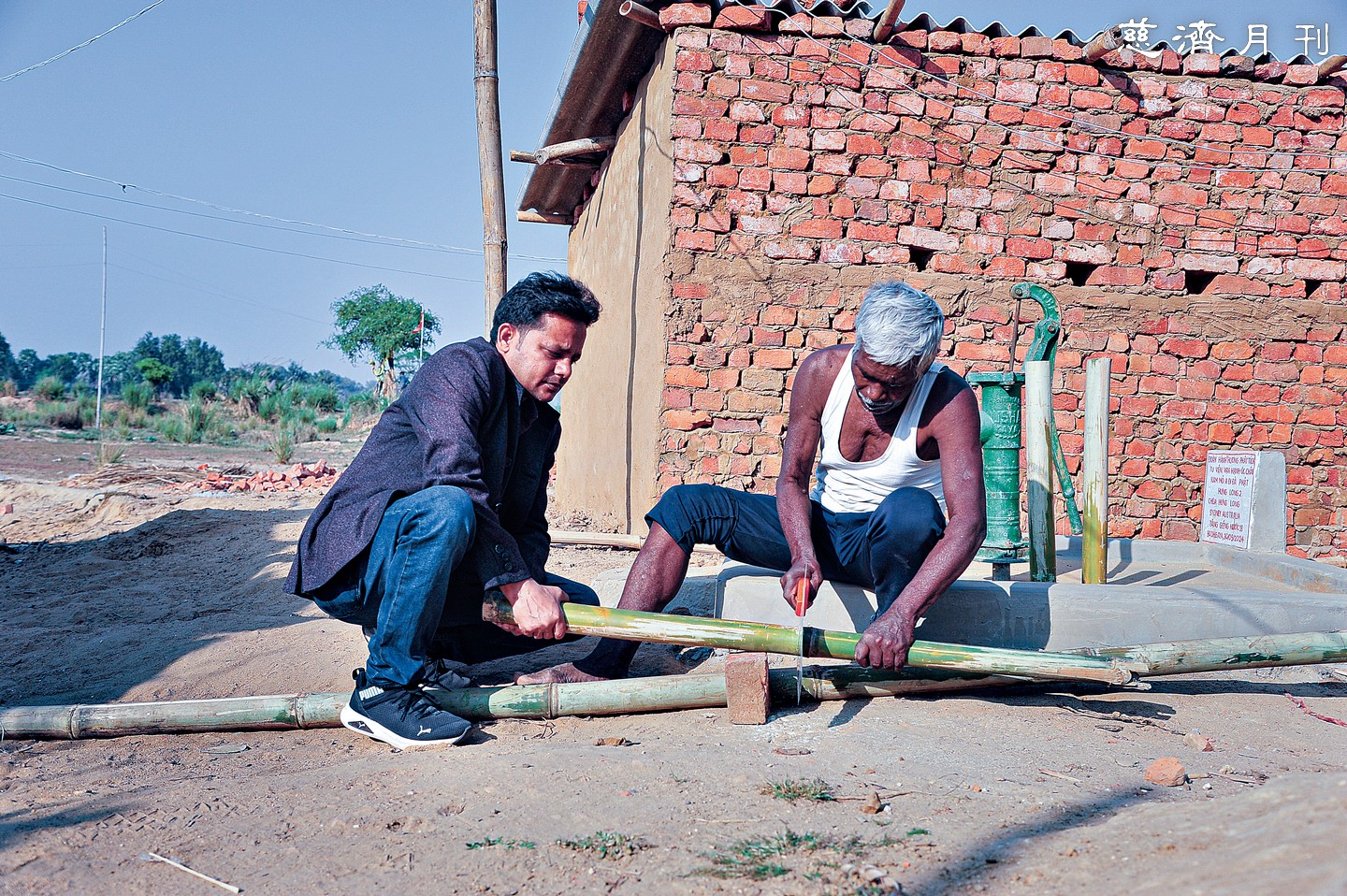
歲末祝福一個月前,志工來到牧羊女村,遠遠地就看到甘滿季(Gaina Manjhi,上圖右)正在鋸竹子。他是慈濟照顧戶,也是志工,主動承擔製作竹筒撲滿的重任,準備發給參加歲末祝福的民眾。採購竹子,鋸成一節節,動作簡單卻費工;為了增加產能,來自馬來西亞的李仁粦,教導本土志工桑杰(Sanjay Singh)和蘇雷德拉(Surendra Paswan)使用電鋸趕工。

鋸好竹筒,還要清洗乾淨、曬乾。甘滿季的朋友德夫納拉揚(Devnarayan Paswan)就在慈濟會所旁默默刷洗竹筒;他受助於慈濟,了解「竹筒歲月」的意涵,也想盡心力。

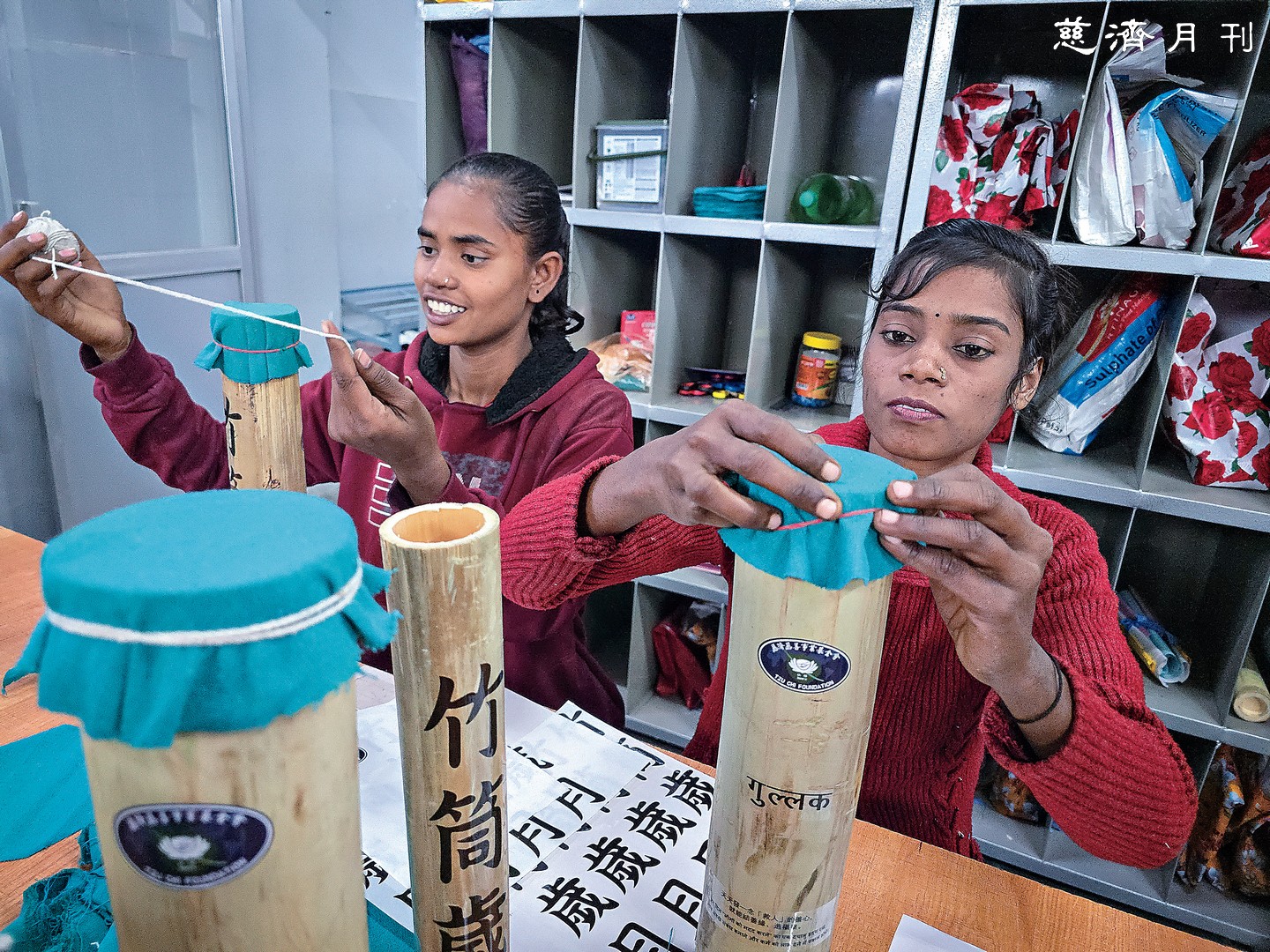
縫紉初階班與電腦班學員,協助在筒身貼上「竹筒歲月」、慈濟標誌貼紙,覆上綠布當蓋子、再畫上一道開口,大功告成,前後共製作了五百餘支。馬來西亞志工姚雅美向學員們說明慈濟早年「竹筒歲月」的歷史。「因為大家都窮,要怎樣去幫助那些更窮的人呢?上人想到小錢行大善,請支持他的三十位家庭主婦,每天買菜省下五毛錢投入竹筒;少五毛買菜錢,對生活沒有影響,但這筆錢積少成多,每個月都可以助人。」

縫紉班學員拉麗塔(Lalita Devi),丈夫過世,獨立撫養三個小孩;她說:「因為慈濟幫助我們,我也想幫助其他人;不用很多錢,每天小錢投進去,也可以助人。」

志工拿著竹筒上街,邀約富有愛心店參加歲末祝福;從乞討到手心向下的甘滿季,也帶著竹筒撲滿來到歲末祝福會場,投入零錢時,他笑著說:「能夠助人,我感覺內心非常富有!」

(攝影/楊桂玟)

(攝影/Sunny Kumar)

五百支竹筒撲滿手工打造,
送進歲末祝福現場「竹筒回娘家」專區,
民眾響應「小錢行大善」,
創造屬於菩提迦耶的「竹筒歲月」。

五百支竹筒撲滿手工打造,送進歲末祝福現場「竹筒回娘家」專區,民眾響應「小錢行大善」,創造屬於菩提迦耶的「竹筒歲月」。

歲末祝福一個月前,志工來到牧羊女村,遠遠地就看到甘滿季(Gaina Manjhi,上圖右)正在鋸竹子。他是慈濟照顧戶,也是志工,主動承擔製作竹筒撲滿的重任,準備發給參加歲末祝福的民眾。採購竹子,鋸成一節節,動作簡單卻費工;為了增加產能,來自馬來西亞的李仁粦,教導本土志工桑杰(Sanjay Singh)和蘇雷德拉(Surendra Paswan)使用電鋸趕工。

鋸好竹筒,還要清洗乾淨、曬乾。甘滿季的朋友德夫納拉揚(Devnarayan Paswan)就在慈濟會所旁默默刷洗竹筒;他受助於慈濟,了解「竹筒歲月」的意涵,也想盡心力。

縫紉初階班與電腦班學員,協助在筒身貼上「竹筒歲月」、慈濟標誌貼紙,覆上綠布當蓋子、再畫上一道開口,大功告成,前後共製作了五百餘支。馬來西亞志工姚雅美向學員們說明慈濟早年「竹筒歲月」的歷史。「因為大家都窮,要怎樣去幫助那些更窮的人呢?上人想到小錢行大善,請支持他的三十位家庭主婦,每天買菜省下五毛錢投入竹筒;少五毛買菜錢,對生活沒有影響,但這筆錢積少成多,每個月都可以助人。」

縫紉班學員拉麗塔(Lalita Devi),丈夫過世,獨立撫養三個小孩;她說:「因為慈濟幫助我們,我也想幫助其他人;不用很多錢,每天小錢投進去,也可以助人。」

志工拿著竹筒上街,邀約富有愛心店參加歲末祝福;從乞討到手心向下的甘滿季,也帶著竹筒撲滿來到歲末祝福會場,投入零錢時,他笑著說:「能夠助人,我感覺內心非常富有!」

(攝影/楊桂玟)

五日 因緣不可思議

12.5《農十一月‧初五》

【靜思小語】方向對準勤精進,不要輕視一念善心、一顆種子的萌芽。

從五毛錢開始走過六十年

上人於慈善董事會中,感恩大家一直以來對慈濟的護持與關懷,共同用心要讓志業扎根扎得穩。慈濟以臺灣為起點,從一粒種子開始萌芽,有天時地利的好因緣,從小小的一點,到現在普遍開展在地球上,並且隨著人間菩薩足跡,把菩薩法帶回佛陀的故鄉,這都是不可思議的因緣。

「最近我一直想著,佛陀距離我們二千五百多年了,當時他出現在人間,而我們現在有這樣的因緣,可以回歸佛陀出生、成長與說法的地方,在今年的慈濟周年慶當天,慈濟人在靈鷲山說法臺與本會連線,讓我既感動又感恩!佛陀在那裏說《法華經》,慈濟也是秉持《法華經》的精神,一路走到現在將近六十年,從五毛錢的點滴匯聚直到現在。」

「不可輕視那一念善心,只要方向對準了,守好誠正信實,就能做得好。我們都有一念很誠意的心,有共同的信仰,即使宗教不同,但是我們都篤定正向,以正心、誠意,朝佛陀的正等正覺,不斷往前精進。我們學佛法,是用清淨的赤子心誠懇地『學』而見道,不曾偏移;而慈濟人力行菩薩道,在社區裏所做的一切,都是為了福利人群,並且做得很好。」

上人舉環保輔具的回收與發送為例,師兄們用心搬扛沉重的電動床等輔具,從民眾家中收回、運到定點,經過細心地修繕、整理,妥善收納,若有家庭提出需求,再搬運到他們家中,上山、下鄉都不辭辛勞。又如安美專案,為獨居長者、兩老相依的家庭裝設安全扶手、無障礙設施等,讓他們的生活起居更有安全保障,這都是慈濟人對他們的真誠愛護。

「我很感恩慈濟人,無論他們有何生活背景或社會地位,從企業家到路邊攤的小販,都是共同一念心,沒有地位高低分別,大家會合起來,有重的東西一起扛,有髒污的器具一起洗,彼此尊重、平等相待;佛陀教育眾生的平等觀,慈濟人做到了。」

上人談到現在氣候變遷,人心不合,天災人禍很多,只要有慈濟人的地方,若發生災難意外,他們彼此聯絡,確認平安之後,就立即動員勘災、賑災;尤其現在網路傳訊很方便,慈濟聯絡網迅速傳達、立即回報,確認哪些地區的人需要幫助,大家就有明確的方向去做。「能夠這麼快速動員做救濟,也是因為有大眾共同護持的力量,才能及時付出,慈濟的效率就是這樣來的。」

談及老年長照,上人表示各地靜思堂發揮大良能,不少靜思堂或聯絡處有長照據點,會為年長者開設課程,讓老人家每天歡喜來學習。有的是子孫早上帶他們來,讓他們隨著課程活絡心腦、肢體,下午再帶他們回家。

「我行腳到各地靜思堂,都看到長照團隊帶著老人家在上課。這次我在臺中,也看到老人家做手工藝。像清水的老人家用藺草編草笠、坐墊等等,在一起做事,每天做得很歡喜,這能讓他們快樂老。」上人說,慈濟應社會所需,在各方面真的做得很不錯,請各位董事有機會到社區多了解。

《證嚴上人衲履足跡》,是「上人之日記」。

靜思精舍常住每日敬侍師側、記錄言行,經融會貫通於心,轉化為字字珠璣,彙整結集,每年四冊,依春、夏、秋、冬四季出版。

本專欄即精簡摘錄自《證嚴上人衲履足跡》,完整版本請關注每季最新出版品。
12.5《農十一月‧初五》

【靜思小語】方向對準勤精進,不要輕視一念善心、一顆種子的萌芽。

從五毛錢開始走過六十年

上人於慈善董事會中,感恩大家一直以來對慈濟的護持與關懷,共同用心要讓志業扎根扎得穩。慈濟以臺灣為起點,從一粒種子開始萌芽,有天時地利的好因緣,從小小的一點,到現在普遍開展在地球上,並且隨著人間菩薩足跡,把菩薩法帶回佛陀的故鄉,這都是不可思議的因緣。

「最近我一直想著,佛陀距離我們二千五百多年了,當時他出現在人間,而我們現在有這樣的因緣,可以回歸佛陀出生、成長與說法的地方,在今年的慈濟周年慶當天,慈濟人在靈鷲山說法臺與本會連線,讓我既感動又感恩!佛陀在那裏說《法華經》,慈濟也是秉持《法華經》的精神,一路走到現在將近六十年,從五毛錢的點滴匯聚直到現在。」

「不可輕視那一念善心,只要方向對準了,守好誠正信實,就能做得好。我們都有一念很誠意的心,有共同的信仰,即使宗教不同,但是我們都篤定正向,以正心、誠意,朝佛陀的正等正覺,不斷往前精進。我們學佛法,是用清淨的赤子心誠懇地『學』而見道,不曾偏移;而慈濟人力行菩薩道,在社區裏所做的一切,都是為了福利人群,並且做得很好。」

上人舉環保輔具的回收與發送為例,師兄們用心搬扛沉重的電動床等輔具,從民眾家中收回、運到定點,經過細心地修繕、整理,妥善收納,若有家庭提出需求,再搬運到他們家中,上山、下鄉都不辭辛勞。又如安美專案,為獨居長者、兩老相依的家庭裝設安全扶手、無障礙設施等,讓他們的生活起居更有安全保障,這都是慈濟人對他們的真誠愛護。

「我很感恩慈濟人,無論他們有何生活背景或社會地位,從企業家到路邊攤的小販,都是共同一念心,沒有地位高低分別,大家會合起來,有重的東西一起扛,有髒污的器具一起洗,彼此尊重、平等相待;佛陀教育眾生的平等觀,慈濟人做到了。」

上人談到現在氣候變遷,人心不合,天災人禍很多,只要有慈濟人的地方,若發生災難意外,他們彼此聯絡,確認平安之後,就立即動員勘災、賑災;尤其現在網路傳訊很方便,慈濟聯絡網迅速傳達、立即回報,確認哪些地區的人需要幫助,大家就有明確的方向去做。「能夠這麼快速動員做救濟,也是因為有大眾共同護持的力量,才能及時付出,慈濟的效率就是這樣來的。」

談及老年長照,上人表示各地靜思堂發揮大良能,不少靜思堂或聯絡處有長照據點,會為年長者開設課程,讓老人家每天歡喜來學習。有的是子孫早上帶他們來,讓他們隨著課程活絡心腦、肢體,下午再帶他們回家。

「我行腳到各地靜思堂,都看到長照團隊帶著老人家在上課。這次我在臺中,也看到老人家做手工藝。像清水的老人家用藺草編草笠、坐墊等等,在一起做事,每天做得很歡喜,這能讓他們快樂老。」上人說,慈濟應社會所需,在各方面真的做得很不錯,請各位董事有機會到社區多了解。

《證嚴上人衲履足跡》,是「上人之日記」。

靜思精舍常住每日敬侍師側、記錄言行,經融會貫通於心,轉化為字字珠璣,彙整結集,每年四冊,依春、夏、秋、冬四季出版。

本專欄即精簡摘錄自《證嚴上人衲履足跡》,完整版本請關注每季最新出版品。
如何面對生命中的衝突?

唯有對「人之所以為人」全面反省、深刻體認彼此是「生命共同體」,才能在內心深處形成呼喚,讓人對衝突感到不安,從而願意、樂意達成共識,實現「真正的溝通」。

人的生命總會遭遇各種可能的衝突。小至自我的不同欲望,大至社群的不同理想等等。

常聽到:「要化解!」然而什麼是「化解」?所「化解」的又是什麼?有人說「溝通」可以「化解」,然而「溝通」與「衝突」是什麼關係?又如何可能達到「真正的溝通」?

這學期我開設的「生命哲學」一部分就是在談這個問題。我的論述主要參考自沈清松《追尋人生的意義—自我、社會與價值觀》,該書結合達倫道夫(R. Darendorf)的衝突理論、哈伯瑪斯(J. Habermas)的溝通理論以及東方儒道及宗教,為這個問題提出完整的理論說明,值得一讀。以下歸結出三個重點:

首先,不要害怕衝突,要以適切心態面對它,包括:承認衝突一定會有且不可能完全消除。若不承認此點,等於取消對方作為權利主體、自我實現與自我肯定的可能。因此,第一個重點是,「化解」並不是指消除雙方的衝突。

「化解」,更確切地說,是提出雙方皆能同意的折衷辦法,但這並不同於一般妥協—你讓一步、我讓一步,勉為其難地接受;而是根據事實與論證進行理性的論辯,共同尋找一個彼此可接受的論題,綜合雙方先前各自看法達成共識,這個過程就是「(理性的)溝通」。這是第二個重點。

第三個重點,上述理性論辯仍不能保證吾人願意、樂意達成共識從而化解衝突。顯然溝通還需要更深刻的基礎。它是什麼?透過東方儒道及宗教的啟發,得知:它就是對「人之所以為人」全面反省、對人與他人是「生命共同體」深刻體認,唯有在此基礎,才能在人的內心深處形成呼喚,或讓人對衝突感到不安,從而願意、樂意達成共識,實現「真正的溝通」。

簡言之,如何面對生命中可能的衝突?要承認「衝突一定會有且不可能完全消除」以及要透過「理性與情感的交融」達成共識。

唯有對「人之所以為人」全面反省、深刻體認彼此是「生命共同體」,才能在內心深處形成呼喚,讓人對衝突感到不安,從而願意、樂意達成共識,實現「真正的溝通」。

人的生命總會遭遇各種可能的衝突。小至自我的不同欲望,大至社群的不同理想等等。

常聽到:「要化解!」然而什麼是「化解」?所「化解」的又是什麼?有人說「溝通」可以「化解」,然而「溝通」與「衝突」是什麼關係?又如何可能達到「真正的溝通」?

這學期我開設的「生命哲學」一部分就是在談這個問題。我的論述主要參考自沈清松《追尋人生的意義—自我、社會與價值觀》,該書結合達倫道夫(R. Darendorf)的衝突理論、哈伯瑪斯(J. Habermas)的溝通理論以及東方儒道及宗教,為這個問題提出完整的理論說明,值得一讀。以下歸結出三個重點:

首先,不要害怕衝突,要以適切心態面對它,包括:承認衝突一定會有且不可能完全消除。若不承認此點,等於取消對方作為權利主體、自我實現與自我肯定的可能。因此,第一個重點是,「化解」並不是指消除雙方的衝突。

「化解」,更確切地說,是提出雙方皆能同意的折衷辦法,但這並不同於一般妥協—你讓一步、我讓一步,勉為其難地接受;而是根據事實與論證進行理性的論辯,共同尋找一個彼此可接受的論題,綜合雙方先前各自看法達成共識,這個過程就是「(理性的)溝通」。這是第二個重點。

第三個重點,上述理性論辯仍不能保證吾人願意、樂意達成共識從而化解衝突。顯然溝通還需要更深刻的基礎。它是什麼?透過東方儒道及宗教的啟發,得知:它就是對「人之所以為人」全面反省、對人與他人是「生命共同體」深刻體認,唯有在此基礎,才能在人的內心深處形成呼喚,或讓人對衝突感到不安,從而願意、樂意達成共識,實現「真正的溝通」。

簡言之,如何面對生命中可能的衝突?要承認「衝突一定會有且不可能完全消除」以及要透過「理性與情感的交融」達成共識。

After Super Typhoon Yagi

By Tzu Chi Monthly editorial staff, Budsara Sombut, Lin Jing Xiu, and Daw Thida Khin
Compiled and translated by Wu Hsiao-ting

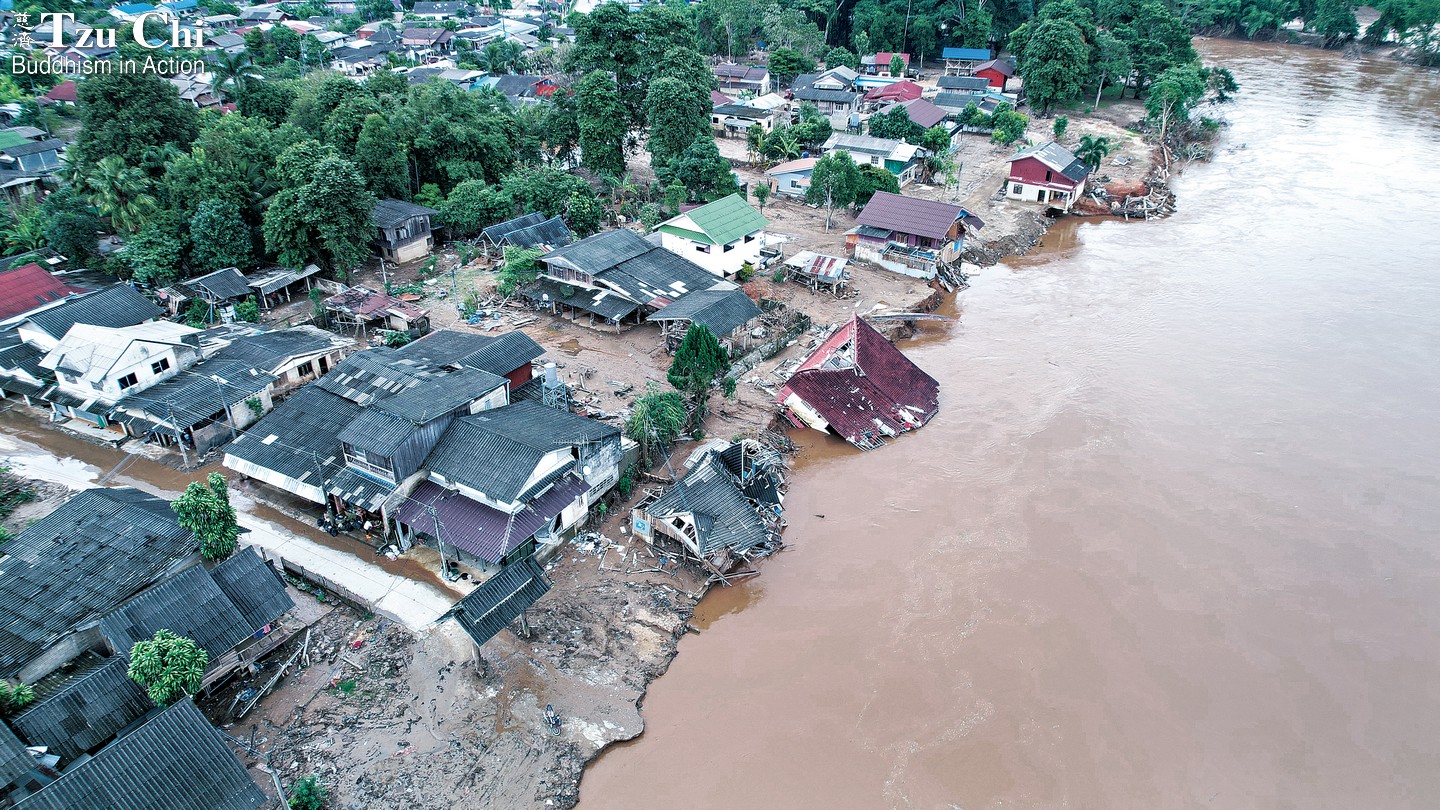
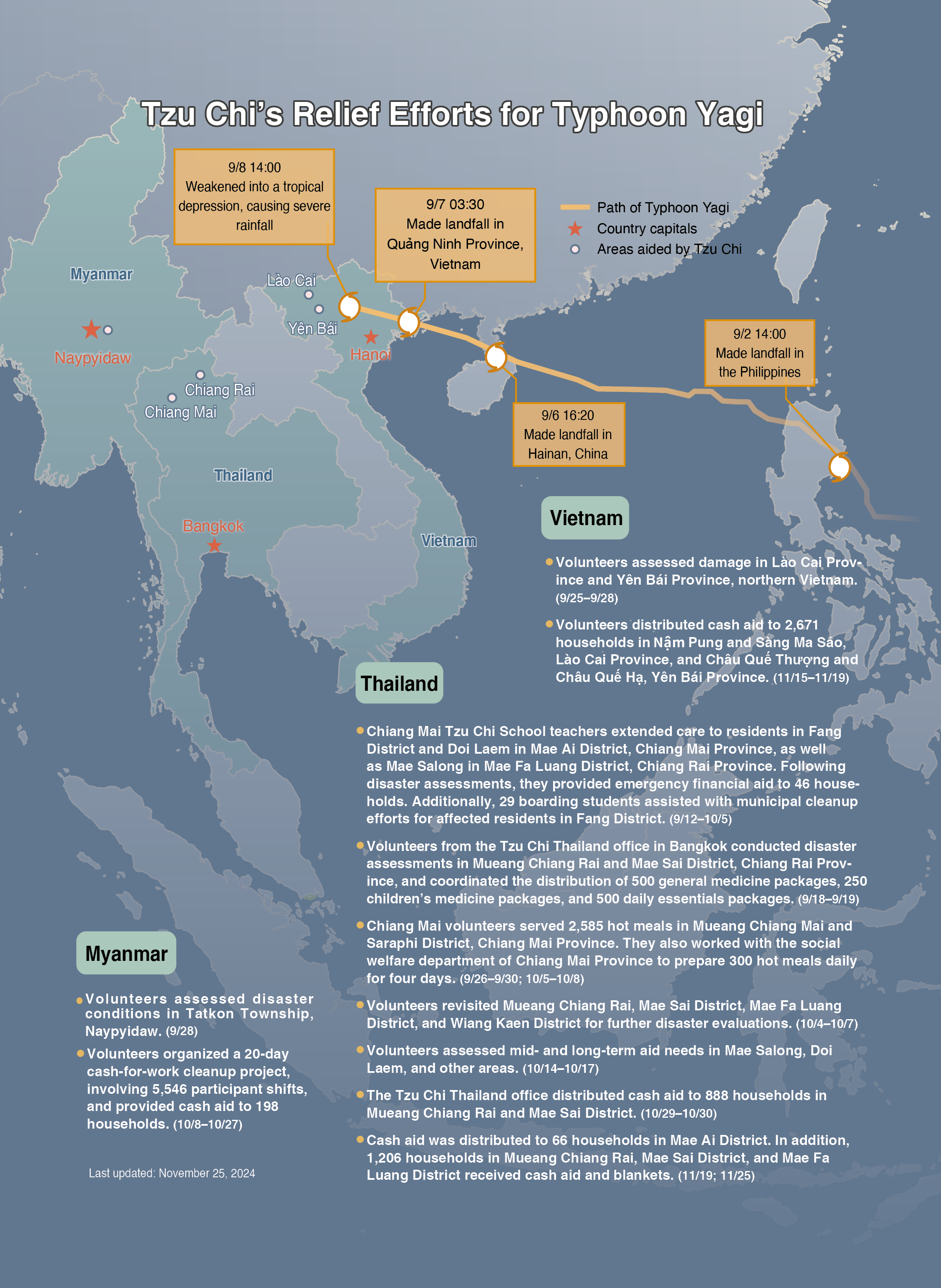
Typhoon Yagi formed over the waters east of the Philippines on August 30, 2024. It made landfall in the country as a low-intensity typhoon on September 2, quickly traversing Luzon Island. Yagi intensified after entering the South China Sea before sweeping across China, Vietnam, and Laos. Heavy rains caused severe damage in Thailand and Myanmar. The typhoon was Asia’s strongest in 2024, affecting over 20 million people and leaving widespread devastation in its wake.

Mae Yao, a flood-affected area along the Kok River in northern Thailand. Singharat Chunchom

Typhoon Yagi made a near 90-degree turn on its path, sparing Taiwan but wreaking havoc across Southeast Asia. On September 2, 2024, it made landfall on Luzon Island in the Philippines, bringing landslides and floods. A major landslide occurred in the province of Rizal, just 25 kilometers (15 miles) from Manila. The Philippines endure an average of 20 typhoons every year, so local Tzu Chi volunteers have developed a rapid disaster response system. Following Typhoon Yagi, they distributed rice and other supplies to over 1,100 families and provided construction material vouchers to families in two severely affected barangays in Antipolo, helping them repair their homes.

Yagi made landfall in Hainan, China, on September 6, and gradually weakened as it moved into Vietnam. What was left of the storm combined with the region’s heavy rainy season while crossing Mainland Southeast Asia toward the Indian Ocean, triggering severe flooding and landslides in Myanmar and Thailand. Rivers overflowed, and landslides buried farmland in mountainous areas. By the time it was over, the disaster had claimed over 500 lives across Southeast Asia.

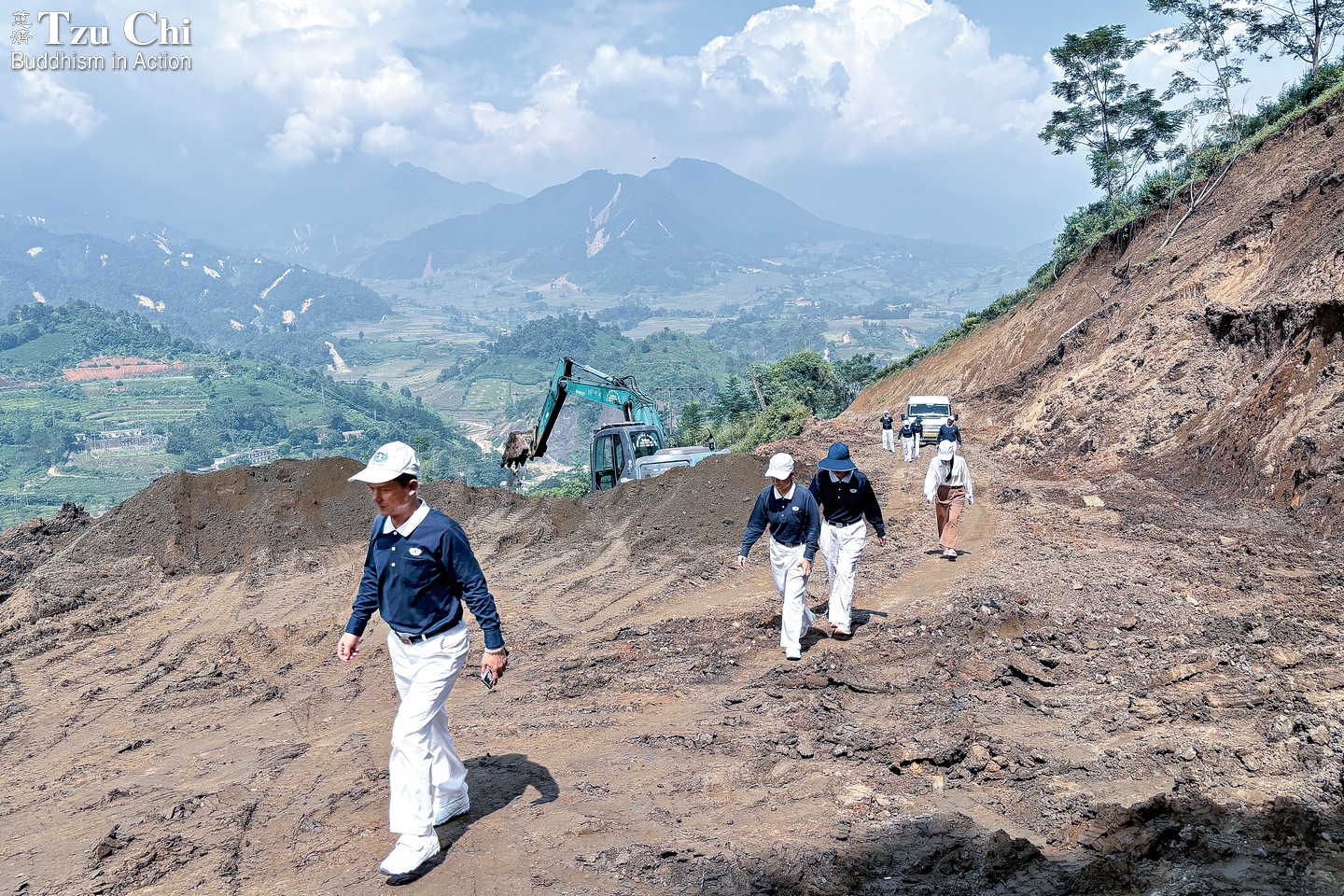
The government of Vietnam declared it the strongest typhoon to hit the country in 30 years. In its aftermath, Tzu Chi volunteers assessed damage in the northern provinces of Lào Cai and Yên Bái, where most victims were impoverished farmers. Some homes were nearly destroyed, with rebuilding nearly impossible for those living in disaster-prone areas. With government assistance, residents in those areas prepared to relocate. In mid-November, Tzu Chi provided cash aid to over 2,600 affected households to help them through this critical period.

In Thailand, the northern provinces of Chiang Mai and Chiang Rai suffered the worst flooding in 80 years. Teachers and students from Chiang Mai Tzu Chi School were the first to respond, assessing damage, distributing aid, and assisting with cleanup. Volunteers from the Tzu Chi office in Bangkok soon followed, surveying conditions and providing relief in affected regions. They set up two distribution centers in mid-September in Mueang Chiang Rai and Mae Sai District, both in Chiang Rai Province. With the help of village leaders, they distributed daily necessities and cleaning tools. Volunteers also delivered supplies to remote villages in Mae Sai, areas often overlooked in relief efforts due to their small populations. They transported goods by truck and trekked into hard-to-reach areas to ensure no one was left behind.

In early October, volunteers returned to four districts in Chiang Rai Province to conduct further damage assessments and distribute aid. They hoped to reach as many people in need as possible. Accompanying them on part of their journey was an assistant to a village head in Mae Sai District, Saowalak, whose own home had been severely damaged. With her guidance, volunteers delivered supplies to affected residents. “My parents and other family members are busy restoring our house,” Saowalak shared, “but they fully support me going out to help the villagers. Although we were strangers before, you have shown us so much love, reaching out to us in our time of need. We are truly grateful and hold you in great affection.”

In addition to distributing relief goods, volunteers provided cash aid to over 2,100 affected households in October and November to support their rebuilding efforts. At the same time, they evaluated medium- and long-term reconstruction plans for Doi Laem in Mae Ai District and Mae Salong in Mae Fa Luang District. In Doi Laem, 28 households needed land to rebuild their homes. During one visit, volunteers were accompanied by Suradej, then deputy village head, to the mountaintop to survey the government’s proposed construction site. The official expressed gratitude for Tzu Chi’s dedication, noting that they were the only organization so far to have made the climb to the mountaintop to carefully assess the proposed land for rebuilding. He sincerely hoped to collaborate with the foundation to help villagers rebuild their homes.

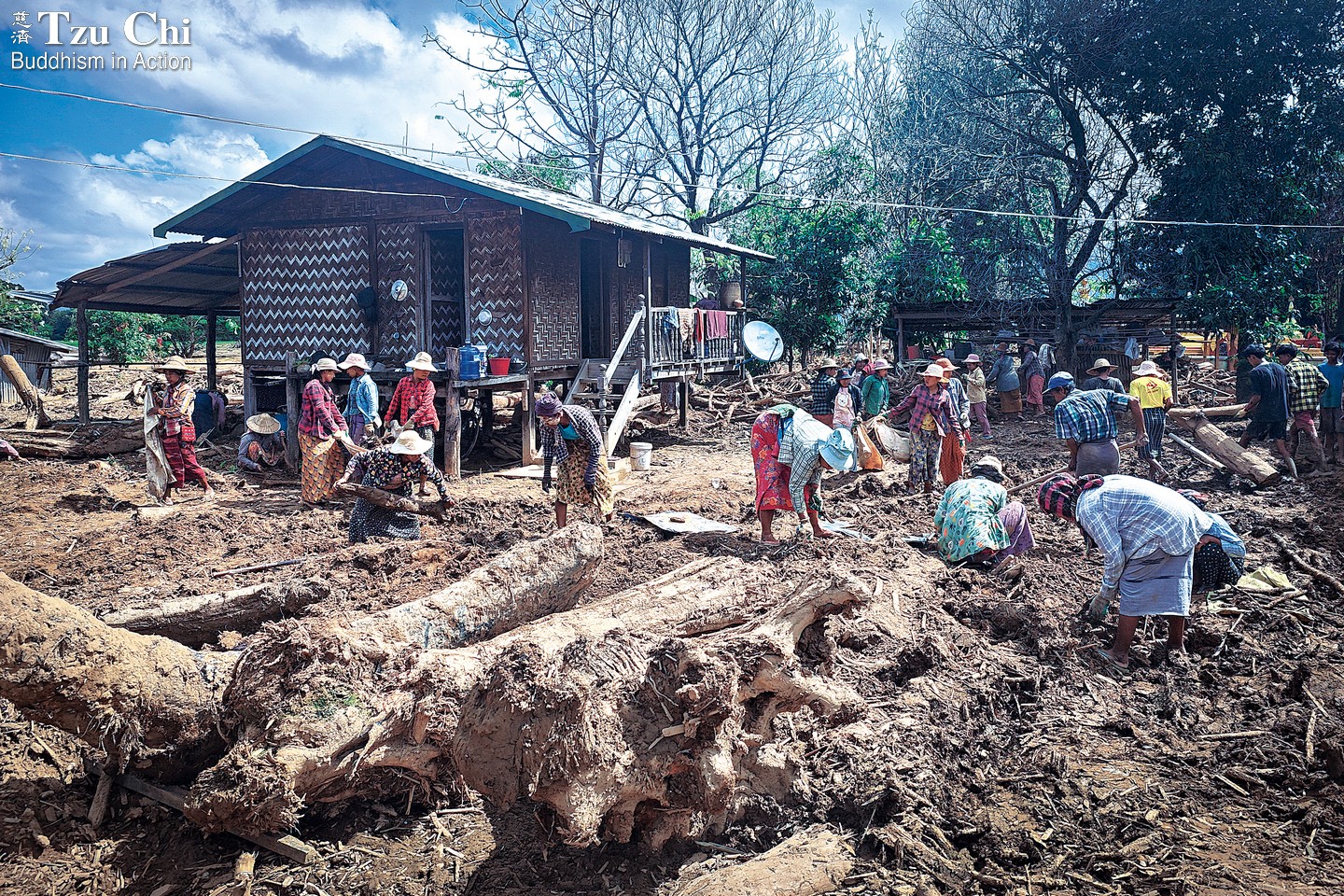
The devastation from Typhoon Yagi was even more widespread in Myanmar than in Thailand. Floodwaters submerged low-lying areas in Naypyidaw, Mandalay Region, Bago Region, and Shan State. A total of 64 townships nationwide were affected, and essential infrastructure like roads and bridges sustained severe damage. In response, Tzu Chi volunteers provided emergency cash aid and launched a cash-for-work cleanup project in Tatkon Township, Naypyidaw. This initiative encouraged local residents to collaborate in clearing debris and restoring their villages, helping to speed up recovery.

Daw Thida Khin (李金蘭), head of Tzu Chi Myanmar, shared her experiences conducting relief efforts in Tatkon Township. In some areas, houses were wrecked and paths were blocked by trees that had been swept down from the mountains. Overwhelmed village heads, unsure of where to begin the cleanup efforts, admitted to feeling helpless. To inspire them and other local residents, Daw Thida Khin and her fellow volunteers shared Master Cheng Yen’s teaching: with unity and determination, even small ants can move great mountains—a principle central to Tzu Chi’s spirit.

At first hesitant, the villagers soon recognized the volunteers’ sincere intentions and joined the cleanup effort. They collected garbage using baskets and plastic bags salvaged from the debris, working together to restore their community. The cleanup in Tatkon Township lasted 20 days, ending on October 27. Residents contributed nearly 5,550 work shifts, significantly aiding the recovery of the area. Afterward, Tzu Chi launched a second phase of aid, distributing relief supplies to further support victims.

Southeast Asia is one of the most vulnerable regions in the world to global climate change. The areas impacted by Typhoon Yagi, primarily agricultural nations, suffered significant crop losses that threatened food security, drove up food prices, and deepened poverty and hunger. Severe damage to infrastructure further complicated relief efforts. Tzu Chi volunteers remain committed to standing by affected communities, helping them navigate their challenging journey of recovery.

Vietnam

While traveling to Nậm Pung in Lào Cai Province to assess conditions after Typhoon Yagi, volunteers encountered several landslides that had blocked the roads, making car access impossible. They had to walk or use motorcycles to continue their journey. Nguyen Dinh Hung

Volunteers in Vietnam distribute pastries to residents of Nậm Pung, Lào Cai Province, during a late September 2024 trip to assess damage caused by Typhoon Yagi. Nguyen Dinh Hung

Thailand

Residents of Mae Sai District, Chiang Rai Province, Thailand, pose with cash aid provided by Tzu Chi. Pinticha Jansuksri

Myanmar

Residents of Tatkon Township, Naypyidaw, Myanmar, work together to clean up in the aftermath of Typhoon Yagi. Hein Pyae Sone

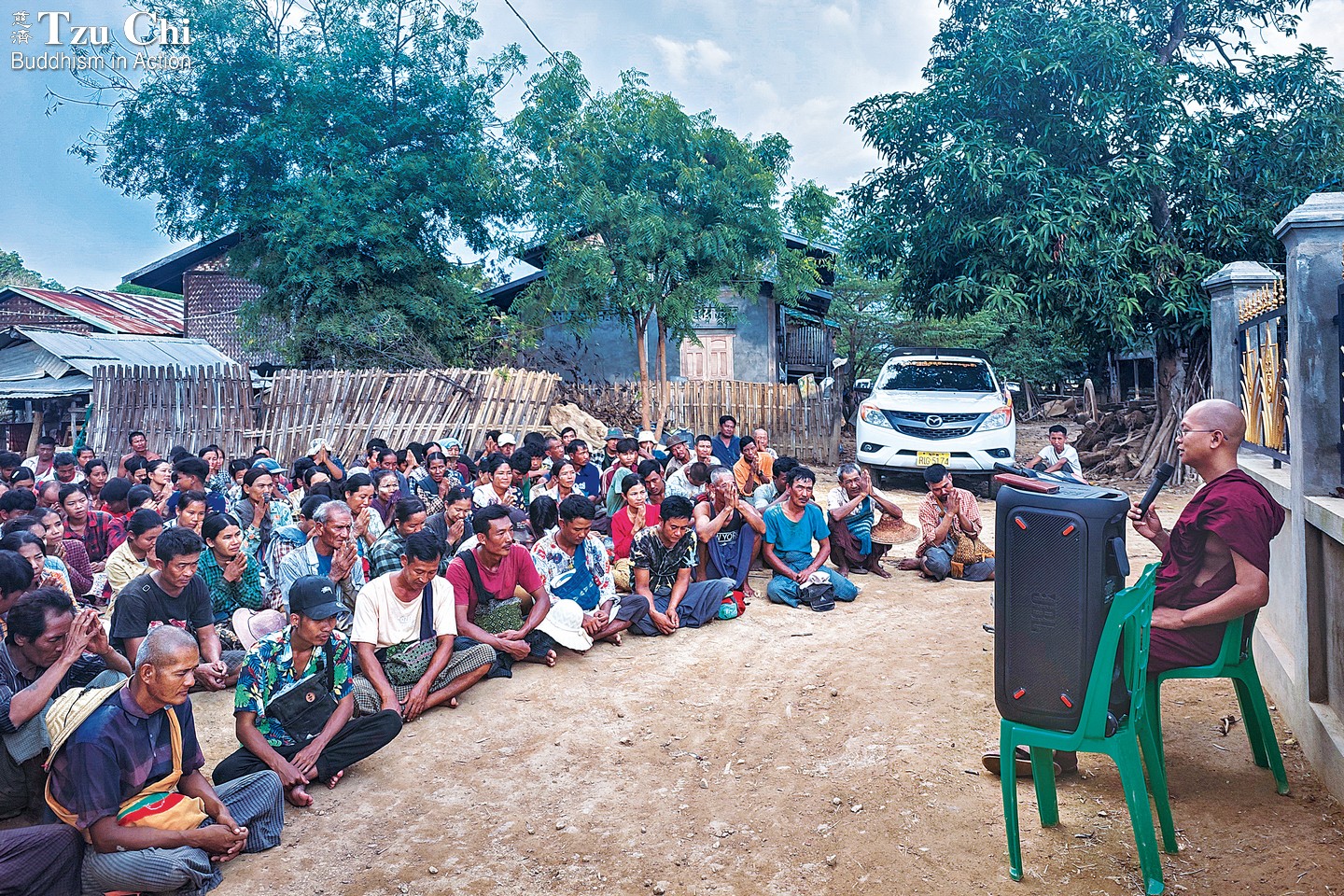
Buddhist monk U Thiha Nyar Na addresses participants of a Tzu Chi cash-for-work cleanup project in Tatkon Township, Myanmar. He provided significant assistance to Tzu Chi volunteers in their relief efforts in response to Typhoon Yagi’s impact. Hein Pyae Sone

By Tzu Chi Monthly editorial staff, Budsara Sombut, Lin Jing Xiu, and Daw Thida Khin
Compiled and translated by Wu Hsiao-ting

Typhoon Yagi formed over the waters east of the Philippines on August 30, 2024. It made landfall in the country as a low-intensity typhoon on September 2, quickly traversing Luzon Island. Yagi intensified after entering the South China Sea before sweeping across China, Vietnam, and Laos. Heavy rains caused severe damage in Thailand and Myanmar. The typhoon was Asia’s strongest in 2024, affecting over 20 million people and leaving widespread devastation in its wake.

Mae Yao, a flood-affected area along the Kok River in northern Thailand. Singharat Chunchom

Typhoon Yagi made a near 90-degree turn on its path, sparing Taiwan but wreaking havoc across Southeast Asia. On September 2, 2024, it made landfall on Luzon Island in the Philippines, bringing landslides and floods. A major landslide occurred in the province of Rizal, just 25 kilometers (15 miles) from Manila. The Philippines endure an average of 20 typhoons every year, so local Tzu Chi volunteers have developed a rapid disaster response system. Following Typhoon Yagi, they distributed rice and other supplies to over 1,100 families and provided construction material vouchers to families in two severely affected barangays in Antipolo, helping them repair their homes.

Yagi made landfall in Hainan, China, on September 6, and gradually weakened as it moved into Vietnam. What was left of the storm combined with the region’s heavy rainy season while crossing Mainland Southeast Asia toward the Indian Ocean, triggering severe flooding and landslides in Myanmar and Thailand. Rivers overflowed, and landslides buried farmland in mountainous areas. By the time it was over, the disaster had claimed over 500 lives across Southeast Asia.

The government of Vietnam declared it the strongest typhoon to hit the country in 30 years. In its aftermath, Tzu Chi volunteers assessed damage in the northern provinces of Lào Cai and Yên Bái, where most victims were impoverished farmers. Some homes were nearly destroyed, with rebuilding nearly impossible for those living in disaster-prone areas. With government assistance, residents in those areas prepared to relocate. In mid-November, Tzu Chi provided cash aid to over 2,600 affected households to help them through this critical period.

In Thailand, the northern provinces of Chiang Mai and Chiang Rai suffered the worst flooding in 80 years. Teachers and students from Chiang Mai Tzu Chi School were the first to respond, assessing damage, distributing aid, and assisting with cleanup. Volunteers from the Tzu Chi office in Bangkok soon followed, surveying conditions and providing relief in affected regions. They set up two distribution centers in mid-September in Mueang Chiang Rai and Mae Sai District, both in Chiang Rai Province. With the help of village leaders, they distributed daily necessities and cleaning tools. Volunteers also delivered supplies to remote villages in Mae Sai, areas often overlooked in relief efforts due to their small populations. They transported goods by truck and trekked into hard-to-reach areas to ensure no one was left behind.

In early October, volunteers returned to four districts in Chiang Rai Province to conduct further damage assessments and distribute aid. They hoped to reach as many people in need as possible. Accompanying them on part of their journey was an assistant to a village head in Mae Sai District, Saowalak, whose own home had been severely damaged. With her guidance, volunteers delivered supplies to affected residents. “My parents and other family members are busy restoring our house,” Saowalak shared, “but they fully support me going out to help the villagers. Although we were strangers before, you have shown us so much love, reaching out to us in our time of need. We are truly grateful and hold you in great affection.”

In addition to distributing relief goods, volunteers provided cash aid to over 2,100 affected households in October and November to support their rebuilding efforts. At the same time, they evaluated medium- and long-term reconstruction plans for Doi Laem in Mae Ai District and Mae Salong in Mae Fa Luang District. In Doi Laem, 28 households needed land to rebuild their homes. During one visit, volunteers were accompanied by Suradej, then deputy village head, to the mountaintop to survey the government’s proposed construction site. The official expressed gratitude for Tzu Chi’s dedication, noting that they were the only organization so far to have made the climb to the mountaintop to carefully assess the proposed land for rebuilding. He sincerely hoped to collaborate with the foundation to help villagers rebuild their homes.

The devastation from Typhoon Yagi was even more widespread in Myanmar than in Thailand. Floodwaters submerged low-lying areas in Naypyidaw, Mandalay Region, Bago Region, and Shan State. A total of 64 townships nationwide were affected, and essential infrastructure like roads and bridges sustained severe damage. In response, Tzu Chi volunteers provided emergency cash aid and launched a cash-for-work cleanup project in Tatkon Township, Naypyidaw. This initiative encouraged local residents to collaborate in clearing debris and restoring their villages, helping to speed up recovery.

Daw Thida Khin (李金蘭), head of Tzu Chi Myanmar, shared her experiences conducting relief efforts in Tatkon Township. In some areas, houses were wrecked and paths were blocked by trees that had been swept down from the mountains. Overwhelmed village heads, unsure of where to begin the cleanup efforts, admitted to feeling helpless. To inspire them and other local residents, Daw Thida Khin and her fellow volunteers shared Master Cheng Yen’s teaching: with unity and determination, even small ants can move great mountains—a principle central to Tzu Chi’s spirit.

At first hesitant, the villagers soon recognized the volunteers’ sincere intentions and joined the cleanup effort. They collected garbage using baskets and plastic bags salvaged from the debris, working together to restore their community. The cleanup in Tatkon Township lasted 20 days, ending on October 27. Residents contributed nearly 5,550 work shifts, significantly aiding the recovery of the area. Afterward, Tzu Chi launched a second phase of aid, distributing relief supplies to further support victims.

Southeast Asia is one of the most vulnerable regions in the world to global climate change. The areas impacted by Typhoon Yagi, primarily agricultural nations, suffered significant crop losses that threatened food security, drove up food prices, and deepened poverty and hunger. Severe damage to infrastructure further complicated relief efforts. Tzu Chi volunteers remain committed to standing by affected communities, helping them navigate their challenging journey of recovery.

Vietnam

While traveling to Nậm Pung in Lào Cai Province to assess conditions after Typhoon Yagi, volunteers encountered several landslides that had blocked the roads, making car access impossible. They had to walk or use motorcycles to continue their journey. Nguyen Dinh Hung

Volunteers in Vietnam distribute pastries to residents of Nậm Pung, Lào Cai Province, during a late September 2024 trip to assess damage caused by Typhoon Yagi. Nguyen Dinh Hung

Thailand

Residents of Mae Sai District, Chiang Rai Province, Thailand, pose with cash aid provided by Tzu Chi. Pinticha Jansuksri

Myanmar

Residents of Tatkon Township, Naypyidaw, Myanmar, work together to clean up in the aftermath of Typhoon Yagi. Hein Pyae Sone

Buddhist monk U Thiha Nyar Na addresses participants of a Tzu Chi cash-for-work cleanup project in Tatkon Township, Myanmar. He provided significant assistance to Tzu Chi volunteers in their relief efforts in response to Typhoon Yagi’s impact. Hein Pyae Sone

關鍵字

Essential Clean Water—Tzu Chi and the SDGs

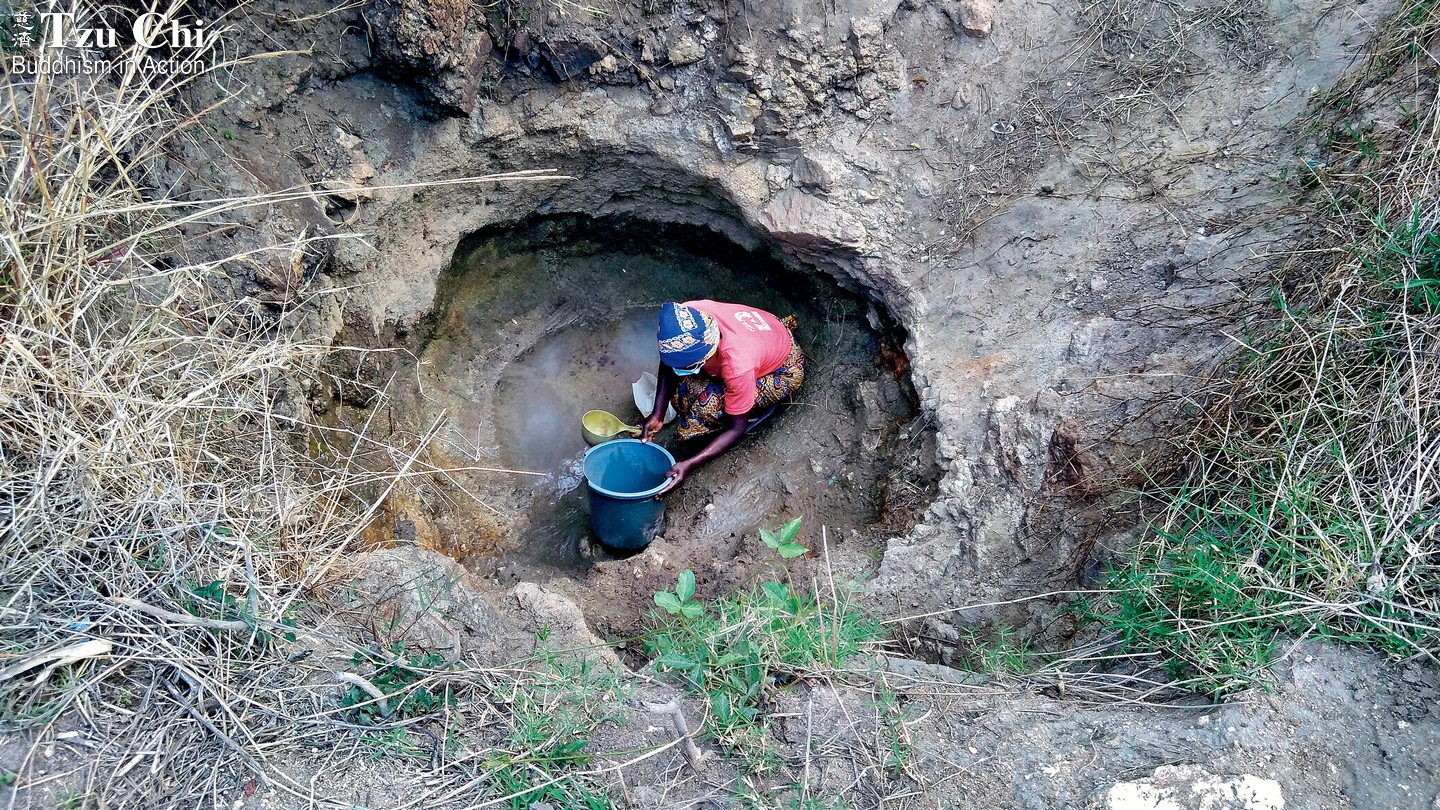
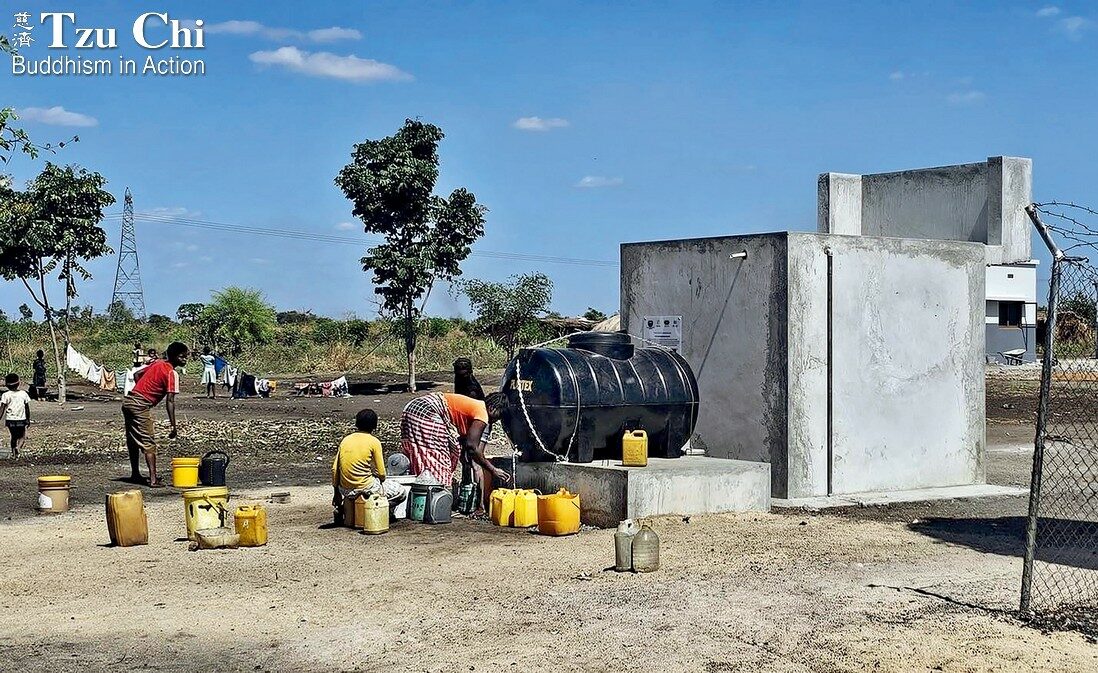
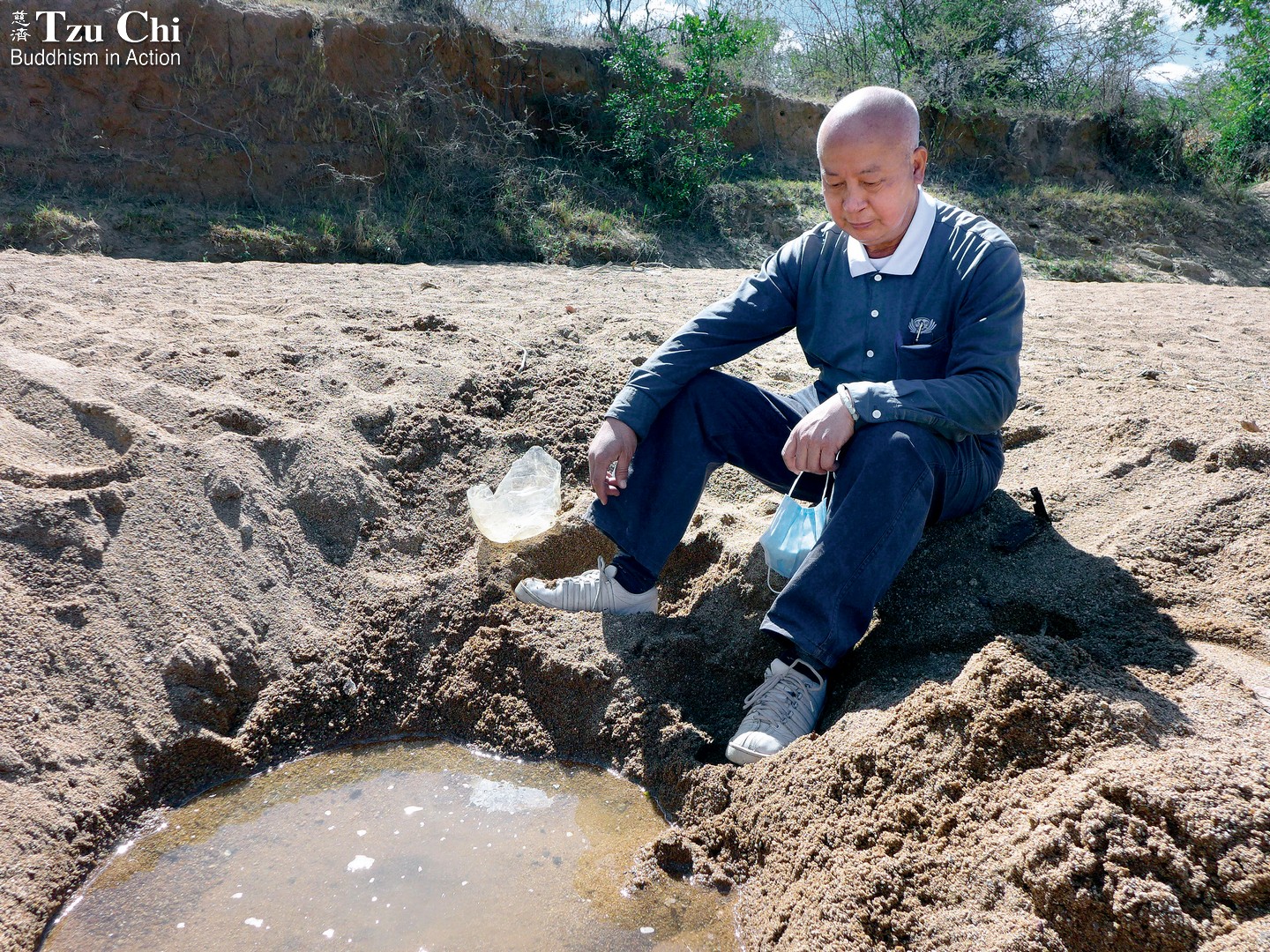
A woman collects water from a water pit in Goromonzi, a rural community in Mashonaland East, Zimbabwe. Despite the poor quality of the water, this pit provides a much-needed water source for local residents. Hlengisile Jiyane

Water is essential for the survival and growth of all living things, yet freshwater resources are limited and unevenly distributed. As climate change alters weather patterns, the frequency and severity of water-related disasters are increasing. It’s time to recognize the true value of water and work towards lasting solutions.

Water for All—Tzu Chi’s Initiatives Around the World

By Yeh Tzu-hao
Translated by Wu Hsiao-ting

PHOTO BY HLENGISILE JIYANE

From drilling wells in Zimbabwe to harvesting rainwater in Taiwan, Tzu Chi’s global efforts bring clean water to those in need while promoting sustainable practices.

In Taiwan, public facilities like train stations, sports venues, shopping malls, and hospitals provide free access to clean drinking water. Anyone with a reusable water bottle can easily find a place to refill it. And that’s not just in Taiwan. In developed and affluent nations, water availability is seldom a concern; the question is usually what to  drink, not whether water is accessible.

In stark contrast, hundreds of millions around the world struggle to secure even a single glass of clean, safe water. A staggering 2.2 billion people lack access to safe drinking water, according to the United Nations Department of Economic and Social Affairs’ 2023 report on the Sustainable Development Goals (SDGs). Sadly, the problem is worsening as climate change intensifies water scarcity.

Digging wells, saving lives

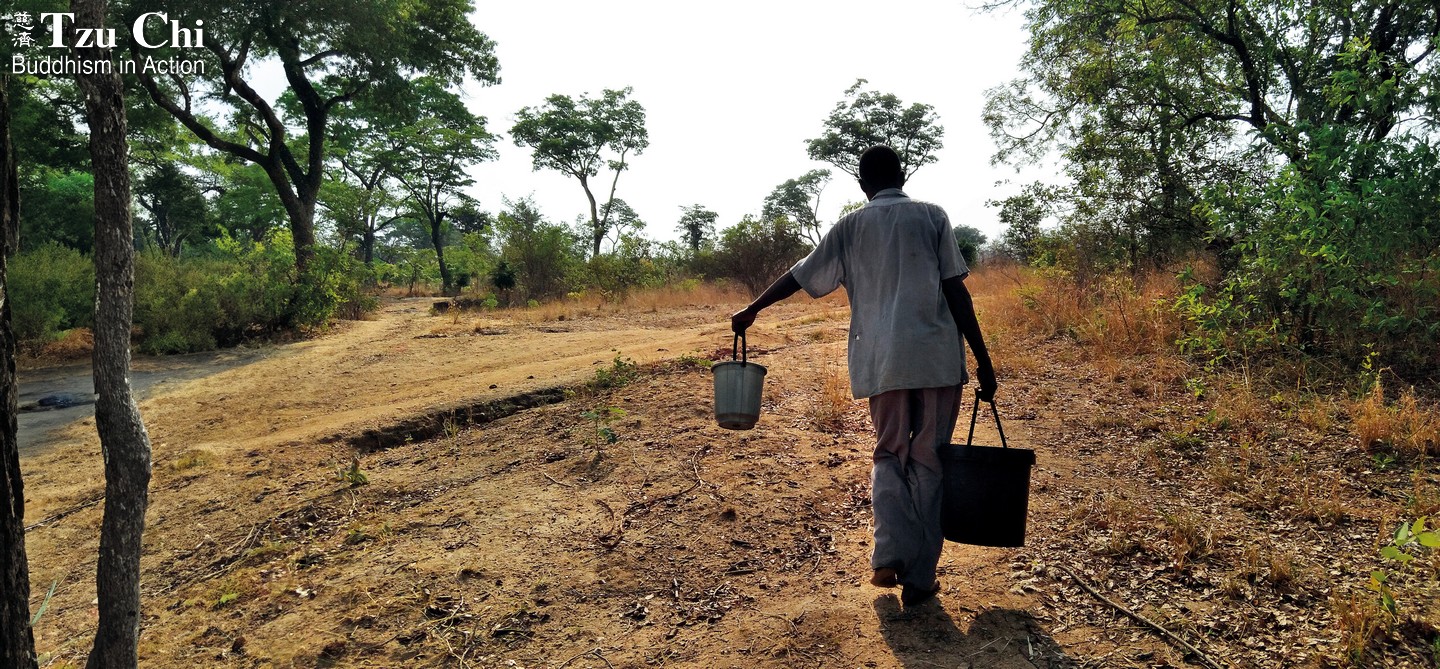
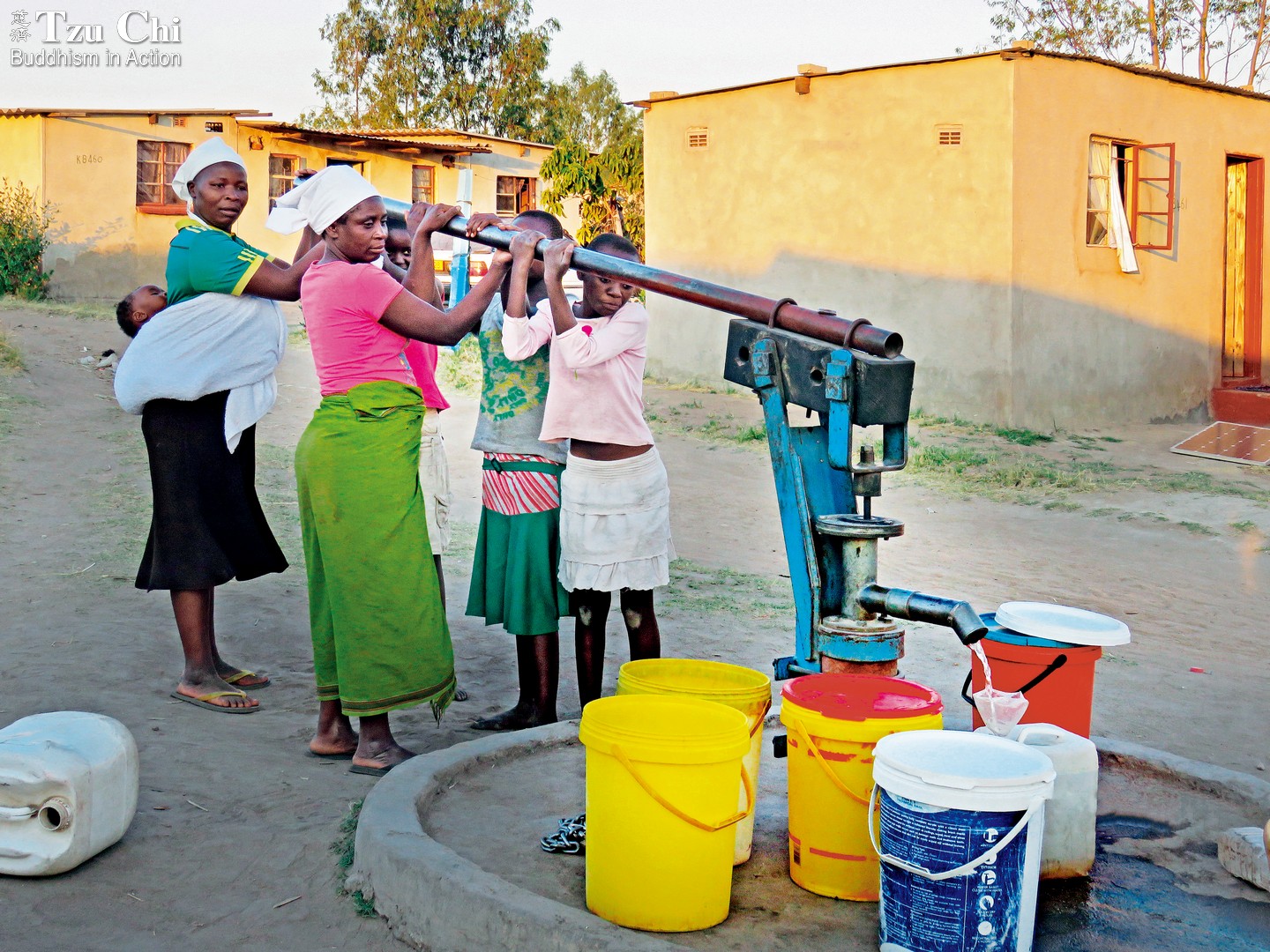
A severe drought that swept across much of southern Africa forced Zimbabwe to declare a state of disaster. In Domboshava, near the national capital of Harare, a long line of people gathered at a well under the scorching sun. After filling their buckets, they set out on the challenging journey home. A fortunate few had bicycles to ease the burden, but many young children and mothers had no choice but to carry the heavy loads home on foot.

Though arduous, this routine marked progress. Previously, residents had to walk over ten kilometers (6.2 miles) to fetch water. The new well reduced the distance to just two or three kilometers.

Tino Chu (朱金財), head of Tzu Chi Zimbabwe and a resident of the country for nearly 30 years, spoke about the struggles faced by communities without functioning wells. Many people in such areas rely on rivers or remote pools for water, risking encounters with crocodiles, wild dogs, and venomous snakes. With no other options available, residents have no choice but to take their chances. What’s worse, the water they collect—shared with wildlife and contaminated with waste—is often unsafe and has led to frequent cases of diarrhea and cholera outbreaks.

Chu recalled a harrowing incident in 2008 when he witnessed a cholera patient succumb to the disease just seven hours after the symptoms first appeared. That year, Zimbabwe recorded over 79,000 cholera cases and more than 3,700 deaths. Experiences and dire statistics like this prompted Chu to take action to make clean water more available. Since 2013, he has led a professional-level team specializing in drilling deep wells to provide clean underground water.

“Zimbabwe’s underground water is generally very clean due to the lack of industrial pollution,” Chu noted. However, drilling or repairing a well requires careful planning to ensure that there is an aquifer, the land is public, and the well is conveniently located near settlements. “I often tell our volunteers that although we are drilling or repairing wells, what we are truly doing is saving lives,” Chu added. “If we don’t take action, many lives could be lost to bacterial infections.”

Chu’s team began with just one well-drilling unit but expanded to five after another major cholera outbreak in 2023, which prompted five provincial governors to seek Chu’s assistance. The team has also greatly improved its efficiency; while drilling a well once took 19 hours, it now takes just five.

The wells drilled by Tzu Chi’s team are deep, providing safer and steadier water supplies than shallow wells or surface water pits. A single well can serve between 1,000 and 5,000 people. Chu’s team has thus far drilled or repaired over 2,000 wells, benefiting at least two million people with access to clean, safe water. Each completed well is met with cheers and celebrations from the local community.

Despite these achievements, water remains a precious commodity and is used sparingly. A family of five typically gets by with just five to seven buckets of water a day, amounting to less than 20 liters per person. Even wastewater from dishwashing is repurposed for livestock. “Seeing chickens desperately waiting for this water is always shocking to me,” Chu shared.

Chu’s efforts to provide clean water in a country with severe water shortages align with the first target of the United Nations’ Sustainable Development Goal 6: ensuring universal access to clean, safe, and affordable drinking water. Tzu Chi, alongside other humanitarian organizations, is addressing water challenges in the world through sourcing, purification, and conservation. Zimbabwe is just one example of Tzu Chi’s broader mission to provide water aid. In August 2024, for instance, the foundation launched its first slow sand filter facility outside Taiwan, in Mozambique, further expanding its efforts to improve access to safe drinking water.

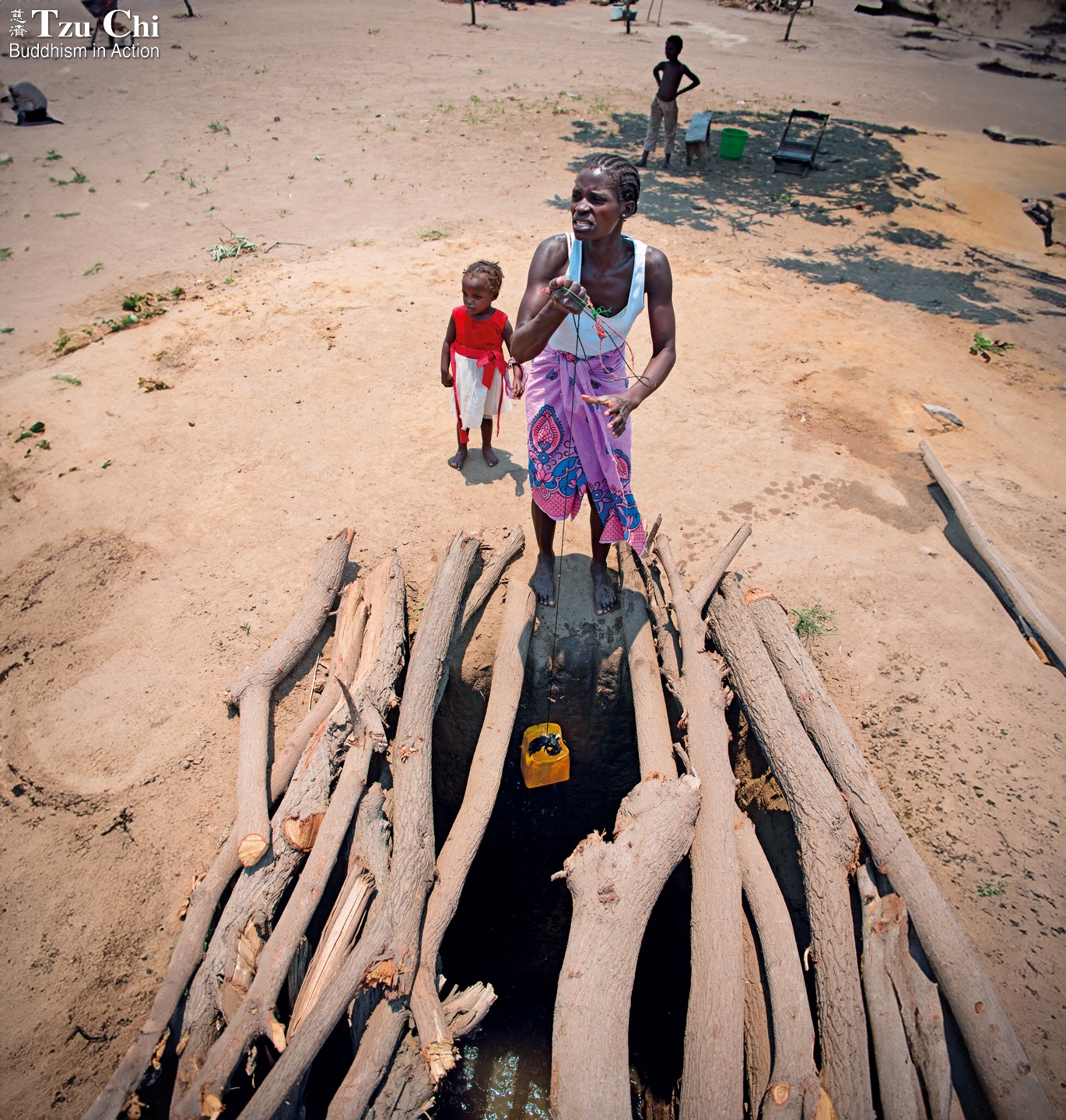
A resident of Tica, Nhamatanda District, Mozambique, draws water from a makeshift well, as witnessed by Tzu Chi volunteers providing care after Cyclone Idai. Cai Kai-fan

Slow sand filtration

Residents of the Kura Tzu Chi Great Love Village in Sofala Province, Mozambique, cheered with joy before lining up to fill their containers with clean water from a newly installed filtration facility. A Tzu Chi team from Taiwan was present to officially inaugurate this much-welcomed addition to the village. Tzu Chi had built the housing village after Cyclone Idai, with residents gradually moving in starting in 2023. In 2024, a slow sand filter was added to ensure access to clean drinking water.

Xie Yao-lian (謝曜聯), the chief engineer for the project, explained that due to the lack of public electricity in the village, solar-powered pumps are used to draw well water into a storage tank, which then feeds water into the slow sand filter for purification. However, the solar-powered system limits the filter’s operation to daylight hours, making it essential for residents to use water judiciously. If the filter runs dry, it takes about a month to restore its purification process.

Slow sand filtration is not a new technology; it has been in use since the 19th century in England. Unlike modern tap water systems that use chlorination to disinfect water, slow sand filters utilize a natural biological process to remove harmful pathogens.

The Kura Village filtration system was made possible through a collaboration between Tzu Chi and the Taiwan Water Corporation, which provided technical expertise and guidance during construction. Chen Wen-hsiang (陳文祥), director of the corporation’s water quality department, described the system’s structure: layers of sand, pebbles, and bricks. After the system is filled with water, a maturation period allows a biofilm of microorganisms and algae to develop on the top layer of sand. This biofilm helps remove bacteria and impurities from the water.

“This ecosystem functions like an African rainforest,” Chen explained, drawing an analogy to the law of the jungle. “Pathogenic bacteria, such as Vibrio cholerae, are consumed as food within this environment.” In this natural process, organisms regulate one another, eliminating the need for chemical chlorination or replaceable filter cartridges. In addition to being all-natural, the system is highly effective. The coliform bacteria count in the water drops from over 7,000 CFU per 100 mL before filtration to fewer than 20 CFU per 100 mL after. This is nearing Taiwan’s potable water standard of fewer than six CFU per 100 mL. This level of purification effectively reduces the risk of waterborne diseases like cholera.

Tzu Chi has previously employed advanced water purification technologies, such as ultrafiltration membranes to remove harmful bacteria and reverse osmosis systems to desalinate seawater. However, those systems require specialized materials and skilled personnel, making them less suitable for long-term use in developing regions. Slow sand filters, in contrast, offer a more practical solution, as they can be built using locally available materials and maintained with minimal training. “Regular scraping, sand replenishment, and basic upkeep are all that’s needed,” Chen emphasized.

Now that the first slow sand filtration unit in Mozambique is operational, more units are being planned. Tzu Chi is also introducing this technology to other regions, including Zimbabwe, Nepal, and India. In Zimbabwe, volunteers have applied for government approval and hope to begin construction soon.

Tzu Chi built a slow sand filter facility using natural methods to provide clean water. Xie Yao-lian

Residents of Epworth, Harare, Zimbabwe, fetch water from a well drilled by Tzu Chi. Courtesy of Tzu Chi Zimbabwe

Rainwater harvesting

Arid regions face a constant battle against drought. Yet, the opposite isn’t always better. The overabundance of water during typhoons or floods brings little relief, as murky floodwaters offer no safe drinking source. After Typhoon Haiyan in the Philippines and a catastrophic dam collapse in Laos, Tzu Chi volunteers stepped in to provide essential water purification and storage equipment. Every extra liter of clean water brought a glimmer of hope in those challenging times.

Taiwan enjoys widespread access to tap water, and most residents rarely worry about shortages. However, the island’s steep mountainous terrain and short rivers mean that most rainfall quickly flows into the ocean, leaving only 18 percent available for storage and use. This low retention rate, coupled with pronounced wet and dry seasons, intensifies the challenges of water scarcity. The severe drought of 2021 remains a vivid reminder of the importance of integrating water-saving practices into daily life and the need to mobilize businesses, organizations, and the public to take collective action.

Lin Min-chao (林敏朝), a consultant for Tzu Chi’s construction department, recalled the origins of rainwater harvesting and water-saving facilities in Tzu Chi buildings. “We were in a meeting with Master Cheng Yen at Hualien Tzu Chi Hospital one very rainy day in Hualien,” he recounted. “After the meeting, a volunteer pointed out that Hualien’s rainfall in one day exceeded what arid regions in Gansu, China, received in an entire year. Hearing this, the Master reminded us that rainwater is a precious natural resource we must cherish.”

This conversation took place in the late 1990s, a time when concepts like rainwater harvesting, water conservation, and green building were still new in Taiwan, with few industry precedents. Tzu Chi’s construction team decided to begin experimenting with these ideas at Hualien Tzu Chi Hospital.

“A single toilet flush uses 12 liters of water,” Lin explained. “The water-saving toilets we introduced in Hualien Tzu Chi Hospital use only nine liters per flush, saving three liters with each use.” He also shared the team’s approach to rainwater harvesting. Traditionally, rainwater is directed to storage facilities at a building’s foundation level, where it is pumped to water towers on upper floors. Tzu Chi’s team, however, opted for a decentralized system, placing storage tanks directly on upper floors. “For example, rainwater collected on the fifth floor flows down to the third floor, eliminating the need for pumps to bring it back up,” Lin said. This design removes the need for additional electricity to power pumps.

Improving water-use efficiency and ensuring sustainable freshwater supply and reuse are also targets under SDG 6 (Clean Water and Sanitation). In 2000, the rainwater harvesting system at Hualien Tzu Chi Hospital was completed and became operational, significantly reducing tap water consumption. It set a pioneering example for sustainable water management in Taiwan.

Larger Tzu Chi facilities constructed after 2000, including schools and hospitals, have incorporated water-saving and rainwater harvesting systems. Taichung Tzu Chi Hospital, in particular, has excelled in water and energy conservation, earning the Green Building Silver Label from Taiwan’s Ministry of the Interior in 2015.

“Initially, rainwater harvested at our hospital was solely used for watering plants, but now it serves both irrigation and air conditioning needs,” stated Yu Xu-fu (余許富), from the engineering department of Taichung Tzu Chi Hospital. As he spoke, he crouched beneath some rooftop eaves and made his way to the top floor of the hospital’s left-side building.

“There are 26 three-ton water tanks here,” Yu said. The tanks are part of the hospital’s overall water storage system. He added that in the past, rainwater was stored until all the tanks were full. However, with some of the water now diverted for air conditioning, the tanks rarely reach full capacity. “The air conditioning runs daily, requiring 500 to 600 tons of water during the summer,” he noted.

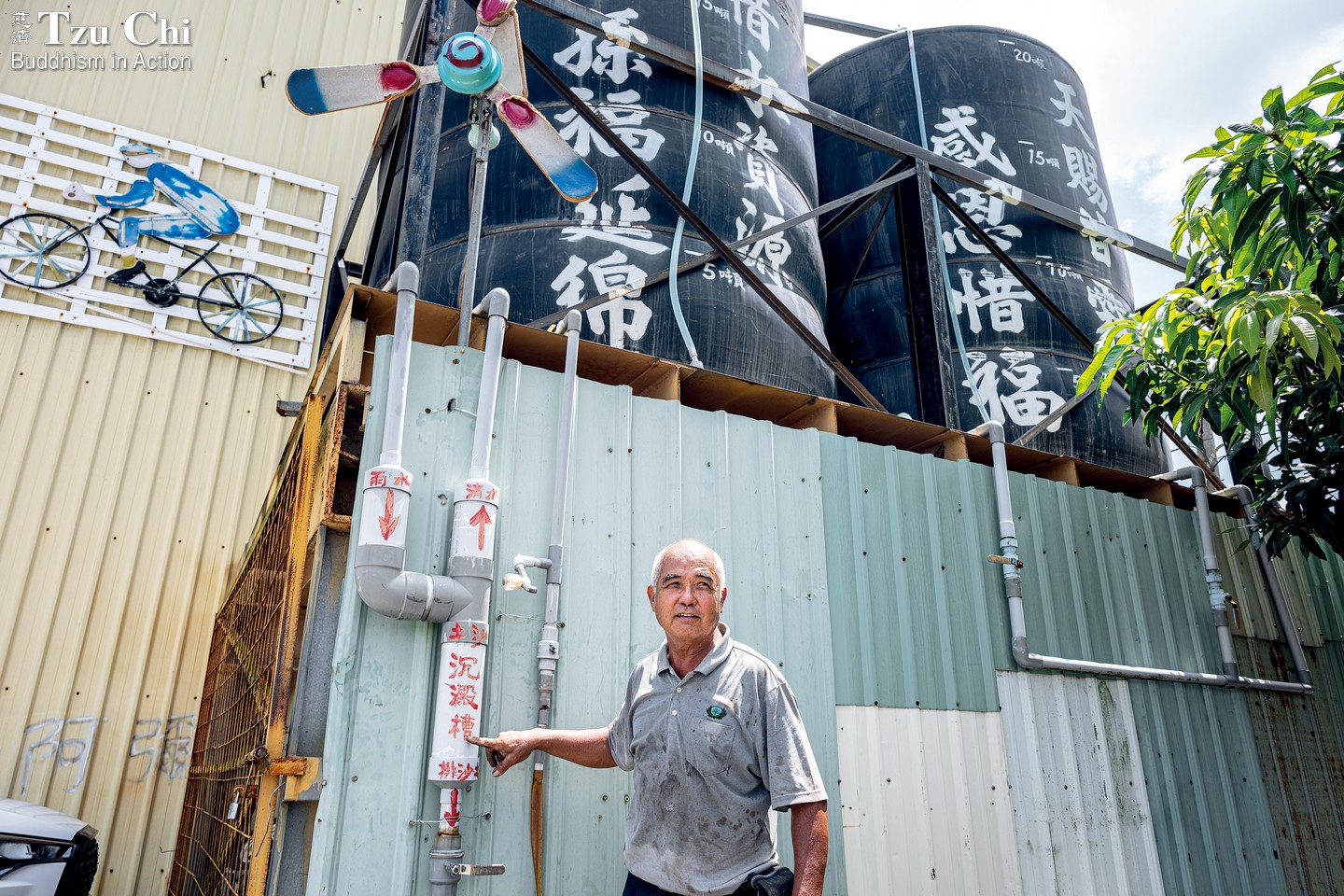
Unlike the discreet rainwater harvesting system at Taichung Tzu Chi Hospital, most of the rainwater facilities at the Tzu Chi Nanbu Recycling Station, located in Nantou County, central Taiwan, are highly visible. The recycling station’s water storage system includes nine tanks of various sizes and a six-ton underground cistern, with a total capacity of 96 tons. Together, these facilities can sustain the station for up to six months without rainfall.

Lin Jin-guo (林金國), who oversees the recycling station and designed its rainwater harvesting system, shared, “Our water reserves had dropped to around 50 tons by the end of July, but were replenished and even overflowed due to Typhoon Gaemi.”

Efficient rainwater use has significantly reduced the station’s reliance on tap water, with bills totaling a mere 200 Taiwanese dollars (US$6.70) every two months. This impressive result prompted an inspection by the water company, which was initially skeptical. In the end, however, Lin was awarded the Water Conservation Public Welfare Award by the Ministry of Economic Affairs’ Water Resources Agency. Now recognized as a water conservation expert, he attracts visits from government organizations and fellow Tzu Chi volunteers seeking to learn from his expertise. Lin has also helped implement rainwater harvesting systems at other recycling stations and the Jing Si Abode, the Buddhist convent founded by Master Cheng Yen.

“When we first established the recycling station,” Lin said, “we envisioned rainwater storage facilities not just for practical use, but also as an educational tool. We hoped to inspire others to cherish rainwater, a gift from nature.” Now, their vision has become a reality.

After Typhoon Haiyan struck the Philippines in 2013, Tzu Chi supplied water purification equipment to help ensure clean water for affected residents in Tacloban(Photo 1). Huang Xiao-zhe

Taichung Tzu Chi Hospital in central Taiwan installed rainwater collection tanks to make use of valuable rainwater resources. Placing such tanks on upper floors conserves electricity by eliminating the need to pump the water(Photo 2). Hsiao Yiu-hwa

Scarcer than they seem

With tap water widely available around the world, many people are unaware of the severity of water shortages and their global implications. The World Health Organization has warned that “as many as 700 million people are at risk of being displaced as a result of drought by 2030,” underscoring the urgent need for greater awareness and action.

To raise awareness of the scarcity and value of water resources, Tzu Chi volunteer Jer Lin Chen (陳哲霖), a recipient of the National Environmental Education Award from Taiwan’s Environmental Protection Administration (now the Ministry of Environment), created an installation artwork called Water Cube, using a thousand PET bottles.

The thousand bottles in the Water Cube symbolize all the water on Earth. Of these, only 25 represent fresh water, while the rest signify salt water. Seventeen of the 25 bottles represent polar icebergs, and seven signify underground water. The amount of surface water available for human use is represented by just one bottle.

“Our Earth may seem to have abundant water, but only 0.1 percent is fresh water we can actually use,” Chen explained. “The stark contrast between one bottle and one thousand bottles vividly illustrates the scarcity of water resources. That’s why we must cherish water as if it were gold.”

Water is the elixir of life for all creatures. As Dharma Master Cheng Yen says, “Water is the essence of life.” Similarly, the United Nations has emphasized that “Water is at the core of sustainable development and is critical for socio-economic development, energy and food production, healthy ecosystems, and human survival itself.”

As water scarcity becomes an ever-growing global crisis, it serves as a stark reminder of how fragile our access to this life-sustaining resource is. With millions already affected, the need for action has never been clearer. Tzu Chi’s initiatives offer hope but also highlight the critical need for widespread, collective efforts to ensure clean water for all. In facing this challenge, we must remember that every action counts in safeguarding the future of our planet and its people.

Lin Jin-guo, a volunteer at the Tzu Chi Nanpu Recycling Station in central Taiwan, designed a rainwater harvesting system using recycled water tanks of various sizes. The collected rainwater is filtered and used within the station, significantly reducing tap water consumption. Hsiao Yiu-hwa

A woman collects water from a water pit in Goromonzi, a rural community in Mashonaland East, Zimbabwe. Despite the poor quality of the water, this pit provides a much-needed water source for local residents. Hlengisile Jiyane

Water is essential for the survival and growth of all living things, yet freshwater resources are limited and unevenly distributed. As climate change alters weather patterns, the frequency and severity of water-related disasters are increasing. It’s time to recognize the true value of water and work towards lasting solutions.

Water for All—Tzu Chi’s Initiatives Around the World

By Yeh Tzu-hao
Translated by Wu Hsiao-ting

PHOTO BY HLENGISILE JIYANE

From drilling wells in Zimbabwe to harvesting rainwater in Taiwan, Tzu Chi’s global efforts bring clean water to those in need while promoting sustainable practices.

In Taiwan, public facilities like train stations, sports venues, shopping malls, and hospitals provide free access to clean drinking water. Anyone with a reusable water bottle can easily find a place to refill it. And that’s not just in Taiwan. In developed and affluent nations, water availability is seldom a concern; the question is usually what to  drink, not whether water is accessible.

In stark contrast, hundreds of millions around the world struggle to secure even a single glass of clean, safe water. A staggering 2.2 billion people lack access to safe drinking water, according to the United Nations Department of Economic and Social Affairs’ 2023 report on the Sustainable Development Goals (SDGs). Sadly, the problem is worsening as climate change intensifies water scarcity.

Digging wells, saving lives

A severe drought that swept across much of southern Africa forced Zimbabwe to declare a state of disaster. In Domboshava, near the national capital of Harare, a long line of people gathered at a well under the scorching sun. After filling their buckets, they set out on the challenging journey home. A fortunate few had bicycles to ease the burden, but many young children and mothers had no choice but to carry the heavy loads home on foot.

Though arduous, this routine marked progress. Previously, residents had to walk over ten kilometers (6.2 miles) to fetch water. The new well reduced the distance to just two or three kilometers.

Tino Chu (朱金財), head of Tzu Chi Zimbabwe and a resident of the country for nearly 30 years, spoke about the struggles faced by communities without functioning wells. Many people in such areas rely on rivers or remote pools for water, risking encounters with crocodiles, wild dogs, and venomous snakes. With no other options available, residents have no choice but to take their chances. What’s worse, the water they collect—shared with wildlife and contaminated with waste—is often unsafe and has led to frequent cases of diarrhea and cholera outbreaks.

Chu recalled a harrowing incident in 2008 when he witnessed a cholera patient succumb to the disease just seven hours after the symptoms first appeared. That year, Zimbabwe recorded over 79,000 cholera cases and more than 3,700 deaths. Experiences and dire statistics like this prompted Chu to take action to make clean water more available. Since 2013, he has led a professional-level team specializing in drilling deep wells to provide clean underground water.

“Zimbabwe’s underground water is generally very clean due to the lack of industrial pollution,” Chu noted. However, drilling or repairing a well requires careful planning to ensure that there is an aquifer, the land is public, and the well is conveniently located near settlements. “I often tell our volunteers that although we are drilling or repairing wells, what we are truly doing is saving lives,” Chu added. “If we don’t take action, many lives could be lost to bacterial infections.”

Chu’s team began with just one well-drilling unit but expanded to five after another major cholera outbreak in 2023, which prompted five provincial governors to seek Chu’s assistance. The team has also greatly improved its efficiency; while drilling a well once took 19 hours, it now takes just five.

The wells drilled by Tzu Chi’s team are deep, providing safer and steadier water supplies than shallow wells or surface water pits. A single well can serve between 1,000 and 5,000 people. Chu’s team has thus far drilled or repaired over 2,000 wells, benefiting at least two million people with access to clean, safe water. Each completed well is met with cheers and celebrations from the local community.

Despite these achievements, water remains a precious commodity and is used sparingly. A family of five typically gets by with just five to seven buckets of water a day, amounting to less than 20 liters per person. Even wastewater from dishwashing is repurposed for livestock. “Seeing chickens desperately waiting for this water is always shocking to me,” Chu shared.

Chu’s efforts to provide clean water in a country with severe water shortages align with the first target of the United Nations’ Sustainable Development Goal 6: ensuring universal access to clean, safe, and affordable drinking water. Tzu Chi, alongside other humanitarian organizations, is addressing water challenges in the world through sourcing, purification, and conservation. Zimbabwe is just one example of Tzu Chi’s broader mission to provide water aid. In August 2024, for instance, the foundation launched its first slow sand filter facility outside Taiwan, in Mozambique, further expanding its efforts to improve access to safe drinking water.

A resident of Tica, Nhamatanda District, Mozambique, draws water from a makeshift well, as witnessed by Tzu Chi volunteers providing care after Cyclone Idai. Cai Kai-fan

Slow sand filtration

Residents of the Kura Tzu Chi Great Love Village in Sofala Province, Mozambique, cheered with joy before lining up to fill their containers with clean water from a newly installed filtration facility. A Tzu Chi team from Taiwan was present to officially inaugurate this much-welcomed addition to the village. Tzu Chi had built the housing village after Cyclone Idai, with residents gradually moving in starting in 2023. In 2024, a slow sand filter was added to ensure access to clean drinking water.

Xie Yao-lian (謝曜聯), the chief engineer for the project, explained that due to the lack of public electricity in the village, solar-powered pumps are used to draw well water into a storage tank, which then feeds water into the slow sand filter for purification. However, the solar-powered system limits the filter’s operation to daylight hours, making it essential for residents to use water judiciously. If the filter runs dry, it takes about a month to restore its purification process.

Slow sand filtration is not a new technology; it has been in use since the 19th century in England. Unlike modern tap water systems that use chlorination to disinfect water, slow sand filters utilize a natural biological process to remove harmful pathogens.

The Kura Village filtration system was made possible through a collaboration between Tzu Chi and the Taiwan Water Corporation, which provided technical expertise and guidance during construction. Chen Wen-hsiang (陳文祥), director of the corporation’s water quality department, described the system’s structure: layers of sand, pebbles, and bricks. After the system is filled with water, a maturation period allows a biofilm of microorganisms and algae to develop on the top layer of sand. This biofilm helps remove bacteria and impurities from the water.

“This ecosystem functions like an African rainforest,” Chen explained, drawing an analogy to the law of the jungle. “Pathogenic bacteria, such as Vibrio cholerae, are consumed as food within this environment.” In this natural process, organisms regulate one another, eliminating the need for chemical chlorination or replaceable filter cartridges. In addition to being all-natural, the system is highly effective. The coliform bacteria count in the water drops from over 7,000 CFU per 100 mL before filtration to fewer than 20 CFU per 100 mL after. This is nearing Taiwan’s potable water standard of fewer than six CFU per 100 mL. This level of purification effectively reduces the risk of waterborne diseases like cholera.

Tzu Chi has previously employed advanced water purification technologies, such as ultrafiltration membranes to remove harmful bacteria and reverse osmosis systems to desalinate seawater. However, those systems require specialized materials and skilled personnel, making them less suitable for long-term use in developing regions. Slow sand filters, in contrast, offer a more practical solution, as they can be built using locally available materials and maintained with minimal training. “Regular scraping, sand replenishment, and basic upkeep are all that’s needed,” Chen emphasized.

Now that the first slow sand filtration unit in Mozambique is operational, more units are being planned. Tzu Chi is also introducing this technology to other regions, including Zimbabwe, Nepal, and India. In Zimbabwe, volunteers have applied for government approval and hope to begin construction soon.

Tzu Chi built a slow sand filter facility using natural methods to provide clean water. Xie Yao-lian

Residents of Epworth, Harare, Zimbabwe, fetch water from a well drilled by Tzu Chi. Courtesy of Tzu Chi Zimbabwe

Rainwater harvesting

Arid regions face a constant battle against drought. Yet, the opposite isn’t always better. The overabundance of water during typhoons or floods brings little relief, as murky floodwaters offer no safe drinking source. After Typhoon Haiyan in the Philippines and a catastrophic dam collapse in Laos, Tzu Chi volunteers stepped in to provide essential water purification and storage equipment. Every extra liter of clean water brought a glimmer of hope in those challenging times.

Taiwan enjoys widespread access to tap water, and most residents rarely worry about shortages. However, the island’s steep mountainous terrain and short rivers mean that most rainfall quickly flows into the ocean, leaving only 18 percent available for storage and use. This low retention rate, coupled with pronounced wet and dry seasons, intensifies the challenges of water scarcity. The severe drought of 2021 remains a vivid reminder of the importance of integrating water-saving practices into daily life and the need to mobilize businesses, organizations, and the public to take collective action.

Lin Min-chao (林敏朝), a consultant for Tzu Chi’s construction department, recalled the origins of rainwater harvesting and water-saving facilities in Tzu Chi buildings. “We were in a meeting with Master Cheng Yen at Hualien Tzu Chi Hospital one very rainy day in Hualien,” he recounted. “After the meeting, a volunteer pointed out that Hualien’s rainfall in one day exceeded what arid regions in Gansu, China, received in an entire year. Hearing this, the Master reminded us that rainwater is a precious natural resource we must cherish.”

This conversation took place in the late 1990s, a time when concepts like rainwater harvesting, water conservation, and green building were still new in Taiwan, with few industry precedents. Tzu Chi’s construction team decided to begin experimenting with these ideas at Hualien Tzu Chi Hospital.

“A single toilet flush uses 12 liters of water,” Lin explained. “The water-saving toilets we introduced in Hualien Tzu Chi Hospital use only nine liters per flush, saving three liters with each use.” He also shared the team’s approach to rainwater harvesting. Traditionally, rainwater is directed to storage facilities at a building’s foundation level, where it is pumped to water towers on upper floors. Tzu Chi’s team, however, opted for a decentralized system, placing storage tanks directly on upper floors. “For example, rainwater collected on the fifth floor flows down to the third floor, eliminating the need for pumps to bring it back up,” Lin said. This design removes the need for additional electricity to power pumps.

Improving water-use efficiency and ensuring sustainable freshwater supply and reuse are also targets under SDG 6 (Clean Water and Sanitation). In 2000, the rainwater harvesting system at Hualien Tzu Chi Hospital was completed and became operational, significantly reducing tap water consumption. It set a pioneering example for sustainable water management in Taiwan.

Larger Tzu Chi facilities constructed after 2000, including schools and hospitals, have incorporated water-saving and rainwater harvesting systems. Taichung Tzu Chi Hospital, in particular, has excelled in water and energy conservation, earning the Green Building Silver Label from Taiwan’s Ministry of the Interior in 2015.

“Initially, rainwater harvested at our hospital was solely used for watering plants, but now it serves both irrigation and air conditioning needs,” stated Yu Xu-fu (余許富), from the engineering department of Taichung Tzu Chi Hospital. As he spoke, he crouched beneath some rooftop eaves and made his way to the top floor of the hospital’s left-side building.

“There are 26 three-ton water tanks here,” Yu said. The tanks are part of the hospital’s overall water storage system. He added that in the past, rainwater was stored until all the tanks were full. However, with some of the water now diverted for air conditioning, the tanks rarely reach full capacity. “The air conditioning runs daily, requiring 500 to 600 tons of water during the summer,” he noted.

Unlike the discreet rainwater harvesting system at Taichung Tzu Chi Hospital, most of the rainwater facilities at the Tzu Chi Nanbu Recycling Station, located in Nantou County, central Taiwan, are highly visible. The recycling station’s water storage system includes nine tanks of various sizes and a six-ton underground cistern, with a total capacity of 96 tons. Together, these facilities can sustain the station for up to six months without rainfall.

Lin Jin-guo (林金國), who oversees the recycling station and designed its rainwater harvesting system, shared, “Our water reserves had dropped to around 50 tons by the end of July, but were replenished and even overflowed due to Typhoon Gaemi.”

Efficient rainwater use has significantly reduced the station’s reliance on tap water, with bills totaling a mere 200 Taiwanese dollars (US$6.70) every two months. This impressive result prompted an inspection by the water company, which was initially skeptical. In the end, however, Lin was awarded the Water Conservation Public Welfare Award by the Ministry of Economic Affairs’ Water Resources Agency. Now recognized as a water conservation expert, he attracts visits from government organizations and fellow Tzu Chi volunteers seeking to learn from his expertise. Lin has also helped implement rainwater harvesting systems at other recycling stations and the Jing Si Abode, the Buddhist convent founded by Master Cheng Yen.

“When we first established the recycling station,” Lin said, “we envisioned rainwater storage facilities not just for practical use, but also as an educational tool. We hoped to inspire others to cherish rainwater, a gift from nature.” Now, their vision has become a reality.

After Typhoon Haiyan struck the Philippines in 2013, Tzu Chi supplied water purification equipment to help ensure clean water for affected residents in Tacloban(Photo 1). Huang Xiao-zhe

Taichung Tzu Chi Hospital in central Taiwan installed rainwater collection tanks to make use of valuable rainwater resources. Placing such tanks on upper floors conserves electricity by eliminating the need to pump the water(Photo 2). Hsiao Yiu-hwa

Scarcer than they seem

With tap water widely available around the world, many people are unaware of the severity of water shortages and their global implications. The World Health Organization has warned that “as many as 700 million people are at risk of being displaced as a result of drought by 2030,” underscoring the urgent need for greater awareness and action.

To raise awareness of the scarcity and value of water resources, Tzu Chi volunteer Jer Lin Chen (陳哲霖), a recipient of the National Environmental Education Award from Taiwan’s Environmental Protection Administration (now the Ministry of Environment), created an installation artwork called Water Cube, using a thousand PET bottles.

The thousand bottles in the Water Cube symbolize all the water on Earth. Of these, only 25 represent fresh water, while the rest signify salt water. Seventeen of the 25 bottles represent polar icebergs, and seven signify underground water. The amount of surface water available for human use is represented by just one bottle.

“Our Earth may seem to have abundant water, but only 0.1 percent is fresh water we can actually use,” Chen explained. “The stark contrast between one bottle and one thousand bottles vividly illustrates the scarcity of water resources. That’s why we must cherish water as if it were gold.”

Water is the elixir of life for all creatures. As Dharma Master Cheng Yen says, “Water is the essence of life.” Similarly, the United Nations has emphasized that “Water is at the core of sustainable development and is critical for socio-economic development, energy and food production, healthy ecosystems, and human survival itself.”

As water scarcity becomes an ever-growing global crisis, it serves as a stark reminder of how fragile our access to this life-sustaining resource is. With millions already affected, the need for action has never been clearer. Tzu Chi’s initiatives offer hope but also highlight the critical need for widespread, collective efforts to ensure clean water for all. In facing this challenge, we must remember that every action counts in safeguarding the future of our planet and its people.

Lin Jin-guo, a volunteer at the Tzu Chi Nanpu Recycling Station in central Taiwan, designed a rainwater harvesting system using recycled water tanks of various sizes. The collected rainwater is filtered and used within the station, significantly reducing tap water consumption. Hsiao Yiu-hwa

關鍵字

A Quiet Ripple

By Christina Wu
Graphic by Su Fang-pei

A stranger’s smile sparked reflections on the quiet power of kindness.

For a time, on my way to work every day, I often passed a middle-aged woman who seemed to work at a nearby hospital. Though we never exchanged words, I found myself looking forward to seeing her because she always carried a trace of a smile. On hectic workdays, when most people appeared harried and burdened, her calm, cheerful demeanor stood out. I often wondered, “Why is she in such a good mood every day? Is she naturally cheerful?” Whatever the reason, her smile felt like a gift.

Though it might not have seemed significant to others, her smile always uplifted me, giving me a sense of hope that I carried with me that day. My mind was often consumed by work-related worries and looming deadlines, but her smile was like a breath of fresh air—cutting through the fog and lightening my load in a most unexpected way. It also encouraged me to work on cultivating more positivity in my own life.

In a world filled with struggles and uncertainties, her smile reminded me that even the smallest of gestures can have a profound impact. A simple, unintentional act can create ripples of hope, offering a meaningful lift to someone’s spirits. This experience reinforced my belief in the quiet power of kindness and underscored how each of us can contribute to positivity, helping others see the silver linings behind the clouds.

Her smile also brought to mind Buddhist teachings on the three types of giving: the giving of material goods, the giving of the Dharma, and the giving of fearlessness. Material giving involves offering physical or financial resources to meet others’ needs. The giving of the Dharma means sharing wisdom or teachings that guide others toward inner peace. The giving of fearlessness entails providing comfort and support to help others overcome their fears.

Even without material wealth, anyone can give. Once, when I shared with my young niece the importance of giving, she said, “I’m still young and don’t have money. What can I give?” I told her that a smile, a kind word, or an encouraging gesture is also a form of giving—and that it can have an impact that surprises you.

We often underestimate our ability to make a difference, believing our small actions are too insignificant to matter in a vast, imperfect world. But the woman’s smile taught me otherwise. However unintentional it might have been, her smile planted a meaningful seed in my mind and inspired me to pass that same positivity and warmth to others.

This is often how a cycle of goodness begins. The starting point may seem insignificant or unexpected, but it ripples outward in ways we may never fully anticipate or see. So, why not start your own ripple?

By Christina Wu
Graphic by Su Fang-pei

A stranger’s smile sparked reflections on the quiet power of kindness.

For a time, on my way to work every day, I often passed a middle-aged woman who seemed to work at a nearby hospital. Though we never exchanged words, I found myself looking forward to seeing her because she always carried a trace of a smile. On hectic workdays, when most people appeared harried and burdened, her calm, cheerful demeanor stood out. I often wondered, “Why is she in such a good mood every day? Is she naturally cheerful?” Whatever the reason, her smile felt like a gift.

Though it might not have seemed significant to others, her smile always uplifted me, giving me a sense of hope that I carried with me that day. My mind was often consumed by work-related worries and looming deadlines, but her smile was like a breath of fresh air—cutting through the fog and lightening my load in a most unexpected way. It also encouraged me to work on cultivating more positivity in my own life.

In a world filled with struggles and uncertainties, her smile reminded me that even the smallest of gestures can have a profound impact. A simple, unintentional act can create ripples of hope, offering a meaningful lift to someone’s spirits. This experience reinforced my belief in the quiet power of kindness and underscored how each of us can contribute to positivity, helping others see the silver linings behind the clouds.

Her smile also brought to mind Buddhist teachings on the three types of giving: the giving of material goods, the giving of the Dharma, and the giving of fearlessness. Material giving involves offering physical or financial resources to meet others’ needs. The giving of the Dharma means sharing wisdom or teachings that guide others toward inner peace. The giving of fearlessness entails providing comfort and support to help others overcome their fears.

Even without material wealth, anyone can give. Once, when I shared with my young niece the importance of giving, she said, “I’m still young and don’t have money. What can I give?” I told her that a smile, a kind word, or an encouraging gesture is also a form of giving—and that it can have an impact that surprises you.

We often underestimate our ability to make a difference, believing our small actions are too insignificant to matter in a vast, imperfect world. But the woman’s smile taught me otherwise. However unintentional it might have been, her smile planted a meaningful seed in my mind and inspired me to pass that same positivity and warmth to others.

This is often how a cycle of goodness begins. The starting point may seem insignificant or unexpected, but it ripples outward in ways we may never fully anticipate or see. So, why not start your own ripple?

關鍵字

Water Scarcity and Crop Failure in Zimbabwe—Providing Wells and Hot Meals

By Xu Fei-li
Abridged and translated by Wu Hsiao-ting

In April 2024, Zimbabwe declared a state of disaster as an ongoing drought left half of the country’s 16 million people facing food shortages. Tzu Chi is helping to address this crisis.

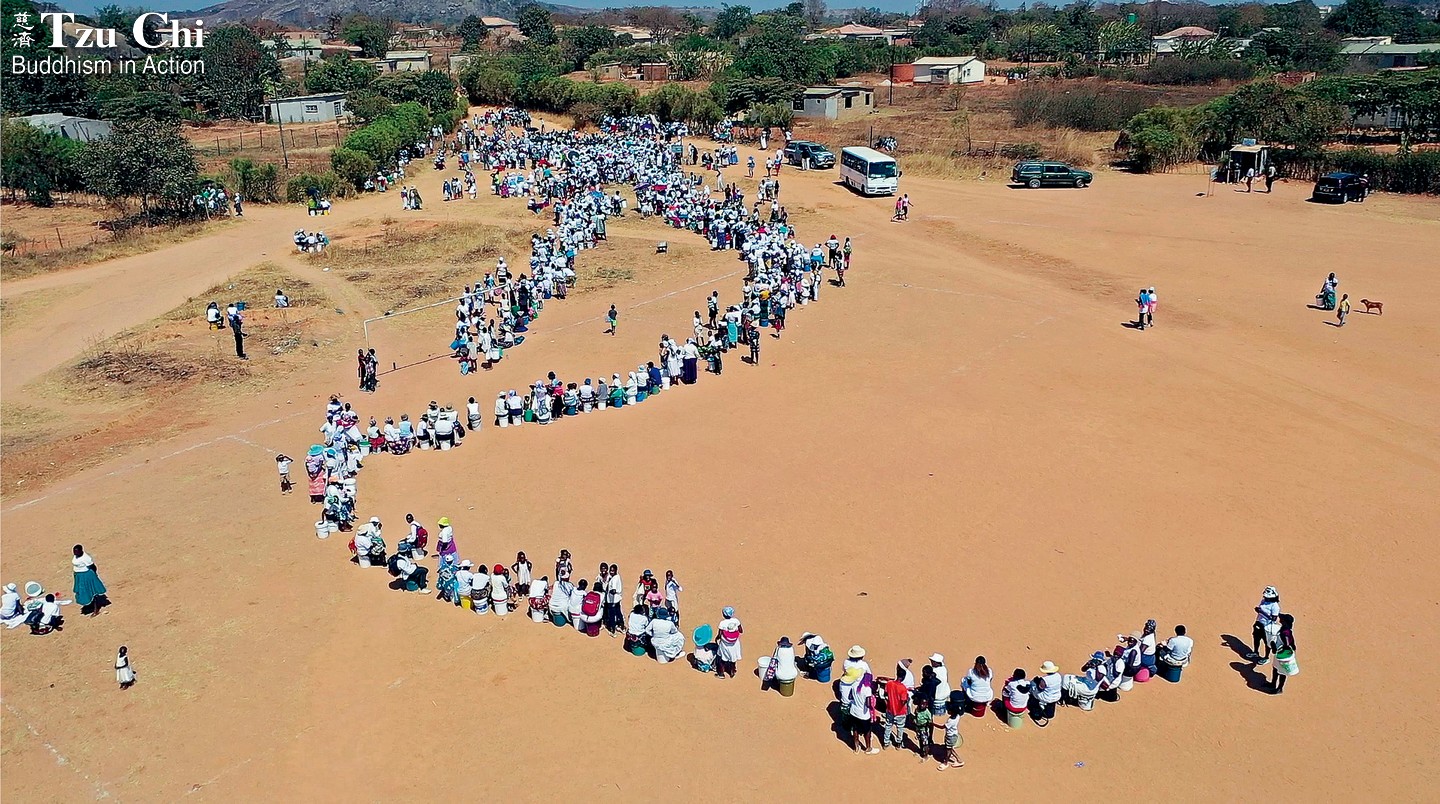
A single well can provide safe drinking water to hundreds of households within a three-kilometer radius. The aerial photo shows a long line of people waiting to fetch water from a well repaired by Tzu Chi in Domboshava. Li Wen-jie

Our team from Da Ai TV, together with Tzu Chi’s Africa Care Team, arrived in Zimbabwe in mid-August 2024. At volunteer Tino Chu’s home in the capital city of Harare, we were greeted with a large pot of vegetable soup made with fresh corn, shiitake mushrooms, and radishes—enough to feed an army. The sight brought me nearly to tears.

What might seem like a simple meal elsewhere is a rare and precious treat in many African countries south of the Sahara. In Mozambique, our previous stop, fresh corn was nowhere to be found. Locals typically dry it, grind it into powder, and cook it into a bland, porridge-like paste mixed with water. This staple dish is not meant to delight the palate but to stave off hunger. For many in these regions, securing even the most basic sustenance is a daily struggle, and meals are dictated by survival rather than choice.

El Niño is a climate phenomenon that has existed for thousands of years, but its impacts on humanity have been significantly more pronounced since the 20th century, particularly in Zimbabwe. In April 2024, the Zimbabwean government declared a national disaster as an El Niño-induced drought triggered severe food shortages, leaving more than half of the country’s 16 million people in need of food.

Food insecurity is not new in Zimbabwe. Over the years, Tzu Chi has worked to address this need, establishing 52 hot meal stations that now provide daily lunches to 16,000 people.

At a hot meal station in Domboshava, near Harare, we were deeply shocked witnessing the overwhelming need firsthand. The site teemed with people—some had walked up to two hours for a meal. Many families own farmland, but the relentless drought had caused crops like corn to fail.

The distributions primarily focus on children, so families often bring their little ones along. Mothers carried or led their children through the crowd, each child clutching a large lunchbox. Amid the hubbub, some children became separated from their families and were brought to Tzu Chi volunteers. Announcements were used to help reunite them. Despite tears streaming down their faces, the children clung tightly to their lunchboxes, aware that this meal might be their family’s only food for the day.

At the Domboshava station, alongside the staple corn paste, Tzu Chi volunteers had prepared rice, potatoes, mashed beans, and cabbage—a feast by local standards. Volunteer Issac pointed out that due to the large crowds, distributing a single meal could take up to two hours.

Thousands of miles away in Taiwan, Dharma Master Cheng Yen viewed images of the massive crowds at Zimbabwe’s hot meal stations when our news was broadcast. Deeply concerned, she sought a clearer understanding of the drought, the food shortages, and how Tzu Chi could optimize its aid efforts to better support those in need.

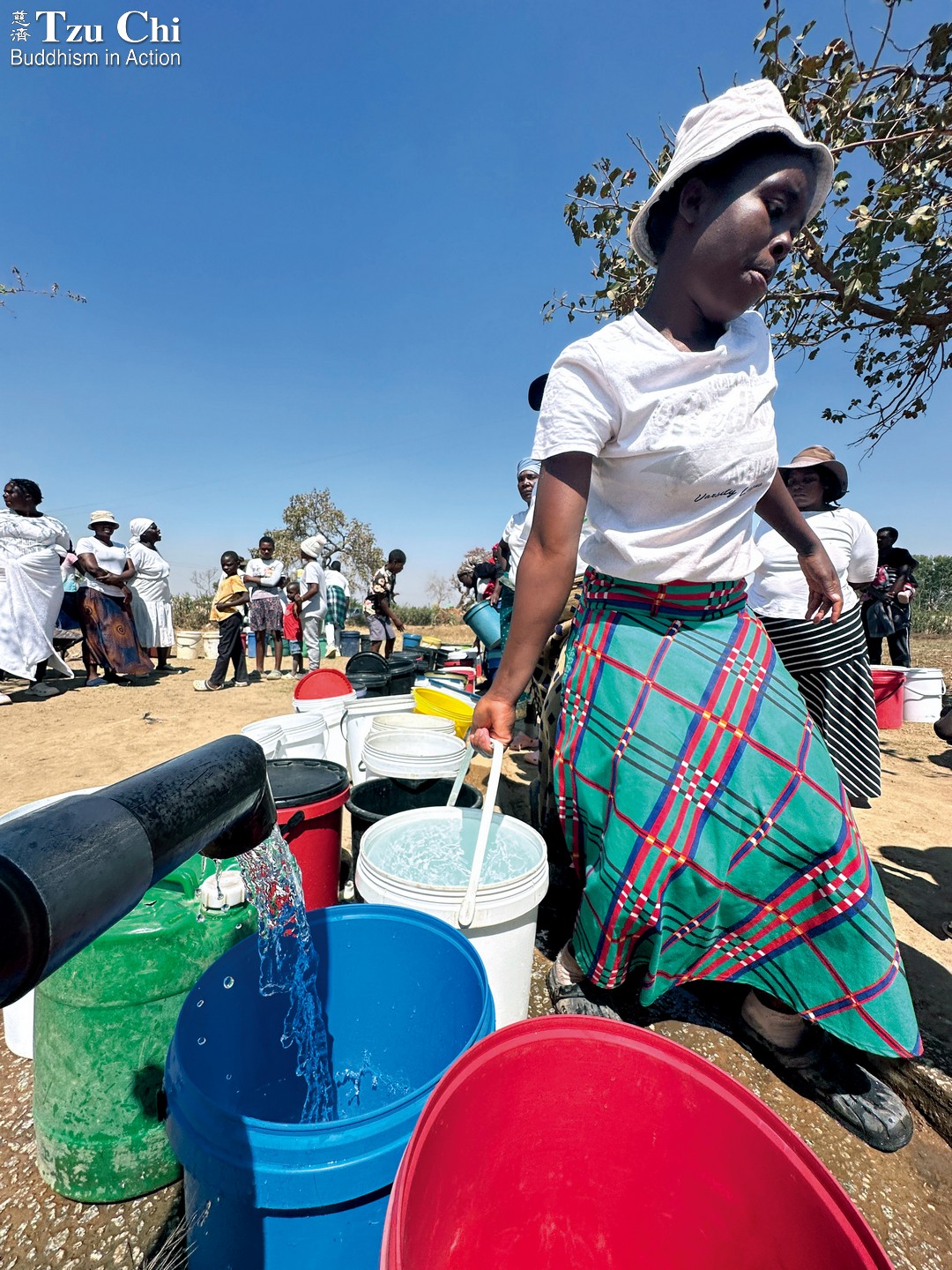
On average, a family requires five to seven buckets of water each day to meet their needs. Xu Fei-li

Water: scarce and precious

At Brother Chu’s home, we did not directly experience Zimbabwe’s food shortages, nor were we affected by the water shortage. According to Chu, tap water was supplied only once a week in Harare, “but no one knows which day it will come.” Even when it did arrive, the water often flowed brown from the pipes, making it nearly unusable.

During the severe cholera outbreak in 2008, contaminated water and food posed a significant risk. In response, Chu spent 12,000 U.S. dollars to dig a 55-meter (180-foot) well in his front yard to ensure his family had access to clean water. While the groundwater is clean and sufficient for daily needs, the family still purchases bottled water for drinking.

Originally from Taiwan, Chu has lived in Zimbabwe for nearly 30 years. While he has the financial means to secure a reliable water source, the same cannot be said for most locals. Repairing a well costs around 3,000 U.S. dollars and drilling a new one ranges from 7,000 to 8,000 dollars—unaffordable for the majority.

Understanding this hardship, Chu took action. Over the past 11 years, the Tzu Chi well-drilling team he leads has drilled or repaired more than 2,000 wells. When they receive reports of a broken well, the team heads out to carry out repairs.

We joined the team on one such trip. The journey was rough—the bumpy ride caused us considerable discomfort. As we left paved roads for dirt paths, the landscape turned stark, with sparse trees and vast stretches of barren land.

Our destination was a well in Mhondoro, built decades ago as a rest stop for travelers. It had been broken for 24 years. Upon arrival, Chu and his team dismantled the pump. An earlier survey by the team had revealed large beehives inside the well. After the local government removed the hives, the team returned to complete the repairs.

I was surprised to see female team members working alongside men, skillfully using large pliers to dismantle the pump. Chu had trained them in the necessary techniques. Once the pump was disassembled, the team identified the faulty parts and replaced them.

With training and experience, the team can now repair two wells in a single day. Beyond their technical work, they also connect with villagers, sharing Tzu Chi’s values and philosophy to inspire hope and resilience.

Under Chu’s leadership, the team has expanded from one unit to five, working entirely free of charge to provide access to clean water. Their efforts have made the Tzu Chi well-drilling team a trusted name in Zimbabwe.

On our way back, we rode in the team’s vehicle, packed with heavy machinery. Though the ride was as rough as before, the volunteers’ spirits remained high. They clapped and sang, their determination to help Zimbabwe shining through.

Sitting on a dry riverbed, Tino Chu looks at a hole dug by local residents to collect water. In Zimbab­we, where a water supply infrastructure is lacking, repairing or drilling wells is a life-saving endeavor. Hlengisile Jiyane

A call for greater efforts

After we returned to Taiwan, Master De Hao (德浩) at the Jing Si Abode shared an unexpected fact with me: bananas, a common fruit in Taiwan, are extremely expensive in Zimbabwe. “Master Cheng Yen eats one banana a day to remind herself of Zimbabwe’s needs,” she said. During my visit, I hadn’t seen a single banana.

Master Cheng Yen has said that transforming Africa’s suffering is an incredibly difficult task. It requires not only external aid but also empowering locals to find their own strength. Only through collective effort can they face the challenges brought by climate change and other hardships.

We sincerely hope that one day, with everyone’s support, Zimbabwe’s people will have the infrastructure, food, and other resources they need to live dignified and thriving lives.

By Xu Fei-li
Abridged and translated by Wu Hsiao-ting

In April 2024, Zimbabwe declared a state of disaster as an ongoing drought left half of the country’s 16 million people facing food shortages. Tzu Chi is helping to address this crisis.

A single well can provide safe drinking water to hundreds of households within a three-kilometer radius. The aerial photo shows a long line of people waiting to fetch water from a well repaired by Tzu Chi in Domboshava. Li Wen-jie

Our team from Da Ai TV, together with Tzu Chi’s Africa Care Team, arrived in Zimbabwe in mid-August 2024. At volunteer Tino Chu’s home in the capital city of Harare, we were greeted with a large pot of vegetable soup made with fresh corn, shiitake mushrooms, and radishes—enough to feed an army. The sight brought me nearly to tears.

What might seem like a simple meal elsewhere is a rare and precious treat in many African countries south of the Sahara. In Mozambique, our previous stop, fresh corn was nowhere to be found. Locals typically dry it, grind it into powder, and cook it into a bland, porridge-like paste mixed with water. This staple dish is not meant to delight the palate but to stave off hunger. For many in these regions, securing even the most basic sustenance is a daily struggle, and meals are dictated by survival rather than choice.

El Niño is a climate phenomenon that has existed for thousands of years, but its impacts on humanity have been significantly more pronounced since the 20th century, particularly in Zimbabwe. In April 2024, the Zimbabwean government declared a national disaster as an El Niño-induced drought triggered severe food shortages, leaving more than half of the country’s 16 million people in need of food.

Food insecurity is not new in Zimbabwe. Over the years, Tzu Chi has worked to address this need, establishing 52 hot meal stations that now provide daily lunches to 16,000 people.

At a hot meal station in Domboshava, near Harare, we were deeply shocked witnessing the overwhelming need firsthand. The site teemed with people—some had walked up to two hours for a meal. Many families own farmland, but the relentless drought had caused crops like corn to fail.

The distributions primarily focus on children, so families often bring their little ones along. Mothers carried or led their children through the crowd, each child clutching a large lunchbox. Amid the hubbub, some children became separated from their families and were brought to Tzu Chi volunteers. Announcements were used to help reunite them. Despite tears streaming down their faces, the children clung tightly to their lunchboxes, aware that this meal might be their family’s only food for the day.

At the Domboshava station, alongside the staple corn paste, Tzu Chi volunteers had prepared rice, potatoes, mashed beans, and cabbage—a feast by local standards. Volunteer Issac pointed out that due to the large crowds, distributing a single meal could take up to two hours.

Thousands of miles away in Taiwan, Dharma Master Cheng Yen viewed images of the massive crowds at Zimbabwe’s hot meal stations when our news was broadcast. Deeply concerned, she sought a clearer understanding of the drought, the food shortages, and how Tzu Chi could optimize its aid efforts to better support those in need.

On average, a family requires five to seven buckets of water each day to meet their needs. Xu Fei-li

Water: scarce and precious

At Brother Chu’s home, we did not directly experience Zimbabwe’s food shortages, nor were we affected by the water shortage. According to Chu, tap water was supplied only once a week in Harare, “but no one knows which day it will come.” Even when it did arrive, the water often flowed brown from the pipes, making it nearly unusable.

During the severe cholera outbreak in 2008, contaminated water and food posed a significant risk. In response, Chu spent 12,000 U.S. dollars to dig a 55-meter (180-foot) well in his front yard to ensure his family had access to clean water. While the groundwater is clean and sufficient for daily needs, the family still purchases bottled water for drinking.

Originally from Taiwan, Chu has lived in Zimbabwe for nearly 30 years. While he has the financial means to secure a reliable water source, the same cannot be said for most locals. Repairing a well costs around 3,000 U.S. dollars and drilling a new one ranges from 7,000 to 8,000 dollars—unaffordable for the majority.

Understanding this hardship, Chu took action. Over the past 11 years, the Tzu Chi well-drilling team he leads has drilled or repaired more than 2,000 wells. When they receive reports of a broken well, the team heads out to carry out repairs.

We joined the team on one such trip. The journey was rough—the bumpy ride caused us considerable discomfort. As we left paved roads for dirt paths, the landscape turned stark, with sparse trees and vast stretches of barren land.

Our destination was a well in Mhondoro, built decades ago as a rest stop for travelers. It had been broken for 24 years. Upon arrival, Chu and his team dismantled the pump. An earlier survey by the team had revealed large beehives inside the well. After the local government removed the hives, the team returned to complete the repairs.

I was surprised to see female team members working alongside men, skillfully using large pliers to dismantle the pump. Chu had trained them in the necessary techniques. Once the pump was disassembled, the team identified the faulty parts and replaced them.

With training and experience, the team can now repair two wells in a single day. Beyond their technical work, they also connect with villagers, sharing Tzu Chi’s values and philosophy to inspire hope and resilience.

Under Chu’s leadership, the team has expanded from one unit to five, working entirely free of charge to provide access to clean water. Their efforts have made the Tzu Chi well-drilling team a trusted name in Zimbabwe.

On our way back, we rode in the team’s vehicle, packed with heavy machinery. Though the ride was as rough as before, the volunteers’ spirits remained high. They clapped and sang, their determination to help Zimbabwe shining through.

Sitting on a dry riverbed, Tino Chu looks at a hole dug by local residents to collect water. In Zimbab­we, where a water supply infrastructure is lacking, repairing or drilling wells is a life-saving endeavor. Hlengisile Jiyane

A call for greater efforts

After we returned to Taiwan, Master De Hao (德浩) at the Jing Si Abode shared an unexpected fact with me: bananas, a common fruit in Taiwan, are extremely expensive in Zimbabwe. “Master Cheng Yen eats one banana a day to remind herself of Zimbabwe’s needs,” she said. During my visit, I hadn’t seen a single banana.

Master Cheng Yen has said that transforming Africa’s suffering is an incredibly difficult task. It requires not only external aid but also empowering locals to find their own strength. Only through collective effort can they face the challenges brought by climate change and other hardships.

We sincerely hope that one day, with everyone’s support, Zimbabwe’s people will have the infrastructure, food, and other resources they need to live dignified and thriving lives.

關鍵字

A Bond Beyond Blood

By Lai Yue-hong, Wu Hui-li, and Chen Hui-yu
Translated by Wu Hsiao-ting
Photos by Lin Qun-jie

Stem cell donors and recipients come together in a celebration of hope, healing, and life-saving compassion.

Chen Chang-long (right) shares a heartfelt embrace with his donor, Zou Yi-qing. After waiting six years, he finally had the chance to meet her and express his gratitude in person.

When Chen Chang-long (陳昌隆) learned that he had cancer, one thought flashed through his mind: “I just pray Heaven lets me live a little longer; if I must go, let it be after my parents.” Unmarried, optimistic, and deeply devoted to his parents, his greatest fear upon receiving the diagnosis was causing them the unbearable pain of losing a child.

Reflecting on his journey, Chen recalled how he began suffering from troubling symptoms in early 2016, just before Chinese New Year: a rash, severe itching, dizziness, and diarrhea. He consulted doctors from various specialties—dermatology, nephrology, neurology, rheumatology, and hematology—but after seeing seven doctors, the cause of his illness remained a mystery. Each visit left him feeling disheartened, wondering where his true adversary lay hidden.

Eventually, a bone marrow biopsy revealed that he was suffering from myelodysplastic syndrome, a type of cancer in which the bone marrow fails to produce enough healthy blood cells. Although the diagnosis was serious, he didn’t feel overly saddened; instead, a sense of relief settled in—at least he finally knew what he was up against. Chemotherapy and targeted therapies began in August 2017, but they proved ineffective. His doctor then recommended a hematopoietic stem cell transplant, and fortunately, a matching donor was found. Chen underwent a conditioning regimen and received the transplant in March 2018. (A conditioning regimen is a rigorous pre-transplant treatment to prepare one’s body for the procedure.)

A few weeks after the transplant, he suffered severe rejection, marked by excruciating headaches, jaundice, and other liver complications. High doses of steroids were needed to stabilize his condition, which resulted in side effects such as hand tremors, blackened nails, swelling, and gum inflammation. When a kidney infection required a CT scan, the contrast agent injected before the scan triggered a life-threatening allergic reaction, requiring four doses of epinephrine to save his life. He also battled severe trigeminal shingles.

A year after his transplant, with rejection behind him except for some residual allergies, his health gradually improved. Now back on his feet, he was eager to meet his donor and express his gratitude. He wrote to the Tzu Chi Stem Cell Center, which had helped him find a match, hoping for a chance to meet his donor. However, due to privacy regulations, he had to wait longer before fulfilling his wish.

Jian Cong-liang (right) presents a card, written by him and his family, to Chen Zheng-bin as a gesture of gratitude for his life-saving stem cell donation.

A long-awaited meeting

On October 18, 2024, Chen traveled from Taichung, central Taiwan, to New Taipei City. The next day, he went to the Tzu Chi Sanchong Campus for a donor-recipient gathering hosted by the Tzu Chi Stem Cell Center. It had been six years of waiting, but the time had finally come for Chen to meet his donor.

The moment that Chen had eagerly anticipated arrived—it was his turn to go on stage. Seeing his donor, Zou Yi-qing (鄒宜青), for the first time, he smiled shyly and, with encouragement from the host, embraced her joyfully. Zou said that seeing him so healthy finally put her mind at ease. Full of gratitude, Chen shared how fortunate he felt to have found a matching donor.

Zou’s own journey to this moment had started 14 years earlier, when she signed up as a donor. Even so, she initially hesitated when she was contacted and informed that she was a match for a potential recipient. She wasn’t sure about the process, but after learning it was similar to donating blood, and after receiving support from her family, she decided to proceed, knowing she might be Chen’s only hope.

When Chen learned at the gathering that Zou had felt unwell during her donation at Hualien Tzu Chi Hospital, his heart went out to her. Zou explained that at the time, she knew Chen had already completed his conditioning regimen and was waiting in a sterile room for the transplant. There was no turning back—she could only hope for his survival. Thankfully, she fully recovered and remained as healthy as before.

Following the transplant, Chen’s blood type changed from A to O, and he noticed that he had become more cheerful than before. He now regularly donates to charities as a way to honor Zou’s kindness, feeling that, because of her, he gained a deeper understanding of selfless love. Zou, in turn, told him, “Because of you, I was able to achieve something extraordinary. Thank you for staying strong and surviving.”

A gift of life

During the gathering, seven donor-recipient pairs shared their stories on stage. The event also honored 81 individuals who had donated their stem cells between July 2023 and June 2024. Each donor received a medal as a token of gratitude for their incredible generosity.

Over the past 31 years, the Tzu Chi Stem Cell Center has facilitated over 6,800 transplants across 31 countries and regions. Of these, over 3,300 donations benefited patients in Taiwan, while more than 3,400 helped those in other parts of the world. With odds of just one in 100,000, finding a non-familial match is as difficult as searching for a needle in a haystack. This life-saving mission is made possible by the dedication of Tzu Chi volunteers, who recruit potential donors, and the donors themselves, who selflessly step forward to give the gift of life.

In 2018, Chen Zheng-bin (陳政彬), then 28, received an unexpected call informing him he had matched with a patient in critical need of stem cells. “Honestly, I thought it was a scam!” he admitted, having forgotten he had joined the donor registry while in high school. Persistent follow-ups from volunteers eventually jogged his memory, but misconceptions—such as the belief that donation involved painful bone marrow extraction—gave him pause.

After receiving explanations from volunteers and conducting his own research, Chen learned that the procedure was much simpler than he had imagined. It involved receiving granulocyte-colony stimulating factor (G-CSF) injections to stimulate stem cell production, followed by a procedure similar to donating blood to collect peripheral blood stem cells.

Understanding that his donation could save a life, Chen agreed without further hesitation. His family wholeheartedly supported his decision. To ensure his stem cells were in optimal condition, he adopted a healthier lifestyle, avoiding late nights and exercising regularly. Because the recipient was physically larger, Chen’s donation required two sessions—eight hours on the first day and four hours on the second. Despite the lengthy process, he felt no discomfort and even described the experience as relaxing, likening it to a brief vacation from his busy work schedule.

The recipient, Jian Cong-liang (簡聰良), 21 years Chen’s senior, experienced only mild rejection symptoms after  the transplant. He was immensely grateful after regaining his health, and now celebrates two birthdays every year: his actual birthday and April 24, the day of his life-saving transplant. His brush with death profoundly changed his outlook on life. “I used to stress about earning enough money to provide material comforts for my children,” he said. “Now, I’m more relaxed and philosophical, realizing that nothing is more precious than life itself.”

Jian, from Taiwan, had lived in Suzhou, China, for many years due to work, where he married and started a family. In January 2018, his life took an unexpected turn when he developed puzzling symptoms and returned to Taiwan for medical care. He was shocked when he was diagnosed with severe aplastic anemia. His doctor recommended a stem cell transplant. Jian, who had been healthy up to that point and rarely needed medical attention, agreed to the procedure.

For Jian, the diagnosis brought with it immense uncertainty: “Will I find a match? What will happen to my young children if I don’t?” Throughout the ordeal, his family was his greatest source of strength, supporting him through the uncertainty and rigorous treatment.

Fortunately, just two months after he opted for a transplant, the Tzu Chi Stem Cell Center found him a donor with a perfect match. When Jian met Chen at the October 19 gathering, he presented him with a heartfelt card, in which he had written: “Though I faced great misfortune [by falling seriously ill], I am also incredibly fortunate. Your generosity gave me a second chance at life during my darkest hour.”

Since his donation, Chen has remained in excellent health, with regular follow-ups confirming his well-being. He often shares his story to inspire others to register as donors. Encouraged by his example, both his sister and wife have joined the registry. Speaking about his experience, Chen said, “I’m so glad the recipient survived. Saving his life is one of the most meaningful things I’ve ever done.”

Recently, his perspective deepened when his mother was diagnosed with cancer, allowing him to better empathize with recipients and their families. He expressed gratitude for the opportunity to donate six years before, realizing it might have been his only chance to save a life. He was truly happy he had seized it.

Painter Liu Feng-lai (fifth from right) conveys her appreciation to her donor, Zeng Hui-ping (third from left), by gifting her a traditional Chinese painting of flowers and birds that she had created herself.

Fueling life-saving efforts

Zeng Hui-ping (曾惠平) received notice of a successful preliminary match 16 years after registering her blood sample in Taipei. Over those years, she had changed jobs several times and moved south to Taichung. To contact her, Tzu Chi volunteers waited outside the building where her parents lived, as there was no doorbell. Luckily, they caught her sister-in-law as she was leaving, and she called Zeng to inform her: “Two Tzu Chi sisters are looking for you.”

When Zeng learned that the recipient’s genes might be influenced by hers—potentially changing his or her hair texture and blood type—she was deeply moved and cried, feeling as though she were gaining a new “baby.” She experienced no side effects during the G-CSF injections, and with the encouragement and support of her friends and family, she felt truly blessed.

Zeng’s “baby” turned out to be 68-year-old painter Liu Feng-lai (劉豐來), who held her fifth exhibition in September 2024. Liu’s entire family attended the gathering to personally thank Zeng—a moment Liu herself had eagerly awaited for six years. At every follow-up appointment after her transplant, Liu would ask, “When can I meet my donor?” During the gathering, even before discovering Zeng was her match, Liu instinctively sensed it. When the two finally embraced, Zeng said, “You’ve done great!” Fighting back tears, Liu replied, “Without you, I wouldn’t be here with my family.”

Liu had been diagnosed with acute myeloid leukemia in March 2017. None of her three sisters were a match, so she was deeply grateful to find one in Zeng, which allowed her to continue pursuing her passion for art and living a full, vibrant life.

Initially, Zeng’s mother was worried about her daughter’s decision to donate and even considered urging her to reconsider during their train ride to Hualien Tzu Chi Hospital for the procedure. However, after seeing how the doctors and Tzu Chi volunteers safeguarded not just the recipient’s but also the donor’s well-being, her concerns eased. Now, six years later, she feels proud of her daughter’s wise, admirable decision.

“At first, I didn’t understand why such a wonderful act [stem cell donation] wasn’t shared more online,” Zeng remarked. Motivated by this realization, she began documenting her donation experience and post-donation health updates on her blog and social media. Her aim was to promote the cause and help future donors prepare both mentally and physically.

Currently, the Tzu Chi Stem Cell Center has over 483,000 registered donors. However, half of them are over 55 and nearing the end of their eligibility. New donor registrations have also declined, and fewer than half of matched donors agree to donate. Compounding these challenges is Taiwan’s declining birth rate, which has reduced the likelihood of family-member matches. These factors make expanding the database of unrelated donors more critical than ever.

Relieving great pain takes immense love. Between January and October 2024 alone, more than 1,100 individuals sought donor matching services through the Tzu Chi Stem Cell Center. This database, made up of voluntary donors, is a vital lifeline for patients. You might hold the key to saving someone’s life. Be the hope a patient is waiting for.

By Lai Yue-hong, Wu Hui-li, and Chen Hui-yu
Translated by Wu Hsiao-ting
Photos by Lin Qun-jie

Stem cell donors and recipients come together in a celebration of hope, healing, and life-saving compassion.

Chen Chang-long (right) shares a heartfelt embrace with his donor, Zou Yi-qing. After waiting six years, he finally had the chance to meet her and express his gratitude in person.

When Chen Chang-long (陳昌隆) learned that he had cancer, one thought flashed through his mind: “I just pray Heaven lets me live a little longer; if I must go, let it be after my parents.” Unmarried, optimistic, and deeply devoted to his parents, his greatest fear upon receiving the diagnosis was causing them the unbearable pain of losing a child.

Reflecting on his journey, Chen recalled how he began suffering from troubling symptoms in early 2016, just before Chinese New Year: a rash, severe itching, dizziness, and diarrhea. He consulted doctors from various specialties—dermatology, nephrology, neurology, rheumatology, and hematology—but after seeing seven doctors, the cause of his illness remained a mystery. Each visit left him feeling disheartened, wondering where his true adversary lay hidden.

Eventually, a bone marrow biopsy revealed that he was suffering from myelodysplastic syndrome, a type of cancer in which the bone marrow fails to produce enough healthy blood cells. Although the diagnosis was serious, he didn’t feel overly saddened; instead, a sense of relief settled in—at least he finally knew what he was up against. Chemotherapy and targeted therapies began in August 2017, but they proved ineffective. His doctor then recommended a hematopoietic stem cell transplant, and fortunately, a matching donor was found. Chen underwent a conditioning regimen and received the transplant in March 2018. (A conditioning regimen is a rigorous pre-transplant treatment to prepare one’s body for the procedure.)

A few weeks after the transplant, he suffered severe rejection, marked by excruciating headaches, jaundice, and other liver complications. High doses of steroids were needed to stabilize his condition, which resulted in side effects such as hand tremors, blackened nails, swelling, and gum inflammation. When a kidney infection required a CT scan, the contrast agent injected before the scan triggered a life-threatening allergic reaction, requiring four doses of epinephrine to save his life. He also battled severe trigeminal shingles.

A year after his transplant, with rejection behind him except for some residual allergies, his health gradually improved. Now back on his feet, he was eager to meet his donor and express his gratitude. He wrote to the Tzu Chi Stem Cell Center, which had helped him find a match, hoping for a chance to meet his donor. However, due to privacy regulations, he had to wait longer before fulfilling his wish.

Jian Cong-liang (right) presents a card, written by him and his family, to Chen Zheng-bin as a gesture of gratitude for his life-saving stem cell donation.

A long-awaited meeting

On October 18, 2024, Chen traveled from Taichung, central Taiwan, to New Taipei City. The next day, he went to the Tzu Chi Sanchong Campus for a donor-recipient gathering hosted by the Tzu Chi Stem Cell Center. It had been six years of waiting, but the time had finally come for Chen to meet his donor.

The moment that Chen had eagerly anticipated arrived—it was his turn to go on stage. Seeing his donor, Zou Yi-qing (鄒宜青), for the first time, he smiled shyly and, with encouragement from the host, embraced her joyfully. Zou said that seeing him so healthy finally put her mind at ease. Full of gratitude, Chen shared how fortunate he felt to have found a matching donor.

Zou’s own journey to this moment had started 14 years earlier, when she signed up as a donor. Even so, she initially hesitated when she was contacted and informed that she was a match for a potential recipient. She wasn’t sure about the process, but after learning it was similar to donating blood, and after receiving support from her family, she decided to proceed, knowing she might be Chen’s only hope.

When Chen learned at the gathering that Zou had felt unwell during her donation at Hualien Tzu Chi Hospital, his heart went out to her. Zou explained that at the time, she knew Chen had already completed his conditioning regimen and was waiting in a sterile room for the transplant. There was no turning back—she could only hope for his survival. Thankfully, she fully recovered and remained as healthy as before.

Following the transplant, Chen’s blood type changed from A to O, and he noticed that he had become more cheerful than before. He now regularly donates to charities as a way to honor Zou’s kindness, feeling that, because of her, he gained a deeper understanding of selfless love. Zou, in turn, told him, “Because of you, I was able to achieve something extraordinary. Thank you for staying strong and surviving.”

A gift of life

During the gathering, seven donor-recipient pairs shared their stories on stage. The event also honored 81 individuals who had donated their stem cells between July 2023 and June 2024. Each donor received a medal as a token of gratitude for their incredible generosity.

Over the past 31 years, the Tzu Chi Stem Cell Center has facilitated over 6,800 transplants across 31 countries and regions. Of these, over 3,300 donations benefited patients in Taiwan, while more than 3,400 helped those in other parts of the world. With odds of just one in 100,000, finding a non-familial match is as difficult as searching for a needle in a haystack. This life-saving mission is made possible by the dedication of Tzu Chi volunteers, who recruit potential donors, and the donors themselves, who selflessly step forward to give the gift of life.

In 2018, Chen Zheng-bin (陳政彬), then 28, received an unexpected call informing him he had matched with a patient in critical need of stem cells. “Honestly, I thought it was a scam!” he admitted, having forgotten he had joined the donor registry while in high school. Persistent follow-ups from volunteers eventually jogged his memory, but misconceptions—such as the belief that donation involved painful bone marrow extraction—gave him pause.

After receiving explanations from volunteers and conducting his own research, Chen learned that the procedure was much simpler than he had imagined. It involved receiving granulocyte-colony stimulating factor (G-CSF) injections to stimulate stem cell production, followed by a procedure similar to donating blood to collect peripheral blood stem cells.

Understanding that his donation could save a life, Chen agreed without further hesitation. His family wholeheartedly supported his decision. To ensure his stem cells were in optimal condition, he adopted a healthier lifestyle, avoiding late nights and exercising regularly. Because the recipient was physically larger, Chen’s donation required two sessions—eight hours on the first day and four hours on the second. Despite the lengthy process, he felt no discomfort and even described the experience as relaxing, likening it to a brief vacation from his busy work schedule.

The recipient, Jian Cong-liang (簡聰良), 21 years Chen’s senior, experienced only mild rejection symptoms after  the transplant. He was immensely grateful after regaining his health, and now celebrates two birthdays every year: his actual birthday and April 24, the day of his life-saving transplant. His brush with death profoundly changed his outlook on life. “I used to stress about earning enough money to provide material comforts for my children,” he said. “Now, I’m more relaxed and philosophical, realizing that nothing is more precious than life itself.”

Jian, from Taiwan, had lived in Suzhou, China, for many years due to work, where he married and started a family. In January 2018, his life took an unexpected turn when he developed puzzling symptoms and returned to Taiwan for medical care. He was shocked when he was diagnosed with severe aplastic anemia. His doctor recommended a stem cell transplant. Jian, who had been healthy up to that point and rarely needed medical attention, agreed to the procedure.

For Jian, the diagnosis brought with it immense uncertainty: “Will I find a match? What will happen to my young children if I don’t?” Throughout the ordeal, his family was his greatest source of strength, supporting him through the uncertainty and rigorous treatment.

Fortunately, just two months after he opted for a transplant, the Tzu Chi Stem Cell Center found him a donor with a perfect match. When Jian met Chen at the October 19 gathering, he presented him with a heartfelt card, in which he had written: “Though I faced great misfortune [by falling seriously ill], I am also incredibly fortunate. Your generosity gave me a second chance at life during my darkest hour.”

Since his donation, Chen has remained in excellent health, with regular follow-ups confirming his well-being. He often shares his story to inspire others to register as donors. Encouraged by his example, both his sister and wife have joined the registry. Speaking about his experience, Chen said, “I’m so glad the recipient survived. Saving his life is one of the most meaningful things I’ve ever done.”

Recently, his perspective deepened when his mother was diagnosed with cancer, allowing him to better empathize with recipients and their families. He expressed gratitude for the opportunity to donate six years before, realizing it might have been his only chance to save a life. He was truly happy he had seized it.

Painter Liu Feng-lai (fifth from right) conveys her appreciation to her donor, Zeng Hui-ping (third from left), by gifting her a traditional Chinese painting of flowers and birds that she had created herself.

Fueling life-saving efforts

Zeng Hui-ping (曾惠平) received notice of a successful preliminary match 16 years after registering her blood sample in Taipei. Over those years, she had changed jobs several times and moved south to Taichung. To contact her, Tzu Chi volunteers waited outside the building where her parents lived, as there was no doorbell. Luckily, they caught her sister-in-law as she was leaving, and she called Zeng to inform her: “Two Tzu Chi sisters are looking for you.”

When Zeng learned that the recipient’s genes might be influenced by hers—potentially changing his or her hair texture and blood type—she was deeply moved and cried, feeling as though she were gaining a new “baby.” She experienced no side effects during the G-CSF injections, and with the encouragement and support of her friends and family, she felt truly blessed.

Zeng’s “baby” turned out to be 68-year-old painter Liu Feng-lai (劉豐來), who held her fifth exhibition in September 2024. Liu’s entire family attended the gathering to personally thank Zeng—a moment Liu herself had eagerly awaited for six years. At every follow-up appointment after her transplant, Liu would ask, “When can I meet my donor?” During the gathering, even before discovering Zeng was her match, Liu instinctively sensed it. When the two finally embraced, Zeng said, “You’ve done great!” Fighting back tears, Liu replied, “Without you, I wouldn’t be here with my family.”

Liu had been diagnosed with acute myeloid leukemia in March 2017. None of her three sisters were a match, so she was deeply grateful to find one in Zeng, which allowed her to continue pursuing her passion for art and living a full, vibrant life.

Initially, Zeng’s mother was worried about her daughter’s decision to donate and even considered urging her to reconsider during their train ride to Hualien Tzu Chi Hospital for the procedure. However, after seeing how the doctors and Tzu Chi volunteers safeguarded not just the recipient’s but also the donor’s well-being, her concerns eased. Now, six years later, she feels proud of her daughter’s wise, admirable decision.

“At first, I didn’t understand why such a wonderful act [stem cell donation] wasn’t shared more online,” Zeng remarked. Motivated by this realization, she began documenting her donation experience and post-donation health updates on her blog and social media. Her aim was to promote the cause and help future donors prepare both mentally and physically.

Currently, the Tzu Chi Stem Cell Center has over 483,000 registered donors. However, half of them are over 55 and nearing the end of their eligibility. New donor registrations have also declined, and fewer than half of matched donors agree to donate. Compounding these challenges is Taiwan’s declining birth rate, which has reduced the likelihood of family-member matches. These factors make expanding the database of unrelated donors more critical than ever.

Relieving great pain takes immense love. Between January and October 2024 alone, more than 1,100 individuals sought donor matching services through the Tzu Chi Stem Cell Center. This database, made up of voluntary donors, is a vital lifeline for patients. You might hold the key to saving someone’s life. Be the hope a patient is waiting for.

關鍵字

Mother and Daughter—Together in Giving

By Zhang Li-yun
Edited and translated by Wu Hsiao-ting
Photos by Yan Lin-zhao

Chen Lin Shui-jin, though 102 years old, continues to find joy in helping others and working diligently. Her resilience, diligence, and generous spirit have been passed down to her daughter Qia.

Mother and daughter, Chen Lin Shui-jin and Chen Qia, are hardworking, resilient, and share a generous spirit.

Chen Lin Shui-jin’s (陳林水錦) century-long life has been marked by tireless hard work. Born into a farming family in the mountains of Zhushan Township, Nantou County, central Taiwan, she grew up in an era when Taiwan was a relatively impoverished society. In those days, having enough to eat was a blessing, and an education was a luxury beyond reach. Consequently, she never attended school or learned to read.

After marrying, she left the mountains and settled by a waterway, where her husband cultivated water spinach hydroponically. Every morning, around three or four, she would head to the fields in the dark, wading through water to harvest the fresh, tender greens. At daybreak, her husband would take the produce to the market for wholesale.

As their family grew to six, the income from farming and selling water spinach became insufficient to support their household. To make ends meet, her husband started a wood processing factory, and Shui-jin began working there as well. Even after their children grew up and she no longer needed to help support the family, she couldn’t sit idle. She began collecting discarded cardboard and scrap metal to sell, earning a small income for herself. Her daughter Chen Qia (陳洽), who ran a general store in Zhushan, readily gave her the shop’s used boxes.

In the early 2000s, Qia suggested, “Those cardboard boxes don’t bring much money. Why not donate them to Tzu Chi?” Moved by the suggestion, Shui-jin agreed without hesitation, turning her recycling efforts into a meaningful contribution. She even made up the difference herself when the proceeds fell short of a thousand Taiwanese dollars (US$33).

For a time, Shui-jin volunteered at the Tzu Chi Zhushan Recycling Station on Wednesdays and Saturdays. But at home, she remained restless. Over time, signs of memory decline emerged, leaving her confused over simple things. For example, she would often pick up fruits from the table, squeeze them, and ask, “What is this?” Her daughter-in-law, who lived with her, discussed the situation with Qia. Hoping to slow her cognitive decline, they arranged for her to attend a Tzu Chi senior day care center on weekdays. On Saturdays, she continued volunteering at the recycling station.

Now over a hundred years old, Shui-jin continues to work with remarkable precision at the recycling station. She sorts bottles with accuracy and folds newspapers neatly. Qia noted her mother’s deep devotion to recycling. Though Shui-jin may not understand complex philosophies or know how to read, her simple wisdom and heartfelt desire to help others shine through in her words: “Recycling is great—the proceeds can be used for charitable purposes.”

In this childhood photograph, Qia (second from left) nestles against her mother, Shui-jin (third from left). Courtesy of Chen Qia

Willingly repaying her karmic debt

Chen Qia was born in 1953. She remembers helping her father at the wood processing factory even as a young elementary school student. She assisted with tasks like moving lumber, which was turned into everyday items such as clothes hangers, rice spatulas, and spoons. She shared that her father had suffered a severe burn on his right hand in an oil lamp accident during his childhood. The injury required treatment at Camillian Saint Mary’s Hospital Luodong. The hospital, aware of the family’s financial struggles, waived the medical expenses. While her father recovered, four fingers on his injured hand eventually atrophied. In the end, only his thumb remained functional. Undeterred by this disability, he continued to develop new products for the factory, including bamboo fruit baskets, plates, and handbags for export.

Before her marriage, Qia was her father’s right-hand helper, skillfully balancing factory work and household tasks. These experiences shaped her into a hardworking and resilient person, like her mother. These qualities became vital when her life took a new direction after marriage, when she took on the demanding role of caring for her elderly father-in-law and two mothers-in-law. (It was not uncommon for men of earlier generations to practice polygamy.) These caregiving responsibilities made it impossible for her to continue to assist her father at the factory. Around the same time, Taiwan’s rising labor costs and increased global competition led many factories to relocate overseas. Consequently, her family decided to close the factory and open a mom-and-pop store instead.

In 1998, Qia found herself caught in a financial crisis when a member of a private credit group she managed misappropriated funds and disappeared, causing the group to collapse. She told her husband, “I’m the head of this credit group. I can’t betray the trust of those involved. I’ll find a way to fix this. Money can be earned again, and if I work hard, we’ll get through this.” Determined to protect others from the fallout, she took full responsibility for the debts and vowed to repay them. She seized every opportunity to earn money, sacrificing sleep and enduring physical exhaustion to meet her goals.

Her challenges intensified in September 1999, when a massive earthquake struck central Taiwan, devastating Zhushan Township. The earthquake damaged her store and warehouse, leaving goods scattered in disarray across the floor. It took nearly two months to restore order. The strain of repair costs, combined with her existing debts, left her feeling overwhelmed.

Life’s trials didn’t stop there. In 1998, her father-in-law passed away. After that, her older mother-in-law lost her sense of purpose and gradually developed dementia. Then her younger mother-in-law began showing similar symptoms. For over a decade, Qia and her sister-in-law took turns caring for them. Despite these challenges, Qia remained committed to giving back to society. She continued her long-term financial support for the Taiwan Fund for Children and Families, a nonprofit that aids vulnerable children and families. Grateful for the care her father had received years earlier, she also made regular donations to Saint Mary’s Hospital. In addition, she became a Tzu Chi donating member through a recommendation from Xie Jin-mu (謝金木), a wholesaler in southern Taiwan.

One day, Tzu Chi volunteer You Shu-juan (尤淑娟) visited her store and noticed a portrait of Dharma Master Cheng Yen on the wall. Curious about the portrait, You asked about it, and Qia explained that it had been a gift from Xie Jin-mu. The two women quickly bonded, and Qia shared the burdens of her debts and family responsibilities, expressing her frustrations. You offered gentle guidance: “Master Cheng Yen teaches that this is ‘shared karma.’ If you accept and repay karmic debts willingly, you’ll get a discount; if you resist, you’ll pay double. It’s not worth it.” She urged Qia to face her challenges with a positive mindset, reminding her that resistance only deepens suffering.

You also urged her to open her heart: “There are others who suffer even more than you. By focusing less on your difficulties, you’ll feel lighter.” She suggested that Qia inspire goodness in her customers, encouraging them to contribute to worthy causes to help those in need.

You’s words resonated deeply with Qia, sparking a shift in her mindset. From that point on, whenever she felt frustrated or down, she reminded herself to shift her perspective from negativity to positivity. Gradually, she found greater peace of mind. In addition to managing her store, she began volunteering with Tzu Chi, collecting recyclables to support the foundation’s recycling efforts.

Shui-jin, 102, expertly sorts recyclables, placing each item in its designated basket.

Putting oneself to good use

After closing her store in the evenings, Chen Qia and her neighbor would each grab a large plastic bag and take a walk along a local road, collecting recyclables as they went. The evening market proved to be a goldmine, with cardboard boxes, bottles, and cans scattered everywhere, waiting to be collected. By the end of the night, their haul would create a small mountain of recyclables in Qia’s family’s unused factory, giving her mother something productive to do the next morning.

This was in the early 2000s, and Shui-jin, then in her 70s, was still very agile. She would quickly and efficiently sort the paper, metal cans, and plastic bottles. Once everything was organized, she would call her daughter, and no matter how busy Qia was at her store, she’d say, “Hurry up and take the sorted recyclables to the recycling station!” or “Quickly bring more recyclables back so I can sort them!”

Qia often encouraged her mother to volunteer at a local Tzu Chi recycling station, but Shui-jin hesitated and frequently made excuses not to do so. She didn’t know any of the volunteers and was concerned about feeling out of place. However, when she finally visited the station one day, she was greeted warmly by the volunteers there and quickly enjoyed the lively atmosphere. Turning to her daughter, she exclaimed, “Why didn’t you bring me here sooner?” From that day on, she went every day. On occasions when Qia was too busy to drive her, she would complain, “I’m so bored at home! So bored!”

Because Shui-jin had spent long hours in the fields picking water spinach and soaking her feet in the water when she was younger, she often struggled with swollen feet in her later years, which kept her awake at night. Sometimes, she would get up in the middle of the night and walk around to reduce the swelling before finally managing to fall back asleep. Her reliance on sleeping pills grew, and her memory began to fade. Even after taking her pills with dinner, she would ask for more before bed. However, after she started volunteering at the recycling station, she began to fall asleep more easily, and over time, her dependence on sleeping pills greatly decreased.

The most trying but also happy times

Chen Qia inherited not only her mother’s diligence and resilience but also her generosity. Shui-jin consistently donates money to help whenever she hears of someone in need. When impoverished people pass away, she covers the cost of their coffins. Qia said, “Children are often encouraged to perform good deeds to accumulate spiritual merits for their parents, but I believe my mother has already earned countless blessings through her own actions.”

Qia’s father passed away at 89. She feels fortunate that she didn’t marry far from home, as it has enabled her to care for her mother. Her greatest joy has been introducing her mother to Tzu Chi, allowing them to work together as recycling volunteers. Qia has endured some of the most difficult times of her life over the past 20-plus years, yet she remains confident that she has made the most meaningful choices.

Giving has become second nature to her. Despite injuring her right hand while moving recyclables and undergoing three surgeries to treat trigger finger in her left hand, she never hesitates to respond to calls for recycling collections, regardless of the volume or weight of the materials. She approaches the work with gratitude, growing stronger with each challenge and feeling fulfilled through her service. “Recycling feels like my second career,” remarked Qia. “Even if I work as hard as an ox every day, I see it as a form of spiritual practice. I willingly take on these tasks and complete them with a contented heart.”

The thought of retirement has never crossed her mind. She deeply appreciates her husband’s unwavering support, which has been a source of strength. “Tzu Chi is already a part of my life—an essential aspect of who I am,” she affirmed.

Through their shared commitment to recycling and steadfast dedication to helping others, the mother and daughter have not only enriched their own lives but have also left an indelible mark on this Earth. Together, they have found joy in their work—not driven by material rewards, but for the peace and purpose it brings.

By Zhang Li-yun
Edited and translated by Wu Hsiao-ting
Photos by Yan Lin-zhao

Chen Lin Shui-jin, though 102 years old, continues to find joy in helping others and working diligently. Her resilience, diligence, and generous spirit have been passed down to her daughter Qia.

Mother and daughter, Chen Lin Shui-jin and Chen Qia, are hardworking, resilient, and share a generous spirit.

Chen Lin Shui-jin’s (陳林水錦) century-long life has been marked by tireless hard work. Born into a farming family in the mountains of Zhushan Township, Nantou County, central Taiwan, she grew up in an era when Taiwan was a relatively impoverished society. In those days, having enough to eat was a blessing, and an education was a luxury beyond reach. Consequently, she never attended school or learned to read.

After marrying, she left the mountains and settled by a waterway, where her husband cultivated water spinach hydroponically. Every morning, around three or four, she would head to the fields in the dark, wading through water to harvest the fresh, tender greens. At daybreak, her husband would take the produce to the market for wholesale.

As their family grew to six, the income from farming and selling water spinach became insufficient to support their household. To make ends meet, her husband started a wood processing factory, and Shui-jin began working there as well. Even after their children grew up and she no longer needed to help support the family, she couldn’t sit idle. She began collecting discarded cardboard and scrap metal to sell, earning a small income for herself. Her daughter Chen Qia (陳洽), who ran a general store in Zhushan, readily gave her the shop’s used boxes.

In the early 2000s, Qia suggested, “Those cardboard boxes don’t bring much money. Why not donate them to Tzu Chi?” Moved by the suggestion, Shui-jin agreed without hesitation, turning her recycling efforts into a meaningful contribution. She even made up the difference herself when the proceeds fell short of a thousand Taiwanese dollars (US$33).

For a time, Shui-jin volunteered at the Tzu Chi Zhushan Recycling Station on Wednesdays and Saturdays. But at home, she remained restless. Over time, signs of memory decline emerged, leaving her confused over simple things. For example, she would often pick up fruits from the table, squeeze them, and ask, “What is this?” Her daughter-in-law, who lived with her, discussed the situation with Qia. Hoping to slow her cognitive decline, they arranged for her to attend a Tzu Chi senior day care center on weekdays. On Saturdays, she continued volunteering at the recycling station.

Now over a hundred years old, Shui-jin continues to work with remarkable precision at the recycling station. She sorts bottles with accuracy and folds newspapers neatly. Qia noted her mother’s deep devotion to recycling. Though Shui-jin may not understand complex philosophies or know how to read, her simple wisdom and heartfelt desire to help others shine through in her words: “Recycling is great—the proceeds can be used for charitable purposes.”

In this childhood photograph, Qia (second from left) nestles against her mother, Shui-jin (third from left). Courtesy of Chen Qia

Willingly repaying her karmic debt

Chen Qia was born in 1953. She remembers helping her father at the wood processing factory even as a young elementary school student. She assisted with tasks like moving lumber, which was turned into everyday items such as clothes hangers, rice spatulas, and spoons. She shared that her father had suffered a severe burn on his right hand in an oil lamp accident during his childhood. The injury required treatment at Camillian Saint Mary’s Hospital Luodong. The hospital, aware of the family’s financial struggles, waived the medical expenses. While her father recovered, four fingers on his injured hand eventually atrophied. In the end, only his thumb remained functional. Undeterred by this disability, he continued to develop new products for the factory, including bamboo fruit baskets, plates, and handbags for export.

Before her marriage, Qia was her father’s right-hand helper, skillfully balancing factory work and household tasks. These experiences shaped her into a hardworking and resilient person, like her mother. These qualities became vital when her life took a new direction after marriage, when she took on the demanding role of caring for her elderly father-in-law and two mothers-in-law. (It was not uncommon for men of earlier generations to practice polygamy.) These caregiving responsibilities made it impossible for her to continue to assist her father at the factory. Around the same time, Taiwan’s rising labor costs and increased global competition led many factories to relocate overseas. Consequently, her family decided to close the factory and open a mom-and-pop store instead.

In 1998, Qia found herself caught in a financial crisis when a member of a private credit group she managed misappropriated funds and disappeared, causing the group to collapse. She told her husband, “I’m the head of this credit group. I can’t betray the trust of those involved. I’ll find a way to fix this. Money can be earned again, and if I work hard, we’ll get through this.” Determined to protect others from the fallout, she took full responsibility for the debts and vowed to repay them. She seized every opportunity to earn money, sacrificing sleep and enduring physical exhaustion to meet her goals.

Her challenges intensified in September 1999, when a massive earthquake struck central Taiwan, devastating Zhushan Township. The earthquake damaged her store and warehouse, leaving goods scattered in disarray across the floor. It took nearly two months to restore order. The strain of repair costs, combined with her existing debts, left her feeling overwhelmed.

Life’s trials didn’t stop there. In 1998, her father-in-law passed away. After that, her older mother-in-law lost her sense of purpose and gradually developed dementia. Then her younger mother-in-law began showing similar symptoms. For over a decade, Qia and her sister-in-law took turns caring for them. Despite these challenges, Qia remained committed to giving back to society. She continued her long-term financial support for the Taiwan Fund for Children and Families, a nonprofit that aids vulnerable children and families. Grateful for the care her father had received years earlier, she also made regular donations to Saint Mary’s Hospital. In addition, she became a Tzu Chi donating member through a recommendation from Xie Jin-mu (謝金木), a wholesaler in southern Taiwan.

One day, Tzu Chi volunteer You Shu-juan (尤淑娟) visited her store and noticed a portrait of Dharma Master Cheng Yen on the wall. Curious about the portrait, You asked about it, and Qia explained that it had been a gift from Xie Jin-mu. The two women quickly bonded, and Qia shared the burdens of her debts and family responsibilities, expressing her frustrations. You offered gentle guidance: “Master Cheng Yen teaches that this is ‘shared karma.’ If you accept and repay karmic debts willingly, you’ll get a discount; if you resist, you’ll pay double. It’s not worth it.” She urged Qia to face her challenges with a positive mindset, reminding her that resistance only deepens suffering.

You also urged her to open her heart: “There are others who suffer even more than you. By focusing less on your difficulties, you’ll feel lighter.” She suggested that Qia inspire goodness in her customers, encouraging them to contribute to worthy causes to help those in need.

You’s words resonated deeply with Qia, sparking a shift in her mindset. From that point on, whenever she felt frustrated or down, she reminded herself to shift her perspective from negativity to positivity. Gradually, she found greater peace of mind. In addition to managing her store, she began volunteering with Tzu Chi, collecting recyclables to support the foundation’s recycling efforts.

Shui-jin, 102, expertly sorts recyclables, placing each item in its designated basket.

Putting oneself to good use

After closing her store in the evenings, Chen Qia and her neighbor would each grab a large plastic bag and take a walk along a local road, collecting recyclables as they went. The evening market proved to be a goldmine, with cardboard boxes, bottles, and cans scattered everywhere, waiting to be collected. By the end of the night, their haul would create a small mountain of recyclables in Qia’s family’s unused factory, giving her mother something productive to do the next morning.

This was in the early 2000s, and Shui-jin, then in her 70s, was still very agile. She would quickly and efficiently sort the paper, metal cans, and plastic bottles. Once everything was organized, she would call her daughter, and no matter how busy Qia was at her store, she’d say, “Hurry up and take the sorted recyclables to the recycling station!” or “Quickly bring more recyclables back so I can sort them!”

Qia often encouraged her mother to volunteer at a local Tzu Chi recycling station, but Shui-jin hesitated and frequently made excuses not to do so. She didn’t know any of the volunteers and was concerned about feeling out of place. However, when she finally visited the station one day, she was greeted warmly by the volunteers there and quickly enjoyed the lively atmosphere. Turning to her daughter, she exclaimed, “Why didn’t you bring me here sooner?” From that day on, she went every day. On occasions when Qia was too busy to drive her, she would complain, “I’m so bored at home! So bored!”

Because Shui-jin had spent long hours in the fields picking water spinach and soaking her feet in the water when she was younger, she often struggled with swollen feet in her later years, which kept her awake at night. Sometimes, she would get up in the middle of the night and walk around to reduce the swelling before finally managing to fall back asleep. Her reliance on sleeping pills grew, and her memory began to fade. Even after taking her pills with dinner, she would ask for more before bed. However, after she started volunteering at the recycling station, she began to fall asleep more easily, and over time, her dependence on sleeping pills greatly decreased.

The most trying but also happy times

Chen Qia inherited not only her mother’s diligence and resilience but also her generosity. Shui-jin consistently donates money to help whenever she hears of someone in need. When impoverished people pass away, she covers the cost of their coffins. Qia said, “Children are often encouraged to perform good deeds to accumulate spiritual merits for their parents, but I believe my mother has already earned countless blessings through her own actions.”

Qia’s father passed away at 89. She feels fortunate that she didn’t marry far from home, as it has enabled her to care for her mother. Her greatest joy has been introducing her mother to Tzu Chi, allowing them to work together as recycling volunteers. Qia has endured some of the most difficult times of her life over the past 20-plus years, yet she remains confident that she has made the most meaningful choices.

Giving has become second nature to her. Despite injuring her right hand while moving recyclables and undergoing three surgeries to treat trigger finger in her left hand, she never hesitates to respond to calls for recycling collections, regardless of the volume or weight of the materials. She approaches the work with gratitude, growing stronger with each challenge and feeling fulfilled through her service. “Recycling feels like my second career,” remarked Qia. “Even if I work as hard as an ox every day, I see it as a form of spiritual practice. I willingly take on these tasks and complete them with a contented heart.”

The thought of retirement has never crossed her mind. She deeply appreciates her husband’s unwavering support, which has been a source of strength. “Tzu Chi is already a part of my life—an essential aspect of who I am,” she affirmed.

Through their shared commitment to recycling and steadfast dedication to helping others, the mother and daughter have not only enriched their own lives but have also left an indelible mark on this Earth. Together, they have found joy in their work—not driven by material rewards, but for the peace and purpose it brings.

關鍵字