
(撮影・陳宜青 モザンビーク・メクジ大愛農場にて)
正念を以て学びと悟りを勤修し、
精進して菩薩道を歩みましょう。
正念を以て学びと悟りを勤修し、精進して菩薩道を歩みましょう。
(撮影・陳宜青 モザンビーク・メクジ大愛農場にて)
正念を以て学びと悟りを勤修し、
精進して菩薩道を歩みましょう。
正念を以て学びと悟りを勤修し、精進して菩薩道を歩みましょう。
By Tan Kim Hion, Sia Ah Tong, Kong Siew Yen, Chan Shi Yih, and Chong Pei Fen
Translated by Wu Hsiao-ting
Photos by Sam Pin Fook
A Tzu Chi free clinic provided much-needed relief in rural Cambodia, offering services ranging from cataract surgeries to dental treatments.
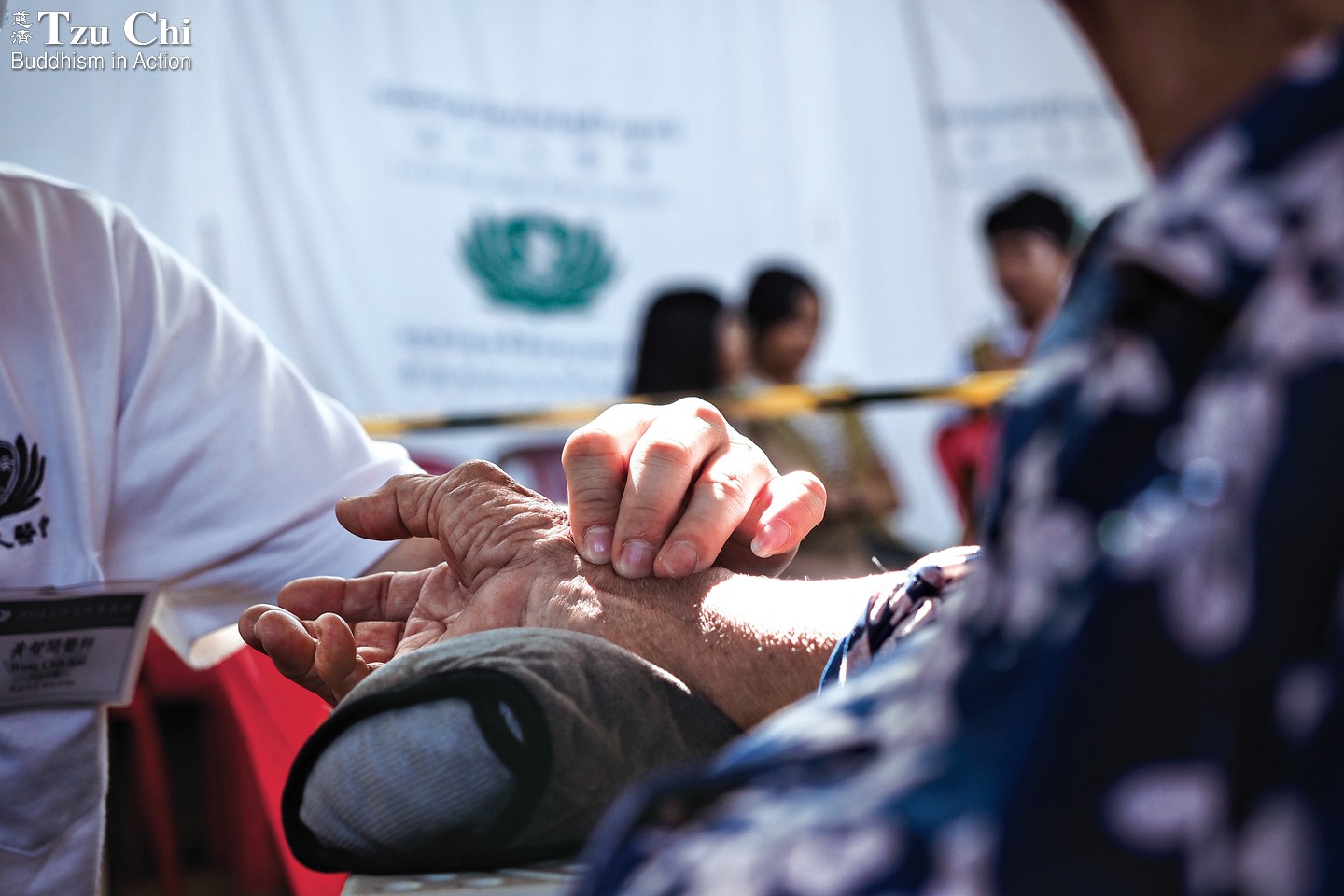
A traditional Chinese medicine practitioner checks a patient’s pulse during the November 2024 free clinic.
Every day for a week leading up to the Tzu Chi free clinic, tuk-tuk driver Sak Kosal navigated the streets of Bavel District, Battambang Province, Cambodia, to promote the event. He eagerly announced through his loudspeaker, “From November 1 to 3, there will be a free clinic offering ophthalmology, dentistry, and more!” His tuk-tuk was adorned with a banner advertising the clinic, and he distributed flyers along his route. He also personally informed his friends and neighbors about the event and planned to seek treatment himself. “We are too poor. Seeing a doctor is very expensive, and we can’t afford it,” he shared.
Meanwhile, a flower vendor shared her difficulties with Tzu Chi volunteers. She had been suffering from rapid heartbeats and difficulty breathing but had avoided seeking medical care. “My child was born with a heart condition and needs frequent hospital visits,” she explained. “I have no money left for my own treatment. At last, free care is here!”
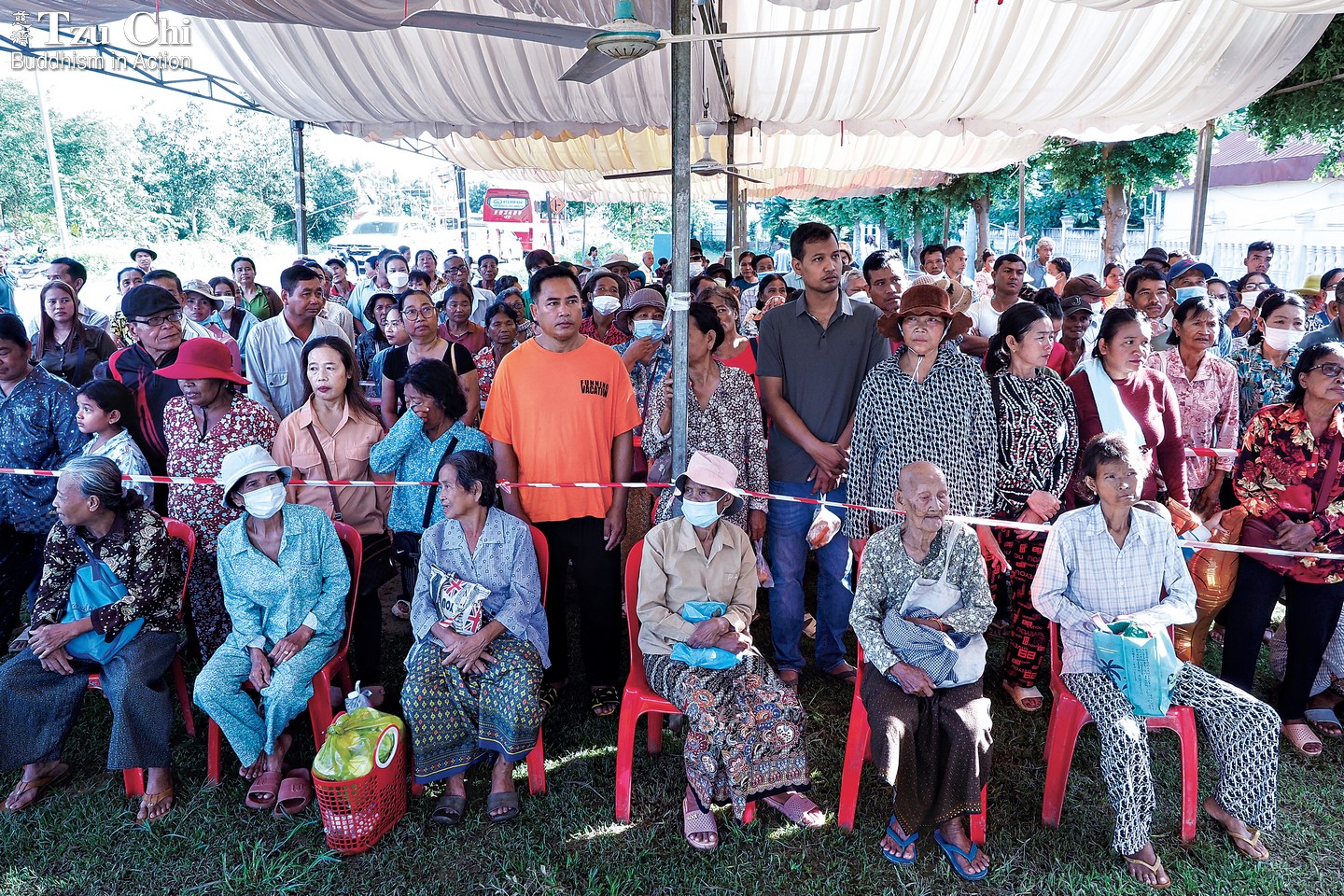
People wait for their turn to see a doctor.
Cambodia, ravaged by years of conflict and prone to natural disasters, is a key focus for the World Health Organization (WHO). The WHO is collaborating with the Cambodian government, international partners, and NGOs to address the nation’s health challenges.
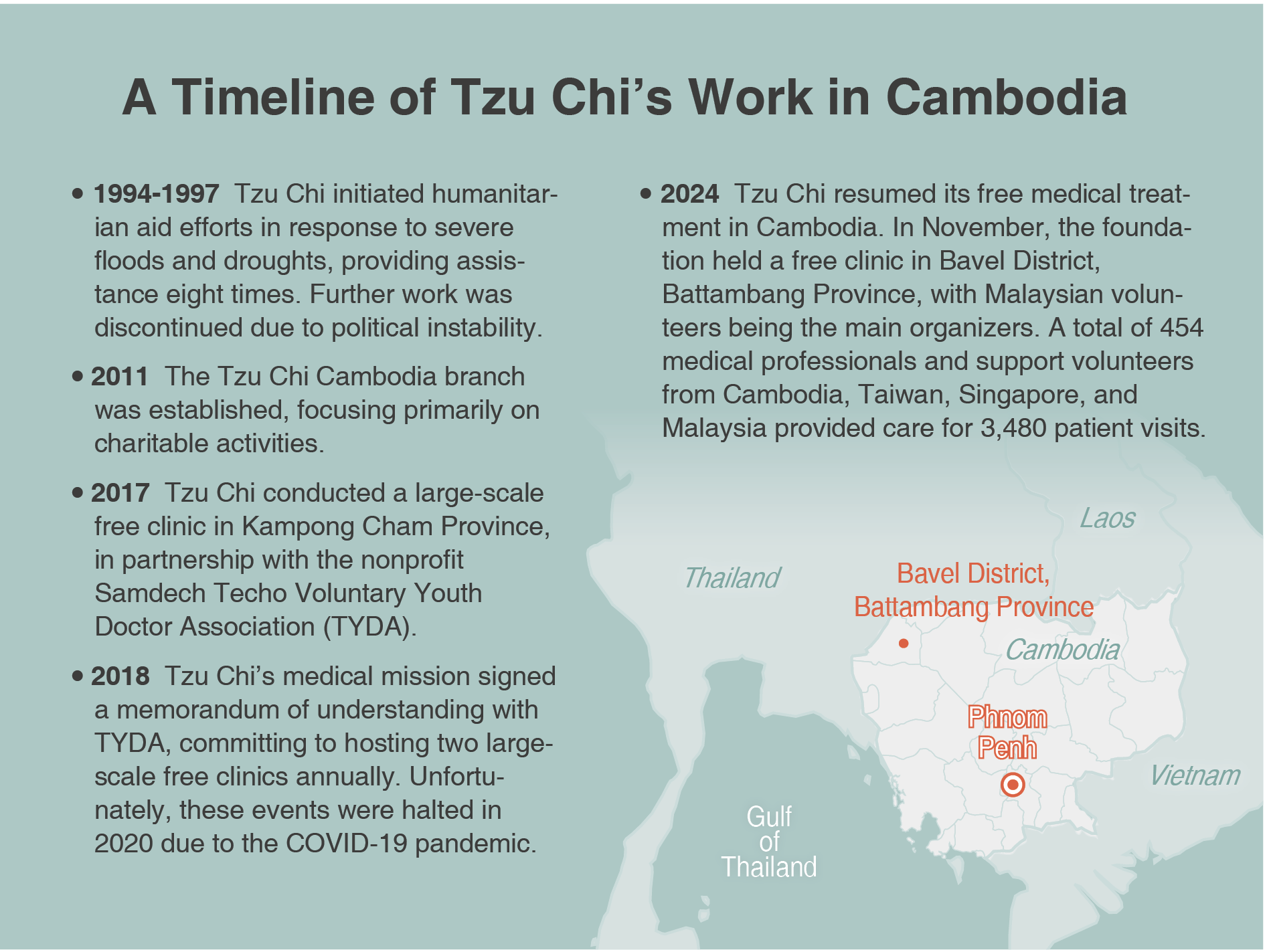
Limited medical resources and prohibitive costs often prevent residents in remote areas from accessing medical care. To help alleviate this issue, Tzu Chi organized a free clinic in early November 2024 in Battambang Province. Medical professionals and support volunteers from Taiwan, Singapore, and Malaysia brought equipment and medications, joining local healthcare workers and volunteers to provide services in internal medicine, surgery, gynecology, ophthalmology, dentistry, and traditional Chinese medicine. The clinic recorded nearly 3,500 patient visits over the course of three days.
The clinic operated at two locations: Bavel Referral Hospital served as the main site, while ophthalmology treatments were conducted at Battambang Provincial Hospital. Sixty-four-year-old Nhem Phoeuk, the chief of a village near Bavel District, traveled to the ophthalmology site for surgery aboard a bus rented by Tzu Chi. A year earlier, he had undergone cataract surgery on his right eye at a private hospital but couldn’t afford treatment for his left eye. The free clinic finally made the long-awaited procedure possible. “I felt comfortable lying on the operating table,” he said with relief. “It was over in no time—so quick!”
Another patient, Pen Voeurn, felt fortunate and deeply grateful for Tzu Chi’s assistance. “I couldn’t see the road [due to my eye condition],” she said. “I was so worried about falling, getting injured, and becoming a burden to my family. But after my cataract surgery at the free clinic, the doctor reassured me that my vision would gradually improve.” Stroking a volunteer’s face, she happily added, “Now I can see the outline of your face—you’re so handsome!”
Dr. Heng Ton, an ophthalmologist at Battambang Provincial Hospital with 20 years of experience, shared insights into Cambodia’s healthcare challenges with Tzu Chi volunteers. He explained that most medical graduates prefer to work in larger cities like Phnom Penh, where salaries are higher, leaving hospitals in less developed areas understaffed. Even government-run hospitals in these areas often charge fees that are unaffordable for many citizens.
As a result, low-income individuals often rely on support from non-profit organizations for medical treatment or hope to raise funds through community efforts. Dr. Heng expressed his willingness to care for impoverished patients but admitted that his efforts alone were not enough. He commended Tzu Chi’s free medical services as a much-needed blessing for many locals. At the same time, he noted the government’s recent efforts to improve healthcare infrastructure and reduce medical costs, expressing hope that more people will soon be able to access care at government hospitals.
The parking lot of Bavel Referral Hospital was transformed into a bustling dental clinic during the free clinic event. Dentists, wearing transparent face shields, worked tirelessly to perform tooth extractions, cleanings, and fillings. Their assistants stood nearby, wiping sweat from the doctors’ brows and efficiently passing instruments, ensuring each patient received attentive care.
The waiting area was crowded with people seeking care, from young mothers cradling their children to elderly individuals in wheelchairs. The scent of sweat mingled with a light breeze as sunlight filtered through gaps in the canopy, illuminating faces filled by a mix of hope and anxiety. For many, this was a rare and precious opportunity to see a dentist—an opportunity they couldn’t afford to miss.
Dental clinics are scarce in Cambodia’s rural areas, often requiring villagers to travel long distances for treatment that can be prohibitively expensive. A tooth extraction, for example, can cost as much as 30 U.S. dollars. Faced with these obstacles, many endure dental pain or resort to traditional remedies for relief, such as chewing medicinal plants or rinsing with saltwater. Unfortunately, these methods rarely resolve the underlying issue and can sometimes lead to infections.
Over three days, 741 patients received dental treatment at the clinic. Dr. Li Yi-bang (李彝邦), a dentist from Hualien Tzu Chi Hospital in eastern Taiwan, observed that many villagers only sought treatment when the pain became unbearable. “Cleaning their teeth is like mining,” he remarked, referring to the thick tartar deposits he removed. Dr. Eugene Tang (鄧國榮), a dentist with 43 years of experience in Singapore, noted that in earlier years of Tzu Chi’s free clinics in Cambodia, many patients came seeking pain relief, often opting for extractions. However, Tzu Chi dentists have always prioritized saving teeth whenever possible, even providing root canal treatments—procedures that are otherwise unaffordable for many locals.
One patient, 22-year-old Keo Muysan, had suffered for a decade from severe tooth pain whenever she ate. Her local dentist could only prescribe painkillers, which cost 25 U.S. dollars for a five-day supply. Her parents, vegetable farmers with limited income, even sold a small plot of their land to afford her medication.
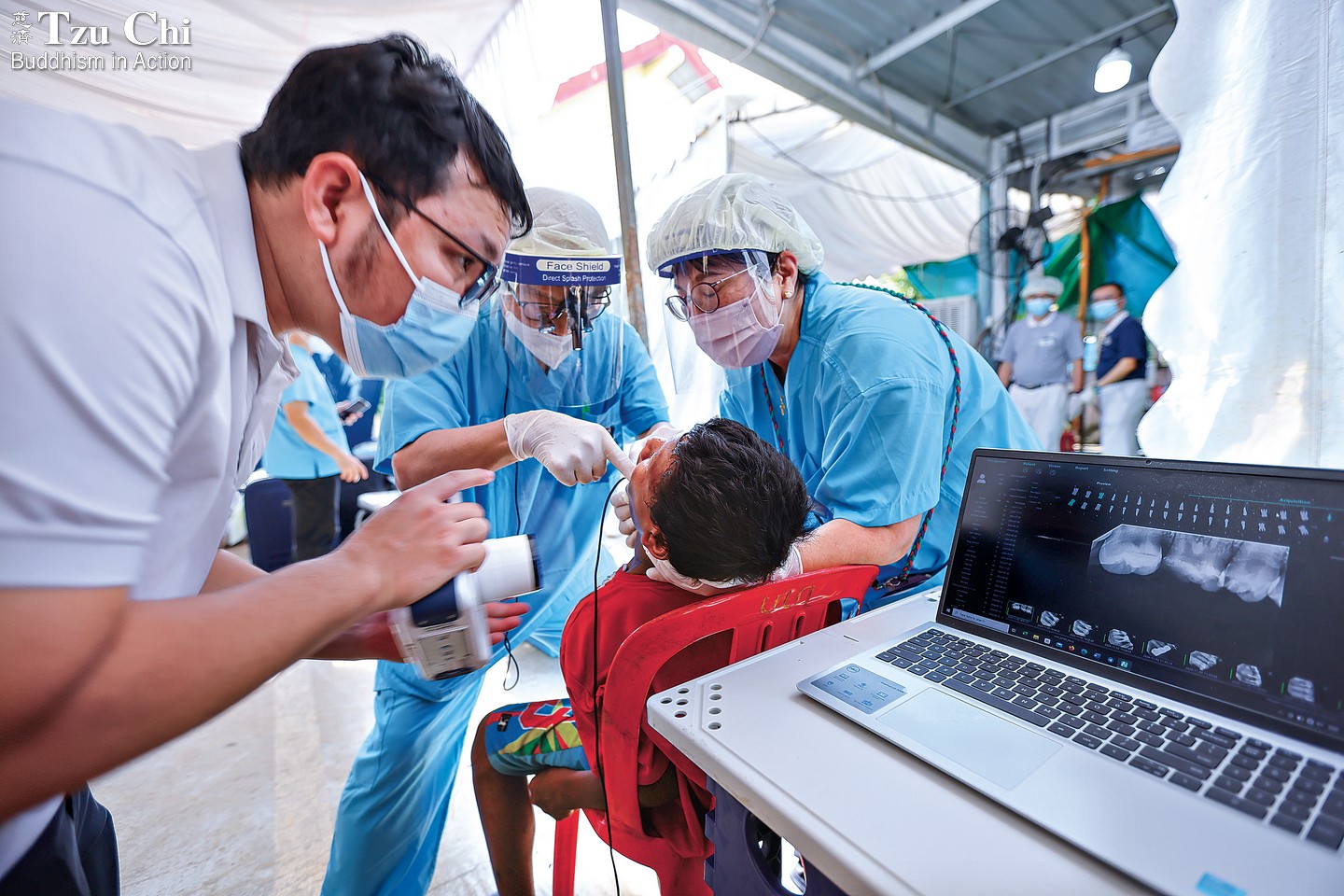
The dental team at the free clinic arranged for Keo’s teeth to be examined via X-rays. The X-rays revealed that several of her teeth were beyond saving. Her dentist gently explained that they would extract one tooth that day and address the rest the next day. Keo tightly gripped her mother’s rough, calloused hand as she braced herself for the procedure. Her mother’s face showed both worry and relief, hopeful that her daughter’s suffering would finally end.
When the decayed tooth was removed, the tension in Keo’s face softened. Her mother, overcome with emotion, said, “Thank you all. What you took away wasn’t just a bad tooth; it was ten years of suffering for my daughter.”
Medical professionals perform an oral X-ray examination on a patient prior to dental treatment. Leong Chian Yee
The day before the free clinic, a medical team visited the home of nine-year-old Horm Tola, who was scheduled for surgery during the event. When Horm saw the strangers, he hid his hands behind his back and watched them with wary eyes. His mother, Chiw Sok Phana, quickly explained that Horm had been born with syndactyly, a congenital condition in which fingers are fused. On his right hand, the middle and ring fingers were joined, as were the thumb and index finger; on his left hand, the index and middle fingers were fused. This condition had made him especially sensitive and self-conscious.
Horm had undergone surgery at age three to separate his right thumb and index finger, but his doctor had deemed further treatment too risky. Since then, he had been unable to use his right hand for tasks requiring strength and relied solely on his left hand for eating and writing. The emotional toll was even greater—his classmates often ridiculed his fused fingers, calling them strange. With her husband supporting the family of six through farming, Chiw Sok Phana couldn’t afford treatment at a large hospital in Phnom Penh, leaving Horm to endure his condition along with the impact to his self-esteem.
In early October 2024, Horm’s father heard at the market that Tzu Chi would be holding a free clinic, with doctors conducting initial screenings on the 13th. “We immediately brought our son in,” Chiw Sok Phana said, “and he was approved for surgery on November 1. Knowing foreign doctors would handle the procedure gave us so much confidence.” The news that her boy would finally receive treatment moved her to tears.
The surgery was performed by Dr. Fong Poh Him (馮寶興), a plastic surgeon from Singapore with over a decade of experience at free clinics. After reviewing Horm’s medical records, Dr. Fong explained to his mother, through a translator, that separating the fused fingers on Horm’s right hand would be extremely difficult because of shared bone structures. However, since the condition didn’t pose a risk to his overall health, he reassured her not to worry. Instead, they would focus on his left hand, ensuring that it would have five fully separated and functional fingers.
As the surgery was set to begin, Horm lay on the operating table, crying in fear. Volunteers and a nurse quickly stepped in to comfort him. During the procedure, the nurse gently turned his face away from the surgical area, while his mother blocked his view with her hand. At the same time, a volunteer played cartoons on a phone to help distract him.
Two hours later, Horm emerged from the operating room. He told his mother that it hadn’t hurt at all. She assured him that when the bandages came off the following week, he’d have a left hand with five separate fingers.
Dr. Fong was deeply moved when Horm shyly thanked him. “The surgical facilities at the free clinic are very basic,” he said. “Cases like this require experienced surgeons to ensure everything goes smoothly. If I hadn’t performed this surgery, the child might have lived his entire life burdened by the limitations of his condition.”
Preparation for the large-scale free clinic began in April, when Tzu Chi Cambodia expanded its recruitment of local volunteers. They also invited an experienced team from Singapore to provide training. On October 30, two days before the event, an advance team from Malaysia and Singapore arrived at Bavel Referral Hospital to begin setup. The Taiwanese team, led by Dr. Chien Jui-teng (簡瑞騰), superintendent of Douliou Tzu Chi Hospital, departed from Taiwan on October 31—just before flights were canceled due to Typhoon Kong-rey.
Volunteers used farm tractors to transport desks and chairs borrowed from a school to prepare the venue. Dr. Soo Jia Ying (史家盈), a Malaysian surgeon, played a pivotal role in setting up the operating room, carefully arranging equipment and even washing slippers for use inside. As she worked, she considered how to thoughtfully communicate with patients too fearful to undergo surgery and how best to reassure them.
The dental clinic was built almost entirely from scratch. Volunteers installed water and electrical systems to meet various needs, including enabling a large compressor to supply the air pressure required for dental equipment. They also created a functional drainage system and set up tents, fans, and lights.
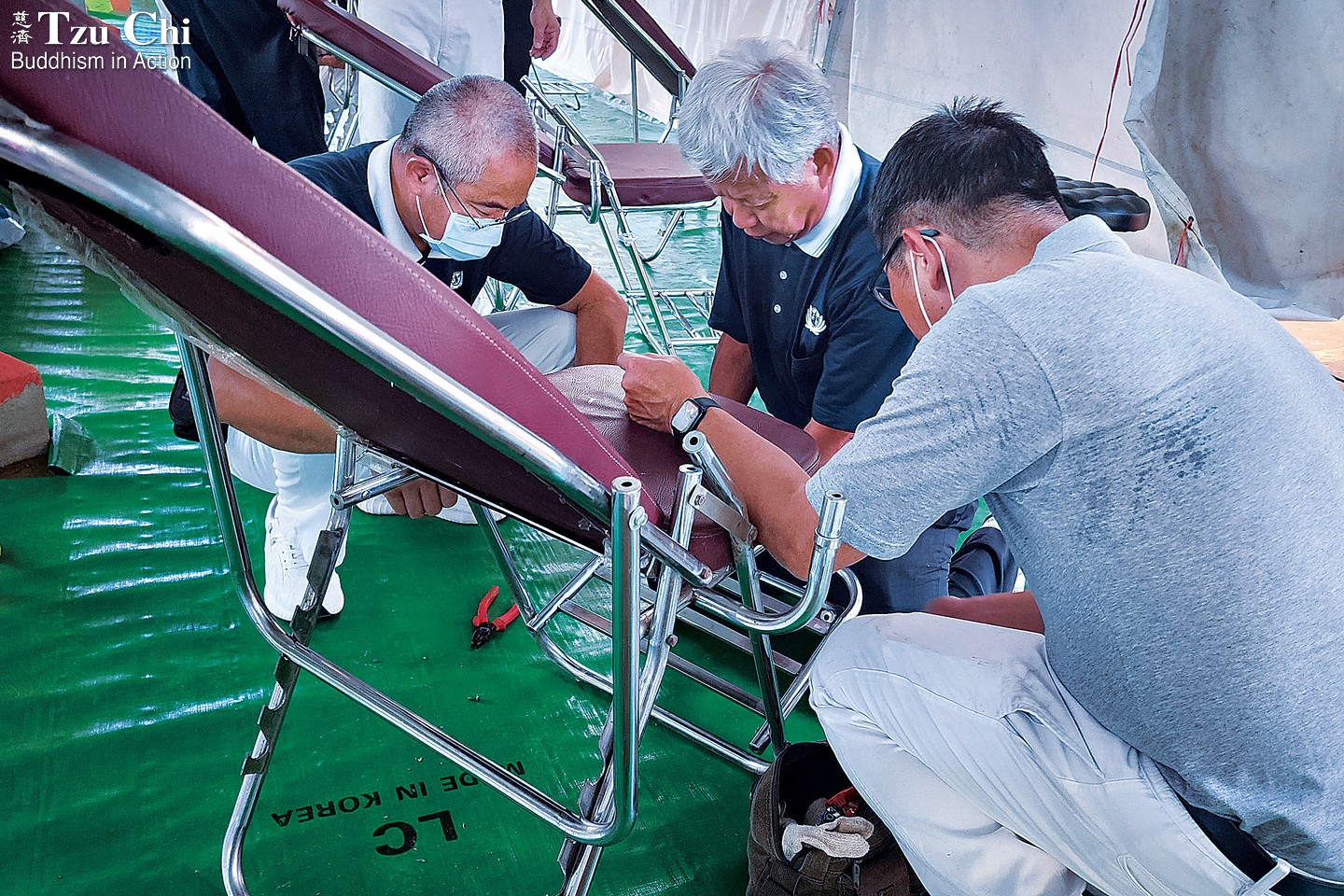
Lin Jin-an (林金安), a seasoned volunteer from Tainan, Taiwan, had arrived in Cambodia earlier than the team led by Superintendent Chien. He joined his Malaysian and Singaporean counterparts in setting up the dental clinic. A skilled equipment repair specialist with over 20 years of experience supporting free clinics in Taiwan and abroad, he recognizes the importance of every piece of medical equipment in ensuring proper patient care. He meticulously prepared a range of spare parts, from simple switches to more complex components, to keep the dental instruments and equipment running smoothly at the free clinic. Even though it meant carrying over 30 kilograms (66 pounds) of luggage from Taiwan, he was determined that no machine would stop working due to a lack of parts.
The day before the clinic, six dental treatment devices required testing and adjustments. One machine was so severely damaged that it required two hours of work to repair. Despite the challenges, Lin’s face reflected focus and determination. His skilled movements demonstrated years of accumulated experience, allowing him to diagnose the needs of each machine almost instinctively.
Lin had battled cancer, which had forced him to leave his job and completely let go of his career. However, those hard experiences led him to rediscover the value of life through volunteering. He has since devoted himself to maintaining equipment for Tzu Chi’s free clinics, becoming a reliable support for the medical team. “It fills my heart with joy to finish my work and see the machines functioning properly,” he said.
Lee Mong Kee (李夢奇), a volunteer from Kuala Lumpur, Malaysia, reflected on the scale of the dental clinic, which involved 19 dentists and exposed him to different work styles across teams from various countries. He also learned to use new equipment, such as sterilizers. But more than all that, helping local patients relieve their dental pain provided the greatest reward.
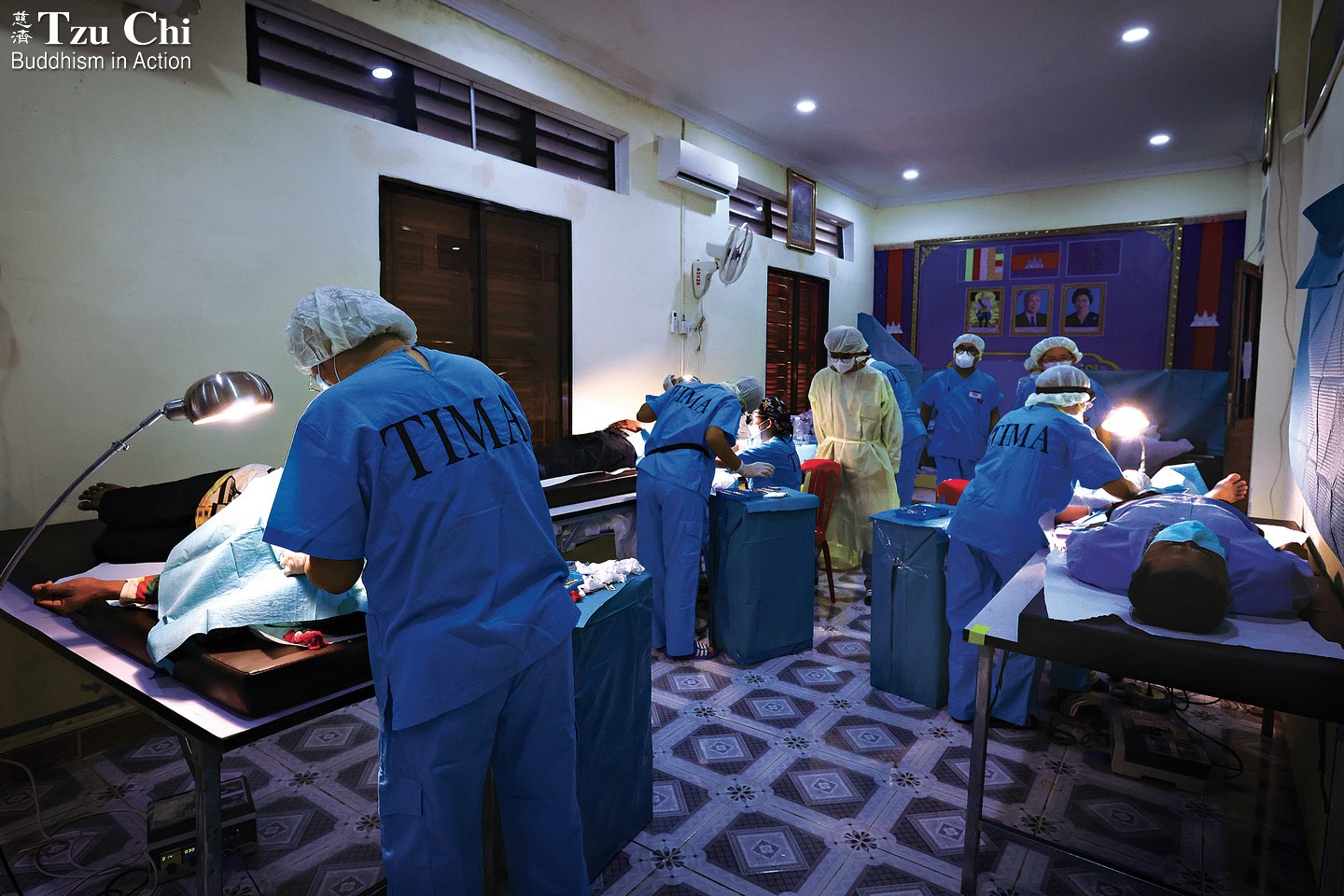
Three surgeries are performed simultaneously in a temporary operating room. Leong Chian Yee
In tropical regions, prolonged exposure to sunlight and intense UV radiation often leads to lens clouding. Coupled with high-sugar diets that accelerate lens oxidation, this significantly increases the need for cataract surgery as people age. Dr. Chan Boon Huat (曾文發), a member of the Tzu Chi Kuala Lumpur and Selangor chapter’s medical coordination team, explained that cataracts are the leading cause of blurred vision and blindness in Cambodia.
Providing ophthalmology services at the free clinic required various medical equipment, including phacoemulsification machines, surgical microscopes, slit lamp microscopes, and autoclaves. Dr. Chan acknowledged, “The ophthalmology team is fully staffed, but our biggest challenge is the lack of medical equipment.”
To address this issue, the team explored every possible avenue, leveraging personal networks to secure the necessary tools. Dr. Goh Siew Yuen (吳秀雲), a pediatric ophthalmologist from Hospital Tunku Azizah in Kuala Lumpur, went above and beyond, even contacting hospitals where she had no prior connections. Her efforts paid off when two institutions each agreed to lend a phacoemulsification machine. In addition to working to secure equipment for the free clinic, she and Dr. Chan brought screening devices to Cambodia as early as October 13 to conduct preoperative evaluations.
While coordinating logistics with Dr. Heng Ton of Battambang Provincial Hospital, the team discovered that the hospital’s autoclave required about 90 minutes to sterilize instruments after surgery. This posed a significant challenge for the time-sensitive clinic, as it would limit the number of patients that could be treated.
Volunteer Chong Li Lei (張綠蕾) acted swiftly, reaching out to a network of industrialists through a group chat. Remarkably, within five minutes, an autoclave capable of sterilizing instruments in just 15 to 20 minutes was donated, much to the team’s delight. Unfortunately, just before the machine was scheduled to be shipped by airplane in late October, it was rejected due to its weight. The team scrambled for alternatives. Finally, with the assistance of Optimax Eye Specialist, Eyetech Cambodia stepped in to lend a suitable autoclave, resolving the issue.
The ophthalmology team successfully performed 21 surgeries on the first day of the free clinic. Dr. Goh expressed gratitude for the team’s collaboration, saying, “Every surgery we complete allows a patient to regain their ability to lead a normal life and care for their family. This brings me immense satisfaction.”
This marked the Tzu Chi Kuala Lumpur and Selangor chapter’s first ophthalmic medical mission, an experience that deeply inspired the team. Dr. Chan shared that they are prepared to provide long-term support and plan to participate in future international free clinics and outreach missions in Malaysia’s rural areas.
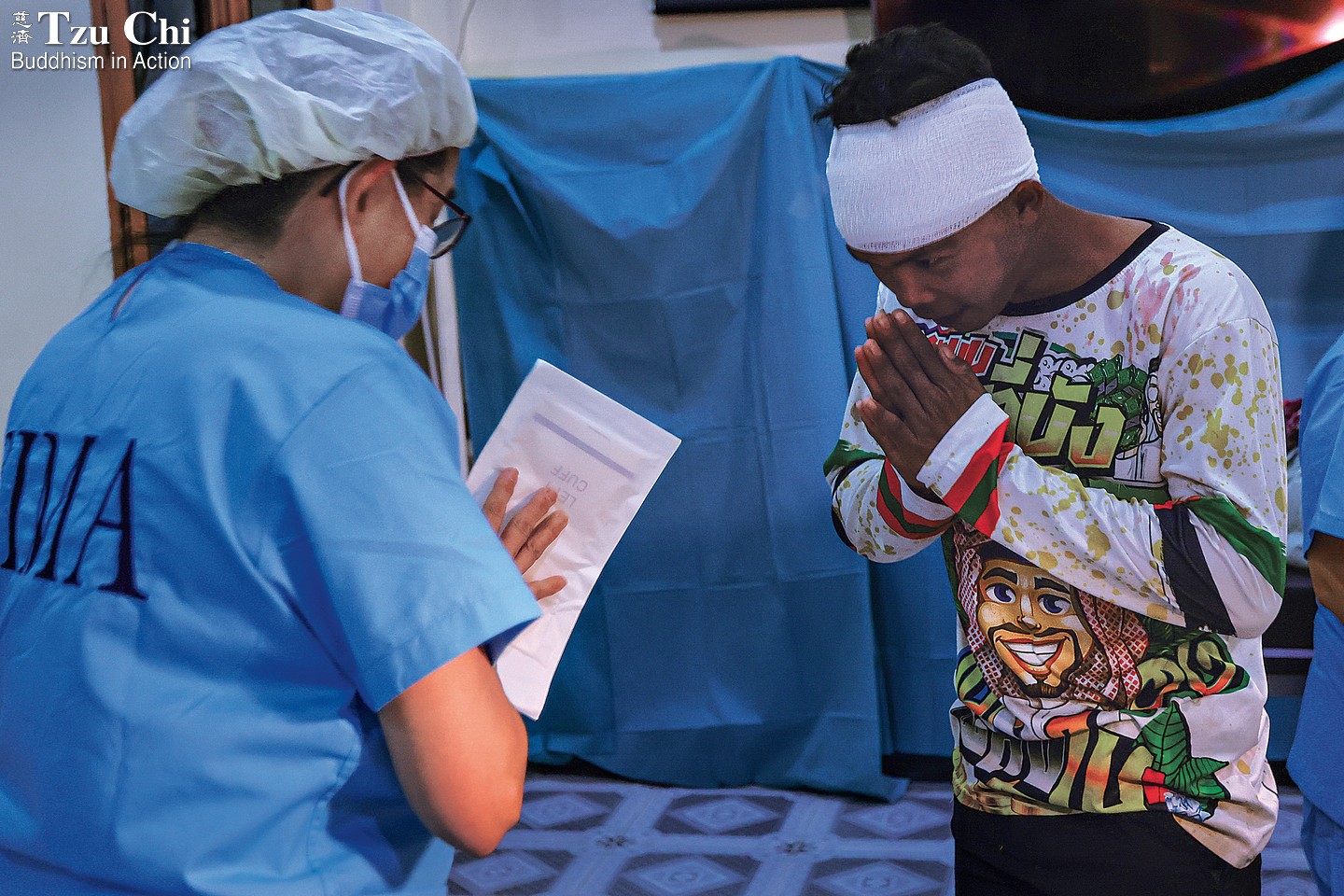
A patient thanks a medical worker after surgery. Leong Chian Yee
Volunteers check each dental chair in preparation for the free clinic(Photo 1). Zeng Qiu Li
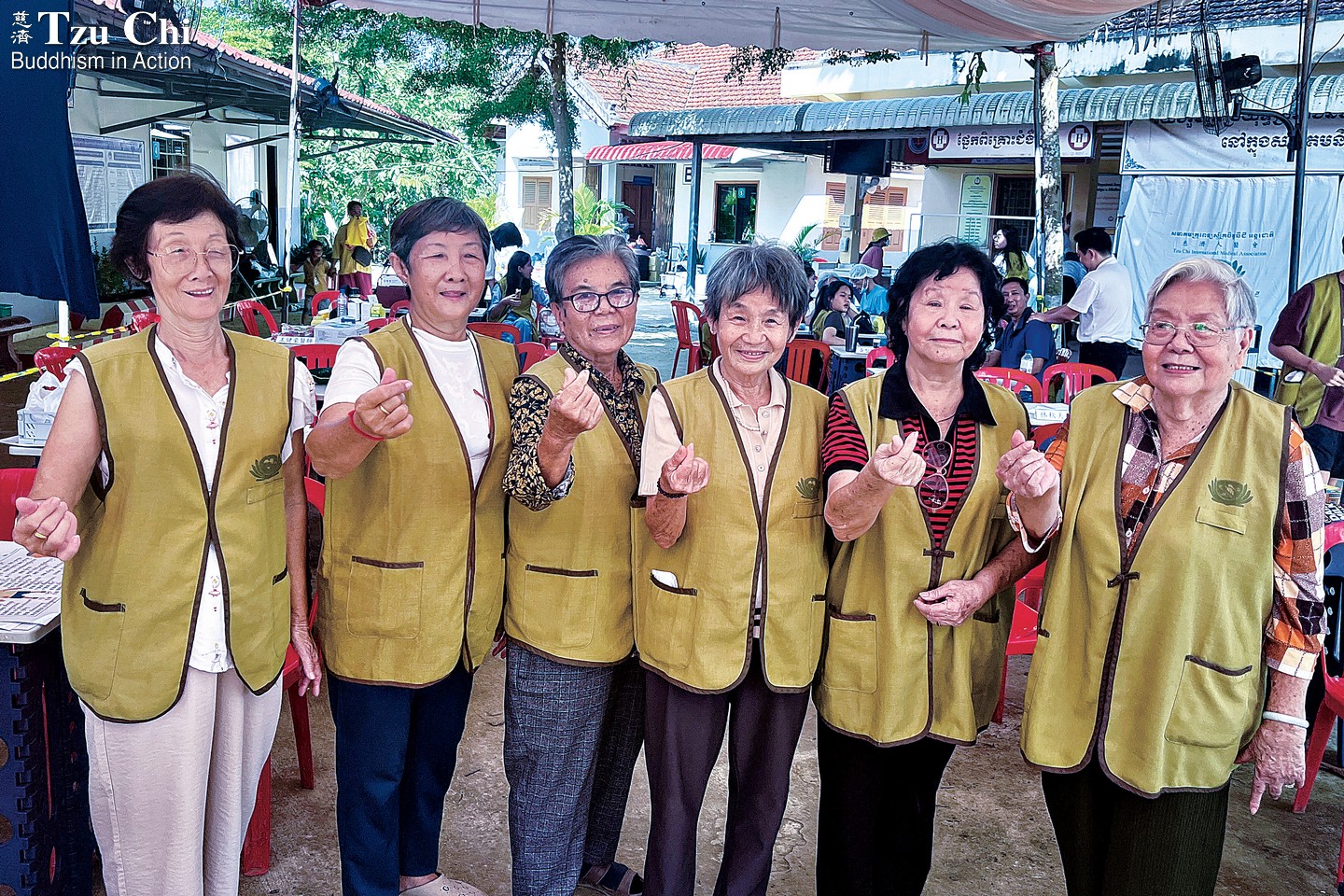
Support volunteers play a vital role in the success of a free clinic. Here, a group of interpreters pose for a photo. Their assistance was crucial in bridging the language gap between many of the doctors at the November free clinic and the locals seeking treatment(Photo 2). Kong Siew Yen
In 1994, when Cambodia was devastated by floods and droughts, Louth Saly, the current chief of Bavel District, received rice from Tzu Chi. In 2020, following another flood, he accompanied Tzu Chi volunteers late into the night to survey disaster-stricken areas. Prior to the free clinic this time, he visited the ophthalmology screening to show his support and took the opportunity to have his own eyes examined. The medical team assured him they would provide him with a suitable pair of reading glasses. When he tried them on later, he was delighted to see the text on his documents clearly. He expressed his gratitude to Tzu Chi and the local Samdech Techo Voluntary Youth Doctor Association for their collaboration in bringing free healthcare to residents of nine villages in Bavel District.
Battambang Deputy Governor Peng Piseth also received unexpected treatment during a visit to the free clinic. He had come to inspect its operations and convey the governor’s thanks when he mentioned that his lower leg, injured 40 years earlier, still caused occasional pain. Dr. Fong Poh Him, assisted by Dr. Chien Jui-teng, performed a 40-minute surgery that resolved the long-standing issue. Reflecting on the experience, Dr. Chien remarked, “If even the deputy governor has such needs, the needs of the general public must be even greater.”
Over 600 people were treated on the first day of the free clinic. As word of the services spread, the number of patients increased significantly on the second day. On the third day, the clinic was scheduled to close at 3 p.m. but the medical team extended their hours to help as many people as possible. Seeing patients leave with relieved smiles warmed the hearts of all the volunteers.

By Tan Kim Hion, Sia Ah Tong, Kong Siew Yen, Chan Shi Yih, and Chong Pei Fen
Translated by Wu Hsiao-ting
Photos by Sam Pin Fook
A Tzu Chi free clinic provided much-needed relief in rural Cambodia, offering services ranging from cataract surgeries to dental treatments.
A traditional Chinese medicine practitioner checks a patient’s pulse during the November 2024 free clinic.
Every day for a week leading up to the Tzu Chi free clinic, tuk-tuk driver Sak Kosal navigated the streets of Bavel District, Battambang Province, Cambodia, to promote the event. He eagerly announced through his loudspeaker, “From November 1 to 3, there will be a free clinic offering ophthalmology, dentistry, and more!” His tuk-tuk was adorned with a banner advertising the clinic, and he distributed flyers along his route. He also personally informed his friends and neighbors about the event and planned to seek treatment himself. “We are too poor. Seeing a doctor is very expensive, and we can’t afford it,” he shared.
Meanwhile, a flower vendor shared her difficulties with Tzu Chi volunteers. She had been suffering from rapid heartbeats and difficulty breathing but had avoided seeking medical care. “My child was born with a heart condition and needs frequent hospital visits,” she explained. “I have no money left for my own treatment. At last, free care is here!”
People wait for their turn to see a doctor.
Cambodia, ravaged by years of conflict and prone to natural disasters, is a key focus for the World Health Organization (WHO). The WHO is collaborating with the Cambodian government, international partners, and NGOs to address the nation’s health challenges.
Limited medical resources and prohibitive costs often prevent residents in remote areas from accessing medical care. To help alleviate this issue, Tzu Chi organized a free clinic in early November 2024 in Battambang Province. Medical professionals and support volunteers from Taiwan, Singapore, and Malaysia brought equipment and medications, joining local healthcare workers and volunteers to provide services in internal medicine, surgery, gynecology, ophthalmology, dentistry, and traditional Chinese medicine. The clinic recorded nearly 3,500 patient visits over the course of three days.
The clinic operated at two locations: Bavel Referral Hospital served as the main site, while ophthalmology treatments were conducted at Battambang Provincial Hospital. Sixty-four-year-old Nhem Phoeuk, the chief of a village near Bavel District, traveled to the ophthalmology site for surgery aboard a bus rented by Tzu Chi. A year earlier, he had undergone cataract surgery on his right eye at a private hospital but couldn’t afford treatment for his left eye. The free clinic finally made the long-awaited procedure possible. “I felt comfortable lying on the operating table,” he said with relief. “It was over in no time—so quick!”
Another patient, Pen Voeurn, felt fortunate and deeply grateful for Tzu Chi’s assistance. “I couldn’t see the road [due to my eye condition],” she said. “I was so worried about falling, getting injured, and becoming a burden to my family. But after my cataract surgery at the free clinic, the doctor reassured me that my vision would gradually improve.” Stroking a volunteer’s face, she happily added, “Now I can see the outline of your face—you’re so handsome!”
Dr. Heng Ton, an ophthalmologist at Battambang Provincial Hospital with 20 years of experience, shared insights into Cambodia’s healthcare challenges with Tzu Chi volunteers. He explained that most medical graduates prefer to work in larger cities like Phnom Penh, where salaries are higher, leaving hospitals in less developed areas understaffed. Even government-run hospitals in these areas often charge fees that are unaffordable for many citizens.
As a result, low-income individuals often rely on support from non-profit organizations for medical treatment or hope to raise funds through community efforts. Dr. Heng expressed his willingness to care for impoverished patients but admitted that his efforts alone were not enough. He commended Tzu Chi’s free medical services as a much-needed blessing for many locals. At the same time, he noted the government’s recent efforts to improve healthcare infrastructure and reduce medical costs, expressing hope that more people will soon be able to access care at government hospitals.
The parking lot of Bavel Referral Hospital was transformed into a bustling dental clinic during the free clinic event. Dentists, wearing transparent face shields, worked tirelessly to perform tooth extractions, cleanings, and fillings. Their assistants stood nearby, wiping sweat from the doctors’ brows and efficiently passing instruments, ensuring each patient received attentive care.
The waiting area was crowded with people seeking care, from young mothers cradling their children to elderly individuals in wheelchairs. The scent of sweat mingled with a light breeze as sunlight filtered through gaps in the canopy, illuminating faces filled by a mix of hope and anxiety. For many, this was a rare and precious opportunity to see a dentist—an opportunity they couldn’t afford to miss.
Dental clinics are scarce in Cambodia’s rural areas, often requiring villagers to travel long distances for treatment that can be prohibitively expensive. A tooth extraction, for example, can cost as much as 30 U.S. dollars. Faced with these obstacles, many endure dental pain or resort to traditional remedies for relief, such as chewing medicinal plants or rinsing with saltwater. Unfortunately, these methods rarely resolve the underlying issue and can sometimes lead to infections.
Over three days, 741 patients received dental treatment at the clinic. Dr. Li Yi-bang (李彝邦), a dentist from Hualien Tzu Chi Hospital in eastern Taiwan, observed that many villagers only sought treatment when the pain became unbearable. “Cleaning their teeth is like mining,” he remarked, referring to the thick tartar deposits he removed. Dr. Eugene Tang (鄧國榮), a dentist with 43 years of experience in Singapore, noted that in earlier years of Tzu Chi’s free clinics in Cambodia, many patients came seeking pain relief, often opting for extractions. However, Tzu Chi dentists have always prioritized saving teeth whenever possible, even providing root canal treatments—procedures that are otherwise unaffordable for many locals.
One patient, 22-year-old Keo Muysan, had suffered for a decade from severe tooth pain whenever she ate. Her local dentist could only prescribe painkillers, which cost 25 U.S. dollars for a five-day supply. Her parents, vegetable farmers with limited income, even sold a small plot of their land to afford her medication.
The dental team at the free clinic arranged for Keo’s teeth to be examined via X-rays. The X-rays revealed that several of her teeth were beyond saving. Her dentist gently explained that they would extract one tooth that day and address the rest the next day. Keo tightly gripped her mother’s rough, calloused hand as she braced herself for the procedure. Her mother’s face showed both worry and relief, hopeful that her daughter’s suffering would finally end.
When the decayed tooth was removed, the tension in Keo’s face softened. Her mother, overcome with emotion, said, “Thank you all. What you took away wasn’t just a bad tooth; it was ten years of suffering for my daughter.”
Medical professionals perform an oral X-ray examination on a patient prior to dental treatment. Leong Chian Yee
The day before the free clinic, a medical team visited the home of nine-year-old Horm Tola, who was scheduled for surgery during the event. When Horm saw the strangers, he hid his hands behind his back and watched them with wary eyes. His mother, Chiw Sok Phana, quickly explained that Horm had been born with syndactyly, a congenital condition in which fingers are fused. On his right hand, the middle and ring fingers were joined, as were the thumb and index finger; on his left hand, the index and middle fingers were fused. This condition had made him especially sensitive and self-conscious.
Horm had undergone surgery at age three to separate his right thumb and index finger, but his doctor had deemed further treatment too risky. Since then, he had been unable to use his right hand for tasks requiring strength and relied solely on his left hand for eating and writing. The emotional toll was even greater—his classmates often ridiculed his fused fingers, calling them strange. With her husband supporting the family of six through farming, Chiw Sok Phana couldn’t afford treatment at a large hospital in Phnom Penh, leaving Horm to endure his condition along with the impact to his self-esteem.
In early October 2024, Horm’s father heard at the market that Tzu Chi would be holding a free clinic, with doctors conducting initial screenings on the 13th. “We immediately brought our son in,” Chiw Sok Phana said, “and he was approved for surgery on November 1. Knowing foreign doctors would handle the procedure gave us so much confidence.” The news that her boy would finally receive treatment moved her to tears.
The surgery was performed by Dr. Fong Poh Him (馮寶興), a plastic surgeon from Singapore with over a decade of experience at free clinics. After reviewing Horm’s medical records, Dr. Fong explained to his mother, through a translator, that separating the fused fingers on Horm’s right hand would be extremely difficult because of shared bone structures. However, since the condition didn’t pose a risk to his overall health, he reassured her not to worry. Instead, they would focus on his left hand, ensuring that it would have five fully separated and functional fingers.
As the surgery was set to begin, Horm lay on the operating table, crying in fear. Volunteers and a nurse quickly stepped in to comfort him. During the procedure, the nurse gently turned his face away from the surgical area, while his mother blocked his view with her hand. At the same time, a volunteer played cartoons on a phone to help distract him.
Two hours later, Horm emerged from the operating room. He told his mother that it hadn’t hurt at all. She assured him that when the bandages came off the following week, he’d have a left hand with five separate fingers.
Dr. Fong was deeply moved when Horm shyly thanked him. “The surgical facilities at the free clinic are very basic,” he said. “Cases like this require experienced surgeons to ensure everything goes smoothly. If I hadn’t performed this surgery, the child might have lived his entire life burdened by the limitations of his condition.”
Preparation for the large-scale free clinic began in April, when Tzu Chi Cambodia expanded its recruitment of local volunteers. They also invited an experienced team from Singapore to provide training. On October 30, two days before the event, an advance team from Malaysia and Singapore arrived at Bavel Referral Hospital to begin setup. The Taiwanese team, led by Dr. Chien Jui-teng (簡瑞騰), superintendent of Douliou Tzu Chi Hospital, departed from Taiwan on October 31—just before flights were canceled due to Typhoon Kong-rey.
Volunteers used farm tractors to transport desks and chairs borrowed from a school to prepare the venue. Dr. Soo Jia Ying (史家盈), a Malaysian surgeon, played a pivotal role in setting up the operating room, carefully arranging equipment and even washing slippers for use inside. As she worked, she considered how to thoughtfully communicate with patients too fearful to undergo surgery and how best to reassure them.
The dental clinic was built almost entirely from scratch. Volunteers installed water and electrical systems to meet various needs, including enabling a large compressor to supply the air pressure required for dental equipment. They also created a functional drainage system and set up tents, fans, and lights.
Lin Jin-an (林金安), a seasoned volunteer from Tainan, Taiwan, had arrived in Cambodia earlier than the team led by Superintendent Chien. He joined his Malaysian and Singaporean counterparts in setting up the dental clinic. A skilled equipment repair specialist with over 20 years of experience supporting free clinics in Taiwan and abroad, he recognizes the importance of every piece of medical equipment in ensuring proper patient care. He meticulously prepared a range of spare parts, from simple switches to more complex components, to keep the dental instruments and equipment running smoothly at the free clinic. Even though it meant carrying over 30 kilograms (66 pounds) of luggage from Taiwan, he was determined that no machine would stop working due to a lack of parts.
The day before the clinic, six dental treatment devices required testing and adjustments. One machine was so severely damaged that it required two hours of work to repair. Despite the challenges, Lin’s face reflected focus and determination. His skilled movements demonstrated years of accumulated experience, allowing him to diagnose the needs of each machine almost instinctively.
Lin had battled cancer, which had forced him to leave his job and completely let go of his career. However, those hard experiences led him to rediscover the value of life through volunteering. He has since devoted himself to maintaining equipment for Tzu Chi’s free clinics, becoming a reliable support for the medical team. “It fills my heart with joy to finish my work and see the machines functioning properly,” he said.
Lee Mong Kee (李夢奇), a volunteer from Kuala Lumpur, Malaysia, reflected on the scale of the dental clinic, which involved 19 dentists and exposed him to different work styles across teams from various countries. He also learned to use new equipment, such as sterilizers. But more than all that, helping local patients relieve their dental pain provided the greatest reward.
Three surgeries are performed simultaneously in a temporary operating room. Leong Chian Yee
In tropical regions, prolonged exposure to sunlight and intense UV radiation often leads to lens clouding. Coupled with high-sugar diets that accelerate lens oxidation, this significantly increases the need for cataract surgery as people age. Dr. Chan Boon Huat (曾文發), a member of the Tzu Chi Kuala Lumpur and Selangor chapter’s medical coordination team, explained that cataracts are the leading cause of blurred vision and blindness in Cambodia.
Providing ophthalmology services at the free clinic required various medical equipment, including phacoemulsification machines, surgical microscopes, slit lamp microscopes, and autoclaves. Dr. Chan acknowledged, “The ophthalmology team is fully staffed, but our biggest challenge is the lack of medical equipment.”
To address this issue, the team explored every possible avenue, leveraging personal networks to secure the necessary tools. Dr. Goh Siew Yuen (吳秀雲), a pediatric ophthalmologist from Hospital Tunku Azizah in Kuala Lumpur, went above and beyond, even contacting hospitals where she had no prior connections. Her efforts paid off when two institutions each agreed to lend a phacoemulsification machine. In addition to working to secure equipment for the free clinic, she and Dr. Chan brought screening devices to Cambodia as early as October 13 to conduct preoperative evaluations.
While coordinating logistics with Dr. Heng Ton of Battambang Provincial Hospital, the team discovered that the hospital’s autoclave required about 90 minutes to sterilize instruments after surgery. This posed a significant challenge for the time-sensitive clinic, as it would limit the number of patients that could be treated.
Volunteer Chong Li Lei (張綠蕾) acted swiftly, reaching out to a network of industrialists through a group chat. Remarkably, within five minutes, an autoclave capable of sterilizing instruments in just 15 to 20 minutes was donated, much to the team’s delight. Unfortunately, just before the machine was scheduled to be shipped by airplane in late October, it was rejected due to its weight. The team scrambled for alternatives. Finally, with the assistance of Optimax Eye Specialist, Eyetech Cambodia stepped in to lend a suitable autoclave, resolving the issue.
The ophthalmology team successfully performed 21 surgeries on the first day of the free clinic. Dr. Goh expressed gratitude for the team’s collaboration, saying, “Every surgery we complete allows a patient to regain their ability to lead a normal life and care for their family. This brings me immense satisfaction.”
This marked the Tzu Chi Kuala Lumpur and Selangor chapter’s first ophthalmic medical mission, an experience that deeply inspired the team. Dr. Chan shared that they are prepared to provide long-term support and plan to participate in future international free clinics and outreach missions in Malaysia’s rural areas.
A patient thanks a medical worker after surgery. Leong Chian Yee
Volunteers check each dental chair in preparation for the free clinic(Photo 1). Zeng Qiu Li
Support volunteers play a vital role in the success of a free clinic. Here, a group of interpreters pose for a photo. Their assistance was crucial in bridging the language gap between many of the doctors at the November free clinic and the locals seeking treatment(Photo 2). Kong Siew Yen
In 1994, when Cambodia was devastated by floods and droughts, Louth Saly, the current chief of Bavel District, received rice from Tzu Chi. In 2020, following another flood, he accompanied Tzu Chi volunteers late into the night to survey disaster-stricken areas. Prior to the free clinic this time, he visited the ophthalmology screening to show his support and took the opportunity to have his own eyes examined. The medical team assured him they would provide him with a suitable pair of reading glasses. When he tried them on later, he was delighted to see the text on his documents clearly. He expressed his gratitude to Tzu Chi and the local Samdech Techo Voluntary Youth Doctor Association for their collaboration in bringing free healthcare to residents of nine villages in Bavel District.
Battambang Deputy Governor Peng Piseth also received unexpected treatment during a visit to the free clinic. He had come to inspect its operations and convey the governor’s thanks when he mentioned that his lower leg, injured 40 years earlier, still caused occasional pain. Dr. Fong Poh Him, assisted by Dr. Chien Jui-teng, performed a 40-minute surgery that resolved the long-standing issue. Reflecting on the experience, Dr. Chien remarked, “If even the deputy governor has such needs, the needs of the general public must be even greater.”
Over 600 people were treated on the first day of the free clinic. As word of the services spread, the number of patients increased significantly on the second day. On the third day, the clinic was scheduled to close at 3 p.m. but the medical team extended their hours to help as many people as possible. Seeing patients leave with relieved smiles warmed the hearts of all the volunteers.
今年、最初に台湾へ上陸した台風三号(ケーミー)は、七月下旬、上陸して四時間で直ぐ海に出たが、台湾全土の一万五千カ所で被害が発生した。この数字は、十年間で最も多い。そのうちの半数は、街路樹の倒壊や違法建築のトタンの落下などだった。また、その二日間に二十回もの「災害発生警告」」のセルブロードキャストが配信されたが、その回数は気象署が一つの台風に対して発した頻度としても最も多い。
九月末の秋分の頃、慈済の緊急支援は終了していたが、高雄と屏東のボランティアは依然として被災世帯の復旧に気を配っていた。台風十八号(クラトーン)は十月三日、台湾南部に甚大な被害をもたらし、再び多くの記録的な数字を残した。月刊誌『慈済』の執筆者とカメラマンは、高雄と屏東を訪れ、それぞれの様子を取材した。災害から六日目、彼らは二百人余りのボランティアと共に海の向こうの琉球郷(小琉球)へ渡り、バイクで八つの村の合計千六百世帯余りを訪問した。彼らは、住民たちに「心を落ち着かせる」祝福パックを届け、そのうちの二十四世帯が持続したケアを必要としていることにも気づいた。
高雄に上陸した台風十八号は、一九七七年の台風四号(テルマ)と似た経路を辿った。四十七年前の七月二十五日、台風四号が高雄南部に上陸した時は、高雄や屏東地域で四千棟以上の家屋が全壊し、二万七千戸が被害を受けた。證厳法師は弟子たちを率いて視察すると共に支援活動を行い、それが縁となって、後に慈済屏東支部が設立された。
災害をもたらしたどの台風も、台湾の気象史に刻まれているが、動員されたボランティアの支援や慈悲の足跡は、各地域における慈済慈善史の一部でもある。十月中旬、台湾では台風十八号被害の支援活動は一段落していたが、ミャンマーとベトナム、タイなどでは、慈済ボランティアたちが、九月の台風十一号(ヤギ)による被災の視察と支援物資配付活動の準備に追われていた。中でもミャンマーの東部と中部における被害が最も深刻で、被災者の家屋はもはや修復や補強ができる可能性を残していなかった。住民たちが水の中に佇んでいること、それが即ちかつて温かい家があったことを物語っているだけだった。
世間には苦しんでいる人が数多くいる。今月号の「慈済のSDGsシリーズ」では、SDGsの目標3「健康と福祉」との繋がりについて述べている。慈済医療について振り返り、どのようにして地域社会に行き渡り、慈済人医会が台湾から世界へ歩みを進めたのかを紹介している。彼らは、出来得る限り力を尽くしてへき地の無医村に出向き、人工透析が必要な貧しい患者や世界中の難民、 植物状態にある人、外国人労働者、脊髄損傷患者、聴覚障害者などに手を差し伸べている。
いわゆる「福祉」とは、病に対する医療を指すだけではなく、心身共に健康で幸福な状態も含まれている。記者は台湾の衛生福利部国民健康署の前署長である王英偉(ワン・インウェイ)医師に単独インタビューをした。「社会的処方」と「慈悲と思いやりのあるコミュニティ」という概念に話が及ぶと、それらは長年にわたって慈済が行っている「医療と地域の慈善活動を合わせた奉仕モデル」によく似ており、全人的な心身の健康に効果をもたらしている、と語った。
台風災害への支援と健康福祉の平等に関する報道を編集していた時、私は法師が言ったことを思い出した。「慈済人がその目で見て、足を運び、支援の手を差し伸べることができる限り、苦しんでいる人々は祝福されるでしょう」。確かに、どこへ行っても人々の困難を解決し、幸せをもたらしているのだから、その足跡は「幸福の軌跡」なのである。
(慈済月刊六九六期より)
今年、最初に台湾へ上陸した台風三号(ケーミー)は、七月下旬、上陸して四時間で直ぐ海に出たが、台湾全土の一万五千カ所で被害が発生した。この数字は、十年間で最も多い。そのうちの半数は、街路樹の倒壊や違法建築のトタンの落下などだった。また、その二日間に二十回もの「災害発生警告」」のセルブロードキャストが配信されたが、その回数は気象署が一つの台風に対して発した頻度としても最も多い。
九月末の秋分の頃、慈済の緊急支援は終了していたが、高雄と屏東のボランティアは依然として被災世帯の復旧に気を配っていた。台風十八号(クラトーン)は十月三日、台湾南部に甚大な被害をもたらし、再び多くの記録的な数字を残した。月刊誌『慈済』の執筆者とカメラマンは、高雄と屏東を訪れ、それぞれの様子を取材した。災害から六日目、彼らは二百人余りのボランティアと共に海の向こうの琉球郷(小琉球)へ渡り、バイクで八つの村の合計千六百世帯余りを訪問した。彼らは、住民たちに「心を落ち着かせる」祝福パックを届け、そのうちの二十四世帯が持続したケアを必要としていることにも気づいた。
高雄に上陸した台風十八号は、一九七七年の台風四号(テルマ)と似た経路を辿った。四十七年前の七月二十五日、台風四号が高雄南部に上陸した時は、高雄や屏東地域で四千棟以上の家屋が全壊し、二万七千戸が被害を受けた。證厳法師は弟子たちを率いて視察すると共に支援活動を行い、それが縁となって、後に慈済屏東支部が設立された。
災害をもたらしたどの台風も、台湾の気象史に刻まれているが、動員されたボランティアの支援や慈悲の足跡は、各地域における慈済慈善史の一部でもある。十月中旬、台湾では台風十八号被害の支援活動は一段落していたが、ミャンマーとベトナム、タイなどでは、慈済ボランティアたちが、九月の台風十一号(ヤギ)による被災の視察と支援物資配付活動の準備に追われていた。中でもミャンマーの東部と中部における被害が最も深刻で、被災者の家屋はもはや修復や補強ができる可能性を残していなかった。住民たちが水の中に佇んでいること、それが即ちかつて温かい家があったことを物語っているだけだった。
世間には苦しんでいる人が数多くいる。今月号の「慈済のSDGsシリーズ」では、SDGsの目標3「健康と福祉」との繋がりについて述べている。慈済医療について振り返り、どのようにして地域社会に行き渡り、慈済人医会が台湾から世界へ歩みを進めたのかを紹介している。彼らは、出来得る限り力を尽くしてへき地の無医村に出向き、人工透析が必要な貧しい患者や世界中の難民、 植物状態にある人、外国人労働者、脊髄損傷患者、聴覚障害者などに手を差し伸べている。
いわゆる「福祉」とは、病に対する医療を指すだけではなく、心身共に健康で幸福な状態も含まれている。記者は台湾の衛生福利部国民健康署の前署長である王英偉(ワン・インウェイ)医師に単独インタビューをした。「社会的処方」と「慈悲と思いやりのあるコミュニティ」という概念に話が及ぶと、それらは長年にわたって慈済が行っている「医療と地域の慈善活動を合わせた奉仕モデル」によく似ており、全人的な心身の健康に効果をもたらしている、と語った。
台風災害への支援と健康福祉の平等に関する報道を編集していた時、私は法師が言ったことを思い出した。「慈済人がその目で見て、足を運び、支援の手を差し伸べることができる限り、苦しんでいる人々は祝福されるでしょう」。確かに、どこへ行っても人々の困難を解決し、幸せをもたらしているのだから、その足跡は「幸福の軌跡」なのである。
(慈済月刊六九六期より)
By Christina Wu
Graphic by Su Fang-pei
A stranger’s smile sparked reflections on the quiet power of kindness.
For a time, on my way to work every day, I often passed a middle-aged woman who seemed to work at a nearby hospital. Though we never exchanged words, I found myself looking forward to seeing her because she always carried a trace of a smile. On hectic workdays, when most people appeared harried and burdened, her calm, cheerful demeanor stood out. I often wondered, “Why is she in such a good mood every day? Is she naturally cheerful?” Whatever the reason, her smile felt like a gift.
Though it might not have seemed significant to others, her smile always uplifted me, giving me a sense of hope that I carried with me that day. My mind was often consumed by work-related worries and looming deadlines, but her smile was like a breath of fresh air—cutting through the fog and lightening my load in a most unexpected way. It also encouraged me to work on cultivating more positivity in my own life.
In a world filled with struggles and uncertainties, her smile reminded me that even the smallest of gestures can have a profound impact. A simple, unintentional act can create ripples of hope, offering a meaningful lift to someone’s spirits. This experience reinforced my belief in the quiet power of kindness and underscored how each of us can contribute to positivity, helping others see the silver linings behind the clouds.
Her smile also brought to mind Buddhist teachings on the three types of giving: the giving of material goods, the giving of the Dharma, and the giving of fearlessness. Material giving involves offering physical or financial resources to meet others’ needs. The giving of the Dharma means sharing wisdom or teachings that guide others toward inner peace. The giving of fearlessness entails providing comfort and support to help others overcome their fears.
Even without material wealth, anyone can give. Once, when I shared with my young niece the importance of giving, she said, “I’m still young and don’t have money. What can I give?” I told her that a smile, a kind word, or an encouraging gesture is also a form of giving—and that it can have an impact that surprises you.
We often underestimate our ability to make a difference, believing our small actions are too insignificant to matter in a vast, imperfect world. But the woman’s smile taught me otherwise. However unintentional it might have been, her smile planted a meaningful seed in my mind and inspired me to pass that same positivity and warmth to others.
This is often how a cycle of goodness begins. The starting point may seem insignificant or unexpected, but it ripples outward in ways we may never fully anticipate or see. So, why not start your own ripple?
By Christina Wu
Graphic by Su Fang-pei
A stranger’s smile sparked reflections on the quiet power of kindness.
For a time, on my way to work every day, I often passed a middle-aged woman who seemed to work at a nearby hospital. Though we never exchanged words, I found myself looking forward to seeing her because she always carried a trace of a smile. On hectic workdays, when most people appeared harried and burdened, her calm, cheerful demeanor stood out. I often wondered, “Why is she in such a good mood every day? Is she naturally cheerful?” Whatever the reason, her smile felt like a gift.
Though it might not have seemed significant to others, her smile always uplifted me, giving me a sense of hope that I carried with me that day. My mind was often consumed by work-related worries and looming deadlines, but her smile was like a breath of fresh air—cutting through the fog and lightening my load in a most unexpected way. It also encouraged me to work on cultivating more positivity in my own life.
In a world filled with struggles and uncertainties, her smile reminded me that even the smallest of gestures can have a profound impact. A simple, unintentional act can create ripples of hope, offering a meaningful lift to someone’s spirits. This experience reinforced my belief in the quiet power of kindness and underscored how each of us can contribute to positivity, helping others see the silver linings behind the clouds.
Her smile also brought to mind Buddhist teachings on the three types of giving: the giving of material goods, the giving of the Dharma, and the giving of fearlessness. Material giving involves offering physical or financial resources to meet others’ needs. The giving of the Dharma means sharing wisdom or teachings that guide others toward inner peace. The giving of fearlessness entails providing comfort and support to help others overcome their fears.
Even without material wealth, anyone can give. Once, when I shared with my young niece the importance of giving, she said, “I’m still young and don’t have money. What can I give?” I told her that a smile, a kind word, or an encouraging gesture is also a form of giving—and that it can have an impact that surprises you.
We often underestimate our ability to make a difference, believing our small actions are too insignificant to matter in a vast, imperfect world. But the woman’s smile taught me otherwise. However unintentional it might have been, her smile planted a meaningful seed in my mind and inspired me to pass that same positivity and warmth to others.
This is often how a cycle of goodness begins. The starting point may seem insignificant or unexpected, but it ripples outward in ways we may never fully anticipate or see. So, why not start your own ripple?
By Yeh Tzu-hao
Translated by Wu Hsiao-ting
Tzu Chi’s initiatives in Gansu Province showcase how access to water can transform communities.
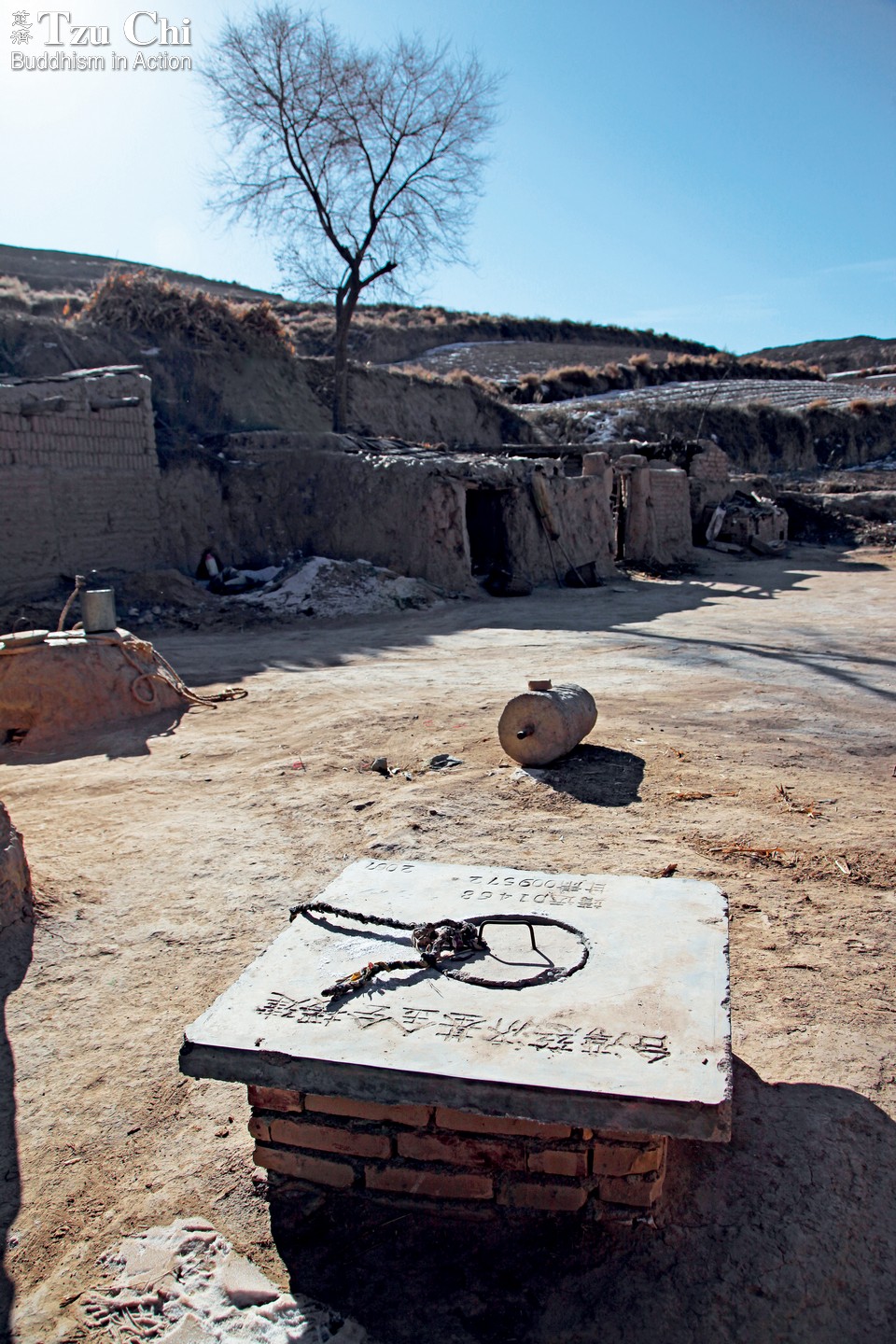
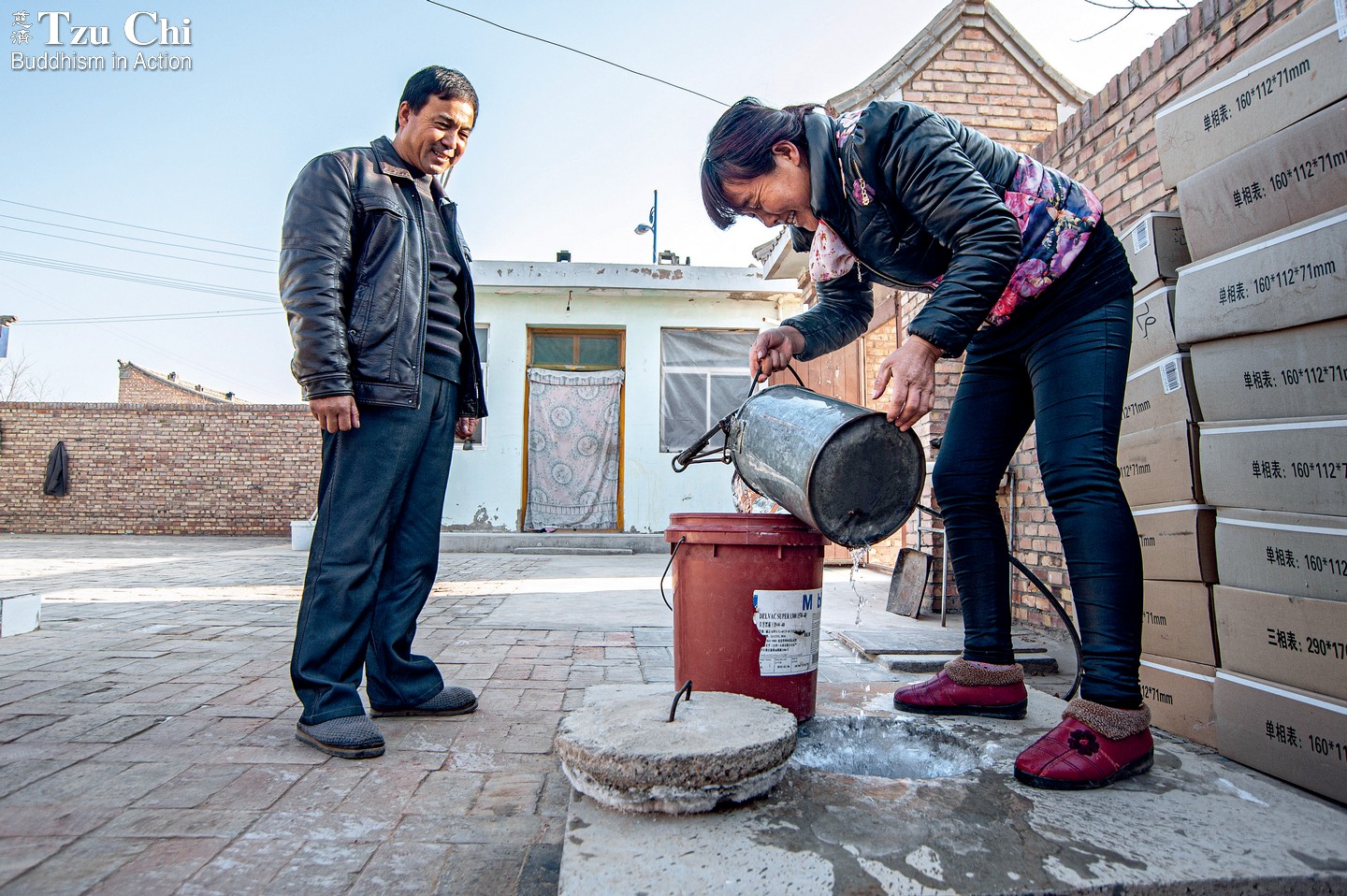
Tzu Chi helped residents in Gansu Province, China, save scarce water by building water cisterns. Hsiao Yiu-hwa
Among all of Tzu Chi’s global humanitarian efforts addressing water-related challenges, the water cistern construction project in Gansu Province, China, stands out as an especially inspiring example. On the Loess Plateau, Tzu Chi volunteers witnessed firsthand how the newly built cisterns enabled rural residents to store water more effectively, significantly improving their quality of life. However, when rainfall sharply declined, water scarcity resurfaced in some assisted areas, prompting the foundation to support village relocation efforts. These initiatives highlight the vital link between water availability and community well-being.
“Without water, people cannot live decent lives, no matter how hard they try,” said Lin Jing Xiu (林靜修) from the Tzu Chi Department of Charity Mission Development. Lin recounted that in the late 1990s, Wang Tuan-cheng (王端正), then vice president of the Tzu Chi Foundation, led a team to Tongwei and Huining counties in the southeastern part of Gansu Province, located on the Loess Plateau, to assess drought conditions and their impact on local farmers. The scope of the assessment later expanded to include Dongxiang, Jingyuan, Yongjing, and Guanghe counties.
The Loess Plateau is one of the world’s most severely eroded regions. Situated at an altitude of 1,000 to 3,000 meters (3,280 to 9,840 feet), it suffers from low rainfall and high evaporation, resulting in severe water scarcity. This scarcity hindered irrigation and forced residents to endure grueling journeys, often walking three to four hours, to fetch water for their daily needs.
Farming in this region was a constant gamble against nature. Farmers, uncertain about the timing and amount of rainfall, would still till the land and sow seeds, hoping for sufficient rain and a bountiful harvest. Most of the time, however, their efforts yielded just enough to scrape by—or nothing at all. This inefficient farming further damaged the fragile vegetation, perpetuating a vicious cycle of land degradation and poverty. As a result, young and able-bodied individuals were forced to find work elsewhere. Many children were unable to continue their education, and those fortunate enough to attend school had to leave their homes and families to study at distant institutions.
Recognizing that extreme water scarcity was driving poverty, family separation, and other social problems, Tzu Chi decided to build durable, high-quality water cisterns and rainwater harvesting systems for residents. Volunteers consulted with a drought research institute at Lanzhou University to determine the most effective solutions. They ultimately decided to construct 30-cubic-meter (1,060-cubic-foot) spherical cement cisterns for households, paired with cement rainwater collection surfaces. The cement cisterns addressed the problems of traditional earthen cisterns, which were prone to leakage, collapse, and contamination.
Between 1998 and 2009, Tzu Chi constructed 19,060 water cisterns across six counties in Gansu Province, benefiting over 100,000 people. Although rainfall in the regions did not increase, the amount of water stored grew significantly. After just a few rainfalls, the 30-cubic-meter cisterns would be filled, providing enough water for daily use and even some for irrigating farmland. Remarkably, these cisterns also helped young locals start families.
Women in drought-stricken areas in these regions often had to shoulder the burden of fetching water, a backbreaking task that continued into old age. As a result, young women were generally unwilling to marry into these water-scarce rural areas. “When we revisited the areas more than a decade later,” Lin Jing Xiu recalled, “the children we had helped were now parents themselves. I asked one woman why she decided to marry a man from this area, and she said, ‘Because his family has a water cistern!’”
Due to the improved living conditions brought about by Tzu Chi’s cisterns, they’ve become known locally as “wealth cisterns” and “happiness cisterns.”
Despite these efforts, climate change proved an overwhelming challenge. In areas like Ruoli Township in Jingyuan County, dwindling rainfall left many cisterns dry, forcing residents to resume their arduous water-collecting journeys.
To help, Tzu Chi partnered with the Gansu provincial government in 2008 to launch a village relocation initiative. The first relocation site was established in Liuchuan Township, also in Jingyuan County. Once a barren and sparsely populated area, Liuchuan was revitalized through government-built facilities that pumped water from the Yellow River for irrigation. This previously arid land was transformed into a thriving agricultural and livestock hub for Gansu Province, with convenient highway and railway access further solidifying its status as an ideal relocation site.
To ensure a smooth transition, Tzu Chi collaborated with local authorities to develop a well-rounded community. The new community provided not only housing but also education, employment opportunities, and agricultural resources to support sustainable livelihoods.
In January 2011, the Laiyao Tzu Chi New Village was inaugurated, providing homes for over a thousand former Ruoli residents across 210 households. By November 2015, a second site, the Baita Tzu Chi New Village in Wuhe Township, was completed, offering a fresh start to 300 families from five townships: Dongsheng, Jing’an, Shimen, Shuanglong, and Wuhe.
With access to irrigation from the Yellow River, life improved significantly for the residents. Freed from the burden of collecting water, they were able to focus on more productive endeavors. The relocation efforts also fostered ecological awareness, inspiring initiatives to restore the original land by converting farmland into forests. After residents vacated their homes on the Loess Plateau, reforestation teams moved in to rejuvenate the parched terrain, planting vegetation and installing drip irrigation systems to gradually transform the landscape into a verdant expanse.
For those using Tzu Chi-built cisterns and those who have begun new lives in the relocation villages, access to sufficient and clean water has been life-changing. It stands as a testament to the value of water and serves as a call to action against the growing challenges of climate change.
By Yeh Tzu-hao
Translated by Wu Hsiao-ting
Tzu Chi’s initiatives in Gansu Province showcase how access to water can transform communities.
Tzu Chi helped residents in Gansu Province, China, save scarce water by building water cisterns. Hsiao Yiu-hwa
Among all of Tzu Chi’s global humanitarian efforts addressing water-related challenges, the water cistern construction project in Gansu Province, China, stands out as an especially inspiring example. On the Loess Plateau, Tzu Chi volunteers witnessed firsthand how the newly built cisterns enabled rural residents to store water more effectively, significantly improving their quality of life. However, when rainfall sharply declined, water scarcity resurfaced in some assisted areas, prompting the foundation to support village relocation efforts. These initiatives highlight the vital link between water availability and community well-being.
“Without water, people cannot live decent lives, no matter how hard they try,” said Lin Jing Xiu (林靜修) from the Tzu Chi Department of Charity Mission Development. Lin recounted that in the late 1990s, Wang Tuan-cheng (王端正), then vice president of the Tzu Chi Foundation, led a team to Tongwei and Huining counties in the southeastern part of Gansu Province, located on the Loess Plateau, to assess drought conditions and their impact on local farmers. The scope of the assessment later expanded to include Dongxiang, Jingyuan, Yongjing, and Guanghe counties.
The Loess Plateau is one of the world’s most severely eroded regions. Situated at an altitude of 1,000 to 3,000 meters (3,280 to 9,840 feet), it suffers from low rainfall and high evaporation, resulting in severe water scarcity. This scarcity hindered irrigation and forced residents to endure grueling journeys, often walking three to four hours, to fetch water for their daily needs.
Farming in this region was a constant gamble against nature. Farmers, uncertain about the timing and amount of rainfall, would still till the land and sow seeds, hoping for sufficient rain and a bountiful harvest. Most of the time, however, their efforts yielded just enough to scrape by—or nothing at all. This inefficient farming further damaged the fragile vegetation, perpetuating a vicious cycle of land degradation and poverty. As a result, young and able-bodied individuals were forced to find work elsewhere. Many children were unable to continue their education, and those fortunate enough to attend school had to leave their homes and families to study at distant institutions.
Recognizing that extreme water scarcity was driving poverty, family separation, and other social problems, Tzu Chi decided to build durable, high-quality water cisterns and rainwater harvesting systems for residents. Volunteers consulted with a drought research institute at Lanzhou University to determine the most effective solutions. They ultimately decided to construct 30-cubic-meter (1,060-cubic-foot) spherical cement cisterns for households, paired with cement rainwater collection surfaces. The cement cisterns addressed the problems of traditional earthen cisterns, which were prone to leakage, collapse, and contamination.
Between 1998 and 2009, Tzu Chi constructed 19,060 water cisterns across six counties in Gansu Province, benefiting over 100,000 people. Although rainfall in the regions did not increase, the amount of water stored grew significantly. After just a few rainfalls, the 30-cubic-meter cisterns would be filled, providing enough water for daily use and even some for irrigating farmland. Remarkably, these cisterns also helped young locals start families.
Women in drought-stricken areas in these regions often had to shoulder the burden of fetching water, a backbreaking task that continued into old age. As a result, young women were generally unwilling to marry into these water-scarce rural areas. “When we revisited the areas more than a decade later,” Lin Jing Xiu recalled, “the children we had helped were now parents themselves. I asked one woman why she decided to marry a man from this area, and she said, ‘Because his family has a water cistern!’”
Due to the improved living conditions brought about by Tzu Chi’s cisterns, they’ve become known locally as “wealth cisterns” and “happiness cisterns.”
Despite these efforts, climate change proved an overwhelming challenge. In areas like Ruoli Township in Jingyuan County, dwindling rainfall left many cisterns dry, forcing residents to resume their arduous water-collecting journeys.
To help, Tzu Chi partnered with the Gansu provincial government in 2008 to launch a village relocation initiative. The first relocation site was established in Liuchuan Township, also in Jingyuan County. Once a barren and sparsely populated area, Liuchuan was revitalized through government-built facilities that pumped water from the Yellow River for irrigation. This previously arid land was transformed into a thriving agricultural and livestock hub for Gansu Province, with convenient highway and railway access further solidifying its status as an ideal relocation site.
To ensure a smooth transition, Tzu Chi collaborated with local authorities to develop a well-rounded community. The new community provided not only housing but also education, employment opportunities, and agricultural resources to support sustainable livelihoods.
In January 2011, the Laiyao Tzu Chi New Village was inaugurated, providing homes for over a thousand former Ruoli residents across 210 households. By November 2015, a second site, the Baita Tzu Chi New Village in Wuhe Township, was completed, offering a fresh start to 300 families from five townships: Dongsheng, Jing’an, Shimen, Shuanglong, and Wuhe.
With access to irrigation from the Yellow River, life improved significantly for the residents. Freed from the burden of collecting water, they were able to focus on more productive endeavors. The relocation efforts also fostered ecological awareness, inspiring initiatives to restore the original land by converting farmland into forests. After residents vacated their homes on the Loess Plateau, reforestation teams moved in to rejuvenate the parched terrain, planting vegetation and installing drip irrigation systems to gradually transform the landscape into a verdant expanse.
For those using Tzu Chi-built cisterns and those who have begun new lives in the relocation villages, access to sufficient and clean water has been life-changing. It stands as a testament to the value of water and serves as a call to action against the growing challenges of climate change.
Translated by Teresa Chang
At our year-end blessing and volunteer certification ceremonies in December, I saw volunteers from over 20 countries and regions. Some had journeyed tens of thousands of kilometers to Taiwan, enduring over 50 hours of travel and transiting through three countries. Meeting like this was not easy. Some spoke different languages, and although I couldn’t understand their words when they shared their life stories and Tzu Chi experiences on stage, I felt immense joy. This joy came from knowing they carry love in their hearts and have chosen a path of compassion and service. I believe they are among the happiest and most blessed people.
As I certified each new volunteer, I said, “Bless you. Be diligent [on the Bodhisattva Path].” I’m deeply grateful to all our volunteers. In a world filled with suffering, no single person can help everyone. That’s why our collective efforts are so vital. Regardless of religion or nationality, we are united in a shared mission: to alleviate suffering and serve those in need.
The Buddha was born into this world over 2,500 years ago. As a prince and heir to a kingdom, he lived a life of privilege. However, upon witnessing the suffering of people outside the palace—so different from his own life—he chose to renounce his throne and seek the truth. After attaining enlightenment, he wished for everyone to understand the true nature of life, cultivate wisdom, and sow blessings. He dedicated himself to guiding others along this path.
The Buddha shared a wealth of wisdom with the world, and I’ve always aspired to repay this kindness. Fulfilling my wish to contribute to the Buddha’s birthplace and other significant locations in his life’s journey, our volunteers from Singapore and Malaysia have traveled in successive groups to Nepal and India. In underserved villages, they have distributed aid, provided medical care, conducted vocational training, and built homes and school facilities. I deeply appreciate their dedication to uplifting the needy in these regions.
But help is needed beyond India and Nepal. Around the world, countless people contend with difficulties in their daily lives. In drought-stricken areas, even a single blade of grass struggles to survive. In Zimbabwe, for instance, people undertake arduous journeys to collect water—often unclean—while risking attacks from animals. Since 2013, our volunteer Tino Chu (朱金財) has led a team in building and repairing wells to address the country’s water scarcity; they have drilled or repaired over 2,000 wells. With the help of other volunteers, he also provides daily lunches to approximately 17,000 people, six days a week. Working in a country plagued by water scarcity and food insecurity is no easy task. I often reflect on how Mr. Chu has persevered for so many years, and I wonder: How many people have received food aid from us? And how many more suffering individuals remain unseen and unreachable?
Challenges abound in our world. Every evening, I watch global news. Beyond the impacts of climate change and natural disasters, countries are mired in crises as people fight over resources, leaving others to suffer and unable to live in peace. Seeing this fills my heart with sorrow. Why must there be such division, conflict, and strife? Without peace, even the greatest wealth holds no true value.
The Earth provides abundantly, offering plentiful crops. With such resources, humanity should not face shortages. Yet, disputes over resources, divisions, and strife cause unnecessary suffering. If people harbored love in their hearts, supported one another, and embraced openness and tolerance, this world could be a paradise.
It was with this belief that I founded Tzu Chi over 50 years ago. The early days were incredibly challenging, but I constantly reminded myself to stay true to my original aspirations and persevere. Gradually, the positive impact of our efforts became evident, drawing more and more people to join us. While one person alone may not accomplish much, anything is possible when everyone’s love comes together.
This year, as I left the Abode to preside over our year-end blessing ceremonies, I felt even weaker than last year. Age continues to take its toll on me. In the face of life’s impermanence, I seek only to make the most of each day. Each morning, if I can move my hands and feet and get out of bed, I focus on accomplishing what needs to be done. The Buddha’s love embraces the universe, and my aspirations to serve are equally boundless. If I cannot fulfill them all in this life, I will carry them forward into the next. Please be ever more mindful.

Master Cheng Yen teaches that even when individual efforts may appear small, the collective power of love can accomplish anything. Huang Xiao-zhe
Translated by Teresa Chang
At our year-end blessing and volunteer certification ceremonies in December, I saw volunteers from over 20 countries and regions. Some had journeyed tens of thousands of kilometers to Taiwan, enduring over 50 hours of travel and transiting through three countries. Meeting like this was not easy. Some spoke different languages, and although I couldn’t understand their words when they shared their life stories and Tzu Chi experiences on stage, I felt immense joy. This joy came from knowing they carry love in their hearts and have chosen a path of compassion and service. I believe they are among the happiest and most blessed people.
As I certified each new volunteer, I said, “Bless you. Be diligent [on the Bodhisattva Path].” I’m deeply grateful to all our volunteers. In a world filled with suffering, no single person can help everyone. That’s why our collective efforts are so vital. Regardless of religion or nationality, we are united in a shared mission: to alleviate suffering and serve those in need.
The Buddha was born into this world over 2,500 years ago. As a prince and heir to a kingdom, he lived a life of privilege. However, upon witnessing the suffering of people outside the palace—so different from his own life—he chose to renounce his throne and seek the truth. After attaining enlightenment, he wished for everyone to understand the true nature of life, cultivate wisdom, and sow blessings. He dedicated himself to guiding others along this path.
The Buddha shared a wealth of wisdom with the world, and I’ve always aspired to repay this kindness. Fulfilling my wish to contribute to the Buddha’s birthplace and other significant locations in his life’s journey, our volunteers from Singapore and Malaysia have traveled in successive groups to Nepal and India. In underserved villages, they have distributed aid, provided medical care, conducted vocational training, and built homes and school facilities. I deeply appreciate their dedication to uplifting the needy in these regions.
But help is needed beyond India and Nepal. Around the world, countless people contend with difficulties in their daily lives. In drought-stricken areas, even a single blade of grass struggles to survive. In Zimbabwe, for instance, people undertake arduous journeys to collect water—often unclean—while risking attacks from animals. Since 2013, our volunteer Tino Chu (朱金財) has led a team in building and repairing wells to address the country’s water scarcity; they have drilled or repaired over 2,000 wells. With the help of other volunteers, he also provides daily lunches to approximately 17,000 people, six days a week. Working in a country plagued by water scarcity and food insecurity is no easy task. I often reflect on how Mr. Chu has persevered for so many years, and I wonder: How many people have received food aid from us? And how many more suffering individuals remain unseen and unreachable?
Challenges abound in our world. Every evening, I watch global news. Beyond the impacts of climate change and natural disasters, countries are mired in crises as people fight over resources, leaving others to suffer and unable to live in peace. Seeing this fills my heart with sorrow. Why must there be such division, conflict, and strife? Without peace, even the greatest wealth holds no true value.
The Earth provides abundantly, offering plentiful crops. With such resources, humanity should not face shortages. Yet, disputes over resources, divisions, and strife cause unnecessary suffering. If people harbored love in their hearts, supported one another, and embraced openness and tolerance, this world could be a paradise.
It was with this belief that I founded Tzu Chi over 50 years ago. The early days were incredibly challenging, but I constantly reminded myself to stay true to my original aspirations and persevere. Gradually, the positive impact of our efforts became evident, drawing more and more people to join us. While one person alone may not accomplish much, anything is possible when everyone’s love comes together.
This year, as I left the Abode to preside over our year-end blessing ceremonies, I felt even weaker than last year. Age continues to take its toll on me. In the face of life’s impermanence, I seek only to make the most of each day. Each morning, if I can move my hands and feet and get out of bed, I focus on accomplishing what needs to be done. The Buddha’s love embraces the universe, and my aspirations to serve are equally boundless. If I cannot fulfill them all in this life, I will carry them forward into the next. Please be ever more mindful.
Master Cheng Yen teaches that even when individual efforts may appear small, the collective power of love can accomplish anything. Huang Xiao-zhe
平安であることに感謝すれば,心は満たされます。
満足できない人は、永遠に自分が幸福であることを知りません。
九月九日、基金会主任たちの報告の時間に、洪静原(ホン・ジンユェン)師姐は慈済の献体への取り組みについて言及しました。多くの慈済ボランティアが健康なうちに献体登録を済ませ、重病を患った時には特に花蓮慈済病院に戻って緩和ケアを受け、最後の瞬間を迎えたならば、動かなくなった身体を慈済大学に寄付することで願いを果たしていると述べました。
上人曰く、慈済ボランティアは慈済と縁を結んで以来、「役に立つことに価値がある」という人生観を築き、生死を平然と受け入れることができるようになったので、「心に執着がなく、執着がないからこそ」、だからこそ不断に奉仕し、求めず、執着せず、心身を捧げているのです。
「かけがえのない生命に値段をつけることはできません。我々は方向をしっかり選び、この人生を衆生のために捧げることができれば、この人生は価値ある人生となるのです」。
「慈済の人々の愛は口先だけではなく、それを実践していますから、家庭の模範、地域の模範となり、その瞬間に教師となることができるのです。最後まで待って無言の良師になるのではありません」。上人は慈済大学で「無言の良師」と呼ばれる献体について、世の中で成功を収める人や、子や孫を育てて家庭を成している人の中には、特に慈済ボランティアが多いと語りました。慈済に入って誠心誠意で心身を捧げ、多くの苦しむ人々のために尽くすその姿は、まさに人の模範です。人生の最後に身体までも寄付し、医学のために奉仕しているのです。そうすることで自分の人生を、本当に精一杯、捧げることができたと言えるのです。
九月十日、シンガポール支部の劉瑞士(リュウ・ルイシ)執行長と幹部たちが精舎に帰り、人工透析センターの運営やスリランカでの施療、会務への配慮、十周年を迎えた慈済大愛幼児教育センターの成果について共有しました。それに対して上人は、こう開示しました。
「シンガポールは福地であり、社会福祉や一般市民の生活は標準以上ですが、清潔で明るい環境に住んでいる人々の心が純朴であることは、非常に幸運なことです。私はいつも自分が幸運であることに感謝しています。なぜなら、毎日出会える方々が善知識であり、友人や法縁者が互いに励まし合っているからです。私を生んで育ててくれた両親に感謝し、この身を以て人間のために福を施し、大衆に利益をもたらしたいのです」。
仏法を学ぶことは、福を求めることではありません。福は、求める必要がないのです。常日頃から真摯に福を施すことで、自然に福が得られるのです。
「もし奉仕を望まず、福を施さなければ、どんなに求めても何も得られません。農夫が田畑を耕さず、種を蒔かず、苗を植えなければ、当然収穫はないのと同じです。季節ごとの作業に心を込め、種を蒔き、耕作し、収穫を得たら更に種を残し、再び種を蒔き、苗を植えてこそ、十分な食糧が得られ、人々に供給できるのです」。
菩提心を発すること、この一念は一つの種子であり、心を込めて耕し、育てることで「一つ」が無量へと増えるのです。上人は、大きな木も小さな種子から芽を出して成長するのであり、地、水、火、風との良い縁が結ばれてこそ、時間と共に成長し繁茂することができると述べました。福縁を持ち、平安な社会に住むことができても、世界にはたくさんの人々が、生まれた時から厳しい環境に置かれて心が極端な状態になり、絶えず戦渦に巻き込まれ、朝が来るかどうかも分からない中で不安に苛まれています。その苦しみと痛みは耐え難いものです。
上人は、多くの国や地域が動乱に満ちていることを嘆き、人と人との間で争いが起こり、衆生の業力がますます重くなり、同じ空間の中で衝突が引き起こされ、感情が引き裂かれ、一般市民は本当に苦しんでいると語りました。
「平和で安定して繁栄する幸せな社会に住んでいる私たちは、毎日感謝することが大切です。私は毎日感謝を唱え、すべての人を尊重します。誰もが仏性を持っているのですから、心を込めて修行して自分の本性に戻ればそれでよく、外に求める必要はなくなるのです」。
「皆さんは、こうして精舎に幸福と感謝を持ち帰ってくれました。これからも自分に満足し、福を知り、福を惜しむことを期待しています。福を知らない人は、永遠に自分が幸福であることを知らず、外に求め続け、心の中は煩悩でいっぱいになり、欲望がますます強くなり、苦しみが増すのです。実のところ、平安であれば心が満たされて満足するというものです。善を行う志を持つことが大切で、善を行える人こそが福のある人であり、豊かで余裕がある人なのです。もし福を知らなければ、永遠に満足できず、人を助けたいと思わなくなります」。
どんなに裕福な国でも、苦しむ人々は存在します。上人はシンガポールのチームを称賛しました。慈善と施療を結びつけ、外に出られない家庭に入って初診を行い、医療を手配し、その後も長期的にフォローアップを行ってボランティアが定期的に訪問したり、家庭環境の清掃を手伝ったりして、安心して病気を治せるようにしていると、その活動を紹介しました。
「人を助けたいという気持ちがあっても、自分の力は限られています。慈済には多くの志を同じくする法縁者がいますから、互いに福を託し、福縁を共にし、協力して多くの困難な人々を助けることができるのです。私たちはお互いを大切にし、感謝し、祝福し合うべきなのです」。上人はシンガポールのボランティアに、この慈済の思いを広め、地域で慈済のボランティアに参加する人々が増えて各地へ伝わり、人々が凡夫から菩薩となってこの世が浄土へと変わることを願っています。
(慈済月刊六九六期より)
平安であることに感謝すれば,心は満たされます。
満足できない人は、永遠に自分が幸福であることを知りません。
九月九日、基金会主任たちの報告の時間に、洪静原(ホン・ジンユェン)師姐は慈済の献体への取り組みについて言及しました。多くの慈済ボランティアが健康なうちに献体登録を済ませ、重病を患った時には特に花蓮慈済病院に戻って緩和ケアを受け、最後の瞬間を迎えたならば、動かなくなった身体を慈済大学に寄付することで願いを果たしていると述べました。
上人曰く、慈済ボランティアは慈済と縁を結んで以来、「役に立つことに価値がある」という人生観を築き、生死を平然と受け入れることができるようになったので、「心に執着がなく、執着がないからこそ」、だからこそ不断に奉仕し、求めず、執着せず、心身を捧げているのです。
「かけがえのない生命に値段をつけることはできません。我々は方向をしっかり選び、この人生を衆生のために捧げることができれば、この人生は価値ある人生となるのです」。
「慈済の人々の愛は口先だけではなく、それを実践していますから、家庭の模範、地域の模範となり、その瞬間に教師となることができるのです。最後まで待って無言の良師になるのではありません」。上人は慈済大学で「無言の良師」と呼ばれる献体について、世の中で成功を収める人や、子や孫を育てて家庭を成している人の中には、特に慈済ボランティアが多いと語りました。慈済に入って誠心誠意で心身を捧げ、多くの苦しむ人々のために尽くすその姿は、まさに人の模範です。人生の最後に身体までも寄付し、医学のために奉仕しているのです。そうすることで自分の人生を、本当に精一杯、捧げることができたと言えるのです。
九月十日、シンガポール支部の劉瑞士(リュウ・ルイシ)執行長と幹部たちが精舎に帰り、人工透析センターの運営やスリランカでの施療、会務への配慮、十周年を迎えた慈済大愛幼児教育センターの成果について共有しました。それに対して上人は、こう開示しました。
「シンガポールは福地であり、社会福祉や一般市民の生活は標準以上ですが、清潔で明るい環境に住んでいる人々の心が純朴であることは、非常に幸運なことです。私はいつも自分が幸運であることに感謝しています。なぜなら、毎日出会える方々が善知識であり、友人や法縁者が互いに励まし合っているからです。私を生んで育ててくれた両親に感謝し、この身を以て人間のために福を施し、大衆に利益をもたらしたいのです」。
仏法を学ぶことは、福を求めることではありません。福は、求める必要がないのです。常日頃から真摯に福を施すことで、自然に福が得られるのです。
「もし奉仕を望まず、福を施さなければ、どんなに求めても何も得られません。農夫が田畑を耕さず、種を蒔かず、苗を植えなければ、当然収穫はないのと同じです。季節ごとの作業に心を込め、種を蒔き、耕作し、収穫を得たら更に種を残し、再び種を蒔き、苗を植えてこそ、十分な食糧が得られ、人々に供給できるのです」。
菩提心を発すること、この一念は一つの種子であり、心を込めて耕し、育てることで「一つ」が無量へと増えるのです。上人は、大きな木も小さな種子から芽を出して成長するのであり、地、水、火、風との良い縁が結ばれてこそ、時間と共に成長し繁茂することができると述べました。福縁を持ち、平安な社会に住むことができても、世界にはたくさんの人々が、生まれた時から厳しい環境に置かれて心が極端な状態になり、絶えず戦渦に巻き込まれ、朝が来るかどうかも分からない中で不安に苛まれています。その苦しみと痛みは耐え難いものです。
上人は、多くの国や地域が動乱に満ちていることを嘆き、人と人との間で争いが起こり、衆生の業力がますます重くなり、同じ空間の中で衝突が引き起こされ、感情が引き裂かれ、一般市民は本当に苦しんでいると語りました。
「平和で安定して繁栄する幸せな社会に住んでいる私たちは、毎日感謝することが大切です。私は毎日感謝を唱え、すべての人を尊重します。誰もが仏性を持っているのですから、心を込めて修行して自分の本性に戻ればそれでよく、外に求める必要はなくなるのです」。
「皆さんは、こうして精舎に幸福と感謝を持ち帰ってくれました。これからも自分に満足し、福を知り、福を惜しむことを期待しています。福を知らない人は、永遠に自分が幸福であることを知らず、外に求め続け、心の中は煩悩でいっぱいになり、欲望がますます強くなり、苦しみが増すのです。実のところ、平安であれば心が満たされて満足するというものです。善を行う志を持つことが大切で、善を行える人こそが福のある人であり、豊かで余裕がある人なのです。もし福を知らなければ、永遠に満足できず、人を助けたいと思わなくなります」。
どんなに裕福な国でも、苦しむ人々は存在します。上人はシンガポールのチームを称賛しました。慈善と施療を結びつけ、外に出られない家庭に入って初診を行い、医療を手配し、その後も長期的にフォローアップを行ってボランティアが定期的に訪問したり、家庭環境の清掃を手伝ったりして、安心して病気を治せるようにしていると、その活動を紹介しました。
「人を助けたいという気持ちがあっても、自分の力は限られています。慈済には多くの志を同じくする法縁者がいますから、互いに福を託し、福縁を共にし、協力して多くの困難な人々を助けることができるのです。私たちはお互いを大切にし、感謝し、祝福し合うべきなのです」。上人はシンガポールのボランティアに、この慈済の思いを広め、地域で慈済のボランティアに参加する人々が増えて各地へ伝わり、人々が凡夫から菩薩となってこの世が浄土へと変わることを願っています。
(慈済月刊六九六期より)
By Tzu Chi Monthly editorial staff, Budsara Sombut, Lin Jing Xiu, and Daw Thida Khin
Compiled and translated by Wu Hsiao-ting
Typhoon Yagi formed over the waters east of the Philippines on August 30, 2024. It made landfall in the country as a low-intensity typhoon on September 2, quickly traversing Luzon Island. Yagi intensified after entering the South China Sea before sweeping across China, Vietnam, and Laos. Heavy rains caused severe damage in Thailand and Myanmar. The typhoon was Asia’s strongest in 2024, affecting over 20 million people and leaving widespread devastation in its wake.
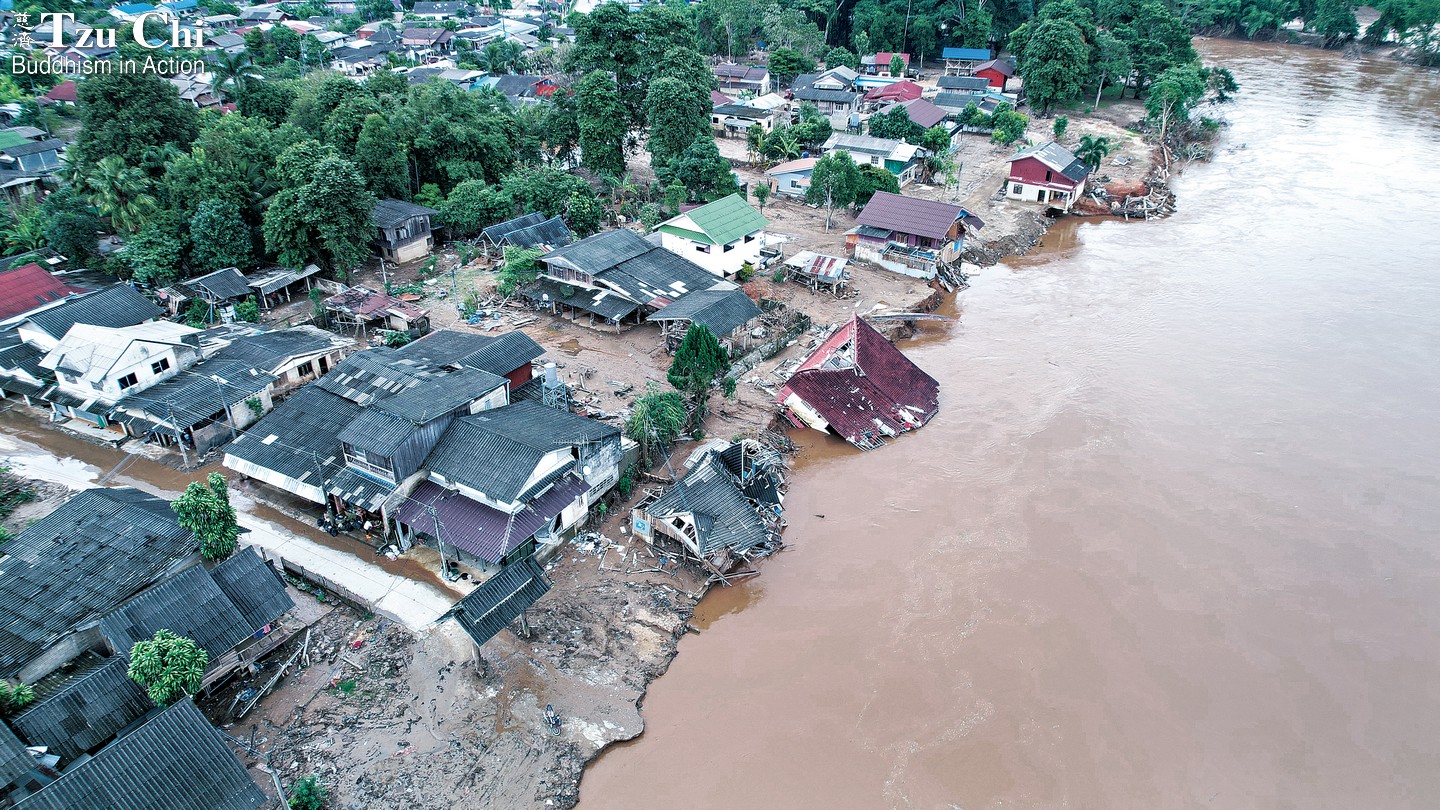
Mae Yao, a flood-affected area along the Kok River in northern Thailand. Singharat Chunchom
Typhoon Yagi made a near 90-degree turn on its path, sparing Taiwan but wreaking havoc across Southeast Asia. On September 2, 2024, it made landfall on Luzon Island in the Philippines, bringing landslides and floods. A major landslide occurred in the province of Rizal, just 25 kilometers (15 miles) from Manila. The Philippines endure an average of 20 typhoons every year, so local Tzu Chi volunteers have developed a rapid disaster response system. Following Typhoon Yagi, they distributed rice and other supplies to over 1,100 families and provided construction material vouchers to families in two severely affected barangays in Antipolo, helping them repair their homes.
Yagi made landfall in Hainan, China, on September 6, and gradually weakened as it moved into Vietnam. What was left of the storm combined with the region’s heavy rainy season while crossing Mainland Southeast Asia toward the Indian Ocean, triggering severe flooding and landslides in Myanmar and Thailand. Rivers overflowed, and landslides buried farmland in mountainous areas. By the time it was over, the disaster had claimed over 500 lives across Southeast Asia.
The government of Vietnam declared it the strongest typhoon to hit the country in 30 years. In its aftermath, Tzu Chi volunteers assessed damage in the northern provinces of Lào Cai and Yên Bái, where most victims were impoverished farmers. Some homes were nearly destroyed, with rebuilding nearly impossible for those living in disaster-prone areas. With government assistance, residents in those areas prepared to relocate. In mid-November, Tzu Chi provided cash aid to over 2,600 affected households to help them through this critical period.
In Thailand, the northern provinces of Chiang Mai and Chiang Rai suffered the worst flooding in 80 years. Teachers and students from Chiang Mai Tzu Chi School were the first to respond, assessing damage, distributing aid, and assisting with cleanup. Volunteers from the Tzu Chi office in Bangkok soon followed, surveying conditions and providing relief in affected regions. They set up two distribution centers in mid-September in Mueang Chiang Rai and Mae Sai District, both in Chiang Rai Province. With the help of village leaders, they distributed daily necessities and cleaning tools. Volunteers also delivered supplies to remote villages in Mae Sai, areas often overlooked in relief efforts due to their small populations. They transported goods by truck and trekked into hard-to-reach areas to ensure no one was left behind.
In early October, volunteers returned to four districts in Chiang Rai Province to conduct further damage assessments and distribute aid. They hoped to reach as many people in need as possible. Accompanying them on part of their journey was an assistant to a village head in Mae Sai District, Saowalak, whose own home had been severely damaged. With her guidance, volunteers delivered supplies to affected residents. “My parents and other family members are busy restoring our house,” Saowalak shared, “but they fully support me going out to help the villagers. Although we were strangers before, you have shown us so much love, reaching out to us in our time of need. We are truly grateful and hold you in great affection.”
In addition to distributing relief goods, volunteers provided cash aid to over 2,100 affected households in October and November to support their rebuilding efforts. At the same time, they evaluated medium- and long-term reconstruction plans for Doi Laem in Mae Ai District and Mae Salong in Mae Fa Luang District. In Doi Laem, 28 households needed land to rebuild their homes. During one visit, volunteers were accompanied by Suradej, then deputy village head, to the mountaintop to survey the government’s proposed construction site. The official expressed gratitude for Tzu Chi’s dedication, noting that they were the only organization so far to have made the climb to the mountaintop to carefully assess the proposed land for rebuilding. He sincerely hoped to collaborate with the foundation to help villagers rebuild their homes.
The devastation from Typhoon Yagi was even more widespread in Myanmar than in Thailand. Floodwaters submerged low-lying areas in Naypyidaw, Mandalay Region, Bago Region, and Shan State. A total of 64 townships nationwide were affected, and essential infrastructure like roads and bridges sustained severe damage. In response, Tzu Chi volunteers provided emergency cash aid and launched a cash-for-work cleanup project in Tatkon Township, Naypyidaw. This initiative encouraged local residents to collaborate in clearing debris and restoring their villages, helping to speed up recovery.
Daw Thida Khin (李金蘭), head of Tzu Chi Myanmar, shared her experiences conducting relief efforts in Tatkon Township. In some areas, houses were wrecked and paths were blocked by trees that had been swept down from the mountains. Overwhelmed village heads, unsure of where to begin the cleanup efforts, admitted to feeling helpless. To inspire them and other local residents, Daw Thida Khin and her fellow volunteers shared Master Cheng Yen’s teaching: with unity and determination, even small ants can move great mountains—a principle central to Tzu Chi’s spirit.
At first hesitant, the villagers soon recognized the volunteers’ sincere intentions and joined the cleanup effort. They collected garbage using baskets and plastic bags salvaged from the debris, working together to restore their community. The cleanup in Tatkon Township lasted 20 days, ending on October 27. Residents contributed nearly 5,550 work shifts, significantly aiding the recovery of the area. Afterward, Tzu Chi launched a second phase of aid, distributing relief supplies to further support victims.
Southeast Asia is one of the most vulnerable regions in the world to global climate change. The areas impacted by Typhoon Yagi, primarily agricultural nations, suffered significant crop losses that threatened food security, drove up food prices, and deepened poverty and hunger. Severe damage to infrastructure further complicated relief efforts. Tzu Chi volunteers remain committed to standing by affected communities, helping them navigate their challenging journey of recovery.
Vietnam
While traveling to Nậm Pung in Lào Cai Province to assess conditions after Typhoon Yagi, volunteers encountered several landslides that had blocked the roads, making car access impossible. They had to walk or use motorcycles to continue their journey. Nguyen Dinh Hung
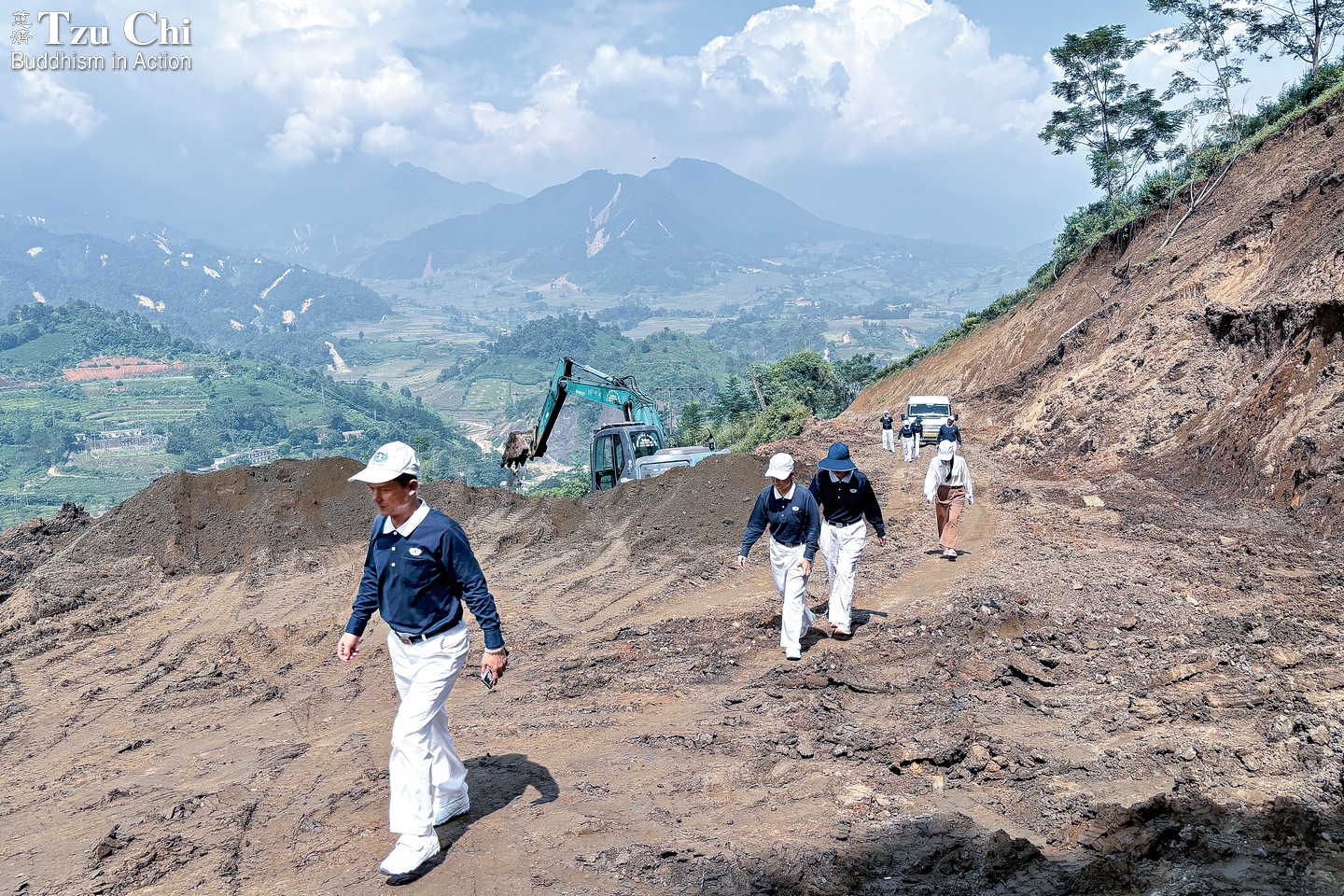

Volunteers in Vietnam distribute pastries to residents of Nậm Pung, Lào Cai Province, during a late September 2024 trip to assess damage caused by Typhoon Yagi. Nguyen Dinh Hung
Thailand

Residents of Mae Sai District, Chiang Rai Province, Thailand, pose with cash aid provided by Tzu Chi. Pinticha Jansuksri
Myanmar
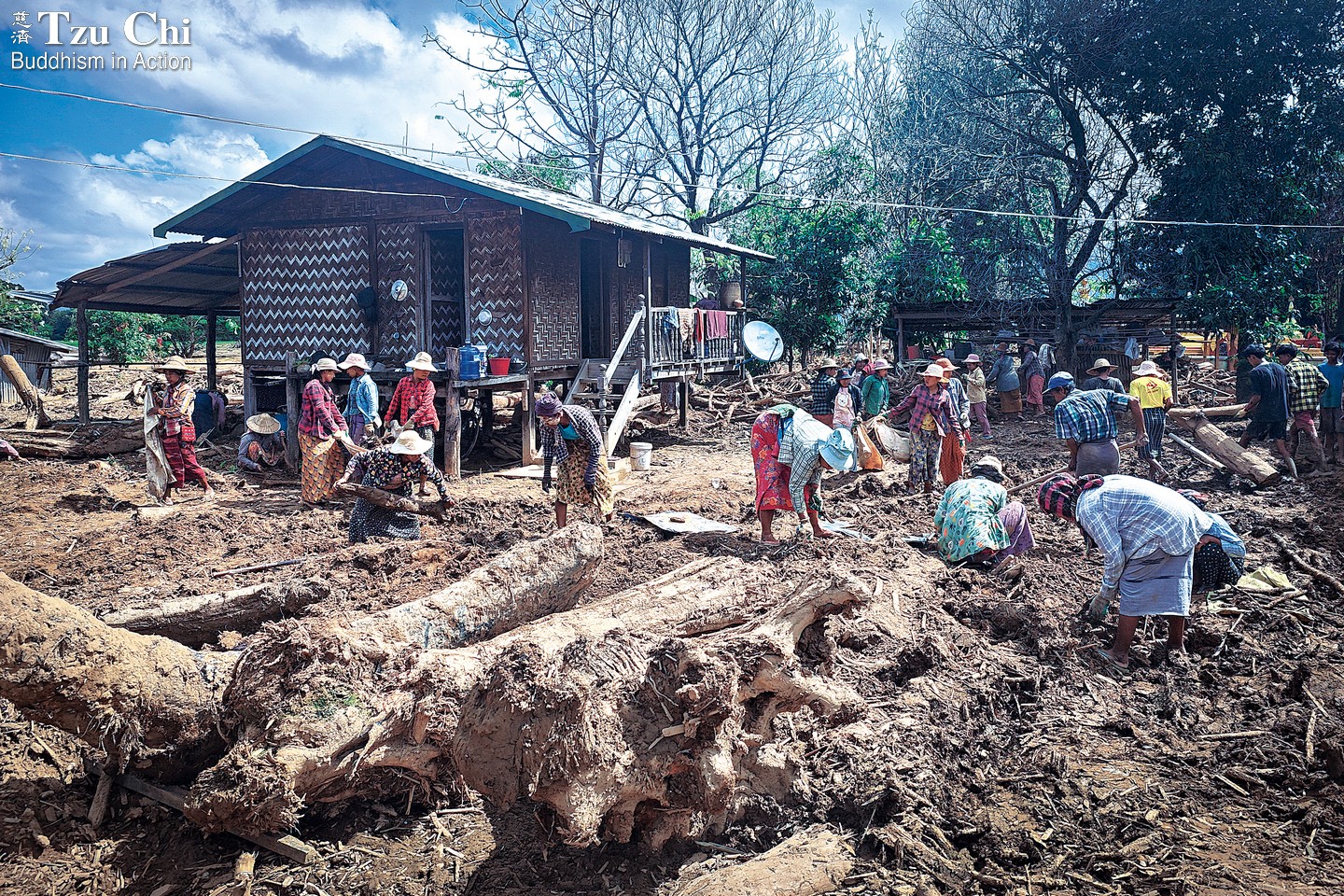
Residents of Tatkon Township, Naypyidaw, Myanmar, work together to clean up in the aftermath of Typhoon Yagi. Hein Pyae Sone
Buddhist monk U Thiha Nyar Na addresses participants of a Tzu Chi cash-for-work cleanup project in Tatkon Township, Myanmar. He provided significant assistance to Tzu Chi volunteers in their relief efforts in response to Typhoon Yagi’s impact. Hein Pyae Sone
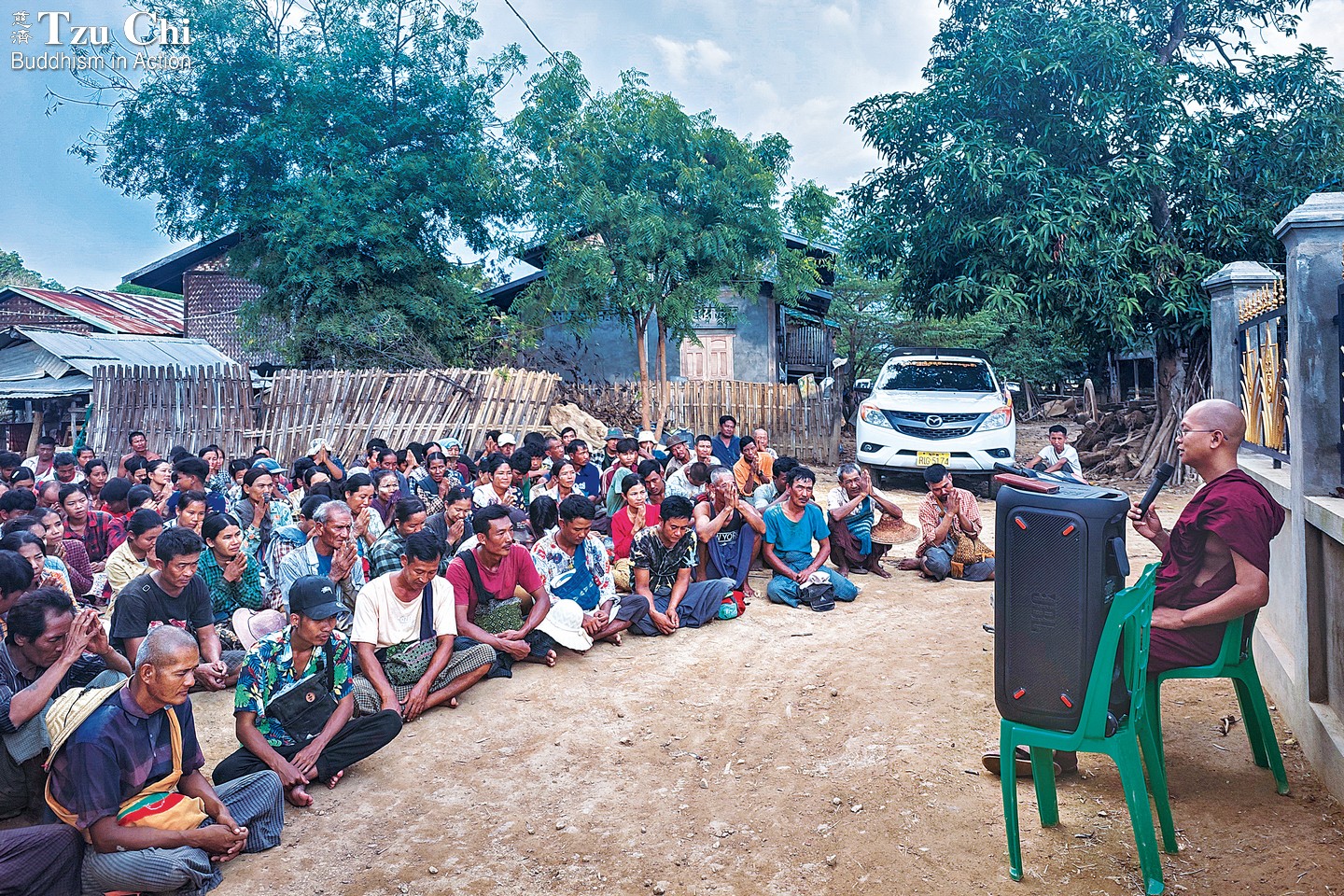
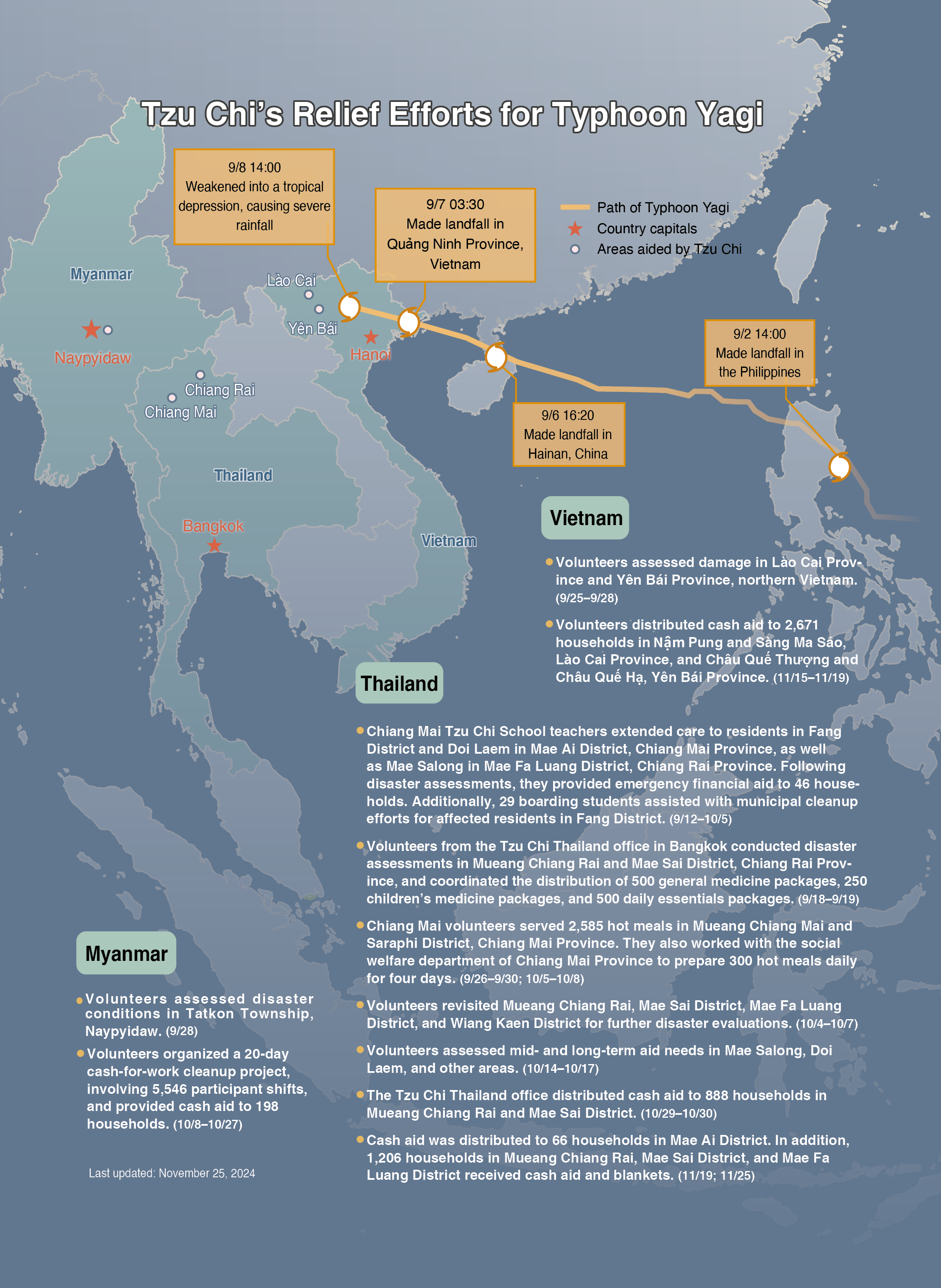
By Tzu Chi Monthly editorial staff, Budsara Sombut, Lin Jing Xiu, and Daw Thida Khin
Compiled and translated by Wu Hsiao-ting
Typhoon Yagi formed over the waters east of the Philippines on August 30, 2024. It made landfall in the country as a low-intensity typhoon on September 2, quickly traversing Luzon Island. Yagi intensified after entering the South China Sea before sweeping across China, Vietnam, and Laos. Heavy rains caused severe damage in Thailand and Myanmar. The typhoon was Asia’s strongest in 2024, affecting over 20 million people and leaving widespread devastation in its wake.
Mae Yao, a flood-affected area along the Kok River in northern Thailand. Singharat Chunchom
Typhoon Yagi made a near 90-degree turn on its path, sparing Taiwan but wreaking havoc across Southeast Asia. On September 2, 2024, it made landfall on Luzon Island in the Philippines, bringing landslides and floods. A major landslide occurred in the province of Rizal, just 25 kilometers (15 miles) from Manila. The Philippines endure an average of 20 typhoons every year, so local Tzu Chi volunteers have developed a rapid disaster response system. Following Typhoon Yagi, they distributed rice and other supplies to over 1,100 families and provided construction material vouchers to families in two severely affected barangays in Antipolo, helping them repair their homes.
Yagi made landfall in Hainan, China, on September 6, and gradually weakened as it moved into Vietnam. What was left of the storm combined with the region’s heavy rainy season while crossing Mainland Southeast Asia toward the Indian Ocean, triggering severe flooding and landslides in Myanmar and Thailand. Rivers overflowed, and landslides buried farmland in mountainous areas. By the time it was over, the disaster had claimed over 500 lives across Southeast Asia.
The government of Vietnam declared it the strongest typhoon to hit the country in 30 years. In its aftermath, Tzu Chi volunteers assessed damage in the northern provinces of Lào Cai and Yên Bái, where most victims were impoverished farmers. Some homes were nearly destroyed, with rebuilding nearly impossible for those living in disaster-prone areas. With government assistance, residents in those areas prepared to relocate. In mid-November, Tzu Chi provided cash aid to over 2,600 affected households to help them through this critical period.
In Thailand, the northern provinces of Chiang Mai and Chiang Rai suffered the worst flooding in 80 years. Teachers and students from Chiang Mai Tzu Chi School were the first to respond, assessing damage, distributing aid, and assisting with cleanup. Volunteers from the Tzu Chi office in Bangkok soon followed, surveying conditions and providing relief in affected regions. They set up two distribution centers in mid-September in Mueang Chiang Rai and Mae Sai District, both in Chiang Rai Province. With the help of village leaders, they distributed daily necessities and cleaning tools. Volunteers also delivered supplies to remote villages in Mae Sai, areas often overlooked in relief efforts due to their small populations. They transported goods by truck and trekked into hard-to-reach areas to ensure no one was left behind.
In early October, volunteers returned to four districts in Chiang Rai Province to conduct further damage assessments and distribute aid. They hoped to reach as many people in need as possible. Accompanying them on part of their journey was an assistant to a village head in Mae Sai District, Saowalak, whose own home had been severely damaged. With her guidance, volunteers delivered supplies to affected residents. “My parents and other family members are busy restoring our house,” Saowalak shared, “but they fully support me going out to help the villagers. Although we were strangers before, you have shown us so much love, reaching out to us in our time of need. We are truly grateful and hold you in great affection.”
In addition to distributing relief goods, volunteers provided cash aid to over 2,100 affected households in October and November to support their rebuilding efforts. At the same time, they evaluated medium- and long-term reconstruction plans for Doi Laem in Mae Ai District and Mae Salong in Mae Fa Luang District. In Doi Laem, 28 households needed land to rebuild their homes. During one visit, volunteers were accompanied by Suradej, then deputy village head, to the mountaintop to survey the government’s proposed construction site. The official expressed gratitude for Tzu Chi’s dedication, noting that they were the only organization so far to have made the climb to the mountaintop to carefully assess the proposed land for rebuilding. He sincerely hoped to collaborate with the foundation to help villagers rebuild their homes.
The devastation from Typhoon Yagi was even more widespread in Myanmar than in Thailand. Floodwaters submerged low-lying areas in Naypyidaw, Mandalay Region, Bago Region, and Shan State. A total of 64 townships nationwide were affected, and essential infrastructure like roads and bridges sustained severe damage. In response, Tzu Chi volunteers provided emergency cash aid and launched a cash-for-work cleanup project in Tatkon Township, Naypyidaw. This initiative encouraged local residents to collaborate in clearing debris and restoring their villages, helping to speed up recovery.
Daw Thida Khin (李金蘭), head of Tzu Chi Myanmar, shared her experiences conducting relief efforts in Tatkon Township. In some areas, houses were wrecked and paths were blocked by trees that had been swept down from the mountains. Overwhelmed village heads, unsure of where to begin the cleanup efforts, admitted to feeling helpless. To inspire them and other local residents, Daw Thida Khin and her fellow volunteers shared Master Cheng Yen’s teaching: with unity and determination, even small ants can move great mountains—a principle central to Tzu Chi’s spirit.
At first hesitant, the villagers soon recognized the volunteers’ sincere intentions and joined the cleanup effort. They collected garbage using baskets and plastic bags salvaged from the debris, working together to restore their community. The cleanup in Tatkon Township lasted 20 days, ending on October 27. Residents contributed nearly 5,550 work shifts, significantly aiding the recovery of the area. Afterward, Tzu Chi launched a second phase of aid, distributing relief supplies to further support victims.
Southeast Asia is one of the most vulnerable regions in the world to global climate change. The areas impacted by Typhoon Yagi, primarily agricultural nations, suffered significant crop losses that threatened food security, drove up food prices, and deepened poverty and hunger. Severe damage to infrastructure further complicated relief efforts. Tzu Chi volunteers remain committed to standing by affected communities, helping them navigate their challenging journey of recovery.
Vietnam
While traveling to Nậm Pung in Lào Cai Province to assess conditions after Typhoon Yagi, volunteers encountered several landslides that had blocked the roads, making car access impossible. They had to walk or use motorcycles to continue their journey. Nguyen Dinh Hung
Volunteers in Vietnam distribute pastries to residents of Nậm Pung, Lào Cai Province, during a late September 2024 trip to assess damage caused by Typhoon Yagi. Nguyen Dinh Hung
Thailand
Residents of Mae Sai District, Chiang Rai Province, Thailand, pose with cash aid provided by Tzu Chi. Pinticha Jansuksri
Myanmar
Residents of Tatkon Township, Naypyidaw, Myanmar, work together to clean up in the aftermath of Typhoon Yagi. Hein Pyae Sone
Buddhist monk U Thiha Nyar Na addresses participants of a Tzu Chi cash-for-work cleanup project in Tatkon Township, Myanmar. He provided significant assistance to Tzu Chi volunteers in their relief efforts in response to Typhoon Yagi’s impact. Hein Pyae Sone
鉄板焼の店主は、竹筒募金箱に六十一元しか入っていないのを見て、五百元札を取り出して寄付した。
お粥の店の女将さんは、「どうぞ座ってお粥を食べて行って下さい。ご馳走しますから」と声をかけてくれた。
路地を歩いて募金に協力してくれている慈済の「愛ある商店」を訪ねる、というこの修行をしていると、歩きながら社会の温かさも冷淡さも感じ取ることができ、感謝の気持ちで一杯になった。
店の出入り口の横に愛の竹筒募金箱を置いて客に小銭を入れてもらう。愛が伴えば、小銭も愛になる。50銭でも人助けができる。
月末の数日間はいつも、「愛ある商店」に出向いて寄付金を集金するのだが、あの日の夜は、立て続けに十軒回った。徒歩で二時間近く歩いて、汗だくになりながら、重い小銭をリュックに入れて背負っていると、見知らぬ人たちからの愛を感じることができ、私の心はとても感動していた。リュックはとても重たかったが、足取りは軽かった。
旧暦十五日の空に輝くお月様と星々が、車が行き交う街を歩く私に寄り添ってくれた。その柔らかい光は、穏やかさと平和を感じさせ、美しさと哀愁に満ちたこの世を静かに見守ってくれていた。街の至る所を歩いていた私は、正に修行の道を歩んでいたのだ。證厳法師の写真が埋め込まれた数珠を手にして出かける時は、心の中で話しかける。「上人様、散歩に行きますよ。私たち弟子が店主とどう交流しているのかもお見せします。どうか安心してください」。
お粥とおつまみを販売する店の女将さんが、「師姐(女性ボランティアの呼称)!お粥を食べてって!……」と私に呼びかけた。私は「最近、あまり食欲がないのです。テレビのニュースで、戦争の避難民が一日にビスケット二枚しか食べられないのを見て、涙が溢れました。その時からあまり食欲がないのです。ご好意には感謝しています」と答えた。
「お宅で売っている碗粿(ワーグイ)㊟には、ベジタリアンの物がありますか」。私が台南碗粿(ワーグイ)を売っている店の人に尋ねると、「本店から出来たものを届けて来るので難しいですね。私は一日も肉なしには過ごせません」という返事だった。私は「魚も肉も食べるなら、もっと野菜を食べた方が健康にいいですよ」と言った。その店の人とは数カ月間にわたって交流していたため、既に気さくに話をすることができた。続けて私はこう言った。「漢字は奥深いですよ。肉という字はどう書くのかご存知ですか? 肉には人という字が二つ入っていて、肉を食べることは命を食べることなんですよ……」と言った。彼は笑い出した。帰り際に、もっと野菜や果物を食べるよう薦めた。
鉄板焼の店主は、私が寄付金を数えているのを見て、「今日はいくらですか?」と聞いた。六十一元だった。「少ないね」。店主はポケットから五百元札を取り出した。本当に感動した!私が「莒光路にあるお店にも、愛の竹筒募金箱を置かせていただけませんか?」と聞くと、店主は快諾してくれた。ありがたい!店主の真心と行動力に心から感動した。なんと善人の多いことか。
私がいつも店主にありがとうと言うので、今では、多くの店の人が私に会うと、自然にありがとうと言うようになった。あちこちで「ありがとう」という声が聞こえるとは、何と和気藹々とした社会なのだろう。
「明日の次はまた明日、何と明日の多いことか。人生は明日ばかりを待っていれば、時を無駄に過ごすことになる」という詩がある。待っているよりも、直ちに行動に移せばよいのだ。だから、用事で出かける時、いつも竹筒募金箱を持ち歩き、沿道で縁を結ぶ店を探すようにしている。確かにそういう店を募るのは容易ではなく、話を切り出せばそれで結ばれるというものでもないが、一歩踏み出せば、チャンスは訪れるのだ。
その過程で、失敗して挫折したこともあったが、気を静めて原因を考えてみると、私自身の初心が消えていたからだった。一刻も早く竹筒募金箱を押しつけたいという気持ちだけしかなく、店と人とが愛の竹筒募金箱を通して慈済と良縁を結べるようにしたい、という初心を忘れてしまっていた。「毎日が人としての始まりであり、一瞬一瞬が自分への戒めでもある」と「静思語・良い言葉を話す」にあるように、敬虔な気持ちに戻って再出発するのはとても大事なことである。
慈済は「実践」を通して発展して来たのであり、実際に行動して初めて様々な状況を体得することができるのである。慈済の菩薩道は修行の道であり、経典の教えを実践する道であり、 真理への道でもある。前世で自分が努力し、今世でも精進していることに感謝し、来世で仏教に学ぶ因縁に巡り会い、いつの人生でも悟りの道を歩むことを願っている。
(慈済月刊六九〇期より)
㊟お米をすりつぶして蒸し上げた茶碗蒸しのような台湾のB級グルメ。
鉄板焼の店主は、竹筒募金箱に六十一元しか入っていないのを見て、五百元札を取り出して寄付した。
お粥の店の女将さんは、「どうぞ座ってお粥を食べて行って下さい。ご馳走しますから」と声をかけてくれた。
路地を歩いて募金に協力してくれている慈済の「愛ある商店」を訪ねる、というこの修行をしていると、歩きながら社会の温かさも冷淡さも感じ取ることができ、感謝の気持ちで一杯になった。
店の出入り口の横に愛の竹筒募金箱を置いて客に小銭を入れてもらう。愛が伴えば、小銭も愛になる。50銭でも人助けができる。
月末の数日間はいつも、「愛ある商店」に出向いて寄付金を集金するのだが、あの日の夜は、立て続けに十軒回った。徒歩で二時間近く歩いて、汗だくになりながら、重い小銭をリュックに入れて背負っていると、見知らぬ人たちからの愛を感じることができ、私の心はとても感動していた。リュックはとても重たかったが、足取りは軽かった。
旧暦十五日の空に輝くお月様と星々が、車が行き交う街を歩く私に寄り添ってくれた。その柔らかい光は、穏やかさと平和を感じさせ、美しさと哀愁に満ちたこの世を静かに見守ってくれていた。街の至る所を歩いていた私は、正に修行の道を歩んでいたのだ。證厳法師の写真が埋め込まれた数珠を手にして出かける時は、心の中で話しかける。「上人様、散歩に行きますよ。私たち弟子が店主とどう交流しているのかもお見せします。どうか安心してください」。
お粥とおつまみを販売する店の女将さんが、「師姐(女性ボランティアの呼称)!お粥を食べてって!……」と私に呼びかけた。私は「最近、あまり食欲がないのです。テレビのニュースで、戦争の避難民が一日にビスケット二枚しか食べられないのを見て、涙が溢れました。その時からあまり食欲がないのです。ご好意には感謝しています」と答えた。
「お宅で売っている碗粿(ワーグイ)㊟には、ベジタリアンの物がありますか」。私が台南碗粿(ワーグイ)を売っている店の人に尋ねると、「本店から出来たものを届けて来るので難しいですね。私は一日も肉なしには過ごせません」という返事だった。私は「魚も肉も食べるなら、もっと野菜を食べた方が健康にいいですよ」と言った。その店の人とは数カ月間にわたって交流していたため、既に気さくに話をすることができた。続けて私はこう言った。「漢字は奥深いですよ。肉という字はどう書くのかご存知ですか? 肉には人という字が二つ入っていて、肉を食べることは命を食べることなんですよ……」と言った。彼は笑い出した。帰り際に、もっと野菜や果物を食べるよう薦めた。
鉄板焼の店主は、私が寄付金を数えているのを見て、「今日はいくらですか?」と聞いた。六十一元だった。「少ないね」。店主はポケットから五百元札を取り出した。本当に感動した!私が「莒光路にあるお店にも、愛の竹筒募金箱を置かせていただけませんか?」と聞くと、店主は快諾してくれた。ありがたい!店主の真心と行動力に心から感動した。なんと善人の多いことか。
私がいつも店主にありがとうと言うので、今では、多くの店の人が私に会うと、自然にありがとうと言うようになった。あちこちで「ありがとう」という声が聞こえるとは、何と和気藹々とした社会なのだろう。
「明日の次はまた明日、何と明日の多いことか。人生は明日ばかりを待っていれば、時を無駄に過ごすことになる」という詩がある。待っているよりも、直ちに行動に移せばよいのだ。だから、用事で出かける時、いつも竹筒募金箱を持ち歩き、沿道で縁を結ぶ店を探すようにしている。確かにそういう店を募るのは容易ではなく、話を切り出せばそれで結ばれるというものでもないが、一歩踏み出せば、チャンスは訪れるのだ。
その過程で、失敗して挫折したこともあったが、気を静めて原因を考えてみると、私自身の初心が消えていたからだった。一刻も早く竹筒募金箱を押しつけたいという気持ちだけしかなく、店と人とが愛の竹筒募金箱を通して慈済と良縁を結べるようにしたい、という初心を忘れてしまっていた。「毎日が人としての始まりであり、一瞬一瞬が自分への戒めでもある」と「静思語・良い言葉を話す」にあるように、敬虔な気持ちに戻って再出発するのはとても大事なことである。
慈済は「実践」を通して発展して来たのであり、実際に行動して初めて様々な状況を体得することができるのである。慈済の菩薩道は修行の道であり、経典の教えを実践する道であり、 真理への道でもある。前世で自分が努力し、今世でも精進していることに感謝し、来世で仏教に学ぶ因縁に巡り会い、いつの人生でも悟りの道を歩むことを願っている。
(慈済月刊六九〇期より)
㊟お米をすりつぶして蒸し上げた茶碗蒸しのような台湾のB級グルメ。
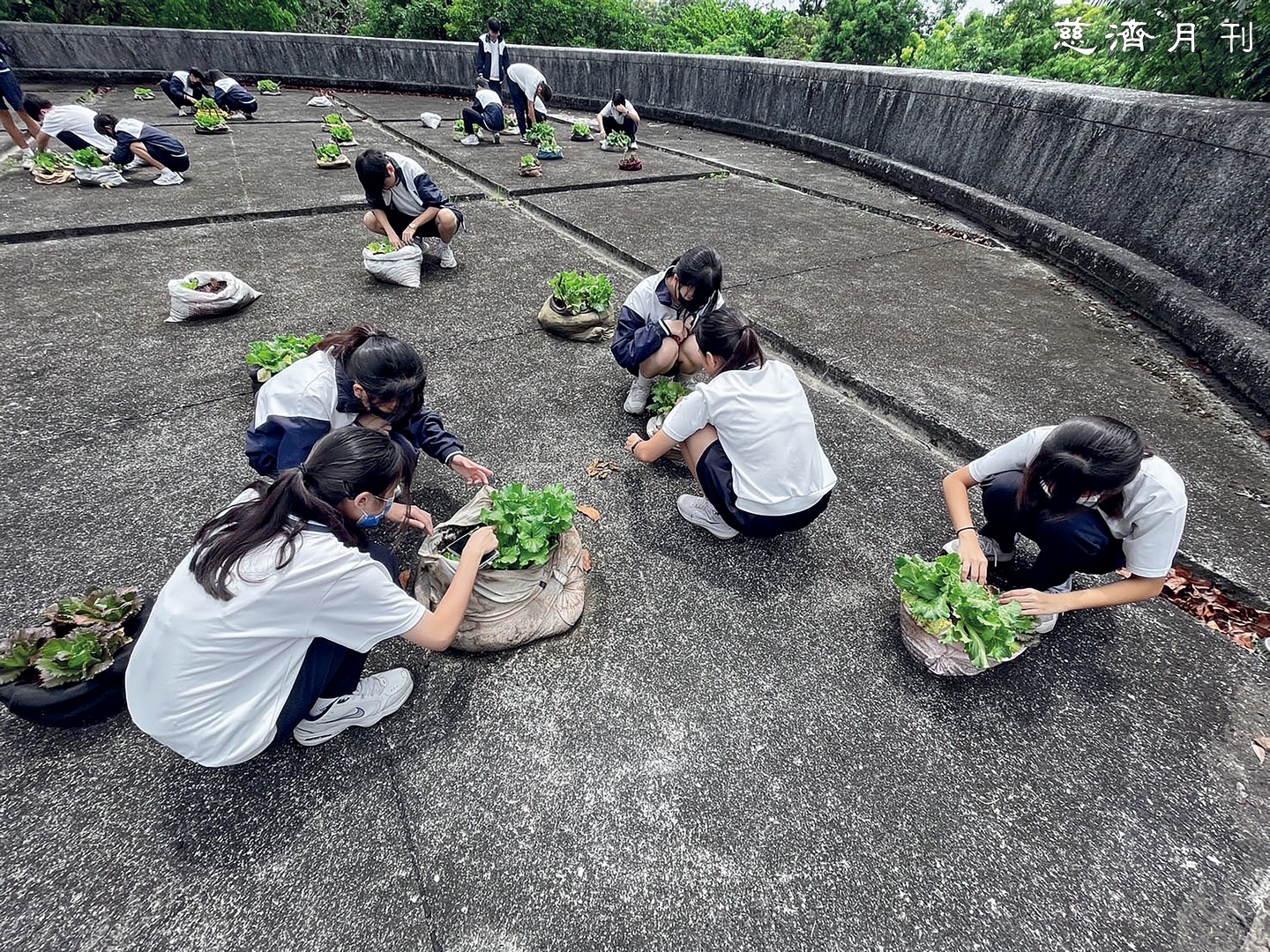
食農教育課程開始進行的前幾年,學生利用回收布袋種植萵苣菜苗。(攝影/徐振家)
從種不出玉米開始,師生發現自己不夠理解大自然,
願意「弄髒雙手」,去鍛鍊解決問題的能力;
學生自主學習,不只完成自己的作業,還與同組同學共好。
與時俱進的課程沒有標準答案,卻是一段驚豔彼此的學習歷程。
從種不出玉米開始,師生發現自己不夠理解大自然,願意「弄髒雙手」,去鍛鍊解決問題的能力;學生自主學習,不只完成自己的作業,還與同組同學共好。
與時俱進的課程沒有標準答案,卻是一段驚豔彼此的學習歷程。
矗立在慈大附中旁的青山,雲層環繞,壯闊而神祕,這般景象令人自覺渺小。慈大附中天文館有張牌匾,寫著「巍峨超越中央山」,取自校歌,大意是期許學生有高遠志向。
慈大附中二○○○年創校招生,為慈濟教育完全化理想的完整實現;辦學初衷以品德為典範,培育品學兼優的學子。在一○八新課綱實施,也就是十二年國教的「素養導向」(competence)教學政策變革中,慈大附中這幾年又如何將品德與素養融入教育之中呢?
「慈濟附中擁有很好的生態,」輔導主任徐振家說:「慈中土地的活用度很高,地面多鋪設透水的連鎖磚,樹木也很多。」他開設了一門食農教育課,才剛起步,師生就面臨挑戰。「我們在校園種玉米,可是土地太硬,小石頭也特別多,勢必要先把土養起來!」短暫的失落中,師生都讓大自然上了一課:「原來我們都沒有認識這片土地與氣候。」
為了嘗試培育有機土,徐振家帶領學生養殖黑水虻,進而分解廚餘、製作堆肥,但黑水虻到了冬天就紛紛死去……他們又轉而設立堆肥區,運用校園裏本來就有的不同物種孕育堆肥,包括黑水虻、蚯蚓、落葉等,「這是一個很好的生態循壞。」
這堂課由跨領域科目的老師們蒐集資料,在慈濟大學「全球永續發展目標教研總中心」邱奕儒老師指導下進行。徐振家帶著學生在失敗中發現問題、找方法,過程看似「充滿失敗」,卻引發了學生對食農議題的興趣。
一○八新課綱將課程分為教育部規畫必修的「部訂課程」,以及依各校願景及特色開設的「校訂課程」;並將必修課程比例降低,提升選修課程的比重。徐振家在高中部開設的這堂「食農藝趣」課,屬於多元選修課程,讓學生依照自己感興趣的方向選讀;課程設計跨科別,有靜態學習,也會有實做、外出參訪,讓學生能從多個角度探索同個問題。
不過,選修課程無法用傳統方式進行評量。慈大附中總務主任蕭湘樺說:「帶領這類課程,就不會有標準答案,而是要看學生實際操作與解決問題的能力。」
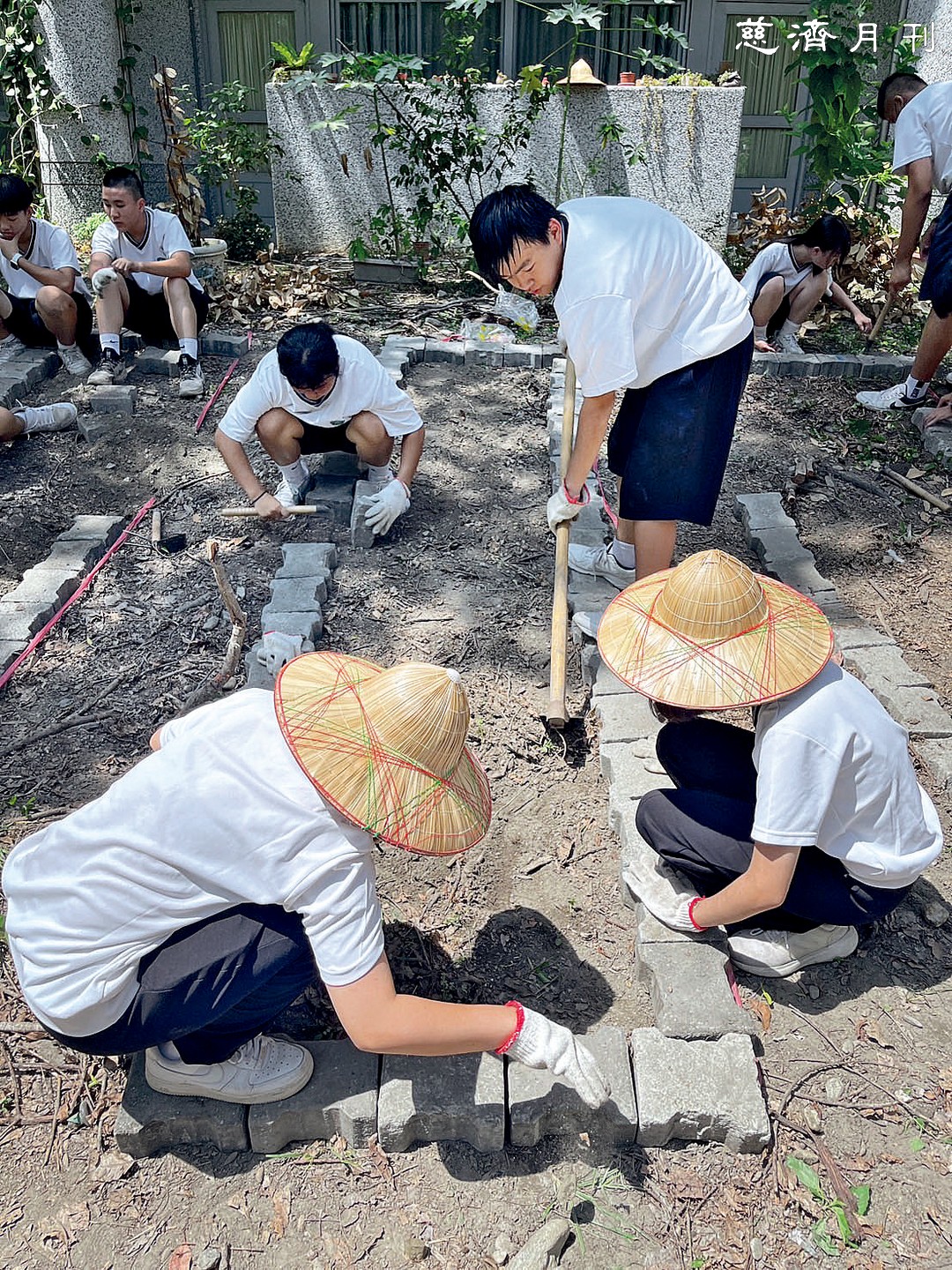
二○二四年七月,風災吹倒樹木,師生整地、以連鎖磚建立生態區。(攝影/徐振家)
蕭湘樺是慈大附中首批設計選修課的團隊成員之一,他們當時還設計了「樂活花蓮」課程,其中一項作業是要學生撰寫一日旅遊計畫書。
「網路上有很多資料,但是每個地點代表不同的人文歷史,準備介紹哪個時期的花蓮?為什麼選這幾個地點就可以認識花蓮?在這幾個地點停留多久?這是學生要思考的重點。」
蕭湘樺說明,相較於傳統「量化」結果的紙筆測驗,「質化」的評比給予學生更多空間,用自己擅長的方式進行表達。「這不就像是在職場或是研究所寫企畫書的過程嗎?期待學生的作品一出來就會完美,是不實際的;可是學生們透過小組合作、戶外踏查,解決問題和產出作品,他們會有成就感,老師看了也會感動。」
傳統教學上,即使學生有這樣的能力,老師也未必能夠看得見,「過去我們只能看到考試的成績而已。」蕭湘樺說,這就像是將實際社會上的運作,轉化為教育現場的教學設計,看著學生操作、思考以及解決問題,是讓老師很驚豔的過程,師生也會更投入課程;在教與學之間,就會形成一個善循環。
學生不只完成了自己的作品,還因團隊合作而有所交流和相互學習。蕭湘樺十分認同課程改革帶來的影響:「李玲惠校長也帶給我們共好。她作為領導者,會隨時去更新,很願意與時並進,帶著我們前進。」
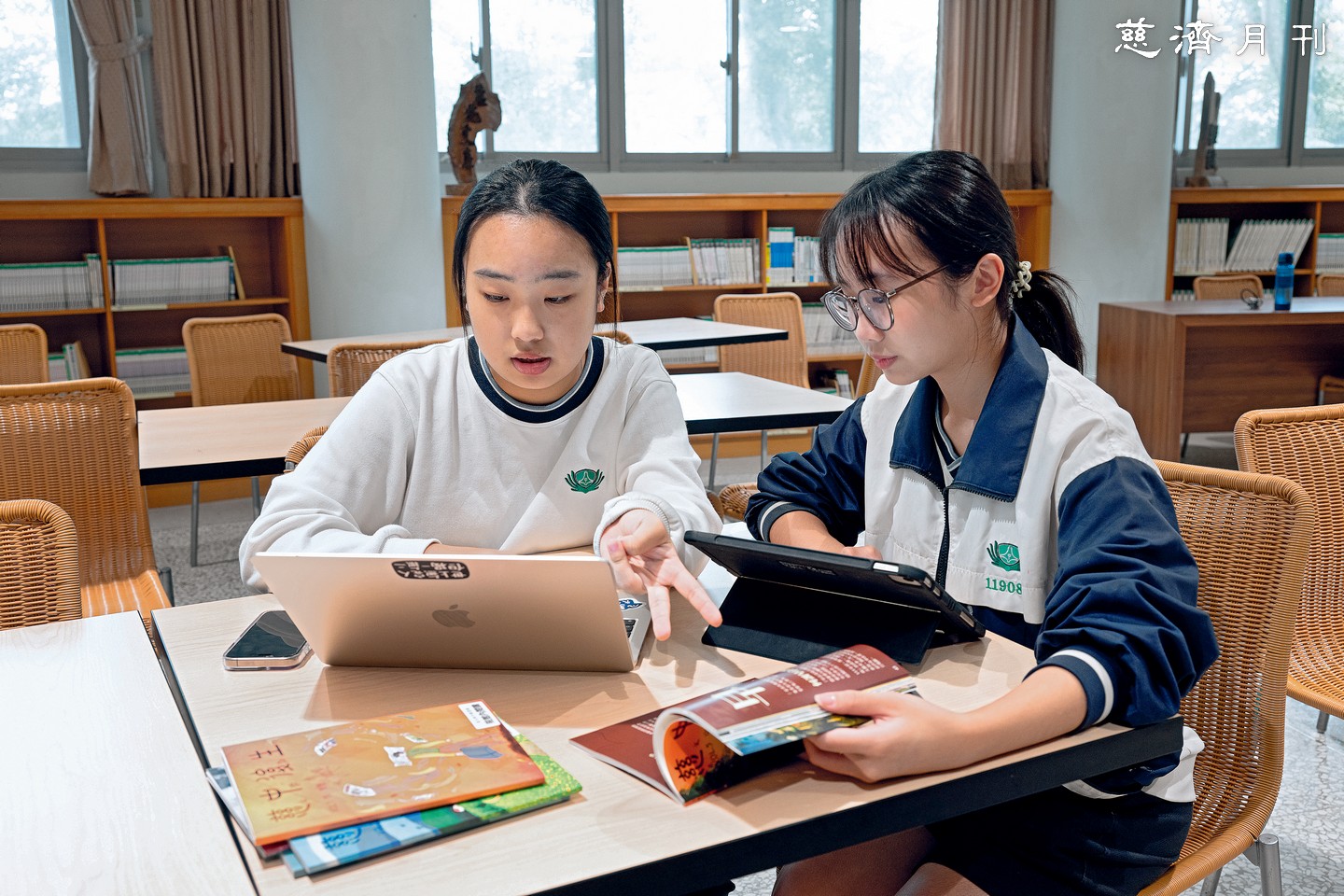
高三的李念蓁(左)和魏苡涵(右)運用自主學習時間討論校刊編務。(攝影/蕭耀華)
慈大附中為高一和高二的學生安排了四個學期共一百四十四小時的「自主學習」,是教育部規定高中三年至少十八小時的八倍。
自主學習在傳統教育觀念裏充滿顧慮,擔心學生沒有善用時間的能力,荒廢掉可以用作上課的時段。對此,圖書館吳思寰主任說明,自主學習不等同放任,反而需要更多的準備,老師尋找可以使用的學習資源,包括介紹不同的筆記方法,或是免費的線上學習網站,甚至協助學生商請校外師資支援;引導學生完成完整的學習計畫,未來成為申請大學時的必要審查資料之一。
高二的江祐賢利用陽明交通大學設立的線上開放教育平臺Ewant系統,學習菇類知識,還讀了其中的兩本相關書目,獨自完成了一段充實的生物學知識之旅。
李研頡在高二時運用自主學習時間製作宮廟模型,用A4紙、色筆和毛線,臨摹出一個手掌大小的宮廟旗幟,她逐一介紹:「這是三十六官將,這是枷大將,是負責抓鬼的,這是鎖大將……」豐富的知識、完整的說明,表現出對傳統宮廟文化濃厚的興趣。
高三的李念蓁與魏苡涵,則利用該時段經營校刊。魏苡涵利用線上軟體免費功能輔助,以電子畫板電繪校刊插圖和封面,完成美編;李念蓁則是主編,甚至早上五點就起床投入編務。他們合力編了一本又一本小而精美的刊物,記載著師生投稿的溫馨文字和影像畫面。
學生在自主學習的過程,學習善用時間,利用資源,去探索自身感興趣的事物,這是老師們最樂見的樣子。「這也是他們的權益。」吳思寰說道。
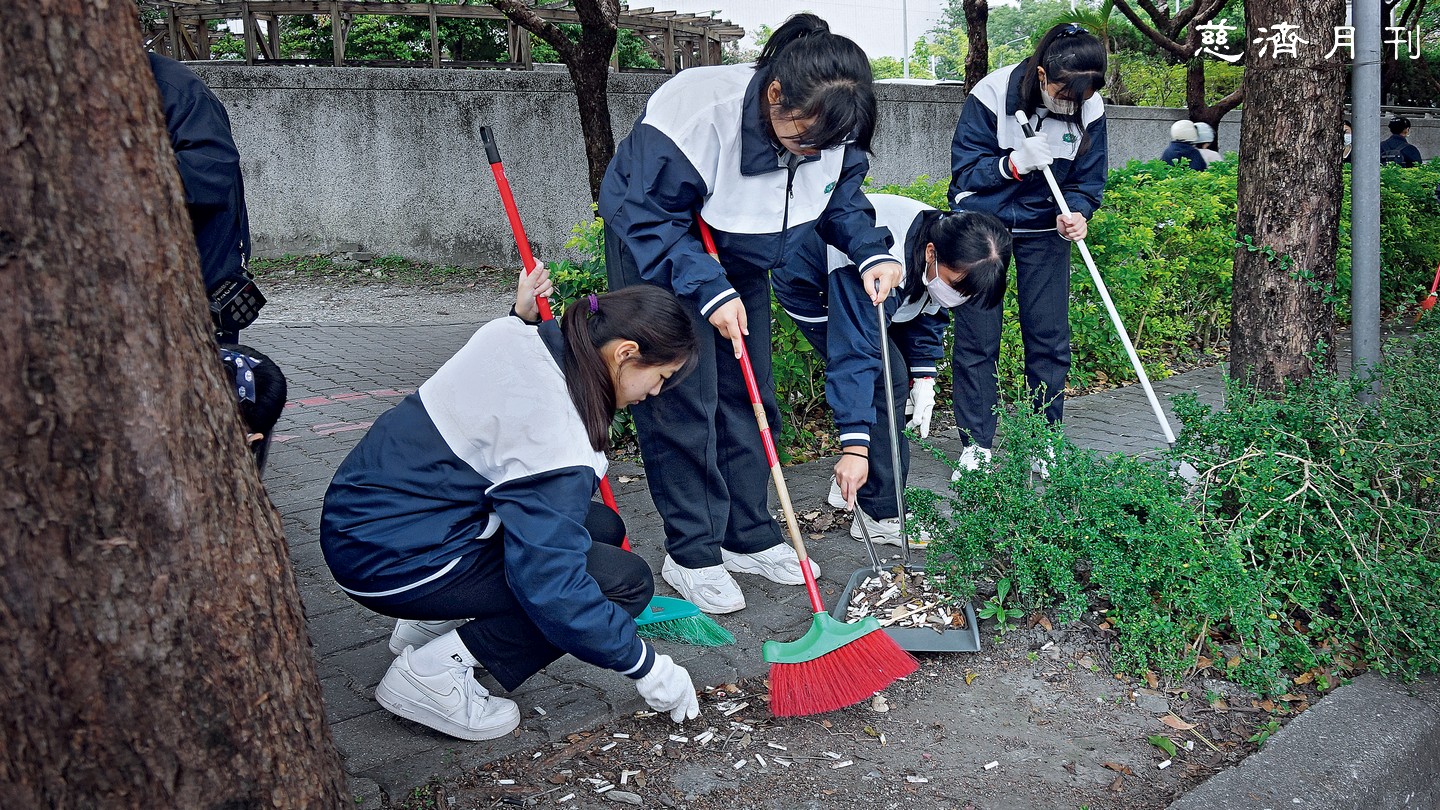
學生們整理鄰近校園的社區環境,以回饋在地的方式慶祝校慶。(相片提供/慈大附中)
每週至少一節的慈濟人文課程是創校以來的傳統,內容包含茶道、花道、書法、靜思語教學、志工服務等課程;也在一○八新課綱之下,設為彰顯學校特色的校訂必修課程,並且轉化。
在「全球公民」課程中,以高二的「國際關懷與行動」為例,分別讓五個班各自負責一個永續發展目標(SDGs)主題,例如難民議題、水資源及糧食問題等,進行一學期的討論。
學校也有回應全球飢餓問題的活動,例如一年一度、連續八年的「感飢12送愛國際」,參加的師生從早上六點到下午六點不進食固體食物,體驗十二小時的飢餓,以「我少吃一口,讓他們多吃一餐」的精神,省下當日餐費,捐作慈濟國際賑災。
慈大附中校慶也與眾不同,學生以感恩回饋的方式慶祝學校生日。教務主任洪振斌曾將校慶活動擴大規模,學生不只清掃校園及周邊社區,高年級生還到了花蓮車站、果菜市場、慈濟醫院及旅遊景點如七星潭等地撿垃圾;另一方面,師生也回到慈濟人的心靈故鄉靜思精舍,跟隨常住師父出坡,一同為「家務事」忙碌,體驗一日不做、一日不食的農禪生活。
李玲惠及洪振斌回憶,改變校慶方式的第一年,當學生清掃到警局附近時,警察嚇了一跳,還拿出飲料慰勞學生,互動十分有趣。
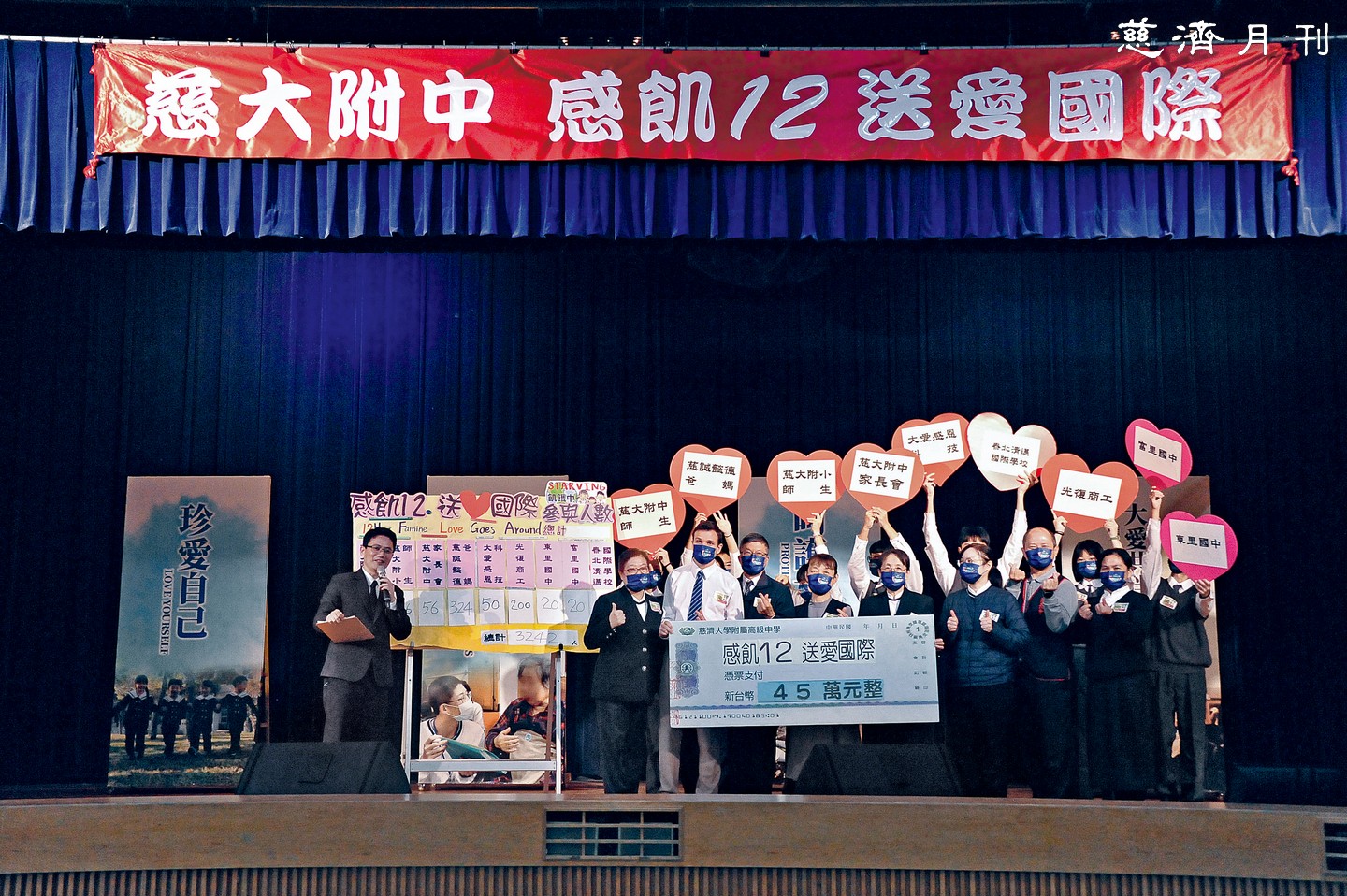
二○二二年的「感飢12送愛國際」,串聯大愛感恩科技及部分九一八池上地震受災學校等共三千多人參與,募集款項捐予慈濟基金會援助烏克蘭難民。(攝影/廖文聰)
慈大附中與多個海外姊妹校維持線上與實體交流,學生也能在寒暑假自主報名海外修學旅行。李玲惠印象深刻,有次學生們制服筆挺、整齊列隊,日本海關人員主動禮遇師生通關。
還有一次到馬來西亞養老院服務,她叮嚀準備上臺表演才藝的學生不要炫技演出,忘詞、搞笑都沒關係,最重要的是娛樂長者們。而慈大附中的學生也領會了校長的意思,學生洪為亨回憶當時:「要站在婆婆的角度,而不是我們自己的角度。」
學生的善舉與貼心,是李玲惠覺得他們與眾不同的地方;「教育,在學校的校風、環境建築、情境的布置、老師的背影裏,那些可能你看不見實際用處的,都會讓一個人改變。」
食農教育課程開始進行的前幾年,學生利用回收布袋種植萵苣菜苗。(攝影/徐振家)
從種不出玉米開始,師生發現自己不夠理解大自然,
願意「弄髒雙手」,去鍛鍊解決問題的能力;
學生自主學習,不只完成自己的作業,還與同組同學共好。
與時俱進的課程沒有標準答案,卻是一段驚豔彼此的學習歷程。
從種不出玉米開始,師生發現自己不夠理解大自然,願意「弄髒雙手」,去鍛鍊解決問題的能力;學生自主學習,不只完成自己的作業,還與同組同學共好。
與時俱進的課程沒有標準答案,卻是一段驚豔彼此的學習歷程。
矗立在慈大附中旁的青山,雲層環繞,壯闊而神祕,這般景象令人自覺渺小。慈大附中天文館有張牌匾,寫著「巍峨超越中央山」,取自校歌,大意是期許學生有高遠志向。
慈大附中二○○○年創校招生,為慈濟教育完全化理想的完整實現;辦學初衷以品德為典範,培育品學兼優的學子。在一○八新課綱實施,也就是十二年國教的「素養導向」(competence)教學政策變革中,慈大附中這幾年又如何將品德與素養融入教育之中呢?
「慈濟附中擁有很好的生態,」輔導主任徐振家說:「慈中土地的活用度很高,地面多鋪設透水的連鎖磚,樹木也很多。」他開設了一門食農教育課,才剛起步,師生就面臨挑戰。「我們在校園種玉米,可是土地太硬,小石頭也特別多,勢必要先把土養起來!」短暫的失落中,師生都讓大自然上了一課:「原來我們都沒有認識這片土地與氣候。」
為了嘗試培育有機土,徐振家帶領學生養殖黑水虻,進而分解廚餘、製作堆肥,但黑水虻到了冬天就紛紛死去……他們又轉而設立堆肥區,運用校園裏本來就有的不同物種孕育堆肥,包括黑水虻、蚯蚓、落葉等,「這是一個很好的生態循壞。」
這堂課由跨領域科目的老師們蒐集資料,在慈濟大學「全球永續發展目標教研總中心」邱奕儒老師指導下進行。徐振家帶著學生在失敗中發現問題、找方法,過程看似「充滿失敗」,卻引發了學生對食農議題的興趣。
一○八新課綱將課程分為教育部規畫必修的「部訂課程」,以及依各校願景及特色開設的「校訂課程」;並將必修課程比例降低,提升選修課程的比重。徐振家在高中部開設的這堂「食農藝趣」課,屬於多元選修課程,讓學生依照自己感興趣的方向選讀;課程設計跨科別,有靜態學習,也會有實做、外出參訪,讓學生能從多個角度探索同個問題。
不過,選修課程無法用傳統方式進行評量。慈大附中總務主任蕭湘樺說:「帶領這類課程,就不會有標準答案,而是要看學生實際操作與解決問題的能力。」
二○二四年七月,風災吹倒樹木,師生整地、以連鎖磚建立生態區。(攝影/徐振家)
蕭湘樺是慈大附中首批設計選修課的團隊成員之一,他們當時還設計了「樂活花蓮」課程,其中一項作業是要學生撰寫一日旅遊計畫書。
「網路上有很多資料,但是每個地點代表不同的人文歷史,準備介紹哪個時期的花蓮?為什麼選這幾個地點就可以認識花蓮?在這幾個地點停留多久?這是學生要思考的重點。」
蕭湘樺說明,相較於傳統「量化」結果的紙筆測驗,「質化」的評比給予學生更多空間,用自己擅長的方式進行表達。「這不就像是在職場或是研究所寫企畫書的過程嗎?期待學生的作品一出來就會完美,是不實際的;可是學生們透過小組合作、戶外踏查,解決問題和產出作品,他們會有成就感,老師看了也會感動。」
傳統教學上,即使學生有這樣的能力,老師也未必能夠看得見,「過去我們只能看到考試的成績而已。」蕭湘樺說,這就像是將實際社會上的運作,轉化為教育現場的教學設計,看著學生操作、思考以及解決問題,是讓老師很驚豔的過程,師生也會更投入課程;在教與學之間,就會形成一個善循環。
學生不只完成了自己的作品,還因團隊合作而有所交流和相互學習。蕭湘樺十分認同課程改革帶來的影響:「李玲惠校長也帶給我們共好。她作為領導者,會隨時去更新,很願意與時並進,帶著我們前進。」
高三的李念蓁(左)和魏苡涵(右)運用自主學習時間討論校刊編務。(攝影/蕭耀華)
慈大附中為高一和高二的學生安排了四個學期共一百四十四小時的「自主學習」,是教育部規定高中三年至少十八小時的八倍。
自主學習在傳統教育觀念裏充滿顧慮,擔心學生沒有善用時間的能力,荒廢掉可以用作上課的時段。對此,圖書館吳思寰主任說明,自主學習不等同放任,反而需要更多的準備,老師尋找可以使用的學習資源,包括介紹不同的筆記方法,或是免費的線上學習網站,甚至協助學生商請校外師資支援;引導學生完成完整的學習計畫,未來成為申請大學時的必要審查資料之一。
高二的江祐賢利用陽明交通大學設立的線上開放教育平臺Ewant系統,學習菇類知識,還讀了其中的兩本相關書目,獨自完成了一段充實的生物學知識之旅。
李研頡在高二時運用自主學習時間製作宮廟模型,用A4紙、色筆和毛線,臨摹出一個手掌大小的宮廟旗幟,她逐一介紹:「這是三十六官將,這是枷大將,是負責抓鬼的,這是鎖大將……」豐富的知識、完整的說明,表現出對傳統宮廟文化濃厚的興趣。
高三的李念蓁與魏苡涵,則利用該時段經營校刊。魏苡涵利用線上軟體免費功能輔助,以電子畫板電繪校刊插圖和封面,完成美編;李念蓁則是主編,甚至早上五點就起床投入編務。他們合力編了一本又一本小而精美的刊物,記載著師生投稿的溫馨文字和影像畫面。
學生在自主學習的過程,學習善用時間,利用資源,去探索自身感興趣的事物,這是老師們最樂見的樣子。「這也是他們的權益。」吳思寰說道。
學生們整理鄰近校園的社區環境,以回饋在地的方式慶祝校慶。(相片提供/慈大附中)
每週至少一節的慈濟人文課程是創校以來的傳統,內容包含茶道、花道、書法、靜思語教學、志工服務等課程;也在一○八新課綱之下,設為彰顯學校特色的校訂必修課程,並且轉化。
在「全球公民」課程中,以高二的「國際關懷與行動」為例,分別讓五個班各自負責一個永續發展目標(SDGs)主題,例如難民議題、水資源及糧食問題等,進行一學期的討論。
學校也有回應全球飢餓問題的活動,例如一年一度、連續八年的「感飢12送愛國際」,參加的師生從早上六點到下午六點不進食固體食物,體驗十二小時的飢餓,以「我少吃一口,讓他們多吃一餐」的精神,省下當日餐費,捐作慈濟國際賑災。
慈大附中校慶也與眾不同,學生以感恩回饋的方式慶祝學校生日。教務主任洪振斌曾將校慶活動擴大規模,學生不只清掃校園及周邊社區,高年級生還到了花蓮車站、果菜市場、慈濟醫院及旅遊景點如七星潭等地撿垃圾;另一方面,師生也回到慈濟人的心靈故鄉靜思精舍,跟隨常住師父出坡,一同為「家務事」忙碌,體驗一日不做、一日不食的農禪生活。
李玲惠及洪振斌回憶,改變校慶方式的第一年,當學生清掃到警局附近時,警察嚇了一跳,還拿出飲料慰勞學生,互動十分有趣。
二○二二年的「感飢12送愛國際」,串聯大愛感恩科技及部分九一八池上地震受災學校等共三千多人參與,募集款項捐予慈濟基金會援助烏克蘭難民。(攝影/廖文聰)
慈大附中與多個海外姊妹校維持線上與實體交流,學生也能在寒暑假自主報名海外修學旅行。李玲惠印象深刻,有次學生們制服筆挺、整齊列隊,日本海關人員主動禮遇師生通關。
還有一次到馬來西亞養老院服務,她叮嚀準備上臺表演才藝的學生不要炫技演出,忘詞、搞笑都沒關係,最重要的是娛樂長者們。而慈大附中的學生也領會了校長的意思,學生洪為亨回憶當時:「要站在婆婆的角度,而不是我們自己的角度。」
學生的善舉與貼心,是李玲惠覺得他們與眾不同的地方;「教育,在學校的校風、環境建築、情境的布置、老師的背影裏,那些可能你看不見實際用處的,都會讓一個人改變。」