After the Flames—Aid for Los Angeles Wildfire Survivors

Compiled by Tzu Chi Monthly editorial staff
Edited and translated by Wu Hsiao-ting
Photos by Jamie Puerta

As Southern California’s wildfires left thousands displaced, Tzu Chi volunteers offered cash cards, comfort, and care to help survivors navigate the challenges of recovery.
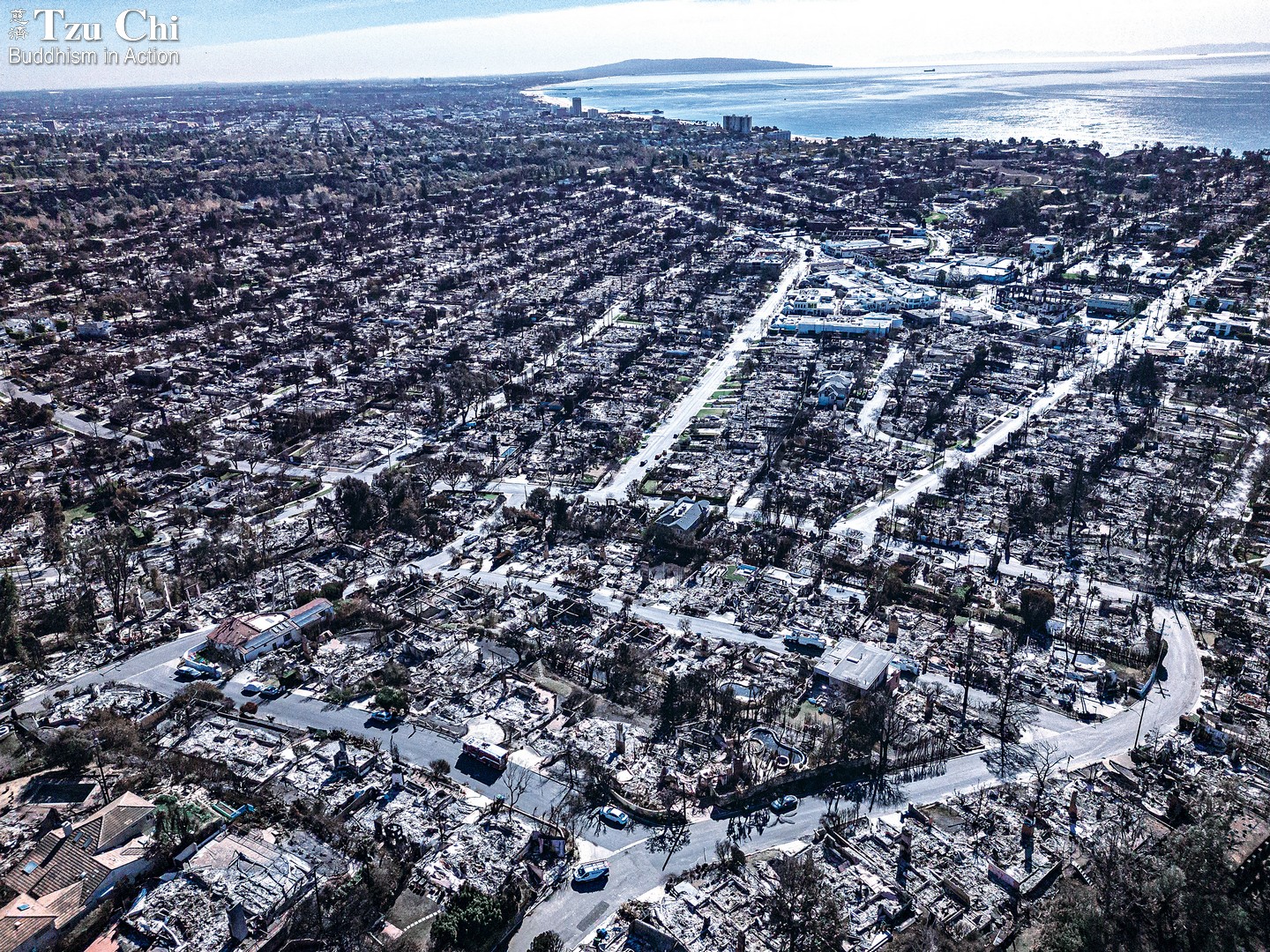
The once-picturesque coastal community of Pacific Palisades lies in ruins after the Palisades Fire in Los Angeles County. Borja Campillo

In the second week of January 2025, a series of ferocious wildfires erupted in Southern California, the United States, fueled by dry conditions and hurricane-force Santa Ana winds. Los Angeles County was hit particularly hard, with the Palisades Fire and the Eaton Fire among the most severe. These wildfires were not fully contained until the end of the month, by which time more than 18,000 structures had been destroyed or damaged. Many residents had little to no time to gather their belongings before evacuating, and upon their return, found their homes reduced to ashes.

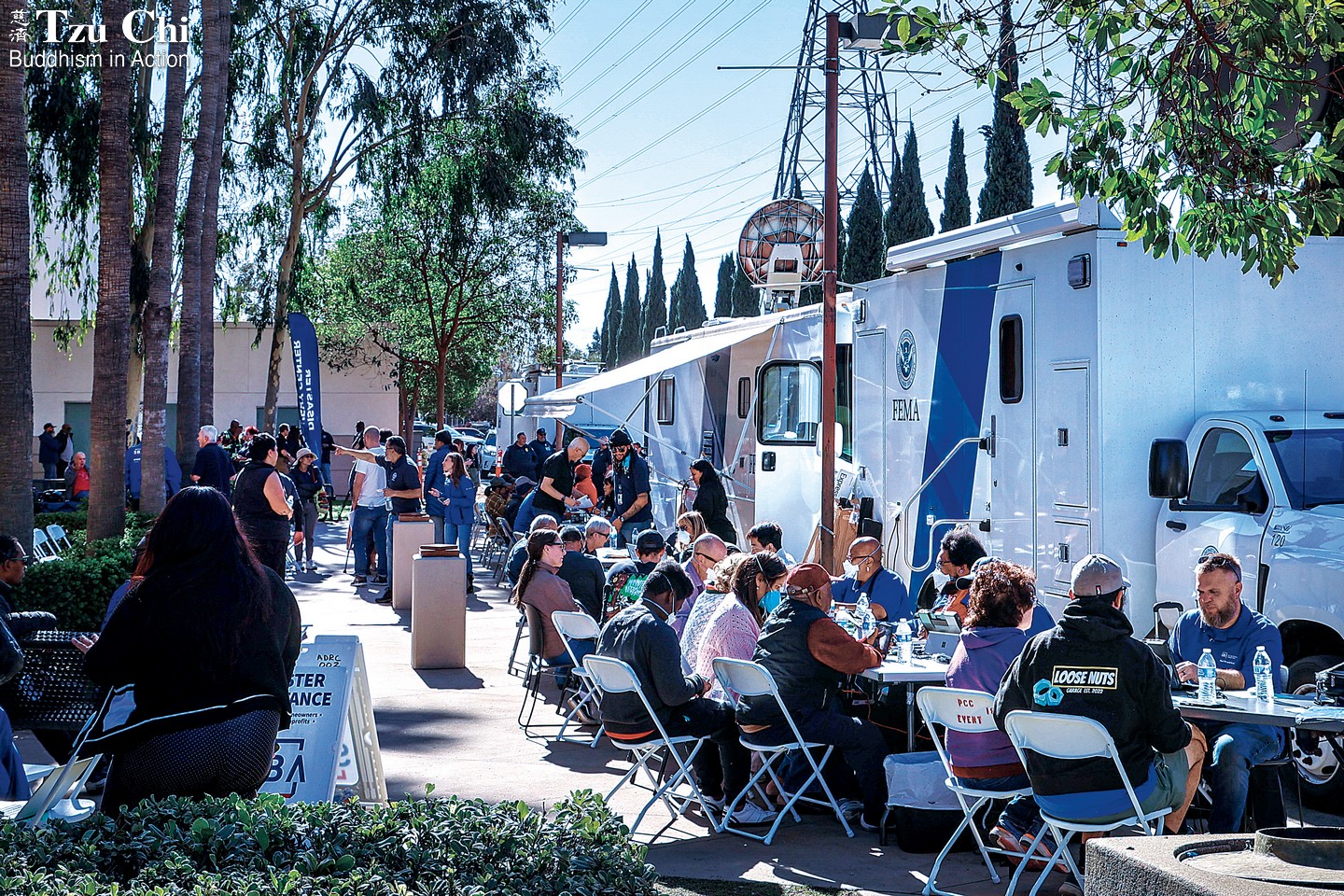
On January 14, the Federal Emergency Management Agency (FEMA) set up two Disaster Recovery Centers (DRCs) in Los Angeles County to coordinate relief efforts. The two centers brought together government agencies, insurance and legal services, and non-governmental organizations to assist survivors. For instance, those who lost birth certificates, marriage licenses, or passports could apply on-site and receive free replacements within 15 to 20 minutes. Crowds at the DRCs were understandably large.

Los Angeles County spokesperson Brenda Duran explained that the DRCs integrated county, state, and federal agencies with nonprofits to connect survivors to essential resources. Nonprofits provided essential support such as housing assistance and clothing to help displaced individuals rebuild their lives.

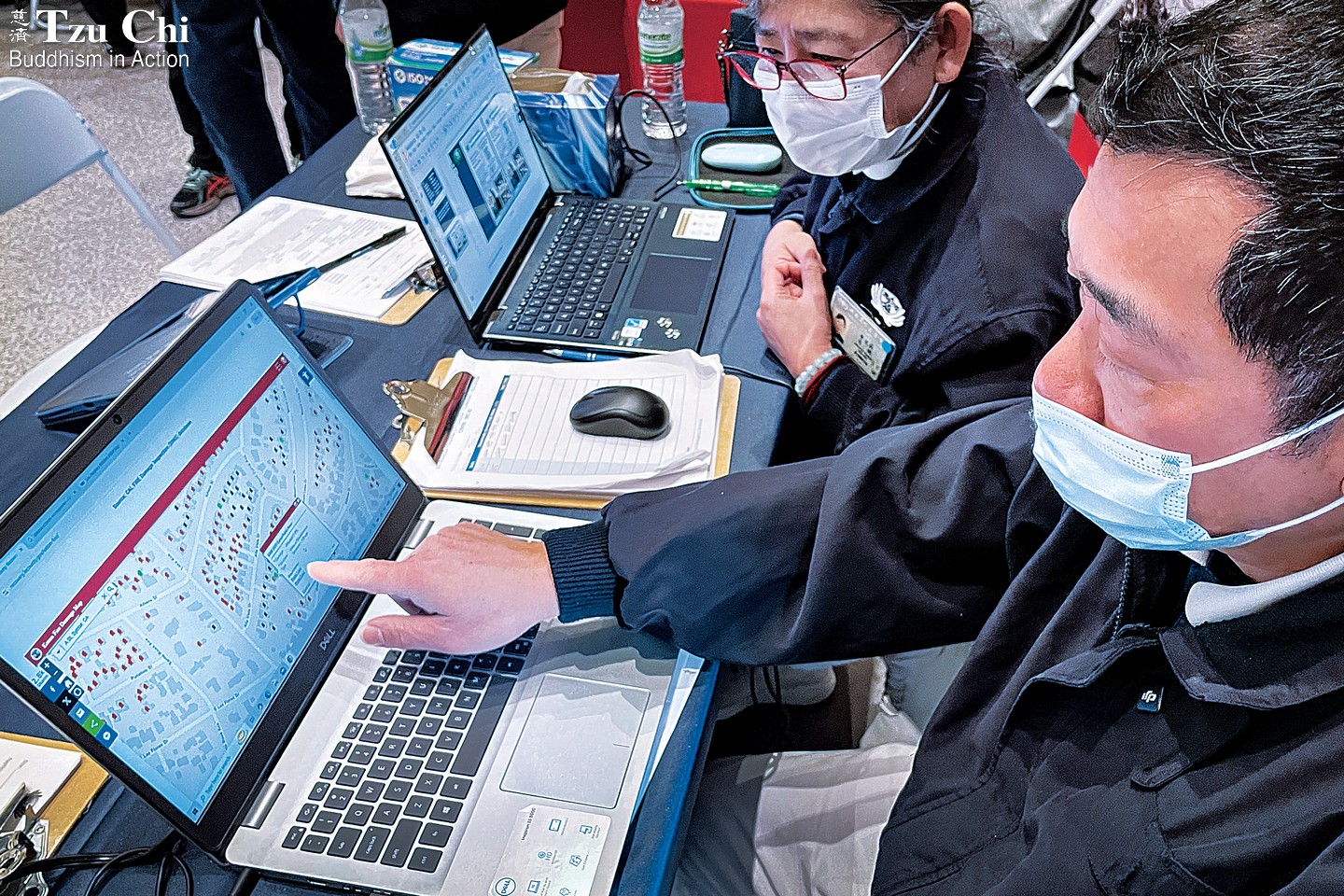
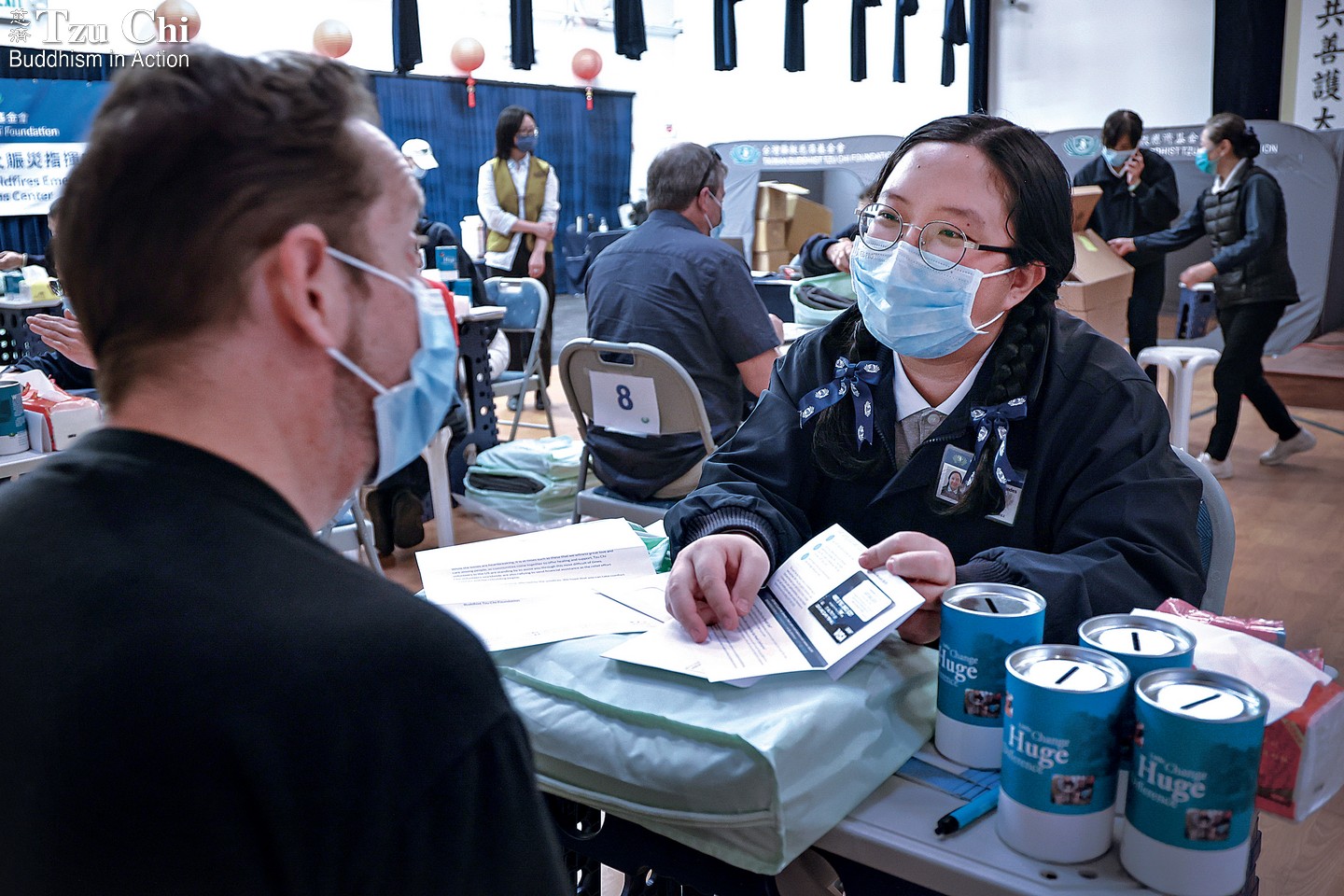
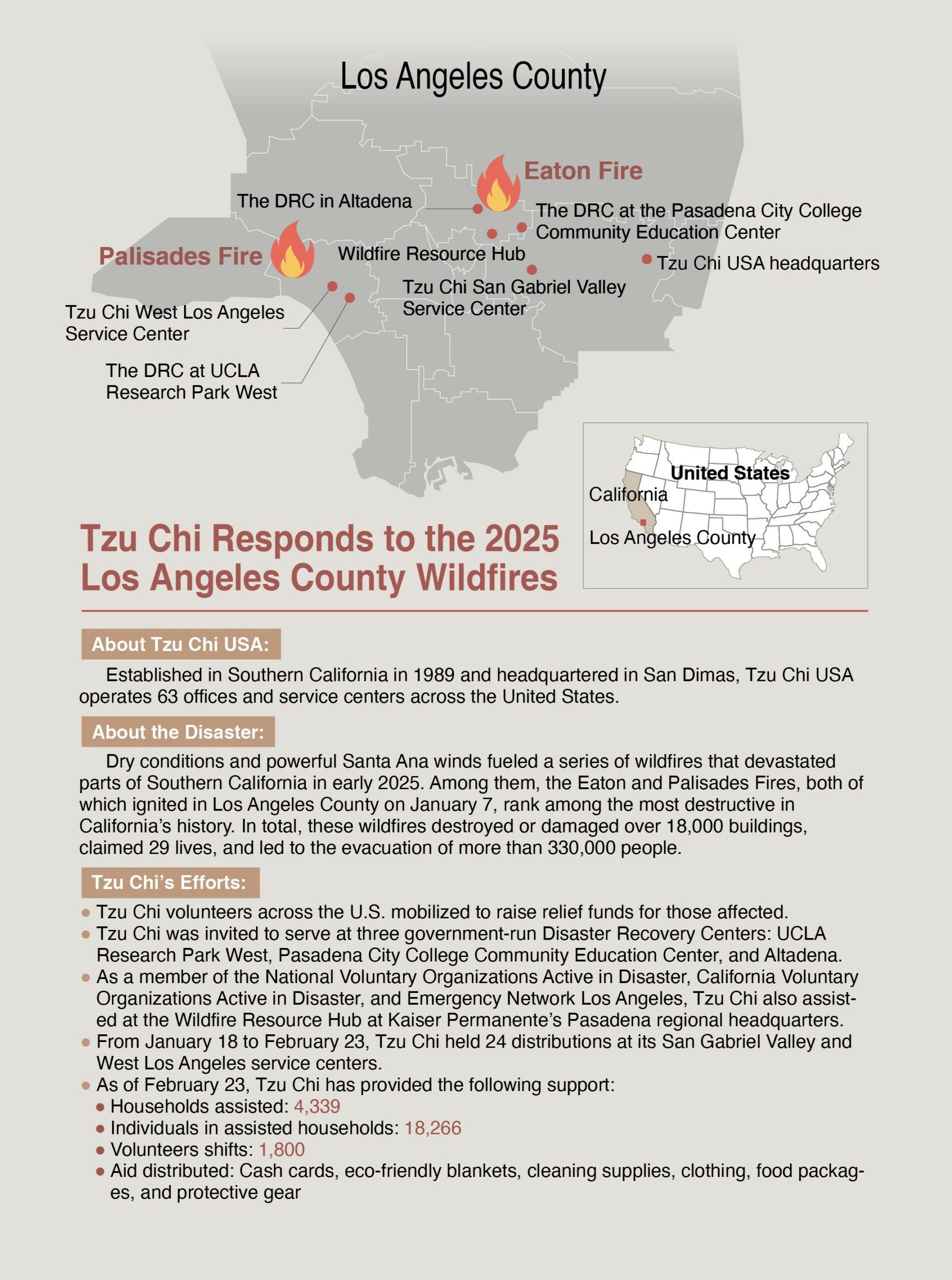
Tzu Chi USA was among the nonprofits serving there. Volunteers registered applicants for cash card assistance, using data from the LA County Recovers website to verify damage based on fire department findings. Tzu Chi USA headquarters then conducted assessments to determine aid amounts.

Survivors who registered at the DRCs or online and were approved received a text notification from Tzu Chi in the following days, informing them of the aid distribution date and location. Each household received between 1,000 and 1,500 U.S. dollars in assistance.
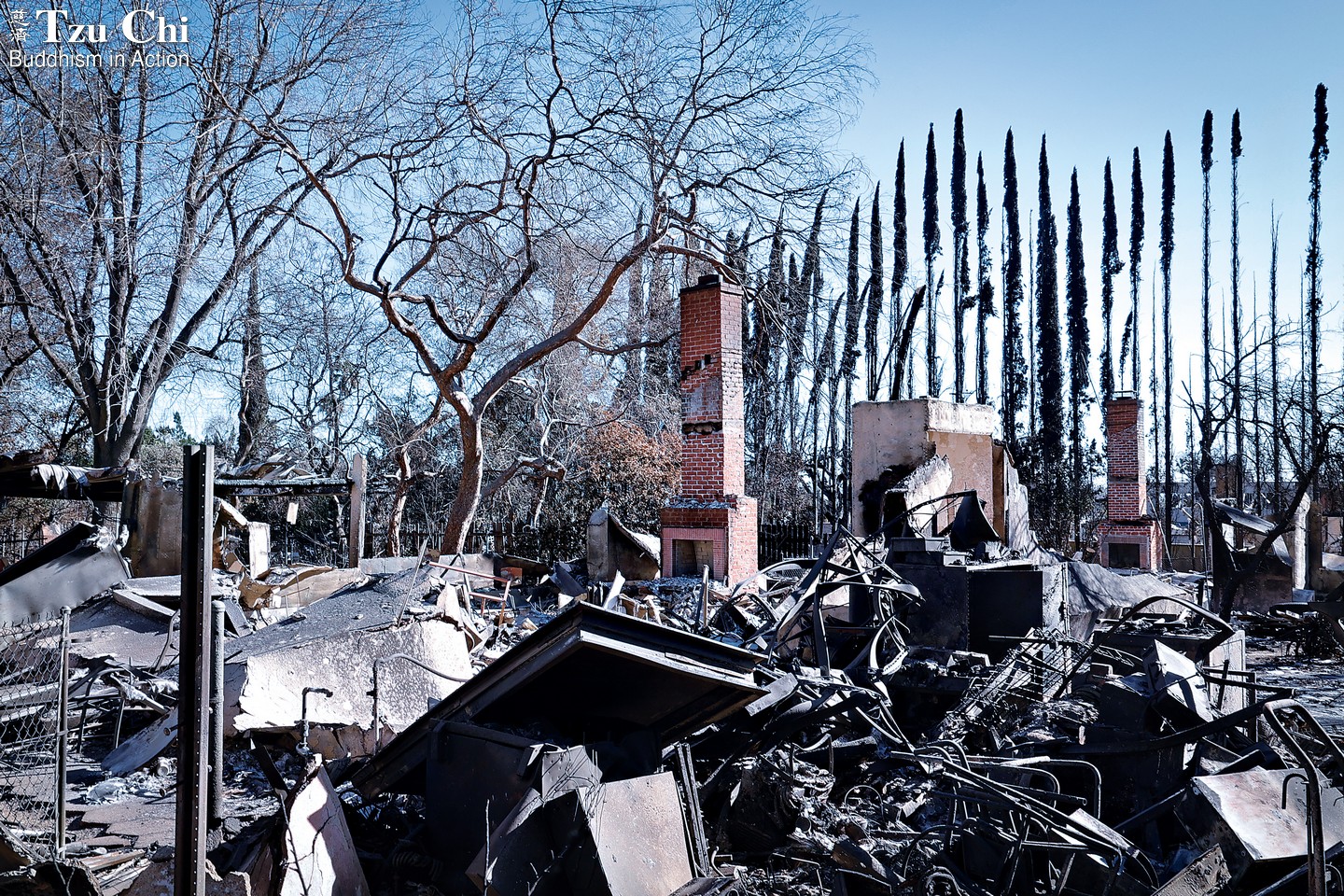
Only red brick fireplaces remain standing in this photo taken in Altadena. The fires left behind debris and soil contaminated with toxic substances, necessitating clearing and remediation. Luo Shu-li

Part of the mainstream aid system

The Eaton Fire burned about a 30-minute drive north of Tzu Chi’s San Gabriel Valley Service Center in El Monte. Beginning January 8, volunteers visited multiple shelters housing displaced residents and delivered water and meals to families in nearby areas affected by power outages.

Tzu Chi volunteers provided more than 11 hours of daily service to survivors at the Disaster Recovery Centers once they had been established. Tzu Chi USA CEO Debra Boudreaux (曾慈慧) explained that Tzu Chi’s presence in the United States for over 35 years has allowed the organization to establish deep roots and long-term engagement. “Tzu Chi has become part of the mainstream American relief system, sharing administrative resources and providing vital non-governmental aid,” she stated.

Starting January 18, Tzu Chi distributed cash cards and relief supplies at its San Gabriel Valley and West Los Angeles service centers. By February 23, volunteers had completed 24 distributions.

To accelerate relief efforts, Tzu Chi, a long-standing member of the National Voluntary Organizations Active in Disaster (NVOAD), also joined the Wildfire Resource Hub organized by California VOAD. For six consecutive days starting on January 27, Tzu Chi’s volunteer team worked at the Hub at Kaiser Permanente’s Pasadena regional headquarters, alongside organizations including the American Red Cross and the Salvation Army.

Long lines of people in need queued at the Hub on its very first day of operation. Unlike the government-run DRCs, charitable organizations at this location could directly distribute aid. In addition to issuing cash cards, Tzu Chi set up a booth on the first floor, offering eco-friendly blankets and vegetarian boxed meals. A Tzu Chi Vision Mobile Clinic also provided free eye exams and prescription glasses. Tzu Chi USA Medical Foundation Executive Vice President Steven Voon (溫俊強) explained, “Many people lost their glasses in the fires, so we’re helping them maintain their ability to work and go about their daily lives.”

Meanwhile, volunteers assessed damage in hard-hit areas. On January 20, they visited Altadena, where the Eaton Fire had left countless structures in ruins. The National Guard had initially guarded the perimeter to prevent looting, allowing only utility workers, emergency responders, insurance investigators, and media personnel to enter. Even residents were prohibited from accessing their properties.

The devastation was worse than expected—business districts, gas stations, and schools had burned to the ground or were in ruins. Once-green vegetation had been reduced to charred remains, and the air was thick with lingering ash and harsh chemical odors. Even homes that had survived were uninhabitable due to the destruction of public infrastructure and soil contamination.

One survivor told volunteers, “Starting over is incredibly difficult. Sometimes, we don’t even know what we need. When people ask how they can help, all I can say is, ‘I don’t know…’”

Crowds quickly gathered at the Disaster Recovery Center in Pasadena when it opened on January 14. Luo Shu-li

Tzu Chi volunteers helped applicants register for cash cards, using data from the LA County Recovers website to determine damage levels: red icons indicated total destruction, yellow for 25 percent damage, and green for less than 10 percent damage. Qian Mei-zhen

Gaining strength

Sixty-three-year-old Larry Demula rode his bicycle for two hours to reach Tzu Chi’s San Gabriel Valley Service Center, where he came to collect aid. On January 7, his 60-year-old wife had just been discharged from the hospital after a surgery. That night, they were abruptly woken by chaotic sounds and the smell of smoke. Seeing flames erupt on the ceiling, he grabbed his immobile wife and fled. He tried to return to salvage some belongings, but their house was already engulfed in flames. Their car had likewise been destroyed. He had no choice but to call an ambulance to take his wife to the hospital.

Since that day, Demula had been staying at the hospital with his wife, awaiting her second surgery. He had tried going to a shelter, but those closer to the hospital were already full, and nearby rental options were either too expensive or unavailable. He said they were still looking for a place on their own to live in.

Each household that arrived at a Tzu Chi distribution brought with it a heartbreaking story of loss: retirees who had saved their entire lives for a home, only to see it reduced to ashes; a family of five who lost their rental home and were now living in a friend’s garage; a couple who had just immigrated from Taiwan, buying a home near their daughter to care for their grandchildren—only for both homes to be destroyed in the blaze.

Survivors shared before-and-after photos of their homes as volunteers deeply empathized with their loss. Amid the uncertainty, survivors found solace in warm embraces and comforting words. Tears were dried, and a renewed sense of courage emerged to face the future.

Lisa Maier, a resident of Pacific Palisades, one of the hardest-hit areas, kept wiping away tears after arriving at Tzu Chi’s West Los Angeles Service Center. Overwhelmed by the volunteers’ compassion, she said, “Somebody gave me five hugs in a row. You can’t beat that, right?” The volunteers reassured her that she was not alone and that they were there to support her. Reflecting on the aftermath of the disaster, she added, “We’ve seen generosity like I never would have expected.”

At the same Tzu Chi venue, Joanna Curtis, who was staying in a hotel with her family while arranging housing, said she already had plans for the cash card she received—she intended to buy beds and pillows for her children. Since their home had been destroyed, she had been doing her best to create a sense of normalcy for them.

Curtis’s mother, Nancy Niles, observed that the Tzu Chi application process was straightforward and easy to follow, with a quick response. She also found the venue warm and welcoming, with even the thoughtful touch of refreshments.

Claire Dorotheo’s partner and his son had lived in Altadena for over 15 years, and she moved in with them in September 2024. She had hoped to put down deep roots there—to grow old in that community. But the fire changed everything. Receiving aid at Tzu Chi’s San Gabriel Valley Service Center, she said, “The sense of community that I feel here is probably the biggest thing that I have received. I feel the love of everybody. There are good people here that want to help, and that’s real. Love is real.”

After completing registration and having their housing damage verified by Tzu Chi, affected residents received a text notification and arrived at a Tzu Chi venue to collect cash cards, cleaning supplies, food, and other essentials. Luo Shu-li
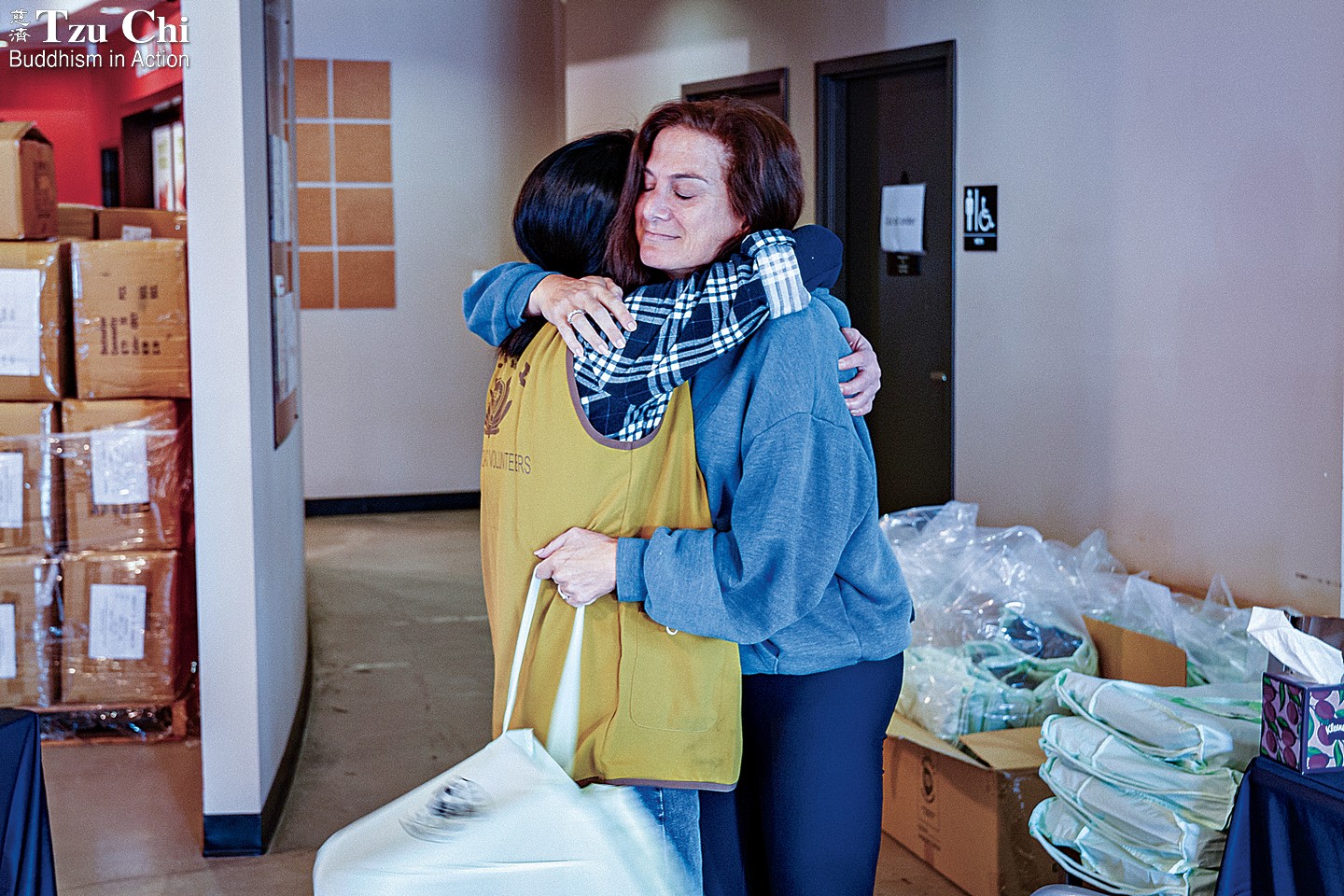
A volunteer embraces an aid recipient.

Long road to recovery

Altadena residents Norman Merino, 70, and his wife lived in a house that, according to their insurance company, was not in a high-risk zone and sat just one block from the fire station. Yet, the wildfire still destroyed their house. Merino estimated that the chance of this happening was probably only one percent, but unfortunately, they were among the unlucky ones.

He recalled that they received a call from a neighbor two blocks away on that fateful night, at 3:30 a.m., urging them to evacuate quickly. They grabbed a few belongings and fled within 30 minutes. Later, however, they learned that an 80-year-old woman had slept through the whole thing and had been left behind. Merino and a neighbor returned to pick her up. “We got her, put her in the truck,” Merino said, his voice catching with emotion, “and as we were doing that, every few seconds, you heard an explosion. The neighborhood was on fire; the whole street was going up in flames.”

Merino expressed deep sadness, explaining that he and his wife had lived in their community for over 15 years and felt a strong connection to it. The restaurant where they first met had also burned to the ground. While others saw it as just a burger place, it was much more to him and his wife. It was where they celebrated their anniversary every year.

Despite his losses, he was impressed by the relief services provided by Tzu Chi. He had visited other organizations, where the response was simply, “Sorry for your loss.” But at Tzu Chi, he felt genuine support. “I think they have been more supportive than a lot of other groups or government agencies,” he said. “The woman who checked me in was just so nice. Here, there was a sincerity and a bond. I think it’s just amazing.” Merino hoped to give back to Tzu Chi in the future. If his circumstances improved, he knew exactly where he’d donate.

The wildfires in Southern California scorched approximately 233 square kilometers (90 square miles) in January—an area roughly one-fifth the size of Los Angeles. Before large-scale reconstruction can begin, the debris and ash must first be cleared, followed by soil and environmental decontamination. Debra Boudreaux remarked, “It will be a long road, and residents may need [to wait] five to seven years before they can return home.”

Tzu Chi plans to continue providing assistance, identifying those in further need through its aid distribution data and offering mid- to long-term care. “We will accompany them as long as necessary, until they are able to stand on their own,” said Boudreaux.
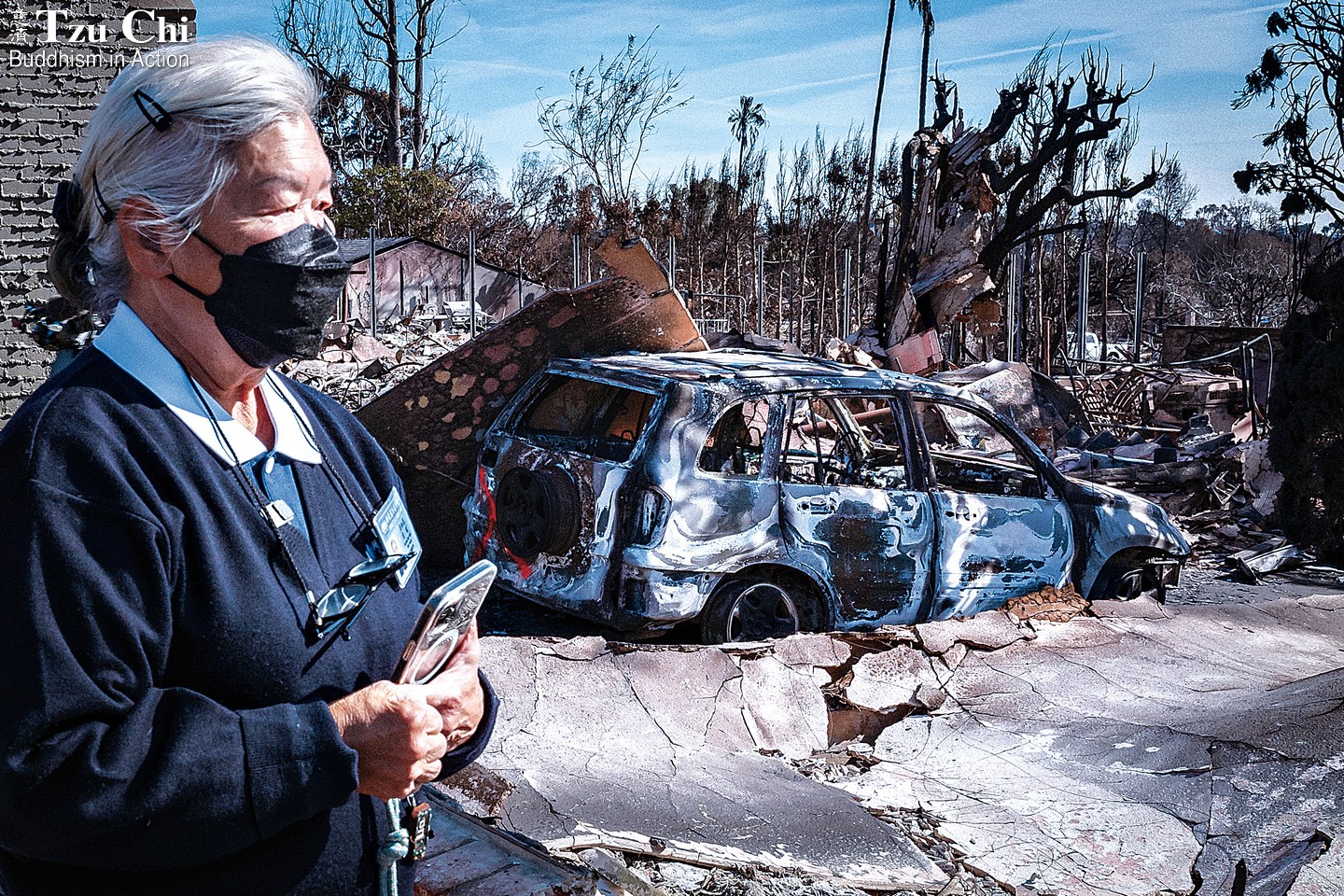
After access restrictions to her neighborhood were lifted, Tzu Chi volunteer Flora Yeh returned to her home of 44 years and was overwhelmed with emotion.
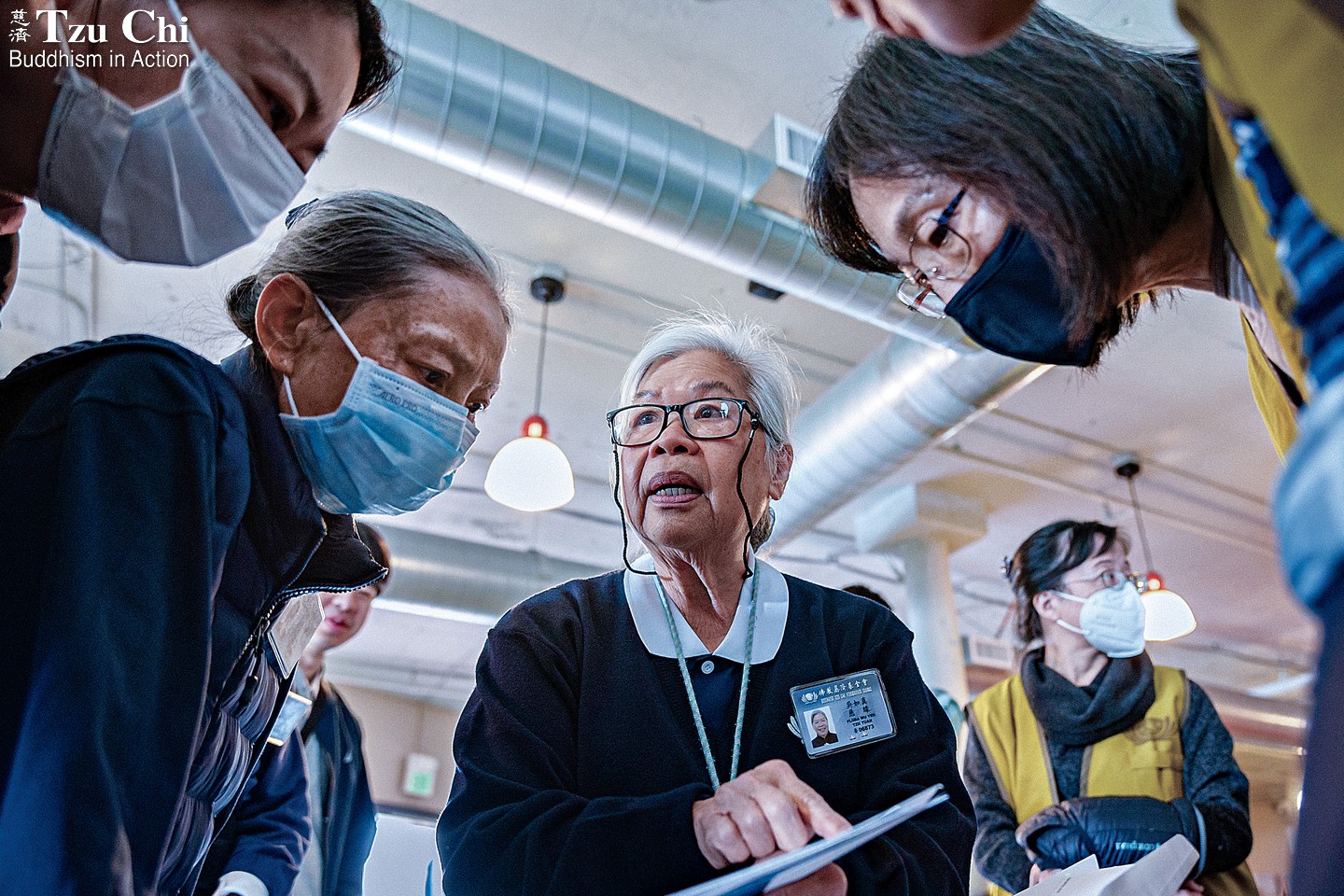
Despite her loss, she remained committed to her volunteer work, assisting with distribution efforts alongside fellow volunteers.

Hope amidst ashes

During the Chinese New Year period, 23 Tzu Chi volunteers from Canada covered their own expenses to travel to Los Angeles County and serve at the Wildfire Resource Hub in Pasadena, where they provided support for about a week. Eight additional volunteers from New York and Boston flew in to join them. They left for the Hub every morning at 7 and often didn’t return to their accommodations until after 9 p.m. Seventy-five-year-old Flora Yeh (吳如真), head of Tzu Chi’s West Los Angeles Service Center, was deeply involved throughout the effort.

“When we were registering survivors, some broke down in tears, saying their homes had been completely destroyed,” she said. “I comforted them, telling them that mine was too. They looked at me in shock and asked how I managed to cope—where did I find the strength?”

Yeh and her husband lived in Pacific Palisades. On the morning of January 7, when they left their house, they were unaware that by midday their neighborhood would become a restricted zone, with even homeowners unable to return. Later, a neighbor who had evacuated in haste sent her a video of the raging fire—her home was engulfed in flames.

Eighteen days after the fire, Yeh was finally able to return to see the ruins. Standing amidst the devastation, she could no longer hold back her grief. “This had been my home for 44 years,” she said, her voice breaking. “I had seen post-disaster photos and heard people describe the damage, but seeing it firsthand is still overwhelming.”

Yet amid the destruction, one thing remained. “The only thing still standing is my Buddha,” she said. “It was a gift from a friend, and I placed it in my yard to protect my family.” The small statue, covered in ashes, remained intact, its serene expression unchanged. Seeing it brought a smile to her face.

Yeh has been a Tzu Chi volunteer for nearly 30 years. She reflected that during home visits to the needy, she had often met people who had faced sudden misfortunes, and she learned from them how they had coped. “This time, I’m experiencing impermanence firsthand,” she said. “I feel I should channel this experience into strength to help other survivors, because I truly understand their suffering. By comforting them, I also find some relief for my own pain.”

She added that in the face of sudden misfortune, it’s natural to ask, “Why me?” But now, she could tell the other survivors, “We are all in this together. Since we are in the same boat, we should stand up and work for our community, contributing what we can.”

Tzu Chi’s rapid relief efforts and meaningful assistance resonated with many, prompting businesses and long-established Asian American NGOs in Southern California to donate. Volunteers across the U.S. also mobilized, braving freezing temperatures to fundraise for reconstruction.

As survivors navigate the long road to recovery, the compassion and solidarity of volunteers provide strength and hope. Though rebuilding homes and communities will take years, kindness exchanged in moments of hardship fosters resilience. In the face of devastation, the warmth of human connection serves as a source of hope, reminding all that even after great loss, new beginnings are possible.

This sentiment was echoed by Wylda Faye, who, while attending a Tzu Chi distribution, shared how volunteers had reassured her that there is goodness in the world—that people care, regardless of the circumstances. A person of faith, she expressed her belief: “There is going to be a better tomorrow. It looks a little foggy, but it’s going to be better.”

Compiled by Tzu Chi Monthly editorial staff
Edited and translated by Wu Hsiao-ting
Photos by Jamie Puerta

As Southern California’s wildfires left thousands displaced, Tzu Chi volunteers offered cash cards, comfort, and care to help survivors navigate the challenges of recovery.

The once-picturesque coastal community of Pacific Palisades lies in ruins after the Palisades Fire in Los Angeles County. Borja Campillo

In the second week of January 2025, a series of ferocious wildfires erupted in Southern California, the United States, fueled by dry conditions and hurricane-force Santa Ana winds. Los Angeles County was hit particularly hard, with the Palisades Fire and the Eaton Fire among the most severe. These wildfires were not fully contained until the end of the month, by which time more than 18,000 structures had been destroyed or damaged. Many residents had little to no time to gather their belongings before evacuating, and upon their return, found their homes reduced to ashes.

On January 14, the Federal Emergency Management Agency (FEMA) set up two Disaster Recovery Centers (DRCs) in Los Angeles County to coordinate relief efforts. The two centers brought together government agencies, insurance and legal services, and non-governmental organizations to assist survivors. For instance, those who lost birth certificates, marriage licenses, or passports could apply on-site and receive free replacements within 15 to 20 minutes. Crowds at the DRCs were understandably large.

Los Angeles County spokesperson Brenda Duran explained that the DRCs integrated county, state, and federal agencies with nonprofits to connect survivors to essential resources. Nonprofits provided essential support such as housing assistance and clothing to help displaced individuals rebuild their lives.

Tzu Chi USA was among the nonprofits serving there. Volunteers registered applicants for cash card assistance, using data from the LA County Recovers website to verify damage based on fire department findings. Tzu Chi USA headquarters then conducted assessments to determine aid amounts.

Survivors who registered at the DRCs or online and were approved received a text notification from Tzu Chi in the following days, informing them of the aid distribution date and location. Each household received between 1,000 and 1,500 U.S. dollars in assistance.

Only red brick fireplaces remain standing in this photo taken in Altadena. The fires left behind debris and soil contaminated with toxic substances, necessitating clearing and remediation. Luo Shu-li

Part of the mainstream aid system

The Eaton Fire burned about a 30-minute drive north of Tzu Chi’s San Gabriel Valley Service Center in El Monte. Beginning January 8, volunteers visited multiple shelters housing displaced residents and delivered water and meals to families in nearby areas affected by power outages.

Tzu Chi volunteers provided more than 11 hours of daily service to survivors at the Disaster Recovery Centers once they had been established. Tzu Chi USA CEO Debra Boudreaux (曾慈慧) explained that Tzu Chi’s presence in the United States for over 35 years has allowed the organization to establish deep roots and long-term engagement. “Tzu Chi has become part of the mainstream American relief system, sharing administrative resources and providing vital non-governmental aid,” she stated.

Starting January 18, Tzu Chi distributed cash cards and relief supplies at its San Gabriel Valley and West Los Angeles service centers. By February 23, volunteers had completed 24 distributions.

To accelerate relief efforts, Tzu Chi, a long-standing member of the National Voluntary Organizations Active in Disaster (NVOAD), also joined the Wildfire Resource Hub organized by California VOAD. For six consecutive days starting on January 27, Tzu Chi’s volunteer team worked at the Hub at Kaiser Permanente’s Pasadena regional headquarters, alongside organizations including the American Red Cross and the Salvation Army.

Long lines of people in need queued at the Hub on its very first day of operation. Unlike the government-run DRCs, charitable organizations at this location could directly distribute aid. In addition to issuing cash cards, Tzu Chi set up a booth on the first floor, offering eco-friendly blankets and vegetarian boxed meals. A Tzu Chi Vision Mobile Clinic also provided free eye exams and prescription glasses. Tzu Chi USA Medical Foundation Executive Vice President Steven Voon (溫俊強) explained, “Many people lost their glasses in the fires, so we’re helping them maintain their ability to work and go about their daily lives.”

Meanwhile, volunteers assessed damage in hard-hit areas. On January 20, they visited Altadena, where the Eaton Fire had left countless structures in ruins. The National Guard had initially guarded the perimeter to prevent looting, allowing only utility workers, emergency responders, insurance investigators, and media personnel to enter. Even residents were prohibited from accessing their properties.

The devastation was worse than expected—business districts, gas stations, and schools had burned to the ground or were in ruins. Once-green vegetation had been reduced to charred remains, and the air was thick with lingering ash and harsh chemical odors. Even homes that had survived were uninhabitable due to the destruction of public infrastructure and soil contamination.

One survivor told volunteers, “Starting over is incredibly difficult. Sometimes, we don’t even know what we need. When people ask how they can help, all I can say is, ‘I don’t know…’”

Crowds quickly gathered at the Disaster Recovery Center in Pasadena when it opened on January 14. Luo Shu-li

Tzu Chi volunteers helped applicants register for cash cards, using data from the LA County Recovers website to determine damage levels: red icons indicated total destruction, yellow for 25 percent damage, and green for less than 10 percent damage. Qian Mei-zhen

Gaining strength

Sixty-three-year-old Larry Demula rode his bicycle for two hours to reach Tzu Chi’s San Gabriel Valley Service Center, where he came to collect aid. On January 7, his 60-year-old wife had just been discharged from the hospital after a surgery. That night, they were abruptly woken by chaotic sounds and the smell of smoke. Seeing flames erupt on the ceiling, he grabbed his immobile wife and fled. He tried to return to salvage some belongings, but their house was already engulfed in flames. Their car had likewise been destroyed. He had no choice but to call an ambulance to take his wife to the hospital.

Since that day, Demula had been staying at the hospital with his wife, awaiting her second surgery. He had tried going to a shelter, but those closer to the hospital were already full, and nearby rental options were either too expensive or unavailable. He said they were still looking for a place on their own to live in.

Each household that arrived at a Tzu Chi distribution brought with it a heartbreaking story of loss: retirees who had saved their entire lives for a home, only to see it reduced to ashes; a family of five who lost their rental home and were now living in a friend’s garage; a couple who had just immigrated from Taiwan, buying a home near their daughter to care for their grandchildren—only for both homes to be destroyed in the blaze.

Survivors shared before-and-after photos of their homes as volunteers deeply empathized with their loss. Amid the uncertainty, survivors found solace in warm embraces and comforting words. Tears were dried, and a renewed sense of courage emerged to face the future.

Lisa Maier, a resident of Pacific Palisades, one of the hardest-hit areas, kept wiping away tears after arriving at Tzu Chi’s West Los Angeles Service Center. Overwhelmed by the volunteers’ compassion, she said, “Somebody gave me five hugs in a row. You can’t beat that, right?” The volunteers reassured her that she was not alone and that they were there to support her. Reflecting on the aftermath of the disaster, she added, “We’ve seen generosity like I never would have expected.”

At the same Tzu Chi venue, Joanna Curtis, who was staying in a hotel with her family while arranging housing, said she already had plans for the cash card she received—she intended to buy beds and pillows for her children. Since their home had been destroyed, she had been doing her best to create a sense of normalcy for them.

Curtis’s mother, Nancy Niles, observed that the Tzu Chi application process was straightforward and easy to follow, with a quick response. She also found the venue warm and welcoming, with even the thoughtful touch of refreshments.

Claire Dorotheo’s partner and his son had lived in Altadena for over 15 years, and she moved in with them in September 2024. She had hoped to put down deep roots there—to grow old in that community. But the fire changed everything. Receiving aid at Tzu Chi’s San Gabriel Valley Service Center, she said, “The sense of community that I feel here is probably the biggest thing that I have received. I feel the love of everybody. There are good people here that want to help, and that’s real. Love is real.”

After completing registration and having their housing damage verified by Tzu Chi, affected residents received a text notification and arrived at a Tzu Chi venue to collect cash cards, cleaning supplies, food, and other essentials. Luo Shu-li

A volunteer embraces an aid recipient.

Long road to recovery

Altadena residents Norman Merino, 70, and his wife lived in a house that, according to their insurance company, was not in a high-risk zone and sat just one block from the fire station. Yet, the wildfire still destroyed their house. Merino estimated that the chance of this happening was probably only one percent, but unfortunately, they were among the unlucky ones.

He recalled that they received a call from a neighbor two blocks away on that fateful night, at 3:30 a.m., urging them to evacuate quickly. They grabbed a few belongings and fled within 30 minutes. Later, however, they learned that an 80-year-old woman had slept through the whole thing and had been left behind. Merino and a neighbor returned to pick her up. “We got her, put her in the truck,” Merino said, his voice catching with emotion, “and as we were doing that, every few seconds, you heard an explosion. The neighborhood was on fire; the whole street was going up in flames.”

Merino expressed deep sadness, explaining that he and his wife had lived in their community for over 15 years and felt a strong connection to it. The restaurant where they first met had also burned to the ground. While others saw it as just a burger place, it was much more to him and his wife. It was where they celebrated their anniversary every year.

Despite his losses, he was impressed by the relief services provided by Tzu Chi. He had visited other organizations, where the response was simply, “Sorry for your loss.” But at Tzu Chi, he felt genuine support. “I think they have been more supportive than a lot of other groups or government agencies,” he said. “The woman who checked me in was just so nice. Here, there was a sincerity and a bond. I think it’s just amazing.” Merino hoped to give back to Tzu Chi in the future. If his circumstances improved, he knew exactly where he’d donate.

The wildfires in Southern California scorched approximately 233 square kilometers (90 square miles) in January—an area roughly one-fifth the size of Los Angeles. Before large-scale reconstruction can begin, the debris and ash must first be cleared, followed by soil and environmental decontamination. Debra Boudreaux remarked, “It will be a long road, and residents may need [to wait] five to seven years before they can return home.”

Tzu Chi plans to continue providing assistance, identifying those in further need through its aid distribution data and offering mid- to long-term care. “We will accompany them as long as necessary, until they are able to stand on their own,” said Boudreaux.

After access restrictions to her neighborhood were lifted, Tzu Chi volunteer Flora Yeh returned to her home of 44 years and was overwhelmed with emotion.

Despite her loss, she remained committed to her volunteer work, assisting with distribution efforts alongside fellow volunteers.

Hope amidst ashes

During the Chinese New Year period, 23 Tzu Chi volunteers from Canada covered their own expenses to travel to Los Angeles County and serve at the Wildfire Resource Hub in Pasadena, where they provided support for about a week. Eight additional volunteers from New York and Boston flew in to join them. They left for the Hub every morning at 7 and often didn’t return to their accommodations until after 9 p.m. Seventy-five-year-old Flora Yeh (吳如真), head of Tzu Chi’s West Los Angeles Service Center, was deeply involved throughout the effort.

“When we were registering survivors, some broke down in tears, saying their homes had been completely destroyed,” she said. “I comforted them, telling them that mine was too. They looked at me in shock and asked how I managed to cope—where did I find the strength?”

Yeh and her husband lived in Pacific Palisades. On the morning of January 7, when they left their house, they were unaware that by midday their neighborhood would become a restricted zone, with even homeowners unable to return. Later, a neighbor who had evacuated in haste sent her a video of the raging fire—her home was engulfed in flames.

Eighteen days after the fire, Yeh was finally able to return to see the ruins. Standing amidst the devastation, she could no longer hold back her grief. “This had been my home for 44 years,” she said, her voice breaking. “I had seen post-disaster photos and heard people describe the damage, but seeing it firsthand is still overwhelming.”

Yet amid the destruction, one thing remained. “The only thing still standing is my Buddha,” she said. “It was a gift from a friend, and I placed it in my yard to protect my family.” The small statue, covered in ashes, remained intact, its serene expression unchanged. Seeing it brought a smile to her face.

Yeh has been a Tzu Chi volunteer for nearly 30 years. She reflected that during home visits to the needy, she had often met people who had faced sudden misfortunes, and she learned from them how they had coped. “This time, I’m experiencing impermanence firsthand,” she said. “I feel I should channel this experience into strength to help other survivors, because I truly understand their suffering. By comforting them, I also find some relief for my own pain.”

She added that in the face of sudden misfortune, it’s natural to ask, “Why me?” But now, she could tell the other survivors, “We are all in this together. Since we are in the same boat, we should stand up and work for our community, contributing what we can.”

Tzu Chi’s rapid relief efforts and meaningful assistance resonated with many, prompting businesses and long-established Asian American NGOs in Southern California to donate. Volunteers across the U.S. also mobilized, braving freezing temperatures to fundraise for reconstruction.

As survivors navigate the long road to recovery, the compassion and solidarity of volunteers provide strength and hope. Though rebuilding homes and communities will take years, kindness exchanged in moments of hardship fosters resilience. In the face of devastation, the warmth of human connection serves as a source of hope, reminding all that even after great loss, new beginnings are possible.

This sentiment was echoed by Wylda Faye, who, while attending a Tzu Chi distribution, shared how volunteers had reassured her that there is goodness in the world—that people care, regardless of the circumstances. A person of faith, she expressed her belief: “There is going to be a better tomorrow. It looks a little foggy, but it’s going to be better.”


關鍵字

良縁は細かい所に隠されている

問:

娘は、幼稚園に通っていた頃は友達と仲良くしていましたが、小学校に進学すると、怒りっぽくて、同級生とよくケンカをする、と先生に注意されたため、カウンセラーの指導を仰がざるをえなくなりました。なぜこんなに大きく変わったのでしょうか?

答:隣の若い夫婦の娘さんは一人っ子で、とても人見知りして、近所の人と出会うと両親の背後に隠れてしまいます。母親は、この子が仲間外れにされることを心配して、三歳から幼稚園に通わせ、団体生活をさせました。初めの頃は、娘さんの行きたがらない声を聞きましたが、三カ月が過ぎた頃には、学校の面白い出来事を娘さんが話すのを耳にするようになり、そして、娘さんが隣に住んでいる同級生の家へも遊びに行くようになりました。人付き合いが好きになり、他人に自分の気持ちを伝えることが好きになったのです。

現代社会は少子化が進み、一人っ子の場合は家庭生活では、兄弟とのやりとりに欠けています。その上、同年齢の子供との交流経験がなければ、良い人間関係を築くのは容易ではありません。一人っ子がそれぞれの成長段階で良い人間関係を築けるよう手助けするには、どうすれば良いのでしょうか。両親にとって、これは大きな課題です。

群を抜くキーポイント
感謝と分かち合いを学ぶ

私と一緒に運動をしているお婆さんが、孫の世話をする際の重点を教えてくれました。

「学校の成績は普通でいいけれど、感謝することと分かち合うようになることを孫に言い聞かせています」。そして、「人生では多くの難関に遭遇するので、普段から人付き合いが良ければ、その時は、誰かが手を貸してくれます」と付け加えました。お婆さんは智慧のある教育者です。何故なら教育専門家の黄美鴻(ホワン・メイホン)女史も同じように、「人とのやりとりを覚え、コミュニケーションと協調性を学ぶことが、子供が群を抜くキーポイントになるのです」と言っています。

子供と毎日、「どうぞ」、「ありがとうございます」、「ごめんなさい」、「お願いします」が口から出るよう練習させています。細かいことですが、良い人間関係を築くためには欠かせません。親が家庭でいつも、分かち合いと助け合いの模範を示すことも大事です。たとえば、卓上ゲームを通してそれらを育てることもできます。ゲームによっては協力し合って、やっとミッションを達成できるものがあり、交代と待つという観念もその過程で学ばせることができます。

一人っ子に最も欠けているのは、分かち合い、交代、協力であり、これらを身につければ、人間関係は大きく改善されます。

他人の気持ちを汲み取る
拒絶されても気にしない

担任から子供が怒りっぽくなったとか、クラスメイトとよく喧嘩するといった報告を受けた場合、両親は先ず子供の気持ちを汲み取ってあげるべきで、その後で子供自身の考えを話してもらい、正しい方向に導いてあげるのです。たとえば、子供が「仲のいい友達が放課後に他の友達と遊んでいるけど、僕と遊んでくれないので、腹が立ったんだ。とても悲しかった」と訴えた場合、両親は子供が相手の立場に立って考えてみるよう、導いてあげるのです。「君の友達はその時、ブランコではなく、滑り台で遊びたかったのかも知れないし、室内に居て、他の友達と本を読みたいと思ったのかも知れないしね」と。

このように導きながら、拒絶されることはよくあることなのだと子供に納得させるのです。「拒絶されるのは自分のせいではない」こともあるのです。このように考えることができるようになれば、自己評価をより高めることができます。

現代人の生活にパソコンとスマホは欠かせないものであり、親子なのにSNSでコミュニケーションを取っているという話まで聞きます。そういう子供は面と向かって他人と接触する練習をしていないので、コミュニケーションや交流、分かち合いが身に付かないのは当然です。ましてや良い人間関係を築くのは難しいでしょう。

子供には、誠意と感謝の気持ちで人に接することを教え、へつらうのではなく、分かち合うことを学ぼうとする時、細心に相手を思いやれば、自ずと魅力的な人間になり、日常生活に気心が知れた良い友達ができるようになります。

(慈済月刊六九五期より)

問:

娘は、幼稚園に通っていた頃は友達と仲良くしていましたが、小学校に進学すると、怒りっぽくて、同級生とよくケンカをする、と先生に注意されたため、カウンセラーの指導を仰がざるをえなくなりました。なぜこんなに大きく変わったのでしょうか?

答:隣の若い夫婦の娘さんは一人っ子で、とても人見知りして、近所の人と出会うと両親の背後に隠れてしまいます。母親は、この子が仲間外れにされることを心配して、三歳から幼稚園に通わせ、団体生活をさせました。初めの頃は、娘さんの行きたがらない声を聞きましたが、三カ月が過ぎた頃には、学校の面白い出来事を娘さんが話すのを耳にするようになり、そして、娘さんが隣に住んでいる同級生の家へも遊びに行くようになりました。人付き合いが好きになり、他人に自分の気持ちを伝えることが好きになったのです。

現代社会は少子化が進み、一人っ子の場合は家庭生活では、兄弟とのやりとりに欠けています。その上、同年齢の子供との交流経験がなければ、良い人間関係を築くのは容易ではありません。一人っ子がそれぞれの成長段階で良い人間関係を築けるよう手助けするには、どうすれば良いのでしょうか。両親にとって、これは大きな課題です。

群を抜くキーポイント
感謝と分かち合いを学ぶ

私と一緒に運動をしているお婆さんが、孫の世話をする際の重点を教えてくれました。

「学校の成績は普通でいいけれど、感謝することと分かち合うようになることを孫に言い聞かせています」。そして、「人生では多くの難関に遭遇するので、普段から人付き合いが良ければ、その時は、誰かが手を貸してくれます」と付け加えました。お婆さんは智慧のある教育者です。何故なら教育専門家の黄美鴻(ホワン・メイホン)女史も同じように、「人とのやりとりを覚え、コミュニケーションと協調性を学ぶことが、子供が群を抜くキーポイントになるのです」と言っています。

子供と毎日、「どうぞ」、「ありがとうございます」、「ごめんなさい」、「お願いします」が口から出るよう練習させています。細かいことですが、良い人間関係を築くためには欠かせません。親が家庭でいつも、分かち合いと助け合いの模範を示すことも大事です。たとえば、卓上ゲームを通してそれらを育てることもできます。ゲームによっては協力し合って、やっとミッションを達成できるものがあり、交代と待つという観念もその過程で学ばせることができます。

一人っ子に最も欠けているのは、分かち合い、交代、協力であり、これらを身につければ、人間関係は大きく改善されます。

他人の気持ちを汲み取る
拒絶されても気にしない

担任から子供が怒りっぽくなったとか、クラスメイトとよく喧嘩するといった報告を受けた場合、両親は先ず子供の気持ちを汲み取ってあげるべきで、その後で子供自身の考えを話してもらい、正しい方向に導いてあげるのです。たとえば、子供が「仲のいい友達が放課後に他の友達と遊んでいるけど、僕と遊んでくれないので、腹が立ったんだ。とても悲しかった」と訴えた場合、両親は子供が相手の立場に立って考えてみるよう、導いてあげるのです。「君の友達はその時、ブランコではなく、滑り台で遊びたかったのかも知れないし、室内に居て、他の友達と本を読みたいと思ったのかも知れないしね」と。

このように導きながら、拒絶されることはよくあることなのだと子供に納得させるのです。「拒絶されるのは自分のせいではない」こともあるのです。このように考えることができるようになれば、自己評価をより高めることができます。

現代人の生活にパソコンとスマホは欠かせないものであり、親子なのにSNSでコミュニケーションを取っているという話まで聞きます。そういう子供は面と向かって他人と接触する練習をしていないので、コミュニケーションや交流、分かち合いが身に付かないのは当然です。ましてや良い人間関係を築くのは難しいでしょう。

子供には、誠意と感謝の気持ちで人に接することを教え、へつらうのではなく、分かち合うことを学ぼうとする時、細心に相手を思いやれば、自ずと魅力的な人間になり、日常生活に気心が知れた良い友達ができるようになります。

(慈済月刊六九五期より)

關鍵字

Making Peace With Our Choices

By Christina Wu
Photo by Hsiao Yiu-hwa

Is happiness about getting what we want, or making peace with our decisions?

My friend Peggy was asked to give a presentation on her layout work for a magazine in front of a large audience of superiors and coworkers. Terrified of public speaking and unsure what she could say that might interest them, she agonized over the decision for several sleepless nights before declining. She expected relief, but that didn’t happen. Though momentarily elated, doubt soon crept in. Had she let her superiors down? Had she given in to fear? When she later came across a line in a book, “Argue for your limitations, and they are yours,” she felt even worse.

She confided in me, voicing her frustration: “Why is it so hard to be happy, even after getting what we want?”

Her feelings were understandable. She had made a choice to protect herself from something deeply stressful, but now she was questioning whether she had held herself back. I reassured her: “It’s okay to feel conflicted—it just means you care about your work and how others see you. But turning down this opportunity doesn’t define you. You’re still talented, still valuable, and still growing. If you ever take on this challenge in the future, you can do it on your own terms, at your own pace. Be kind to yourself—you made the best decision you could at the time.”
She seemed comforted by my words, but our conversation lingered in my mind. In life, we make countless decisions—some we stand by, others we second-guess. The best we can do is learn from them and move forward. The worst thing is to dwell on such choices with regret and self-criticism, wasting energy on negative emotions. Too often, people treat themselves far more harshly than they would ever treat others. I once read a quote that put it perfectly: “If some of us treated others the way we treat ourselves, we would be jailed.”
We readily offer compassion to others yet struggle to extend the same kindness to ourselves. But life is too short to be our own worst critics. My friend’s experience is a reminder that happiness isn’t just about getting what we want—it’s about making peace with our choices.

The key, I believe, lies in self-compassion. Peggy made a decision that felt right in that moment. That was a valid choice, even if she later had doubts. Instead of berating herself for “failing” or “giving in,” she could see it as an act of self-preservation—an acknowledgment of her limits at that time. Rather than focusing on the should-haves and could-haves, she could reflect: “What did I learn? How will I approach similar situations in the future?”

Ultimately, growth isn’t about never feeling fear or doubt—it’s about how we respond to such feelings when we encounter them. Each choice we make adds to our understanding of ourselves, shaping how we navigate future challenges. Peggy’s experience was not a failure but a step in her journey, one that might eventually lead her to take the stage when she feels ready. And when that moment comes, she won’t just be facing an audience—she’ll be standing in the confidence she has built along the way.

By Christina Wu
Photo by Hsiao Yiu-hwa

Is happiness about getting what we want, or making peace with our decisions?

My friend Peggy was asked to give a presentation on her layout work for a magazine in front of a large audience of superiors and coworkers. Terrified of public speaking and unsure what she could say that might interest them, she agonized over the decision for several sleepless nights before declining. She expected relief, but that didn’t happen. Though momentarily elated, doubt soon crept in. Had she let her superiors down? Had she given in to fear? When she later came across a line in a book, “Argue for your limitations, and they are yours,” she felt even worse.

She confided in me, voicing her frustration: “Why is it so hard to be happy, even after getting what we want?”

Her feelings were understandable. She had made a choice to protect herself from something deeply stressful, but now she was questioning whether she had held herself back. I reassured her: “It’s okay to feel conflicted—it just means you care about your work and how others see you. But turning down this opportunity doesn’t define you. You’re still talented, still valuable, and still growing. If you ever take on this challenge in the future, you can do it on your own terms, at your own pace. Be kind to yourself—you made the best decision you could at the time.”

She seemed comforted by my words, but our conversation lingered in my mind. In life, we make countless decisions—some we stand by, others we second-guess. The best we can do is learn from them and move forward. The worst thing is to dwell on such choices with regret and self-criticism, wasting energy on negative emotions. Too often, people treat themselves far more harshly than they would ever treat others. I once read a quote that put it perfectly: “If some of us treated others the way we treat ourselves, we would be jailed.”

We readily offer compassion to others yet struggle to extend the same kindness to ourselves. But life is too short to be our own worst critics. My friend’s experience is a reminder that happiness isn’t just about getting what we want—it’s about making peace with our choices.

The key, I believe, lies in self-compassion. Peggy made a decision that felt right in that moment. That was a valid choice, even if she later had doubts. Instead of berating herself for “failing” or “giving in,” she could see it as an act of self-preservation—an acknowledgment of her limits at that time. Rather than focusing on the should-haves and could-haves, she could reflect: “What did I learn? How will I approach similar situations in the future?”

Ultimately, growth isn’t about never feeling fear or doubt—it’s about how we respond to such feelings when we encounter them. Each choice we make adds to our understanding of ourselves, shaping how we navigate future challenges. Peggy’s experience was not a failure but a step in her journey, one that might eventually lead her to take the stage when she feels ready. And when that moment comes, she won’t just be facing an audience—she’ll be standing in the confidence she has built along the way.

關鍵字

Rooted in a Green Vision—The Zhushan Recycling Station

Text and photos by Huang Xiao-zhe
Translated by Wu Hsiao-ting

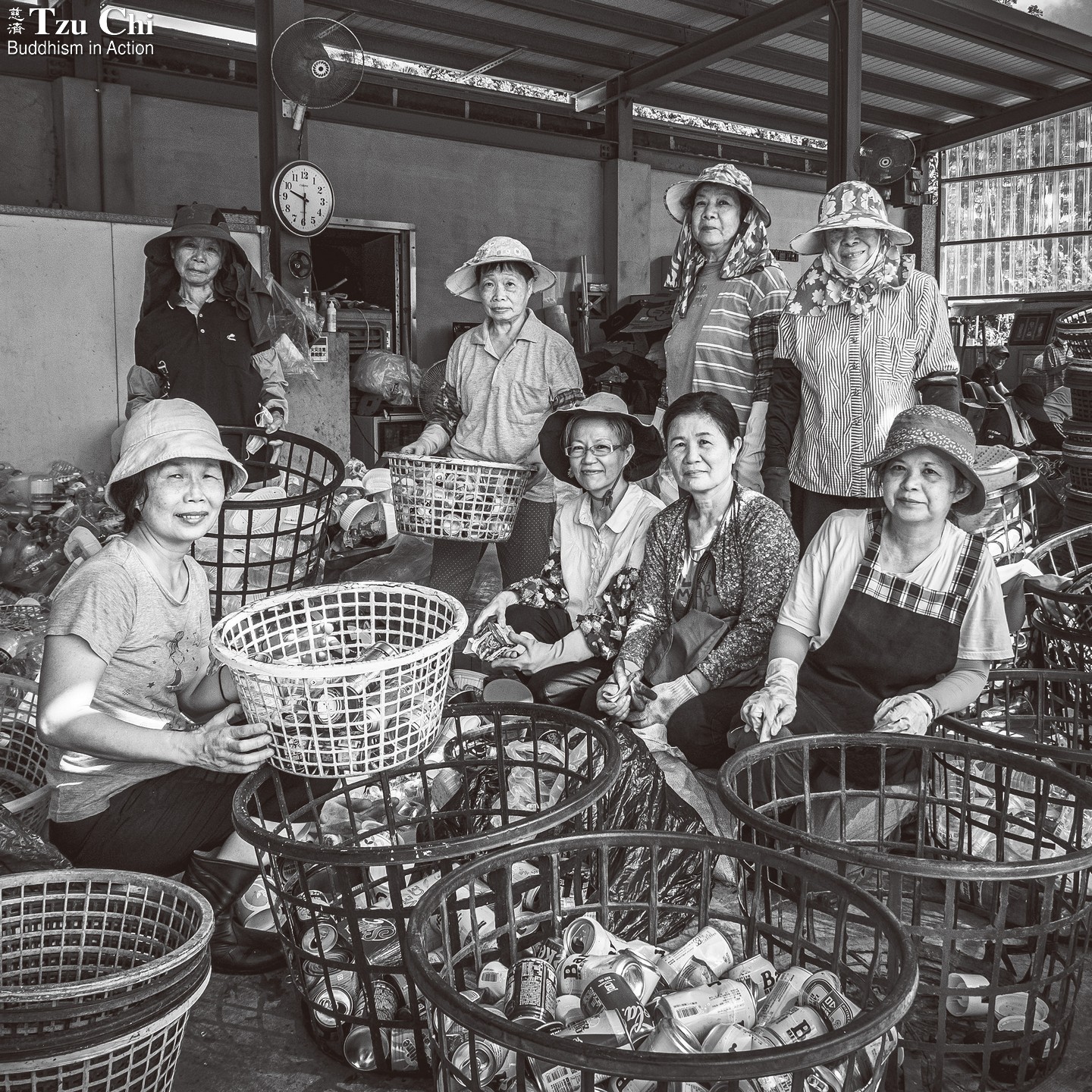
Volunteers at the Zhushan Recycling Station pose for a photo. From left: Yang Feng-ling (楊鳳玲), Zhang Yue-zhu (張月珠), Huang Lin Mei-yue (黃林美月), Ye Pin-xiu (葉品秀), Huang Jin-man (黃錦滿), Cai Xiu-zhi (蔡秀治), Qiu Luan-ying (邱鑾英), and Cai Wan-zhen (蔡宛真).

Zhushan Township, nestled in Nantou County, central Taiwan, translates to “bamboo mountain” and is celebrated for its abundant bamboo production. With ideal geography and climate, the area yields various varieties of this plant year-round, making its bamboo products well-known far and wide.

On my first visit to the Zhushan Recycling Station, I immediately felt the warmth of the local people and their deep connection to the land. Over the years, more and more locals joined Tzu Chi’s recycling efforts, and numerous recycling points sprang up as a result. However, many changed locations or had to close entirely as circumstances changed. Thankfully, in 2021, a more permanent site—the Zhushan Recycling Station—was established next to the Zhushan Jing Si Hall, providing a stable, central hub for volunteers’ efforts.

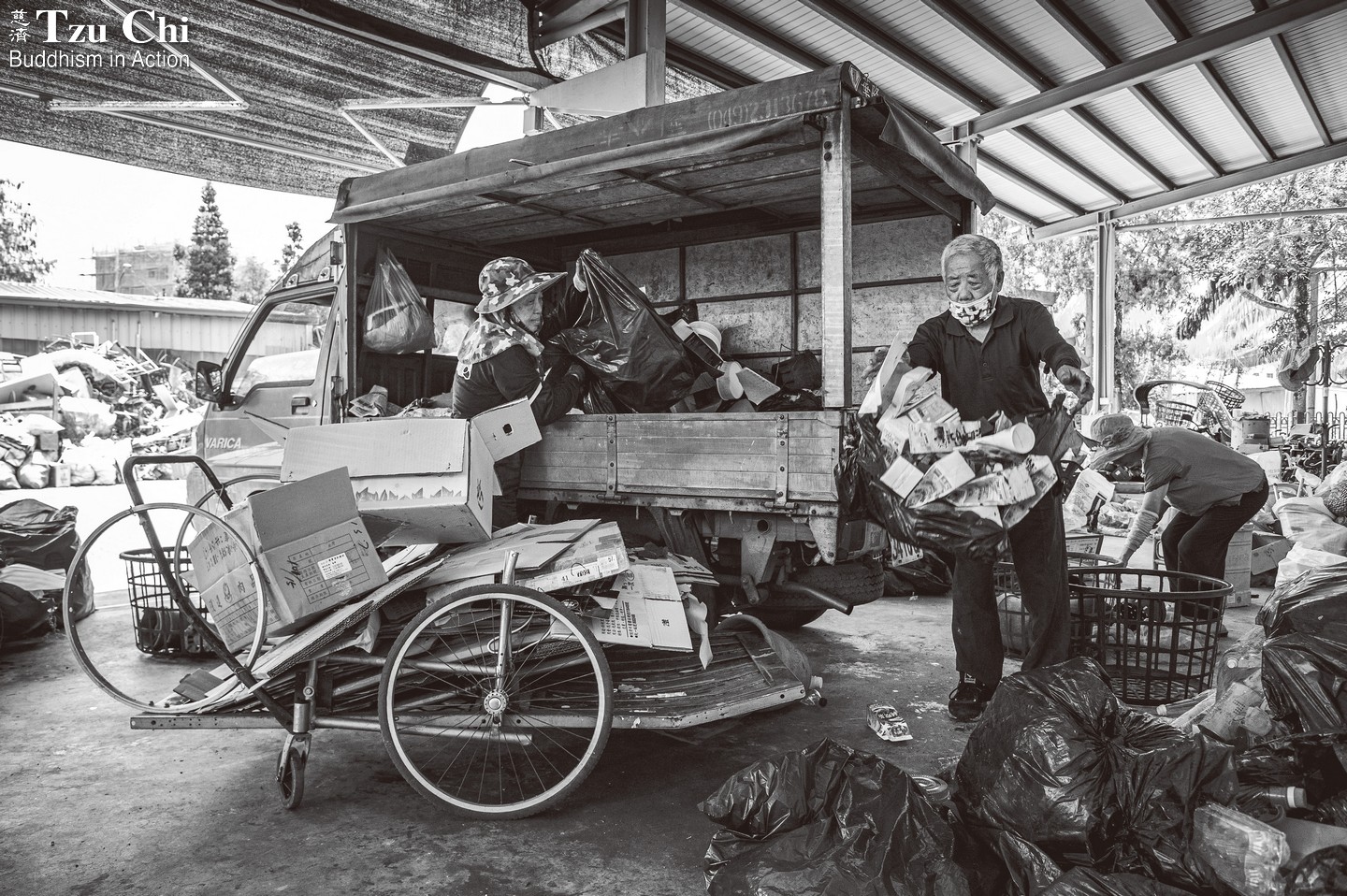
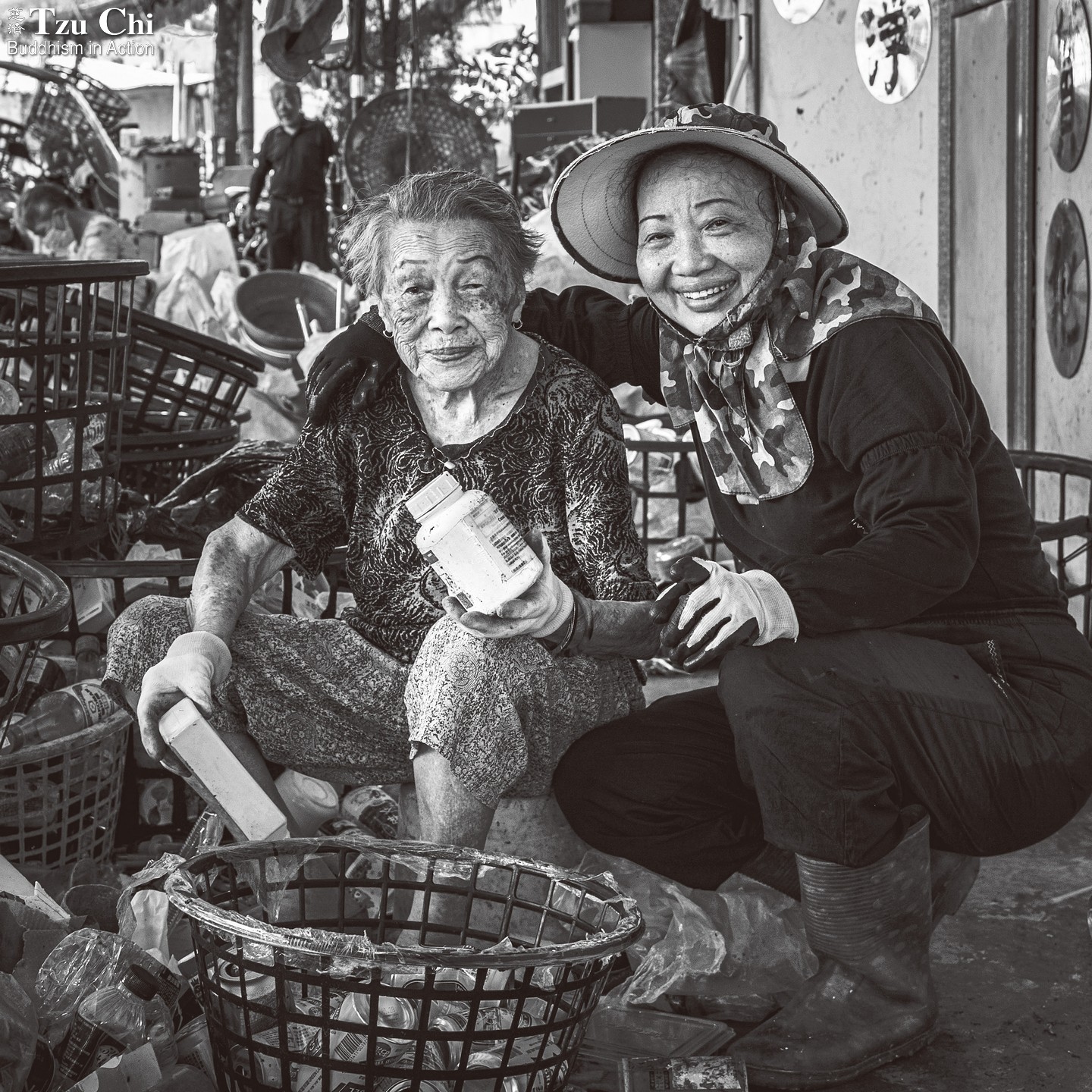
Volunteers gather at the recycling station every Wednesday and Saturday, the designated recycling days. Some drive trucks to collect recyclables, others sort materials, and still others prepare snacks and lunch for the team. This group of like-minded people has developed a strong sense of teamwork, each contributing in their own way to a shared mission.

As I took a group photo that day, I imagined each volunteer as a unique bamboo shoot emerging from the soil—each deeply rooted in their commitment to resource recycling and environmental protection. They embody a vibrant spirit, both filling their lives with purpose and nurturing the Earth’s vitality.

Zhushan’s Unique Handcarts

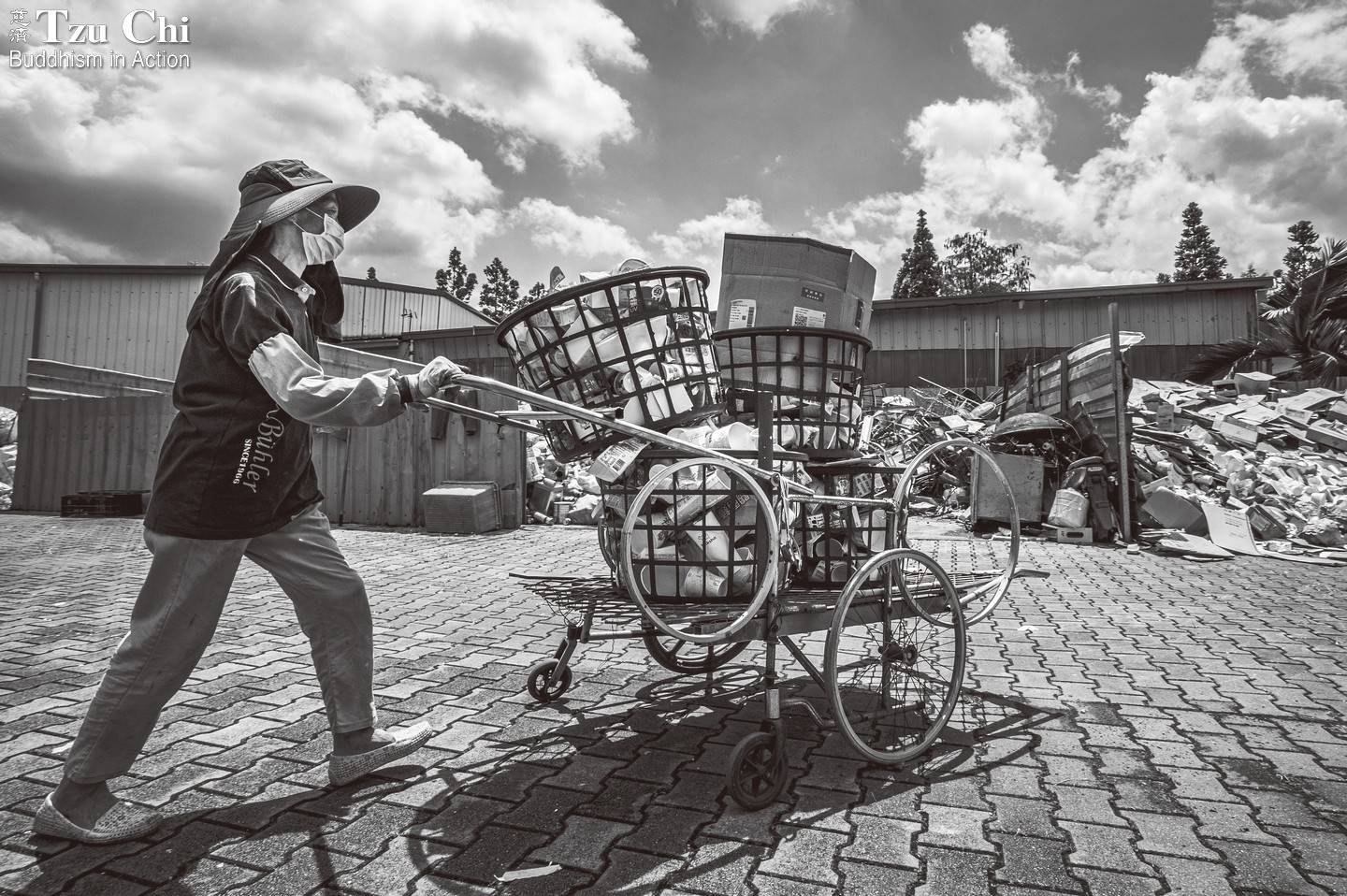
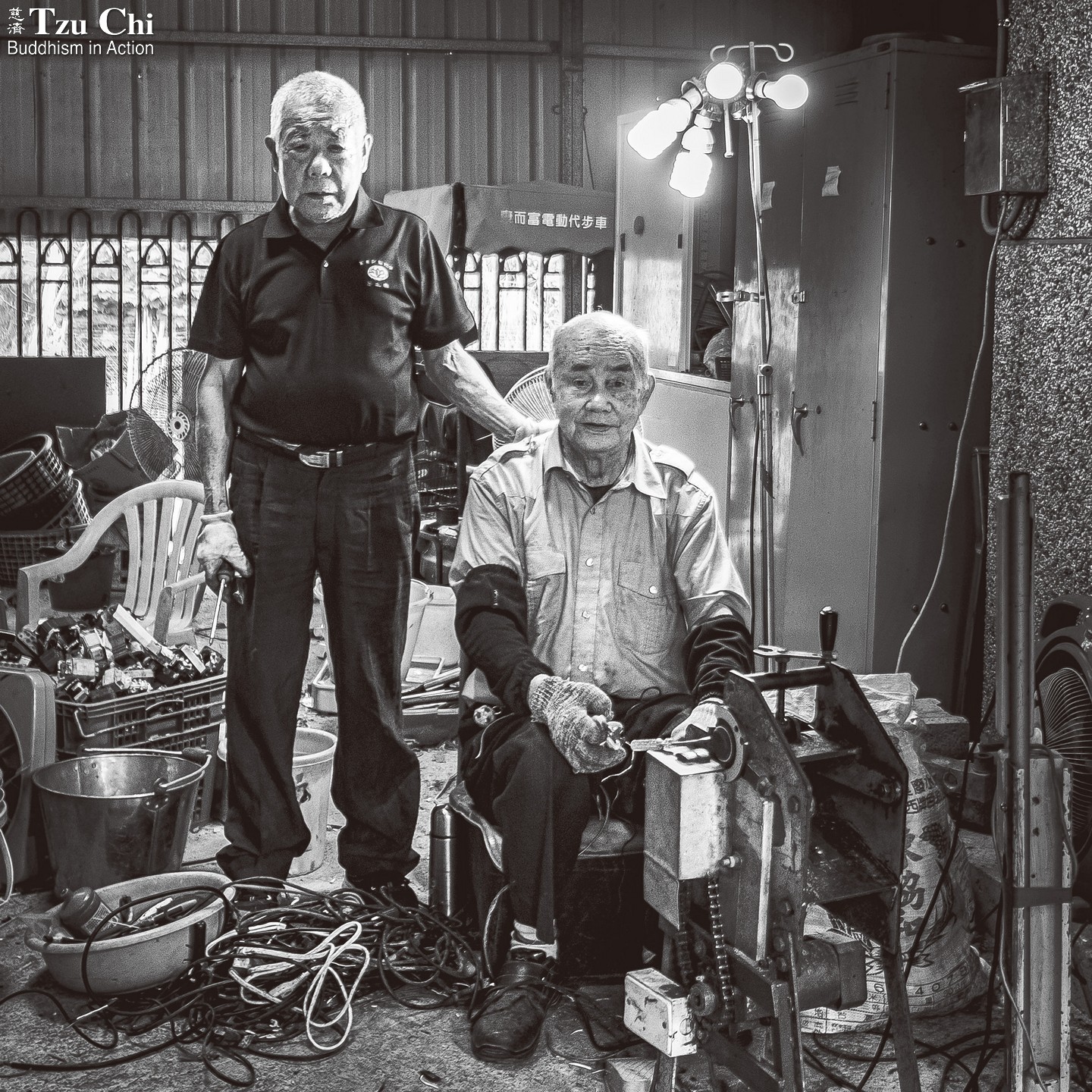
When I entered the recycling station, I was drawn to a handcart used for transporting recyclables. At first glance, it resembled a mini “Transformer”! On closer inspection, I noticed that the cart’s four wheels and the round aluminum rings on its sides had been salvaged from old wheelchairs and bicycles. An aluminum screen window served as its base, while the rest of the frame was assembled from various recycled metal parts. This inventive design redefined my idea of a handcart—it was both creative and an impressive example of resourceful repurposing.

A volunteer later explained that all the handcarts at the station were designed and assembled by Zhang Wei-gao (張維誥), a former craft teacher at Zhushan Junior High School. Dubbed the “Zhushan MacGyver,” Zhang has a unique talent for turning discarded items into practical, functional objects. While many would see broken tools or electronics as waste, he repairs and repurposes them using almost entirely recycled parts. As he put it, “To me, repairing something to extend its life is far better than letting it turn into tomorrow’s waste.” In his view, objects and people hold equal value; when things are treated with care, we begin to see love and gratitude reflected in them.

Steadfast in Their Efforts

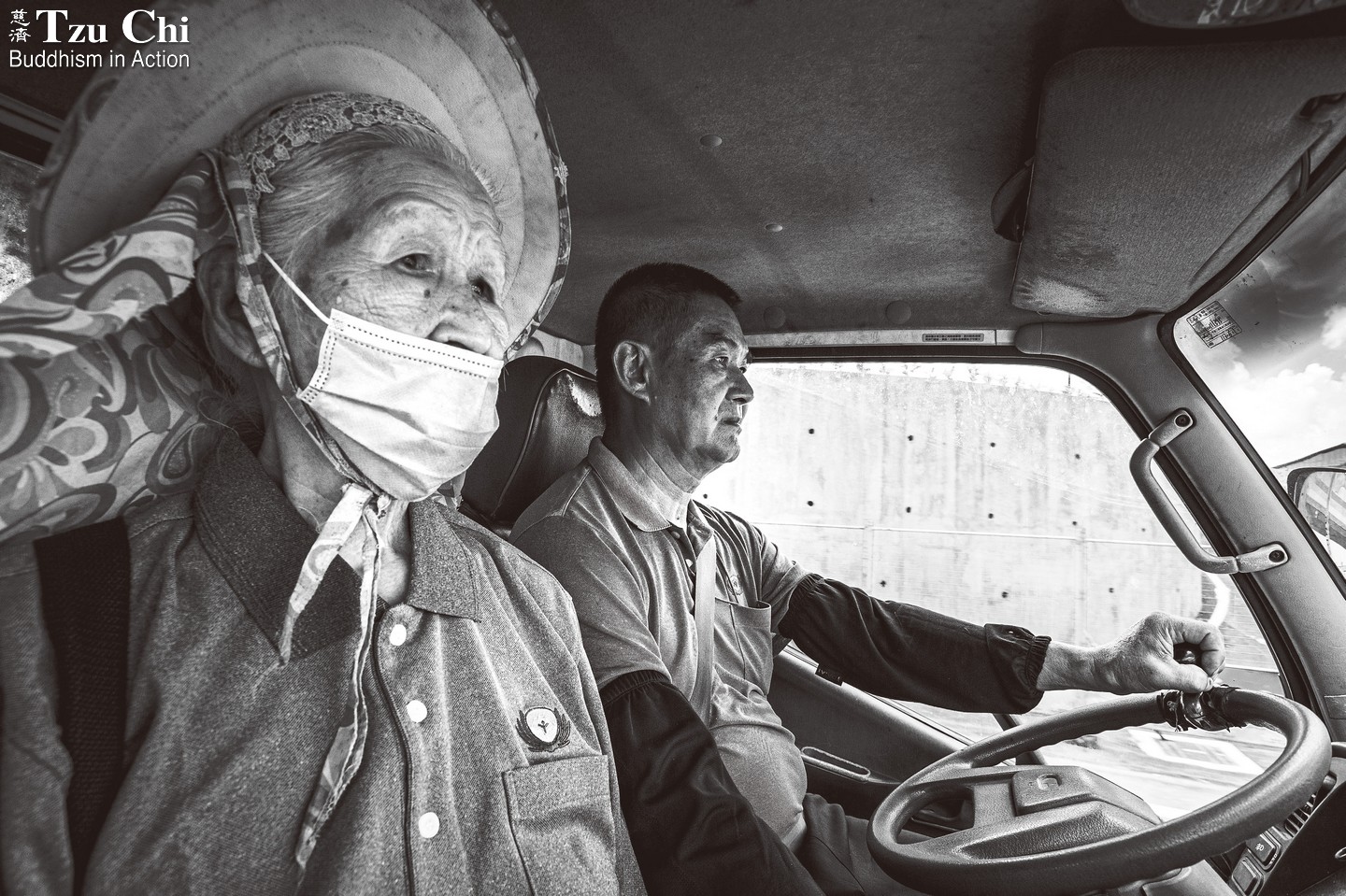
It was not yet eight in the morning when Shi Tian-sheng (石添勝) arrived at the recycling station with his 91-year-old mother. A former aviation safety officer, Shi had returned to his hometown after retiring to care for her. What began as an act of filial duty soon evolved into a lifelong commitment to environmental work, a dedication he has maintained for over 20 years. With few volunteers available to drive trucks, Shi took on the responsibility of collecting recyclables along various routes at least six days a week. His mother works in the sorting area at the station, cutting paper and organizing items.

It was already noon by the time Shi returned with a full load of recyclables that day. Despite the heat and his perspiration-soaked clothes, his face showed no trace of fatigue. Another small truck pulled into the station just then. As volunteers helped unload it, a petite woman in a floral-patterned hat stepped out of the driver’s seat. Her name, I learned, is Chen Qia (陳洽). Now 71, she has devoted over 20 years to recycling work. Energetic and determined, she tackles every task with enthusiasm, undeterred even by the demands of driving a manual truck. Years of lifting and physical labor have left her with some aches and old injuries, but she takes them all in stride, saying, “Being able to move and work is a blessing!”

The “Flavor” of the Zhushan Recycling Station

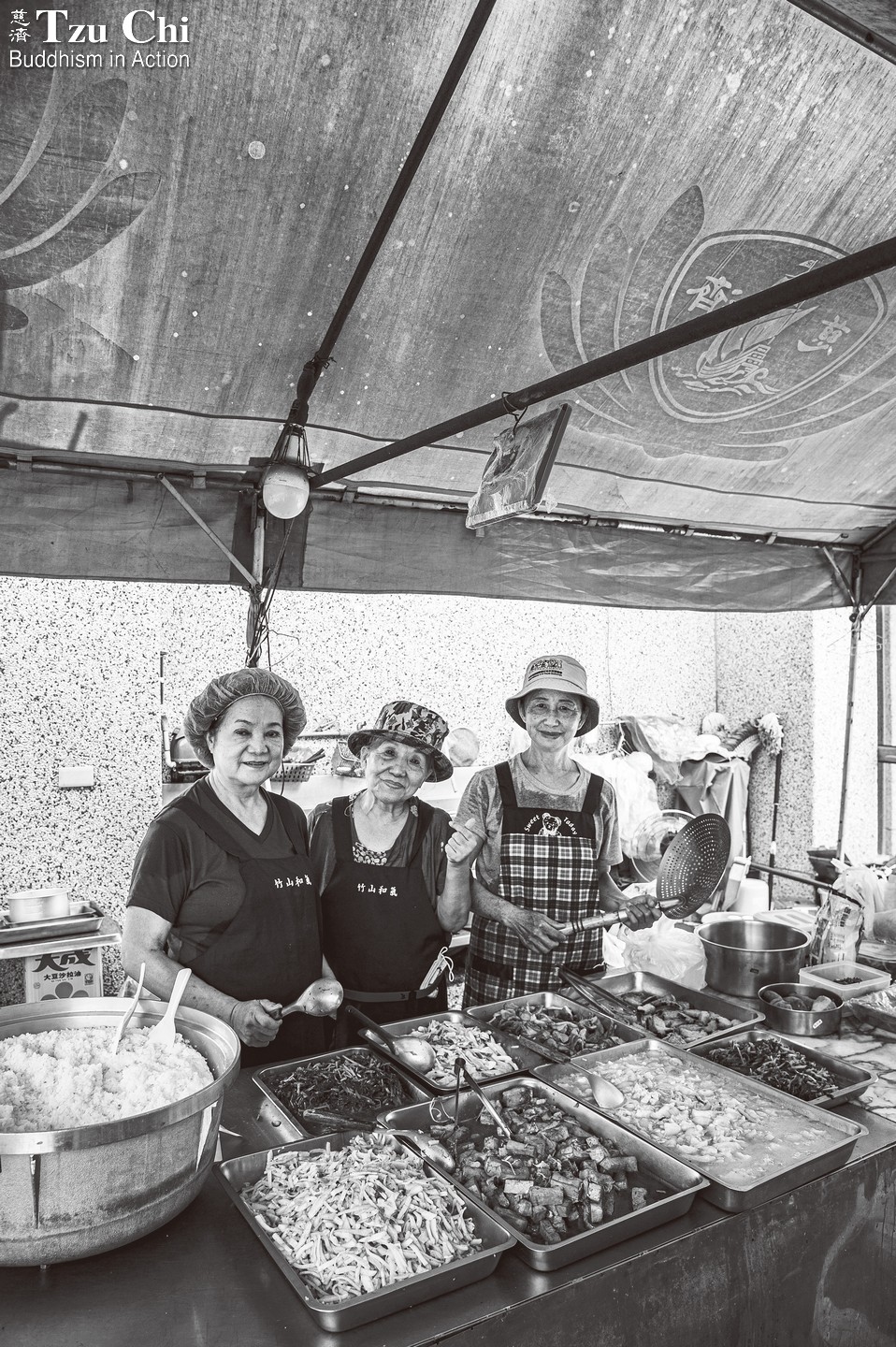
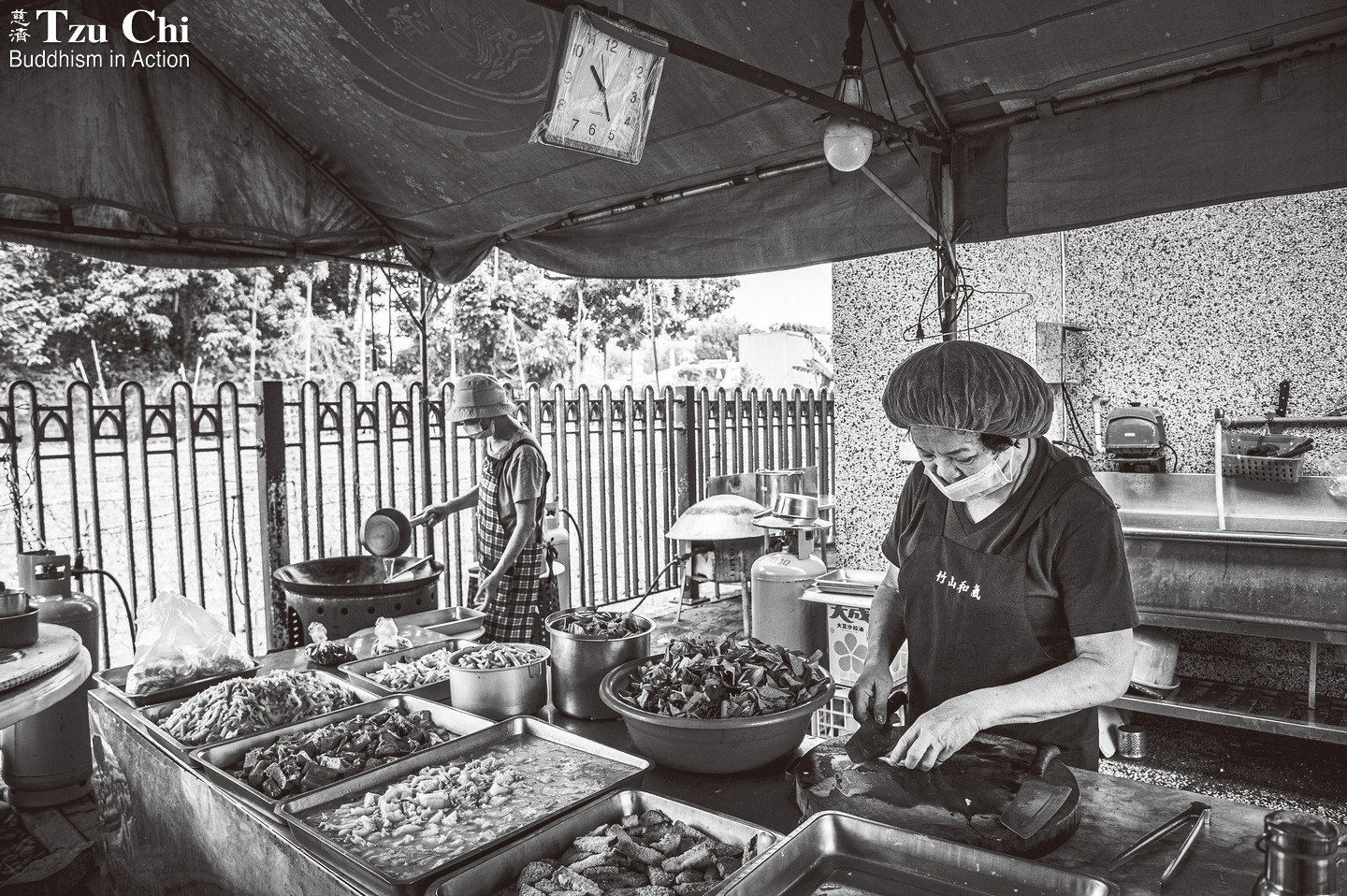
Under the canopy in one corner of the Zhushan Recycling Station, three culinary volunteers of similar age were busy at work preparing lunch for more than 20 recycling volunteers. Despite the outdoor setting, they had all the necessary equipment for cooking. The trio had, over the years, developed a smooth and efficient routine, with Zeng Bi (曾碧) and the petite Lan Cai-hua (藍彩華) preparing the ingredients and Shi Su-qin (石素琴) in charge of cooking. The three of them always work together on recycling days. They begin meal preparations at 8 a.m., and although there are only three of them, their dishes are far from basic. In less than three hours, they manage to prepare eight different vegetarian dishes, each one delicious and visually appealing.

As noon approached that day, the recycling volunteers wrapped up their work and gathered to enjoy the meal. I had the pleasure of dining with them. Though the midday heat surrounded us, we sat on recycled plastic chairs, savoring the meal with great satisfaction. A volunteer even shared a dish made with bamboo shoots she had grown herself. Every face reflected contentment, and I couldn’t help but feel moved. This, I realized, is the “flavor” of the Zhushan Recycling Station—simple yet fulfilling and truly blessed.

Text and photos by Huang Xiao-zhe
Translated by Wu Hsiao-ting

Volunteers at the Zhushan Recycling Station pose for a photo. From left: Yang Feng-ling (楊鳳玲), Zhang Yue-zhu (張月珠), Huang Lin Mei-yue (黃林美月), Ye Pin-xiu (葉品秀), Huang Jin-man (黃錦滿), Cai Xiu-zhi (蔡秀治), Qiu Luan-ying (邱鑾英), and Cai Wan-zhen (蔡宛真).

Zhushan Township, nestled in Nantou County, central Taiwan, translates to “bamboo mountain” and is celebrated for its abundant bamboo production. With ideal geography and climate, the area yields various varieties of this plant year-round, making its bamboo products well-known far and wide.

On my first visit to the Zhushan Recycling Station, I immediately felt the warmth of the local people and their deep connection to the land. Over the years, more and more locals joined Tzu Chi’s recycling efforts, and numerous recycling points sprang up as a result. However, many changed locations or had to close entirely as circumstances changed. Thankfully, in 2021, a more permanent site—the Zhushan Recycling Station—was established next to the Zhushan Jing Si Hall, providing a stable, central hub for volunteers’ efforts.

Volunteers gather at the recycling station every Wednesday and Saturday, the designated recycling days. Some drive trucks to collect recyclables, others sort materials, and still others prepare snacks and lunch for the team. This group of like-minded people has developed a strong sense of teamwork, each contributing in their own way to a shared mission.

As I took a group photo that day, I imagined each volunteer as a unique bamboo shoot emerging from the soil—each deeply rooted in their commitment to resource recycling and environmental protection. They embody a vibrant spirit, both filling their lives with purpose and nurturing the Earth’s vitality.

Zhushan’s Unique Handcarts

When I entered the recycling station, I was drawn to a handcart used for transporting recyclables. At first glance, it resembled a mini “Transformer”! On closer inspection, I noticed that the cart’s four wheels and the round aluminum rings on its sides had been salvaged from old wheelchairs and bicycles. An aluminum screen window served as its base, while the rest of the frame was assembled from various recycled metal parts. This inventive design redefined my idea of a handcart—it was both creative and an impressive example of resourceful repurposing.

A volunteer later explained that all the handcarts at the station were designed and assembled by Zhang Wei-gao (張維誥), a former craft teacher at Zhushan Junior High School. Dubbed the “Zhushan MacGyver,” Zhang has a unique talent for turning discarded items into practical, functional objects. While many would see broken tools or electronics as waste, he repairs and repurposes them using almost entirely recycled parts. As he put it, “To me, repairing something to extend its life is far better than letting it turn into tomorrow’s waste.” In his view, objects and people hold equal value; when things are treated with care, we begin to see love and gratitude reflected in them.

Steadfast in Their Efforts

It was not yet eight in the morning when Shi Tian-sheng (石添勝) arrived at the recycling station with his 91-year-old mother. A former aviation safety officer, Shi had returned to his hometown after retiring to care for her. What began as an act of filial duty soon evolved into a lifelong commitment to environmental work, a dedication he has maintained for over 20 years. With few volunteers available to drive trucks, Shi took on the responsibility of collecting recyclables along various routes at least six days a week. His mother works in the sorting area at the station, cutting paper and organizing items.

It was already noon by the time Shi returned with a full load of recyclables that day. Despite the heat and his perspiration-soaked clothes, his face showed no trace of fatigue. Another small truck pulled into the station just then. As volunteers helped unload it, a petite woman in a floral-patterned hat stepped out of the driver’s seat. Her name, I learned, is Chen Qia (陳洽). Now 71, she has devoted over 20 years to recycling work. Energetic and determined, she tackles every task with enthusiasm, undeterred even by the demands of driving a manual truck. Years of lifting and physical labor have left her with some aches and old injuries, but she takes them all in stride, saying, “Being able to move and work is a blessing!”

The “Flavor” of the Zhushan Recycling Station

Under the canopy in one corner of the Zhushan Recycling Station, three culinary volunteers of similar age were busy at work preparing lunch for more than 20 recycling volunteers. Despite the outdoor setting, they had all the necessary equipment for cooking. The trio had, over the years, developed a smooth and efficient routine, with Zeng Bi (曾碧) and the petite Lan Cai-hua (藍彩華) preparing the ingredients and Shi Su-qin (石素琴) in charge of cooking. The three of them always work together on recycling days. They begin meal preparations at 8 a.m., and although there are only three of them, their dishes are far from basic. In less than three hours, they manage to prepare eight different vegetarian dishes, each one delicious and visually appealing.

As noon approached that day, the recycling volunteers wrapped up their work and gathered to enjoy the meal. I had the pleasure of dining with them. Though the midday heat surrounded us, we sat on recycled plastic chairs, savoring the meal with great satisfaction. A volunteer even shared a dish made with bamboo shoots she had grown herself. Every face reflected contentment, and I couldn’t help but feel moved. This, I realized, is the “flavor” of the Zhushan Recycling Station—simple yet fulfilling and truly blessed.

關鍵字

母の大きな心願 来世もこの世で弘法利生したい

私の母、洪玉哖(ホン・ユウニェン)は、出家する縁が三度あったが、願いは叶わなかった。慈済委員の認証を授かってからは、手押し車を押して草屯地区を回り、募金集めやリサイクル活動をした。

腰をかがめる度に「南無阿弥陀仏」と唱えるので、毎日、街角や路地にいても繞仏(にょうぶつ)していることになる。母は仏の弟子であると同時に、模範的な母親であり、私にとってのお手本である。

私の母、洪玉哖(ホン・ユーニエン)は、人生の中で三度、出家して仏道に学ぼうとしたことがあったが、三度とも願いを叶えることができなかった。

彼女は、一九二六年三月十四日に草屯鎮の新庄里の田舎に生まれた。当時の社会は貧しさに加えて男尊女卑の観念があり、勉強したいという彼女の願いは叶わず、長姉と一緒に牛の放牧をしたり、家事に明け暮れたりする日々を送った。母方の祖父は、二男を薬剤師にするために日本に留学させようと、田んぼを売って資金を調達してくれた。後に末の息子も医学部を卒業した。薬剤師と人を救う医師を輩出したことで、洪家は名を揚げた。

母は、病に苦しんでも貧しかったために医者にかかるのは容易でなかったという祖母の姿を、幼い頃から見て育った。人生の苦しみを体験した母は、お寺に行って、法師に剃髪出家の思いを懇願した。しかし、硬く反対した祖父に連れ戻された。こうして、最初の出家の縁は消えてしまった。

一九四五年、母は十九歳で大工職人の謝松釜(シェ・ソンフー)と結婚し、三男四女を儲けた。生活は厳しく、母は出家の願いを断ち切れず、解脱の道を探そうとしたが、子供がまだ幼かったため、父からカンナ削りやノコギリの使い方、ペンキ塗りなどを学び、苦労しながらも夫婦で力を合わせ、家具や勉強机と椅子などを作って生計を立てた。

誠実な性格の父は真面目に仕事をし、手抜きすることがなかったため、収入は多くなかった。母はやりくりして家計を支え、数々の内職をした。後に父が慢性病を患ってから、母は早朝四時に市場に行って、野菜や果物の卸売をしたり、道端で野菜や果物と紙銭を売ったりした。野菜や果物が売れ残った時は、自転車を押して売り歩き、家に帰るのは日が暮れてからだった。

一九九〇年、父が六十六歳で病死し、母は深い悲しみに暮れ、再び人生への未練をなくしてしまった。私たち子供は、母の出家を忍びなく思い、真面目に慈済に打ち込んで、菩薩道を歩むよう勧めた。それ以降、母は慈済に専念するようになり、私たちが帰省する時でも事前に約束しないと会えないこともあった。

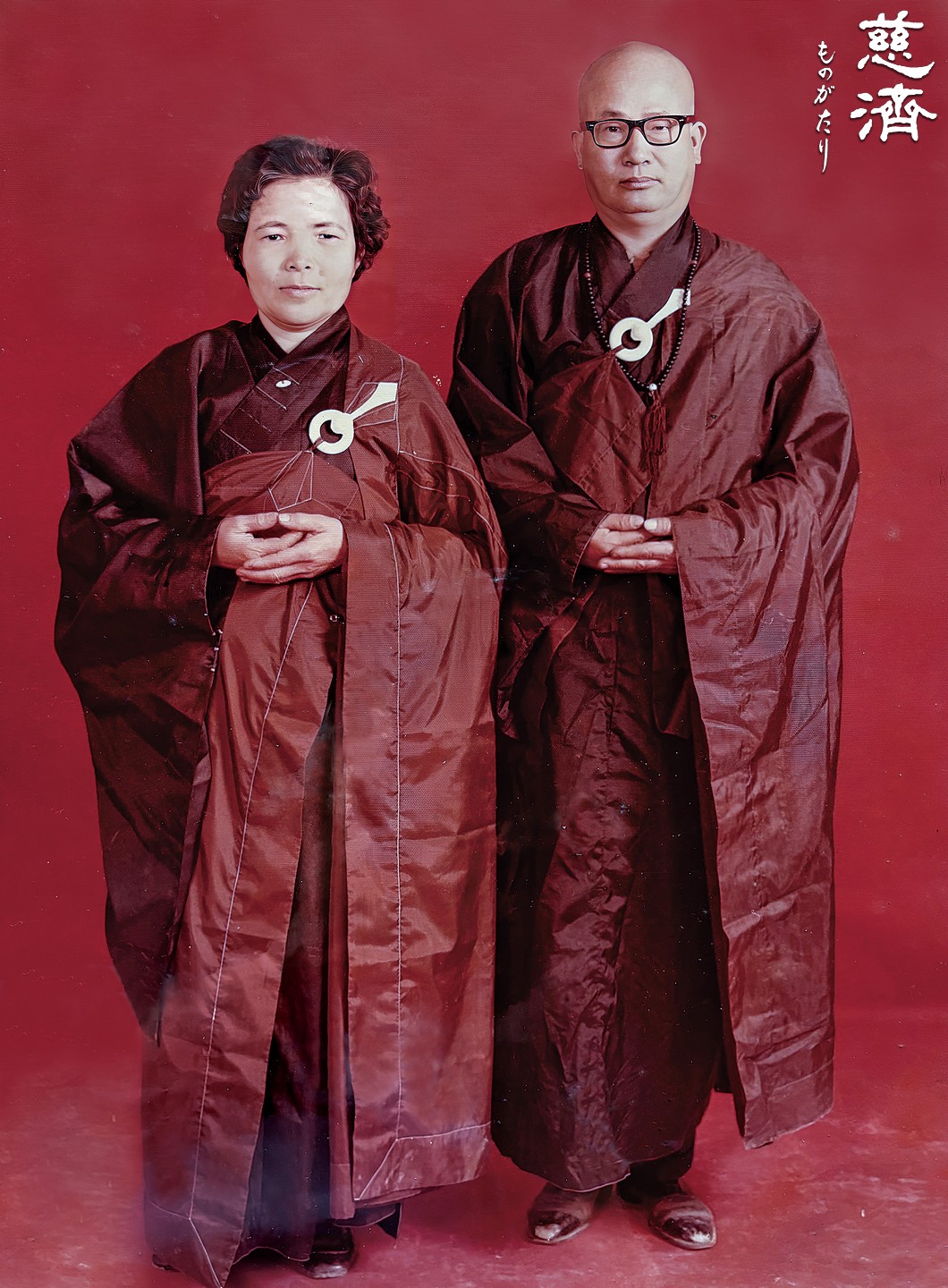
仏法を深く信仰した洪玉哖さんと夫の謝松釜さんは、二人とも菩薩戒を受けた仏教徒だった。

毎日手押し車で善行する

読み書きができないことで苦労した母は、教育の重要性を感じ、「たとえ物乞いしてでも、私たちを学校に通わせる」と言ったことがある。新学期の頃になると、いつも七人の子どもの莫大な学費を工面するために、借金したり、頼母子講で資金を調達したりした。草屯鎮で開業医をしていた叔父は、いつも私たちの学費を支援してくれた人で、一家にとって忘れがたい恩人だった。みんなの期待を裏切らず、私たちは全員高等教育を修了し、兄の謝輝龍(シェ・フイロン)は南投竹山秀傳病院の院長を務めるまでになった。

母は、菩薩戒を受けた敬虔な仏教徒で、早くから菜食をしていた。彼女自身の生活は極めて質素だったが、周囲の仏教寺院へ供養したいと尽力し、お経を唱え、法器を叩くことを学び、多くの経典を暗誦することができるようになった。草屯鎮で初めての慈済の種子である張河圳(ヅァン・ホーヅン)師兄は、よく私たちの家に来て慈済の話をした。慈済が花蓮で病院を建設していた頃、母は慈済列車に乗って花蓮を訪れてとても感銘を受け、直ちに病室一つ分の建設費三十万台湾ドルを集めた。一九八九年に慈済委員になった時、私たちは既に成長して自立していたが、母は悠々自適の暮らしに甘んじることなく、證厳法師の後ろについて、人々に奉仕した。

一九九〇年、證厳法師は「拍手する手で環境保護をしましょう」と呼びかけた。母はその教えを実行に移し、道路が彼女の道場となり、四輪車を押して街中を歩きまわった。彼女は、自分で栽培した野菜や仕入れた果物を販売しながら資源を回収したり、募金や会費集めをしたりした。そして、腰をかがめてペットボトルやダンボールなど資源ゴミを拾う度に、「阿弥陀仏」と唱えていた。それが彼女なりの拝仏であった。このようにして、毎日街角や路地で仏法を実践していたので、草屯鎮の多くの人は母のことを知っていて、非常に多くの人が彼女の会員になった。

彼女は、あちこちで資源回収をする途中でバスにぶつけられて入院したことがある。また、バイクに乗った若者が母の後をつけ、ペットボトルを手渡すと同時に首にかけていた金のネックレスを奪ったので、母は転んで怪我をしたこともある。しかし、どんな事があっても、彼女の堅い信念は揺るがなかった。

母は料理が得意で、一度食べた料理は全て調理でき、周囲からコック長と称賛された。私の二人の兄が結婚した時、母は自ら宴席の料理を作って来客をもてなした。そして、国内外で大きな災害が発生し、慈済が支援活動をした時も、ベジタリアンちまきやスープ、昔ながらのタケノコマントウなどを作ってチャリティ販売をした。今でも家族は、母が作ったちまきや薬膳スープの味を懐かしむ。母の右に出る味には出会ったことが無い。

戦争を経験した母は、被災者の苦しみを、身をもって感じていた。平成八年台風九号や921地震、平成二十一年の八八水害の時は、料理のチャリティー販売をしたりした他、誰にでも慈済のことを語り、募金集めをしたりして、あらゆる機会を逃さなかった。毎月、会費を集めに行く日、母は早朝から長男の輝龍、または私の妹の謝素芬(シェ・スーフェン)に頼んで手推し車と一緒に新庄村まで運んでもらい、そこから歩いて会費集めと資源回収をした後、草屯市街地まで歩いて帰宅する。時には夜の十一時を回ることもあって、一日に十数キロを歩いており、その並外れた気力は人々を驚かせた。

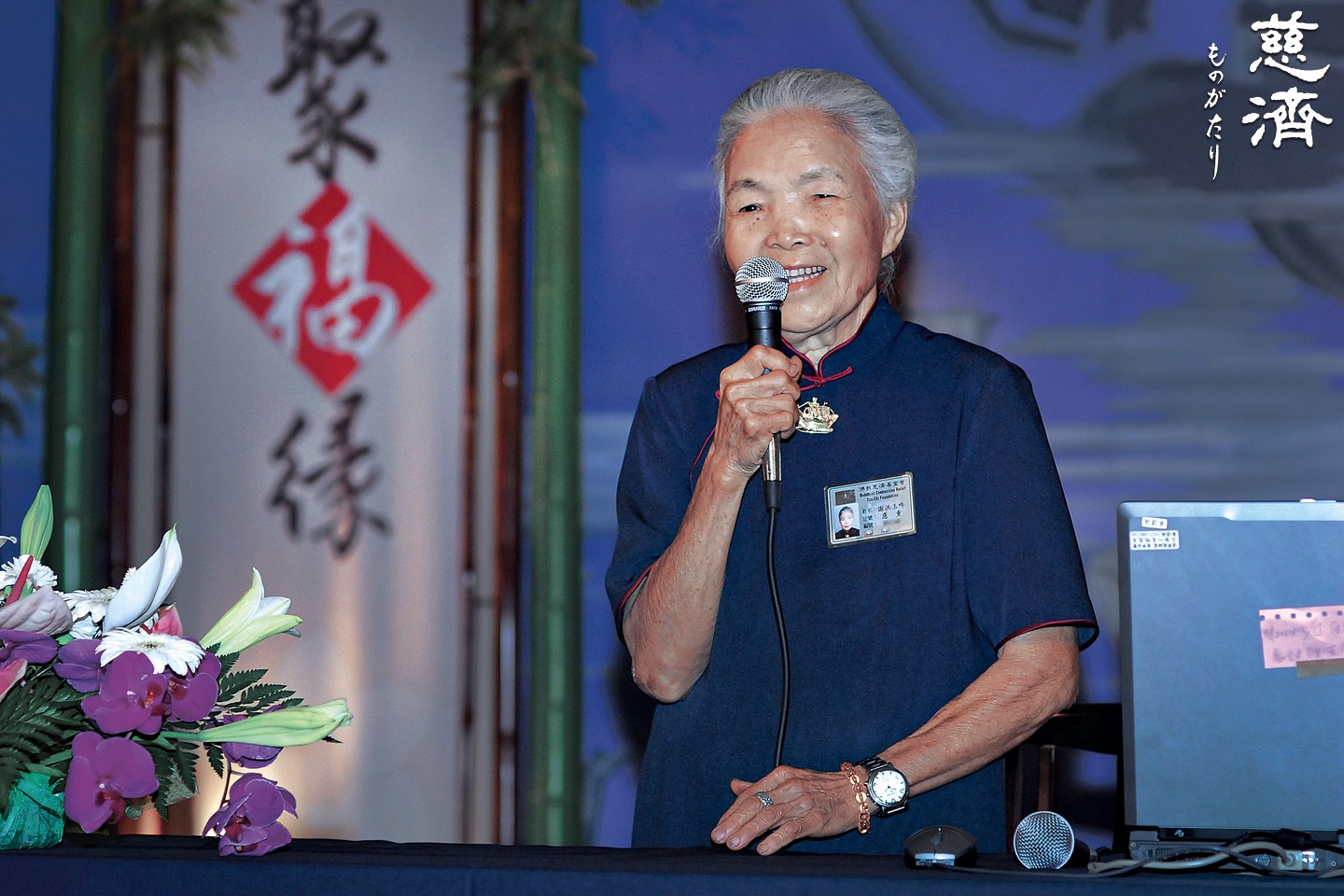
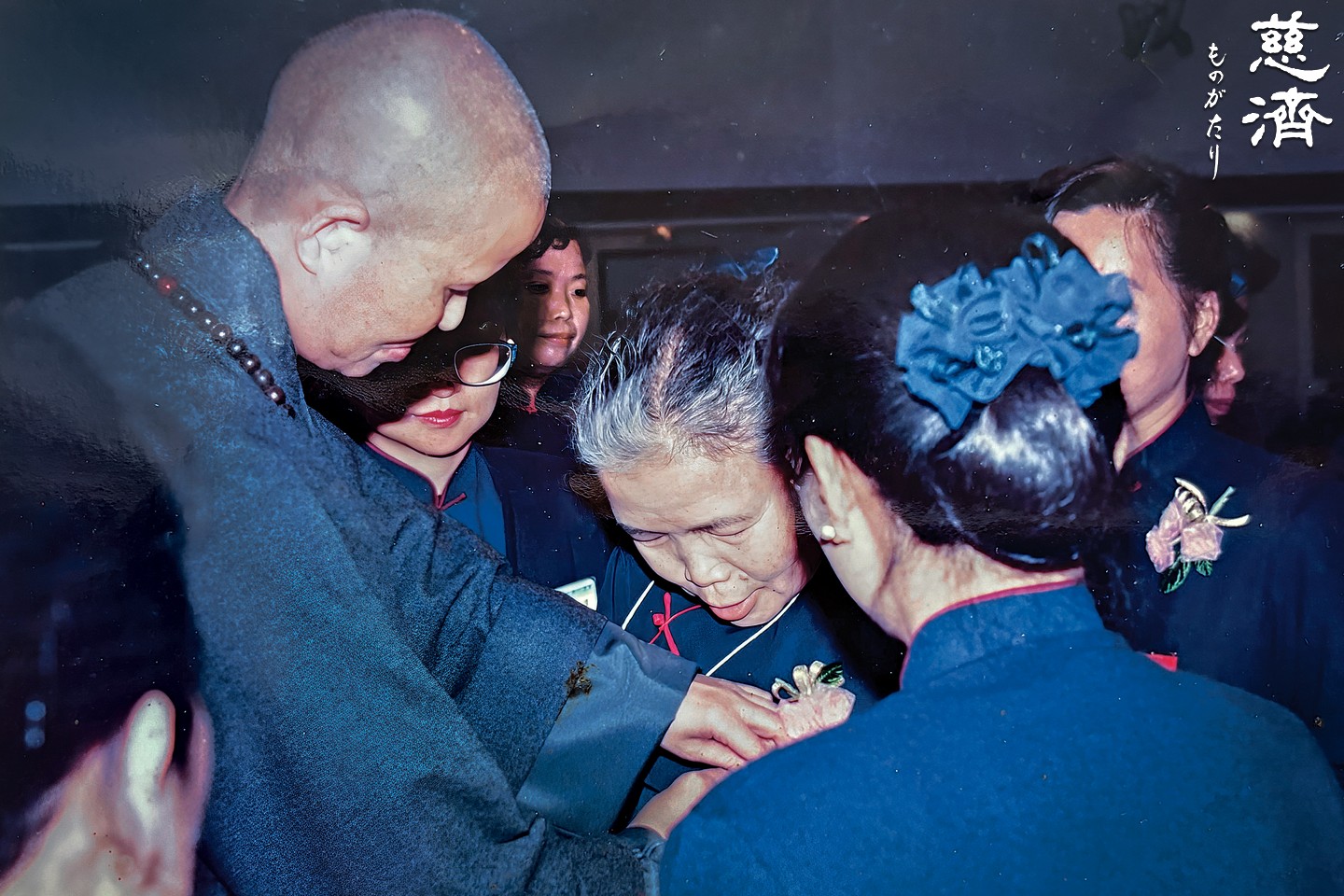
洪玉哖さん(中央)は気前よく布施をし、2005年の歳末祝福会で名誉董事の称号を授かった。

七十七歳で海外ボランティア

草屯鎮における母の善行は、多くの人々に感動を与え、集った会員は四、五百人にも達した。最初は募金ノートの記入を人に頼んでいたが、やがて光栄小学校の夜間部に通って読み書きを勉強するようになった。在学の三年間、一度も欠席したことがなく、卒業の時は、成績優秀者に贈られる賞状までもらった。

彼女は慈済病院でボランティアをする事に喜びを感じ、花蓮、大林、台中のどこでも母の姿が見られた。初めは花蓮慈済病院の地下室でシーツの縫製を手伝い、暫くして病室ボランティアをした。彼女は、自身の人生経歴や聞いた仏法をシェアして患者の心を落ち着かせた。患者の笑顔を見られるだけで、母は大きな達成感を感じた。ある日のボランティア朝の会で、母は勇敢にも壇上に上がって自分の人生を分かち合った。その時、人々は初めて、彼女の素晴らしい人生を聞き、仏法が心に入り、それを実践しているのが人間菩薩であることを知った。

彼女は海外での施療活動に参加したかったが、證厳法師は母の年齢を考慮し、長距離移動が負担になるのではないかと心配した。彼女は、大丈夫だということを証明するために、中国の黄山に登り、写真を撮って来て法師に見せた。二〇〇三年、彼女は長男の謝輝龍院長と一緒に、インドネシアでの施療活動に参加した。少し休憩するようボランティアに勧められても、母は「高い航空券を買ってやって来たのは、手伝いをするためです」と言った。

二〇〇五年、母を主人公にした大愛ドラマ『好願連年』が放映された。彼女は、自分が歩んできた人生なのだからその内容をよく知っており、見る必要はないと言って、いつも通り夜遅くまで資源回収をしていた。兄は、母は視力が悪く、夜は危ないと心配して、よく探しに出かけた。私たちの心配を知った法師は、毎晩必ず『好願連年』を見なさいと母に言づけた。法師を深く愛する母は、おとなしく早目に帰宅するようになった。

百歳近い洪玉哖さんが子供や孫たちと一緒に撮った写真。(写真提供・謝輝龍)

善行に導いてくれた母に感謝

母は九十歳を過ぎても仏の教えに従って奉仕し続け、いつも愛を募る募金をすることと仏法を聞いて精進することだけ考えていた。やがて、ほぼ全盲になり、認知症も進んでいたが、耳で仏法を聞いて精進し、亡くなる直前になっても、『心経』や『大悲咒』・『阿弥陀経』を唱えることができた。

看護師である妹の謝素英(シェ・スーイン)は、長庚大学看護学部副教授を務めている。母は、九十一歳で手術を受けて以来、新北市林口区で妹と同居するようになった。素英は母を連れて、念仏会やリサイクルステーションで活動に参加したが、母は募金集めに行きたいとよく口にしていた。

二〇二四年の八月三日、母は自宅で息を引き取った。「何もせずに死ぬよりも、死ぬまで奉仕する方がいい」という自分への約束を守った。六度万行を成し遂げた母は仏の弟子であり、台湾の模範的な母親だと言えよう。全国から推薦された「善人善行」の代表にもなり、私にとってもお手本である。

母は一生、私たち家族のために働き過ぎていたので、三十歳を過ぎた頃、子宮から大量出血した。手術後、父は母を連れて二回も占いに連れて行った。占い師は、「この人はもうこの世にはいない」と断言しながらも、確かに目の前にいる母を見て不思議だと言った。「この世には占いが効かない人が二種類あります。一種類は修行者で、もう一種類は常に善行をしている人です」。

たとえ生活が苦しくても、母は変わらずに善行をしていたので、それが子どもたちに大きく影響して全員が仏教徒になり、人助けに喜びを感じている。私たちは、慈済に導いてくれた母に、心から感謝している。彼女の勇猛な精進ぶりには及ばない。怠けてはいけないと励まし、「上人が担っている責任はとても重く、みんなで分担し合えばその重荷が軽くなり、過去の業も消えるようになる」と母は常に言っていた。

母は生涯にわたって多くの人と良縁を結んで来たため、草屯鎮の自宅で行われた告別式の日には五百人あまりが母を見送ってくれた。母の大いなる心願は、「来世は弘法利生する法師になること」だった。私は、母が既にこの世に生まれ変わっていると信じている。

(慈済月刊六九五期より)

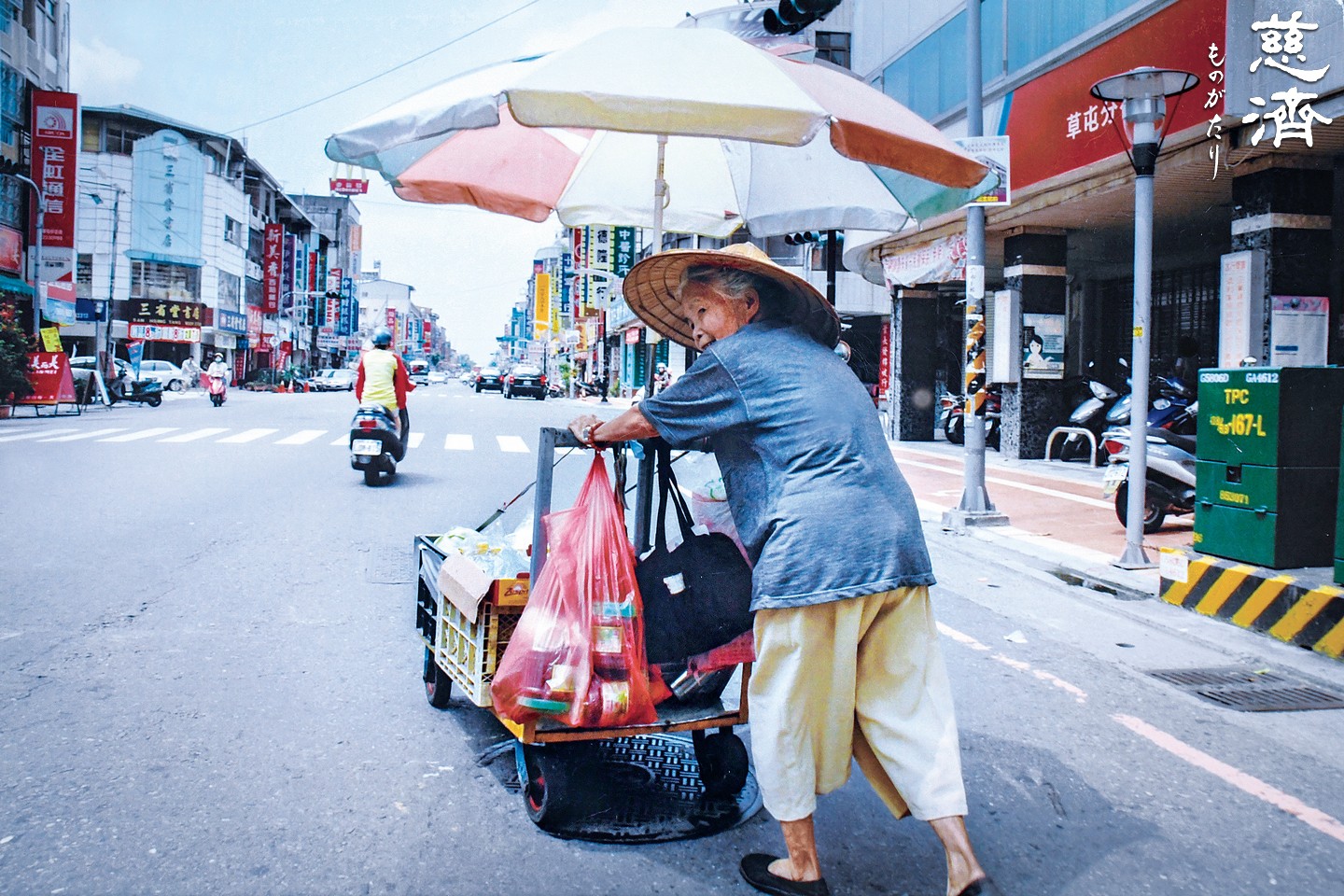
洪玉哖さんは手押し車を押して野菜や果物を売りながら、道すがら資源を回収し、環境保護活動をした。(撮影・林義澤)

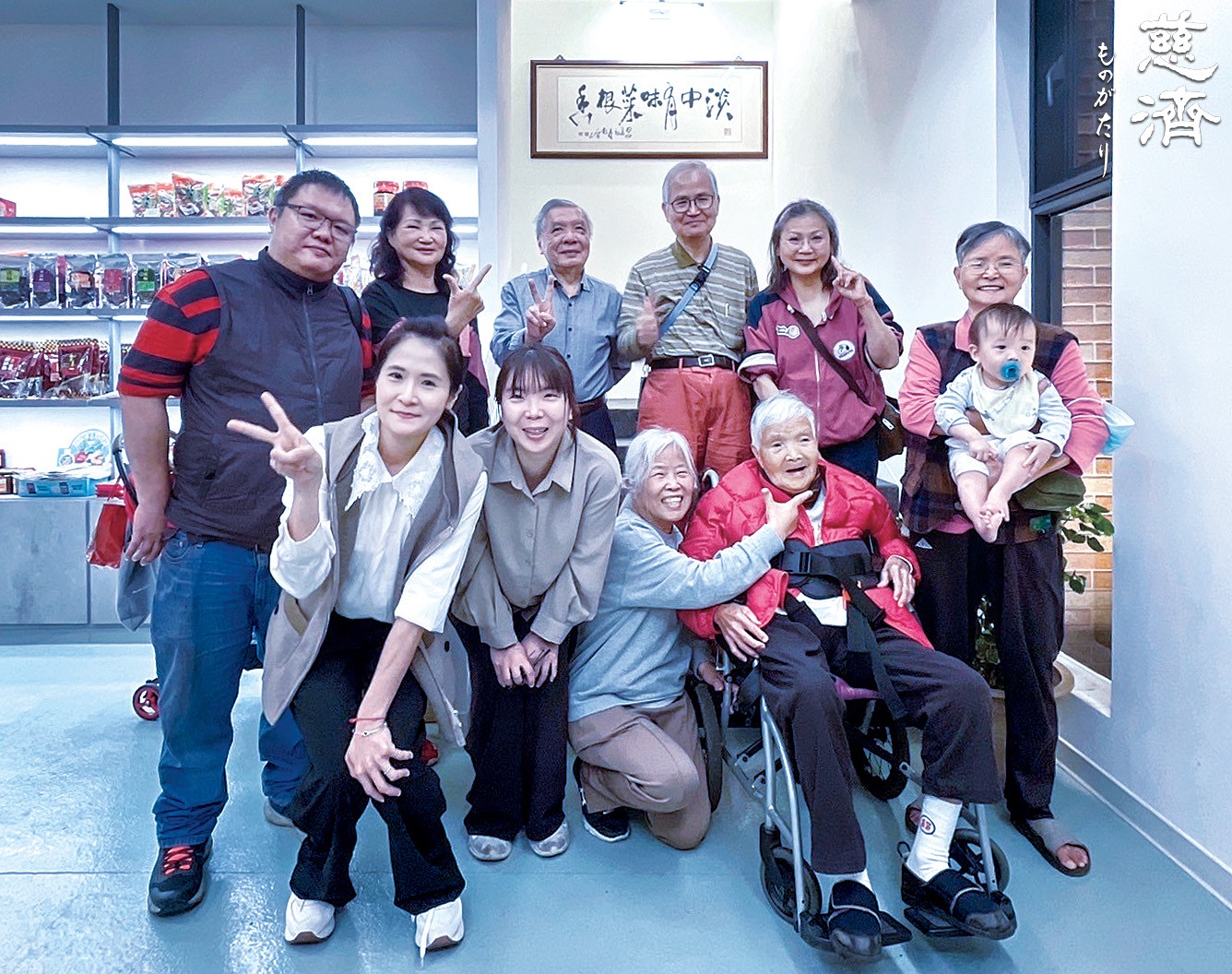
私の母、洪玉哖(ホン・ユウニェン)は、出家する縁が三度あったが、願いは叶わなかった。慈済委員の認証を授かってからは、手押し車を押して草屯地区を回り、募金集めやリサイクル活動をした。

腰をかがめる度に「南無阿弥陀仏」と唱えるので、毎日、街角や路地にいても繞仏(にょうぶつ)していることになる。母は仏の弟子であると同時に、模範的な母親であり、私にとってのお手本である。

私の母、洪玉哖(ホン・ユーニエン)は、人生の中で三度、出家して仏道に学ぼうとしたことがあったが、三度とも願いを叶えることができなかった。

彼女は、一九二六年三月十四日に草屯鎮の新庄里の田舎に生まれた。当時の社会は貧しさに加えて男尊女卑の観念があり、勉強したいという彼女の願いは叶わず、長姉と一緒に牛の放牧をしたり、家事に明け暮れたりする日々を送った。母方の祖父は、二男を薬剤師にするために日本に留学させようと、田んぼを売って資金を調達してくれた。後に末の息子も医学部を卒業した。薬剤師と人を救う医師を輩出したことで、洪家は名を揚げた。

母は、病に苦しんでも貧しかったために医者にかかるのは容易でなかったという祖母の姿を、幼い頃から見て育った。人生の苦しみを体験した母は、お寺に行って、法師に剃髪出家の思いを懇願した。しかし、硬く反対した祖父に連れ戻された。こうして、最初の出家の縁は消えてしまった。

一九四五年、母は十九歳で大工職人の謝松釜(シェ・ソンフー)と結婚し、三男四女を儲けた。生活は厳しく、母は出家の願いを断ち切れず、解脱の道を探そうとしたが、子供がまだ幼かったため、父からカンナ削りやノコギリの使い方、ペンキ塗りなどを学び、苦労しながらも夫婦で力を合わせ、家具や勉強机と椅子などを作って生計を立てた。

誠実な性格の父は真面目に仕事をし、手抜きすることがなかったため、収入は多くなかった。母はやりくりして家計を支え、数々の内職をした。後に父が慢性病を患ってから、母は早朝四時に市場に行って、野菜や果物の卸売をしたり、道端で野菜や果物と紙銭を売ったりした。野菜や果物が売れ残った時は、自転車を押して売り歩き、家に帰るのは日が暮れてからだった。

一九九〇年、父が六十六歳で病死し、母は深い悲しみに暮れ、再び人生への未練をなくしてしまった。私たち子供は、母の出家を忍びなく思い、真面目に慈済に打ち込んで、菩薩道を歩むよう勧めた。それ以降、母は慈済に専念するようになり、私たちが帰省する時でも事前に約束しないと会えないこともあった。

仏法を深く信仰した洪玉哖さんと夫の謝松釜さんは、二人とも菩薩戒を受けた仏教徒だった。

毎日手押し車で善行する

読み書きができないことで苦労した母は、教育の重要性を感じ、「たとえ物乞いしてでも、私たちを学校に通わせる」と言ったことがある。新学期の頃になると、いつも七人の子どもの莫大な学費を工面するために、借金したり、頼母子講で資金を調達したりした。草屯鎮で開業医をしていた叔父は、いつも私たちの学費を支援してくれた人で、一家にとって忘れがたい恩人だった。みんなの期待を裏切らず、私たちは全員高等教育を修了し、兄の謝輝龍(シェ・フイロン)は南投竹山秀傳病院の院長を務めるまでになった。

母は、菩薩戒を受けた敬虔な仏教徒で、早くから菜食をしていた。彼女自身の生活は極めて質素だったが、周囲の仏教寺院へ供養したいと尽力し、お経を唱え、法器を叩くことを学び、多くの経典を暗誦することができるようになった。草屯鎮で初めての慈済の種子である張河圳(ヅァン・ホーヅン)師兄は、よく私たちの家に来て慈済の話をした。慈済が花蓮で病院を建設していた頃、母は慈済列車に乗って花蓮を訪れてとても感銘を受け、直ちに病室一つ分の建設費三十万台湾ドルを集めた。一九八九年に慈済委員になった時、私たちは既に成長して自立していたが、母は悠々自適の暮らしに甘んじることなく、證厳法師の後ろについて、人々に奉仕した。

一九九〇年、證厳法師は「拍手する手で環境保護をしましょう」と呼びかけた。母はその教えを実行に移し、道路が彼女の道場となり、四輪車を押して街中を歩きまわった。彼女は、自分で栽培した野菜や仕入れた果物を販売しながら資源を回収したり、募金や会費集めをしたりした。そして、腰をかがめてペットボトルやダンボールなど資源ゴミを拾う度に、「阿弥陀仏」と唱えていた。それが彼女なりの拝仏であった。このようにして、毎日街角や路地で仏法を実践していたので、草屯鎮の多くの人は母のことを知っていて、非常に多くの人が彼女の会員になった。

彼女は、あちこちで資源回収をする途中でバスにぶつけられて入院したことがある。また、バイクに乗った若者が母の後をつけ、ペットボトルを手渡すと同時に首にかけていた金のネックレスを奪ったので、母は転んで怪我をしたこともある。しかし、どんな事があっても、彼女の堅い信念は揺るがなかった。

母は料理が得意で、一度食べた料理は全て調理でき、周囲からコック長と称賛された。私の二人の兄が結婚した時、母は自ら宴席の料理を作って来客をもてなした。そして、国内外で大きな災害が発生し、慈済が支援活動をした時も、ベジタリアンちまきやスープ、昔ながらのタケノコマントウなどを作ってチャリティ販売をした。今でも家族は、母が作ったちまきや薬膳スープの味を懐かしむ。母の右に出る味には出会ったことが無い。

戦争を経験した母は、被災者の苦しみを、身をもって感じていた。平成八年台風九号や921地震、平成二十一年の八八水害の時は、料理のチャリティー販売をしたりした他、誰にでも慈済のことを語り、募金集めをしたりして、あらゆる機会を逃さなかった。毎月、会費を集めに行く日、母は早朝から長男の輝龍、または私の妹の謝素芬(シェ・スーフェン)に頼んで手推し車と一緒に新庄村まで運んでもらい、そこから歩いて会費集めと資源回収をした後、草屯市街地まで歩いて帰宅する。時には夜の十一時を回ることもあって、一日に十数キロを歩いており、その並外れた気力は人々を驚かせた。

洪玉哖さん(中央)は気前よく布施をし、2005年の歳末祝福会で名誉董事の称号を授かった。

七十七歳で海外ボランティア

草屯鎮における母の善行は、多くの人々に感動を与え、集った会員は四、五百人にも達した。最初は募金ノートの記入を人に頼んでいたが、やがて光栄小学校の夜間部に通って読み書きを勉強するようになった。在学の三年間、一度も欠席したことがなく、卒業の時は、成績優秀者に贈られる賞状までもらった。

彼女は慈済病院でボランティアをする事に喜びを感じ、花蓮、大林、台中のどこでも母の姿が見られた。初めは花蓮慈済病院の地下室でシーツの縫製を手伝い、暫くして病室ボランティアをした。彼女は、自身の人生経歴や聞いた仏法をシェアして患者の心を落ち着かせた。患者の笑顔を見られるだけで、母は大きな達成感を感じた。ある日のボランティア朝の会で、母は勇敢にも壇上に上がって自分の人生を分かち合った。その時、人々は初めて、彼女の素晴らしい人生を聞き、仏法が心に入り、それを実践しているのが人間菩薩であることを知った。

彼女は海外での施療活動に参加したかったが、證厳法師は母の年齢を考慮し、長距離移動が負担になるのではないかと心配した。彼女は、大丈夫だということを証明するために、中国の黄山に登り、写真を撮って来て法師に見せた。二〇〇三年、彼女は長男の謝輝龍院長と一緒に、インドネシアでの施療活動に参加した。少し休憩するようボランティアに勧められても、母は「高い航空券を買ってやって来たのは、手伝いをするためです」と言った。

二〇〇五年、母を主人公にした大愛ドラマ『好願連年』が放映された。彼女は、自分が歩んできた人生なのだからその内容をよく知っており、見る必要はないと言って、いつも通り夜遅くまで資源回収をしていた。兄は、母は視力が悪く、夜は危ないと心配して、よく探しに出かけた。私たちの心配を知った法師は、毎晩必ず『好願連年』を見なさいと母に言づけた。法師を深く愛する母は、おとなしく早目に帰宅するようになった。

百歳近い洪玉哖さんが子供や孫たちと一緒に撮った写真。(写真提供・謝輝龍)

善行に導いてくれた母に感謝

母は九十歳を過ぎても仏の教えに従って奉仕し続け、いつも愛を募る募金をすることと仏法を聞いて精進することだけ考えていた。やがて、ほぼ全盲になり、認知症も進んでいたが、耳で仏法を聞いて精進し、亡くなる直前になっても、『心経』や『大悲咒』・『阿弥陀経』を唱えることができた。

看護師である妹の謝素英(シェ・スーイン)は、長庚大学看護学部副教授を務めている。母は、九十一歳で手術を受けて以来、新北市林口区で妹と同居するようになった。素英は母を連れて、念仏会やリサイクルステーションで活動に参加したが、母は募金集めに行きたいとよく口にしていた。

二〇二四年の八月三日、母は自宅で息を引き取った。「何もせずに死ぬよりも、死ぬまで奉仕する方がいい」という自分への約束を守った。六度万行を成し遂げた母は仏の弟子であり、台湾の模範的な母親だと言えよう。全国から推薦された「善人善行」の代表にもなり、私にとってもお手本である。

母は一生、私たち家族のために働き過ぎていたので、三十歳を過ぎた頃、子宮から大量出血した。手術後、父は母を連れて二回も占いに連れて行った。占い師は、「この人はもうこの世にはいない」と断言しながらも、確かに目の前にいる母を見て不思議だと言った。「この世には占いが効かない人が二種類あります。一種類は修行者で、もう一種類は常に善行をしている人です」。

たとえ生活が苦しくても、母は変わらずに善行をしていたので、それが子どもたちに大きく影響して全員が仏教徒になり、人助けに喜びを感じている。私たちは、慈済に導いてくれた母に、心から感謝している。彼女の勇猛な精進ぶりには及ばない。怠けてはいけないと励まし、「上人が担っている責任はとても重く、みんなで分担し合えばその重荷が軽くなり、過去の業も消えるようになる」と母は常に言っていた。

母は生涯にわたって多くの人と良縁を結んで来たため、草屯鎮の自宅で行われた告別式の日には五百人あまりが母を見送ってくれた。母の大いなる心願は、「来世は弘法利生する法師になること」だった。私は、母が既にこの世に生まれ変わっていると信じている。

(慈済月刊六九五期より)

洪玉哖さんは手押し車を押して野菜や果物を売りながら、道すがら資源を回収し、環境保護活動をした。(撮影・林義澤)

關鍵字

Bridging Healthcare Gaps—Tzu Chi and the SDGs

By Yeh Tzu-hao
Translated by Wu Hsiao-ting

“Ensuring healthy lives and promoting well-being for all at all ages” is the focus of the United Nations’ Sustainable Development Goal 3. This vision has also guided Tzu Chi’s medical efforts over the past five decades, benefiting communities worldwide.

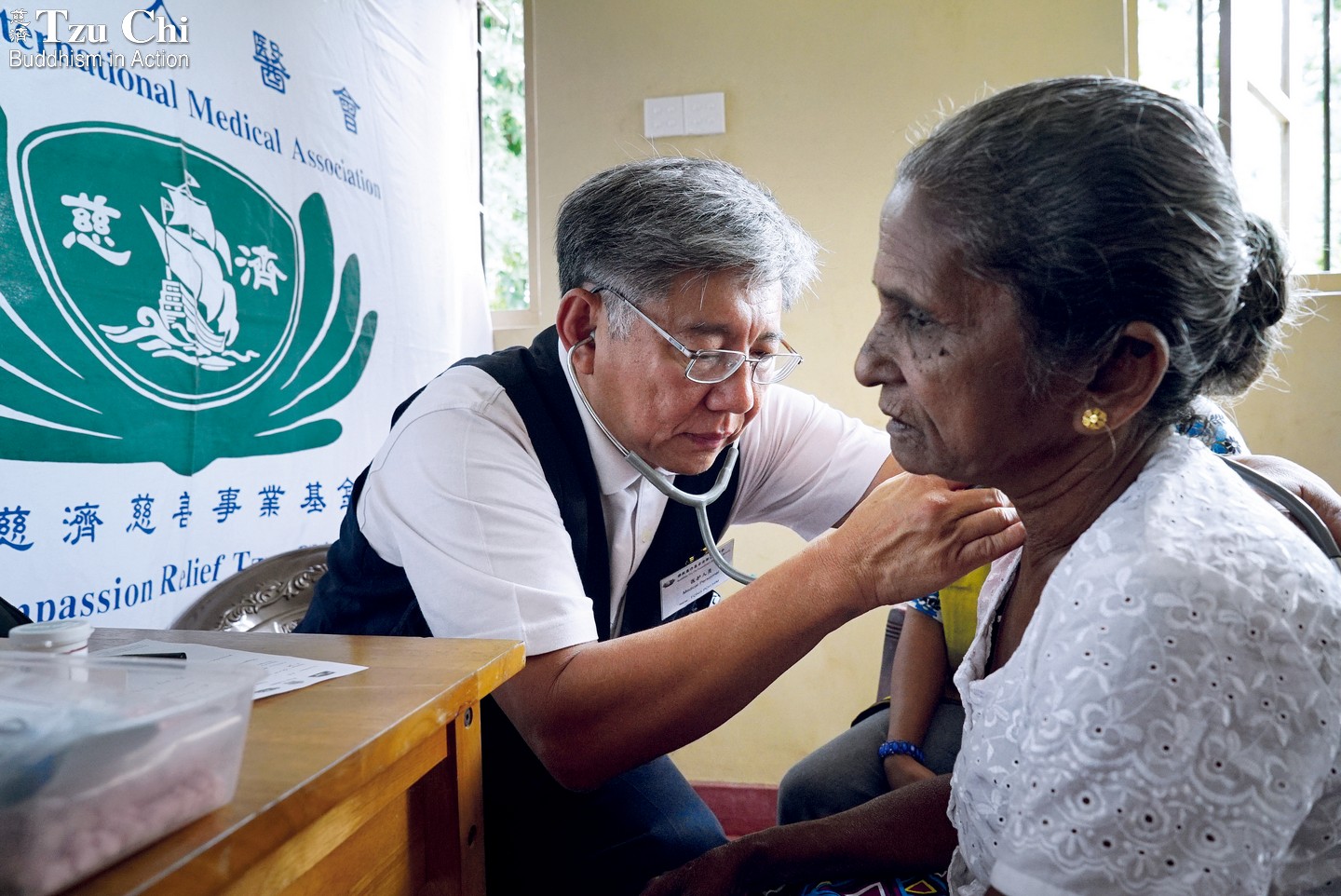
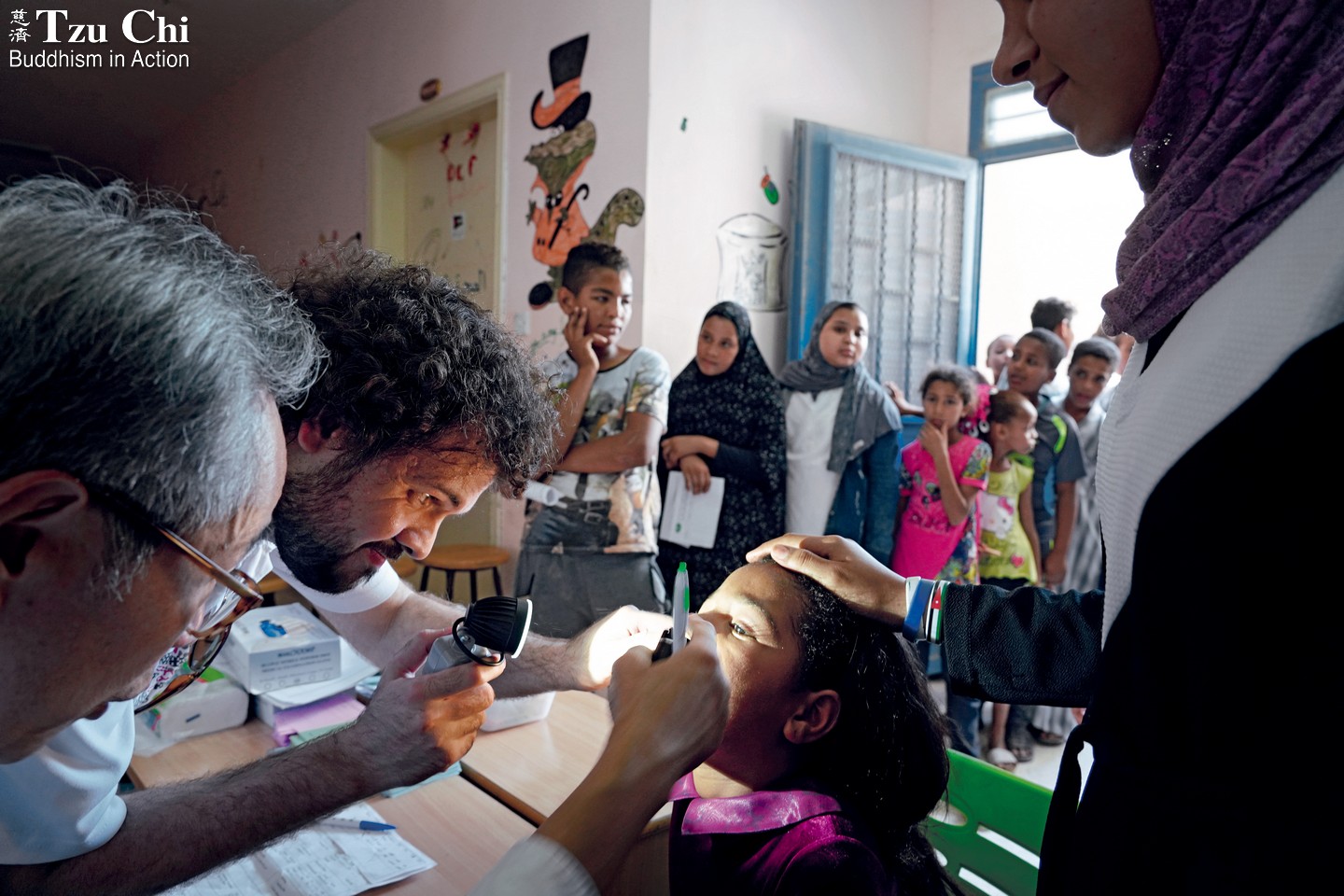
A doctor from the Singapore chapter of TIMA sees a patient during a free clinic event in Colombo, Sri Lanka. Hsiao Yiu-hwa

Dapu Township, located in the mountainous region of Chiayi County in southern Taiwan, lies within the catchment area of the Zengwen Reservoir. The reservoir’s construction significantly affected local agriculture, prompting many young residents to leave in search of better opportunities. As a result, the township was for many years unable to support a medical institution.

To help meet the needs of this underserved community, the Tzu Chi International Medical Association (TIMA) provided free clinics in the area for a decade. Healthcare professionals and support volunteers visited each month to offer care but could not stay long-term. That changed in 2002, when Dalin Tzu Chi Hospital, which opened in 2000, began participating in two government healthcare programs and stationing doctors in the area. Finally, this enabled local residents to gain easier access to essential medical care.

Dr. Lin Ying-lung (林英龍), a specialist in family medicine, is the current resident physician and head of the emergency room at the medical station in Dapu. Over the past eight years, he has averaged only two days off per month. He’s treated everything from bee stings and snakebites to traffic accidents, work-related injuries, and heart attacks. In addition to Dr. Lin’s work, specialists from Dalin Tzu Chi Hospital visit on a rotating basis to offer additional support in fields including rheumatology, cardiology, dermatology, and dentistry.

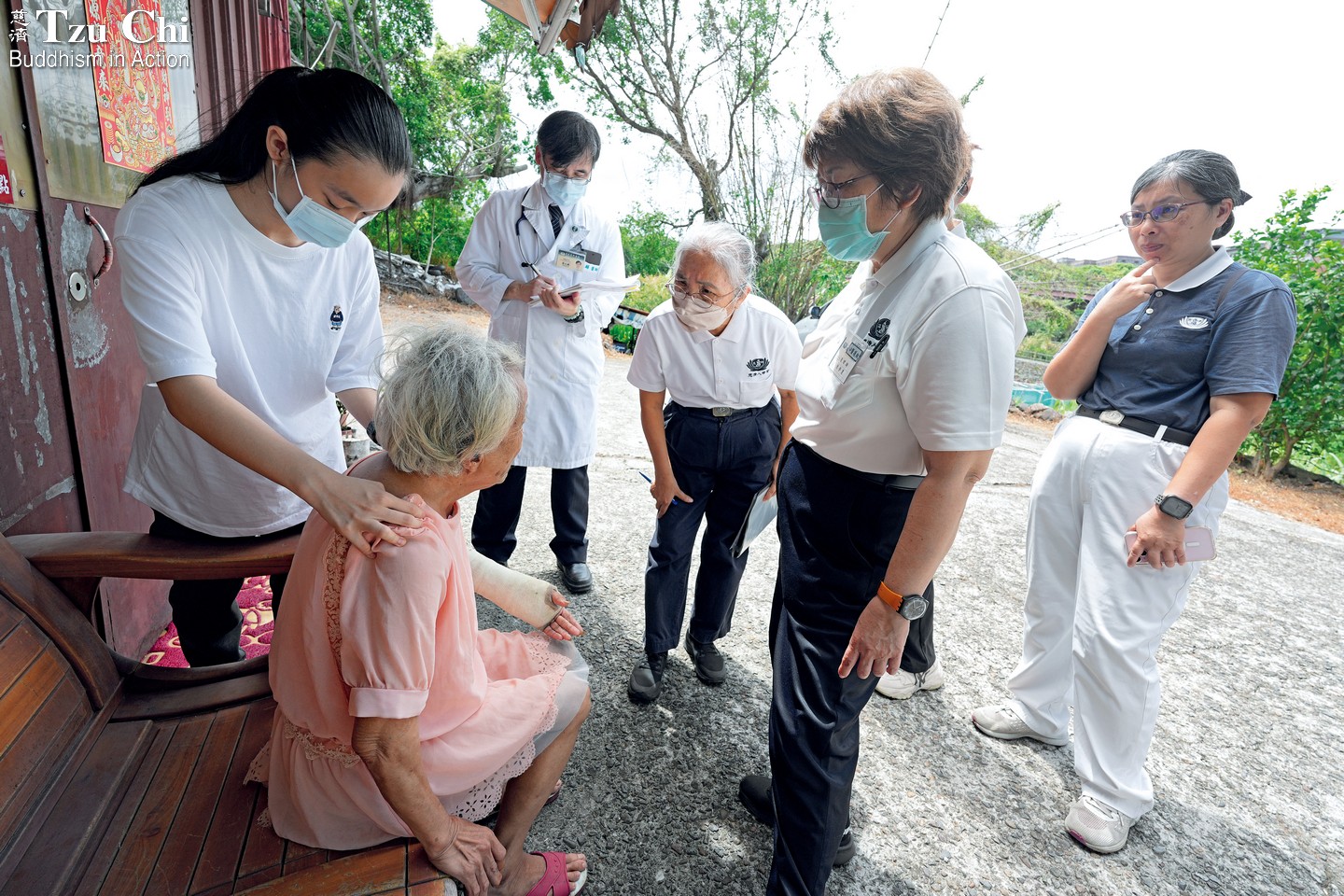
The healthcare team also makes home visits. “We’ve established a strong network with home care workers to identify patients who can’t come to us. For these, we go to them to provide care for them in their homes,” said Dr. Yeh Ming-hsien (葉明憲), a traditional Chinese medicine practitioner from Dalin Tzu Chi Hospital. He serves at the station every Wednesday, and for the past 22 years, has personally visited bedridden or housebound patients after completing his duties at the station.

Thanks to the team’s efforts, many elderly residents have shown significant health improvements. Stroke patients who were once bedridden can now stand, and individuals with dementia have regained speech and mobility, some even able to tell stories. In addition to providing 24-hour medical coverage for Dapu residents, Dalin Tzu Chi Hospital also offers mobile medical services in Meishan Township and Zhuqi Township in Chiayi County, as well as Gukeng Township in Yunlin County.

TIMA members in northern Taiwan regularly visit rural areas such as Sanzhi, Shuangxi, Ruifang, and Pingxi in New Taipei City to care for the health of elderly residents, forming bonds like those of old friends. Li Zheng-ming

Serving underserved migrant workers

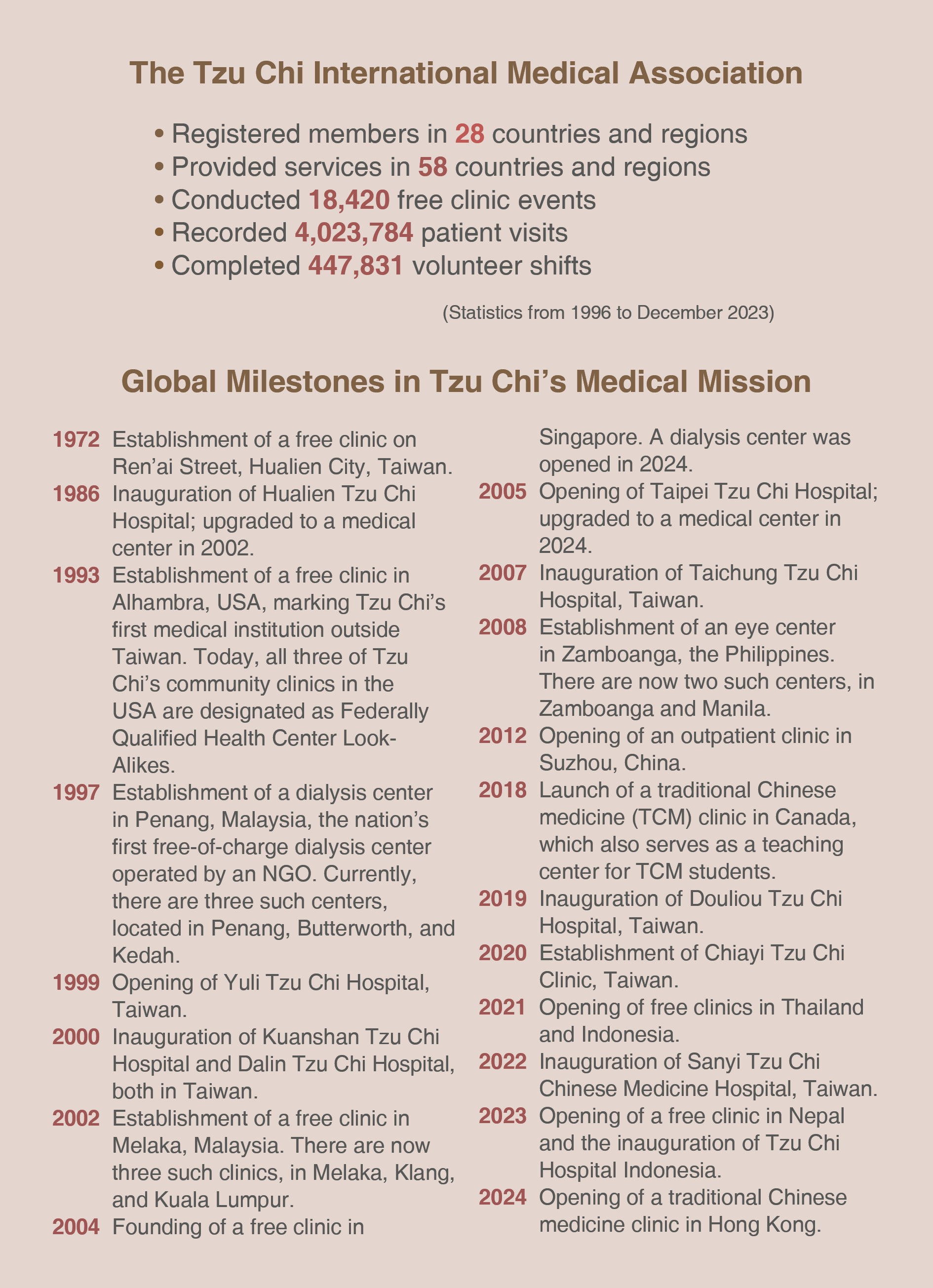
Dharma Master Cheng Yen recognized a link between poverty and illness as early as 1966, the year Tzu Chi was founded in Hualien, eastern Taiwan. Illness often drives families into poverty, while the impoverished are more likely to develop serious health conditions due to their inability to afford treatment for common ailments. In response, the Master established a free clinic on Ren’ai Street in Hualien City in 1972. In addition to on-site services, medical professionals conducted home visits in rural areas in Hualien and neighboring Taitung. Recognizing the need for a modern, well-equipped hospital in remote eastern Taiwan, Master Cheng Yen established Hualien Tzu Chi Hospital in 1986.

Currently in Taiwan, Tzu Chi operates two medical centers, two regional hospitals, four medium-sized or small hospitals, and a clinic. Furthermore, more than 2,700 TIMA doctors, nurses, pharmacists, and support volunteers provide free services to those in need. In rural areas where elderly residents have difficulties accessing healthcare, TIMA volunteers make home visits to deliver care. These mobile services reach not only remote villages and mountainous regions but also underserved groups in urban areas.

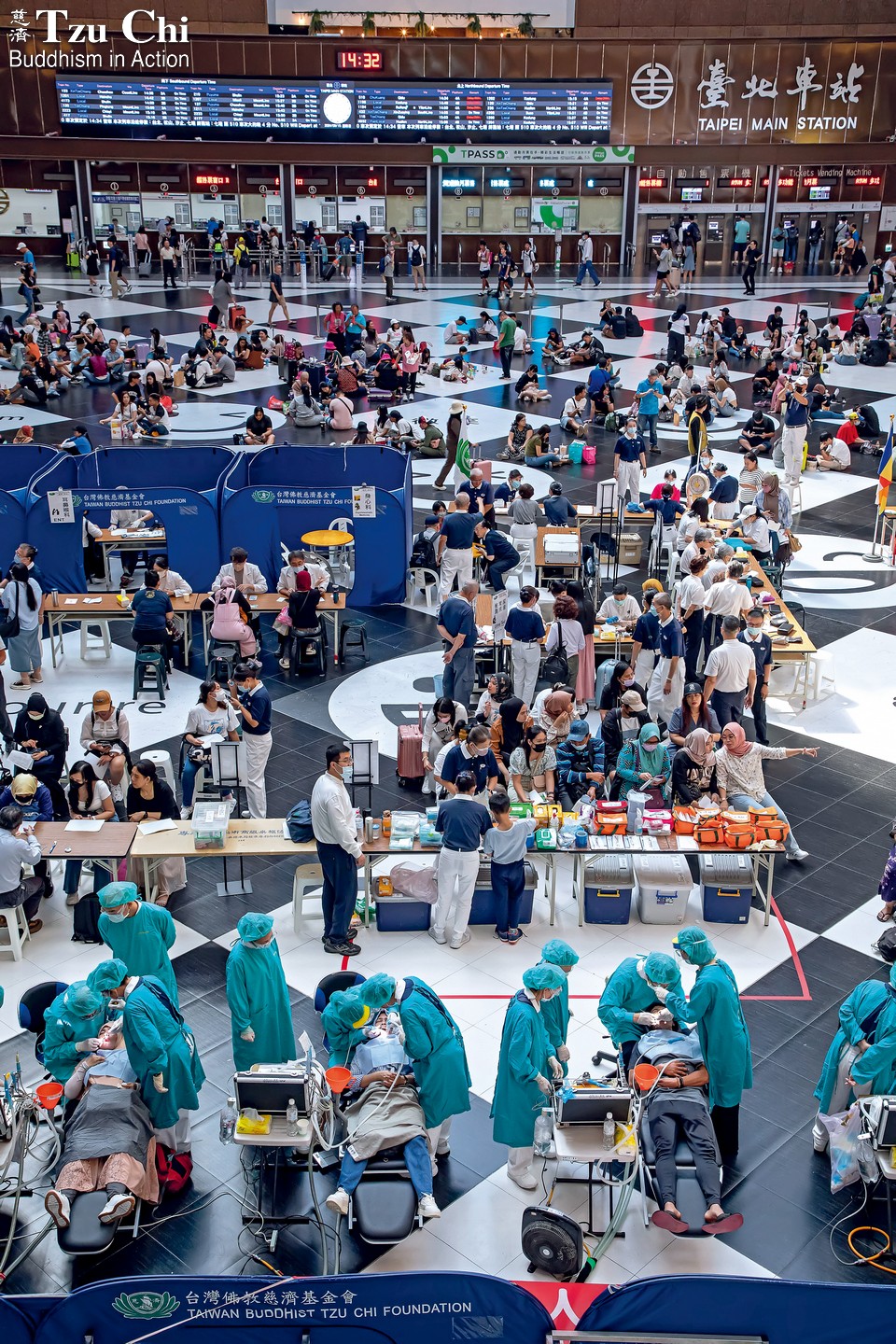
TIMA members in northern Taiwan have partnered with the Taipei City Government for 20 years to provide medical services to foreign migrant workers. Held at Taipei Main Station—a popular gathering spot for migrant workers—these free clinic events offer consultations in specialties such as mental health, internal medicine, dentistry, ophthalmology, orthopedics, gynecology, and traditional Chinese medicine. Medications are dispensed through partner clinics using National Health Insurance cards. Although procedures like blood draws and injections are not performed on-site, the services that are offered provide vital support to migrant workers.

“How old is the grandpa you care for?” asked a clinical psychologist at one such free clinic. “Eighty years old,” replied a migrant worker. “You mentioned having trouble sleeping. Do you feel dizzy? How many hours do you sleep at night?” the psychologist continued. “Four hours,” the worker answered. Despite the bustling atmosphere at Taipei Main Station on Sundays, these exchanges carried on undisturbed.

Tzu Chi volunteer Yan Mei-ling (顏渼姈) is the contact person for the free clinic, currently held about three times a year. She explained that most migrant workers they serve come from Indonesia and work as home caregivers for elderly individuals needing substantial assistance. Such demanding work often leads to physical strain and disrupted sleep patterns. Since many hospitals and clinics are closed on Sundays, the usual day off for most migrant workers, it can be hard for them to get the medical care they need. To meet their needs, TIMA specifically chose Sundays to offer services.

Other than serving remote areas, islands, and migrant workers and the homeless in urban areas, TIMA volunteers and Tzu Chi medical personnel in Taiwan also visit facilities to provide care for other vulnerable groups, such as patients in a vegetative state or those with paralysis, alleviating their suffering and easing the minds of their families.

Gaps in SDG 3

“Ensuring healthy lives and promoting well-being for all at all ages” is the third Sustainable Development Goal of the United Nations. The aim of the goal is to significantly reduce maternal, infant, and under-five child mortality rates by 2030. It also seeks to achieve universal health coverage, including financial risk protection; ensuring access to essential healthcare services; and making safe, effective, high-quality, and affordable medicines and vaccines available to all. Although Taiwan has nearly achieved these targets, significant gaps remain in healthcare access in many other parts of the world.

According to the World Health Organization and the World Bank, out-of-pocket medical expenses have pushed hundreds of millions of people worldwide into extreme poverty. Furthermore, fewer than ten percent of the global population has access to medical services on par with those offered by teaching hospitals. In developing countries across Southeast Asia, Africa, and Latin America, many destitute individuals struggle to obtain even basic clinic services, let alone hospitalization for advanced care.

In countries without well-established healthcare systems, Tzu Chi’s medical mission addresses far greater needs. In areas where access to essential medical care is limited, even a simple surgical procedure can profoundly impact the fate of an entire family.

At the Tzu Chi Eye Center in Manila, the Philippines, patients with eye diseases begin arriving early in the morning from various regions. Often guided by family members due to impaired vision, they come seeking examinations and treatment. One such patient was Kevin Andrade. Blind for over three years due to cataracts, he had been unable to afford treatment. At one point, despair had overwhelmed him to the extent that he attempted to take his own life, but one of his children intervened and saved him just in time. Now he anxiously waited in the recovery area, recovering after cataract surgery at the eye center.

“Do you see this?” Dr. Catherina Coronel-Nasol asked Kevin after his surgery, holding out a finger. Kevin replied dejectedly, “No.” But after resting for three hours, he suddenly stood up and walked to and from the toilet on his own—moving as though his vision were completely normal. Everyone was surprised and overjoyed. Although only the vision in his right eye had been restored, it filled him with hope as he eagerly looked forward to returning to work to support his family.

The Tzu Chi Eye Center, offering free, critical eye care to those in need, recorded 20,000 patient visits in 2023 alone. Similarly, a prosthetics center in Zamboanga City, southern Philippines, provides free, customized prosthetics to people with disabilities, addressing another essential aspect of medical care for underserved populations.

These services are just one facet of Tzu Chi’s nearly three decades of medical work in the Philippines. With over 7,000 islands, the country faces significant wealth inequality and transportation barriers. Many impoverished residents in remote areas live their entire lives without ever visiting a hospital. To bring healthcare to these underserved communities, Tzu Chi volunteers established medical outreach teams in the Philippines in 1995.

Dr. Josefino Qua (柯賢智), a senior member of TIMA Philippines, reflected on those early days: “We started with nothing.” Their first anesthesia machine was a second-hand unit phased out by the U.S. military; lacking specialized surgical lamps, they improvised with regular light bulbs; and surgeries were performed in school libraries or offices, with desks serving as makeshift operating tables. Despite these limitations, the volunteers were driven by a deep passion to help others.

“The number of nurses and other volunteers participating grew with each event,” Dr. Qua said. “Even though there was no financial compensation or recognition, everyone stayed committed. While much has changed over the years, the one constant has been love.”

TIMA Philippines now conducts three to four large-scale free clinics in the country annually. Over nearly 30 years, volunteers have held more than 260 such events, recording over 300,000 patient visits.

In addition to the Philippines, Tzu Chi has been organizing free clinics in Indonesia, Malaysia, and Singapore for many years, with teams often crossing borders to provide assistance. For example, in August 2024, volunteers from Singapore teamed up with medical professionals and support volunteers from Sri Lanka to host a free clinic in Sri Lanka’s Kalutara District. The event brought together 352 healthcare workers and other volunteers. While doctor visits are free in Sri Lanka, patients are required to pay out-of-pocket for medications. In recent years, the cost of medicine has doubled, placing a significant financial burden on low-income residents.

This free clinic, offering services in traditional Chinese medicine, dentistry, ophthalmology, and internal medicine, was held at Katugahahena Divisional Hospital, a public facility staffed by only four doctors and lacking both ophthalmology and dentistry specialties. A root canal procedure at a private hospital costs 40,000 Sri Lankan rupees (US$135), making it unaffordable for many. Consequently, although the free clinic officially began at 8:30 a.m., some local people arrived as early as 3 a.m. to secure their place. Over the course of two and a half days, the clinic provided care for 4,600 patient visits.

Tzu Chi’s medical efforts worldwide have not only brought relief to patients but also sparked a passion for service among healthcare professionals. For instance, Dr. Ruzbih Bahtiar, a TIMA volunteer in Indonesia, found the experience of serving patients in a free clinic profoundly fulfilling. When patients expressed their gratitude, he humbly remarked that he was the one who had benefited more. “Fulfilling others’ needs is an incredibly rewarding experience,” he said.

Tzu Chi has held free clinics for foreign migrant workers at Taipei Main Station for 20 years. Jiang Bao-qing

Serving people in affluent countries

It is not surprising that less-developed regions in Southeast Asia, Latin America, and Africa require humanitarian medical aid. But why would a nation like the United States—renowned for its world-class medical standards and high per capita income—still have a substantial need for free clinics?

“The issue lies with insurance and legal status,” explained Dr. Lin Chin-lon (林俊龍), CEO of the Tzu Chi medical mission and convener of TIMA. He is a former superintendent of the Northridge Hospital Medical Center in Los Angeles, and he pointed out that while most U.S. citizens have basic health insurance, undocumented immigrants lack coverage and are often left helpless in the face of medical emergencies. Job loss and subsequent poverty can also render insurance premiums unaffordable, leaving individuals vulnerable. “For people without insurance, even a simple appendectomy can lead to bankruptcy,” he lamented.

To address gaps in healthcare access for underserved communities, Tzu Chi USA opened its first permanent clinic in Alhambra, California, in November 1993, offering free medical services to those in need. Initially providing treatment in internal medicine, dentistry, and traditional Chinese medicine, the clinic gradually expanded its healthcare specialties and even installed showers to serve homeless patients. In 2005, the clinic transitioned into a community health center, offering paid healthcare to the general public while continuing to provide free services to underprivileged populations. Its commitment to supporting the less fortunate remains unchanged.

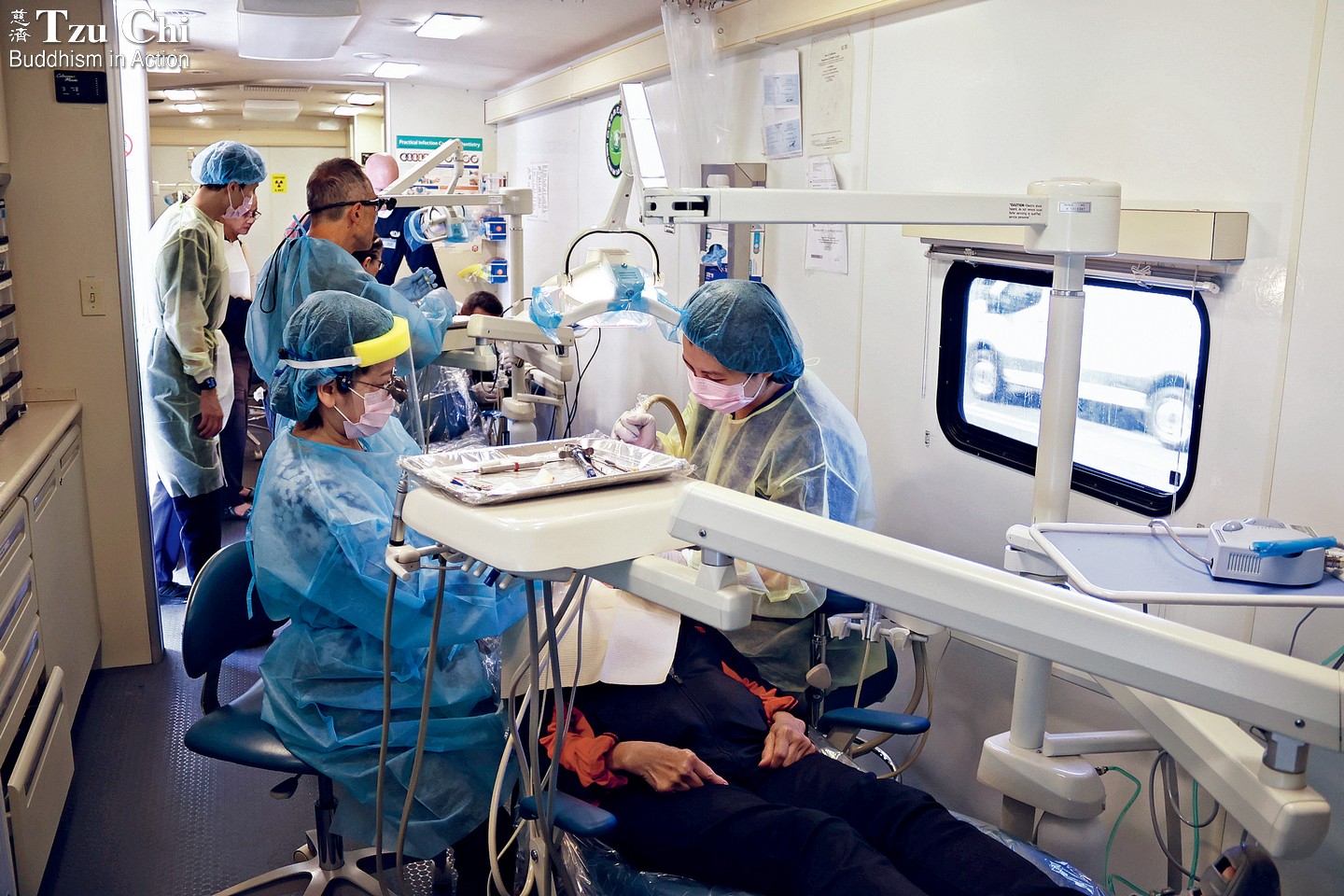
To tackle the vast geographic challenges of the United States, Tzu Chi USA has also launched 12 mobile medical units. These specially equipped vehicles travel to underserved communities, offering on-site services such as vision exams and dental care.

“We can complete a vision test and fit someone for glasses within an hour,” said Dr. Kenneth Liao (廖敬興), a dentist and senior volunteer with TIMA USA. “This is practically unheard of in New York and has a profound impact on students from low-income families.” He explained that many underprivileged students are unaware they have vision problems. Unable to see the whiteboard clearly, these students may struggle academically. By providing eye exams and glasses, TIMA volunteers help these students see clearly and stay focused during their lessons. “Their grades can improve significantly—from a C to an A,” he said with a smile.

Today, TIMA chapters operate in 24 locations across the United States. Volunteers also serve communities abroad through free clinic events in countries such as Mexico, Haiti, the Dominican Republic, Ecuador, and Bolivia.

Globally, TIMA has members in 28 countries and regions. More than 15,000 doctors, nurses, medical technicians, pharmacists, and administrative volunteers work together to provide free medical services to disadvantaged patients. TIMA volunteers also respond to major international disasters by actively participating in relief efforts. By the end of 2023, TIMA had delivered care in 58 countries and regions, with over four million instances of medical aid provided.

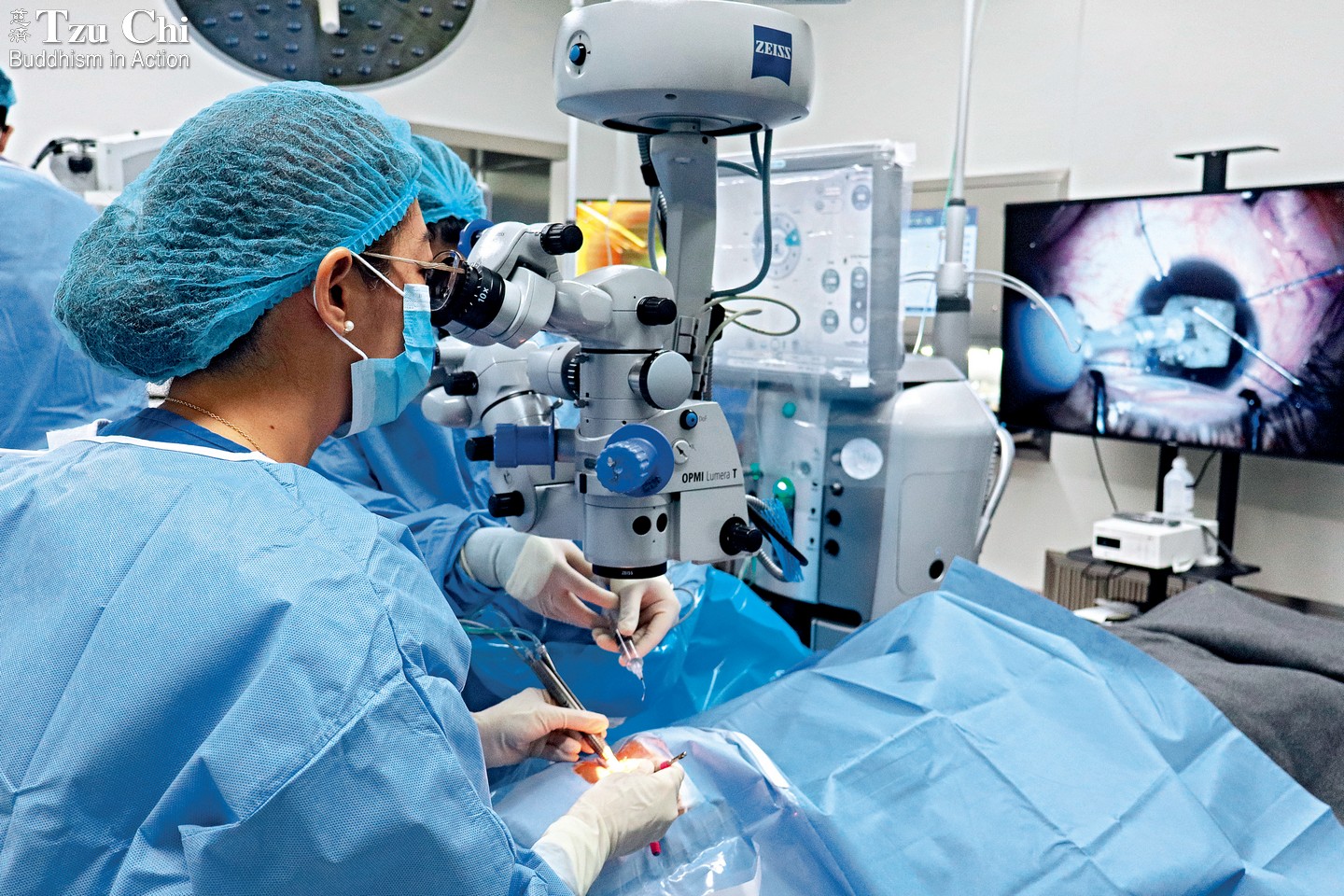
The Tzu Chi Eye Center in Manila, the Philippines, provides free treatment to underprivileged patients. In 2023, the center conducted nearly 3,000 surgeries, as shown in photo 1. Photo 2 shows Medical Director Dr. Bernardita Navarro visiting patient Kevin Andrade at his home. Jamaica Mae Digo

Harnessing technology

As the landscape of global healthcare evolves, Tzu Chi continues to adapt its approach to delivering care. Healthcare professionals in the 21st century are witnessing revolutionary advancements that are transforming the field. Dr. Wang Pen-jung (王本榮), former dean of the College of Medicine at Tzu Chi University and current CEO of Tzu Chi’s educational mission, highlighted the growing role of artificial intelligence (AI) in healthcare. “AI-assisted diagnostic imaging will inevitably surpass human doctors in accuracy,” he stated. “It can help address disparities in healthcare resources and resolve supply-demand imbalances. When integrated into telemedicine, its reach becomes virtually limitless, enabling care for underserved populations in remote areas. Whether it’s precision medicine, personalized healthcare, or digital therapies, AI will be a powerful tool for us.”

That said, while embracing cutting-edge technologies, it is essential to maintain a human-centered approach to care—addressing both the physical and emotional needs of patients. Striking this balance is key to truly advancing health and well-being for all.

Dr. Wang emphasized three guiding principles for healthcare providers: “First, cure—possessing the professional expertise to diagnose illnesses and safeguard life; second, care—attending to the needs of patients; and most importantly, comfort—soothing the suffering of those in pain.” He explained that these “three Cs” capture the essence of healthcare and reflect the core values that Master Cheng Yen has always advocated: healthcare must remain human-centered, dedicated to protecting life, safeguarding health, and nurturing love. These principles continue to guide Tzu Chi’s healthcare workers and volunteers as they strive to provide compassionate, life-changing care.

In Jordan, Tzu Chi volunteers have long provided assistance to those in need, including Syrian refugees. Volunteers from Taiwan have made multiple trips to the country to offer support. In 2019, a dental clinic was held in Ghawr as-Safi, where men, women, and children patiently waited for treatment despite the heat. Hsiao Yiu-hwa

Low-income individuals and those without health insurance receive dental care aboard a mobile dental unit in Oakland, USA. Lu Wan-jie

By Yeh Tzu-hao
Translated by Wu Hsiao-ting

“Ensuring healthy lives and promoting well-being for all at all ages” is the focus of the United Nations’ Sustainable Development Goal 3. This vision has also guided Tzu Chi’s medical efforts over the past five decades, benefiting communities worldwide.

A doctor from the Singapore chapter of TIMA sees a patient during a free clinic event in Colombo, Sri Lanka. Hsiao Yiu-hwa

Dapu Township, located in the mountainous region of Chiayi County in southern Taiwan, lies within the catchment area of the Zengwen Reservoir. The reservoir’s construction significantly affected local agriculture, prompting many young residents to leave in search of better opportunities. As a result, the township was for many years unable to support a medical institution.

To help meet the needs of this underserved community, the Tzu Chi International Medical Association (TIMA) provided free clinics in the area for a decade. Healthcare professionals and support volunteers visited each month to offer care but could not stay long-term. That changed in 2002, when Dalin Tzu Chi Hospital, which opened in 2000, began participating in two government healthcare programs and stationing doctors in the area. Finally, this enabled local residents to gain easier access to essential medical care.

Dr. Lin Ying-lung (林英龍), a specialist in family medicine, is the current resident physician and head of the emergency room at the medical station in Dapu. Over the past eight years, he has averaged only two days off per month. He’s treated everything from bee stings and snakebites to traffic accidents, work-related injuries, and heart attacks. In addition to Dr. Lin’s work, specialists from Dalin Tzu Chi Hospital visit on a rotating basis to offer additional support in fields including rheumatology, cardiology, dermatology, and dentistry.

The healthcare team also makes home visits. “We’ve established a strong network with home care workers to identify patients who can’t come to us. For these, we go to them to provide care for them in their homes,” said Dr. Yeh Ming-hsien (葉明憲), a traditional Chinese medicine practitioner from Dalin Tzu Chi Hospital. He serves at the station every Wednesday, and for the past 22 years, has personally visited bedridden or housebound patients after completing his duties at the station.

Thanks to the team’s efforts, many elderly residents have shown significant health improvements. Stroke patients who were once bedridden can now stand, and individuals with dementia have regained speech and mobility, some even able to tell stories. In addition to providing 24-hour medical coverage for Dapu residents, Dalin Tzu Chi Hospital also offers mobile medical services in Meishan Township and Zhuqi Township in Chiayi County, as well as Gukeng Township in Yunlin County.

TIMA members in northern Taiwan regularly visit rural areas such as Sanzhi, Shuangxi, Ruifang, and Pingxi in New Taipei City to care for the health of elderly residents, forming bonds like those of old friends. Li Zheng-ming

Serving underserved migrant workers

Dharma Master Cheng Yen recognized a link between poverty and illness as early as 1966, the year Tzu Chi was founded in Hualien, eastern Taiwan. Illness often drives families into poverty, while the impoverished are more likely to develop serious health conditions due to their inability to afford treatment for common ailments. In response, the Master established a free clinic on Ren’ai Street in Hualien City in 1972. In addition to on-site services, medical professionals conducted home visits in rural areas in Hualien and neighboring Taitung. Recognizing the need for a modern, well-equipped hospital in remote eastern Taiwan, Master Cheng Yen established Hualien Tzu Chi Hospital in 1986.

Currently in Taiwan, Tzu Chi operates two medical centers, two regional hospitals, four medium-sized or small hospitals, and a clinic. Furthermore, more than 2,700 TIMA doctors, nurses, pharmacists, and support volunteers provide free services to those in need. In rural areas where elderly residents have difficulties accessing healthcare, TIMA volunteers make home visits to deliver care. These mobile services reach not only remote villages and mountainous regions but also underserved groups in urban areas.

TIMA members in northern Taiwan have partnered with the Taipei City Government for 20 years to provide medical services to foreign migrant workers. Held at Taipei Main Station—a popular gathering spot for migrant workers—these free clinic events offer consultations in specialties such as mental health, internal medicine, dentistry, ophthalmology, orthopedics, gynecology, and traditional Chinese medicine. Medications are dispensed through partner clinics using National Health Insurance cards. Although procedures like blood draws and injections are not performed on-site, the services that are offered provide vital support to migrant workers.

“How old is the grandpa you care for?” asked a clinical psychologist at one such free clinic. “Eighty years old,” replied a migrant worker. “You mentioned having trouble sleeping. Do you feel dizzy? How many hours do you sleep at night?” the psychologist continued. “Four hours,” the worker answered. Despite the bustling atmosphere at Taipei Main Station on Sundays, these exchanges carried on undisturbed.

Tzu Chi volunteer Yan Mei-ling (顏渼姈) is the contact person for the free clinic, currently held about three times a year. She explained that most migrant workers they serve come from Indonesia and work as home caregivers for elderly individuals needing substantial assistance. Such demanding work often leads to physical strain and disrupted sleep patterns. Since many hospitals and clinics are closed on Sundays, the usual day off for most migrant workers, it can be hard for them to get the medical care they need. To meet their needs, TIMA specifically chose Sundays to offer services.

Other than serving remote areas, islands, and migrant workers and the homeless in urban areas, TIMA volunteers and Tzu Chi medical personnel in Taiwan also visit facilities to provide care for other vulnerable groups, such as patients in a vegetative state or those with paralysis, alleviating their suffering and easing the minds of their families.

Gaps in SDG 3

“Ensuring healthy lives and promoting well-being for all at all ages” is the third Sustainable Development Goal of the United Nations. The aim of the goal is to significantly reduce maternal, infant, and under-five child mortality rates by 2030. It also seeks to achieve universal health coverage, including financial risk protection; ensuring access to essential healthcare services; and making safe, effective, high-quality, and affordable medicines and vaccines available to all. Although Taiwan has nearly achieved these targets, significant gaps remain in healthcare access in many other parts of the world.

According to the World Health Organization and the World Bank, out-of-pocket medical expenses have pushed hundreds of millions of people worldwide into extreme poverty. Furthermore, fewer than ten percent of the global population has access to medical services on par with those offered by teaching hospitals. In developing countries across Southeast Asia, Africa, and Latin America, many destitute individuals struggle to obtain even basic clinic services, let alone hospitalization for advanced care.

In countries without well-established healthcare systems, Tzu Chi’s medical mission addresses far greater needs. In areas where access to essential medical care is limited, even a simple surgical procedure can profoundly impact the fate of an entire family.

At the Tzu Chi Eye Center in Manila, the Philippines, patients with eye diseases begin arriving early in the morning from various regions. Often guided by family members due to impaired vision, they come seeking examinations and treatment. One such patient was Kevin Andrade. Blind for over three years due to cataracts, he had been unable to afford treatment. At one point, despair had overwhelmed him to the extent that he attempted to take his own life, but one of his children intervened and saved him just in time. Now he anxiously waited in the recovery area, recovering after cataract surgery at the eye center.

“Do you see this?” Dr. Catherina Coronel-Nasol asked Kevin after his surgery, holding out a finger. Kevin replied dejectedly, “No.” But after resting for three hours, he suddenly stood up and walked to and from the toilet on his own—moving as though his vision were completely normal. Everyone was surprised and overjoyed. Although only the vision in his right eye had been restored, it filled him with hope as he eagerly looked forward to returning to work to support his family.

The Tzu Chi Eye Center, offering free, critical eye care to those in need, recorded 20,000 patient visits in 2023 alone. Similarly, a prosthetics center in Zamboanga City, southern Philippines, provides free, customized prosthetics to people with disabilities, addressing another essential aspect of medical care for underserved populations.

These services are just one facet of Tzu Chi’s nearly three decades of medical work in the Philippines. With over 7,000 islands, the country faces significant wealth inequality and transportation barriers. Many impoverished residents in remote areas live their entire lives without ever visiting a hospital. To bring healthcare to these underserved communities, Tzu Chi volunteers established medical outreach teams in the Philippines in 1995.

Dr. Josefino Qua (柯賢智), a senior member of TIMA Philippines, reflected on those early days: “We started with nothing.” Their first anesthesia machine was a second-hand unit phased out by the U.S. military; lacking specialized surgical lamps, they improvised with regular light bulbs; and surgeries were performed in school libraries or offices, with desks serving as makeshift operating tables. Despite these limitations, the volunteers were driven by a deep passion to help others.

“The number of nurses and other volunteers participating grew with each event,” Dr. Qua said. “Even though there was no financial compensation or recognition, everyone stayed committed. While much has changed over the years, the one constant has been love.”

TIMA Philippines now conducts three to four large-scale free clinics in the country annually. Over nearly 30 years, volunteers have held more than 260 such events, recording over 300,000 patient visits.

In addition to the Philippines, Tzu Chi has been organizing free clinics in Indonesia, Malaysia, and Singapore for many years, with teams often crossing borders to provide assistance. For example, in August 2024, volunteers from Singapore teamed up with medical professionals and support volunteers from Sri Lanka to host a free clinic in Sri Lanka’s Kalutara District. The event brought together 352 healthcare workers and other volunteers. While doctor visits are free in Sri Lanka, patients are required to pay out-of-pocket for medications. In recent years, the cost of medicine has doubled, placing a significant financial burden on low-income residents.

This free clinic, offering services in traditional Chinese medicine, dentistry, ophthalmology, and internal medicine, was held at Katugahahena Divisional Hospital, a public facility staffed by only four doctors and lacking both ophthalmology and dentistry specialties. A root canal procedure at a private hospital costs 40,000 Sri Lankan rupees (US$135), making it unaffordable for many. Consequently, although the free clinic officially began at 8:30 a.m., some local people arrived as early as 3 a.m. to secure their place. Over the course of two and a half days, the clinic provided care for 4,600 patient visits.

Tzu Chi’s medical efforts worldwide have not only brought relief to patients but also sparked a passion for service among healthcare professionals. For instance, Dr. Ruzbih Bahtiar, a TIMA volunteer in Indonesia, found the experience of serving patients in a free clinic profoundly fulfilling. When patients expressed their gratitude, he humbly remarked that he was the one who had benefited more. “Fulfilling others’ needs is an incredibly rewarding experience,” he said.

Tzu Chi has held free clinics for foreign migrant workers at Taipei Main Station for 20 years. Jiang Bao-qing

Serving people in affluent countries

It is not surprising that less-developed regions in Southeast Asia, Latin America, and Africa require humanitarian medical aid. But why would a nation like the United States—renowned for its world-class medical standards and high per capita income—still have a substantial need for free clinics?

“The issue lies with insurance and legal status,” explained Dr. Lin Chin-lon (林俊龍), CEO of the Tzu Chi medical mission and convener of TIMA. He is a former superintendent of the Northridge Hospital Medical Center in Los Angeles, and he pointed out that while most U.S. citizens have basic health insurance, undocumented immigrants lack coverage and are often left helpless in the face of medical emergencies. Job loss and subsequent poverty can also render insurance premiums unaffordable, leaving individuals vulnerable. “For people without insurance, even a simple appendectomy can lead to bankruptcy,” he lamented.

To address gaps in healthcare access for underserved communities, Tzu Chi USA opened its first permanent clinic in Alhambra, California, in November 1993, offering free medical services to those in need. Initially providing treatment in internal medicine, dentistry, and traditional Chinese medicine, the clinic gradually expanded its healthcare specialties and even installed showers to serve homeless patients. In 2005, the clinic transitioned into a community health center, offering paid healthcare to the general public while continuing to provide free services to underprivileged populations. Its commitment to supporting the less fortunate remains unchanged.

To tackle the vast geographic challenges of the United States, Tzu Chi USA has also launched 12 mobile medical units. These specially equipped vehicles travel to underserved communities, offering on-site services such as vision exams and dental care.

“We can complete a vision test and fit someone for glasses within an hour,” said Dr. Kenneth Liao (廖敬興), a dentist and senior volunteer with TIMA USA. “This is practically unheard of in New York and has a profound impact on students from low-income families.” He explained that many underprivileged students are unaware they have vision problems. Unable to see the whiteboard clearly, these students may struggle academically. By providing eye exams and glasses, TIMA volunteers help these students see clearly and stay focused during their lessons. “Their grades can improve significantly—from a C to an A,” he said with a smile.

Today, TIMA chapters operate in 24 locations across the United States. Volunteers also serve communities abroad through free clinic events in countries such as Mexico, Haiti, the Dominican Republic, Ecuador, and Bolivia.

Globally, TIMA has members in 28 countries and regions. More than 15,000 doctors, nurses, medical technicians, pharmacists, and administrative volunteers work together to provide free medical services to disadvantaged patients. TIMA volunteers also respond to major international disasters by actively participating in relief efforts. By the end of 2023, TIMA had delivered care in 58 countries and regions, with over four million instances of medical aid provided.

The Tzu Chi Eye Center in Manila, the Philippines, provides free treatment to underprivileged patients. In 2023, the center conducted nearly 3,000 surgeries, as shown in photo 1. Photo 2 shows Medical Director Dr. Bernardita Navarro visiting patient Kevin Andrade at his home. Jamaica Mae Digo

Harnessing technology

As the landscape of global healthcare evolves, Tzu Chi continues to adapt its approach to delivering care. Healthcare professionals in the 21st century are witnessing revolutionary advancements that are transforming the field. Dr. Wang Pen-jung (王本榮), former dean of the College of Medicine at Tzu Chi University and current CEO of Tzu Chi’s educational mission, highlighted the growing role of artificial intelligence (AI) in healthcare. “AI-assisted diagnostic imaging will inevitably surpass human doctors in accuracy,” he stated. “It can help address disparities in healthcare resources and resolve supply-demand imbalances. When integrated into telemedicine, its reach becomes virtually limitless, enabling care for underserved populations in remote areas. Whether it’s precision medicine, personalized healthcare, or digital therapies, AI will be a powerful tool for us.”

That said, while embracing cutting-edge technologies, it is essential to maintain a human-centered approach to care—addressing both the physical and emotional needs of patients. Striking this balance is key to truly advancing health and well-being for all.

Dr. Wang emphasized three guiding principles for healthcare providers: “First, cure—possessing the professional expertise to diagnose illnesses and safeguard life; second, care—attending to the needs of patients; and most importantly, comfort—soothing the suffering of those in pain.” He explained that these “three Cs” capture the essence of healthcare and reflect the core values that Master Cheng Yen has always advocated: healthcare must remain human-centered, dedicated to protecting life, safeguarding health, and nurturing love. These principles continue to guide Tzu Chi’s healthcare workers and volunteers as they strive to provide compassionate, life-changing care.

In Jordan, Tzu Chi volunteers have long provided assistance to those in need, including Syrian refugees. Volunteers from Taiwan have made multiple trips to the country to offer support. In 2019, a dental clinic was held in Ghawr as-Safi, where men, women, and children patiently waited for treatment despite the heat. Hsiao Yiu-hwa

Low-income individuals and those without health insurance receive dental care aboard a mobile dental unit in Oakland, USA. Lu Wan-jie

關鍵字

敬虔に祈り、吉祥を呼び込む

福を造る因縁を大切にし、真心をもって助け合い、皆の敬虔な祈りを天に届けるのです。

私たちの心が一つになり、思いがすべて善であるなら、全てに幸運を呼び込むことができるのです。

新年早々、アメリカ・カリフォルニア州ロサンゼルス郡で山火事が発生し、被災地の空が真っ赤に染まった映像をニュースで見て、不安になりました。大火に強風が加わり、火が飛んでまた燃え上がり、近隣の居住地区に燃え移って広範囲の災難となり、まるで人間(じんかん)の火宅のようです。

家が全焼した被災者は親戚や友人に頼って、宿泊と生活は安定していても、火事場から急いで脱出したため、経済的に困難に直面しているかもしれません。今、私たちにできることは緊急援助であり、早く駆け付けて、被災者に、彼らにとって役に立つ、「実感が得られる」支援を与えるべきで、表面的なものであってはなりません。

慈済が行った最初の大規模な緊急災害支援を思い返してみると、それは、一九六九年に台湾台東県卑南郷大南村で発生した火災でした。中秋節の夜に台風エルシーが襲来した上、フェーン現象が起きて、村で発生した火災が大惨事になりました。一夜にして百軒以上の家屋が焼失し、七百人余りが家を無くしました。お見舞金の配付だけでなく、寒い冬がやってくるため、慈済は二萬元(十万円相当)の金額を費やして、当時台湾で最高な品質を誇る「台麗」ブランドの毛布を購入し、被災世帯に配付しました。それも、一世帯に一枚ではなく、家族構成に合わせて、二人に一枚を配付することにしました。愛と敬意の心を込めて、最高の物を贈り、私たちの気持ちを感じ取ってもらいました。

私はアメリカの今回の山火事に注目し、どうすれば助けられるかを真剣に考えました。人力と物資の投入以外に、皆の敬虔な祈りを諸仏や天に届けることで、人間(じんかん)の大愛を見てもらうのです。誰もが一緒に大善と大愛で奉仕し、今回の火災が一日も早く鎮火し、危機が安堵に変わることを願うのです。

多くの被災住民は、これまで裕福な暮らしをして来ましたが、一夜にして家も財産も失いました。これは正に仏法の言葉通り、財産は「五家共有する」であり、突然の災難で今まで持っていた全てを無くしてしまったのです。お金持ちであろうと貧しい人であろうと、お腹が空いて食べ物がない時、相手がお金持ちだからといって、ご飯をあげないでいられるでしょうか?緊急時に、飲み水や食事を適時に提供し、また寒い時に暖かい衣服や毛布を提供するのは、とても大事なことです。

㊟五家共有:「財産は、火災、洪水、戦争、強盗(詐欺)、親不孝の子によって無くなる」という仏教での教え。

慈済人は募金活動を開始しましたが、それは復興支援のためというだけでなく、最も重要なのは、皆の警戒心を高め、この世で相互扶助の精神を発揮するよう呼びかけていることです。これこそ私たちが福を造る因縁なのです。ですから、誰もがその機会を逃さないようにしましょう。とても困っている人がいる時、直ちに奉仕するのが、私たちの人生で最も貴い時だと言えます。また奉仕すると同時に、親戚や友人にも、より多くの力を発揮し、共に福田を耕すことを発心するよう、呼びかけましょう。

慈済は明朗な仏教団体であり、仏教精神は、宗教に関係なく、常に心を開き、衆生を抱擁します。慈済がアメリカに根を下ろして三十余年、さらに足場を固め、この因縁を逃さず、実力を発揮して効率良く支援を提供すべきです。誠意を以てこの国際的なプラットフォームに立ち、「仏教の為、衆生の為」という精神を千年百世へ延々と継続させるのです。未来の人間(じんかん)は災害から逃れられないため、災害支援の経験を代々受け継いでいかなければなりません。

今回の火災は、私たちが今学んでいる、大いなる教育なのです。山火事の範囲がとても広いため、誰もが心を静めて、敬虔に祈ることです。もし、複雑な先入観があれば、火災による災害よりもはるかに深刻な事態になるかもしれません。私たちは身で以て模範を示し、誠実な愛で敬虔さを表わさなければいけません。真心の愛とは、生きとし生けるものを慈しむことであり、衆生の命を守ることは、即ち自分の心を養い、自分の心を潤すことなのです。私たちの「心の宅」を、常に愛で潤すことができれば、心が乾くことはなく、小さな火が燃え盛ることはありません。

アメリカ慈済ボランティアの呉如真(ウー・ルーヅン)さんの家はこの火事で全焼しました。しかし、彼女は勇敢に現実に立ち向かい、心念を一転して、暫し自分の境遇を脇に置き、直ちに他人を助ける行動に出ました。なんと素晴らしい、私の良き弟子なのでしょう!このような模範的な法縁者がいるのですから、私たちは彼女の智慧をしっかり学ばなければなりません。

慈済人は人間(じんかん)菩薩であり、菩薩は苦難のあるところならどこでも現れます。人々が神頼みするところに現れるのではありません。私たちは、誰かが助けを求めるのを待っていてはならず、直ちに苦難を助けに行くのです。ここ数日、現地の慈済人は災害支援に尽力しています。皆さんの労を労いつつ、誰もが互いに励まし合い、皆が自信と気力と勇気を結集し、心から菩薩の愛を衆生に奉仕することを願っています。私たちが愛と善でこの道を切り開くことができれば、私たちの心は一つになり、心中に念ずるのは善だけとなって、幸運を呼び込むことができるのです。

今この時、私たちは世界の人々に、敬虔に祈り、敬虔に慎み深く発願し、菜食をするよう、呼びかけなければなりません。アメリカと世界の平和を祈って!

(慈済月刊六九九期より)

福を造る因縁を大切にし、真心をもって助け合い、皆の敬虔な祈りを天に届けるのです。

私たちの心が一つになり、思いがすべて善であるなら、全てに幸運を呼び込むことができるのです。

新年早々、アメリカ・カリフォルニア州ロサンゼルス郡で山火事が発生し、被災地の空が真っ赤に染まった映像をニュースで見て、不安になりました。大火に強風が加わり、火が飛んでまた燃え上がり、近隣の居住地区に燃え移って広範囲の災難となり、まるで人間(じんかん)の火宅のようです。

家が全焼した被災者は親戚や友人に頼って、宿泊と生活は安定していても、火事場から急いで脱出したため、経済的に困難に直面しているかもしれません。今、私たちにできることは緊急援助であり、早く駆け付けて、被災者に、彼らにとって役に立つ、「実感が得られる」支援を与えるべきで、表面的なものであってはなりません。

慈済が行った最初の大規模な緊急災害支援を思い返してみると、それは、一九六九年に台湾台東県卑南郷大南村で発生した火災でした。中秋節の夜に台風エルシーが襲来した上、フェーン現象が起きて、村で発生した火災が大惨事になりました。一夜にして百軒以上の家屋が焼失し、七百人余りが家を無くしました。お見舞金の配付だけでなく、寒い冬がやってくるため、慈済は二萬元(十万円相当)の金額を費やして、当時台湾で最高な品質を誇る「台麗」ブランドの毛布を購入し、被災世帯に配付しました。それも、一世帯に一枚ではなく、家族構成に合わせて、二人に一枚を配付することにしました。愛と敬意の心を込めて、最高の物を贈り、私たちの気持ちを感じ取ってもらいました。

私はアメリカの今回の山火事に注目し、どうすれば助けられるかを真剣に考えました。人力と物資の投入以外に、皆の敬虔な祈りを諸仏や天に届けることで、人間(じんかん)の大愛を見てもらうのです。誰もが一緒に大善と大愛で奉仕し、今回の火災が一日も早く鎮火し、危機が安堵に変わることを願うのです。

多くの被災住民は、これまで裕福な暮らしをして来ましたが、一夜にして家も財産も失いました。これは正に仏法の言葉通り、財産は「五家共有する」であり、突然の災難で今まで持っていた全てを無くしてしまったのです。お金持ちであろうと貧しい人であろうと、お腹が空いて食べ物がない時、相手がお金持ちだからといって、ご飯をあげないでいられるでしょうか?緊急時に、飲み水や食事を適時に提供し、また寒い時に暖かい衣服や毛布を提供するのは、とても大事なことです。

㊟五家共有:「財産は、火災、洪水、戦争、強盗(詐欺)、親不孝の子によって無くなる」という仏教での教え。

慈済人は募金活動を開始しましたが、それは復興支援のためというだけでなく、最も重要なのは、皆の警戒心を高め、この世で相互扶助の精神を発揮するよう呼びかけていることです。これこそ私たちが福を造る因縁なのです。ですから、誰もがその機会を逃さないようにしましょう。とても困っている人がいる時、直ちに奉仕するのが、私たちの人生で最も貴い時だと言えます。また奉仕すると同時に、親戚や友人にも、より多くの力を発揮し、共に福田を耕すことを発心するよう、呼びかけましょう。

慈済は明朗な仏教団体であり、仏教精神は、宗教に関係なく、常に心を開き、衆生を抱擁します。慈済がアメリカに根を下ろして三十余年、さらに足場を固め、この因縁を逃さず、実力を発揮して効率良く支援を提供すべきです。誠意を以てこの国際的なプラットフォームに立ち、「仏教の為、衆生の為」という精神を千年百世へ延々と継続させるのです。未来の人間(じんかん)は災害から逃れられないため、災害支援の経験を代々受け継いでいかなければなりません。

今回の火災は、私たちが今学んでいる、大いなる教育なのです。山火事の範囲がとても広いため、誰もが心を静めて、敬虔に祈ることです。もし、複雑な先入観があれば、火災による災害よりもはるかに深刻な事態になるかもしれません。私たちは身で以て模範を示し、誠実な愛で敬虔さを表わさなければいけません。真心の愛とは、生きとし生けるものを慈しむことであり、衆生の命を守ることは、即ち自分の心を養い、自分の心を潤すことなのです。私たちの「心の宅」を、常に愛で潤すことができれば、心が乾くことはなく、小さな火が燃え盛ることはありません。

アメリカ慈済ボランティアの呉如真(ウー・ルーヅン)さんの家はこの火事で全焼しました。しかし、彼女は勇敢に現実に立ち向かい、心念を一転して、暫し自分の境遇を脇に置き、直ちに他人を助ける行動に出ました。なんと素晴らしい、私の良き弟子なのでしょう!このような模範的な法縁者がいるのですから、私たちは彼女の智慧をしっかり学ばなければなりません。

慈済人は人間(じんかん)菩薩であり、菩薩は苦難のあるところならどこでも現れます。人々が神頼みするところに現れるのではありません。私たちは、誰かが助けを求めるのを待っていてはならず、直ちに苦難を助けに行くのです。ここ数日、現地の慈済人は災害支援に尽力しています。皆さんの労を労いつつ、誰もが互いに励まし合い、皆が自信と気力と勇気を結集し、心から菩薩の愛を衆生に奉仕することを願っています。私たちが愛と善でこの道を切り開くことができれば、私たちの心は一つになり、心中に念ずるのは善だけとなって、幸運を呼び込むことができるのです。

今この時、私たちは世界の人々に、敬虔に祈り、敬虔に慎み深く発願し、菜食をするよう、呼びかけなければなりません。アメリカと世界の平和を祈って!

(慈済月刊六九九期より)

關鍵字

From Earthquake to Empowerment in Bohol

By Jiang Ji-fang
Translated by Wu Hsiao-ting
Photos by Hsiao Yiu-hwa

Marking a decade of service, Tzu Chi volunteers in Bohol, the Philippines, continue to drive meaningful change through education, disaster relief, and community support.

In 2014, volunteers from Taiwan helped build temporary classrooms at Infant King Academy. A decade later, they revisited the site and joyfully posed with students at the school.

Bohol, an island province in the Philippines, is a popular tourist destination and diving paradise, known for its enigmatic Chocolate Hills and the rare, protected tarsiers. Beyond these iconic attractions, the people of Bohol are down-to-earth, hospitable, and deeply rooted in religious faith. Their warmth transcends language—a friendly smile can bridge the gap.

In December 2024, our team from Da Ai TV in Taiwan visited this beautiful island to document a decade of dedication by Tzu Chi volunteers. Over the years, these volunteers have done their best to make a difference in the region, particularly in the field of education.

The Philippines has many universities, but many children from impoverished families struggle to complete even secondary education. According to the Philippine Depart­ment of Education’s 2018 statistics, the dropout rate among secondary school students was 11 percent. For those that did graduate, less than half pursued higher education. As of 2023, over 15 percent of the Philippines’ 117 million population lived below the poverty line. This means approximately 17.54 million people or three million families. With an average monthly income of only 12,000 pesos (US$205) per five-person household, many families can barely meet their basic needs, let alone afford education. As a result, the dream of higher education remains out of reach for many children.

Tzu Chi’s support for Bohol has extended beyond charity and medical referrals to include education. By helping local students pursue their education, Tzu Chi has given them a chance to escape poverty and build a brighter future.

After a major earthquake

On October 15, 2013, a magnitude 7.2 earthquake struck Bohol, leaving more than 200 people dead or missing and damaging tens of thousands of structures. Volunteers from Manila, approximately an hour and a half away by plane, traveled to Bohol to assess damage and provide aid. However, just three weeks later, Typhoon Haiyan devastated nearby regions, including Leyte, leaving catastrophic destruction in its wake. In response, many NGOs, including Tzu Chi, redirected their resources to the urgent relief efforts in the typhoon-affected regions, temporarily halting aid operations in Bohol.

Over a month later, James Chua (蔡青山), a Tzu Chi volunteer who had assessed damage in Bohol, visited the Jing Si Abode in Hualien, Taiwan, to report on the relief efforts for Typhoon Haiyan. During his visit, Master Cheng Yen gently reminded him, “Don’t forget Bohol.” Taking her words to heart, Chua and other volunteers returned to Bohol in early 2014. During their trip there, local officials appealed to them, pleading, “Please visit our schools. Our students haven’t been able to attend classes properly for months!”

Vergie P. Almosura was a high school senior when the earthquake struck, leaving her school’s classrooms in ruins. She and her schoolmates were forced to attend lessons in makeshift tents, enduring stifling heat on sunny days and navigating puddles from leaks during rainy ones. When she was about to graduate, Tzu Chi volunteers visited the school, assessed the situation, and decided to construct temporary classrooms to create a more conducive learning environment.

In early June, construction materials were delivered, and a volunteer team arrived from Taiwan. They worked alongside parents, teachers, and local residents, teaching them how to assemble the structures. In total, 150 classrooms were built for 19 schools across nine towns in Bohol.

Vergie joined local residents in making concrete flooring bricks for the classroom construction project. She had already graduated by the time the classrooms were completed, but she was nonetheless overjoyed to see her younger schoolmates finally learning in a much-improved environment.

In October 2013, a powerful earthquake struck Bohol, severely damaging many school buildings. Sandingan National High School resumed classes under canopies set up beneath trees. Lin Yan-huang

By July 2014, the newly constructed temporary classrooms at Carmel Academy were completed and in use. Lineth Brondial

A warm reunion

In late 2024, a group of Taiwanese volunteers who had helped build the temporary classrooms in Bohol a decade earlier returned to the island to mark the tenth anniversary of Tzu Chi Bohol. Before the celebration began, they visited Infant King Academy in Cortes to check on the 15 temporary classrooms they had helped construct.

When they entered the school grounds, Chen Jin-hai (陳金海), the leader of the Taiwanese delegation, recognized a familiar face—Patricio B. Teneza. Teneza, who lives near the school, had joined the construction efforts ten years earlier. He had stepped in to help when he saw Tzu Chi volunteers working at the school. The reunion between the two men was filled with joy. Reflecting on their time working together, Chen said, “He was incredibly hardworking. Whenever we needed small parts, we always asked him to buy them for us. He worked seamlessly with our team.” Teneza’s dedication earned him a stable job; after the classrooms were completed, the school principal, impressed by his reliability, hired him as the school’s security guard. It’s a position he continues to hold to this day.

Another Taiwanese volunteer, Gan Qing-wen (甘清文), gently touched a pillar in a classroom at the school. “These two classrooms here—I assembled them with my own hands,” he said. “I was involved from the moment the materials were prefabricated at Tzu Chi’s office in Houli, central Taiwan. It’s hard to believe ten years have passed already.” He added that it was obvious that the school had taken great care of these classrooms: “Apart from minor roof leaks, they’re nearly in as good shape as they were ten years ago.”

The temporary classrooms, as their names indicate, were designed for short-term use, typically two to three years, until permanent replacements could be built. Why, then, after a decade, has the school been unable to rebuild permanent classrooms?

Infant King Academy’s situation isn’t unique. While education in the Philippines is widely accessible, annual education budgets are relatively low. By the time the already limited budget trickles down to more remote areas, the remaining funds are often insufficient to support major reconstruction projects. Schools have no choice but to delay reconstruction year after year.

Public schools might eventually receive government subsidies, but private institutions like Infant King Academy, which is church-run, face greater hurdles. Donations to the church in Bohol dropped after the earthquake in 2013, and the COVID-19 pandemic, along with the impact of Super Typhoon Rai in 2021, added further difficulties. As a result, the school is struggling to cover basic operational costs, making classroom reconstruction an insurmountable challenge.

Closing the technology gap

Classroom reconstruction remains a distant hope, but natural disasters can strike at any time. Super Typhoon Rai delivered a severe blow to Bohol in December 2021, destroying most wooden houses and severely damaging school buildings. Even sturdier classrooms and their contents were not spared. Among the most pressing challenges following the typhoon was the shortage of computers for students.

The computer lab at Infant King Academy originally housed 30 computers for about 450 students to share. After the typhoon, only eight remained functional, far from enough to meet the school’s needs. Teachers were forced to explain how to use the computers without students being able to practice on the machines themselves.

Joven Uy (黃三民), the first certified Tzu Chi volunteer in Bohol, learned of the school’s predicament during a visit there. He is a fourth-generation Chinese-Filipino, and, coming from a family that highly values education, he was determined to find a solution. “This is the digital age,” he said. “Can you imagine a computer class without computers? It puts students at a significant disadvantage.”

Uy first reached out to a multinational computer company in Manila but received no response. He then turned to Chen Zhao-yang (陳兆揚), a Taiwanese Tzu Chi volunteer and former businessman in Manila, who helped connect him with Tzu Chi’s computer recycling team in Hsinchu, Taiwan. That led to volunteers from Taiwan and the Philippines working together to deliver refurbished computers to Bohol. Between June 2023 and November 2024, the computer recycling team donated 150 computers. Infant King Academy benefited from the influx of equipment, as did dozens of other schools and several orphanages in Bohol.

On December 12, 2024, Wu Xiong-lin (吳雄麟), a volunteer with the computer recycling team, visited Infant King Academy to meet the teachers and students who had received the donated computers. Wu has been refurbishing second-hand computers for the team for about two years and is skilled in basic repairs and parts replacement. While visiting the school, he sought feedback on how the donated computers were being used in order to improve future refurbishment efforts. He also expressed hope that the computers would open new horizons for students and enrich their educational experience.

A student eagerly uses a refurbished second-hand computer donated by volunteers from Taiwan.

Philippine volunteer James Chua engages with teachers and students to understand their needs.

Scholarships

In 2014, while Tzu Chi was building temporary classrooms in Bohol, volunteers discovered that the earthquake had exacerbated the financial difficulties of many families, forcing their children to discontinue their education. In response, Tzu Chi began offering scholarships to underprivileged students, enabling them to pursue higher education.

Vergie, from earlier in this article, shared her story. Her family lived in a remote mountainous area and survived on farming rice that yielded just enough to feed themselves. As she and her siblings grew older, the burden of tuition fees grew heavier. To support their education, her mother risked venturing into the jungle to collect vines, which she wove into baskets to sell. Fighting back tears, Vergie recalled, “Those were truly difficult days. Tzu Chi’s scholarship program was my only chance to attend university.” Determined to continue her education, she worked hard to gain admission to Bohol Island State University and successfully passed the Tzu Chi scholarship qualification exam, becoming one of its beneficiaries.

Another scholarship recipient, Menard Gabriel Diez Alisoso, shared a similar story. His father had several children to support, including Menard’s older sister, who was already in college. Understanding his family’s financial struggles, Menard was prepared to forgo higher education and had even found a job as a market laborer. But then he unexpectedly learned about Tzu Chi’s scholarship program. After passing the qualification exam, he was able to realize his dream of attending college.

During their university years, Vergie, Menard, and other Tzu Chi scholarship recipients participated in monthly courses to learn about Tzu Chi’s values and philosophy. They also joined volunteers in caring for needy families and visiting orphanages. These experiences led Vergie and Menard to join Tzu Chi Bohol as staff members after graduation.

In June 2024, Vergie secured a position with a government agency. Later that December, she traveled to Taiwan to attend a Tzu Chi year-end blessing and volunteer certification ceremony, becoming the first scholarship recipient from Bohol to be certified as a Tzu Chi volunteer.

Menard, on the other hand, became a key figure in Tzu Chi Bohol’s Happy Home Project. This initiative builds houses for disadvantaged families and elderly individuals living alone, using locally sourced materials like bamboo. Housing recipients can also participate in the construction process, earning wages for their labor. Volunteers continue to support the families with follow-up visits after the houses are finished.

Between 2014 and 2024, Tzu Chi Bohol awarded 2,212 scholarships to young people like Vergie and Menard, with 355 recipients completing their university education. Most of these graduates secured stable jobs, significantly improving their families’ financial circumstances.

In August 2023, Tzu Chi volunteers hosted a scholarship award ceremony in Loon, Bohol. Du Mei-lin

Vergie P. Almosura, the first Tzu Chi scholarship recipient from Bohol to become a certified Tzu Chi volunteer, completed her college education with the support of the scholarship. After graduating, she secured a stable income, greatly improving her family’s financial situation.

Spreading love

When our team arrived in Bohol on the evening of December 8, we visited Brother Joven Uy at his home. He recounted Tzu Chi’s decade-long journey in Bohol, sharing insights that deeply resonated with us. While many see Bohol as a glamorous tourist destination, he offered a different perspective: “Bohol is a simple and humble place. Most residents are farmers or fishermen, and many families live on the edge of poverty, unable to afford their children’s education. These challenges need more attention.”

He expressed heartfelt gratitude to the Tzu Chi volunteers who had returned to Bohol ten years earlier after providing relief for Typhoon Haiyan. He was especially thankful for Master Cheng Yen’s gentle reminder: “Don’t forget Bohol.” Those words ensured that help reached many people in need.

A decade is just the beginning. Brother Uy and other volunteers in Bohol sincerely hope to inspire more locals to join Tzu Chi’s mission, spreading love and compassion throughout the island.

Where Water Is a Luxury

Text and photos by Hsiao Yiu-hwa
Information provided by Jiang Ji-fang
Translated by Wu Hsiao-ting
Photos by Hsiao Yiu-hwa

Photo by Chen Yi-ming

Bagong Banwa, an islet located 13 kilometers (8.1 miles) northwest of the main island of Bohol province in the Philippines, spans an area roughly equivalent to three to four soccer fields. Home to over 1,300 residents, the island previously had no freshwater resources and relied almost entirely on the main island for drinking water and essential supplies. Water costs for locals consumed up to ten percent of their monthly income—a struggle also shared by residents of more than 80 small islands surrounding Bohol. Recently, however, conditions have begun to improve with the installation of a solar-powered seawater desalination unit.

Supply Strain

Bagong Banwa, about an hour by boat from Bohol, lacks a formal dock for unloading cargo. All supplies arriving by boat are manually transported. People wade through the water to reach the boat, unload the cargo, and then carry it ashore (photo 1). This labor-intensive process highlights the logistical difficulties of island life, including the high cost of water. In Tubigon, Bohol’s busiest port, a five-gallon container of water costs 40 pesos (US$0.69), but the price rises to 60 pesos (US$1.03) once transported to Bagong Banwa. Photo 2 shows empty water containers placed outside a local home, awaiting transport back to Tubigon for refilling.

Desalinated Well Water

Bagong Banwa has retail water dispensers, where plastic bags are also provided for collecting water. These dispensers charge one peso for about 250 milliliters of water. Wells are common on the island, producing water with a salinity slightly lower than seawater, primarily used for washing and cleaning. The well water can also serve as a source for desalinated drinking water.

After a year of installation and testing, Tzu Chi Bohol officially launched a solar-powered seawater desalination unit on Bagong Banwa on December 17, 2024. Donated by Taiwanese businessman Chen Qi-yi and Taiwan’s Hamak Technology, the unit uses well water as its source and can produce 5,000 liters of freshwater daily. This is enough to supply drinking water to 2,000 residents of Bagong Banwa and the nearby island of Macaboc, providing each person with a daily allocation of 2.5 liters.

By Jiang Ji-fang
Translated by Wu Hsiao-ting
Photos by Hsiao Yiu-hwa

Marking a decade of service, Tzu Chi volunteers in Bohol, the Philippines, continue to drive meaningful change through education, disaster relief, and community support.

In 2014, volunteers from Taiwan helped build temporary classrooms at Infant King Academy. A decade later, they revisited the site and joyfully posed with students at the school.

Bohol, an island province in the Philippines, is a popular tourist destination and diving paradise, known for its enigmatic Chocolate Hills and the rare, protected tarsiers. Beyond these iconic attractions, the people of Bohol are down-to-earth, hospitable, and deeply rooted in religious faith. Their warmth transcends language—a friendly smile can bridge the gap.

In December 2024, our team from Da Ai TV in Taiwan visited this beautiful island to document a decade of dedication by Tzu Chi volunteers. Over the years, these volunteers have done their best to make a difference in the region, particularly in the field of education.

The Philippines has many universities, but many children from impoverished families struggle to complete even secondary education. According to the Philippine Depart­ment of Education’s 2018 statistics, the dropout rate among secondary school students was 11 percent. For those that did graduate, less than half pursued higher education. As of 2023, over 15 percent of the Philippines’ 117 million population lived below the poverty line. This means approximately 17.54 million people or three million families. With an average monthly income of only 12,000 pesos (US$205) per five-person household, many families can barely meet their basic needs, let alone afford education. As a result, the dream of higher education remains out of reach for many children.

Tzu Chi’s support for Bohol has extended beyond charity and medical referrals to include education. By helping local students pursue their education, Tzu Chi has given them a chance to escape poverty and build a brighter future.

After a major earthquake

On October 15, 2013, a magnitude 7.2 earthquake struck Bohol, leaving more than 200 people dead or missing and damaging tens of thousands of structures. Volunteers from Manila, approximately an hour and a half away by plane, traveled to Bohol to assess damage and provide aid. However, just three weeks later, Typhoon Haiyan devastated nearby regions, including Leyte, leaving catastrophic destruction in its wake. In response, many NGOs, including Tzu Chi, redirected their resources to the urgent relief efforts in the typhoon-affected regions, temporarily halting aid operations in Bohol.

Over a month later, James Chua (蔡青山), a Tzu Chi volunteer who had assessed damage in Bohol, visited the Jing Si Abode in Hualien, Taiwan, to report on the relief efforts for Typhoon Haiyan. During his visit, Master Cheng Yen gently reminded him, “Don’t forget Bohol.” Taking her words to heart, Chua and other volunteers returned to Bohol in early 2014. During their trip there, local officials appealed to them, pleading, “Please visit our schools. Our students haven’t been able to attend classes properly for months!”

Vergie P. Almosura was a high school senior when the earthquake struck, leaving her school’s classrooms in ruins. She and her schoolmates were forced to attend lessons in makeshift tents, enduring stifling heat on sunny days and navigating puddles from leaks during rainy ones. When she was about to graduate, Tzu Chi volunteers visited the school, assessed the situation, and decided to construct temporary classrooms to create a more conducive learning environment.

In early June, construction materials were delivered, and a volunteer team arrived from Taiwan. They worked alongside parents, teachers, and local residents, teaching them how to assemble the structures. In total, 150 classrooms were built for 19 schools across nine towns in Bohol.

Vergie joined local residents in making concrete flooring bricks for the classroom construction project. She had already graduated by the time the classrooms were completed, but she was nonetheless overjoyed to see her younger schoolmates finally learning in a much-improved environment.

In October 2013, a powerful earthquake struck Bohol, severely damaging many school buildings. Sandingan National High School resumed classes under canopies set up beneath trees. Lin Yan-huang

By July 2014, the newly constructed temporary classrooms at Carmel Academy were completed and in use. Lineth Brondial

A warm reunion

In late 2024, a group of Taiwanese volunteers who had helped build the temporary classrooms in Bohol a decade earlier returned to the island to mark the tenth anniversary of Tzu Chi Bohol. Before the celebration began, they visited Infant King Academy in Cortes to check on the 15 temporary classrooms they had helped construct.

When they entered the school grounds, Chen Jin-hai (陳金海), the leader of the Taiwanese delegation, recognized a familiar face—Patricio B. Teneza. Teneza, who lives near the school, had joined the construction efforts ten years earlier. He had stepped in to help when he saw Tzu Chi volunteers working at the school. The reunion between the two men was filled with joy. Reflecting on their time working together, Chen said, “He was incredibly hardworking. Whenever we needed small parts, we always asked him to buy them for us. He worked seamlessly with our team.” Teneza’s dedication earned him a stable job; after the classrooms were completed, the school principal, impressed by his reliability, hired him as the school’s security guard. It’s a position he continues to hold to this day.

Another Taiwanese volunteer, Gan Qing-wen (甘清文), gently touched a pillar in a classroom at the school. “These two classrooms here—I assembled them with my own hands,” he said. “I was involved from the moment the materials were prefabricated at Tzu Chi’s office in Houli, central Taiwan. It’s hard to believe ten years have passed already.” He added that it was obvious that the school had taken great care of these classrooms: “Apart from minor roof leaks, they’re nearly in as good shape as they were ten years ago.”

The temporary classrooms, as their names indicate, were designed for short-term use, typically two to three years, until permanent replacements could be built. Why, then, after a decade, has the school been unable to rebuild permanent classrooms?

Infant King Academy’s situation isn’t unique. While education in the Philippines is widely accessible, annual education budgets are relatively low. By the time the already limited budget trickles down to more remote areas, the remaining funds are often insufficient to support major reconstruction projects. Schools have no choice but to delay reconstruction year after year.

Public schools might eventually receive government subsidies, but private institutions like Infant King Academy, which is church-run, face greater hurdles. Donations to the church in Bohol dropped after the earthquake in 2013, and the COVID-19 pandemic, along with the impact of Super Typhoon Rai in 2021, added further difficulties. As a result, the school is struggling to cover basic operational costs, making classroom reconstruction an insurmountable challenge.

Closing the technology gap

Classroom reconstruction remains a distant hope, but natural disasters can strike at any time. Super Typhoon Rai delivered a severe blow to Bohol in December 2021, destroying most wooden houses and severely damaging school buildings. Even sturdier classrooms and their contents were not spared. Among the most pressing challenges following the typhoon was the shortage of computers for students.

The computer lab at Infant King Academy originally housed 30 computers for about 450 students to share. After the typhoon, only eight remained functional, far from enough to meet the school’s needs. Teachers were forced to explain how to use the computers without students being able to practice on the machines themselves.

Joven Uy (黃三民), the first certified Tzu Chi volunteer in Bohol, learned of the school’s predicament during a visit there. He is a fourth-generation Chinese-Filipino, and, coming from a family that highly values education, he was determined to find a solution. “This is the digital age,” he said. “Can you imagine a computer class without computers? It puts students at a significant disadvantage.”

Uy first reached out to a multinational computer company in Manila but received no response. He then turned to Chen Zhao-yang (陳兆揚), a Taiwanese Tzu Chi volunteer and former businessman in Manila, who helped connect him with Tzu Chi’s computer recycling team in Hsinchu, Taiwan. That led to volunteers from Taiwan and the Philippines working together to deliver refurbished computers to Bohol. Between June 2023 and November 2024, the computer recycling team donated 150 computers. Infant King Academy benefited from the influx of equipment, as did dozens of other schools and several orphanages in Bohol.

On December 12, 2024, Wu Xiong-lin (吳雄麟), a volunteer with the computer recycling team, visited Infant King Academy to meet the teachers and students who had received the donated computers. Wu has been refurbishing second-hand computers for the team for about two years and is skilled in basic repairs and parts replacement. While visiting the school, he sought feedback on how the donated computers were being used in order to improve future refurbishment efforts. He also expressed hope that the computers would open new horizons for students and enrich their educational experience.

A student eagerly uses a refurbished second-hand computer donated by volunteers from Taiwan.

Philippine volunteer James Chua engages with teachers and students to understand their needs.

Scholarships

In 2014, while Tzu Chi was building temporary classrooms in Bohol, volunteers discovered that the earthquake had exacerbated the financial difficulties of many families, forcing their children to discontinue their education. In response, Tzu Chi began offering scholarships to underprivileged students, enabling them to pursue higher education.

Vergie, from earlier in this article, shared her story. Her family lived in a remote mountainous area and survived on farming rice that yielded just enough to feed themselves. As she and her siblings grew older, the burden of tuition fees grew heavier. To support their education, her mother risked venturing into the jungle to collect vines, which she wove into baskets to sell. Fighting back tears, Vergie recalled, “Those were truly difficult days. Tzu Chi’s scholarship program was my only chance to attend university.” Determined to continue her education, she worked hard to gain admission to Bohol Island State University and successfully passed the Tzu Chi scholarship qualification exam, becoming one of its beneficiaries.

Another scholarship recipient, Menard Gabriel Diez Alisoso, shared a similar story. His father had several children to support, including Menard’s older sister, who was already in college. Understanding his family’s financial struggles, Menard was prepared to forgo higher education and had even found a job as a market laborer. But then he unexpectedly learned about Tzu Chi’s scholarship program. After passing the qualification exam, he was able to realize his dream of attending college.

During their university years, Vergie, Menard, and other Tzu Chi scholarship recipients participated in monthly courses to learn about Tzu Chi’s values and philosophy. They also joined volunteers in caring for needy families and visiting orphanages. These experiences led Vergie and Menard to join Tzu Chi Bohol as staff members after graduation.

In June 2024, Vergie secured a position with a government agency. Later that December, she traveled to Taiwan to attend a Tzu Chi year-end blessing and volunteer certification ceremony, becoming the first scholarship recipient from Bohol to be certified as a Tzu Chi volunteer.

Menard, on the other hand, became a key figure in Tzu Chi Bohol’s Happy Home Project. This initiative builds houses for disadvantaged families and elderly individuals living alone, using locally sourced materials like bamboo. Housing recipients can also participate in the construction process, earning wages for their labor. Volunteers continue to support the families with follow-up visits after the houses are finished.

Between 2014 and 2024, Tzu Chi Bohol awarded 2,212 scholarships to young people like Vergie and Menard, with 355 recipients completing their university education. Most of these graduates secured stable jobs, significantly improving their families’ financial circumstances.

In August 2023, Tzu Chi volunteers hosted a scholarship award ceremony in Loon, Bohol. Du Mei-lin

Vergie P. Almosura, the first Tzu Chi scholarship recipient from Bohol to become a certified Tzu Chi volunteer, completed her college education with the support of the scholarship. After graduating, she secured a stable income, greatly improving her family’s financial situation.

Spreading love

When our team arrived in Bohol on the evening of December 8, we visited Brother Joven Uy at his home. He recounted Tzu Chi’s decade-long journey in Bohol, sharing insights that deeply resonated with us. While many see Bohol as a glamorous tourist destination, he offered a different perspective: “Bohol is a simple and humble place. Most residents are farmers or fishermen, and many families live on the edge of poverty, unable to afford their children’s education. These challenges need more attention.”

He expressed heartfelt gratitude to the Tzu Chi volunteers who had returned to Bohol ten years earlier after providing relief for Typhoon Haiyan. He was especially thankful for Master Cheng Yen’s gentle reminder: “Don’t forget Bohol.” Those words ensured that help reached many people in need.

A decade is just the beginning. Brother Uy and other volunteers in Bohol sincerely hope to inspire more locals to join Tzu Chi’s mission, spreading love and compassion throughout the island.

Where Water Is a Luxury

Text and photos by Hsiao Yiu-hwa
Information provided by Jiang Ji-fang
Translated by Wu Hsiao-ting
Photos by Hsiao Yiu-hwa

Photo by Chen Yi-ming

Bagong Banwa, an islet located 13 kilometers (8.1 miles) northwest of the main island of Bohol province in the Philippines, spans an area roughly equivalent to three to four soccer fields. Home to over 1,300 residents, the island previously had no freshwater resources and relied almost entirely on the main island for drinking water and essential supplies. Water costs for locals consumed up to ten percent of their monthly income—a struggle also shared by residents of more than 80 small islands surrounding Bohol. Recently, however, conditions have begun to improve with the installation of a solar-powered seawater desalination unit.

Supply Strain

Bagong Banwa, about an hour by boat from Bohol, lacks a formal dock for unloading cargo. All supplies arriving by boat are manually transported. People wade through the water to reach the boat, unload the cargo, and then carry it ashore (photo 1). This labor-intensive process highlights the logistical difficulties of island life, including the high cost of water. In Tubigon, Bohol’s busiest port, a five-gallon container of water costs 40 pesos (US$0.69), but the price rises to 60 pesos (US$1.03) once transported to Bagong Banwa. Photo 2 shows empty water containers placed outside a local home, awaiting transport back to Tubigon for refilling.

Desalinated Well Water

Bagong Banwa has retail water dispensers, where plastic bags are also provided for collecting water. These dispensers charge one peso for about 250 milliliters of water. Wells are common on the island, producing water with a salinity slightly lower than seawater, primarily used for washing and cleaning. The well water can also serve as a source for desalinated drinking water.

After a year of installation and testing, Tzu Chi Bohol officially launched a solar-powered seawater desalination unit on Bagong Banwa on December 17, 2024. Donated by Taiwanese businessman Chen Qi-yi and Taiwan’s Hamak Technology, the unit uses well water as its source and can produce 5,000 liters of freshwater daily. This is enough to supply drinking water to 2,000 residents of Bagong Banwa and the nearby island of Macaboc, providing each person with a daily allocation of 2.5 liters.

關鍵字

ネットゼロとは

(写真提供・慈済基金会 場所・花蓮慈済志業パーク同心円食堂)

ネットゼロ」が話題になっている昨今だが、生かじりのままでいる人が多いのではないだろうか。

「一年間に世界で排出されている約五百億トンもの温室効果ガスを、ゼロにするのは無理です」。陳哲霖(チェン・ヅェーリン)さんが簡潔に説明した。排出ネットゼロとは、温室効果ガスを全く排出しないのではなく、排出量を最低限に抑える努力を行いつつ、森林や海洋、土壌などが果たす「カーボンシンク」という役割に加えて、二酸化炭素の回収や貯蔵施設などでの「人工的な二酸化炭素の吸収」によって、差し引きゼロに近づけることである。

「ネットゼロ」の意味がわかれば、なぜ肉類を食べずに菜食したり、公共交通機関を利用したり、忘れず電気を消したりするのかが理解できるようになる。「塵も積もれば山となる」と言われるように、個人レベルの小さな行動でも地球と人類の持続可能性に貢献できるのだ。

天然資源の枯渇問題に対応するには、原料の採掘から製造・消費・廃棄・汚染まで一方通行の「線形経済(リニアエコノミー)」システムを改める必要があり、資源の使用や消費を抑え、汚染を減らし、廃棄物をリサイクルする「循環経済」という新たな道を進むべきである。

陳さんは、ある大手の科技工場を例に挙げた。その会社は電球の製造で世界に知られていたが、後に新しいビジネスモデルを開発し、オランダ・アムステルダムのスキポール空港と契約を交わした。空港全体で使われる照明器具の受注とその交換及びメンテナンスを含む業務を請け負ったのである。利益の源が製品の販売からサービスの提供へ移行したので、メンテナンスコストを削減するためにより優れた耐久性のある製品を製造した結果、原材料とエネルギーの消費が削減されたのである。

「ネットゼロは地球温暖化の問題を解決するために必要です。循環経済で地球資源の枯渇問題に対応し、ネットゼロと資源の循環を進めることで、地球と人類は持続することが可能になります。持続的な発展は環境問題に限ったことではなく、経済の発展や社会の進歩も然りであるため、その中核となる精神を知らなければいけません。多様性があって包括的であるためには、何よりも誰も置き去りにしないことが大切です」。陳さんは、慈済の環境教育の要点と順序を語った。

(慈済月刊六九八期より)

太陽光をグリーン電力に変換

太陽光をグリーン電力に変換

慈済は、各地の連絡所の屋上や空き地にソーラーパネルを取り付けるプロジェクトを推進しており、2024年末現在、46カ所で太陽光発電を行っている。その中の34カ所は太陽光発電企業との合作である。慈済が空き地を提供し、業者が出資して建設し、完成後は、慈済が土地の賃貸料を受け取らない代わりに発電量の15〜20%を使用すること、また「グリーン電力証書」を提供してもらうことにしている。

  • 46カ所の太陽光発電所が完成

  • 再生可能エネルギー発電によるグリーン電力:年間738万キロワット

  • 総容量:6524キロワットピーク

  • 炭素排出削減量:年間3647トン

(2024年12月末までの統計)

(写真提供・慈済基金会 場所・花蓮慈済志業パーク同心円食堂)

ネットゼロ」が話題になっている昨今だが、生かじりのままでいる人が多いのではないだろうか。

「一年間に世界で排出されている約五百億トンもの温室効果ガスを、ゼロにするのは無理です」。陳哲霖(チェン・ヅェーリン)さんが簡潔に説明した。排出ネットゼロとは、温室効果ガスを全く排出しないのではなく、排出量を最低限に抑える努力を行いつつ、森林や海洋、土壌などが果たす「カーボンシンク」という役割に加えて、二酸化炭素の回収や貯蔵施設などでの「人工的な二酸化炭素の吸収」によって、差し引きゼロに近づけることである。

「ネットゼロ」の意味がわかれば、なぜ肉類を食べずに菜食したり、公共交通機関を利用したり、忘れず電気を消したりするのかが理解できるようになる。「塵も積もれば山となる」と言われるように、個人レベルの小さな行動でも地球と人類の持続可能性に貢献できるのだ。

天然資源の枯渇問題に対応するには、原料の採掘から製造・消費・廃棄・汚染まで一方通行の「線形経済(リニアエコノミー)」システムを改める必要があり、資源の使用や消費を抑え、汚染を減らし、廃棄物をリサイクルする「循環経済」という新たな道を進むべきである。

陳さんは、ある大手の科技工場を例に挙げた。その会社は電球の製造で世界に知られていたが、後に新しいビジネスモデルを開発し、オランダ・アムステルダムのスキポール空港と契約を交わした。空港全体で使われる照明器具の受注とその交換及びメンテナンスを含む業務を請け負ったのである。利益の源が製品の販売からサービスの提供へ移行したので、メンテナンスコストを削減するためにより優れた耐久性のある製品を製造した結果、原材料とエネルギーの消費が削減されたのである。

「ネットゼロは地球温暖化の問題を解決するために必要です。循環経済で地球資源の枯渇問題に対応し、ネットゼロと資源の循環を進めることで、地球と人類は持続することが可能になります。持続的な発展は環境問題に限ったことではなく、経済の発展や社会の進歩も然りであるため、その中核となる精神を知らなければいけません。多様性があって包括的であるためには、何よりも誰も置き去りにしないことが大切です」。陳さんは、慈済の環境教育の要点と順序を語った。

(慈済月刊六九八期より)

太陽光をグリーン電力に変換

太陽光をグリーン電力に変換

慈済は、各地の連絡所の屋上や空き地にソーラーパネルを取り付けるプロジェクトを推進しており、2024年末現在、46カ所で太陽光発電を行っている。その中の34カ所は太陽光発電企業との合作である。慈済が空き地を提供し、業者が出資して建設し、完成後は、慈済が土地の賃貸料を受け取らない代わりに発電量の15〜20%を使用すること、また「グリーン電力証書」を提供してもらうことにしている。

  • 46カ所の太陽光発電所が完成

  • 再生可能エネルギー発電によるグリーン電力:年間738万キロワット

  • 総容量:6524キロワットピーク

  • 炭素排出削減量:年間3647トン

(2024年12月末までの統計)

關鍵字

科学と医学で菜食の勧め

菜食するのは動物を守ると共に、環境保護にもなり、
世の中や社会、健康、教育のあらゆる面でプラスの影響をもたらす。

慈済の教育価値を見つめ直す

十一月二十七日、慈済大学の管理職たちが校務に関する報告をしました。慈済大学附属中学校は、開校二十五周年記念行事の一つとして、バイリンガルクラスによる英語の劇を上演し、六年生の生徒たちが、トルコのマンナハイ国際学校をテーマに、『月星空の下の愛』を演じました。また、仏陀の故郷への恩返しの劇では、シッダールタ王子の話からラージギルのサンディープ君の物語まで演じました。

上人は、小学部の子供たちが偉大な仏陀を演じるのは容易ではなく、演劇とは言っても、一挙手一投足全てが実際の教育となっていること、純真な心で演じた児童の演技は人々に感動を与え、人心の浄化に役立ったことなどに言及しました。「私はいつも皆さんに、生命の価値を見つめ直すよう言っていますが、教育の価値も見つめ直す必要があると思います。台湾や世界にどんな影響を与えたでしょうか。このような行動は見せびらかすためではなく、自分を肯定し、自分のために履歴を残すことになるのです。しかし、欠点があれば、直ちに直さなければなりません。良く出来たならば奨励し、優秀な教育方式は残し、健全な校風を築いて国際的な模範となる名誉を享受するのです。子供たちに良い教育を与えると同時に、私たちも大きな達成感が得られます」。

上人は、「『菜食の勧め』を続け、環境汚染と気候変動の科学的研究から人類の食生活が地球に与える影響を分析し、炭素の排出を抑えて汚染を減らすのです」と念を押しました。菜食習慣による炭素排出量削減が科学的分析による数値として示されれば、人々は比較的容易に受け入れることができます。また、医学と生理学の観点からも、健康に有益だということを、研究結果の数値で示すことができます。動物を護り、環境保護を望んで菜食をしている人は、善良で愛を持っています。菜食は、社会にも、健康や教育の面にもプラスの影響を与え、世の中がまた一段階昇格します。

世界に目を向けると、様々な憂慮すべき出来事が報道されています。上人は、慈済の学校が教師と学生を導くことで、人々が一層敬虔な心を持ち、人心が愛と善に向かうことを期待しています。花蓮は、「海の彼方に日が昇れば、山を照らす」場所ですが、海から昇る太陽は、光明を意味しています。そして、慈済の教育は花蓮に起源を発しているため、いつもその責任と使命を携えて光明と善良な教育の気風をもたらすべく、先頭に立っているのです。「信心を得てやる気さえ起こせば、今からでも遅くはありません。もしこれ以上先延ばしにしていたら、どうしようもなくなり、沈んでいく教育の気風を盛り上げることはできません。今この時に教育を伝承するのも、人間(じんかん)を庇護する力となるのです」。

幸いにも慈済があることに感謝

世界二百余りの国のうち、六十八の国と地域に慈済人がいます。この六十年間に百三十六の国と地域で、苦難にある人に人道ケアや支援を行って来ました。慈済人のいない国では、国境を越えて皆で一緒に緊急援助をしたり、施療活動をしたりして来ました。

昨年十一月九日、上人は歳末祝福式典で次のように開示しました。「世界各地にいる慈済人から報告が来ると、『幸いに』と言う言葉が私の脳裏に浮かびます。人間(じんかん)に苦難が多くても、幸いに慈済人がいるからです。特に慈済人がいる国では、災害が発生しても比較的迅速に被災者の支援に行けるのです。慈済人がいない国では、近隣の国の慈済人が、力を合わせて慈善救済に行きます。たとえ災害が過ぎて暫く経った頃でも、抱擁して慰めの言葉をかけることで、被災者の悲痛な心を落ち着かせると同時に、困難な時期を乗り越えられるよう、生活支援をすることができます」。

「私が常々言っているように、災害に遭った人を支援しに行く時は、相手に『感じてもらえる』ことが大切です。即ち、彼らが慈済の救済金や買い物カードを受け取った時、その金額が彼らにとって役に立ち、困難を乗り越えられると感じてもらうことであり、その場しのぎで少しばかり施すのではありません。そして、私たちがこんなに大人数で、時間と労力を費やし、遠くへ出掛けて奉仕したことを無駄にしないためでもあるのです」。

上人は、平穏で繁栄した社会で何事もなく生活できるという自分の幸福を知って大切にし、更に社会に幸福をもたらすべきだと言いました。「微々たるものであっても結集すれば、社会に幸福をもたらすことができます。人助けできるのは、私たちの幸せです。台湾には善良な人が多く、自分の能力でなし得る範囲内での善行は、生活に影響しないばかりか、広く世の衆生と良縁を結んでいるのです。助けられた人が落ち着くのを見ると、私たちも心が安らぎ、喜び、それ以上何も求めるものはありません。このような心境は最も喜びに溢れていて、これが即ち菩薩心なのです」。

(慈済月刊六九八期より)

慈済モザンビーク連絡所は11月1日、エンジア小学校に授業用の椅子を寄贈した。先生と生徒はより快適な学習環境が得られるようになる。(攝影・エズラ・ミリーズ)

菜食するのは動物を守ると共に、環境保護にもなり、
世の中や社会、健康、教育のあらゆる面でプラスの影響をもたらす。

慈済の教育価値を見つめ直す

十一月二十七日、慈済大学の管理職たちが校務に関する報告をしました。慈済大学附属中学校は、開校二十五周年記念行事の一つとして、バイリンガルクラスによる英語の劇を上演し、六年生の生徒たちが、トルコのマンナハイ国際学校をテーマに、『月星空の下の愛』を演じました。また、仏陀の故郷への恩返しの劇では、シッダールタ王子の話からラージギルのサンディープ君の物語まで演じました。

上人は、小学部の子供たちが偉大な仏陀を演じるのは容易ではなく、演劇とは言っても、一挙手一投足全てが実際の教育となっていること、純真な心で演じた児童の演技は人々に感動を与え、人心の浄化に役立ったことなどに言及しました。「私はいつも皆さんに、生命の価値を見つめ直すよう言っていますが、教育の価値も見つめ直す必要があると思います。台湾や世界にどんな影響を与えたでしょうか。このような行動は見せびらかすためではなく、自分を肯定し、自分のために履歴を残すことになるのです。しかし、欠点があれば、直ちに直さなければなりません。良く出来たならば奨励し、優秀な教育方式は残し、健全な校風を築いて国際的な模範となる名誉を享受するのです。子供たちに良い教育を与えると同時に、私たちも大きな達成感が得られます」。

上人は、「『菜食の勧め』を続け、環境汚染と気候変動の科学的研究から人類の食生活が地球に与える影響を分析し、炭素の排出を抑えて汚染を減らすのです」と念を押しました。菜食習慣による炭素排出量削減が科学的分析による数値として示されれば、人々は比較的容易に受け入れることができます。また、医学と生理学の観点からも、健康に有益だということを、研究結果の数値で示すことができます。動物を護り、環境保護を望んで菜食をしている人は、善良で愛を持っています。菜食は、社会にも、健康や教育の面にもプラスの影響を与え、世の中がまた一段階昇格します。

世界に目を向けると、様々な憂慮すべき出来事が報道されています。上人は、慈済の学校が教師と学生を導くことで、人々が一層敬虔な心を持ち、人心が愛と善に向かうことを期待しています。花蓮は、「海の彼方に日が昇れば、山を照らす」場所ですが、海から昇る太陽は、光明を意味しています。そして、慈済の教育は花蓮に起源を発しているため、いつもその責任と使命を携えて光明と善良な教育の気風をもたらすべく、先頭に立っているのです。「信心を得てやる気さえ起こせば、今からでも遅くはありません。もしこれ以上先延ばしにしていたら、どうしようもなくなり、沈んでいく教育の気風を盛り上げることはできません。今この時に教育を伝承するのも、人間(じんかん)を庇護する力となるのです」。

幸いにも慈済があることに感謝

世界二百余りの国のうち、六十八の国と地域に慈済人がいます。この六十年間に百三十六の国と地域で、苦難にある人に人道ケアや支援を行って来ました。慈済人のいない国では、国境を越えて皆で一緒に緊急援助をしたり、施療活動をしたりして来ました。

昨年十一月九日、上人は歳末祝福式典で次のように開示しました。「世界各地にいる慈済人から報告が来ると、『幸いに』と言う言葉が私の脳裏に浮かびます。人間(じんかん)に苦難が多くても、幸いに慈済人がいるからです。特に慈済人がいる国では、災害が発生しても比較的迅速に被災者の支援に行けるのです。慈済人がいない国では、近隣の国の慈済人が、力を合わせて慈善救済に行きます。たとえ災害が過ぎて暫く経った頃でも、抱擁して慰めの言葉をかけることで、被災者の悲痛な心を落ち着かせると同時に、困難な時期を乗り越えられるよう、生活支援をすることができます」。

「私が常々言っているように、災害に遭った人を支援しに行く時は、相手に『感じてもらえる』ことが大切です。即ち、彼らが慈済の救済金や買い物カードを受け取った時、その金額が彼らにとって役に立ち、困難を乗り越えられると感じてもらうことであり、その場しのぎで少しばかり施すのではありません。そして、私たちがこんなに大人数で、時間と労力を費やし、遠くへ出掛けて奉仕したことを無駄にしないためでもあるのです」。

上人は、平穏で繁栄した社会で何事もなく生活できるという自分の幸福を知って大切にし、更に社会に幸福をもたらすべきだと言いました。「微々たるものであっても結集すれば、社会に幸福をもたらすことができます。人助けできるのは、私たちの幸せです。台湾には善良な人が多く、自分の能力でなし得る範囲内での善行は、生活に影響しないばかりか、広く世の衆生と良縁を結んでいるのです。助けられた人が落ち着くのを見ると、私たちも心が安らぎ、喜び、それ以上何も求めるものはありません。このような心境は最も喜びに溢れていて、これが即ち菩薩心なのです」。

(慈済月刊六九八期より)

慈済モザンビーク連絡所は11月1日、エンジア小学校に授業用の椅子を寄贈した。先生と生徒はより快適な学習環境が得られるようになる。(攝影・エズラ・ミリーズ)

關鍵字