
(撮影・蔡麗瑜)
産んで苦労して育ててくれた親の恩、
真理を悟るよう教えてくれた仏の恩、
人としての道を歩むよう教え導いてくれた師の恩、
善業を成就させてくれた衆生の恩に、敬虔な気持ちで感謝しましょう。
善行と親孝行で親の恩に報い、
仏の心を己の心として清浄を保ち、
努めて衆生を利し、福を造って智慧を修め、
この世を平和で満たすよう、誠意で以て発願しましょう。
産んで苦労して育ててくれた親の恩、真理を悟るよう教えてくれた仏の恩、人としての道を歩むよう教え導いてくれた師の恩、善業を成就させてくれた衆生の恩に、敬虔な気持ちで感謝しましょう。
善行と親孝行で親の恩に報い、仏の心を己の心として清浄を保ち、努めて衆生を利し、福を造って智慧を修め、この世を平和で満たすよう、誠意で以て発願しましょう。
(撮影・蔡麗瑜)
産んで苦労して育ててくれた親の恩、
真理を悟るよう教えてくれた仏の恩、
人としての道を歩むよう教え導いてくれた師の恩、
善業を成就させてくれた衆生の恩に、敬虔な気持ちで感謝しましょう。
善行と親孝行で親の恩に報い、
仏の心を己の心として清浄を保ち、
努めて衆生を利し、福を造って智慧を修め、
この世を平和で満たすよう、誠意で以て発願しましょう。
産んで苦労して育ててくれた親の恩、真理を悟るよう教えてくれた仏の恩、人としての道を歩むよう教え導いてくれた師の恩、善業を成就させてくれた衆生の恩に、敬虔な気持ちで感謝しましょう。
善行と親孝行で親の恩に報い、仏の心を己の心として清浄を保ち、努めて衆生を利し、福を造って智慧を修め、この世を平和で満たすよう、誠意で以て発願しましょう。
06・02
◎慈済インドネシア支部は2003年、北スマトラ州メダン市の低海抜地域に位置し、洪水被害に遭った、国立六十六、六十七、六十八べラワン小学校の支援建設を進め、2004年に竣工した。本日、学校の20周年記念として、インドネシア慈済人医会メンバーとボランティアから成るチームが、学校で施療を行った。歯科、耳鼻咽喉科、皮膚科、一般内科の診療に加えて、行動が不便な人の家に往診した。543人の保護者や教師、生徒及び住民に祝福を届けた。
◎慈済基金会は、0403花蓮地震被災者ケアプロジェクトにおける「安住計画」を本日、県庁舎において花蓮県政府と協力する由の契約を交わした。広東街と信義街の交差点付近に被災者が一時的に入居可能な集合住宅を再建する案で、低層の集合住宅様式が採用された。初歩段階では122戸の1LDK、32戸の2LDKの建設が計画されており、双方が手を携えて被災地の復旧と再建に尽す。
06・05
慈済基金会と台湾モバイルは、「企業共善」における協力覚書を交わした。「活動ごとに企業が支援する」共善プロジェクトで、台湾モバイルの「OP店の立ち上げパッケージ」という新規出店サポートの推進、そして同社の5180にダイヤルすると簡単に寄付と通話料と一緒に支払いができる「5180即寄付」という支援と合わせ、3つの行動を通してデジタルエンパワーメント、高齢者介護、地方の創生という慈善における三大領域に力を入れている。
06・07
慈済基金会は能登半島地震の被災者ケアを続けている。7日から9日まで石川県鳳珠郡能登町で第二回の見舞金配付活動が行われ、5つの会場で722世帯に祝福を届けた。(詳細ページ8から27ページ)
06・08
◎ドミニカの慈済ボランティアは、アンカー財団の要請に応じて、UFHEC大学歯学部と共同でサントドミンゴ市オリンピックパークにおいて、無料の歯科検査サービスを50人のアスリートに提供すると共に、歯学部の教師や学生に慈済と竹筒歳月の精神を紹介した。
◎慈済インドネシア支部は、ノースジャカルタ・ペンジャリンガン町のカマルムアラ村で、「貧困支援建設プロジェクト」を実施しているが、これまでステップ4が完成し、30世帯の住民が新居に移った。ステップ5は2024年3月16日に始動し、ボランティアが村で視察し、8世帯に対する支援建設を行う。本日、支援を受ける村民が同意書に署名した。
06・09
◎慈済アルゼンチン連絡所は、市民社会団体「国境なき太陽と緑の会」(Asociacion Sol Y Verde Sin Frontera)と本年度第一回冬季配付活動を催し、現地の32の貧困世帯に米と食糧セットを配付し、171人に祝福を届けた。
◎インドネシア・アチェ州の慈済ボランティアは、メラボー大愛村で1100袋(1袋5キロ)の米を配付して、住民が安心して祝日を過ごせるようにした。当大愛村は2004年のスマトラ島沖大地震の後に建てられたもので、近年はコロナ禍の後、通貨の下落とインフレに見舞われ、慈済ボランティアが途切れることなく、村民のケアを続けて来た。
06・14
慈済基金会は長期的にモザンビークのサイクロン・イダイ被害における支援建設プロジェクトを展開しているが、本日、EPCエストゥーロ小学校で、再建される13校の合同起工式が行われた。243の教室が建設される予定である。
06・17
本日、慈済基金会モザンビーク、サイクロン・イダイ被害長期支援建設プロジェクトの1つである、メトゥシラ大愛村の移管式典が催され、フィリップ・ニュシ大統領の主催で記念碑の除幕とテープカットが行われた。当大愛村はファソラ州ニャマタンダ郡メトゥシラにあり、2022年4月12日に工事が始まり、今411戸の恒久住宅が完成した。
06・18
◎慈済基金会は政府の農業部食糧署に「食糧の人道支援」を申請し、本年度分として1200トンの米をハイチへの支援に充てる。一回目の300トンは本日、現地の通関手続きが終わり、順次学校、病院、孤児院及びコミュニティに届けられ、貧しい高齢者や病人、子供など社会的弱者を支援する。
◎慈済ネパール初めてのコミュニティセンターがルンビニ文化都市第11里にあるマハーデーヴァで運用を開始した。現地ボランティアのサントシュさんが自主的に住居の一階を提供し、慈済のコミュニティセンターとした。中には仏堂、多用途室、職能養成・裁縫クラスがあり、村の女性が自宅の近くで手に職を付けるスキルを学ぶことができるようにした。
06・22
スリランカは南西の季節風の影響による豪雨と強風で被害が出た。12日まで既に37人が死亡し、23万人が影響を受け、1万6千棟余りの家屋が損壊した。慈済スリランカ連絡所のボランティア6人が7日、政府の許可を得て、被災地のカルタラを視察し、一軒一軒訪ね、政府から受け取った被災者名簿と照らし合わせた。本日、572の被災世帯に米、ヒラ豆、麺、粥、茶葉、食用油、ミネラルウォーター、石鹸、毛布などの物資が入った生活パックを配付した。
06・02
◎慈済インドネシア支部は2003年、北スマトラ州メダン市の低海抜地域に位置し、洪水被害に遭った、国立六十六、六十七、六十八べラワン小学校の支援建設を進め、2004年に竣工した。本日、学校の20周年記念として、インドネシア慈済人医会メンバーとボランティアから成るチームが、学校で施療を行った。歯科、耳鼻咽喉科、皮膚科、一般内科の診療に加えて、行動が不便な人の家に往診した。543人の保護者や教師、生徒及び住民に祝福を届けた。
◎慈済基金会は、0403花蓮地震被災者ケアプロジェクトにおける「安住計画」を本日、県庁舎において花蓮県政府と協力する由の契約を交わした。広東街と信義街の交差点付近に被災者が一時的に入居可能な集合住宅を再建する案で、低層の集合住宅様式が採用された。初歩段階では122戸の1LDK、32戸の2LDKの建設が計画されており、双方が手を携えて被災地の復旧と再建に尽す。
06・05
慈済基金会と台湾モバイルは、「企業共善」における協力覚書を交わした。「活動ごとに企業が支援する」共善プロジェクトで、台湾モバイルの「OP店の立ち上げパッケージ」という新規出店サポートの推進、そして同社の5180にダイヤルすると簡単に寄付と通話料と一緒に支払いができる「5180即寄付」という支援と合わせ、3つの行動を通してデジタルエンパワーメント、高齢者介護、地方の創生という慈善における三大領域に力を入れている。
06・07
慈済基金会は能登半島地震の被災者ケアを続けている。7日から9日まで石川県鳳珠郡能登町で第二回の見舞金配付活動が行われ、5つの会場で722世帯に祝福を届けた。(詳細ページ8から27ページ)
06・08
◎ドミニカの慈済ボランティアは、アンカー財団の要請に応じて、UFHEC大学歯学部と共同でサントドミンゴ市オリンピックパークにおいて、無料の歯科検査サービスを50人のアスリートに提供すると共に、歯学部の教師や学生に慈済と竹筒歳月の精神を紹介した。
◎慈済インドネシア支部は、ノースジャカルタ・ペンジャリンガン町のカマルムアラ村で、「貧困支援建設プロジェクト」を実施しているが、これまでステップ4が完成し、30世帯の住民が新居に移った。ステップ5は2024年3月16日に始動し、ボランティアが村で視察し、8世帯に対する支援建設を行う。本日、支援を受ける村民が同意書に署名した。
06・09
◎慈済アルゼンチン連絡所は、市民社会団体「国境なき太陽と緑の会」(Asociacion Sol Y Verde Sin Frontera)と本年度第一回冬季配付活動を催し、現地の32の貧困世帯に米と食糧セットを配付し、171人に祝福を届けた。
◎インドネシア・アチェ州の慈済ボランティアは、メラボー大愛村で1100袋(1袋5キロ)の米を配付して、住民が安心して祝日を過ごせるようにした。当大愛村は2004年のスマトラ島沖大地震の後に建てられたもので、近年はコロナ禍の後、通貨の下落とインフレに見舞われ、慈済ボランティアが途切れることなく、村民のケアを続けて来た。
06・14
慈済基金会は長期的にモザンビークのサイクロン・イダイ被害における支援建設プロジェクトを展開しているが、本日、EPCエストゥーロ小学校で、再建される13校の合同起工式が行われた。243の教室が建設される予定である。
06・17
本日、慈済基金会モザンビーク、サイクロン・イダイ被害長期支援建設プロジェクトの1つである、メトゥシラ大愛村の移管式典が催され、フィリップ・ニュシ大統領の主催で記念碑の除幕とテープカットが行われた。当大愛村はファソラ州ニャマタンダ郡メトゥシラにあり、2022年4月12日に工事が始まり、今411戸の恒久住宅が完成した。
06・18
◎慈済基金会は政府の農業部食糧署に「食糧の人道支援」を申請し、本年度分として1200トンの米をハイチへの支援に充てる。一回目の300トンは本日、現地の通関手続きが終わり、順次学校、病院、孤児院及びコミュニティに届けられ、貧しい高齢者や病人、子供など社会的弱者を支援する。
◎慈済ネパール初めてのコミュニティセンターがルンビニ文化都市第11里にあるマハーデーヴァで運用を開始した。現地ボランティアのサントシュさんが自主的に住居の一階を提供し、慈済のコミュニティセンターとした。中には仏堂、多用途室、職能養成・裁縫クラスがあり、村の女性が自宅の近くで手に職を付けるスキルを学ぶことができるようにした。
06・22
スリランカは南西の季節風の影響による豪雨と強風で被害が出た。12日まで既に37人が死亡し、23万人が影響を受け、1万6千棟余りの家屋が損壊した。慈済スリランカ連絡所のボランティア6人が7日、政府の許可を得て、被災地のカルタラを視察し、一軒一軒訪ね、政府から受け取った被災者名簿と照らし合わせた。本日、572の被災世帯に米、ヒラ豆、麺、粥、茶葉、食用油、ミネラルウォーター、石鹸、毛布などの物資が入った生活パックを配付した。
By Wang Ming-meng
Translated by Wu Hsiao-ting
Yang Ma-yun, once an avid angler, repurposed his fishing rods into selfie sticks after joining Tzu Chi. Through this adaptation, he enhances the perspectives of the photos and videos he captures for the foundation.
Clang, clang, clang! The heavy iron hammer, typically used for carpentry, struck with resounding blows, filling the air with scattered shards of carbon fiber. Yang Ma-yun (楊媽允), standing on his balcony, felt not a hint of regret as the five premium fishing rods, valued at about 40,000 Taiwanese dollars (US$1,340) in total, were pounded to rubble in just five minutes. Instead, he felt a weight lifted from his shoulders.
Yang hails from Xiyu Township, located in Penghu County, an archipelago off Taiwan’s southwestern coast. In his childhood, he enjoyed fishing and playing by the sea with friends, fashioning simple fishing rods from bamboo and using shellfish as bait. His love for fishing persisted as he grew older. He continued fishing after getting married, when he moved to Taichung, central Taiwan.
As an adult, Yang became obsessed with fishing, always looking forward to the end of the workweek. He was often accompanied by his construction industry friends, fostering camaraderie through shared experiences. Weekends and holidays often saw him with fishing companions, equipped with gear and small coolers filled with ice and refreshments, exploring different fishing spots and having a blast.
One of his longest fishing trips began before sunrise and lasted until sunset. He spent nearly the entire day gazing at the sea, his eyes fixed on the bobber, silently anticipating each catch.
His impressive fishing records made him a popular companion among fellow anglers, who often sought his company for fishing outings. Their favorite fishing spot was Taiwan’s northern coast, where, on weekends, it often felt as though there were more anglers lining the shore than fish in the sea. In the wee hours, hundreds of anglers would gather on breakwaters, holding their breath in anticipation of hooking silver-white largehead hairtail. Bathed in moonlight, the sea’s surface shimmered with the greenish glow of floating bobbers, resembling the flicker of fireflies.
Fish don’t have tear ducts, so they can’t cry. But if they could, the flickering lights on the dark sea’s surface might well have been their glistening tears.
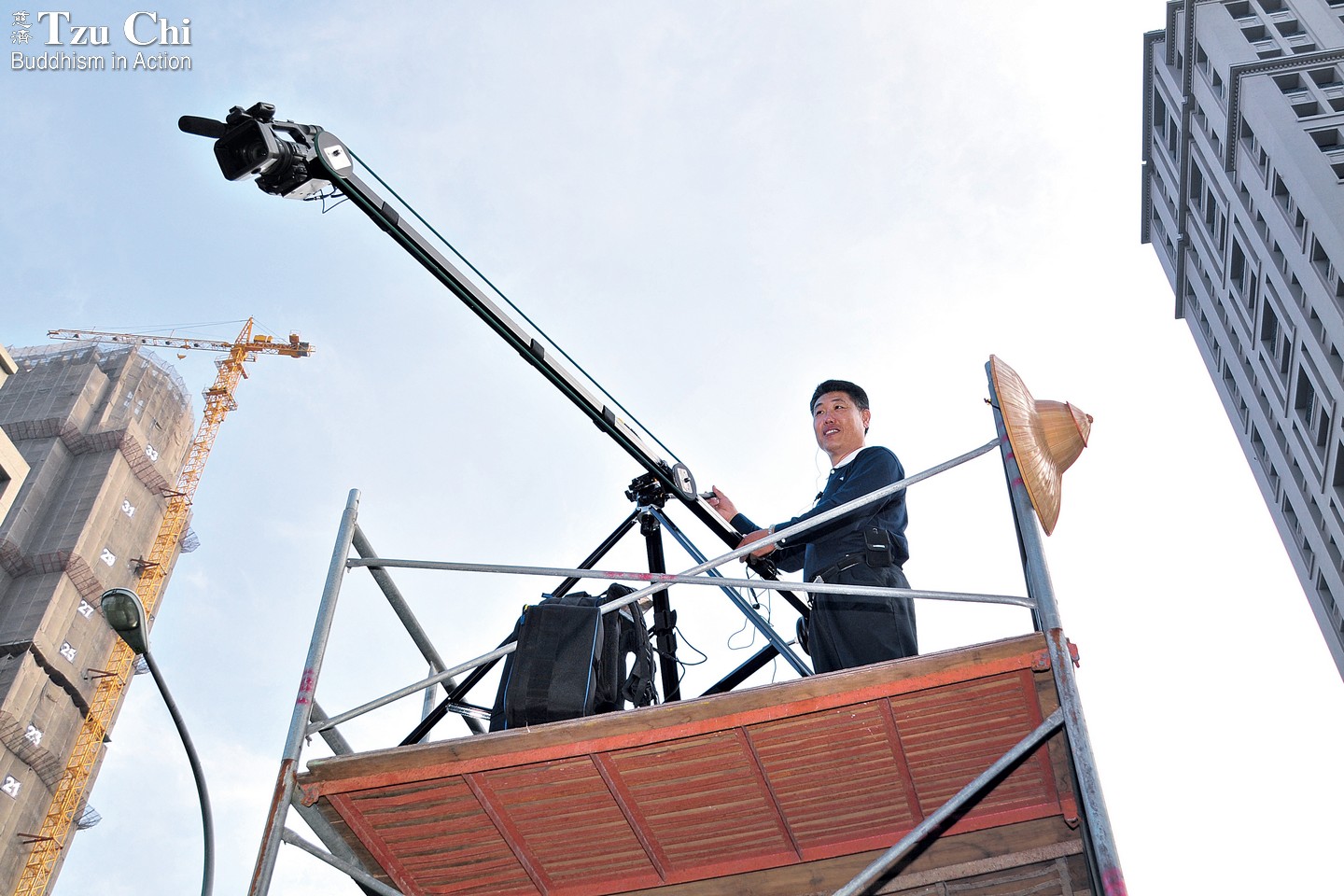
In 2012, Tzu Chi volunteers in Taichung held a Buddha Day ceremony at Summer Green Park. Here, Yang Ma-yun films the rehearsal. Yang Rong-shu
In 1998, Yang’s wife, Zhuo Yue-jiao (卓月嬌), visited the Jing Si Abode, a Buddhist convent established by Dharma Master Cheng Yen, the founder of Tzu Chi, in Hualien County, eastern Taiwan. Zhuo saw how the monastics there strove to live self-sufficiently through farming and other work rather than relying on offerings. Their efforts deeply touched her. When she returned home, she eagerly shared her experiences with her husband.
The following year, at the enthusiastic invitation of senior Tzu Chi volunteer Zhou Sha-han (周莎涵), the couple revisited the Jing Si Abode. Amidst its simple and serene surroundings, Yang learned how Master Cheng Yen led her monastic disciples in adhering to the principle set by Master Bai Zhang (百丈, 749-814), a monk in the Tang Dynasty: “If you don’t work, you don’t eat.” Living by this principle, the nuns at the Abode had done all kinds of handiwork to sustain themselves. Even though they had to work hard to sustain themselves and lived an extremely frugal life, they still committed themselves to philanthropic work and initiated the four Tzu Chi missions of charity, medicine, education, and culture.
Moved by this experience, Yang pledged to translate his inspiration into action and share Master Cheng Yen’s burden of caring for the needy around the world.
He seemed transformed after that, eagerly sharing stories of Tzu Chi with everyone he met. He believed it was his duty as a disciple of Master Cheng Yen to spread the word about Tzu Chi, trusting in karmic connections to determine whether others would be inspired to support the foundation. Undeterred by rejection, he shared about Tzu Chi with increasing confidence and conviction.
His leisure time became almost entirely filled with volunteer work for Tzu Chi. His fishing companions gradually drifted away, and the days of gazing at the sea and quietly observing a bobber’s movements naturally faded from his life.
There were other changes in Yang’s life too. After being addicted to cigarettes for three decades, he began to find them increasingly unpalatable and quit without hesitation. He also transitioned to a vegetarian diet. In 2011, Tzu Chi put on a musical adaptation of the Compassionate Samadhi Water Repentance, a Chinese Buddhist text. Participants were required to observe a vegetarian diet for at least 108 days to help purify their hearts and bodies. Yang resolved to quit eating meat after taking part in the adaptation and embrace vegetarianism to maintain a pure body and mind.
In 2003, he became a documenting volunteer, helping record Tzu Chi events and stories, even though he was a complete novice when it came to computers. Starting with basics like powering on/off and typing in Pinyin, he gradually progressed to editing and finishing video segments on his own. His daughter, Yang Li-yi (楊莉怡), remarked, “Sometimes I see my dad meticulously scrutinizing the screen for a long time to perfect just a few seconds of video. His dedication is truly moving.”
One day in 2013, during a study session of documenting volunteers, attendees discussed using a long pole with a microphone attached for filming activities or interviews, which could result in near-perfect sound quality. Suddenly, Yang thought of his large bag of fishing rods at home. After the study session ended, he hurried back home and opened a long-unused fishing gear bag, finding eight fishing rods inside.
Since dedicating himself to Tzu Chi, he had stopped fishing and had no plans to give away the rods. On his balcony, he wielded a hammer and obliterated five of them, deeply remorseful for taking the lives of many fish in the past. He repurposed the remaining three 18-foot fishing rods for filming purposes, equipping two of them with recording microphones and one with a clip for attaching a mobile phone. Using them, it’s as if a microphone or mobile phone has grown invisible wings—they can glide into every corner, capturing touching moments and documenting the world’s goodness.
On August 5, 2023, documenting volunteers from central Taiwan visited the Jing Si Hall in Taichung for a meeting with Master Cheng Yen. “On the count of five, four, three, two, one…recording!” Yang called out. Under Yang’s guidance, the Master pressed the record button. A converted fishing rod of Yang’s, now adorned with a mobile phone, circled the reception room, capturing video of everyone present. It was a rare opportunity to have their images captured with Master Cheng Yen’s. Everyone wore joyful and warm smiles.
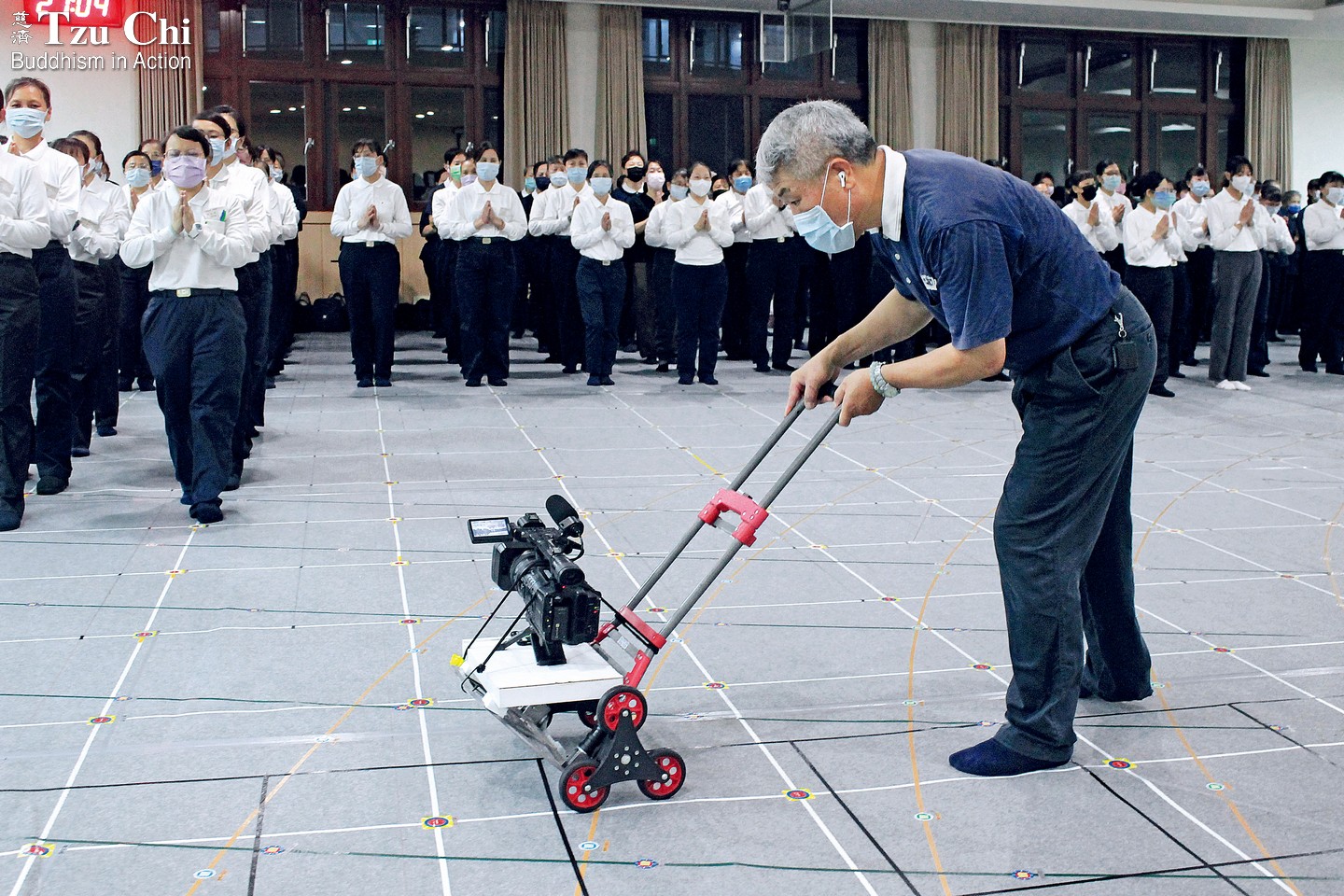
Yang Ma-yun displays ingenuity by attaching a wooden board to a small hand truck and securing a video camera onto it, facilitating easier shooting from a low angle. Wu Chen Mei-yan

By Wang Ming-meng
Translated by Wu Hsiao-ting
Yang Ma-yun, once an avid angler, repurposed his fishing rods into selfie sticks after joining Tzu Chi. Through this adaptation, he enhances the perspectives of the photos and videos he captures for the foundation.
Clang, clang, clang! The heavy iron hammer, typically used for carpentry, struck with resounding blows, filling the air with scattered shards of carbon fiber. Yang Ma-yun (楊媽允), standing on his balcony, felt not a hint of regret as the five premium fishing rods, valued at about 40,000 Taiwanese dollars (US$1,340) in total, were pounded to rubble in just five minutes. Instead, he felt a weight lifted from his shoulders.
Yang hails from Xiyu Township, located in Penghu County, an archipelago off Taiwan’s southwestern coast. In his childhood, he enjoyed fishing and playing by the sea with friends, fashioning simple fishing rods from bamboo and using shellfish as bait. His love for fishing persisted as he grew older. He continued fishing after getting married, when he moved to Taichung, central Taiwan.
As an adult, Yang became obsessed with fishing, always looking forward to the end of the workweek. He was often accompanied by his construction industry friends, fostering camaraderie through shared experiences. Weekends and holidays often saw him with fishing companions, equipped with gear and small coolers filled with ice and refreshments, exploring different fishing spots and having a blast.
One of his longest fishing trips began before sunrise and lasted until sunset. He spent nearly the entire day gazing at the sea, his eyes fixed on the bobber, silently anticipating each catch.
His impressive fishing records made him a popular companion among fellow anglers, who often sought his company for fishing outings. Their favorite fishing spot was Taiwan’s northern coast, where, on weekends, it often felt as though there were more anglers lining the shore than fish in the sea. In the wee hours, hundreds of anglers would gather on breakwaters, holding their breath in anticipation of hooking silver-white largehead hairtail. Bathed in moonlight, the sea’s surface shimmered with the greenish glow of floating bobbers, resembling the flicker of fireflies.
Fish don’t have tear ducts, so they can’t cry. But if they could, the flickering lights on the dark sea’s surface might well have been their glistening tears.
In 2012, Tzu Chi volunteers in Taichung held a Buddha Day ceremony at Summer Green Park. Here, Yang Ma-yun films the rehearsal. Yang Rong-shu
In 1998, Yang’s wife, Zhuo Yue-jiao (卓月嬌), visited the Jing Si Abode, a Buddhist convent established by Dharma Master Cheng Yen, the founder of Tzu Chi, in Hualien County, eastern Taiwan. Zhuo saw how the monastics there strove to live self-sufficiently through farming and other work rather than relying on offerings. Their efforts deeply touched her. When she returned home, she eagerly shared her experiences with her husband.
The following year, at the enthusiastic invitation of senior Tzu Chi volunteer Zhou Sha-han (周莎涵), the couple revisited the Jing Si Abode. Amidst its simple and serene surroundings, Yang learned how Master Cheng Yen led her monastic disciples in adhering to the principle set by Master Bai Zhang (百丈, 749-814), a monk in the Tang Dynasty: “If you don’t work, you don’t eat.” Living by this principle, the nuns at the Abode had done all kinds of handiwork to sustain themselves. Even though they had to work hard to sustain themselves and lived an extremely frugal life, they still committed themselves to philanthropic work and initiated the four Tzu Chi missions of charity, medicine, education, and culture.
Moved by this experience, Yang pledged to translate his inspiration into action and share Master Cheng Yen’s burden of caring for the needy around the world.
He seemed transformed after that, eagerly sharing stories of Tzu Chi with everyone he met. He believed it was his duty as a disciple of Master Cheng Yen to spread the word about Tzu Chi, trusting in karmic connections to determine whether others would be inspired to support the foundation. Undeterred by rejection, he shared about Tzu Chi with increasing confidence and conviction.
His leisure time became almost entirely filled with volunteer work for Tzu Chi. His fishing companions gradually drifted away, and the days of gazing at the sea and quietly observing a bobber’s movements naturally faded from his life.
There were other changes in Yang’s life too. After being addicted to cigarettes for three decades, he began to find them increasingly unpalatable and quit without hesitation. He also transitioned to a vegetarian diet. In 2011, Tzu Chi put on a musical adaptation of the Compassionate Samadhi Water Repentance, a Chinese Buddhist text. Participants were required to observe a vegetarian diet for at least 108 days to help purify their hearts and bodies. Yang resolved to quit eating meat after taking part in the adaptation and embrace vegetarianism to maintain a pure body and mind.
In 2003, he became a documenting volunteer, helping record Tzu Chi events and stories, even though he was a complete novice when it came to computers. Starting with basics like powering on/off and typing in Pinyin, he gradually progressed to editing and finishing video segments on his own. His daughter, Yang Li-yi (楊莉怡), remarked, “Sometimes I see my dad meticulously scrutinizing the screen for a long time to perfect just a few seconds of video. His dedication is truly moving.”
One day in 2013, during a study session of documenting volunteers, attendees discussed using a long pole with a microphone attached for filming activities or interviews, which could result in near-perfect sound quality. Suddenly, Yang thought of his large bag of fishing rods at home. After the study session ended, he hurried back home and opened a long-unused fishing gear bag, finding eight fishing rods inside.
Since dedicating himself to Tzu Chi, he had stopped fishing and had no plans to give away the rods. On his balcony, he wielded a hammer and obliterated five of them, deeply remorseful for taking the lives of many fish in the past. He repurposed the remaining three 18-foot fishing rods for filming purposes, equipping two of them with recording microphones and one with a clip for attaching a mobile phone. Using them, it’s as if a microphone or mobile phone has grown invisible wings—they can glide into every corner, capturing touching moments and documenting the world’s goodness.
On August 5, 2023, documenting volunteers from central Taiwan visited the Jing Si Hall in Taichung for a meeting with Master Cheng Yen. “On the count of five, four, three, two, one…recording!” Yang called out. Under Yang’s guidance, the Master pressed the record button. A converted fishing rod of Yang’s, now adorned with a mobile phone, circled the reception room, capturing video of everyone present. It was a rare opportunity to have their images captured with Master Cheng Yen’s. Everyone wore joyful and warm smiles.
Yang Ma-yun displays ingenuity by attaching a wooden board to a small hand truck and securing a video camera onto it, facilitating easier shooting from a low angle. Wu Chen Mei-yan
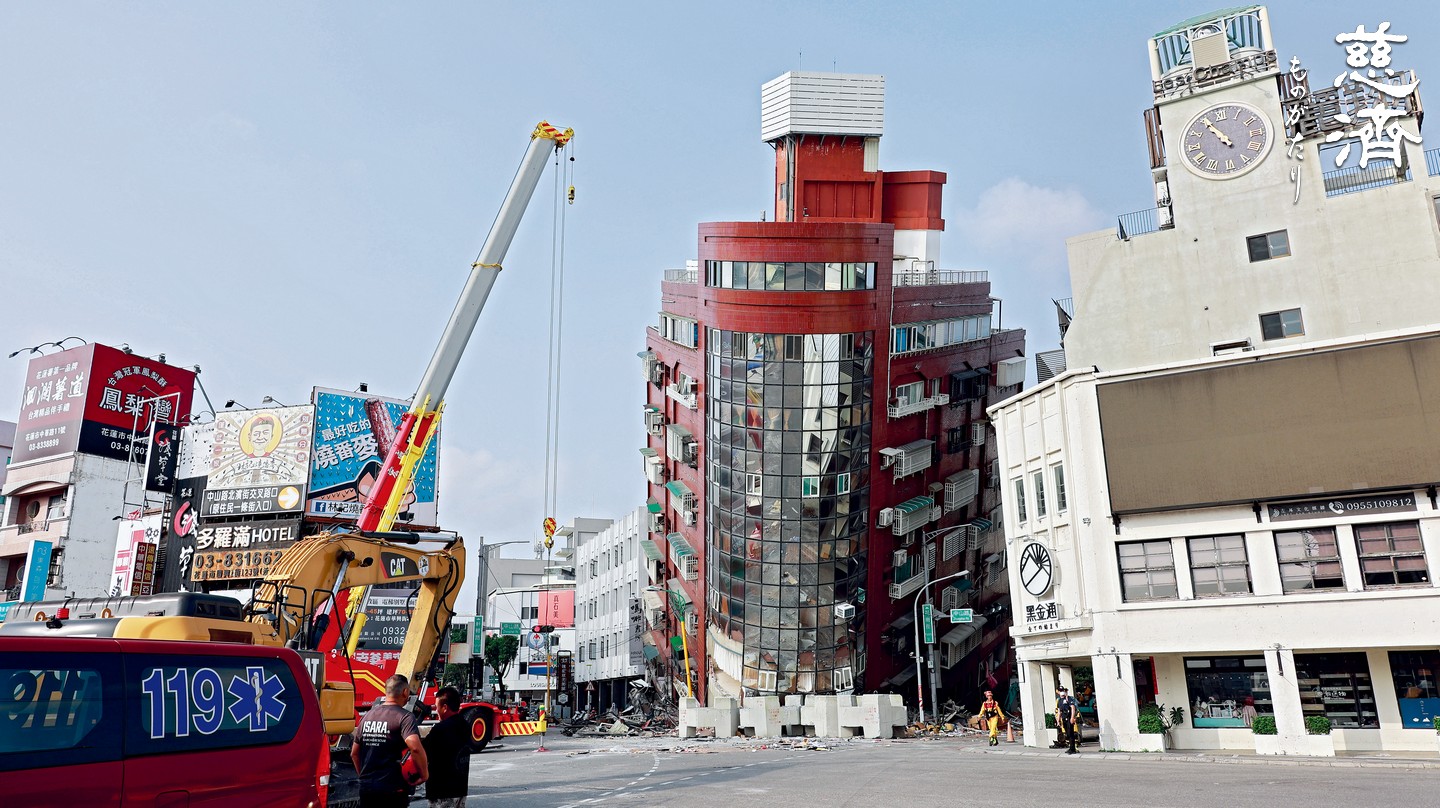
花蓮市にある天王星ビルは4月3日の強い地震で傾き、捜索救助隊員が到着した。(撮影・羅明道)
地震の後、台湾全土で百棟以上の建物に赤(危険)や黄色(要注意)の紙が貼られた。
甚大被災地の花蓮では、慈済が公共機関と協力して第一線の救助人員のニーズに合わせて支援し、避難所の設置を効率よく行った。
そして、地震発生から二十四時間以内に一回目のお見舞金が届けられ、四月半ばまでに千四百世帯余りに配付を終えた。
続いて家屋の修繕に着手し、被災者の心身を落ち着かせた。
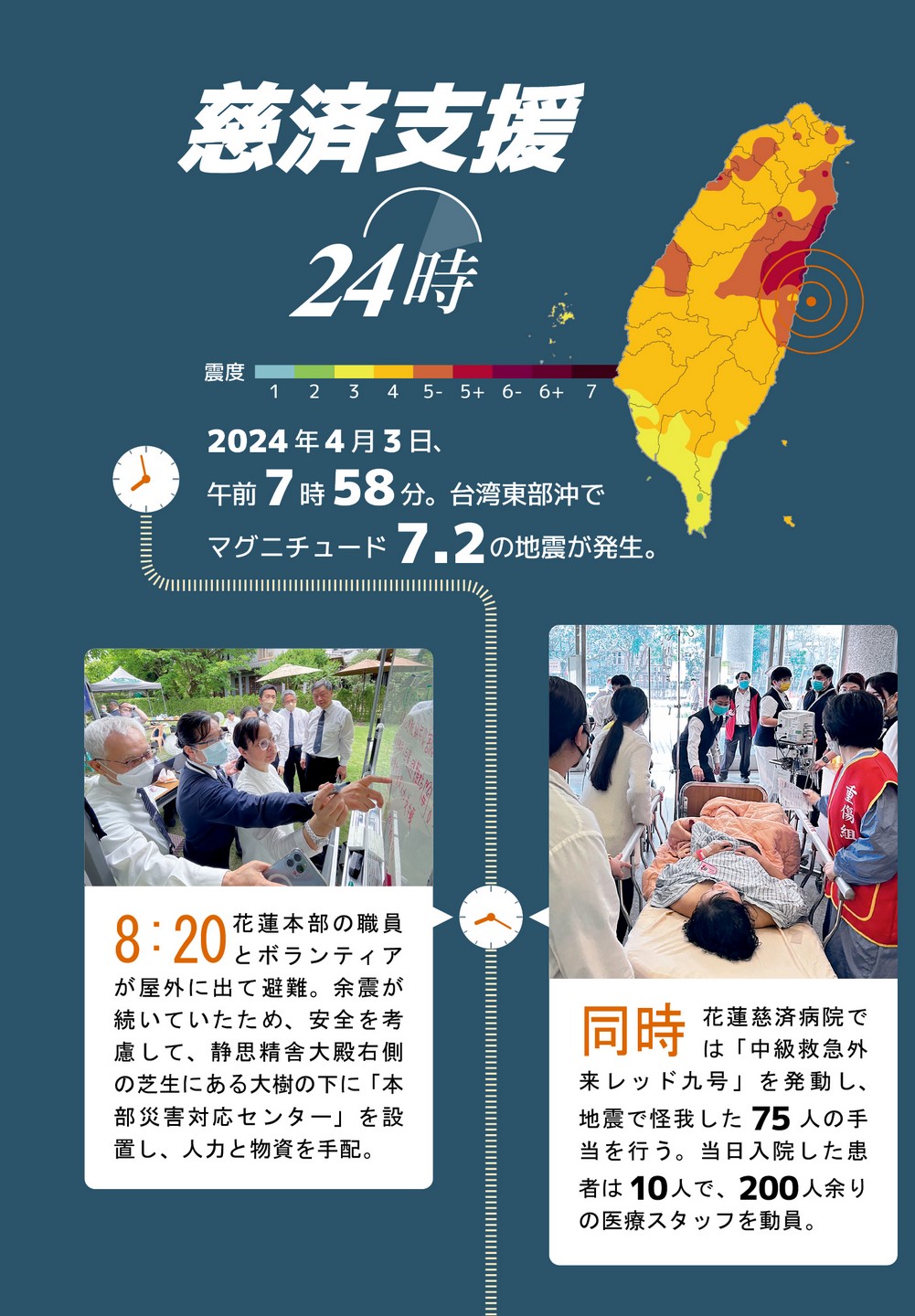
四月三日、清明節連休前日の早朝、マグニチュード七・二の強い地震が台湾全土を襲い、震源に近い花蓮県は大きな被害を受けた。県北部の秀林、新城、吉安の三つの町と花蓮市では、多くの家屋が損壊し、タロコ国立公園の遊歩道でがけ崩れや落石が発生した。政府は特捜隊を派遣し、全力で捜索と救助に当たった。
政府が「一級災害対応」を開始すると、慈済基金会は唯一の民間団体として、花蓮県消防局に設置された「花蓮県政府災害対策本部」に駐在した。そして、人的、物的資源を投入し、「前線部隊を援護する後方部隊の先鋒」となり、政府や他のNGOと協力して、全力で被災者を支え、最前線の救助活動を支援した。
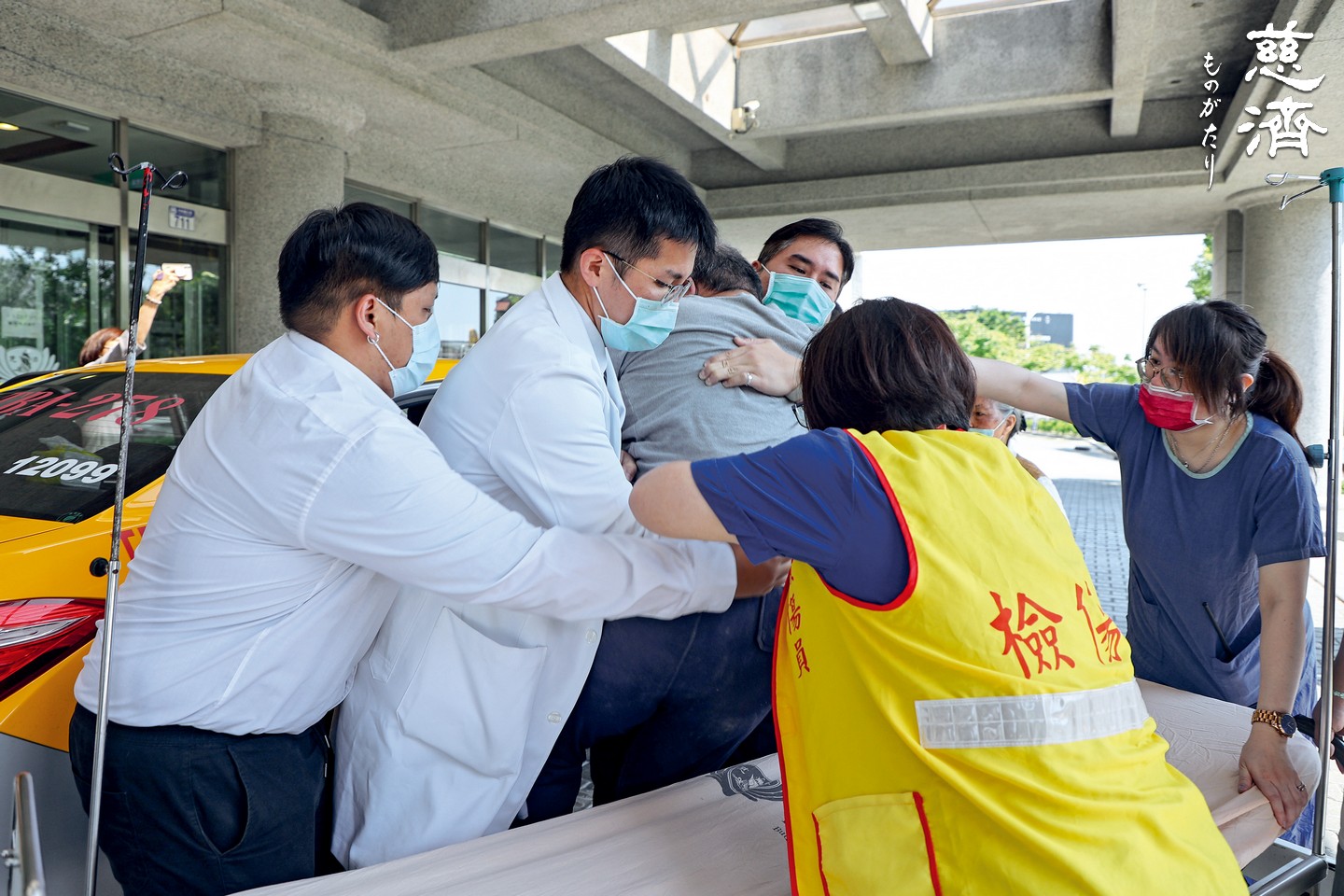
花蓮慈済病院では、多数の負傷者を受け入れる体制を取った。医療スタッフが患者を支えてストレッチャーに乗せていた。(撮影・劉明繐)
震度六の激しい揺れにより、花蓮北部では、程度の差こそあれ、どの家でも家具が傾いたり倒れたりするなどの被害があった。また、避難中に転倒した人もいて、地震により台湾全土で千百人余りが負傷した。魏嘉彦(ウェイ・ジアイェン)花蓮市長もそのうちの一人だ。
「タンスが足の上に倒れてきたのです。幸い骨折までには至りませんでした」。
左足がタンスの下敷きになって怪我をした魏市長が松葉杖をつきながら避難所で陣頭指揮に当たっていた姿は、図らずも震災をまざまざと見せつけるものとなった。
花蓮慈済病院のボランティアをしている李思蓓(リー・スーペイ)さんは、二人の娘に、家の中の倒れた物を片付けたら入院している負傷者を見舞うよう念を押した。一回目に病院に運ばれた負傷者は八人だったと彼女は記憶している。そのうちの一人である陳さんという女性は、地震が起きた時、自分で栽培した野菜を友人に届けるために家を出ようとした矢先だった。ところが玄関で棚が倒れてきて、腰骨を折ってしまった。
「彼女は救急車を待てなかったので、タクシーで病院に行きました。立つことさえできなかったので、救急外来の医師が抱えて降ろしたそうです」と李さんが言った。
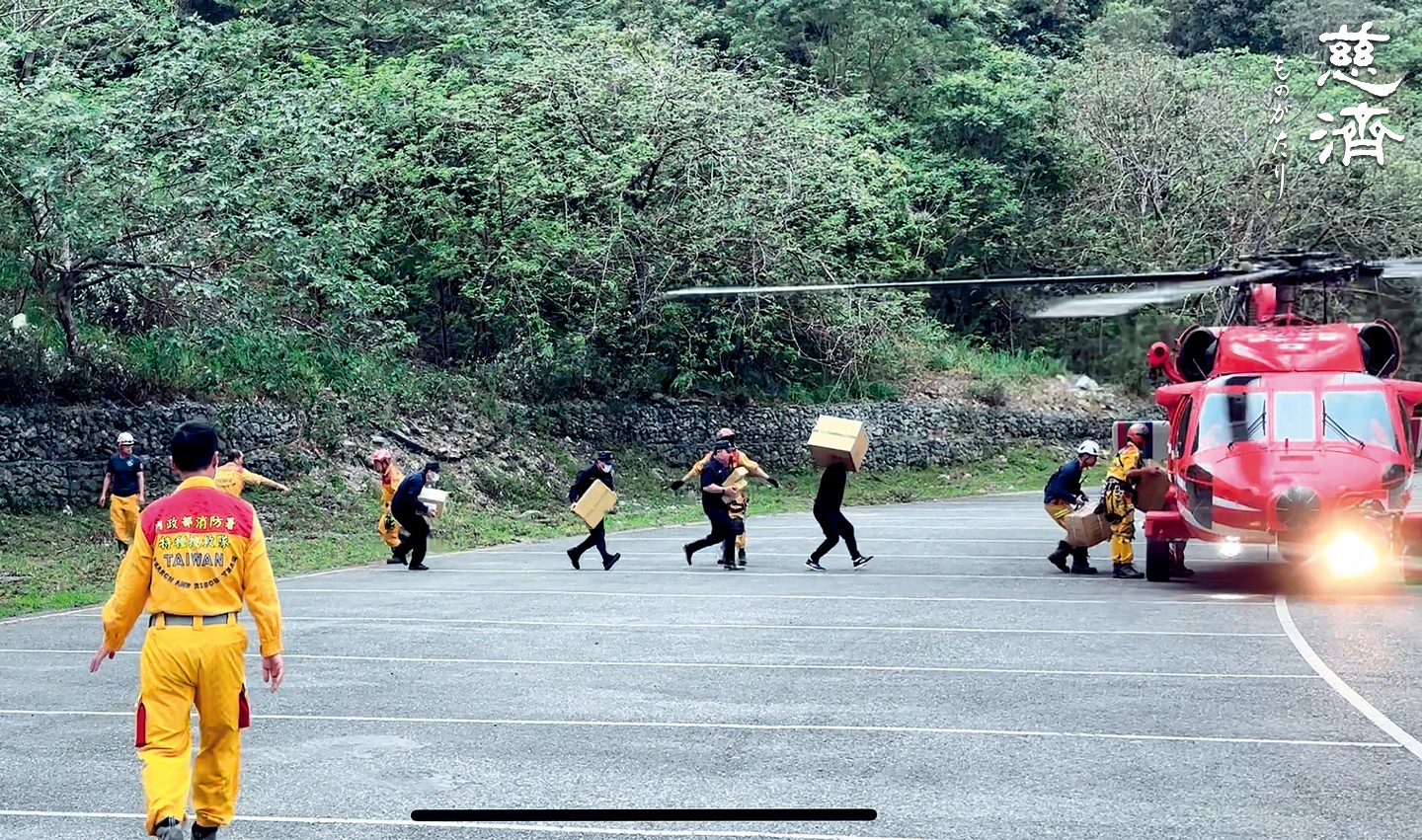
タロコ峡谷は、がけ崩れで道路が寸断され、数百人が山間部に取り残された。車両が通行できなかったため、人員や物資の輸送はヘリコプター頼みとなった。花蓮県警察局は内政部空中勤務総隊に救援を要請し、慈済にも支援物資の提供を求めた。
「ヘリコプターで支援物資を運んだのは初めてです」。
定年退職した元警察官で、花蓮慈警会の合心チームの幹事を務めるボランティアの許志賢(シユウ・ヅ―シエン)さんは、日頃から地域の警察や消防と連絡を取り合っており、連絡を受けるとすぐに手配を始めた。四月五日の朝六時には物資の準備が完了し、一行の立ち入りが許可された。警察官と共にパトカー三台とトラック一台に分乗して、立入規制区域のタロコヘリポートに向かい、待機した。
「一回目は、ヘリコプターで天祥のホテルに足止めされていたシンガポールや香港からの観光客九人を下山させました。徳勱(ドーマイ)師父がボランティアたちを伴って現地を訪れ、見舞ったので、彼らは感動のあまり涙を流していました」。
許さんによると、山間部に足止めされていたのは、観光客とホテル従業員、住民の他、天祥派出所や保安警察など公的機関の職員で、合計六百人余りが食糧と水を必要としていた。慈済は花蓮県警察、内政部空中勤務総隊と協力して、二回ヘリでの輸送を行い、道路が通行できるようになるまでの間、足止めされていた人々を支えると共に、世界中の慈済人の思いやりを救援活動の最前線に届けた。
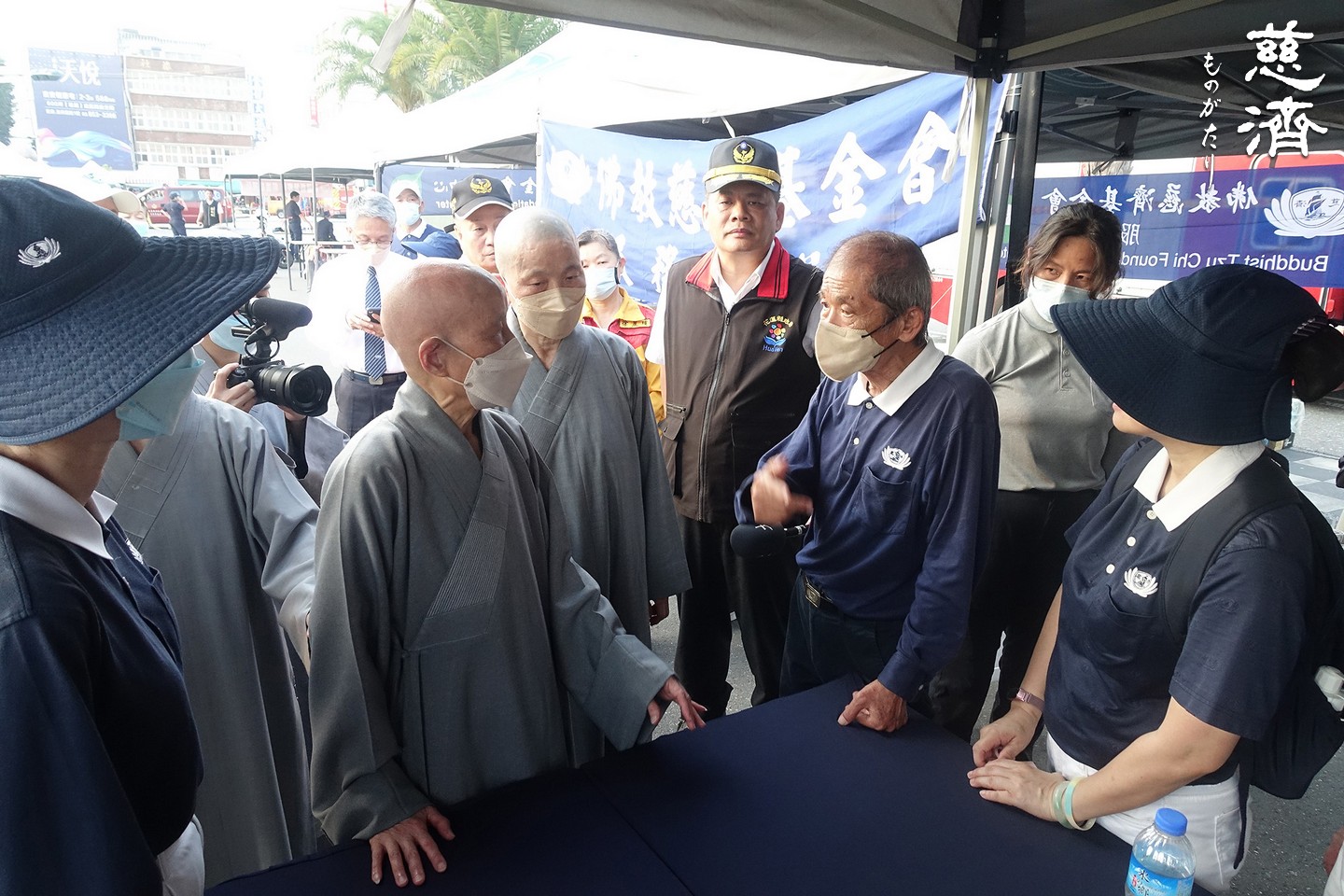
4月3日午後、證厳法師が花蓮市街地の傾斜したビル現場で、ボランティアと救助人員を見舞った。(写真提供・花蓮本部)
花蓮県政府の統計によると、地震により七十七棟の建物が傾くか損壊して危険な状態になり、千七百戸余りの住宅に影響が出たという。県、市、郷(町)の役所は、県立体育館、徳興野球場、中華小学校、化仁中学校など八カ所に避難所を設け、慈済も支援に加わった。
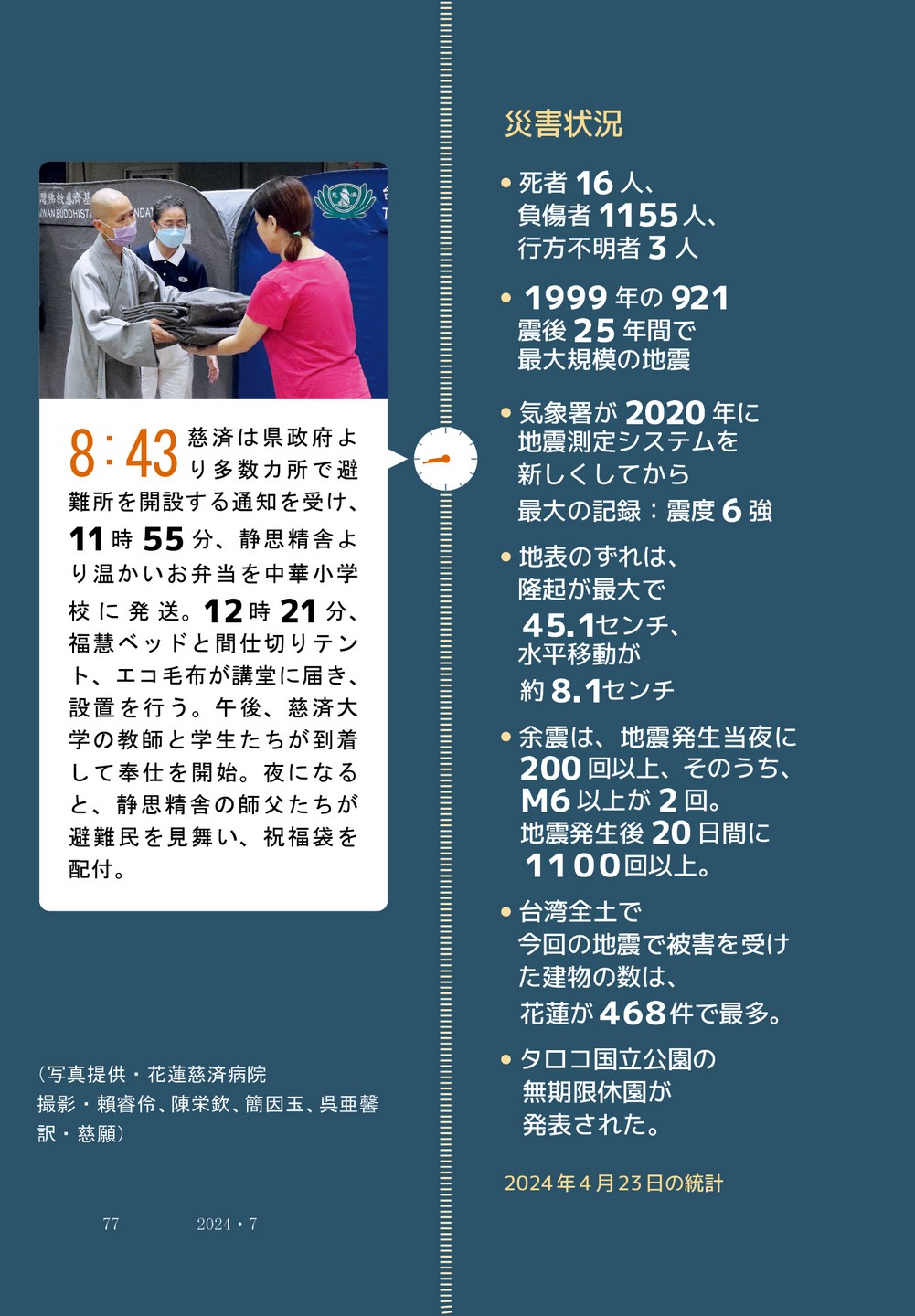
吉安郷では化仁中学校が主な避難所となり、グラウンドには赤十字社から提供された大きなテントが張られた。七年前に慈済の支援で建設された多機能体育館内には、青や灰色の「ジンスー福慧間仕切りテント」が設置された。中には福慧ベッドとエコ毛布が用意され、被災者のプライバシーを守ると同時に、快適に過ごせるようになっていた。
避難した人々の様々な不便に対応するため、公的部門や民間団体が避難所に人員を派遣して奉仕した。例えば、中華小学校の避難所では、健康保険署の職員が、着の身着のままで建物を飛び出して保険証を持っていない住民のために保険証を再発行し、通信業者は避難者が無料で市内電話をかけられるよう電話機を設置した。また、不動産業者は賃貸物件を仲介し、国軍はグラウンドの一角に野戦シャワーテントを設置した。操作担当の士官は、「一度に十二人がシャワーを使用することができ、毎日、使用時間帯を二分して、男女を入れ替えています」と言った。
各方面の人々の善意に支えられ、各避難所は物資が十分にあった。しかし、どれだけ完璧な支援も、元来の穏やかな家庭生活に代わるものではない。魏市長は当時の状況を振り返って、「『何もかもなくしてしまった……』と気落ちしていた高齢者を、うちの職員とソーシャルワーカーが励まし続けました」と言った。
市長は、東華大学の顧(グー)教授に心から感謝した。教授は、このような被災者の気が晴れるようにと、車で景色の美しいキャンパスに連れて行き、精神的な傷を癒そうとしたそうだ。
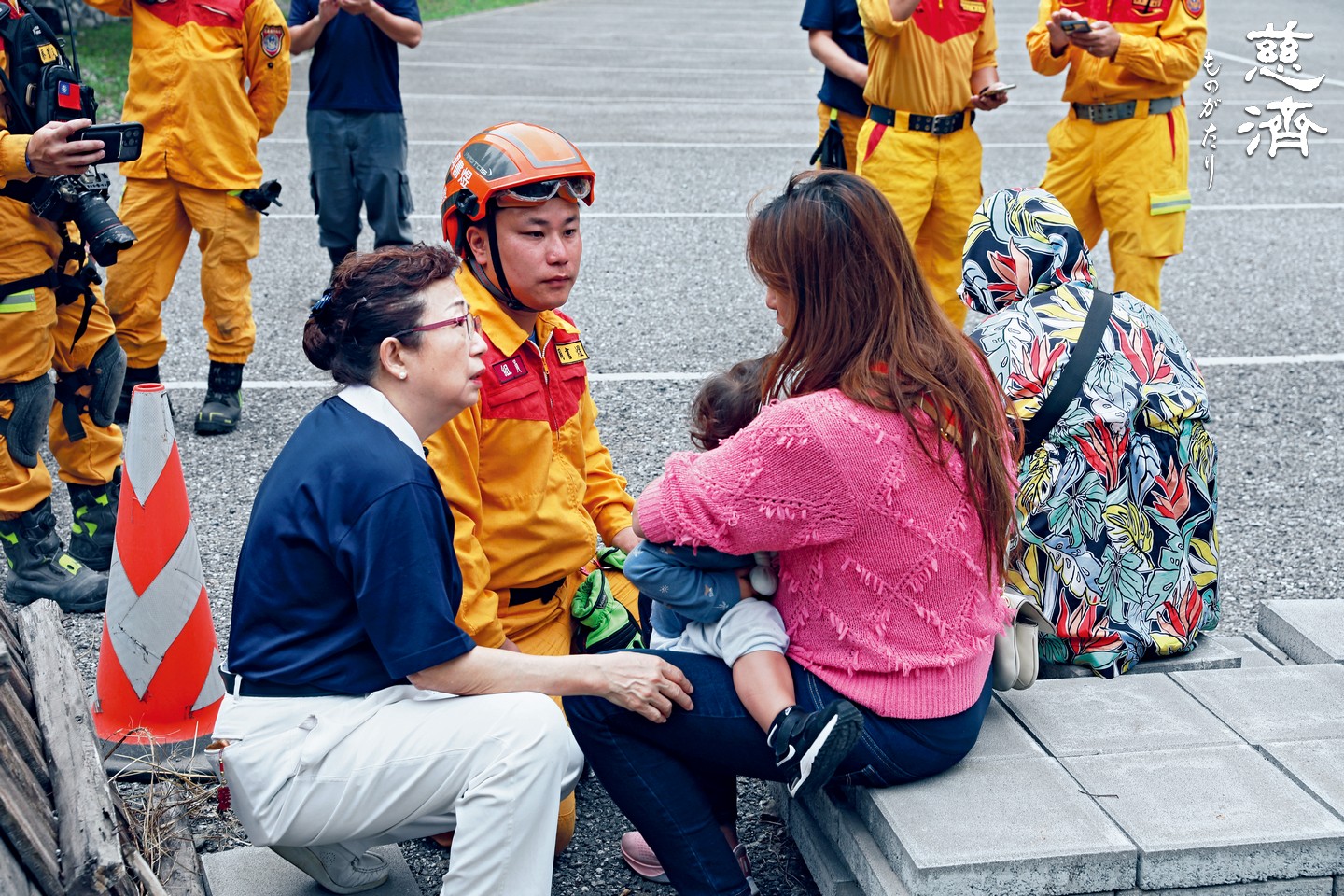
また、数多くの震災支援の経験から、慈済は被災者の苦しみや心の痛みをよく理解しているため、経験豊富なボランティアを避難所に派遣し、専門のソーシャルワーカーや衛生機関の特約カウンセラーと共に、被災者のケアに当たってもらった。
慈済基金会慈善志業発展処総合企画室防災チームの専属スタッフ、黄玉琪(フワォン・ユーチー)さんの話によると、避難所で心のケアに当たっているボランティアは、被災者が二次被害を受けないよう訓練を受けているため、一緒に働く専門のカウンセラーも喜んで協力しているという。
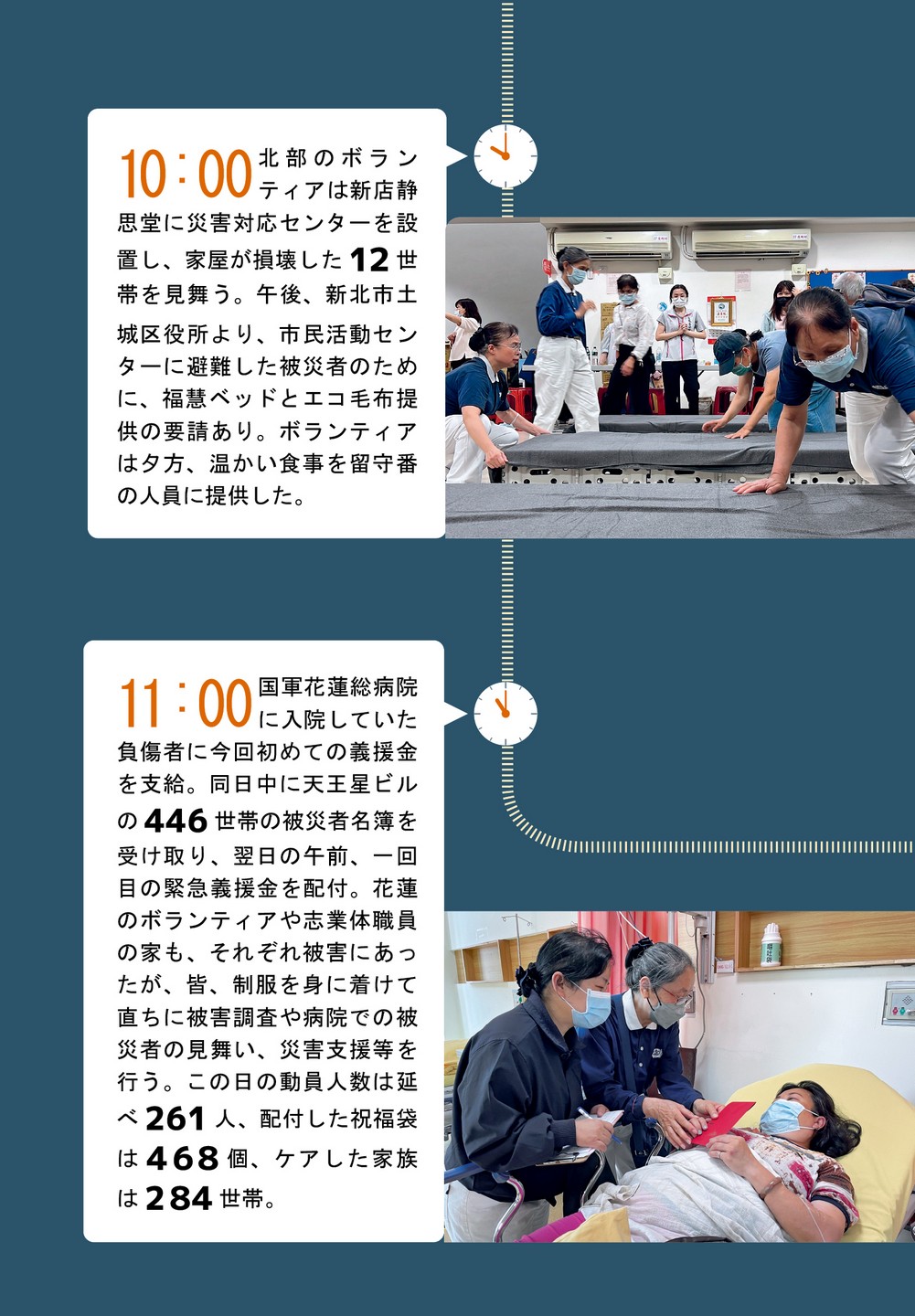
台湾全土で倒壊する危険性のある建物は四十カ所余りあり、主要構造上の損壊ではない建物は七十カ所以上ある。慈済は家屋が損壊した避難世帯を見舞い、一日でも早く安心した生活ができるよう、北部と花蓮の千四百世帯余りを対象に、世帯人数と被災の程度に応じて、二万元から五万元の災害見舞金を手渡した。
花蓮慈済ボランティアは、災害見舞金と慰問品を手渡す時の会場の移動経路にも気を配った。台北から来たボランティアの王宣方(ワン・イーフォン)さんによると、住民は先ず一つ目の丸テーブルでボランティアやソーシャルワーカーの協力の下に、書類に記入してから、災害見舞金や結縁品(縁結びの品)を受け取る。それから、二つ目の丸テーブルで休憩してもらうが、この時はボランティアと精舎の師父が付き添う。「師父と話をすれば、心が落ち着くのです」と王さんが補足した。
小さい丸テーブルでは、ボランティアと精舎の師父が住民の話に耳を傾けていた。
「私は一人だから、せいぜい何日か友人の家をはしごすればいいのですが、お年寄りがいたり、子どもがいて学校に通っていたり、特殊な事情のある家庭はどうしたらいいのでしょう」。頼さんは住居が地震で損壊した上、働いていた店も仕事がほとんどないため、休業に追い込まれた。一時的に収入がなくなっても、家のローンは待ってくれない。それに、被災者が多いため、適当なアパートを借りられるかどうかも心配だという。配付を受け取った後で、彼女はそのような問題と不安を語った。
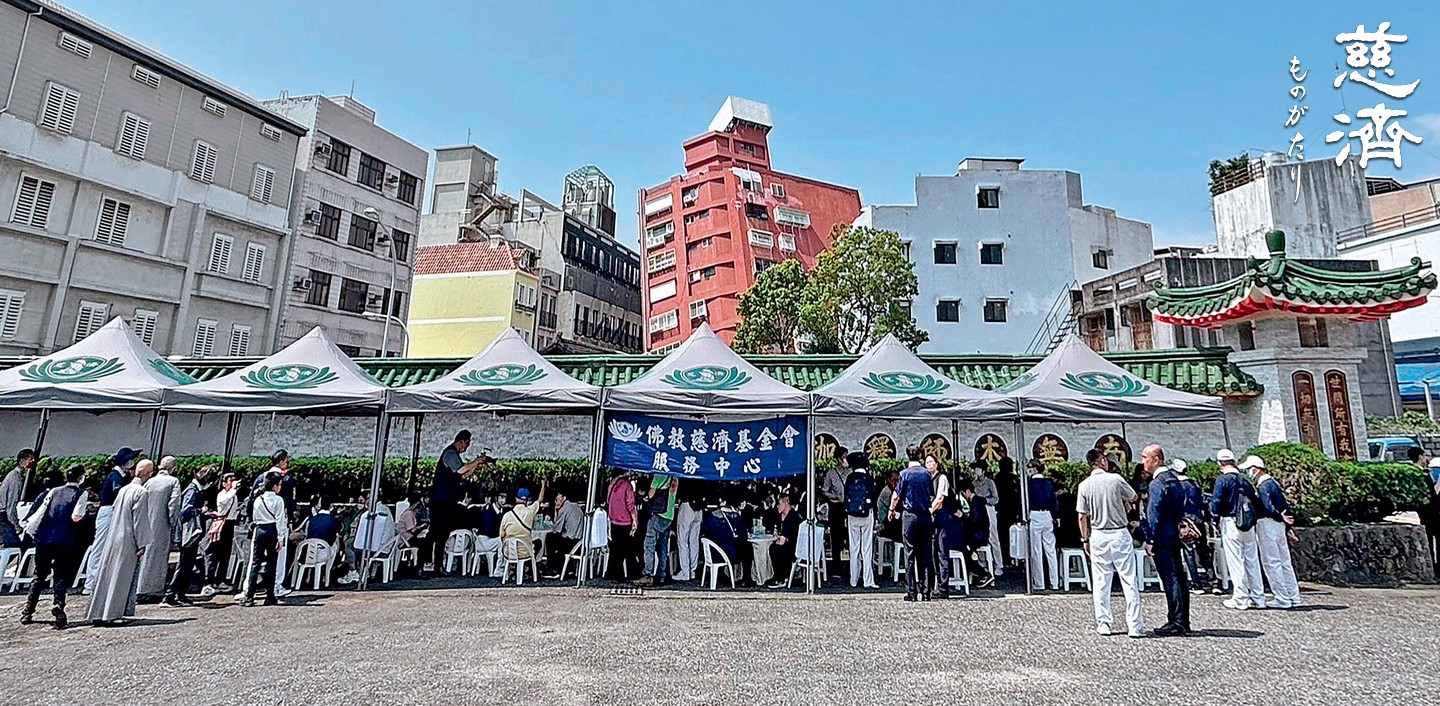
地震翌日の午前、ボランティアは天王星ビル近くの東浄寺で最初の災害見舞金配付を実施した。(撮影・劉秋伶)
慈済大学と慈済科技大学の教師と学生、東部の慈済青年懇親会の若者たちも、地震の後、積極的にボランティアに応募した。慈済の支援計画に従い、慈済大学の学生三十人余りと引率の教師たちは、まず中華小学校、化仁中学校、徳興野球場へ支援に向かった。
「テントや福慧ベッドの設置、被災者に配付する物資の袋詰めなど、ボランティアとしてできることはたくさんありました。僕たちは力を合わせて無事に仕事をやり遂げました」。
こう話す慈済大学理学療法学科修士課程の楊景湧(ヤン・ジンヨン)さんは、インドネシア出身の留学生だ。故郷ではほとんど地震がないため、当初は激しい揺れにかなりショックを受けたが、その後、勇気を奮ってボランティアに参加した。それで清明節の連休は忙しく過ごした。
楊さんはある時、雨が降っていたため、駐車場に行く住民のために傘を差して付き添った。
「苦労して手に入れたマイホームが一瞬にして無くなってしまってね……」
被災者はため息交じりに言ったが、彼は心が痛んでならなかった。
「ありがとう。あなたたちがいなかったら、この先どうやって暮らして行けばいいか分かりませんでした」。被災者の言葉に、彼は強く胸を打たれた。
「あの時、一人の人間として、人の役に立っていると実感しました」と、彼はしみじみと語った。
慈済大学学士再入学中医学科の林世峰(リン・スーフォン)さんは、簡単な英語を使って、震災当日の心の変化を見事に表現して見せた。
「Taker(もらう人)からGiver(与える人)に、Victim(被災者)からVolunteer(ボランティア)になったのです。午前中は動揺していましたが、午後はボランティアになって人々が安心できるよう慰めたので、自分も落ち着きを取り戻しました」。
被害を最小限に抑えるには、日頃から訓練を繰り返して災害に備えることが必要だ。「災害を最小限に止めるには、源からリスクを最低限まで抑えることです。備えるということは、自然に逆らうのではなく、災害は必ずやってくると予想して、災害状況に合わせて訓練することで準備ができるのです」。呂学正(リュ・シュエヅン)さんは、防災マネジメントの四つの段階におけるサイクルについて大まかに説明した。「三番目は臨機応変な対応によって、実際に災害が発生した時、様々な支援活動をすることです。復興と再建は最後の段階です」。
二〇一八年の〇二〇六花蓮地震の後、防災支援の能力を強化するため、慈済基金会は、花蓮県政府と「共善協力覚書」を交わすと同時に、新城、秀林、吉安の三つの町及び花蓮市との間に 「防災・災害支援協力協定」を結んだ。関連業務に携わる多くの公務員は、慈済の避難所運営研修に参加したことがある。また、県消防局と慈済が共催した防災士養成研修にも参加し、内政部認定防災士の資格を取得した人もいる。
花蓮市社会・労働課の蕭子蔚(シャオ・ヅ―ウェイ)課長はこう話す。
「私たちは地域発展協会の会員研修も実施しました。昨年の中央政府の水害対策訓練で、全員、実際に操作して練習したので、今回は皆落ち着いて対応できました」。
花蓮北部の慈済減災希望プロジェクトで建設された六つの校舎は、今回の地震を想定通りに耐え、プロジェクトの狙いを見事に体現した。即ち、老朽化した校舎を建て替えたことが、防災、減災を図るだけでなく、災害時の避難所確保になったのである。これは防災マネジメントの四段階のうちの「減災」と「臨機応変な対応」の良いモデルともなった。
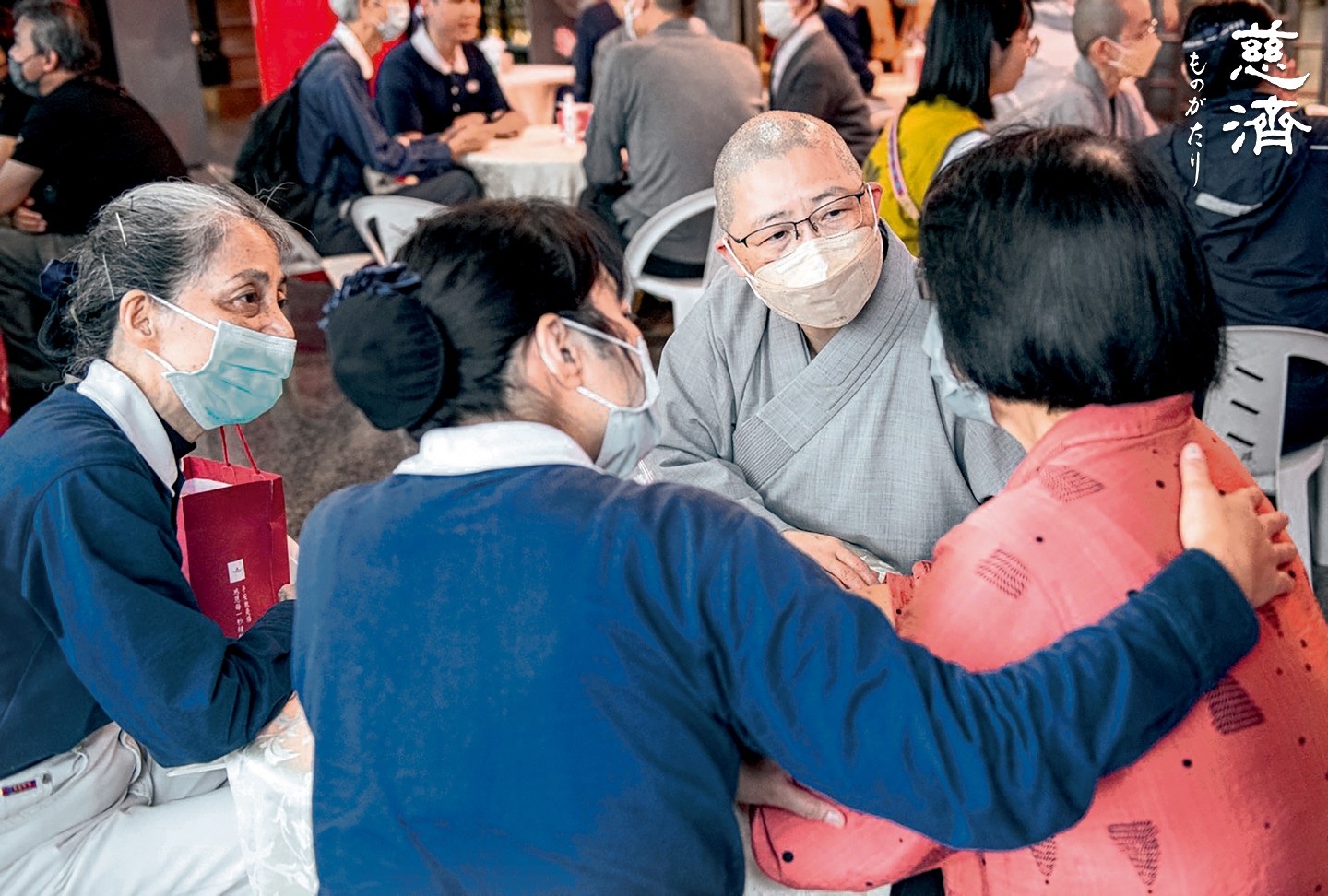
大規模な配付が5回行われ、精舎の師父やボランティアが被災者の声に耳を傾けた(撮影・邱俊誠)
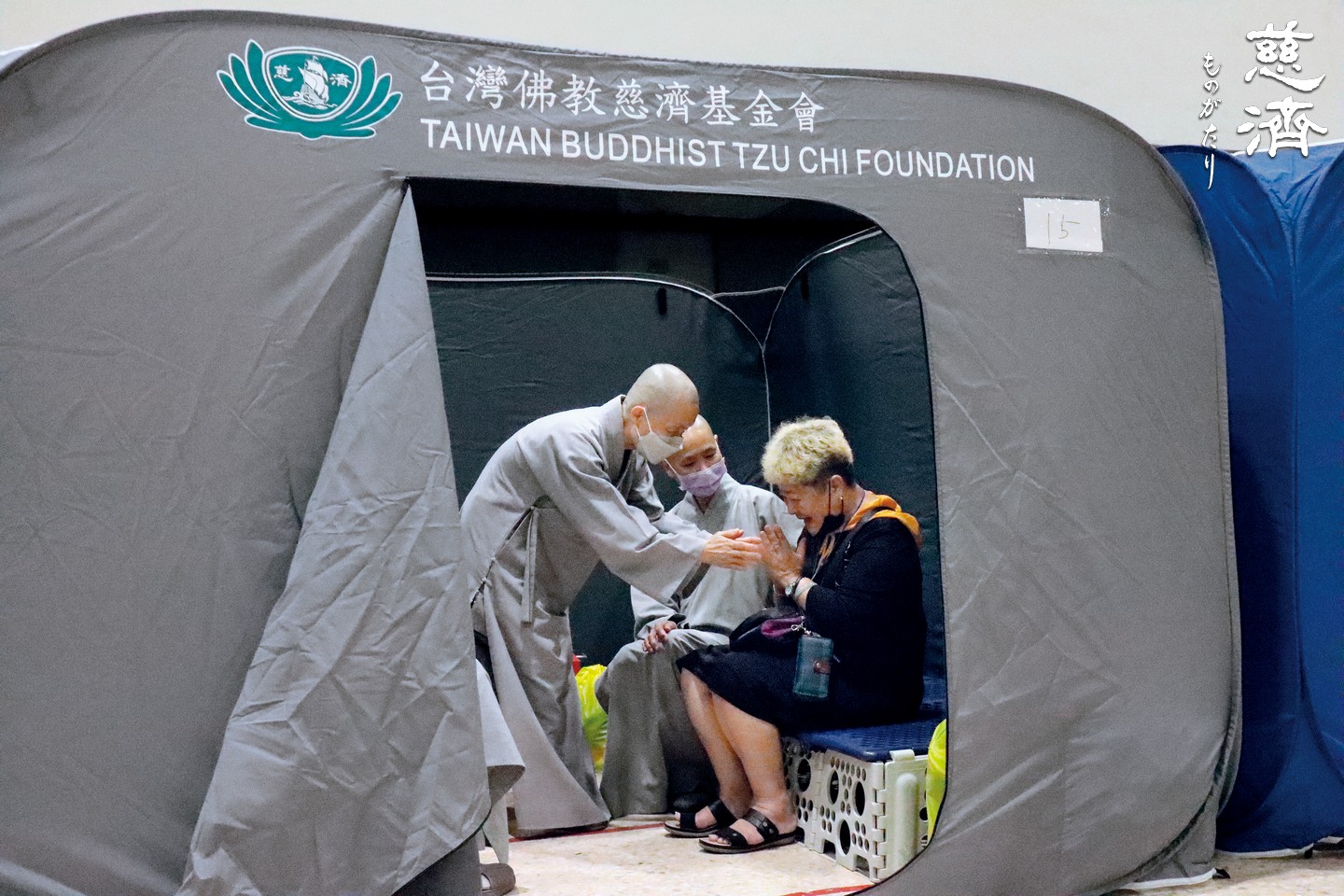
地震が発生した当日の昼、慈済は政府が立ち上げた避難所を支援した。その晩、精舎の師父が訪れて被災者を見舞った。(撮影・陳榮欽)
「一般に学校の体育館は、安全係数を校舎の一・二倍にしていますが、私たちはそれよりも高い一・七倍に設計しています」。慈済基金会営建処顧問の林敏朝(リン・ミンツァオ)さんは、かつて減災希望プロジェクトの責任者を務めていた。化仁中学校の多機能体育館を建設した時、採光をよくするためにガラス窓の面積を広くとる一方で、SRC構造にすることで、軽量の屋根と壁を採用することができ、高い耐震性を確保したという。
「学校の建築物に関しては、地震が来ても倒壊しないのが前提ですが、そればかりでなく、住民の避難所としての役割も果たせるよう設計しています」と林さんが補足した。
同じく減災希望プロジェクトで建設された国風中学校は、防災と臨機応変な対応を具体的な行動で示した。四月八日午前九時三十一分、花蓮県秀林郷でマグニチュード三・三の地震が発生したが、震源の深さは僅か六・二キロメートルで、学校との距離も近かったため、校内では激しい揺れを感じた。
地震警報が鳴るや否や、全校生徒千九百人余りは直ちにその場で身をかがめ、その後、速やかに校舎を離れてグラウンドに集合した。車椅子の身障者生徒も教師やクラスメートの手を借りてグラウンド脇に避難した。クラスごとに人数を数え、教師も生徒も全員無事だと確認した後、劉文彦(リュウ・ウェンイェン)校長が朝礼台に上がって再度、注意を促した。
「地震が起きる度に、初めてまたは新たな地震だと思うようにしてください。『狼が来た』という物語のように、どうせ何も起きないだろうと、高を括ってはいけません。地震が起きた時はいつも落ち着いて、冷静に行動してください」。
小さな地震だからと軽視したり、建物が丈夫だからといって安心したりしてはいけない。老朽化した国風中学校の校舎は、慈済によって耐震性の高い新校舎に建て替えられ、倒壊の心配はなくなったが、学校では今でも、いつ何時襲ってくるかわからない地震に対応する準備をしている。起こり得る災害に備えて真剣に考え、万全を期しておくことが、減災の唯一の方法なのである。慈済は、被災世帯への災害見舞金の配付、入院している負傷者への慰問、葬儀場での「助念」、支援物資の準備といった第一段階の緊急援助が終わると、第二段階の生活再建支援を始める。慈済は、四月中旬に花蓮県政府、TSMC慈善基金会と役割分担を話し合った結果、主に新城、秀林、吉安の三つの町で住居の修繕を受け持つことになり、低所得者、病人、身寄りのないお年寄り、幼い子どもなど、弱者世帯を優先した。台湾全土から参加した専門ボランティアは、四月十八日から被災状況の調査と施工を始めた。そして、世界中の慈済人は、被災者の生活再建を支援するために、愛を募る募金活動に取り組んでいる。
(慈済月刊六九〇期より)
花蓮市にある天王星ビルは4月3日の強い地震で傾き、捜索救助隊員が到着した。(撮影・羅明道)
地震の後、台湾全土で百棟以上の建物に赤(危険)や黄色(要注意)の紙が貼られた。
甚大被災地の花蓮では、慈済が公共機関と協力して第一線の救助人員のニーズに合わせて支援し、避難所の設置を効率よく行った。
そして、地震発生から二十四時間以内に一回目のお見舞金が届けられ、四月半ばまでに千四百世帯余りに配付を終えた。
続いて家屋の修繕に着手し、被災者の心身を落ち着かせた。
四月三日、清明節連休前日の早朝、マグニチュード七・二の強い地震が台湾全土を襲い、震源に近い花蓮県は大きな被害を受けた。県北部の秀林、新城、吉安の三つの町と花蓮市では、多くの家屋が損壊し、タロコ国立公園の遊歩道でがけ崩れや落石が発生した。政府は特捜隊を派遣し、全力で捜索と救助に当たった。
政府が「一級災害対応」を開始すると、慈済基金会は唯一の民間団体として、花蓮県消防局に設置された「花蓮県政府災害対策本部」に駐在した。そして、人的、物的資源を投入し、「前線部隊を援護する後方部隊の先鋒」となり、政府や他のNGOと協力して、全力で被災者を支え、最前線の救助活動を支援した。
花蓮慈済病院では、多数の負傷者を受け入れる体制を取った。医療スタッフが患者を支えてストレッチャーに乗せていた。(撮影・劉明繐)
震度六の激しい揺れにより、花蓮北部では、程度の差こそあれ、どの家でも家具が傾いたり倒れたりするなどの被害があった。また、避難中に転倒した人もいて、地震により台湾全土で千百人余りが負傷した。魏嘉彦(ウェイ・ジアイェン)花蓮市長もそのうちの一人だ。
「タンスが足の上に倒れてきたのです。幸い骨折までには至りませんでした」。
左足がタンスの下敷きになって怪我をした魏市長が松葉杖をつきながら避難所で陣頭指揮に当たっていた姿は、図らずも震災をまざまざと見せつけるものとなった。
花蓮慈済病院のボランティアをしている李思蓓(リー・スーペイ)さんは、二人の娘に、家の中の倒れた物を片付けたら入院している負傷者を見舞うよう念を押した。一回目に病院に運ばれた負傷者は八人だったと彼女は記憶している。そのうちの一人である陳さんという女性は、地震が起きた時、自分で栽培した野菜を友人に届けるために家を出ようとした矢先だった。ところが玄関で棚が倒れてきて、腰骨を折ってしまった。
「彼女は救急車を待てなかったので、タクシーで病院に行きました。立つことさえできなかったので、救急外来の医師が抱えて降ろしたそうです」と李さんが言った。
タロコ峡谷は、がけ崩れで道路が寸断され、数百人が山間部に取り残された。車両が通行できなかったため、人員や物資の輸送はヘリコプター頼みとなった。花蓮県警察局は内政部空中勤務総隊に救援を要請し、慈済にも支援物資の提供を求めた。
「ヘリコプターで支援物資を運んだのは初めてです」。
定年退職した元警察官で、花蓮慈警会の合心チームの幹事を務めるボランティアの許志賢(シユウ・ヅ―シエン)さんは、日頃から地域の警察や消防と連絡を取り合っており、連絡を受けるとすぐに手配を始めた。四月五日の朝六時には物資の準備が完了し、一行の立ち入りが許可された。警察官と共にパトカー三台とトラック一台に分乗して、立入規制区域のタロコヘリポートに向かい、待機した。
「一回目は、ヘリコプターで天祥のホテルに足止めされていたシンガポールや香港からの観光客九人を下山させました。徳勱(ドーマイ)師父がボランティアたちを伴って現地を訪れ、見舞ったので、彼らは感動のあまり涙を流していました」。
許さんによると、山間部に足止めされていたのは、観光客とホテル従業員、住民の他、天祥派出所や保安警察など公的機関の職員で、合計六百人余りが食糧と水を必要としていた。慈済は花蓮県警察、内政部空中勤務総隊と協力して、二回ヘリでの輸送を行い、道路が通行できるようになるまでの間、足止めされていた人々を支えると共に、世界中の慈済人の思いやりを救援活動の最前線に届けた。
4月3日午後、證厳法師が花蓮市街地の傾斜したビル現場で、ボランティアと救助人員を見舞った。(写真提供・花蓮本部)
花蓮県政府の統計によると、地震により七十七棟の建物が傾くか損壊して危険な状態になり、千七百戸余りの住宅に影響が出たという。県、市、郷(町)の役所は、県立体育館、徳興野球場、中華小学校、化仁中学校など八カ所に避難所を設け、慈済も支援に加わった。
吉安郷では化仁中学校が主な避難所となり、グラウンドには赤十字社から提供された大きなテントが張られた。七年前に慈済の支援で建設された多機能体育館内には、青や灰色の「ジンスー福慧間仕切りテント」が設置された。中には福慧ベッドとエコ毛布が用意され、被災者のプライバシーを守ると同時に、快適に過ごせるようになっていた。
避難した人々の様々な不便に対応するため、公的部門や民間団体が避難所に人員を派遣して奉仕した。例えば、中華小学校の避難所では、健康保険署の職員が、着の身着のままで建物を飛び出して保険証を持っていない住民のために保険証を再発行し、通信業者は避難者が無料で市内電話をかけられるよう電話機を設置した。また、不動産業者は賃貸物件を仲介し、国軍はグラウンドの一角に野戦シャワーテントを設置した。操作担当の士官は、「一度に十二人がシャワーを使用することができ、毎日、使用時間帯を二分して、男女を入れ替えています」と言った。
各方面の人々の善意に支えられ、各避難所は物資が十分にあった。しかし、どれだけ完璧な支援も、元来の穏やかな家庭生活に代わるものではない。魏市長は当時の状況を振り返って、「『何もかもなくしてしまった……』と気落ちしていた高齢者を、うちの職員とソーシャルワーカーが励まし続けました」と言った。
市長は、東華大学の顧(グー)教授に心から感謝した。教授は、このような被災者の気が晴れるようにと、車で景色の美しいキャンパスに連れて行き、精神的な傷を癒そうとしたそうだ。
また、数多くの震災支援の経験から、慈済は被災者の苦しみや心の痛みをよく理解しているため、経験豊富なボランティアを避難所に派遣し、専門のソーシャルワーカーや衛生機関の特約カウンセラーと共に、被災者のケアに当たってもらった。
慈済基金会慈善志業発展処総合企画室防災チームの専属スタッフ、黄玉琪(フワォン・ユーチー)さんの話によると、避難所で心のケアに当たっているボランティアは、被災者が二次被害を受けないよう訓練を受けているため、一緒に働く専門のカウンセラーも喜んで協力しているという。
台湾全土で倒壊する危険性のある建物は四十カ所余りあり、主要構造上の損壊ではない建物は七十カ所以上ある。慈済は家屋が損壊した避難世帯を見舞い、一日でも早く安心した生活ができるよう、北部と花蓮の千四百世帯余りを対象に、世帯人数と被災の程度に応じて、二万元から五万元の災害見舞金を手渡した。
花蓮慈済ボランティアは、災害見舞金と慰問品を手渡す時の会場の移動経路にも気を配った。台北から来たボランティアの王宣方(ワン・イーフォン)さんによると、住民は先ず一つ目の丸テーブルでボランティアやソーシャルワーカーの協力の下に、書類に記入してから、災害見舞金や結縁品(縁結びの品)を受け取る。それから、二つ目の丸テーブルで休憩してもらうが、この時はボランティアと精舎の師父が付き添う。「師父と話をすれば、心が落ち着くのです」と王さんが補足した。
小さい丸テーブルでは、ボランティアと精舎の師父が住民の話に耳を傾けていた。
「私は一人だから、せいぜい何日か友人の家をはしごすればいいのですが、お年寄りがいたり、子どもがいて学校に通っていたり、特殊な事情のある家庭はどうしたらいいのでしょう」。頼さんは住居が地震で損壊した上、働いていた店も仕事がほとんどないため、休業に追い込まれた。一時的に収入がなくなっても、家のローンは待ってくれない。それに、被災者が多いため、適当なアパートを借りられるかどうかも心配だという。配付を受け取った後で、彼女はそのような問題と不安を語った。
地震翌日の午前、ボランティアは天王星ビル近くの東浄寺で最初の災害見舞金配付を実施した。(撮影・劉秋伶)
慈済大学と慈済科技大学の教師と学生、東部の慈済青年懇親会の若者たちも、地震の後、積極的にボランティアに応募した。慈済の支援計画に従い、慈済大学の学生三十人余りと引率の教師たちは、まず中華小学校、化仁中学校、徳興野球場へ支援に向かった。
「テントや福慧ベッドの設置、被災者に配付する物資の袋詰めなど、ボランティアとしてできることはたくさんありました。僕たちは力を合わせて無事に仕事をやり遂げました」。
こう話す慈済大学理学療法学科修士課程の楊景湧(ヤン・ジンヨン)さんは、インドネシア出身の留学生だ。故郷ではほとんど地震がないため、当初は激しい揺れにかなりショックを受けたが、その後、勇気を奮ってボランティアに参加した。それで清明節の連休は忙しく過ごした。
楊さんはある時、雨が降っていたため、駐車場に行く住民のために傘を差して付き添った。
「苦労して手に入れたマイホームが一瞬にして無くなってしまってね……」
被災者はため息交じりに言ったが、彼は心が痛んでならなかった。
「ありがとう。あなたたちがいなかったら、この先どうやって暮らして行けばいいか分かりませんでした」。被災者の言葉に、彼は強く胸を打たれた。
「あの時、一人の人間として、人の役に立っていると実感しました」と、彼はしみじみと語った。
慈済大学学士再入学中医学科の林世峰(リン・スーフォン)さんは、簡単な英語を使って、震災当日の心の変化を見事に表現して見せた。
「Taker(もらう人)からGiver(与える人)に、Victim(被災者)からVolunteer(ボランティア)になったのです。午前中は動揺していましたが、午後はボランティアになって人々が安心できるよう慰めたので、自分も落ち着きを取り戻しました」。
被害を最小限に抑えるには、日頃から訓練を繰り返して災害に備えることが必要だ。「災害を最小限に止めるには、源からリスクを最低限まで抑えることです。備えるということは、自然に逆らうのではなく、災害は必ずやってくると予想して、災害状況に合わせて訓練することで準備ができるのです」。呂学正(リュ・シュエヅン)さんは、防災マネジメントの四つの段階におけるサイクルについて大まかに説明した。「三番目は臨機応変な対応によって、実際に災害が発生した時、様々な支援活動をすることです。復興と再建は最後の段階です」。
二〇一八年の〇二〇六花蓮地震の後、防災支援の能力を強化するため、慈済基金会は、花蓮県政府と「共善協力覚書」を交わすと同時に、新城、秀林、吉安の三つの町及び花蓮市との間に 「防災・災害支援協力協定」を結んだ。関連業務に携わる多くの公務員は、慈済の避難所運営研修に参加したことがある。また、県消防局と慈済が共催した防災士養成研修にも参加し、内政部認定防災士の資格を取得した人もいる。
花蓮市社会・労働課の蕭子蔚(シャオ・ヅ―ウェイ)課長はこう話す。
「私たちは地域発展協会の会員研修も実施しました。昨年の中央政府の水害対策訓練で、全員、実際に操作して練習したので、今回は皆落ち着いて対応できました」。
花蓮北部の慈済減災希望プロジェクトで建設された六つの校舎は、今回の地震を想定通りに耐え、プロジェクトの狙いを見事に体現した。即ち、老朽化した校舎を建て替えたことが、防災、減災を図るだけでなく、災害時の避難所確保になったのである。これは防災マネジメントの四段階のうちの「減災」と「臨機応変な対応」の良いモデルともなった。
大規模な配付が5回行われ、精舎の師父やボランティアが被災者の声に耳を傾けた(撮影・邱俊誠)
地震が発生した当日の昼、慈済は政府が立ち上げた避難所を支援した。その晩、精舎の師父が訪れて被災者を見舞った。(撮影・陳榮欽)
「一般に学校の体育館は、安全係数を校舎の一・二倍にしていますが、私たちはそれよりも高い一・七倍に設計しています」。慈済基金会営建処顧問の林敏朝(リン・ミンツァオ)さんは、かつて減災希望プロジェクトの責任者を務めていた。化仁中学校の多機能体育館を建設した時、採光をよくするためにガラス窓の面積を広くとる一方で、SRC構造にすることで、軽量の屋根と壁を採用することができ、高い耐震性を確保したという。
「学校の建築物に関しては、地震が来ても倒壊しないのが前提ですが、そればかりでなく、住民の避難所としての役割も果たせるよう設計しています」と林さんが補足した。
同じく減災希望プロジェクトで建設された国風中学校は、防災と臨機応変な対応を具体的な行動で示した。四月八日午前九時三十一分、花蓮県秀林郷でマグニチュード三・三の地震が発生したが、震源の深さは僅か六・二キロメートルで、学校との距離も近かったため、校内では激しい揺れを感じた。
地震警報が鳴るや否や、全校生徒千九百人余りは直ちにその場で身をかがめ、その後、速やかに校舎を離れてグラウンドに集合した。車椅子の身障者生徒も教師やクラスメートの手を借りてグラウンド脇に避難した。クラスごとに人数を数え、教師も生徒も全員無事だと確認した後、劉文彦(リュウ・ウェンイェン)校長が朝礼台に上がって再度、注意を促した。
「地震が起きる度に、初めてまたは新たな地震だと思うようにしてください。『狼が来た』という物語のように、どうせ何も起きないだろうと、高を括ってはいけません。地震が起きた時はいつも落ち着いて、冷静に行動してください」。
小さな地震だからと軽視したり、建物が丈夫だからといって安心したりしてはいけない。老朽化した国風中学校の校舎は、慈済によって耐震性の高い新校舎に建て替えられ、倒壊の心配はなくなったが、学校では今でも、いつ何時襲ってくるかわからない地震に対応する準備をしている。起こり得る災害に備えて真剣に考え、万全を期しておくことが、減災の唯一の方法なのである。慈済は、被災世帯への災害見舞金の配付、入院している負傷者への慰問、葬儀場での「助念」、支援物資の準備といった第一段階の緊急援助が終わると、第二段階の生活再建支援を始める。慈済は、四月中旬に花蓮県政府、TSMC慈善基金会と役割分担を話し合った結果、主に新城、秀林、吉安の三つの町で住居の修繕を受け持つことになり、低所得者、病人、身寄りのないお年寄り、幼い子どもなど、弱者世帯を優先した。台湾全土から参加した専門ボランティアは、四月十八日から被災状況の調査と施工を始めた。そして、世界中の慈済人は、被災者の生活再建を支援するために、愛を募る募金活動に取り組んでいる。
(慈済月刊六九〇期より)
By Yeh Tzu-hao
Abridged and translated by Wu Hsiao-ting
Photo by Yan Lin-zhao
From planting seeds and tending crops to harvesting, transporting, and cooking, the journey of food from the field to our dining table is far from simple.
“Look, earthworms!” an elementary student exclaimed while pulling up some amaranth plants from the soil, alerting his peers to be mindful of the creatures below.
The elementary division of Tainan Tzu Chi Senior High School maintains a small kitchen garden on campus, where parent gardening volunteers and students participating in the U.S.-Taiwan Eco-Campus Partnership Program grow various vegetables and fruits. Every Friday morning, these adults and children put on cotton gloves, grab hoes and shovels, and get to work cultivating the garden together.
They were harvesting amaranth on this particular Friday morning. Pesticides are eschewed in the garden, but not even holes in the leaves caused by cabbage worms could dampen the enthusiasm of the children as they proudly held up some of their amaranth harvest, showcasing their accomplishment. Due to campus food safety requirements, the garden’s produce cannot be added to school lunches. Instead, any harvested vegetables are taken home by volunteers and students, distributed to staff, or given as gifts to visiting guests.
Once the harvesting was complete, the gardening volunteers showed the children how to prepare the soil for planting new vegetables. A white-haired volunteer then guided the students in evenly dispersing water spinach seeds on the vegetable bed where the amaranth had been, reminding them to be gentle when covering the seeds with soil. She mentioned that in just three days, they would be able to see the seeds sprouting.
The farming activities began at eight o’clock and concluded in about half an hour. During this time, the students completed tasks such as harvesting, soil preparation, seed sowing, fertilizing, and watering. Despite the sweat on their faces and the dirt on their hands and legs, everyone enjoyed the process. It was mid-April; the vegetables would be ripe for harvest by late May or early June.
“This kind of agricultural labor is hard to experience nowadays unless parents specifically take their children to the fields on weekends or holidays,” said Xu Rong-sheng (徐榮勝), chairman of Tainan Tzu Chi Senior High School’s Parents’ Association. “But here at the Tzu Chi school, we have the opportunity to experience farming right on campus.” Xu, who was volunteering in the garden that day, shared that he became a gardening volunteer when his son was in second grade at the school. Though his son is now in eighth grade, he is still leading elementary students to cultivate vegetables.
“Growing vegetables isn’t easy,” Xu added. “From germination to maturity, it requires a lot of care. When children understand how vegetables are grown, they will better appreciate what’s in their bowls and be more likely to finish their food.”
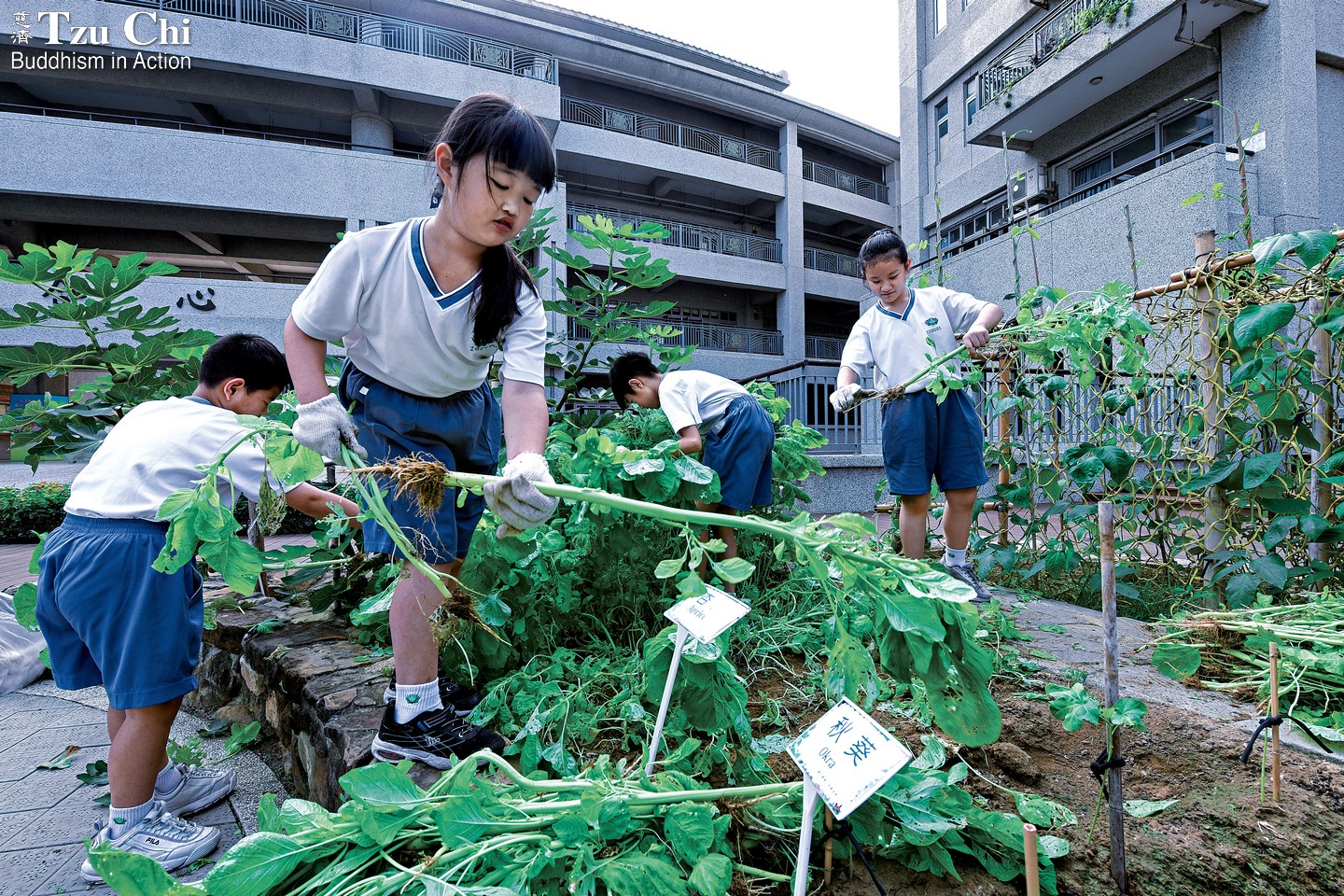
Students in the elementary division of Tainan Tzu Chi Senior High School harvest amaranth plants on campus. Participating in farming activities helps children develop a connection with the earth and nurtures a sense of gratitude for their daily food.
Many parents struggle to persuade their children to eat vegetables and are often met with resistance, such as tightly closed mouths or tears. A psychological experiment at Yale University showed that toddlers aged eight to 18 months instinctively avoided real plants when presented with both man-made and natural objects. This avoidance is possibly an evolved survival mechanism to avoid potential poisoning or harm from thorns or fuzz. Understanding such instinctive behaviors highlights the importance of teaching children about a balanced diet and the origins of their food. Effective food and agricultural education is essential in shaping healthy eating habits and fostering a deeper appreciation for food.
Taiwan has been making efforts to promote food and agricultural education, as evidenced by the recent passing of the Food and Agricultural Education Act in April 2022. This legislation outlines six key principles: supporting local agriculture; promoting balanced diets; reducing food waste; preserving and innovating food culture; strengthening the link between food and agriculture; and advocating for sustainable local production and consumption. Encouraged by the Ministry of Education, many teachers and students visit produce farms, fisheries, livestock farms, and food processing plants to learn more about food production. Many schools even grow vegetables and fruits on campus or raise chickens to lay eggs, providing students with hands-on learning opportunities right at school.
The kitchen garden at the Tainan Tzu Chi school mentioned earlier was created even before the Food and Agricultural Education Act was passed. Yen Hsiu-wen, the director of academic affairs in the elementary division of the school, views the garden as a “landscape dining table,” allowing children to cultivate and witness the growth of fruits and vegetables they regularly consume. “Through observing, recording, and reflecting on how a tiny seed grows into a mature plant,” she explained, “children come to understand that cultivating vegetables is no simple task. They also learn that food goes through additional steps, such as transportation and cooking, before it ends up on our dining tables. Appreciating the effort involved helps develop a deeper sense of gratitude for our food.”
Successful food and agricultural education should foster a sense of connection with and care for food, the land, and all those involved in the food production process. Professor Chiu Yie-ju (邱奕儒), the director of the Master’s Program in Sustainability and Disaster Management at Tzu Chi University, in eastern Taiwan, pointed out that one of humanity’s most severe problems is the lack of understanding about how our food grows from the land, resulting in a loss of connection with the earth. When people reconnect with the land, they naturally gain security and develop inner confidence.
“Food and agricultural education should start as early as possible,” Chiu asserted. Understanding how food is grown and harvested helps cultivate much-needed virtues, including an appreciation for food, mindfulness of reducing waste, and respect for the environment.
By Yeh Tzu-hao
Abridged and translated by Wu Hsiao-ting
Photo by Yan Lin-zhao
From planting seeds and tending crops to harvesting, transporting, and cooking, the journey of food from the field to our dining table is far from simple.
“Look, earthworms!” an elementary student exclaimed while pulling up some amaranth plants from the soil, alerting his peers to be mindful of the creatures below.
The elementary division of Tainan Tzu Chi Senior High School maintains a small kitchen garden on campus, where parent gardening volunteers and students participating in the U.S.-Taiwan Eco-Campus Partnership Program grow various vegetables and fruits. Every Friday morning, these adults and children put on cotton gloves, grab hoes and shovels, and get to work cultivating the garden together.
They were harvesting amaranth on this particular Friday morning. Pesticides are eschewed in the garden, but not even holes in the leaves caused by cabbage worms could dampen the enthusiasm of the children as they proudly held up some of their amaranth harvest, showcasing their accomplishment. Due to campus food safety requirements, the garden’s produce cannot be added to school lunches. Instead, any harvested vegetables are taken home by volunteers and students, distributed to staff, or given as gifts to visiting guests.
Once the harvesting was complete, the gardening volunteers showed the children how to prepare the soil for planting new vegetables. A white-haired volunteer then guided the students in evenly dispersing water spinach seeds on the vegetable bed where the amaranth had been, reminding them to be gentle when covering the seeds with soil. She mentioned that in just three days, they would be able to see the seeds sprouting.
The farming activities began at eight o’clock and concluded in about half an hour. During this time, the students completed tasks such as harvesting, soil preparation, seed sowing, fertilizing, and watering. Despite the sweat on their faces and the dirt on their hands and legs, everyone enjoyed the process. It was mid-April; the vegetables would be ripe for harvest by late May or early June.
“This kind of agricultural labor is hard to experience nowadays unless parents specifically take their children to the fields on weekends or holidays,” said Xu Rong-sheng (徐榮勝), chairman of Tainan Tzu Chi Senior High School’s Parents’ Association. “But here at the Tzu Chi school, we have the opportunity to experience farming right on campus.” Xu, who was volunteering in the garden that day, shared that he became a gardening volunteer when his son was in second grade at the school. Though his son is now in eighth grade, he is still leading elementary students to cultivate vegetables.
“Growing vegetables isn’t easy,” Xu added. “From germination to maturity, it requires a lot of care. When children understand how vegetables are grown, they will better appreciate what’s in their bowls and be more likely to finish their food.”
Students in the elementary division of Tainan Tzu Chi Senior High School harvest amaranth plants on campus. Participating in farming activities helps children develop a connection with the earth and nurtures a sense of gratitude for their daily food.
Many parents struggle to persuade their children to eat vegetables and are often met with resistance, such as tightly closed mouths or tears. A psychological experiment at Yale University showed that toddlers aged eight to 18 months instinctively avoided real plants when presented with both man-made and natural objects. This avoidance is possibly an evolved survival mechanism to avoid potential poisoning or harm from thorns or fuzz. Understanding such instinctive behaviors highlights the importance of teaching children about a balanced diet and the origins of their food. Effective food and agricultural education is essential in shaping healthy eating habits and fostering a deeper appreciation for food.
Taiwan has been making efforts to promote food and agricultural education, as evidenced by the recent passing of the Food and Agricultural Education Act in April 2022. This legislation outlines six key principles: supporting local agriculture; promoting balanced diets; reducing food waste; preserving and innovating food culture; strengthening the link between food and agriculture; and advocating for sustainable local production and consumption. Encouraged by the Ministry of Education, many teachers and students visit produce farms, fisheries, livestock farms, and food processing plants to learn more about food production. Many schools even grow vegetables and fruits on campus or raise chickens to lay eggs, providing students with hands-on learning opportunities right at school.
The kitchen garden at the Tainan Tzu Chi school mentioned earlier was created even before the Food and Agricultural Education Act was passed. Yen Hsiu-wen, the director of academic affairs in the elementary division of the school, views the garden as a “landscape dining table,” allowing children to cultivate and witness the growth of fruits and vegetables they regularly consume. “Through observing, recording, and reflecting on how a tiny seed grows into a mature plant,” she explained, “children come to understand that cultivating vegetables is no simple task. They also learn that food goes through additional steps, such as transportation and cooking, before it ends up on our dining tables. Appreciating the effort involved helps develop a deeper sense of gratitude for our food.”
Successful food and agricultural education should foster a sense of connection with and care for food, the land, and all those involved in the food production process. Professor Chiu Yie-ju (邱奕儒), the director of the Master’s Program in Sustainability and Disaster Management at Tzu Chi University, in eastern Taiwan, pointed out that one of humanity’s most severe problems is the lack of understanding about how our food grows from the land, resulting in a loss of connection with the earth. When people reconnect with the land, they naturally gain security and develop inner confidence.
“Food and agricultural education should start as early as possible,” Chiu asserted. Understanding how food is grown and harvested helps cultivate much-needed virtues, including an appreciation for food, mindfulness of reducing waste, and respect for the environment.
Text and photo by Tzu Chi documenting volunteers
Edited and translated by Wu Hsiao-ting
Tzu Chi’s direct cash aid brings hope and warmth to earthquake victims on Japan’s Noto Peninsula.
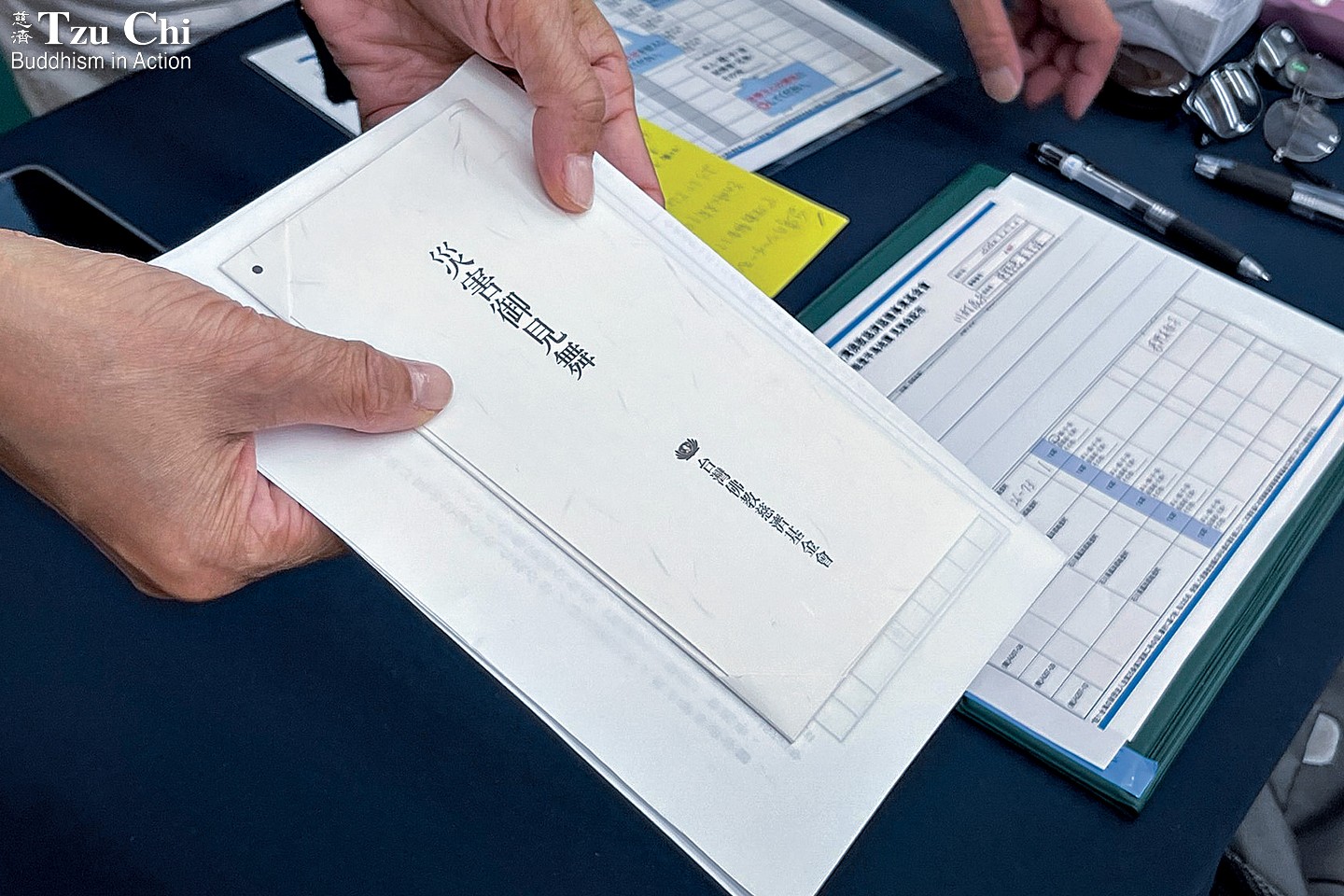
Photo by Wang Meng-zhuan
On New Year’s Day, an earthquake struck Japan’s Noto Peninsula, in Ishikawa Prefecture, resulting in 260 deaths, 1,200 injuries, and damage to 80,000 houses. The quake also destroyed the only road into and out of the Noto Peninsula, complicating rescue and demolition efforts.
Even after the road was repaired, the severe damage to hotels left demolition crews nowhere to stay and slowed efforts to rebuild. For example, the earthquake destroyed about 4,000 houses in Suzu City, the area closest to the epicenter. Although a thousand people there applied for government-funded demolition, only a few cases had been completed months after the quake.
Given the extent of the damage, residents were in need of cash assistance for reconstruction. Prefectural and town offices announced emergency support funds with various subsidy measures, but many residents, especially the elderly, were unsure how to apply. Insufficient administrative manpower in the disaster area further delayed the application process.
Amidst this uncertainty, it was announced that Tzu Chi would be distributing cash aid. Many residents were hopeful but skeptical. However, from May 17 to 19, representatives from 1,091 households in the town of Anamizu received financial assistance from the foundation. They could not believe such timely help!
Tzu Chi began distributing cash assistance in mid-May and will continue into July. The aid is directed at families with homes meeting two criteria: being over 50 percent damaged and having elderly residents aged 65 and above. The targeted areas include the towns and cities of Anamizu, Noto, Nakanoto, Wajima, Shika, and Suzu. Depending on their size, households have received or will receive amounts of 130,000, 150,000, or 170,000 Japanese yen (US$825-$1,080).
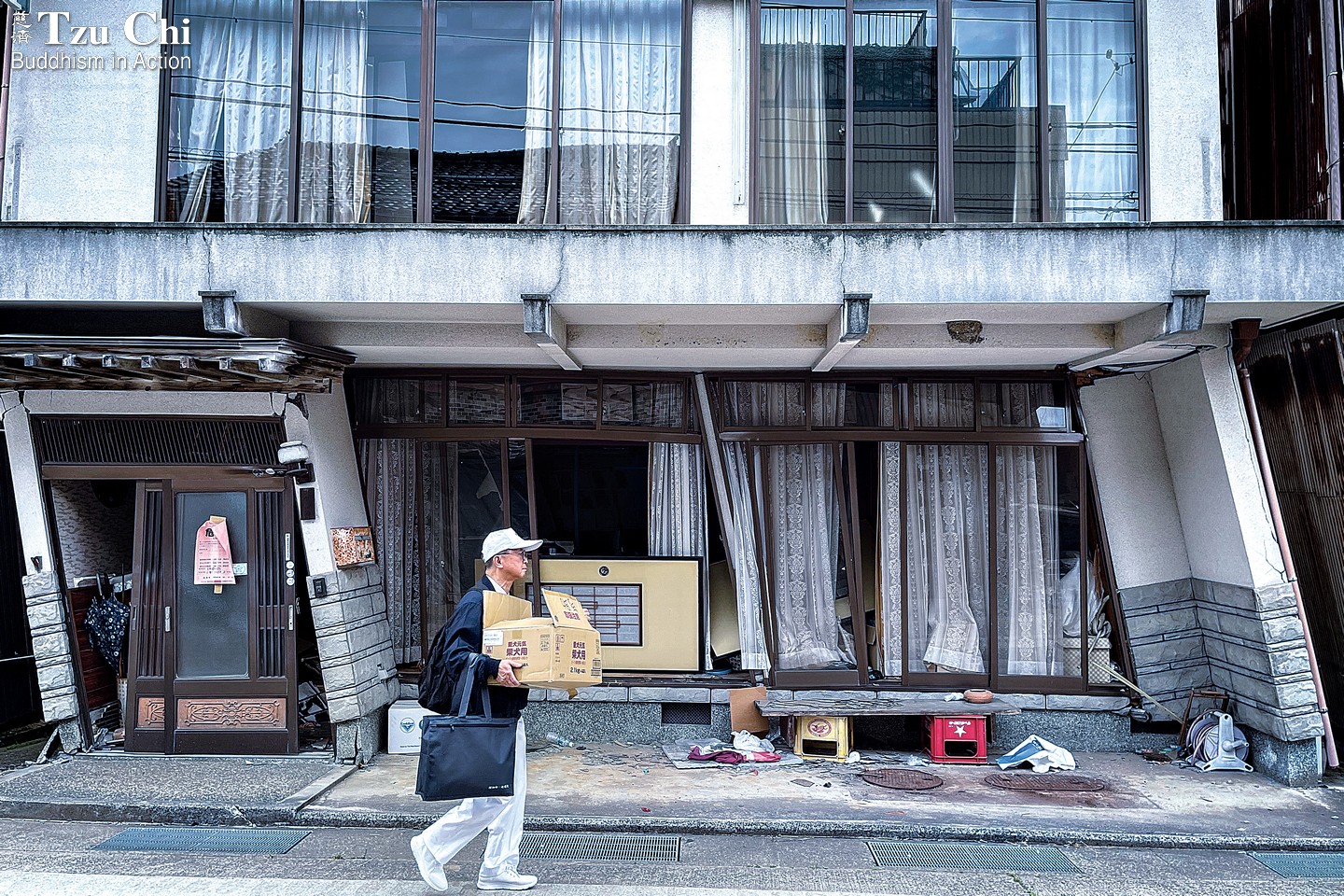
Tzu Chi volunteers and a quake survivor bow to each other during a cash aid distribution at the Noto town office in Japan’s Ishikawa Prefecture on June 9.
The first round of distributions took place in Anamizu, where Tzu Chi focused its care after the earthquake. Between January 13 and March 30, volunteers from Tokyo and Osaka, along with residents participating in a Tzu Chi work relief program, provided over 20,000 servings of hot meals and drinks in the town.
The second set of cash aid distributions were held from June 7 to 9 in the town of Noto, where 722 households received aid. Noto is renowned for its farming practices that harmonize with nature, which have earned recognition as a Globally Important Agricultural Heritage System. The earthquake on New Year’s Day caused many old houses in the town to collapse, tilt, or crumble. Some houses began to sink when the soil liquefied in the shaking.
Twelve evacuation centers with over a hundred residents were still open in the town when Tzu Chi held its distributions there. Nearly half of the town’s population is elderly and settlements are dispersed, so Tzu Chi and the local government organized five distributions to ensure easy access for the elderly. Though volunteers arrived early at each location to set up, they were never early enough to beat the residents already waiting for them.
Although privacy is highly regarded in Japanese culture, the local government understood Tzu Chi’s principle of direct disaster relief, which aims to distribute aid personally, without intermediaries. Although the local government wouldn’t provide a list of affected households to Tzu Chi, they arranged for civil servants to verify the identities of recipients in the reception area of the distribution venue. Then, Tzu Chi volunteers guided recipients to service counters to gather and verify additional information necessary for them to receive assistance. Finally, recipients were directed to the interaction area where they could rest and converse with volunteers.
Seventy-six-year-old Yoshimatsu Yokochi said he was initially skeptical when he received a notification letter from the town office about Tzu Chi’s distribution, but he decided to check it out in person. Once he was there, he kept asking, “Are we really getting cash? Not a bank transfer?” He just couldn’t believe he would be receiving 150,000 yen in cash.
He and his wife were staying at a friend’s home at the time. “We’re still waiting for the city office to demolish our house,” he said, “but we don’t know when that will happen.” He was very touched when he learned the source of Tzu Chi’s relief funds and said he would cherish the money and put it towards building a new home for his wife and children. Although his children and grandchildren only visit once or twice a year, he still hoped to provide them with a home for their stays.
He added that he would tell his children about Tzu Chi’s help to encourage them to pay the love forward. “I feel your warmth,” he said, “and now I feel motivated and hopeful about building a new home.” He and his wife smiled kindly at the volunteers receiving them, saying, “We look forward to having you visit our new home.”
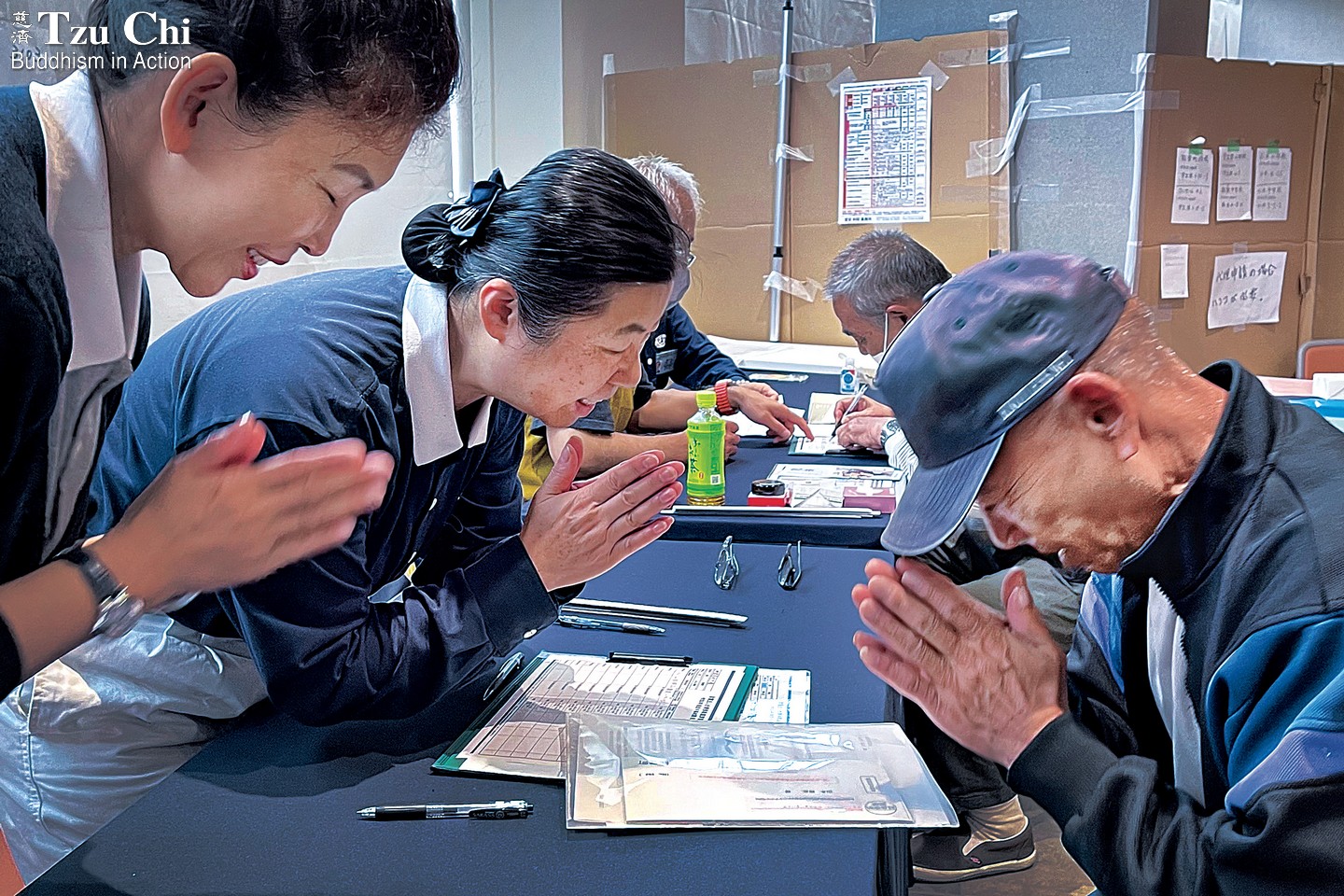
A volunteer passes a damaged house in the fishing village of Ukawa, Noto, on his way to distribute aid on June 9. Yan Wan-ting
Many people were amazed that Tzu Chi volunteers personally delivered cash to them. Exclamations like, “We can’t express how thankful we are!” were heard repeatedly at the distributions. Eighty-one-year-old Sachiko Matsuda said this several times herself.
Mrs. Matsuda lives with her 84-year-old husband, Sodetosio, and two other family members. She wiped away tears after receiving aid from Tzu Chi and agreed to let volunteers accompany her home to see how the quake had affected their house. The group arrived at a traditional Japanese-style house on a slope.
“I was cooking in the kitchen when the earthquake hit,” Mrs. Matsuda told the visitors. “I quickly rushed to the entrance of our home, but the shaking was so severe I couldn’t stay on my feet.” Her husband was holding on to the door, unable to stand up or get out. She hugged his waist, and their daughter and granddaughter hugged hers. The four of them clung together, unable to make it out of their house. Still haunted by the memory, she remembered feeling like the sky was falling. Mr. Matsuda, on the other hand, said that his only thought during the earthquake was that the house was about to collapse. He felt hopeless. “Now that I’m still alive and my family is safe,” he said, “I consider us really lucky.”
Because a wall of their home collapsed during the tremor, the whole family had to move to a nearby shelter. There was no running water or electricity in the aftermath of the disaster, so local women gathered and worked together to cook with small gas stoves. After living like this for ten days, the family rented a house near a relative’s home in Kanazawa, the capital of Ishikawa Prefecture. They lived there for some time but wanted to return to their own home, so they tidied it up the best they could and settled back in.
Mrs. Matsuda told the volunteers that it had cost them more than 2.8 million yen (US$17,760) to have a contractor repair a bedroom and kitchen. She added that it would cost at least ten million yen to have everything repaired. “The contractor hasn’t invoiced us yet,” she said. “The money from Tzu Chi will help cover the repair costs, which will make our lives a little easier.”
Many residents expressed deep gratitude for the volunteers’ comforting words and attentive listening. One resident said, “It’s not about the money you provided, but the fact that you came from afar to help us.” She was referring to the volunteers who had traveled all the way from Taiwan. “The warmth and love we received from you is priceless!”
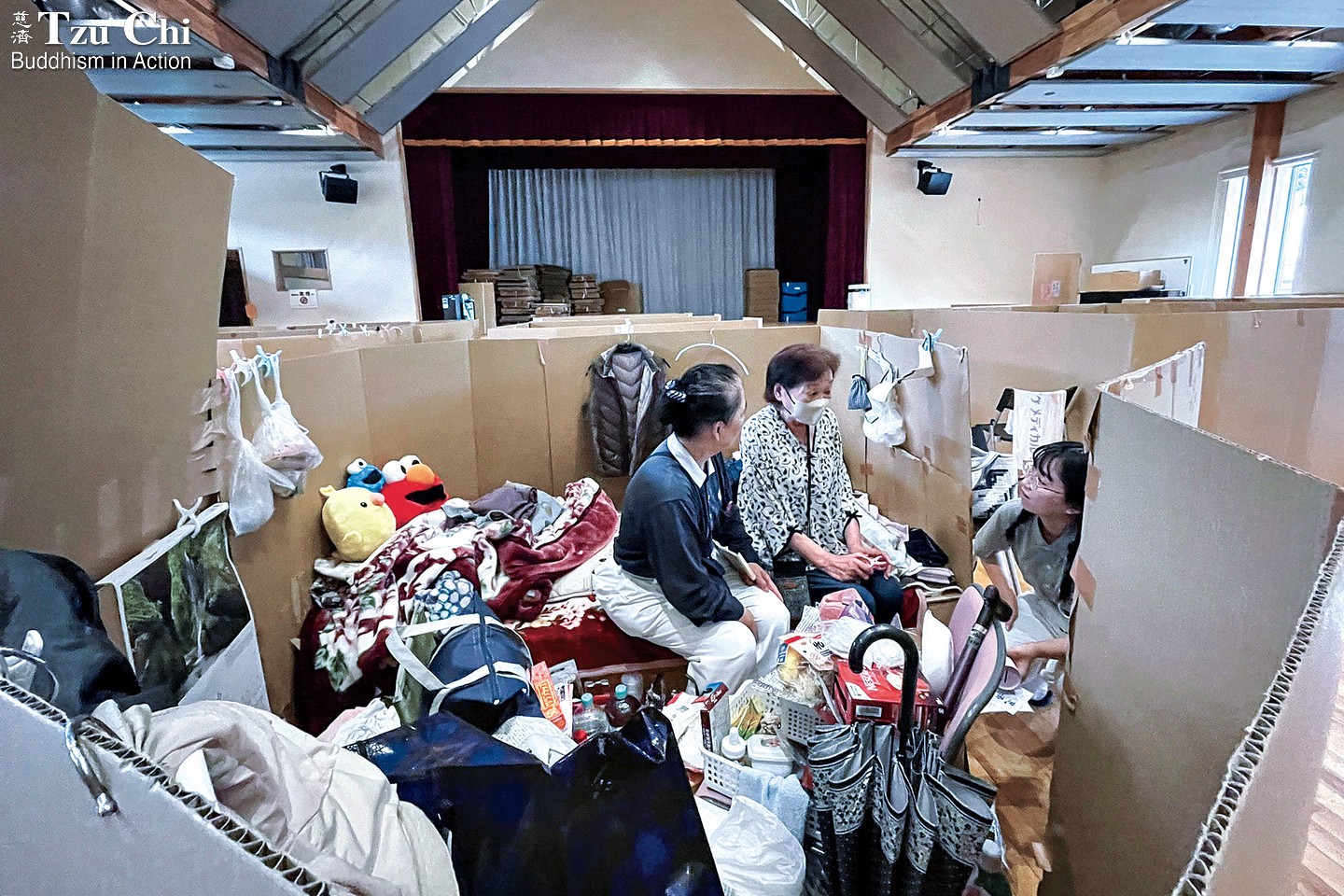
Honya Shimako, pictured here at her evacuation center, thanks Tzu Chi volunteers for traveling from afar to help them, giving them strength. Jessica Yang
After receiving her cash aid, Shimako Motoya led a small group of Tzu Chi volunteers back to the evacuation center where she was staying, right next to the town office. She had been sheltering there for over five months, using cardboard to section off a bedroom. She planned to move to a friend’s house in mid-June. “Thank you for the cash aid,” she said to the volunteers. “I’ll use it to buy daily necessities. But more importantly, thank you for coming. Your presence gives me strength.”
Sixty-seven-year-old fisherman Masahiro Yamamoto also agreed to show volunteers his temporary housing, which was built in Fujinami Sports Park. The housing complex there accommodated about 120 families. Each unit was approximately 25 square meters (265 square feet) and featured a bathroom with separate wet and dry areas, a small kitchen equipped with household appliances, including a refrigerator and a microwave, and two small rooms, one of which served as a living room. Mrs. Yamamoto expressed satisfaction with their current living conditions.
The road in front of the Yamamotos’ old residence sank 3.5 meters (11 feet), causing the house to tilt forward. The couple stayed at two evacuation centers before moving into their current temporary housing in May, which brought more stability to their lives. “I worked hard my entire life to support my family and am now blessed with many children and grandchildren,” Yamamoto said. “I never expected to face something like this at my age, but there’s nothing we can do.” He mentioned that their 30-year-old house—which looked undamaged apart from its tilt—would soon be dismantled. The thought filled him with indescribable sadness.
Their temporary housing was only available for two years, so Yamamoto thought about applying for government disaster recovery housing. Despite being retired, he could use his pension to help cover the monthly fee. He mentioned that Tzu Chi was the first and only charity to distribute cash in the disaster area and that he felt honored to receive the help.
Seventy-year-old Mikio Ueno made a special trip from Kanazawa by bus to receive the cash aid. He recalled how the town office broadcast a warning of an impending tsunami after two strong shocks on January 1, urging residents to evacuate. He and his wife quickly prepared to flee. However, their house had deformed and tilted, trapping them inside. Despite her frailness, Mrs. Ueno managed to break a reinforced glass window with her bare hands, allowing them to escape. Barefoot, they hurried to a nearby temple to borrow two pairs of shoes before fleeing to higher ground.
Afterwards, they rented a house in Kanazawa. The landlord was reluctant to rent to older people, so they rented under their son’s name. Mr. Ueno used to work in the fish trade but was now unemployed. He said he planned to use Tzu Chi’s aid to buy household appliances.
“Thank you for coming from afar to help us,” said Mrs. Ueno. “Not only did you distribute cash to us, but you also served us hot tea and snacks, and gave us good-luck ornaments. I never expected to receive so much.” She choked up with emotion as she spoke.
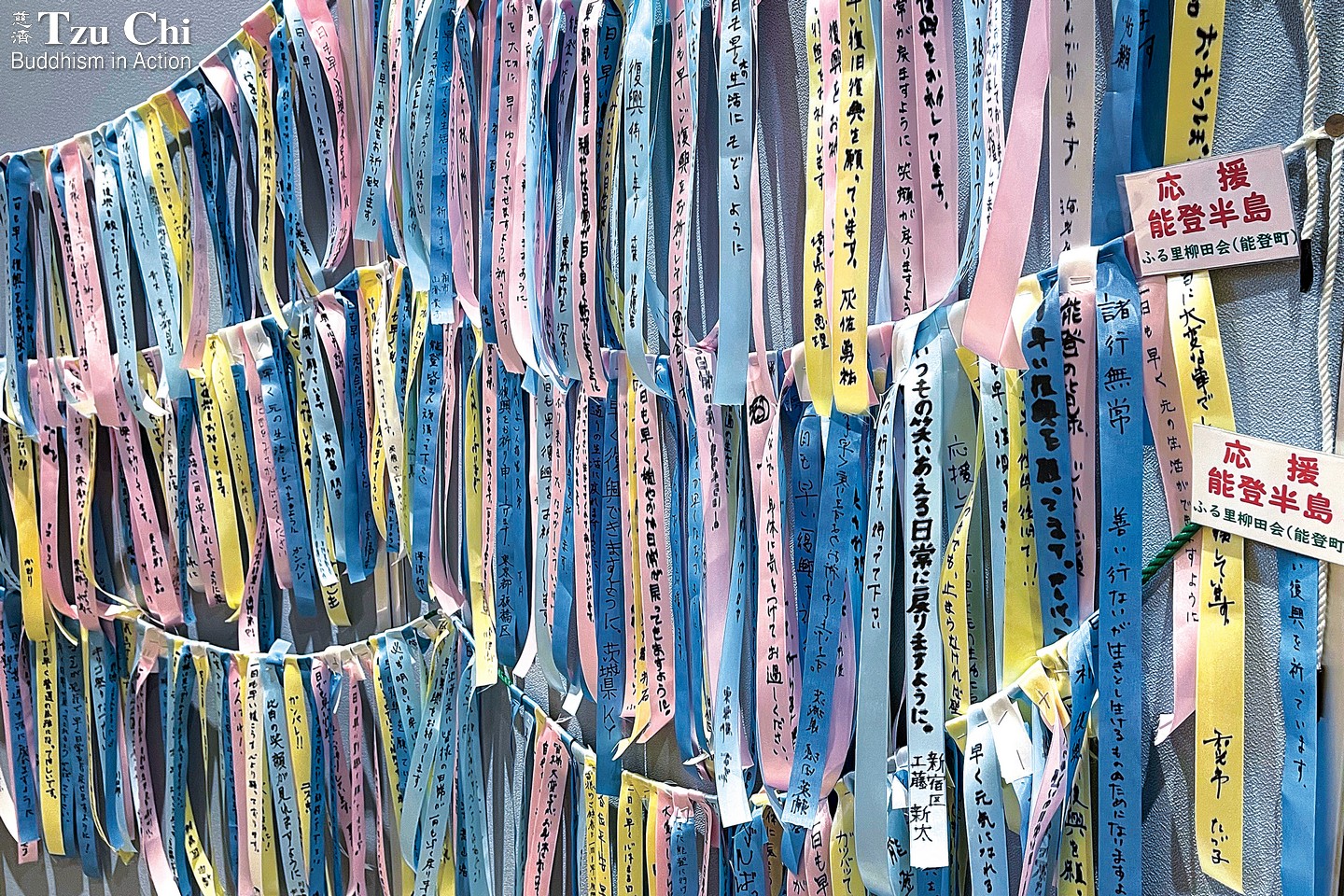
At the entrance of the Noto town office, numerous cards and ribbons from various locations adorn the area, bearing messages of encouragement and blessings for the local earthquake victims. Yan Wan-ting
Tzu Chi volunteers repeatedly visited the disaster area for six months following the earthquake. They assessed the damage, provided hot meals, discussed aid distribution plans with relevant agencies, and then followed up with distributions.
Xu Li-xiang (許麗香), CEO of Tzu Chi Japan, shared that her mind was filled with images of the local residents’ gratitude each time she returned to Tokyo from the disaster area. She recounted the story of an older farmer who said, “My bank account is running out of money, and I’m worried about the water source for my fields. A few days ago, I brought two tons of water from a river, but I’m unsure if it will be enough for my vegetables to sprout. Receiving such a large amount of money from you is truly like timely rain.”
Xu complimented the Noto Peninsula not only for its beautiful scenery but also for its people and their spirit of deep gratitude. “Residents kept shedding tears, saying Taiwan was similarly affected after the strong earthquake in Hualien on April 3. How could they not be moved, knowing Tzu Chi volunteers still came personally to help them?”
In mid-June, Wajima city announced that Tzu Chi would distribute cash aid at the end of the month, leading to a flood of inquiries to Tzu Chi Japan. Evacuees sheltering out of town were moved and expressed their determination to return home to receive the aid. Despite the endless calls, volunteers said that the chance to express the love from around the world to the quake survivors was truly a great joy.
Text and photo by Tzu Chi documenting volunteers
Edited and translated by Wu Hsiao-ting
Tzu Chi’s direct cash aid brings hope and warmth to earthquake victims on Japan’s Noto Peninsula.
Photo by Wang Meng-zhuan
On New Year’s Day, an earthquake struck Japan’s Noto Peninsula, in Ishikawa Prefecture, resulting in 260 deaths, 1,200 injuries, and damage to 80,000 houses. The quake also destroyed the only road into and out of the Noto Peninsula, complicating rescue and demolition efforts.
Even after the road was repaired, the severe damage to hotels left demolition crews nowhere to stay and slowed efforts to rebuild. For example, the earthquake destroyed about 4,000 houses in Suzu City, the area closest to the epicenter. Although a thousand people there applied for government-funded demolition, only a few cases had been completed months after the quake.
Given the extent of the damage, residents were in need of cash assistance for reconstruction. Prefectural and town offices announced emergency support funds with various subsidy measures, but many residents, especially the elderly, were unsure how to apply. Insufficient administrative manpower in the disaster area further delayed the application process.
Amidst this uncertainty, it was announced that Tzu Chi would be distributing cash aid. Many residents were hopeful but skeptical. However, from May 17 to 19, representatives from 1,091 households in the town of Anamizu received financial assistance from the foundation. They could not believe such timely help!
Tzu Chi began distributing cash assistance in mid-May and will continue into July. The aid is directed at families with homes meeting two criteria: being over 50 percent damaged and having elderly residents aged 65 and above. The targeted areas include the towns and cities of Anamizu, Noto, Nakanoto, Wajima, Shika, and Suzu. Depending on their size, households have received or will receive amounts of 130,000, 150,000, or 170,000 Japanese yen (US$825-$1,080).
Tzu Chi volunteers and a quake survivor bow to each other during a cash aid distribution at the Noto town office in Japan’s Ishikawa Prefecture on June 9.
The first round of distributions took place in Anamizu, where Tzu Chi focused its care after the earthquake. Between January 13 and March 30, volunteers from Tokyo and Osaka, along with residents participating in a Tzu Chi work relief program, provided over 20,000 servings of hot meals and drinks in the town.
The second set of cash aid distributions were held from June 7 to 9 in the town of Noto, where 722 households received aid. Noto is renowned for its farming practices that harmonize with nature, which have earned recognition as a Globally Important Agricultural Heritage System. The earthquake on New Year’s Day caused many old houses in the town to collapse, tilt, or crumble. Some houses began to sink when the soil liquefied in the shaking.
Twelve evacuation centers with over a hundred residents were still open in the town when Tzu Chi held its distributions there. Nearly half of the town’s population is elderly and settlements are dispersed, so Tzu Chi and the local government organized five distributions to ensure easy access for the elderly. Though volunteers arrived early at each location to set up, they were never early enough to beat the residents already waiting for them.
Although privacy is highly regarded in Japanese culture, the local government understood Tzu Chi’s principle of direct disaster relief, which aims to distribute aid personally, without intermediaries. Although the local government wouldn’t provide a list of affected households to Tzu Chi, they arranged for civil servants to verify the identities of recipients in the reception area of the distribution venue. Then, Tzu Chi volunteers guided recipients to service counters to gather and verify additional information necessary for them to receive assistance. Finally, recipients were directed to the interaction area where they could rest and converse with volunteers.
Seventy-six-year-old Yoshimatsu Yokochi said he was initially skeptical when he received a notification letter from the town office about Tzu Chi’s distribution, but he decided to check it out in person. Once he was there, he kept asking, “Are we really getting cash? Not a bank transfer?” He just couldn’t believe he would be receiving 150,000 yen in cash.
He and his wife were staying at a friend’s home at the time. “We’re still waiting for the city office to demolish our house,” he said, “but we don’t know when that will happen.” He was very touched when he learned the source of Tzu Chi’s relief funds and said he would cherish the money and put it towards building a new home for his wife and children. Although his children and grandchildren only visit once or twice a year, he still hoped to provide them with a home for their stays.
He added that he would tell his children about Tzu Chi’s help to encourage them to pay the love forward. “I feel your warmth,” he said, “and now I feel motivated and hopeful about building a new home.” He and his wife smiled kindly at the volunteers receiving them, saying, “We look forward to having you visit our new home.”
A volunteer passes a damaged house in the fishing village of Ukawa, Noto, on his way to distribute aid on June 9. Yan Wan-ting
Many people were amazed that Tzu Chi volunteers personally delivered cash to them. Exclamations like, “We can’t express how thankful we are!” were heard repeatedly at the distributions. Eighty-one-year-old Sachiko Matsuda said this several times herself.
Mrs. Matsuda lives with her 84-year-old husband, Sodetosio, and two other family members. She wiped away tears after receiving aid from Tzu Chi and agreed to let volunteers accompany her home to see how the quake had affected their house. The group arrived at a traditional Japanese-style house on a slope.
“I was cooking in the kitchen when the earthquake hit,” Mrs. Matsuda told the visitors. “I quickly rushed to the entrance of our home, but the shaking was so severe I couldn’t stay on my feet.” Her husband was holding on to the door, unable to stand up or get out. She hugged his waist, and their daughter and granddaughter hugged hers. The four of them clung together, unable to make it out of their house. Still haunted by the memory, she remembered feeling like the sky was falling. Mr. Matsuda, on the other hand, said that his only thought during the earthquake was that the house was about to collapse. He felt hopeless. “Now that I’m still alive and my family is safe,” he said, “I consider us really lucky.”
Because a wall of their home collapsed during the tremor, the whole family had to move to a nearby shelter. There was no running water or electricity in the aftermath of the disaster, so local women gathered and worked together to cook with small gas stoves. After living like this for ten days, the family rented a house near a relative’s home in Kanazawa, the capital of Ishikawa Prefecture. They lived there for some time but wanted to return to their own home, so they tidied it up the best they could and settled back in.
Mrs. Matsuda told the volunteers that it had cost them more than 2.8 million yen (US$17,760) to have a contractor repair a bedroom and kitchen. She added that it would cost at least ten million yen to have everything repaired. “The contractor hasn’t invoiced us yet,” she said. “The money from Tzu Chi will help cover the repair costs, which will make our lives a little easier.”
Many residents expressed deep gratitude for the volunteers’ comforting words and attentive listening. One resident said, “It’s not about the money you provided, but the fact that you came from afar to help us.” She was referring to the volunteers who had traveled all the way from Taiwan. “The warmth and love we received from you is priceless!”
Honya Shimako, pictured here at her evacuation center, thanks Tzu Chi volunteers for traveling from afar to help them, giving them strength. Jessica Yang
After receiving her cash aid, Shimako Motoya led a small group of Tzu Chi volunteers back to the evacuation center where she was staying, right next to the town office. She had been sheltering there for over five months, using cardboard to section off a bedroom. She planned to move to a friend’s house in mid-June. “Thank you for the cash aid,” she said to the volunteers. “I’ll use it to buy daily necessities. But more importantly, thank you for coming. Your presence gives me strength.”
Sixty-seven-year-old fisherman Masahiro Yamamoto also agreed to show volunteers his temporary housing, which was built in Fujinami Sports Park. The housing complex there accommodated about 120 families. Each unit was approximately 25 square meters (265 square feet) and featured a bathroom with separate wet and dry areas, a small kitchen equipped with household appliances, including a refrigerator and a microwave, and two small rooms, one of which served as a living room. Mrs. Yamamoto expressed satisfaction with their current living conditions.
The road in front of the Yamamotos’ old residence sank 3.5 meters (11 feet), causing the house to tilt forward. The couple stayed at two evacuation centers before moving into their current temporary housing in May, which brought more stability to their lives. “I worked hard my entire life to support my family and am now blessed with many children and grandchildren,” Yamamoto said. “I never expected to face something like this at my age, but there’s nothing we can do.” He mentioned that their 30-year-old house—which looked undamaged apart from its tilt—would soon be dismantled. The thought filled him with indescribable sadness.
Their temporary housing was only available for two years, so Yamamoto thought about applying for government disaster recovery housing. Despite being retired, he could use his pension to help cover the monthly fee. He mentioned that Tzu Chi was the first and only charity to distribute cash in the disaster area and that he felt honored to receive the help.
Seventy-year-old Mikio Ueno made a special trip from Kanazawa by bus to receive the cash aid. He recalled how the town office broadcast a warning of an impending tsunami after two strong shocks on January 1, urging residents to evacuate. He and his wife quickly prepared to flee. However, their house had deformed and tilted, trapping them inside. Despite her frailness, Mrs. Ueno managed to break a reinforced glass window with her bare hands, allowing them to escape. Barefoot, they hurried to a nearby temple to borrow two pairs of shoes before fleeing to higher ground.
Afterwards, they rented a house in Kanazawa. The landlord was reluctant to rent to older people, so they rented under their son’s name. Mr. Ueno used to work in the fish trade but was now unemployed. He said he planned to use Tzu Chi’s aid to buy household appliances.
“Thank you for coming from afar to help us,” said Mrs. Ueno. “Not only did you distribute cash to us, but you also served us hot tea and snacks, and gave us good-luck ornaments. I never expected to receive so much.” She choked up with emotion as she spoke.
At the entrance of the Noto town office, numerous cards and ribbons from various locations adorn the area, bearing messages of encouragement and blessings for the local earthquake victims. Yan Wan-ting
Tzu Chi volunteers repeatedly visited the disaster area for six months following the earthquake. They assessed the damage, provided hot meals, discussed aid distribution plans with relevant agencies, and then followed up with distributions.
Xu Li-xiang (許麗香), CEO of Tzu Chi Japan, shared that her mind was filled with images of the local residents’ gratitude each time she returned to Tokyo from the disaster area. She recounted the story of an older farmer who said, “My bank account is running out of money, and I’m worried about the water source for my fields. A few days ago, I brought two tons of water from a river, but I’m unsure if it will be enough for my vegetables to sprout. Receiving such a large amount of money from you is truly like timely rain.”
Xu complimented the Noto Peninsula not only for its beautiful scenery but also for its people and their spirit of deep gratitude. “Residents kept shedding tears, saying Taiwan was similarly affected after the strong earthquake in Hualien on April 3. How could they not be moved, knowing Tzu Chi volunteers still came personally to help them?”
In mid-June, Wajima city announced that Tzu Chi would distribute cash aid at the end of the month, leading to a flood of inquiries to Tzu Chi Japan. Evacuees sheltering out of town were moved and expressed their determination to return home to receive the aid. Despite the endless calls, volunteers said that the chance to express the love from around the world to the quake survivors was truly a great joy.

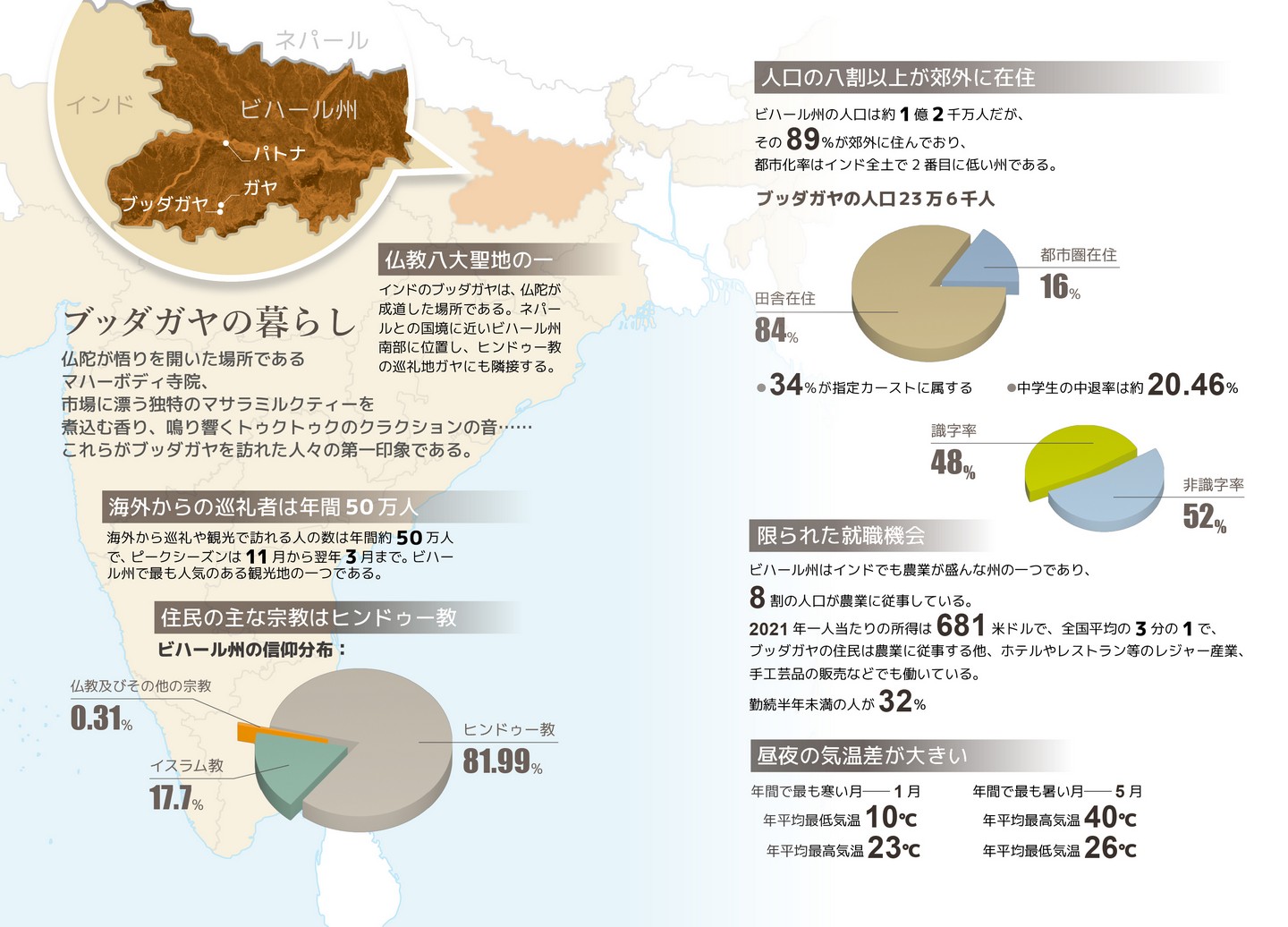
インドのブッダガヤにある世界遺産のマハーボディ寺院は、仏陀が悟りを開いたことを記念し建てられたものである。
二千五百年余り前、シッダールタ王子は、真理を探究するために出家して修行した。菩提樹の下に静座していた時、夜空に輝く明るい星を見て心が無限に広くなり、悟りを得、衆生に対して説法するようになった。物語は今も続いている……。
二〇二三年一月から十一月までに各方面から慈済に連絡があったケアケースは、一万二千件以上に上った。ボランティアが毎月家庭訪問して長期的に援助しているケア世帯は延べ十一万世帯、在宅ケア世帯は延べ十八万世帯を数える。
慈済の慈善活動は既に五十八年の経験があり、台湾社会の少子高齢化の傾向とニーズに応じて、更に「予防」の概念を重視するようになった。即ち、転倒や障害予防、老化と社会への依存を遅らせる上で、台湾の長期介護社会福祉資源ネットワークにおいて、なくてはならない民間の力なのである。
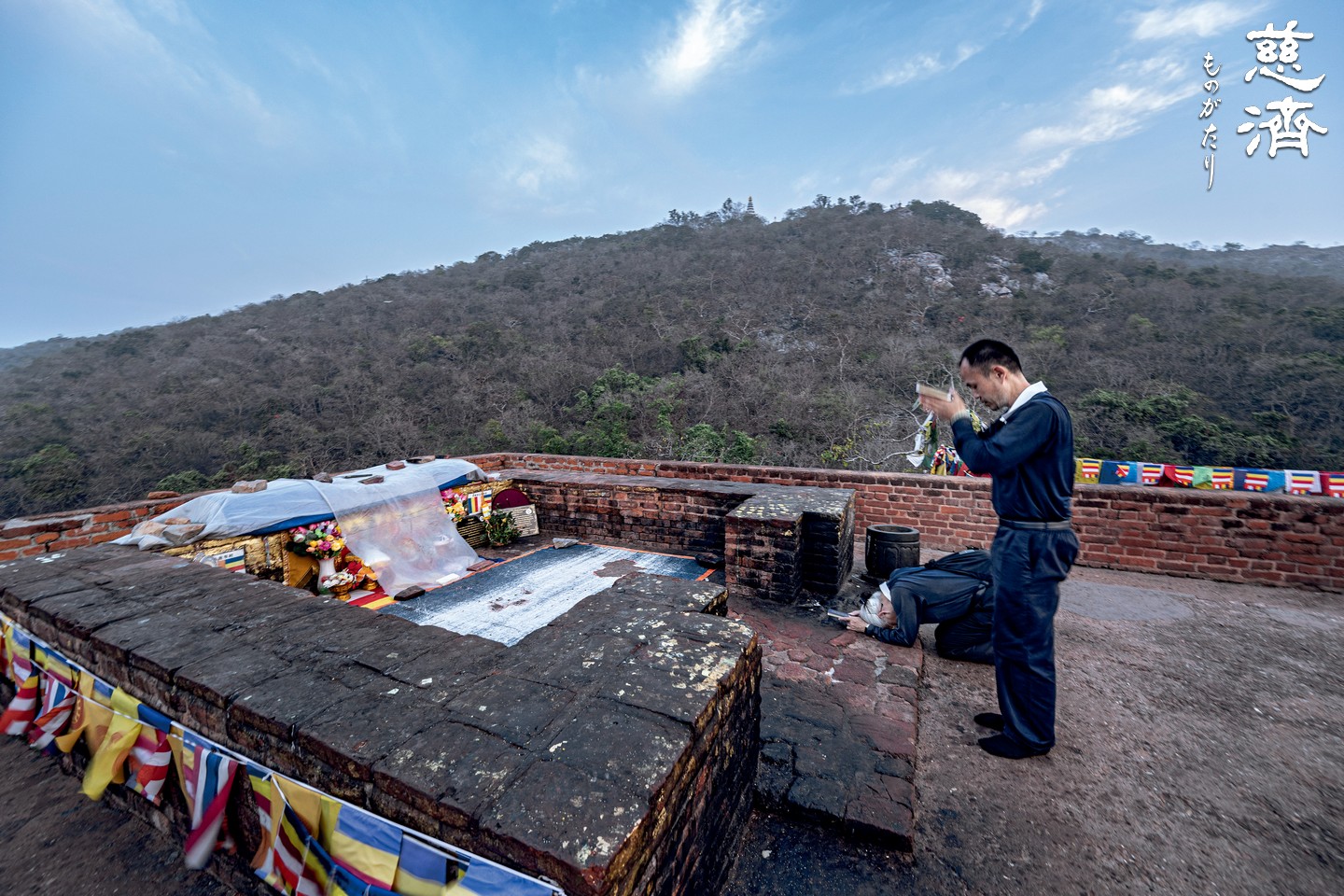
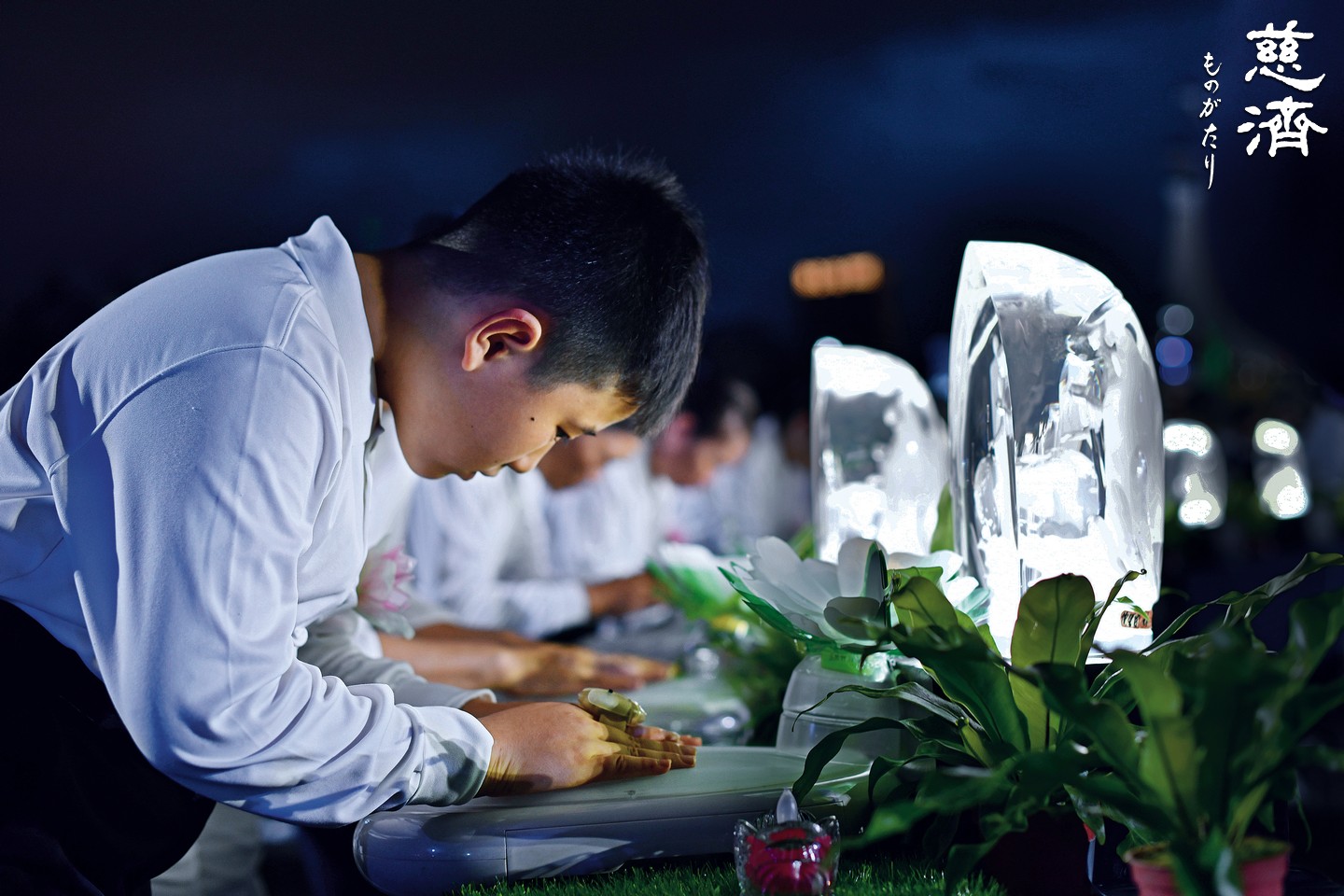
三月末のある朝、夜が明ける頃、霊鷲山の祭壇の前で、慈済ボランティアは《無量義経》を読誦するために礼敬した。
霊鷲山は、仏典では「耆闍崛山(ぎじゃくっせん)」と称されることも多く、今のインド・ビハール州ラージギル郊外に位置し、仏陀が生前頻繁に説法した場所である。説法の一つが《妙法蓮華経》であり、《無量義経》はその真髄として、慈済が五十八年間に亘って精神的拠り所としてきた理念である。
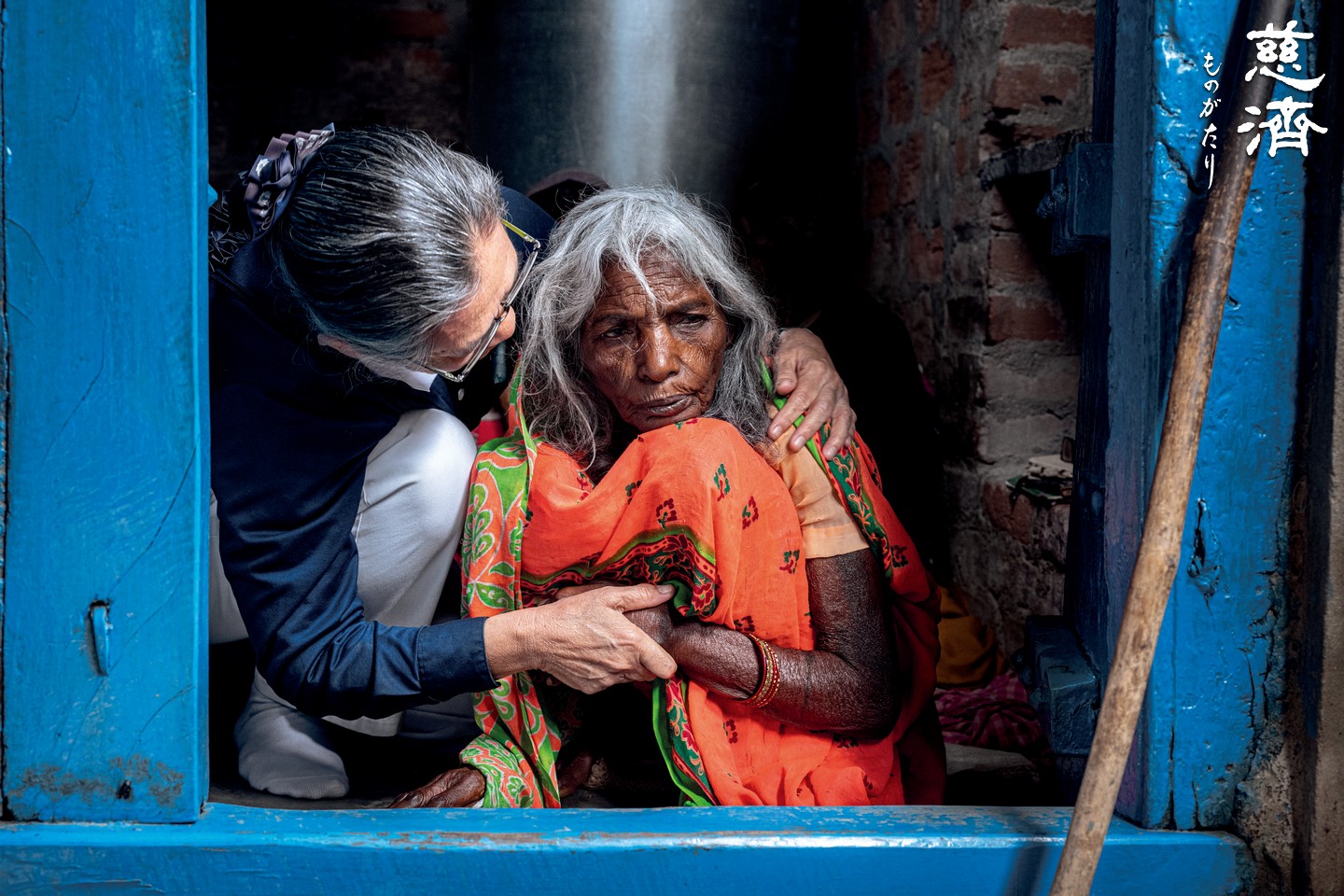
マレーシア慈済ボランティアの陳美聰(チェン・メイツォン)さんは、シロンガ村でケア世帯を再調査した時、事故による怪我のために這う動作しかできなくなった高齢の女性を見舞った。
慈済ボランティアが昨年二月にブッダガヤを訪れた後は、シンガポールとマレーシアのボランティアが交代で駐在し、慈善、医療、教育などの志業を着実に行って、下層階級に属する貧しい村の住民への支援を続けている。「慈悲喜捨」と「衆生の平等」という仏陀の教えを実践しているだけでなく、「仏陀の故郷への恩返し」という師の志を継承した奉仕である。
インドのブッダガヤにある世界遺産のマハーボディ寺院は、仏陀が悟りを開いたことを記念し建てられたものである。
二千五百年余り前、シッダールタ王子は、真理を探究するために出家して修行した。菩提樹の下に静座していた時、夜空に輝く明るい星を見て心が無限に広くなり、悟りを得、衆生に対して説法するようになった。物語は今も続いている……。
二〇二三年一月から十一月までに各方面から慈済に連絡があったケアケースは、一万二千件以上に上った。ボランティアが毎月家庭訪問して長期的に援助しているケア世帯は延べ十一万世帯、在宅ケア世帯は延べ十八万世帯を数える。
慈済の慈善活動は既に五十八年の経験があり、台湾社会の少子高齢化の傾向とニーズに応じて、更に「予防」の概念を重視するようになった。即ち、転倒や障害予防、老化と社会への依存を遅らせる上で、台湾の長期介護社会福祉資源ネットワークにおいて、なくてはならない民間の力なのである。
三月末のある朝、夜が明ける頃、霊鷲山の祭壇の前で、慈済ボランティアは《無量義経》を読誦するために礼敬した。
霊鷲山は、仏典では「耆闍崛山(ぎじゃくっせん)」と称されることも多く、今のインド・ビハール州ラージギル郊外に位置し、仏陀が生前頻繁に説法した場所である。説法の一つが《妙法蓮華経》であり、《無量義経》はその真髄として、慈済が五十八年間に亘って精神的拠り所としてきた理念である。
マレーシア慈済ボランティアの陳美聰(チェン・メイツォン)さんは、シロンガ村でケア世帯を再調査した時、事故による怪我のために這う動作しかできなくなった高齢の女性を見舞った。
慈済ボランティアが昨年二月にブッダガヤを訪れた後は、シンガポールとマレーシアのボランティアが交代で駐在し、慈善、医療、教育などの志業を着実に行って、下層階級に属する貧しい村の住民への支援を続けている。「慈悲喜捨」と「衆生の平等」という仏陀の教えを実践しているだけでなく、「仏陀の故郷への恩返し」という師の志を継承した奉仕である。
四月三日に台湾東部の花蓮県沖で発生した強い地震は、地震に慣れている花蓮の人々を恐怖に陥れ、今も苦しめている。当日、静思精舎に到着したネパールの慈済ボランティア一行は、それでも日程を変えず、直ぐ花蓮ボランティアと一緒に災害支援活動に投入した。ボランティアのユニシュさんは、二〇一五年のネパール地震の後、慈済人が遠くカトマンズまで出向いて支援した諸々のことを思い出した。
「あの地震で、私は家も何もかも無くしました。慈済人が福慧ベッドと毛布を持って来てくれたので、床で寝なくて済みました。被災後四、五年間、一家皆、福慧ベッドで寝ていました。そして九年が経った今も、そのベッドは家にあります。地域の人にとってそのベッドは記憶として留まっています。それは、私たちの最も困難な時に、慈済の援助を受けた記念の品なのです」。
福慧ベッドは片手で持ち上げることができるが、彼の心の中ではずっしりとした存在である。人生で最も困難な時に温めてくれたものだからだ。ユニシュさんは目を潤ませた。それは今回花蓮で恩返しできたことをとても幸せだと思ったからだ。
ネパールボランティアに付き添って台湾に来たマレーシアの慈惟(ツーウェイ)さんによれば、余震が続く中でも逃げ出そうとは思わなかった。心霊の故郷で一緒に天地が揺れ動く経験をし、大地の響きを聴いたことで、「歩く時はそっと、地面が痛まないように」という法師のお言葉を思い出した。一歩一歩傷ついたこの世を労るように慎重に足を運ぶのだ。
この二年間、マレーシアとシンガポールの慈済ボランティアは「仏陀の故郷への恩返し」プロジェクトで先行している。ネパールのルンビニとインドのブッダガヤに交替で長期滞在して、苦難の人々を救済すると同時に、善行して福を作るよう導いている。現地に大乗菩薩法を根付かせ、仏陀の理想を実現するのが目標である。
仏陀は当時の古代インドで衆生に説法をしていた。しかし、「衆生の平等」という生命観を持った仏教思想を説いても、十二、十三世紀にはその土地から消失した。インドのカースト制度は、古代バラモン教のヴェーダ思想に基づくものだが、この制度が早い時期に、インドの憲法の父であり、インド佛教復興者でもあるアンベードカル博士によって廃棄が起草されたが、世襲されるカーストの観念は、未だに現地の人々の日常生活に深く根付いている。
「慈済」月刊誌のチームは、取材でインドに滞在していた一カ月間、伝統的な風土と人情を理解すると共に、今まさに起きている変化も目の当たりにした。シンガポールとマレーシアのボランティアは、仏法の理や慈善活動、人文的な情を取り入れ、身分の差によって区別することなく接することで、少しずつ村民に影響を与えている。少なくとも現地ボランティアは、人と人の交流において、カースト制度に左右されないよう取り計っている。衆生への慈悲こそが、今期号で伝えたい二つの重要な報道の主旨である。
(慈済月刊六九〇期より)
四月三日に台湾東部の花蓮県沖で発生した強い地震は、地震に慣れている花蓮の人々を恐怖に陥れ、今も苦しめている。当日、静思精舎に到着したネパールの慈済ボランティア一行は、それでも日程を変えず、直ぐ花蓮ボランティアと一緒に災害支援活動に投入した。ボランティアのユニシュさんは、二〇一五年のネパール地震の後、慈済人が遠くカトマンズまで出向いて支援した諸々のことを思い出した。
「あの地震で、私は家も何もかも無くしました。慈済人が福慧ベッドと毛布を持って来てくれたので、床で寝なくて済みました。被災後四、五年間、一家皆、福慧ベッドで寝ていました。そして九年が経った今も、そのベッドは家にあります。地域の人にとってそのベッドは記憶として留まっています。それは、私たちの最も困難な時に、慈済の援助を受けた記念の品なのです」。
福慧ベッドは片手で持ち上げることができるが、彼の心の中ではずっしりとした存在である。人生で最も困難な時に温めてくれたものだからだ。ユニシュさんは目を潤ませた。それは今回花蓮で恩返しできたことをとても幸せだと思ったからだ。
ネパールボランティアに付き添って台湾に来たマレーシアの慈惟(ツーウェイ)さんによれば、余震が続く中でも逃げ出そうとは思わなかった。心霊の故郷で一緒に天地が揺れ動く経験をし、大地の響きを聴いたことで、「歩く時はそっと、地面が痛まないように」という法師のお言葉を思い出した。一歩一歩傷ついたこの世を労るように慎重に足を運ぶのだ。
この二年間、マレーシアとシンガポールの慈済ボランティアは「仏陀の故郷への恩返し」プロジェクトで先行している。ネパールのルンビニとインドのブッダガヤに交替で長期滞在して、苦難の人々を救済すると同時に、善行して福を作るよう導いている。現地に大乗菩薩法を根付かせ、仏陀の理想を実現するのが目標である。
仏陀は当時の古代インドで衆生に説法をしていた。しかし、「衆生の平等」という生命観を持った仏教思想を説いても、十二、十三世紀にはその土地から消失した。インドのカースト制度は、古代バラモン教のヴェーダ思想に基づくものだが、この制度が早い時期に、インドの憲法の父であり、インド佛教復興者でもあるアンベードカル博士によって廃棄が起草されたが、世襲されるカーストの観念は、未だに現地の人々の日常生活に深く根付いている。
「慈済」月刊誌のチームは、取材でインドに滞在していた一カ月間、伝統的な風土と人情を理解すると共に、今まさに起きている変化も目の当たりにした。シンガポールとマレーシアのボランティアは、仏法の理や慈善活動、人文的な情を取り入れ、身分の差によって区別することなく接することで、少しずつ村民に影響を与えている。少なくとも現地ボランティアは、人と人の交流において、カースト制度に左右されないよう取り計っている。衆生への慈悲こそが、今期号で伝えたい二つの重要な報道の主旨である。
(慈済月刊六九〇期より)
By Li Qiu-yue, Tzu Chi Teachers Association
Edited and translated by Wu Hsiao-ting
Graphic by Zhong Ting-jia
Is your child still resisting school, even after spending time in elementary? Learn practical tips to ease separation anxiety and foster enjoyable learning experiences.

A concerned mother asked, “Even after some time in elementary school, my child still resists going every day. What can we do?”
Every child who exhibits reluctance towards attending school has their own reasons. They need support from caregivers and educators.
When my friend’s grandson began first grade, he would cry every morning before school, expressing a strong reluctance to attend. All of the family’s efforts to comfort him proved futile. When they asked why he disliked school, he couldn’t articulate a clear answer. The family turned to the child’s homeroom teacher for advice, and she offered several helpful tips that parents could employ with new first graders.
The teacher recommended that before the school year starts, parents should take their new first graders to the elementary school campus to familiarize them with the environment. This could include playing on playground equipment and visiting a first-grade classroom. If a classroom door is open, they could step inside and sit down for a bit. Parents could explain to the child, “This is where you’ll be going to school in the future. There will be new teachers, classmates, and lots of new activities and things to learn.” This initial exposure can lay the foundation for the upcoming school experience and may significantly ease the child’s transition.
Furthermore, after school begins, parents or older members of the family should establish a daily routine with the child. This could mean saying something like, “You’ll finish school at noon, and either Grandpa or I will pick you up and take you home. Then, we can head to the park to play after you finish your homework in the afternoon. How does that sound?” Laying out these plans will give the child a sense of structure and comfort.
The teacher also offered reassurance, remarking that many children initially cry due to separation anxiety. However, as they become more familiar with their teachers, surroundings, and peers over time, these tears typically stop.
Across the street from my house, there’s a set of twins who began first grade last September. Every morning at 7:30 a.m., they’d hold hands and sing nursery rhymes as they headed off to school, returning home hand in hand at 4:30 p.m. I never once heard them cry or refuse to go to school. Similarly, at the end of our lane, a retired school principal had a granddaughter who started first grade with ease. She went to school with a smile every day, thanks to a fourth grader living next door who held her hand and escorted her to school each morning.
To help ease separation anxiety before your child starts first grade, consider arranging for him or her to go to school with neighbors or classmates from the same kindergarten. This can greatly reduce crying and resistance towards attending school.
When first-grade students don’t want to go to school, teachers play a vital role along with family members. If a teacher provides enough support, the struggle against going to school might stop right at the classroom door. My friend shared, “It was like magic! I handed my grandson to the teacher, who gently guided him to his seat. Even though my grandson still had tears in his eyes, the crying and resistance suddenly disappeared.” A teacher’s experience and understanding are pivotal. When my friend’s grandson first started school, he’d spend class time alone in a corner instead of at his desk. However, the teacher didn’t compel him to return to his seat. Instead, she waited until he felt better before helping him to his seat, allowing him to gradually acclimate to the unfamiliar environment. After a month, the child was able to attend school happily.
While many first graders have experience with kindergarten and group settings, some may still feel anxious about new places, teachers, and peers. Parents should be patient as their child adjusts and ensure they stick to agreed-upon pick-up times to build a sense of security and trust. At the same time, teachers must be accommodating to new students and provide reassurance in the school setting. With supportive parents, understanding teachers, and the little ones making friends in class, their separation anxiety will gradually fade away, leading to a happier and more enjoyable school experience.
By Li Qiu-yue, Tzu Chi Teachers Association
Edited and translated by Wu Hsiao-ting
Graphic by Zhong Ting-jia
Is your child still resisting school, even after spending time in elementary? Learn practical tips to ease separation anxiety and foster enjoyable learning experiences.
A concerned mother asked, “Even after some time in elementary school, my child still resists going every day. What can we do?”
Every child who exhibits reluctance towards attending school has their own reasons. They need support from caregivers and educators.
When my friend’s grandson began first grade, he would cry every morning before school, expressing a strong reluctance to attend. All of the family’s efforts to comfort him proved futile. When they asked why he disliked school, he couldn’t articulate a clear answer. The family turned to the child’s homeroom teacher for advice, and she offered several helpful tips that parents could employ with new first graders.
The teacher recommended that before the school year starts, parents should take their new first graders to the elementary school campus to familiarize them with the environment. This could include playing on playground equipment and visiting a first-grade classroom. If a classroom door is open, they could step inside and sit down for a bit. Parents could explain to the child, “This is where you’ll be going to school in the future. There will be new teachers, classmates, and lots of new activities and things to learn.” This initial exposure can lay the foundation for the upcoming school experience and may significantly ease the child’s transition.
Furthermore, after school begins, parents or older members of the family should establish a daily routine with the child. This could mean saying something like, “You’ll finish school at noon, and either Grandpa or I will pick you up and take you home. Then, we can head to the park to play after you finish your homework in the afternoon. How does that sound?” Laying out these plans will give the child a sense of structure and comfort.
The teacher also offered reassurance, remarking that many children initially cry due to separation anxiety. However, as they become more familiar with their teachers, surroundings, and peers over time, these tears typically stop.
Across the street from my house, there’s a set of twins who began first grade last September. Every morning at 7:30 a.m., they’d hold hands and sing nursery rhymes as they headed off to school, returning home hand in hand at 4:30 p.m. I never once heard them cry or refuse to go to school. Similarly, at the end of our lane, a retired school principal had a granddaughter who started first grade with ease. She went to school with a smile every day, thanks to a fourth grader living next door who held her hand and escorted her to school each morning.
To help ease separation anxiety before your child starts first grade, consider arranging for him or her to go to school with neighbors or classmates from the same kindergarten. This can greatly reduce crying and resistance towards attending school.
When first-grade students don’t want to go to school, teachers play a vital role along with family members. If a teacher provides enough support, the struggle against going to school might stop right at the classroom door. My friend shared, “It was like magic! I handed my grandson to the teacher, who gently guided him to his seat. Even though my grandson still had tears in his eyes, the crying and resistance suddenly disappeared.” A teacher’s experience and understanding are pivotal. When my friend’s grandson first started school, he’d spend class time alone in a corner instead of at his desk. However, the teacher didn’t compel him to return to his seat. Instead, she waited until he felt better before helping him to his seat, allowing him to gradually acclimate to the unfamiliar environment. After a month, the child was able to attend school happily.
While many first graders have experience with kindergarten and group settings, some may still feel anxious about new places, teachers, and peers. Parents should be patient as their child adjusts and ensure they stick to agreed-upon pick-up times to build a sense of security and trust. At the same time, teachers must be accommodating to new students and provide reassurance in the school setting. With supportive parents, understanding teachers, and the little ones making friends in class, their separation anxiety will gradually fade away, leading to a happier and more enjoyable school experience.
By Yeh Tzu-hao
Translated by Wu Hsiao-ting
Photos by Yan Lin-zhao
With over 700 million people facing hunger worldwide, taking only what you can eat is a virtue. Elementary students at a Tzu Chi school in southern Taiwan are showing their values by taking action and doing their part
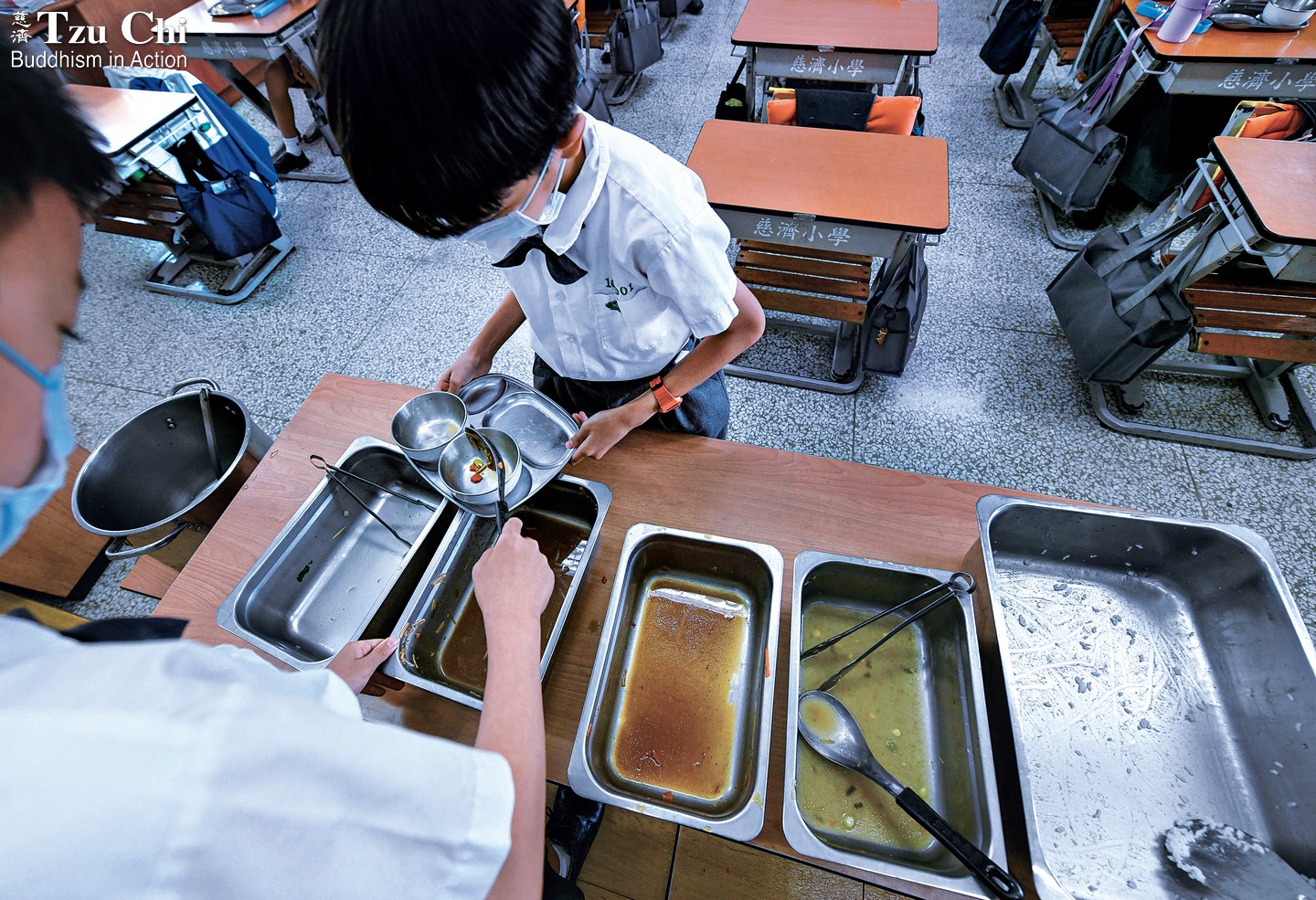
Empty food serving trays serve as evidence of the efforts made by this elementary class at Tainan Tzu Chi Senior High School to minimize food waste.
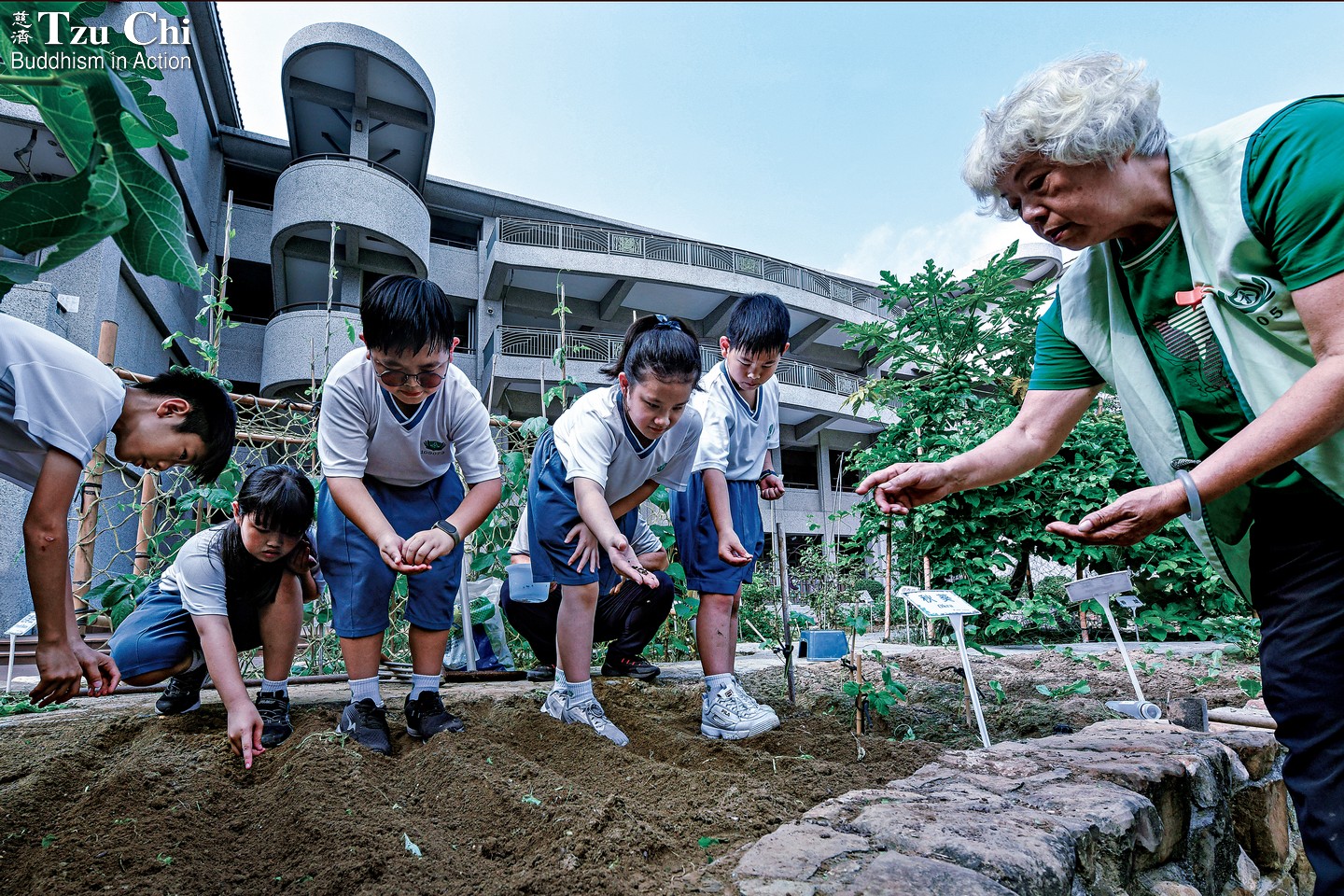
With the guidance of a gardening volunteer, students in the elementary division of Tainan Tzu Chi Senior High School sow water spinach seeds and carefully cover them with soil. Through firsthand farming experience, they learn to appreciate the effort required to cultivate food.
The Clean Plate Campaign
By Yeh Tzu-hao
Translated by Wu Hsiao-ting
Photos by Yan Lin-zhao
The leftover food from school lunches each day at Tainan Tzu Chi Senior High School’s elementary division has decreased from 35 kilograms three years ago to just three kilograms now. How did more than 600 elementary students achieve this?
Every school day, before lunch, students from the elementary school division of Tainan Tzu Chi Senior High School in southern Taiwan sing the “Gratitude Song”: “Each grain of rice, spoonful of soup, and piece of vegetable on our plates comes with great effort. Let’s savor each bite mindfully and be grateful to all those involved in making our food possible.” This practice helps instill the values of cherishing food in students, and aligns perfectly with the goals of the Clean Plate campaign.
Yen Hsiu-wen (顏秀雯), the director of academic affairs in the elementary school division, explained that the Clean Plate campaign was initiated in 2021 to tackle food waste. It was sparked by a visit to the school’s central kitchen, where students learned about the significant amount of waste generated by over 600 elementary students during lunch.
How much waste was there? The detailed records Yen Hsiu-wen kept show that the elementary division produced an average of 35 kilograms (77 pounds) of food waste each day. This amount is not large compared to the waste produced by similar-sized schools, but it added up to 3,500 kilograms, or 3.5 metric tons (3.86 short tons), of waste over a 100-school-day semester.
Yen was shocked by these figures. “Aside from the carbon footprint from food production and transportation,” she stated, “producing food costs money and requires farmers’ hard work. Moreover, with so many people facing hunger in the world, wasting this much food is simply unacceptable. That’s when we began urging everyone to finish their meals.”
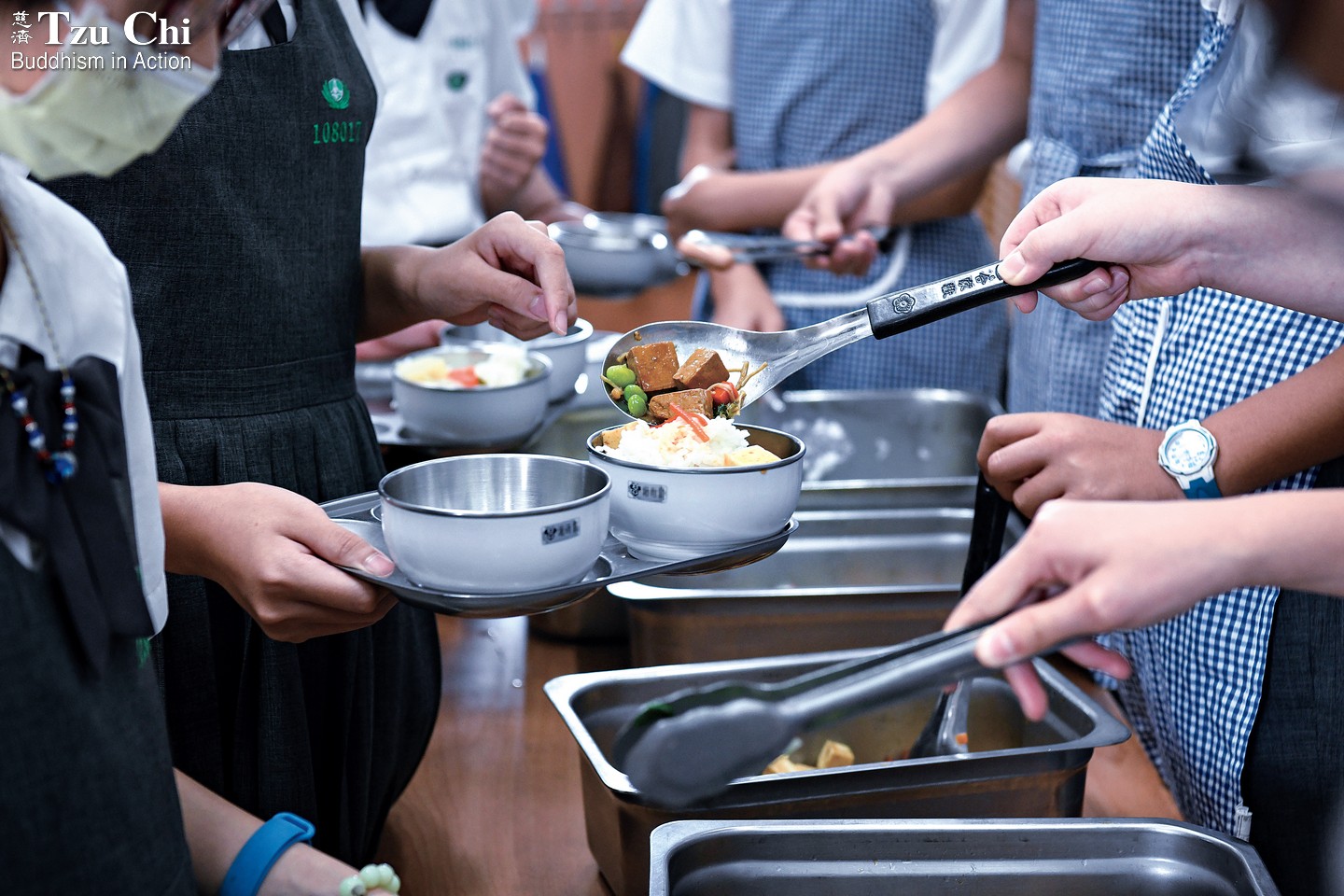
Elementary students holding trays and bowls line up to receive their food.
Food waste is a widespread problem in the world, particularly in more affluent regions. According to Taiwan’s Ministry of Environment, each person in Taiwan has discarded an average of 24 kilograms (53 pounds) of food waste annually over the past decade. When factoring in losses from production and distribution, along with unsold food that is discarded, the total amount of food wasted in Taiwan each year exceeds one million metric tons (1.102 million short tons).
Three years ago, Yen Hsiu-wen guided students from the elementary division of Tainan Tzu Chi Senior High School to participate in the U.S.-Taiwan Eco-Campus Partnership Program, launched by the Ministry of Environment and the U.S. Environmental Protection Agency. This program aims to inspire students to address various environmental challenges, including the promotion of sustainable food practices. Participating in the program prompted students to visit the school’s kitchen. “We went to our school’s central kitchen to interview the nutritionist about lunch menu planning and to observe how they handled food waste,” Yen recalled. “It was only then that we realized how much food waste the students were creating.”
In response, students in the program’s food sustainability group researched online for relevant information, brainstormed ideas, and initiated the Clean Plate campaign. They advocated within the elementary school division to reduce food waste, encouraging both teachers and students to minimize the amount of food they discarded. They even created Clean Plate Ambassador certificates to commend classes that effectively cut down waste.
To monitor food waste, school lunch leftovers produced by each class were weighed each day. Wei Jing-xuan (魏靖軒), now a second-year student in the junior high division, was among the pioneers of the Clean Plate campaign during his elementary school years. He emphasized the importance of teacher guidance due to elementary students’ unfamiliarity with weighing and recording.
In addition to the involvement of students and teachers, the meal supply team at the central kitchen provided significant support. They assisted each class in weighing their leftovers and adjusted food quantities based on daily class sizes. These adjustments were particularly noticeable during the COVID-19 pandemic when fewer students ate at school. Students also encouraged each other to finish their meals, often sharing and consuming any leftovers together to minimize waste. They viewed it as an honor to earn the Clean Plate Ambassador recognition.
Nutritionist Ye Jia-wen (葉佳紋), who joined Tainan Tzu Chi Senior High School when it was established in 2007, also contributed to the effort. She shared her tips for planning menus, such as avoiding bitter melon as a main dish and relegating green bell peppers to side dishes. Additionally, she occasionally combined popular and unpopular items in the same dish to encourage the consumption of the entire meal. Her ultimate objective was to create dishes that kids would enjoy without sacrificing nutrition.
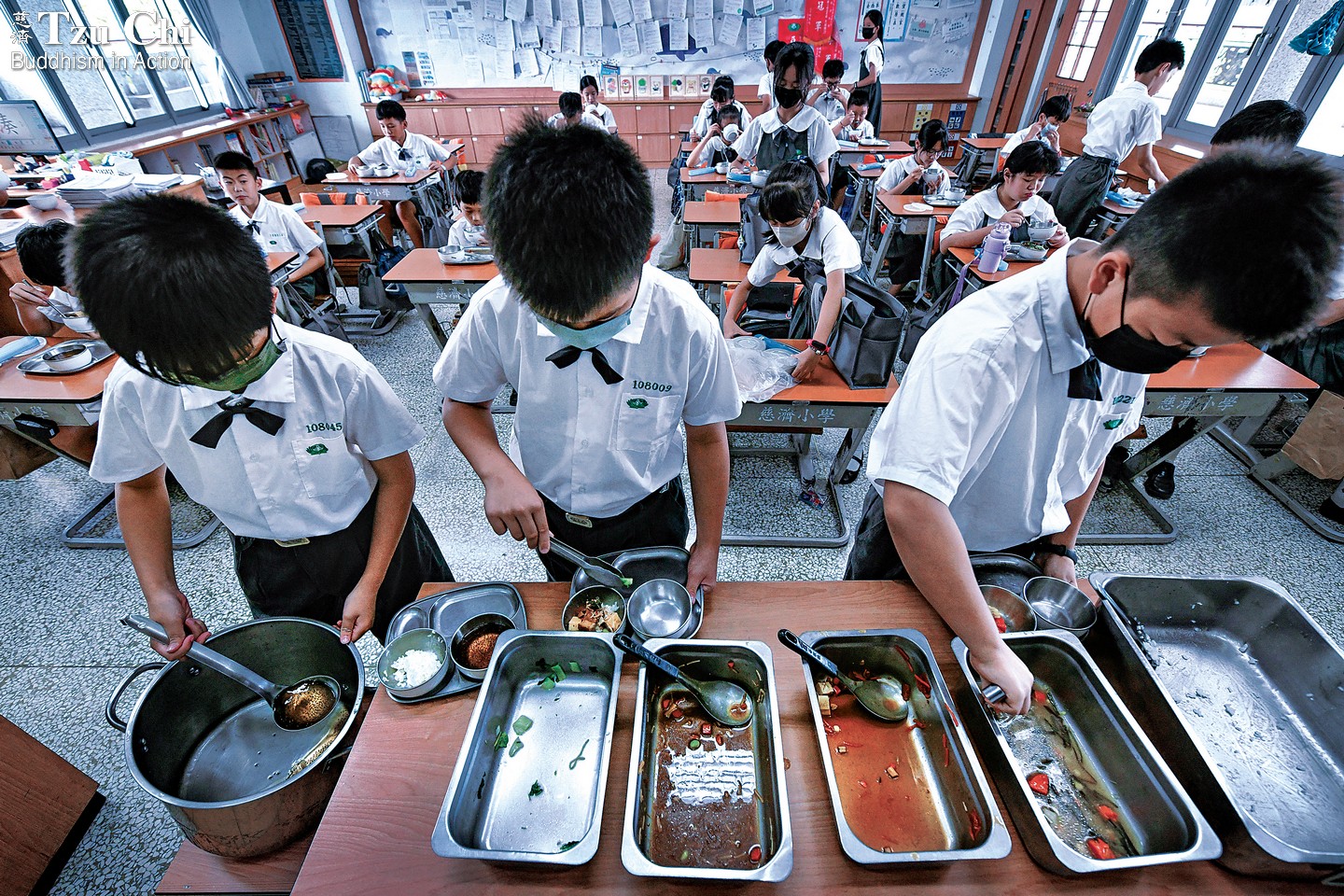
Food waste in the elementary division of Tainan Tzu Chi Senior High School has been significantly reduced by carefully planning meals and adjusting food quantities according to daily student attendance.
Thanks to the concerted efforts of teachers, students, and the meal supply team, the endeavor to reduce food waste gradually yielded positive results. The Clean Plate campaign kicked off in September 2021; by the end of that first semester, in December, the total amount of food waste had decreased to just over 900 kilograms (1,985 pounds). This translated to only nine kilograms of food waste per day, marking a significant improvement from the previous daily amount of 35 kilograms.
Even more improvement was seen in the second semester of that school year, during which only 300 kilograms (660 pounds) of food waste was produced, averaging just three kilograms per day. To put that into perspective, among the 25 classes in the elementary division, each class produced only about 120 grams (0.26 pounds) of food waste per day.
But despite this success, the journey had its challenges. At one point, just as the total daily food waste had significantly dropped to 20 kilograms, it unexpectedly spiked back to 35 kilograms after a single meal. This sudden increase prompted an investigation into the cause.
It turned out that the main dish that day was udon noodles, a type of food that requires more chewing and is bulkier and heavier. The classes with the highest amounts of leftover food were the first and second grades. Children in that age group are losing their baby teeth, which weakens their biting and chewing abilities. Consequently, they tend to eat slower and consume less when faced with tougher food. This explained the increased food waste that day. Learning from this udon noodle incident, the central kitchen team began considering factors such as food texture and difficulty of chewing when planning menus to avoid similar situations.
Principal Yao Zhi-hua (姚智化) of the elementary school division particularly commended the meal supply team. He stated that they are not only skilled in vegetarian cooking but also work to ensure that students from kindergarten to high school receive the nutrition they need. In addition to providing daily lunches, they also serve dinner for junior and senior high school students during evening self-study sessions. Despite their demanding workload, the team wholeheartedly supports the Clean Plate campaign. “They operate with great care,” the principal noted. “It’s rare to hear any complaints from students or parents about the taste or portion size of the school meals. Their dedication is truly praiseworthy.”
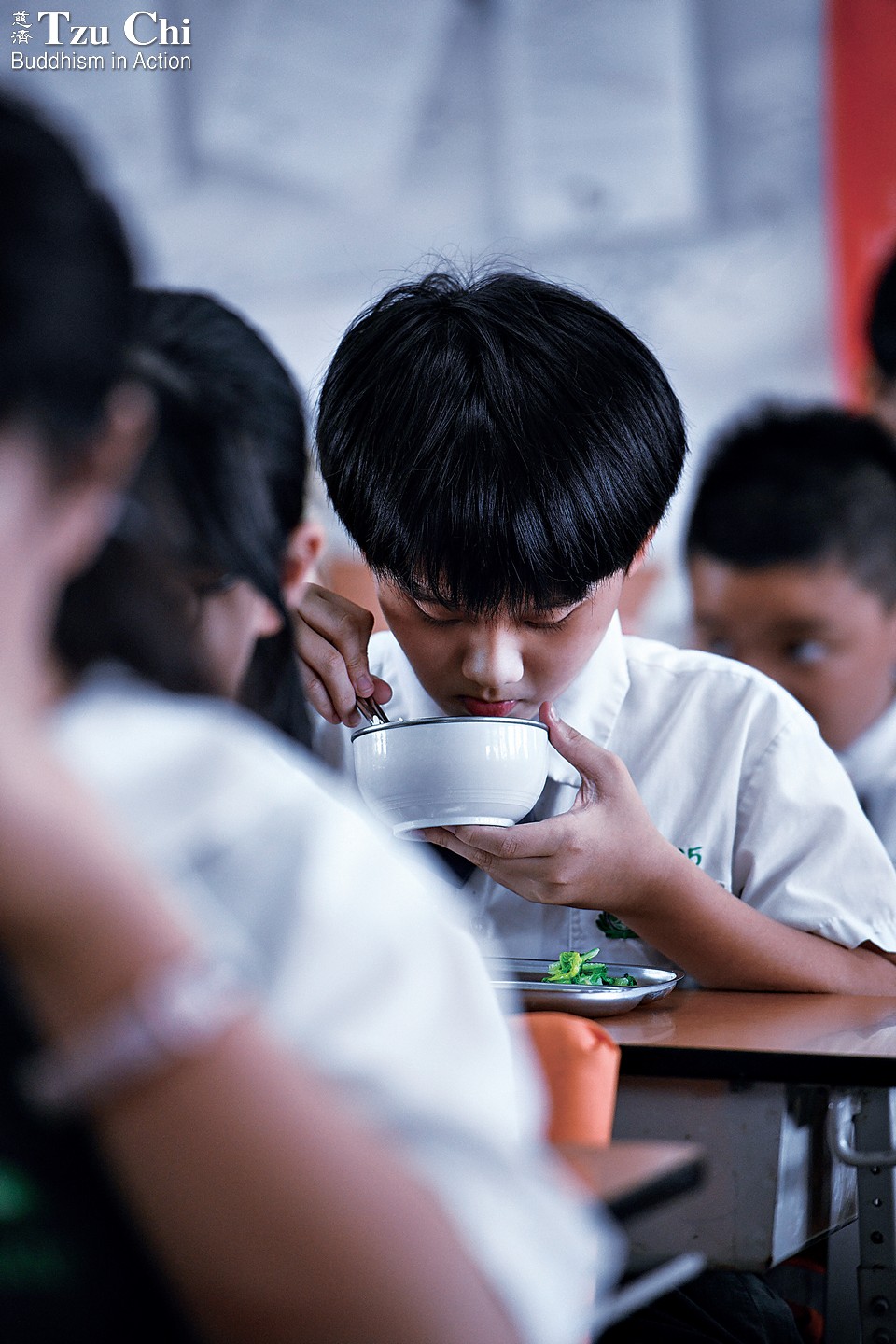
The Clean Plate campaign aims to encourage students to cherish food.
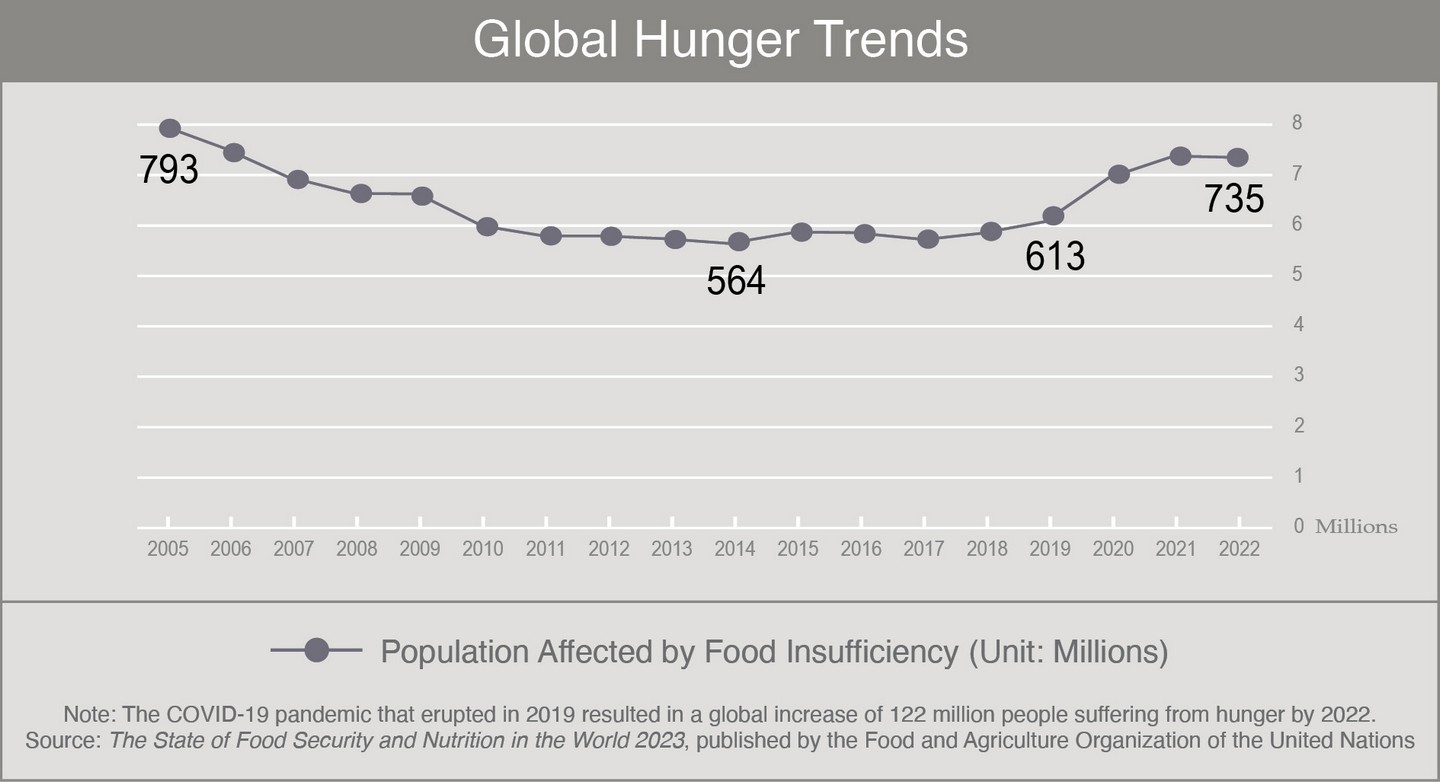
The students who pioneered the Clean Plate campaign have already graduated from the elementary school division. Six of them have moved on to the junior high division of the same school, where they continue their efforts to reduce food waste under the guidance of social studies teachers Lin Yu-ru (林昱汝) and Chen Bo-ling (陳柏伶).
“[In the junior high division], we promote food waste reduction under a different banner: Design For Change,” explained Lin Yu-ru. Design For Change (DFC) is a global movement that fosters the “I Can” mindset in children. Lin elaborated that, unlike the teacher-directed approach of the Clean Plate campaign in the elementary school division, DFC empowers students to discover problems and develop strategies independently.
Junior high students are at a developmental stage where they begin forming their own opinions and perspectives. To capture the attention of these students, the food waste reduction team employs more captivating approaches. For instance, noticing that many students dislike celery, the team filmed a short video titled “Celery: To Love or Not to Love?” This video was shown during a morning school assembly.
In the video, eighth-grader Fang Zheng-hao (方正豪) takes a bite of celery and playfully questions his peers about their reluctance to eat the vegetable. Unexpectedly, everyone pushes their celery towards him, teasingly telling him to feel free to eat it all. This humorous scene kicks off the promotional video. Then, the team interviews teachers, schoolmates, and Tzu Chi volunteers about their attitudes toward celery before introducing its structure and nutritional value. Many teachers and students didn’t realize that the edible part of celery, often mistaken for a stem, is actually a petiole, a part of the leaf, until they watched the video.
Interestingly, Fang Zheng-hao himself does not like celery. “I had quite a few takes filming the segment where I ate celery. I think I ate enough celery to last me a lifetime,” he said. Despite his appearance in the video, his dislike for celery remains unchanged. Nevertheless, he recognizes the importance of not wasting food. He said, “Every food has its nutritional value, and we should be willing to try all kinds of food.” Zheng-hao’s twin brother, Zheng-yi (正毅), chimed in: “Regardless of whether the promotional video is effective or not, at least we made an effort to combat food waste.”
Zheng Qi-yun (鄭綺紜), the only female member of the team, noted that food waste is higher in most junior high and high school classes compared to the elementary school division. She attributed this to the busier academic schedules in secondary school, which distract students from the issue of food waste. However, she believes that with determination, it is still possible to reduce food waste or even achieve zero waste. “For example, after our class saw the video in the morning assembly, we asked our homeroom teacher to talk to the kitchen personnel about adjusting the amount of food provided to us,” said Zheng. “The amount of rice has since been reduced by one-third, for instance. After the adjustment, there has hardly been any leftover food in our class each day.”
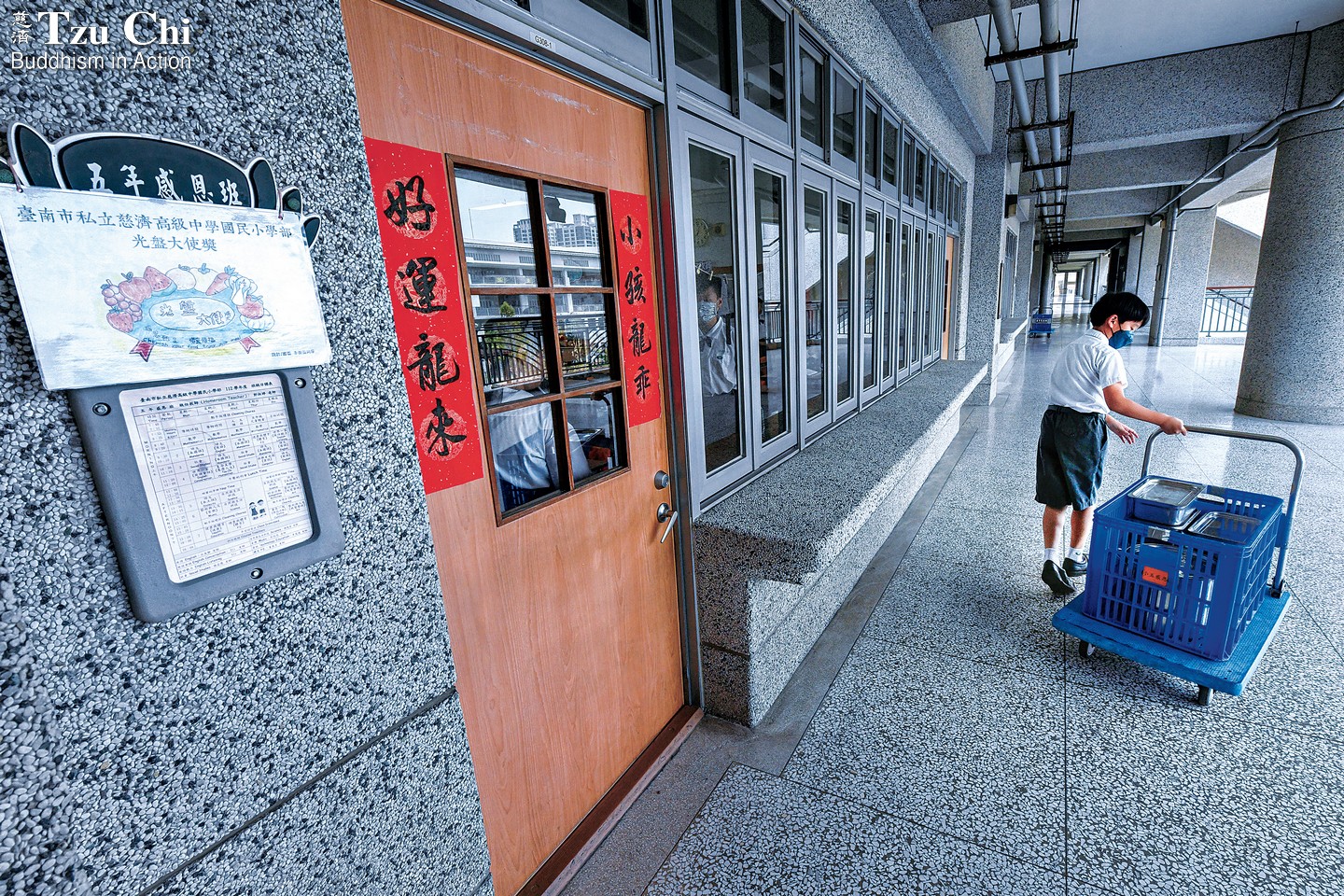
After lunch, a student from the fifth-grade Gratitude Class returns their food serving trays for weighing leftover food and recycling. This class has successfully met the target for reducing food waste, earning them the Clean Plate Ambassador award displayed next to the classroom door.
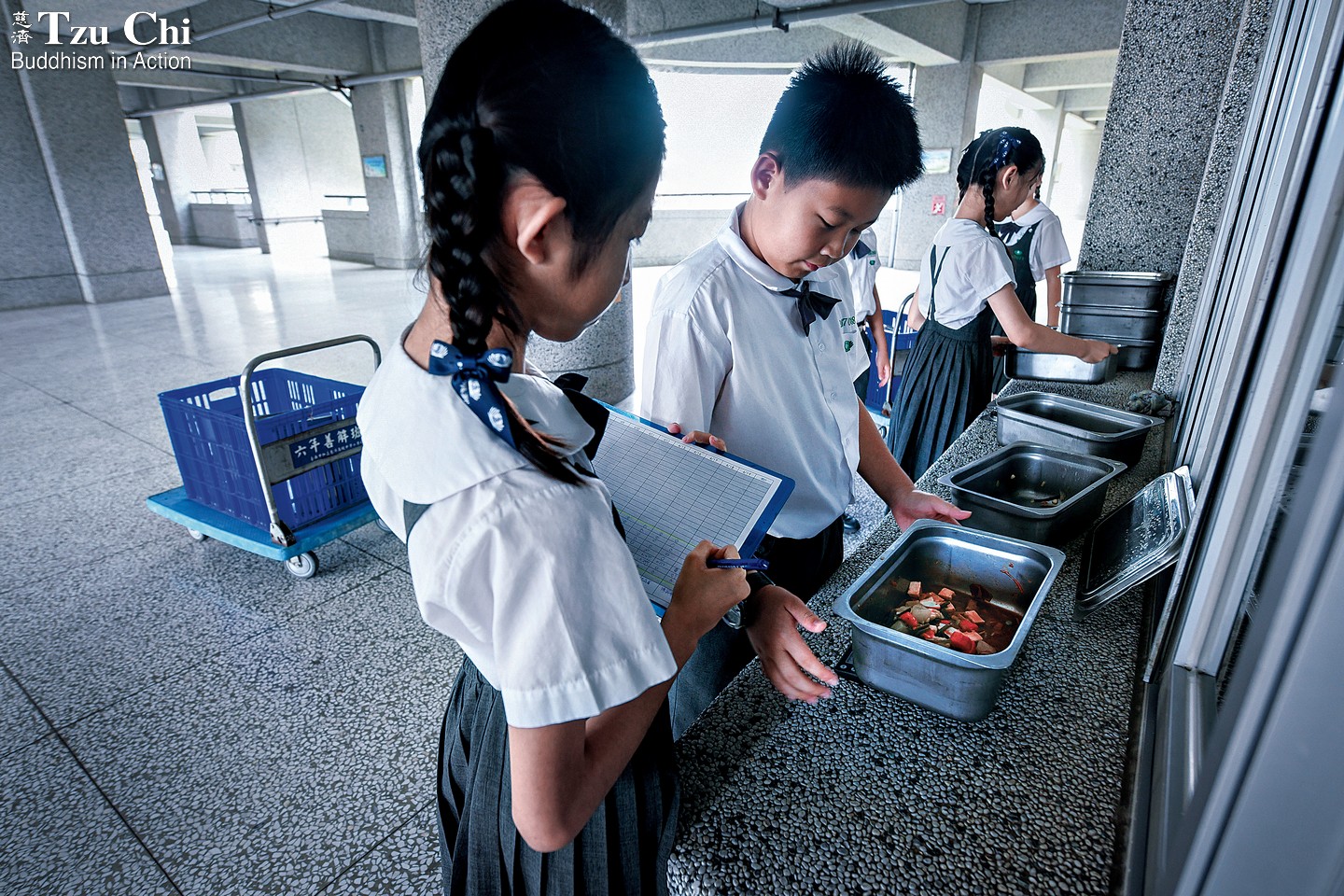
Weighing leftovers is a daily routine after lunch. While some classes have reduced their leftovers to just a few grams, many have made zero leftovers the norm.
By launching the Clean Plate campaign and using actual measurements of food waste to raise awareness among teachers and students about the severity of the issue, the elementary school division of Tainan Tzu Chi Senior High School has successfully prevented over-serving and fostered food conservation.
This initiative is a positive response to global food challenges. According to statistics from the Food and Agriculture Organization of the United Nations, the production of major crops such as sugarcane, corn, wheat, and rice increased by 50 percent from 2000 to 2020. Despite technological advancements driving production beyond dietary needs, millions worldwide still suffer from hunger and malnutrition.
The waste from discarding food extends beyond just the food itself; it also encompasses the resources expended during its production, transportation, and storage. The Clean Plate campaign echoes the spirit of a carbon inventory. Cutting down on leftovers optimizes food use and lowers greenhouse gas emissions. Thus, the campaign is aligned with the United Nations’ Sustainable Development Goal 12, which calls for responsible consumption and production.
In the Clean Plate campaign, students gain knowledge, enhance communication skills, and bolster confidence. Moreover, all students responding positively to food conservation and leftover reduction benefit from balanced nutrition intake, fostering healthier growth.
By Yeh Tzu-hao
Translated by Wu Hsiao-ting
Photos by Yan Lin-zhao
With over 700 million people facing hunger worldwide, taking only what you can eat is a virtue. Elementary students at a Tzu Chi school in southern Taiwan are showing their values by taking action and doing their part
Empty food serving trays serve as evidence of the efforts made by this elementary class at Tainan Tzu Chi Senior High School to minimize food waste.
With the guidance of a gardening volunteer, students in the elementary division of Tainan Tzu Chi Senior High School sow water spinach seeds and carefully cover them with soil. Through firsthand farming experience, they learn to appreciate the effort required to cultivate food.
The Clean Plate Campaign
By Yeh Tzu-hao
Translated by Wu Hsiao-ting
Photos by Yan Lin-zhao
The leftover food from school lunches each day at Tainan Tzu Chi Senior High School’s elementary division has decreased from 35 kilograms three years ago to just three kilograms now. How did more than 600 elementary students achieve this?
Every school day, before lunch, students from the elementary school division of Tainan Tzu Chi Senior High School in southern Taiwan sing the “Gratitude Song”: “Each grain of rice, spoonful of soup, and piece of vegetable on our plates comes with great effort. Let’s savor each bite mindfully and be grateful to all those involved in making our food possible.” This practice helps instill the values of cherishing food in students, and aligns perfectly with the goals of the Clean Plate campaign.
Yen Hsiu-wen (顏秀雯), the director of academic affairs in the elementary school division, explained that the Clean Plate campaign was initiated in 2021 to tackle food waste. It was sparked by a visit to the school’s central kitchen, where students learned about the significant amount of waste generated by over 600 elementary students during lunch.
How much waste was there? The detailed records Yen Hsiu-wen kept show that the elementary division produced an average of 35 kilograms (77 pounds) of food waste each day. This amount is not large compared to the waste produced by similar-sized schools, but it added up to 3,500 kilograms, or 3.5 metric tons (3.86 short tons), of waste over a 100-school-day semester.
Yen was shocked by these figures. “Aside from the carbon footprint from food production and transportation,” she stated, “producing food costs money and requires farmers’ hard work. Moreover, with so many people facing hunger in the world, wasting this much food is simply unacceptable. That’s when we began urging everyone to finish their meals.”
Elementary students holding trays and bowls line up to receive their food.
Food waste is a widespread problem in the world, particularly in more affluent regions. According to Taiwan’s Ministry of Environment, each person in Taiwan has discarded an average of 24 kilograms (53 pounds) of food waste annually over the past decade. When factoring in losses from production and distribution, along with unsold food that is discarded, the total amount of food wasted in Taiwan each year exceeds one million metric tons (1.102 million short tons).
Three years ago, Yen Hsiu-wen guided students from the elementary division of Tainan Tzu Chi Senior High School to participate in the U.S.-Taiwan Eco-Campus Partnership Program, launched by the Ministry of Environment and the U.S. Environmental Protection Agency. This program aims to inspire students to address various environmental challenges, including the promotion of sustainable food practices. Participating in the program prompted students to visit the school’s kitchen. “We went to our school’s central kitchen to interview the nutritionist about lunch menu planning and to observe how they handled food waste,” Yen recalled. “It was only then that we realized how much food waste the students were creating.”
In response, students in the program’s food sustainability group researched online for relevant information, brainstormed ideas, and initiated the Clean Plate campaign. They advocated within the elementary school division to reduce food waste, encouraging both teachers and students to minimize the amount of food they discarded. They even created Clean Plate Ambassador certificates to commend classes that effectively cut down waste.
To monitor food waste, school lunch leftovers produced by each class were weighed each day. Wei Jing-xuan (魏靖軒), now a second-year student in the junior high division, was among the pioneers of the Clean Plate campaign during his elementary school years. He emphasized the importance of teacher guidance due to elementary students’ unfamiliarity with weighing and recording.
In addition to the involvement of students and teachers, the meal supply team at the central kitchen provided significant support. They assisted each class in weighing their leftovers and adjusted food quantities based on daily class sizes. These adjustments were particularly noticeable during the COVID-19 pandemic when fewer students ate at school. Students also encouraged each other to finish their meals, often sharing and consuming any leftovers together to minimize waste. They viewed it as an honor to earn the Clean Plate Ambassador recognition.
Nutritionist Ye Jia-wen (葉佳紋), who joined Tainan Tzu Chi Senior High School when it was established in 2007, also contributed to the effort. She shared her tips for planning menus, such as avoiding bitter melon as a main dish and relegating green bell peppers to side dishes. Additionally, she occasionally combined popular and unpopular items in the same dish to encourage the consumption of the entire meal. Her ultimate objective was to create dishes that kids would enjoy without sacrificing nutrition.
Food waste in the elementary division of Tainan Tzu Chi Senior High School has been significantly reduced by carefully planning meals and adjusting food quantities according to daily student attendance.
Thanks to the concerted efforts of teachers, students, and the meal supply team, the endeavor to reduce food waste gradually yielded positive results. The Clean Plate campaign kicked off in September 2021; by the end of that first semester, in December, the total amount of food waste had decreased to just over 900 kilograms (1,985 pounds). This translated to only nine kilograms of food waste per day, marking a significant improvement from the previous daily amount of 35 kilograms.
Even more improvement was seen in the second semester of that school year, during which only 300 kilograms (660 pounds) of food waste was produced, averaging just three kilograms per day. To put that into perspective, among the 25 classes in the elementary division, each class produced only about 120 grams (0.26 pounds) of food waste per day.
But despite this success, the journey had its challenges. At one point, just as the total daily food waste had significantly dropped to 20 kilograms, it unexpectedly spiked back to 35 kilograms after a single meal. This sudden increase prompted an investigation into the cause.
It turned out that the main dish that day was udon noodles, a type of food that requires more chewing and is bulkier and heavier. The classes with the highest amounts of leftover food were the first and second grades. Children in that age group are losing their baby teeth, which weakens their biting and chewing abilities. Consequently, they tend to eat slower and consume less when faced with tougher food. This explained the increased food waste that day. Learning from this udon noodle incident, the central kitchen team began considering factors such as food texture and difficulty of chewing when planning menus to avoid similar situations.
Principal Yao Zhi-hua (姚智化) of the elementary school division particularly commended the meal supply team. He stated that they are not only skilled in vegetarian cooking but also work to ensure that students from kindergarten to high school receive the nutrition they need. In addition to providing daily lunches, they also serve dinner for junior and senior high school students during evening self-study sessions. Despite their demanding workload, the team wholeheartedly supports the Clean Plate campaign. “They operate with great care,” the principal noted. “It’s rare to hear any complaints from students or parents about the taste or portion size of the school meals. Their dedication is truly praiseworthy.”
The Clean Plate campaign aims to encourage students to cherish food.
The students who pioneered the Clean Plate campaign have already graduated from the elementary school division. Six of them have moved on to the junior high division of the same school, where they continue their efforts to reduce food waste under the guidance of social studies teachers Lin Yu-ru (林昱汝) and Chen Bo-ling (陳柏伶).
“[In the junior high division], we promote food waste reduction under a different banner: Design For Change,” explained Lin Yu-ru. Design For Change (DFC) is a global movement that fosters the “I Can” mindset in children. Lin elaborated that, unlike the teacher-directed approach of the Clean Plate campaign in the elementary school division, DFC empowers students to discover problems and develop strategies independently.
Junior high students are at a developmental stage where they begin forming their own opinions and perspectives. To capture the attention of these students, the food waste reduction team employs more captivating approaches. For instance, noticing that many students dislike celery, the team filmed a short video titled “Celery: To Love or Not to Love?” This video was shown during a morning school assembly.
In the video, eighth-grader Fang Zheng-hao (方正豪) takes a bite of celery and playfully questions his peers about their reluctance to eat the vegetable. Unexpectedly, everyone pushes their celery towards him, teasingly telling him to feel free to eat it all. This humorous scene kicks off the promotional video. Then, the team interviews teachers, schoolmates, and Tzu Chi volunteers about their attitudes toward celery before introducing its structure and nutritional value. Many teachers and students didn’t realize that the edible part of celery, often mistaken for a stem, is actually a petiole, a part of the leaf, until they watched the video.
Interestingly, Fang Zheng-hao himself does not like celery. “I had quite a few takes filming the segment where I ate celery. I think I ate enough celery to last me a lifetime,” he said. Despite his appearance in the video, his dislike for celery remains unchanged. Nevertheless, he recognizes the importance of not wasting food. He said, “Every food has its nutritional value, and we should be willing to try all kinds of food.” Zheng-hao’s twin brother, Zheng-yi (正毅), chimed in: “Regardless of whether the promotional video is effective or not, at least we made an effort to combat food waste.”
Zheng Qi-yun (鄭綺紜), the only female member of the team, noted that food waste is higher in most junior high and high school classes compared to the elementary school division. She attributed this to the busier academic schedules in secondary school, which distract students from the issue of food waste. However, she believes that with determination, it is still possible to reduce food waste or even achieve zero waste. “For example, after our class saw the video in the morning assembly, we asked our homeroom teacher to talk to the kitchen personnel about adjusting the amount of food provided to us,” said Zheng. “The amount of rice has since been reduced by one-third, for instance. After the adjustment, there has hardly been any leftover food in our class each day.”
After lunch, a student from the fifth-grade Gratitude Class returns their food serving trays for weighing leftover food and recycling. This class has successfully met the target for reducing food waste, earning them the Clean Plate Ambassador award displayed next to the classroom door.
Weighing leftovers is a daily routine after lunch. While some classes have reduced their leftovers to just a few grams, many have made zero leftovers the norm.
By launching the Clean Plate campaign and using actual measurements of food waste to raise awareness among teachers and students about the severity of the issue, the elementary school division of Tainan Tzu Chi Senior High School has successfully prevented over-serving and fostered food conservation.
This initiative is a positive response to global food challenges. According to statistics from the Food and Agriculture Organization of the United Nations, the production of major crops such as sugarcane, corn, wheat, and rice increased by 50 percent from 2000 to 2020. Despite technological advancements driving production beyond dietary needs, millions worldwide still suffer from hunger and malnutrition.
The waste from discarding food extends beyond just the food itself; it also encompasses the resources expended during its production, transportation, and storage. The Clean Plate campaign echoes the spirit of a carbon inventory. Cutting down on leftovers optimizes food use and lowers greenhouse gas emissions. Thus, the campaign is aligned with the United Nations’ Sustainable Development Goal 12, which calls for responsible consumption and production.
In the Clean Plate campaign, students gain knowledge, enhance communication skills, and bolster confidence. Moreover, all students responding positively to food conservation and leftover reduction benefit from balanced nutrition intake, fostering healthier growth.

 Zoom in picture)