( Zoom in picture)

( Zoom in picture)
Japan
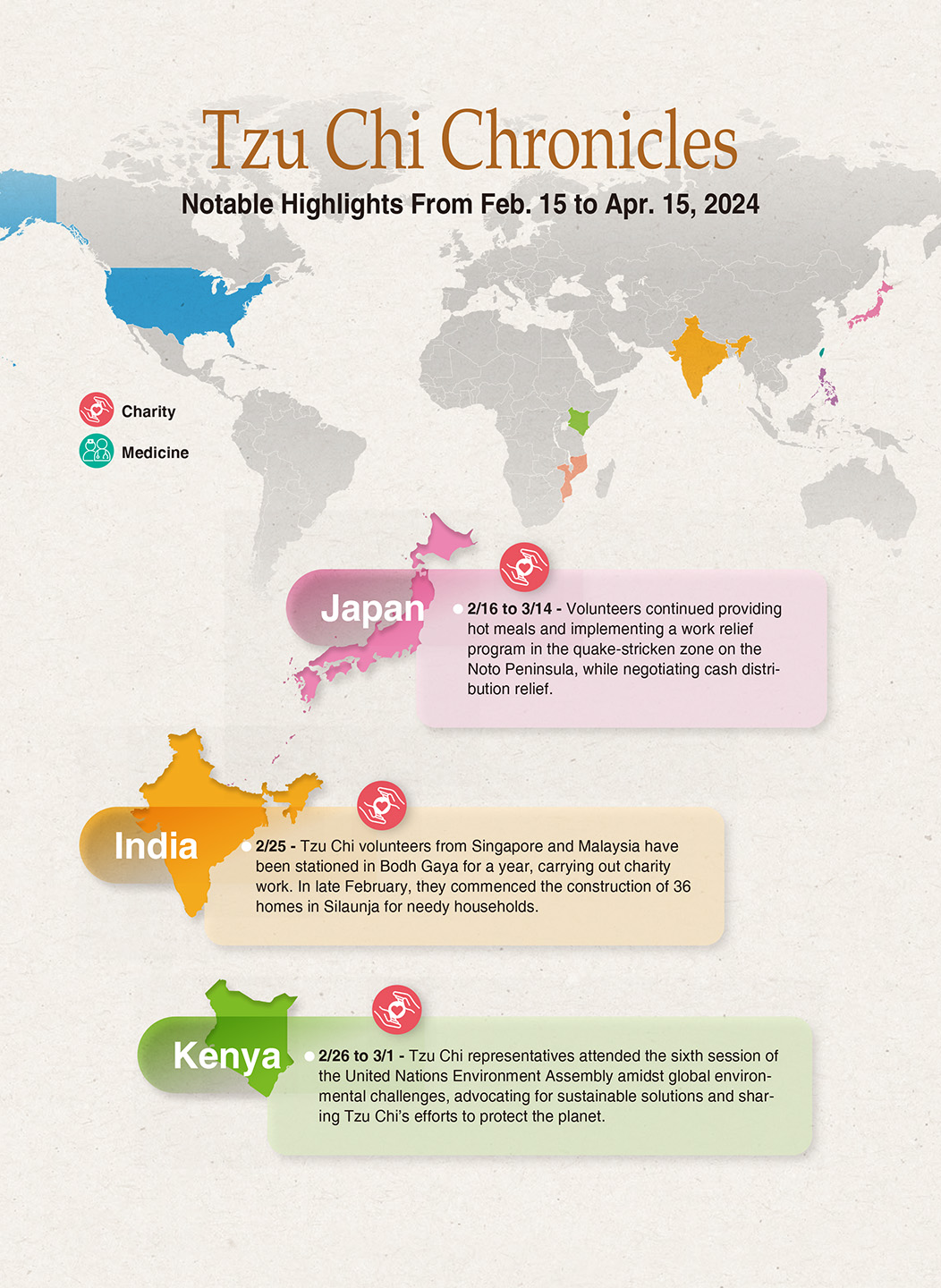
2/16 to 3/14 – Volunteers continued providing hot meals and implementing a work relief program in the quake-stricken zone on the Noto Peninsula, while negotiating cash distribution relief.
India
2/25 – Tzu Chi volunteers from Singapore and Malaysia have been stationed in Bodh Gaya for a year, carrying out charity work. In late February, they commenced the construction of 36 homes in Silaunja for needy households.
Kenya
2/26 to 3/1 – Tzu Chi representatives attended the sixth session of the United Nations Environment Assembly amidst global environmental challenges, advocating for sustainable solutions and sharing Tzu Chi’s efforts to protect the planet.
The United States
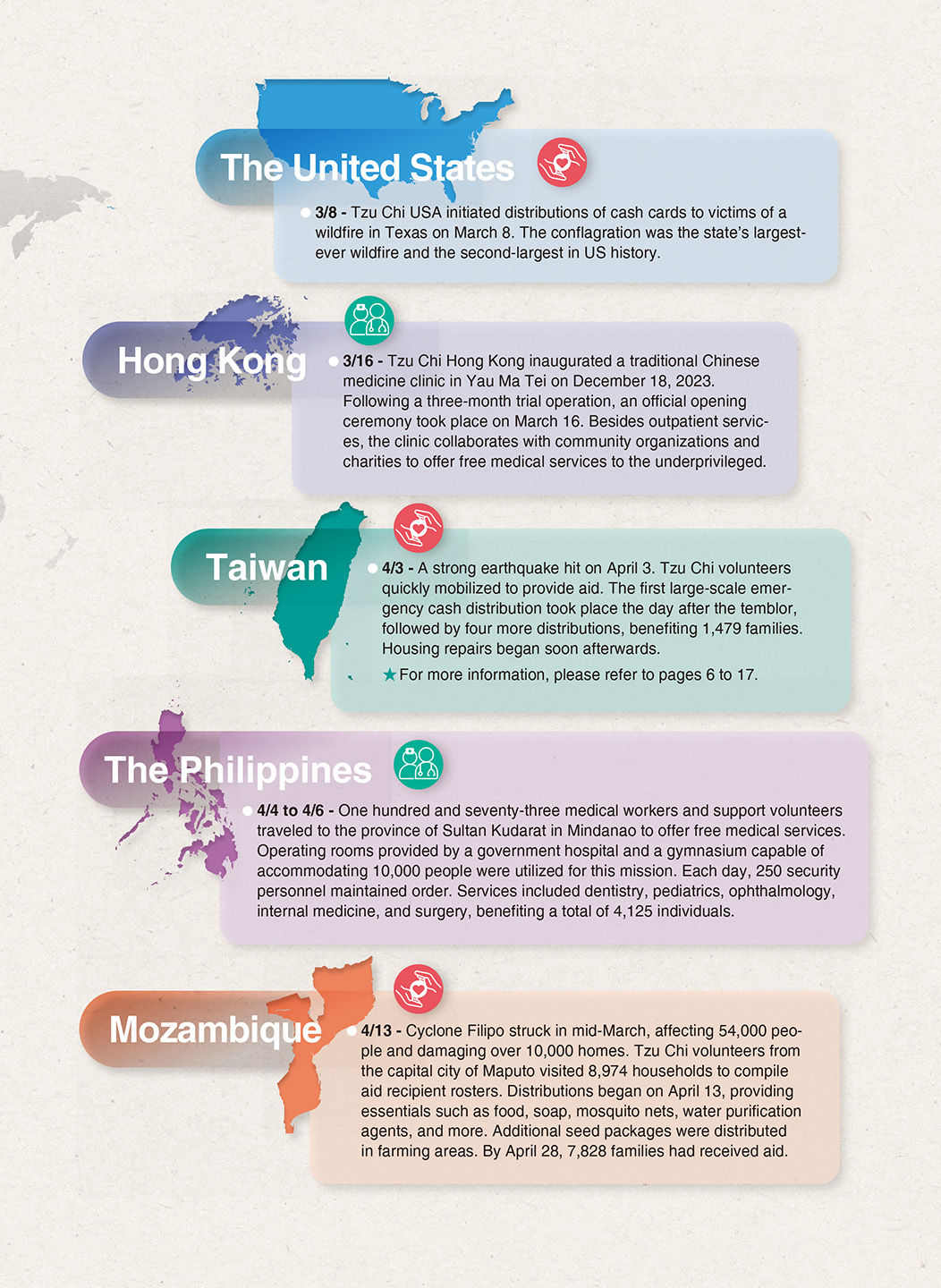
3/8 – Tzu Chi USA initiated distributions of cash cards to victims of a wildfire in Texas on March 8. The conflagration was the state’s largest-ever wildfire and the second-largest in US history.
Hong Kong
3/16 – Tzu Chi Hong Kong inaugurated a traditional Chinese medicine clinic in Yau Ma Tei on December 18, 2023. Following a three-month trial operation, an official opening ceremony took place on March 16. Besides outpatient services, the clinic collaborates with community organizations and charities to offer free medical services to the underprivileged.
Taiwan
4/3 – A strong earthquake hit on April 3. Tzu Chi volunteers quickly mobilized to provide aid. The first large-scale emergency cash distribution took place the day after the temblor, followed by four more distributions, benefiting 1,479 families. Housing repairs began soon afterwards.
★For more information
The Philippines
4/4 to 4/6 – One hundred and seventy-three medical workers and support volunteers traveled to the province of Sultan Kudarat in Mindanao to offer free medical services. Operating rooms provided by a government hospital and a gymnasium capable of accommodating 10,000 people were utilized for this mission. Each day, 250 security personnel maintained order. Services included dentistry, pediatrics, ophthalmology, internal medicine, and surgery, benefiting a total of 4,125 individuals.
Mozambique
4/13 – Cyclone Filipo struck in mid-March, affecting 54,000 people and damaging over 10,000 homes. Tzu Chi volunteers from the capital city of Maputo visited 8,974 households to compile aid recipient rosters. Distributions began on April 13, providing essentials such as food, soap, mosquito nets, water purification agents, and more. Additional seed packages were distributed in farming areas. By April 28, 7,828 families had received aid.
Japan
2/16 to 3/14 – Volunteers continued providing hot meals and implementing a work relief program in the quake-stricken zone on the Noto Peninsula, while negotiating cash distribution relief.
India
2/25 – Tzu Chi volunteers from Singapore and Malaysia have been stationed in Bodh Gaya for a year, carrying out charity work. In late February, they commenced the construction of 36 homes in Silaunja for needy households.
Kenya
2/26 to 3/1 – Tzu Chi representatives attended the sixth session of the United Nations Environment Assembly amidst global environmental challenges, advocating for sustainable solutions and sharing Tzu Chi’s efforts to protect the planet.
The United States
3/8 – Tzu Chi USA initiated distributions of cash cards to victims of a wildfire in Texas on March 8. The conflagration was the state’s largest-ever wildfire and the second-largest in US history.
Hong Kong
3/16 – Tzu Chi Hong Kong inaugurated a traditional Chinese medicine clinic in Yau Ma Tei on December 18, 2023. Following a three-month trial operation, an official opening ceremony took place on March 16. Besides outpatient services, the clinic collaborates with community organizations and charities to offer free medical services to the underprivileged.
Taiwan
4/3 – A strong earthquake hit on April 3. Tzu Chi volunteers quickly mobilized to provide aid. The first large-scale emergency cash distribution took place the day after the temblor, followed by four more distributions, benefiting 1,479 families. Housing repairs began soon afterwards.
★For more information
The Philippines
4/4 to 4/6 – One hundred and seventy-three medical workers and support volunteers traveled to the province of Sultan Kudarat in Mindanao to offer free medical services. Operating rooms provided by a government hospital and a gymnasium capable of accommodating 10,000 people were utilized for this mission. Each day, 250 security personnel maintained order. Services included dentistry, pediatrics, ophthalmology, internal medicine, and surgery, benefiting a total of 4,125 individuals.
Mozambique
4/13 – Cyclone Filipo struck in mid-March, affecting 54,000 people and damaging over 10,000 homes. Tzu Chi volunteers from the capital city of Maputo visited 8,974 households to compile aid recipient rosters. Distributions began on April 13, providing essentials such as food, soap, mosquito nets, water purification agents, and more. Additional seed packages were distributed in farming areas. By April 28, 7,828 families had received aid.
Narrated by Chen Rong-feng
Interviewed and written by Lin Mei-hong
Abridged and translated by Wu Hsiao-ting
Photos by Chen Rong-feng
I’ve loved taking photos since my teenage years. After joining Tzu Chi, I kept growing my photography and videography skills, eventually venturing into aerial imagery. My goal is simple—I want to use my skills to capture the beauty and goodness of the world.
—Chen Rong-feng
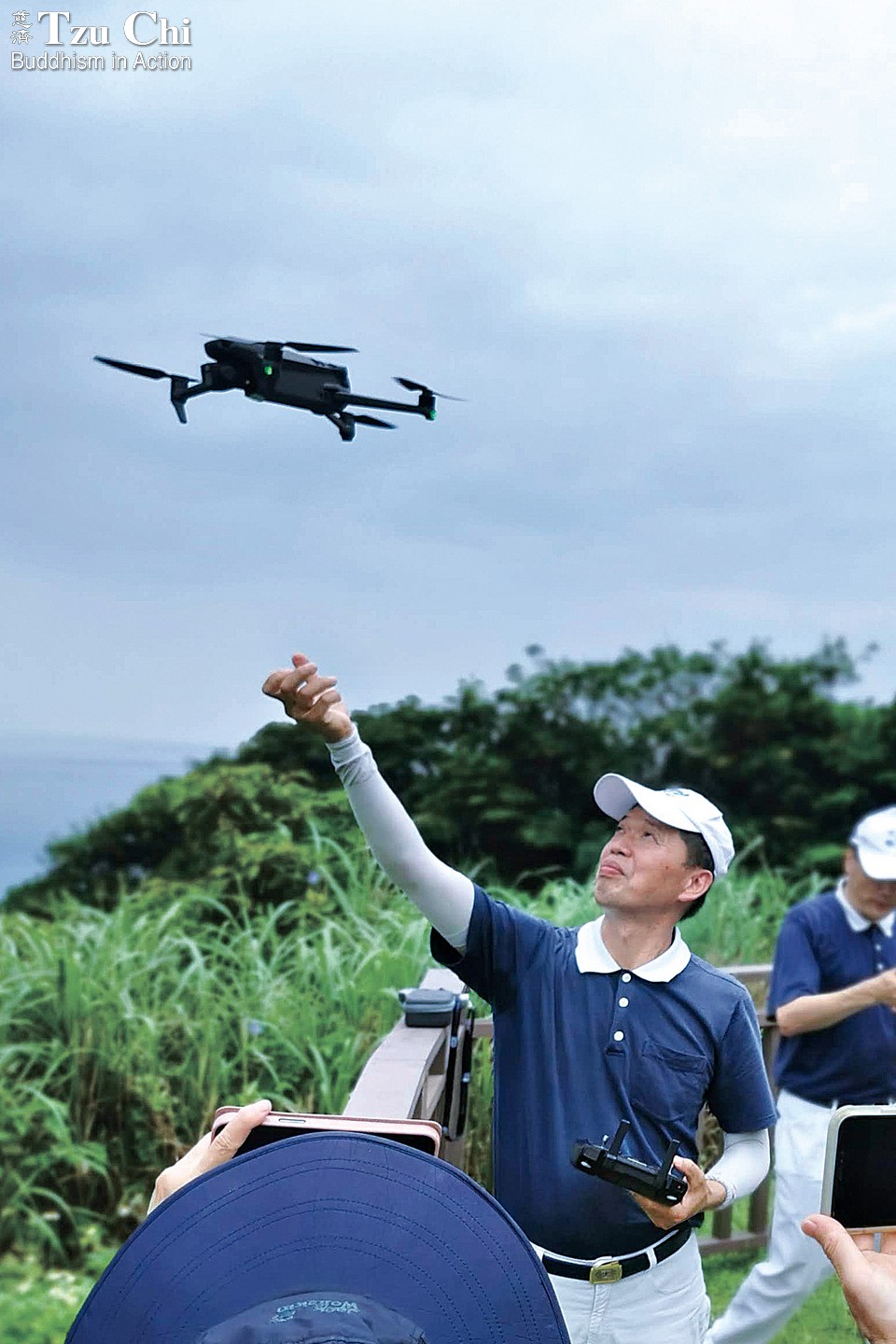
Photo by Lin Mei-hong
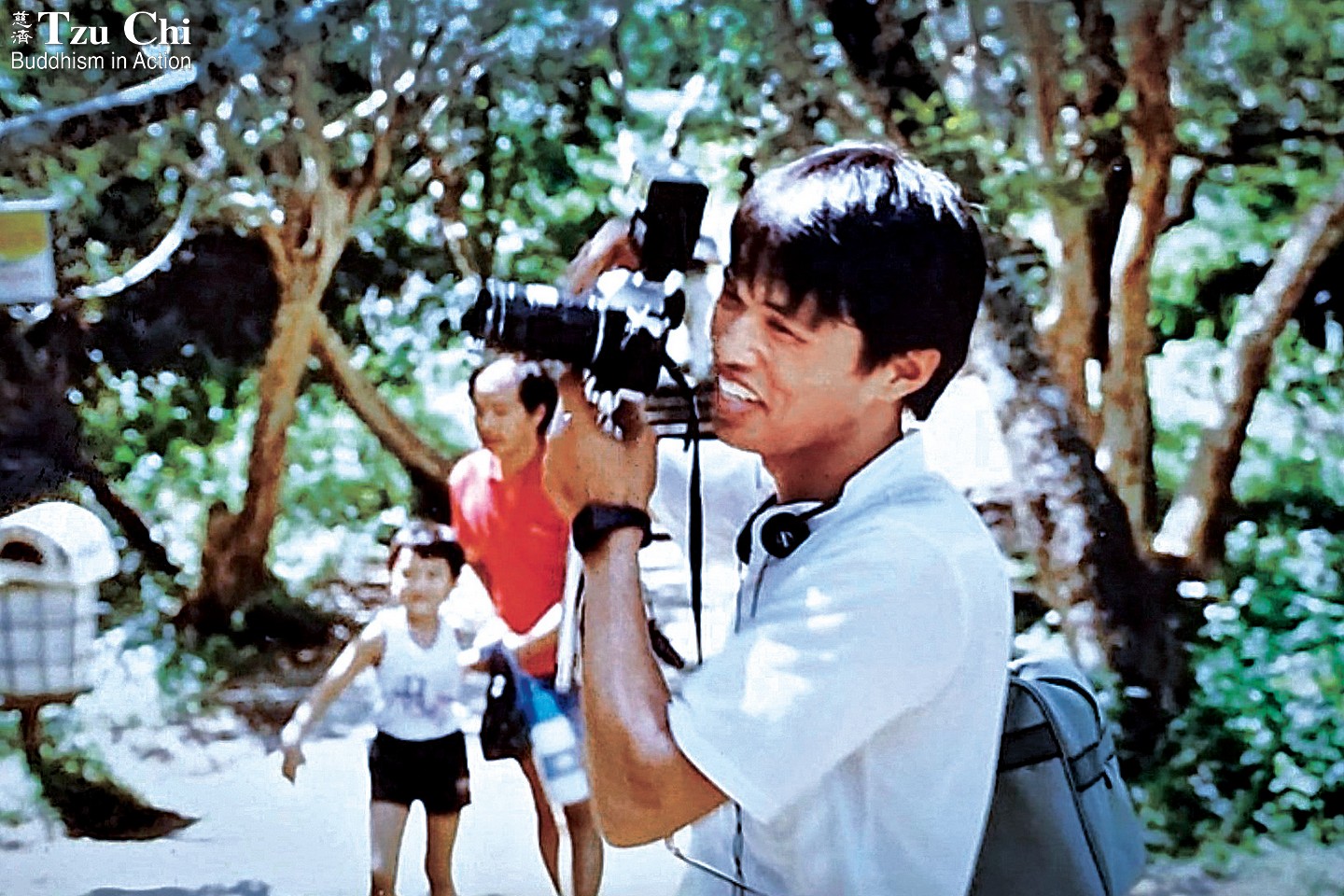
I have been curious about “new” things since childhood, especially when it comes to electronic products and devices. In elementary school, I even dismantled a radio my dad bought to study its inner workings. During high school, I developed a fascination with cameras. I recall waking up one morning at two to capture the school gate, using a B shutter speed for 20 seconds. In the interplay of moonlight and car lights, the majestic school gate showcased the beauty of a dignified academic institution. I submitted the work to an intramural competition and won first place.
Time flew quickly after high school. My eldest son was born in 1991, when I was 28. While on a business trip to Japan, I purchased a mini digital video camera, marking the beginning of my journey into videography. In 2006, I attended a Tzu Chi year-end blessing ceremony for the first time. At the volunteer recruitment area, I enthusiastically noted my expertise in photography and videography on a form. Soon thereafter, I received an invitation to join Tzu Chi as a documenting volunteer. I began training in 2008 to become a certified volunteer.
I always followed my own approach through my years of taking photos, doing things as I liked. When I first joined the foundation, I was uncertain about which aspects of a Tzu Chi event to capture. I vividly recall my dissatisfaction with my work at my first Tzu Chi camp. However, when I submitted the photos I had taken to Jian Hong-zheng (簡宏正), the coordinator for the Image Team, I was pleasantly surprised. Looking at my photos, Brother Jian exclaimed, “Everything I needed is right here!” This affirmation greatly cheered me and set me on my determined journey as a documenting volunteer, motivating me to continuously refine my skills.
In early 2010, I joined fellow Tzu Chi volunteers from Taiwan on a mission to Guizhou Province, China, to distribute aid to the needy. When we arrived at the distribution venue in Pingyan Township, Luodian County, we were greeted by the heartwarming sight of hundreds of villagers and children forming two rows, applauding and warmly welcoming us. The sight moved me deeply. I found myself wondering, “What have I done to deserve such warmth from people I have never met?” I followed the other volunteers without saying a word, afraid that if I spoke, tears of emotion would spill from my eyes.
During home visits, we were welcomed into their households as if we were part of their family. This heartfelt reception stemmed from the love nurtured by my fellow volunteers during their ten years of work in Guizhou. I felt deeply grateful that my role as a documenting volunteer brought me to Guizhou, allowing me to be showered in such warmth while I captured one poignant scene after another through my lens.
The rural homes we visited were typically basic, crude structures that provided minimal shelter from wind and rain. I vividly remember a home visit to the Li family. Mr. Li had suffered a bone fracture, and lacking the financial means for medical treatment, his arm had become deformed. His wife, experiencing back pain, struggled to carry water for the family. The family had no source of income at all. We checked their pot and saw some poor-looking corn porridge inside. When we learned that such meager fare was their main food for three daily meals, I couldn’t contain my emotions. I rushed outside and began crying uncontrollably.
I used to think that crying was embarrassing for a man, but I couldn’t hold back my tears that day. They just couldn’t stop flowing. It was the first time I had shed tears in 40 years, and I must have cried without stopping for a good half hour.
After this trip to Guizhou, I set aside my love for the pursuit of enjoyment and pleasure. Before, I used to travel abroad for sightseeing once or twice a year. Although such travels brought me happiness, the joy was short-lived. The charitable mission to Guizhou, however, left an indelible mark on me. After that trip, almost every time I traveled abroad, it was for Tzu Chi.
I faced several challenges after taking on the role of coordinator for a community documentation team. At the time, our documenting volunteers lacked a dedicated database for their work, making it difficult for some of them to find photos to complement their articles. To address this issue, I collaborated with other volunteers to establish a dedicated File Transfer Protocol platform. This platform allowed our volunteers to easily upload and share data. Additionally, I worked with computer engineers to develop an online event schedule, which helped us post information about our community’s Tzu Chi activities. This saved us a lot of time and money. It reduced the need for phone calls to disseminate event information and encouraged greater participation from those interested in the events.
The challenge of not having a storage system for articles and photos extended beyond our specific community. I recognized that our volunteers’ hard work was not adequately preserved and that a considerable amount of time and manpower was spent gathering relevant data, so I began contemplating cross-district data integration. I started collaborating with Zhang Ting-xu (張廷旭), a volunteer from Tzu Chi’s central Taiwan Information Technology Team. We developed a dedicated software system for data integration. After we were successful, Zhang remarked in friendly banter, “This software was created at your request; you’re responsible for promoting it!”
In response, I reached out every day to the coordinators for documenting teams in different districts in central Taiwan, providing explanations and tutorials on archiving using our software system. After a year of efforts, relevant records from across the central Taiwan district began to be uploaded to the system, easily accessible through a simple search. Eventually, this system expanded to include other areas in Taiwan.
Later, I became the coordinator for Tzu Chi’s central Taiwan Image Team. I pondered: “How can I attract new volunteers? More importantly, how can I rekindle the initial enthusiasm of our senior volunteers?” I decided to introduce courses in 2018 to tackle these questions. The course design was diverse, allowing instructors to use personal photos for storytelling or inviting professional photographers to engage with our volunteers. Photos can speak volumes; for instance, instructor Chen Jian-hua (陳建華) used pictures of his mother to reflect on accompanying her through the last leg of her life, while Li Ying-qing (李盈青) shared the challenges she had experienced in her life through photos documenting her growth and development. Everyone got to know the instructors better through their photos, but also gained insight into the art of storytelling through photography.
I also collaborated with bakeries and dessert shops, requesting their products for volunteers to photograph. The resulting photos became promotional materials for the businesses. I invited commercial photographer and Tzu Chi volunteer Ye Tang-ming (葉唐銘) to share insights on composition and the use of light and shadow in pastry photography. During class, everyone arranged and presented the pastries provided by our collaborating businesses. Ye reminded everyone that the direction of light sources would change at different times, resulting in various effects, and that photography is subjective, with no definitive right or wrong. Following the instructor’s guidance, participants took their photos and then uploaded their work to a messaging app group chat for immediate sharing and discussion. Afterwards, the participants were able to eat the pastries, bringing sweetness to palates and hearts alike.
At the end of the course, I used the Kahoot! app as a fun, interactive way for participants to review what they had learned. I gave prizes to the top three scorers in the review game. It was a lot of fun to see participants navigate through a series of tense and joyful moments during the activity. Creating classes that were eagerly anticipated by our volunteers became what I considered my greatest achievement.
Chen Rong-feng developed a passion for photography during high school and often went outdoors for photoshoots.
Courtesy of Chen Rong-feng
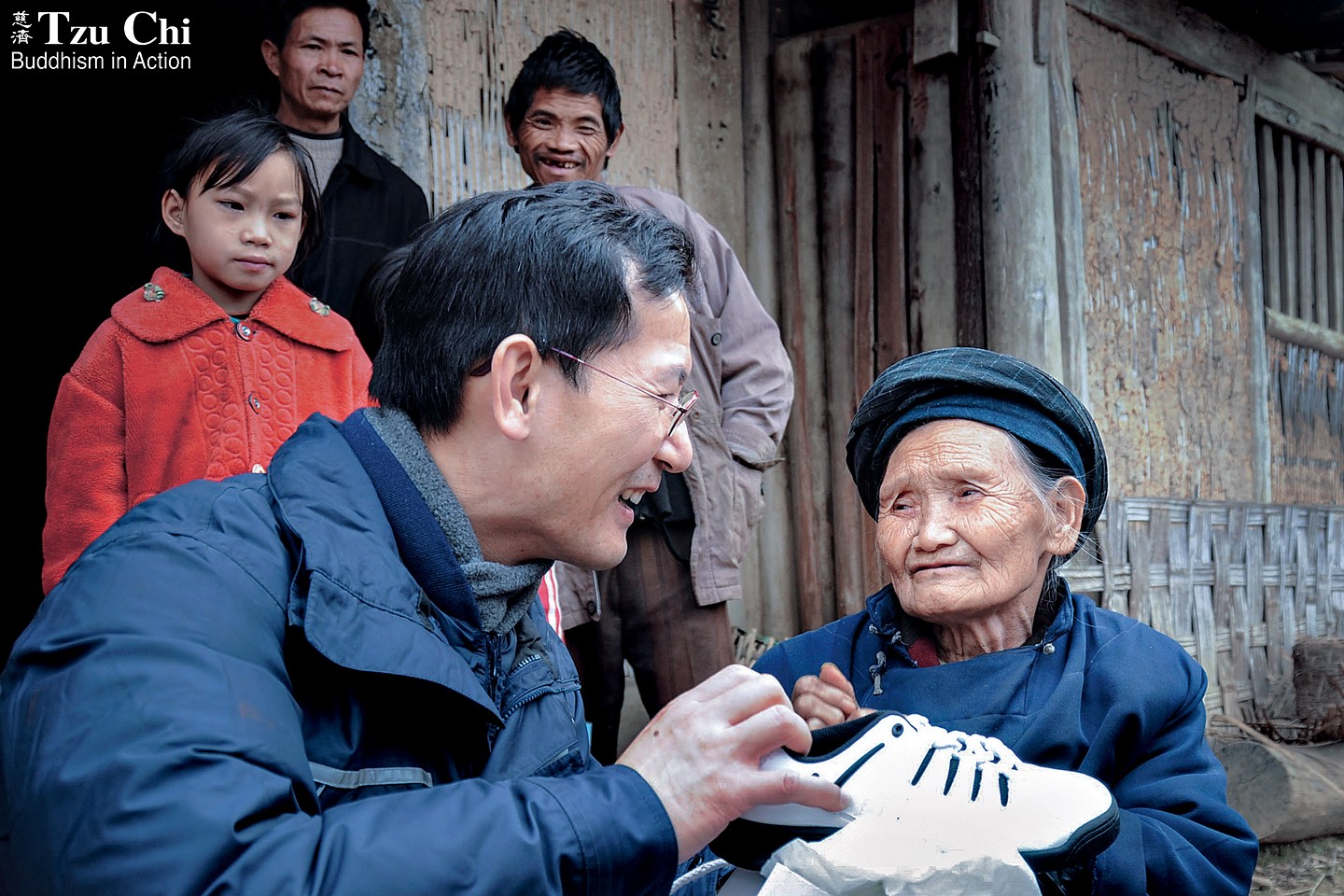
Tzu Chi volunteers went to Luodian, Guizhou, China, in 2010 to distribute aid to the needy. Here is a touching moment captured by Chen Rong-feng.
My foray into aerial imagery began in 2014. That year, Tzu Chi held a Buddha Day ceremony at the Taichung Intercontinental Baseball Stadium in Taichung, central Taiwan. While I was documenting the ceremony with a camera, a buzzing sound caught my attention. Following the sound, I looked up and saw a drone for the first time. Involuntarily, my gaze followed it as it soared into the sky, and I found myself drawn closer to the drone operator. I was completely mesmerized when I saw the spectacular aerial view captured by the drone.
I couldn’t get the image of a drone out of my mind after that and purchased a drone the following year. I practiced flying it whenever time allowed and shared the videos I took online. Some people left negative comments upon seeing my footage, saying things like: “It’s not just about flying high in aerial imagery.” Instead of becoming disheartened by such comments, I recognized my inadequacies from their perspectives and encouraged myself to keep improving my skills.
I established an aerial imagery team in 2018, with the goal of sharing my drone flying skills and learning from more enthusiasts. The next year, I joined the Taichung City Fire Department’s aerial imagery unit to contribute to disaster relief efforts. This involved surveying the origins of fires, assisting on-site commanders in making accurate decisions for firefighting, participating in search and rescue missions for missing mountain climbers, and deploying lifebuoys for drowning victims. The aerial imagery team I established also collaborates with the Coast Guard Administration to fly over the sea and document the ecology of white dolphins.
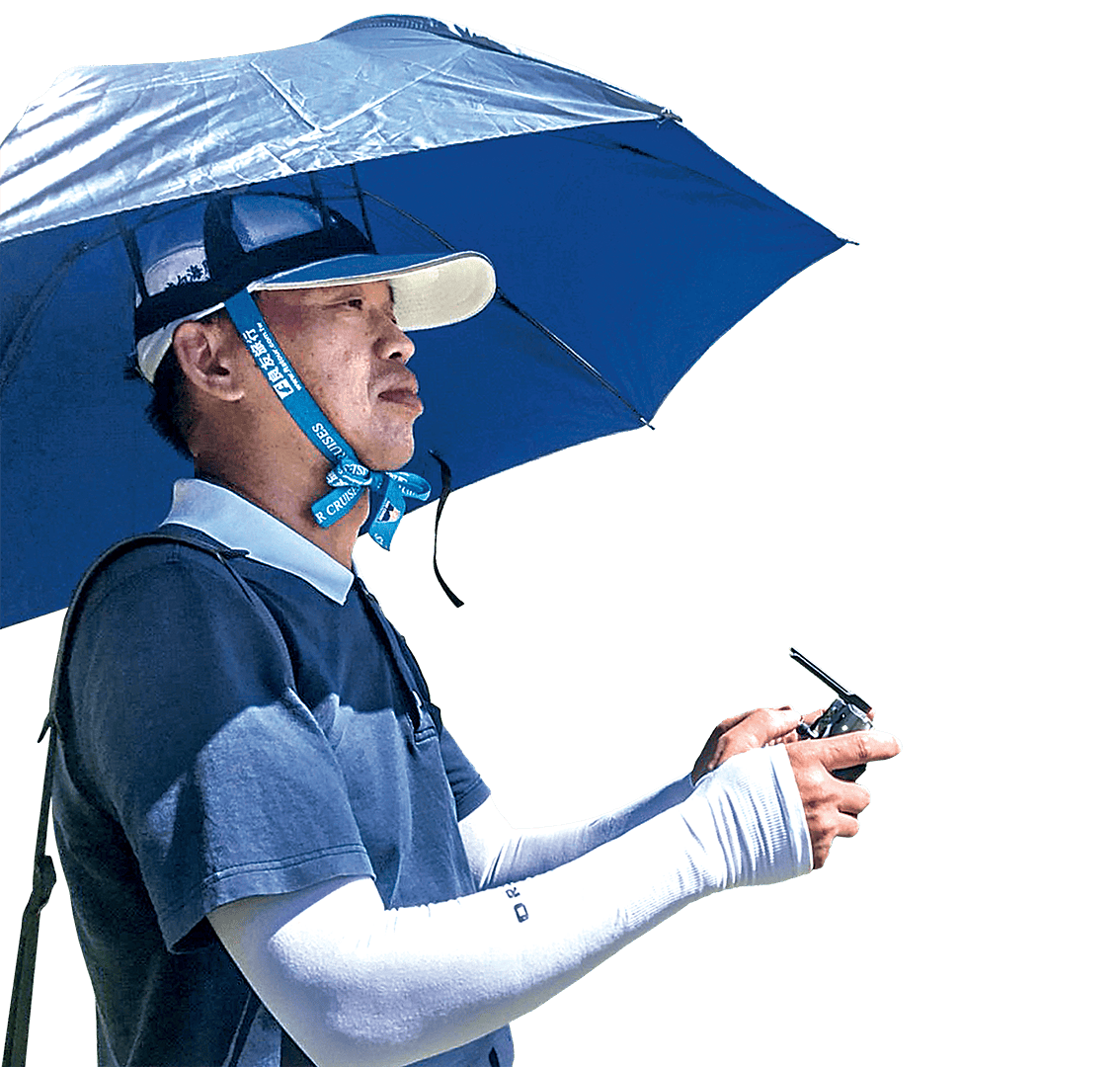
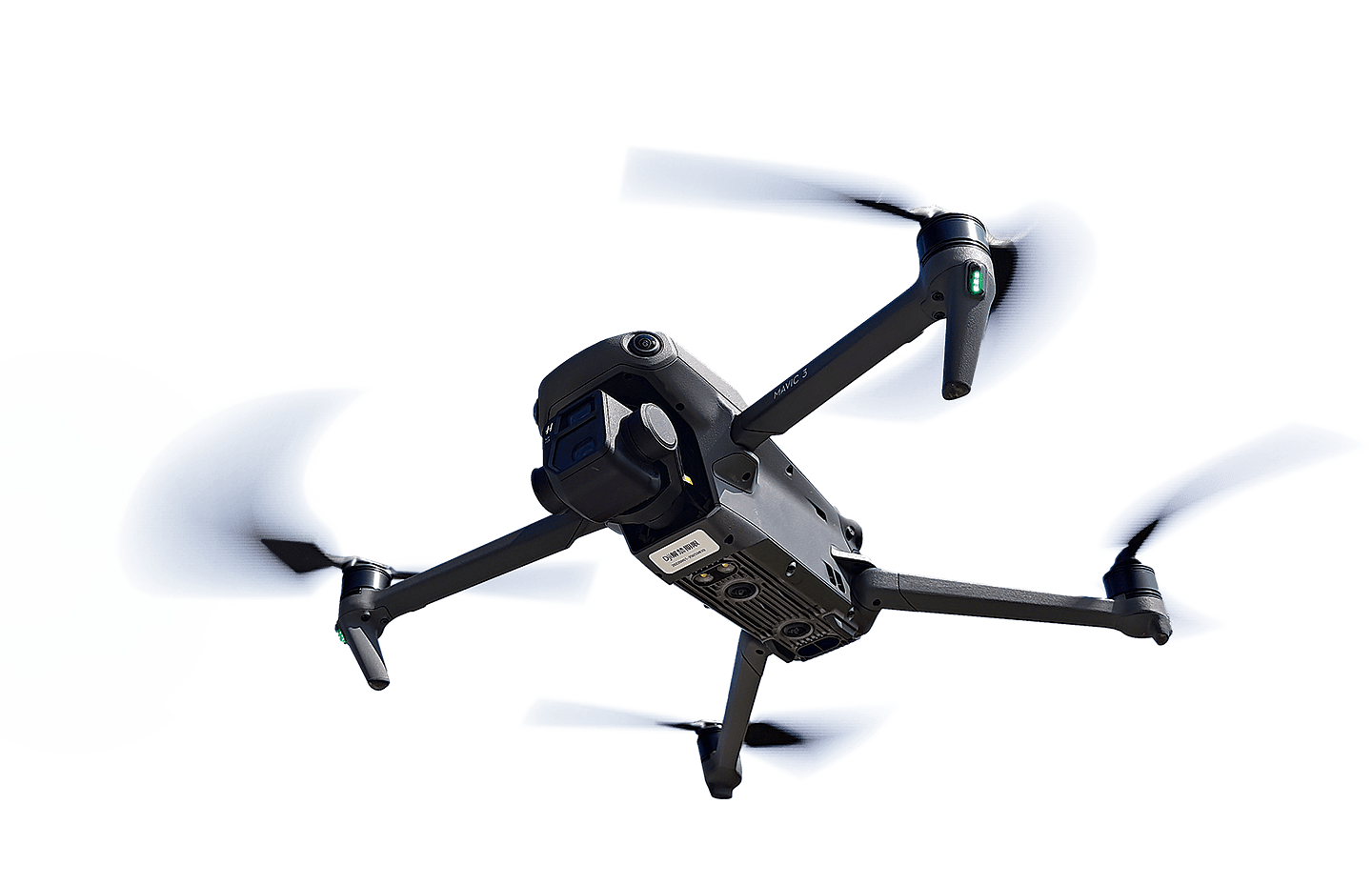
Driven by a passion for aerial imagery, Chen Rong-feng organized a Tzu Chi drone team to enhance the perspective of documentary photography and filming.
Courtesy of Chen Rong-feng
In 2020, the Taiwanese government began regulating drones. To help fellow Tzu Chi volunteers pass licensing exams, I began designing mock test questions and organizing flying technique practice sessions in open areas. Everyone endured the scorching sun without shade during the practice sessions, so I offered cool refreshments and snacks for relief. We mutually encouraged and learned from each other. A total of 68 volunteers have successfully obtained certifications.
Organizing a flying practice session, whether for exam purposes or not, entails careful planning. It includes finding an appropriate outdoor space, providing diverse flight training, and prioritizing safety. Once an outdoor space is chosen, I conduct repeated site inspections. In addition to training in mountain and sea flying techniques, I incorporate rescue scenarios. As an example, I strategically place five mannequins in grassy areas or along riverbanks, turning the exercise into a friendly competition to see who can locate the most mannequins in the shortest time.
I’ve been with Tzu Chi for over 15 years. The number of volunteers participating in our photography classes or learning sessions has grown from dozens to over 200. The aerial imagery team has also welcomed many new members, with participants now spread across Taiwan. Our numbers are steadily increasing. While one person may move swiftly, a group can go much farther. Preserving Tzu Chi’s history is not a task achievable by one person alone; it requires the collective effort of many. That’s why we must encourage participation and new blood in our documenting work.
I’ve seen a constant evolution in photography and video equipment during my time with Tzu Chi. My viewfinder has expanded from ground-level to aerial perspectives. I enjoy learning and growing along my life’s journey. I’m not one with grand plans. My goal for life is simple—to use my skills and abilities for the common good. As I share on my Facebook page: “My love for photography dates back to my youth. Images and visuals drive me forward. From photography and videography to editing and aerial imagery, I’m on a continuous learning journey. I am genuinely passionate about my work. I’m Chen Rong-feng [陳榮豐].”
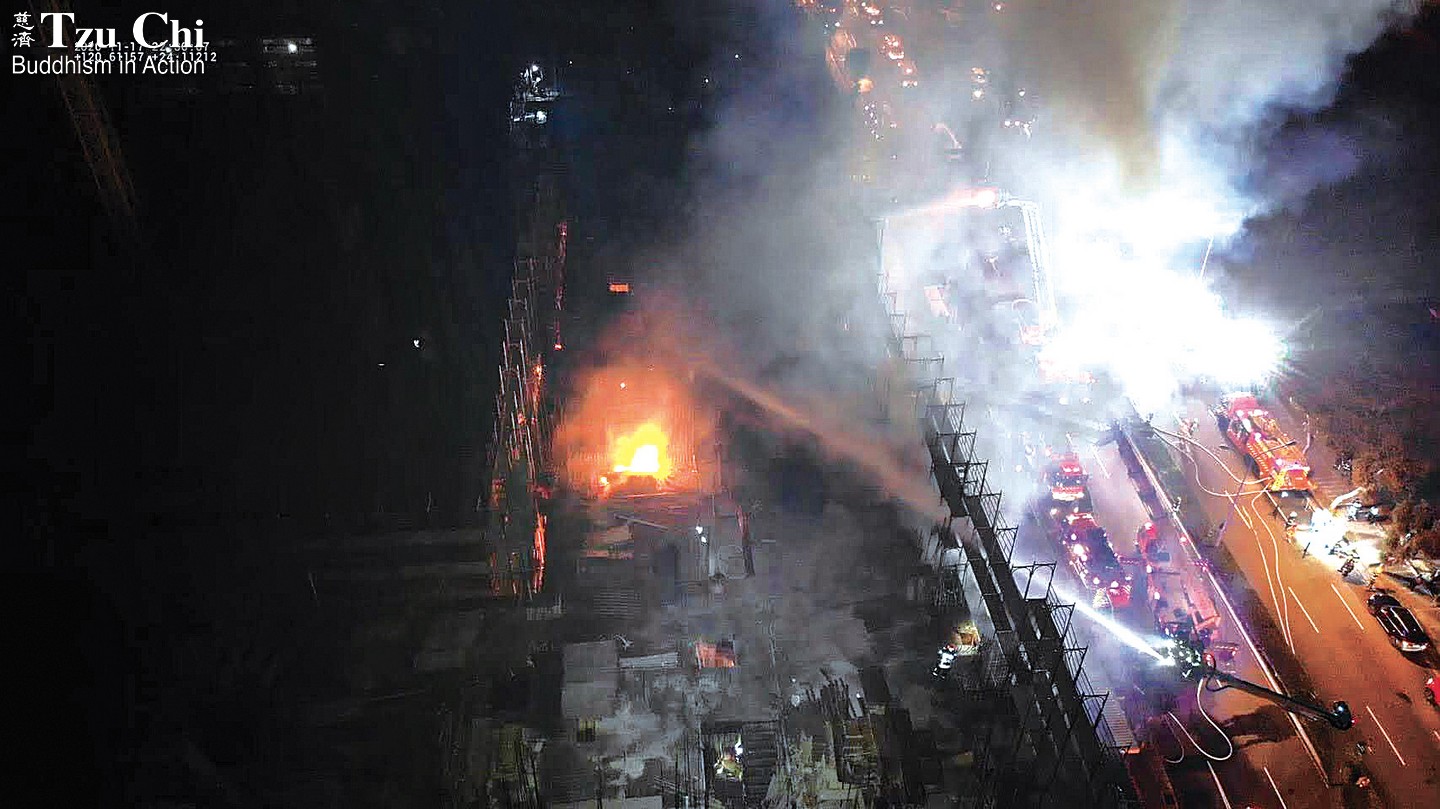
Chen Rong-feng used a drone to aid in aerial reconnaissance and investigate the point of ignition at a fire scene in Taichung, central Taiwan.
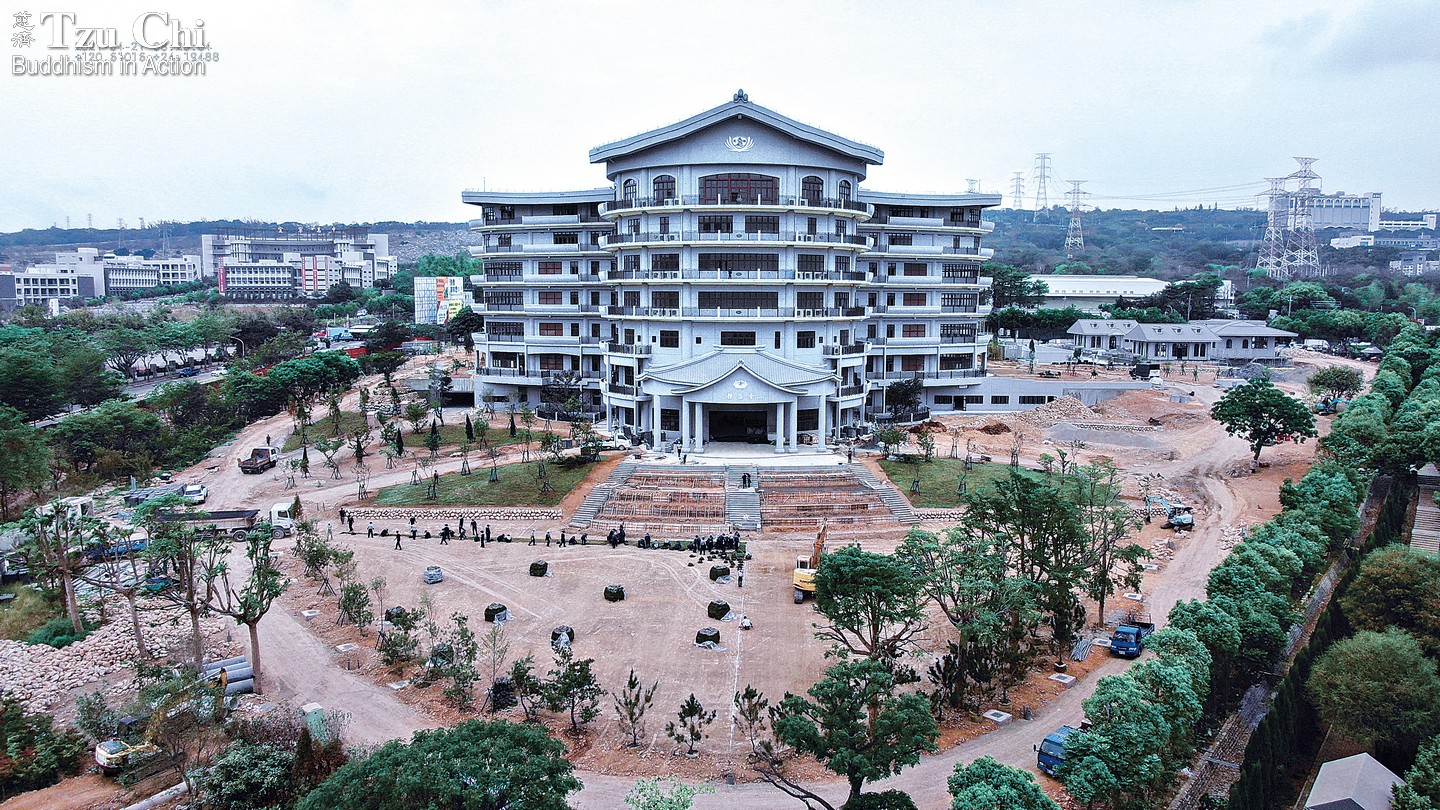
In 2021, Chen Rong-feng captured aerial footage of the Tzu Chi Dongda Campus in central Taiwan after the main construction was completed and landscaping was beginning.
Narrated by Chen Rong-feng
Interviewed and written by Lin Mei-hong
Abridged and translated by Wu Hsiao-ting
Photos by Chen Rong-feng
I’ve loved taking photos since my teenage years. After joining Tzu Chi, I kept growing my photography and videography skills, eventually venturing into aerial imagery. My goal is simple—I want to use my skills to capture the beauty and goodness of the world.
—Chen Rong-feng
Photo by Lin Mei-hong
I have been curious about “new” things since childhood, especially when it comes to electronic products and devices. In elementary school, I even dismantled a radio my dad bought to study its inner workings. During high school, I developed a fascination with cameras. I recall waking up one morning at two to capture the school gate, using a B shutter speed for 20 seconds. In the interplay of moonlight and car lights, the majestic school gate showcased the beauty of a dignified academic institution. I submitted the work to an intramural competition and won first place.
Time flew quickly after high school. My eldest son was born in 1991, when I was 28. While on a business trip to Japan, I purchased a mini digital video camera, marking the beginning of my journey into videography. In 2006, I attended a Tzu Chi year-end blessing ceremony for the first time. At the volunteer recruitment area, I enthusiastically noted my expertise in photography and videography on a form. Soon thereafter, I received an invitation to join Tzu Chi as a documenting volunteer. I began training in 2008 to become a certified volunteer.
I always followed my own approach through my years of taking photos, doing things as I liked. When I first joined the foundation, I was uncertain about which aspects of a Tzu Chi event to capture. I vividly recall my dissatisfaction with my work at my first Tzu Chi camp. However, when I submitted the photos I had taken to Jian Hong-zheng (簡宏正), the coordinator for the Image Team, I was pleasantly surprised. Looking at my photos, Brother Jian exclaimed, “Everything I needed is right here!” This affirmation greatly cheered me and set me on my determined journey as a documenting volunteer, motivating me to continuously refine my skills.
In early 2010, I joined fellow Tzu Chi volunteers from Taiwan on a mission to Guizhou Province, China, to distribute aid to the needy. When we arrived at the distribution venue in Pingyan Township, Luodian County, we were greeted by the heartwarming sight of hundreds of villagers and children forming two rows, applauding and warmly welcoming us. The sight moved me deeply. I found myself wondering, “What have I done to deserve such warmth from people I have never met?” I followed the other volunteers without saying a word, afraid that if I spoke, tears of emotion would spill from my eyes.
During home visits, we were welcomed into their households as if we were part of their family. This heartfelt reception stemmed from the love nurtured by my fellow volunteers during their ten years of work in Guizhou. I felt deeply grateful that my role as a documenting volunteer brought me to Guizhou, allowing me to be showered in such warmth while I captured one poignant scene after another through my lens.
The rural homes we visited were typically basic, crude structures that provided minimal shelter from wind and rain. I vividly remember a home visit to the Li family. Mr. Li had suffered a bone fracture, and lacking the financial means for medical treatment, his arm had become deformed. His wife, experiencing back pain, struggled to carry water for the family. The family had no source of income at all. We checked their pot and saw some poor-looking corn porridge inside. When we learned that such meager fare was their main food for three daily meals, I couldn’t contain my emotions. I rushed outside and began crying uncontrollably.
I used to think that crying was embarrassing for a man, but I couldn’t hold back my tears that day. They just couldn’t stop flowing. It was the first time I had shed tears in 40 years, and I must have cried without stopping for a good half hour.
After this trip to Guizhou, I set aside my love for the pursuit of enjoyment and pleasure. Before, I used to travel abroad for sightseeing once or twice a year. Although such travels brought me happiness, the joy was short-lived. The charitable mission to Guizhou, however, left an indelible mark on me. After that trip, almost every time I traveled abroad, it was for Tzu Chi.
I faced several challenges after taking on the role of coordinator for a community documentation team. At the time, our documenting volunteers lacked a dedicated database for their work, making it difficult for some of them to find photos to complement their articles. To address this issue, I collaborated with other volunteers to establish a dedicated File Transfer Protocol platform. This platform allowed our volunteers to easily upload and share data. Additionally, I worked with computer engineers to develop an online event schedule, which helped us post information about our community’s Tzu Chi activities. This saved us a lot of time and money. It reduced the need for phone calls to disseminate event information and encouraged greater participation from those interested in the events.
The challenge of not having a storage system for articles and photos extended beyond our specific community. I recognized that our volunteers’ hard work was not adequately preserved and that a considerable amount of time and manpower was spent gathering relevant data, so I began contemplating cross-district data integration. I started collaborating with Zhang Ting-xu (張廷旭), a volunteer from Tzu Chi’s central Taiwan Information Technology Team. We developed a dedicated software system for data integration. After we were successful, Zhang remarked in friendly banter, “This software was created at your request; you’re responsible for promoting it!”
In response, I reached out every day to the coordinators for documenting teams in different districts in central Taiwan, providing explanations and tutorials on archiving using our software system. After a year of efforts, relevant records from across the central Taiwan district began to be uploaded to the system, easily accessible through a simple search. Eventually, this system expanded to include other areas in Taiwan.
Later, I became the coordinator for Tzu Chi’s central Taiwan Image Team. I pondered: “How can I attract new volunteers? More importantly, how can I rekindle the initial enthusiasm of our senior volunteers?” I decided to introduce courses in 2018 to tackle these questions. The course design was diverse, allowing instructors to use personal photos for storytelling or inviting professional photographers to engage with our volunteers. Photos can speak volumes; for instance, instructor Chen Jian-hua (陳建華) used pictures of his mother to reflect on accompanying her through the last leg of her life, while Li Ying-qing (李盈青) shared the challenges she had experienced in her life through photos documenting her growth and development. Everyone got to know the instructors better through their photos, but also gained insight into the art of storytelling through photography.
I also collaborated with bakeries and dessert shops, requesting their products for volunteers to photograph. The resulting photos became promotional materials for the businesses. I invited commercial photographer and Tzu Chi volunteer Ye Tang-ming (葉唐銘) to share insights on composition and the use of light and shadow in pastry photography. During class, everyone arranged and presented the pastries provided by our collaborating businesses. Ye reminded everyone that the direction of light sources would change at different times, resulting in various effects, and that photography is subjective, with no definitive right or wrong. Following the instructor’s guidance, participants took their photos and then uploaded their work to a messaging app group chat for immediate sharing and discussion. Afterwards, the participants were able to eat the pastries, bringing sweetness to palates and hearts alike.
At the end of the course, I used the Kahoot! app as a fun, interactive way for participants to review what they had learned. I gave prizes to the top three scorers in the review game. It was a lot of fun to see participants navigate through a series of tense and joyful moments during the activity. Creating classes that were eagerly anticipated by our volunteers became what I considered my greatest achievement.
Chen Rong-feng developed a passion for photography during high school and often went outdoors for photoshoots.
Courtesy of Chen Rong-feng
Tzu Chi volunteers went to Luodian, Guizhou, China, in 2010 to distribute aid to the needy. Here is a touching moment captured by Chen Rong-feng.
My foray into aerial imagery began in 2014. That year, Tzu Chi held a Buddha Day ceremony at the Taichung Intercontinental Baseball Stadium in Taichung, central Taiwan. While I was documenting the ceremony with a camera, a buzzing sound caught my attention. Following the sound, I looked up and saw a drone for the first time. Involuntarily, my gaze followed it as it soared into the sky, and I found myself drawn closer to the drone operator. I was completely mesmerized when I saw the spectacular aerial view captured by the drone.
I couldn’t get the image of a drone out of my mind after that and purchased a drone the following year. I practiced flying it whenever time allowed and shared the videos I took online. Some people left negative comments upon seeing my footage, saying things like: “It’s not just about flying high in aerial imagery.” Instead of becoming disheartened by such comments, I recognized my inadequacies from their perspectives and encouraged myself to keep improving my skills.
I established an aerial imagery team in 2018, with the goal of sharing my drone flying skills and learning from more enthusiasts. The next year, I joined the Taichung City Fire Department’s aerial imagery unit to contribute to disaster relief efforts. This involved surveying the origins of fires, assisting on-site commanders in making accurate decisions for firefighting, participating in search and rescue missions for missing mountain climbers, and deploying lifebuoys for drowning victims. The aerial imagery team I established also collaborates with the Coast Guard Administration to fly over the sea and document the ecology of white dolphins.
Driven by a passion for aerial imagery, Chen Rong-feng organized a Tzu Chi drone team to enhance the perspective of documentary photography and filming.
Courtesy of Chen Rong-feng
In 2020, the Taiwanese government began regulating drones. To help fellow Tzu Chi volunteers pass licensing exams, I began designing mock test questions and organizing flying technique practice sessions in open areas. Everyone endured the scorching sun without shade during the practice sessions, so I offered cool refreshments and snacks for relief. We mutually encouraged and learned from each other. A total of 68 volunteers have successfully obtained certifications.
Organizing a flying practice session, whether for exam purposes or not, entails careful planning. It includes finding an appropriate outdoor space, providing diverse flight training, and prioritizing safety. Once an outdoor space is chosen, I conduct repeated site inspections. In addition to training in mountain and sea flying techniques, I incorporate rescue scenarios. As an example, I strategically place five mannequins in grassy areas or along riverbanks, turning the exercise into a friendly competition to see who can locate the most mannequins in the shortest time.
I’ve been with Tzu Chi for over 15 years. The number of volunteers participating in our photography classes or learning sessions has grown from dozens to over 200. The aerial imagery team has also welcomed many new members, with participants now spread across Taiwan. Our numbers are steadily increasing. While one person may move swiftly, a group can go much farther. Preserving Tzu Chi’s history is not a task achievable by one person alone; it requires the collective effort of many. That’s why we must encourage participation and new blood in our documenting work.
I’ve seen a constant evolution in photography and video equipment during my time with Tzu Chi. My viewfinder has expanded from ground-level to aerial perspectives. I enjoy learning and growing along my life’s journey. I’m not one with grand plans. My goal for life is simple—to use my skills and abilities for the common good. As I share on my Facebook page: “My love for photography dates back to my youth. Images and visuals drive me forward. From photography and videography to editing and aerial imagery, I’m on a continuous learning journey. I am genuinely passionate about my work. I’m Chen Rong-feng [陳榮豐].”
Chen Rong-feng used a drone to aid in aerial reconnaissance and investigate the point of ignition at a fire scene in Taichung, central Taiwan.
In 2021, Chen Rong-feng captured aerial footage of the Tzu Chi Dongda Campus in central Taiwan after the main construction was completed and landscaping was beginning.
By Zhang Ju-fen
Translated by Wu Hsiao-ting
Photos by Li Ya-ping
The Tzu Chi assistive device team in Chiayi, southern Taiwan, repairs and refurbishes retired beds from Dalin Tzu Chi Hospital, transforming some into fully operational beds.

Volunteers from the Chiayi assistive device team visit Dalin Tzu Chi Hospital to collect retired hospital beds for repair and reuse.
Dalin Tzu Chi Hospital in Chiayi, southern Taiwan, opened its doors 23 years ago, thanks to generous donations from around the world. However, the high-quality hospital beds purchased at that time have started showing signs of wear and tear, including rust and malfunctions. While other medical institutions might swap out such beds without a second thought, at Tzu Chi, they’re repurposed, continuing the cycle of love.
In 2023, volunteer Yang Li-fen (楊麗芬) found a collection of hospital beds stored together in the hospital and inquired if they were going to be retired and replaced. Lin Wen-feng (林文峰), head of the Safekeeping Section of the General Affairs Department at the hospital, explained that these electric beds, imported from the United States and each costing over 50,000 New Taiwan dollars (approximately US$1,650), were experiencing issues after years of use, including with their lifting mechanisms. The Engineering Department at the hospital had evaluated the beds and concluded that they no longer met modern medical standards. The beds were slated to be replaced with newer models.
Shen Kun-fu (沈坤福), head of the Engineering Department’s Maintenance Section, clarified that some beds had defective circuit boards or motors. He also noted that the original manufacturers had stopped producing the parts. Some were showing rust stains, affecting their appearance, but refurbishing them would be nearly as expensive as purchasing new ones. He added that if these beds were handed over to a recycling company, they would likely be treated as scrap metal, a fate he couldn’t help but find regrettable.
Yang Li-fen proposed that the beds be given to the Tzu Chi assistive device team in Chiayi for repair and reuse. This proposal received strong support from the General Affairs Department. The large-scale recycling project with the team was initiated on June 7, 2023.
Each bed weighed 150 kilograms, and many of the volunteers involved in the project were getting on in years, but they worked tirelessly, bending down to tie ropes securely and carefully transporting each bed to their repair site. Over the eight months since the project started, volunteers have dismantled beds too far gone to be functional, transferred usable parts onto beds in better condition, and meticulously cleaned every part of each bed. They rewired broken circuits or switches and removed rust before repainting. Some volunteers even bought parts with their own money to repair some of the faulty beds.
As of February 2024, over 60 of the 122 repaired beds had already been distributed. Despite the challenging transportation process, volunteers have delivered beds to nursing centers in Penghu, an archipelago off the southwestern coast of Taiwan, as well as to various locations in Chiayi County and City, including the mountainous Alishan Township and the coastal Budai Township. The first bed arrived at Leye Village in Alishan Township on August 24, 2023. A 72-year-old woman there, receiving home care, couldn’t afford the tens of thousands of Taiwanese dollars for an electric medical bed. When the bed provided by Tzu Chi was delivered to her home, her daughter, the woman’s principal caregiver, was deeply grateful to Tzu Chi for alleviating pressure on her family.
Volunteers for the Tzu Chi Eco-Friendly Assistive Device Program in Taiwan clean, disinfect, and refurbish used assistive devices before sending them out to people needing such equipment. Anyone can apply for these devices, which are delivered to the applicant’s home. Dalin Tzu Chi Hospital still has nearly 400 beds waiting to be recycled, so volunteers will continue their efforts to give new life to the equipment.
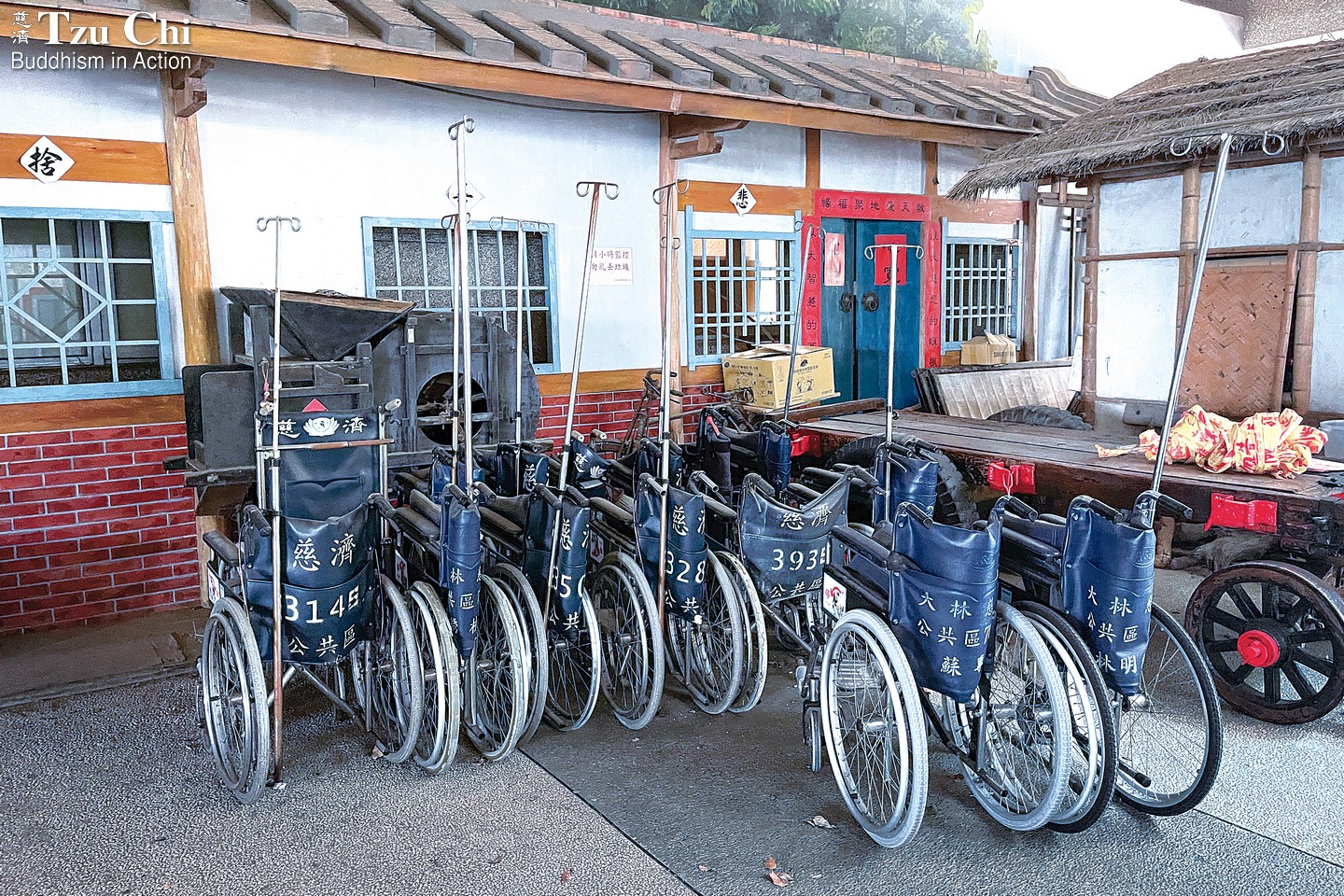
Tzu Chi’s assistive device program collects used assistive devices across Taiwan, then repairs and refurbishes them before distributing them to applicants. Here are some wheelchairs collected by program volunteers in Chiayi.
By Zhang Ju-fen
Translated by Wu Hsiao-ting
Photos by Li Ya-ping
The Tzu Chi assistive device team in Chiayi, southern Taiwan, repairs and refurbishes retired beds from Dalin Tzu Chi Hospital, transforming some into fully operational beds.
Volunteers from the Chiayi assistive device team visit Dalin Tzu Chi Hospital to collect retired hospital beds for repair and reuse.
Dalin Tzu Chi Hospital in Chiayi, southern Taiwan, opened its doors 23 years ago, thanks to generous donations from around the world. However, the high-quality hospital beds purchased at that time have started showing signs of wear and tear, including rust and malfunctions. While other medical institutions might swap out such beds without a second thought, at Tzu Chi, they’re repurposed, continuing the cycle of love.
In 2023, volunteer Yang Li-fen (楊麗芬) found a collection of hospital beds stored together in the hospital and inquired if they were going to be retired and replaced. Lin Wen-feng (林文峰), head of the Safekeeping Section of the General Affairs Department at the hospital, explained that these electric beds, imported from the United States and each costing over 50,000 New Taiwan dollars (approximately US$1,650), were experiencing issues after years of use, including with their lifting mechanisms. The Engineering Department at the hospital had evaluated the beds and concluded that they no longer met modern medical standards. The beds were slated to be replaced with newer models.
Shen Kun-fu (沈坤福), head of the Engineering Department’s Maintenance Section, clarified that some beds had defective circuit boards or motors. He also noted that the original manufacturers had stopped producing the parts. Some were showing rust stains, affecting their appearance, but refurbishing them would be nearly as expensive as purchasing new ones. He added that if these beds were handed over to a recycling company, they would likely be treated as scrap metal, a fate he couldn’t help but find regrettable.
Yang Li-fen proposed that the beds be given to the Tzu Chi assistive device team in Chiayi for repair and reuse. This proposal received strong support from the General Affairs Department. The large-scale recycling project with the team was initiated on June 7, 2023.
Each bed weighed 150 kilograms, and many of the volunteers involved in the project were getting on in years, but they worked tirelessly, bending down to tie ropes securely and carefully transporting each bed to their repair site. Over the eight months since the project started, volunteers have dismantled beds too far gone to be functional, transferred usable parts onto beds in better condition, and meticulously cleaned every part of each bed. They rewired broken circuits or switches and removed rust before repainting. Some volunteers even bought parts with their own money to repair some of the faulty beds.
As of February 2024, over 60 of the 122 repaired beds had already been distributed. Despite the challenging transportation process, volunteers have delivered beds to nursing centers in Penghu, an archipelago off the southwestern coast of Taiwan, as well as to various locations in Chiayi County and City, including the mountainous Alishan Township and the coastal Budai Township. The first bed arrived at Leye Village in Alishan Township on August 24, 2023. A 72-year-old woman there, receiving home care, couldn’t afford the tens of thousands of Taiwanese dollars for an electric medical bed. When the bed provided by Tzu Chi was delivered to her home, her daughter, the woman’s principal caregiver, was deeply grateful to Tzu Chi for alleviating pressure on her family.
Volunteers for the Tzu Chi Eco-Friendly Assistive Device Program in Taiwan clean, disinfect, and refurbish used assistive devices before sending them out to people needing such equipment. Anyone can apply for these devices, which are delivered to the applicant’s home. Dalin Tzu Chi Hospital still has nearly 400 beds waiting to be recycled, so volunteers will continue their efforts to give new life to the equipment.
Tzu Chi’s assistive device program collects used assistive devices across Taiwan, then repairs and refurbishes them before distributing them to applicants. Here are some wheelchairs collected by program volunteers in Chiayi.
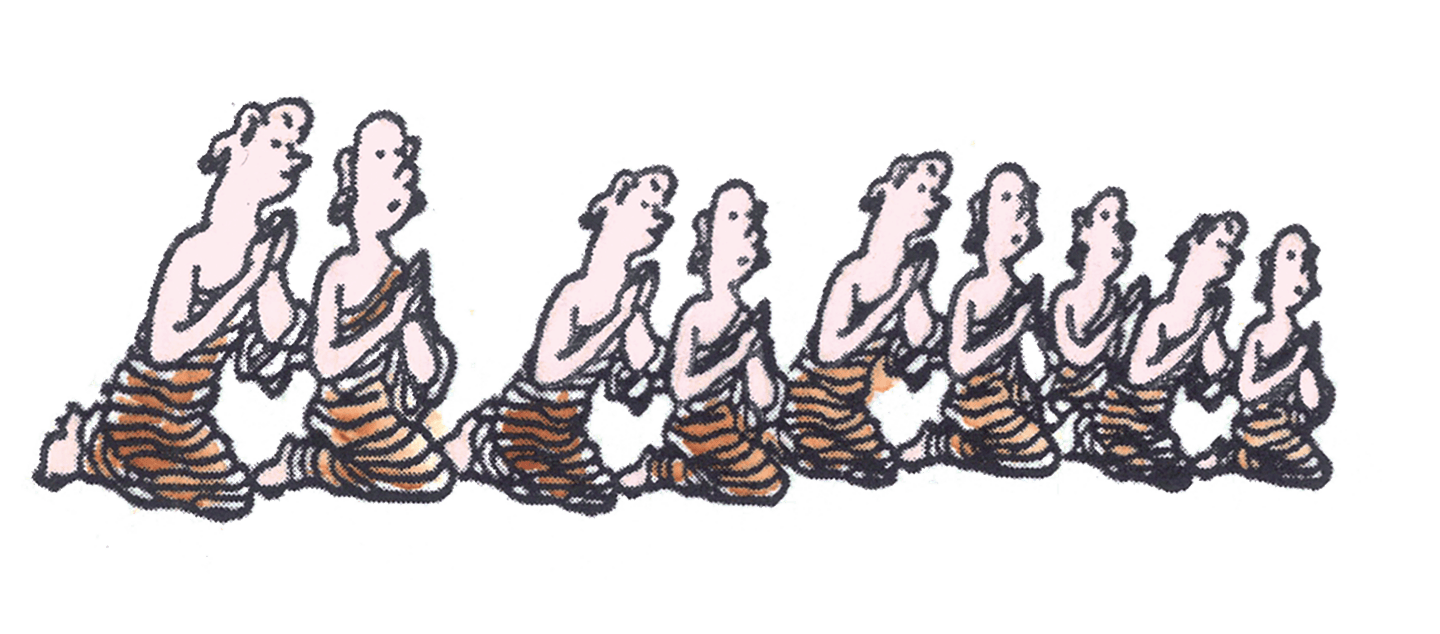
My fellow monks!
Do not accept my teachings just because you respect me.
You should be like fire which tries pure gold.
You must personally test and prove the Dharma I teach.
Recognize the Dharma from the fruit it produces.
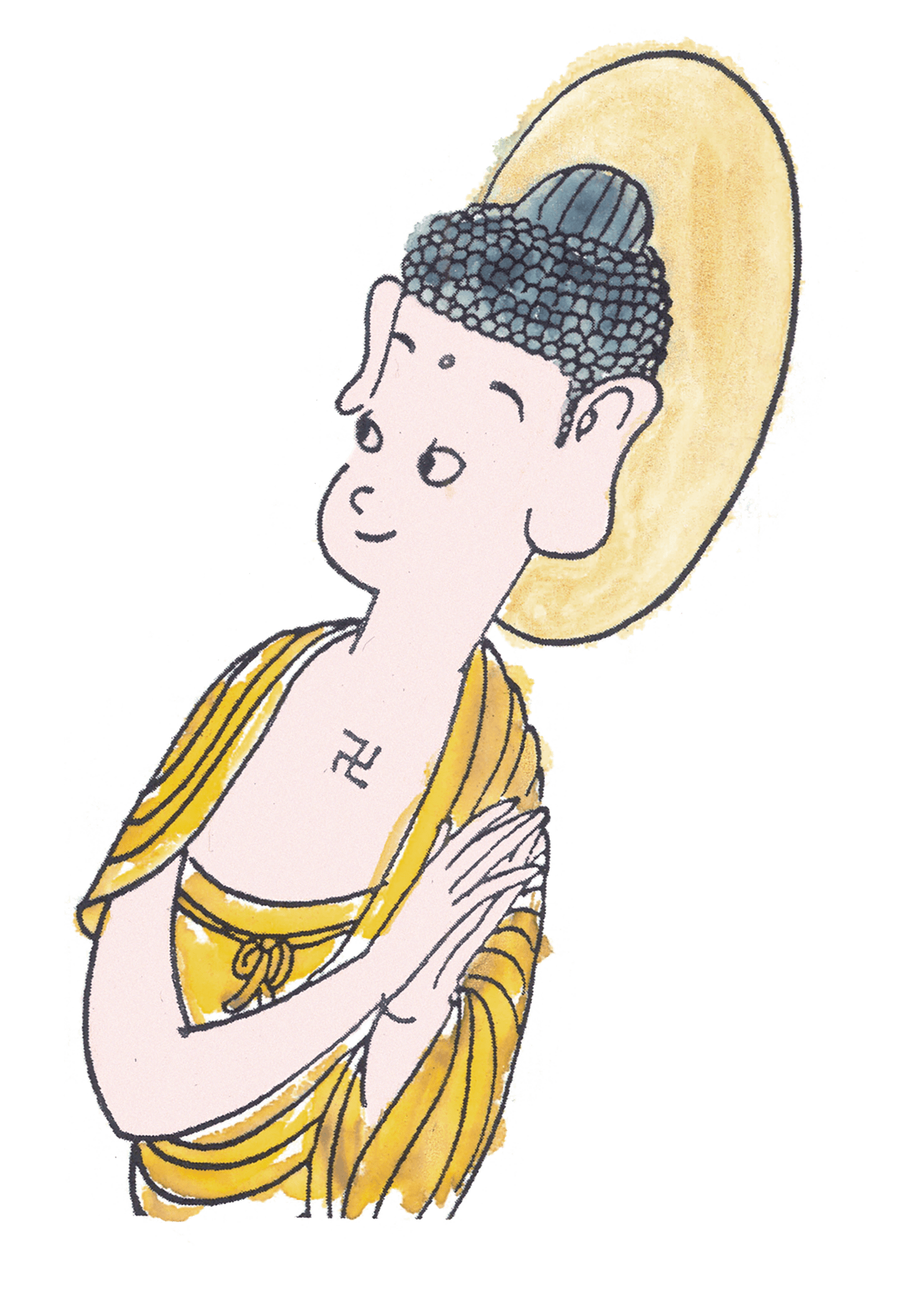
Buddhist disciples should not worship the Buddha as a god. We should think of the Buddha as a saint—a great educator who exceeds earthly intelligence and reveals true wisdom. He serves as a role model for us to follow.
This approach establishes a solid foundation for life and encompasses the rich educational essence of Buddhism.
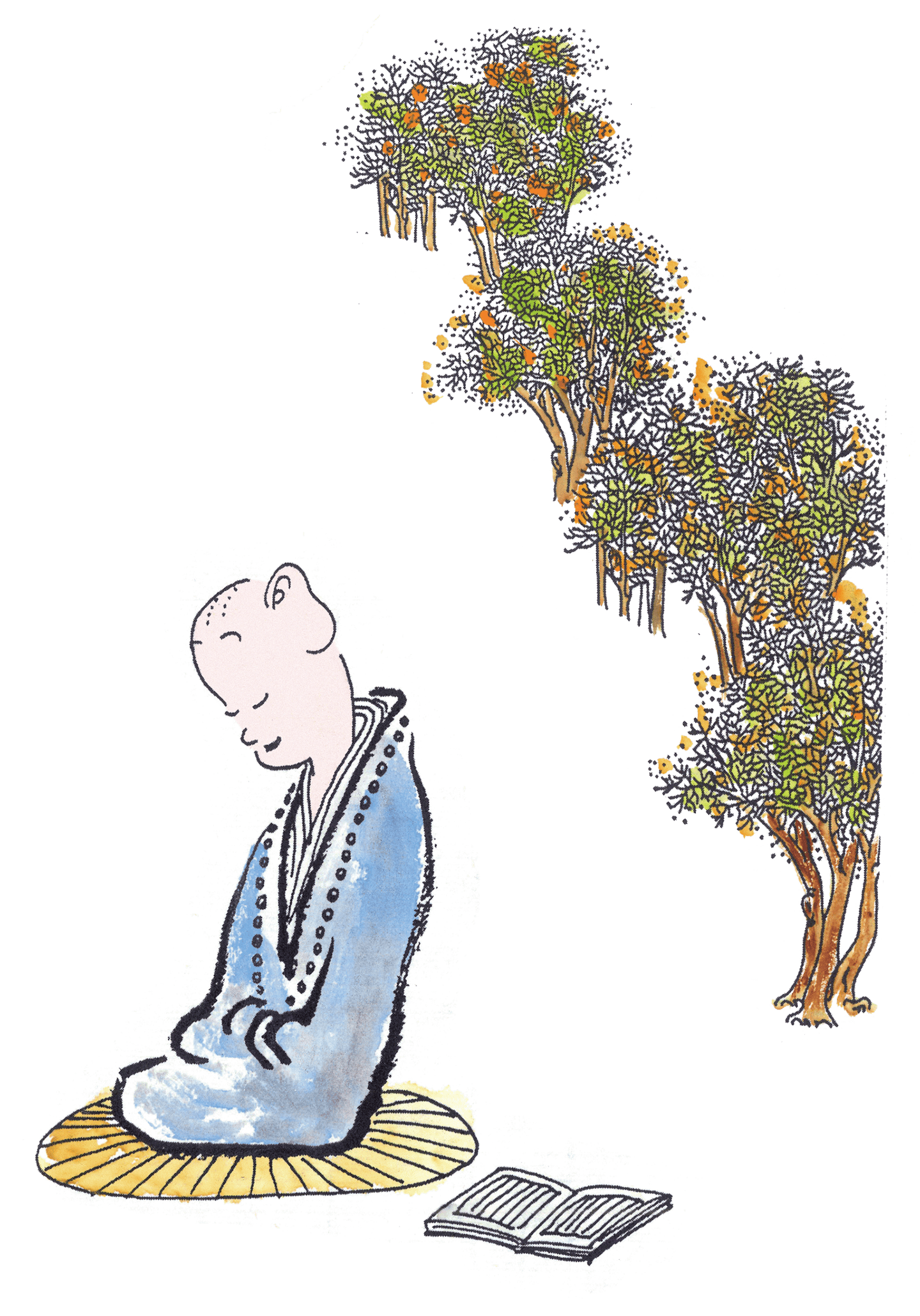
Is it possible to always take without ever giving? It’s like always wanting to withdraw money from a bank account without ever making any deposits. It’s impossible.
Translated by E. E. Ho and W. L. Rathje; drawings by Tsai Chih-chung; coloring by May E. Gu
My fellow monks!
Do not accept my teachings just because you respect me.
You should be like fire which tries pure gold.
You must personally test and prove the Dharma I teach.
Recognize the Dharma from the fruit it produces.
Buddhist disciples should not worship the Buddha as a god. We should think of the Buddha as a saint—a great educator who exceeds earthly intelligence and reveals true wisdom. He serves as a role model for us to follow.
This approach establishes a solid foundation for life and encompasses the rich educational essence of Buddhism.
Is it possible to always take without ever giving? It’s like always wanting to withdraw money from a bank account without ever making any deposits. It’s impossible.
Translated by E. E. Ho and W. L. Rathje; drawings by Tsai Chih-chung; coloring by May E. Gu
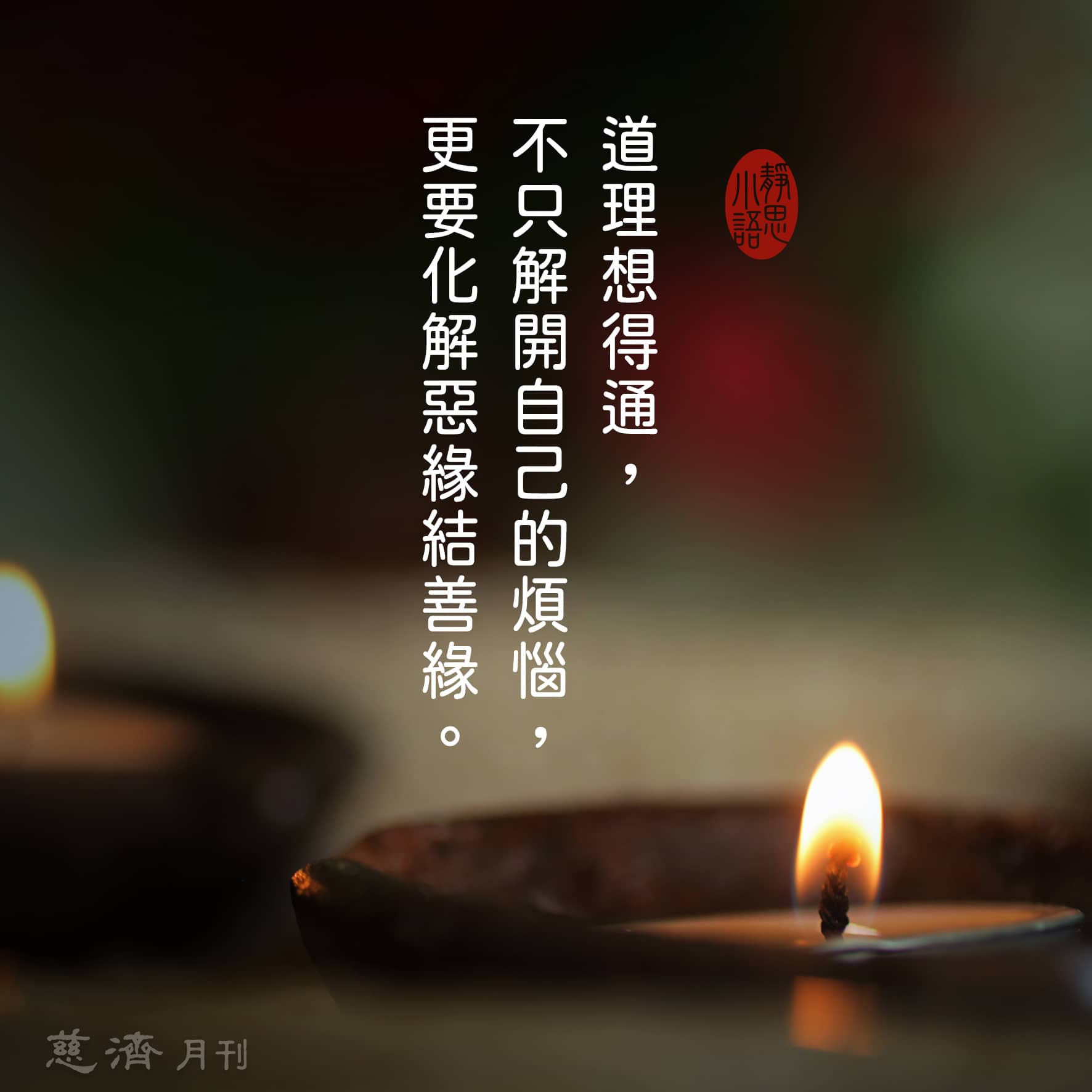
【靜思小語】道理想得通,不只解開自己的煩惱,更要化解惡緣結善緣。
《證嚴上人衲履足跡》有聲書,由慈濟人文志業廣播內容創作中心提供,更多精彩的廣播節目,歡迎到「大愛網路電台」收聽。
三月八日,馬來西亞慈濟人與吉隆坡慈濟國際學校教師團隊與上人座談,上人說,人生學無止境,累生累世有學不完的真諦、道理,而此時大家有緣共聚在慈濟,無論在臺灣或馬來西亞,還有尼泊爾,人人有心、有願,彼此的緣就可以結合起來,走在佛陀為眾生指引的大道上。
「我時常感恩自己有好因緣,因緣不是別人給的,是自己過去生種的因、結的緣。我們今生也在為未來而造作因緣,每一天的每一個心念、每一個腳步,都會影響到明天與以後,所以要把握當下這一刻。每天的八萬六千四百秒,秒秒都是我們的關卡,秒秒的心念都在生、住、異、滅中,若因感動而發心立願,生起一股力量,就要把握住這個念頭與力量,隨著時間成就一切,達成心願。」
上人肯定馬來西亞的慈濟志業能夠發展得這麼好,是因為資深慈濟人用心用愛接引、帶動新進者;領眾者並非用威權服人,而是用愛的語言鼓勵、褒揚大家,讓人感受到真誠的愛,覺得受到肯定,進而發心承擔志業責任,能再接引人、帶動人。所以每一位慈濟人都是一顆飽滿的種子,再接引出來的新進者,也能成長為可以不斷產生好種子的大樹,不只能庇蔭馬來西亞的苦難人,還可以跨國付出,並接引其他國度的人間菩薩。
上人請老師們與師兄師姊把握時間、把握因緣,不要空過時日;聞法要入心,記得住、放在心裏,還要身體力行,否則就像一顆種子,錯過了播種的時機而沒有發芽,也就不會有收穫。「大家已經投入慈濟,很清楚慈濟的方向與道路,要落實清淨無染的無私大愛,就要用心精進,步步踏實。靜思語教學是教育的好方法,簡單的靜思語,幼小的孩子可以吸收入心,大人聽到孩子在生活中自然而然地運用靜思語的道理,也能受教。」
「一念心是一顆種子,還要會合人人的緣,人多力量大,慈濟志業需要這麼多人的心力推動,所以我要時常提醒自己,對人要親切,與人互動要和氣,用真誠的愛接引人。」上人勉勵大家學習資深典範,用愛接引、帶動人,一代傳一代,讓菩薩種子不斷地從「一」生無量。
三月九日,馬來西亞雪隆四合一幹部與上人座談,上人聆聽師兄師姊述說無常人生、病痛之苦,指出若對人生無常有切身體會,認清生老病死的人生自然法則,就要用因緣果報的道理開導自己,平靜以對。境界來時,無須抱怨:「我平常做很多好事,也沒有做壞事,為什麼是我?」會這麼想,就是還不理解因緣果報的道理,平常聽的法沒有入心中。學佛、了解法,就要用法開啟心門,認知這是過去種下的因,現在結的果。
「無論如何,我們過去也有造福,結下好緣,現在見面共聚,彼此投緣;你們看到師父就心生歡喜,聽到師父說話,你們聽入心,當你們心裏有苦、有難、有掙扎,師父說的話就會浮現腦海,想到師父說要打開心門,要放下,不爭為安,你們將這些話當成法來用,就度過了一件煩惱事。」
上人對大家說,法在心中,遇事能夠用法解心結,就是「有法度」,先能做到度自己;當心開意解、煩惱滅除之後,也能與大家分享自己的心路歷程,讓別人也能聞法善用,這就是聞法、說法、傳法;自己經歷過、用過法而獲益,把道理和經驗傳給別人,讓人受用,即是以法度人,這就是聞法功德。假如聽再多的法,自己沒有受用,讓煩惱延續;或是有因緣卻不傳給別人,解開別人的煩惱,沒有與眾生結好緣,實在很可惜。
上人指出,即使是佛也不能度無緣眾生,所以有智慧要度眾生,還要結好眾生緣,才能讓人見面投緣,願意聽從引導而解開心結、脫離心靈的困苦。「有的人一次又一次被最愛的人背叛,一次又一次被傷害而痛苦,心靈總是在不甘願、不諒解、仇恨的負面情緒中翻攪。其實生命隨著時間不斷過去,總是為了這些事煩惱、受折磨,又有什麼用?要想通因緣果報、無常、苦、空的道理。」
「我們做好事會有好報,沒有錯,但不是僅僅要做來補;如是因,現在得到的是過去做的,我們現在做的是未來得,所以是『做來囤』,為來生囤積好因緣。不過我們在這一生除了甘願承受過去生造作而來的惡業,還可以解冤釋結,把複雜而糾纏的結打斷,轉惡緣為善緣。」
「即使我們現在行菩薩道,難免也會接觸到過去結了不好的緣的人,我們要主動對他們好,拉回來與我們一起做慈濟事;或許也有即使我們一直付出,還是無法與我們修好的人,我們要用寬大的心面對他。他不願解開惡緣,我們自己解開,才不會在來生再糾纏。」
上人說,菩薩度有緣人,有不少師兄師姊度全家人投入慈濟,全家和樂有福;然而不只是度家人,還要度無量眾生,請師兄師姊抱持這樣的心態,讓馬來西亞有更多慈濟的好因緣,人間菩薩相互勉勵、彼此度化,把馬來西亞的慈濟志業推動得更好,推展得更廣。
本專欄為靜思人文出版之《證嚴上人衲履足跡》精簡版;更完整的慈濟脈動與開示內容,以及師徒之間的感人對談,請展閱每季出版的《證嚴上人衲履足跡》
【靜思小語】道理想得通,不只解開自己的煩惱,更要化解惡緣結善緣。
《證嚴上人衲履足跡》有聲書,由慈濟人文志業廣播內容創作中心提供,更多精彩的廣播節目,歡迎到「大愛網路電台」收聽。
三月八日,馬來西亞慈濟人與吉隆坡慈濟國際學校教師團隊與上人座談,上人說,人生學無止境,累生累世有學不完的真諦、道理,而此時大家有緣共聚在慈濟,無論在臺灣或馬來西亞,還有尼泊爾,人人有心、有願,彼此的緣就可以結合起來,走在佛陀為眾生指引的大道上。
「我時常感恩自己有好因緣,因緣不是別人給的,是自己過去生種的因、結的緣。我們今生也在為未來而造作因緣,每一天的每一個心念、每一個腳步,都會影響到明天與以後,所以要把握當下這一刻。每天的八萬六千四百秒,秒秒都是我們的關卡,秒秒的心念都在生、住、異、滅中,若因感動而發心立願,生起一股力量,就要把握住這個念頭與力量,隨著時間成就一切,達成心願。」
上人肯定馬來西亞的慈濟志業能夠發展得這麼好,是因為資深慈濟人用心用愛接引、帶動新進者;領眾者並非用威權服人,而是用愛的語言鼓勵、褒揚大家,讓人感受到真誠的愛,覺得受到肯定,進而發心承擔志業責任,能再接引人、帶動人。所以每一位慈濟人都是一顆飽滿的種子,再接引出來的新進者,也能成長為可以不斷產生好種子的大樹,不只能庇蔭馬來西亞的苦難人,還可以跨國付出,並接引其他國度的人間菩薩。
上人請老師們與師兄師姊把握時間、把握因緣,不要空過時日;聞法要入心,記得住、放在心裏,還要身體力行,否則就像一顆種子,錯過了播種的時機而沒有發芽,也就不會有收穫。「大家已經投入慈濟,很清楚慈濟的方向與道路,要落實清淨無染的無私大愛,就要用心精進,步步踏實。靜思語教學是教育的好方法,簡單的靜思語,幼小的孩子可以吸收入心,大人聽到孩子在生活中自然而然地運用靜思語的道理,也能受教。」
「一念心是一顆種子,還要會合人人的緣,人多力量大,慈濟志業需要這麼多人的心力推動,所以我要時常提醒自己,對人要親切,與人互動要和氣,用真誠的愛接引人。」上人勉勵大家學習資深典範,用愛接引、帶動人,一代傳一代,讓菩薩種子不斷地從「一」生無量。
三月九日,馬來西亞雪隆四合一幹部與上人座談,上人聆聽師兄師姊述說無常人生、病痛之苦,指出若對人生無常有切身體會,認清生老病死的人生自然法則,就要用因緣果報的道理開導自己,平靜以對。境界來時,無須抱怨:「我平常做很多好事,也沒有做壞事,為什麼是我?」會這麼想,就是還不理解因緣果報的道理,平常聽的法沒有入心中。學佛、了解法,就要用法開啟心門,認知這是過去種下的因,現在結的果。
「無論如何,我們過去也有造福,結下好緣,現在見面共聚,彼此投緣;你們看到師父就心生歡喜,聽到師父說話,你們聽入心,當你們心裏有苦、有難、有掙扎,師父說的話就會浮現腦海,想到師父說要打開心門,要放下,不爭為安,你們將這些話當成法來用,就度過了一件煩惱事。」
上人對大家說,法在心中,遇事能夠用法解心結,就是「有法度」,先能做到度自己;當心開意解、煩惱滅除之後,也能與大家分享自己的心路歷程,讓別人也能聞法善用,這就是聞法、說法、傳法;自己經歷過、用過法而獲益,把道理和經驗傳給別人,讓人受用,即是以法度人,這就是聞法功德。假如聽再多的法,自己沒有受用,讓煩惱延續;或是有因緣卻不傳給別人,解開別人的煩惱,沒有與眾生結好緣,實在很可惜。
上人指出,即使是佛也不能度無緣眾生,所以有智慧要度眾生,還要結好眾生緣,才能讓人見面投緣,願意聽從引導而解開心結、脫離心靈的困苦。「有的人一次又一次被最愛的人背叛,一次又一次被傷害而痛苦,心靈總是在不甘願、不諒解、仇恨的負面情緒中翻攪。其實生命隨著時間不斷過去,總是為了這些事煩惱、受折磨,又有什麼用?要想通因緣果報、無常、苦、空的道理。」
「我們做好事會有好報,沒有錯,但不是僅僅要做來補;如是因,現在得到的是過去做的,我們現在做的是未來得,所以是『做來囤』,為來生囤積好因緣。不過我們在這一生除了甘願承受過去生造作而來的惡業,還可以解冤釋結,把複雜而糾纏的結打斷,轉惡緣為善緣。」
「即使我們現在行菩薩道,難免也會接觸到過去結了不好的緣的人,我們要主動對他們好,拉回來與我們一起做慈濟事;或許也有即使我們一直付出,還是無法與我們修好的人,我們要用寬大的心面對他。他不願解開惡緣,我們自己解開,才不會在來生再糾纏。」
上人說,菩薩度有緣人,有不少師兄師姊度全家人投入慈濟,全家和樂有福;然而不只是度家人,還要度無量眾生,請師兄師姊抱持這樣的心態,讓馬來西亞有更多慈濟的好因緣,人間菩薩相互勉勵、彼此度化,把馬來西亞的慈濟志業推動得更好,推展得更廣。
本專欄為靜思人文出版之《證嚴上人衲履足跡》精簡版;更完整的慈濟脈動與開示內容,以及師徒之間的感人對談,請展閱每季出版的《證嚴上人衲履足跡》
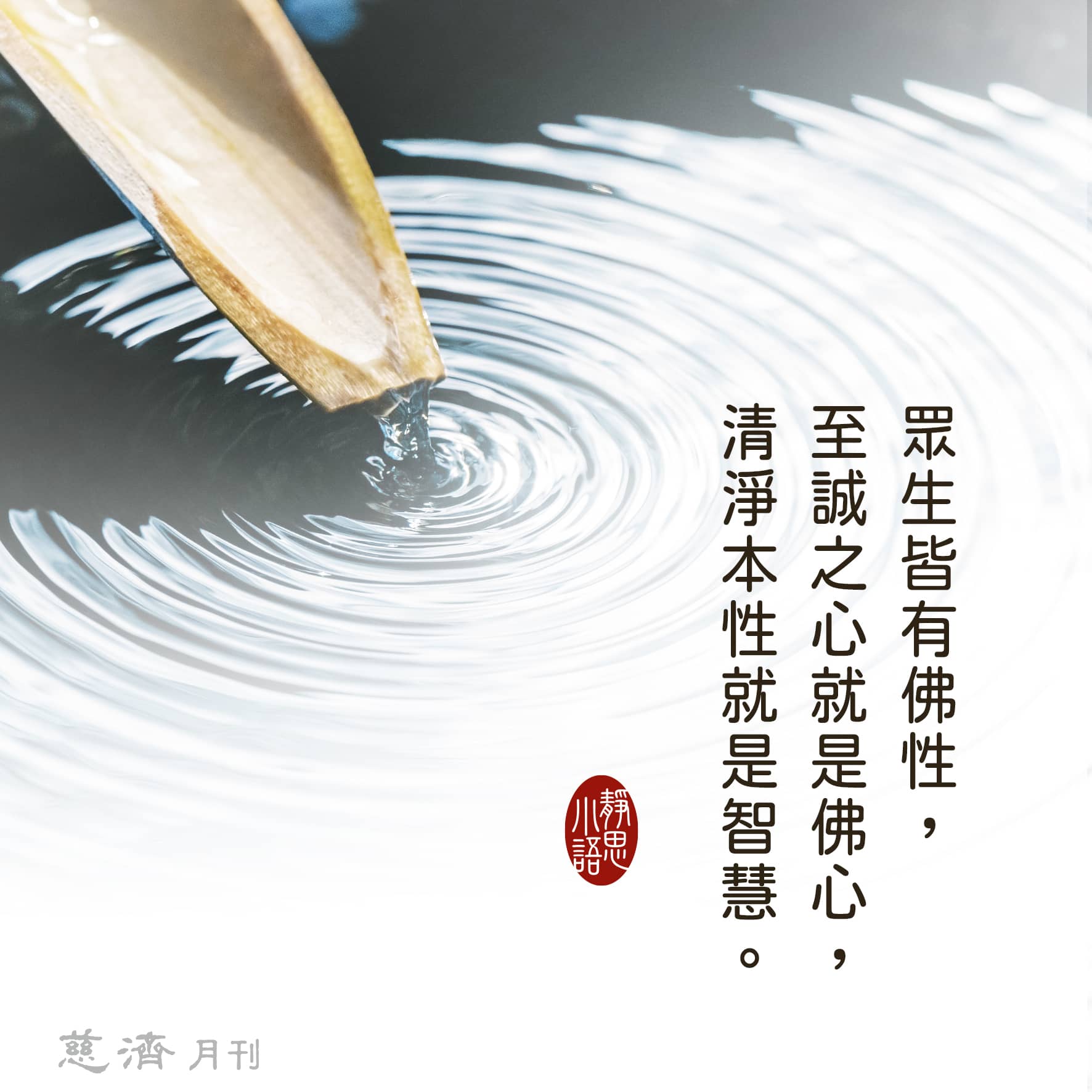
【靜思小語】眾生皆有佛性,至誠之心就是佛心,清淨本性就是智慧。
《證嚴上人衲履足跡》有聲書,由慈濟人文志業廣播內容創作中心提供,更多精彩的廣播節目,歡迎到「大愛網路電台」收聽。
三月十日,與返臺參加全美合心共識會的美國慈濟人座談,上人說,佛陀來人間教導菩薩法,而菩薩為苦難眾生開闢一條慈善之道,佛陀在這條慈善之道上,開展出智慧之道。慈善就是福,智慧是從至誠之心發揮出來,這分至誠之心就是佛心;人人本具佛性,而眾生的清淨佛心久受無明煩惱蒙蔽,需要有人引導,走上智慧之道,回歸佛心本性。
上人請大家思考,在現代,慈濟要如何更加深入人群度眾生。在此一時代,眾生心很複雜,因為科技發達,人們愈來愈倚賴科技,認為運用科技可以無所不為,愈漸背離佛心本性,偏離正軌。
上人指出,方便的科技工具與網路傳訊讓人如有神通,若用於正途,可以幫助人間發展,但若人心偏邪,運用科技為惡,就會威脅人間安全。「我們要淨化人心,顯出人人與佛同等的智慧,傳播善法普及天下、教化眾生,發揮真誠的大愛,顯示清淨無染的佛心本性。」
「在慈濟,真的可以看見人人本具佛心,發揮無私大愛,付出無所求。現在的社會中,人人都很忙,不過慈濟人仍以大愛為前提,撥出時間做慈濟,也要捨一點小愛先做大愛的事,很有智慧。太太因為先生來做慈濟,她心歡喜,多增加福;雖然在小愛中甜甜蜜蜜,但是在慈濟汲取法水,智慧之水是源源不絕。」
「各州慈濟人難得共聚,相互分享,可以聽到某一州的慈濟人如何運用智慧走入社會,為社會做更多事,讓更多家庭圓滿,則人間平安。」上人說,人人都有各自的小家庭,小家庭的愛無法容納很大的範圍;而慈濟大家庭可以包容每一個小家庭,讓家家都因為大愛而圓滿。請大家相互勉勵,共同發心立願造福人間,同時增長智慧。
上人鼓勵師兄師姊為人間而多發揮生命價值,不要只在私情小愛中糾纏,要把愛擴大,人人共善。「慈濟人的獨特之處,在於我們有共善的意志,有共善的大愛善念,願意無私付出,是名副其實的人間菩薩。」
上人說,雖然與全球人口相較,慈濟人還是極少數,度人的力量仍很微弱,但是每一位就像一盞燈,點亮了一支蠟燭,其他的蠟燭可以來引火,點亮更多盞燈,讓微弱的燭光漸漸明亮起來,讓愈多人顯露本具的佛性。「人人本來都具有佛心的覺悟智慧,只是睡著了,現在覺醒,就要端正自己、修好自己,同時不斷招攬人間菩薩,讓每個地方都有一盞燈,每一盞燈再點亮無量燈,度更多人,反轉更多迷茫的凡夫心,走上覺悟之道,這就是我們的目標。」
上人表示,因為眾生業力深重,需要更多菩薩出現在人間,發揮無量神通;請大家不斷招募人間菩薩,還要善用科技聞法、傳法,讓愛普及天下。
三月十一日,聆聽基金會主管同仁分享後,上人說,現在科技發達,運用網路傳播就能立即普遍傳法,就如此時開放連線,全球各地的慈濟人與會眾,只要上網點擊就能同步聆聽主管同仁們的分享,以及師父所說的話,聽到師父對人間菩薩的聲聲讚歎,以及對於天下苦難的聲聲感嘆。「人間苦難多,菩薩從地湧現、從空而降,在座許多海外歸來的菩薩,搭飛機回到臺灣,有些還需要多次轉機,再經陸路,越過千山萬水而歸,大家都是同一念心的慈濟菩薩。」
「海外的菩薩們要做慈濟,其實不簡單,面對語文、文化的差異,要拉近人心,談何容易?就是靠著覺有情的菩薩心。全球是一個大空間,我們共同生活在地球上,共聞佛法,接受佛陀的教育,佛陀告訴我們,眾生皆有佛性,眾生平等,佛與眾生無差別。其實佛陀要表達的是,他自己也是從凡夫而修行成為正等正覺,並且將修行的方法告訴眾生。」
「佛與眾生平等,但是人的思考觀念落差很大,才會導致社會動盪不安,引來共業,造成氣候變遷。氣候變遷與人類行為息息相關,或許大家都說自己沒有做壞事,其實是在生活中累積業力,不覺不知。我們現在要共同推素,素食非推不可,因為要淨化人心、淨化空氣,愛惜眾生命。」
「佛陀要救度眾生,我們也要如此發心立願,用大愛的心包容地球村,愛惜生命。」上人說,要用感恩心愛護眾生,因為平安富足的生活是大眾所成就;自己時時感恩,慈濟四大志業也是有許多人的心力投入,才能有如今的一步八腳印,志業足跡從臺灣遍及國際。
「我們是慈濟的第一代,有責任為後世而傳承,讓世世代代的慈濟人弘法利生,人人說好話、做慈濟,弘揚佛陀的精神,做慈濟的人間事。過去我曾說,走過、做就好,付出無所求;現在我很重視數據,希望留下有史實、有見證的真實歷史,因為我們要將精神理念傳於未來,現在的人品典範與人間故事是未來的經典,而且是傳揚人道精神的經典。」
上人指出,法不在多,只要能讓人受用,即使是簡單的一、二句話,也能在人心中種下一顆種子,而這顆種子在有心人的照顧、耕耘之下,能長成參天大樹,年年開花結果,產生無量種子,又能向人間播種。「佛在靈山莫遠求,靈山只在汝心頭,人人有個靈山塔,好向靈山塔下修」,人人都有靈山塔,只要用心自修,靈山法會永不散。
上人進一步說明,塔象徵崇高的品德,沒有人的德比佛德更高,而這分佛德是人人所仰望、所追求的。所以說人人有個靈山塔,以佛心為己心,要讓心量無限開闊,包容天下眾生;自己學佛修行,還要向外度眾生,接引、成就人間菩薩,已度者度當度者、當度者度未度者,要弘法利生,並且用心傳承。
「慈濟將近六十年有豐富的真實故事,慈濟人可以用說故事的方法,傳法入人間;此外,網路傳播很方便,只要有人有心傳法,有人有心要聽法,這些法就能傳入人心,讓人同入靈山法會,得見寶塔,共同在靈山塔下修行。」
本專欄為靜思人文出版之《證嚴上人衲履足跡》精簡版;更完整的慈濟脈動與開示內容,以及師徒之間的感人對談,請展閱每季出版的《證嚴上人衲履足跡》
【靜思小語】眾生皆有佛性,至誠之心就是佛心,清淨本性就是智慧。
《證嚴上人衲履足跡》有聲書,由慈濟人文志業廣播內容創作中心提供,更多精彩的廣播節目,歡迎到「大愛網路電台」收聽。
三月十日,與返臺參加全美合心共識會的美國慈濟人座談,上人說,佛陀來人間教導菩薩法,而菩薩為苦難眾生開闢一條慈善之道,佛陀在這條慈善之道上,開展出智慧之道。慈善就是福,智慧是從至誠之心發揮出來,這分至誠之心就是佛心;人人本具佛性,而眾生的清淨佛心久受無明煩惱蒙蔽,需要有人引導,走上智慧之道,回歸佛心本性。
上人請大家思考,在現代,慈濟要如何更加深入人群度眾生。在此一時代,眾生心很複雜,因為科技發達,人們愈來愈倚賴科技,認為運用科技可以無所不為,愈漸背離佛心本性,偏離正軌。
上人指出,方便的科技工具與網路傳訊讓人如有神通,若用於正途,可以幫助人間發展,但若人心偏邪,運用科技為惡,就會威脅人間安全。「我們要淨化人心,顯出人人與佛同等的智慧,傳播善法普及天下、教化眾生,發揮真誠的大愛,顯示清淨無染的佛心本性。」
「在慈濟,真的可以看見人人本具佛心,發揮無私大愛,付出無所求。現在的社會中,人人都很忙,不過慈濟人仍以大愛為前提,撥出時間做慈濟,也要捨一點小愛先做大愛的事,很有智慧。太太因為先生來做慈濟,她心歡喜,多增加福;雖然在小愛中甜甜蜜蜜,但是在慈濟汲取法水,智慧之水是源源不絕。」
「各州慈濟人難得共聚,相互分享,可以聽到某一州的慈濟人如何運用智慧走入社會,為社會做更多事,讓更多家庭圓滿,則人間平安。」上人說,人人都有各自的小家庭,小家庭的愛無法容納很大的範圍;而慈濟大家庭可以包容每一個小家庭,讓家家都因為大愛而圓滿。請大家相互勉勵,共同發心立願造福人間,同時增長智慧。
上人鼓勵師兄師姊為人間而多發揮生命價值,不要只在私情小愛中糾纏,要把愛擴大,人人共善。「慈濟人的獨特之處,在於我們有共善的意志,有共善的大愛善念,願意無私付出,是名副其實的人間菩薩。」
上人說,雖然與全球人口相較,慈濟人還是極少數,度人的力量仍很微弱,但是每一位就像一盞燈,點亮了一支蠟燭,其他的蠟燭可以來引火,點亮更多盞燈,讓微弱的燭光漸漸明亮起來,讓愈多人顯露本具的佛性。「人人本來都具有佛心的覺悟智慧,只是睡著了,現在覺醒,就要端正自己、修好自己,同時不斷招攬人間菩薩,讓每個地方都有一盞燈,每一盞燈再點亮無量燈,度更多人,反轉更多迷茫的凡夫心,走上覺悟之道,這就是我們的目標。」
上人表示,因為眾生業力深重,需要更多菩薩出現在人間,發揮無量神通;請大家不斷招募人間菩薩,還要善用科技聞法、傳法,讓愛普及天下。
三月十一日,聆聽基金會主管同仁分享後,上人說,現在科技發達,運用網路傳播就能立即普遍傳法,就如此時開放連線,全球各地的慈濟人與會眾,只要上網點擊就能同步聆聽主管同仁們的分享,以及師父所說的話,聽到師父對人間菩薩的聲聲讚歎,以及對於天下苦難的聲聲感嘆。「人間苦難多,菩薩從地湧現、從空而降,在座許多海外歸來的菩薩,搭飛機回到臺灣,有些還需要多次轉機,再經陸路,越過千山萬水而歸,大家都是同一念心的慈濟菩薩。」
「海外的菩薩們要做慈濟,其實不簡單,面對語文、文化的差異,要拉近人心,談何容易?就是靠著覺有情的菩薩心。全球是一個大空間,我們共同生活在地球上,共聞佛法,接受佛陀的教育,佛陀告訴我們,眾生皆有佛性,眾生平等,佛與眾生無差別。其實佛陀要表達的是,他自己也是從凡夫而修行成為正等正覺,並且將修行的方法告訴眾生。」
「佛與眾生平等,但是人的思考觀念落差很大,才會導致社會動盪不安,引來共業,造成氣候變遷。氣候變遷與人類行為息息相關,或許大家都說自己沒有做壞事,其實是在生活中累積業力,不覺不知。我們現在要共同推素,素食非推不可,因為要淨化人心、淨化空氣,愛惜眾生命。」
「佛陀要救度眾生,我們也要如此發心立願,用大愛的心包容地球村,愛惜生命。」上人說,要用感恩心愛護眾生,因為平安富足的生活是大眾所成就;自己時時感恩,慈濟四大志業也是有許多人的心力投入,才能有如今的一步八腳印,志業足跡從臺灣遍及國際。
「我們是慈濟的第一代,有責任為後世而傳承,讓世世代代的慈濟人弘法利生,人人說好話、做慈濟,弘揚佛陀的精神,做慈濟的人間事。過去我曾說,走過、做就好,付出無所求;現在我很重視數據,希望留下有史實、有見證的真實歷史,因為我們要將精神理念傳於未來,現在的人品典範與人間故事是未來的經典,而且是傳揚人道精神的經典。」
上人指出,法不在多,只要能讓人受用,即使是簡單的一、二句話,也能在人心中種下一顆種子,而這顆種子在有心人的照顧、耕耘之下,能長成參天大樹,年年開花結果,產生無量種子,又能向人間播種。「佛在靈山莫遠求,靈山只在汝心頭,人人有個靈山塔,好向靈山塔下修」,人人都有靈山塔,只要用心自修,靈山法會永不散。
上人進一步說明,塔象徵崇高的品德,沒有人的德比佛德更高,而這分佛德是人人所仰望、所追求的。所以說人人有個靈山塔,以佛心為己心,要讓心量無限開闊,包容天下眾生;自己學佛修行,還要向外度眾生,接引、成就人間菩薩,已度者度當度者、當度者度未度者,要弘法利生,並且用心傳承。
「慈濟將近六十年有豐富的真實故事,慈濟人可以用說故事的方法,傳法入人間;此外,網路傳播很方便,只要有人有心傳法,有人有心要聽法,這些法就能傳入人心,讓人同入靈山法會,得見寶塔,共同在靈山塔下修行。」
本專欄為靜思人文出版之《證嚴上人衲履足跡》精簡版;更完整的慈濟脈動與開示內容,以及師徒之間的感人對談,請展閱每季出版的《證嚴上人衲履足跡》
【靜思小語】醫師也是教育家,不只治病,還要傳達、帶動、開導身心保健之道。
《證嚴上人衲履足跡》有聲書,由慈濟人文志業廣播內容創作中心提供,更多精彩的廣播節目,歡迎到「大愛網路電台」收聽。
三月十三日,花蓮慈濟中小學師長分享寒假期間海外教育交流見聞,上人肯定現在的教育有優良成果,可以參與臺灣的比賽、國際的活動,展現慈濟教育人文之美。大家有心向外推廣慈濟教育,就要向內取材;教育志業的資料很豐富,需要好好整理,呈現天下典範的教育。
「在這個世紀,有慈濟在臺灣,對臺灣社會的影響有多大?花蓮的教育環境若沒有慈濟,今天又是什麼情況?我們整理歷史資料,要把時間、空間、人間連貫起來,志業要永續。」上人說,慈濟學校也要有教聯會,把海內外各地的教聯會老師凝聚起來,完整傳承慈濟教育理念與方法;除了前人用心耕耘,後面也要有人用心跟隨,才能穩定傳續。
「看到慈中孩子們出國遊學,無論到哪一個國家,遊學同時受教育,並且發揮影響力,讓海外人士從孩子的服裝儀容、言行舉止,看見慈濟教育品質,也就是慈濟人文。人文不只在臺上展現,而是在平時的舉止行動;學生跟著老師外出,服裝整齊,走路整隊,這就是人文,從行儀可以知內涵,從心出發、從心行禮。」
上人表示自己每天在書房,哪裏也沒有去,卻也隨著全球慈濟人的腳步在世界各地「遊學」;慈濟菩薩在人間的付出,都是很寶貴的生命教育,也是人文教育。「有些國家的慈濟人,勇敢走入治安不好的社區,去幫助貧苦居民、幫助孩子安心就學;他們在那裏也等於是弘法利生,發揮慈濟精神去安頓那些貧窮苦難人,去分享慈濟的法,也是為他們做教育。這群慈濟人大多非教職人員,卻可以視為老師的老師,他們的言行是從心出發,在危險地帶淨化人心,每一位在各地留下的足跡都很有價值;吸收了道理、知道了方法,實際走出去才會有進步,走出去才有辦法在人間發揮影響力。」
「像你們遊學,邊走也邊教,用什麼教?身教。不只是穿著整齊,言語動作也讓人看在眼裏。從你們的簡報看到孩子出門在外,行動很整齊,老師也一樣,讓當地教育機構看了受感動,也願意來訪慈濟,這叫作遊學教育。若是心沒有顧好,就變成遊覽而非遊學。孔子周遊列國,也是邊走邊教育;而現在的慈濟歷史,已經有很豐富的內容,可以作為現在與後世的教育。」
「我們要為時代作見證,為人間寫歷史,你們的教育精神,若沒有好好寫下來,以後的人看不到慈濟中小學的歷史足跡。教聯會要從慈濟學校重新出發,否則慈濟學校的老師沒有聯合起來推行慈濟人文教育,如何教學生,更不用說要向外推廣;從慈濟學校凝聚起教聯會,慈濟人文教育才能代代相傳,精神代代延續;還要將你們投入慈濟教育的心,以及教育方法留下來,彙整影像、文字出版成書,才能長久傳承。」
上人期許慈濟教育要培養無漏的智慧,把孩子教成人間的良師,不一定從事教職,但是行儀讓人看了覺得很有修養,讓人覺得態度、威儀很值得學習,這就是人間典範,也是能夠教育大眾的老師。

花蓮慈大附小元月赴美國校際交流,期間參訪舊金山景點與慈濟北加州分會。(相片提供/慈大附中國小部)
三月十四日,於醫療志策會聆聽主管們分享後,上人說,此時世間災難不斷,聽大家報告目前的新冠肺炎和流感疫情,以及院內感染防治管控,想到佛經所說的疾疫災,這是小三災之一,很令人擔心;病毒、病菌,肉眼看不到,難以防範,唯有做好防護措施。
「要預防感染,就要保持環境整潔,其實不只淨化空間,還要淨化人心。應知病從口入,人們為了滿足口欲,大量飼養牲畜而破壞大地、傷殺生命,可謂傷天害理,與我們提倡的搶救生命或救濟眾生背道而馳。我們是佛教慈濟醫院,就要做到真正的身、心淨化,教育、帶動病人。」
醫師在臨床上面對許多習慣不好的病患,例如酗酒、抽菸,與所患的病症有很大的關聯。上人說,戒酒、戒菸需要克服心中的貪欲,對於這些病患,要靠醫師教育、開導他們,所以醫師也是教育家,平時可以向大眾傳達衛生教育,教大家如何保健、維護好身體機能,以預防生病等。當各種病毒持續在人間散播的時候,醫療人員要負起重任,不只治病,更要宣導如何防範。
「醫病之間要建立情感,醫療人員對病患的情,就是菩薩的覺有情。醫與病之間是生命的連線,這一條有情線,要靠大家用心拉好;生命脆弱,就像一條絲線,沒有拉好就會斷掉。其實生命很有韌性、有耐力,千斤萬擔都能承擔,但是經不起微細到看不見的細菌、病毒感染;輕如毫芒、重如泰山,醫療就像在泰山之下,要挑起這個重大的責任。用生命走入生命,守護生命,這就是我們要承擔的責任。」
本專欄為靜思人文出版之《證嚴上人衲履足跡》精簡版;更完整的慈濟脈動與開示內容,以及師徒之間的感人對談,請展閱每季出版的《證嚴上人衲履足跡》
【靜思小語】醫師也是教育家,不只治病,還要傳達、帶動、開導身心保健之道。
《證嚴上人衲履足跡》有聲書,由慈濟人文志業廣播內容創作中心提供,更多精彩的廣播節目,歡迎到「大愛網路電台」收聽。
三月十三日,花蓮慈濟中小學師長分享寒假期間海外教育交流見聞,上人肯定現在的教育有優良成果,可以參與臺灣的比賽、國際的活動,展現慈濟教育人文之美。大家有心向外推廣慈濟教育,就要向內取材;教育志業的資料很豐富,需要好好整理,呈現天下典範的教育。
「在這個世紀,有慈濟在臺灣,對臺灣社會的影響有多大?花蓮的教育環境若沒有慈濟,今天又是什麼情況?我們整理歷史資料,要把時間、空間、人間連貫起來,志業要永續。」上人說,慈濟學校也要有教聯會,把海內外各地的教聯會老師凝聚起來,完整傳承慈濟教育理念與方法;除了前人用心耕耘,後面也要有人用心跟隨,才能穩定傳續。
「看到慈中孩子們出國遊學,無論到哪一個國家,遊學同時受教育,並且發揮影響力,讓海外人士從孩子的服裝儀容、言行舉止,看見慈濟教育品質,也就是慈濟人文。人文不只在臺上展現,而是在平時的舉止行動;學生跟著老師外出,服裝整齊,走路整隊,這就是人文,從行儀可以知內涵,從心出發、從心行禮。」
上人表示自己每天在書房,哪裏也沒有去,卻也隨著全球慈濟人的腳步在世界各地「遊學」;慈濟菩薩在人間的付出,都是很寶貴的生命教育,也是人文教育。「有些國家的慈濟人,勇敢走入治安不好的社區,去幫助貧苦居民、幫助孩子安心就學;他們在那裏也等於是弘法利生,發揮慈濟精神去安頓那些貧窮苦難人,去分享慈濟的法,也是為他們做教育。這群慈濟人大多非教職人員,卻可以視為老師的老師,他們的言行是從心出發,在危險地帶淨化人心,每一位在各地留下的足跡都很有價值;吸收了道理、知道了方法,實際走出去才會有進步,走出去才有辦法在人間發揮影響力。」
「像你們遊學,邊走也邊教,用什麼教?身教。不只是穿著整齊,言語動作也讓人看在眼裏。從你們的簡報看到孩子出門在外,行動很整齊,老師也一樣,讓當地教育機構看了受感動,也願意來訪慈濟,這叫作遊學教育。若是心沒有顧好,就變成遊覽而非遊學。孔子周遊列國,也是邊走邊教育;而現在的慈濟歷史,已經有很豐富的內容,可以作為現在與後世的教育。」
「我們要為時代作見證,為人間寫歷史,你們的教育精神,若沒有好好寫下來,以後的人看不到慈濟中小學的歷史足跡。教聯會要從慈濟學校重新出發,否則慈濟學校的老師沒有聯合起來推行慈濟人文教育,如何教學生,更不用說要向外推廣;從慈濟學校凝聚起教聯會,慈濟人文教育才能代代相傳,精神代代延續;還要將你們投入慈濟教育的心,以及教育方法留下來,彙整影像、文字出版成書,才能長久傳承。」
上人期許慈濟教育要培養無漏的智慧,把孩子教成人間的良師,不一定從事教職,但是行儀讓人看了覺得很有修養,讓人覺得態度、威儀很值得學習,這就是人間典範,也是能夠教育大眾的老師。
花蓮慈大附小元月赴美國校際交流,期間參訪舊金山景點與慈濟北加州分會。(相片提供/慈大附中國小部)
三月十四日,於醫療志策會聆聽主管們分享後,上人說,此時世間災難不斷,聽大家報告目前的新冠肺炎和流感疫情,以及院內感染防治管控,想到佛經所說的疾疫災,這是小三災之一,很令人擔心;病毒、病菌,肉眼看不到,難以防範,唯有做好防護措施。
「要預防感染,就要保持環境整潔,其實不只淨化空間,還要淨化人心。應知病從口入,人們為了滿足口欲,大量飼養牲畜而破壞大地、傷殺生命,可謂傷天害理,與我們提倡的搶救生命或救濟眾生背道而馳。我們是佛教慈濟醫院,就要做到真正的身、心淨化,教育、帶動病人。」
醫師在臨床上面對許多習慣不好的病患,例如酗酒、抽菸,與所患的病症有很大的關聯。上人說,戒酒、戒菸需要克服心中的貪欲,對於這些病患,要靠醫師教育、開導他們,所以醫師也是教育家,平時可以向大眾傳達衛生教育,教大家如何保健、維護好身體機能,以預防生病等。當各種病毒持續在人間散播的時候,醫療人員要負起重任,不只治病,更要宣導如何防範。
「醫病之間要建立情感,醫療人員對病患的情,就是菩薩的覺有情。醫與病之間是生命的連線,這一條有情線,要靠大家用心拉好;生命脆弱,就像一條絲線,沒有拉好就會斷掉。其實生命很有韌性、有耐力,千斤萬擔都能承擔,但是經不起微細到看不見的細菌、病毒感染;輕如毫芒、重如泰山,醫療就像在泰山之下,要挑起這個重大的責任。用生命走入生命,守護生命,這就是我們要承擔的責任。」
本專欄為靜思人文出版之《證嚴上人衲履足跡》精簡版;更完整的慈濟脈動與開示內容,以及師徒之間的感人對談,請展閱每季出版的《證嚴上人衲履足跡》
【靜思小語】人生的價值,在於做過的事、走過的路,還能讓未來的人朝這條路繼續走下去。
《證嚴上人衲履足跡》有聲書,由慈濟人文志業廣播內容創作中心提供,更多精彩的廣播節目,歡迎到「大愛網路電台」收聽。
基金會文史處、編纂處、靜思人文叢書處等單位,多位常住師父及新加坡莫濟協師兄、蕭慈力師姊等人,為六十周年上人著作結集召開會議,人文志業王志宏師兄連線與會。德師父、洪靜原師姊報告「上人全集」規畫,慈善志業何日生副執行長與林靜憪師姊亦給予建議。
聆聽報告與討論後,上人開示:「師父講經,並非依循經文字句或參照其他法師的講述,也沒有多方參考資料,都是適應人間社會隨緣應機說話。就如這本書(編按:《靜思語─行菩薩道的方向》),我隨手一翻,所看到的字句都讓我激動不已,覺得很有意義與價值。看看這頁寫著:『淡定─人生紛擾真真假假,多計較則多煩惱,心執著則心難熬;看淡一切、立定志向,淡定自輕安。』短短幾個字,讓人覺得:『對,就是這樣!』書裏的文字好、相片美,每一句都是對機說,都是好話。」
「當我講述經典時,除了會就經文大概談說以外,接下來就是走我的路、說我的話。佛陀出現於世是要教菩薩法,佛陀也是隨緣說法,我把握住佛陀的精神,認為『經是道,道是路』,說的是道要如何走,路要如何開;注重的是人間菩薩,如何把握住佛陀本懷,行走在人間路上。」
「人生的價值在於走過的路、做過的事,所以我們要重視歷史、肯定歷史的價值。菩薩在人間,我們現在要結集,就不只是二千五百多年前聽聞佛說的『如是我聞』,亦要重視現在的『如是見聞』,也就是你們現在親自看到、聽到的人間菩薩足跡。這些菩薩足跡是重要的、真實的歷史,他們說的話、做的事,分秒都是歷史,不論是文字、相片或影片,都要抓住那稍縱即逝的歷史,好好結集。」
上人提到自己早期講經時,是在舊大殿佛龕前,靠著桌子坐下,幾位弟子在前席地而坐。當時是用錄音帶,自己按機器錄音,有時講了一半才想起要按鍵錄音。那時沒有什麼資料可以參考,其實也因為忙於與日俱增的慈濟事務,也沒有辦法參考資料。「雖然那時我對佛法的意識還不很通透,卻覺得過去講的那些話是最珍貴的;因為講話的環境很克難,也不是很重視,所以現在要來追溯過去,想要結集那些散失的話語,做起來是很辛苦。」
「孔子有七十二賢,七十二位弟子精通孔子的教義,具有美好的倫理道德情操。我不是一個人在做慈濟,而是群,很多人一起在做;他們都是賢人,思想正確、行為端正,能說、能做,所以成就龐大的慈濟志業。」上人強調「經者,道也;道者,路也」,慈濟是開道鋪路,開出方便道,讓人走向真實路。慈濟應時代、應根機,成立四大志業,讓大家知道四大一體,明白慈善、醫療、教育、人文如何走。既然大家有心要做,就要正本清源,回溯經的源頭、道的源頭,也就是走回過去、走回源頭,找出走過的路,讓大家都清楚每條路是如何走出來的。若四大志業斷絕本體,失掉源頭,離開了慈濟精神,那麼慈善、醫療、教育、人文,就只會各做各的、各說各的,也不會說慈濟、做慈濟了。
「若能溯源回歸慈濟起步時,當我還在,能為四大志業作見證,你們說、我在聽,我就能見證你們所說:『對,是這樣。』這就是最珍貴的歷史。若是我不在了,第一代的弟子各有看法,一字之偏、一寸之偏,以致差毫釐、失千里。所以,我在的時候,就可以作見證,見證真實的事情。」
上人說,一天當中,自己關心著諸多天下事,要回應全球多少國家的慈濟人所做的事。每個國家的慈濟志工,都是很真誠地在做慈濟,他們明明走過了許多路程,若本會沒有將他們的足跡留下來,漏失了他們的歷史,這會讓自己感到最為愧疚,覺得愧對這些人間菩薩!所以請大家要用心結集過去散落不全的真實事,做得「精而純而美」。
「師父的時間沒有浪費、也沒有空過,不說虛言、也無戲語,總是覺得時間不夠用。大家要結集文史,也不要感到壓力很大,壓力大就會煩惱,就寫不下去了。不如抱著『遊戲文字』之心,讓自己在文字上寫得很快樂。如果大家都能溯源慈濟,找到真實的慈濟路,必然會深受感動;如同我聽到每一位慈濟人說的話,我的心就充滿感動、感恩和歡喜。」
「在慈濟之前,佛陀、孔子出現在人間,一在西、一在東,他們的年代相差不多,都是同一世紀的人。我們重視、尊敬古時的聖人,他們所說的雖然也是世間法,但當時的人求取思想、學問,並沒有走入人間,缺乏如慈濟人般的人間菩薩,腳踏實地行走人間路。」
上人說,慈濟人總是聽師父怎麼說,就怎麼走,最重要的是有路可走,腳踩得到路。慈濟人認真守在自己生活的國度,勇猛精進做慈濟,是真實的人間菩薩。「慈濟人、慈濟事說不盡,運用現代科技來做經史子集的結集,有實體書又有電子書,可說不只千冊了!經是較莊重,回歸於我本身說的,總是比較嚴肅;若是慈濟人做的,就精彩得多。」
「今天是重要的歷史時刻,我們要做的事很多,需要大家多次互動,用真心誠意整理慈濟的真人實事。經史子集的結集,請大家不要放棄、不能放棄,否則就對不起慈濟在現代做了這麼多感動人的事。我們是真正為人間鋪未來路─為人間、為過去,鋪展出未來的路,讓未來的人照著這條路繼續走下去。請各位文史菩薩要多用心溯源慈濟,整理慈濟歷史的人,慈濟歷史也有你們!」
本專欄為靜思人文出版之《證嚴上人衲履足跡》精簡版;更完整的慈濟脈動與開示內容,以及師徒之間的感人對談,請展閱每季出版的《證嚴上人衲履足跡》
【靜思小語】人生的價值,在於做過的事、走過的路,還能讓未來的人朝這條路繼續走下去。
《證嚴上人衲履足跡》有聲書,由慈濟人文志業廣播內容創作中心提供,更多精彩的廣播節目,歡迎到「大愛網路電台」收聽。
基金會文史處、編纂處、靜思人文叢書處等單位,多位常住師父及新加坡莫濟協師兄、蕭慈力師姊等人,為六十周年上人著作結集召開會議,人文志業王志宏師兄連線與會。德師父、洪靜原師姊報告「上人全集」規畫,慈善志業何日生副執行長與林靜憪師姊亦給予建議。
聆聽報告與討論後,上人開示:「師父講經,並非依循經文字句或參照其他法師的講述,也沒有多方參考資料,都是適應人間社會隨緣應機說話。就如這本書(編按:《靜思語─行菩薩道的方向》),我隨手一翻,所看到的字句都讓我激動不已,覺得很有意義與價值。看看這頁寫著:『淡定─人生紛擾真真假假,多計較則多煩惱,心執著則心難熬;看淡一切、立定志向,淡定自輕安。』短短幾個字,讓人覺得:『對,就是這樣!』書裏的文字好、相片美,每一句都是對機說,都是好話。」
「當我講述經典時,除了會就經文大概談說以外,接下來就是走我的路、說我的話。佛陀出現於世是要教菩薩法,佛陀也是隨緣說法,我把握住佛陀的精神,認為『經是道,道是路』,說的是道要如何走,路要如何開;注重的是人間菩薩,如何把握住佛陀本懷,行走在人間路上。」
「人生的價值在於走過的路、做過的事,所以我們要重視歷史、肯定歷史的價值。菩薩在人間,我們現在要結集,就不只是二千五百多年前聽聞佛說的『如是我聞』,亦要重視現在的『如是見聞』,也就是你們現在親自看到、聽到的人間菩薩足跡。這些菩薩足跡是重要的、真實的歷史,他們說的話、做的事,分秒都是歷史,不論是文字、相片或影片,都要抓住那稍縱即逝的歷史,好好結集。」
上人提到自己早期講經時,是在舊大殿佛龕前,靠著桌子坐下,幾位弟子在前席地而坐。當時是用錄音帶,自己按機器錄音,有時講了一半才想起要按鍵錄音。那時沒有什麼資料可以參考,其實也因為忙於與日俱增的慈濟事務,也沒有辦法參考資料。「雖然那時我對佛法的意識還不很通透,卻覺得過去講的那些話是最珍貴的;因為講話的環境很克難,也不是很重視,所以現在要來追溯過去,想要結集那些散失的話語,做起來是很辛苦。」
「孔子有七十二賢,七十二位弟子精通孔子的教義,具有美好的倫理道德情操。我不是一個人在做慈濟,而是群,很多人一起在做;他們都是賢人,思想正確、行為端正,能說、能做,所以成就龐大的慈濟志業。」上人強調「經者,道也;道者,路也」,慈濟是開道鋪路,開出方便道,讓人走向真實路。慈濟應時代、應根機,成立四大志業,讓大家知道四大一體,明白慈善、醫療、教育、人文如何走。既然大家有心要做,就要正本清源,回溯經的源頭、道的源頭,也就是走回過去、走回源頭,找出走過的路,讓大家都清楚每條路是如何走出來的。若四大志業斷絕本體,失掉源頭,離開了慈濟精神,那麼慈善、醫療、教育、人文,就只會各做各的、各說各的,也不會說慈濟、做慈濟了。
「若能溯源回歸慈濟起步時,當我還在,能為四大志業作見證,你們說、我在聽,我就能見證你們所說:『對,是這樣。』這就是最珍貴的歷史。若是我不在了,第一代的弟子各有看法,一字之偏、一寸之偏,以致差毫釐、失千里。所以,我在的時候,就可以作見證,見證真實的事情。」
上人說,一天當中,自己關心著諸多天下事,要回應全球多少國家的慈濟人所做的事。每個國家的慈濟志工,都是很真誠地在做慈濟,他們明明走過了許多路程,若本會沒有將他們的足跡留下來,漏失了他們的歷史,這會讓自己感到最為愧疚,覺得愧對這些人間菩薩!所以請大家要用心結集過去散落不全的真實事,做得「精而純而美」。
「師父的時間沒有浪費、也沒有空過,不說虛言、也無戲語,總是覺得時間不夠用。大家要結集文史,也不要感到壓力很大,壓力大就會煩惱,就寫不下去了。不如抱著『遊戲文字』之心,讓自己在文字上寫得很快樂。如果大家都能溯源慈濟,找到真實的慈濟路,必然會深受感動;如同我聽到每一位慈濟人說的話,我的心就充滿感動、感恩和歡喜。」
「在慈濟之前,佛陀、孔子出現在人間,一在西、一在東,他們的年代相差不多,都是同一世紀的人。我們重視、尊敬古時的聖人,他們所說的雖然也是世間法,但當時的人求取思想、學問,並沒有走入人間,缺乏如慈濟人般的人間菩薩,腳踏實地行走人間路。」
上人說,慈濟人總是聽師父怎麼說,就怎麼走,最重要的是有路可走,腳踩得到路。慈濟人認真守在自己生活的國度,勇猛精進做慈濟,是真實的人間菩薩。「慈濟人、慈濟事說不盡,運用現代科技來做經史子集的結集,有實體書又有電子書,可說不只千冊了!經是較莊重,回歸於我本身說的,總是比較嚴肅;若是慈濟人做的,就精彩得多。」
「今天是重要的歷史時刻,我們要做的事很多,需要大家多次互動,用真心誠意整理慈濟的真人實事。經史子集的結集,請大家不要放棄、不能放棄,否則就對不起慈濟在現代做了這麼多感動人的事。我們是真正為人間鋪未來路─為人間、為過去,鋪展出未來的路,讓未來的人照著這條路繼續走下去。請各位文史菩薩要多用心溯源慈濟,整理慈濟歷史的人,慈濟歷史也有你們!」
本專欄為靜思人文出版之《證嚴上人衲履足跡》精簡版;更完整的慈濟脈動與開示內容,以及師徒之間的感人對談,請展閱每季出版的《證嚴上人衲履足跡》

【靜思小語】人間的福不是享樂度日、無所事事,而是每天都能付出,每天都有故事。
《證嚴上人衲履足跡》有聲書,由慈濟人文志業廣播內容創作中心提供,更多精彩的廣播節目,歡迎到「大愛網路電台」收聽。
三月二十五日,文史處主管同仁報告新書《慈濟通史》出版緣起、架構,以及一九九○年歐菲莉颱風重創花蓮之慈濟賑災回顧,資深委員林慧美師姊、張前田師兄等人在座。
上人重申此時將慈濟歷史整理好,才能對當代的慈濟人有交代,為後世的人見證這一切都是真人實事。例如颱風造成災情,慈濟人及時關懷、救助受災鄉親,快速到達災區,人間菩薩的精神與行誼一定要記錄完整,以傳續慧命。
上人說,生命隨著時間與自然法則來去,如果這一生無史可留,空過此生,實在很可惜;若此生過得扎實,為社會人群付出,還有特殊的因緣,有一群人即時記錄,有準確的人事時地物,留下有人見證的歷史,是多麼可貴!
「慈濟人用生命做慈濟,我們有好因緣,見證慈濟人的付出,應該為這一群慈濟人的慧命留歷史,而且彙編成慈濟大藏經。」上人說,整理慈濟人的事蹟,也可以讓慈濟人的子孫後輩知道,父母長輩如何用生命做慈濟,從而受感動,也能繼承志願做志業,以善傳家。言教不如身教,以身作則的實際行動最有說服力;慈濟人的子孫後代看見祖先的事蹟,也受到菩薩法的洗滌、淨化而學做菩薩,淨化人心,菩薩精神與行動就能代代相傳。
三月二十六日,與返回精舍的宜蘭慈濟人座談,上人說,每次行腳北上到宜蘭,若搭巴士會經過彎彎曲曲的公路,不過一邊是山、一邊是海,風景很美;若搭火車過隧道,心中總是念著感恩,感恩天地,感恩開闢道路的人們。
「早年如果要到宜蘭,需要經過四、五個小時的車程,現在搭火車只要一個多小時。能夠節省這麼多時間,是多少人很辛苦,用心盡力去鑽這條隧道,甚至有人為了開隧道而犧牲,那時的工程沒有此時進步,真的耗盡時間、體力,才有安全的隧道,才能讓我們看見這麼美好的山海景觀。」
「雖然臺灣面積不大,不過因緣如果不會合,路途永遠都很長,彼此距離很遙遠,就是因為有緣,所以人與人之間不只能見面、共聚,還能共同行菩薩道,為人間付出。許多人到寺院拜菩薩,菩薩到底在哪裏?只是拜,這條路就會通嗎?菩薩就會到苦難人身旁,去救苦救難嗎?這都求不可得。要求自己,求出我們本具有的清淨本性,求出我們的菩薩心,並且力行菩薩道,與眾生廣結法緣。」
「我們修行不是只為了自己成佛,如果沒有行菩薩道也無法成佛;但是行菩薩道,也不可自大,走這條路要歷經三大阿僧祇劫,是難以推算的長時間。其實也不需要去計算到底要多久才能成佛,我們要保持付出無所求的心態,總是把握今生有限的時間,將自己度入人群,在人群中結好緣,才有辦法度眾生。」
上人認為人間的福不是無所事事,享樂度日。自己如果一天沒有做事,會覺得這一天過得毫無意義,空過人生,因為這一天的生命沒有故事,沒有實行真理、沒有走入人間、沒有與人互動,無所事事的每一天,哪有什麼意義呢?
自我盤點生命價值,若除了為自己的小家庭付出,疼惜子孫,用心於事業,就沒有其他可說,如果人人都如此,只顧各自的利益,其他與己無關,人人都關在很狹窄的「心宅」中,看不見開闊壯麗的美景。要敞開心門走出去,天寬地闊,所見都是觸動心靈的美景,感受到天地之間的蓬勃生機。
「我們要欣賞世間的美景,欣賞天地生機,讓自己的內心與大自然融合,體會人間的真諦、真理。佛陀教育我們四諦、十二因緣,這都是人間的生態;我們體會道理,要好好思考自己該如何做,把握時間造福修慧,不要空過時日,或是有一念閃失,導致人生偏差錯誤。」上人與眾共勉,學佛修行,就要維護清淨無染的本性,發揮如來智性,但是不能關起門來修,要投入菩薩道場,與許多志同道合的法親相互勉勵,彼此分享,菩薩道上共同精進,時時刻刻都能體會這條道路上的美好風光。
本專欄為靜思人文出版之《證嚴上人衲履足跡》精簡版;更完整的慈濟脈動與開示內容,以及師徒之間的感人對談,請展閱每季出版的《證嚴上人衲履足跡》
【靜思小語】人間的福不是享樂度日、無所事事,而是每天都能付出,每天都有故事。
《證嚴上人衲履足跡》有聲書,由慈濟人文志業廣播內容創作中心提供,更多精彩的廣播節目,歡迎到「大愛網路電台」收聽。
三月二十五日,文史處主管同仁報告新書《慈濟通史》出版緣起、架構,以及一九九○年歐菲莉颱風重創花蓮之慈濟賑災回顧,資深委員林慧美師姊、張前田師兄等人在座。
上人重申此時將慈濟歷史整理好,才能對當代的慈濟人有交代,為後世的人見證這一切都是真人實事。例如颱風造成災情,慈濟人及時關懷、救助受災鄉親,快速到達災區,人間菩薩的精神與行誼一定要記錄完整,以傳續慧命。
上人說,生命隨著時間與自然法則來去,如果這一生無史可留,空過此生,實在很可惜;若此生過得扎實,為社會人群付出,還有特殊的因緣,有一群人即時記錄,有準確的人事時地物,留下有人見證的歷史,是多麼可貴!
「慈濟人用生命做慈濟,我們有好因緣,見證慈濟人的付出,應該為這一群慈濟人的慧命留歷史,而且彙編成慈濟大藏經。」上人說,整理慈濟人的事蹟,也可以讓慈濟人的子孫後輩知道,父母長輩如何用生命做慈濟,從而受感動,也能繼承志願做志業,以善傳家。言教不如身教,以身作則的實際行動最有說服力;慈濟人的子孫後代看見祖先的事蹟,也受到菩薩法的洗滌、淨化而學做菩薩,淨化人心,菩薩精神與行動就能代代相傳。
三月二十六日,與返回精舍的宜蘭慈濟人座談,上人說,每次行腳北上到宜蘭,若搭巴士會經過彎彎曲曲的公路,不過一邊是山、一邊是海,風景很美;若搭火車過隧道,心中總是念著感恩,感恩天地,感恩開闢道路的人們。
「早年如果要到宜蘭,需要經過四、五個小時的車程,現在搭火車只要一個多小時。能夠節省這麼多時間,是多少人很辛苦,用心盡力去鑽這條隧道,甚至有人為了開隧道而犧牲,那時的工程沒有此時進步,真的耗盡時間、體力,才有安全的隧道,才能讓我們看見這麼美好的山海景觀。」
「雖然臺灣面積不大,不過因緣如果不會合,路途永遠都很長,彼此距離很遙遠,就是因為有緣,所以人與人之間不只能見面、共聚,還能共同行菩薩道,為人間付出。許多人到寺院拜菩薩,菩薩到底在哪裏?只是拜,這條路就會通嗎?菩薩就會到苦難人身旁,去救苦救難嗎?這都求不可得。要求自己,求出我們本具有的清淨本性,求出我們的菩薩心,並且力行菩薩道,與眾生廣結法緣。」
「我們修行不是只為了自己成佛,如果沒有行菩薩道也無法成佛;但是行菩薩道,也不可自大,走這條路要歷經三大阿僧祇劫,是難以推算的長時間。其實也不需要去計算到底要多久才能成佛,我們要保持付出無所求的心態,總是把握今生有限的時間,將自己度入人群,在人群中結好緣,才有辦法度眾生。」
上人認為人間的福不是無所事事,享樂度日。自己如果一天沒有做事,會覺得這一天過得毫無意義,空過人生,因為這一天的生命沒有故事,沒有實行真理、沒有走入人間、沒有與人互動,無所事事的每一天,哪有什麼意義呢?
自我盤點生命價值,若除了為自己的小家庭付出,疼惜子孫,用心於事業,就沒有其他可說,如果人人都如此,只顧各自的利益,其他與己無關,人人都關在很狹窄的「心宅」中,看不見開闊壯麗的美景。要敞開心門走出去,天寬地闊,所見都是觸動心靈的美景,感受到天地之間的蓬勃生機。
「我們要欣賞世間的美景,欣賞天地生機,讓自己的內心與大自然融合,體會人間的真諦、真理。佛陀教育我們四諦、十二因緣,這都是人間的生態;我們體會道理,要好好思考自己該如何做,把握時間造福修慧,不要空過時日,或是有一念閃失,導致人生偏差錯誤。」上人與眾共勉,學佛修行,就要維護清淨無染的本性,發揮如來智性,但是不能關起門來修,要投入菩薩道場,與許多志同道合的法親相互勉勵,彼此分享,菩薩道上共同精進,時時刻刻都能體會這條道路上的美好風光。
本專欄為靜思人文出版之《證嚴上人衲履足跡》精簡版;更完整的慈濟脈動與開示內容,以及師徒之間的感人對談,請展閱每季出版的《證嚴上人衲履足跡》

【靜思小語】以慈悲的愛、師徒的情教導,學生也會尊重和親近老師。
《證嚴上人衲履足跡》有聲書,由慈濟人文志業廣播內容創作中心提供,更多精彩的廣播節目,歡迎到「大愛網路電台」收聽。
三月二十七日,聆聽志業體主管報告慈濟大學、慈濟科技大學合併進度後,上人指出,無論大環境如何改變,慈濟教育都要用至誠的愛為社會人間培養好人才;雖然少子化對各級學校招生造成衝擊,然而就是因為學生減少,更要把教育做得精緻、實在,讓學生學以致用、學而有用,老師一定要負起教學責任。
「教育對於四大志業都很重要,因為四大志業都需要學以致用的人才,而且需要有國際人才,語文的教育也很重要。」上人指出人類要靠語言溝通,所以對於外籍生的華語文教學,一定要認真教好,發音標準,讓人聽得懂;任何科系、任何科目,老師一定要認真教,學生才能學得好。事在人為,期待人人共同一心,用真誠的心做教育,守住自己立志要當老師的初發心。
「當老師要守師道,『守志奉道,其道甚大』,這是老師的生命價值所在。老師們很有福,接受很好的教育,能讓自己選擇志願而學習;既然選擇要當老師,就要教育好人才,不要忘記自己的心願。」
上人表示,在這個科技發達、交通便利的時代,教育國際化,語文很重要,老師要用心教導、矯正外籍生的中文發音,否則這群外籍生遠道而來學習華語文,發音不準確,說的話讓人聽不懂,無法與說華語的人互動溝通,許多路行不通,也是慈濟教育對外籍生的虧欠。請師長們負起責任,為未來的社會育英才。
「我們在東臺灣辦教育,不只讓東部地區的學子不必到西部求學,從幼教到高中,連大學、研究所的教育,也能就地、就近完成;而且花蓮好山好水,慈濟辦學是以誠以善以美,所以很多慈濟人的孩子從臺灣各地與海外來就讀,他們也很期待從小到大能接受慈濟的一貫教育。」上人說,要讓孩子留在花蓮升學,就地培養出各行各業的優良人才,要靠老師立志與用心。
上人說,慈濟科技大學的護理教育很優質,三十多年來培養了不少東部的孩子,也為慈濟醫院補充護理人力,且培育出不少護理主管;慈濟大學醫學系畢業的醫師,已有許多在各所慈濟醫院任職,且升任主治醫師,承擔主管職。「想來我總是很感恩,幸好當時決定辦教育,那一念間,方向正確。如今基礎已經打穩,教育志業要更認真,負起責任,以至誠的愛心培養人才。二所學校合起來,在各方面要銜接好,做得更精純、更好。」
三月二十八日院校聯席會中,上人談及現在的社會高齡化,醫療除了在醫院內看診治病以外,也要培養醫療人才走入人群,隨時隨地都能發揮醫療良能。「即使慈濟學校的學生畢業以後回歸家鄉,我們可以經常與他們互動,關心他們的近況,讓這分情不中斷;長照要走入社區人群,可以聯絡慈濟學校培養的醫療人才投入。老師與學生有師徒情,學生與母校也有感情,永遠都是一家人。」
上人說,在高齡化的環境中,更要有活潑朝氣,但不能失禮。「禮者,理也」,無禮就沒有道理,所以學校教育要教學生尊師重道,老師有尊嚴,當然也要有那一分慈悲如慈父、慈母之愛,讓孩子既尊重老師也很愛親近老師。
「在修行的道場有法親,在學校也有師徒親,有時在課堂上也可以運用佛教的故事來談道理,佛陀的智慧通達天地宇宙,佛經的道理含括天文地理。學海無涯,世間有學不盡的道理,教學、研究永遠沒有盡頭,而我們要在學海上駕船渡人,用大愛的心、師徒的情教導孩子,讓他們覺得學校就是一個大家庭。」上人說,教學傳道也要有情,要提起教育的使命,讓孩子從「學」到「覺」,從迷茫無知到懂理、守禮,見道且能行道,不受五光十色的社會環境污染,永遠抱著赤子之心認真學習。
「要讓孩子好學,老師要用方法,讓他們對學習很有興趣,而且主動深入探究,所以教育同樣要用法度;若說『無法度』,是我們沒有用心。其實方法很多,要靠我們自己多探究;我們有心要教人,先要自學才能自覺,而且要一直不斷地學習,在學習的道路上看到各種心靈風光,還可以在教學時發揮運用。」
上人鼓勵大家學習佛法,佛法道理涵蓋甚廣,可以從中發現和自己專業相應的部分,更能吸收其他方面的智慧。「大家平時大多用知識判斷日常接觸到的人事物,學習佛法可以提升智慧,回歸清淨本性,了解天地宇宙的道理;只要多用心,道理都在心腦中。」
三月二十九日,清修士黃靜恩、陳思育與視訊連線的美國曾慈慧師姊、全球合作暨青年事務發展室褚于嘉等人,報告參加聯合國婦女大會的會議內容。上人肯定團隊成員都很有內涵也很穩重,不只會做事,最重要的是具有精神理念,而這股精神是很扎實地從基礎鞏固,再向上發展。就如合抱之木原本是從種子萌發,只要與周圍的緣會合,有土地、陽光、空氣、水,就可以逐漸成長茁壯。
聯合國大會有諸多議題,因為現在世界上有很多需要解決的問題,而慈濟走入聯合國的殿堂,也是要為解決這些人間的問題而盡一分心力。上人表示慈濟一向不爭不取,不求名也不求利,但是「為佛教,為眾生」,要讓大眾知道慈濟的貢獻,了解慈濟的精神核心,所以既有因緣參與聯合國的會議或活動,就要積極把握,接起更多善因緣。
「對的事,做就對了。我們不需要爭權,也不要爭利,只是隨著因緣,用心去看、去聽現在的人間社會有什麼問題,需要我們做哪些事,經一事、長一智。有因緣可以去參加國際會議,大家做得很好,該聽、該了解的,都能掌握議題核心,待人接物很圓滿。這麼多天接觸到的人事物還有心得感想,也要爭取時間做分享。」
上人感恩大家做師父的眼睛與耳朵,讓自己增廣見聞,就如土耳其余自成師兄分享敘利亞難民孩子的逃難過程,有人是鑽入大卡車車頭與貨櫃聯結處躲避盤查,而且經過約二十個小時的車程以及輪船的航程,聽了覺得孩子的忍耐力驚人,也很不捨。
「慈濟在這個時代,面對全球,為國際間的苦難人進行人道援助,同時見聞各種人間現象,都值得記錄下來,為這個時代寫下歷史;而且我們的親身見聞,經由書寫記錄,可以傳於後世,見證世間的苦難,還有生命的韌力,對於後世來說,是歷史見證,也是人類的教育。」
本專欄為靜思人文出版之《證嚴上人衲履足跡》精簡版;更完整的慈濟脈動與開示內容,以及師徒之間的感人對談,請展閱每季出版的《證嚴上人衲履足跡》
【靜思小語】以慈悲的愛、師徒的情教導,學生也會尊重和親近老師。
《證嚴上人衲履足跡》有聲書,由慈濟人文志業廣播內容創作中心提供,更多精彩的廣播節目,歡迎到「大愛網路電台」收聽。
三月二十七日,聆聽志業體主管報告慈濟大學、慈濟科技大學合併進度後,上人指出,無論大環境如何改變,慈濟教育都要用至誠的愛為社會人間培養好人才;雖然少子化對各級學校招生造成衝擊,然而就是因為學生減少,更要把教育做得精緻、實在,讓學生學以致用、學而有用,老師一定要負起教學責任。
「教育對於四大志業都很重要,因為四大志業都需要學以致用的人才,而且需要有國際人才,語文的教育也很重要。」上人指出人類要靠語言溝通,所以對於外籍生的華語文教學,一定要認真教好,發音標準,讓人聽得懂;任何科系、任何科目,老師一定要認真教,學生才能學得好。事在人為,期待人人共同一心,用真誠的心做教育,守住自己立志要當老師的初發心。
「當老師要守師道,『守志奉道,其道甚大』,這是老師的生命價值所在。老師們很有福,接受很好的教育,能讓自己選擇志願而學習;既然選擇要當老師,就要教育好人才,不要忘記自己的心願。」
上人表示,在這個科技發達、交通便利的時代,教育國際化,語文很重要,老師要用心教導、矯正外籍生的中文發音,否則這群外籍生遠道而來學習華語文,發音不準確,說的話讓人聽不懂,無法與說華語的人互動溝通,許多路行不通,也是慈濟教育對外籍生的虧欠。請師長們負起責任,為未來的社會育英才。
「我們在東臺灣辦教育,不只讓東部地區的學子不必到西部求學,從幼教到高中,連大學、研究所的教育,也能就地、就近完成;而且花蓮好山好水,慈濟辦學是以誠以善以美,所以很多慈濟人的孩子從臺灣各地與海外來就讀,他們也很期待從小到大能接受慈濟的一貫教育。」上人說,要讓孩子留在花蓮升學,就地培養出各行各業的優良人才,要靠老師立志與用心。
上人說,慈濟科技大學的護理教育很優質,三十多年來培養了不少東部的孩子,也為慈濟醫院補充護理人力,且培育出不少護理主管;慈濟大學醫學系畢業的醫師,已有許多在各所慈濟醫院任職,且升任主治醫師,承擔主管職。「想來我總是很感恩,幸好當時決定辦教育,那一念間,方向正確。如今基礎已經打穩,教育志業要更認真,負起責任,以至誠的愛心培養人才。二所學校合起來,在各方面要銜接好,做得更精純、更好。」
三月二十八日院校聯席會中,上人談及現在的社會高齡化,醫療除了在醫院內看診治病以外,也要培養醫療人才走入人群,隨時隨地都能發揮醫療良能。「即使慈濟學校的學生畢業以後回歸家鄉,我們可以經常與他們互動,關心他們的近況,讓這分情不中斷;長照要走入社區人群,可以聯絡慈濟學校培養的醫療人才投入。老師與學生有師徒情,學生與母校也有感情,永遠都是一家人。」
上人說,在高齡化的環境中,更要有活潑朝氣,但不能失禮。「禮者,理也」,無禮就沒有道理,所以學校教育要教學生尊師重道,老師有尊嚴,當然也要有那一分慈悲如慈父、慈母之愛,讓孩子既尊重老師也很愛親近老師。
「在修行的道場有法親,在學校也有師徒親,有時在課堂上也可以運用佛教的故事來談道理,佛陀的智慧通達天地宇宙,佛經的道理含括天文地理。學海無涯,世間有學不盡的道理,教學、研究永遠沒有盡頭,而我們要在學海上駕船渡人,用大愛的心、師徒的情教導孩子,讓他們覺得學校就是一個大家庭。」上人說,教學傳道也要有情,要提起教育的使命,讓孩子從「學」到「覺」,從迷茫無知到懂理、守禮,見道且能行道,不受五光十色的社會環境污染,永遠抱著赤子之心認真學習。
「要讓孩子好學,老師要用方法,讓他們對學習很有興趣,而且主動深入探究,所以教育同樣要用法度;若說『無法度』,是我們沒有用心。其實方法很多,要靠我們自己多探究;我們有心要教人,先要自學才能自覺,而且要一直不斷地學習,在學習的道路上看到各種心靈風光,還可以在教學時發揮運用。」
上人鼓勵大家學習佛法,佛法道理涵蓋甚廣,可以從中發現和自己專業相應的部分,更能吸收其他方面的智慧。「大家平時大多用知識判斷日常接觸到的人事物,學習佛法可以提升智慧,回歸清淨本性,了解天地宇宙的道理;只要多用心,道理都在心腦中。」
三月二十九日,清修士黃靜恩、陳思育與視訊連線的美國曾慈慧師姊、全球合作暨青年事務發展室褚于嘉等人,報告參加聯合國婦女大會的會議內容。上人肯定團隊成員都很有內涵也很穩重,不只會做事,最重要的是具有精神理念,而這股精神是很扎實地從基礎鞏固,再向上發展。就如合抱之木原本是從種子萌發,只要與周圍的緣會合,有土地、陽光、空氣、水,就可以逐漸成長茁壯。
聯合國大會有諸多議題,因為現在世界上有很多需要解決的問題,而慈濟走入聯合國的殿堂,也是要為解決這些人間的問題而盡一分心力。上人表示慈濟一向不爭不取,不求名也不求利,但是「為佛教,為眾生」,要讓大眾知道慈濟的貢獻,了解慈濟的精神核心,所以既有因緣參與聯合國的會議或活動,就要積極把握,接起更多善因緣。
「對的事,做就對了。我們不需要爭權,也不要爭利,只是隨著因緣,用心去看、去聽現在的人間社會有什麼問題,需要我們做哪些事,經一事、長一智。有因緣可以去參加國際會議,大家做得很好,該聽、該了解的,都能掌握議題核心,待人接物很圓滿。這麼多天接觸到的人事物還有心得感想,也要爭取時間做分享。」
上人感恩大家做師父的眼睛與耳朵,讓自己增廣見聞,就如土耳其余自成師兄分享敘利亞難民孩子的逃難過程,有人是鑽入大卡車車頭與貨櫃聯結處躲避盤查,而且經過約二十個小時的車程以及輪船的航程,聽了覺得孩子的忍耐力驚人,也很不捨。
「慈濟在這個時代,面對全球,為國際間的苦難人進行人道援助,同時見聞各種人間現象,都值得記錄下來,為這個時代寫下歷史;而且我們的親身見聞,經由書寫記錄,可以傳於後世,見證世間的苦難,還有生命的韌力,對於後世來說,是歷史見證,也是人類的教育。」
本專欄為靜思人文出版之《證嚴上人衲履足跡》精簡版;更完整的慈濟脈動與開示內容,以及師徒之間的感人對談,請展閱每季出版的《證嚴上人衲履足跡》
