By Yeh Tzu-hao
Abridged and translated by Wu Hsiao-ting
Tzu Chi has distributed nearly 1.4 million eco-blankets worldwide over the past 19 years. Every thread in these blankets has been recycled from discarded PET bottles, collected and sorted by volunteers. The transformation, from waste to something of real value, offers warmth to people in need.
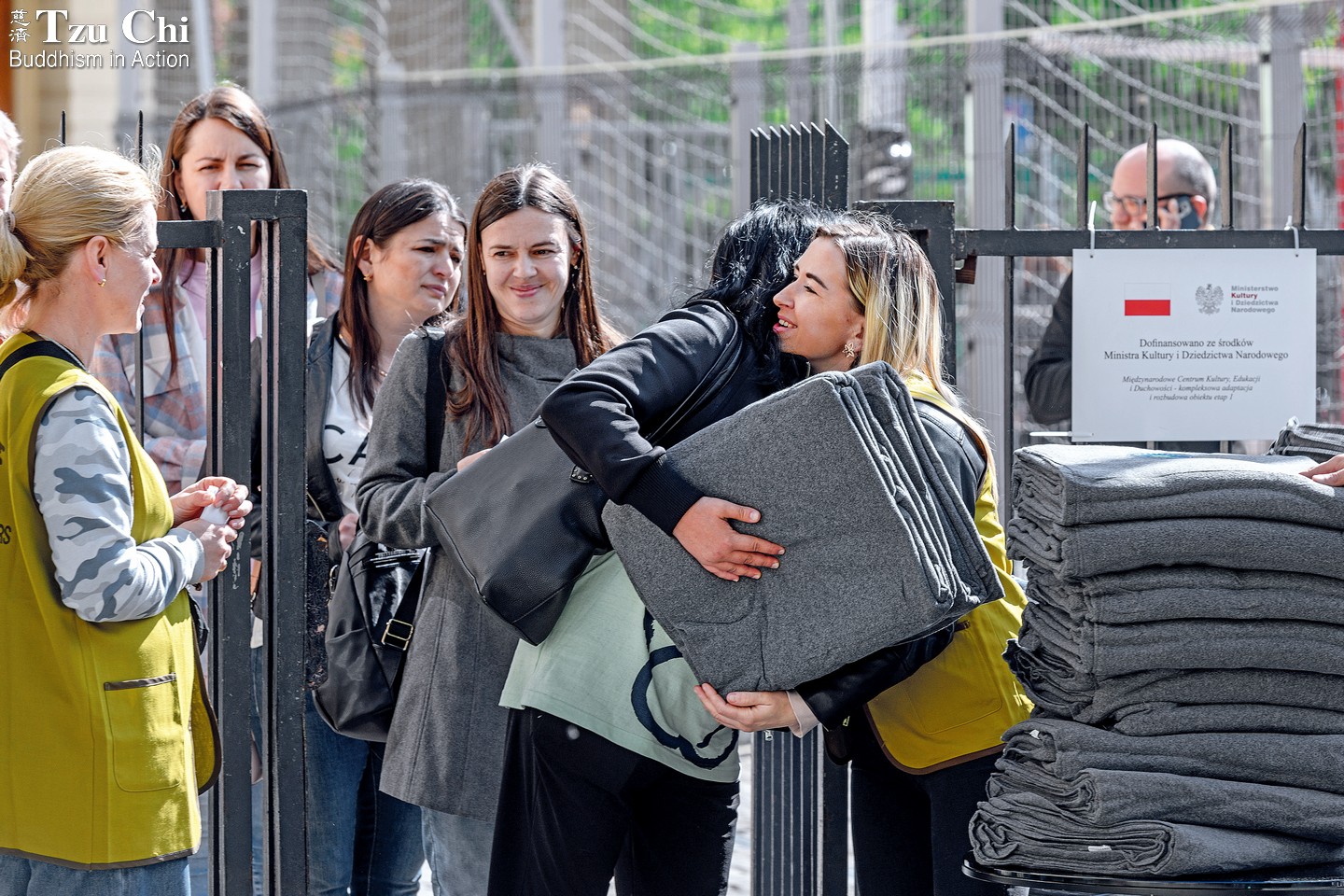
Tzu Chi’s eco-blankets have reached 47 countries and regions. In Poland, they provided warmth to Ukrainians displaced by the war. Alberto Buzzola
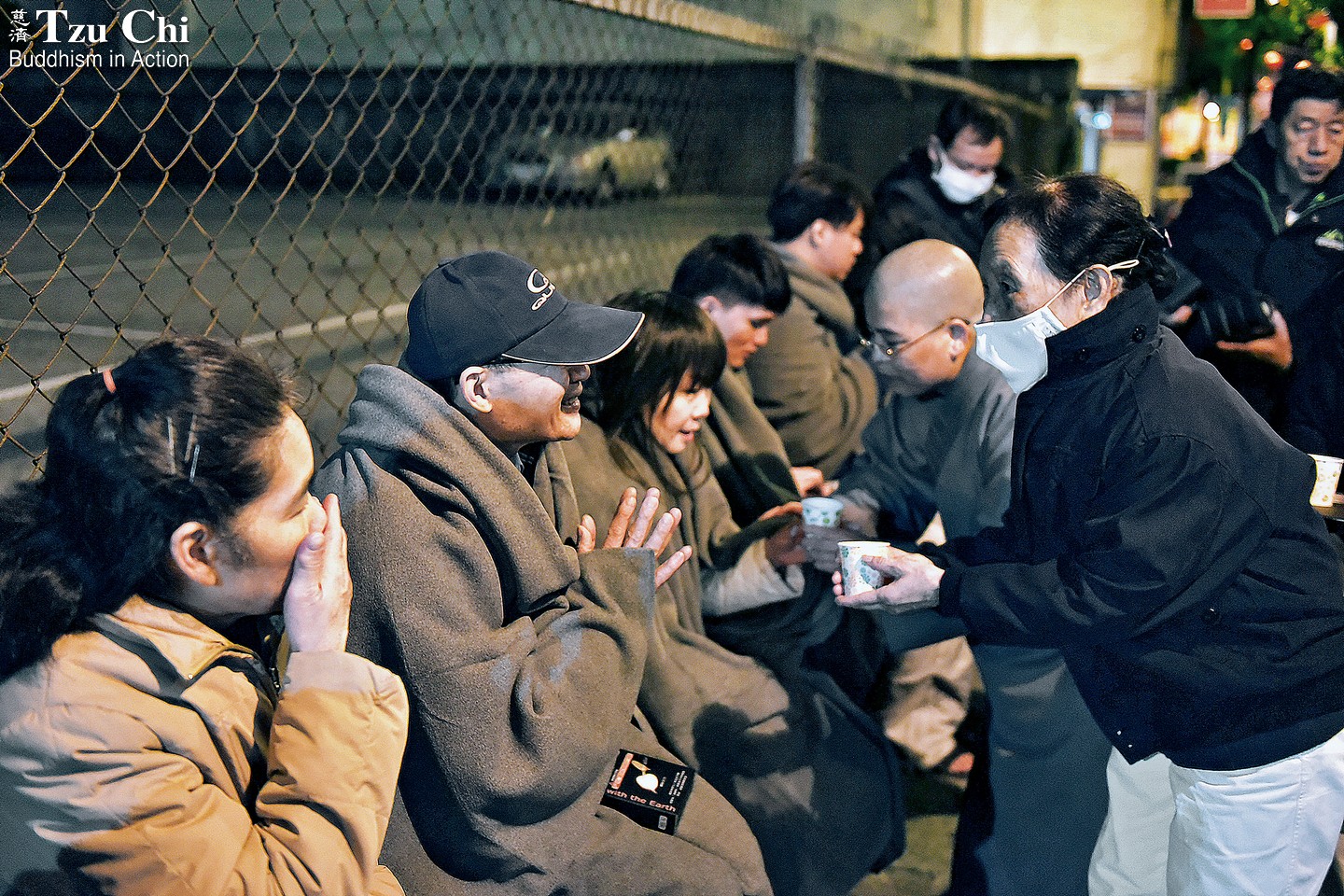
After the February 6, 2018, earthquake in Hualien, Taiwan, Jing Si Abode monastics and Tzu Chi volunteers delivered hot meals and eco-blankets to victims of a partially collapsed hotel. Qiu Ji-qing
“
Mothers in the audience widened their eyes in disbelief that such warm blankets could be made from PET bottles!” recalled Tzu Chi volunteer Chen Shu-nu (陳淑女), describing her experience distributing aid to Ukrainian refugees in Poland. “More than just surprised, they were touched by Tzu Chi’s efforts to protect the Earth and create a better environment for future generations.”
Russia invaded Ukraine in February 2022. Within a year, Tzu Chi had provided over 40,000 blankets and more than 38,000 gift and cash cards to over 80,000 displaced Ukrainians. The aid brought comfort and support to refugees adjusting to the harsh realities of exile.
Tzu Chi blankets have been given to those in need around the world, from Taiwan’s Typhoon Morakot in 2009 to more recent crises such as the Russia-Ukraine war and wildfires in the United States. More than 1.39 million such blankets have been distributed for disaster relief since mass production began in 2006.
No matter the situation, volunteers have consistently explained the origin of the blankets while distributing them. Recipients learn that the blankets provide not only physical relief but embody the love, kindness, and dedication of Tzu Chi volunteers. Bottles collected and sorted by volunteers in Taiwan undergo a low-carbon, low-consumption, and low-pollution process as they are transformed into blankets. This exemplifies the principles of reusing and recycling within a circular economy. It’s due to many people’s care and hard work that ordinary waste products can be transformed into something extraordinary.
A smaller environmental footprint
Polyethylene terephthalate (PET), one of the most commonly used plastics for beverage bottles, is a stable polymer that can take hundreds of years to decompose. On average, each Tzu Chi eco-blanket can be produced from about 67 PET bottles, giving new life to plastic that might otherwise persist in landfills for centuries.
In addition to reducing plastic waste, the blankets’ production generates 15 percent fewer carbon emissions than similar products made from virgin materials. Water use and pollution are minimized through a pre-dyeing process. For example, producing a one-kilogram eco-blanket consumes only 643 liters of water—compared with 2,700 liters required to make a conventionally dyed short-sleeved cotton T-shirt.
Synthetic fibers are extruded from the processed PET plastic and spun into yarn. Tzu Chi’s signature blankets are light gray, woven from black and white yarn. The white yarn comes from transparent PET bottles, while the black yarn is made by adding carbon powder to the plastic. This pre-dyeing method makes the production process more environmentally friendly and resource-efficient.
In 2011, Tzu Chi blankets passed a rigorous review by TÜV Rheinland Group—an international testing and certification organization based in Germany—earning a water footprint certification, the first of its kind in the global textile industry. Uwe Halstenbach, then general manager of TÜV Rheinland Taiwan, praised the achievement, noting that water footprint was a very new metric, with most applicants coming from the electronics industry. DA.AI Technology, which developed and produced the blankets, was considered a pioneer in the textile sector.
Cherishing limited resources
As early as the 1990s, the textile industry understood that recycled PET bottles could be shredded, melted into resin pellets, and processed into fibers, yarn, and fabric for a variety of products, including clothing, blankets, shoes, and more.
Alex Lo (羅忠祐), a Tzu Chi industrialist volunteer in the textile sector, highlighted the importance of reusing resources: “Mother Earth’s resources are limited and should be reused whenever possible.” He added that once PET bottles are melted down, the recycled material is nearly identical to new PET. Since PET, like most plastics, is derived from crude oil or natural gas, recycling it reduces reliance on fossil fuels.
Recognizing the great need for disaster relief supplies, Tzu Chi’s industrialist volunteers established the Tzu Chi International Humanitarian Aid Association (TIHAA) in 2003. In addition to developing various items, the association provided logistical help and information and communication technology support. Since blankets were often in high demand after disasters, Master Cheng Yen instructed that eco-friendly textiles be developed from recycled plastics. Following her guidance, Walter Huang (黃華德)—then chairman of the Taiwan Garment Industry Association and head of TIHAA—rallied fellow industrialist volunteers to begin research and development (R&D) on how PET bottles collected by Tzu Chi recycling volunteers could be turned into textiles.
By that time, Taiwan’s PET bottle recycling rate had already surpassed 90 percent, but most of the recycled output was short fibers, suitable only as stuffing for plush toys. If long fibers could be produced instead and woven into textiles, it would be a technical breakthrough and a realization of Master Cheng Yen’s ideal of achieving both environmental and humanitarian goals: “Turn garbage into gold, and gold into love.”
The first trial production was in 2004, but the success rate was only 30 percent. The industrialist volunteers later discovered that the problem lay in the raw materials: Though the bottles themselves were made of PET, the caps and rings were made of other plastics. When mixed in, these impurities caused fibers to break during extrusion.
This has since been resolved through water-based separation: Shredded plastic from bottles is placed in a water tank; the PET flakes sink while cap and ring flakes float, allowing the plastics to be separated. But more than 20 years ago, this technology was not yet mature. Volunteers instead overcame the challenge by hand, painstakingly removing caps and rings one by one. Tens of thousands of volunteers devoted time and care to sorting the materials, ultimately raising the yield of workable recycled yarn to nearly 90 percent. By 2006, mass production began.
In 2008, five industrialist volunteers, including Walter Huang, founded the social enterprise DA.AI Technology Co., Ltd. The company not only took over the production and R&D of eco-blankets and other disaster relief items but also began developing a range of clothing and lifestyle goods from recycled plastics—bringing circular economy principles into daily life. The following year, all company shares were donated to Tzu Chi, with net profits dedicated to charitable work.
Since its founding, DA.AI Technology has collaborated with experts from industry, academia, and research sectors to develop more than a thousand products, repeatedly earning international certifications and awards. Yet co-founder and general manager James Lee (李鼎銘), who serves as a volunteer, rarely talks about the company’s technological achievements. Instead, he points to the quiet dedication of the recycling volunteers.
He recalled, “I once asked an elderly volunteer at a recycling station, ‘You could stay home with the air conditioning on and watch TV—why come here, where physical comforts are minimal?’ She simply said, ‘Because I love the Earth!’” He added, deeply moved, “When they say they love the Earth, they are really loving their children and grandchildren—the generations to come.”
Of the over 90,000 recycling volunteers across Taiwan, many are seniors, and some face illness or physical limitations. Yet they persist in their recycling work, even pledging to continue until their last breath. They are truly the heroes behind Tzu Chi’s environmental mission.
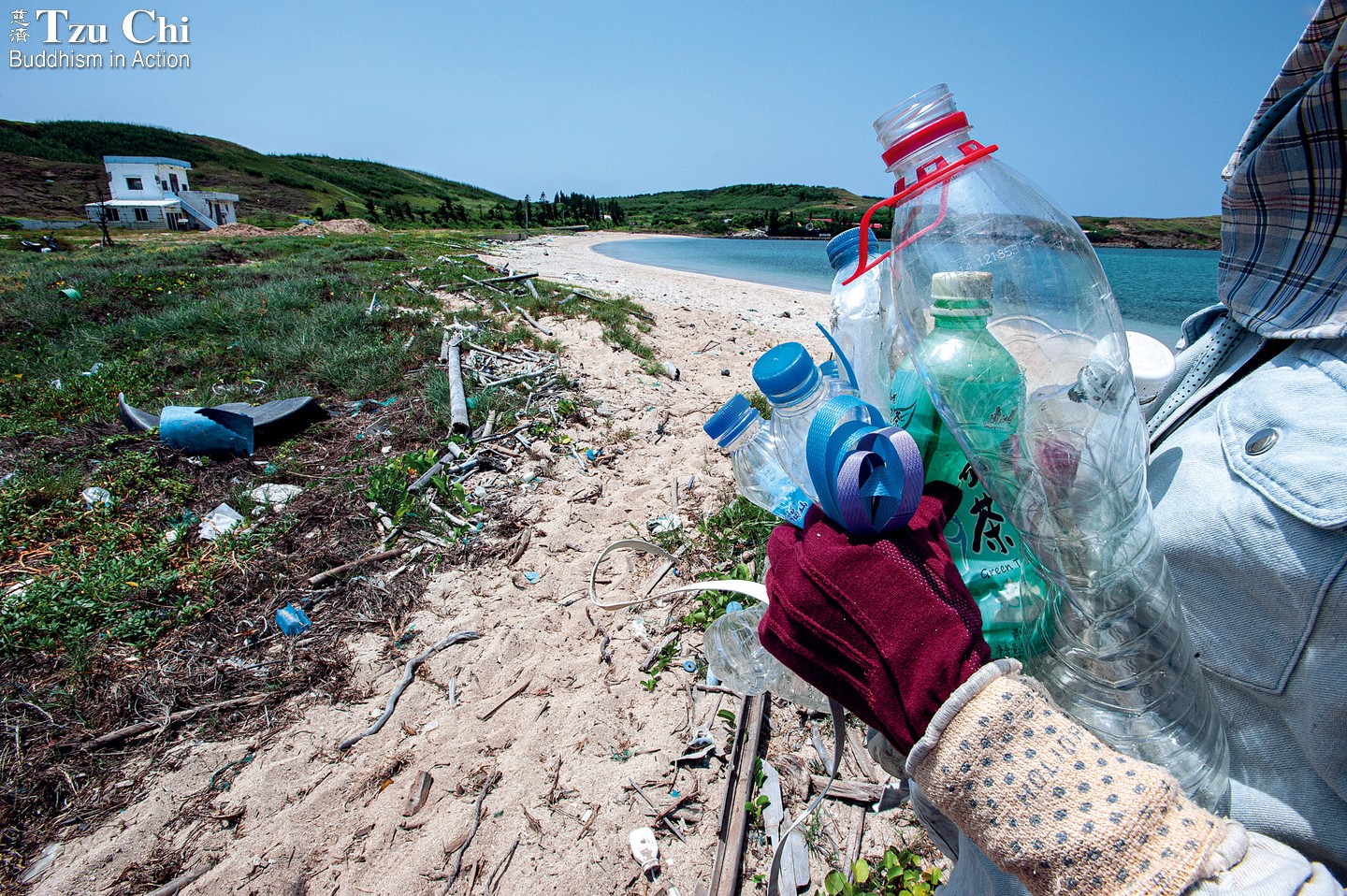
The coasts of Taiwan’s Penghu Islands receive garbage from around the world year-round due to seasonal winds and ocean currents. Tzu Chi volunteers continue to collect and recycle it. Reducing plastic use and ensuring used plastics are recycled are vital for protecting the environment we all share. Huang Xiao-zhe
Consume thoughtfully
In addition to producing the widely distributed eco-blankets, DA.AI Technology has developed products to meet the diverse needs of Tzu Chi volunteers engaged in disaster relief, charity, and medical work. The puncture-resistant insole, designed to fit a variety of shoes, was created and refined at Master Cheng Yen’s suggestion after she noticed that volunteers entering disaster zones might step on sharp objects. After the August 23, 2018, tropical depression floods, for instance, volunteers cleaning affected homes along Taiwan’s Chiayi and Tainan coasts relied on these insoles to help prevent injury. Another product is the solar-powered LED cap. Equipped with a built-in light, an ordinary baseball cap later proved useful as a portable light for Tzu Chi doctors during free clinic events outside of Taiwan.
Beyond keeping volunteers safe and supporting their work, DA.AI Technology has also tackled major environmental issues, such as microplastic pollution. Concerned about microfibers—tiny plastic threads that come from synthetic fabrics, most often shed during washing—and their impact on marine ecosystems and human health, the company collaborated with the Industrial Technology Research Institute to develop a new type of functional fiber. This innovation reduces the release of microplastics during washing by half, further advancing the principles of environmental stewardship.
Growing environmental awareness has deepened the public’s understanding of sustainable development. People are more willing to support a circular economy through green consumption and to participate as recycling volunteers. However, from a broader perspective, recycling and remanufacturing cannot fully restore resources, as some loss or degradation is inevitable, and the process still consumes water, electricity, oil, and raw materials. For this reason, DA.AI Technology encourages consumers to avoid over-purchasing and to buy only what they truly need. In addition to choosing recycled and eco-friendly products, it is even more important to practice the principles of reduce and reuse in daily life. By valuing every resource, we can help ensure the sustainability of the Earth’s resources.