By Li Mei-hui and Yuan Shu-zhen
Translated by Wu Hsiao-ting
Volunteers help needy families gain skills and start small businesses so they can earn a steady living.
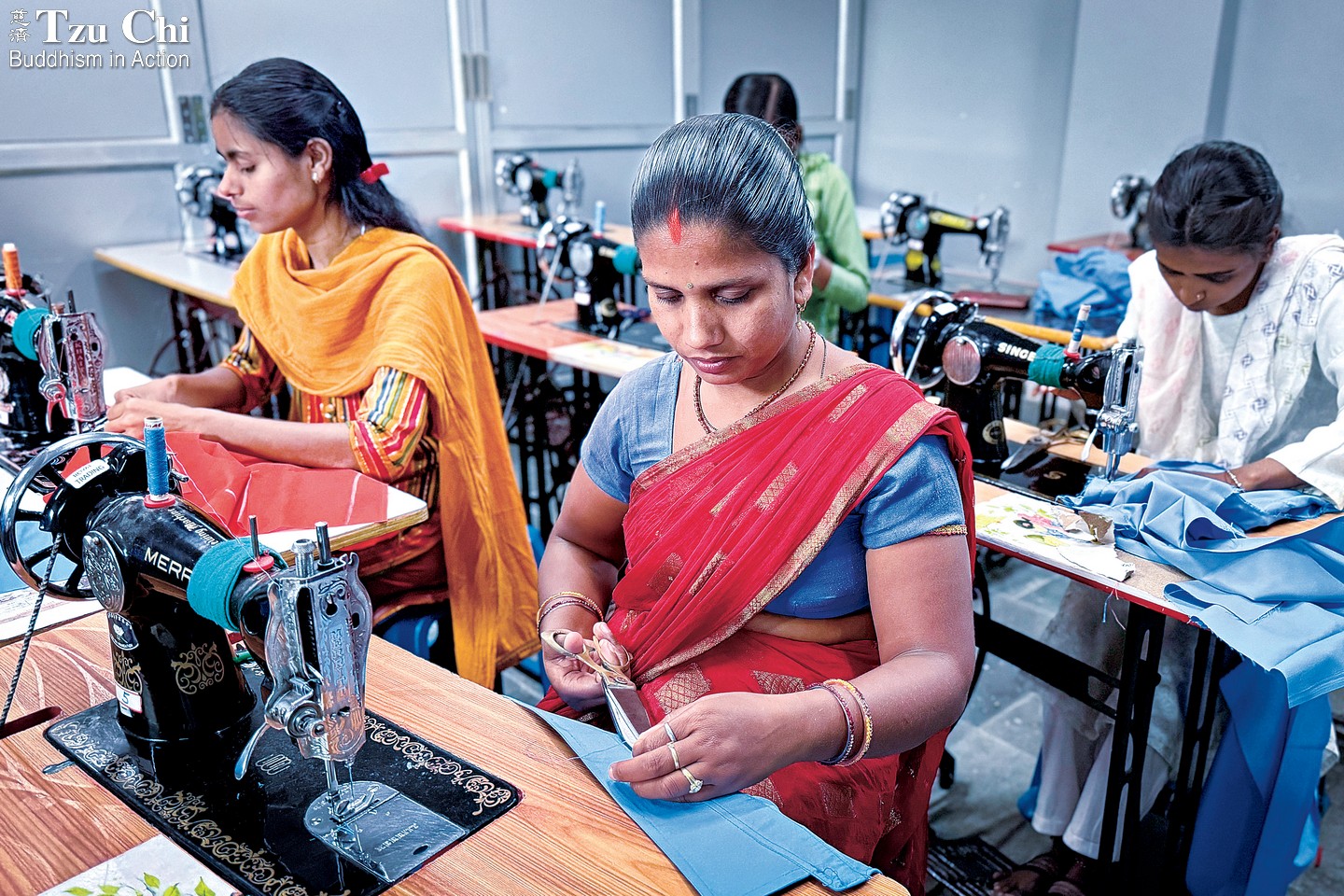
Advanced sewing students at the Tzu Chi office in Bodh Gaya work on school uniforms. Five students completed their uniforms in March and were recognized with monetary awards from Tzu Chi. Hu Yuan-zhen
Morning had just begun at the Buddha Juice cart in Bakraur, Bodh Gaya, India, and six glasses of fresh orange juice had already been ordered. Lalmani Devi greeted customers as her son, Omanand Kumar, swiftly peeled oranges and her daughter, Nandane Kumari, washed glasses. For this family, the cart represents both hope and a new beginning.
Seven years ago, Lalmani’s husband, Bhimsen Prajapati, suffered a serious electric shock at work. He was in a coma for two weeks, and though he eventually recovered, his strength and memory were slow to return. Lalmani took up farming to keep the family afloat, but her modest income barely covered the costs of raising their three school-aged children.
In November 2023, Tzu Chi volunteers learned of the family’s situation and visited them to offer support. When they discovered that Bhimsen hoped to become self-reliant by selling fresh juice outside a private hospital near their home, they provided him with a custom-built cart and a juicer. The cart was designed according to his ideas—sturdy, durable, and easy to move. Bhimsen had originally planned to name it after his daughter, but when he saw the finished cart in January 2024, he was deeply moved by Tzu Chi’s generosity. “Tzu Chi is a Buddhist organization, so I decided to name the cart after the Buddha!” he said with emotion.
Since then, Bhimsen’s health has improved enough for him to find new employment, leaving the cart for Lalmani to manage. She has sought ways to grow the business, such as selling ready-made cookies for extra income. Nandane, about to enter tenth grade, beamed as she said, “Before, Mom had to ride her bike to the fields and work in all kinds of weather. Now, this is so much better.”
Sanjeet Paswan runs another thriving cart. He rises at five every morning and takes a tuk-tuk to a wholesale fruit and vegetable market in Gaya to buy pineapples and papayas. Around nine o’clock, he begins preparing the fruit, and from ten to noon, sells slices in front of the Mahabodhi Convention Center. In the afternoon, he moves his cart to Mahabodhi Temple and continues vending.
A small plate of fruit sells for ten rupees (about US$0.11). Sanjeet earns around 15,000 rupees (about US$170) a month—enough to set aside money to build a small storage unit for his fruit. His daughter helps however she can, waking before four in the morning to prepare his breakfast. “Eating the breakfast my daughter makes for me makes me feel truly happy!” he exclaimed.
In May, both families joined Tzu Chi’s Loving Store campaign, placing coin banks at their stalls for customers to donate spare change. Volunteers regularly collect the donations and use them to help others in need.
Once unemployed, Sanjeet can now support his family of seven. Dropping a donation into the coin bank at his cart, he smiled broadly and said, “I am very thankful—I’m a truly blessed person.”
Vocational training
Tzu Chi officially registered as a non-governmental organization in Bodh Gaya in 2022. Its local office opened the following September, offering not only charitable assistance but also vocational training and employment guidance to help aid recipients and disadvantaged families build sustainable livelihoods.
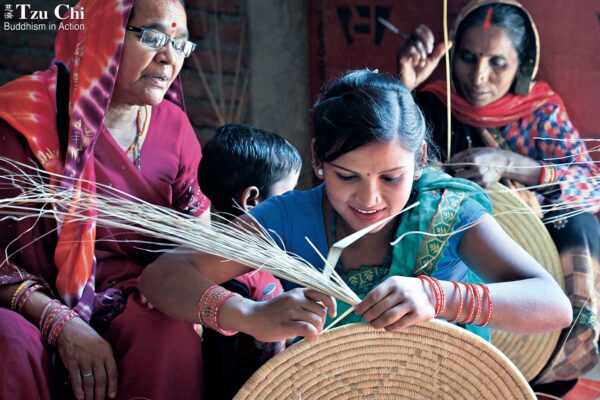
In Bodh Gaya, relatively few women work outside the home. In rural areas, it is common to see women chatting together, scrubbing pots with sand, or picking lice from family members’ hair. While some women have paying jobs, it is usually in manual labor. To help men and women alike gain employable skills, the Tzu Chi office offers classes in sewing, computer use, Chinese, and English. The sewing class is primarily for women. A knitting class has also been established in Silaunja, a village where Tzu Chi has built homes for impoverished residents.
Koshila Devi, who moved into a Tzu Chi-built home in Silaunja, went from not knowing how to use knitting needles to skillfully making woolen hats after attending the class. She gained a practical skill and earns an income from it—and relishes the sense of accomplishment that comes with it as well. Tzu Chi volunteers pay her and other villagers based on the quality and quantity of their hats. During the cold season, the hats are donated to schoolchildren.
Rekha Devi, the knitting class teacher, said joyfully, “Through my students’ hard work, I can see real progress. On the day Tzu Chi distributes the wages, all the students thank me.”
Malaysian volunteer Kua Liang Ming (郭糧鳴) encourages the women to attend classes consistently and learn wholeheartedly: “You don’t need to pay anything to be here. Tzu Chi volunteers save money to fund your classes. Once you’ve learned, you can even teach others and help them in turn.”
In mid-May, volunteers visited Bakraur to promote the fourth cycle of the beginner sewing class and register villagers. Malaysian volunteer Lim Geok Kim (林玉金) explained the simple rule they set to highlight the importance of committing to the class: “If you miss more than three classes, you cannot continue.” The young women who were present, initially eager to join, hesitated upon hearing the attendance requirement.
The first to enroll was 18-year-old Sweety Kumari, who smiled brightly and showed great determination. Her father is one of Tzu Chi’s “tea instead of alcohol” success stories, having abstained from drinking for over seven months. He now sells sugarcane juice near Mahabodhi Temple.
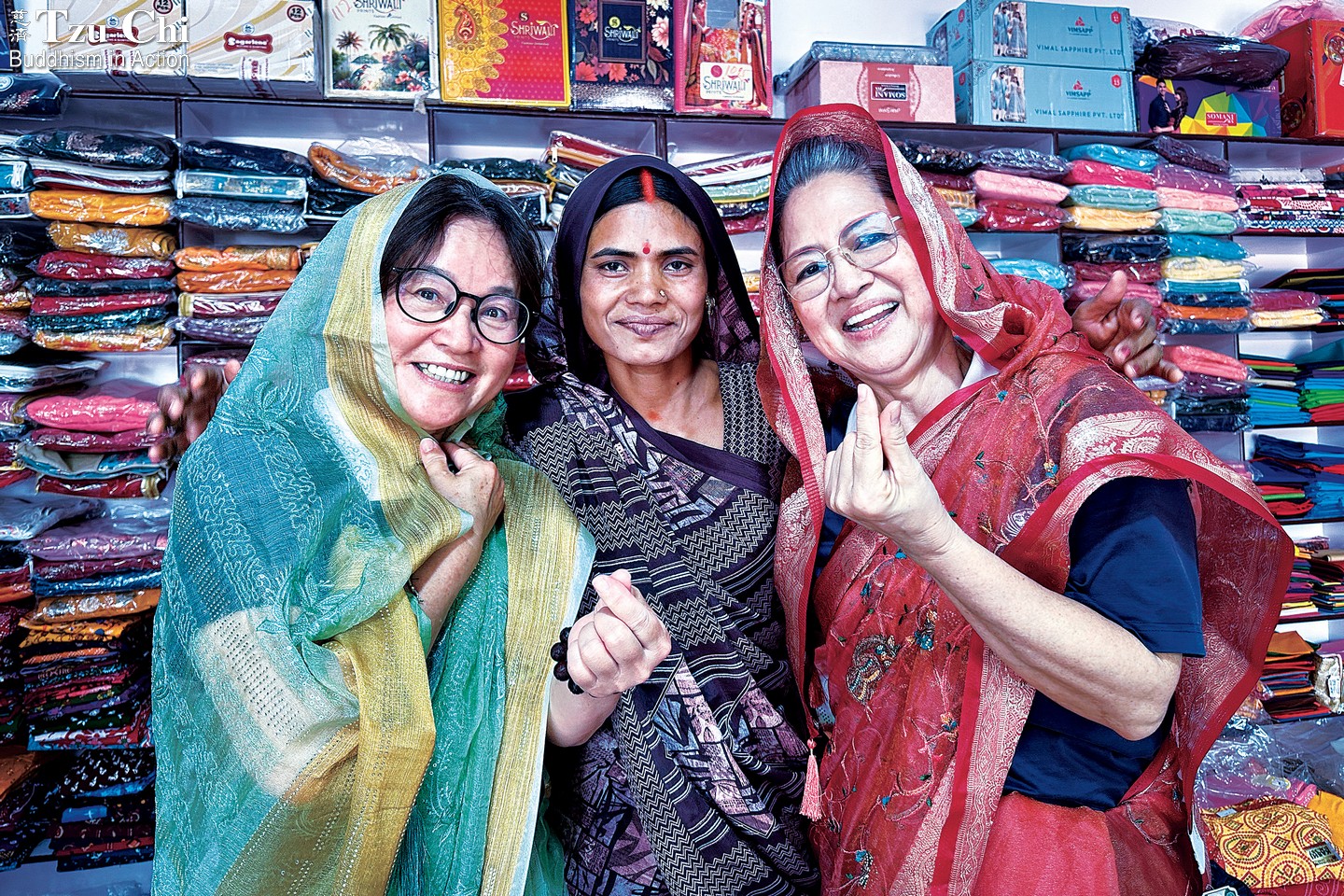
Volunteers Lim Geok Kim (right) and Ling Cui-lian (凌翠蓮, left) pose with Saraswati Devi at her store. Saraswati graduated from Tzu Chi Bodh Gaya’s first sewing class. Li Mei-hui
A dream comes true
On May 20, Lim Geok Kim stopped by a shop near the Tzu Chi office. Stepping into the bright, spacious store, she was warmly greeted by the poised and confident Saraswati Devi. Saraswati was a graduate of Tzu Chi’s first sewing class. She had excelled during her 2023 training and could even help classmates resolve sewing machine thread jams.
While attending the class, she read a saying by Dharma Master Cheng Yen: “Learn by doing, awaken through learning, and act with awareness.” The aphorism resonated with her and gave her the confidence and insight to pursue her own dreams. Inspired, she made a wish: “One day, I’ll open my own shop.” That wish came true on October 10, 2024. Today, she runs a neatly organized store selling saris, traditional Indian women’s attire. A sewing machine in the store allows her to offer free alterations for customers.
“I started with no skills at all,” Saraswati said. “Thanks to the Tzu Chi teachers, I learned both knowledge and techniques. Now I can make clothes, bags, and school uniforms. I’ve discovered that I can do so much—and keep improving.”
She added that she had never thought about helping others before, but now that she knows she can, she is more than willing to give back. With the income from her shop, Saraswati and her husband, Racedeo, have been saving diligently. They plan to build a classroom on the land behind the store to teach sewing to other women, passing on her skills and contributing to the community.
Racedeo spoke about his wife’s transformation, noting that it extended beyond her sewing abilities: “She used to have a short temper, and we argued often. I didn’t know how to handle it. After joining the Tzu Chi sewing class, she gradually changed. Now she speaks gently, we discuss things calmly, and together we get things done better.” He added shyly, “I have a wonderful wife, and that makes me very happy!”