By Chiu Chuan Peinn
Compiled and translated by Wu Hsiao-ting
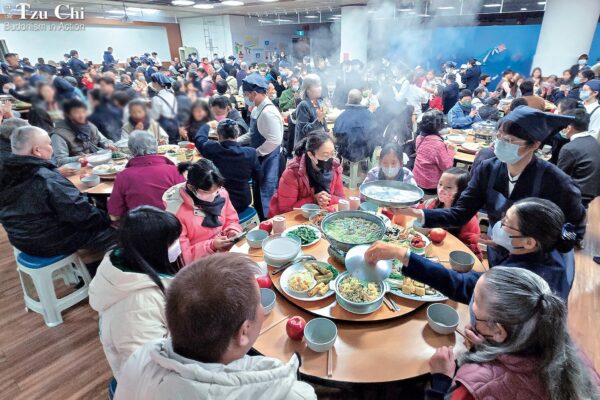
Floodwaters swept into Guangfu Township in Hualien when a barrier lake overflowed. This rare disaster in Taiwan’s history devastated the town, but also sparked one of the largest spontaneous civilian relief efforts the island had ever seen.
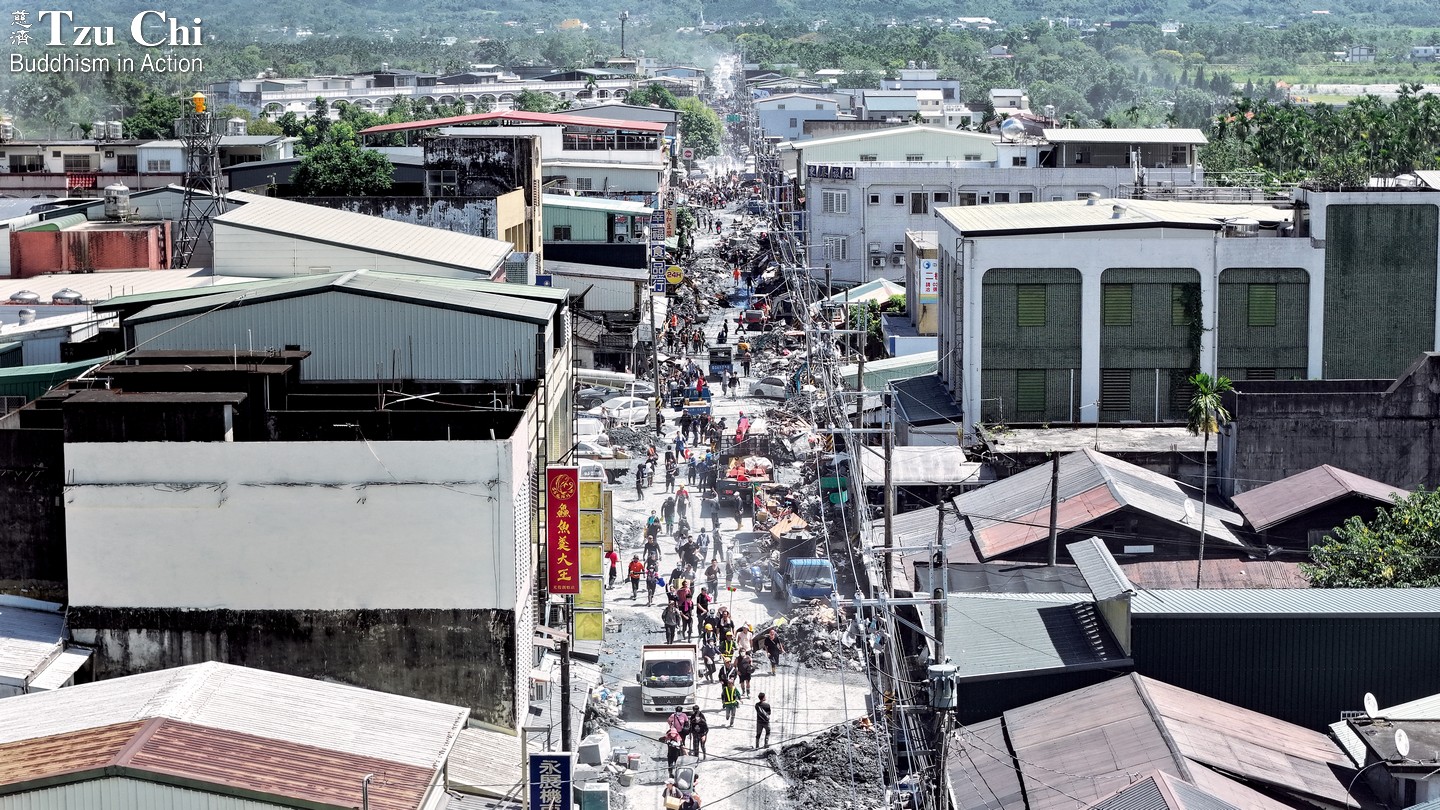
A scene in Guangfu Township, Hualien, on September 28, 2025. Chen Li Shao-min
Before and After the Cleanup
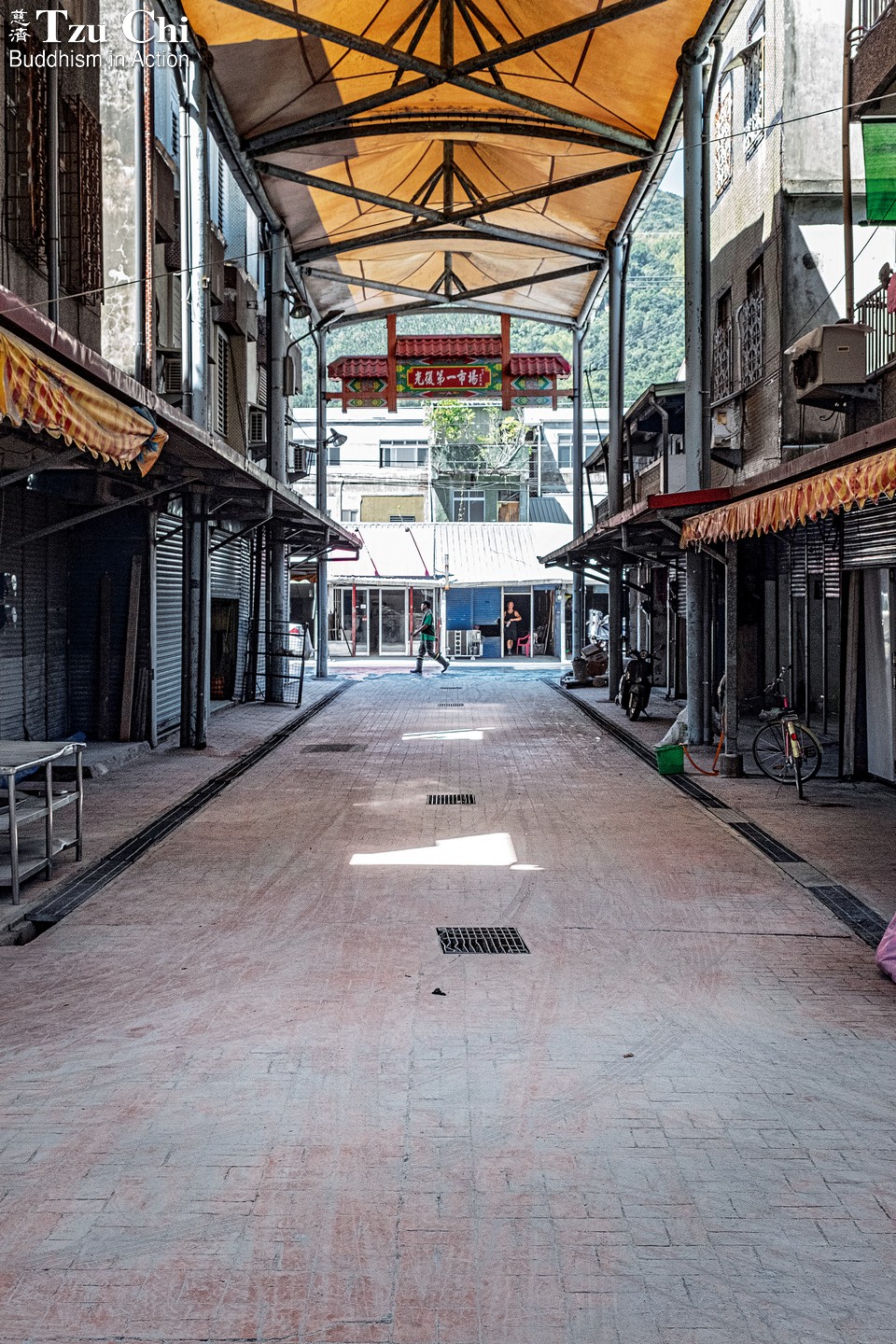
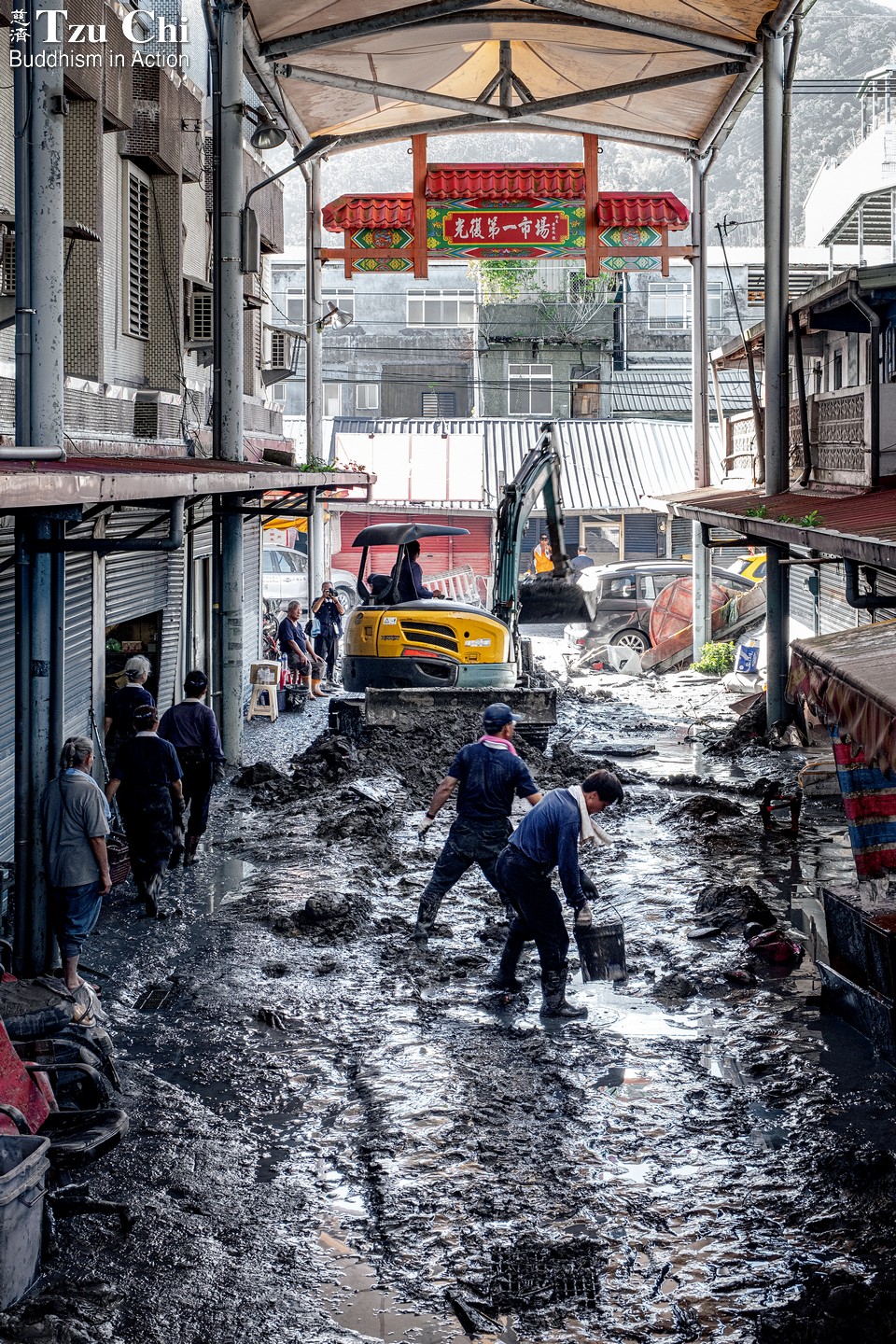
An empty alley with only a few shafts of sunlight on a quiet afternoon at Guangfu First Market, October 9 (photo 1). Just two weeks earlier, mudflows had surged in from all directions, covering the market in a thick layer of sludge. Disaster relief workers and heavy machinery (photo 2) work to clear the mud and debris in the aftermath.
Photos by Hsiao Yiu-hwa
Superheroes Rise to Clear a Path to Recovery
Taiwan Railway recorded nearly half a million passenger movements at Guangfu Station from the day after the disaster through the Double Ten Day long weekend, September 24 to October 12. That figure included both military personnel and civilians from across Taiwan who came of their own accord to join the relief efforts, with daily peaks exceeding 50,000. Helpers, equipped with their cleaning tools and affectionately called “Shovel Superheroes,” filled the trains. Even those who couldn’t get a seat didn’t mind standing—everyone was determined to go. In those days, all were Hualien residents at heart.
Photo by Xu Yong-feng
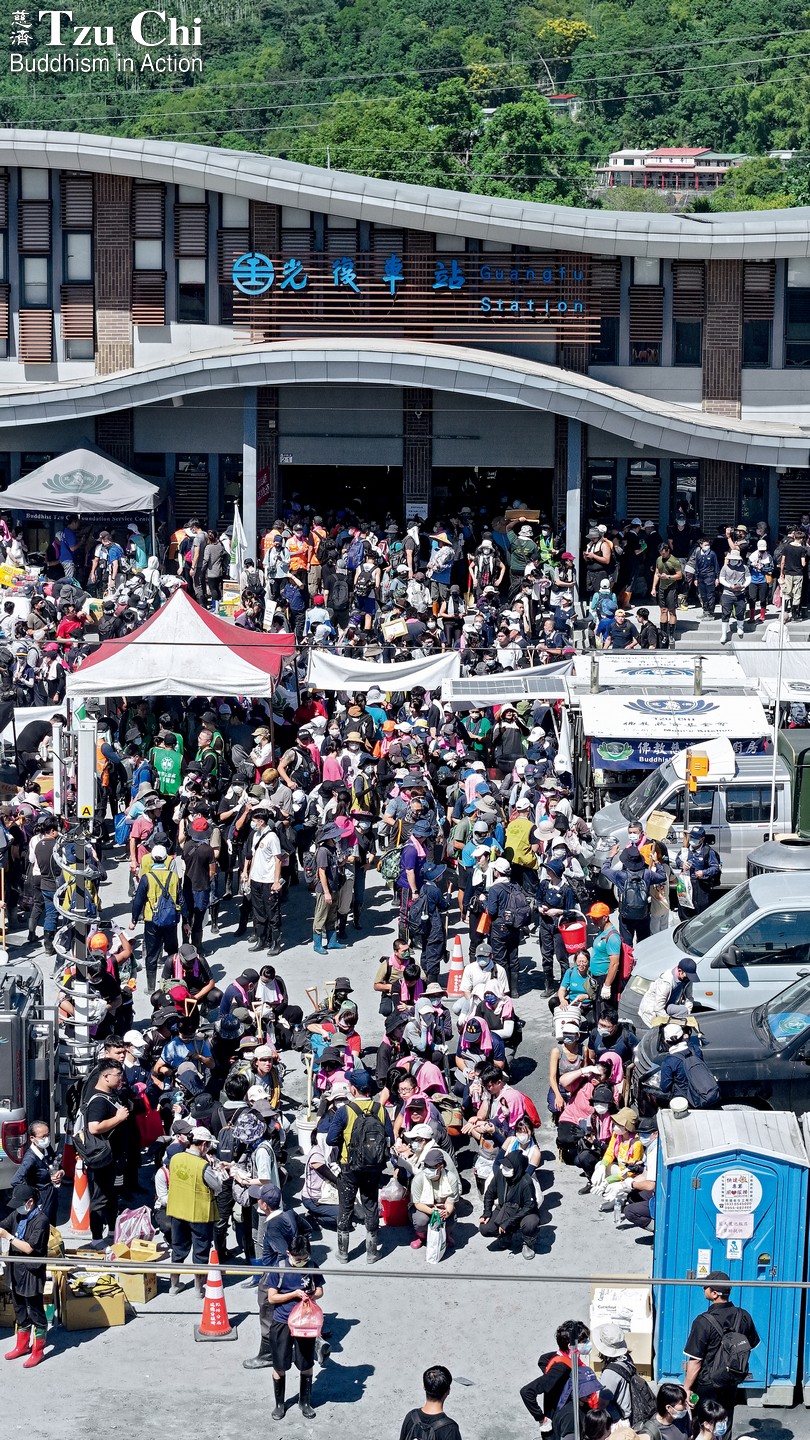
Guangfu Station serves as a hub for cleanup volunteers, with government and relief organizations setting up stations on-site. This photo was taken during the first post-disaster weekend, which coincided with the Teachers’ Day holiday. Chen Li Shao-min
On September 23, 2025, heavy rain from Typhoon Ragasa caused a barrier lake upstream of Matai’an Creek in Hualien, eastern Taiwan, to overflow. Muddy water surged downstream, blanketing villages and communities in Guangfu Township with a thick layer of gray silt, leaving a formidable cleanup challenge in its wake.
The very next day, the Tzu Chi Foundation issued an online appeal to its volunteers and the public to help restore the affected communities. On September 25, I departed from Hualien Station on an early local train packed with Tzu Chi volunteers and other citizens heading to Guangfu to lend a hand. I was going as a reporter for Tzu Chi Monthly.
The platform at the small Guangfu Station was crowded after we had arrived and disembarked. The sudden influx of people made it clear that something extraordinary was happening in this ordinary town. As I stepped out of the station, I saw dust rising in the distance, bringing to mind old black-and-white footage of unpaved roads veiled in swirling clouds of haze.
Guangfu Station faces a long street that links the three villages of Da’an, Dahua, and Datong. Directly outside the station lay an open lot, its painted parking lines buried under layers of dirt. On that very day, Tzu Chi established a command post at the station, which also became the site of Tzu Chi’s mobile kitchen. Tzu Chi coordinated with the government’s disaster response center and took responsibility for the area nearest the station during the initial phase of cleanup.
From September 25 onward, waves of people began arriving each day, starting as early as 8 a.m., with the number growing larger day by day. The parking lot served as an assembly point and staging area where helpers were divided into teams and assigned cleanup zones.
It wasn’t long before the term “Shovel Superheroes” began appearing frequently in the media. Unlike the caped heroes of movies, these volunteers wielded shovels instead of superpowers, ready to clear mud and debris. Their willingness to step forward in a difficult time revealed the goodness of Taiwanese society, inspiring even more people to join the relief efforts.
Countless homes were in urgent need of cleanup. Clearing thick silt from inside houses was highly labor-intensive, demanding massive manpower and long hours. A dozen or more people could spend a full day on a single home and still have to return the next morning to finish the job.
During the first two days of cleanup, I often saw volunteers step outside for a break around 2 or 3 p.m. Having started work at eight or nine in the morning, they were simply running out of energy. The combination of high temperatures, exhaustion, and the risk of dehydration made heat stress and injuries a constant threat.
These volunteers spent entire days shoveling and moving mud, exposed to dust, returning home sore and exhausted. While they were uplifted by the gratitude of flood victims, health and safety risks remained. Despite earning the moniker of “superheroes,” they were, ultimately, only human. Thankfully, various organizations were on-site distributing much-needed bottled water and sports drinks, and Hualien Tzu Chi Hospital set up an additional medical station on Zhongzheng Road, one of Guangfu Township’s main thoroughfares, to help care for both volunteers and residents.
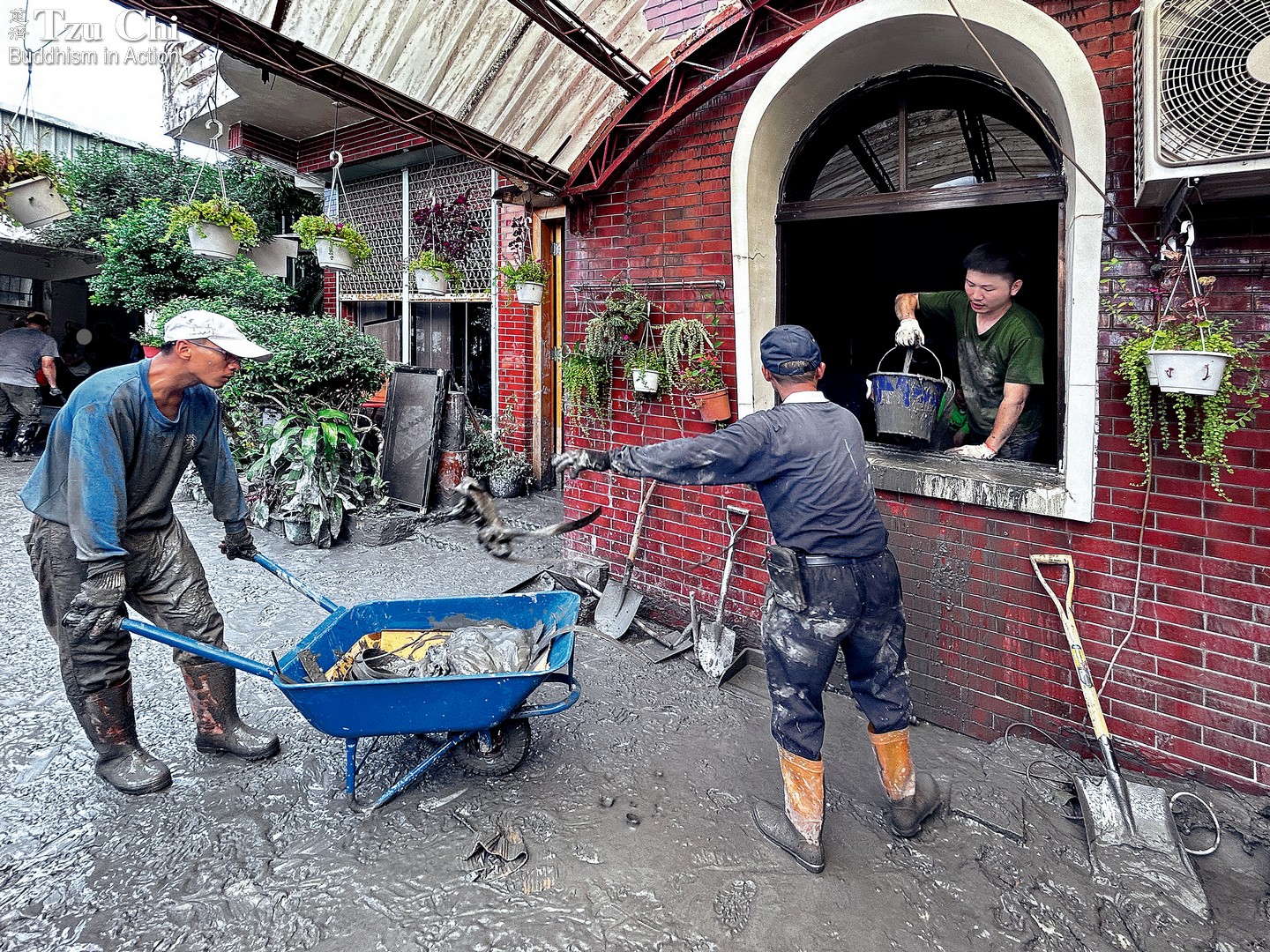
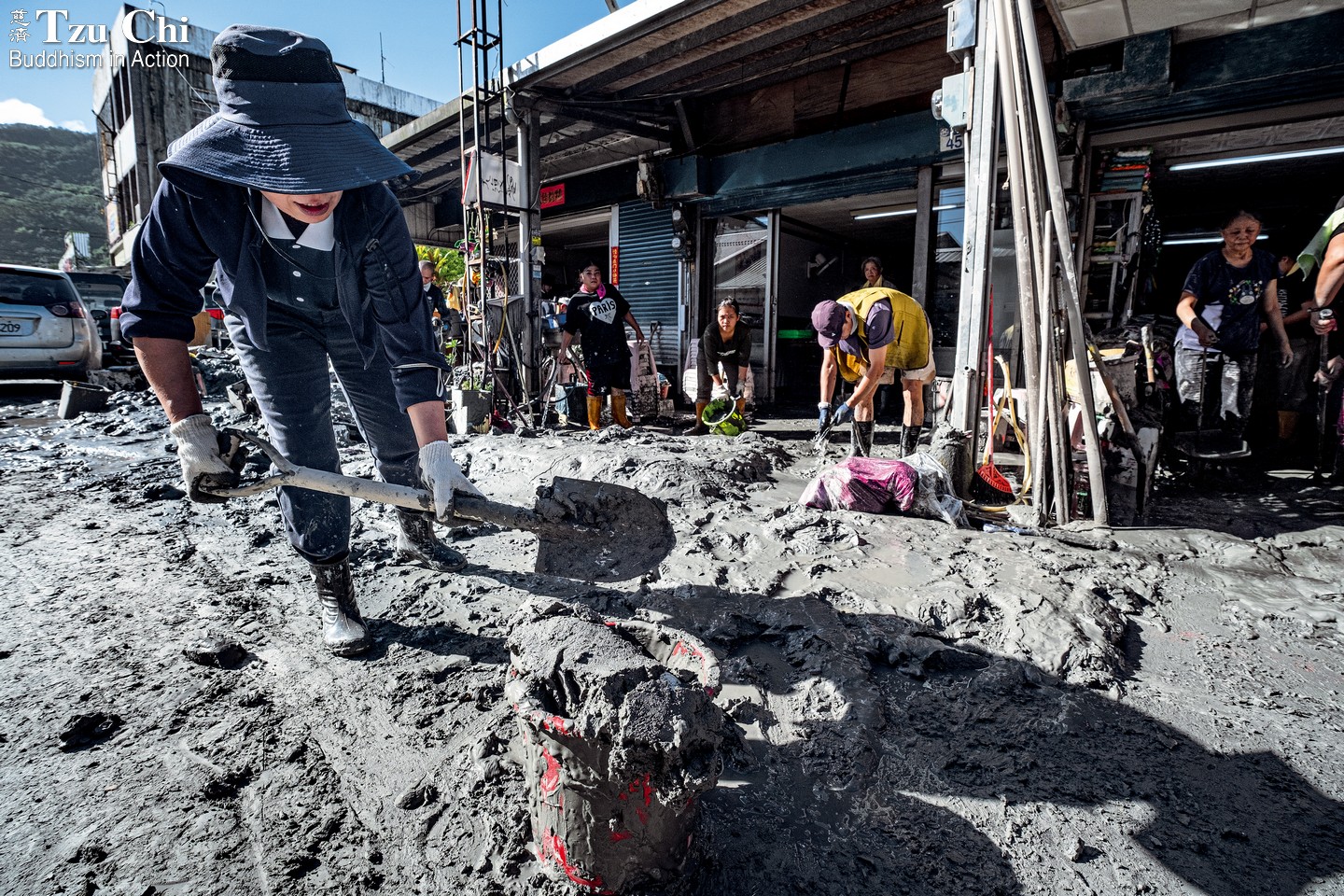
Volunteers use shovels, buckets, and wheelbarrows to remove sludge from inside the building (photo 1). Under the scorching sun, another group of volunteers quickens their pace, knowing that the cleanup will become even harder once the mud dries (photo 2). Photo 1: Jian Ming-an; photo 2: Hsiao Yiu-hwa
Battling the mud
“Twist your leg! You have to twist it!” Amid the shouts of health center staff and Tzu Chi volunteers, I twisted again and again until I finally freed my leg from the mud. I briefly lost my balance and put one hand on the ground to steady myself—only to find it coated in a gray glove of sludge.
I had arrived at the Guangfu Public Health Center, intending to enter through the front path, but accidentally stepped into a patch of mud more than ten centimeters (four inches) deep. The wet, sticky sludge clung stubbornly to my rubber boots. Later, when I turned on the faucet to wash my hands, I discovered that the health center’s running water had been knocked out by the flood. The staff and volunteers worked tirelessly under these harsh conditions, using squeegees and mops to repeatedly push the muddy water out of the building. It was a difficult task, as the murky water flowed uncontrollably in all directions.
The Tzu Chi team on-site came from the Jing Si Abode Maintenance Crew. All of its members had professional backgrounds in plumbing, electrical work, or masonry. They also had extensive disaster relief experience. Just this past August, they had completed roof repairs for households affected by Typhoon Danas in Tainan, southern Taiwan.
“I’m worried the water will drain away,” said Lin Shi-jie (林世傑), a volunteer with masonry expertise. “The silt is full of water. The more you step on it, the more the water rises to the surface and runs away, and the more compacted the soil becomes underneath, [making it harder to remove].” He compared it to cement used in construction—if left sitting too long, the sediment hardens.
His words reminded me of what I had observed at many cleanup sites: The deeper volunteers worked into a house, the more they noticed the mud beneath their feet beginning to harden, making the remaining sludge increasingly difficult to remove.
The mud was about 20 centimeters deep inside the health center. In the X-ray room, which sat slightly lower than the rest of the first floor, it reached 30 centimeters deep. Everyone first used buckets and wheelbarrows to haul the mud outside. As the level of mud dropped and water began seeping up from the sediment, they quickly switched to squeegees and cement scrapers to push it out. Those without tools improvised, using waterproof advertising posters to move the sludge.
Lin Shi-jie stressed that using the wrong technique to clean would quickly exhaust a helper. He mentioned that at 58, he was the youngest member of the Abode team present; the others were all over 65.
Only later did I learn that the thick, sticky mud that had trapped me at the entrance was the very sludge the staff and volunteers had cleared from inside the health center.
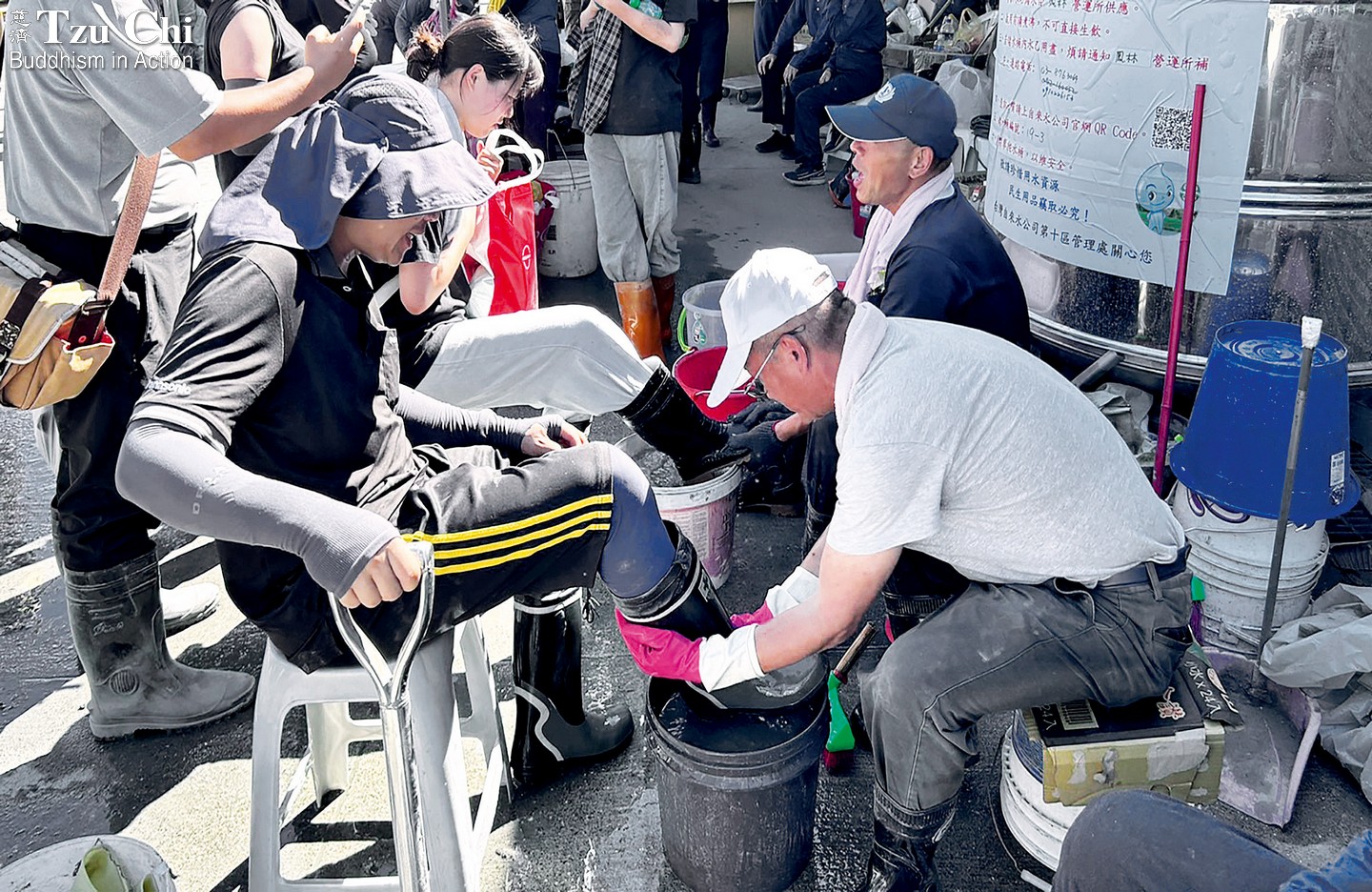
“Shovel Superheroes” have their boots cleaned to prevent mud from being brought into a carriage before heading home by train after helping clean up the disaster area. Shen Xiu-hua
A kaleidoscope of helpers
The scenes I witnessed in Guangfu were strikingly different from what I saw in Tainan’s disaster zones in July and August after Typhoon Danas. In Tainan, most workers on-site were professional repair crews and utility teams. In Guangfu, helpers came from every walk of life: Tzu Chi volunteers in their signature blue-and-white uniforms, soldiers in camouflage, conscripts in fluorescent vests, disinfection workers in white coveralls, and, most numerous of all, warm-hearted citizens in everyday clothes.
These helpers often formed mixed teams on the streets or inside homes to clear the sludge. On one occasion, I saw three young conscripts in their 20s shoveling thick, muddy water into buckets, which a chain of older female Tzu Chi volunteers then passed outside. After nearly three hours of work, some remarked that the mud seemed to have grown heavier. Different ages and genders working together required patience and a willingness to adapt to each other’s strengths and limitations.
One’s ability, of course, isn’t always tied to age, gender, or size. Monastics from the Jing Si Abode joined the cleanup around the Teachers’ Day long weekend, September 27–29. On September 26, a beauty and skincare shop owner and her older brother were cleaning their store when they noticed a nun, well into her 60s, working alongside them. The shop owner whispered to her brother, “She’s so petite—can she really manage the work?”
“Don’t be fooled by our size,” the nun replied with a smile. “You can count on us to work like men!”
The shop owner beamed as she spoke of the moment: “Yesterday it was just my brother and me cleaning, and I was feeling really down. But today, seeing the Tzu Chi brothers and sisters here, I felt calm and uplifted.”
Cleaning the affected communities required not only human strength but also heavy machinery. In the days following the disaster, the streets were lined with piles of silt and mud-matted furniture. Bulldozers, excavators, and other machines wove ceaselessly through the debris—some small enough to enter homes, others large enough to pile sand and gravel three stories high.
Caught in one of the traffic jams, I spoke with a dump truck driver whose vehicle was filled with sludge.
“I’m heading to the collapsed bridge,” he said.
“The one over Matai’an Creek between Guangfu and Wanrong?” I asked.
“That’s right.”
“How many trips have you made?”
He shook his head. “I’ve lost count—too many to remember.”
The scale of the disaster was immense. Military vehicles, water trucks, and heavy equipment from counties and cities across Taiwan were a common sight. In early October, in Dama Village, I met a bulldozer operator loading a five-meter-high pile of sand and gravel onto a truck. He had come all the way from Taoyuan in northern Taiwan and had been working in Hualien for two weeks.
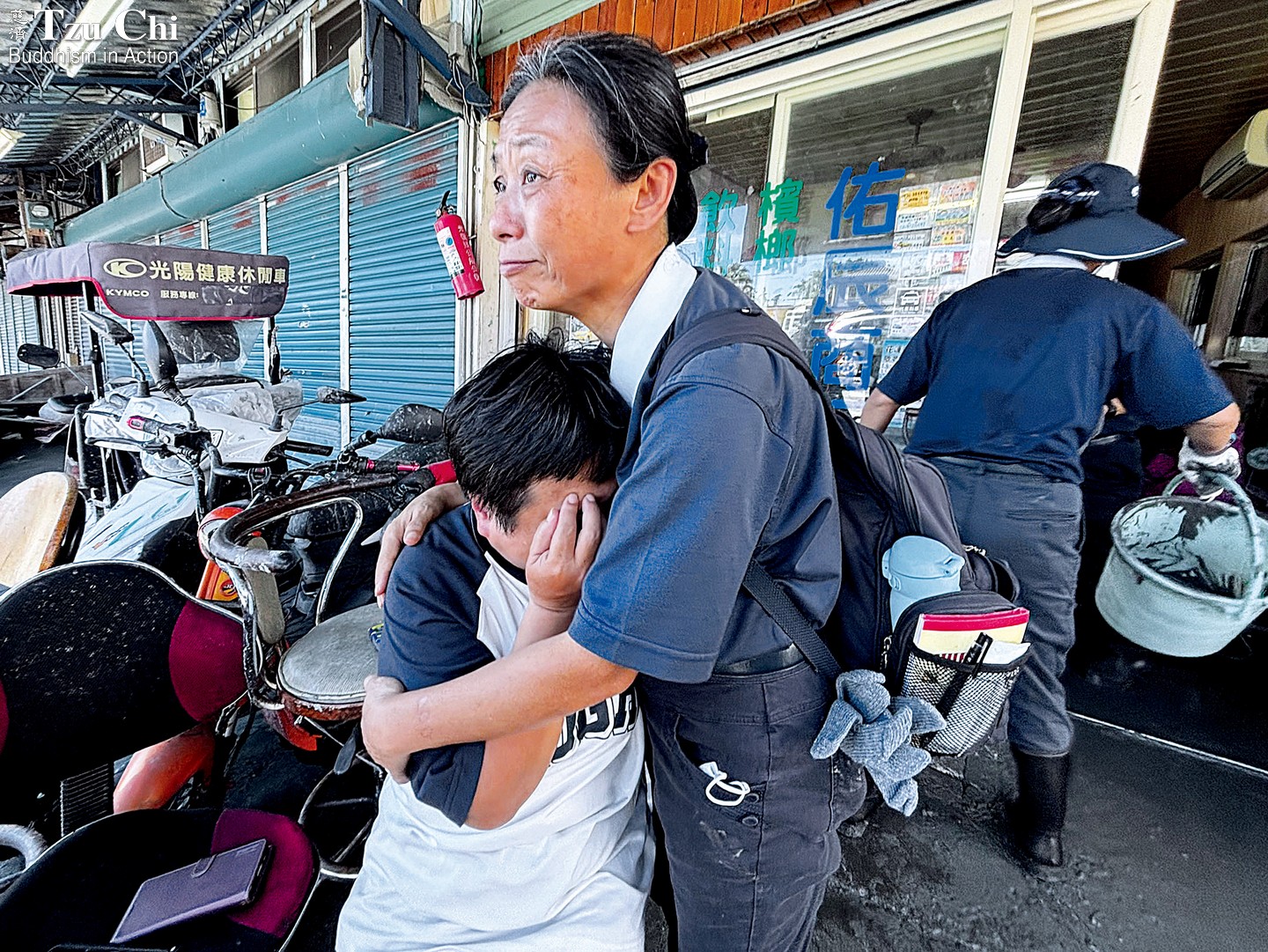
A volunteer comforts a flood-affected resident. Liu Qiu-ling
One mission, many fronts
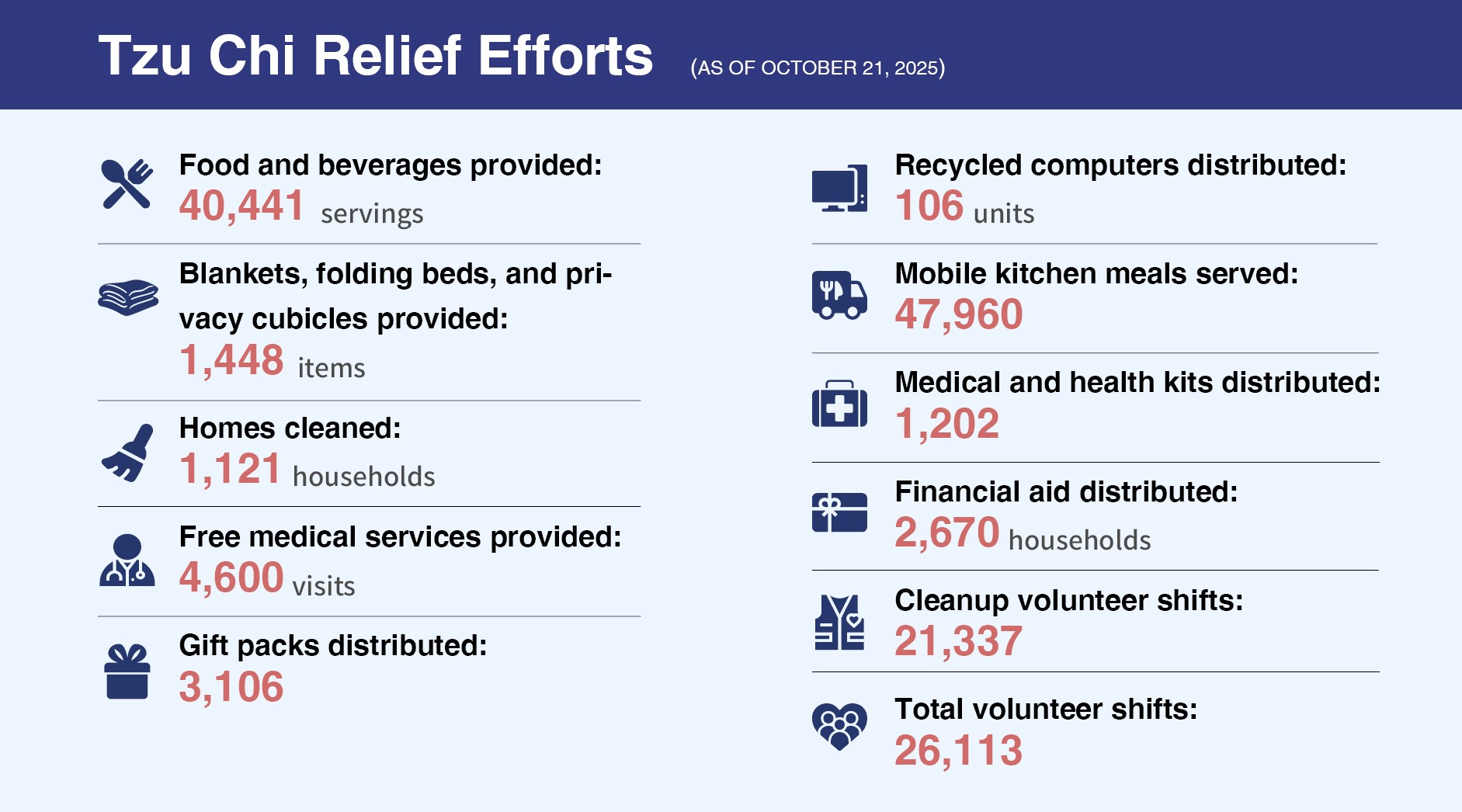
From government agencies to civic groups, all sectors joined in the relief work. Tzu Chi was among the first to respond.
Yen Po-wen (顏博文), CEO of Tzu Chi’s charity mission, arrived with his team in Guangfu Township amidst wind and rain on September 24 for an on-site assessment. They immediately mobilized volunteers for cleanup, launched a nationwide youth volunteer recruitment campaign, and arranged for the delivery of cleaning equipment and relief supplies. At the same time, they attended government coordination meetings to assist in the broader disaster response.
On September 25, nearly 300 Tzu Chi volunteers from Hualien and Taitung were urgently mobilized to help in the disaster area. Yet by the end of the day, they had managed to clear only 15 homes. With an estimated 2,000 households affected, Yen admitted to feeling disheartened. However, as media coverage of the devastation spread, the Teachers’ Day long weekend brought a surge of helpers from across Taiwan—especially young people averaging around 30 years old. They were energetic, disciplined, and cooperative, leaving Yen impressed and deeply moved.
The overwhelming turnout over those three days greatly accelerated the cleanup. In the days that followed, helpers continued arriving in Hualien to lend a hand. Yen lauded this as “a milestone moment demonstrating the strength of Taiwan’s volunteer spirit.”
Aside from helping with the cleanup, Tzu Chi provided assistance in several other areas. Hualien Tzu Chi Hospital set up a temporary medical station at the Guangfu Sugar Factory the day after the disaster, later expanding to two additional stations in harder-hit areas. Within just the first five days, medical teams treated 500 trauma cases, including wound cleaning and suturing. One of the medical stations was established on property generously offered by Xu Heng-rui (許恒瑞), who said, “It’s nothing at all. I’m just grateful to Tzu Chi and everyone else who came to help Guangfu.”
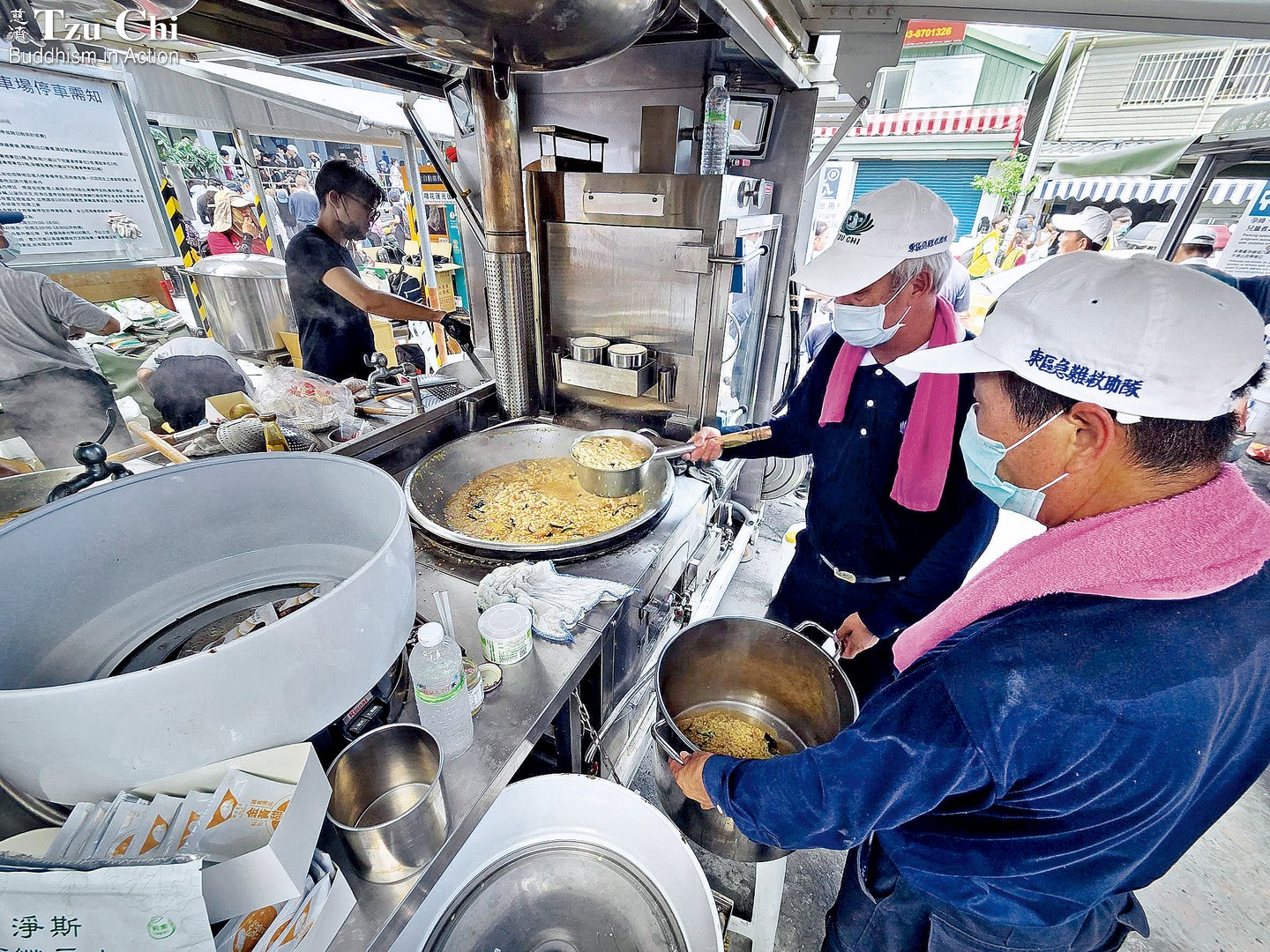
On the first day of cleanup, September 25, Tzu Chi’s emergency aid team transported a mobile kitchen to the open area in front of Guangfu Station. Hot meal service began on September 26. “Local residents told us they were deeply touched when we started cooking that first day—they’d been eating bread for three days and could finally enjoy a hot meal again,” said Tzu Chi volunteer Xu Bi-zhu (許碧珠), who had traveled from New Taipei City to help. Meals were also prepared at Tzu Chi’s Ruisui Jing Si Hall, about a 20-minute drive from Guangfu, to help meet the high demand for food.
Volunteers, working alongside the foundation’s social workers, also prepared and organized the distribution of financial aid, which began in early October across Da’an, Datong, Dahua, Dama, and the Ataomo tribal community in Dongfu. “Finding suitable distribution sites at this stage was very challenging,” said senior volunteer Huang Li-yun (黃麗雲), explaining that each venue needed to be convenient for residents and spacious enough for waiting areas, registration desks, care stations, and supply zones, ensuring a smooth and comfortable process. Despite the challenges, over 2,000 households benefited from the distributions, each receiving 50,000 NT dollars (US$1,700).
On October 7, the day after the Mid-Autumn Festival holiday, members of the Jing Si Abode Maintenance Crew began repair work in the disaster area, prioritizing affected Tzu Chi volunteers, disadvantaged families, and households under the foundation’s long-term care. On October 9, team members arrived in Dama Village to help restore a Tzu Chi University student’s home. Floodwaters had destroyed the window frames and glass, and all furniture and appliances had been cleared out, leaving the house nearly bare.
“Our first priority is to restore what’s essential for daily life, such as water and electricity,” said team leader Chen Chong-guang (陳重光). The home’s plumbing was clogged with silt—showers, faucets, and toilets all needed to be cleared or reconnected before they could be used again. Volunteer Chen Jin-zhong (陳進中) repeatedly checked the bathroom, kitchen, and outdoor septic tank to determine the next steps. Other volunteers later delivered Tzu Chi folding beds and privacy cubicles, helping the family rest with dignity.
After the disaster, Tzu Chi volunteers from different regions and teams applied their expertise wherever needed, helping residents gradually regain the rhythm of daily life amid the chaos.
In the 17 days after the disaster, volunteers prepared over 47,000 servings of savory porridge, noodle soup, and other meals at Tzu Chi’s mobile kitchen. Wang Jia-bin
Path to recovery eased
With so many volunteers working in the disaster zone—both from Tzu Chi and otherwise—the foundation developed a digital mapping platform to track progress and needs. The system showed which homes had been cleaned, which still required cleaning, and which needed heavy machinery, helping to avoid duplicated efforts. It also marked the locations of medical stations and supply points, allowing people to access assistance more efficiently.
Thanks to the dedicated work of helpers from across Taiwan, supported by military personnel operating heavy machinery day and night, Guangfu’s road to recovery became much smoother. Amid the mud and debris, acts of kindness converged into a collective effort, restoring homes and streets while also lifting the town’s spirit.
The outpouring of love and solidarity turned Guangfu into a moving testament to how, when one place is in distress, compassion from every direction can come together to heal it.
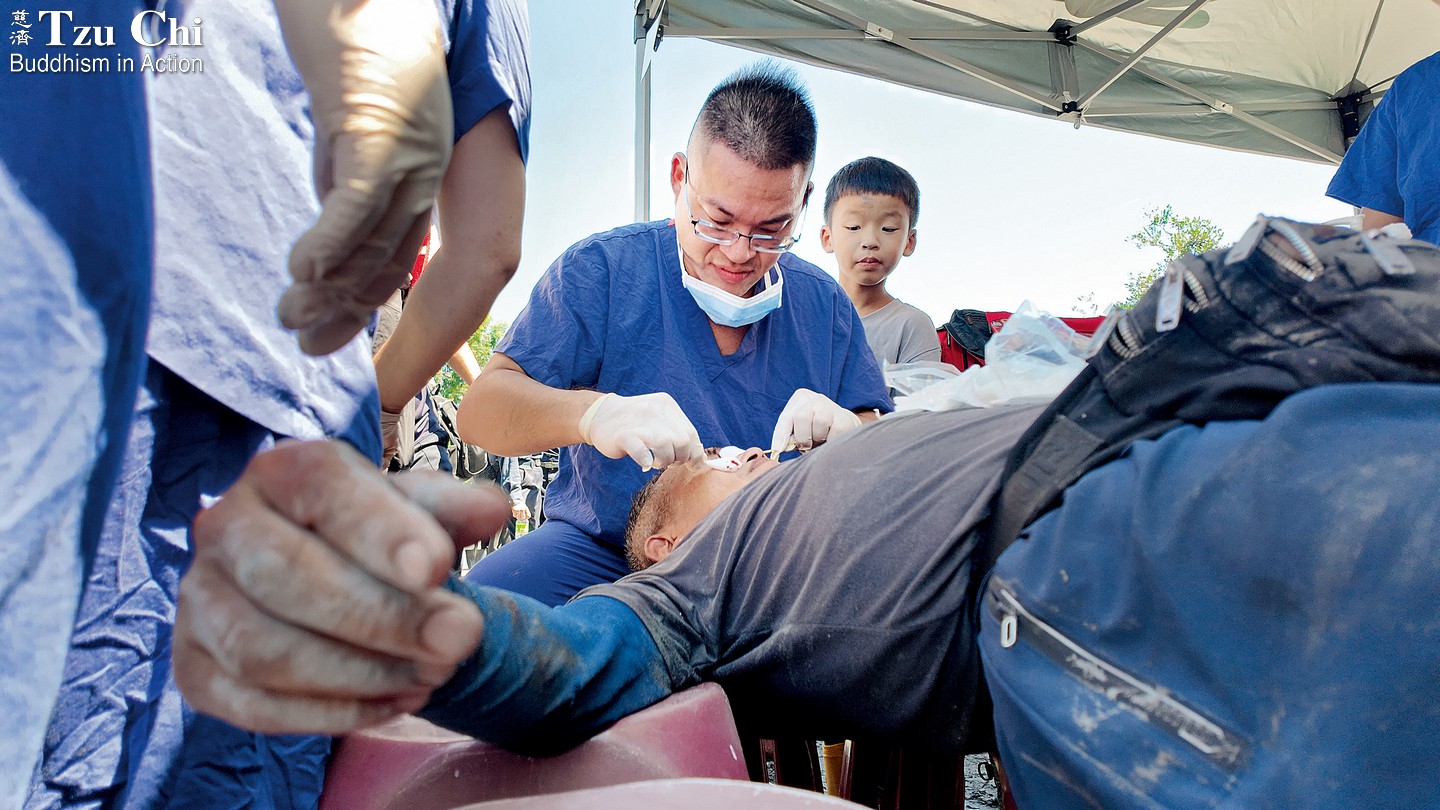
A healthcare professional treats a patient at a Tzu Chi medical station. Chen Li Shao-min