By Zhang Li-yun
Translated by Wu Hsiao-ting
Photos by Hsiao Yiu-hwa
Tzu Chi has more than 130 assistive device outlets in Taiwan. The one at the Dongda Campus in Taichung began in 2023 with just a few women but has since grown to over 150 volunteers, delivering nearly 500 devices each month to families needing such equipment. How did they manage such a feat so quickly?
It wasn’t yet nine on a Saturday morning, but several people were already waiting outside the assistive device outlet at Tzu Chi’s Dongda Campus in Taichung, central Taiwan. Moments later, volunteer Li Guan-hui (李冠慧) arrived in a hurry, her arms loaded with bags. “Sorry I’m late! But we don’t open until nine!” she called out with a smile.
The outlet’s office, about a hundred square meters (1,080 ft²), serves as a hub where people can apply for or return assistive devices. It resembles a medical supply store inside, with second-hand wheelchairs, walkers, suction machines, bedside rails, commode chairs, and other home-care equipment neatly organized and labeled for easy access. Each item has been thoroughly cleaned, disinfected, and repaired if necessary. Donations from companies—such as diapers, underpads, and nutritional supplements—are also available free of charge to families in need.
That morning, Mrs. Lin and her son arrived to return a wheelchair they had borrowed a year earlier. They hoped to exchange it for a sturdier model for her husband, who has Parkinson’s disease and had become much heavier over the past year—now weighing 96 kilograms (210 pounds). Volunteer Huang Sha-li (黃沙麗) brought out a wheelchair, but Li Guan-hui thought the seat was still too narrow. She quickly headed downstairs to the storage area and returned with another model.
“This one is heavier but more stable,” Li explained. “The backrest can be adjusted so he can recline and rest. Just be sure to set the wheelchair’s speed lower to prevent tipping.” Ever cautious and mindful, she also reminded Mrs. Lin to always engage the wheelchair’s brakes before moving her husband into and out of the chair.
Mr. Lin had been diagnosed with Parkinson’s six or seven years earlier. Because their son worked full time, Mrs. Lin had left her job to care for him. Later, the couple moved from Taipei to Daya, Taichung. A volunteer at the hospital where Mr. Lin received treatment told Mrs. Lin about the nearby Tzu Chi outlet, praising its wide selection of well-maintained equipment and suggesting she apply. That was how Mrs. Lin first learned of the service.
“I’m very grateful to Tzu Chi for filling the gaps in our household budget [by providing assistive devices free of charge]. They have really eased our burden,” Mrs. Lin said. “I care for my husband entirely on my own. Thankfully, a Tzu Chi sister often comes by to chat and guide me in caring for him. Without her, I would have fallen into depression.”
Just after Mrs. Lin and her son left, another woman arrived with two young people to apply for equipment. Nurse Su Wei-ling (蘇瑋苓), a member of the Tzu Chi International Medical Association, stepped forward to help. Such scenes are typical at the outlet, which serves many people each day. Two to three volunteers are on duty from Monday to Saturday. Nurse Su volunteers on Saturdays, her day off from work. She also shares her expertise on assistive devices with other volunteers, drawing on her nursing background.
Although the outlet runs very smoothly today, it started only two years ago. The story of how it came about is worth telling.
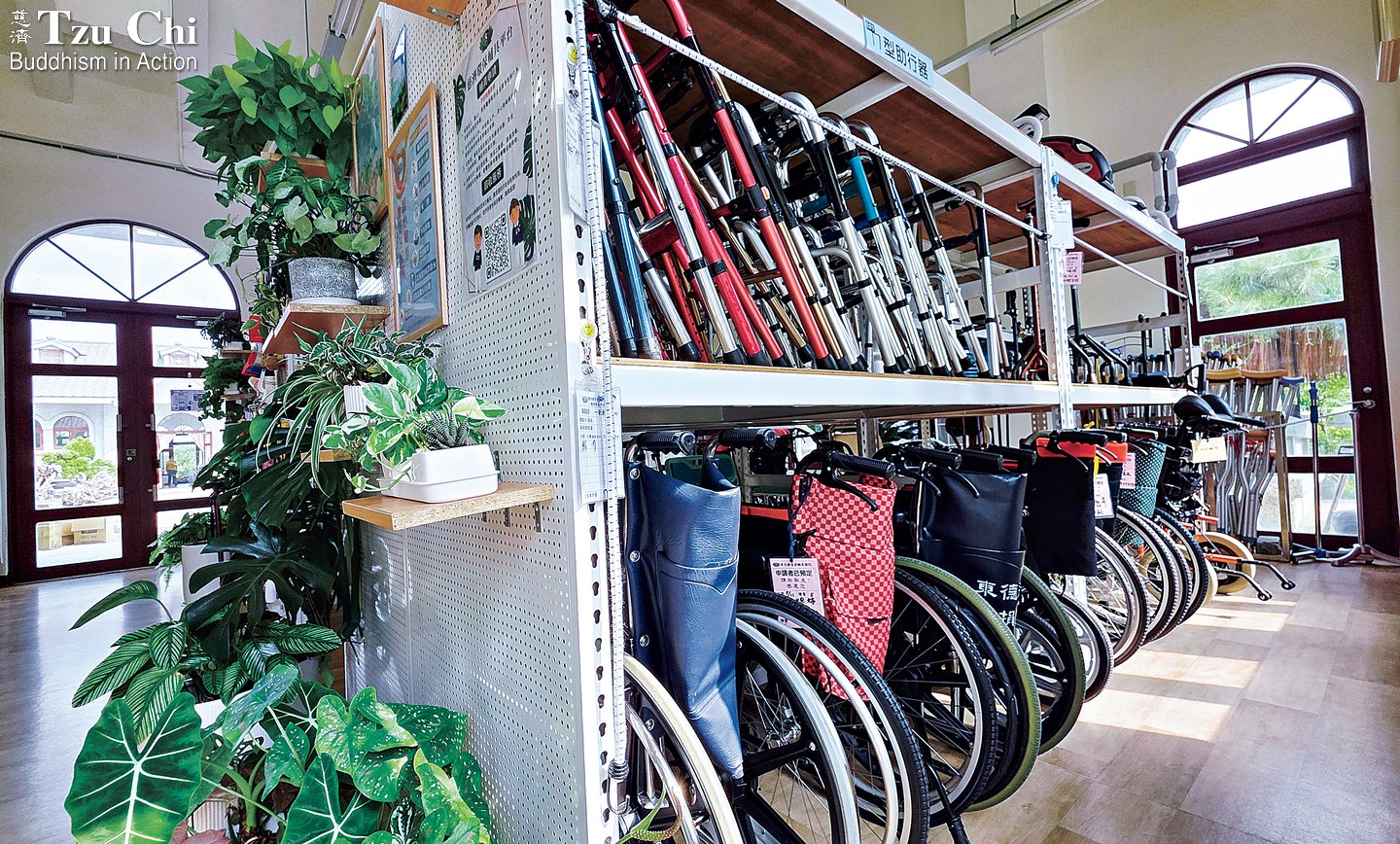
The Dongda assistive device outlet is bright and spacious, with equipment neatly categorized and arranged. Li Guan-hui
From small beginnings
In the summer of 2023, a woman visited the Dongda Campus seeking help. Her son had been paralyzed from the neck down in a car accident, and her family couldn’t afford a specialized high-back wheelchair. Li Guan-hui happened to be giving a tour at the campus and met her. At the time, there was no assistive device outlet at Dongda, so no team was in place to take on the case.
As a Tzu Chi volunteer, Li was regularly visiting three Tzu Chi care recipients with spinal cord injuries, all of whom needed high-back wheelchairs and electric beds. She understood how important such devices were for these patients and how costly the equipment could be for ordinary families. Convinced that an outlet serving local residents couldn’t wait, she volunteered to start one.
The idea of a local outlet immediately resonated with another volunteer, Zhang Xue-hui (張雪慧). While serving at the campus recycling station, Zhang had received several calls from people asking if secondhand assistive devices were available. Her personal experience gave her a deep sense of empathy—her own son has severe cerebral palsy and has relied on such equipment for rehabilitation and mobility since childhood. The two women agreed: “Let’s find like-minded people and do this together!”
The courage and resolve of the two women were admirable, but many—including veteran volunteer Cai Dong-wen (蔡東文)—were skeptical. Cai had often helped deliver discarded but still usable assistive devices from the campus recycling station to families in need. During the COVID-19 pandemic, however, he fell seriously ill and had to discontinue that work. Now, with Li deciding to start an outlet, he worried she might give up halfway and leave the work to him. He shared the same concern with other doubters: Some devices, like hospital beds, weighed nearly a hundred kilograms and sometimes had to be carried upstairs during deliveries. How could a small team of three or four women manage such heavy work?
Even Li’s husband, Li Chang-xian (李昌憲), had his doubts. “Assistive devices are usually very heavy—I didn’t think she could manage it,” he admitted. Busy with his job and volunteer commitments, he couldn’t offer much help. “But on the other hand, I trusted her resilience.” To his surprise, everything moved quickly: Planning began in September 2023, the outlet officially opened in mid-October, and just three days later, on the 18th, the first delivery was completed.
Yan Shi-chuan (嚴世川), who handles general affairs at the Dongda Campus, threw his full support behind Li. “I’ve got your back,” he told her. “Just let me know if you need anything!” True to his word, he played a vital role in setting up the outlet—installing shelves, organizing areas for cleaning, repairs, and storage, and often completing tasks on the very day Li made a request. Under their plan, smaller items went on display in the office, while larger devices like electric beds, transfer machines, and rehabilitation equipment were stored downstairs.
Whenever applications came in for large items, volunteers used two trucks to deliver them on Wednesday and Saturday afternoons. Li Chang-xian pitched in whenever possible. Wednesdays were the toughest—sometimes four or five families were scheduled for deliveries, and with most male volunteers at work, it was hard to find enough help. “I’d choose homes that were closer to my office, stop by to help move the equipment, then head straight back to work,” he recalled.
The couple still remembers their first Lunar New Year’s Eve after the outlet opened. While most families in Taiwan were home celebrating, they were out delivering hospital beds. “We felt that we had to complete all pending requests so that families could spend the holiday in peace,” they said.
But those days, though only a couple of years ago, seem far away. The team now has plenty of help. Whenever a delivery request is posted in the group chat, the slots are filled almost instantly—and nearly always by men.
A valued resource
People who come to the Dongda Campus to apply for assistive devices include residents of Xitun District, where the campus is located, as well as several other areas in Taichung. Because the campus happens to be close to multiple hospitals and nursing facilities, in-home and institutional caregivers often recommend the outlet to families needing such equipment. Hospital case managers and doctors also inform patients about the resource.
Before a patient is discharged, doctors issue a pre-discharge preparation notice, advising families to prepare the necessary assistive devices. Families can apply for equipment through public assistive device centers, but such centers sometimes experience shortages of high-demand items, such as electric beds. Government subsidies are available for certain devices, but renting a full set—including a hospital bed, wheelchair, walker, suction machine, and oxygen concentrator—can cost upwards of NT$30,000 to 40,000 (US$1,000 to $1,330) per month, constituting a significant financial burden for many households.
As a result, many families turn to the Tzu Chi Eco-Friendly Assistive Device Program for help. With over 130 outlets across Taiwan, the program recycles, repairs, and provides equipment free of charge, ensuring quick access while easing financial pressure. Volunteers also deliver devices directly to households at no cost—a service especially meaningful for elderly individuals living alone without transportation. Many recipients are deeply moved when volunteers personally bring equipment and set it up for them.
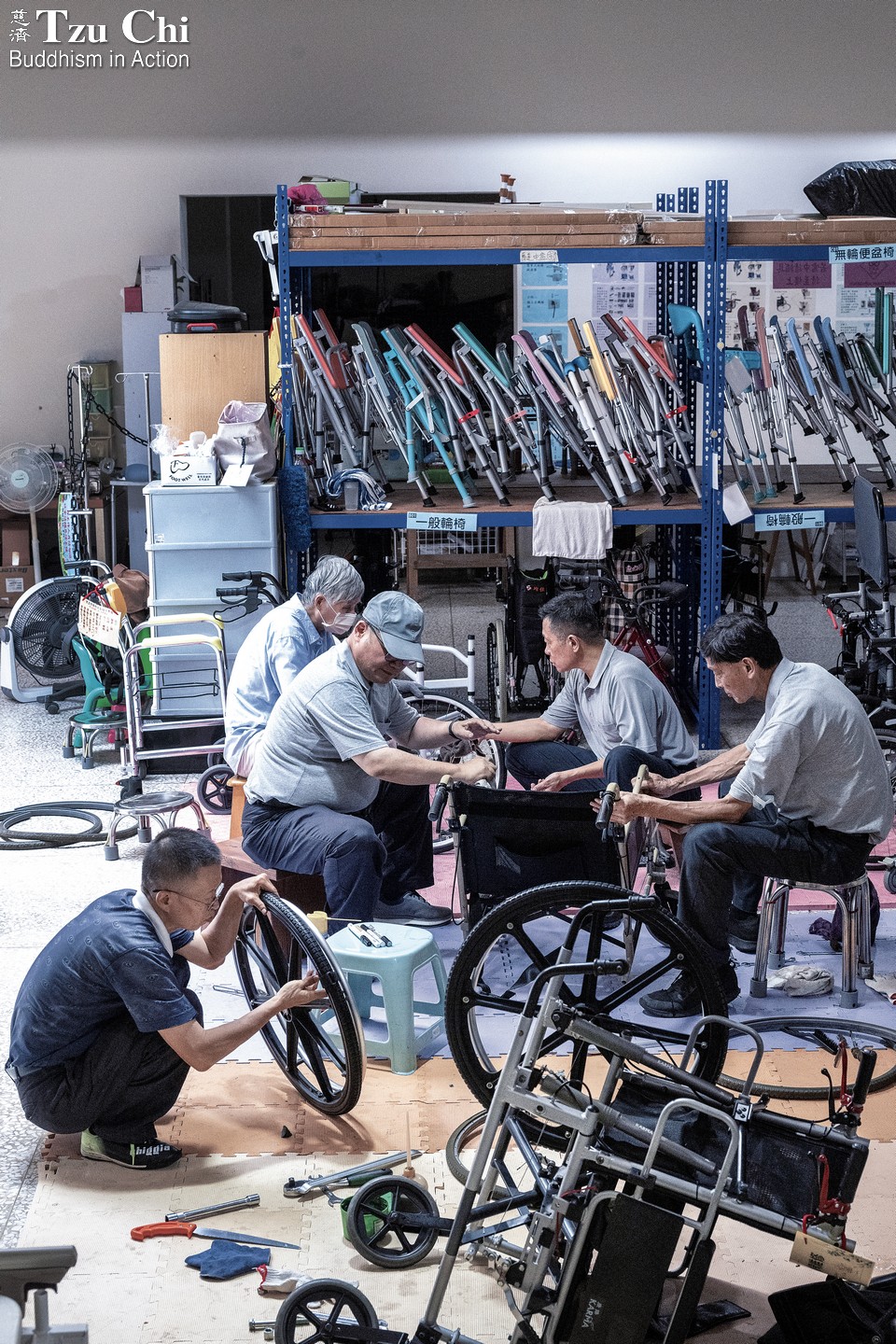
Volunteers check recycled wheelchairs to ensure safety, replacing any parts that are worn or broken.
Helping hands
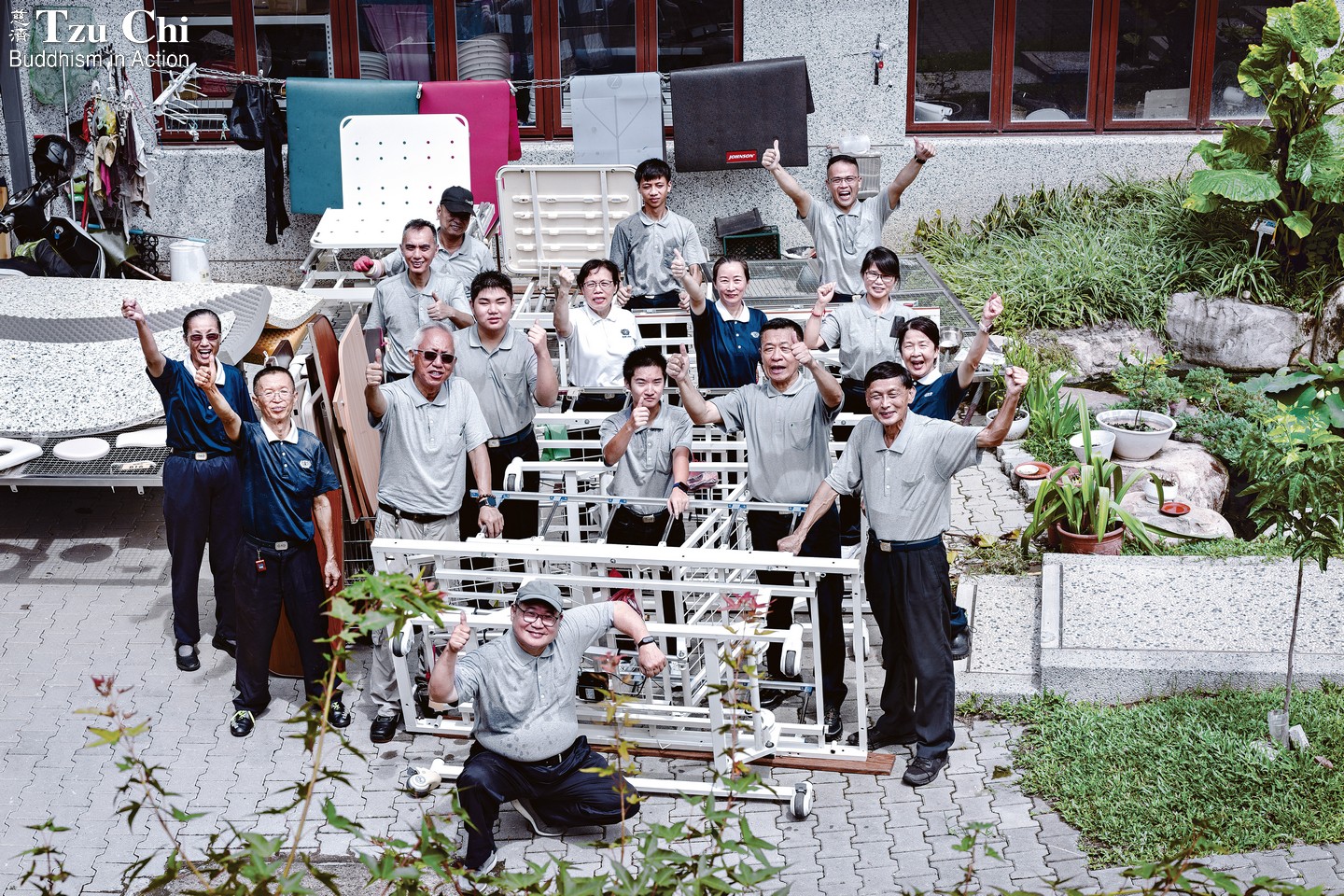
The Dongda outlet team began with fewer than 20 volunteers, but by 2025, it had grown to over 150. How did this remarkable growth happen?
Manpower is essential for sustaining an outlet. When hands were short, solutions had to be found. Li Guan-hui often invited visitors—whether they came to apply for equipment or simply tour the campus—to look around the outlet, including the office and the downstairs area. She would explain the services they offered and the process of cleaning, disinfecting, and repairing devices. She used each of these encounters as an opportunity to recruit new volunteers.
One such visitor was Lin Qun-zhi (林群智). In 2024, newly retired from the general affairs office at a school, he stopped by the Dongda Campus while out walking with his grandson. After learning about the outlet, he decided to join the team.
Yu Zheng-de (于正德), a retiree from the aerospace industry, was inspired to help because his mother had benefited from the outlet. Its efficient service and well-maintained equipment had allowed her to transition smoothly from hospital to home care. After she passed away, he began assisting with equipment maintenance and deliveries.
Lin Jing-wei (林景偉), who had borrowed a wheelchair for his son following a car accident, was also moved to give back. Despite managing four or five chain stores, he sets aside Wednesday afternoons to drive and help with transport.
Xu Wen-xian (許文獻) signed on following the lead of his wife, Zhang Xue-hui. Because their son, as mentioned earlier, has severe cerebral palsy, Xu deeply understood the importance of assistive devices for both caregivers and patients. “Since I have the ability,” he said, “I feel I must help more people—after all, my own child has benefited from society.” On one delivery, he and other volunteers encountered an elderly woman caring for both her husband and son, who had suffered strokes. “We found them using a wooden bed covered with cardboard as a mattress,” he recalled. “I couldn’t believe such conditions still exist in Taiwan. They likely needed many things, but providing an urgently needed electric bed was the least we could do.”
Another volunteer, Lin Zhao-ji (林肇基), who works at a Ministry of Justice correctional facility, ran into former colleagues Lin Qun-zhi and Tu Ying-san (塗英三) during a visit to the outlet. “There’s a magnetic quality here, a joyful energy,” he said. “The team works in harmony, like brothers.” Impressed, he joined as well.
On Saturday mornings, volunteers like these spend hours maintaining equipment. Before work begins, Lin Zhao-ji leads the team in stretching exercises. Around 1:30 p.m., they put on vests and helmets and set out to deliver devices. “I’m 62,” Lin said, “but at the outlet, I feel my spirit leap again. One of the sisters told me, ‘That’s the Tzu Chi soul.’ With this renewed energy, I believe I can continue volunteering with Tzu Chi for at least another 30 years.”
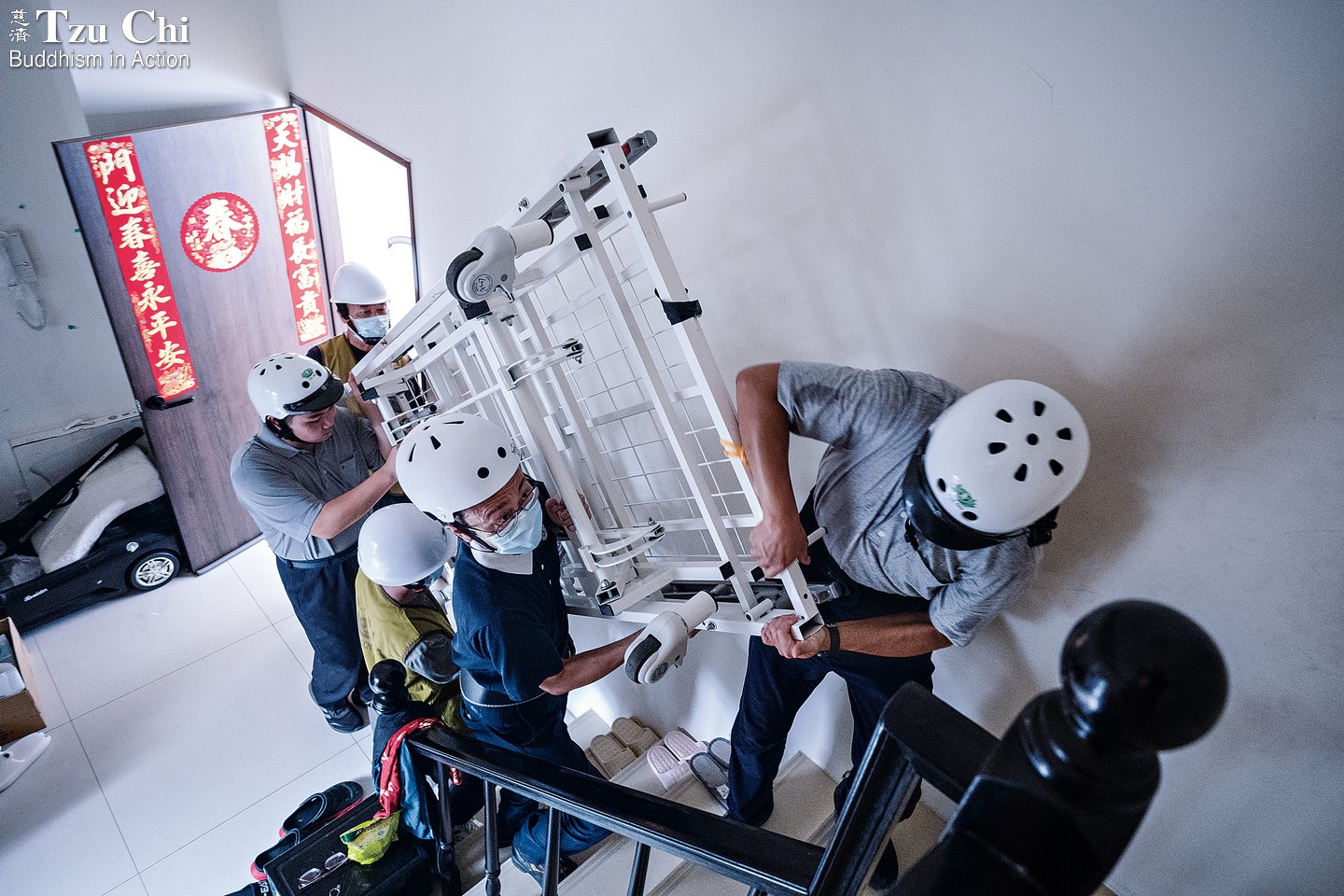
Volunteers work together to maneuver a hospital bed up a narrow staircase for delivery to an applicant’s room.
Behind the scenes
Running an outlet involves many responsibilities, so having many volunteers is a great help. In addition to frontline tasks like transporting equipment to families, volunteers handle extensive behind-the-scenes work.
The outlet, like other Tzu Chi assistive device centers, has a strict quality control process. “We tried several brands of cleaning solutions before finally settling on oxalic acid, which effectively removes water stains and rust,” Li Guan-hui explained as she scrubbed a piece of equipment. “If a device is not cleaned properly, it will be returned.”
In the storage area, charts detailing the cleaning, disinfection, and inspection procedures for wheelchairs, suction machines, air mattresses, electric beds, and other devices are posted for volunteers to follow. For instance, a wheelchair has 15 inspection points—besides checking the overall condition, volunteers make sure screw joints, bent areas, and even hidden spots are carefully cleaned, any chipped paint touched up, and screws, brakes, tires, and cushions repaired or replaced as needed. When mattress covers or the fabric parts of wheelchairs—such as seat and back covers—are torn or irreversibly stained, a team of skilled sewers at the campus is called on to help. They sew new replacements, ensuring the devices are both safe and visually appealing. Each item is signed off only after passing all checks.
“A wheelchair is not sent out even if missing just one small part,” Li explained. Some components are small but expensive. In such cases, Li photographs the items and coordinates with other Tzu Chi outlets to obtain replacements. “Some devices are from different brands or production years, and the manufacturer no longer provides parts. In these situations, we wait for the same models to be recycled so we can combine two or three units into one functional device.”
Maintenance extends beyond hardware. Every Saturday, the outlet hosts a workshop where nurses, rehabilitation therapists, and doctors share their expertise, helping volunteers build skills and confidence in serving clients. Li said, “We learn as we go, working together to build a strong reputation for our outlet.”
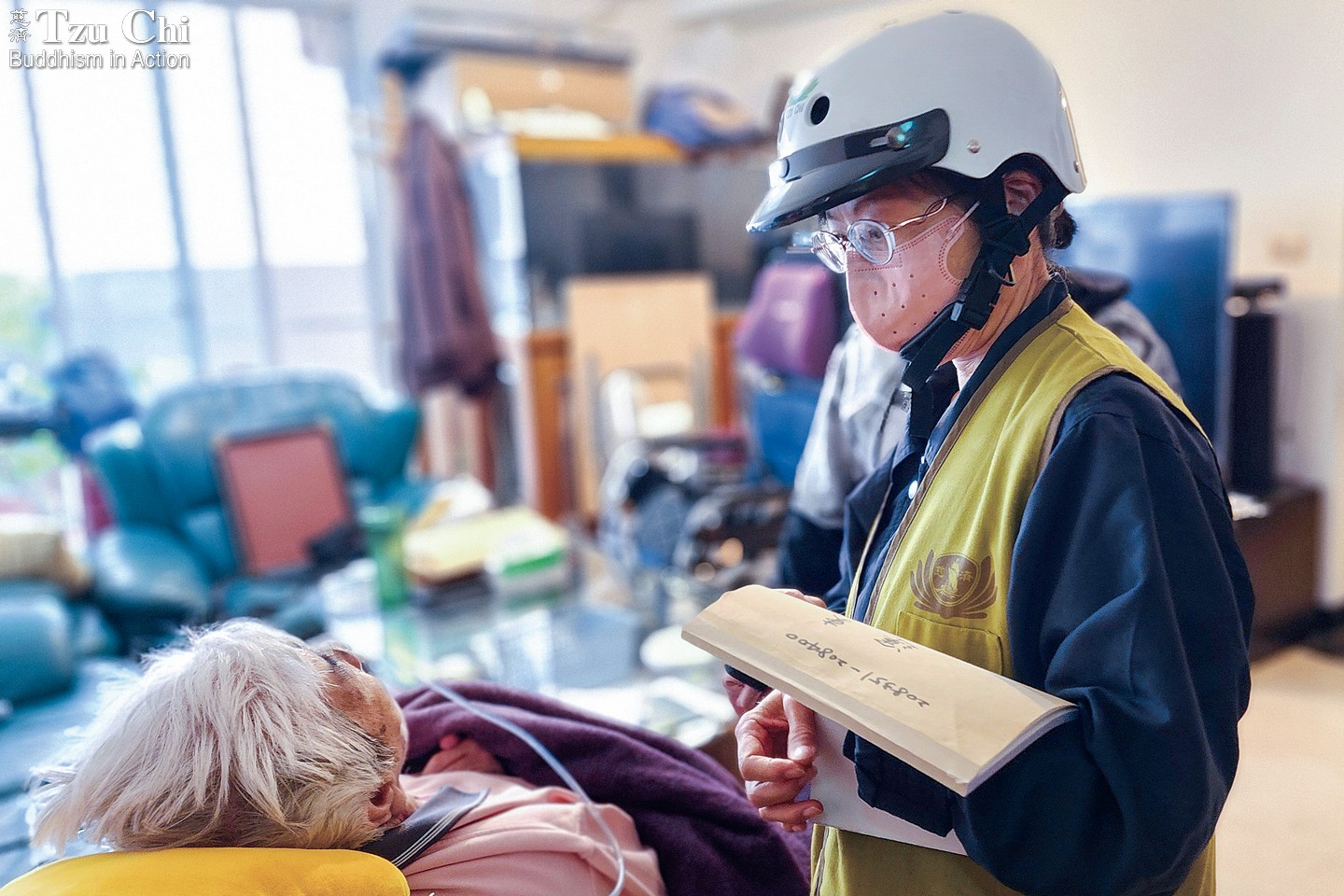
Volunteer Chen Yue-hui (陳月慧), a critical care nurse, checks on a patient with a nasogastric tube while delivering assistive devices to the patient’s home. She also shares her nursing experience with families during such visits. Li Guan-hui
The power of united will
“Thankfully, along the way, there have always been kindhearted people stepping in to help—whether with manpower or resources,” said Li. When the outlet needs tools for repairs or gloves and scrubbers for cleaning, someone appears like Santa Claus, leaving a large box of supplies at the door. Volunteers have even received gifts of fresh eggs, potatoes, fruit, and drinks from members of the public as tokens of appreciation.
Though still relatively new, the Dongda outlet now delivers nearly 500 items each month. Looking back on its establishment, Li shared a guiding belief: “Even when something seems hard to achieve, as long as you are determined, you can make it happen. As Master Cheng Yen often says, ‘Nothing is difficult if you set your mind to it,’ and ‘Proficiency comes from mindfulness.’”
She expressed deep gratitude for the team’s support, noting how every volunteer—regardless of age or the difficulty of a task—does what they can to ease the burdens of those in need. In turn, they enrich their own lives. For Li, every event in life arises from countless karmic affinities, and every accomplishment depends on many such conditions converging. “That’s why we must cherish every encounter and every chance to help, so that we may live without regrets,” she said.
Summing up their journey, she concluded: “I truly believe that when we combine our willpower, we can unleash limitless potential.”