By Yang Wen-fu and Tao Su-lian
Translated by Wu Hsiao-ting
Photo by Li Yan-yu
In late September 2025, a mudflow triggered by the overflow of a barrier lake devastated Guangfu Township in Hualien County, eastern Taiwan. The authors of this article joined the cleanup efforts that followed, witnessing the suffering of residents yet experiencing the joy of giving.
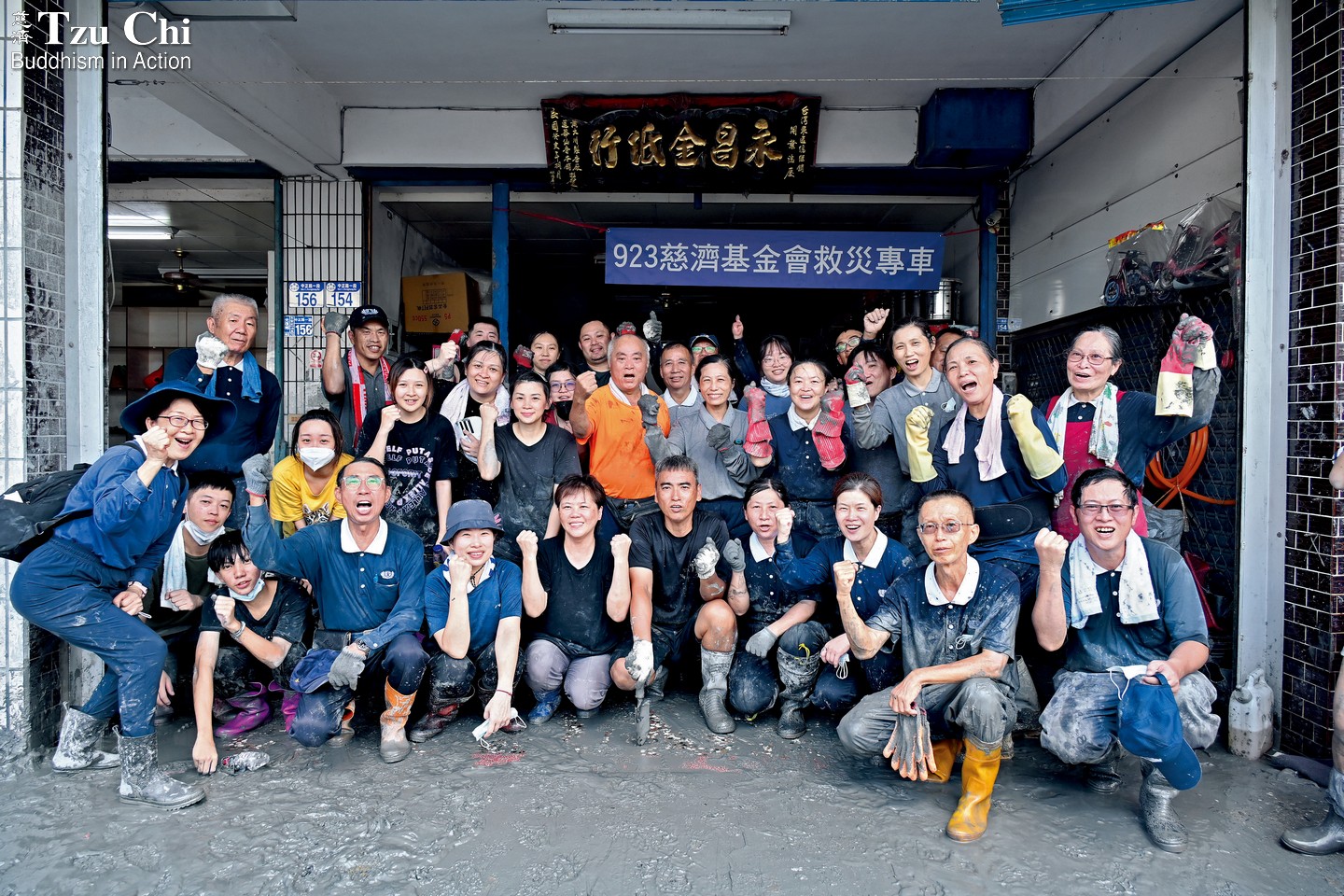
Volunteers from Tzu Chi and all parts of Taiwan rushed to Guangfu Township to help clean up after the mudflow. Here, a group takes a moment for a photo.
On September 23, Guangfu Township, Hualien, was devastated by the overflow of a barrier lake, blanketing parts of the town in thick layers of mud. On September 28, our group of more than 40 Hsinchu residents arrived to help with cleanup efforts.
Stepping out of Guangfu Station, we were met by a flood of volunteers from all over Taiwan. Their numbers far exceeded our expectations, a heartwarming testament to how the disaster, though unfortunate, had unleashed a great deal of compassion and solidarity.
As we moved deeper into the town, we saw many houses displaying cardboard signs that read, “We need volunteers.” We all wished we had superhuman strength so we could help every single household.
Dodging mini skid loaders at work, we wound our way down the road with tools in hand. Our boots and pant legs were soon coated in mud, even though we hadn’t even begun working. When we reached the house assigned to our team, we observed a straight waterline mark at shoulder height running across one wall. It was a stark reminder of the nightmare the homeowner had endured. Nearly 40 centimeters (15 inches) of sludge still blanketed the first floor, with furniture half-buried in the mire.
At first glance, the cleanup didn’t look too difficult. But with the very first shovelfuls, we quickly discovered how stubborn the sludge was—shifting yet heavy, soft on top yet packed firm beneath. It was anything but easy to clear. Even so, working together and coordinating closely, we soon settled into a steady rhythm. Everyone kept their heads down, pushing ahead, while the Tzu Chi brothers and sisters working alongside us reminded us from time to time to drink water and stay safe.
Our clothes were soon soaked with sweat, but each wheelbarrow we pushed out, brimming with mud, lifted our morale. As the terrazzo floor slowly emerged, our team felt a surge of joy, as if hope itself were breaking through the mud. And the smile on the homeowner’s face was the finest reward we could have asked for.
The next day, we saw military personnel and police directing traffic along the roads. Operating large machinery during the day was difficult with so many volunteers working, so the military and government agencies focused on clearing heavy debris at night. Work in the disaster area was thus carried out both day and night. We also saw young soldiers carrying waterlogged furniture, a truly demanding task.
Our group from Hsinchu managed to clean ten homes over three days. Some were completely filled with mud. We witnessed firsthand the toll on residents: Some elderly residents refused to come downstairs to face the damage, while other homeowners’ eyes were red with sadness. Every scene left a deep impression because we saw it with our own eyes.
Our bodies were exhausted and sore at the end of each day, but our spirits felt light. Along the way back to the station, we were constantly thanked for our efforts. Kind-hearted people even offered bread, steamed buns, drinking water, fruit, and pain-relief patches. It all truly warmed our hearts. Two large barrels of water in front of the station allowed us to rinse our boots, and we could even be sprayed with disinfectant. Taiwan Railway ran several extra trains to transport the “shovel superheroes,” a term used for the cleanup volunteers. Each carriage was coated in dust, yet after returning to Hualien, the trains were cleaned and sent out again—an impressive testament to the dedication of the railway staff.
Because we had signed up with Tzu Chi for the cleanup, we were able to spend nights at the dormitories in the Hualien Jing Si Hall, a first-time experience for us. While eating boxed dinners provided by the foundation, we observed more than 200 Tzu Chi volunteers reviewing the day’s work, checking progress item by item, and coordinating resources for the next steps. We were impressed by how Tzu Chi volunteers applied the planning and management skills of running a business to disaster relief. No wonder people often praise Tzu Chi for its organization and efficiency!
In the disaster zone, Tzu Chi volunteers in uniform were everywhere, a calming, stabilizing presence. Wherever there is need, Tzu Chi is there. Even those who could not help personally in the disaster area contributed through donations, keeping a powerful current of goodwill flowing strong and full.
This was our first time taking part in a Tzu Chi volunteer effort. From the initial call for volunteers onward, everything—from our schedules and transportation to our accommodations and the thoughtfully prepared vegetarian meals—was arranged with remarkable order. Behind it all was a support team as solid as a rock. Thanks to such strong and reliable backing, volunteers like us could focus entirely on the work before us and contribute in whatever small ways we could.