By Bai Ru-lu, Goh Lam Kia, and Anish Manandhar
Translated by Wu Hsiao-ting
Photos by Ramesh Karki
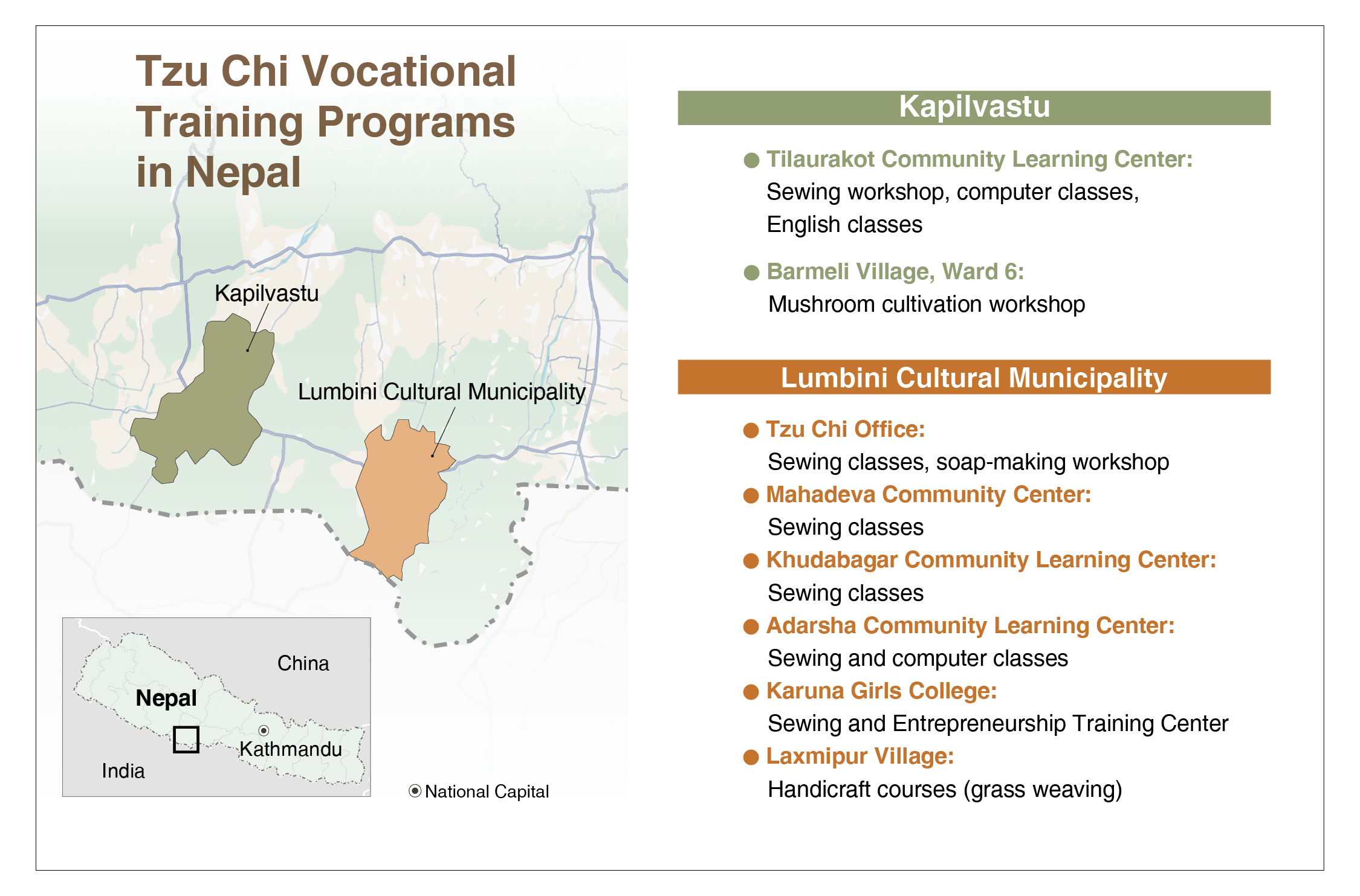
Tzu Chi volunteers have set up programs in Lumbini and Kapilvastu, Nepal, to teach valuable skills to women often restricted by caste and patriarchal norms. As sewing machines click, mushrooms flourish, and deft fingers weave handicrafts, these women are gaining a chance to rise out of poverty and become self-reliant.
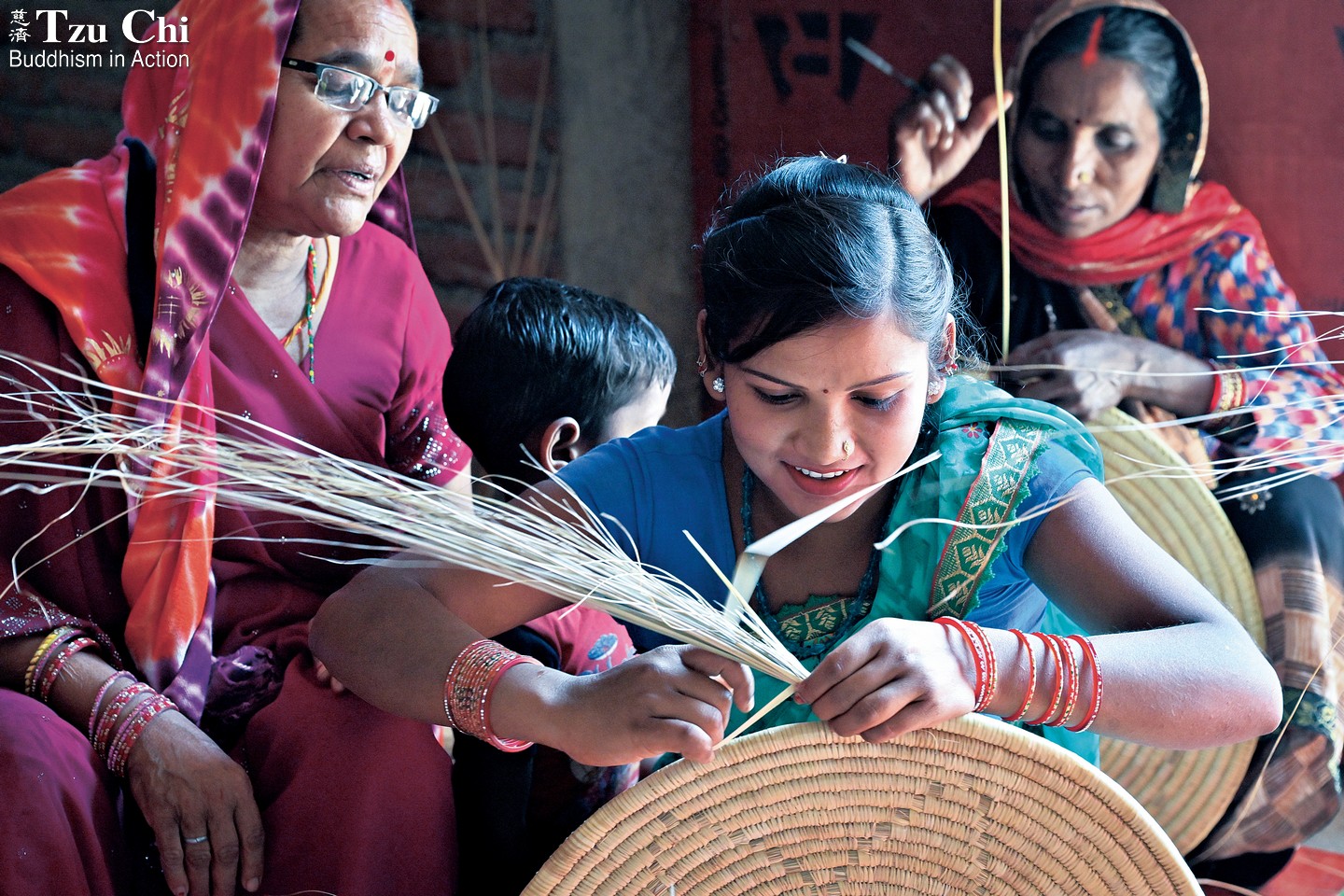
Women from Laxmipur Village, Lumbini, learn grass weaving in March 2025, guided by instructor Subhauti Pal (left). Lin Jia-ru
It was another misty morning. Radha Upadhyaya was already busy in her courtyard, scrubbing pots with a mixture of lime and soap. Though she is in her 60s, the demands of daily labor have not eased with age. She and her husband live in Barmeli Village, Ward 6 of Kapilvastu, Nepal. Their home is a fragile mud-brick house that sometimes crumbles. They raise cattle together on informally cultivated land, gather sand from nearby rivers, and tend a small, infertile plot of farmland just to get by.
All three of their children left school early to seek work abroad. They have since started families of their own, but their lives remain financially strained. Though the children have occasionally sent money home to help when their parents were ill, Upadhyaya said, “We can’t always expect to lean on our children. My kids don’t even have their own houses. We have to stand on our own two feet.”
Seeking that independence, she visited the Tilaurakot Community Learning Center on September 21, 2025, to join Tzu Chi’s mushroom cultivation workshop. A bag of mushroom spawn costs about 75 Nepalese rupees (US$0.50), and the quality and quantity of eventual yields depend on temperature, care, and harvest timing. But for her, the potential of a good harvest represents more than just a new source of income—it offers a step toward greater self-sufficiency and dignity.
On the center’s second floor, a sewing workshop houses 12 machines, where local women work from 8:00 a.m. to 4:00 p.m. The facility opened in late July 2025. The women began by learning to sew straight lines, gradually mastering the machinery. They also built a professional workplace culture along the way—arriving on time, keeping the space clean, and taking collective responsibility for equipment and other property.
The third floor offers yet a different scene. There, a group of young people tap away at keyboards, practicing commands like copy, cut, and paste. Supported by a teacher, an assistant, and four volunteers, they are learning basic computer skills to improve their employment prospects.
These programs are just the first steps in the broader vision of Tzu Chi volunteers working in Lumbini and Kapilvastu. Over the past three years, Tzu Chi has provided vocational training and explored products suitable for mass production to create local jobs. The hope is that one day, these products or skills will earn government certification for their quality, helping villagers break the cycle of poverty and achieve true independence.
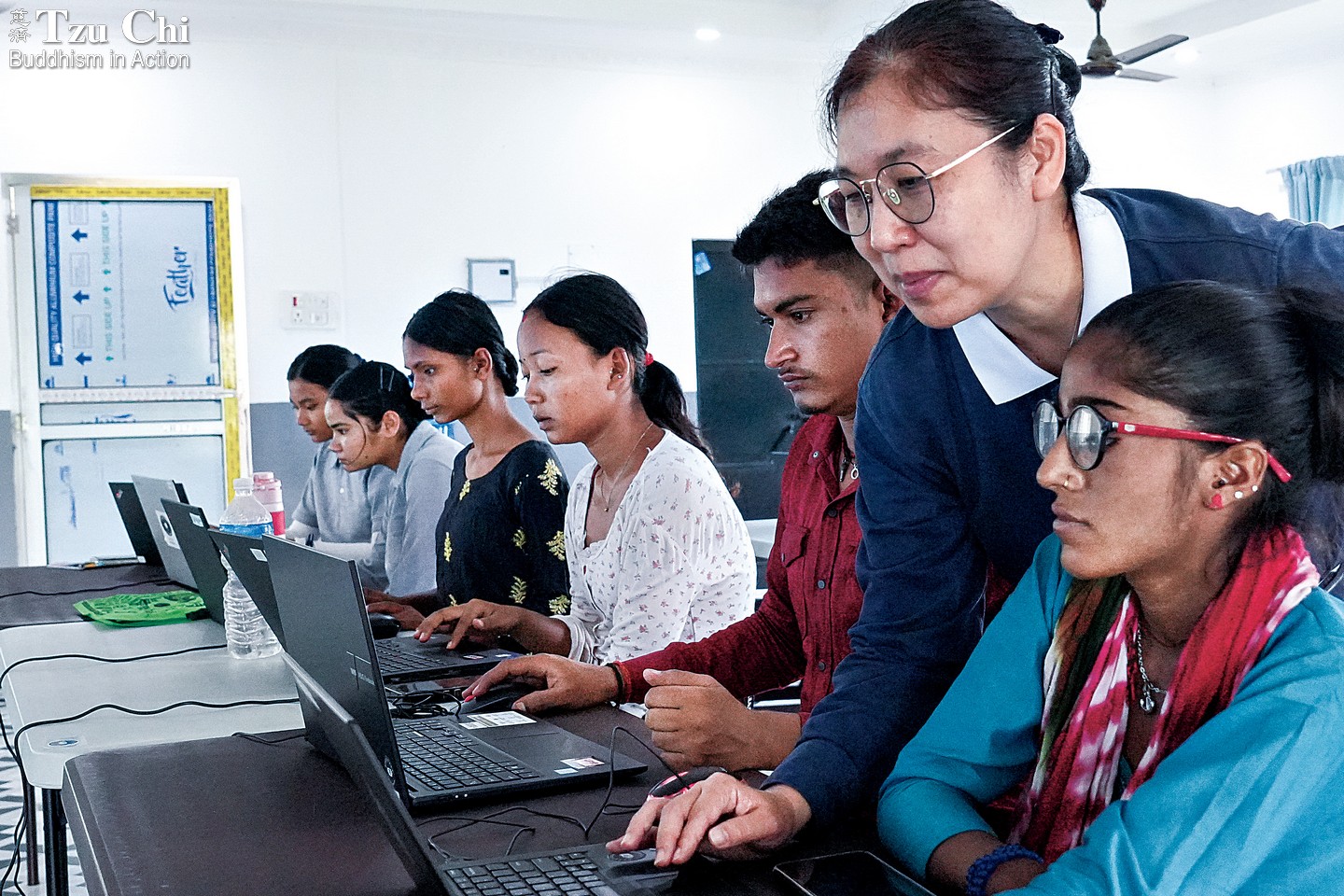
Singaporean Tzu Chi volunteer Teoh Ai Ping (張愛彬, second from right) checks in on students’ progress on July 2, 2025, during a basic computer skills class at the Tilaurakot Community Learning Center in Kapilvastu.
National certification
Prince Siddhartha was born in Lumbini more than 2,500 years ago and was raised in Kapilvastu. After confronting the realities of aging, sickness, and death, he left the palace to follow a spiritual path—a journey that ultimately opened the way for future generations to benefit from the wisdom of the Dharma.
Tzu Chi established a presence in Lumbini in April 2022 to honor the Buddha and uplift the needy in his birthplace. In November 2023, volunteers began to be regularly stationed in Kapilvastu, another significant site in the Buddha’s life. The foundation now provides long-term support to roughly 80 households across both regions. It also offers free medical services and educational aid for local communities. Vocational training, in particular, has become a central focus of this work.
Formal education typically ends after the 10th or 12th grade in Lumbini’s rural villages, as few families have the means to provide the education and training their children would need to pursue a professional career. Most men stay on to farm ancestral lands, while young women are prepared for marriage.
Cecelia Ong (王慈惟), a Malaysian Tzu Chi volunteer, was among the first to arrive in the region more than three years ago. She has observed firsthand through years of home visits that many families are weighed down by debts passed down from previous generations. The primary reason, she explains, is the need to raise dowries for daughters’ marriages. Although microfinance institutions offer loans to farmers and women, the money rarely leads to sustainable income. Instead, families fall into a debt trap—taking out new loans to repay earlier ones—creating a vicious cycle in which some spend their entire lives working just to pay off what they owe.
What Ong finds most heartbreaking is the hidden cost of this poverty. When families struggle, daughters are often the first to be pulled out of school. This interruption doesn’t just end their education; it closes off future opportunities. Compounding the problem, few industries have taken root locally, and job prospects are extremely limited.
Ong believes that self-sufficiency is the only way to change the course of these women’s lives. “That’s why we started sewing classes,” she explained. “Our local volunteers went door to door asking girls if they wanted to participate. Even when they were interested, we still had to obtain their families’ permission to let them leave home for lessons.” The goal was never just to create a hobby class for mending clothes. The vision was professionalization—preparing these women to pass national exams and become certified tailors.
The Council for Technical Education and Vocational Training (CTEVT), Nepal’s national apex body for technical and vocational education, oversees and administers such certification exams. Because the machines at the testing site were outdated, Tzu Chi transported its own equipment to the venue. With the lighting also inadequate, Ong applied for permission for volunteers to enter and use their mobile phones to supplement the lighting, helping students trained by Tzu Chi complete their tests. Moved by these actions, some students said, “Master Cheng Yen has used such care and love to lift us up.”
In these rural areas, even basic supplies are scarce. Scissors are not a standard household tool—some women even use sickles to trim their nails. And because many left school early, they initially struggled with basic math and measurements. Examiner Kanel Arjun expressed her surprise at Tzu Chi, noting that she had never seen an NGO dedicate such sustained efforts to training rural women for national certification.
Tzu Chi has offered five advanced courses since its sewing program in Lumbini began in October 2022. A total of 71 women have graduated, including 11 who obtained national tailoring certification. Ong’s next goal is to have the program accredited by CTEVT. In late November 2025, the foundation received notice that its teaching curriculum had passed review, clearing the way to formally submit the accreditation application.
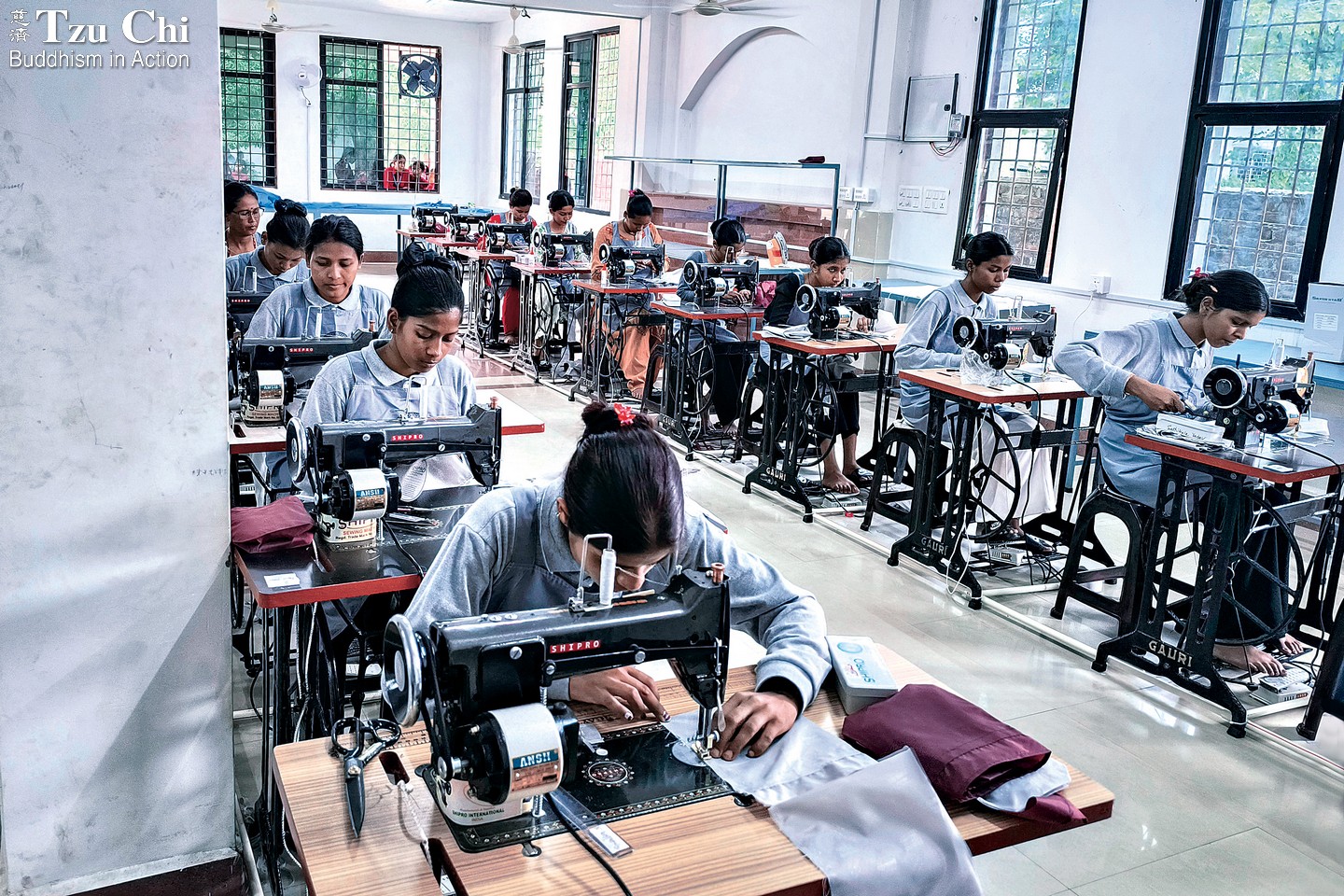
Tzu Chi established the Sewing and Entrepreneurship Training Center at Karuna Girls College in Lumbini in May 2025. The treadle sewing machines there (photo 1) are equipped with motors, enabling faster sewing when power is available, but can be powered manually during frequent outages. Lee Lay Sim
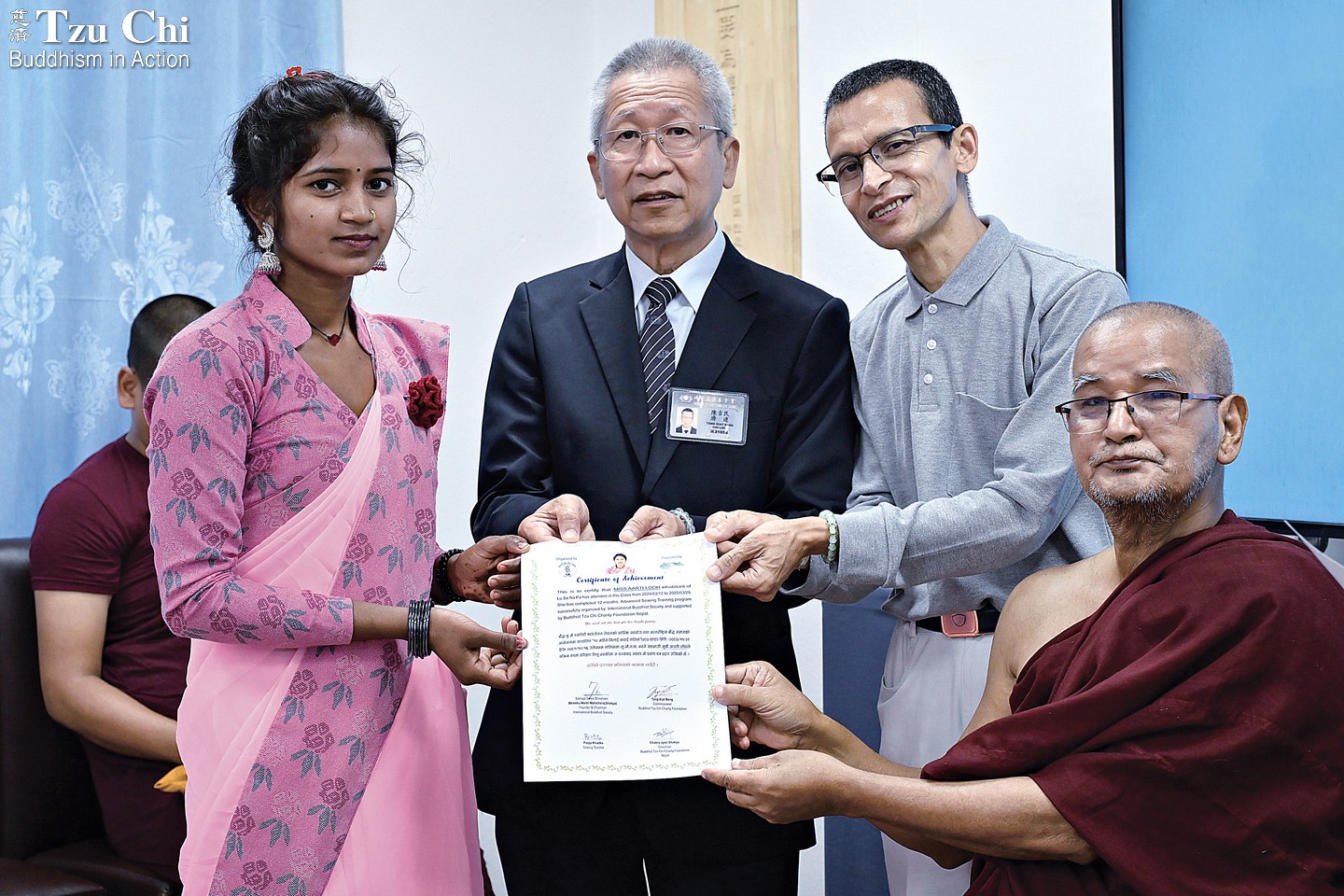
A graduate of a Tzu Chi advanced sewing course wears a self-made garment during a graduation ceremony on May 17, 2025, as she receives her certificate from Venerable Bhikkhu Maitri and other guests. The Venerable noted that while some local organizations offer tailoring courses, none provide the kind of support Tzu Chi does in helping trainees pass national-level certification exams (photo 2). Lin Jia-ru
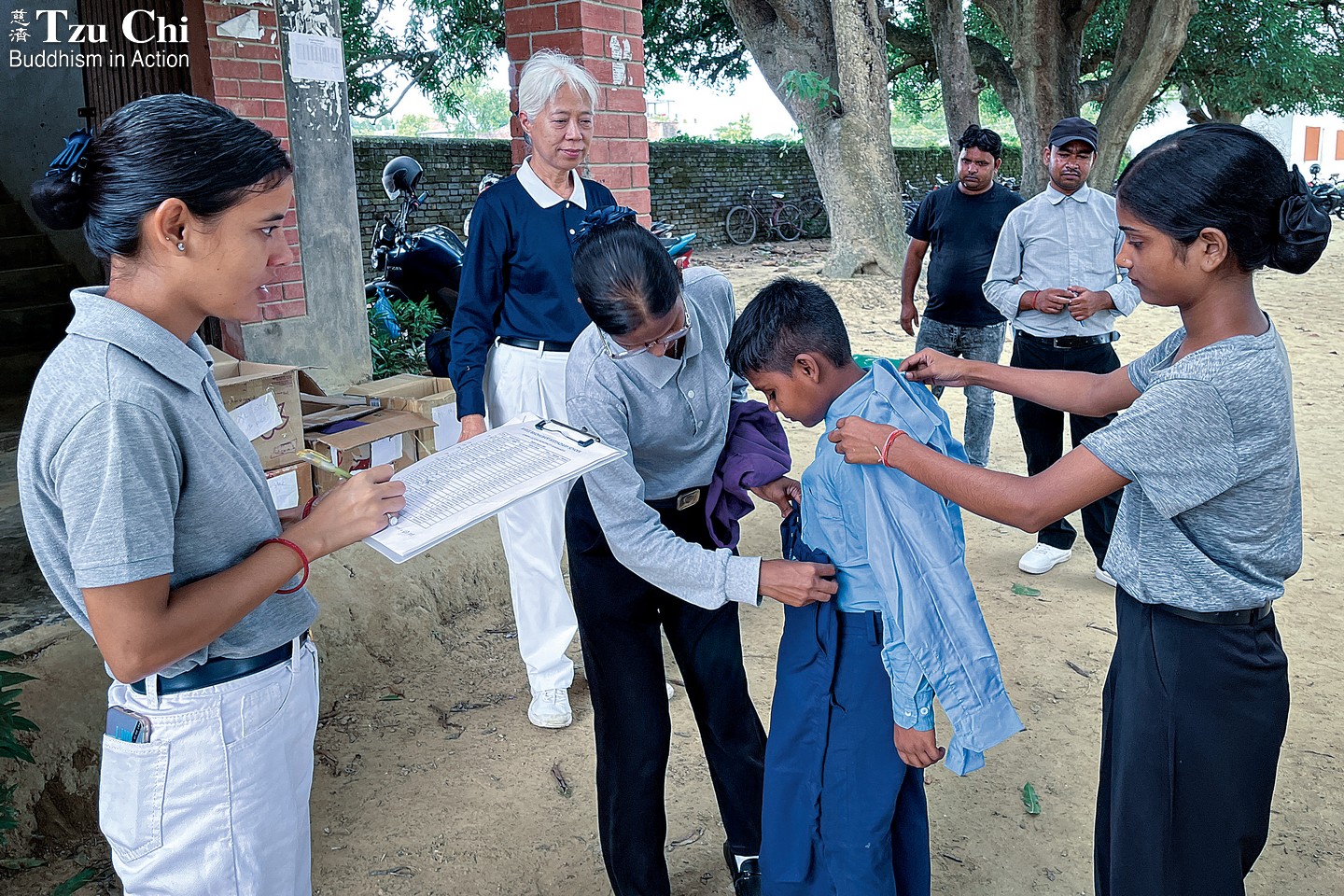
Volunteers measure underprivileged students at Shree Madhubani Secondary School in September 2024 to provide them with uniforms handmade by teachers and trainees of Tzu Chi’s sewing classes in Lumbini. Amarkesh Mourya
Building confidence
Tzu Chi’s basic sewing courses run for six months and are tuition-free, covering 21 essential sewing skills, along with the math needed for tailoring. Students who pass an exam can move on to an eight-month advanced course, where they gain the skills to take on independent commissions or even serve as instructors in Tzu Chi’s classes.
Sakina Khatun, who joined Tzu Chi’s sewing program in 2023, left school in fourth grade to help with household chores, following the path of her older sister, who married at 18. With Tzu Chi’s guidance, she passed the national certification exam in May 2025, at just 20 years old, and became a sewing instructor. She is now also a working tailor, earning 300 Nepalese rupees (US$2) for each garment she makes.
Yet her success is shadowed by tradition. She recently confided to volunteers that her parents were planning to marry her off to a man working in the Middle East. “I’ve never even met him,” she shared. “I truly don’t want to marry a stranger.”
This sense of uncertainty is common. When asked about their future, many students respond with blank stares. Bound by local customs, some women have never left their home villages. For them, even a simple trip to the city, with its rushing traffic and crowds, can be physically overwhelming, leaving them pale and disoriented.
The sewing program, however, is giving these women a chance to take control of their lives. Bandhana Chaudhary, for example, once lived the precarious life typical of slum dwellers, often unsure where her next meal would come from. Today, her tailoring income ensures her family has food and medicine and, most importantly, allows her to pay her son’s school fees. “I want to help him become a doctor,” she said.
Another student, Swastika Chaudhary, has worked in the sewing program for two years. “At Tzu Chi, I’ve learned discipline, how to help others, and how to show love and care,” she said. “I plan to become a sewing instructor.” Ong elaborated, “We’re not just teaching them to earn money. We want them to go on to care for their communities. Once women are empowered, they can help other women.”
Tzu Chi has also set up the Sewing and Entrepreneurship Training Center at Karuna Girls College, housing 20 electric sewing machines. Volunteer Rakesh Tripathi shared that the college was founded by his brother, Venerable Metteyya Sakyaputta, specifically to cultivate the potential of women in Lumbini. Center director Baijnath praised the students’ efforts, noting they produced 4,000 high-quality gift bags in just a few months. “This center helps married women continue to grow and achieve self-reliance,” he observed.
In Mahadeva Village, volunteer Santosh Maurya offered his own space for Tzu Chi to set up its first community center in Lumbini in July 2024. Seeing the center in their own neighborhood gave fathers and husbands the confidence to allow their wives and daughters to attend classes there. Today, around 150 women learn sewing at the center each day.
Ong shared a lighthearted observation from her home visits: “Village elders said that now, if a girl or woman steps outside, you can immediately tell whether she has been to Tzu Chi!” At its core, Tzu Chi’s sewing classes are about building women’s confidence. The curriculum goes beyond technical skills. By listening daily to Master Cheng Yen’s teachings and receiving basic etiquette training, many students have undergone a profound transformation in both their demeanor and conduct.
Instructor Puja Khadka watched with pride during the May 2025 graduation ceremony as students wore garments they had sewn themselves. For her, it was more than a display of their craft; it was a symbol of bravely pursuing one’s dreams and breaking personal limitations. “This program opens the door to the outside world for the students,” she said.
Dr. Tang Kiat Beng (陳吉民), deputy CEO of Tzu Chi Malaysia, has been based in Lumbini for over three years. Having witnessed firsthand the systemic barriers of the caste system and gender inequality, he said, “I am moved to tears every time I see a woman graduate from our sewing program. They are finally leaving the confines of their mud houses. With an income, they begin to see the value of education. Our next step is to train them in entrepreneurship, management, and even fashion design to help them eventually launch their own brands.”
Perhaps the most significant shift is the transition from being recipients of aid to becoming providers of it. Dr. Tang said that when students save a handful of rice each day for the needy or visit schools to distribute the uniforms they have sewn, they often share, “We never imagined we could help others, too.”
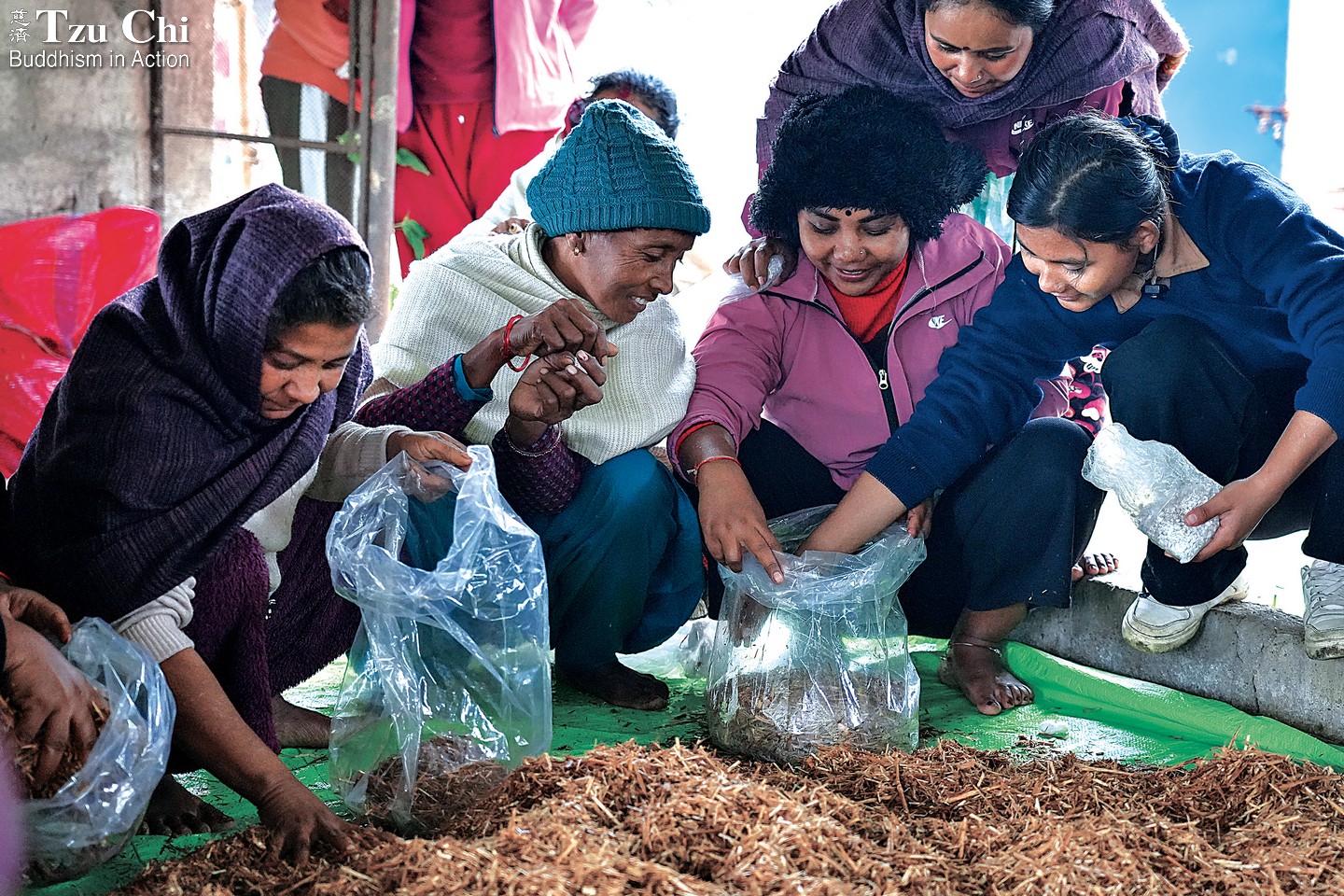
Participants of Tzu Chi’s mushroom cultivation workshop in Kapilvastu carefully layer rice straw and spawn to create grow bags during a 2025 training session (photo 1).
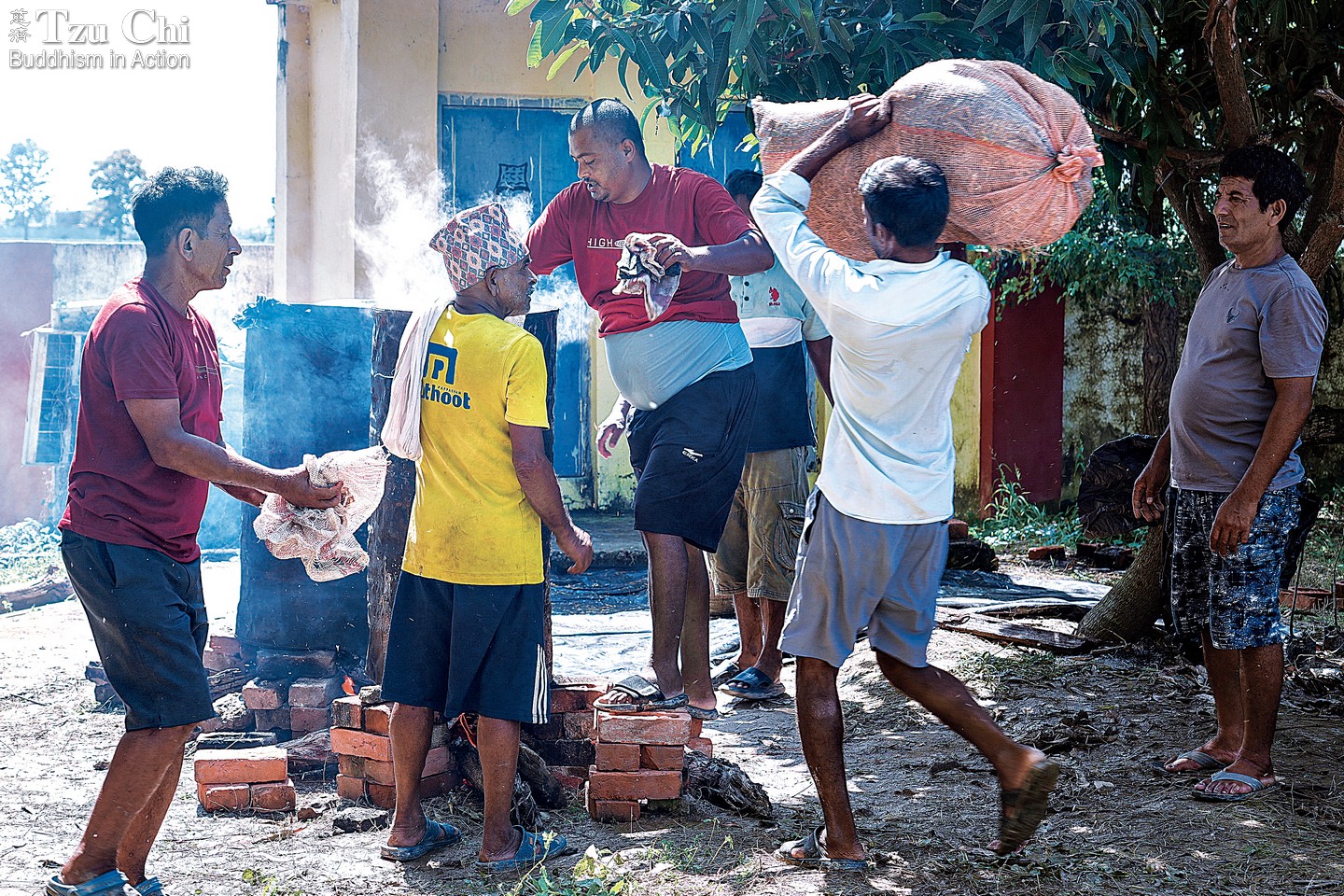
Male participants of the workshop work together to steam-pasteurize rice straw for grow bags. Some had previous experience growing mushrooms, but without formal training in proper techniques and processes, their harvests were poor (photo 2).
The mushroom mission begins
Although Tzu Chi’s sewing program was already empowering local women, 75-year-old Singaporean volunteer Willy Ang (洪德謙) saw that villagers needed additional livelihood options—ones with lower barriers to entry and minimal startup costs. The poverty he witnessed in Barmeli Village, Kapilvastu, weighed heavily on him. “Villagers turn to alcohol to cope with having no income and no future,” he said. “We must help them find a way to earn a living.”
In May 2025, Ang and local volunteer and Tzu Chi staff member Aliza Chaudhary traveled to a mushroom farm in the hills of Tansen to learn cultivation techniques firsthand. Despite his age, Ang navigated the narrow, uneven ridges between the fields to observe how the mushrooms were grown.
Tzu Chi’s “mushroom mission” began through a serendipitous connection. Arbind Mani Tripathi, an administrative supervisor in Nepal’s Ministry of Agriculture, has a son, Ashutosh, who was transformed from a rebellious school dropout into a motivated and responsible young man through his involvement in Tzu Chi activities. Wanting to give back to the foundation, Tripathi introduced volunteers to mushroom cultivation facilities and connected them with professional resources.
Because mushrooms can be grown indoors using locally available materials such as rice straw, the project held great potential for villagers. In September 2025, Tzu Chi launched a mushroom cultivation workshop for the first cohort of participants, led by Aliza Chaudhary and fellow Tzu Chi staff member Simran Thapa, both agriculture graduates. Villagers learned careful sanitation procedures to ensure good yields: chopping rice straw, soaking it in limewater, and steaming it over a fire to pasteurize the straw. Despite protests and heavy rains delaying the delivery of mushroom spawn from Kathmandu, the villagers’ enthusiasm never wavered—they cleared space in their homes and followed strict hygiene practices to ensure a successful harvest.
Participants demonstrated remarkable teamwork during the hands-on training. Men teamed up to carry heavy metal barrels for steaming the straw, while women carefully layered mushroom spawn into plastic grow bags. Challenges did arise, and some participants experienced contamination setbacks, but with Chaudhary and Thapa checking in every four days and offering guidance, most achieved successful harvests. Upadhyaya, the woman introduced at the start of this article, also faced a few contamination issues but quickly adjusted, ultimately earning 5,000 Nepalese rupees (US$34) from fresh mushrooms and another 4,000 from dried ones. She was even invited to share her experience with the next group of trainees.
The second offering of the workshop was scheduled for December, with a goal of recruiting 30 participants. The response exceeded expectations: 42 households signed up. Ramjeet Prasad Kurmi, chair of Ward 6, encouraged the participants: “No NGO has ever provided such vocational training in our area. Please treasure this opportunity to learn.”
Among the trainees, a few stood out. Krishna, a blind man in his mid-40s who sells incense for a living, was the first to sign up. He encouraged hesitant neighbors to join, and under his leadership, three households decided to learn together, sell their mushrooms jointly, and share the profits. Another participant, Pabitra, was an expectant mother just 15 days from her due date when she joined. Her family had lost their source of income after their five water buffalo were injured in a fire and stopped producing milk. Determined to find a new path, she told volunteers, “Mushroom farming allows us to turn local resources into quick returns with very little cost. I want to master this.”
Volunteers believe that a stable income can help children stay in school and may also reduce domestic violence and alcohol abuse. “If we help pave the way, villagers will walk it themselves,” they say. Reflecting on her role, Aliza Chaudhary added, “If it weren’t for Tzu Chi, I wouldn’t have realized these pockets of poverty existed right in my own backyard. I want to use my education to create job opportunities for my own people.”
Willy Ang continues to work tirelessly for the villagers, planning improvements to cultivation facilities. “The look of satisfaction in the villagers’ eyes is all the reward we need,” he said. “It makes all our work worth it. We want them to realize that with mindfulness and an open heart, anything is possible. As Master Cheng Yen says, ‘We all have unlimited potential.’”
According to surveys, mushrooms are in demand in Nepal but are not easy to obtain consistently, largely because most growers produce only small quantities at a time. While villagers trained by Tzu Chi currently grow mushrooms in small batches, the Great Love Village under construction in Kapilvastu offers a glimpse of a larger future. There, a large-scale mushroom facility could eventually be established, giving trained villagers an opportunity to work as skilled staff.
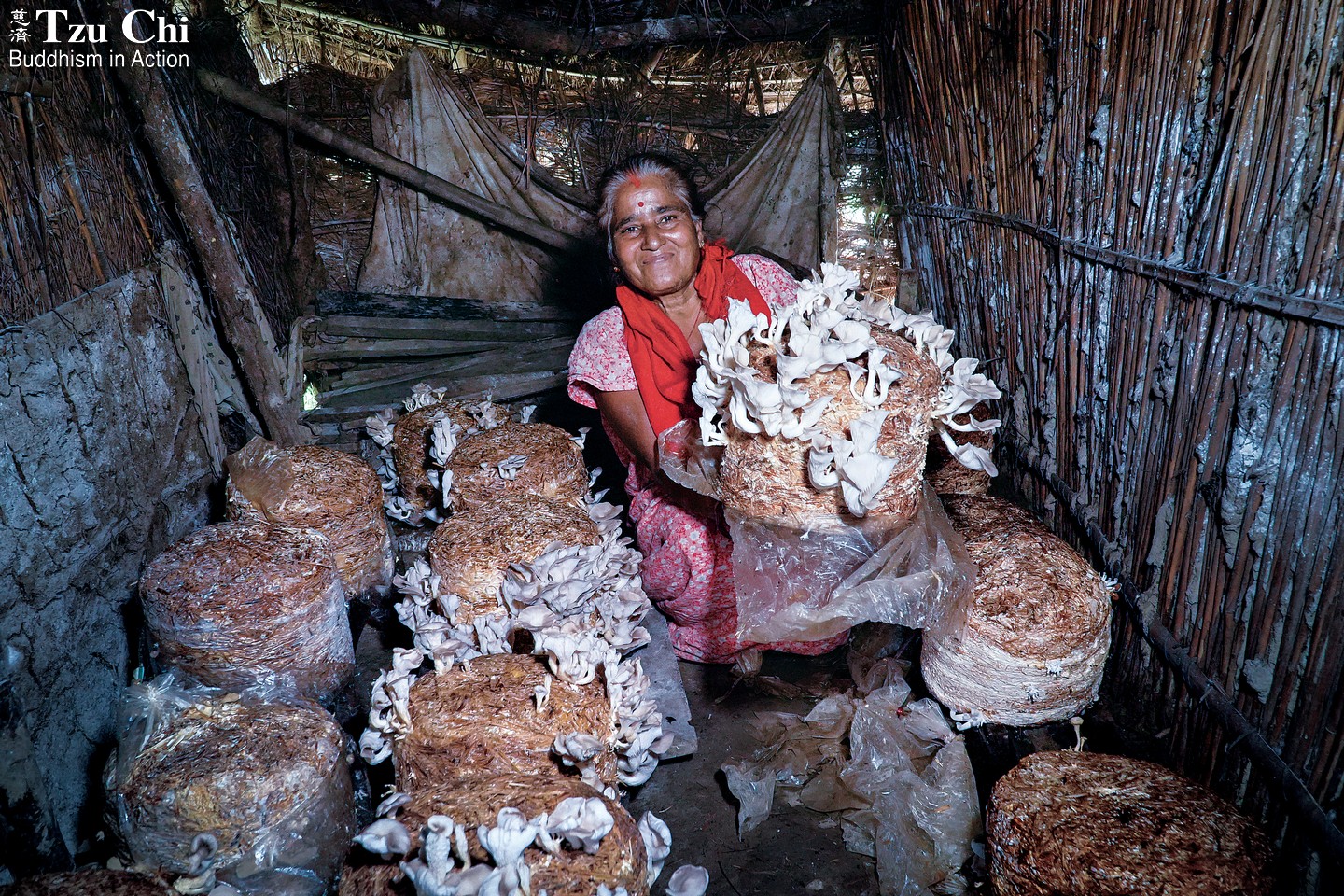
Radha Upadhyaya, a resident of Kapilvastu, poses with the abalone mushrooms she cultivates at home. She appreciates that the work is easy to manage and can be done entirely at home, making it well suited to her age. She plans to expand her cultivation space in the future. Anish Manandhar
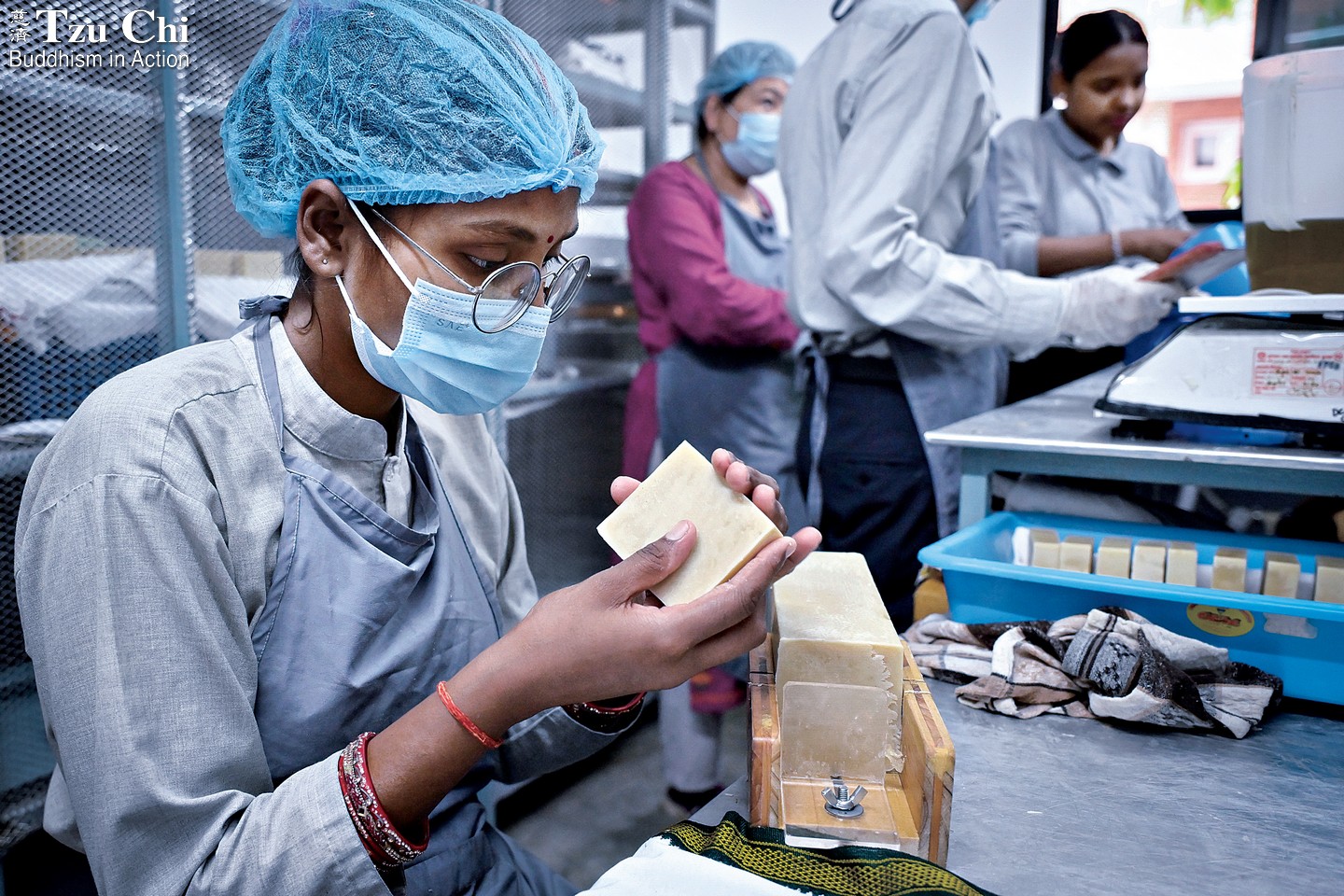
A cash-for-work participant inspects the quality of soap in the soap-making workshop at Tzu Chi’s Lumbini office. Lin Jia-ru
Moving forward
Tzu Chi has also launched other programs to help villagers build sustainable livelihoods. In Laxmipur Village in Lumbini, women use slower periods in the farming cycle to learn how to weave sitting mats and household items from locally harvested grass. The craft draws on indigenous resources and fits naturally into the rhythm of village life. Under the guidance of instructors with legal harvesting permits, villagers gather the grass they use from natural growing areas in the northern part of Lumbini Garden, near the World Peace Pagoda. Fibers harvested in July are especially prized for their flexibility and strength, making them ideal for high-quality handmade products. Villagers collecting the plants follow strict guidelines to ensure the grass can regenerate each year, balancing livelihood needs with environmental care.
The soap-making workshop at the Tzu Chi office in Lumbini likewise makes use of locally available materials. Volunteers and women participating in a cash-for-work program use neem leaves to produce natural soap. Initially shared as gifts, the soap has gradually begun to generate income through customer orders.
The Lumbini Tzu Chi Campus, scheduled for completion later this year, will provide dedicated spaces to connect and expand these vocational training programs. Dr. Tang Kiat Beng expressed deep gratitude that Tzu Chi will soon have a permanent home in the Buddha’s birthplace, adding that he has been deeply encouraged by the emergence of local volunteers who, like bodhisattvas rising from the earth, have stepped forward to share in the work.
“The road ahead is still long, and the responsibilities are great,” he said, “but we will keep moving forward.”