Text and photos by Huang Xiao-zhe
Translated by Wu Hsiao-ting

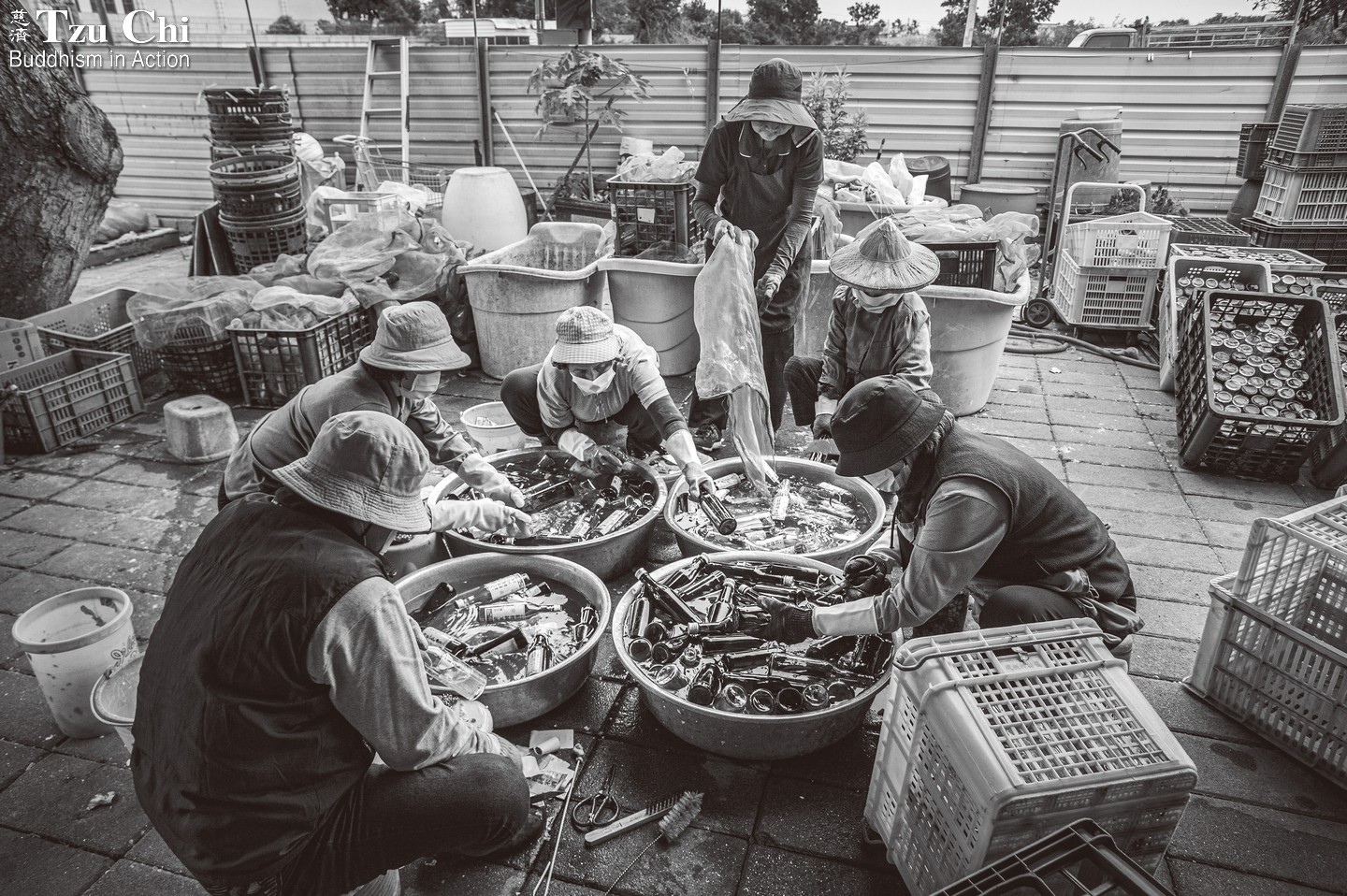
Members of the Yanshui bottle-washing team. From left: Weng Bi-yue, Wu Bi-li, Su Xiu-xiang, Li Zhao Xiu-ce, Huang Bao-xiu, and Huang A-bi.
Photographing and writing about Tzu Chi’s recycling work for Tzu Chi Monthly has taken me to many recycling stations across Taiwan over the years. I thought I had seen it all—until a photo shoot at the Yanshui Recycling Station in Tainan in September 2022. There, I noticed a group of women sitting in a circle, their heads bowed in deep concentration. Curious, I stepped closer and discovered that they were meticulously washing and scrubbing recycled glass bottles—an activity I had never seen at any other station.
Tied up with other responsibilities that day, I regrettably couldn’t stay to learn more. I managed only to take a few quick photos, promising myself I’d return later for a proper interview. But time has a way of slipping by; when I finally revisited those images with the intent to return, three years had already passed.
In November 2025, I finally reconnected with the Yanshui volunteers and spoke with Su Xiu-xiang (蘇秀香), a member of the bottle-washing team. To my delight, I learned that not only had they continued their work, but the entire team I had met three years earlier was still there, as dedicated as ever. This time, I was finally able to take the time to get to know the everyday stories of the Yanshui bottle-washing group.
Six women, one rhythm
It was not yet seven in the morning when I arrived at the station, but the crisp, rhythmic clinking of glass could already be heard echoing through the air. The women were working in full swing, their hands moving with practiced efficiency. This dedicated crew—Su Xiu-xiang, Huang Bao-xiu (黃寶秀), Huang A-bi (黃阿碧), Weng Bi-yue (翁碧月), Wu Bi-li (吳碧利), and Li Zhao Xiu-ce (李趙秀策)—forms the core of the bottle-washing team.
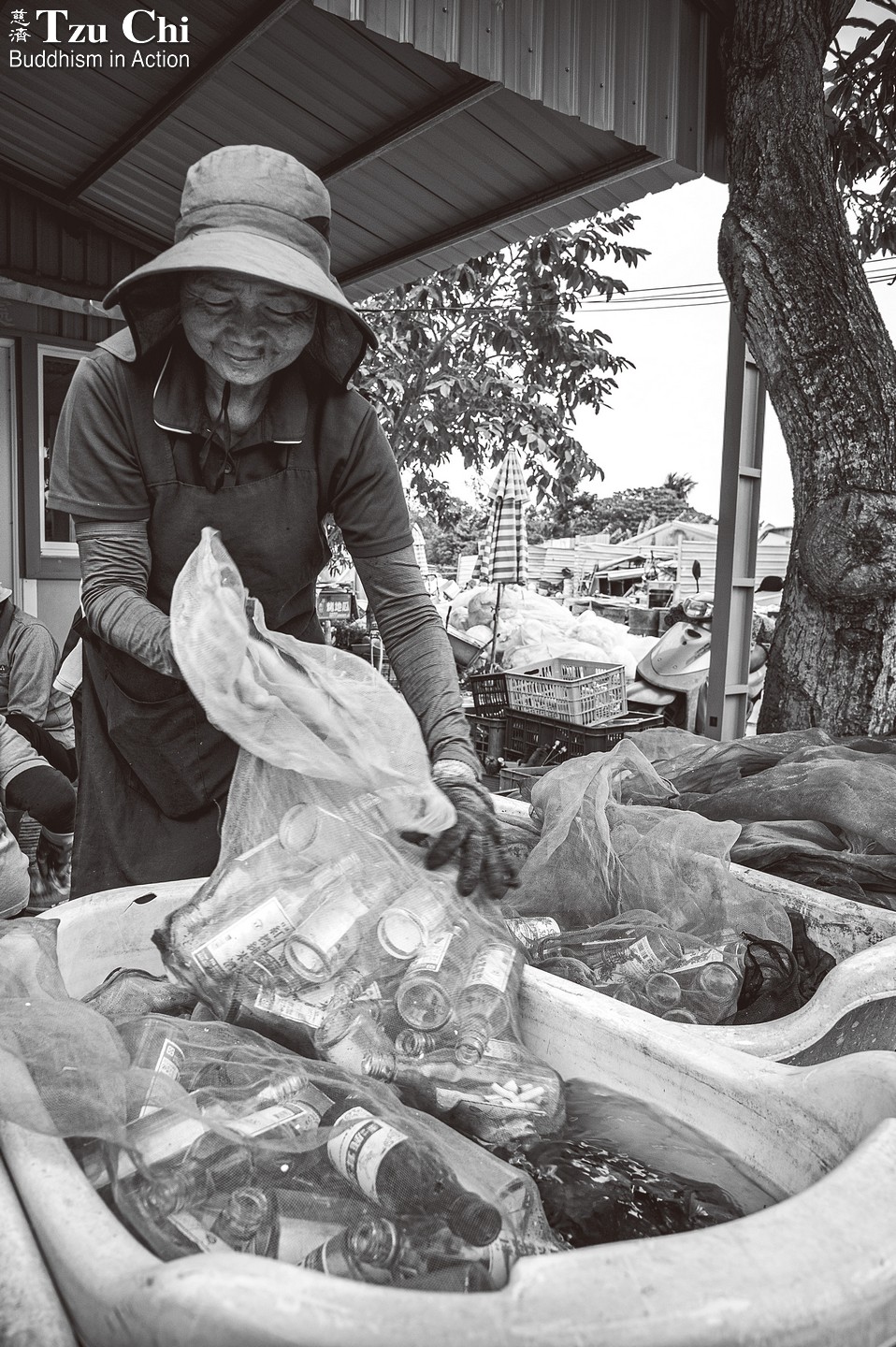
Nearly all of them are in their 70s. At 68, Su Xiu-xiang is the “youngster” of the group and has naturally taken on the heavier labor. Whenever a batch of glass bottles arrives, she separates them into mesh bags and submerges them in large recycled bathtubs to soak overnight, softening the paper labels and adhesive for easier scrubbing.
The team’s swift movements and clear division of labor reveal an unspoken coordination. It is no surprise: They have been washing bottles together for a full five years. Even more striking is the atmosphere. Despite the constant clatter of glass and the relentless pace of their work, the air is light, filled with lively chatter and laughter. They even joked about their shared circumstances: “We’re just a bunch of seniors living alone whose husbands have all passed on. As soon as we wake up, we want to come to the recycling station. We have each other for company here, and there’s never a dull moment.”
Their words brought to mind Dharma Master Cheng Yen’s teaching that recycling stations can serve as excellent senior care centers. The elders before me were living proof of it.
The finer points of bottle washing
As I learned more about their process, I realized that the glass bottles in their hands had already been carefully screened. They must be uniform in size and free of any cracks or chips. Once cleaned, the bottles are purchased by factories for further processing and used as containers for paint thinner.
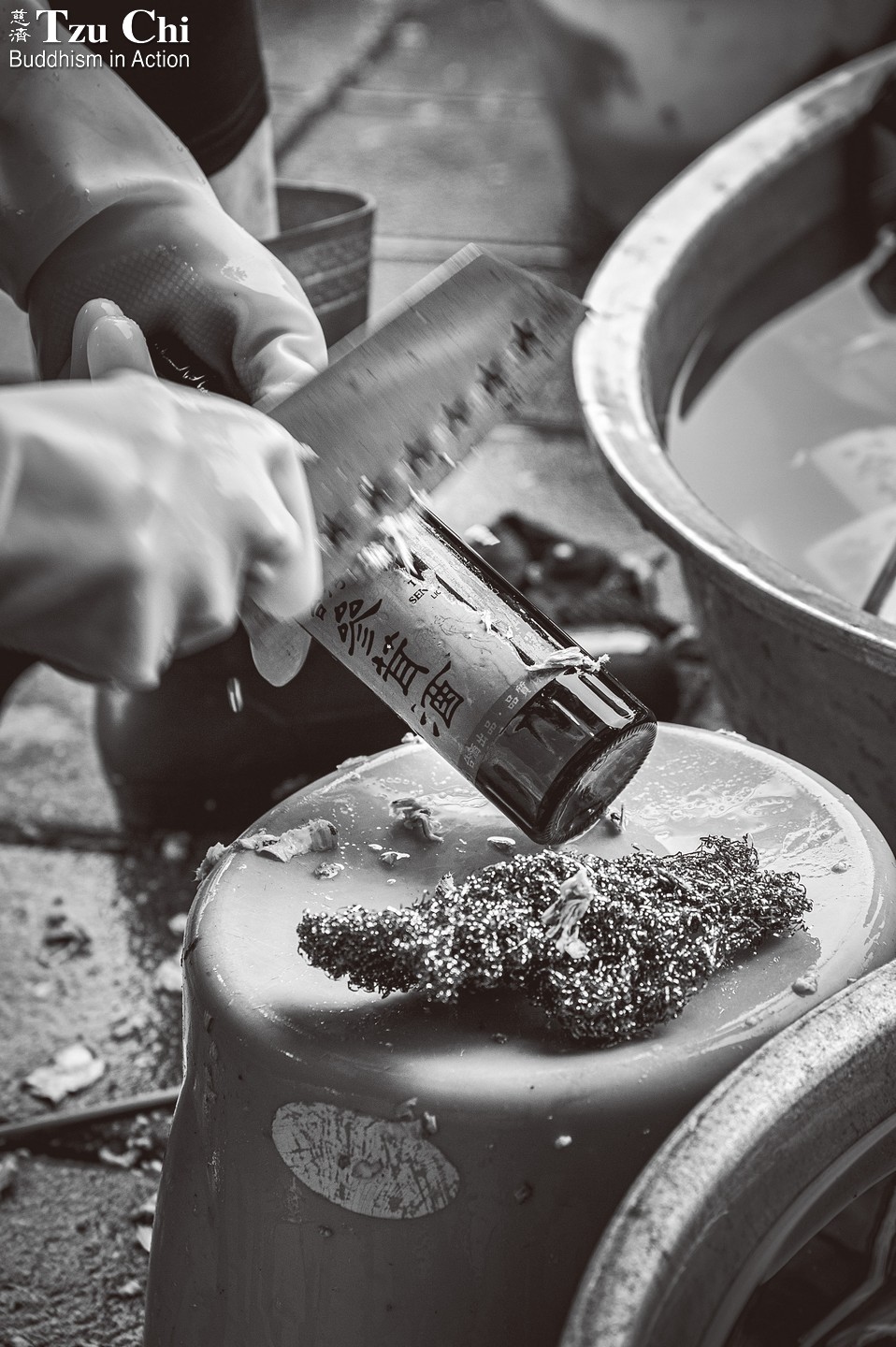
Before washing begins, the aluminum caps must first be removed and sorted. The most labor-intensive part is usually removing the labels. With luck, a label comes off in one piece. If the adhesive proves stubborn, the volunteers carefully scrape it away bit by bit with kitchen knives, finishing with a steel scourer to remove any remaining traces of glue.
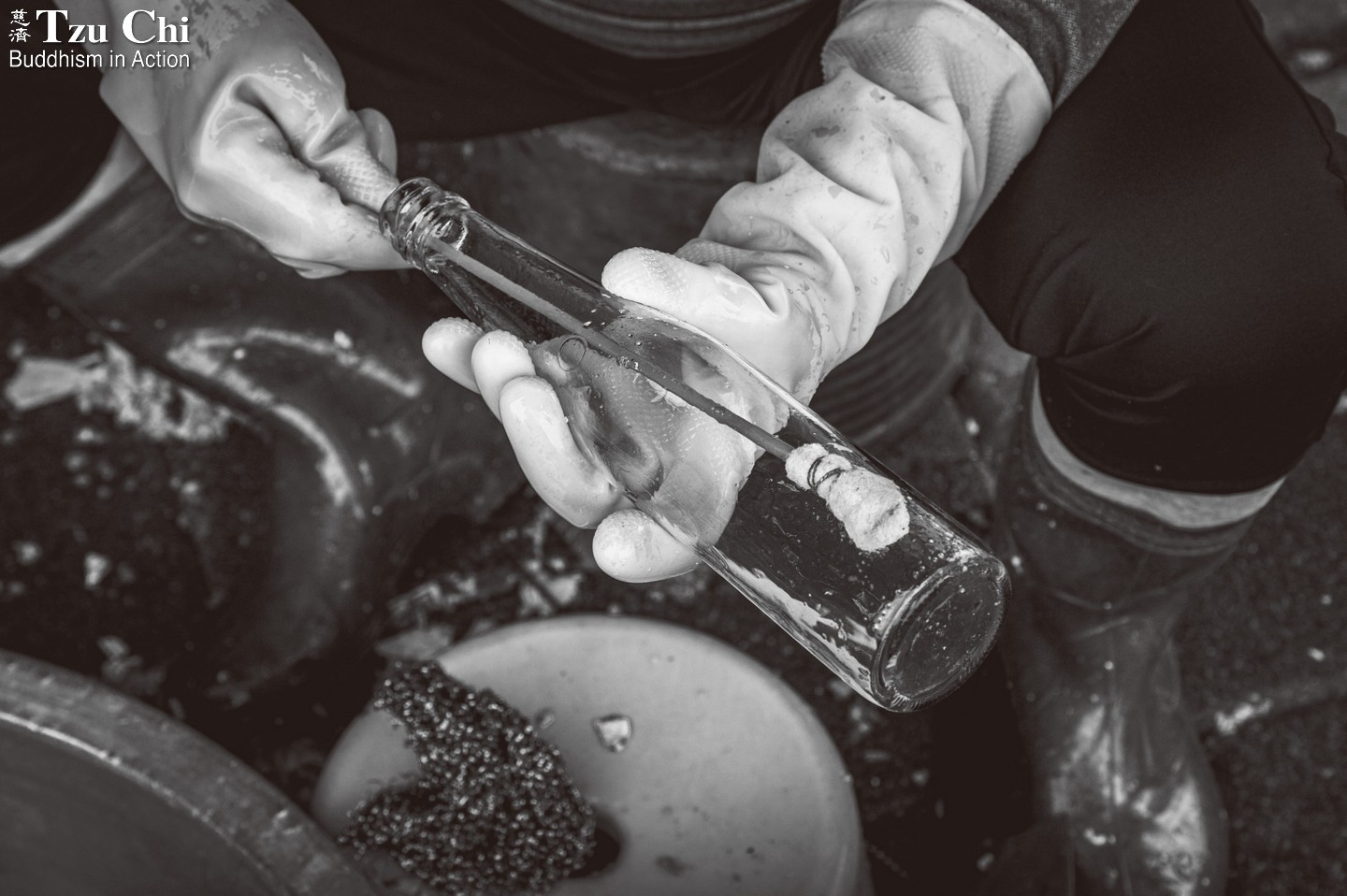
The insides of the bottles pose their own challenges, as they are often stuffed with cigarette butts or other debris. After clearing these out, the women reach for their secret weapon—long bottle cleaners fashioned from recycled wire hangers, with small pieces of scouring pads fastened to the ends. Only after a thorough internal scrubbing, a final rinse, and a period of air-drying is the process complete.
For the team, this work has become routine, likely even second nature. But to an outsider like me, their patience and persistence are genuinely admirable. Thanks to their dedication, the large volume of glass collected at the recycling station can continue on to serve new purposes.
The man who started it all
Partway through my visit, Su Xiu-xiang introduced me to a man nearby who was deeply focused on dismantling appliances. It was then that I learned he, Yang Jia-xiong (楊嘉雄), was the founder of the bottle-washing team.
Yang had previously run a business related to bottled products, and so is intimately familiar with the specifications of different glass containers. When he joined Tzu Chi’s recycling work in 1996, he discovered that a large number of recycled glass bottles had accumulated at the recycling station, with no buyers willing to take them. Not wanting to see them go to waste, he began searching for a solution.
He realized that the 300-milliliter bottles commonly used for spirits were the same size as the containers used by paint factories for solvents such as turpentine, lacquer thinner, and toluene. With this insight, he began visiting factories one by one to see if they would be willing to purchase recycled bottles. Some agreed, and for the next 20-plus years, he personally washed the bottles and delivered them himself.
Now 85 and coping with health problems, Yang can no longer manage such heavy physical work. Therefore, he’s especially grateful to the volunteers who make up today’s bottle-washing team. They took over his responsibilities five years ago under his personal guidance. I was deeply moved watching them in action; this was more than just recycling—it was a living legacy, a passing of the torch, and a continuation of one man’s lifelong mission to cherish the Earth.