By Chiu Chuan Peinn
Edited and translated by Wu Hsiao-ting
Photos by Hsiao Yiu-hwa
“A good man” is often just a phrase, but Xu Wu-song embodies it every day, giving the term real meaning. Once lost to gambling, he now finds fulfillment in reading, reflection, and volunteer service.
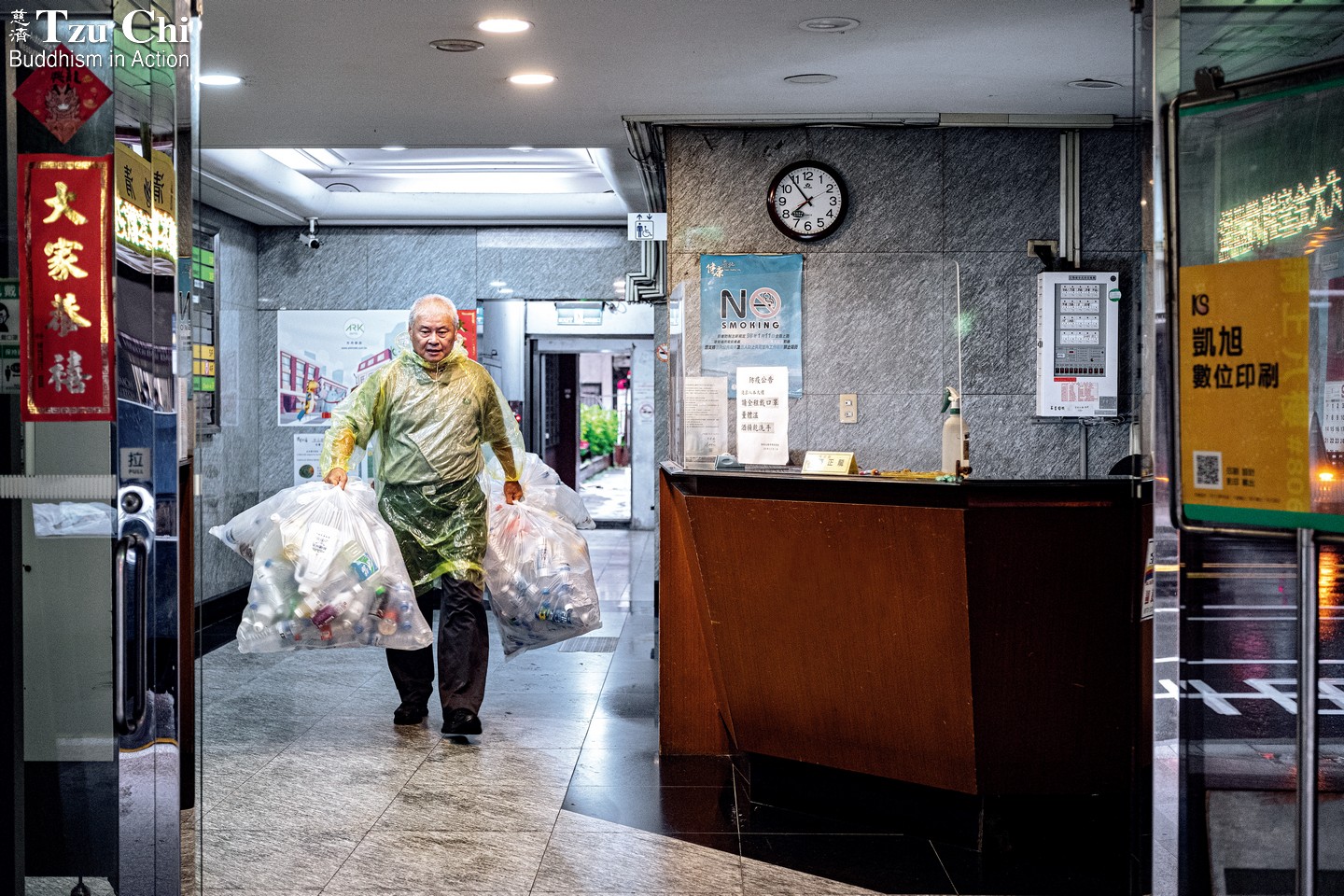
Xu Wu-song has arrived punctually every week for the past six years to collect recyclables from this mixed-use office building on Fuxing North Road in Taipei. His steadiness and reliability have earned him the trust of security guards and caretakers.
The compliment of being “a good person” seems to have lost its impact in an era marked by social distance and growing indifference. The term has become a vague, polite label—and sometimes even carries negative connotations, suggesting someone who is “too nice” or “easy to take advantage of.”
But in the case of Xu Wu-song (許武嵩), the term carries real weight. In 2007, at age 50, he received his Tzu Chi volunteer certification. He was later selected as a “Community Role Model,” and during Tzu Chi’s year-end blessing ceremonies in several major cities across Taiwan, he took the stage to share the candid and inspiring story of his life’s transformation.
Xu speaks openly and sincerely on stage and off, his voice strong and resonant. The warmth in his words, coupled with his willingness to reveal his own vulnerabilities, makes him easy to connect with.
“Brother Xu is responsible and incredibly easy to work with,” said a fellow volunteer who has worked alongside him in recycling for many years. Though naturally fast-paced, he rarely loses his cool and always considers the best way to communicate whenever an issue arises. Even people outside Tzu Chi—security guards, cleaners, and visiting guests—consistently describe him as a “good person.” But what, exactly, makes him so “good”?
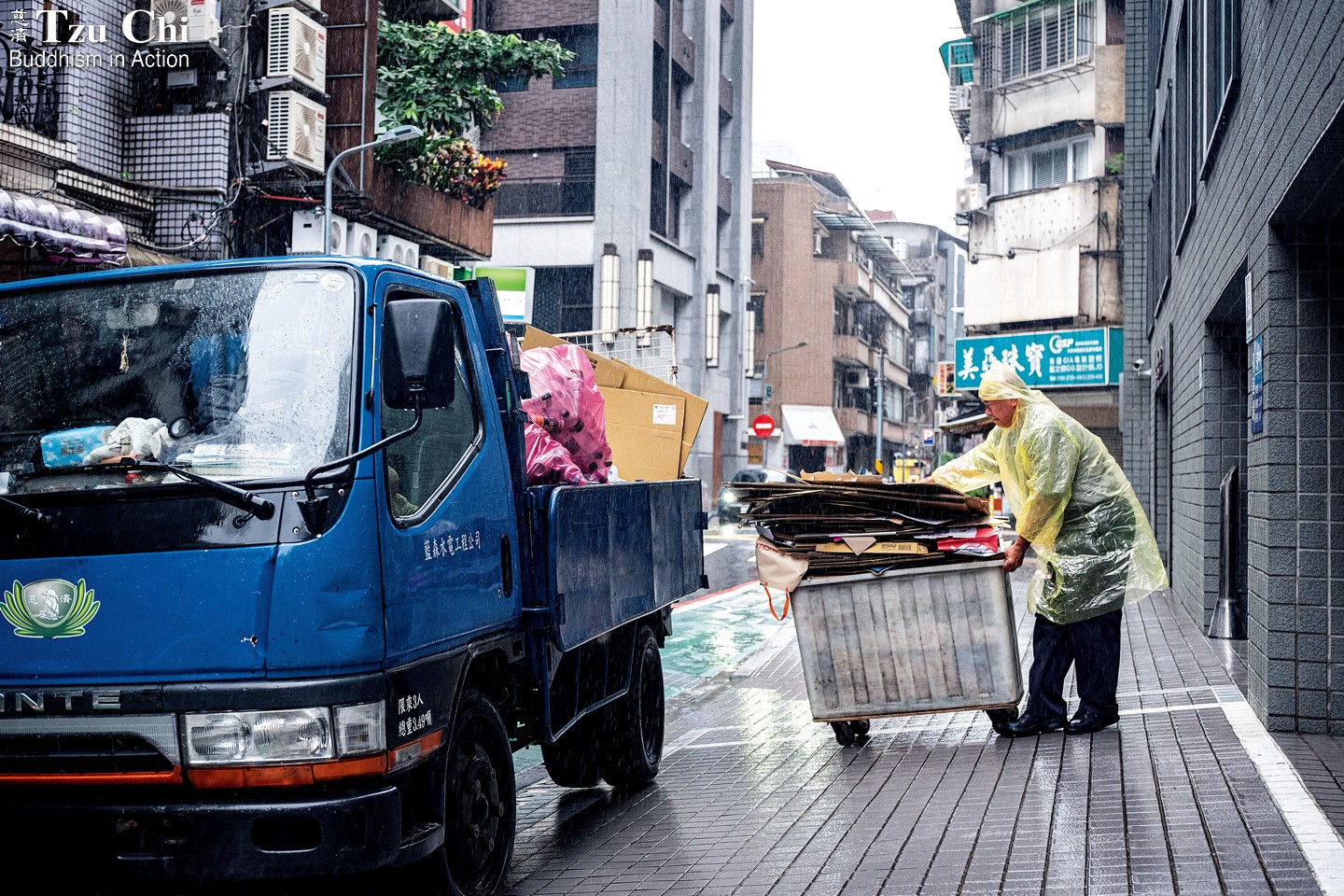
Every week, Xu drives a truck on his own and collects recyclables from shops and buildings in Taipei.
From gambling to growth
Before Xu Wu-song became involved with Tzu Chi, his life went through a turbulent period.
In 1982, at age 25, he began selling clothing on Taipei’s “Shoe Street,” in what is now Zhongzheng District. He recalls those days as a golden age for business; inventory moved fast, and his net earnings on a good day could exceed 10,000 New Taiwan dollars (approximately US$330).
At 35, he began investing in the stock market, often moving sums of ten million NT dollars or more. When those investments soured, he turned to gambling, risking equally staggering amounts—sometimes starting at a million NT dollars at a time. To fund his bets, he mortgaged his home, causing his wife, Huang Bi-hua (黃碧華), to leave him twice. He tapped into his parents’ life savings too, breaking their hearts in the process.
Once, after a winning streak, Xu left a stack of cash on the table for household expenses. Taking it as a sign of change, his wife believed that the worst was finally behind them—until the next morning, when she discovered the money was gone. For ten years, Xu teetered between gambling and quitting, unable to fully pull himself free.
But, as the saying goes, even in the darkest times there can be a spark of hope. He identifies the turning point in his life as the moment his wife enrolled their youngest son in Forest School, an alternative grade school operated by the Humanistic Education Foundation. The school required parents to participate in a parental growth program—a form of adult re-education that included a book club. There, Xu found himself sitting alongside professors, engineers, and street vendors, reading and discussing books on psychology, philosophy, education, and Buddhist teachings.
Over the six years their son attended the school, Xu developed a love of reading. He came to realize that even though he had long left formal schooling, he was still capable of learning and growth. “I had been a poor student,” he said, “but given a chance to start over, I could become someone eager to learn—someone who could, in turn, bring energy, enthusiasm, and positivity to those around me.”
Reflecting on this, he said, “Everyone in the parental growth class and book club knew me and could see that I wasn’t a bad person at heart. So why did I lose my way chasing money?” Reading The Art of Loving by renowned psychologist Erich Fromm helped him understand that his pursuit of wealth had been an attempt to fill an inner emptiness rooted in a narrow, self-centered view of love.
When Xu was a child, his parents were often too busy to provide the guidance he needed. In his teachers’ eyes, he was a troublemaker who liked to play pranks on classmates. One teacher even told him, “Coming from a poor family and always causing trouble, a kid like you will never amount to anything.”
Comparing his son’s upbringing with his own, Xu came to see the difference a nurturing, well-guided environment can make. He grew to deeply appreciate the power of good education and felt grateful to have developed a habit of reading—something largely absent from his life after he entered the working world. The wisdom he found in books offered new insight into himself and life’s deeper meaning, giving him the clarity and resolve to live differently. He learned that true love is expansive and active, and that only those who learn to respect and care for themselves can genuinely love others.
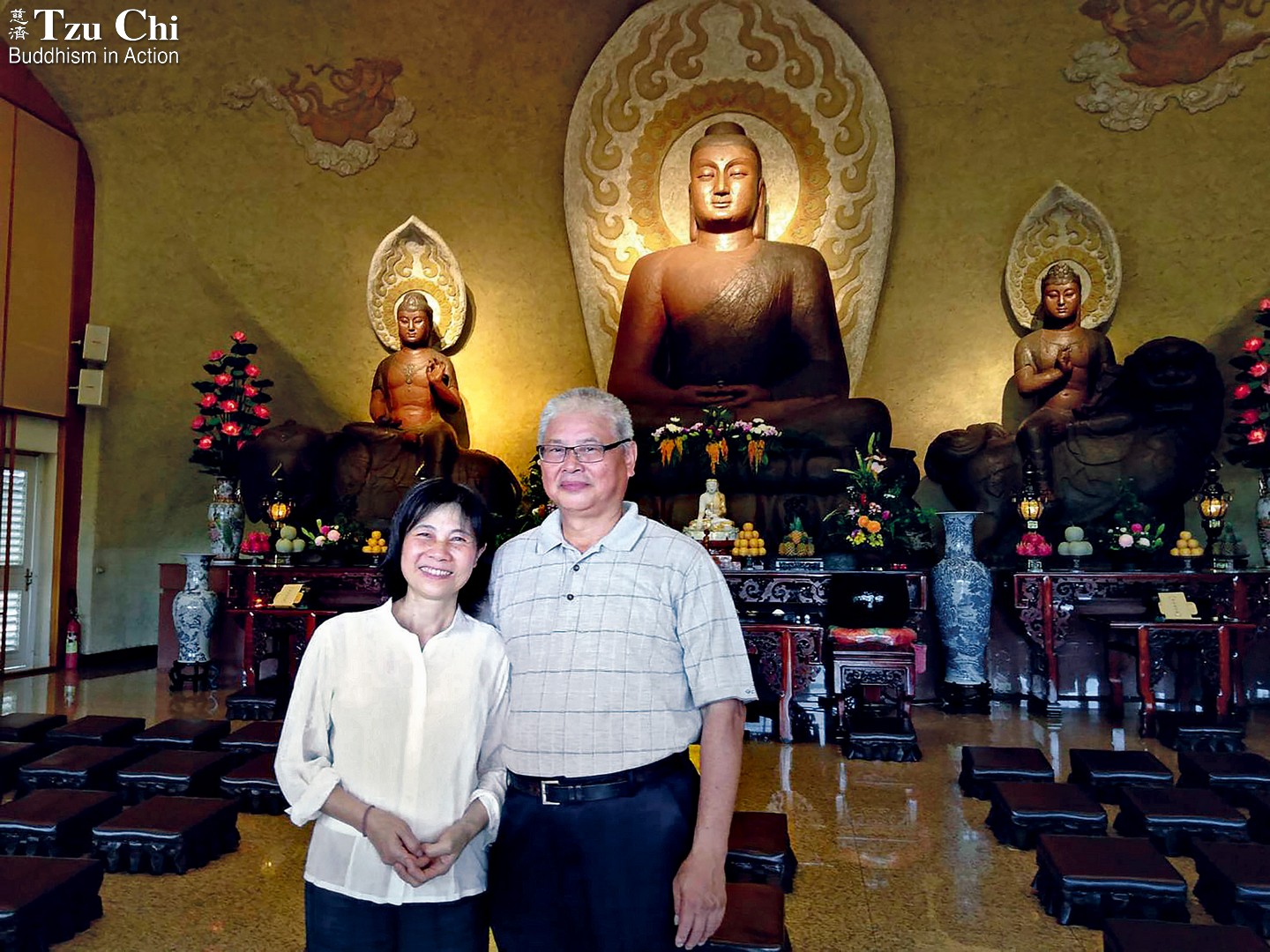
Having weathered the storms of life together, Xu and his wife, Huang Bi-hua, now walk the Tzu Chi Path side by side, supporting each other in both daily life and volunteer work. Courtesy of Xu Wu-song
Steady service
What he learned from years of reading and reflection now finds expression in the dedication and care he brings to his volunteer work.
Each day, four or five small trucks set out from Tzu Chi’s Zhongshan Bade Recycling Station in Taipei, weaving through the city’s concrete-and-steel landscape to collect what urban life discards. On Fuxing North Road stands a mixed-use office building that houses a hotel. The hotel is one of the sites Xu has visited for more than a decade to pick up recyclables.
Six years ago, when security guard Chen Zheng-long (陳正龍) first took up his post at the building, he was met with an ongoing problem: Tenants on other floors were troubled by the buildup of recyclables caused by irregular collection by commercial operators. Seeking a solution, Chen reached out to Xu and proposed that while he was picking up recycling at the hotel, he might as well handle all the building’s recycling, with all proceeds donated to Tzu Chi. To make the system work, Chen asked residents, banks, and offices in the building to carry out basic sorting in advance. “They all say I’m very strict,” Chen admitted with a laugh.
Xu has been a model of punctuality since this cooperation began. Sometimes, the recyclables are cleared before Chen even starts his shift. “If he’s heading to Hualien to volunteer for Tzu Chi there, he always calls ahead to give me a heads-up,” Chen noted.
Volunteers from the Zhongshan Bade Recycling Station routinely collect recyclables from government offices, hotels, shops, office buildings, and residential complexes. As long as a building or business is willing to do basic sorting in advance, long-term cooperation is possible. Even if a building or shop chooses to keep part of its recyclables for private sale or give them to scavengers, this does not affect its partnership with Tzu Chi. As Xu put it, “What matters most is promoting environmental awareness and not wasting reusable resources.” He has been a central part of this effort.
Yu Xing-jia (余幸佳), a caretaker at a building near Minsheng East Road, has known Xu for ten years. She is responsible for receiving mail, handling trash, and sorting recyclables. In a small partitioned area on the first floor, several large industrial sacks sit, filled with plastic bottles, cardboard boxes, and other recyclables.
Each day, Yu makes two trips with a cart to take out the general trash. She can’t imagine how many additional trips would be required if she also had to handle the recyclables herself. “I’m truly grateful to Brother Xu for his help,” she said. “The volume of recycling is really large now.” Even before Yu started working there, Xu had already been coming with a team to collect recyclables. “Now, it’s just Brother Xu coming on his own,” she added. Because the basements of residential and office buildings do not allow easy access by outside vehicles, Xu often carries out collections single-handedly.
Over many years of working with building security guards and caretakers, Xu has consistently maintained a courteous, respectful distance. In this big city, he and those he works with are closely connected through their shared commitment to environmental protection, yet they never intrude into one another’s private lives. Their relationships are restrained and understated, built on mutual respect. Xu’s steadiness and trustworthiness serve as an important anchor for these connections.
Perfect days
The life Xu leads today may seem ordinary at first glance, but it is anything but. He aspires to a rhythm of living akin to monastic life. He rises at four each morning, believing that the transition between night and day—the brief moment when the sun and the moon share the sky—is the most spiritually potent time. Most days, he participates online in the morning service at the Jing Si Abode in Hualien, chanting sutras alongside resident monastics and listening to Master Cheng Yen’s teachings. Only after this devotional ritual does he feel the day truly begin.
Afterward, he has a simple, wholesome breakfast: pumpkin soy milk, a multigrain steamed bun, fruit, and a hard-boiled egg lightly seasoned with salt. By seven o’clock, he is on his way to the recycling station, ready for the day’s work. His wife sometimes accompanies him, but since she has recently taken on the care of elderly people living alone, he usually goes by himself.
Packing, loading, and transporting recyclables to recycling plants for sale make up the routine he shares with other volunteers. Despite his solid build and broad, sturdy hands, he faces the same physical challenges as everyone else. During his work, he bends repeatedly to lift cardboard boxes packed with recyclables—motions he performs over a hundred times a day. Working like this inevitably chaps his hands and weakens his grip, and the constant bending and straightening leaves his lower back aching. Yet he seems to take these challenges in stride, finding fulfillment in doing the Earth a good turn.
He now helps care for his grandson, so he returns home at noon to cook lunch. Evenings after seven are reserved for himself, usually spent reading or taking a walk. The steady, regular rhythm of his days calls to mind the Japanese film Perfect Days. In the film, a public toilet cleaner carries out the daily toil of cleaning toilets, yet lives with grace, nourished by music, photography, reading, and a soak in a public bath. Xu may be even more fortunate than the film’s protagonist: He has a loving family and a large, close-knit community at the recycling station.
Reflecting on his work and daily practice, Xu views environmental pollution as a form of collective karma, and recycling as a form of individual cultivation. Recycling transforms what is dirty and discarded into something clean and useful—an act he sees as a metaphor for spiritual practice itself, clearing mental impurities to cultivate mindfulness and inner clarity. “I recycle every day, listen to the Master’s teachings every day, and reflect on myself every day,” he said. “Daily reflection brings me joy, revealing the innate purity I have always carried within.”
Focusing on living each day well—doing your best with the task at hand, being kind to yourself, and showing the same kindness to others—could well be a fair definition of a good person today.
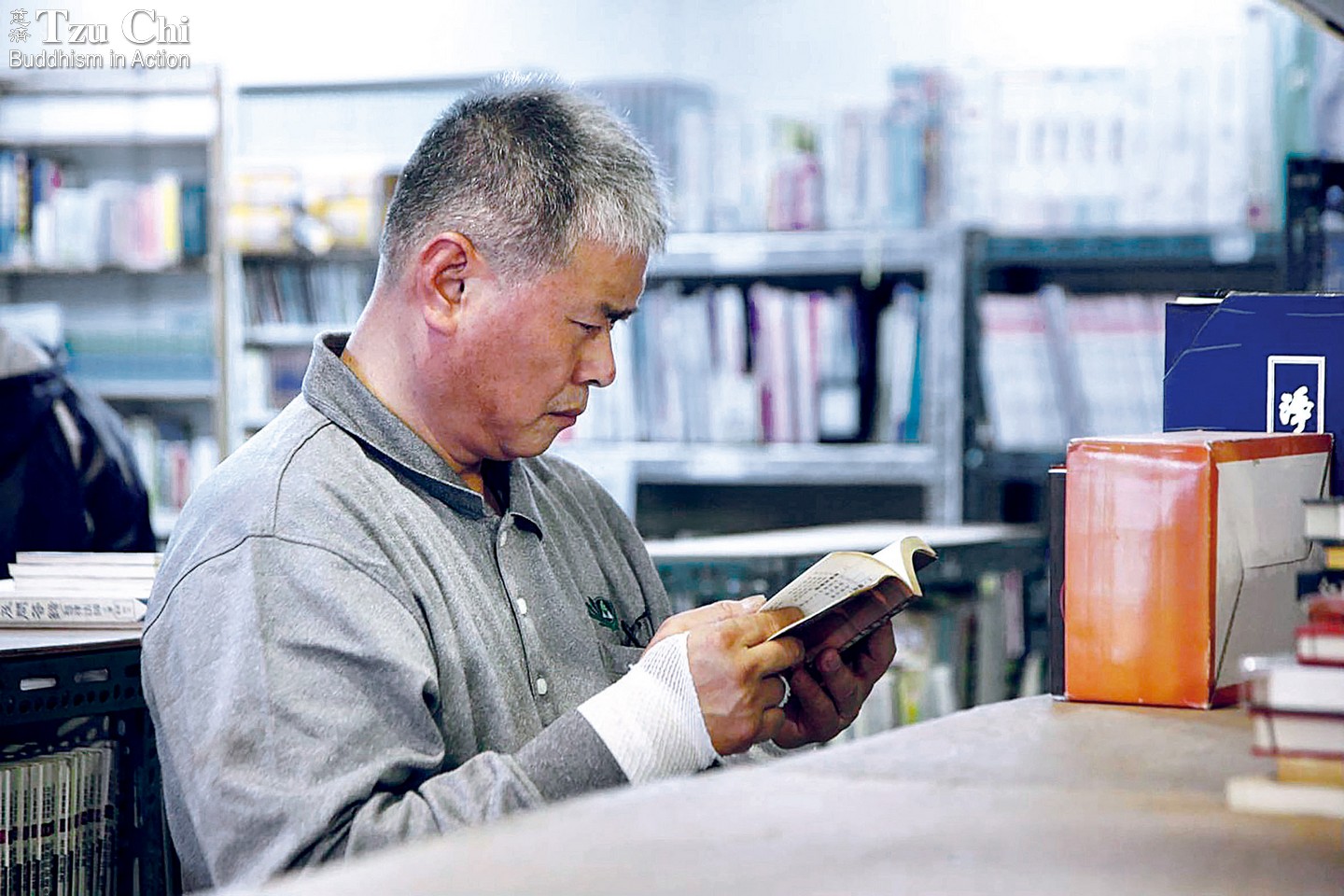
A devoted reader, Xu often studies Buddhist scriptures and Master Cheng Yen’s teachings as part of his daily routine. Courtesy of Xu Wu-song