By Fikhri Fathoni, Khusnul Khotimah, and Metta Wulandari
Translated by Wu Hsiao-ting
Photos by Arimami Suryo Asmoro
Tens of thousands of homes in Indonesia, from Jakarta’s narrow alleyways to Central Java’s mountain villages, are structurally unsafe. Supporting a government initiative, Tzu Chi has undertaken the rebuilding and renovation of 5,000 homes, delivering safety and dignity to families in need.
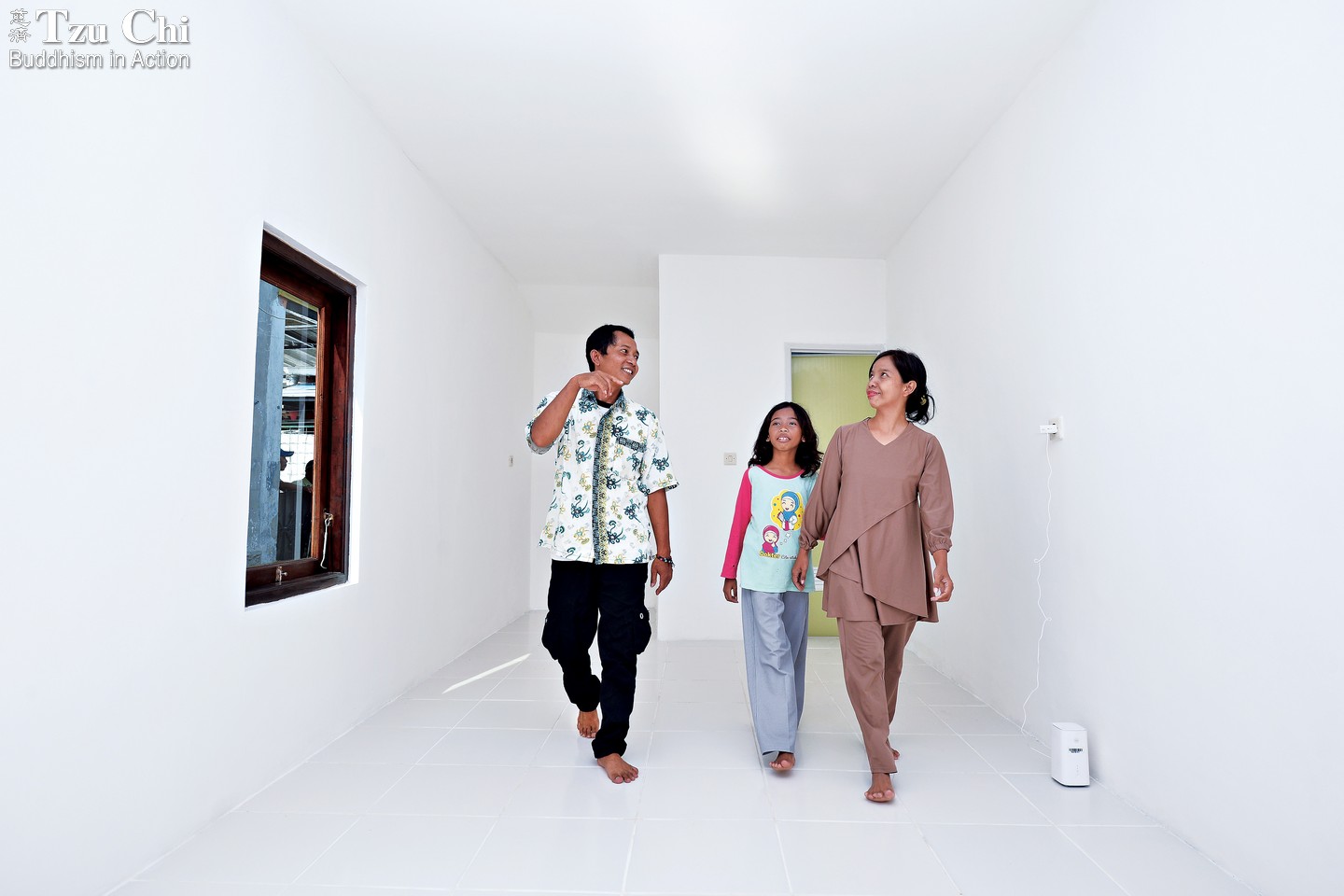
Anton (left) and his family in Bekasi, West Java, happily walk through their newly completed home in 2025. They are beneficiaries of a national government housing program, with Tzu Chi among the partners.
For some people, a safe, well-built home is a luxury. Many families across Indonesia—from crowded city corners to remote rural villages—live in houses that are barely habitable: leaking roofs, bare floors without cement or tiles, and crumbling walls so structurally weak that they seem on the verge of collapse. During the rainy season, water seeps in, leaving no part of these homes dry; under the blazing sun, heat becomes trapped inside with no way to escape. These dwellings are often cramped and lack basic amenities, including proper bathrooms.
This reality is starkly reflected in national data. According to a 2023 report by BPS–Statistics Indonesia on housing and environmental health, 37 percent of homes nationwide are classified as being in poor condition. That means that nearly four out of every ten households live in structures that urgently need improvement and may even pose safety risks.
In response to this pressing social issue, President Prabowo Subianto launched the Three Million Houses Program in November 2024. Its aim is to help families in extreme poverty and low- to middle-income groups secure safer, healthier living conditions. The initiative is focused primarily on repairing existing homes, but there are provisions for some rebuilding as well. The eventual goal is to provide one million homes in urban regions and two million in rural and coastal areas.
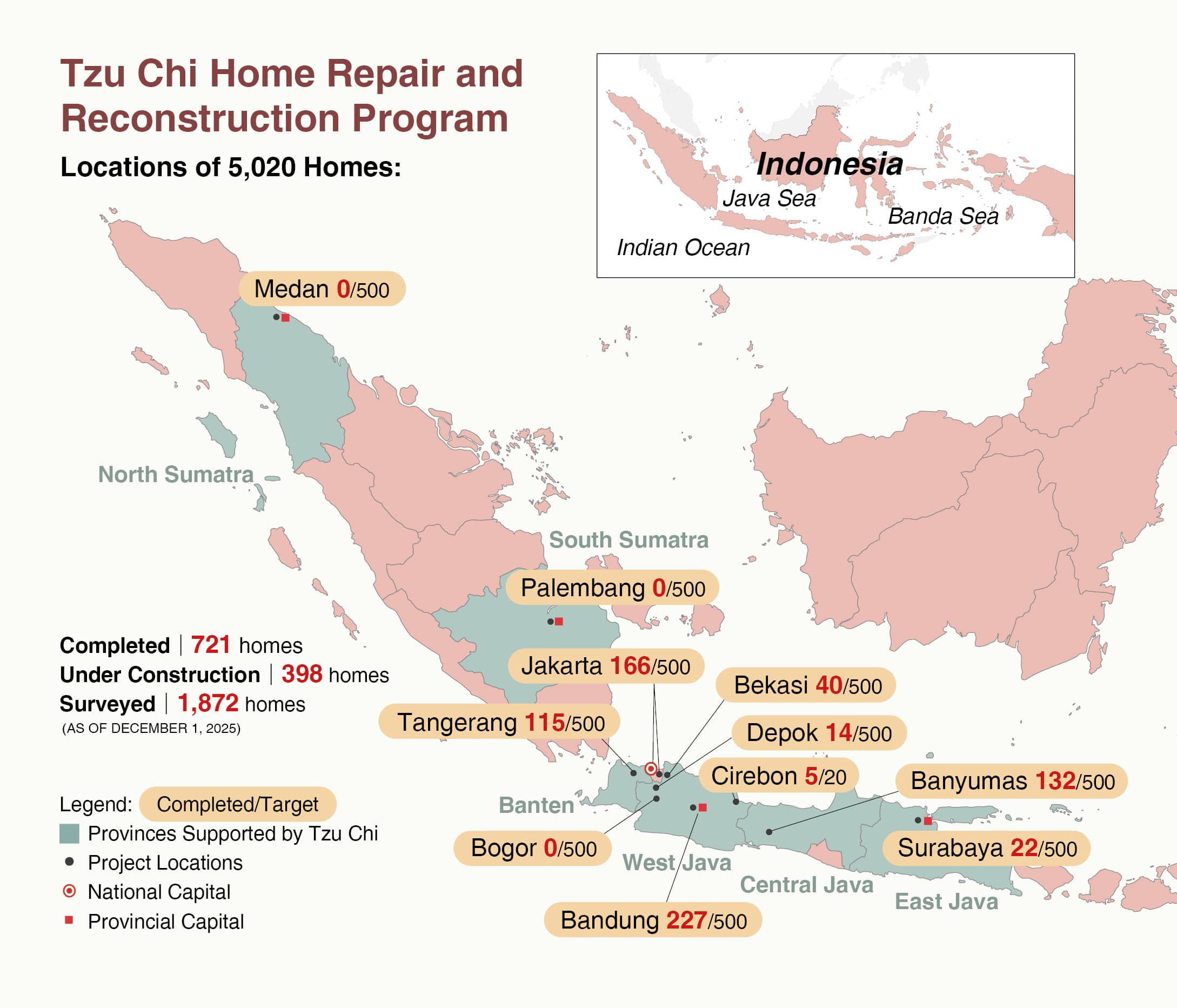
To achieve such objectives, Indonesia’s Ministry of Housing and Residential Areas has partnered with private companies and NGOs. Among them, Tzu Chi has committed to delivering 5,020 homes, making it the program’s largest partner. The foundation began work in January 2025 and completed over 700 homes by early December. Nearly 400 more are currently under construction.
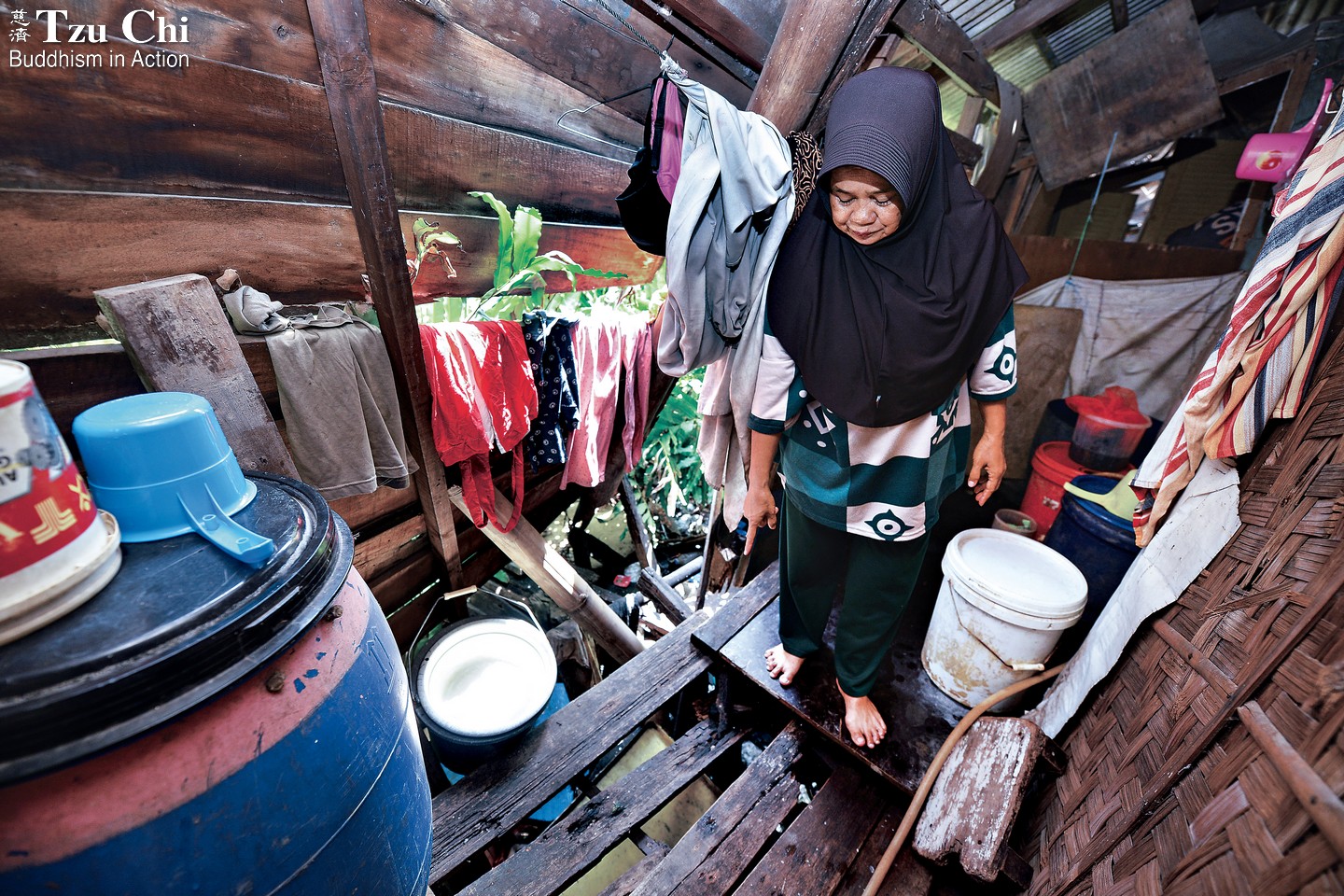
In November 2024, ahead of Tzu Chi’s sixth phase of home repairs in Kamal Muara, North Jakarta, homeowner Kokom Komariyah shows volunteers her rotting floorboards, explaining that the gaps are so severe that she sometimes accidentally steps into them.
A unified effort for social progress
The more than 5,000 homes under Tzu Chi’s care are spread across ten locations on Java and Sumatra, including Jakarta, Bandung, Surabaya, Medan, and Palembang. Liu Su-mei (劉素美), CEO of Tzu Chi Indonesia, explained that while the nation has seen steady economic growth and social progress, many people continue to live below the poverty line. “Without a proper place to call home,” she noted, “the future for both parents and their children is severely constrained.”
Tzu Chi has been engaged in charitable work in Indonesia for 30 years, and by the end of 2025, its number of regular donors had grown to more than 2.3 million. As early as 2006, the foundation began collaborating with the Indonesian military and government to improve housing for low-income families, renovating more than 1,400 homes by 2025. Tzu Chi has also built housing villages following major disasters, including those in Aceh, Padang, Palu, Lombok, and Yogyakarta, completing a total of 8,000 homes.
Liu explained that the current project is unprecedented in both scale and geographic reach. Coordination with government agencies and residents took time, with so many homes to take care of across so many regions. Early progress was inevitably slower. She added that some families were concerned about where they would live during construction, so rental subsidies were provided to help ease the transition.
Another major challenge has been finding enough suitable contractors in each area. “Dozens of contractors must be involved when 500 homes need to be built or renovated in a single region,” Liu said. “In addition to manpower, we also have to ensure construction quality. Whether a home is built solidly is extremely important to us.”
Beyond providing shelter, the project also serves as a vital public health intervention. Dr. Helen Suryana, a member of the Tzu Chi International Medical Association, witnessed this firsthand during a pre-construction assessment visit to Bekasi. She noted that tightly packed, poorly ventilated homes trap moisture and stale air, increasing the risk of airborne diseases, such as tuberculosis. In fact, the true number of tuberculosis cases in Indonesia is believed to be far higher than official statistics suggest, due in part to these hidden transmission environments.
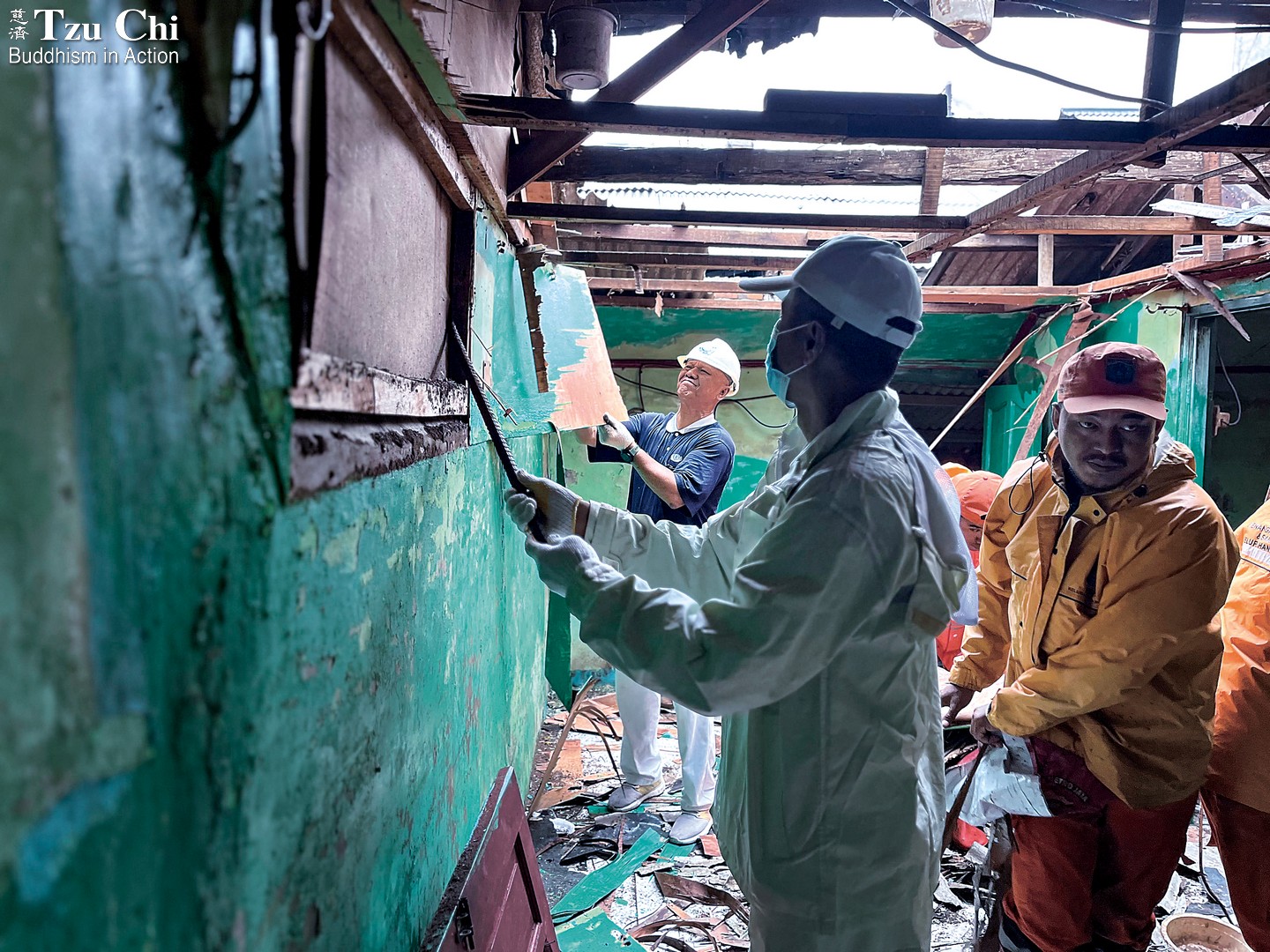
Demolition is underway on a home in Kamal Muara at the start of Tzu Chi’s sixth phase of repairs in February 2025. Clarissa Ruth Octavianadya
Lighting hope in the alleyways
For project coordinator Teksan Luis (盧德汕), narrow alleyways have proven to be the greatest obstacle. Many homes measure less than seven square meters (75 square feet) and are located along lanes only 40 centimeters (1.3 feet) wide, making even the transport of construction materials highly difficult.
He shared an example: Although construction in Bandung began two months later than in Jakarta, it quickly pulled ahead. “Bandung has more workers,” he said, “but the alleys there are also wider, which makes transporting materials much easier.” This allowed the team to redeploy workers from Bandung to support the more difficult sites in Jakarta.
“Renovation is also far more complex than rebuilding,” he added. “You have to tear down parts of an existing house and then rebuild those parts—it’s almost like doing the job twice, which naturally takes more time.” Terrain presents additional challenges. In Banyumas Regency, Central Java, for instance, villages are spread far apart, with undulating landscapes forcing workers to haul materials longer distances, uphill and downhill.
Luis admitted that he felt some apprehension when he first took on the project, concerned that residents might not cooperate or that he might not be capable enough. Yet each time he walked into a dark alleyway and saw homes without proper walls, roofs riddled with holes, beds placed above drainage ditches, or floors paved with shells, his resolve to carry on grew stronger.
“When my own business runs into difficulties, I might complain,” he said. “But then I think of the families in Kamal Muara who have endured harsh living conditions for over a decade without a word of complaint. It puts everything into perspective. What do I really have to complain about? I’ll do my best to help see this project through, because I know this mission is truly worth the effort.”
Tzu Chi selected Jakarta, Bandung, Surabaya, Depok, and Bogor as key focus areas because behind the glossy façade of these metropolises, many overlooked corners remain. “We want to bridge the gap between rich and poor,” Luis said, “and help these families step out of the shadow of poverty.”
New life for Kamal Muara
Kamal Muara, mentioned earlier, is a coastal fishing village in North Jakarta. “It’s actually right behind Tzu Chi’s Jing Si Hall,” Luis explained. “But because there’s no direct access, you have to take a long detour to get to the village.” As a result, what should be a short trip stretches to 30 minutes and can last up to two hours in heavy traffic.
When Luis and other volunteers first began visiting the area, they found many old and dilapidated homes, with floors lower than the surrounding roads. During the rainy season or at high tide, floodwaters would enter the houses, leaving walls submerged for long periods and putting the structures at risk of collapse. Reaching some residents’ homes required navigating extremely narrow paths, and once at the doorway, volunteers often had to stoop to enter. Some entrances were so tight that larger volunteers could not fit through at all.
In an attempt to keep floodwaters out, villagers had raised their floors with layers of shells, which further reduced the interior height. In some homes, the floors had rotted so badly that residents and volunteers occasionally stepped into gaps and fell through.
Tzu Chi began its work in Kamal Muara in 2019, several years before the government program was launched. By 2025, the project had entered its sixth phase, with 48 homes completed, along with two mosques and the Nurul Islam Elementary School. As part of the agreement, residents committed to living in their new homes for at least ten years without selling, renting, or transferring ownership. At handover, volunteers also provided household items such as rice cookers, fans, gas stoves, tables, chairs, and beds.
The benefits of the housing renovation are evident in Kamal Muara. Take Denovan Ramadan, a fifth grader at Nurul Islam Elementary School: His family’s home was rebuilt in October 2024 and he now consistently ranks first in his class. “We used to live in a stilt house where rain would spray right through the windows,” he recalled. “Now, our home is sturdy, and we finally feel safe.”
The new house has not only motivated Denovan to study harder but has also served as a foundation for the family to improve their livelihood. While they once relied on the father’s income from selling porridge, Tzu Chi provided a food cart that allowed Denovan’s mother to start a noodle business. The family eventually bought a motor scooter to offer delivery services. The mother expressed her appreciation, saying, “This new house has brought so many blessings to our lives. Thank you, Allah!”
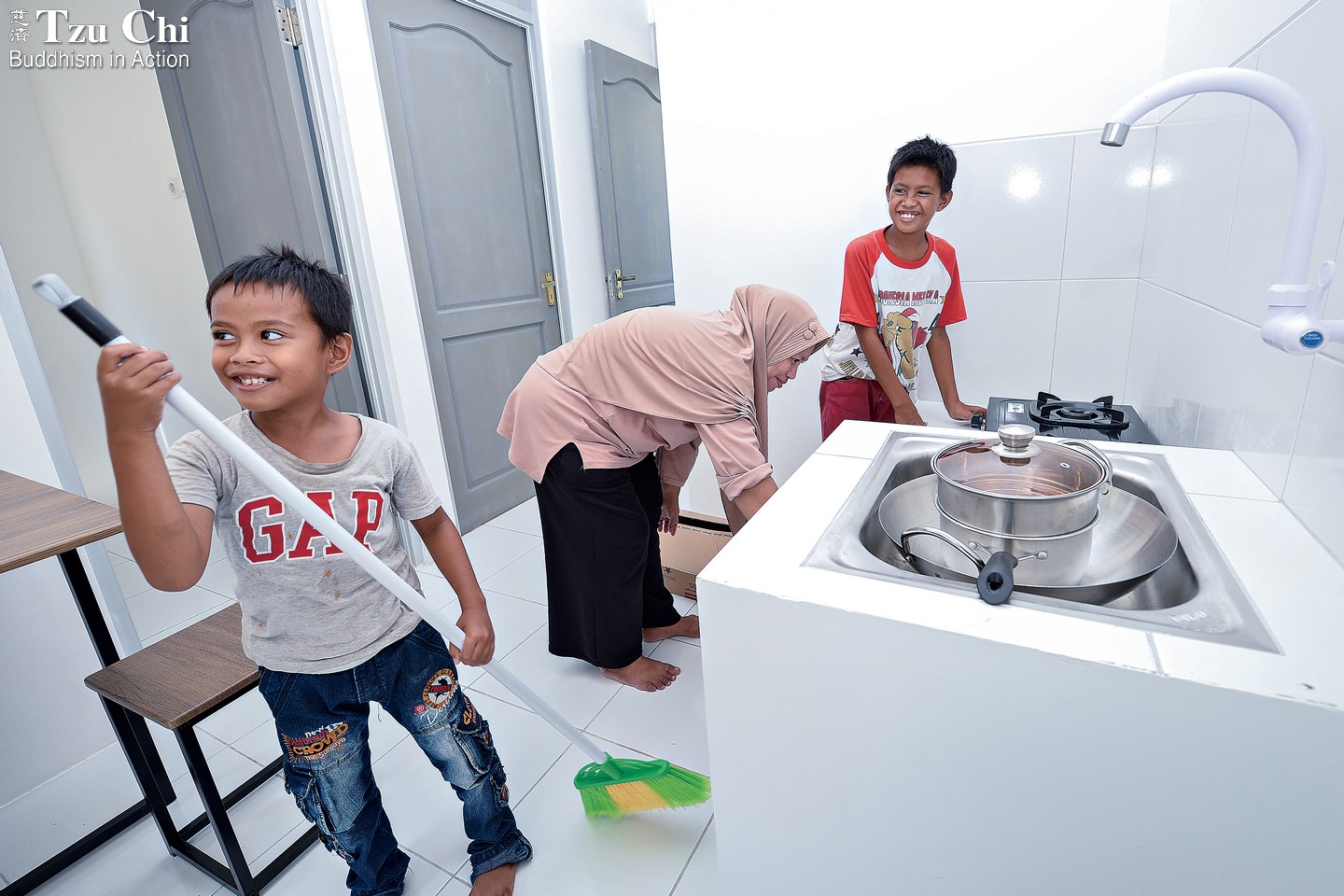
Hasnawati (center) and her family, residents of Kamal Muara, share a joyful moment as they move into their new home.
A head held high
The morning sun cast a soft glow over the village of Somakaton in Banyumas, Central Java. Fifty-three-year-old Rasman pushed open the door to his new home. As he thought back to his old house—with walls of wood and bamboo, rainwater dripping into buckets, and mud floors—he felt nothing but deep gratitude. He was one of the beneficiaries of Tzu Chi’s renovation work in Somakaton.
Banyumas, located inland on Java, is among the country’s most impoverished regions. The local economy relies on traditional agriculture and handicrafts. The rugged, hilly terrain makes industrial development difficult, so steady, secure jobs are hard to come by. Of Banyumas’s 27 districts, Tzu Chi’s renovation project is underway in 13. Volunteers visit each household to assess its needs before construction begins, ensuring help reaches those who truly need it.
During the renovation of his home, Rasman and his family stayed with relatives behind the house. He checked the progress every day—sometimes helping, sometimes simply sitting by the doorway watching the house take shape. On some nights, he even slept there.
Today, Rasman’s brick house stands complete, its walls freshly painted. The sturdy pillars seem to hold up a new beginning. He no longer has to worry about wind slipping through bamboo walls or rain leaking through holes in the roof. This is more than a new house—it is a restored sense of dignity. He can now walk with his head held high, moving forward with hope.
His wife, Munfaridah, used to pray for a clean, bright, and healthy home, but the dream always seemed out of reach. “My husband had faith in Tzu Chi, so I believed in them too,” she said. “Now, I am filled with gratitude. We’ll work together for this home and for our children’s future.”
Rasman works as a farm laborer, earning about 50,000 Indonesian rupiah (US$3.20) a day. His income barely covered daily expenses, let alone the cost of building or renovating a house. But Munfaridah refused to give up. She tutored local children and saved every little bit she could, buying sheets of asbestos and partition boards to gradually strengthen their old home.
When Tzu Chi’s renovation was finished, Munfaridah was most excited to finally have the bathroom she had always dreamed of. “The old facilities were too basic,” she said. “We are so grateful for the new ones. May Allah bless you all many times over.”
Unlike older, low-slung Javanese dwellings, the new house features a higher roof and a spacious interior. “In addition to a living room,” Rasman said, “we now have three bedrooms: one for my wife and me, and two for the children.” Having a room of his own had always been the wish of their youngest son, Utaqo. Rasman was thrilled, saying they were now just waiting to move the furniture in.
The radiant smiles of families like Rasman’s fuel volunteers’ sense of mission. By racing against time to renovate and rebuild homes into safe, comfortable spaces, they are providing a sanctuary and peace for more than 5,000 households across the regions they serve.