By Chiu Chuan Peinn
Translated by Wu Hsiao-ting
Young medical volunteers supported patients and their doctors, embodying warm care and a spirit of learning—the very qualities that bring lasting hope to Tzu Chi free clinics.
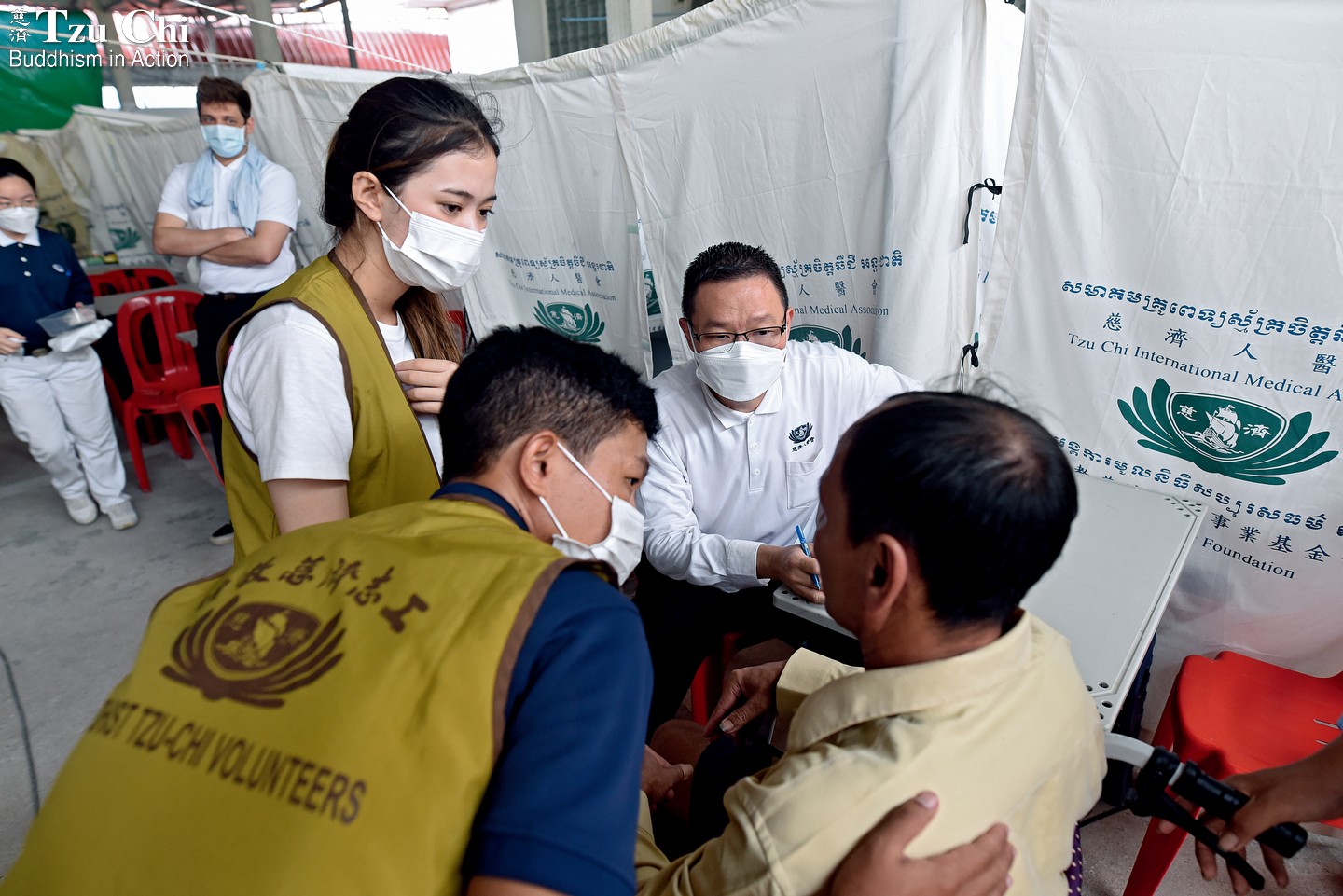
Cambodian medical student Eng Sonita (back row, left) serves as an interpreter for Malaysian traditional Chinese medicine doctor Ong Boon Hock (in white), helping to bridge communication between doctor and patient. Lai Tong Heng
On the third day of the free clinic in Cambodia, a young doctor in a white polo shirt was tending to a female patient in the internal medicine area. Unlike the ethnic Chinese doctors volunteering from other countries, his skin tone and facial features suggested that he was local. His name was Chhay Daro, an emergency medicine physician. The logo on his shirt identified him as a member of the Samdech Techo Voluntary Youth Doctor Association (TYDA), a nonprofit organization that has partnered with Tzu Chi for years to organize free clinics in Cambodia. He had made the trip to the free clinic to lend his support, despite just having completed a night shift.
TYDA is a leading medical volunteer association in Cambodia, boasting over 10,000 members. Its clinics operate across the country, aiming to bridge the healthcare gap between urban and rural areas. Dr. Chhay, the son of a farmer, said he had long hoped to help reduce disparities in access to medical care—a goal that closely aligns with TYDA’s mission.
Because TYDA members are affiliated with medical institutions across Cambodia, they can refer complex cases encountered during their joint clinics with Tzu Chi to larger hospitals. Tzu Chi volunteer Hsieh Ming-hsuan added that the foundation covers both transportation and treatment costs for referred patients.
Great help
Dr. Chhay first encountered Tzu Chi in 2018, when he was still a medical student. That year, he participated in a Tzu Chi free clinic held at the Dangkor landfill in Phnom Penh. Now in Takeo Province, he once again saw how many local residents could not afford medical care and was glad that the clinic offered services across various specialties, especially ophthalmology.
Another TYDA physician, Thay Vireth, remarked that healthcare in Cambodia has been steadily improving. Both the healthcare-related infrastructure and medical services have advanced significantly, even compared to just a decade ago. Today, citizens with ID cards and work permits are eligible for medical subsidies and can choose between local clinics and government hospitals in the cities. Even so, access to medical care remains difficult for some. That’s where TYDA has stepped in to help connect these patients with needed resources.
Like members of the Tzu Chi International Medical Association (TIMA), those of TYDA are all volunteers. They volunteer on weekends or take leave from work to participate in free clinics, an experience that Dr. Thay says allows him to witness compassion in action. The clinics also provide additional opportunities for professional exchange and collaboration beyond his regular work.
In addition to TYDA members, 90 students from the private University of Puthisastra and the public University of Health Sciences in Phnom Penh also volunteered at the event. Dental students served in the dentistry department, while others contributed in various areas by registering patients, interpreting for doctors, supporting health education efforts, and more. Of all these services, interpretation was in highest demand.
Dr. Hsu Jung-yuan (徐榮源), deputy superintendent of Taipei Tzu Chi Hospital, described this free clinic as the most extensive he had ever participated in. He praised everything from the blood testing and electrocardiogram equipment to the referral system. He was especially impressed by the medical student interpreters, noting that sometimes they completed every item on the consultation form before even being asked. One such student, Visal, humbly said he had learned a lot through the experience.
A long road for medical students
Tzu Chi’s dental team from Singapore guided local dental students in performing extractions, fillings, and cleanings. Dr. Koh Tieh Leong (許智亮) praised the students’ performance and was especially moved to see them serving their own community.
Lay Chhaykong, a fourth-year dental student at the University of Health Sciences, observed that the visiting physicians brought a wealth of clinical experience and were able to diagnose conditions quickly. He also noticed differences in how they handled instruments during extractions—details not typically covered in textbooks—which made the experience all the more eye-opening.
During one procedure, Lay used his phone as a light source to help ensure a clearer view while an upper-year student, Sor Narin, extracted a decayed tooth root from a patient. Dr. Koh explained that the case was the result of severe tooth decay—so advanced only the root remained—something rarely seen in countries like Singapore, where dental care is widely accessible. In rural Cambodia, however, poor oral hygiene and the inability to afford cleanings or fillings often lead to more advanced cases like this one.
Sor performed between 25 and 30 extractions over the course of the clinic, while Lay contributed what he could. He said participating in the clinic all three days was well worth it, as it gave him more opportunities to put what he had learned into practice.
The path to becoming a doctor in Cambodia is a long one. Dental school takes seven years, while medical school requires eight. After graduation, students must spend another two to five years, depending on their specialty, to earn certification. Most graduates seek positions in well-equipped urban hospitals, where they feel their skills are best utilized.
Eng Sonita, a third-year medical student, reflected on her long journey. She admitted that at times she had felt like giving up, but now that she was nearly halfway through her studies, she was committed to seeing it through. She hopes to specialize in either pediatrics or pulmonology. Including her internship, it will take her nine more years to become a fully licensed physician.
Although Eng often volunteers at free clinics, this time marked her first experience with traditional Chinese medicine—she even tried her hand at pulse diagnosis. She felt she wasn’t very expressive, and that the past few days of interacting with patients had been valuable training for her future as a doctor.
Dr. Ong Boon Hock (王玟富) is a traditional Chinese medicine physician from Malaysia. He said that while treating patients was important at the event, connecting with students and nurturing their compassion was just as meaningful. Dr. Koh expressed hope that Cambodia might one day establish its own TIMA chapter, giving local medical students and doctors another platform to serve the needy. For experienced physicians like Ong and Koh, guiding students like Eng and Lay on their path to becoming doctors is one of the most meaningful and lasting aspects of such free clinics.
The greatest asset in healthcare
Renowned Filipino ophthalmologist Dr. Antonio Say said that whenever he joins a Tzu Chi medical mission abroad, he hopes to work with local doctors. He remembers his early trips to Indonesia, when most team members were volunteers from other countries. Now, he says, the Tzu Chi medical team in Indonesia is even bigger than the one in the Philippines. He emphasized the importance of providing sustainable eye care by empowering local doctors to lead and giving more doctors opportunities to volunteer. He believes this is the only way to establish lasting, self-sufficient care.
Veteran Singaporean surgeon Dr. Fong Poh Him (馮寶興) said that Tzu Chi’s greatest contribution to the communities it serves is its humanistic approach to medicine—compassionate, people-centered care. He considers this its greatest asset too, one that resonates with local medical students as well as mid-career physicians, both local and international, who participate in its free clinics.
Dr. Fong pointed to Dr. Lu Pei-jie (呂佩潔), a cardiovascular surgeon from Dalin Tzu Chi Hospital in southern Taiwan, and Dr. Zheng Jia Hui (鄭嘉慧), a surgeon from Singapore, who were working together at the free clinic to remove a skin tumor. He remarked modestly that he was getting old, and that the future of such medical service would soon rest in the hands of these younger doctors.
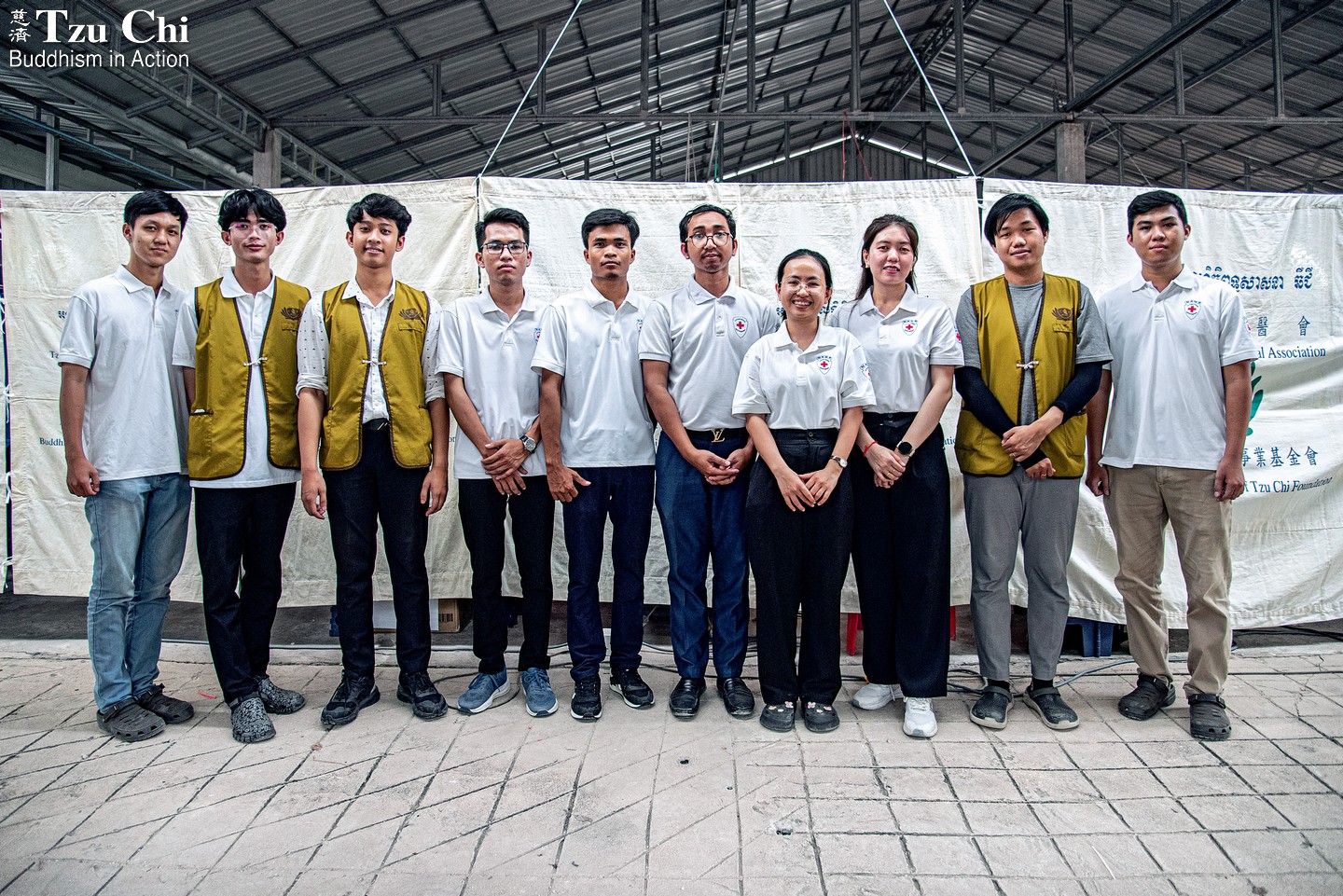
Chhay Daro (fifth from right), a young TYDA member, rushed to the free clinic to serve even though he had just finished his night shift in the emergency department. The presence of young TYDA members like him and medical students in Tzu Chi volunteer vests filled the clinic with a sense of hope. Chai Mong Ping