By Wu Chunying and Liao Yamian
Edited and translated by Wu Hsiao-ting
Photos by Zheng Aijiao
Husband and wife Wu Gonghe and Su Liya turned environmental protection into a shared mission, inspiring others along the way.
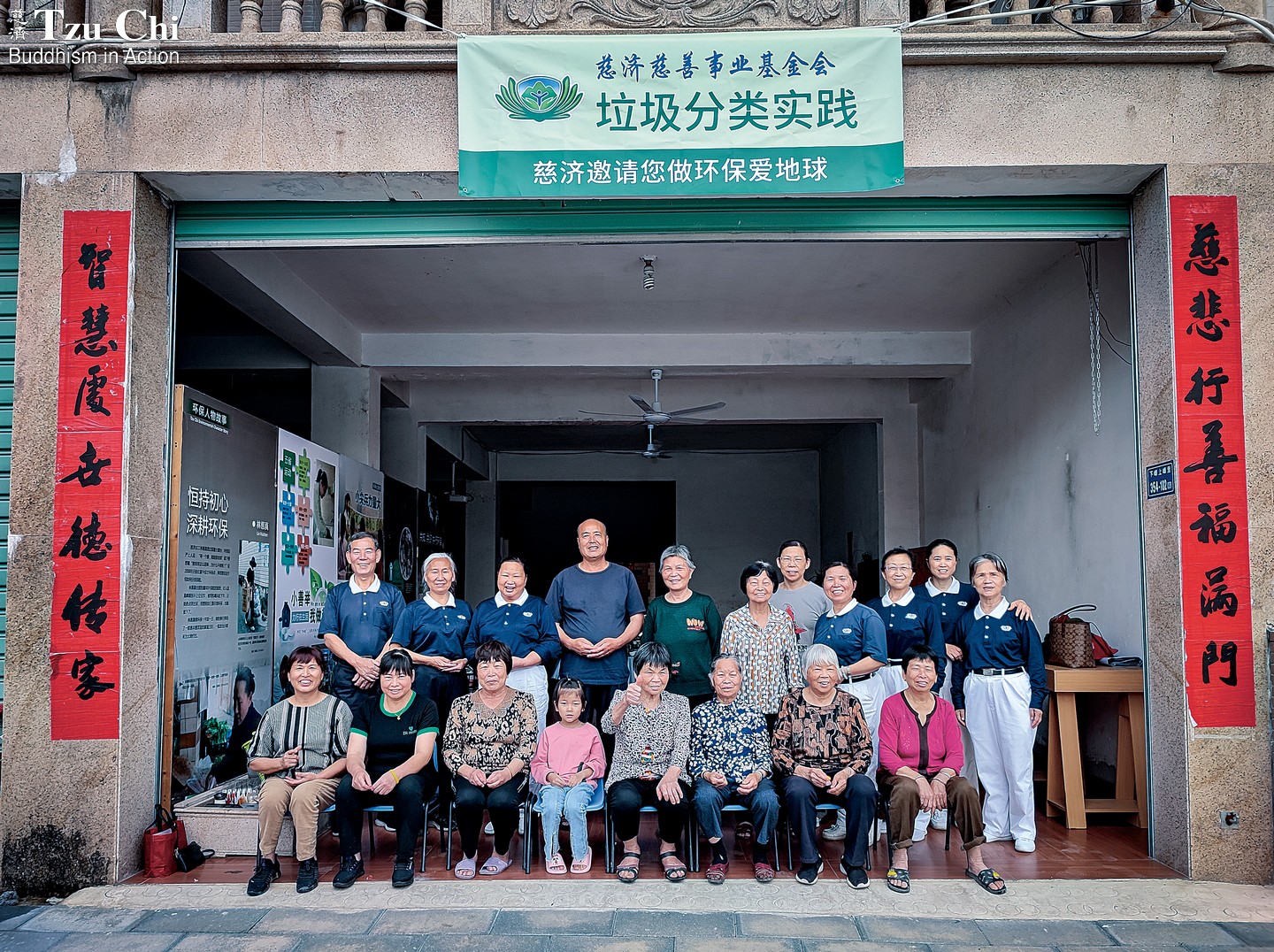
Every Wednesday, volunteers gather at the Shangfeng Recycling Point in Xiamen, China, to sort recyclables. Zeng Langyi
“
It’s doing good deeds, and that’s a good thing,” said Wu Gonghe (吳共和) of his recycling work. Newly retired at the end of 2014, he accepted his cousin Wu Jinlian’s (吳金煉) invitation to volunteer at the Tzu Chi recycling station in Xike Township, Xiamen, Fujian Province, China. Tzu Chi’s environmental principle—“Don’t use, use less, and recycle”—deeply resonated with him.
He reminisced about his childhood, when rivers were so clear you could see the bottom and the water so clean you could scoop it up to drink without fear. Adults washed clothes along the banks while children caught shrimp in the shallows. But such scenes are now a thing of the past. Severe pollution has taken over. Garbage litters the riverbanks, and some ditches, even covered, emit a foul smell. “It would be truly wonderful if everyone were more eco-conscious and developed recycling habits,” he mused.
Usually quiet, he began sharing Tzu Chi’s environmental efforts with his wife, Su Liya (蘇麗雅), leaving her wondering what had come over him. Each time he returned from volunteering, his clothes were stained and difficult to clean. His once neatly styled hair was sometimes disheveled, even covered in dust and spiderwebs—a stark contrast to the husband she knew.
As a blue-collar worker, he had always worn work clothes on the job and suits off duty. No matter the occasion, his hair was neatly pomaded, with a small comb in his pocket at the ready. To those who didn’t know better, he looked more like a teacher or civil servant.
“How can someone who loves cleanliness so much stoop down to pick up garbage?” Liya wondered. Curious, she followed her husband to the Xike Recycling Station. There, she saw heaps of recyclables piled up like small mountains. Her husband was crouched on the ground, carefully sorting through them. But he wasn’t alone; his cousin Jinlian, volunteer Chen Hongmei’s (陳紅梅) mother, and several other gray-haired volunteers also worked diligently among the “garbage mountains.”
“They’re all old and still doing it—how can I not do it too?” her husband later said to her, referring to the elderly volunteers. His words made her realize that beyond his wish to help the environment, he was moved by their dedication.
“Only by reducing waste can we lessen the burden on the Earth,” Liya said. She decided to join him. For the past ten years, the couple has worked side by side, collecting recyclables and promoting environmental awareness in local shops—walking their path together.
Sharing the journey
Liya’s willingness to join her husband may have stemmed from more than just environmental concern—he had always been a devoted partner.
Married for over 40 years, Liya still gets emotional when talking about her husband. “Whenever we argue, he always lets me win,” she said.
Gonghe shared his philosophy on marriage: “Arguing or fighting is exhausting and unpleasant. When my wife and I are on the verge of an argument, I usually just stay quiet and let her vent—then the tension naturally fades.”
“He also takes great care of my parents,” Liya said. Once, when her father fell ill, Gonghe rushed over on his motor scooter, carried him down the stairs, and took him to the doctor. He stayed by his side at the hospital, tending to his every need. “I couldn’t hold back my tears seeing him care for my father like that,” Liya said. “His thoughtfulness truly moved me.”
Gonghe’s devotion to her and her parents earned her wholehearted support for his recycling work, which in turn motivated him even more. When Gonghe saw that volunteer Chen Dongsong (陳冬松) was the only one who could drive a truck to collect recyclables, he decided to help—even though he didn’t know how to drive. In 2016, at 62, he signed up for driving lessons. Friends and relatives teased him, saying, “You’ll never pass the driving test!”
His age and slowed reflexes made the test a challenge. Two years went by, and he still hadn’t passed, but he refused to give up. After three years of perseverance, he finally got his license, at 65. “Now that I can drive, whenever someone calls, I go as soon as I can,” he said. He now often drives the truck to collect recyclables in Jimei, Tong’an, Xiang’an, and Zhangzhou. Worried for his safety, Liya accompanies him.
They are partners not just on the road but also in their work. “If we lift a 50 kg load together, we each only have to lift 25 kg. We help each other out and look after each other,” Liya said.
At the Xike Recycling Station, the couple can often be seen emptying bags of PET bottles into a compactor. Once the bottles are compressed into bales, they work together to lift and stack them. “One, two, three—lift!” Liya counted as they heaved each load onto the pile.
Shaking out her hands, she brushed back a few stray silver strands from her forehead. “At our age, how much longer can we wait?” she said. “Recycling lightens the burden on the Earth. So many people admire us—they say that my husband and I working together like this is romantic and a blessing.”
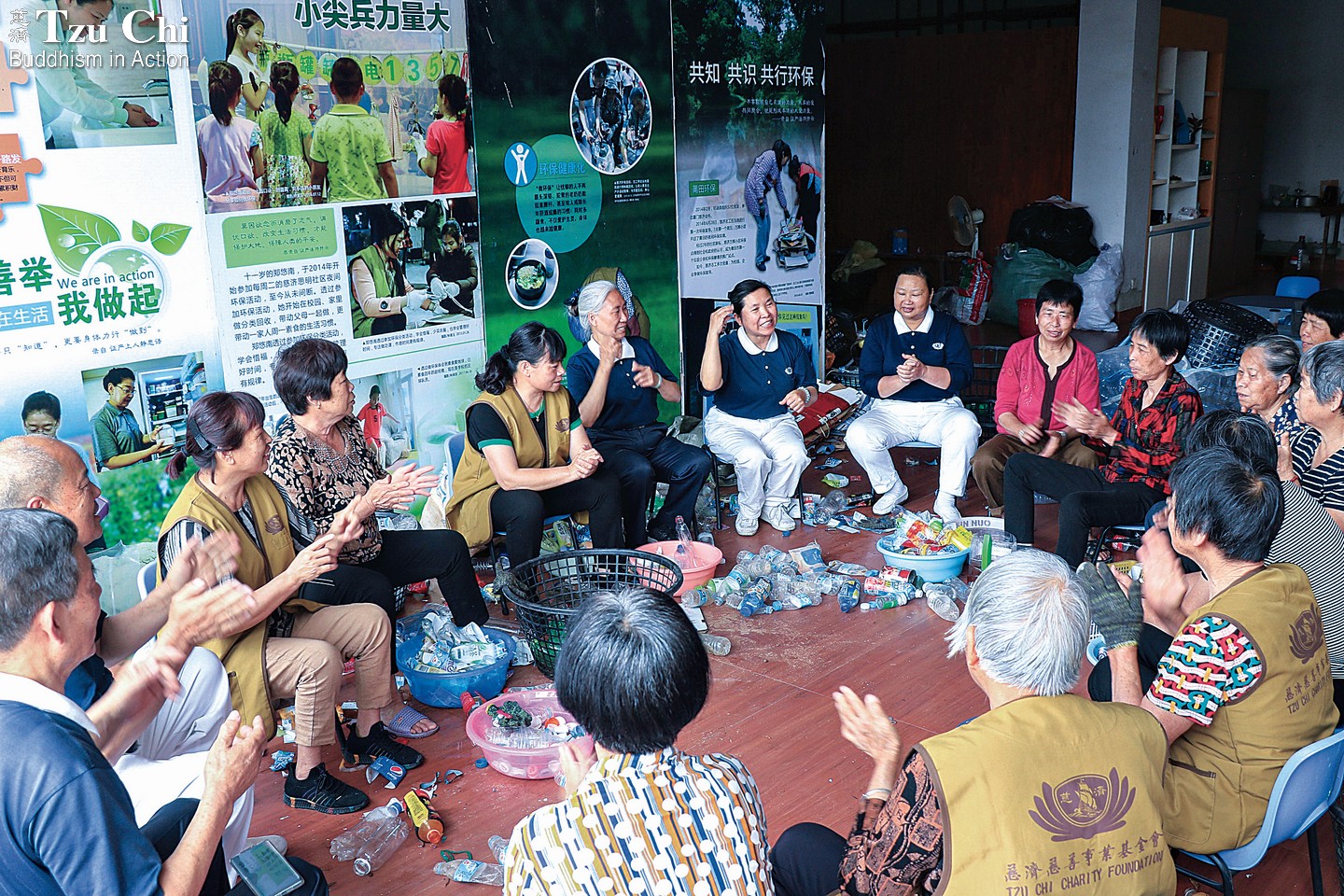
Taking a break from their recycling work, volunteers sit in a circle for a group activity, singing and clapping along.
Two couples together
In 2017, Ye Kuizhi (葉奎治), who had taken up recycling following Liya’s example, noticed that Gonghe always spoke to Liya in a gentle tone. She couldn’t help but feel envious. Her own husband, Ye Mingzhi (葉明志), had a bad temper and a loud voice. Hoping that Tzu Chi’s environment and the influence of other volunteers would help him change, she invited him to join as a volunteer.
The two couples now often team up to collect recyclables from Xiamen No. 10 High School. The round-trip drive alone takes two hours, with additional time required to load the recyclables, transport the plastic bottles to the Xike Recycling Station for compressing, and handle other tasks. In the end, each trip takes nearly four hours.
When they arrived at the school on this particular day, they first loaded several large bags of plastic bottles onto the vehicle before moving stacks of bundled paper and books tied up by students. With so many items to load, they needed to plan carefully. “Let’s place the bags of bottles on both sides, put the other recyclables in the middle, and stack the heavier books on the outer edges. That way, it’ll be easier to unload later, and the books can help hold everything in place,” Gonghe explained, easing Mingzhi’s worries about how it was going to all fit in.
Gonghe repeatedly climbed up and down from the truck, stacking the materials with patience and care despite being drenched in sweat. Mingzhi felt a deep sense of admiration. “When I first started doing recycling, he taught me how to stack and arrange everything properly,” he recalled.
Thinking back, Mingzhi remembered how hot it used to get, because the old truck had no air conditioning. On a hot day, the heat from the ground radiated up, and the blazing sun beat down on the vehicle, leaving those inside dripping with sweat. Once, after spending over an hour on the road under the scorching sun, Gonghe arrived at a collection point in Jimei. The rental building had no elevator, and discarded liquor bottles and appliances were piled on the second floor. After making multiple trips to carry everything down, he started experiencing heat stress—his head felt heavy, his stomach twisted in pain, and sweat poured from his body. Only after taking heat-relief medicine and resting in a well-ventilated area did he recover. Despite it all, the very next day, when another call for a pickup came in, Gonghe got behind the wheel once again.
Seeing Gonghe’s dedication firsthand, Mingzhi felt motivated to deepen his own commitment to recycling efforts.
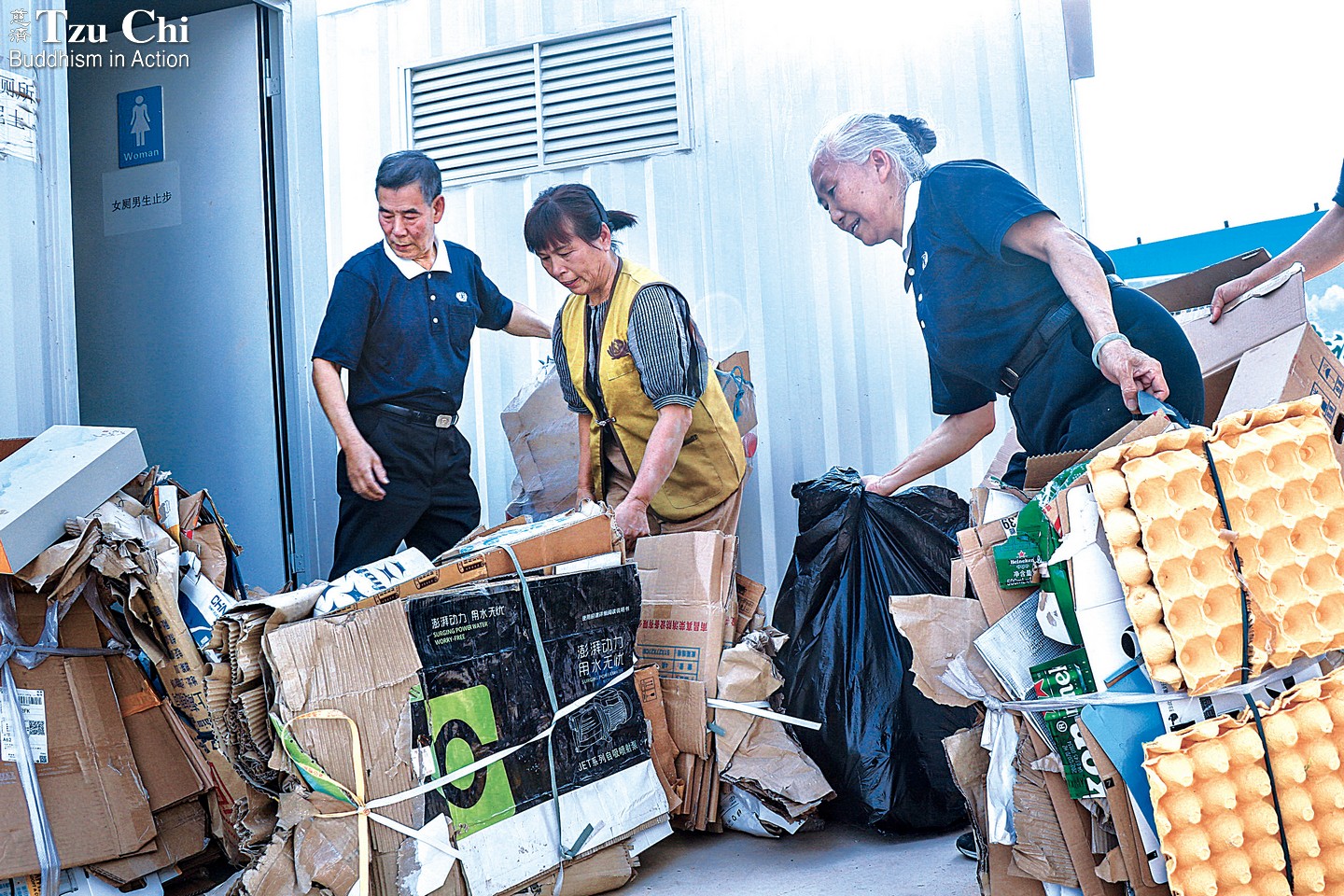
Su Liya (right) was inspired by her husband, Wu Gonghe (left), to join Tzu Chi’s recycling work.
Additional benefits of recycling
In 2020, at a gathering of recycling volunteers, Mingzhi heard his counterparts from Quanzhou, also in Fujian Province, pledge to establish recycling points in every village in their area. Inspired, he offered his 100-square-meter (1,075-square-foot) storefront as a space for residents in his community to participate in recycling. With help from other volunteers in Xiamen, the Tzu Chi Shangfeng Recycling Point opened in July of that year.
“At first, few people wanted to come,” Mingzhi recalled. He and his wife went door to door, encouraging neighbors to join. “Recycling protects the Earth and keeps us active, which helps us stay healthy!” they would say. They also prepared delicious snacks for participants. Touched by their sincerity, more and more people joined.
“Thank you! You’ve brought another truckload of recyclables!” Mingzhi said to a neighbor, beaming as he helped carry the load inside. Every Wednesday morning, the recycling point at his store buzzes with activity—locals dropping off or sorting recyclables, with ten to 20 people regularly taking part.
“I’m here!” called out a 79-year-old woman known as Grandma Li as she arrived with her makeshift cart, which consisted of a single wheel, a wooden board, and two discarded iron rods tied to the sides. Her cart brimmed with bottles and cardboard. “Picked these up from trash piles, haha!” she said with a chuckle. She had made a habit of collecting recyclables whenever she was out and about.
Gonghe emerged from the back room carrying a nylon sack as tall as a person, filled with plastic bottles. As he emptied it, volunteers—young and old—quickly got to work, peeling off labels and crushing bottles. The rhythmic sounds intertwined, creating a melody of cheerful activity.
“Compared to before, life feels much happier now!” said Li Miaozhen (李妙珍), who had just arrived on her electric scooter with a load of recyclables. “My husband wasn’t pleased when I first started, but recycling makes me feel good, so I became more patient with my family. Because of my change, everyone is happier, and we all get along much better than before.”
Hearing that, Mingzhi, as the host of the recycling point, felt warmth and gratitude. Seeing volunteers transformed through recycling—and not only themselves, but their families too—filled him with joy.
He, too, had undergone a profound transformation since joining Tzu Chi.
Mingzhi had started drinking in his teens and couldn’t sleep without alcohol. Two years into volunteering, he decided to stop. The first two weeks were tough, with sleepless nights, but he persevered. “A promise is a promise. No drinking means no drinking!” he affirmed.
He also switched to a vegetarian diet and felt its benefits. “Before, I suffered from gout so badly I couldn’t even get out of bed. My blood pressure was high too. Now, my blood pressure is normal,” he said.
Perhaps no one was happier than his wife about another one of his changes—his improved temper. “I used to have to close all the doors and windows before talking to him, or else his yelling would shake the roof tiles,” Kuizhi said, laughing. Beside her, Mingzhi softly admitted, “I was in the wrong back then.”
Gonghe and Liya, Mingzhi and Kuizhi—these two couples embarked on their recycling journeys for different reasons, yet along the way, they found the same sense of fulfillment. Through their shared dedication, they not only lightened the burden on the Earth but also nurtured harmony in their families and communities. For them and their fellow volunteers, the impact of recycling extends far beyond environmental protection—it brings people together, strengthens families, and even changes lives.