Text and photos by Lamiya Lin
Translated by Wu Hsiao-ting
All the hospitals capable of providing cancer treatment in Gaza were destroyed by war. A group of families with children battling cancer thus made their way to Jordan for treatment with the help of medical and charitable organizations. Tzu Chi provided free dental care, standing by the families during the difficult time.
Between October 7, 2023, and October 13, 2025, during the conflict between Israel and Hamas, roughly 68,000 people were killed in Gaza. Over a quarter of them were children. Everyone says, “Children are our hope for the future,” but in that span, 18,430 children perished before they could see that future.
The conflict also displaced 1.9 million people, including families who arrived in Amman, Jordan, with children battling cancer and urgently needing treatment. Supported by multiple humanitarian organizations, medical care for these children continued despite the war. Tzu Chi was invited to provide free dental care for the families, offering a moment of relief amid immense hardship.
Collaborative relief
Jordan has a population of about 11 million and has long hosted refugees fleeing regional conflicts, including those displaced by the Syrian civil war. Many of the Syrian refugees have gradually returned home since the 13-year conflict ended in December 2024. Jordan is also home to approximately 2.4 million Palestinian refugees, who have arrived over the years since the 1948 Arab–Israeli War and are now spread across 13 refugee camps.
The organization Medical Aid for Palestinians (MAP) has operated in Jordan for 35 years, primarily serving Palestinian refugees without Jordanian citizenship. In June 2025, Tzu Chi began partnering with MAP to provide financial support for medical treatment to this community. On September 15, MAP informed Tzu Chi that 127 families from Gaza needed help. Six days later, Tzu Chi volunteers met with MAP staff to assess the families’ situations. The volunteers included Chen Chiou Hwa (陳秋華), Mohamed Khir Alriz, Khader Khalifeh, and Dr. Amjad Othman (from the Tzu Chi International Medical Association), as well as myself.
The families were housed in 12 hotels and supported by multiple international organizations. One such organization, the St. Jude Global Alliance Online Community, is based in the United States and provides critical support for children with cancer. They have long collaborated with the World Health Organization and the United Nations Children’s Fund USA. Additional assistance came from the King Hussein Cancer Center in Jordan, the King Salman Relief and Humanitarian Aid Center in Saudi Arabia, and the Mariam Foundation, a Palestinian non-profit headquartered in Israel.
While these organizations provided comprehensive aid—covering treatment, accommodations, and living expenses—they did not address the medical needs of accompanying relatives or non-cancer treatments for the children, such as dental care.
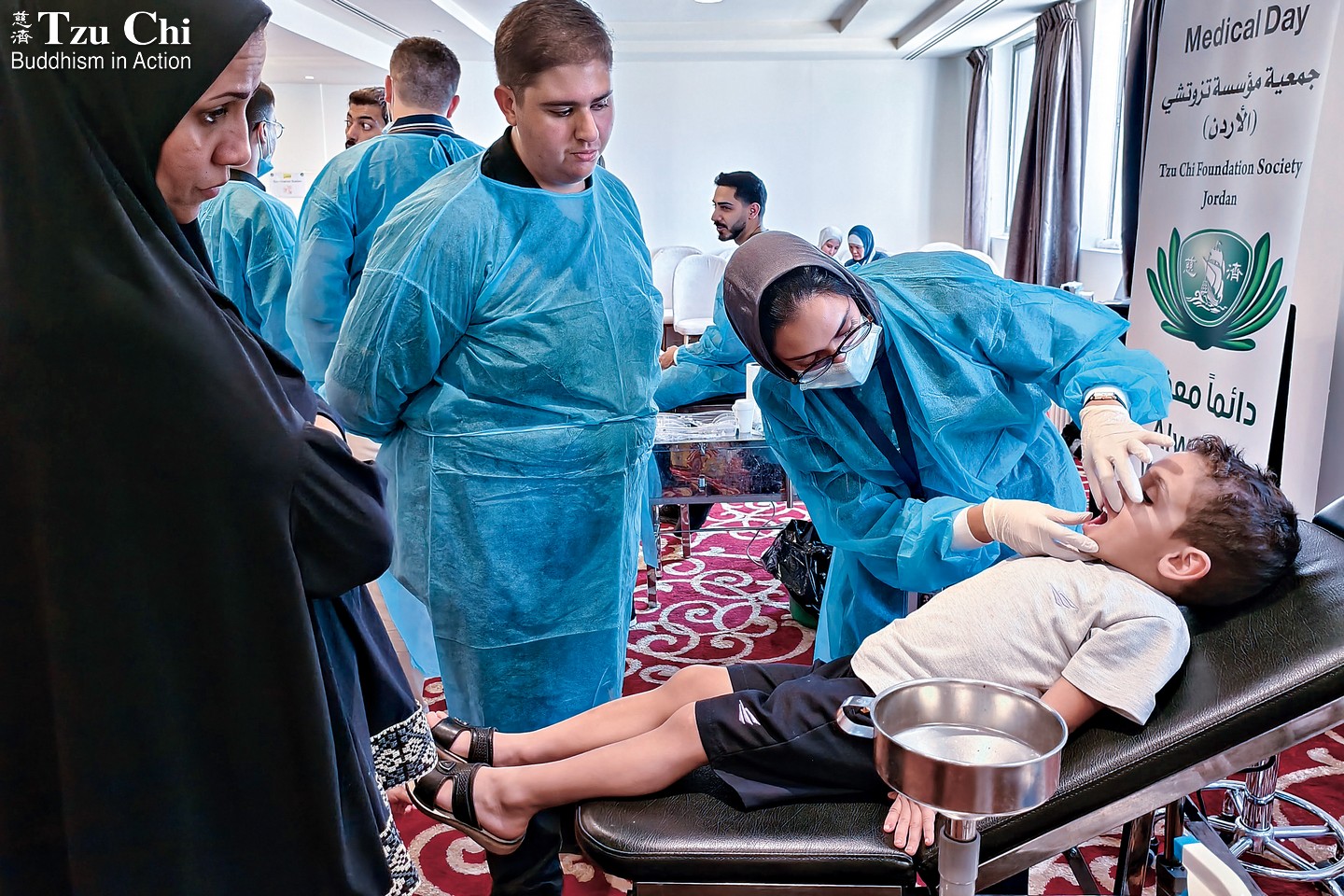
To fill this gap, the Jordan chapter of the Tzu Chi International Medical Association, which has been serving the poor and refugees in the country for 16 years, decided to provide free dental care for the families. On October 15, a mobile dental clinic was set up at the Al Fanar Hotel, complete with generators, compressors, and dental chairs. The following day, ten dentists and Tzu Chi volunteers began service at nine in the morning, ultimately treating 107 patients.
Three special cases required referral to larger hospitals. One was four-year-old Hisham, who had suffered severe burns from an explosion before leaving Gaza. His mother shared that he had endured six months of tooth pain, crying every night, yet had refused to let strangers see his face or open his mouth for examination—a truly heart-wrenching situation.
A hellish escape
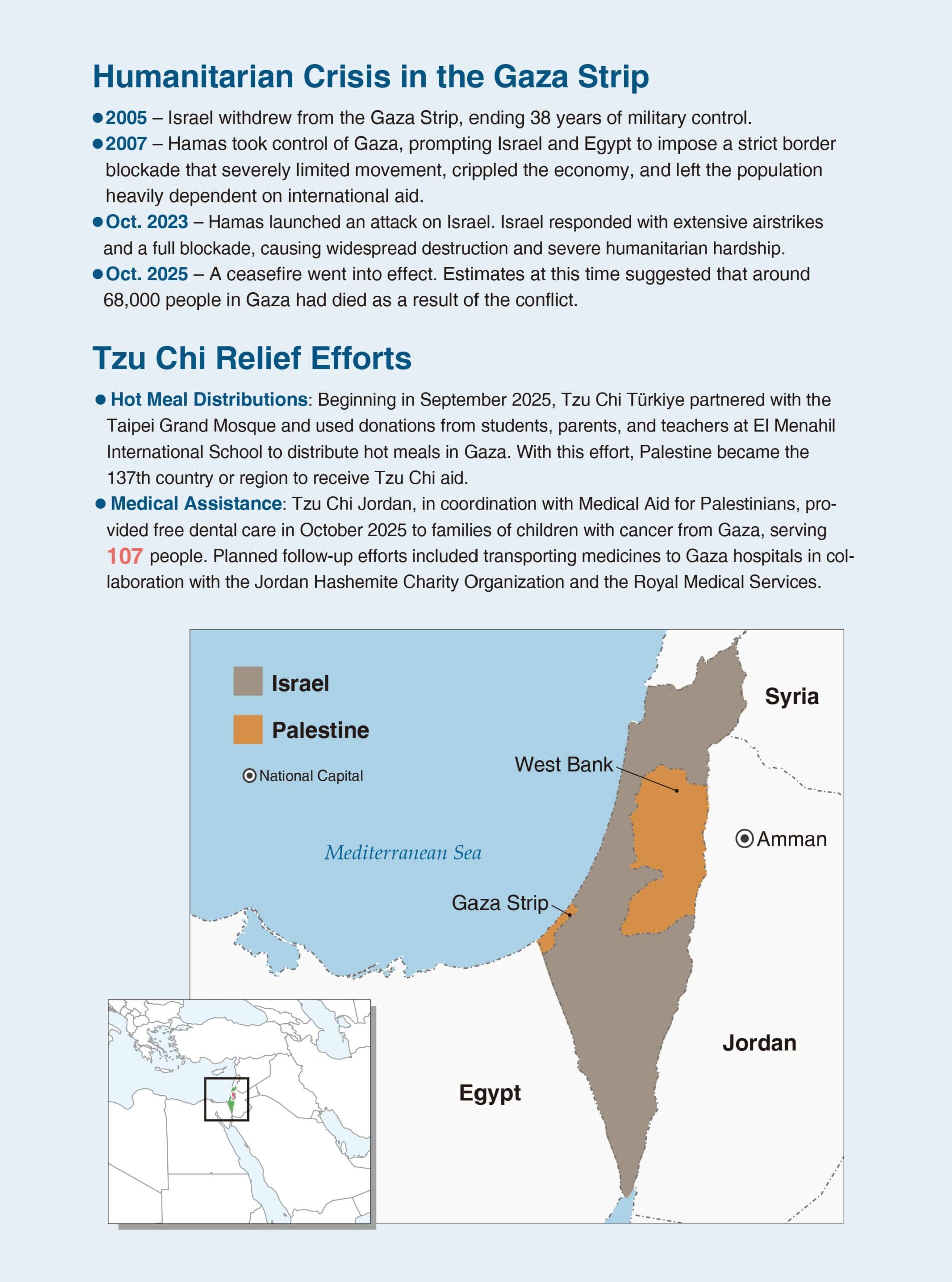
The Gaza Strip—a narrow stretch of land 41 kilometers (25 miles) long and ten kilometers wide—borders the Mediterranean Sea to the west, is tightly sealed by Israel to the north and east, and touches Egypt at its southern end. Its population includes both native Gazans and people who had fled there from other parts of Palestine.
Life for the 2.3 million people crowded into this besieged enclave had been harsh and confining before the war, yet they remained determined not to leave. Residents had endured repeated clashes with Israel, each one plunging them into crises of water, electricity, food, and medical supplies. More than 60 percent of the population lived below the poverty line, surviving on UN relief, small home-based work, and subsistence farming.
Then, on October 7, 2023, the Islamist militant group Hamas, the de facto ruler of Gaza since 2007, launched an attack on Israel, shocking the world. Israel struck back. Over the next two years, the Gaza Strip was subjected to relentless, indiscriminate airstrikes. An estimated 70,000 tons of bombs were dropped. Ninety percent of residents fled repeatedly from place to place in an effort to escape the bombardment. Sixty-eight thousand people were killed, 170,000 were wounded, and 14,000 went missing. Eighty-five percent of buildings were damaged. All the educational and medical facilities in the area became inoperable.
Twenty-nine-year-old Shaima Zaarab, a mother of six, left Gaza for Jordan in the middle of the war so that her 13-year-old daughter, Suheir, who suffered from leukemia, could receive treatment. Their story is harrowing.
In Gaza, with no fuel and no transportation, Shaima had previously pushed her daughter to the hospital on a tricycle. One night, bombs fell like rain, as if the world were ending. As the airstrikes intensified, people ran from their homes into the streets. Many were separated from their families in the chaos. Shaima told her children, “Hold hands tightly! Keep running forward and don’t stop! Don’t look back! If your father and I die, you must live on.” The family fled south. Her husband, who had previously lost an arm and a leg in an airstrike, could barely move.
When the family reached southern Gaza, they lived on the beach in a makeshift shelter pieced together from blankets and plastic sheets. For six months, they washed only with seawater. For three months, they did not eat a single piece of bread. They endured winter storms and scorching summer heat that reached 40°C (104°F). They eventually returned home, but found nothing but ruins. Then, in May 2025, the last hospital in Gaza that still provided cancer treatment was bombed and destroyed. For the sake of her daughter, Shaima had no choice but to leave Gaza.
Shaima was eight months pregnant when they arrived in Jordan. Suheir told her soon-to-deliver mother, “I want to name my baby sister Siwar. That way, if I die, she’ll remember me—she’ll remember that her sister gave her that name.”
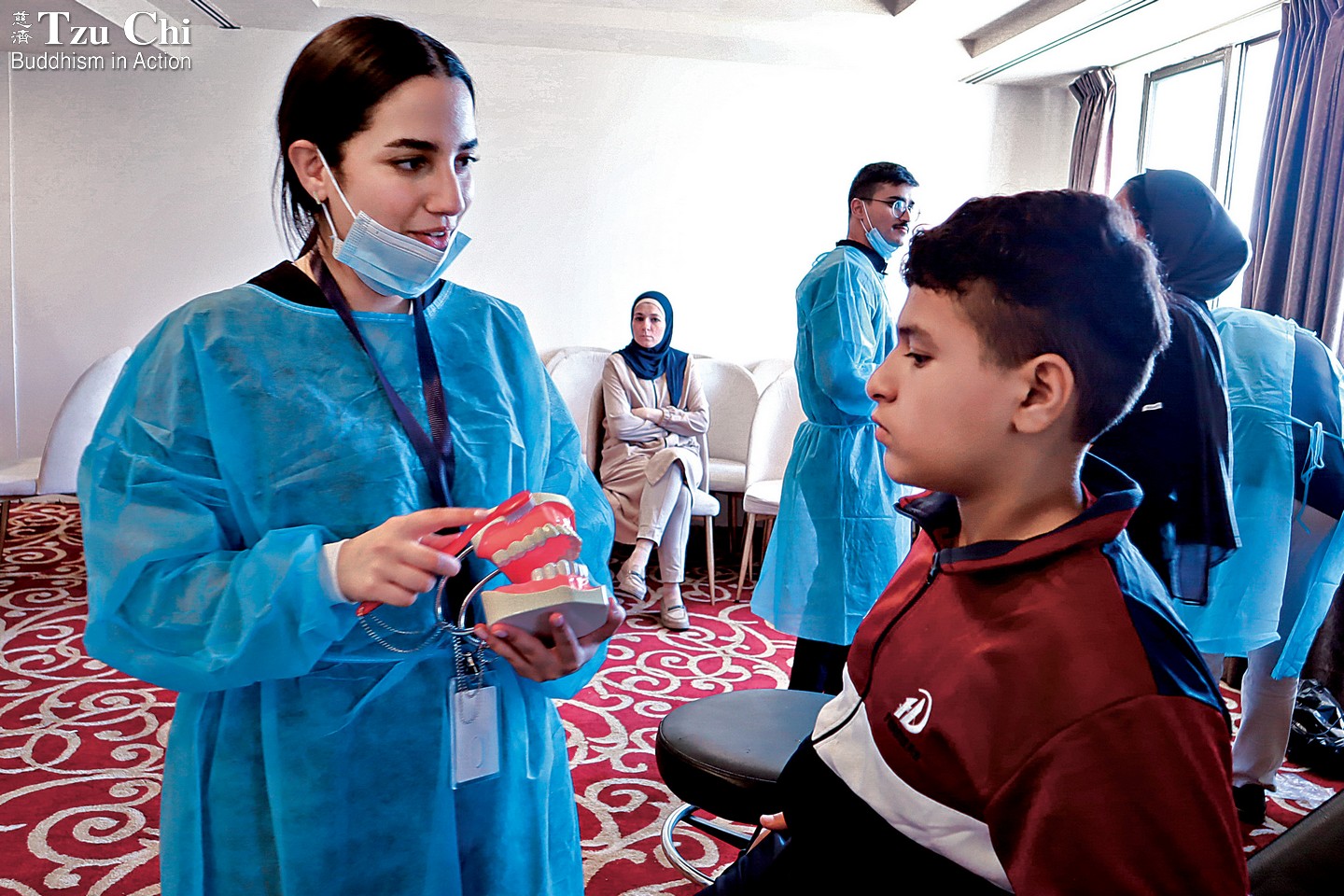
A volunteer provides oral health education to a child from Gaza at the free dental event held by Tzu Chi in Amman, Jordan, in October 2025.
Their only wish
The people of Gaza have developed a steadfast faith after years of blockade and bombardment, entrusting everything to Allah. The families I interviewed spoke about their experiences with remarkable composure—no complaints, no pleading. They shared their stories with gentle smiles and repeated words of gratitude. Their acceptance of suffering was beyond anything I could have imagined.
Forty-three-year-old Shahinaz Kaskin’s daughter Rahaf was diagnosed with brain cancer just as the war erupted, when she was ten. They quickly applied to the Gaza Ministry of Health for permission to leave the country for treatment. Their first stop was Egypt, where Rahaf underwent tumor-removal surgery; two months later, she was transferred to Jordan’s King Hussein Cancer Center to continue her care. “Thanks be to Allah, her condition has stabilized,” Shahinaz said of her daughter. “However, she’s lost her sight and is now confined to bed.”
Shahinaz’s other children remained in Gaza. When she left, her youngest daughter was just 20 months old. “We’ve been in Jordan for a year and seven months now,” she said. “We pray that Allah will allow our family to be reunited safely. The hardest part of being here is the separation—constantly worrying about our loved ones back home. But we are grateful to Allah and to the kind people here for taking such good care of us. We thank the Jordanian people and King Abdullah II for their support for Gaza’s children with cancer.”
Just two weeks before Tzu Chi’s free dental clinic, Shahinaz faced another crisis. She was rushed to Akila Hospital with severe abdominal pain. There, she was diagnosed with gallstones. “I had surgery,” she said, “and the Tzu Chi Foundation helped pay for it. May Allah bless all of you. I now feel healthier every day. I’m deeply grateful for everything you are doing for the Palestinian people.”
Despite all they have endured, the families have not lost their passion for life. Their hopes rest on their children recovering from cancer. After that, they plan to return to Gaza and rebuild their homes. None expressed any desire to remain in Jordan, even with the safety and comfort it offers. Even when a child passes away, family members apply to cross the border as soon as the three-day mourning period ends. Going home is their only wish.
This is not the first time Gaza has faced devastation—it is the 15th since the Arab–Israeli War of 1948. And despite the signing of a ceasefire agreement between Israel and Hamas in October 2025, the current round of violence has not fully ended; sporadic airstrikes and gunfire have continued. The families from Gaza know that when they return, they will find their homes reduced to rubble. Yet even if they must live in tents and rebuild with their bare hands, they are determined to go back. Even if famine and severe shortages await them, nothing can deter their longing for home. Even if they must dig out the remains of their loved ones with their bare hands, they are resolved to bury them with dignity.
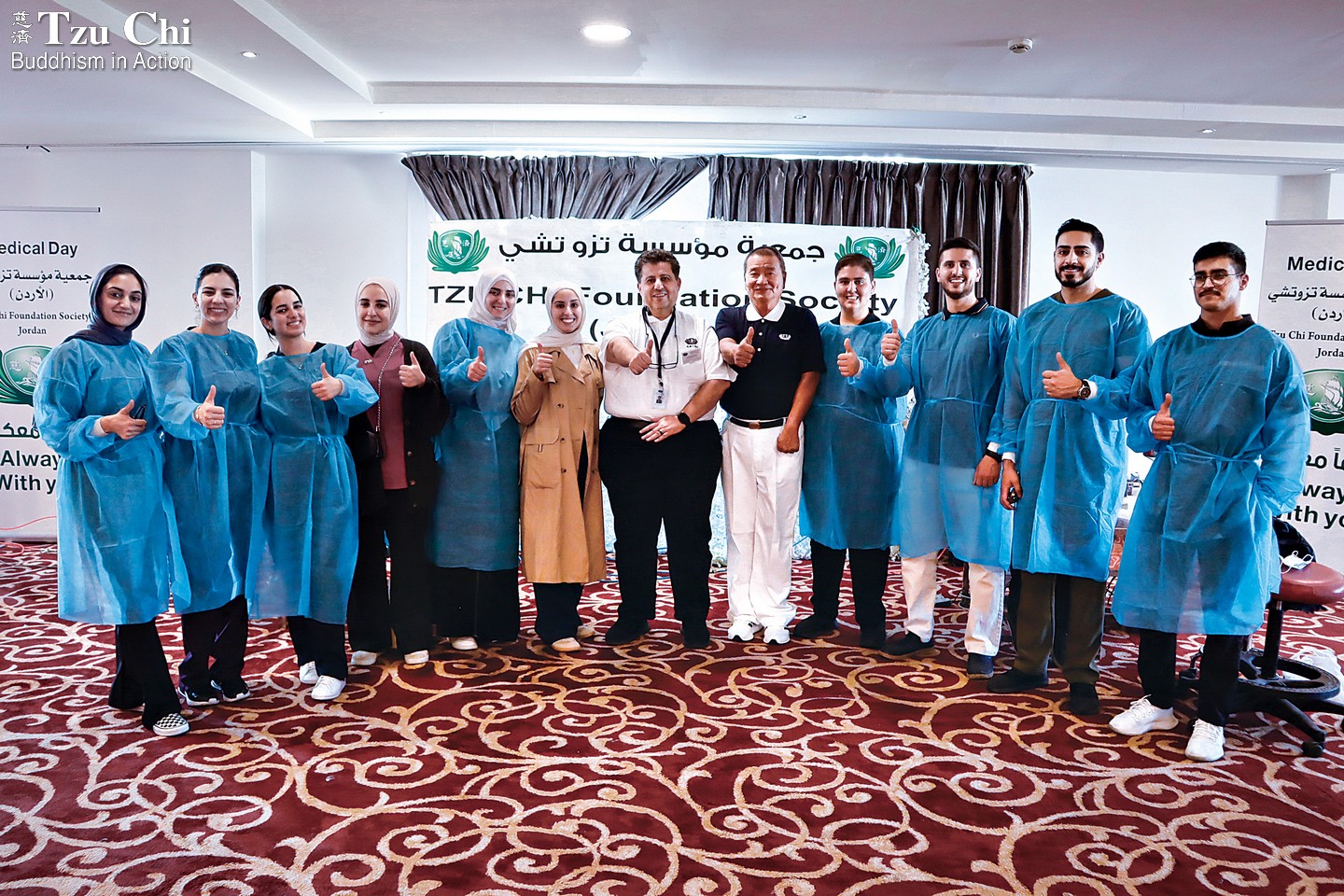
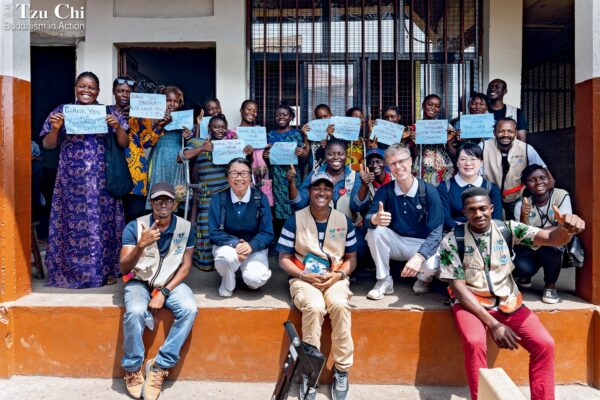
Dental professionals from the Tzu Chi International Medical Association and other Tzu Chi volunteers, including Syrian refugees, pose with thumbs up at the dental event, showing their enthusiasm to serve.
Steadfast as bedrock
Dr. Amjad prepared many small gifts for the children who came to Tzu Chi’s dental event, filling the venue with warmth. He also promised that any patients needing follow-up care could visit his clinic for free treatment. Tzu Chi would also cover the cost for special dental needs, such as dentures.
Dentist Zaid Hamdan, 26, said he felt honored, as a member of the Tzu Chi International Medical Association, to care for the people from Gaza. “I provide services such as extractions, fillings, fluoride treatments, and cleanings at the event,” he said. “I’m grateful that Tzu Chi created this opportunity. I hope this service continues. We’ll stand with you.”
Mahmoud Ashour, a 31-year-old relative of a young cancer patient, had arrived in Jordan in May 2024. His three-year-old niece, Judi, has cancer in her left eye, but her parents were unable to obtain exit permits. Mahmoud had no choice but to leave his wife and three children in Gaza and bring his niece to Amman for treatment.
“Living under the shadow of this brutal war, we suffer tremendously, whether we stay in Gaza or leave it,” he said in an interview. “On behalf of the families of Gaza’s children with cancer staying at the Al Fanar Hotel, I offer my deepest thanks to the Tzu Chi Foundation for helping ease our pain.”
We often see through the media how deeply Gazans love their homeland. But meeting them face-to-face for the first time and hearing their stories left me even more profoundly affected. Their resilience and unwavering faith, passed down through generations, feel as solid as bedrock even under the suffocating pressure of war.
I hope to speak for those who cannot speak, to preserve the stories of those who have suffered; their deaths or suffering should not be reduced to statistics. The care we offered the Gazans brought them a measure of comfort, and in return, their inner calm touched us. It was a moment of genuine human connection—proof that kindness and care can flow freely through this world, across races and beyond religion.