By Lu Yue-xia and Yi Yi
Translated by Wu Hsiao-ting
Photos courtesy of Lu Yue-xia
Without electricity, households in some impoverished settlements in South Africa spent their nights in complete darkness. Their lives changed significantly after Tzu Chi installed solar lights.
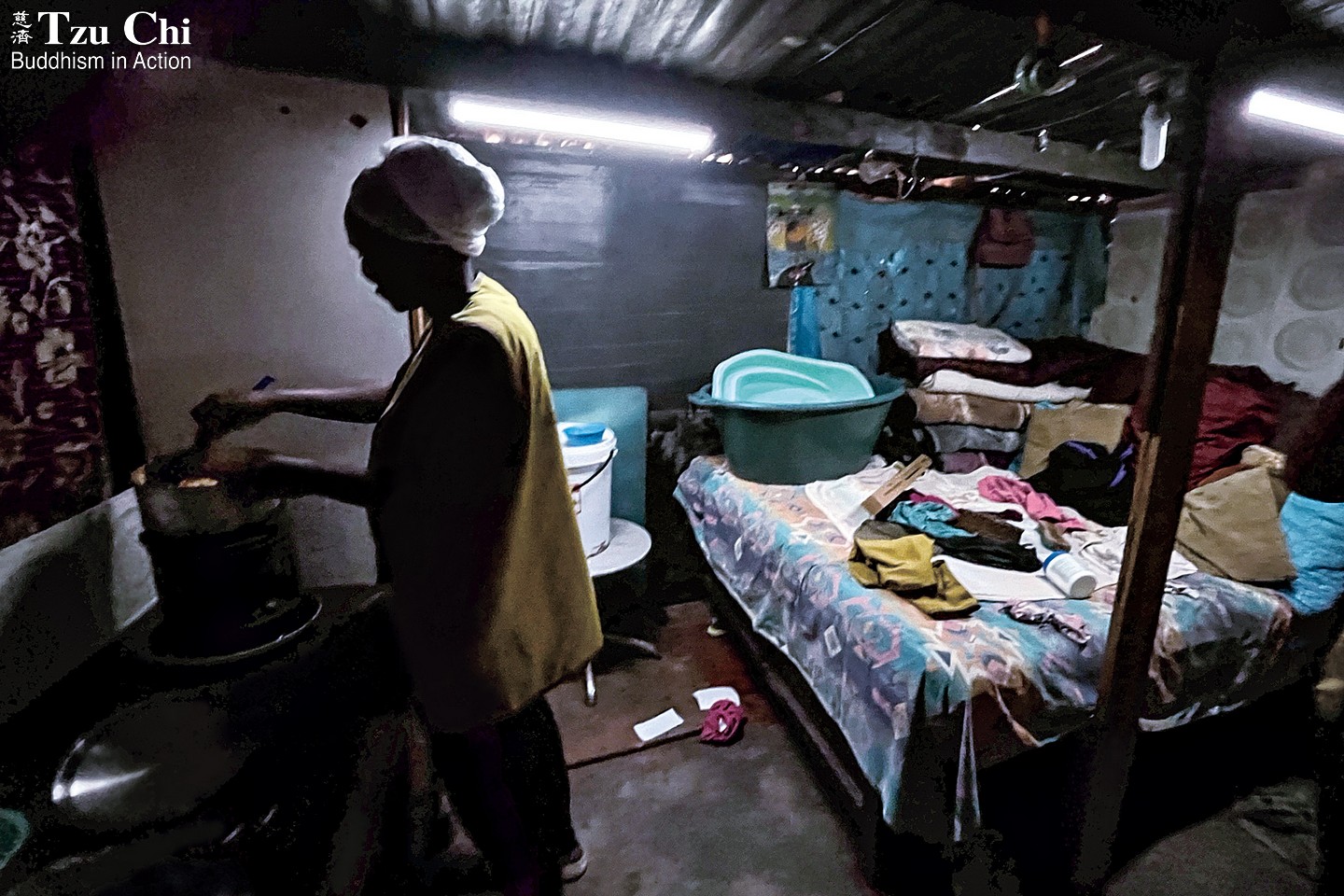
Nights are often pitch-dark in several impoverished communities on the outskirts of Johannesburg, South Africa. Without electricity, families rely on candles, kerosene lamps, or the dim glow of mobile phones for light—costly solutions that also carry fire risks.
This was the reality for Sipati in the Kanana community. One of her children, Hope, a Tzu Chi scholarship recipient, often had to study late into the night to do well in school. Candles were both dangerous and costly, but the family had no alternative.
Sipati used to live with her husband, but his drinking led to frequent fights at home. She eventually left him to raise their eight-member family alone in a small room rented for 800 South African rand (about US$45) per month. Four children shared a double bed, and the others slept on the floor. Two elementary-school-aged children crowded around a tiny table to do their homework.
On October 16, 2025, Tzu Chi volunteers installed solar lighting in their home. Sipati was moved to tears. The light was more than illumination—it was a symbol of hope for her and her children.
Tzu Chi South Africa received a donation of more than 200 solar lighting units in 2024 and began installing them in disadvantaged households in 2025, helping families find light in the darkness.
Another beneficiary of this project was a single mother supporting three children through temporary work and recycling. Her 14-year-old daughter dreams of becoming a lawyer and speaking up for her community. With the solar lighting installed by Tzu Chi, that dream suddenly feels a little closer.
Zandile, a volunteer from Sophiatown, also benefited from the solar technology. She volunteers weekly at a Tzu Chi feeding station or at the Tzu Chi Exercise Room in Phomolong, Thembisa, a facility that supports stroke survivors and injured patients with rehabilitation routines. When fellow volunteers learned that she quietly served others despite her own difficult living conditions, they decided to install solar lighting for her. “At night, we couldn’t see anything,” Zandile said. “My children and I were often in complete darkness, sometimes getting by with a few candles.” The lighting greatly improved their quality of life.
Nthombi, who also volunteers at the Exercise Room, is a long-term recipient of Tzu Chi’s aid. Her home is accessible via a path strewn with trash; the refuse, along with stagnant water, gives off an almost unbearable stench in hot weather. When volunteers walked this path to her place on October 16 to install solar lighting, their hearts went out to the residents living in such conditions. Upon entering Nthombi’s home, they noticed that the roof was damaged in several places. When asked whether it leaked during rain, she smiled and said, “Yes, it does, but it’s okay.” The clearly visible holes told a more serious story, so the volunteers began making plans for repairs.
When the solar lighting was installed and switched on, the small home overflowed with laughter and heartfelt moments. Nthombi said that because they are now the only family in the area with electricity, she happily welcomes neighborhood children to come over in the evenings to do their homework.
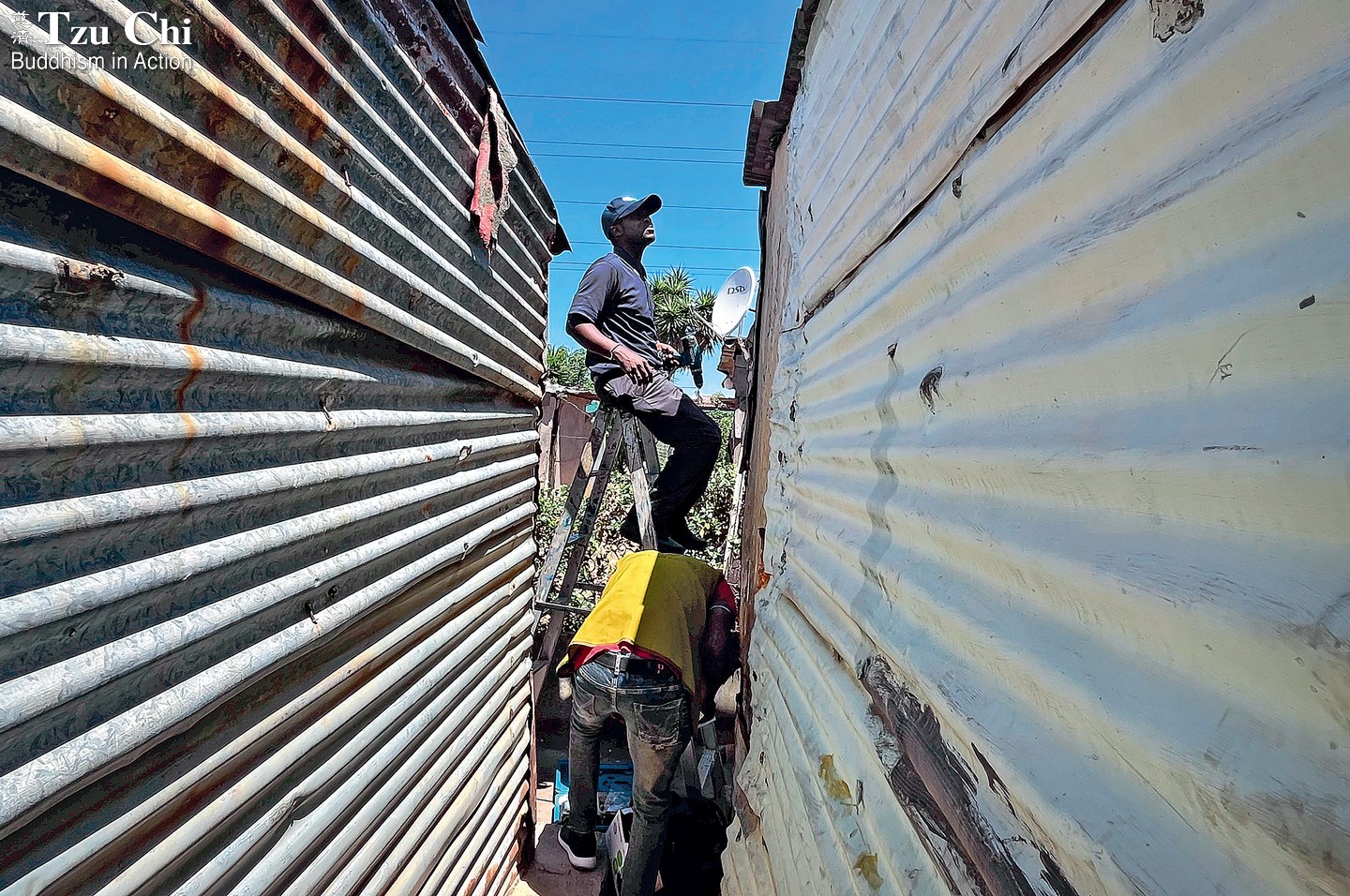
Volunteers install solar lighting for a household.