By Yeh Tzu-hao
Translated by Wu Hsiao-ting
Photos by Hsiao Yiu-hwa
Tzu Chi volunteers come together to grow toxin-free crops and nurture the land with mindful, eco-conscious farming.
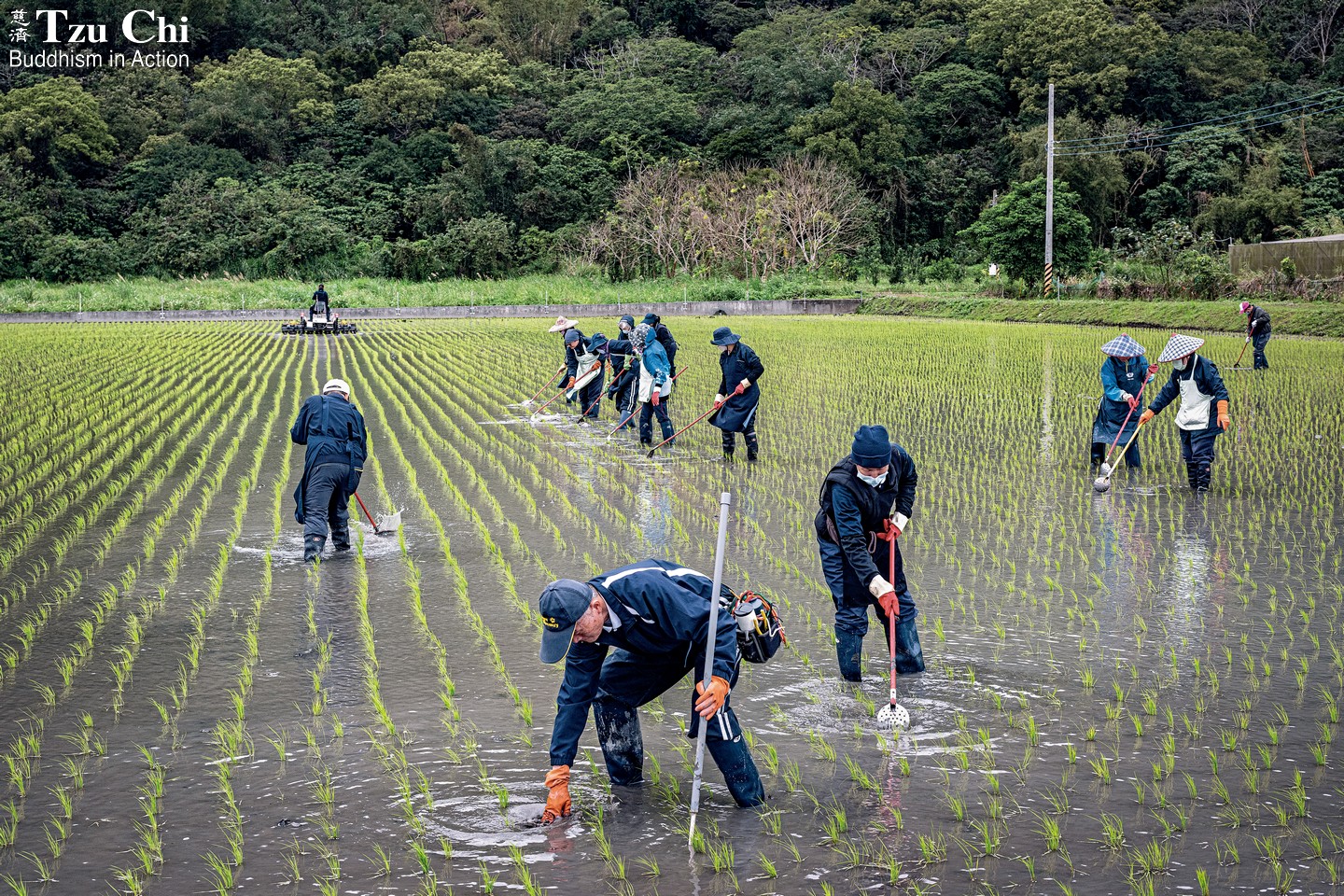
Tzu Chi volunteers from Taoyuan weed the fields at Zhixue Great Love Farm using a combination of machinery and manual labor. Herbicides are avoided to maintain a toxin-free, organic environment and protect the farm’s ecosystem.
As February gives way to March, Taiwan often sees overcast skies and periods of rain. On one such chilly, damp day, more than 30 Tzu Chi volunteers from Taoyuan, northern Taiwan, arrived at Zhixue Great Love Farm, nestled at the foot of Liyu Mountain in Shoufeng Township, Hualien, eastern Taiwan. A biting wind swept across the rice paddies with temperatures dipping below 10°C (50°F). Fortunately, the volunteers were well prepared with warm clothing, hats, raincoats, rain pants, and high rubber boots. Once they got busy with work, they warmed up and the cold no longer seemed to matter.
“In summer, the sun and heated water in the paddies make the work more exhausting,” said volunteer Lu Chun-tao (呂春桃), drawing on her years of experience at the farm. “Though it’s cold in winter, it’s actually more bearable, and we’ve gotten used to it.”
Their focus this time was weeding. First, the volunteers removed the protective barriers that keep wild geese and ducks away. Then, they pushed weeds that had sprouted beside the rice seedlings, such as barnyard grass, back into the mud, preventing them from competing with the rice for sunlight and nutrients.
“Barnyard grass absorbs nutrients faster than rice,” explained team vice leader Yang Zhi-ming (楊志明). “Since fertilizer will be applied tomorrow, we need to remove the weeds today. This will allow the rice plants to better absorb the nutrients.”
Yang also offered an overview of the farm’s rice-growing cycle. The first crop is planted at the end of winter or in early spring and harvested after about 128 days. Following a fallow period of over a month, a second crop is planted in the summer. Because of the warmer weather, this crop matures slightly faster and is harvested after about 120 days.
These two annual harvests are made possible by the collective efforts of volunteers from across Taiwan. Teams from Taoyuan, Taichung, Kaohsiung, Pingtung, and Taipei take turns helping with weeding, installing protective barriers, operating farm machinery, and maintaining the irrigation system, ensuring that the farm runs smoothly.
Zhixue Great Love Farm follows eco-friendly farming practices, such as avoiding the use of chemical pesticides, to help preserve the land’s natural ecology. As a result, the rice grown here is certified as organic and toxin-free. In addition to supplying the Jing Si Abode—including meals for visiting Tzu Chi volunteers from Taiwan and abroad—the rice is also processed into products such as instant rice. These products are sold to the public during normal times and used to support disaster relief efforts or to aid the impoverished when needed.
Master Cheng Yen has long expressed concern about potential food crises and often reminds followers of the importance of preparing for difficult times. The Great Love Farm in Hualien is part of Tzu Chi’s response. It not only provides organic rice for the Jing Si Abode, the spiritual home of Tzu Chi volunteers, but also reflects a mindful response to climate change, supports food security, and promotes the sustainable vitality of the land.
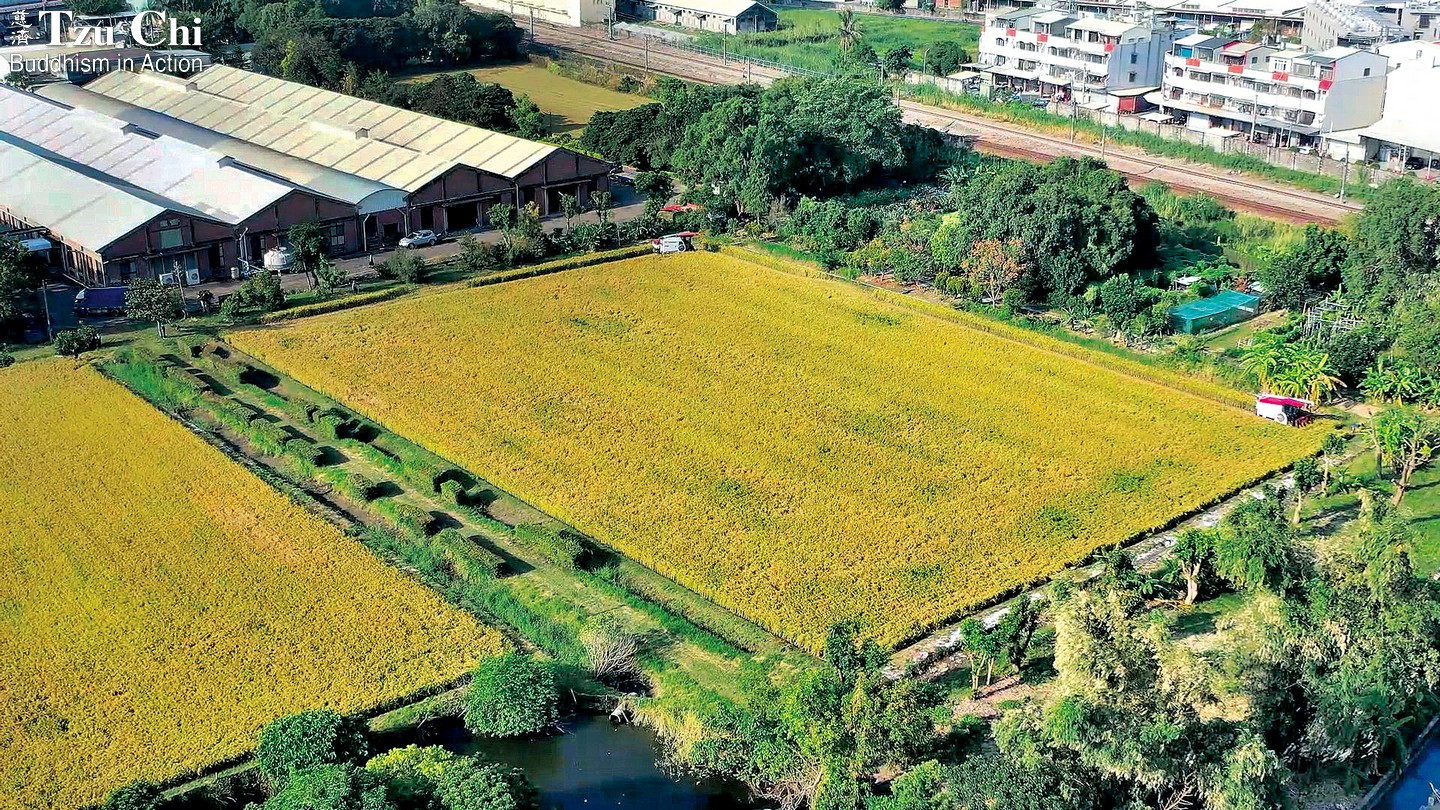
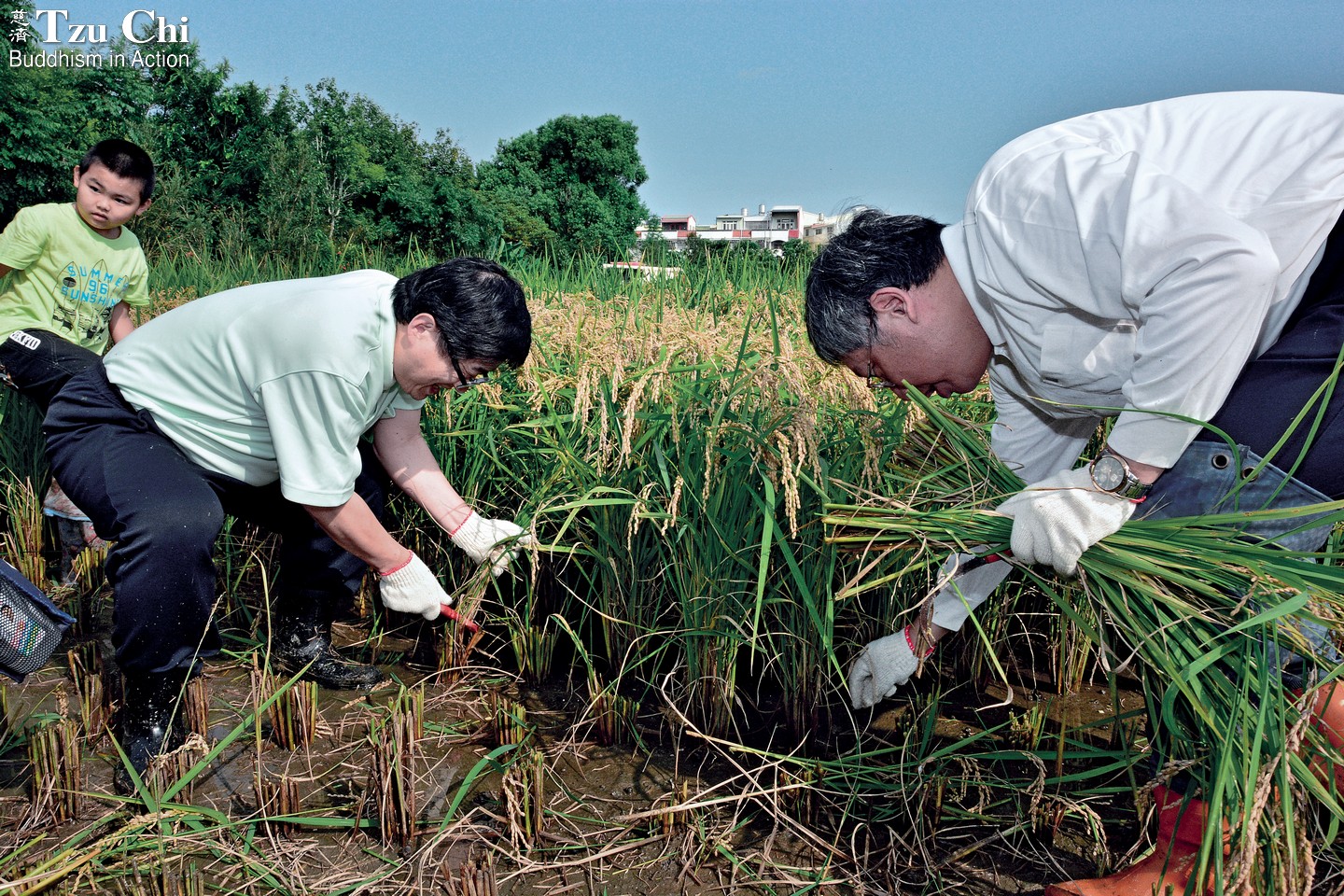
Yunlin Great Love Farm (photo 1) covers nearly two hectares. Its rice harvest supplies Tzu Chi offices in southern Taiwan, with a portion also used to make red blessing packets for the foundation’s year-end blessing ceremonies. Medical staff from Dalin Tzu Chi Hospital (photo 2) take part in harvesting. Photo 1 by Wei Qing-tang; photo 2 by Huang Shu-ying
The farm in Yunlin
Another Tzu Chi Great Love Farm is located at the foundation’s Yunlin office in Dounan Township, Yunlin County, southwestern Taiwan. Due to its relatively convenient location, this 1.8-hectare (4.4-acre) farm is often open to Tzu Chi volunteers and members who want to experience farm work firsthand. Whether they are healthcare professionals from Tzu Chi’s medical mission, teachers and students from the education mission, or families participating in parent-child classes, all are welcome to take part in planting seedlings or helping with other farming tasks.
“Our annual rice yield is about 14 metric tons [15.4 short tons], mainly supplying Tzu Chi offices south of Taichung [in central Taiwan],” said volunteer Jian Zhen-quan (簡圳銓), who currently oversees the farm. “We also set aside about a hundred kilograms [220 pounds] of unhusked rice each year to make fuhui hongbaos [literally ‘red envelopes of blessings and wisdom’].” These small red packets, distributed during Tzu Chi’s year-end blessing ceremonies, each contain three grains of unhusked rice, most of which comes from the Yunlin farm. In this way, the rice grown here reaches people all over the world.
Tzu Chi’s commitment to toxin-free, organic, and eco-friendly farming requires more time and effort than conventional methods, but Jian is unwavering in his dedication to the farmwork. In addition to volunteering at a Tzu Chi hospital and participating in recycling efforts, he works on the farm tirelessly—even during the middle of the night or early morning, guided by the beam of his headlamp.
He shared the principles that guide the farm’s practices: grass retention, meaning weeds are left alone unless they interfere with the crops; root protection, which focuses on preserving root systems and maintaining soil moisture; and coexistence with and respect for life, living alongside insects, snails, mice, and birds—creatures often labeled as pests—without using pesticides to eliminate them for the sake of higher yields. This last principle is in accordance with Master Cheng Yen’s teachings.
This “field of blessings” has been cultivated for 17 years and has produced over 200 metric tons (220 short tons) of food. Whether it’s the rice served in the dining halls of Tzu Chi offices in southern Taiwan or meals delivered to disaster survivors in times of need, every grain carries love and sincerity from this piece of land.
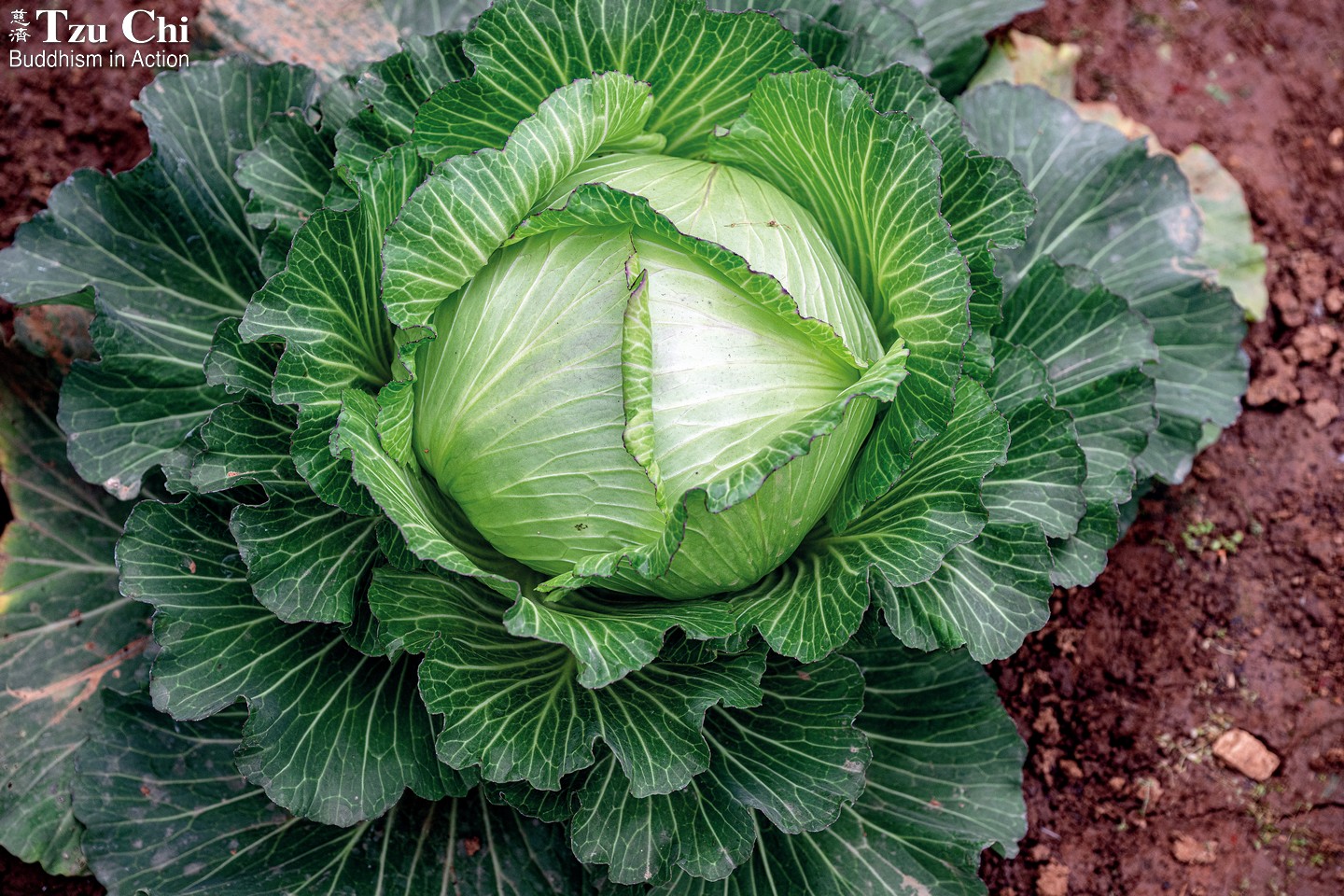
At the farm on Tzu Chi’s Zhongli Campus, leafy greens nourished with diluted enzyme solutions grow large and healthy. Produce grown on-site are available for charity sales from time to time.
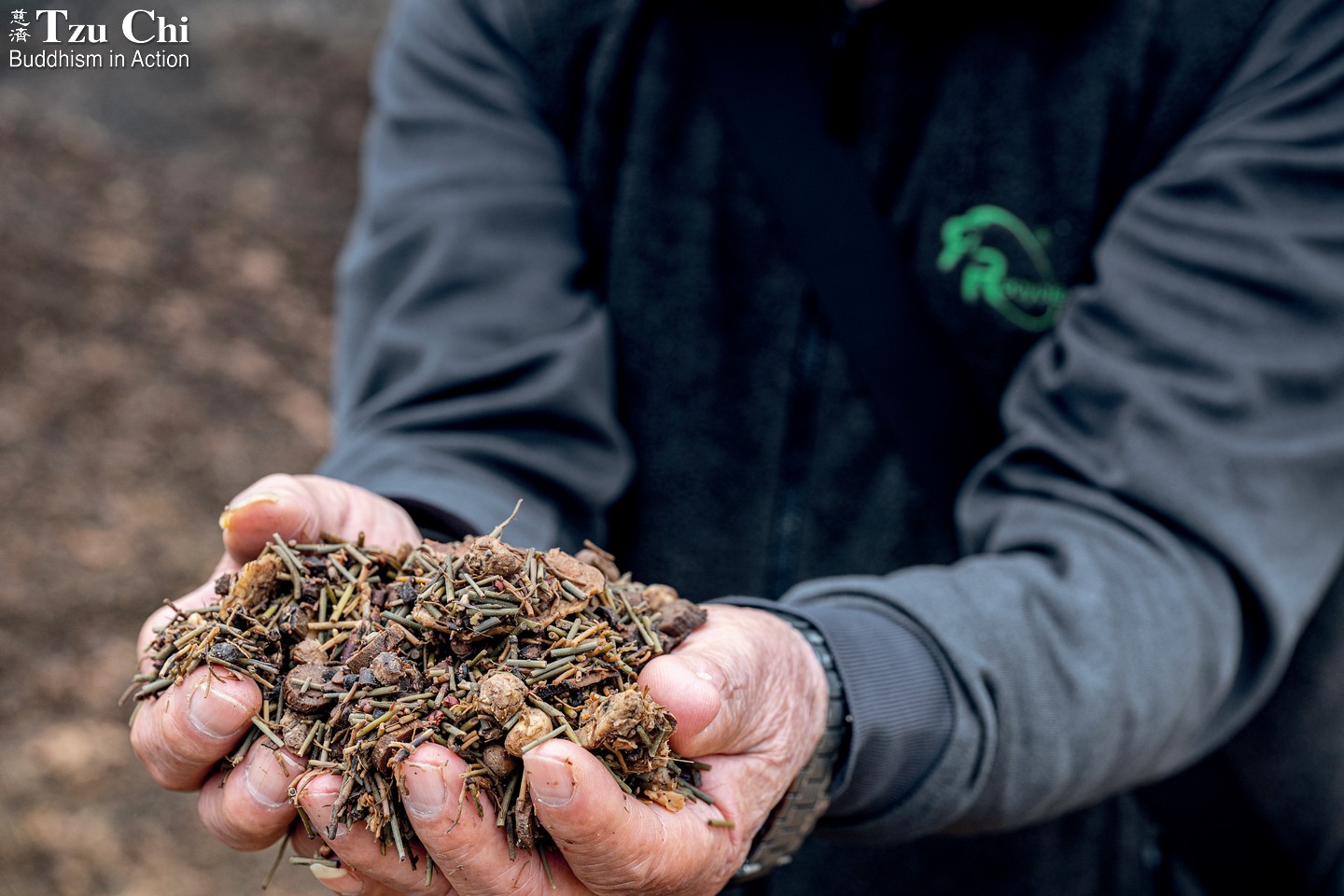
Volunteers at Tzu Chi’s Zhongli Campus make compost from herbal dregs, fruit peels, vegetable scraps, and other natural plant waste. It helps improve soil quality when mixed into the soil.
Everything for sustainability
Tzu Chi’s Zhongli Campus in northern Taiwan, where nearly 90 percent of the grounds are dedicated to green space, is home to another Great Love Farm. Volunteers there have cultivated the farm with impressive results.
Eighty-five-year-old volunteer Chen Hong-yong (陳鴻永) said that the fruits and vegetables grown on the farm are highly desired due to their organic, toxin-free cultivation methods: “Every time we hold a charity sale, everything sells out quickly! The proceeds go toward supporting Tzu Chi’s poverty alleviation and disaster relief efforts.”
These prized harvests are the result of dedicated, hands-on care. To protect crops from insect damage, volunteers have constructed net houses made mostly of recycled materials. These structures are highly effective despite their humble origins, not only shielding vegetables from pests but also providing insulation during cold snaps.
Volunteers also repurpose herbal dregs from a nearby traditional Chinese medicine factory to make compost, and use fruit peels and vegetable scraps to produce enzyme solutions. “We dilute the enzyme solution to water the crops and mix the remaining solids into the soil as fertilizer,” explained volunteer Wu Wen-xiong (吳文雄), sharing one of their secrets to growing quality produce.
Like the Great Love Farms in Hualien and Yunlin, the Zhongli farm follows eco-friendly, organic principles and strives to coexist harmoniously with nature. But that doesn’t mean everything always goes according to plan. Last winter, for instance, the farm’s signature crop, Inca nuts, suffered major losses due to pest infestations and low temperatures, sharply reducing the harvest. Shifting rainfall patterns and water shortages in recent years have also forced the farm to stop growing rice, a water-intensive crop.
“In the past, rainfall was more evenly distributed,” said volunteer Chen Wen-yin (陳文印), who takes care of most of the farm work. “Now, during summer when we need water, it often doesn’t rain—or when it does, it pours all at once. When the pond water gets too low, we have to use electric pumps or even draw from wells. That’s not sustainable.” In response, the campus rice paddies were converted this year to drought-tolerant oil-seed camellia trees.
In addition to adapting by adjusting crop varieties, the Zhongli campus is planning a broader transformation: to become a certified Environmental Education Facility recognized by the Ministry of Environment. This will involve enhancing the farm and other outdoor areas with reforestation efforts to support Taiwan’s net-zero emissions goals.
“We hope to help visitors learn about plant diversity and biodiversity [through this transformation], inspiring them to cherish the land,” said volunteer Pan Fu-shou (潘福壽). He envisions the Zhongli campus and farm evolving to play a greater educational role and also to serve as a place of healing. Achieving this vision requires long-term thinking in the cultivation of crops and other plants, as well as in overall land stewardship.
This transformation is especially important in light of Taiwan’s declining birthrate and aging population. As volunteers grow older, maintaining the expansive campus and farmland will become increasingly difficult. By fostering a self-sustaining, forest-like ecosystem, the need for manual labor can be reduced, while providing a tranquil sanctuary that nourishes both body and spirit.
Whether cultivating the Great Love Farms or transforming them, the volunteers’ mission remains clear: despite ongoing challenges from climate and environmental change, to preserve the land beneath our feet for generations to come.