Compiled by Tzu Chi Monthly editorial staff
Information provided by Wang Su-zhen and Debby Pan
Translated by Wu Hsiao-ting
Rare torrential rains in late October 2024 triggered the deadliest floods in Spain in decades. Even six months later, many communities were still struggling to recover. Tzu Chi volunteers from other countries visited the area, saw firsthand the extent of destruction, and distributed much-needed aid.

A street in Benetússer is covered in mud after floodwaters subsided, with flood-damaged vehicles lying overturned by the roadside. Courtesy of Veronica Chaparro Sornosa
Eastern Spain was hit by catastrophic flash floods in late October 2024. Some areas received rainfall exceeding their annual average in a very short period, causing waterways to overflow and swiftly inundate residential neighborhoods and major roads. More than 200 people lost their lives, many of them elderly residents unable to evacuate in time.
The province of Valencia was among the hardest hit. Tzu Chi volunteers in Europe conducted an initial disaster assessment, followed by six rounds of follow-up inspections. Working with local government agencies, they compiled lists of affected households and, beginning on July 9, 2025, carried out a week-long relief operation distributing supermarket gift cards to more than 3,000 families.
The scars left behind
In addition to government agencies, Tzu Chi volunteers collaborated with Fundación Altius España (Altius Spain Foundation) and Caritas to assess the flood’s damage and distribute aid. Altius launched emergency relief efforts in the immediate aftermath of the disaster, but even months later was still responding to requests from affected households and providing essential items, including furniture. The organization maintained a meticulous registration system, evaluating eligibility based on the extent of damage and whether the potential aid recipients had been living in the affected homes. Home visits were conducted to verify conditions when necessary. Tzu Chi volunteers later used these records to carry out additional follow-up visits.
The gift cards distributed by Tzu Chi were redeemable at the Mercadona supermarket chain, allowing recipients to purchase everything from fresh produce to shelf-stable foods and household essentials.
Of the more than 3,000 families who received aid, about half lived in Picanya, a town of nearly 12,000 residents. Around 1,700 households, or 5,000 people, were affected. Among these households, 80 homes were deemed uninhabitable. Those residents were relocated by the government.
In mid-May, Rosario González, first deputy mayor of Picanya, personally led Tzu Chi volunteers on a disaster assessment tour. All five bridges across a local river had been destroyed by the floodwaters. A temporary bridge had been constructed to restore traffic flow, and cleanup efforts along the river were still underway. Homes on both sides of the river had also suffered severe damage from floodwaters that reached one to two meters in height.
The Tzu Chi team learned during their visit that the municipal government established an emergency response center after the floods, on November 2, to register survivors’ damage and needs. The government, in cooperation with the Red Cross, then provided subsidies and other forms of assistance to victims. However, at the time of Tzu Chi’s visit, data showed that over 50 households had yet to receive appliances or were still lacking basic supplies. Also brought to the Tzu Chi team’s attention was one neighborhood that—although not deeply flooded—was home predominantly to elderly residents living alone, some of whom were possibly in need of aid too.
Altius Foundation volunteers later accompanied Tzu Chi volunteers on another round of visits to the disaster zone. Conditions across several towns were similar: Many homes remained uninhabited, were under renovation, or had been furnished with donated items from charitable organizations.
Maria, an elderly woman who had resided in Picanya for 35 years, lived near the river. She recalled that when the floodwaters came, she and her family fled upstairs. But then her husband decided to go back down to retrieve important documents and was tragically swept away. His body was found 15 days later, not far from their home.
Another elderly woman told volunteers that the disaster had taken a deep emotional toll on everyone on her street. For a long time, people wore blank expressions. Only slowly did they begin to recover from the trauma. Some were grateful that they had a second floor to which they could retreat and survive, but long after the flood had receded, the cries for help—and the sudden silence that followed—continued to echo in their minds.

In Chiva, signs of devastation from floodwaters, mud, and debris remain visible along a watercourse, as witnessed by volunteers during a disaster assessment from January 21 to 24. Wang Hui-zhen
Elderly residents and old homes
The town of Utiel was hit hard. Heavy rain began on the morning of October 29, causing river waters to spill over and surge into buildings, rising to heights of up to two meters. It took more than 24 hours for the waters to recede. Some houses were left structurally unsound, with walls broken open by the flood. When Tzu Chi volunteers visited, they saw walls still seeping water and ceilings badly stained with mold and water damage.
Catarroja was another severely affected town. Torrents of water rushing down from mountains turned the area into a swamp-like landscape. Accompanied by Caritas staff, Tzu Chi volunteers visited affected households there.
Seventy-three-year-old Vicenta Juana Yusa Ciscan told the visitors she was home alone when the flood struck. The water quickly rose to her waist. Alarmed, she climbed onto a table, but the water kept rising until it reached her neck. The power had gone out, so she stood there in darkness for four hours before rescuers finally arrived.
Another resident, Juana Pacomo, had limited mobility and walked with a cane. She was saved by grabbing a bedsheet tossed to her by a neighbor, which kept her from being swept away in the current. As the floodwaters flowed around her, she saw the body of a neighbor float past. The trauma of that day left lasting effects on her family. Afterwards, her three-year-old grandson would cry and shout “No!” every time he heard the sound of water running in the shower.
Most of the affected residents were elderly and living in old homes. Once damaged, such homes were difficult to repair—especially for those without the financial means to rebuild. While the assistance offered by charities was heartfelt, it often felt like a drop in the ocean.
Some elderly survivors made it through the flood, only to face the heartbreak of returning to ruined homes alone, having lost loved ones. Volunteers listened with compassion as grandmothers and grandfathers shared their stories, always responding with a warm, comforting embrace.
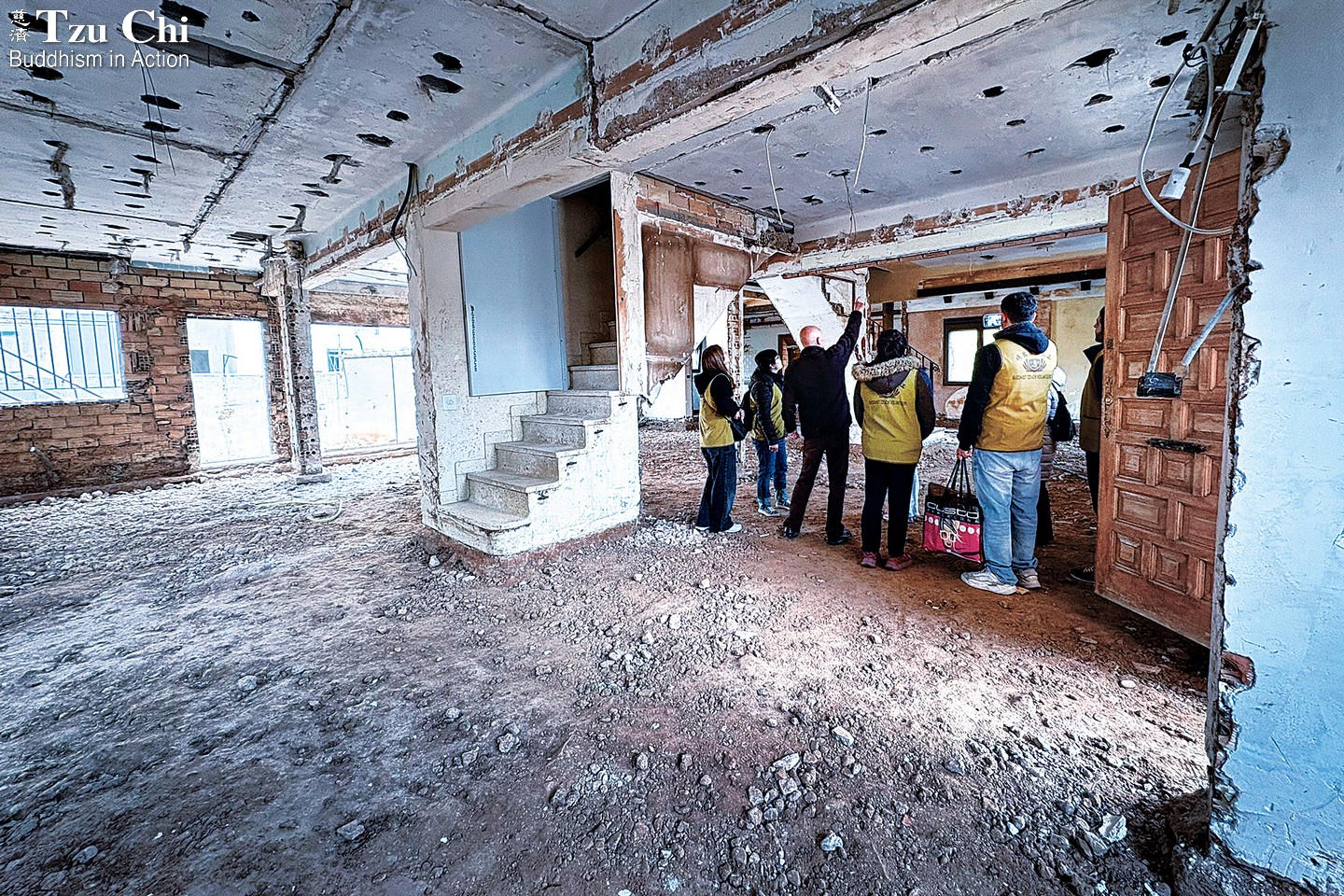
Tzu Chi volunteers visit households listed in disaster registries provided by Caritas and the Utiel municipal government. Many homes in severely flooded areas were badly damaged. Liang Xin-ling
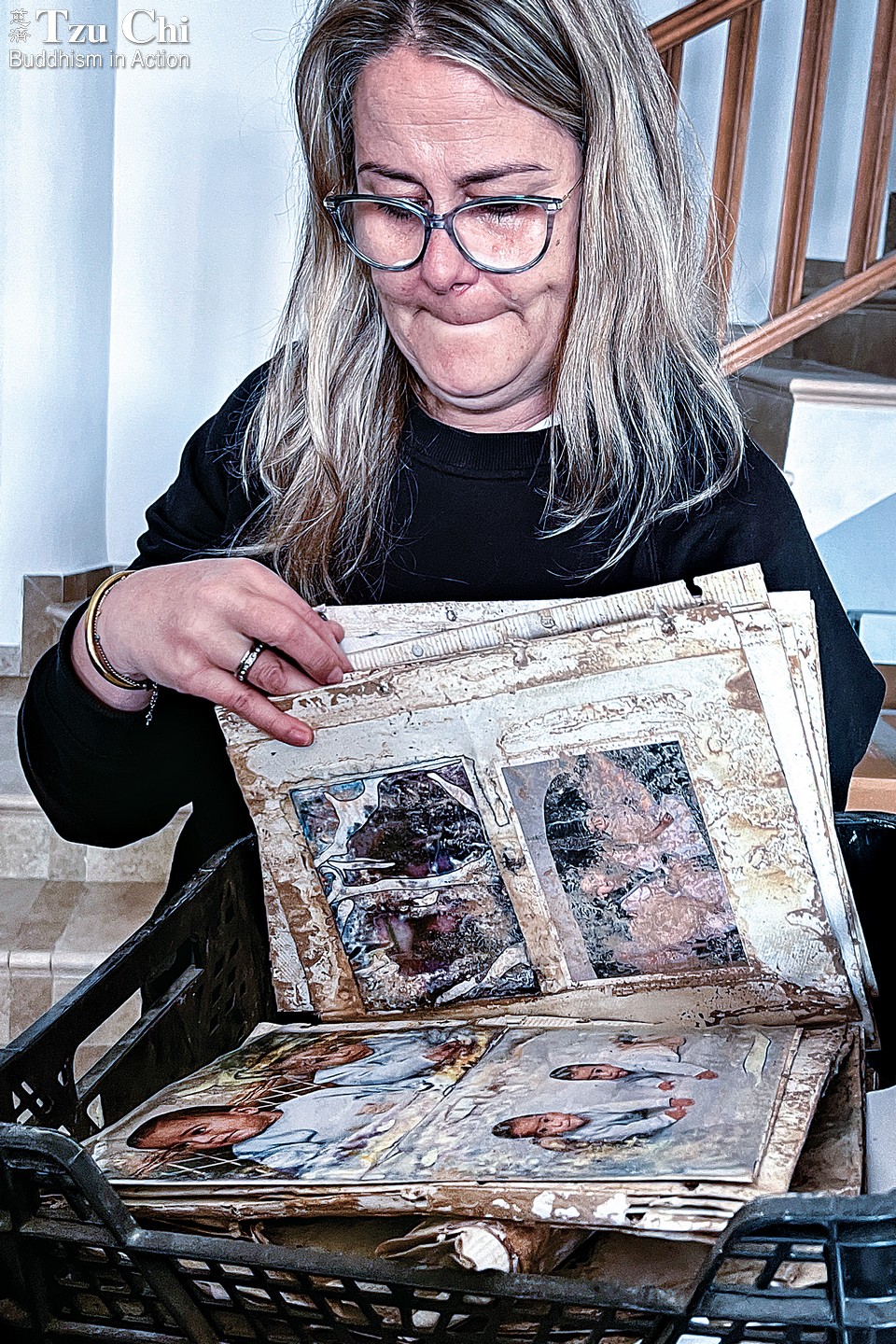
A flood survivor in Utiel flips through a photo album, recalling that her first thought during the flood was to save it. The album holds precious memories—from her mother doing her hair and makeup on her wedding day to the birth and growth of her children—capturing the warmth of her family’s story. Liang Xin-ling
Painting away sorrow
Between January and May, Tzu Chi volunteers from France, the United Kingdom, Germany, and Poland worked in teams to assess flood damage and conduct follow-up inspections. In addition to visiting stricken areas and meeting with personnel from local governments and organizations, they scouted potential venues for aid distributions. In June, they rented a temporary office in Paiporta to coordinate the work.
Paiporta itself had been badly affected. The flood left its streets coated in mud and disrupted electricity, water, and natural gas supplies. Residents living near the temporary office soon learned why the volunteers were there. Many stopped by to greet them and learn more about the foundation. Neighbors often brought vegetables, fruit, and homemade cakes to share. Over time, more locals began visiting regularly and donned volunteer vests to lend a hand.
One of them was Lidia, who was deeply moved to learn that the Tzu Chi volunteers had traveled from across Europe at their own expense. She began coming to the office almost daily to help with errands and call flood survivors. “Seeing so many people suffering and losing everything—it may seem like making phone calls is a small thing, but it’s my way of contributing,” she said. “With so many Tzu Chi volunteers coming from other countries to help us, a voice inside told me I should do my part too.” Since most local residents were unfamiliar with Tzu Chi—a foundation based in distant Taiwan and comprised predominantly of ethnic Chinese—volunteers were often hung up on, mistaken for phone scammers. Thus, help with phone calls from locals like Lidia proved invaluable.
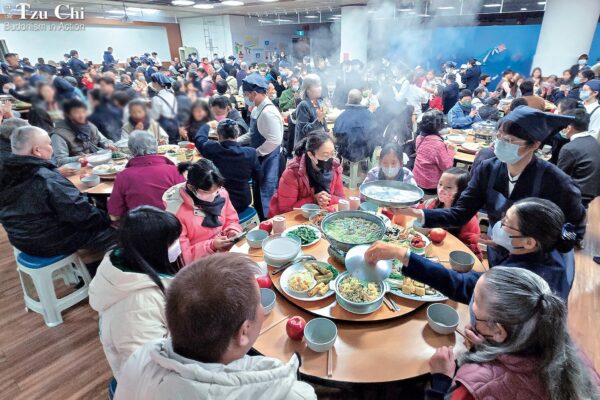
The temporary office also hosted a creative activity called “Fans of Love, Acts of Kindness,” inviting residents to paint paper fans that would later be given out during distributions as tokens of encouragement and connection. It was also hoped that the act of painting would help participants feel calmer and more at peace. A group of older residents came every day—often staying for three hours at a time—and even took fans home to continue painting. They pledged to complete 2,000 fans, saying that forming good affinities through this creative activity was deeply meaningful to them.
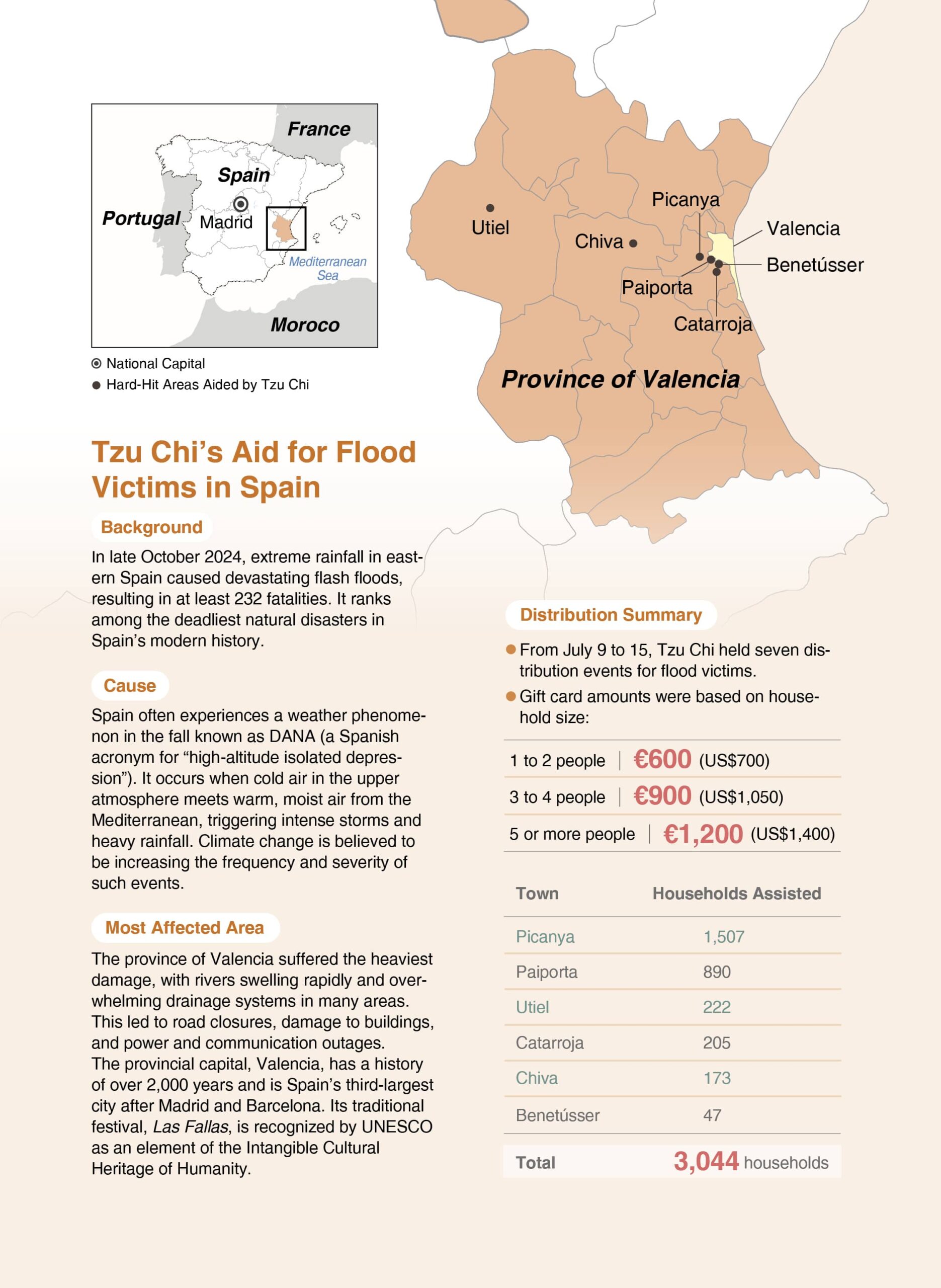
Holding seven distributions across six towns required considerable manpower, underscoring the need to recruit locals who could speak English or Chinese. On June 3, Tzu Chi held its first volunteer recruitment event in Paiporta. The venue was generously provided by Zheng Xiao-ling (鄭小玲), owner of a local Chinese restaurant, who offered her space during off-hours. “Life shouldn’t be just about making a living—we should do our best to help others. That’s what gives life meaning,” she remarked.
Zheng also often prepared lunch for the volunteers, offering a variety of delicious vegetarian dishes. Her kindness brought warmth and comfort to the teams, who had been traveling back and forth to disaster areas for more than half a year, giving them a feeling of home even while far from their own.
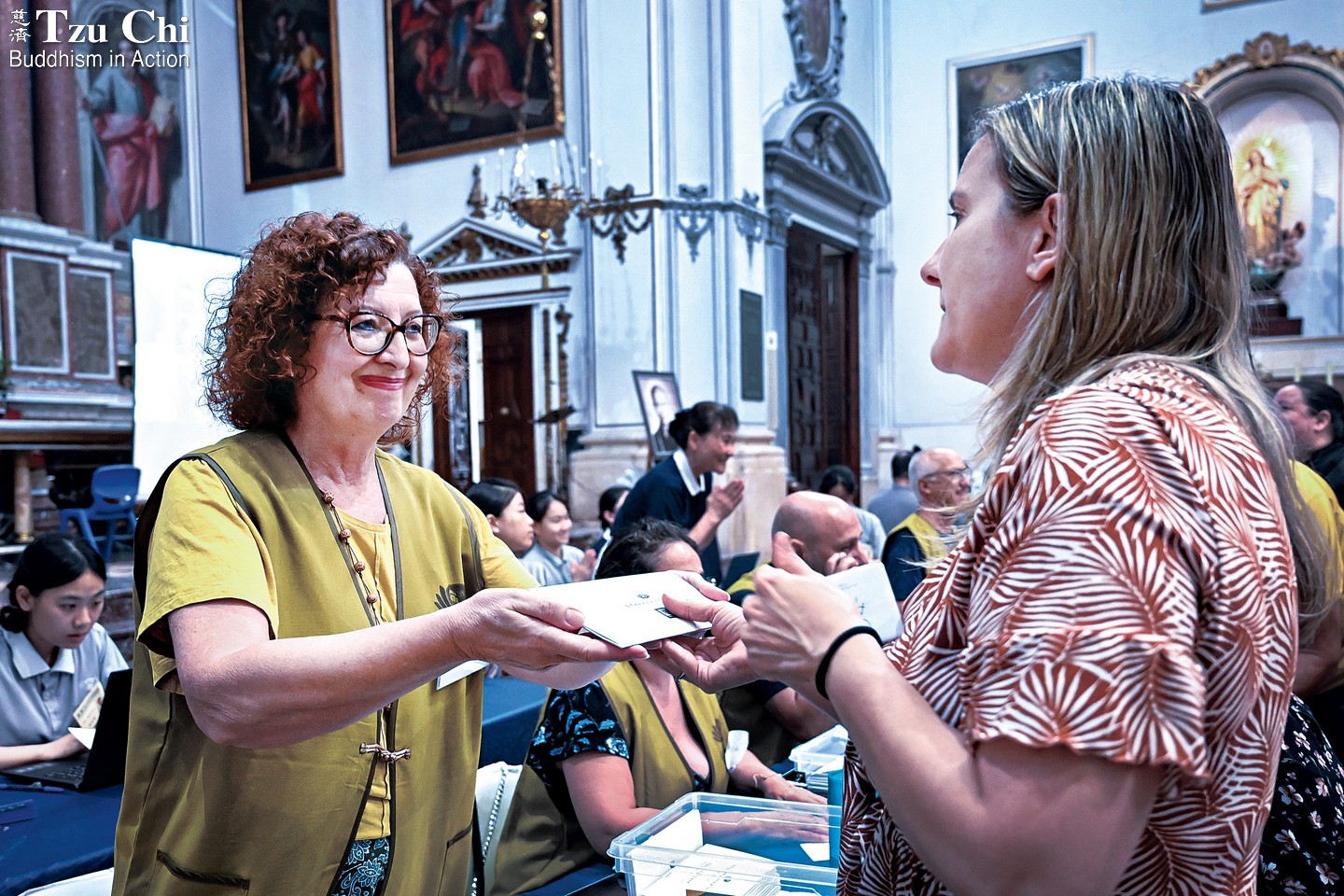
A local Spanish volunteer presents a gift card to a flood-affected resident in a church in Chiva. At Tzu Chi’s July distributions, many locals volunteered to serve their fellow citizens. Wang Su-zhen
Interfaith cooperation
In late June, with help from local residents, Tzu Chi volunteers began delivering notification slips to flood-affected households across the towns where distributions were planned. On July 8, over 50 volunteers from Spain, the United Kingdom, Germany, France, the Netherlands, Poland, Italy, Switzerland, Taiwan, and Argentina gathered in the disaster zone to help with the distributions.
The first event, held on July 9, focused on supporting ethnic Chinese store owners affected by the disaster. The next day, a second distribution took place at a church in Catarroja. To help things run smoothly, Monsa, a local volunteer and psychologist, recorded a video explaining the distribution process and used a piece of cardboard to show where recipients should sign on the forms, making it easier for fellow volunteers to assist efficiently.
Teresa, an architect, had lost all her furniture in the flood. Her parents, both nearing 90, moved in with her after their own home was badly damaged. Teresa said the supermarket gift card from Tzu Chi would cover her parents’ living expenses for three months. She herself had also received assistance from other organizations. All this support would help them on their path to recovery—something for which they were deeply grateful.
After receiving her gift card, an older woman stepped outside the church, saw volunteers handing out small keepsakes in the square, and burst into tears. Even ten months after the disaster, it was clear that many survivors were still carrying deep emotional wounds—grief and trauma they had had to set aside simply to keep going and rebuild their lives.
In Utiel, aid was distributed in the historic Church of Our Lady of the Assumption, a centuries-old building. Father Cristobal solemnly lit six large white candles—symbols of reverence and sanctity—as if it were a Sunday Mass, and offered his blessings for the relief work.
Tim Lu (呂宗翰), representing Tzu Chi’s headquarters in Taiwan, addressed those gathered. He reflected that a Buddhist organization from Taiwan distributing aid in a Catholic church in Spain was a beautiful example of interfaith harmony and a reflection of the spirit of Great Love—a selfless love that embraces all of humanity—that the world truly needed. “We’re sorry we came late,” he said, “but we’ve done our best to be here and help. What we’re most grateful for is the support of so many local Spanish volunteers. Without your help, today’s distribution wouldn’t have been possible.”
Father Cristobal then shared a message inspired by the parable of the Good Samaritan from the Gospel of St. Luke, which teaches the importance of loving one’s neighbor as oneself. He expressed how moved he was by the long journeys many Tzu Chi volunteers had undertaken, and encouraged the local community to follow their example by reaching out to those in need without waiting to be asked.
Chen Yao-ming (陳耀明), a businessman in Spain who had supported the Tzu Chi team from the beginning, described a scene at the close of the distributions: Guided by Tzu Chi volunteers, residents joined hands and signed the lyrics of the Tzu Chi song “One Family” in sign language. The scene, he said, was filled with warmth and a sense of sacred unity. When applause broke out at the end, all the effort expended and every challenge faced during the relief mission felt completely worthwhile.
Spain has no Tzu Chi office, which made carrying out the relief work more challenging—yet the volunteers never complained. Their fatigue vanished when a young mother from Paiporta said, “When the world had forgotten us, Tzu Chi still remembered our pain.”