Compiled by Tzu Chi Monthly editorial staff
Edited and translated by Wu Hsiao-ting
Following Hong Kong’s catastrophic fire, volunteers delivered relief and comfort to residents facing sudden loss, trauma, and displacement.
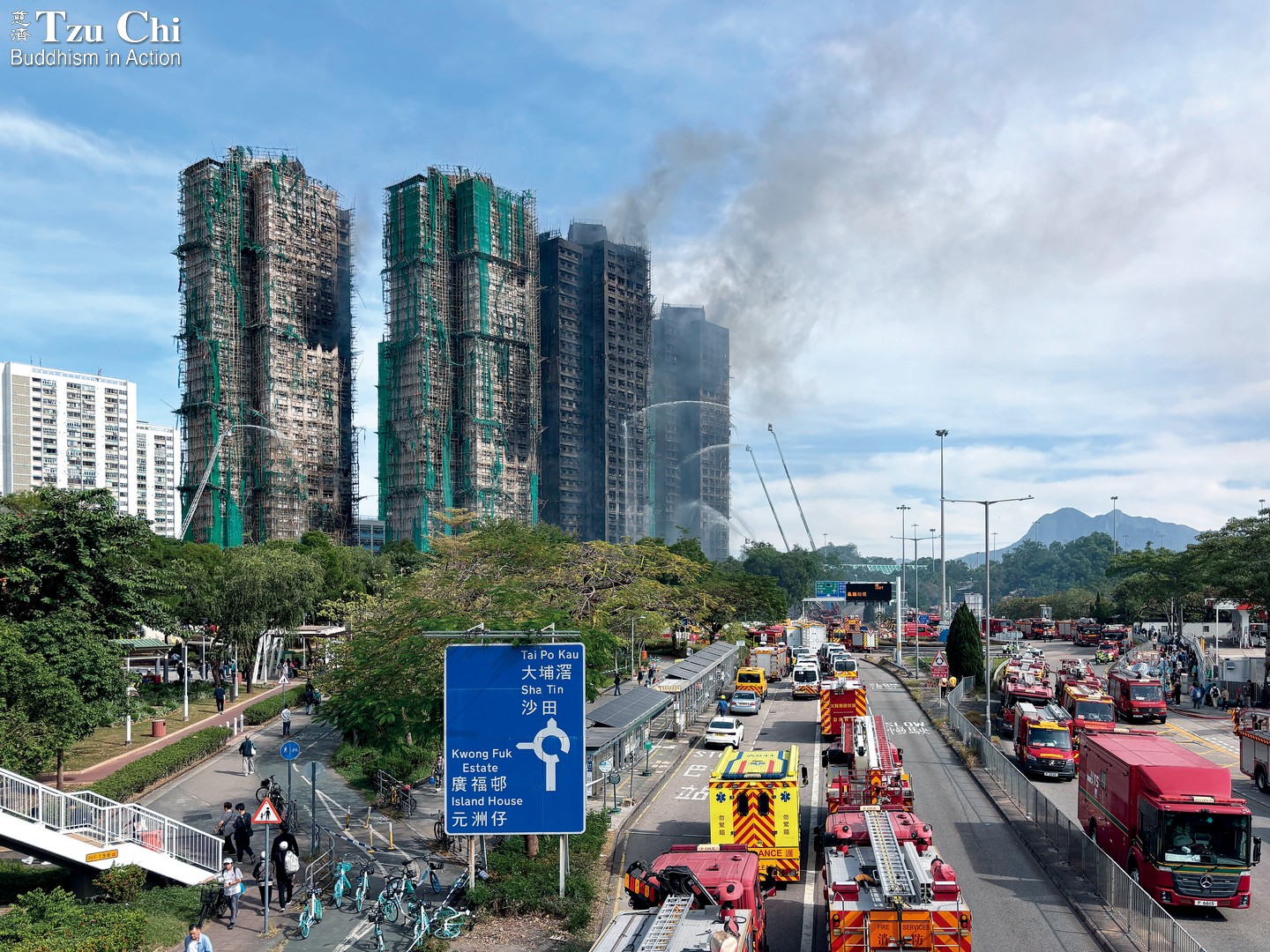
Thick smoke still rises from the scene on the afternoon after the blaze broke out. The fire was fully extinguished after 43 hours, with more than 2,000 firefighter shifts involved. Mu Yan Ying
On the afternoon of November 26, 2025, a fire broke out at one of the high-rise buildings at Wang Fuk Court, a large residential complex in Tai Po, Hong Kong. Flames raced up the scaffolding that had been erected for exterior renovation and, fueled by strong winds, spread to six neighboring buildings. Within three hours, what began as a small blaze had escalated to a Level 5 fire, the highest on Hong Kong’s five-tier alarm scale.
Mr. Yu, a resident, had the doors and windows of his home tightly closed when the fire started and did not hear the alarm. It was only when his wife called that he realized the danger and fled, managing to grab only his mobile phone, identification documents, wallet, and keys. He was born in 1951 and had survived the devastating Tung Tau Estate fire in Kowloon that same year, one of Hong Kong’s major disasters. That conflagration had destroyed thousands of homes and left more than 10,000 people homeless. He never imagined he would again encounter a disastrous fire 74 years later.
At the height of the blaze, Pipi Lau (劉松蓮), a skilled floral arranger, happened to be in Tai Po buying flowers. Though she did not live at Wang Fuk Court, she was deeply anxious: Both of her sons are firefighters. Her younger son was stationed in the district where the fire occurred, and her elder in Kowloon. Though regulations normally prevent two siblings from working in the same district, her son stationed in Kowloon was immediately redeployed to Tai Po to help, underscoring the severity of the disaster. In fact, her elder son had already entered the fire scene. Despite the family’s group chat, he still had not confirmed his safety by the early hours of the following morning.
Cordons restricted access at the scene. Unsure whether they would be allowed inside, Tzu Chi volunteers from nearby districts nevertheless arrived, remaining outside the perimeter, ready to assist in any way they could. Even if they could not enter, they resolved to stay nearby in case residents needed help. This commitment marked the volunteers’ first response and the beginning of an intensive relief effort that would continue over the next two weeks.
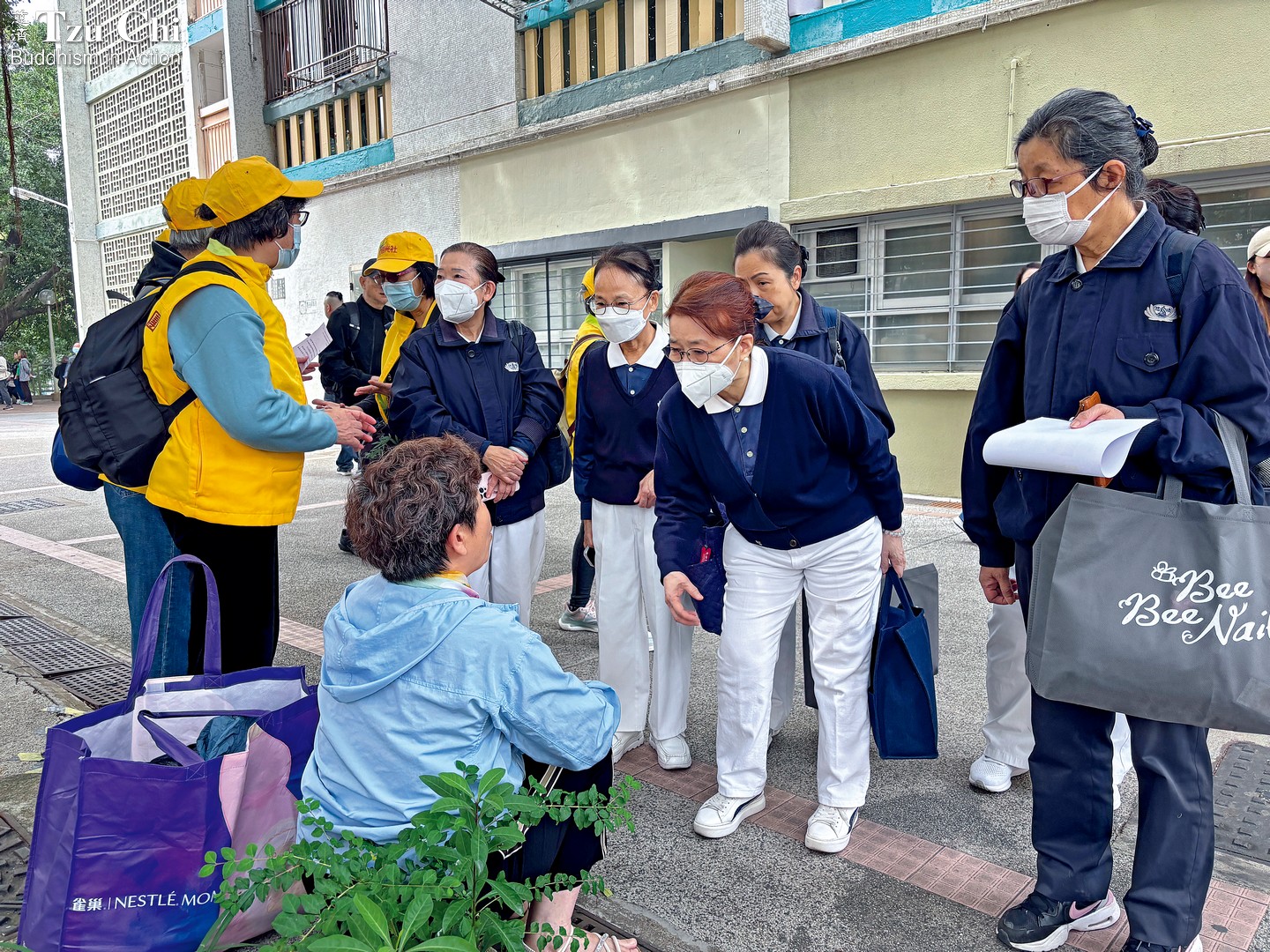
Volunteers return to the perimeter of Wang Fuk Court on the morning of November 27 to offer care and comfort to affected residents. Mu Yan Ying
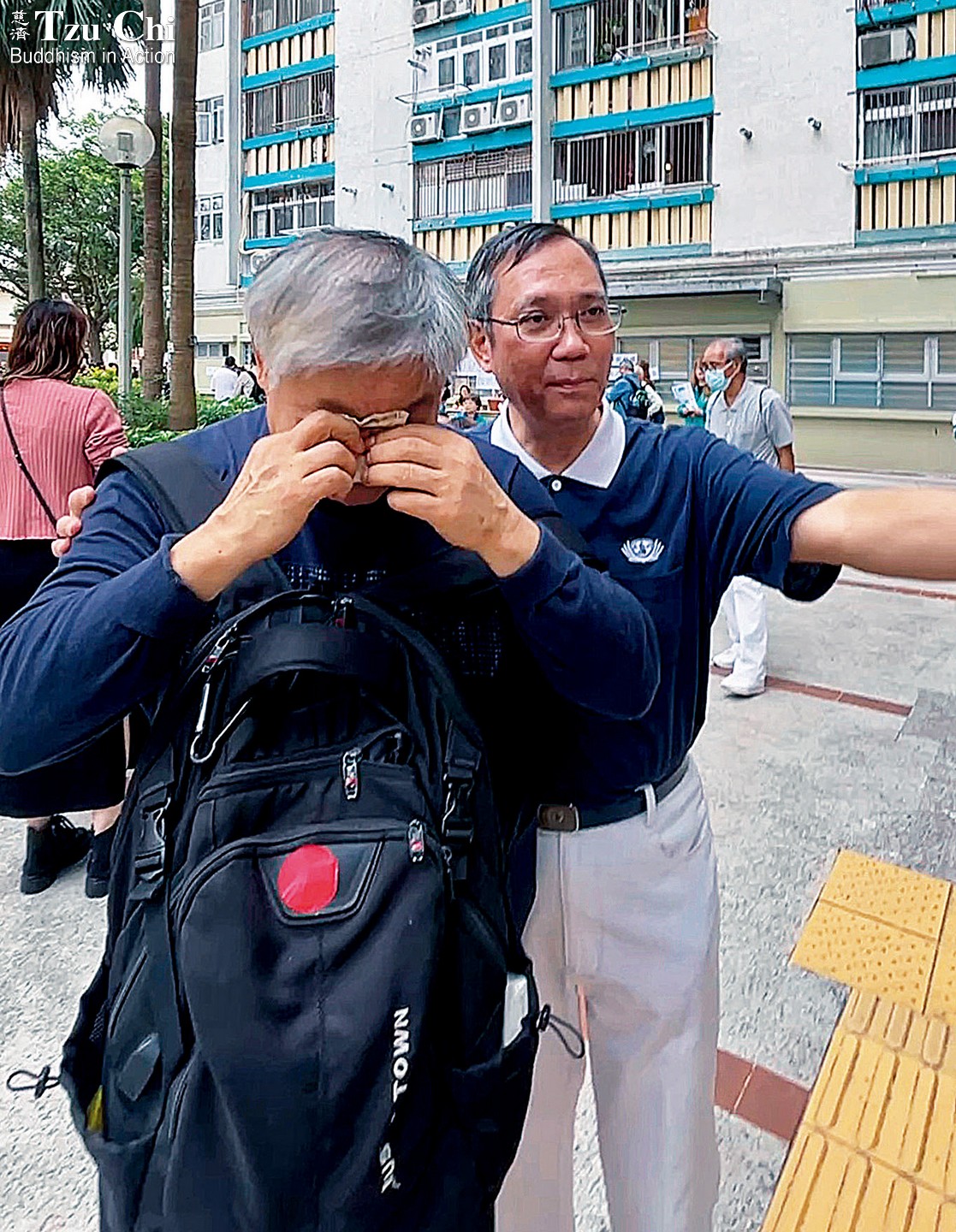
A volunteer stands beside a resident shaken by the fire, placing a reassuring hand on his shoulder. Tzu Chi distributed relief payments after the blaze to not only meet urgent needs but also offer emotional comfort. Yiu Ga Wai
Relief takes shape
Wang Fuk Court, about 42 years old, comprises eight high-rise buildings, with a total of 1,984 units. The estate was undergoing exterior renovation when the fire broke out. Flames erupted on the bamboo scaffolding on one of the buildings. The scaffold’s safety netting failed to resist the fire, and highly flammable Styrofoam used to protect glass doors and windows only fueled the blaze. Shattered glass allowed flames to spread indoors, sweeping through seven of the eight buildings. It took more than 43 hours to extinguish the conflagration. Only one building was spared, thanks to a combination of distance from the fire, wind direction, and the firefighters’ efforts.
The disaster ultimately claimed 161 lives, prompting the Hong Kong government to provide a condolence payment of 200,000 Hong Kong dollars (US$25,700) to each bereaved family. Authorities additionally distributed an immediate emergency fund of 10,000 Hong Kong dollars (US$1,300) to each affected household, followed by living subsidies of 100,000 Hong Kong dollars. To support those left homeless by the blaze, the government also arranged for more than one thousand transitional housing units.
Cherina Sze (施頌鈴), CEO of Tzu Chi Hong Kong, quickly mobilized the volunteer team in response to the disaster. Less than 24 hours later, they decided to distribute relief payments, though for a while they received no response from the authorities. Since they were not permitted to enter shelters, volunteers provided support from outside the perimeter, delivering water and dry food and bringing registration forms for aid.
Senior volunteer Tina Huang (黃錦秀) recalled that volunteers, dressed in Tzu Chi uniforms, greeted and offered care to residents leaving the shelters. As night fell and temperatures dropped, they distributed blankets and scarves. “Listening to their stories, we deeply felt their suffering and the fragility of life,” Huang said. “We are more than willing to listen, to provide hugs, and to do more for them.” Despite their ordeal, many residents expressed gratitude for having survived.
On November 28, when the government began issuing official documentation for those affected by the fire, the team decided not to wait any longer and to use this identification to help register applications for relief payments.
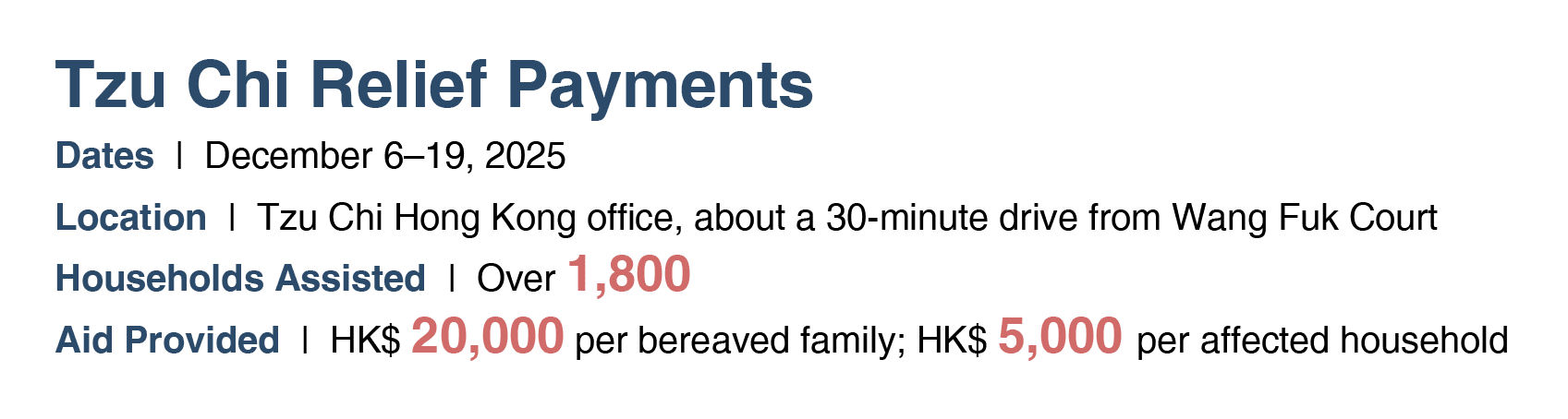
On November 29, volunteers sent out messages announcing that relief payments—20,000 Hong Kong dollars for each bereaved family and 5,000 for each affected household—would be distributed on December 6 and 7 at the Tzu Chi Hong Kong office in Kowloon Tong. Free medical consultations for affected residents and frontline rescue personnel were also started that day at the Tzu Chi Great Love Chinese Medicine Clinic on Nathan Road in Yau Ma Tei; these services continued through December 31.
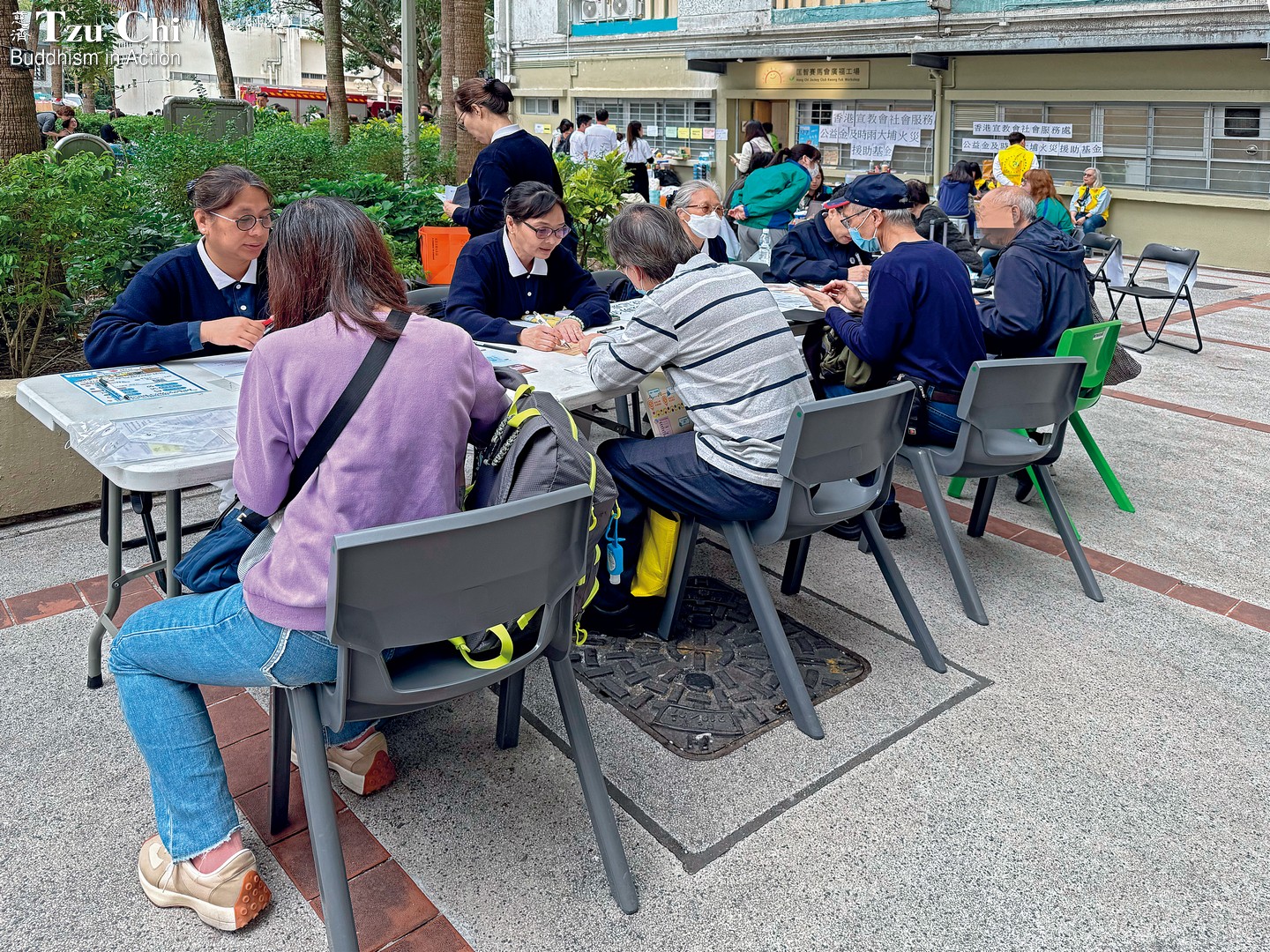
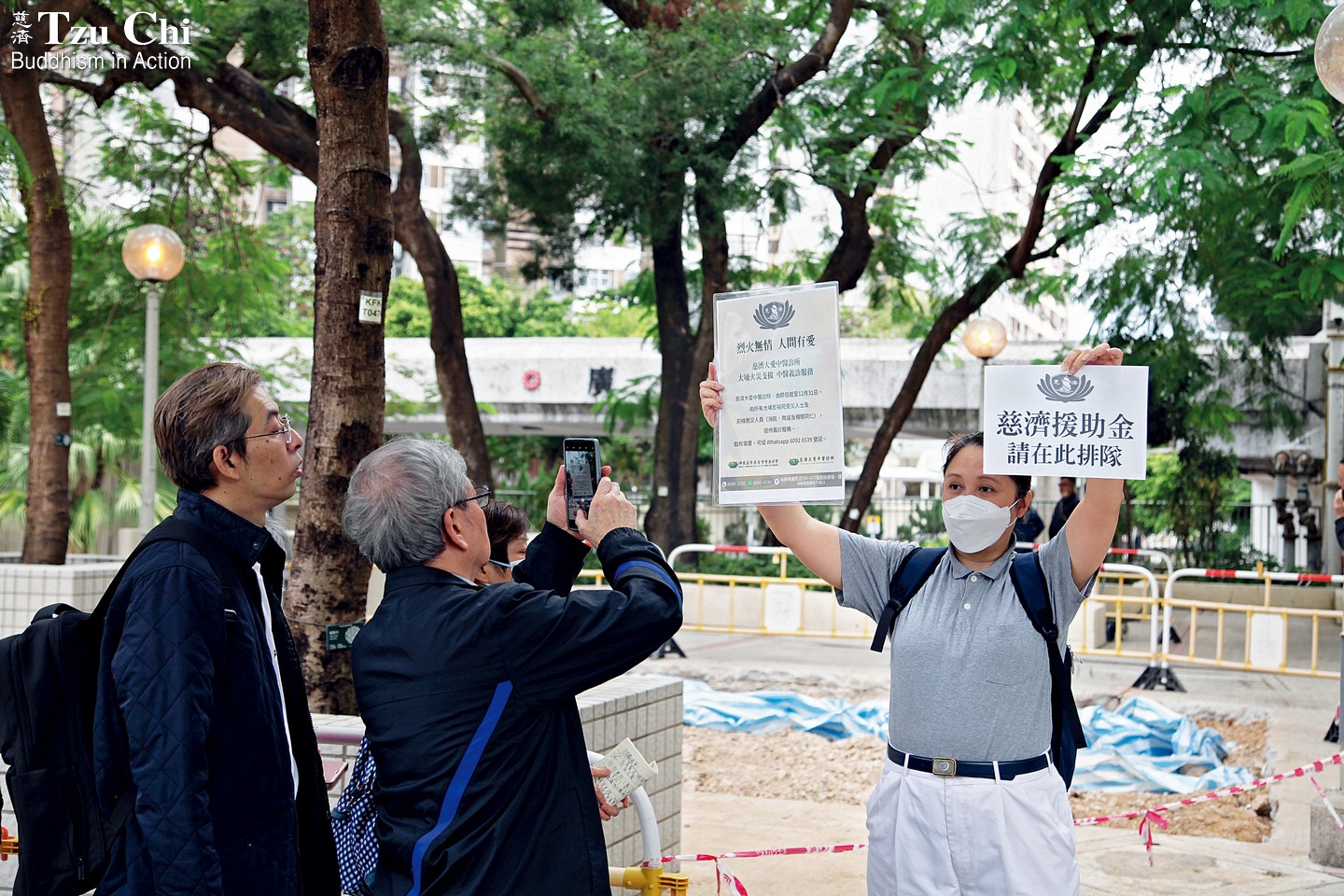
Following the disaster, the government made Fung Leung Kit Memorial Secondary School, near the fire scene, available as a temporary center for evacuation and subsidy applications. Access was restricted to affected residents, so Tzu Chi volunteers stationed themselves under a tree outside, standing as they registered residents for relief payments. One passerby, noticing the volunteers on their feet and moved by their dedication, guided them to a space upstairs and provided two tables for their work. Government care team members also assisted by directing residents to the Tzu Chi registration area to complete their forms.
Huang recalled, “From then on, the number of residents coming to us increased. We gradually expanded from two tables to four, and the registration process ran smoothly.”
Registration took place both indoors and outdoors. Some residents were initially hesitant to provide personal information, but volunteers patiently explained the process and showed their Tzu Chi identification, gradually building trust. Eventually, some residents even notified their neighbors to come forward and register.
Not wanting to miss any calls
“When Tzu Chi’s relief messages were posted to major social media platforms, the phones at our branch office started ringing nonstop within an hour,” said Marjorie Ma (馬子愉), a Tzu Chi Hong Kong staff member and certified volunteer. With volunteers handling registrations on the front lines and the logistics team coordinating behind the scenes, the branch was completely stretched. Recognizing how urgently residents needed help, Ma didn’t want to miss a single call and turned to her mother, also a Tzu Chi volunteer, for help. “She and other senior volunteers quickly stepped in and were at the office providing support within an hour,” Ma said.
Much of the work went unseen by outsiders. Paper records collected at the front lines had to be entered into computers, a task volunteers carried out from morning until midnight for several consecutive days. Once the registration lists were complete, residents were notified to collect aid. However, after the first 70 messages were sent, the system flagged them as potential spam, blocking telecommunications service for 24 hours. With distribution imminent, volunteers anxiously sought a solution, reaching out to a marketing entrepreneur and a communications software expert, who quickly offered assistance. Within a single day, 2,000 messages were successfully sent, with Tzu Chi bearing no cost.
On the first day of distribution, volunteers at the registration desks had expected the work to be straightforward, but the five teams had to take turns to step outside to cry. “The expressions on residents’ faces revealed exhaustion and intense worry,” Leung Hiu Lam (梁曉霖) recalled. “When we asked, ‘Are your family members okay?’ many immediately broke down in tears. Their homes were gone, loved ones lost, pets too. Exposed to their emotions, we couldn’t help but cry too.” Many residents had already been visiting other charities or managing arrangements for deceased family members, leaving them little time to process their grief or attend to their own health. At Tzu Chi, they could finally pause, while doctors from the Tzu Chi International Medical Association provided care and comfort.
One woman rushed in after colliding with a passerby and dropping her phone onto the subway tracks. Worried about being late and missing her chance to receive aid, she first asked a station attendant to help retrieve her phone before coming to Tzu Chi. Volunteers reassured her, saying, “Go get your phone first; don’t lose contact with your family. We’ll wait for you here.”
Over the two days, 1,543 of the 1,700 registered households collected their aid, with additional payments issued the following week, bringing the total number of households assisted to over 1,800. Of the 1,900 households affected by the disaster, Tzu Chi assisted over 90 percent.
Volunteer Yu Ka Zeon (余嘉進), a professional social worker, noted that although the government and social welfare organizations provided assistance, the sheer number of affected residents meant many had to queue repeatedly and complete multiple forms, leaving them physically and emotionally drained. “They have already gone through a lot,” he said. “Can we help ease their burden?” Tzu Chi’s second phase of aid will proactively coordinate with the government’s “one social worker per household” system, working directly with assigned social workers to spare residents repeated trips.
Unable to participate in the distributions in person due to work, Yu Ka Zeon followed updates on social media. Reading residents’ messages about how moved they were by their visit to Tzu Chi, he couldn’t hold back his tears, deeply grateful to the volunteers who delivered love and care straight to residents’ hearts.
Challenges for survivors
Volunteer Pipi Lau, whose two sons are firefighters, was on duty outside the fire scene on that first long, harrowing night. “The acrid smoke and towering flames were shocking,” she recalled. “I was deeply worried about my sons. But I couldn’t cry—I had to take responsibility and do what a Tzu Chi volunteer should do.”
Seeing the fire rage even more fiercely on the way home weighed heavily on her heart. “I couldn’t sleep that night,” she said. “The next morning, I urged my younger son to be careful, as he, too, had entered the fire scene for rescue work.” She found solace in volunteering, as staying busy with Tzu Chi helped her cope. She also tried to transform her worry for her loved ones into blessings.
Her elder son returned home a few days later. “He rarely talks about work because he doesn’t want me to worry,” she said. “After the fire started, he entered the fire scene three times. Though he was doing his duty, I still think he was incredibly brave. He told me that our encouragement was the greatest support we could give him.”
Mr. Yu, the elderly resident introduced at the beginning of this article, later visited the Tzu Chi Hong Kong office to collect his relief payment. He told volunteers, “Surviving this fire feels like a miracle. I’m very lucky, but I also feel sad for those who lost their lives.”
This relief effort marked the largest disaster operation in Tzu Chi Hong Kong’s 32-year history. CEO Cherina Sze hoped the cash payments could help survivors manage the immediate aftermath, while acknowledging that material aid alone cannot heal the emotional wounds left by such a tragic event. “Recovery from psychological trauma is a long journey,” she said. “We hope to be there with them, supporting them as they heal.”